The roots of zⁿ = 1 are given in exponential form.
Since 2018
8 question parts, 26 marks
Notes, worked examples and practice for this topic are being written by our tutors. The past-paper questions below are ready now: work each one on paper, then open the mark scheme and the examiner's comment.
Tap a question to zoom it. Mark scheme and examiner's comment open under each question.
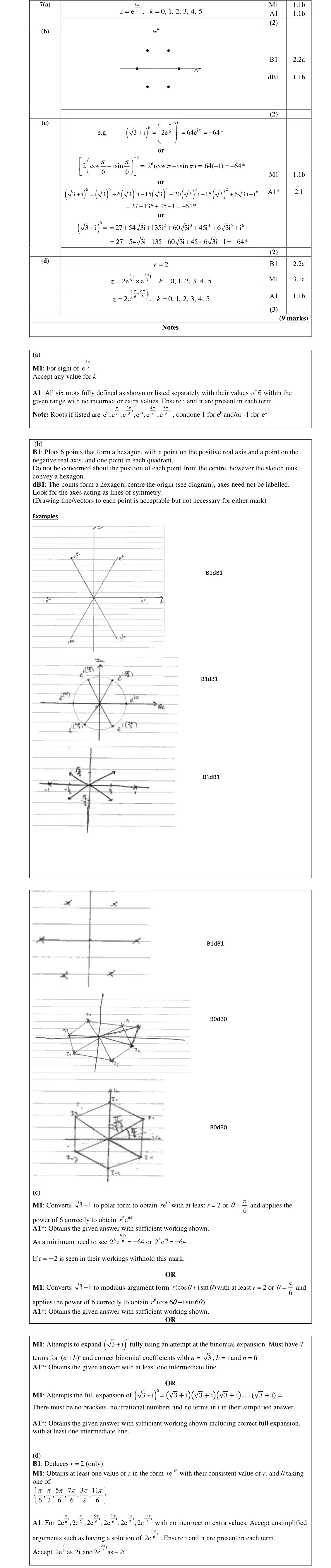
June 2024 · Paper 2 (Core Pure 2) · Q7(a)2 marks
Mark scheme (whole question; this part is marked with the orange bar)
Examiner's comment
(a) This was generally answered. Care should be taken to read the given domain as several candidates were using intervals such as (-𝜋, 𝜋] or even (0, 2𝜋) with 𝑒2𝜋𝑖 being the most common incorrect answer. Some candidates missed i out of their solutions and some had the denominator as 6. Almost all candidates listed each of solutions rather than using k notation which was completely acceptable.
Key points from the mark scheme and examiner's report
z = e^(kπi/3), k = 0 to 5, within 0 ≤ θ < 2π (e^(2πi) is outside)
missing i or using π/6
June 2024 · Paper 2 (Core Pure 2) · Q7(b)2 marks
Mark scheme (whole question; this part is marked with the orange bar)
Examiner's comment
(b) Most candidates realised the six points form a hexagon of some description. However, there was a lack of care in the drawing of a regular hexagon with two vertices needed to be correctly plotted on the coordinate axis. There was often a lack of symmetry in the diagram.
Key points from the mark scheme and examiner's report
regular hexagon centred at O with vertices on the positive and negative real axis and one in each quadrant
symmetry needed
June 2024 · Paper 2 (Core Pure 2) · Q7(d)3 marks
Mark scheme (whole question; this part is marked with the orange bar)
Examiner's comment
(d) Most candidates either were successful and scored full marks or did not know where to start. Many achieved the first two marks in this part for 2 r = and one correct answer: usually . Errors here were generally from an incorrect angle; using was often seen. A common error was missing i on at least one of their solutions.
Key points from the mark scheme and examiner's report
r = 2 and z = 2e^(iπ/6) × e^(kπi/3): arguments π/6, π/2, 5π/6, 7π/6, 3π/2, 11π/6
wrong starting angle or missing i
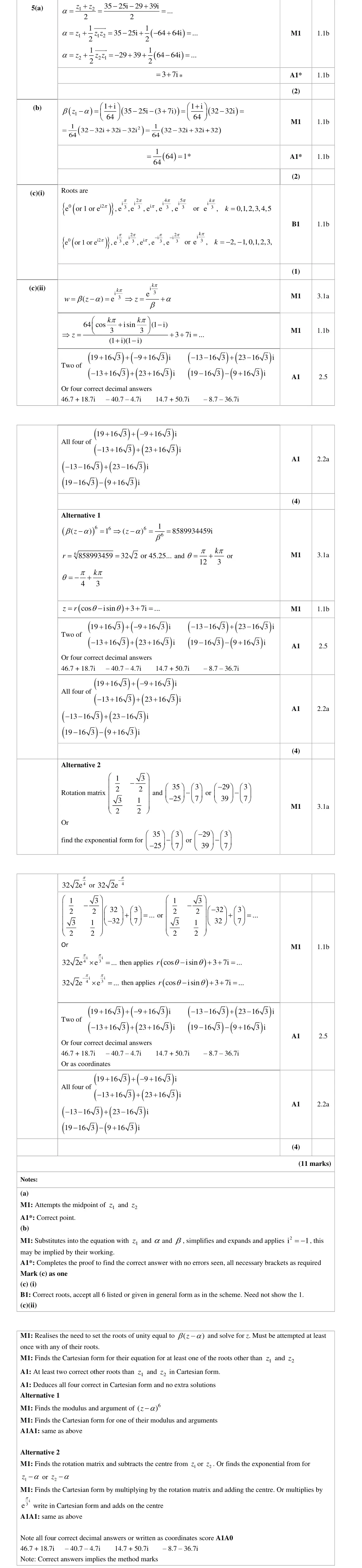
June 2023 · Paper 2 (Core Pure 2) · Q5(c)(i)1 mark
Mark scheme (whole question; this part is marked with the orange bar)
Examiner's comment
(c) This was poorly answered. Many tried complex methods and many missed the i off in the power. Some thought there were radians in a full turn, giving answers over 6 instead of 3. Many candidates failed to spot the relationship between the previous parts in part (ii); some tried alternative methods but few of these were successful. (c)(i) required a listing of the sixth roots of unity. This part was answered correctly by many students. However, often some roots were omitted, or the spacing of the arguments of the roots was 𝜋 6 instead of 𝜋 3. A few candidates tried to write as function 3 e n but many did not define n.
Key points from the mark scheme and examiner's report
w = e^(kπi/3) for k = 0 to 5
spacing of π/6 instead of π/3 and missing i were common
June 2023 · Paper 2 (Core Pure 2) · Q5(c)(ii)4 marks
Mark scheme (whole question; this part is marked with the orange bar)
Examiner's comment
(c)(ii) The final part of the question proved challenging with only the most able students being able to attempt this question. Very few were able to gain full marks. They did not realise that they need to set the roots of unity equal to 𝛽(𝑧-𝛼) and solve for z. Those who did make headway in this part sometimes did not gain full credit either because they resorted to decimals or because they did not give their answer in the requested Cartesian form. If a candidate attempted the problem, they were able to achieve the required roots in the correct form; some omitted i within some solutions, missing the B1 mark. For the remainder of the problem candidates made attempts to rotate their roots understanding the need to equate their roots to 𝛽(𝑧-𝛼) or some similar form. Using transformation, if candidates successfully transformed the centre to the origin, they often were able to arrive at the desired solutions. However, many candidates failed to move the centre to the origin, unable to note the requirement of being centred about the origin before applying their methods. If candidates were unable to identify the required method, the initial M1 mark was earned by some respondents in the alternative mark scheme for this problem, determining the modulus and argument. A lot of candidates struggled to start (c)(ii), or if they did attempt it, they failed to gain marks as they did not deal with the transformation by (3+7i) in their method. There was a lot of processing required here unless candidates used their calculators effectively.
Key points from the mark scheme and examiner's report
Mark scheme (whole question; this part is marked with the orange bar)
Examiner's comment
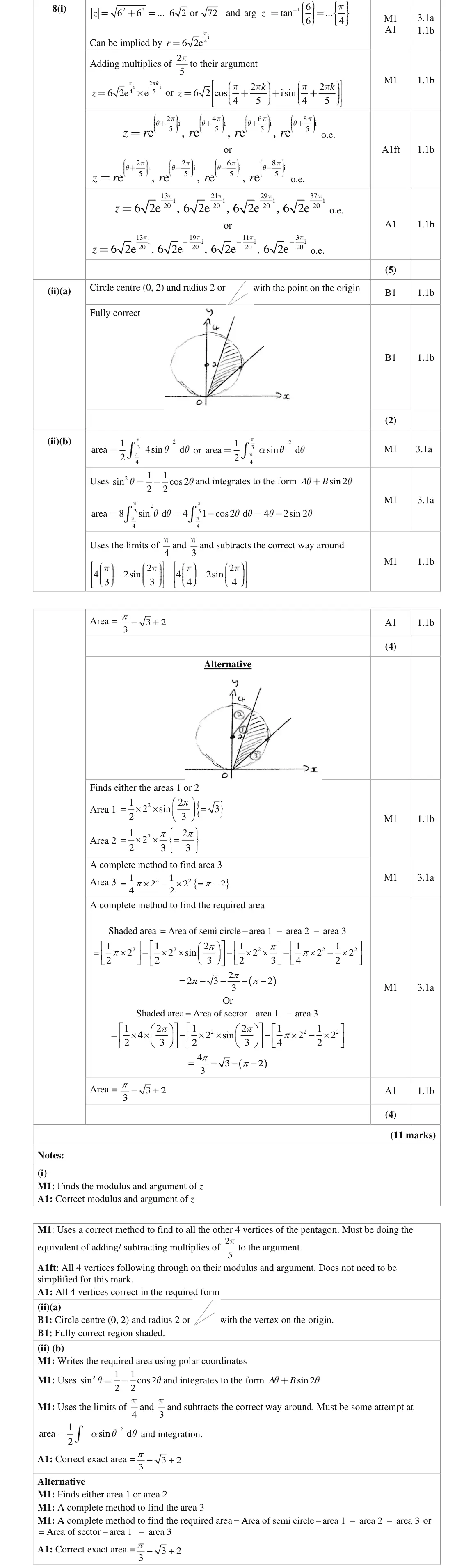
Part (i) Most candidates were able to correctly find the modulus and argument of 6 + 6i and a majority also realised that the angle at the center of a regular pentagon is 2 . They then either added or subtracted multiples 5 of 2 to their original argument to obtain the required arguments. Having 5 done this successfully a few candidates failed to give their final answer in the correct format. (ii) Part (a) Quite well done on the whole. Candidates recognised that a circle with centre on the y axis and passes through the origin but some candidates failed to indicate that the radius of the circle was 2. Candidates are reminded to indicate key coordinates on graphs. (ii) Part (b) This was well done by the majority of candidates by expressing the circle as a polar equation and finding the required area 4sin r between and . 4 3
Key points from the mark scheme and examiner's report
Mark scheme (whole question; this part is marked with the orange bar)
Examiner's comment
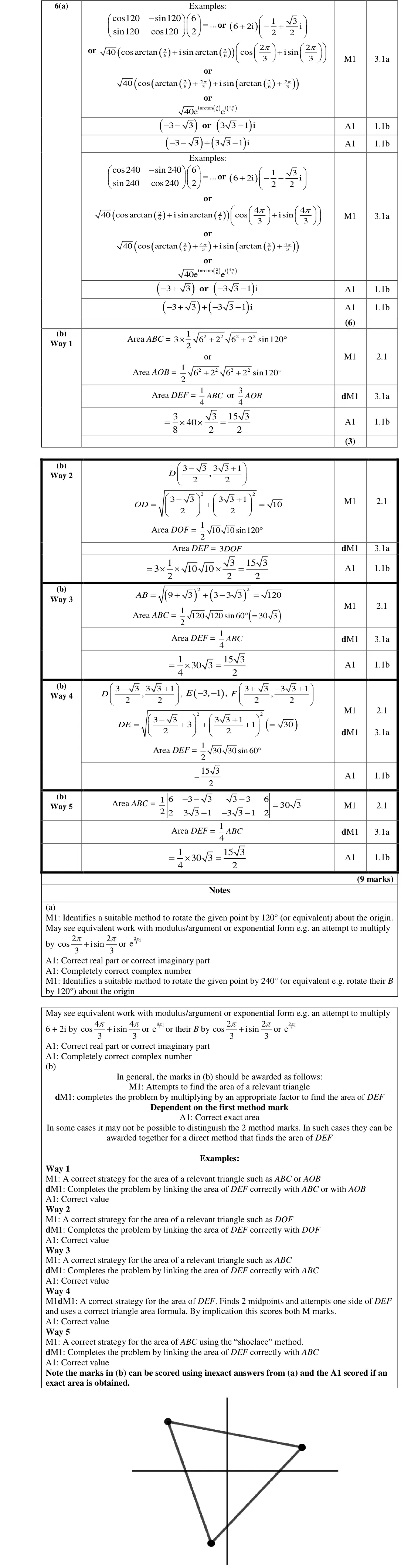
Part (b) was often not attempted by candidates who were unable to progress in (a) although full marks were still possible if the area of triangle AOB was found and this was a reliable route. A wide range of methods were seen, although those using the coordinates of B and C often fell foul of errors handling the surds. Some candidates got into difficulty with approaches that used 1 1 2 x base x perpendicular height rather than 2 ab sin C.
Key points from the mark scheme and examiner's report
multiply 6 + 2i by the cube roots of unity e^(±2πi/3)
B = (−3 − √3) + (3√3 − 1)i, C = (−3 + √3) + (−3√3 − 1)i
using ω = ½ ± (√3/2)i
decimals instead of exact values
June 2019 · Paper 2 (Core Pure 2) · Q6(b)3 marks
Mark scheme (whole question; this part is marked with the orange bar)
Examiner's comment
Part (b) was often not attempted by candidates who were unable to progress in (a) although full marks were still possible if the area of triangle AOB was found and this was a reliable route. A wide range of methods were seen, although those using the coordinates of B and C often fell foul of errors handling the surds. Some candidates got into difficulty with approaches that used 1 1 2 x base x perpendicular height rather than 2 ab sin C.
Key points from the mark scheme and examiner's report
area ABC = 3 × ½ × 40 sin 120° = 30√3
DEF is a quarter of ABC: 15√3/2
area of AOB route works without (a)
Find an Edexcel Further Maths tutor
Stuck on this? Book a trial lesson with our Further Maths tutor.