Examiner's comment
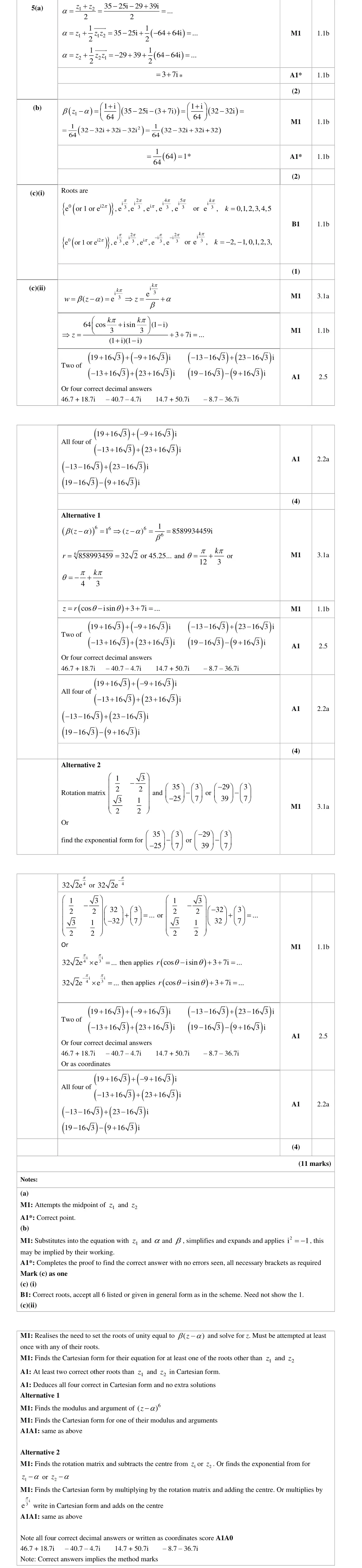
(c)(ii) The final part of the question proved challenging with only the most able students being able to attempt this question. Very few were able to gain full marks. They did not realise that they need to set the roots of unity equal to 𝛽(𝑧-𝛼) and solve for z. Those who did make headway in this part sometimes did not gain full credit either because they resorted to decimals or because they did not give their answer in the requested Cartesian form. If a candidate attempted the problem, they were able to achieve the required roots in the correct form; some omitted i within some solutions, missing the B1 mark. For the remainder of the problem candidates made attempts to rotate their roots understanding the need to equate their roots to 𝛽(𝑧-𝛼) or some similar form. Using transformation, if candidates successfully transformed the centre to the origin, they often were able to arrive at the desired solutions. However, many candidates failed to move the centre to the origin, unable to note the requirement of being centred about the origin before applying their methods. If candidates were unable to identify the required method, the initial M1 mark was earned by some respondents in the alternative mark scheme for this problem, determining the modulus and argument. A lot of candidates struggled to start (c)(ii), or if they did attempt it, they failed to gain marks as they did not deal with the transformation by (3+7i) in their method. There was a lot of processing required here unless candidates used their calculators effectively.