11 question parts, 40 marks, 1 with a difficulty rating from the examiner's report
Notes, worked examples and practice for this topic are being written by our tutors. The past-paper questions below are ready now: work each one on paper, then open the mark scheme and the examiner's comment.
Tap a question to zoom it. Mark scheme and examiner's comment open under each question.
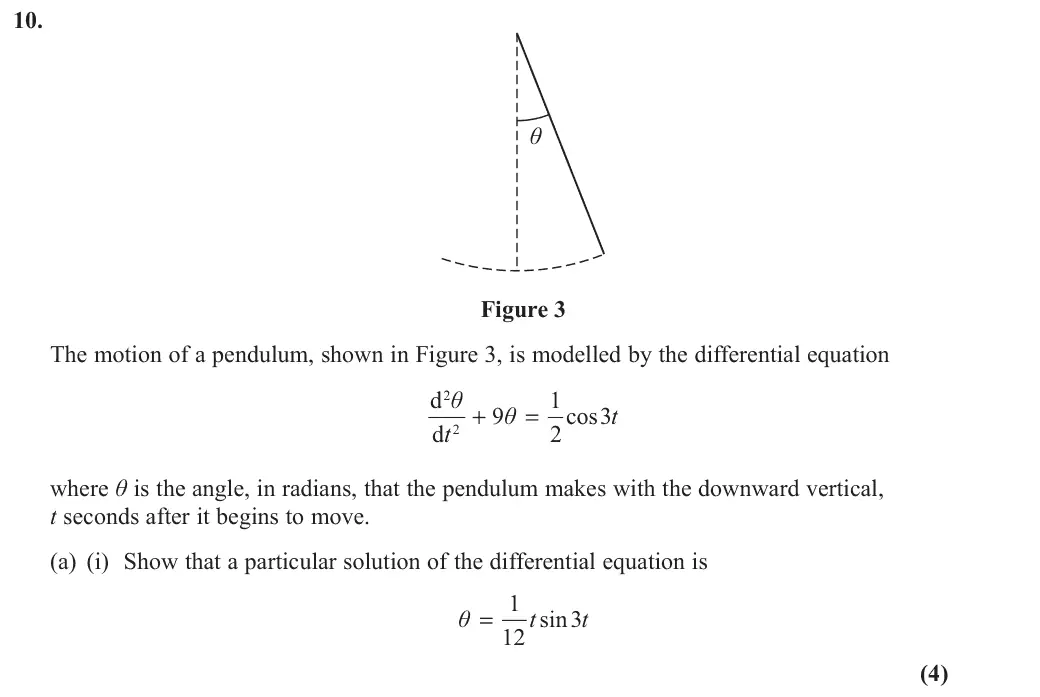
June 2022 · Paper 1 (Core Pure 1) · Q10(a)(i)4 marks
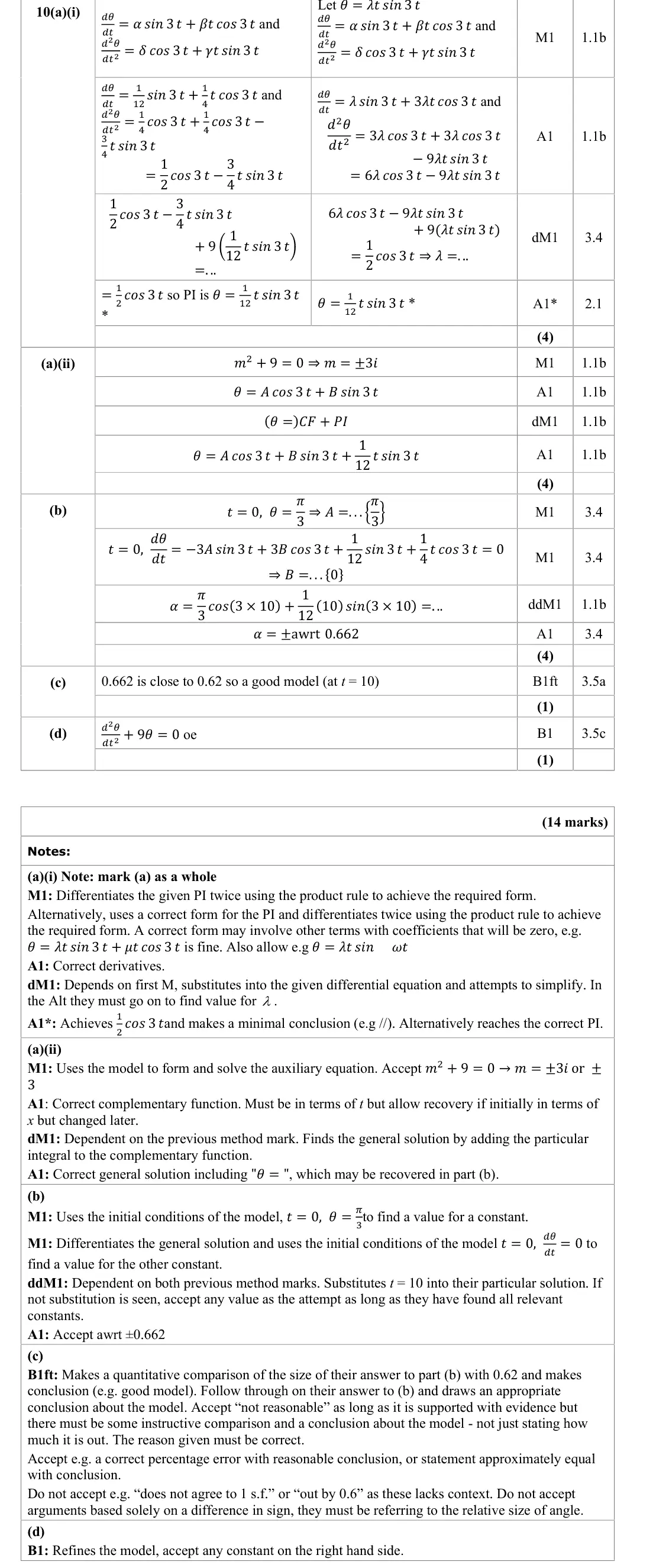
Mark scheme (whole question; this part is marked with the orange bar)
Examiner's comment
Part (a) did not work quite as expected, with many candidates not realising that to show a function is a particular solution requires only to show it satisfies the differential equation, and instead setting out to find the complementary function first, so the form of the particular integral could be decided. Even among those who realise the complementary function was not needed, many used a general form and found values for constants, rather than using the specific function given, making the differentiation harder as often a cosine term was included as well. Fortunately, this did not seem to affect their overall marks for part (a), but it did result in many inefficient methods being seen when attempting the particular integral. No more than 30% of candidates used the most efficient method of starting with the given particular integral, differentiating twice and substituting into the given differential equation. This proved very straight forward to do, although a notable number then omitted any kind of conclusion and gained only 3 of the 4 marks available. Many candidates used the laborious = + method of using the form for their particular integral. sin3 cos3 t t t t Most students were able to construct the general solution successfully for part (ii), though many repeated work finding the auxiliary equation and hence complementary function having already found it in part (i) beforehand to decide on a form for the particular integral. The most common auxiliary equation was the correct equation of m^2 + 9 = 0, however m^2 +9m = 0 was also commonly seen. The question was generally answered well here although theta =… was sometimes missed or the letter x used instead of t. Those who successfully navigated part (a) usually went on to do well in part (b).Candidates who had the correct form for their General Solution found it easy enough to find their A with mixed results for B. Those who recognised how to differentiate successfully here, were usually able to find B = 0, though some guessed this or obtained in fortuitously. Assuming an answer was reached with the qualifying methods gained, candidates were then able to find an estimate for the angle at t =10 seconds, and many correct answers were seen, although 0.66 was sometimes given, losing accuracy. Assessing the model in part (c) was done with varying degrees of success. Those offering a
Key points from the mark scheme and examiner's report
differentiate the given PI twice (product rule) and substitute to get ½cos 3t
finding the CF or a general PI form first is unnecessary
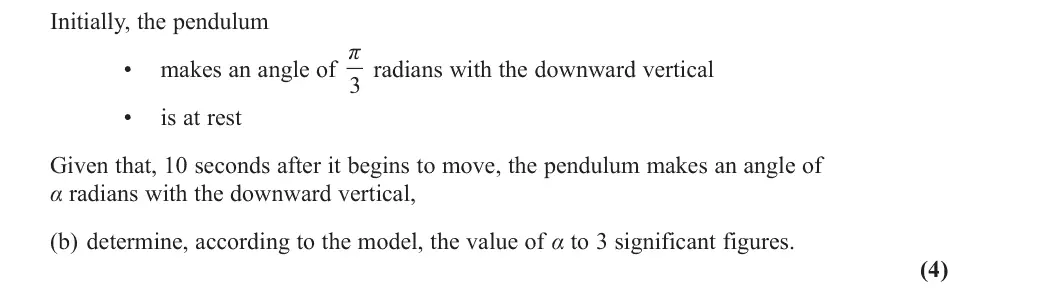
June 2022 · Paper 1 (Core Pure 1) · Q10(b)4 marks
Mark scheme (whole question; this part is marked with the orange bar)
Examiner's comment
Those who successfully navigated part (a) usually went on to do well in part (b).Candidates who had the correct form for their General Solution found it easy enough to find their A with mixed results for B. Those who recognised how to differentiate successfully here, were usually able to find B = 0, though some guessed this or obtained in fortuitously. Assuming an answer was reached with the qualifying methods gained, candidates were then able to find an estimate for the angle at t =10 seconds, and many correct answers were seen, although 0.66 was sometimes given, losing accuracy. Assessing the model in part (c) was done with varying degrees of success. Those offering a difference in signs between their answer to part (b) and the given value caused some confusion with a significant number of candidates thinking that the model was not good because it was predicting that the pendulum was on the other side of the vertical. Those who suggested it was a good model were more likely to get the mark here but many failed to back this up with a quantitative comparison of their answer and the given 0.62. A fair number of candidates did give the correct response to part (d), but there was a, perhaps
Key points from the mark scheme and examiner's report
θ = π/3 at t = 0 gives A = π/3
dθ/dt = 0 gives B = 0 (product rule)
α = (π/3)cos 30 + (10/12)sin 30 = awrt 0.662
June 2022 · Paper 1 (Core Pure 1) · Q10(c)1 mark
Mark scheme (whole question; this part is marked with the orange bar)
Examiner's comment
Assessing the model in part (c) was done with varying degrees of success. Those offering a percentage error and a conclusion were most successful in obtaining the B1 mark. The difference in signs between their answer to part (b) and the given value caused some
Key points from the mark scheme and examiner's report
0.662 is close to 0.62 (quantitative comparison, e.g. percentage error) so a good model
arguments based on sign alone not accepted
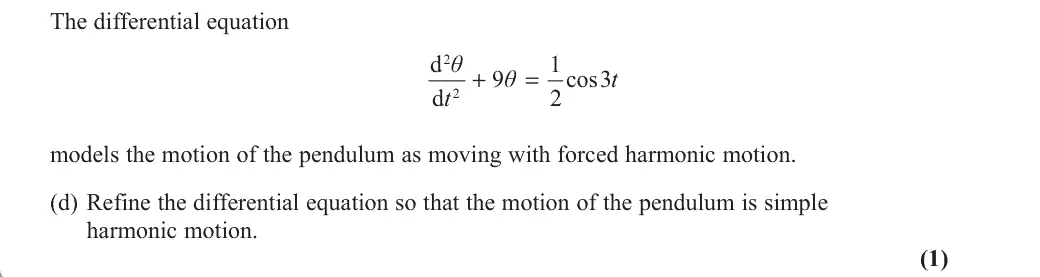
June 2022 · Paper 1 (Core Pure 1) · Q10(d)1 mark
Mark scheme (whole question; this part is marked with the orange bar)
Examiner's comment
A fair number of candidates did give the correct response to part (d), but there was a, perhaps surprisingly, also a large proportion that did not. Many did not attempt it at all or were simply unclear about the correct answer, despite simple harmonic motion begin expected on the specification. Occasionally incorrect variables were seen, perhaps as they were recalling the correct form from a text book.
Key points from the mark scheme and examiner's report
remove the forcing term: d²θ/dt² + 9θ = 0
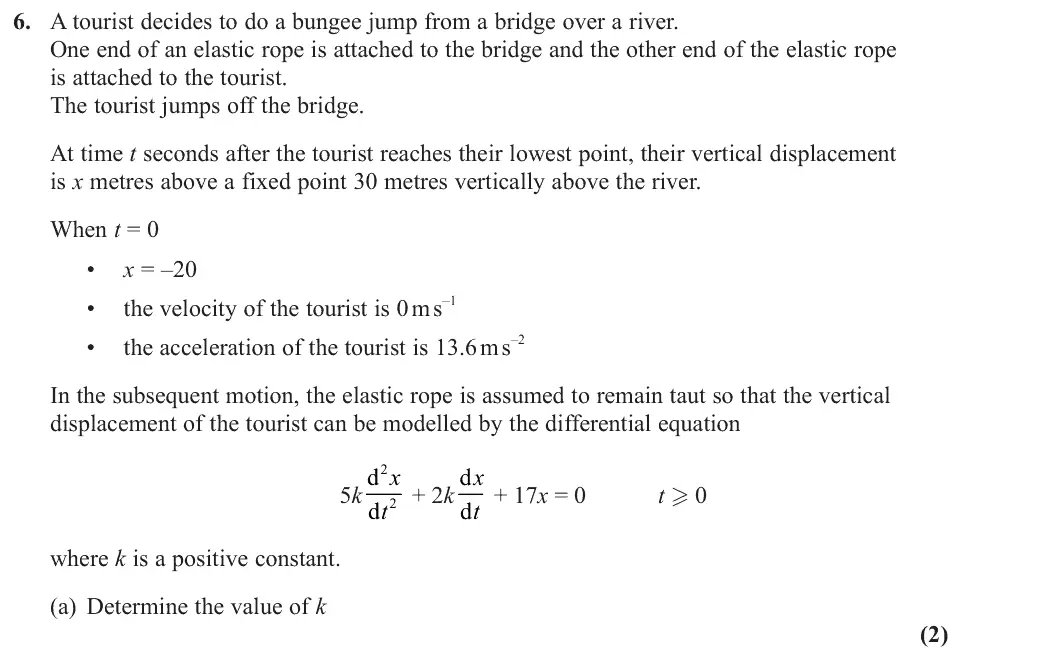
Nov 2021 · Paper 1 (Core Pure 1) · Q6(a)2 marks
Mark scheme (whole question; this part is marked with the orange bar)
Examiner's comment
This question worked well in providing a structure with ramping with success in the first part being over 60%, tailing off gradually through the question with over 50% accessing the first half of (b), but only 20% successfully completing it, just over 20% accessing the M in (c), with 10% successful, and about 15% (a) Most substituted to find a correct value for k. Very few attempted it but found an incorrect value.
Key points from the mark scheme and examiner's report
substitute x = −20, dx/dt = 0, d²x/dt² = 13.6: k = 5
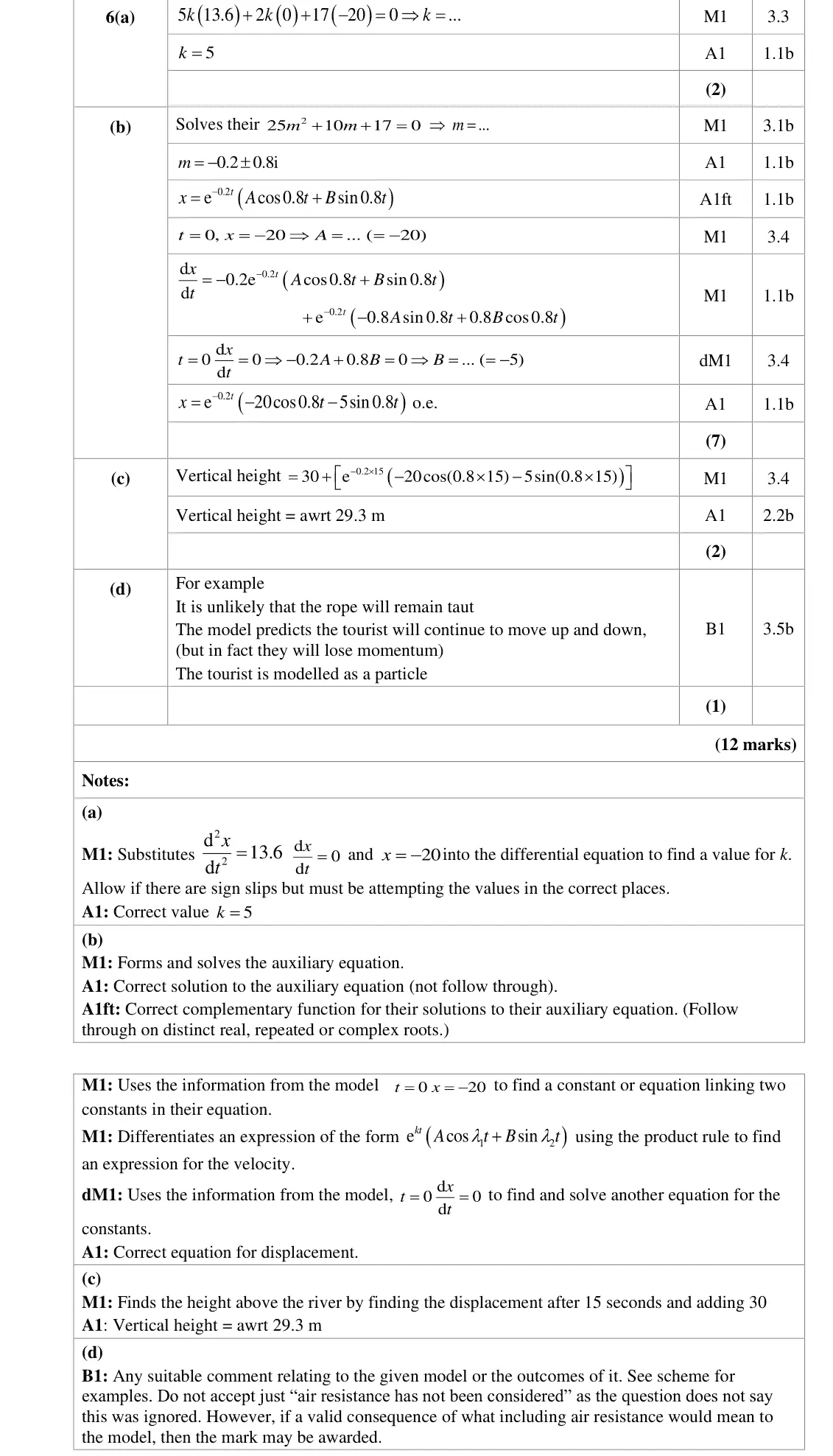
Nov 2021 · Paper 1 (Core Pure 1) · Q6(b)7 marks
Mark scheme (whole question; this part is marked with the orange bar)
Examiner's comment
This question worked well in providing a structure with ramping with success in (b) This part was generally well approached by the majority with the first 4 marks accessed by most. The correct form for their complementary function was given by nearly all who attempted the solution, and they were able to substitute the correct values for t and x to find a constant. A few stopped at this point but most who made progress then used the product rule to find an expression for the velocity, and the only common error was in evaluating their second constant.
Key points from the mark scheme and examiner's report
25m² + 10m + 17 = 0, m = −0.2 ± 0.8i
A = −20 from x = −20
product rule with dx/dt = 0 gives B = −5
x = e^(−0.2t)(−20cos 0.8t − 5sin 0.8t)
Nov 2021 · Paper 1 (Core Pure 1) · Q6(c)2 marksMedium
Mark scheme (whole question; this part is marked with the orange bar)
Examiner's comment
This question worked well in providing a structure with ramping with success in just over 20% accessing the M in (c), with 10% successful, and about 15% (c) Many candidates used t = 15, but did not add 30 to their answer and so lost both marks. About 1 in 5 managed to score the method, but only 10% had a correct final answer.
Key points from the mark scheme and examiner's report
height = 30 + x(15) = awrt 29.3 m
forgetting to add 30 is the common error
Nov 2021 · Paper 1 (Core Pure 1) · Q6(d)1 mark
Mark scheme (whole question; this part is marked with the orange bar)
Examiner's comment
This question worked well in providing a structure with ramping with success in (d) Comments involving air resistance were very common but not accepted as this did not relate to the model, which was silent on whether this was already considered or not. Only a few made a sensible comment and many made no attempt at all.
Key points from the mark scheme and examiner's report
e.g. the rope will not stay taut, or the tourist is modelled as a particle
"air resistance ignored" alone scores 0 as the model does not say so
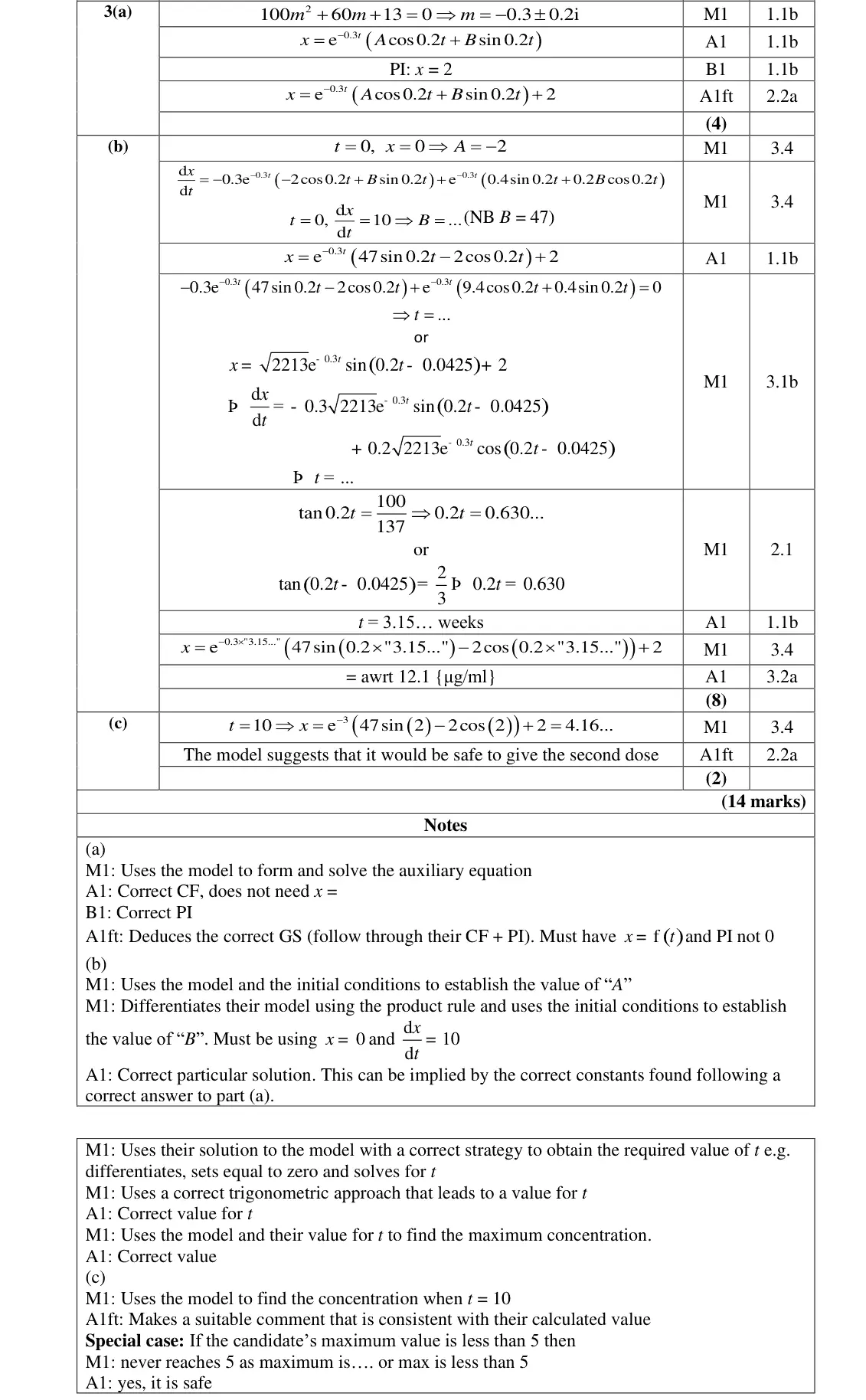
Oct 2020 · Paper 2 (Core Pure 2) · Q3(b)8 marks
Mark scheme (whole question; this part is marked with the orange bar)
Examiner's comment
(b) Most candidates used x = 0 and d x 10 t = when t = 0 correctly having used the d product rule when differentiating. A majority found the constants, correctly, to be – 2 and 47 however there were a few careless errors in the calculation of the second of these. A common error seen was to use d x 0 t = to find the value of the second constant. d Candidates who found constant most went on to find a value for t when d x 0 t = but d many careless errors meant that the correct value was obtained by less than half of candidates. A correct value of t often lead to a correct maximum value although a few did fail to add in their PI when evaluating.
Key points from the mark scheme and examiner's report
x = 0 and dx/dt = 10 at t = 0 give A = −2, B = 47 (product rule
dx/dt = 0 used wrongly)
dx/dt = 0 gives tan 0.2t = 100/137, t = 3.15 weeks
maximum awrt 12.1 μg/ml
forgetting to add the PI
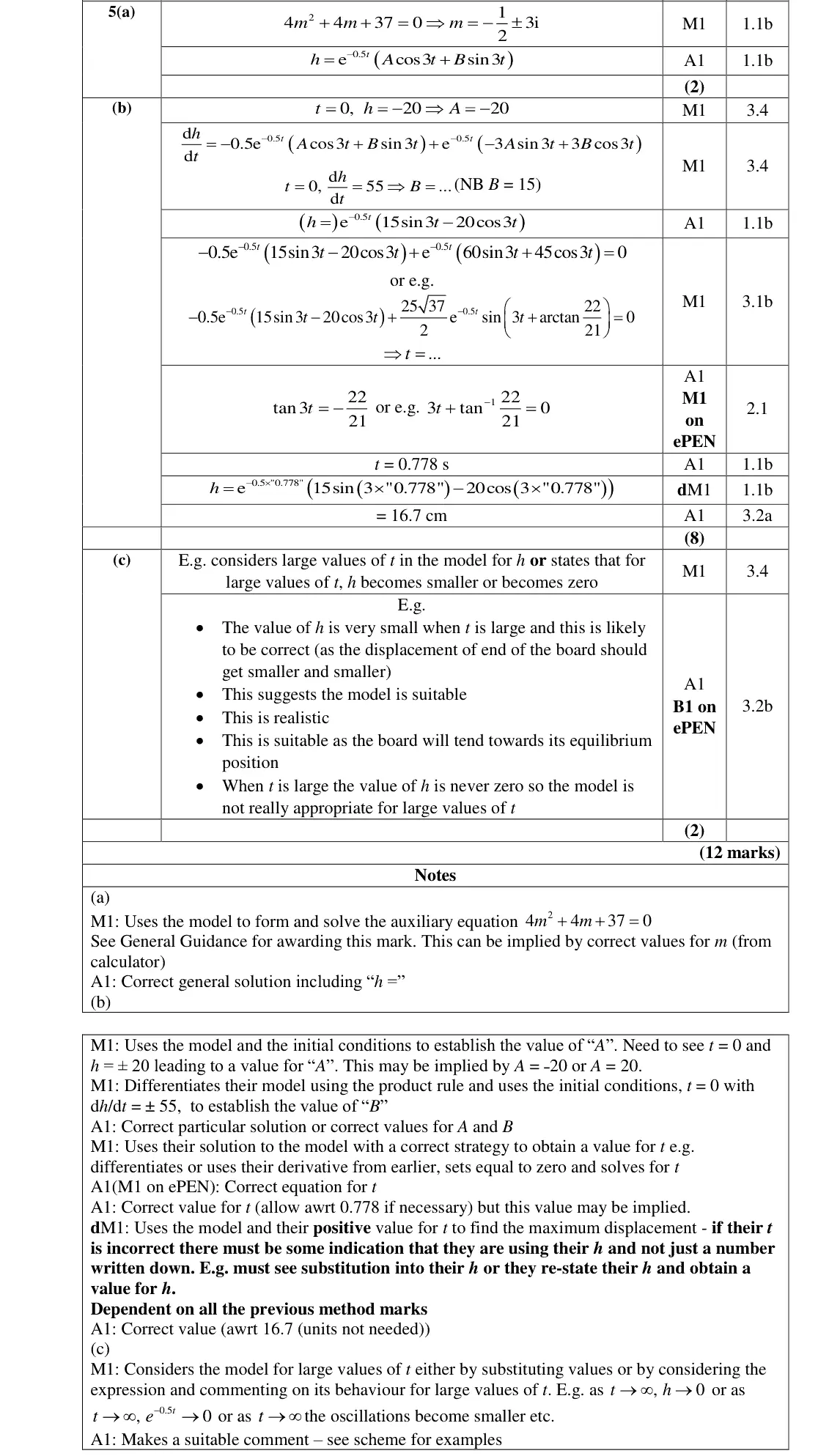
June 2019 · Paper 2 (Core Pure 2) · Q5(b)8 marks
Mark scheme (whole question; this part is marked with the orange bar)
Examiner's comment
Q5 featured a model involving a second order differential equation and the latter marks in part (b) were not widely scored. In part (b), most candidates were able to appropriately obtain a value for both constants. Common errors were to set h = 20 rather than –20 and to not use the product rule when differentiating h. Finding the maximum proved challenging and many had an incorrect strategy. A significant number of candidates attempted to apply R sin(3t + 𝛼) to the trigonometric part of their h instead of their derivative, leading to answers of R or Re-0.5t. The more sensible route of using sin 3t cos 3t to get an equation in tan 3t saw more success. Those who obtained the correct equation often failed to obtain the smallest positive value of t. Some just dropped the minus sign from the calculator value of tan-1(- 22 21). A small number did not go on to obtain h for their t. Occasionally, work in degrees was seen, often producing clearly unreasonable values for hmax.
Key points from the mark scheme and examiner's report
h = −20 at t = 0 (not +20) gives A = −20
product rule for dh/dt gives B = 15
dh/dt = 0 gives tan 3t = −22/21, smallest positive t = 0.778 s
h max = 16.7 cm
applying R sin(3t + α) to h itself
work in radians
June 2019 · Paper 2 (Core Pure 2) · Q5(c)2 marks
Mark scheme (whole question; this part is marked with the orange bar)
Examiner's comment
Q5 featured a model involving a second order differential equation and the latter marks in part (b) were not widely scored. Part (c) required candidates to comment on the suitability of the model for large values of t and this was well answered on the whole. Most deduced that h tended to zero as t →∞ and were able to make a sensible comment which was often perceptive about the mechanics of the situation. A few however, did not offer any appraisal of the model’s suitability in their answer.
Key points from the mark scheme and examiner's report
as t → ∞, e^(−0.5t) → 0 so h → 0: board returns to equilibrium, so suitable (or h never exactly 0)
must give an appraisal, not just the behaviour
Find an Edexcel Further Maths tutor
Stuck on this? Book a trial lesson with our Further Maths tutor.