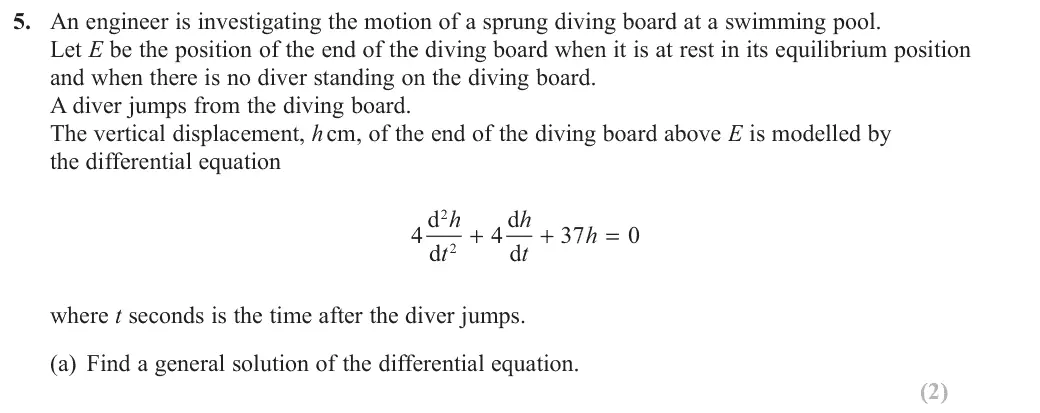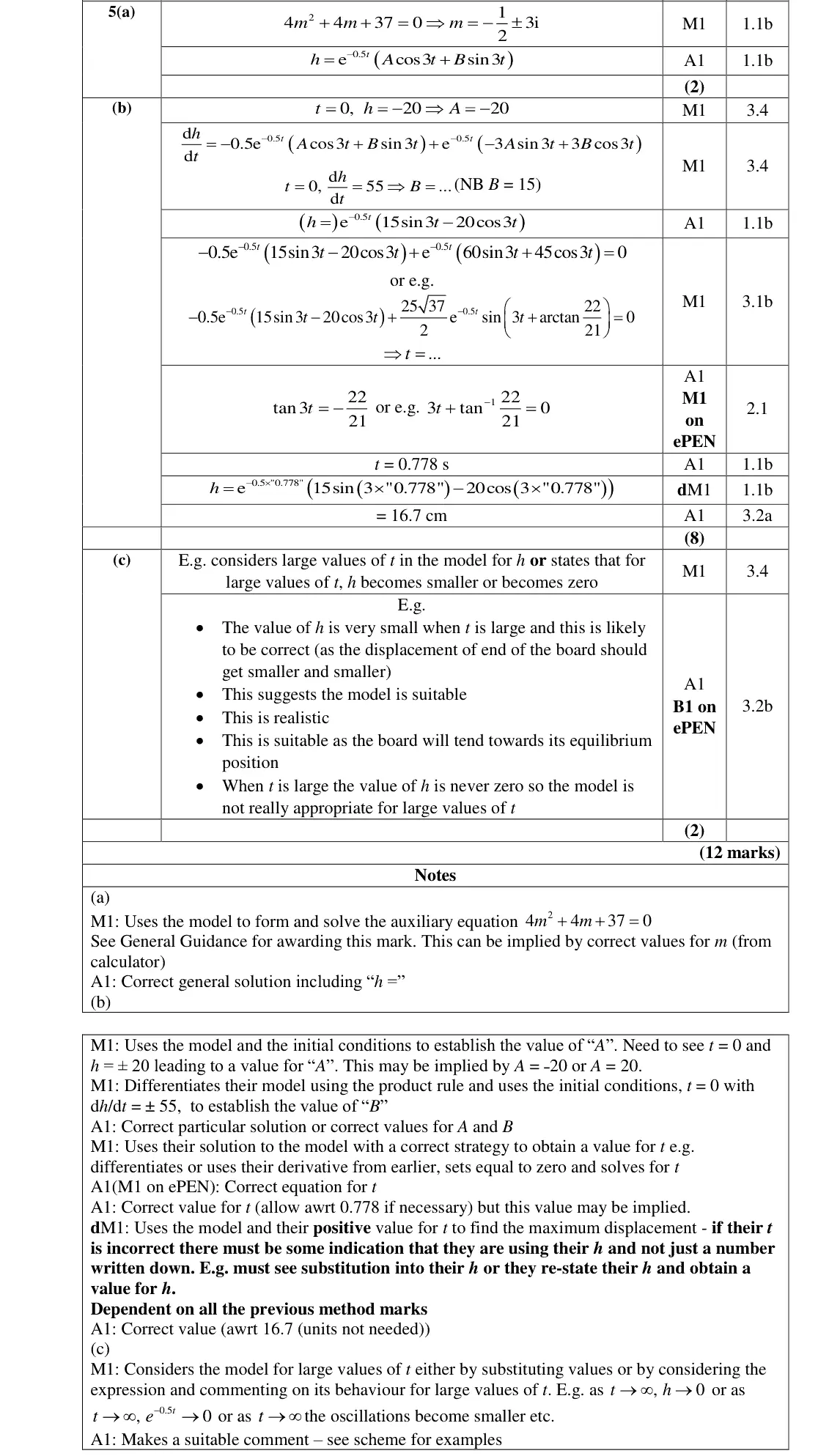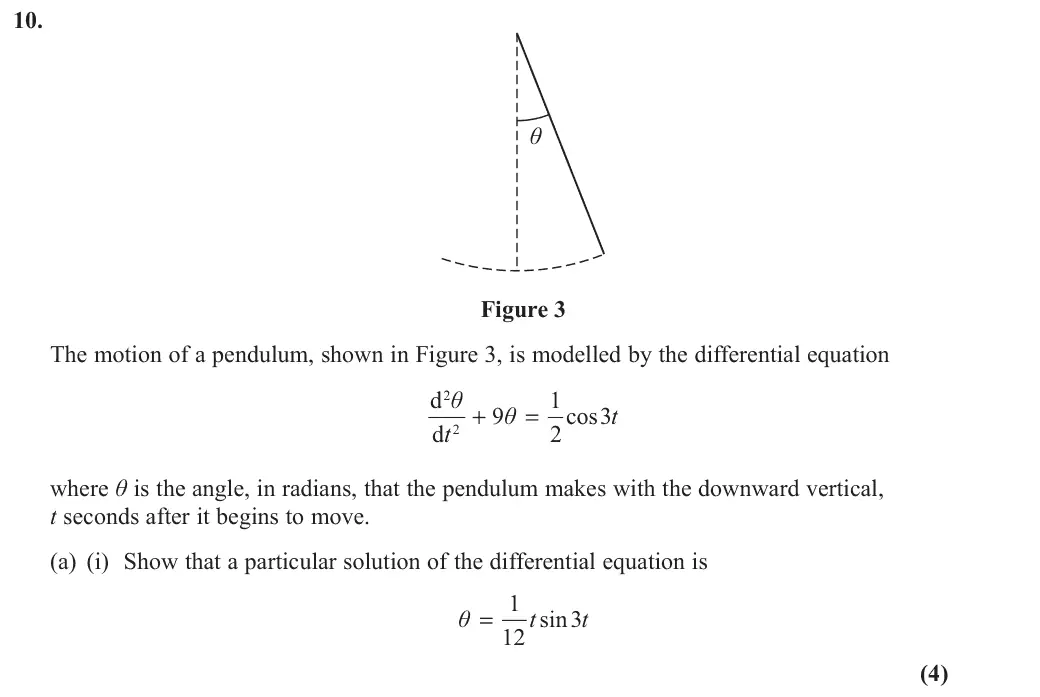
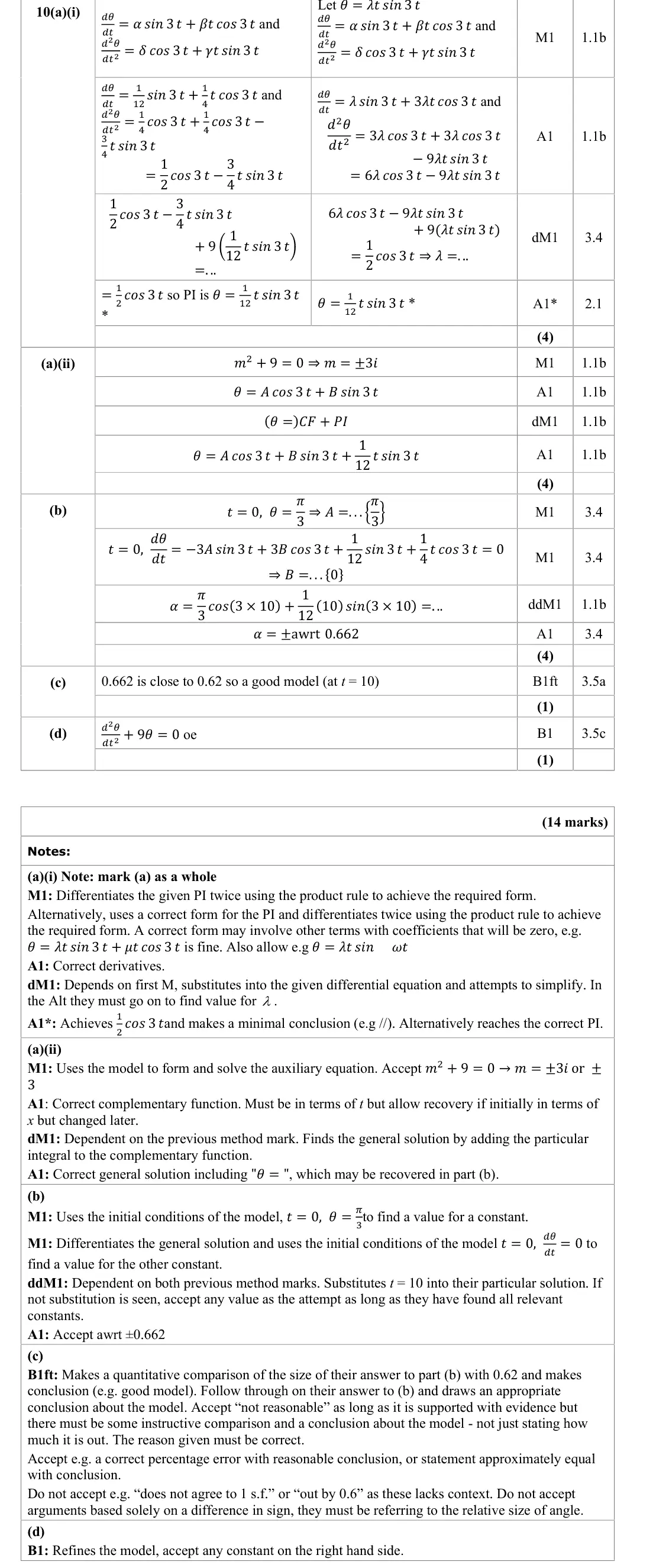
Mark scheme (whole question; this part is marked with the orange bar)
Examiner's comment
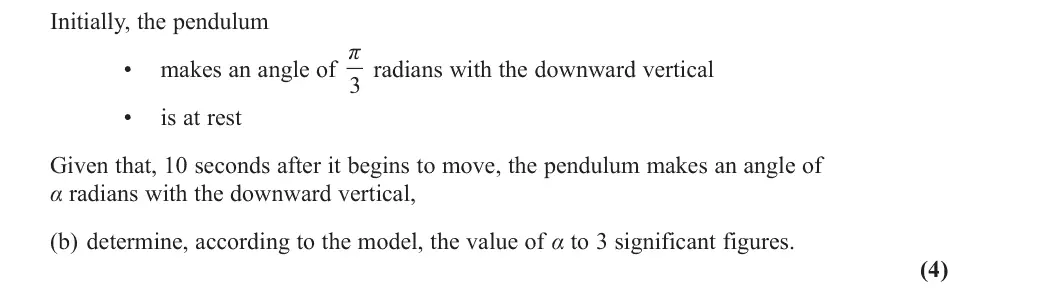
Part (a) did not work quite as expected, with many candidates not realising that to show a function is a particular solution requires only to show it satisfies the differential equation, and instead setting out to find the complementary function first, so the form of the particular integral could be decided. Even among those who realise the complementary function was not needed, many used a general form and found values for constants, rather than using the specific function given, making the differentiation harder as often a cosine term was included as well. Fortunately, this did not seem to affect their overall marks for part (a), but it did result in many inefficient methods being seen when attempting the particular integral. No more than 30% of candidates used the most efficient method of starting with the given particular integral, differentiating twice and substituting into the given differential equation. This proved very straight forward to do, although a notable number then omitted any kind of conclusion and gained only 3 of the 4 marks available. Many candidates used the laborious = + method of using the form for their particular integral. sin3 cos3 t t t t Most students were able to construct the general solution successfully for part (ii), though many repeated work finding the auxiliary equation and hence complementary function having already found it in part (i) beforehand to decide on a form for the particular integral. The most common auxiliary equation was the correct equation of m^2 + 9 = 0, however m^2 +9m = 0 was also commonly seen. The question was generally answered well here although theta =… was sometimes missed or the letter x used instead of t. Those who successfully navigated part (a) usually went on to do well in part (b).Candidates who had the correct form for their General Solution found it easy enough to find their A with mixed results for B. Those who recognised how to differentiate successfully here, were usually able to find B = 0, though some guessed this or obtained in fortuitously. Assuming an answer was reached with the qualifying methods gained, candidates were then able to find an estimate for the angle at t =10 seconds, and many correct answers were seen, although 0.66 was sometimes given, losing accuracy. Assessing the model in part (c) was done with varying degrees of success. Those offering a
Key points from the mark scheme and examiner's report
- differentiate the given PI twice (product rule) and substitute to get ½cos 3t
- finding the CF or a general PI form first is unnecessary