25 question parts, 82 marks, 3 with a difficulty rating from the examiner's report
Notes, worked examples and practice for this topic are being written by our tutors. The past-paper questions below are ready now: work each one on paper, then open the mark scheme and the examiner's comment.
Tap a question to zoom it. Mark scheme and examiner's comment open under each question.
June 2025 · AS Paper 2 (Further Pure 1) · Q1(a)1 mark
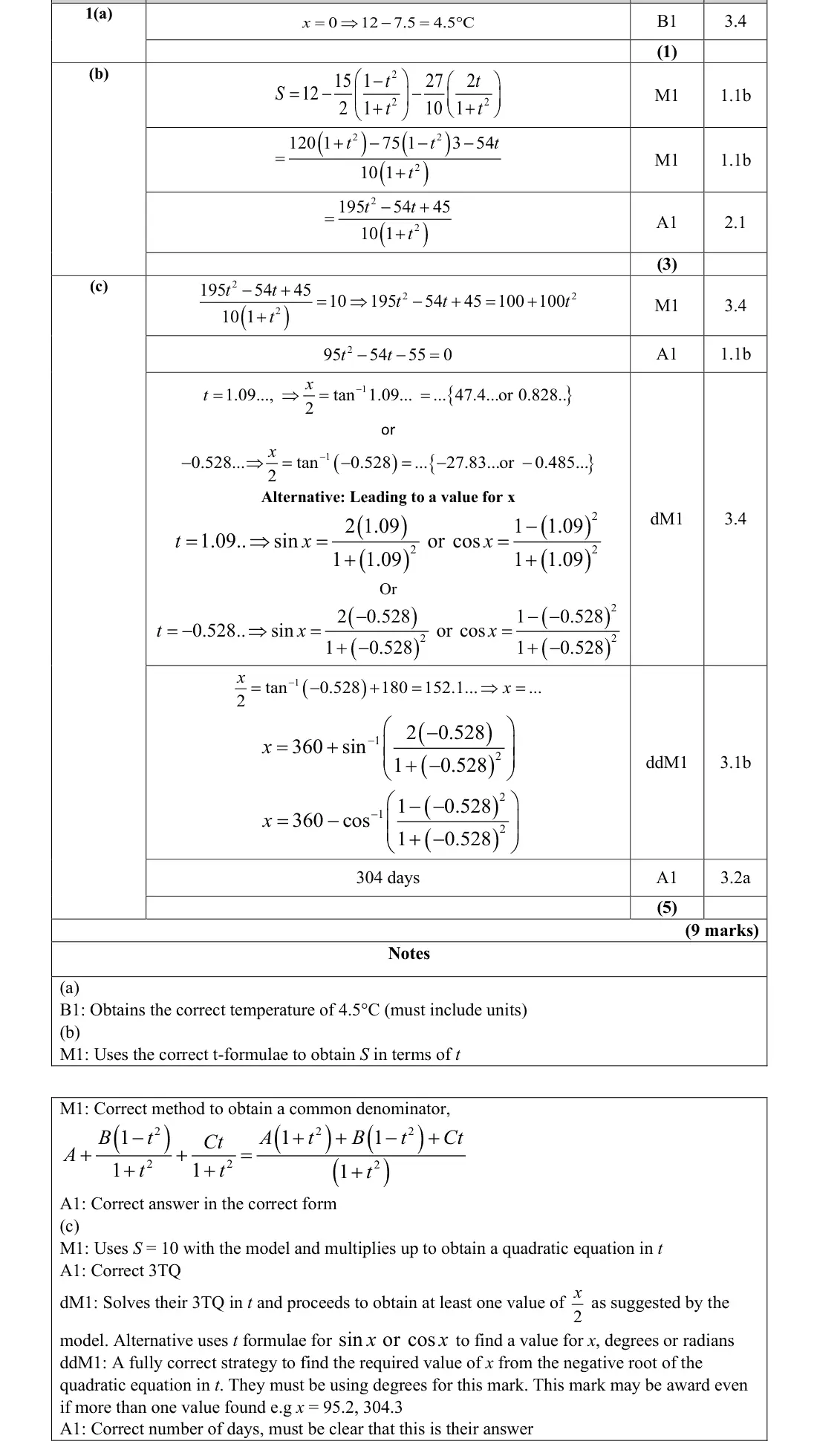
Mark scheme (whole question; this part is marked with the orange bar)
Examiner's comment
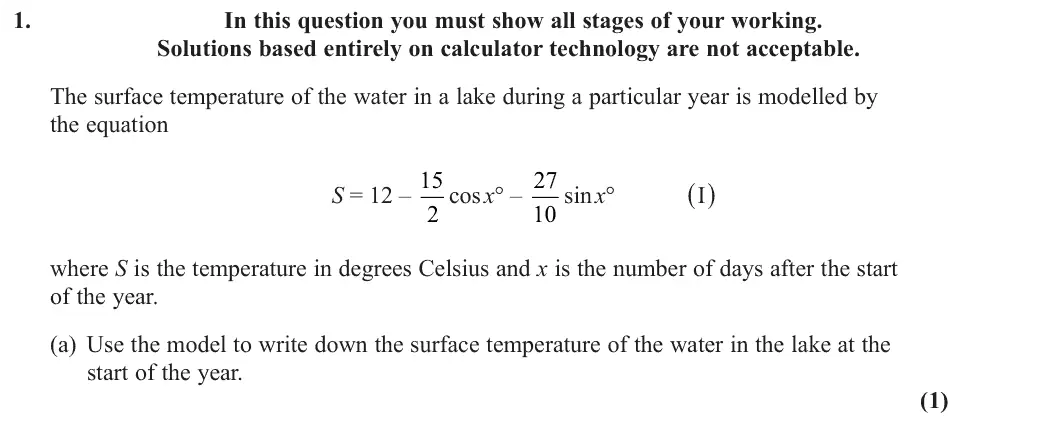
Part (a) The majority of candidates achieved 4.5°C, although some did not include the units. There were some who answered 12°, just looking at the function 15 27 12 cos sin 2 10 S x x = - - and not substituting in 0 x =
Key points from the mark scheme and examiner's report
x = 0: S = 12 − 7.5 = 4.5 °C (units needed)
12 from not substituting x = 0
June 2025 · AS Paper 2 (Further Pure 1) · Q1(b)3 marks
Mark scheme (whole question; this part is marked with the orange bar)
Examiner's comment
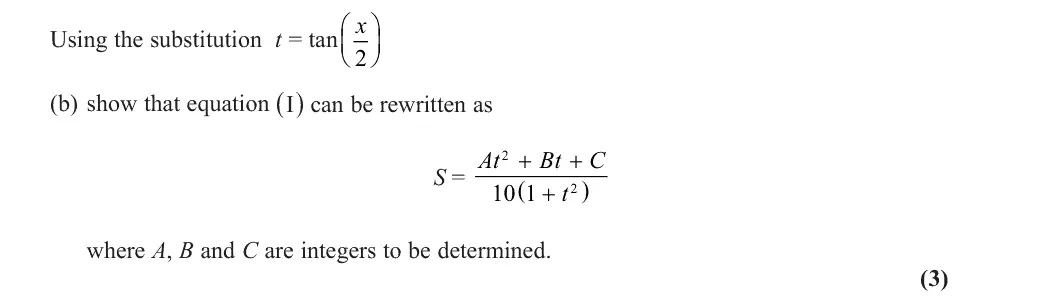
Part (b) Nearly all candidates could start this section correctly; there were just a few sign errors in the formulae. Most, knew how to reach a common denominator, although more sign errors appeared during the manipulation. However the correct expression was frequently achieved.
Key points from the mark scheme and examiner's report
substitute cos x = (1 − t²)/(1 + t²), sin x = 2t/(1 + t²) and use a common denominator: S = (195t² − 54t + 45)/(10(1 + t²))
sign errors in the manipulation
June 2025 · AS Paper 2 (Further Pure 1) · Q1(c)5 marks
Mark scheme (whole question; this part is marked with the orange bar)
Examiner's comment
Part (c) Most candidates started correctly by multiplying up, obtaining a 3 term quadratic, but there were some careless errors – notably 100 10 ... t + = The majority then solved their 3 term quadratic, most of them remembered that they needed to proceed from ... t = to ... x = Several candidates rejected the negative value of t, saying the number of days must be positive. Some also answered in radians, candidates need to look at the expression to identify the degrees symbol. There were some very good responses, picking out the second value confidently, and others who were rather more laborious in the process. There were frequent errors in the order of operations, ranging from implying tan 2tan 2 x x = , to doubling the value of 2 x before adding 180 etc to obtain further values.
Key points from the mark scheme and examiner's report
S = 10 gives 95t² − 54t − 55 = 0, t = 1.09 or −0.528
second time comes from the negative root: x/2 = 180° + arctan(−0.528) so x = 304 days
rejecting the negative t, working in radians and doubling/adding 180° in the wrong order were common
June 2024 · AS Paper 2 (Further Pure 1) · Q4(a)3 marks
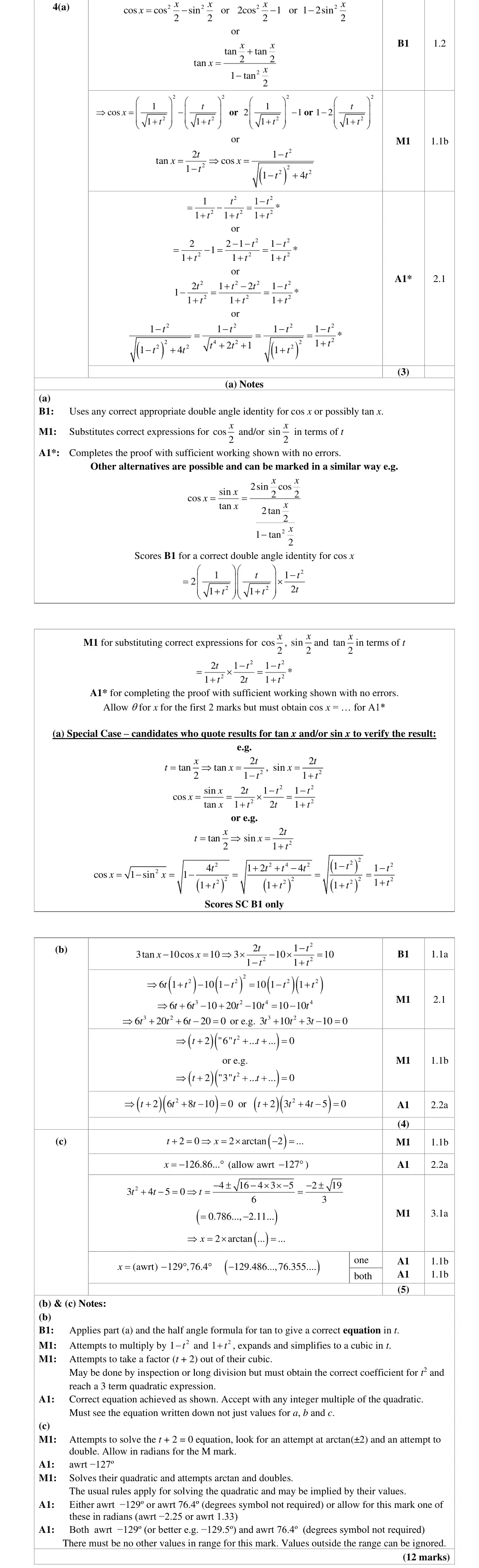
Mark scheme (whole question; this part is marked with the orange bar)
Examiner's comment
Part (a) was probably the least well answered part on the paper and many candidates did not know how to prove this result using suitable double angle formula. Of those who attempted this part, the majority simply quoted the standard results for tan x and sin x to obtain the expression for cos x. Such attempts were given a special case of 1 mark.
Key points from the mark scheme and examiner's report
use a double-angle identity, e.g. cos x = cos²(x/2) − sin²(x/2) with cos(x/2) = 1/√(1 + t²), sin(x/2) = t/√(1 + t²)
quoting the t-formulae for sin x and tan x to verify is a special case (1 mark)
least well answered part
June 2024 · AS Paper 2 (Further Pure 1) · Q4(b)4 marks
Mark scheme (whole question; this part is marked with the orange bar)
Examiner's comment
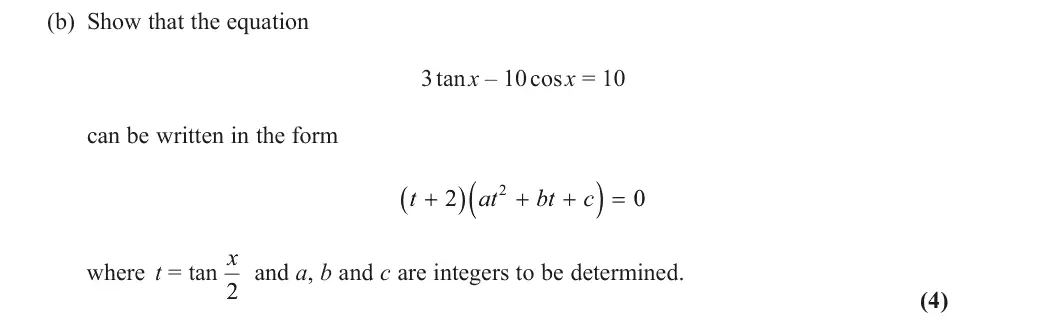
In part (b), nearly all substituted to obtain a correct initial equation in t, but the attempts to rearrange it were very variable. There were many sign errors which might have been avoided by careful bracketing of the numerators of fractions before multiplying up. Sometimes these errors prevented them from reducing the equation to a cubic, so they could not proceed to the required result. The most efficient solutions rearranged to 3tan x = 10(1 + cos x ), which gave a much simpler expansion. Candidates who found the correct cubic nearly always factorised it as required although many forgot the “= 0” at the end and so forfeited the final mark in this part.
Key points from the mark scheme and examiner's report
substitute tan x = 2t/(1 − t²), cos x = (1 − t²)/(1 + t²), multiply by (1 − t²)(1 + t²) to get 6t³ + 20t² + 6t − 20 = 0
June 2024 · AS Paper 2 (Further Pure 1) · Q4(c)5 marks
Mark scheme (whole question; this part is marked with the orange bar)
Examiner's comment
Part (c) was a very good source of marks for many candidates. Most could at least use a fully correct procedure for finding x from the given factor and even without a correct quadratic factor, could score the next method mark. Some additional incorrect solutions were obtained by adding or subtracting 180° after doubling their solution of arctan 2 x . There were also some solutions which were not accurate to 3 significant figures because the candidate had used a solution of the quadratic rounded to 3 significant figures.
Key points from the mark scheme and examiner's report
t = −2 gives x = −126.9°
3t² + 4t − 5 = 0, t = (−2 ± √19)/3 gives x = 76.4°, −129.5°
x = 2 arctan t
extra solutions from adding or subtracting 180° after doubling
premature rounding of t
June 2023 · AS Paper 2 (Further Pure 1) · Q2(a)3 marks
Mark scheme (whole question; this part is marked with the orange bar)
Examiner's comment
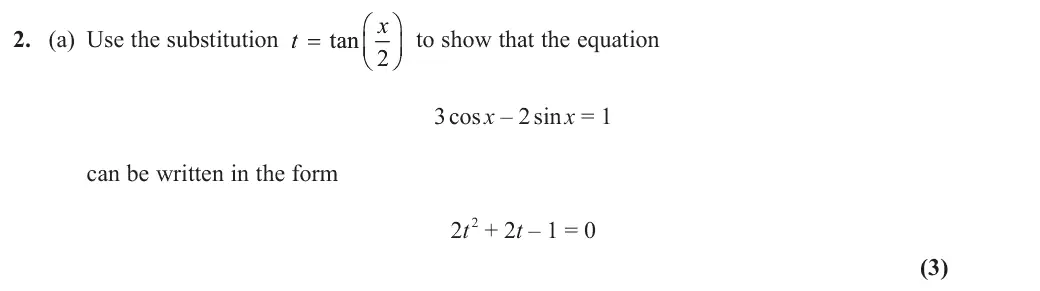
An expected and well-rehearsed topic, many had little trouble answering the whole question, and showing good accuracy throughout. In part (a) the majority of responses were fully correct, with the correct t-formulae well known, only a very small number had a wrong formula for one or the other. Occasional inaccuracies, with an error in some steps of working, meant the final accuracy mark in the part was lost, but generally the manipulation required to reach the given quadratic was done well. That the quadratic was given was a great help as a guide to confirm work as well as giving access into part (b) where a slip may otherwise have not been detected.
Key points from the mark scheme and examiner's report
substitute cos x = (1 − t²)/(1 + t²), sin x = 2t/(1 + t²), multiply through by 1 + t² to reach 2t² + 2t − 1 = 0
June 2023 · AS Paper 2 (Further Pure 1) · Q2(b)4 marks
Mark scheme (whole question; this part is marked with the orange bar)
Examiner's comment
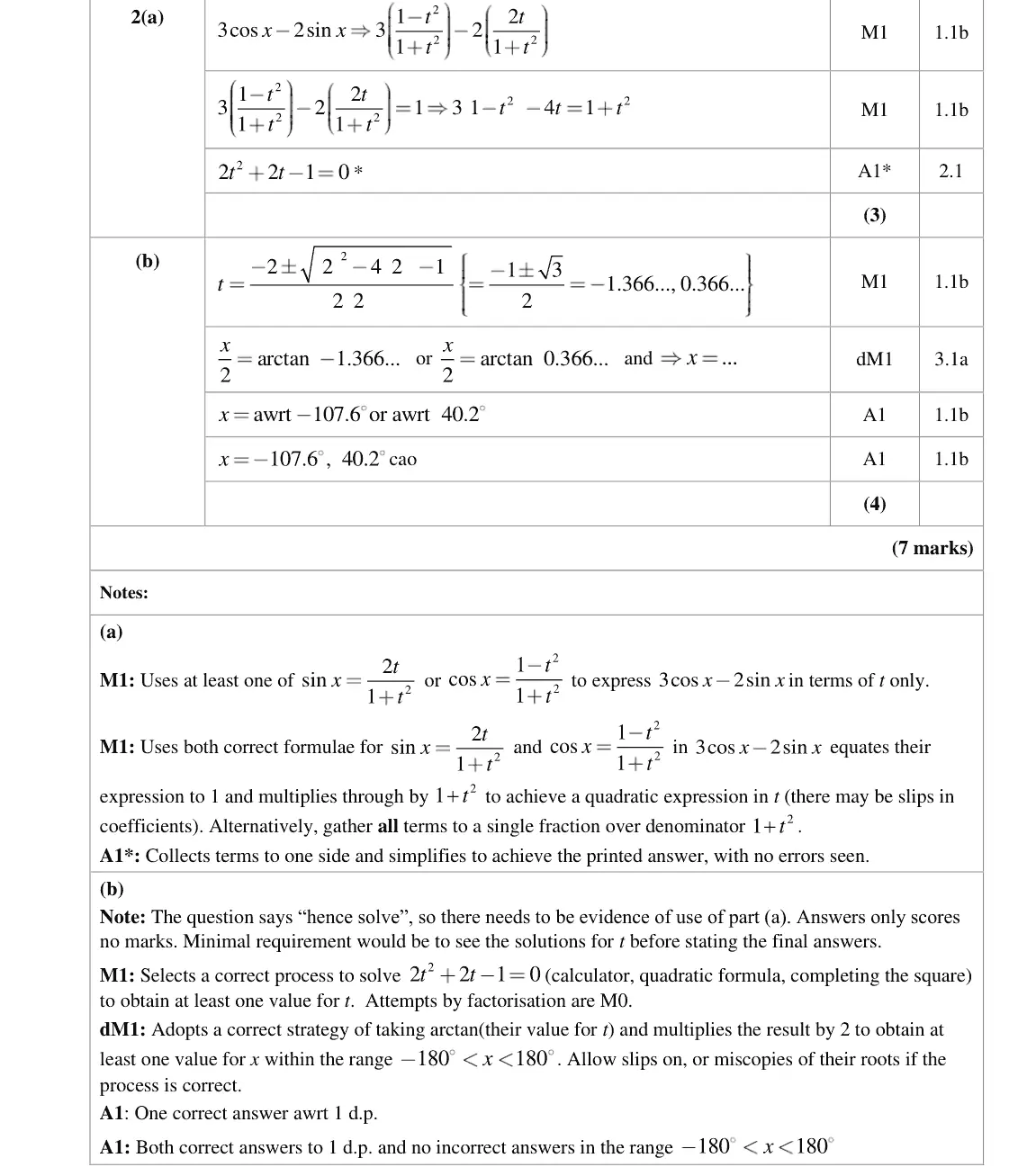
An expected and well-rehearsed topic, many had little trouble answering the whole question, and showing good accuracy throughout. For part (b), solving the quadratic correctly posed little problem for the most part, with just a few sign errors. Method was not always shown, the mark was implied by correct solutions, and evidence of students reliance on calculators to solve quadratics was shown, and very few attempted factorisation approaches. Most students went on to apply arctan to their solutions and remembered to double their angles to give the final answer, but some forgot, and some halved them instead, causing the loss of the last three marks. There were also a few who tried x = arctan(2t). The main loss of marks came at the end, where some either had their calculator in the wrong mode or failed to carry out the process correctly having shown the correct method, such as sign errors (getting the negatives of one or both answers). Another common error was the inclusion of additional solutions, e.g. from substituting the values of t back into formulae for either sin or cos and generating extras, or invalid solutions arising from attempts at e.g. x ± 180°. Nearly all gave their answers to the required accuracy. But the final accuracy was occasionally lost by those rounding to an incorrect number of decimal places, e.g. given to 3 significant figures instead of the required 3 decimal places. Careful checking of instructions in the question should be advised.
Key points from the mark scheme and examiner's report
t = (−1 ± √3)/2
x = 2 arctan t: x = 40.2°, −107.6°
answers only score 0 ("hence")
forgetting to double or halving, extra solutions from substituting back into sin or cos, wrong calculator mode
June 2022 · AS Paper 2 (Further Pure 1) · Q3(a)4 marks
Mark scheme (whole question; this part is marked with the orange bar)
Examiner's comment
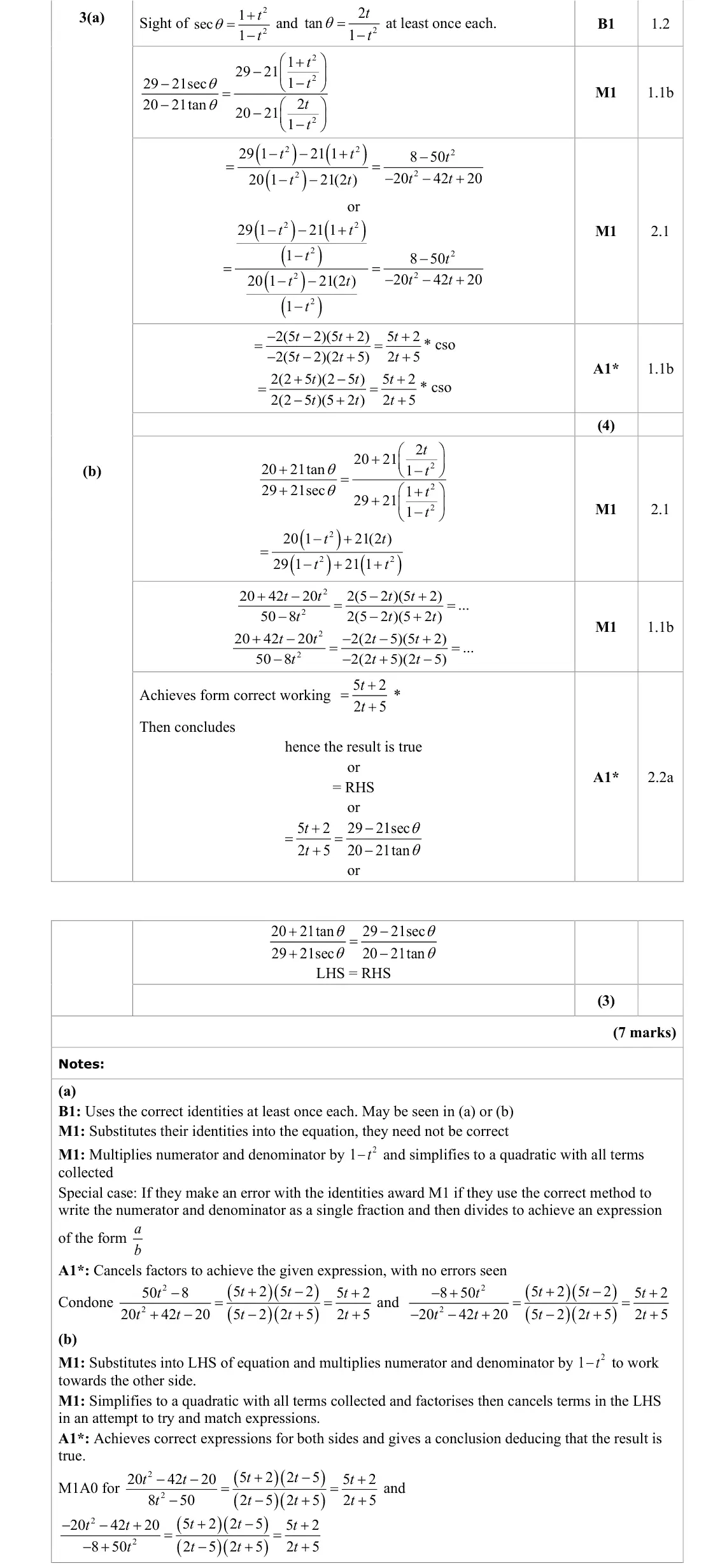
In most responses, the correct t-formulae were used for both sec theta and tan theta , which usually allowed candidates to reach the desired final result in part (a). In cases where incorrect formulae were substituted, most candidates demonstrated the right techniques to simplify the resulting expression and were able to access the method marks. Correct simplified quadratics in numerator and denominator were seen in most cases, but the factorising was often less rigorous, with the factor of two not being cancelled consistently. In part (b), where a proof was required,
Key points from the mark scheme and examiner's report
sec θ = (1 + t²)/(1 − t²), tan θ = 2t/(1 − t²)
multiply through by 1 − t²: (8 − 50t²)/(20 − 42t − 20t²)
factorise and cancel −2(5t − 2) to get (5t + 2)/(2t + 5)
the factor 2 often not handled
June 2022 · AS Paper 2 (Further Pure 1) · Q3(b)3 marks
Mark scheme (whole question; this part is marked with the orange bar)
Examiner's comment
In most responses, the correct t-formulae were used for both sec theta and tan theta , which usually with the factor of two not being cancelled consistently. In part (b), where a proof was required, this was more of an issue, with fully correct working being less common. Marks were lost in 2 20 42 20 t t + - to (b) for not showing the factor of 2 when cancelling e.g .going from 2 50 8 t - (2 5)(5 2) t t - + and not completing the proof with a statement of LHS= RHS o.e. seen. The (2 5)(2 5) t t + - most successful candidates were those who were most logical in the presentation of the stages of their algebraic manipulations.
Key points from the mark scheme and examiner's report
must show the factor 2 and state a conclusion (LHS = RHS)
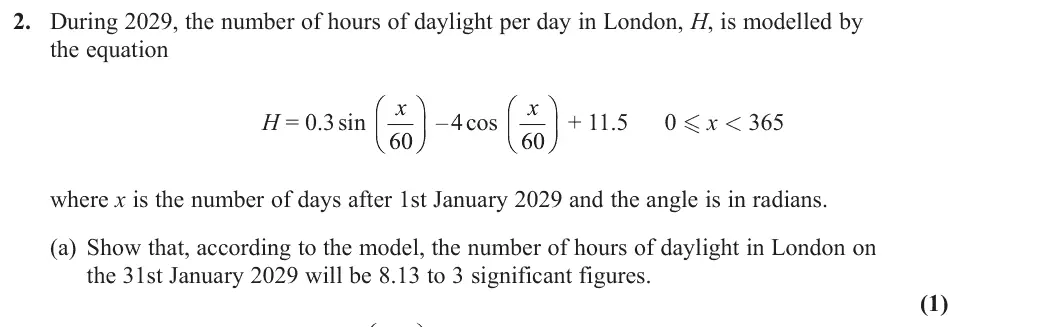
June 2022 · Paper 3A (Further Pure 1) · Q2(a)1 markHard
Mark scheme (whole question; this part is marked with the orange bar)
Examiner's comment
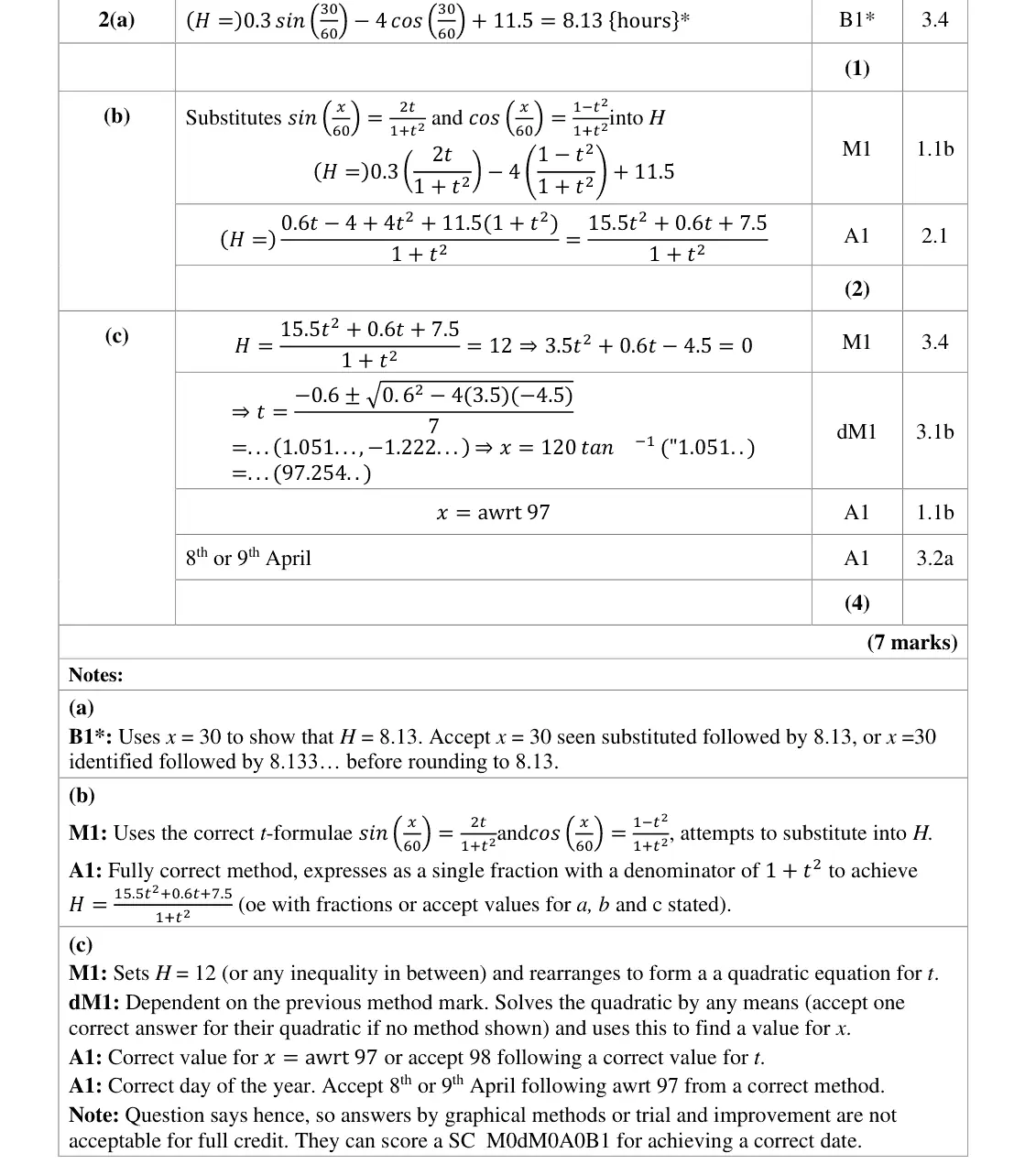
While this question proved accessible for the majority of candidates it was less well done than question 1, or even questions 4 and 6, which proved more accessible. The likely reason for this is the context of the modelling, which led to some confusion with the date at the end, and many did not achieve the final 3 marks. However, the modal score was full marks and achieved by 45% of candidates with just under 30% achieving 6/7, and 10% achieving 4/7 the next most common scores. In part (a) most were able to demonstrate a suitable substitution to arrive at the correct answer with a suitable step shown. Indeed, most did show a value correct to more than 3 significant figures to exemplify the calculation had been made.
Key points from the mark scheme and examiner's report
x = 30 (not 31) substituted, showing 8.133… before rounding to 8.13
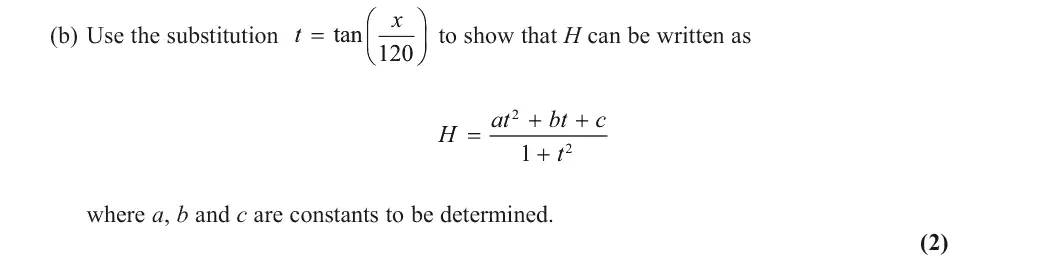
June 2022 · Paper 3A (Further Pure 1) · Q2(b)2 marksMedium
Mark scheme (whole question; this part is marked with the orange bar)
Examiner's comment
While this question proved accessible for the majority of candidates it was less well done than question 1, or even questions 4 and 6, which proved more accessible. The likely reason for this is the context of the modelling, which led to some confusion with the date at the end, and many did not achieve the final 3 marks. However, the modal score was full marks and achieved by 45% of candidates with just under 30% achieving 6/7, and 10% achieving 4/7 the next most common scores. Part (b) was also well attempted by most, with the correct formulae identified and used by the vast majority. Common errors were mainly poor algebraic manipulation leading to an incorrect result, with incorrect half angle formulae being used only rarely seen.
Key points from the mark scheme and examiner's report
June 2022 · Paper 3A (Further Pure 1) · Q2(c)4 marksMedium
Mark scheme (whole question; this part is marked with the orange bar)
Examiner's comment
While this question proved accessible for the majority of candidates it was less well done than question 1, or even questions 4 and 6, which proved more accessible. The likely reason for this is the context of the modelling, which led to some confusion with the date at the end, and many did not achieve the final 3 marks. However, the modal score was full marks and achieved by 45% of candidates with just under 30% achieving 6/7, and 10% achieving 4/7 the next most common scores. Part (c) was the real differentiator with most able to access the first mark using the ‘hence’, utilising the part (b) of the question, with less success at proceeding from there to a correct answer. Some candidates appeared to be confused between the variables, for example it was common among the incorrect responses to see t = 1.05 which was then interpreted as the number of days, forgetting to undo the substitution. Such responses were unable to access the final three marks. The value awrt 97 (usually 97.25 was seen) was found by many but not all were able to convert this into a correct date, either omitting the date entirely or by saying the wrong month (March was popular) or day. For those who solved to find a value of t, it was common to see ‘counting’ days in each month, but it was very surprising to see how many did not know how many days were in each month, and some appeared were unsure whether 2029 was a leap year. It was also rare to see incorrect values due to calculators being in degrees rather than radians, which is good to note students take care of the mode.
Key points from the mark scheme and examiner's report
H = 12 gives 3.5t² + 0.6t − 4.5 = 0, t = 1.051…
x = 120 arctan t = awrt 97, i.e. 8th or 9th April
errors: treating t as days, not undoing the substitution, wrong month or day
Nov 2021 · Paper 3A (Further Pure 1) · Q2(i)5 marks
Mark scheme (whole question; this part is marked with the orange bar)
Examiner's comment
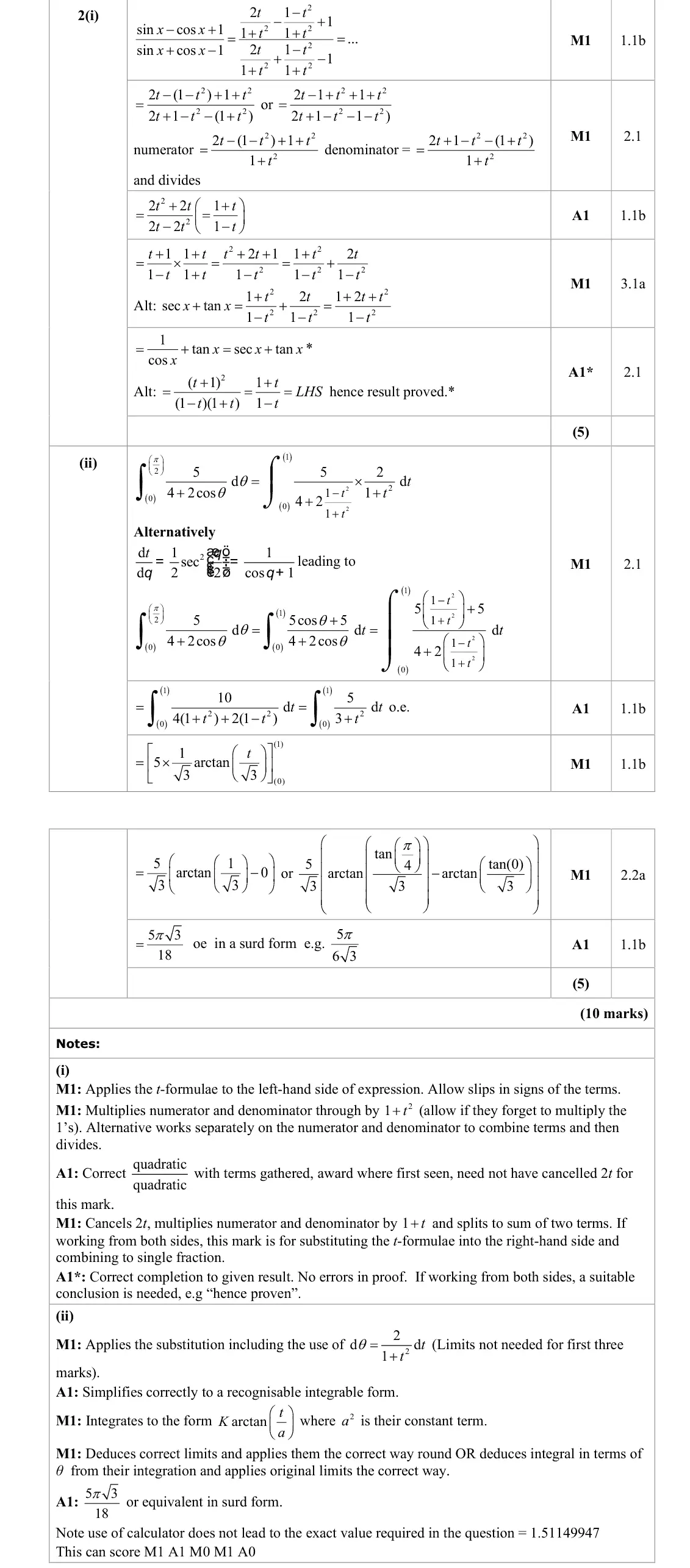
Part (a) was done well by the majority of the candidates. It was good to see that candidates could correctly recall the t formula. They substituted correctly int the left-hand side of the identity and dealt correctly with the fractions. It was pleasing to see that brackets were used especially with minus cosx. Once the left-hand side was simplified the majority of the candidates worked on the right-hand side to achieve the same simplified expression. Again, it was good to see that the madidates did then draw the correct conclusion to complete the proof. Part (b) caused more problems for candidates. A few candidates did not 2 1 t - recall how to deal with d theta , they replaced but struggled with cos with theta 2 1 t + 2 remembering that . Once candidates used the correct d d t theta = + 2 1 t substitutions, they successfully simplified recognised that it integrated to the form 1 arctan t which can be found in the formula book. After a a integrating candidates used the correct limits, most used t = 1 and t = 0, to achieve the correct exact answer.
Key points from the mark scheme and examiner's report
t-formulae on the left-hand side with brackets round −cos x
multiply through by 1 + t² and simplify
work on the right-hand side to the same form and conclude ("hence proved")
Oct 2020 · AS Paper 2 (Further Pure 1) · Q3(i)2 marks
Mark scheme (whole question; this part is marked with the orange bar)
Examiner's comment
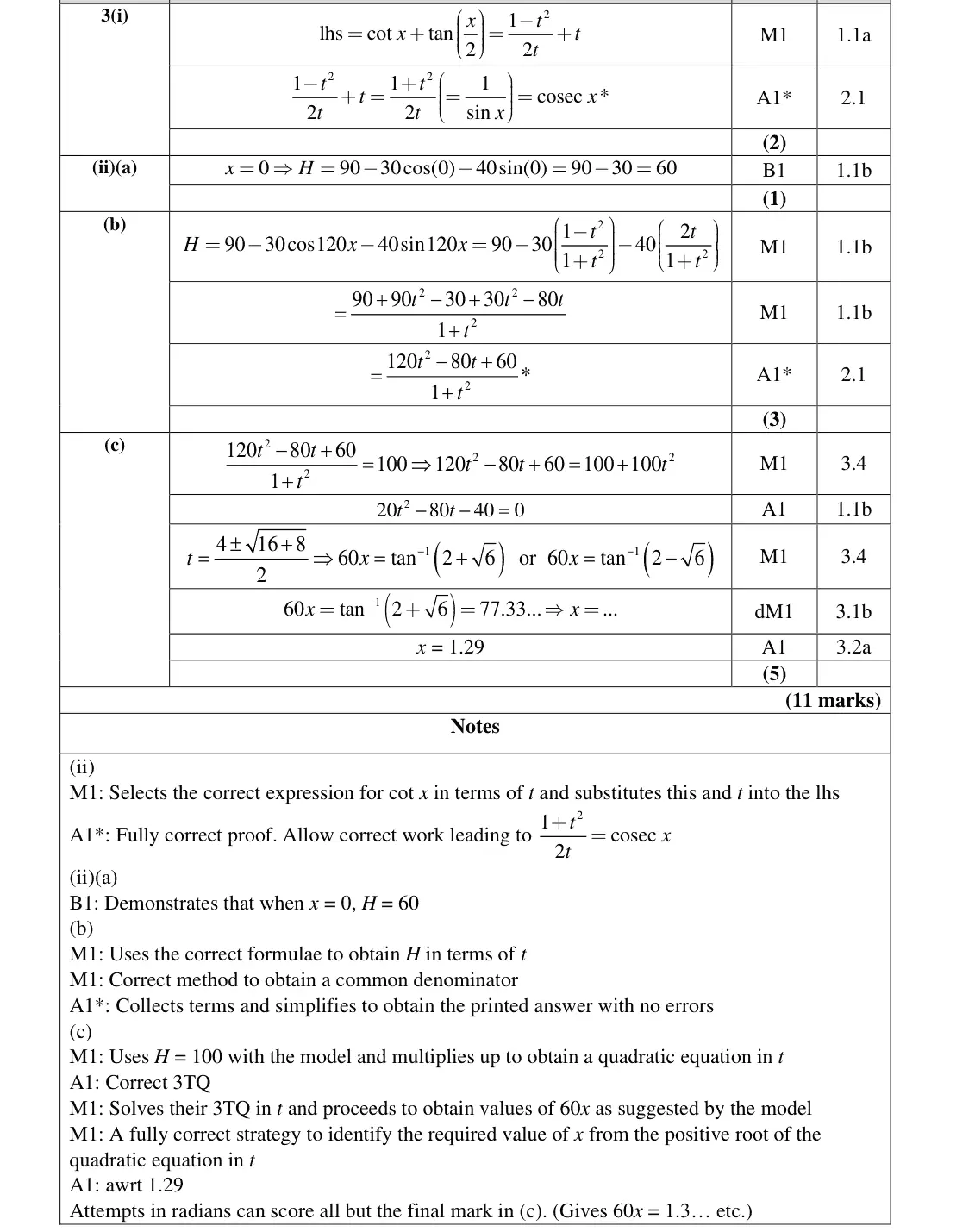
All candidates made an attempt at this question and success was variable, giving a full range of marks with 5 candidates scoring full marks. Part (i) was an easy source of marks for those who could recall the t-formulae. In (ii) part (a), several candidates spent time attempting to solve the equation when H = 60 when All that was required was the substitution of x = 0 to establish H = 60. Candidates should be aware that 1 mark would imply that minimal working was required. Most candidates could make a start with part (b) although there were a significant number of algebraic errors, particularly with signs when combining the fractions. Most candidates could reach the required quadratic equation in t in part (c), but then failed to realise that they needed to then solve for 60x and forfeited the final 3 marks.
Key points from the mark scheme and examiner's report
cot x = (1 − t²)/(2t)
(1 − t²)/(2t) + t = (1 + t²)/(2t) = 1/sin x
Oct 2020 · AS Paper 2 (Further Pure 1) · Q3(ii)(a)1 mark
Mark scheme (whole question; this part is marked with the orange bar)
Examiner's comment
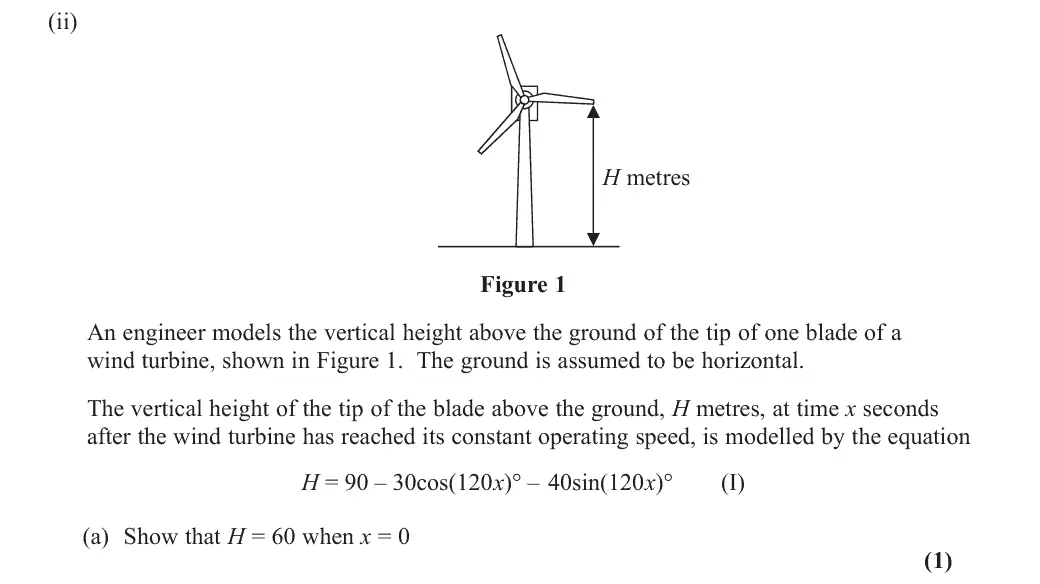
All candidates made an attempt at this question and success was variable, giving a full range of marks with 5 candidates scoring full marks. Part (i) was an easy source of marks for those who could recall the t-formulae. In (ii) part (a), several candidates spent time attempting to solve the equation when H = 60 when All that was required was the substitution of x = 0 to establish H = 60. Candidates should be aware that 1 mark would imply that minimal working was required. Most candidates could make a start with part (b) although there were a significant number of algebraic errors, particularly with signs when combining the fractions. Most candidates could reach the required quadratic equation in t in part (c), but then failed to realise that they needed to then solve for 60x and forfeited the final 3 marks.
Key points from the mark scheme and examiner's report
substitute x = 0: 90 − 30 = 60
1 mark only, no need to solve an equation
Oct 2020 · AS Paper 2 (Further Pure 1) · Q3(ii)(b)3 marks
Mark scheme (whole question; this part is marked with the orange bar)
Examiner's comment
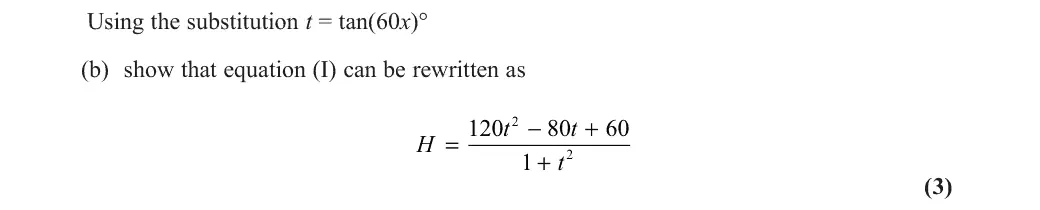
All candidates made an attempt at this question and success was variable, giving a full range of marks with 5 candidates scoring full marks. Part (i) was an easy source of marks for those who could recall the t-formulae. In (ii) part (a), several candidates spent time attempting to solve the equation when H = 60 when All that was required was the substitution of x = 0 to establish H = 60. Candidates should be aware that 1 mark would imply that minimal working was required. Most candidates could make a start with part (b) although there were a significant number of algebraic errors, particularly with signs when combining the fractions. Most candidates could reach the required quadratic equation in t in part (c), but then failed to realise that they needed to then solve for 60x and forfeited the final 3 marks.
Key points from the mark scheme and examiner's report
t = tan(60x)° so cos(120x)° = (1 − t²)/(1 + t²), sin(120x)° = 2t/(1 + t²)
common denominator to the printed form
sign errors when combining
Oct 2020 · AS Paper 2 (Further Pure 1) · Q3(ii)(c)5 marks
Mark scheme (whole question; this part is marked with the orange bar)
Examiner's comment
All candidates made an attempt at this question and success was variable, giving a full range of marks with 5 candidates scoring full marks. Part (i) was an easy source of marks for those who could recall the t-formulae. In (ii) part (a), several candidates spent time attempting to solve the equation when H = 60 when All that was required was the substitution of x = 0 to establish H = 60. Candidates should be aware that 1 mark would imply that minimal working was required. Most candidates could make a start with part (b) although there were a significant number of algebraic errors, particularly with signs when combining the fractions. Most candidates could reach the required quadratic equation in t in part (c), but then failed to realise that they needed to then solve for 60x and forfeited the final 3 marks.
Key points from the mark scheme and examiner's report
20t² − 80t − 40 = 0, t = 2 ± √6
60x = arctan(2 + √6) = 77.33° so x = 1.29 s
many stopped at t and did not solve for 60x
radians lose the final mark
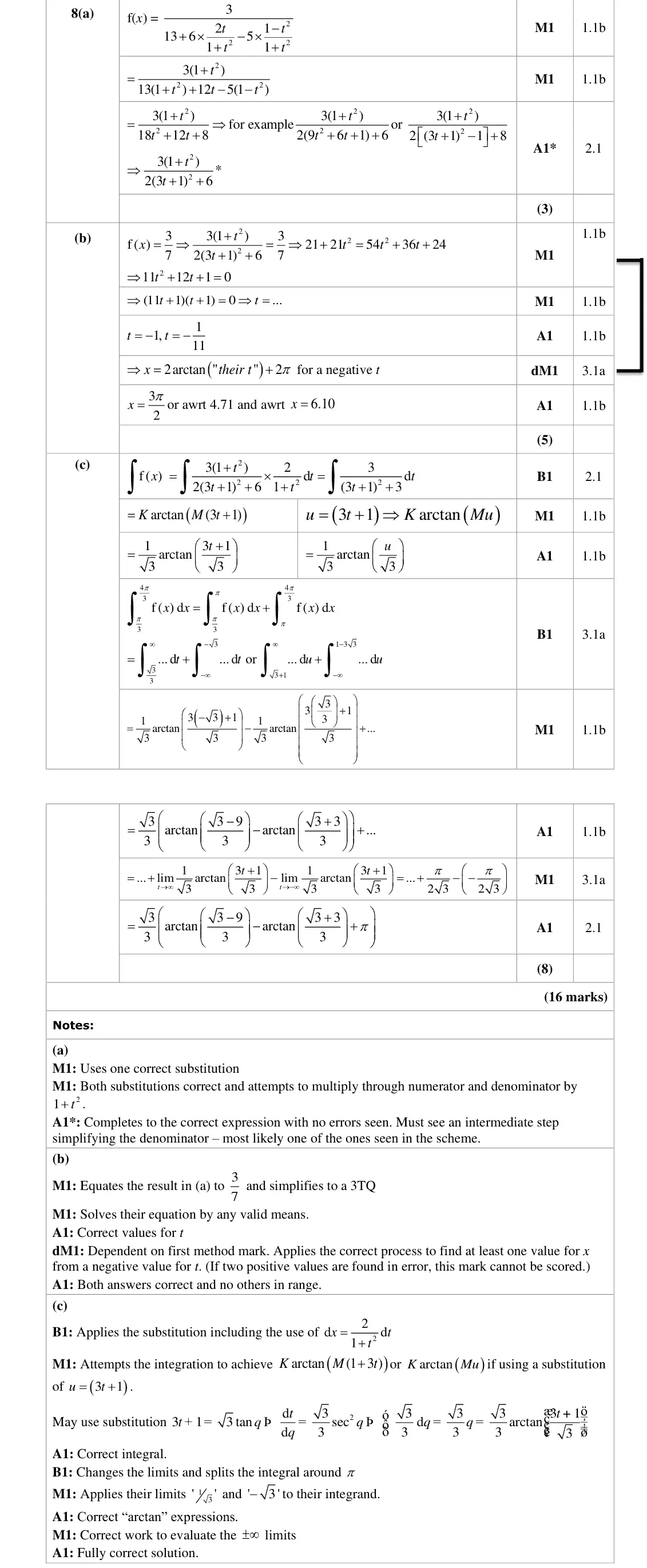
Oct 2020 · Paper 3A (Further Pure 1) · Q8(a)3 marks
Mark scheme (whole question; this part is marked with the orange bar)
Examiner's comment
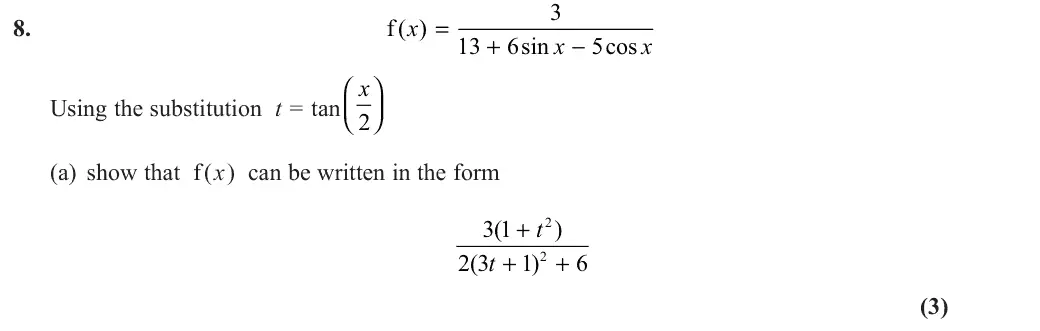
Again, part a was easily accessible to most candidates and most correctly substituted the correct t – formulae for cos x and sin x. Most candidates were able to manipulate their expressions to ( ) + 2 3 1 t reach but then wrote down the given answer in completed square form with no + + 2 18 12 8 t t further justification, losing the final accuracy mark. It should be reiterated to students that though it is relatively straightforward to check that the two denominators are equivalent, as the answer is given, they should be showing intermediate working to reach the given answer or writing down some other form of justification. Part b was generally well done with some arithmetic errors leading to an incorrect quadratic and so incorrect values of t. Some candidates either did not continue to find values of x or used an incorrect method to find values of x from their values of t. Part c was attempted by a good number of candidates but no-one got full marks. Candidates were so focussed on the process of integration that they did not consider the limits carefully enough and did not spot that this was in fact an improper integral. A significant number of candidates did not make a complete substitution, omitting the substitution for dx, and so struggled to make any further progress. Of those that did make a complete substitution most ( ) t + arctan 3 1 K M obtained an integral of the correct form but there were many errors, the most common being to forget to apply the reverse chain rule and so have additional factor of 3. Candidates using a further substitution of u = 3t + 1 generally avoided this error.
Key points from the mark scheme and examiner's report
t-formulae for sin x and cos x and multiply through by 1 + t²: 3(1 + t²)/(18t² + 12t + 8)
must show the completed-square step to 2(3t + 1)² + 6, not just write the given answer
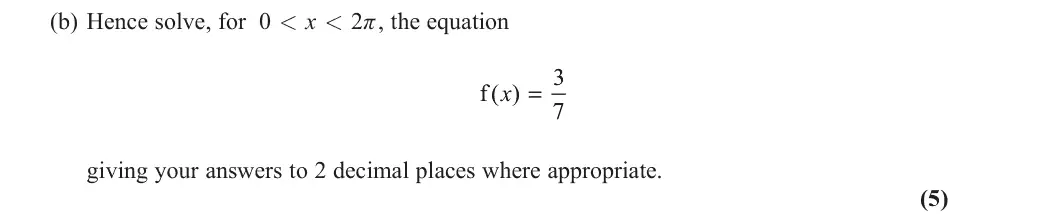
Oct 2020 · Paper 3A (Further Pure 1) · Q8(b)5 marks
Mark scheme (whole question; this part is marked with the orange bar)
Examiner's comment
Again, part a was easily accessible to most candidates and most correctly substituted the correct t – formulae for cos x and sin x. Most candidates were able to manipulate their expressions to ( ) + 2 3 1 t reach but then wrote down the given answer in completed square form with no + + 2 18 12 8 t t further justification, losing the final accuracy mark. It should be reiterated to students that though it is relatively straightforward to check that the two denominators are equivalent, as the answer is given, they should be showing intermediate working to reach the given answer or writing down some other form of justification. Part b was generally well done with some arithmetic errors leading to an incorrect quadratic and so incorrect values of t. Some candidates either did not continue to find values of x or used an incorrect method to find values of x from their values of t. Part c was attempted by a good number of candidates but no-one got full marks. Candidates were so focussed on the process of integration that they did not consider the limits carefully enough and did not spot that this was in fact an improper integral. A significant number of candidates did not make a complete substitution, omitting the substitution for dx, and so struggled to make any further progress. Of those that did make a complete substitution most ( ) t + arctan 3 1 K M obtained an integral of the correct form but there were many errors, the most common being to forget to apply the reverse chain rule and so have additional factor of 3. Candidates using a further substitution of u = 3t + 1 generally avoided this error.
Key points from the mark scheme and examiner's report
11t² + 12t + 1 = 0: t = −1, −1/11
x = 2arctan t + 2π for negative t: x = 3π/2 (4.71) and awrt 6.10
some did not convert t back to x correctly
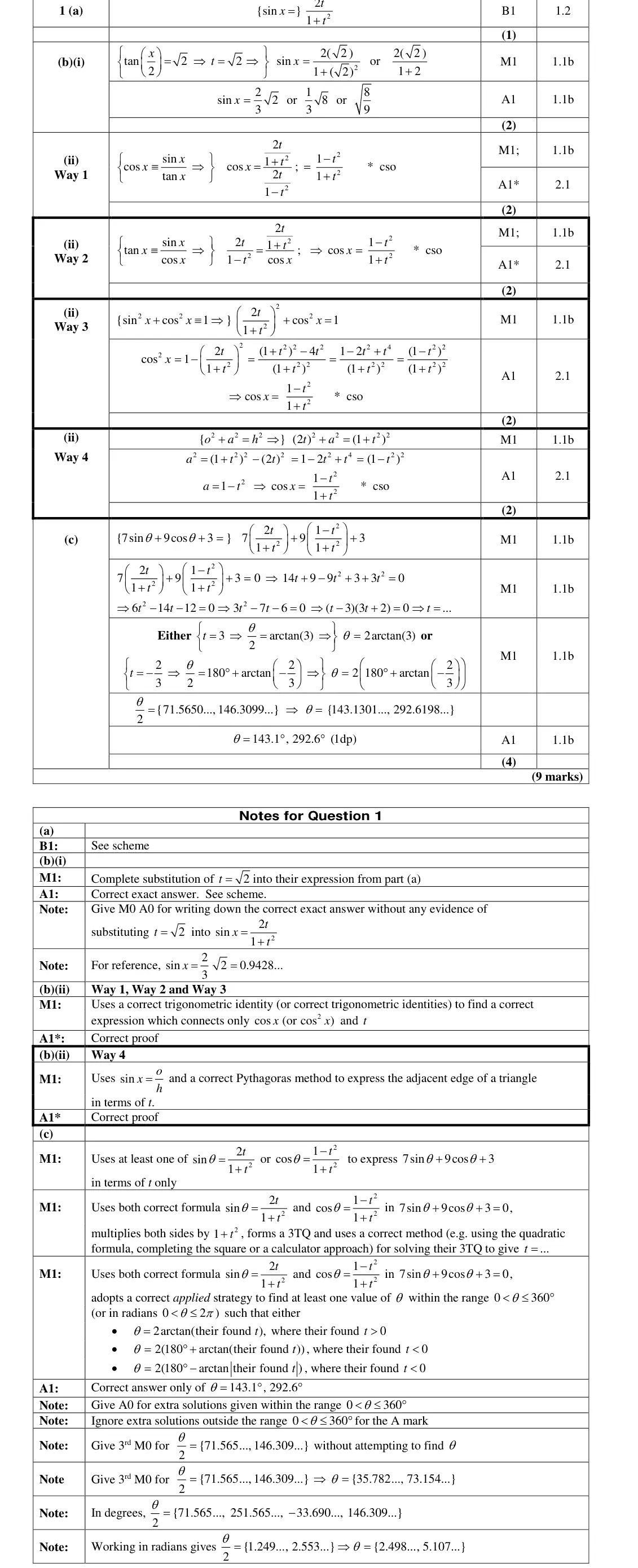
June 2019 · AS Paper 2 (Further Pure 1) · Q1(a)1 mark
Mark scheme (whole question; this part is marked with the orange bar)
Examiner's comment
2 edges 1, t and 1 , t did not receive any credit as they had not used their answer to part (a). 2 1 t cos x Some candidates received no credit because they attempted to verify that was 2 1 t t 2 . true, usually with In Q1(c), most candidates provided a fully correct solution to achieve both angles 2 1 t 2 t x Many substituted cos sin 143.1 , 292.6 . and their into the given 2 2 1 t 1 t 7sin 9cos 3 0. Nearly all candidates formed and attempted to solve a quadratic 2 tan , 3 equation in t. At this stage some candidates manipulated a correct to give 2 3 arctan( 2) arctan(6). an incorrect or Other candidates who achieved a correct {71.5650..., 146.3099...} then halved (rather than doubled) their results to give an 2 {35.8 , 73.1 ,...}. incorrect Other common errors included failing to round their final answers to one decimal place; premature rounding earlier on in their working which led a loss additional solutions found in the range 0 and ; 360 ; of accuracy in their value(s) for leaving their final answer(s) in radians. Some candidates used the alternative method of substituting their values of t into the t-formulae for sin or cos . Only a few of these candidates achieved both correct values for .
Key points from the mark scheme and examiner's report
sin x = 2t/(1 + t²) where t = tan(x/2)
nearly all correct
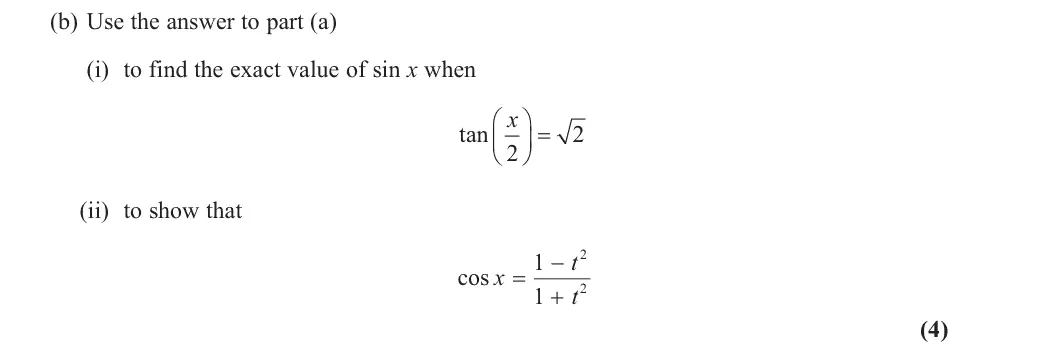
June 2019 · AS Paper 2 (Further Pure 1) · Q1(b)4 marks
Mark scheme (whole question; this part is marked with the orange bar)
Examiner's comment
Q1 was accessible with some candidates struggling to gain access to Q1(b)(ii). 2 t sin . x In Q1(a), nearly all candidates recalled a correct 2 1 t x t In Q1(b)(i), most candidates used tan 2 2 to deduce and substitute into their 2 answer from Q1(a). Many achieved sin x as an exact 2 2. 3 2 t 2 2 or applied sin cos 1 x x sin x In Q1(b)(ii), most candidates either applied to 2 1 t Pythagoras’ Theorem to a right-angled triangle with angle x, opposite edge 2t and 2 1 t hypothenuse . Some of these attempts contained incorrect algebra or were incomplete because of errors in forming and factorising a quartic expression or an error in using a sin x 2 t 2 t tan x 1. tan , x numerator of A few candidates applied with 2 cos x 1 t 2 1 t 2 t cos . x sin x and were generally more successful in showing that Those 2 2 1 t 1 t x x x 2 2 , cos cos sin x candidates who applied to a right-angled triangle with angle 2 2 2
Key points from the mark scheme and examiner's report
(i) t = √2 into the answer to (a): sin x = (2/3)√2, writing the value without substitution scores 0
(ii) must use (a), e.g. cos x = sin x/tan x with tan x = 2t/(1 − t²), or sin²x + cos²x = 1
verifying with t = √2 or using cos²(x/2) − sin²(x/2) scores 0
June 2019 · AS Paper 2 (Further Pure 1) · Q1(c)4 marks
Mark scheme (whole question; this part is marked with the orange bar)
Examiner's comment
Q1 was accessible with some candidates struggling to gain access to Q1(b)(ii). 2 t sin . x In Q1(a), nearly all candidates recalled a correct 2 1 t x t In Q1(b)(i), most candidates used tan 2 2 to deduce and substitute into their 2 answer from Q1(a). Many achieved sin x as an exact 2 2. 3 2 t 2 2 or applied sin cos 1 x x sin x In Q1(b)(ii), most candidates either applied to 2 1 t Pythagoras’ Theorem to a right-angled triangle with angle x, opposite edge 2t and 2 1 t hypothenuse . Some of these attempts contained incorrect algebra or were incomplete because of errors in forming and factorising a quartic expression or an error in using a sin x 2 t 2 t tan x 1. tan , x numerator of A few candidates applied with 2 cos x 1 t 2 1 t 2 t cos . x sin x and were generally more successful in showing that Those 2 2 1 t 1 t x x x 2 2 , cos cos sin x candidates who applied to a right-angled triangle with angle 2 2 2
Key points from the mark scheme and examiner's report
3t² − 7t − 6 = 0, t = 3 or −2/3
θ/2 = arctan t then double: θ = 143.1°, 292.6°
halving instead of doubling, θ = arctan t, extra solutions and radians all lost marks
June 2018 · AS Paper 2 (Further Pure 1) · Q1(a)3 marks
Mark scheme (whole question; this part is marked with the orange bar)
Examiner's comment
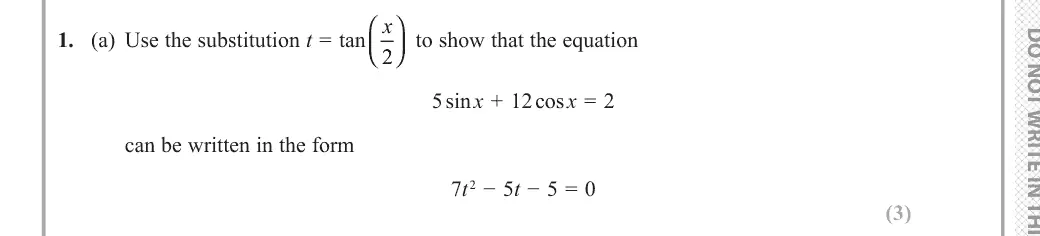
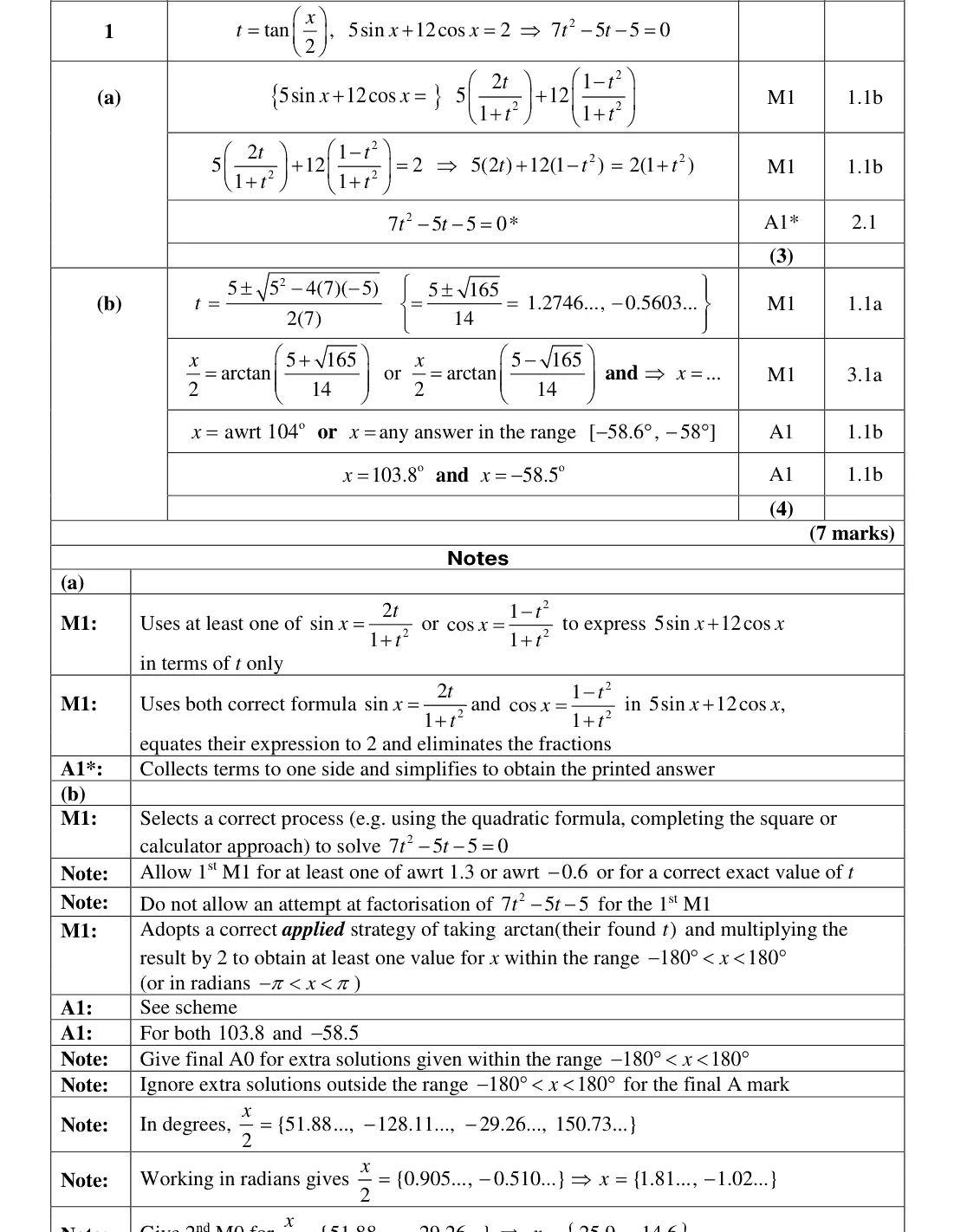
This was an accessible question with some students losing the final mark in part (b). In part (a), most students recalled 2 2 sin 1 t x t and 2 2 1 cos , 1 t x t where tan 2 x t and substituted these into the given 5sin 12cos 2. x x Nearly all students correctly manipulated 2 2 2 2 1 5 12 2 1 1 t t t t to give the required result 2 7 5 5 0. t t There were a few students who wrote down incorrect t-formulae for cos x such as 2 2 1 cos 1 t x t or 2 2 cos . 1 t x t
Key points from the mark scheme and examiner's report
substitute sin x = 2t/(1 + t²) and cos x = (1 − t²)/(1 + t²), multiply through by 1 + t² to reach the printed quadratic
some misremembered the cos x t-formula
June 2018 · AS Paper 2 (Further Pure 1) · Q1(b)4 marks
Mark scheme (whole question; this part is marked with the orange bar)
Examiner's comment
This was an accessible question with some students losing the final mark in part (b). In part (b), most students correctly solved the equation 2 7 5 5 0 t t by using the quadratic formula. At this stage some students manipulated a correct 5 165 tan 2 14 x to give an incorrect 5 165 arctan 7 x . Other students who achieved a correct 29.26412..., 51.88499... 2 x then halved (rather than doubled) their results to give an incorrect 14.6 , 25.9 . x It was pleasing that a significant number of students provided a fully correct solution to achieve both angles 58.5 , 108.5 x correct to one decimal place. Other common errors included failing to round their final answers to one decimal place; premature rounding earlier on in their working which led a loss of accuracy in their value(s) for x; rejecting negative values for x and additional solutions found in the range 180 180 . x A few students substituted their values for t into both 2 2 sin 1 t x t and 2 2 1 cos . 1 t x t Some were successful, but this method gave additional solutions and these were rarely eliminated.
Key points from the mark scheme and examiner's report
t = (5 ± √165)/14
x/2 = arctan t then DOUBLE (halving gave 25.9, −14.6)
x = 103.8°, −58.5°
extra solutions in range or premature rounding lose the final A mark
Find an Edexcel Further Maths tutor
Stuck on this? Book a trial lesson with our Further Maths tutor.