Notes, worked examples and practice for this topic are being written by our tutors. The past-paper questions below are ready now: work each one on paper, then open the mark scheme and the examiner's comment.
Tap a question to zoom it. Mark scheme and examiner's comment open under each question.
June 2025 · AS Paper 1 (Core Pure) · Q10(b)6 marks
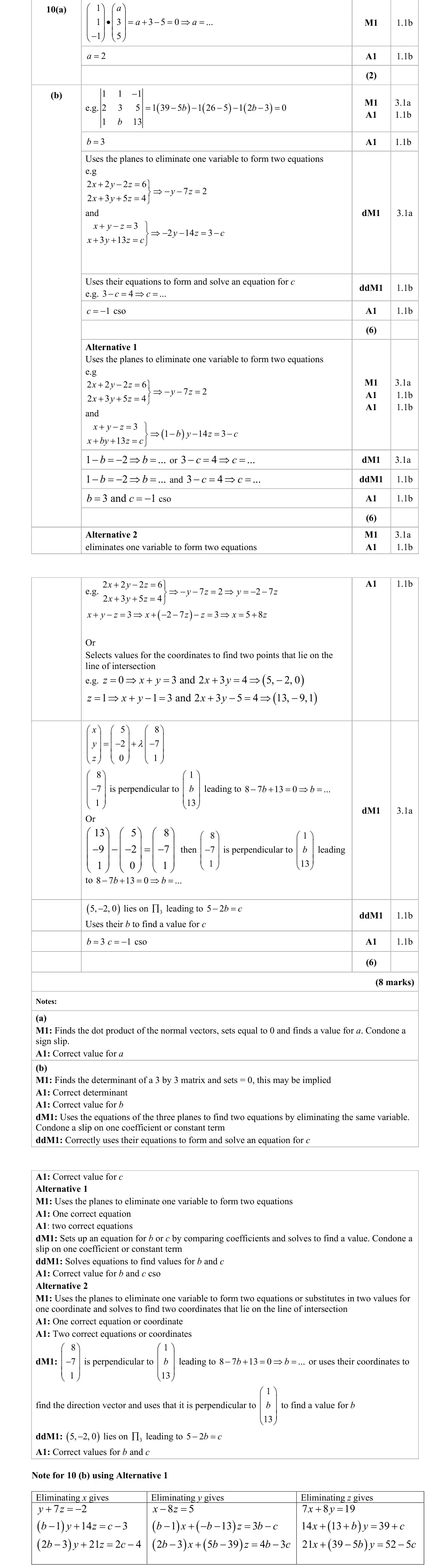
Mark scheme (whole question; this part is marked with the orange bar)
Examiner's comment
In part (b), the method used to find b was equally split between those who used the determinant of the 3x3 matrix formed from the normal vectors of the three planes and those who used the three plane equations to form two equations by eliminating one of the variables x, y or z. Either way, much success was achieved in finding both b and c but there was clear evidence that some of the learners were unclear of the definition of a sheaf and thus made little progress in their solution.
Key points from the mark scheme and examiner's report
sheaf: det of normals = 0 gives b = 3
eliminate a variable to get matching equations (−y − 7z = 2 and −2y − 14z = 3 − c): c = −1
confusion over what a sheaf means
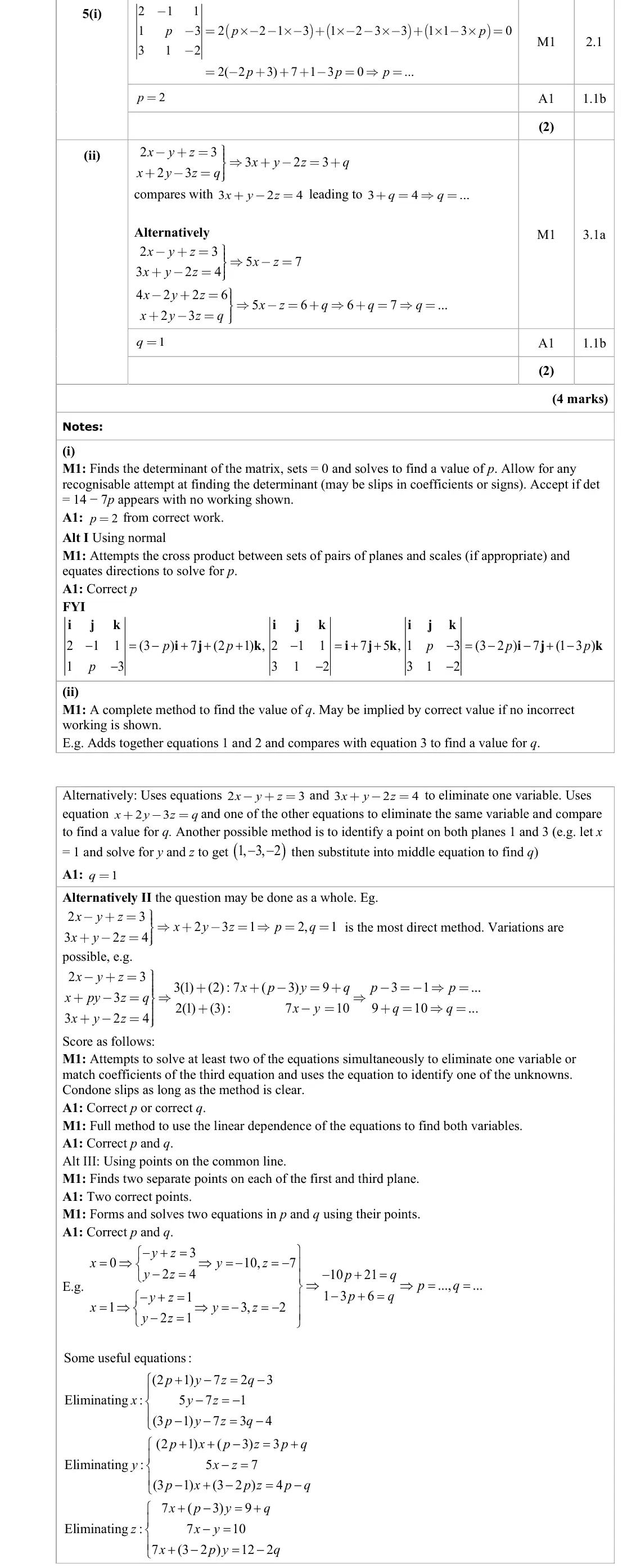
June 2025 · Paper 2 (Core Pure 2) · Q54 marks
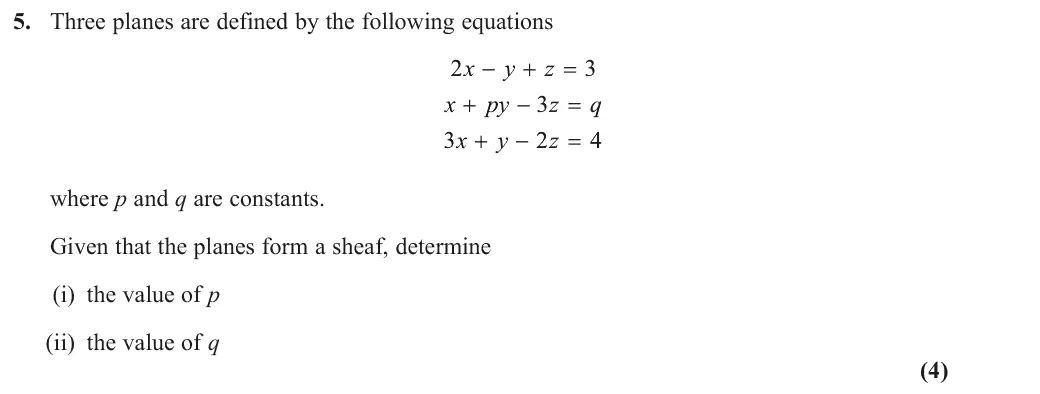
Mark scheme (whole question; this part is marked with the orange bar)
Examiner's comment
A deceptively simple looking question with a very efficient solution for those who appreciated the geometry of the situation and could see the third equation was the sum of the first two, this nevertheless produced a plethora of responses and proved difficult to mark. Most had an idea of what to do and tried to solve the equations simultaneously in some way, but with varying degrees of success. The most successful method used to find p was to form the matrix of the equations and set the determinant equal to 0. A few candidates found the determinant but failed to set it to zero. Once p was found, it was very much easier to find q and those candidates approaching the question this way had much more success. Most candidates knew that the equations had to be consistent and used this with their p to find q, though a few at this point instead reverted to solving the equations simultaneously, even though they had p. Many others went directly for the method of solving the equations, but many made slips causing problems, and so many managed to get method marks but lost the accuracy. Alternatively, to using the determinant, many learners were also able to find p and q by tackling the question as a whole, eliminating one variable and using linear dependence to find p and q. Occasionally candidates spotted the most direct method subtracting equation 1 from 3 and comparing coefficients with equation 2, but most took more convoluted roots, with varying degrees of success in eliminating one of p or q from the equations. Other methods were also used, with some successfully finding one point in common, or the common line, and solving from there. Some used the cross product to deduce the direction vector of the normal and used this in conjunction with the common line or with another normal direction from other equations. Various attempts at using vector or scalar products of various vectors formed from the equations were seen.
Key points from the mark scheme and examiner's report
sheaf: determinant of the coefficient matrix = 0 gives p = 2 (14 − 7p = 0)
spotting that row 3 = row 1 + row 2 is the efficient route
some found the determinant but did not set it to 0
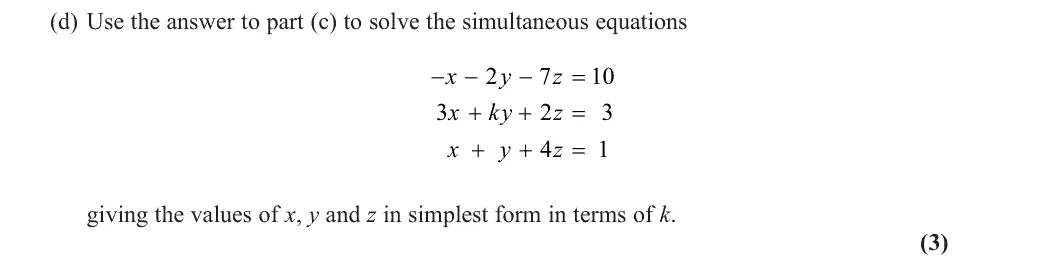
June 2024 · AS Paper 1 (Core Pure) · Q4(d)3 marks
Mark scheme (whole question; this part is marked with the orange bar)
Examiner's comment
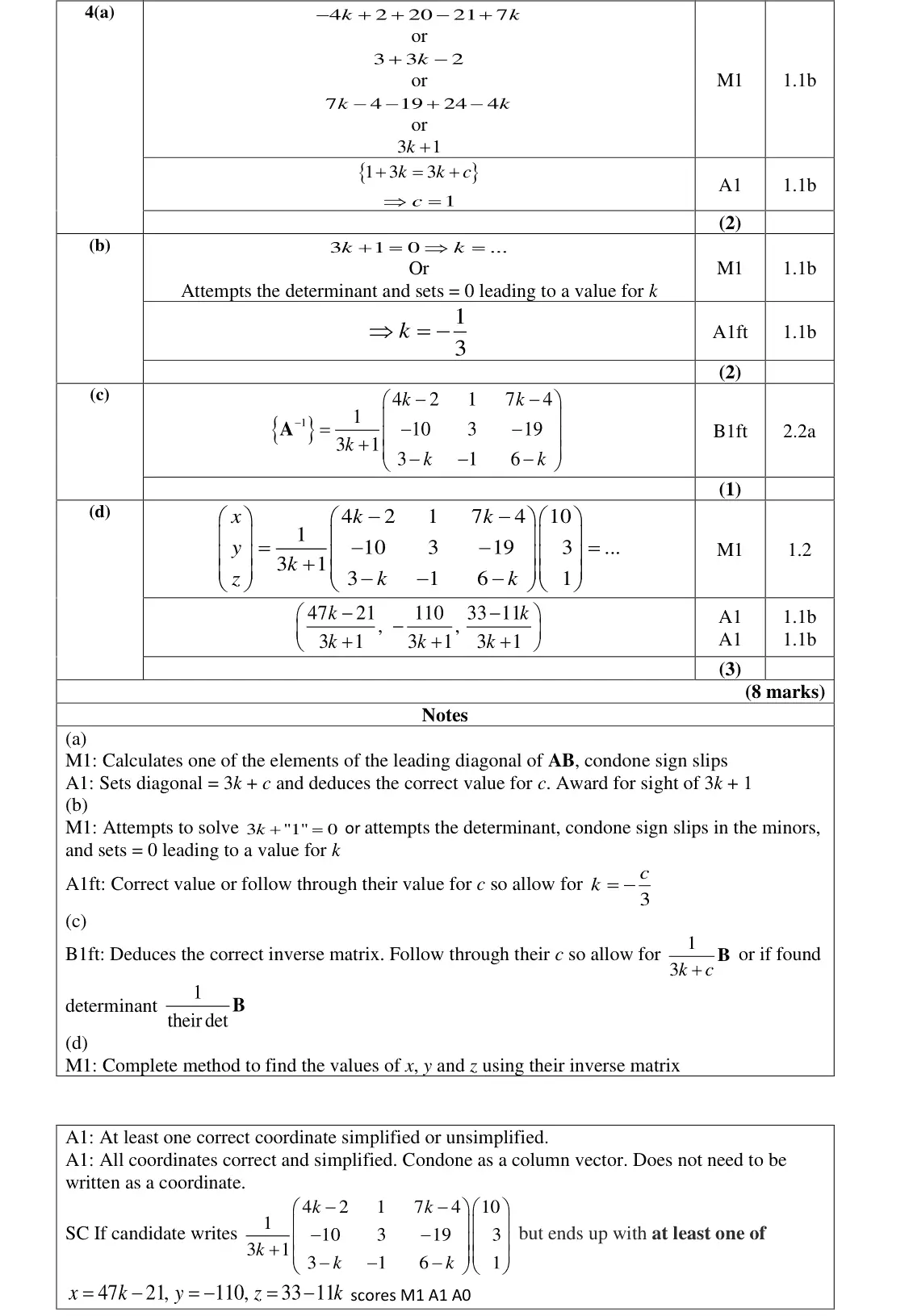
In part (d), the vast majority of the candidates converted the given system of equations into a matrix equation and then used their inverse matrix to correctly solve for x, y and z. Any marks lost here were mainly due to sign errors.
Key points from the mark scheme and examiner's report
multiply A⁻¹ by (10, 3, 1): x = (47k − 21)/(3k + 1), y = −110/(3k + 1), z = (33 − 11k)/(3k + 1)
sign errors
June 2024 · Paper 2 (Core Pure 2) · Q8(b)3 marks
Mark scheme (whole question; this part is marked with the orange bar)
Examiner's comment
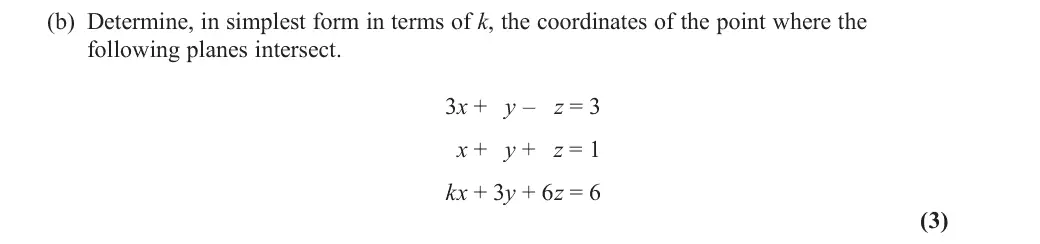
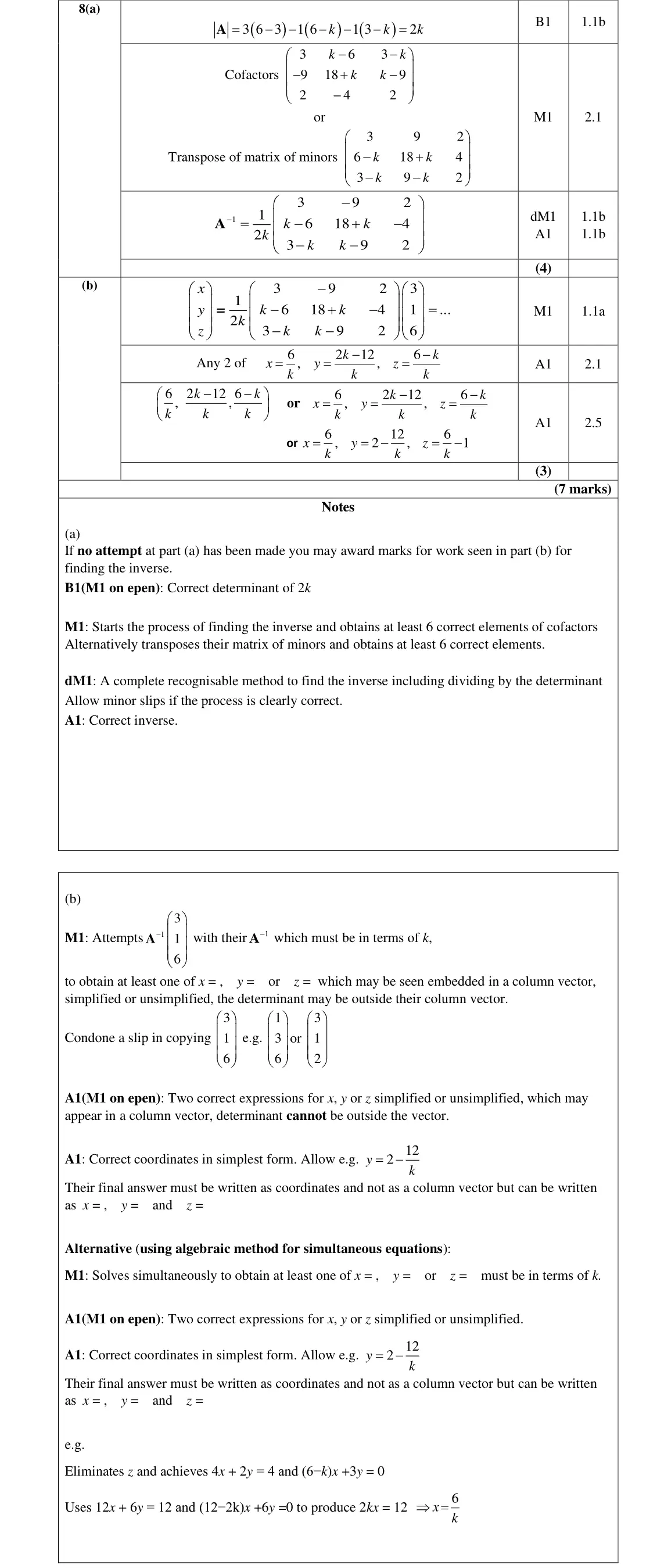
(b) Most candidates solved the equation by multiplying the vector 3 1 6 by their inverse. Those who used the matrix approach often did not achieve all the marks. This was due to an incorrect answer in part (a) or basic arithmetic errors in their matrix multiplication and subsequent algebraic simplification. Several candidates lost the final mark because they didn’t give their answer as coordinates. A smaller number gave un-simplified answers. Leaving the determinant outside the vector was another cause of marks lost. A few candidates opted instead for the elimination method for solving their three equations simultaneously, sometimes abandoning halfway through. Those who were successful with this approach had the advantage of writing their answers automatically in the correct form.
Key points from the mark scheme and examiner's report
determinant left outside the vector or answer left as a column vector lost the last mark
June 2023 · Paper 1 (Core Pure 1) · Q5(d)3 marks
Mark scheme (whole question; this part is marked with the orange bar)
Examiner's comment
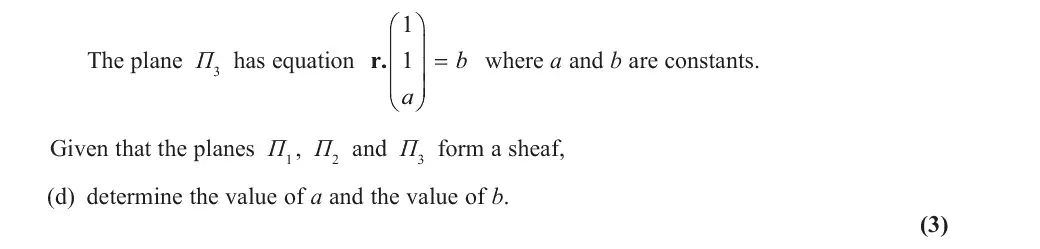
This question yielded a varied range of mark profiles and also saw a wide variety of methods employed in the different parts of the question. Many candidates were unsure of what to do in part (d) and did not attempt a solution. A common method was finding (often using earlier work) the vector equation of the second plane, then using consistency arguments by considering a linear combination of the equations of the three planes. Others candidates who had also established the three equations of the planes used a determinant method to find the value of a. However, these candidates were often unsure how to proceed to find the value of b. Again, the easier methods were seen quite rarely. Those with two points on the line of intersection were able to find the values of a and b very efficiently by substituting these position vectors into the equation of the third plane. A few candidates recognised that the normal to the third plane was perpendicular to the direction vector of their line of intersection found in part (c) and they used the scalar product to find the value of a. These candidates usually went on to use a point on the line of intersection to find b.
Key points from the mark scheme and examiner's report
a sheaf means the line from (c) lies in Π₃: direction perpendicular to (1, 1, a) gives a = −1, a point on it gives b = 2
often not attempted
determinant routes found a but stalled on b
June 2022 · AS Paper 1 (Core Pure) · Q1(b)3 marks
Mark scheme (whole question; this part is marked with the orange bar)
Examiner's comment
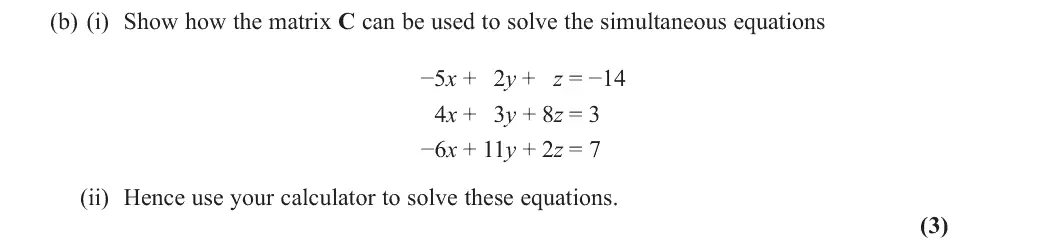
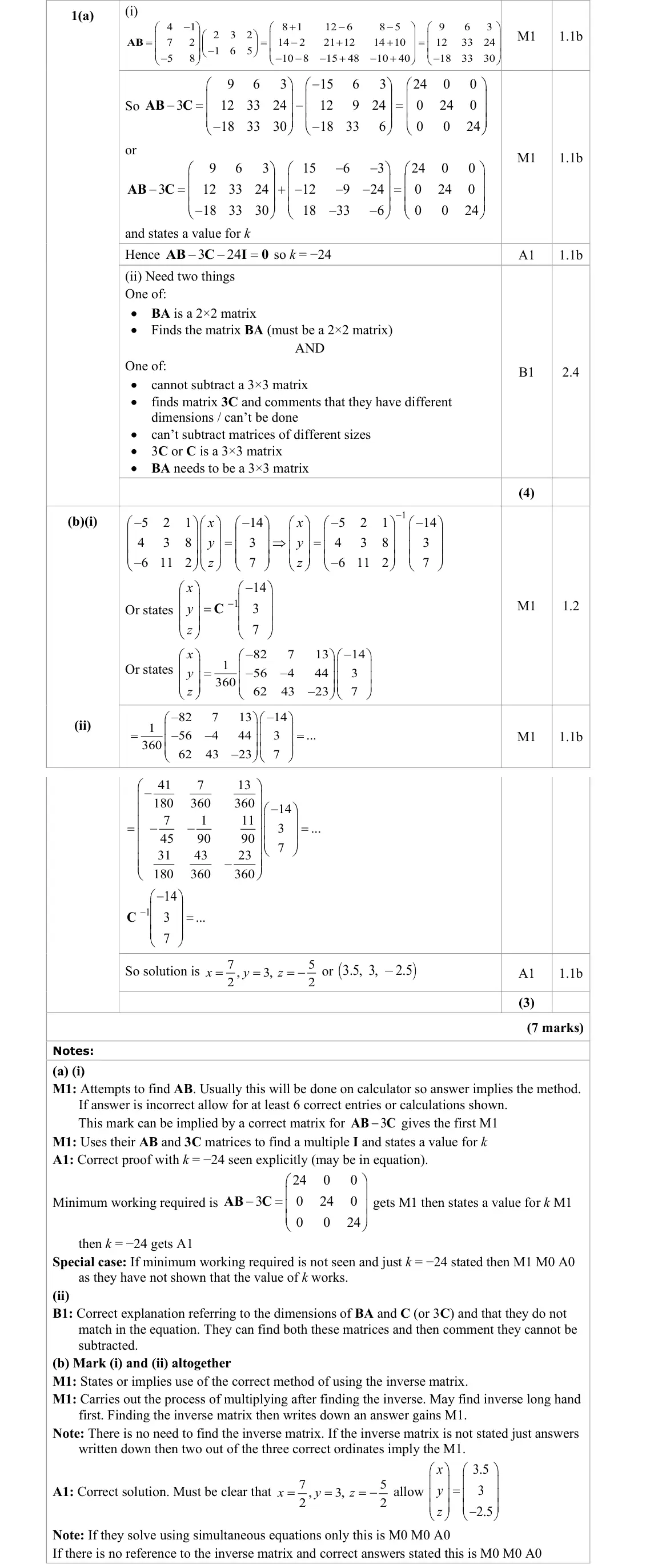
This was in general a very accessible question with the majority of candidates achieving 5 or more marks. All candidates managed to at least make an attempt on this question. For part (b) some of the successful candidates evaluated the matrix AB and concluded, however many just stated that AB was a 2 by 2 matrix and thus not possible to add to a 3 by 3 matrix. The most common misunderstanding for this part was that of the requirements of matrix multiplication with a number of candidates stating that AB was not possible to be calculated due to the dimensions. Part (c) was a very accessible question - most gained full marks. A small number of candidates used simultaneous equations and thus gained no marks since the questions asked for candidates to show how the matrix can be used to solve the equations. Some actually calculated the inverse going through all steps – whilst it is nice to see their ability it was a shame that these candidates had spent a lot of time disproportionate for the number of marks available. The question paper did say ‘Hence use your calculator…’ candidates are reminded that they can use their calculator to find inverse matrices and matrix algebra when matrices are fully numeric.
Key points from the mark scheme and examiner's report
write as C(x, y, z) = (−14, 3, 7) so (x, y, z) = C⁻¹(−14, 3, 7)
x = 3.5, y = 3, z = −2.5
solving by elimination or with no reference to the inverse scores 0
June 2022 · Paper 2 (Core Pure 2) · Q2(a)4 marks
Mark scheme (whole question; this part is marked with the orange bar)
Examiner's comment
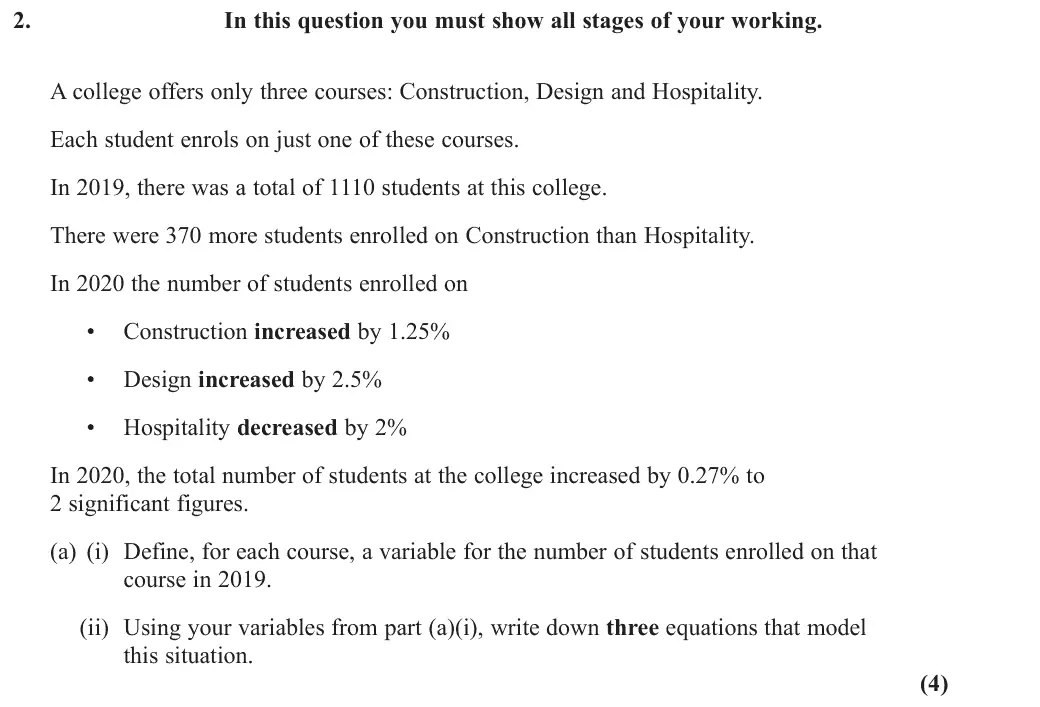
This question on a model involving matrices was generally well-answered, but there was less success in part (b). In part (a), a small number of students neglected to define variables or did so in a cursory fashion (e.g., “C = x”). Most, however, were able to produce a set of equations and these were often correct although there were incorrect multipliers seen for the percentage increases and decrease. ”H – C = 370” rather than “C – H = 370” was occasionally seen. 1110 was sometimes misread as 1100. Some tried to eliminate variables as they constructed the equations – this generally led to correct answers but tended to cause problems in part (b).
Key points from the mark scheme and examiner's report
define a variable for each course
C + D + H = 1110, C − H = 370, 1.0125C + 1.025D + 0.98H = 1113 (0.27% rise to 2 s.f. gives 1113)
wrong multipliers, H − C = 370, misreading 1110 as 1100
June 2022 · Paper 2 (Core Pure 2) · Q2(b)4 marks
Mark scheme (whole question; this part is marked with the orange bar)
Examiner's comment
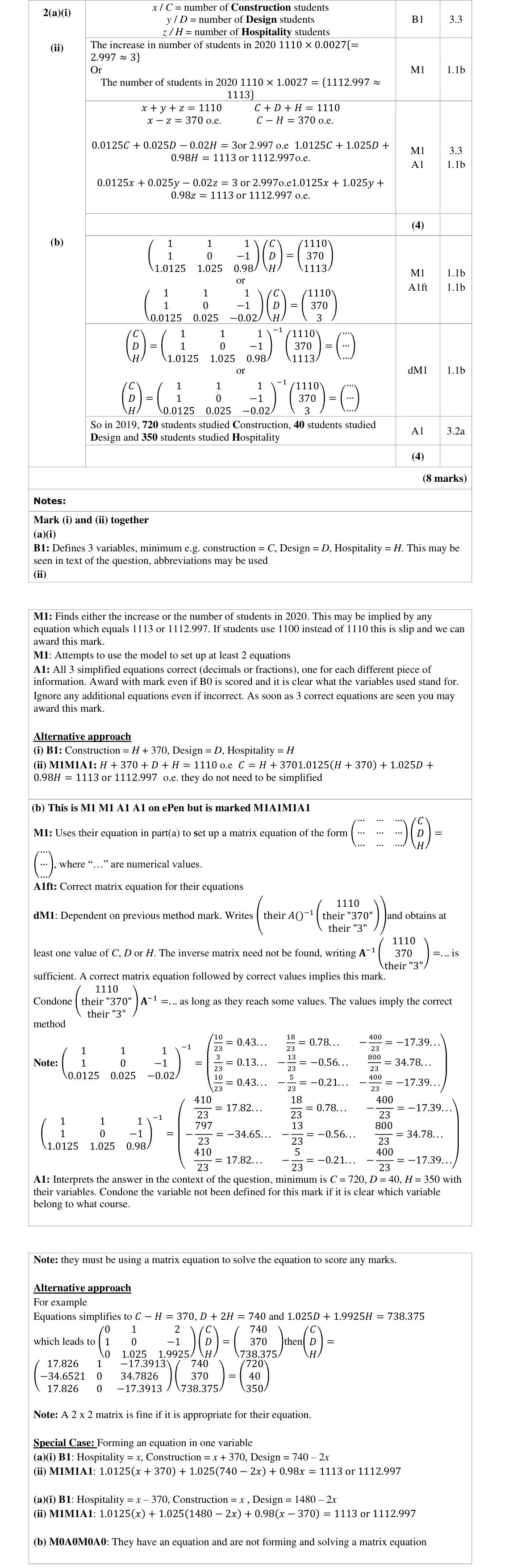
This question on a model involving matrices was generally well-answered, but there was less success in part (b). In part (b) most set up a matrix equation although some merely solved their set of linear simultaneous equations. The matrix equations tended to be correct for their equations and most knew that an inverse had to be obtained to solve for the variables. It was unfortunate to see manual attempts at matrix inversion – teachers and students are reminded that unless the question directs otherwise, it is expected that a matrix whose elements are fully numerical then a calculator can be used. A small number left their answer (sometimes unrounded) as a column vector instead of putting their values in context.
Key points from the mark scheme and examiner's report
must form and solve a matrix equation with the inverse (calculator inverse expected, manual inversion wastes time)
C = 720, D = 40, H = 350 given in context, not left as a column vector
solving simultaneous equations without matrices scores 0
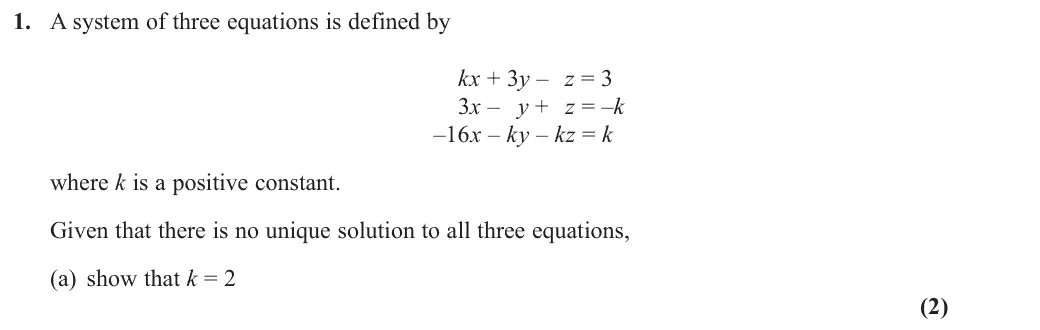
Oct 2020 · AS Paper 1 (Core Pure) · Q1(a)2 marks
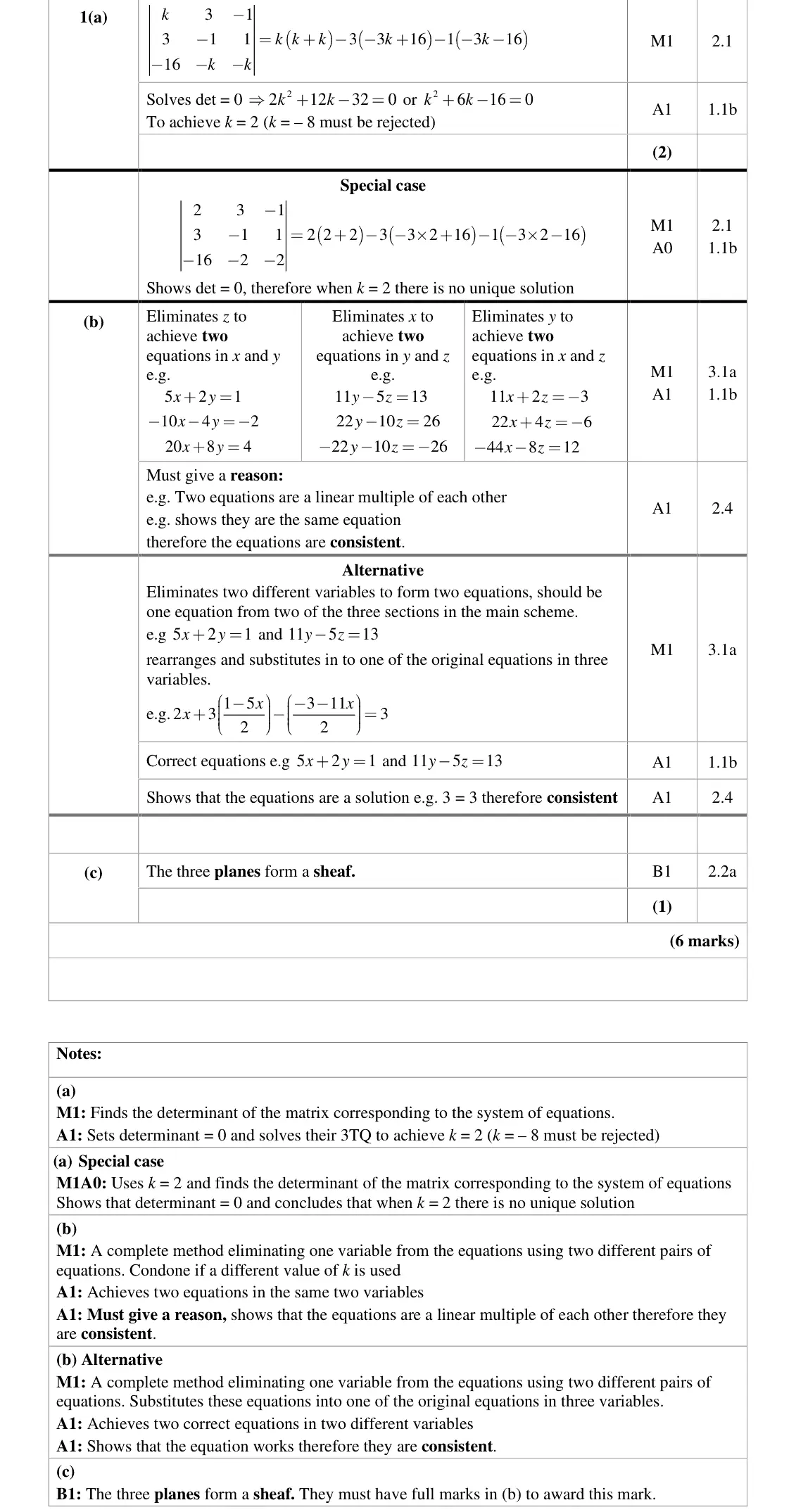
Mark scheme (whole question; this part is marked with the orange bar)
Examiner's comment
Very few students achieved full marks on this question. Many did not make any valid attempt for the full question. Part (a) the majority of candidates score full marks
Key points from the mark scheme and examiner's report
no unique solution means the coefficient matrix is singular: det = 2k² + 12k − 32 = 0, k² + 6k − 16 = 0
k = 2, reject k = −8 as k > 0
verifying det = 0 at k = 2 scores M1A0
Oct 2020 · AS Paper 1 (Core Pure) · Q1(b)3 marks
Mark scheme (whole question; this part is marked with the orange bar)
Examiner's comment
Very few students achieved full marks on this question. Many did not make any valid attempt for the full question. Part (b) the majority of candidates eliminated on variable to find two equation however many made arithmetic errors leading to inconsistent planes. These candidates did correctly go on to identify that would mean the planes form a prism but unfortunately this was not a B1ft.
Key points from the mark scheme and examiner's report
eliminate one variable from two pairs (e.g. 5x + 2y = 1 twice)
equations are multiples of each other so consistent
reason needed
arithmetic slips led to "inconsistent"
Oct 2020 · AS Paper 1 (Core Pure) · Q1(c)1 mark
Mark scheme (whole question; this part is marked with the orange bar)
Examiner's comment
Very few students achieved full marks on this question. Many did not make any valid attempt for the full question. Part (c) Most students did mention "planes" in their geometric description which is an improvement on last year.
Key points from the mark scheme and examiner's report
the three planes form a sheaf
needs full marks in (b)
Oct 2020 · Paper 2 (Core Pure 2) · Q6(b)3 marks
Mark scheme (whole question; this part is marked with the orange bar)
Examiner's comment
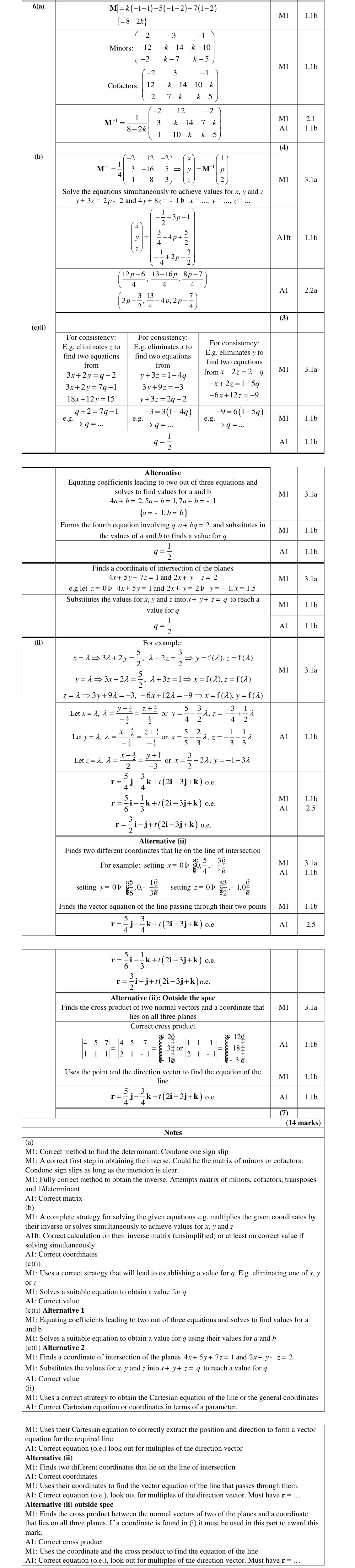
Part (b) This part was answer well with many using their inverse matrix found in part (a) to find the point of intersection. A few candidates attempted to solve the three simultaneous equations where algebraic error often occurred.
Key points from the mark scheme and examiner's report
use the inverse from (a) with k = 2 (det 4): (3p − 3/2, 13/4 − 4p, 2p − 7/4) as coordinates
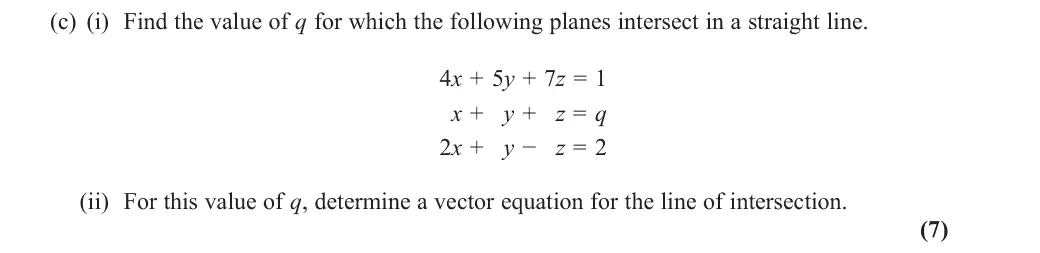
Oct 2020 · Paper 2 (Core Pure 2) · Q6(c)7 marks
Mark scheme (whole question; this part is marked with the orange bar)
Examiner's comment
Part (c) The part was only done successfully by a handful of candidates. Many candidates did not attempt this part. (i) a few eliminated a variable to fid two equations and formed an equation for q. An alternative method was to find a point of intersection by letting for example x = 1 and then using this to find a value for q (ii) Very few attempted this part. Correct answers were rarely seen using let x l = and finding y an z in terms of l and went on to find a correct vector equation of the line.
Key points from the mark scheme and examiner's report
M is singular for k = 4, so eliminate a variable to get two equations and a consistency condition: q = ½
(ii) set x = λ (or y or z) to get a parametric line, e.g. r = (3/2)i − j + t(2i − 3j + k)
rarely completed
June 2019 · Paper 2 (Core Pure 2) · Q7(b)5 marks
Mark scheme (whole question; this part is marked with the orange bar)
Examiner's comment
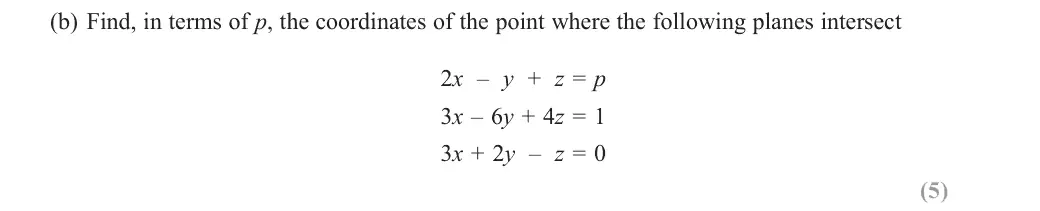
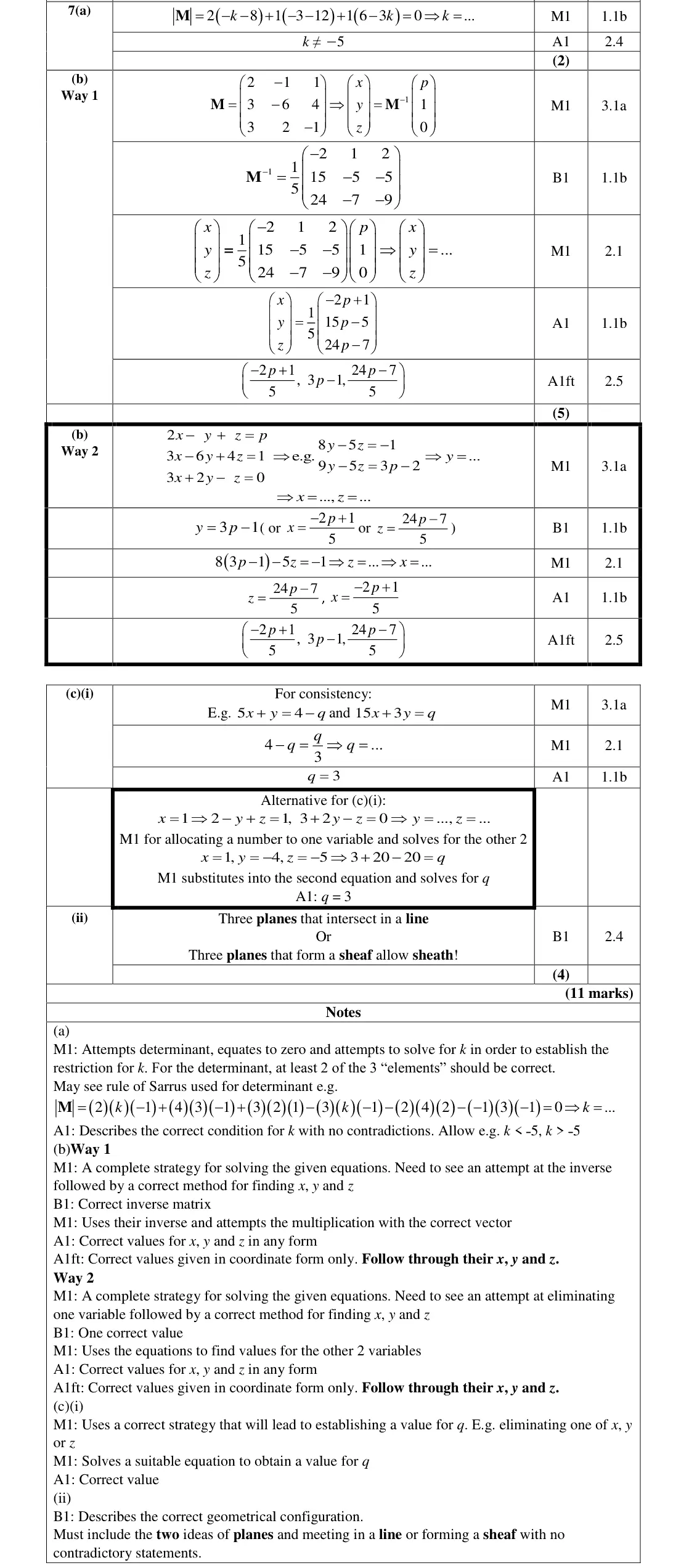
Part (b) required the point of intersection of three planes to be found and the most successful candidates used Way 1. It is acceptable to obtain an inverse of a matrix with no variables as elements using a calculator and it was unfortunate to see some embarking upon a step-by-step 1 method. This often led to errors such as omitting the det M multiplier. The correct inverse was seen fairly widely and the subsequent matrix multiplication was also often correct. This specification has an assessment objective for the use of correct notation so the point of intersection had to be given as coordinates. Those who chose to solve the system of equations were much less successful, with many unable to obtain x, y and z in terms of p (including a small number who attempted to find a value for p). Those who did not make any progress in (b) often left (c) unanswered but this part was still a reasonable source of marks for many. In part (i), correct strategies to obtain a value of q were common and although slips were evident, the correct q = 3 was often achieved. Weaker attempts tried to use an inverse, even with candidates who had scored both marks in (a). Part
Key points from the mark scheme and examiner's report
M⁻¹ with k = −6 (calculator allowed)
point ((−2p + 1)/5, 3p − 1, (24p − 7)/5) given as coordinates
omitting the 1/det factor
June 2019 · Paper 2 (Core Pure 2) · Q7(c)4 marks
Mark scheme (whole question; this part is marked with the orange bar)
Examiner's comment
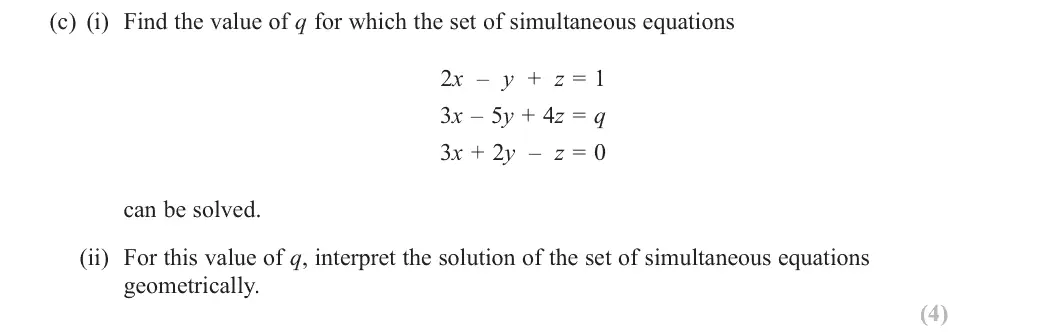
This matrix question also saw a wide range in the quality of response. In part (a) it was surprising to see a significant number of slips in obtaining an expression for the determinant. Most obtained an expression for det M conventionally although a few used the rule of Sarrus – usually correctly. A small number gave their answer as “k = 5” but the question required the values of k for which M had an inverse and not the value of k for which M was singular. Part (b) required the point of intersection of three planes to be found and the most successful candidates used Way 1. It is acceptable to obtain an inverse of a matrix with no variables as elements using a calculator and it was unfortunate to see some embarking upon a step-by-step 1 method. This often led to errors such as omitting the det M multiplier. The correct inverse was seen fairly widely and the subsequent matrix multiplication was also often correct. This specification has an assessment objective for the use of correct notation so the point of intersection had to be given as coordinates. Those who chose to solve the system of equations were much less successful, with many unable to obtain x, y and z in terms of p (including a small number who attempted to find a value for p). Those who did not make any progress in (b) often left (c) unanswered but this part was still a reasonable source of marks for many. In part (i), correct strategies to obtain a value of q were common and although slips were evident, the correct q = 3 was often achieved. Weaker attempts tried to use an inverse, even with candidates who had scored both marks in (a). Part (ii) required a geometric interpretation of the solution to the equations. Some neglected to mention “planes”. A few candidates did this successfully with a diagram. The unfortunate misspelling of “sheaf” was condoned!
Key points from the mark scheme and examiner's report
eliminate a variable to get a consistency condition: q = 3
(ii) three planes meeting in a line (a sheaf)
must mention planes
trying to use an inverse fails
June 2018 · AS Paper 1 (Core Pure) · Q1(b)2 marks
Mark scheme (whole question; this part is marked with the orange bar)
Examiner's comment
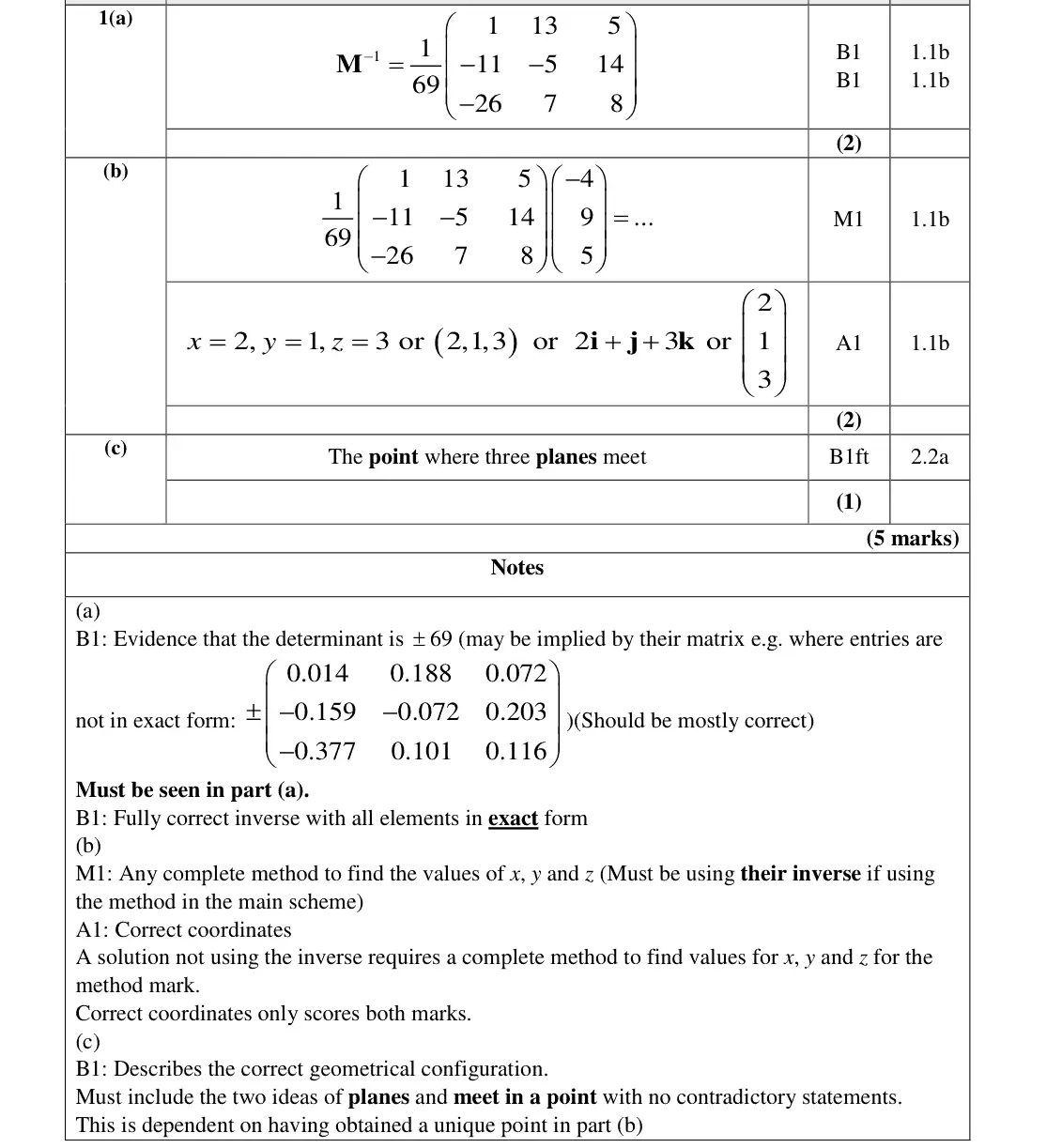
This question was generally well done with the majority gaining full marks for (a) and (b). (b) The majority of students used their inverse correctly to find the coordinates using a calculator. Some students chose a manual simultaneous equation method of solution, but this often led to errors. Others seem to have used a calculator to solve the simultaneous equations rather than take the inverse matrix approach.
Key points from the mark scheme and examiner's report
multiply their inverse by (−4, 9, 5): x = 2, y = 1, z = 3
manual elimination often led to errors
June 2018 · AS Paper 1 (Core Pure) · Q1(c)1 mark
Mark scheme (whole question; this part is marked with the orange bar)
Examiner's comment
This question was generally well done with the majority gaining full marks for (a) and (b). (c) There was some confusion with the demand here. Some students talked about intersecting lines and others referred to a sheaf or a prism. A few talked in vague terms about transformations and had clearly not understood the question and others left this part blank.
Key points from the mark scheme and examiner's report
three planes meeting at a single point
needs both "planes" and "point"
lines, sheaf or prism answers score 0
Find an Edexcel Further Maths tutor
Stuck on this? Book a trial lesson with our Further Maths tutor.