The perpendicular distance from a point to a plane is given. Angle and shortest-distance methods are not.
Since 2018
17 question parts, 55 marks, 1 with a difficulty rating from the examiner's report
Notes, worked examples and practice for this topic are being written by our tutors. The past-paper questions below are ready now: work each one on paper, then open the mark scheme and the examiner's comment.
Tap a question to zoom it. Mark scheme and examiner's comment open under each question.
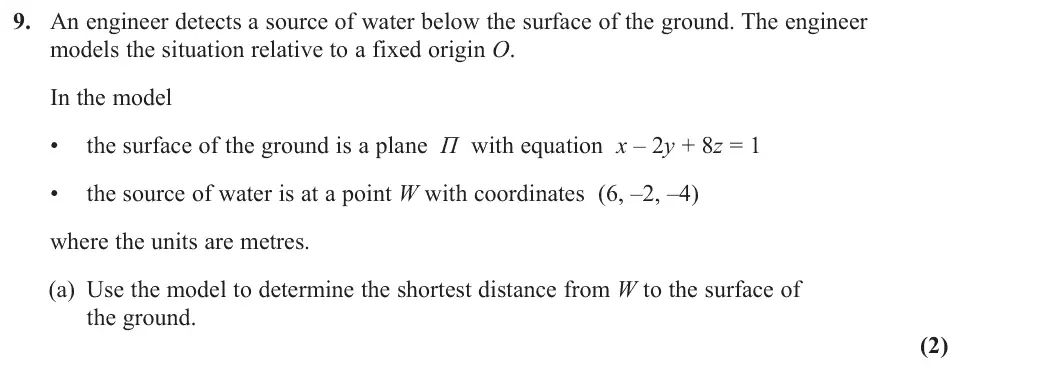
June 2025 · AS Paper 1 (Core Pure) · Q9(a)2 marks
Mark scheme (whole question; this part is marked with the orange bar)
Examiner's comment
This question was well answered with many completely correct solutions. In part (a), the common approach was to use the formula for the perpendicular distance of a point from a plane and was usually completed successfully. A common error was using +1 instead of – 1 for the value of + d. An allowable approach taking longer to complete used a more basic method starting with the parametric equation of the line, using the condition that the line is normal to the plane to find the coordinates of the foot of the perpendicular and then finding the length of the perpendicular. This was the work intended for part (c). To achieve credit in (c) there needed to be some acknowledgement that this earlier work was relevant.
Key points from the mark scheme and examiner's report
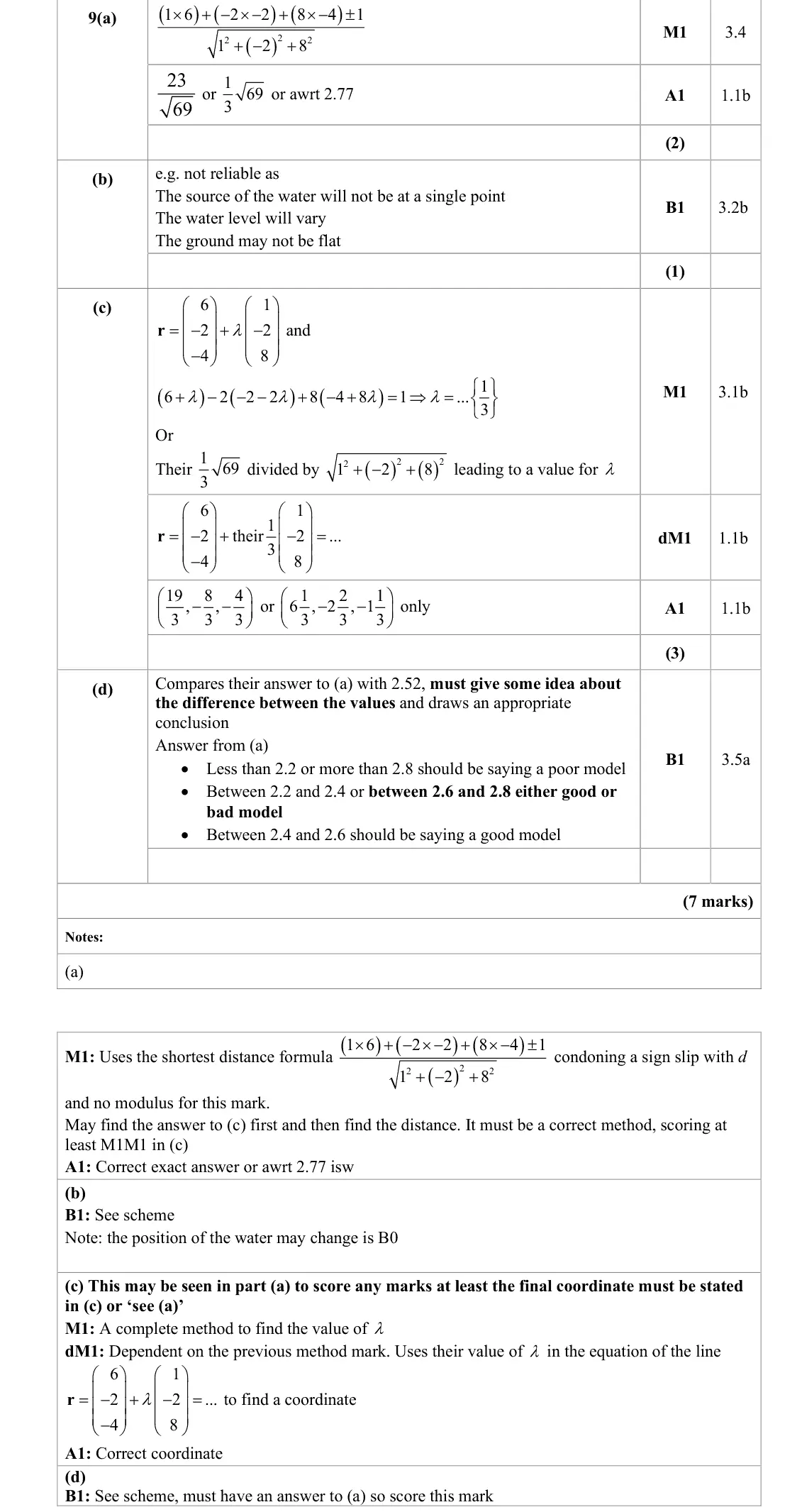
point-to-plane formula: modulus of (6 + 4 − 32 − 1)/√69 = 23/√69 ≈ 2.77 m
+1 for d a common sign error
June 2025 · AS Paper 1 (Core Pure) · Q9(b)1 mark
Mark scheme (whole question; this part is marked with the orange bar)
Examiner's comment
This question was well answered with many completely correct solutions. The reasons in part (b) usually referred to the flatness of the ground or that the water may not be at a single point. Responses such as the source of the water may not be at the given point did not receive credit. A few learners said that it was reliable as they had found the perpendicular distance not commenting on the model.
Key points from the mark scheme and examiner's report
not reliable: the water source is not a single point, water level varies, ground not flat
June 2025 · AS Paper 1 (Core Pure) · Q9(c)3 marks
Mark scheme (whole question; this part is marked with the orange bar)
Examiner's comment
This question was well answered with many completely correct solutions. Part (c) was usually well answered. Only rarely did learners resort to decimals in their final answers. An error when substituting the parametric form of the point into the plane was to equate the scalar product to 1 rather than 0 so losing all marks in this part.
Key points from the mark scheme and examiner's report
line through W along the normal (1, −2, 8) meets the plane at λ = 1/3: P = (19/3, −8/3, −4/3)
June 2025 · AS Paper 1 (Core Pure) · Q9(d)1 mark
Mark scheme (whole question; this part is marked with the orange bar)
Examiner's comment
This question was well answered with many completely correct solutions. In part (d) a comparison of the answer to (a) with 2.52 was required to comment on the appropriateness of the model. The comparison has to look at the difference between the two values in some way to draw an appropriate conclusion. This may be explicit value, a percentage or something similar but not just a statement like 2.77 > 2.52.
Key points from the mark scheme and examiner's report
compare 2.77 with 2.52 (difference or % error) and conclude
just "2.77 > 2.52" scores 0
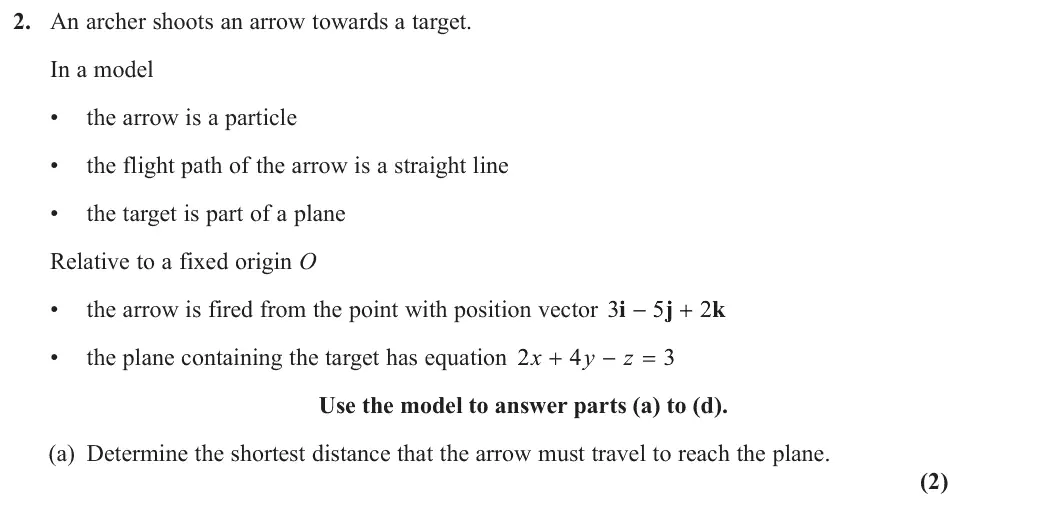
June 2025 · Paper 2 (Core Pure 2) · Q2(a)2 marks
Mark scheme (whole question; this part is marked with the orange bar)
Examiner's comment
In contrast to question 1, this was very well answered overall, proving to be an accessible vector model question, which traditionally causes problems. The context was straightforward enough to not obscure what was needed and learners made good progress with many identifying the shortcoming of the model at the end. Part (a) was mostly very well done, with almost all learners using the correct formula, to attempt the distance. Alternative approaches were rare and the most common errors were slips in copying one vector entry, or arithmetic slips when simplifying. Another common error was with the “ d -” in the numerator where some responses missed the d completely and others made a sign error on it. There was a small proportion of learners who used a wrong vector in the formula (such as using the 3 3 + - i j k or the 6 2 - + i j k too early in the question), but these were infrequent.
Key points from the mark scheme and examiner's report
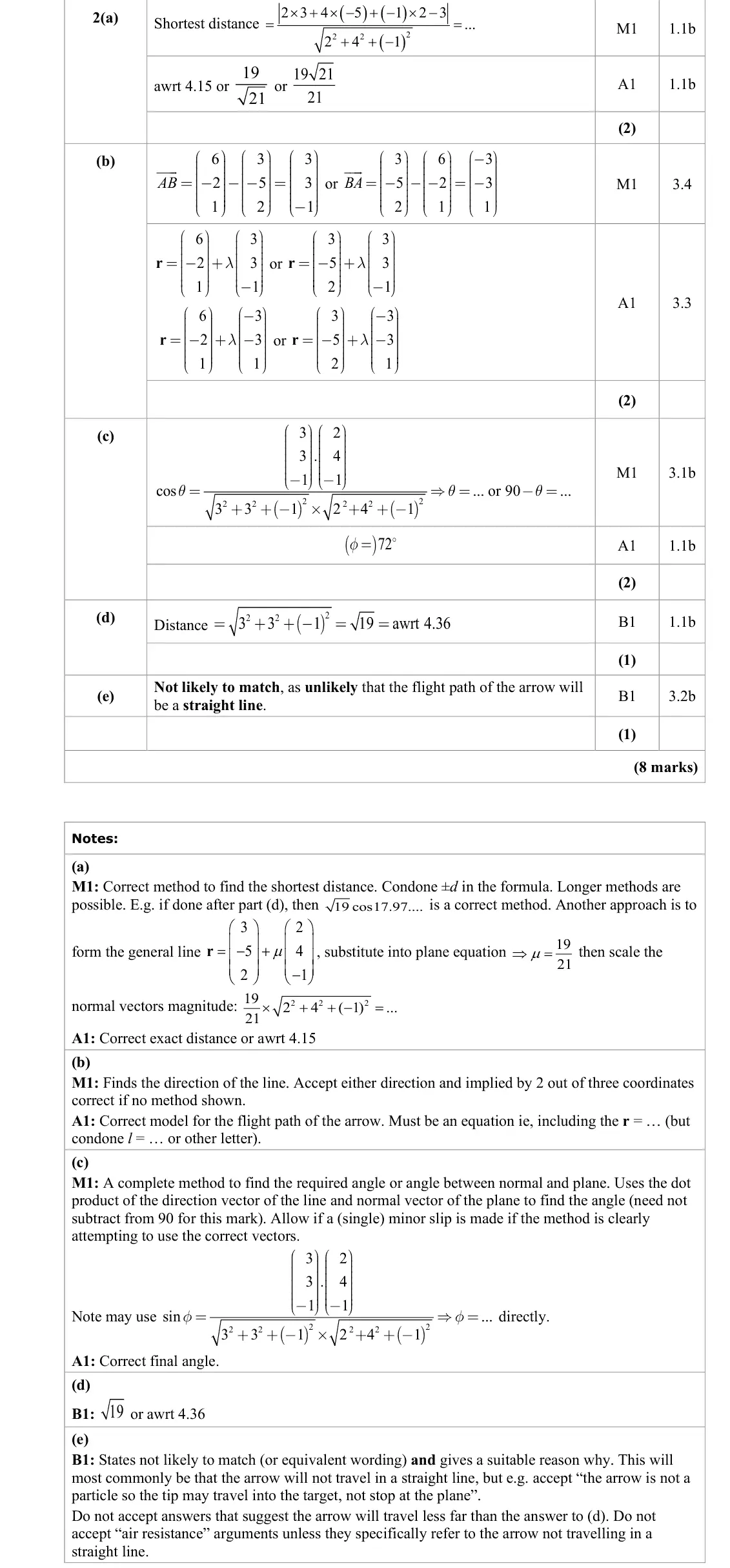
point-to-plane distance formula: 19/√21 ≈ 4.15
missing or wrong sign of d
copying slips
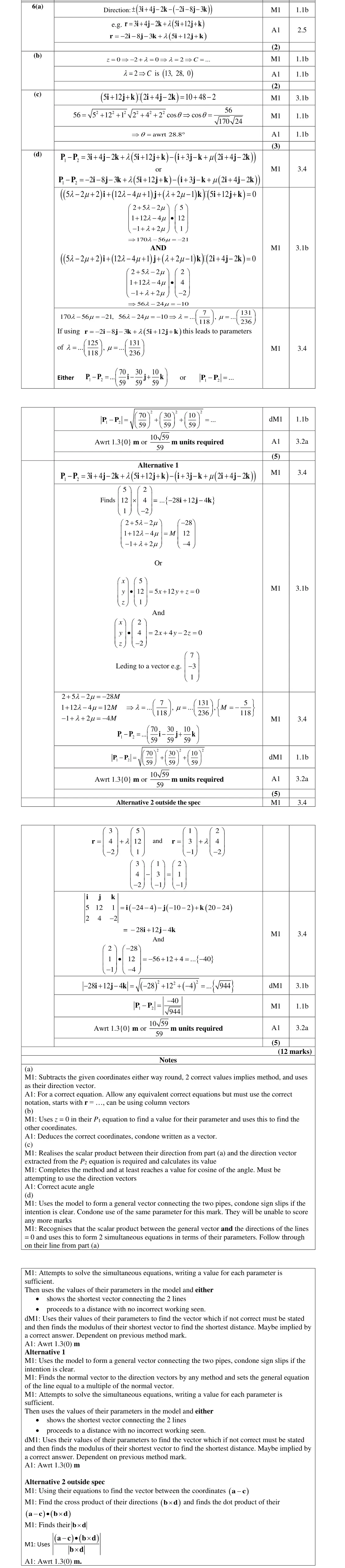
June 2024 · AS Paper 1 (Core Pure) · Q6(d)5 marks
Mark scheme (whole question; this part is marked with the orange bar)
Examiner's comment
In part (d), many of the candidates found this part the most demanding on the entire paper and struggled to make much progress. The need to find a general vector which connects the two pipes was identified by many of the cohort but then some went on to find inappropriate scalar products and thus lost both method and accuracy marks. A pleasing number of candidates did find the correct scalar products and went on to find the required shortest distance, even though the calculations did involve non-routine fractions such as 7 118 and 131 236 . A few of the cohort found the distance using a method, outside of the specification, involving vector products which was perfectly acceptable here.
Key points from the mark scheme and examiner's report
general vector between the pipes perpendicular to both directions gives two simultaneous equations
distance awrt 1.30 m (10√59/59), units needed
most demanding part of the paper
June 2023 · Paper 1 (Core Pure 1) · Q5(a)2 marks
Mark scheme (whole question; this part is marked with the orange bar)
Examiner's comment
This question yielded a varied range of mark profiles and also saw a wide variety of methods employed in the different parts of the question. In part (a), the vast majority of candidates achieved full marks by substituting the parametric form of the line into the plane equation to find a value for their parameter. They then substituted this value into the equation of their line to find the coordinates of the point of intersection. A few attempted to rearrange the Cartesian equation of the line to express y and z in terms of x and then substituted these expressions into the equation of the plane to find the value of x (then finding y and z).
Key points from the mark scheme and examiner's report
substitute the parametric line into the plane: λ = −2, point (−7, 2, −7)
correct answer only scores 0
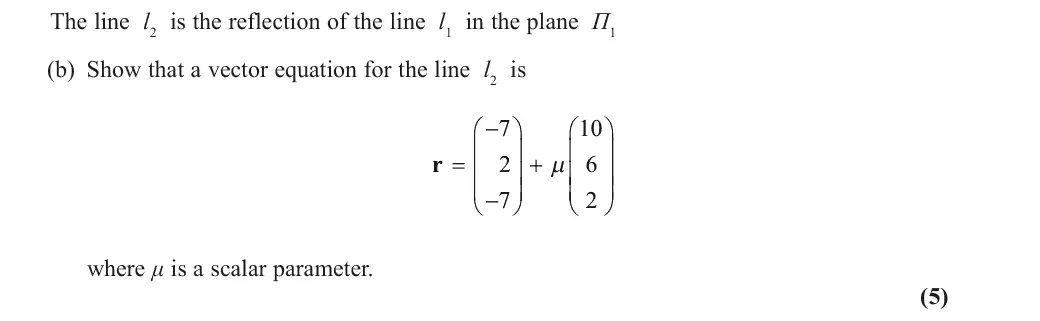
June 2023 · Paper 1 (Core Pure 1) · Q5(b)5 marks
Mark scheme (whole question; this part is marked with the orange bar)
Examiner's comment
This question yielded a varied range of mark profiles and also saw a wide variety of methods employed in the different parts of the question. In part (b), the majority of candidates executed their solutions competently to achieve the given result. Most set up the equation of a new line using the normal to the plane and a point on the given line (usually (–5, -4, 3)) and attempted to find the value of their parameter where this line met the plane. They then proceeded to find the image point and the equation of the line as required. Those who had used an initial point other than (-5, -4, 3) generally realised that their resulting direction vector was a multiple of the required direction vector. When writing the equation of the reflected line, a significant number did not write “r =” (despite it being a given result), either omitting it entirely or writing e.g. l2 = . This omission lost them the final accuracy mark. A relatively small number of candidates identified a point on l1 and found the perpendicular distance from this point to the plane. Many did not progress any further, but some went on to gain full marks by considering the modulus of the normal to the plane which in turn enabled them to identify the image point and ultimately the equation of the line as required. A few candidates found the angle between the line and the plane, but this very rarely resulted in any creditworthy work.
Key points from the mark scheme and examiner's report
line through (−5, −4, 3) along the normal meets the plane at t = 2, so the mirror image point is (3, 8, −5)
direction from (−7, 2, −7)
must write r = for the given answer
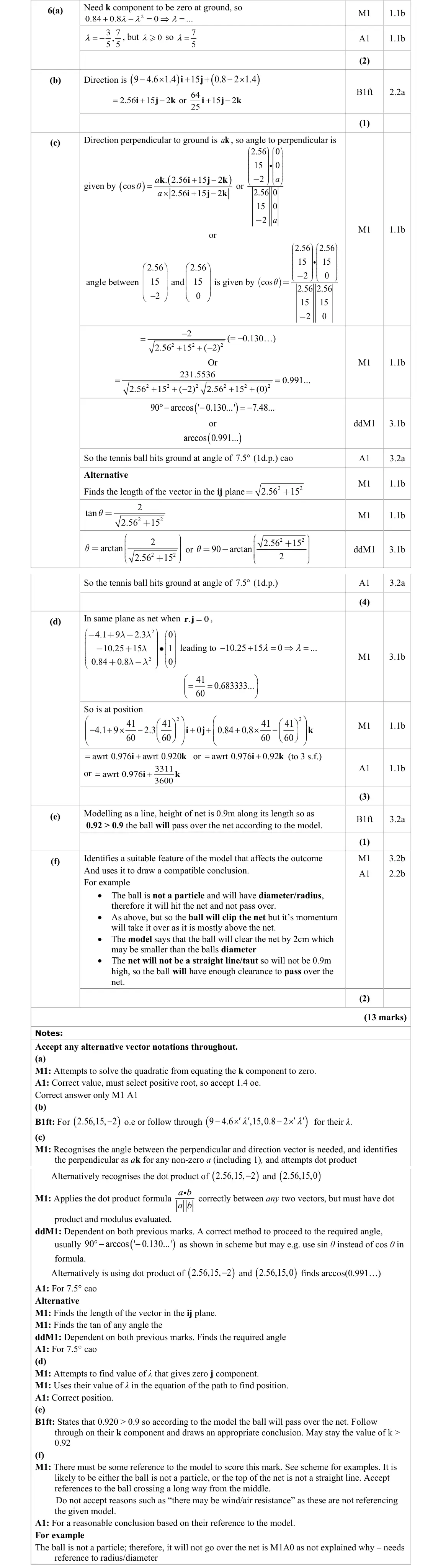
June 2022 · AS Paper 1 (Core Pure) · Q6(d)3 marks
Mark scheme (whole question; this part is marked with the orange bar)
Examiner's comment
This question, which required candidates to work with a model of a tennis ball, proved quite challenging for candidates and tested their ability to apply vector methods to a real-life scenario. There was a great deal of confusion between the position vector of the tennis ball and the direction vector for which it was moving, and less confident students mixed these up frequently. Part (d) was similarly mixed for the same reasons as the errors in (b), although some candidates picked up the second method mark for using their new value of λ in the correct vector expression. Some candidates lost the final accuracy mark due to calculation errors or a lack of accuracy in the i component.
Key points from the mark scheme and examiner's report
r.j = 0 gives −10.25 + 15λ = 0, λ = 41/60
position awrt 0.976i + 0.920k
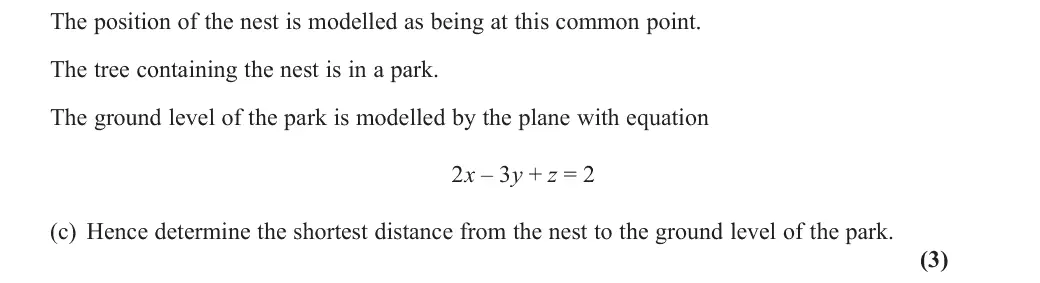
June 2022 · Paper 2 (Core Pure 2) · Q8(c)3 marks
Mark scheme (whole question; this part is marked with the orange bar)
Examiner's comment
This question on a vector model was well-answered although completely correct solutions across all question parts were not that common. In part (c), using the result in formula book was the most common approach but a few did succumb to errors in substitution or had the wrong sign of the constant from the plane equation. Finding the length of the line from the nest to the ground in the direction of the normal to the plane was not common and led to confusion for many who tried it. Parallel plane approaches were generally numerically correct but often involved sign errors when combining the two values.
Key points from the mark scheme and examiner's report
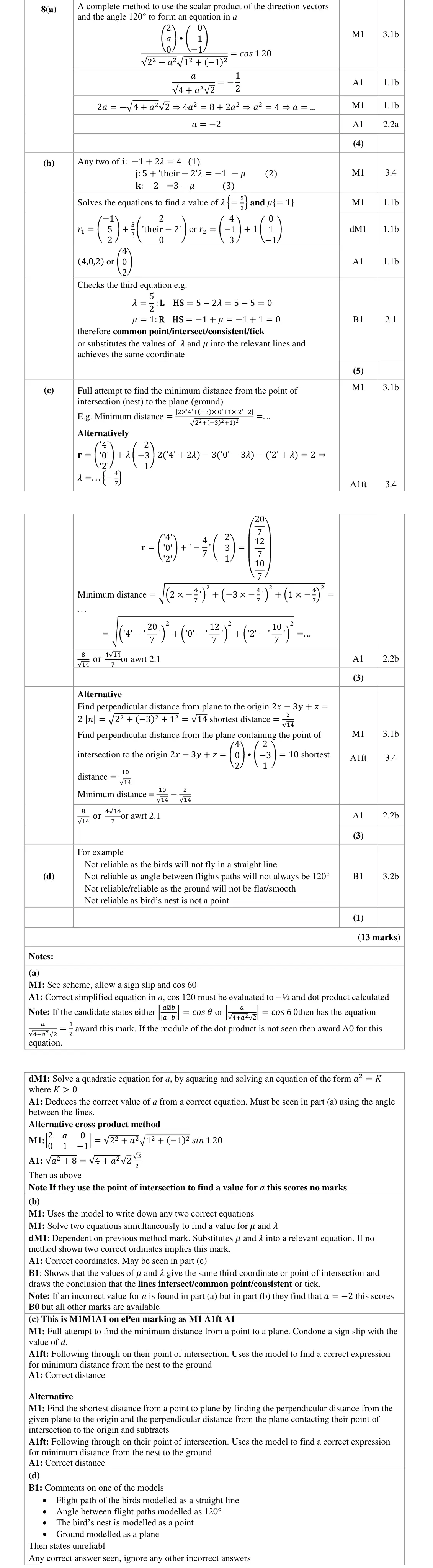
distance from (4, 0, 2) to 2x − 3y + z = 2: modulus of 8 − 2 over √14 → 8/√14 = 4√14/7 ≈ 2.14
sign errors with the plane constant
Nov 2021 · Paper 1 (Core Pure 1) · Q7(c)4 marksMedium
Mark scheme (whole question; this part is marked with the orange bar)
Examiner's comment
There was a step up in difficulty from this question in the paper, perhaps a tail off towards the end of the exam, but the performance was not as high on the next (c) A very few candidates gained full marks for this part of the question, though a generous second method mark gave access to some candidates. Most did not know how to begin, with many not attempting it at all. The most common successful method was as in the main scheme. Those who did apply the perpendicular distance formula were usually able to find a value for t, but the majority only gave one value, with 25% success on the first mark dropping to less than 10% for the second. Those who got that far were usually able to gain the next, generous, M mark for finding a set of coordinates for A. Some found the point of intersection of the line and the plane but these attempts usually only scored the second M mark, with 36% accessing this mark, since they assumed this was the value of t that was required. Those who did achieve two correct values for t almost always went on to find both sets of coordinates.
Key points from the mark scheme and examiner's report
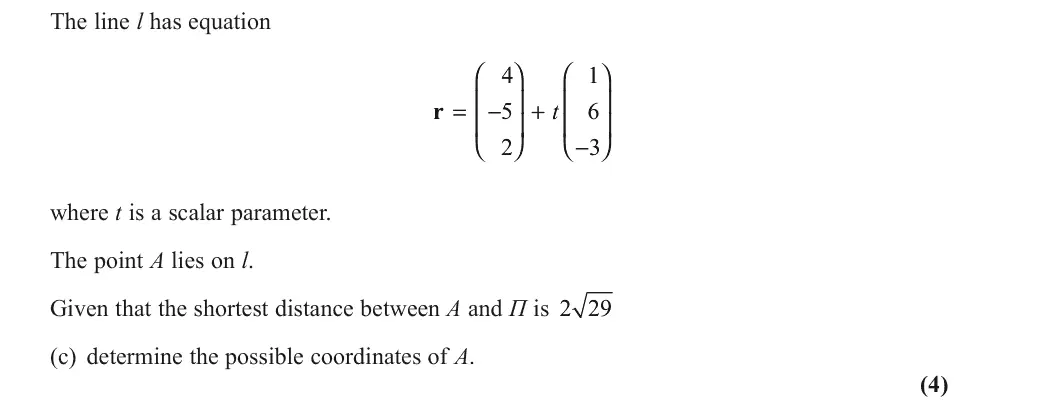
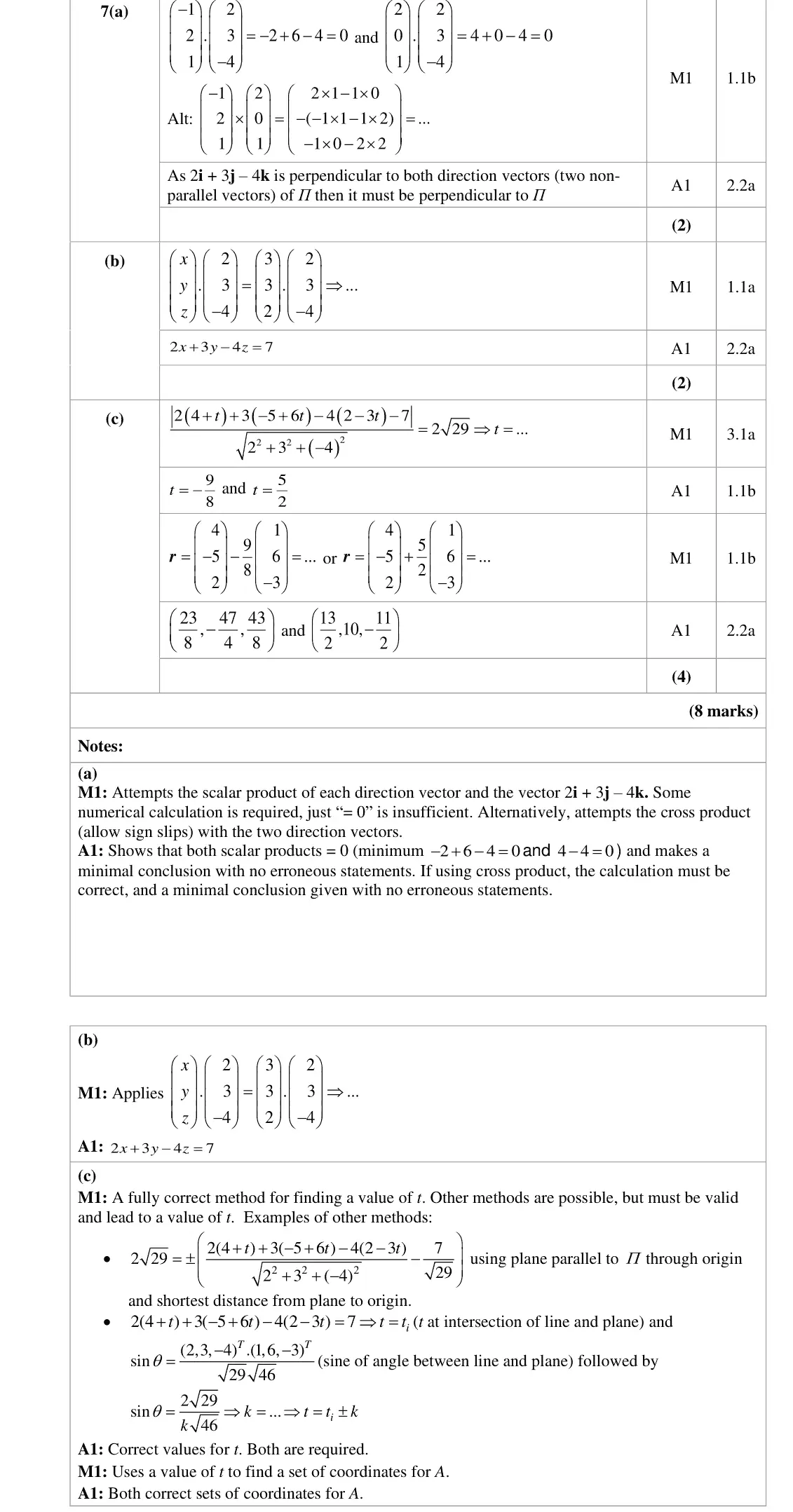
perpendicular distance from (4 + t, −5 + 6t, 2 − 3t) to the plane = 2√29 gives modulus of 29t − 36 = 58, t = −9/8 or 5/2
A = (23/8, −47/4, 43/8) or (13/2, 10, −11/2)
most gave only one value
Oct 2020 · Paper 1 (Core Pure 1) · Q4(b)3 marks
Mark scheme (whole question; this part is marked with the orange bar)
Examiner's comment
(b) The easiest approach to this part was to use the parametric form for the line and to substitute into their Cartesian equation to find a value for the parameter, and most chose to use this method. Those who had not managed to do part (a) were still able to gain full marks in part (b) by using the parametric form for both the line and the plane. Some then used their calculators to solve their three equations in three unknowns successfully, which was fine. Most then substituted back into the line to find the correct intersection. Those who used the same parameter in both line and plane unfortunately gained no marks here.
Key points from the mark scheme and examiner's report
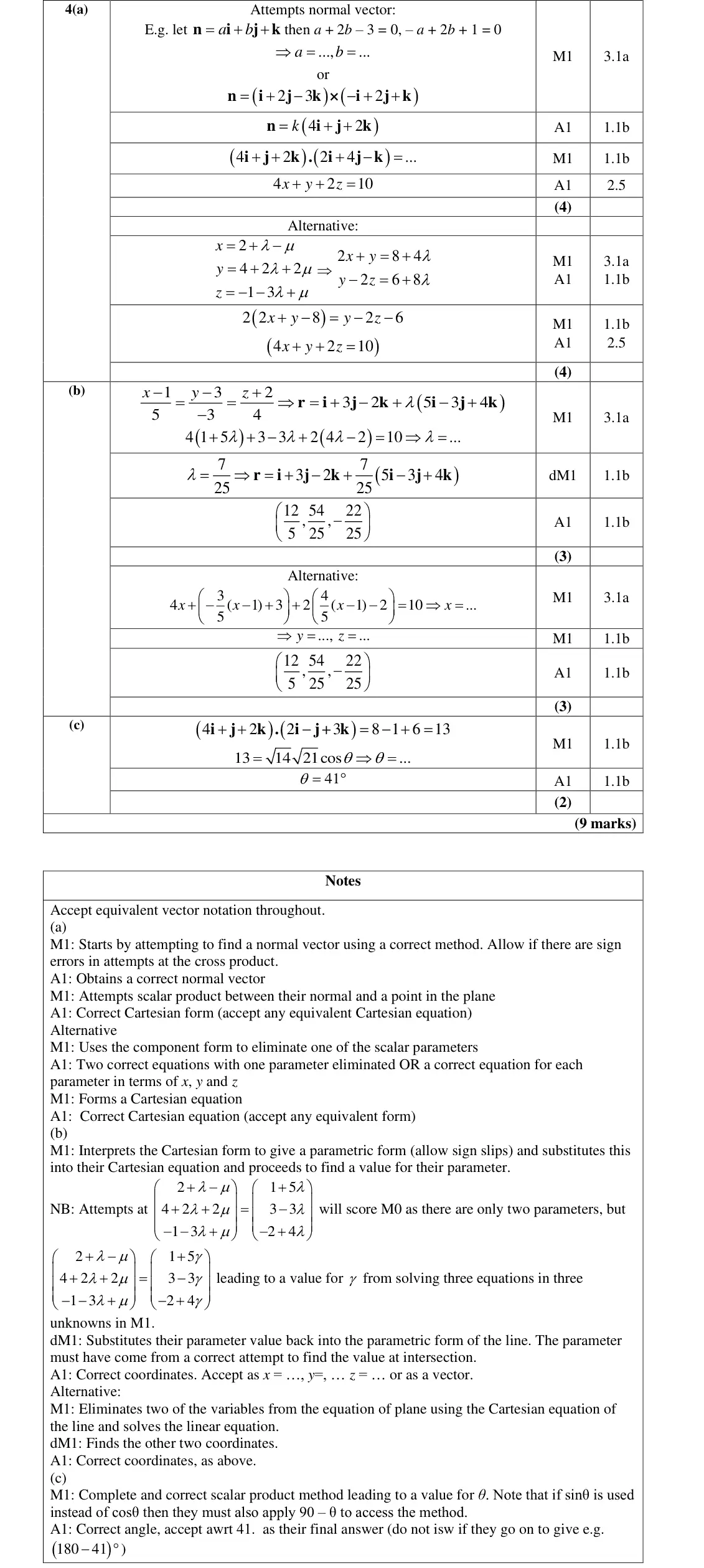
parametric form of l substituted into the plane: λ = 7/25
point (12/5, 54/25, −22/25)
using the same parameter for line and plane scores 0
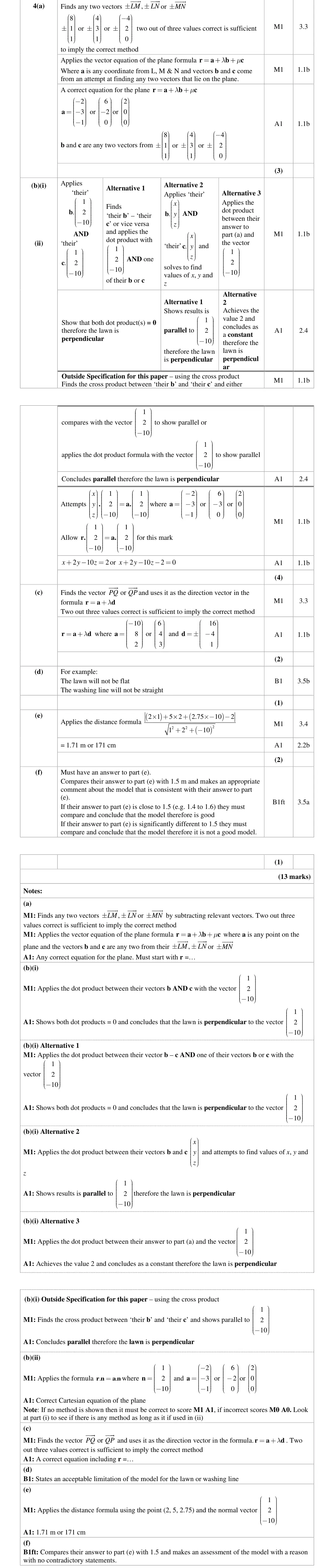
Oct 2020 · AS Paper 1 (Core Pure) · Q4(e)2 marks
Mark scheme (whole question; this part is marked with the orange bar)
Examiner's comment
It was pleasing to see that the large majority of candidates attempted at least parts of this question. Part (e) was very poorly answered, especially considering the formula is in the formula book! Many did not even attempt this part and of those that did most attempted it incorrectly, some not using the normal vector, others using an incorrect formula and the majority trying to solve as though it were the shortest distance between a point and a line.
Key points from the mark scheme and examiner's report
point-to-plane formula with normal (1, 2, −10): modulus of (2 + 10 − 27.5 − 2)/√105 = 1.71 m (171 cm)
very poorly answered, many used point-to-line methods
Oct 2020 · AS Paper 1 (Core Pure) · Q4(f)1 mark
Mark scheme (whole question; this part is marked with the orange bar)
Examiner's comment
It was pleasing to see that the large majority of candidates attempted at least parts of this question. Part (f) was again surprisingly not answered correctly by all that could, though this again should be a familiar question. Over half did achieve this mark whilst those that didn't often did not conclude with others not attempting.
Key points from the mark scheme and examiner's report
compare 1.71 m with 1.5 m and conclude (not a good model if significantly different)
conclusion often missing
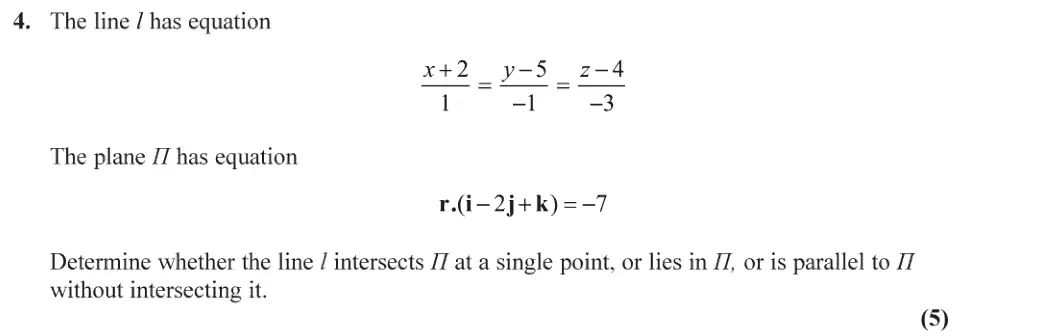
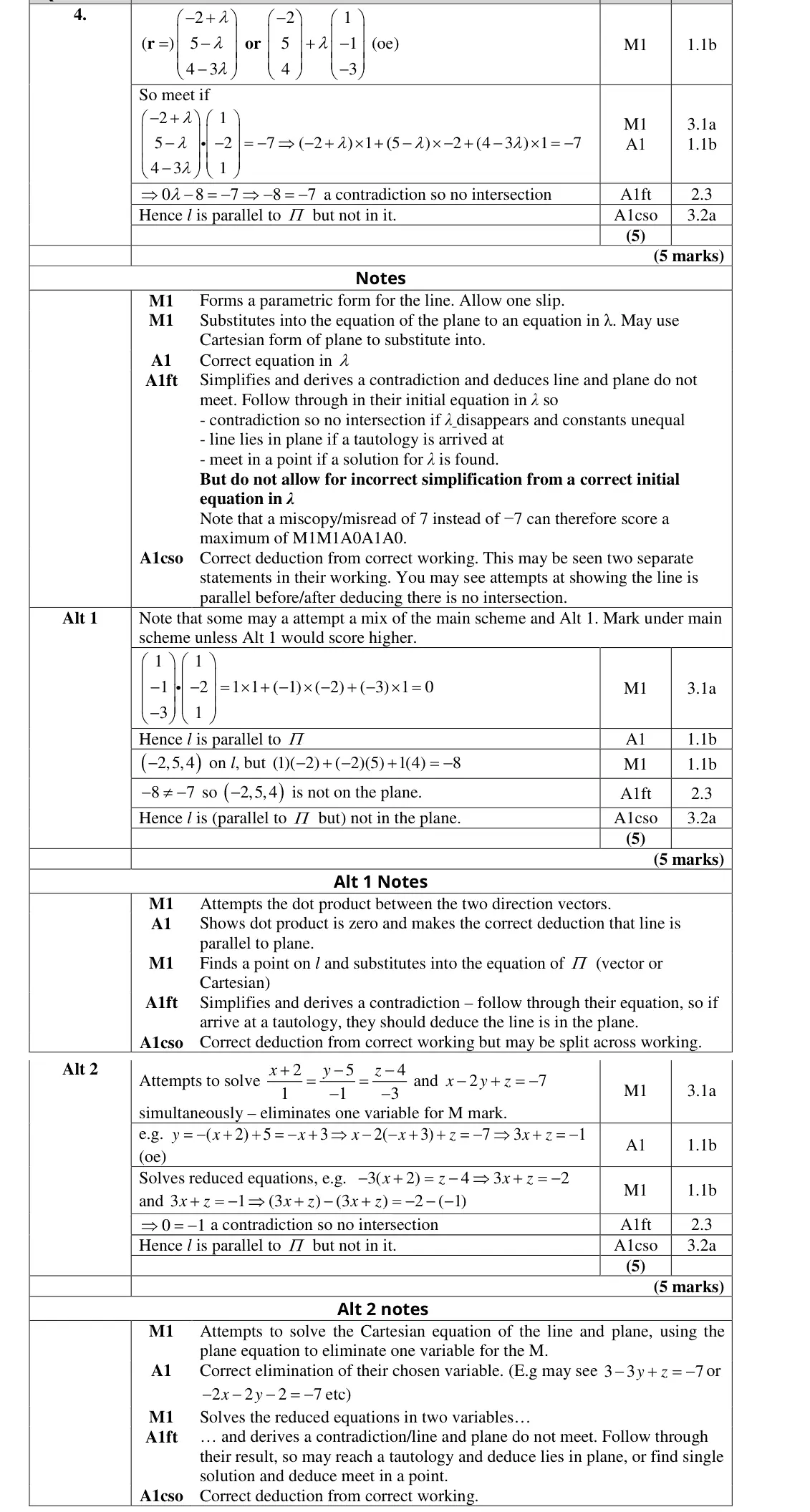
June 2019 · AS Paper 1 (Core Pure) · Q45 marks
Mark scheme (whole question; this part is marked with the orange bar)
Key points from the mark scheme and examiner's report
substitute the parametric line into r.(1, −2, 1) = −7: 0λ − 8 = −7, a contradiction so no intersection
l is parallel to Π but not in it
or direction.normal = 0 then test a point
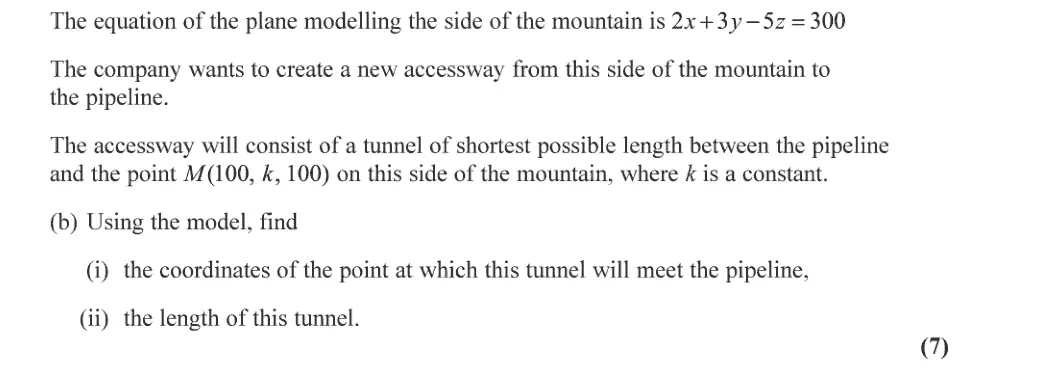
June 2019 · AS Paper 1 (Core Pure) · Q8(b)7 marks
Mark scheme (whole question; this part is marked with the orange bar)
Key points from the mark scheme and examiner's report
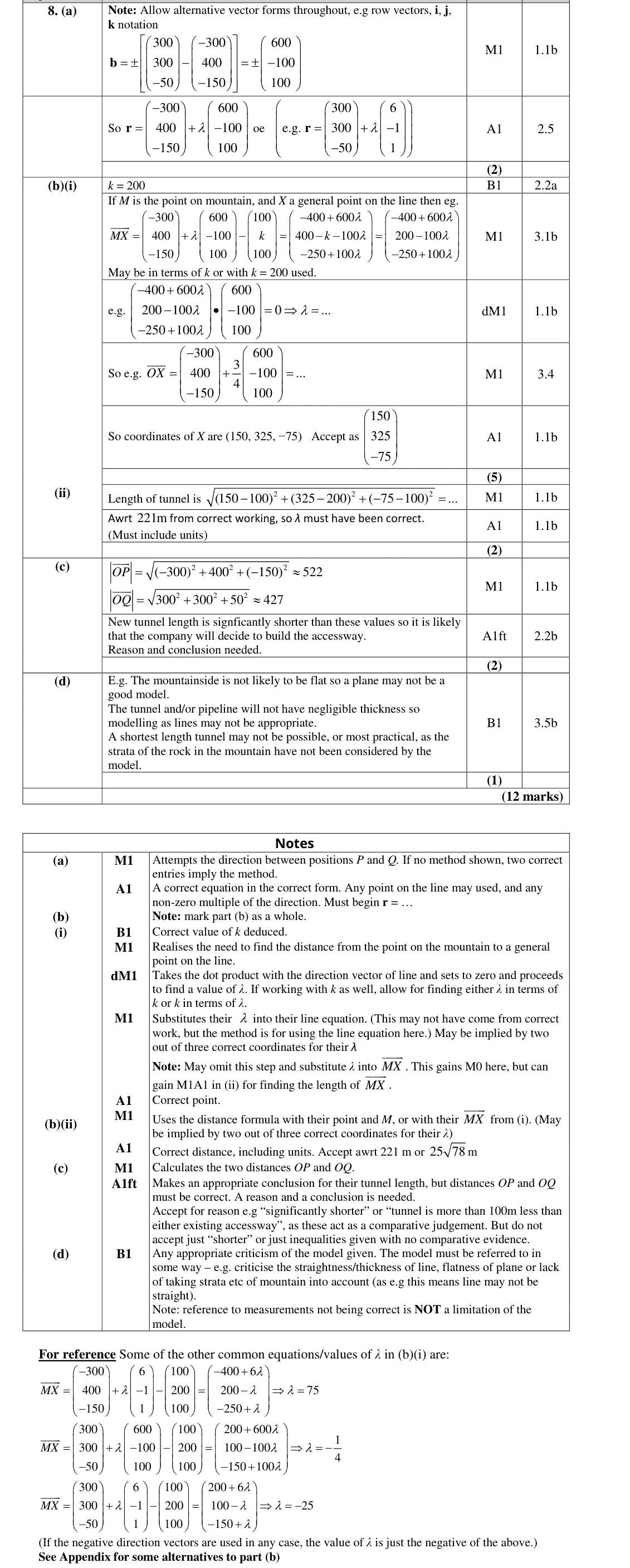
k = 200 from M on the plane
MX perpendicular to the line direction gives λ = 3/4 (for direction (600, −100, 100))
X = (150, 325, −75)
length awrt 221 m (25√78), units needed
June 2018 · AS Paper 1 (Core Pure) · Q4(b)6 marks
Mark scheme (whole question; this part is marked with the orange bar)
Examiner's comment
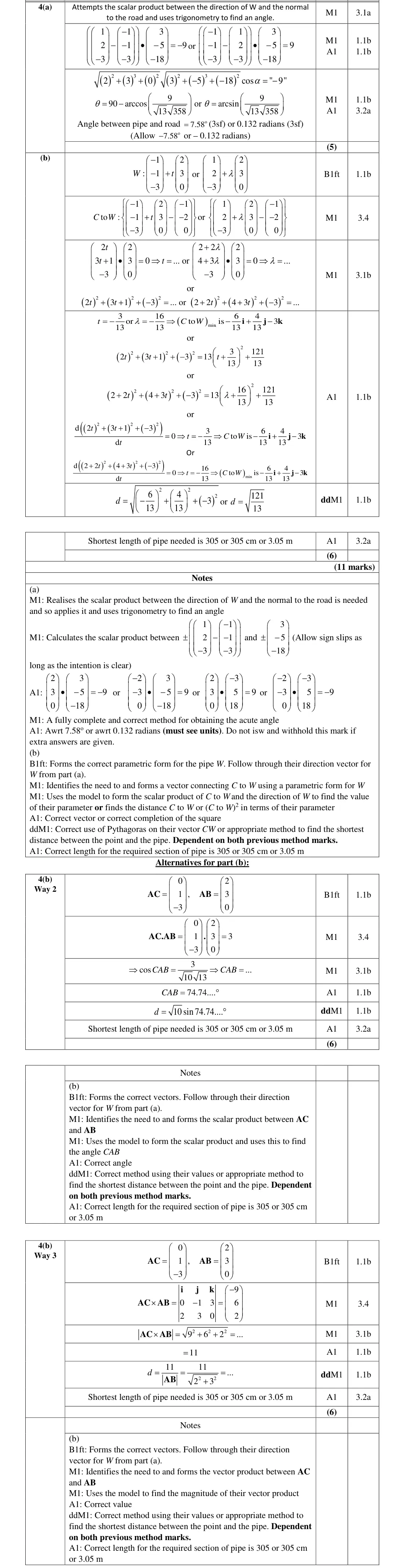
(b) The majority of students formed the correct parametric form for W but many did not then find CW and some were attempting a scalar product with a direction vector perpendicular to the plane. There were often errors with signs for those who were working with the appropriate vectors. Those with the correct CW were usually then able to accurately use Pythagoras’ Theorem to gain full marks here but they were in a minority. Some of the students who correctly found the value of their parameter, substituted this into the equation of line W and found the magnitude of this vector rather than finding the vector CW and its magnitude. Those students who produced a diagram of the situation were more successful. It is perhaps a pity that a number having done fully correct work lost the final mark as they either failed to include units or thought that the units were centimetres throughout.
Key points from the mark scheme and examiner's report
vector CW from a general point on W, perpendicular to (2, 3, 0) gives t = −3/13
distance √(121/13) = 3.05 m = 305 cm
many used the plane normal or found the position vector instead of CW
Find an Edexcel Further Maths tutor
Stuck on this? Book a trial lesson with our Further Maths tutor.