Examiner's comment
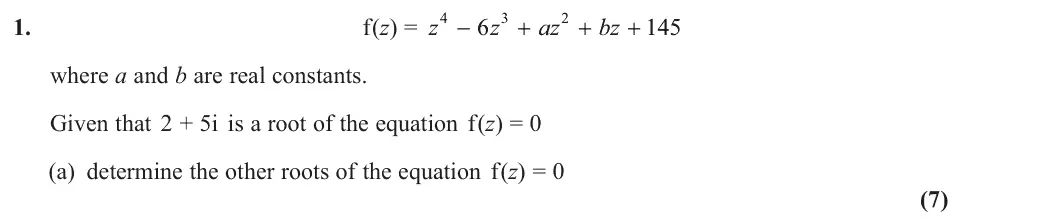
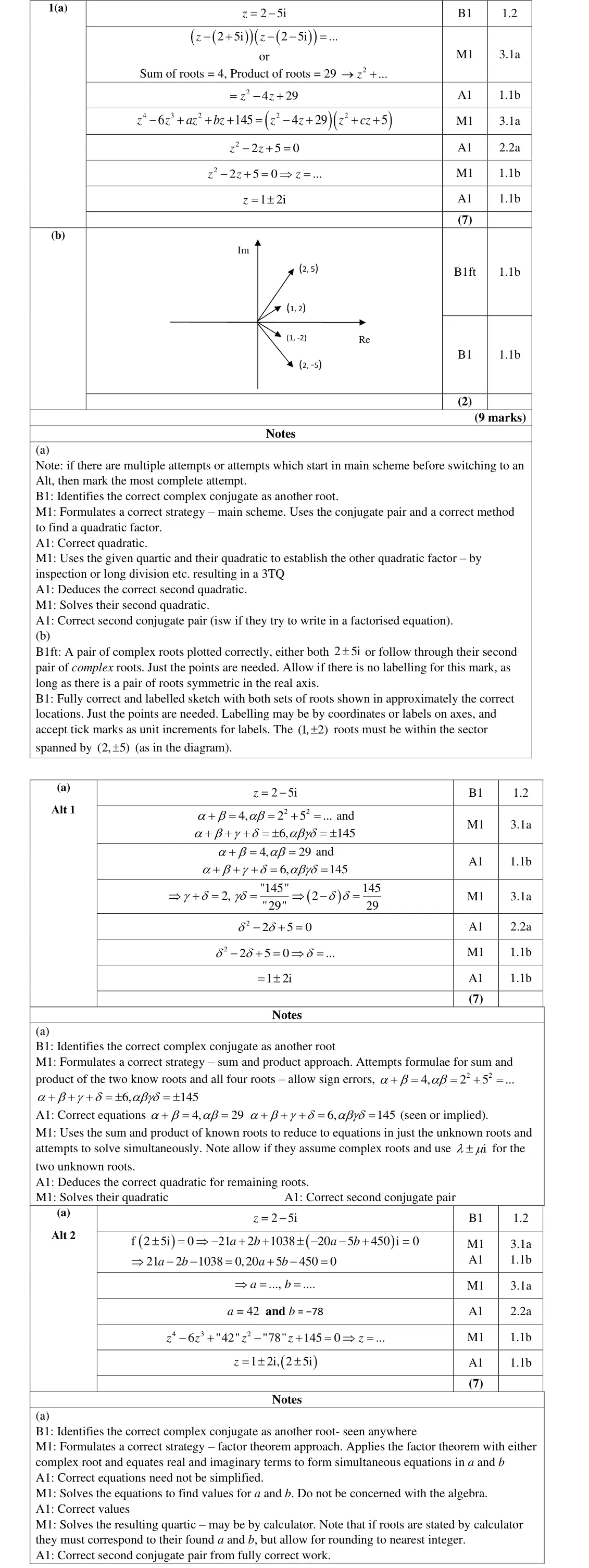
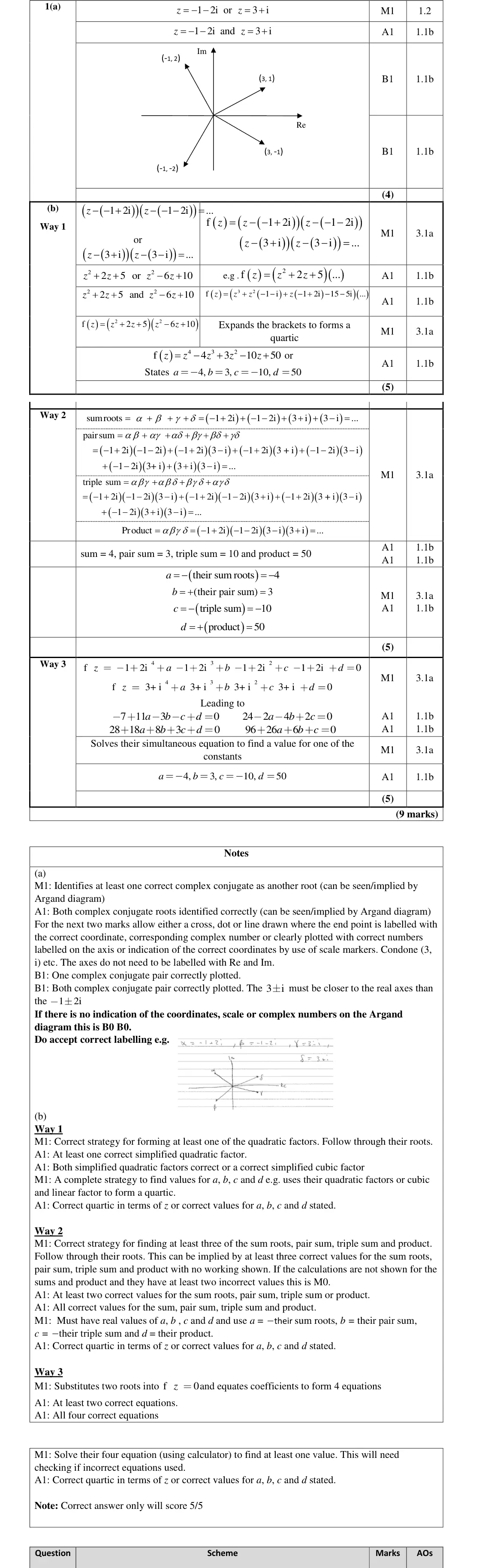
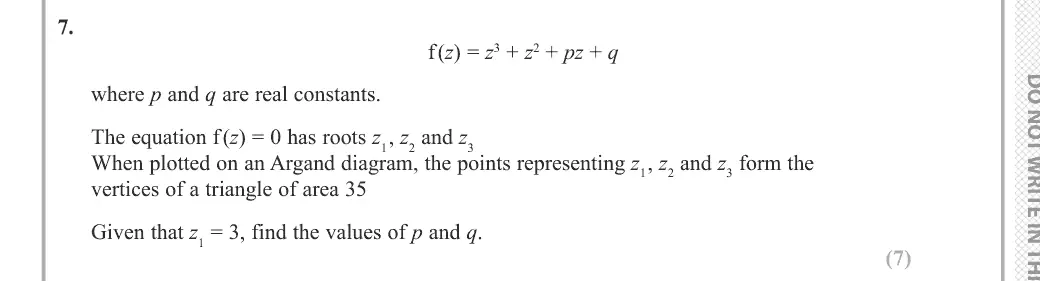
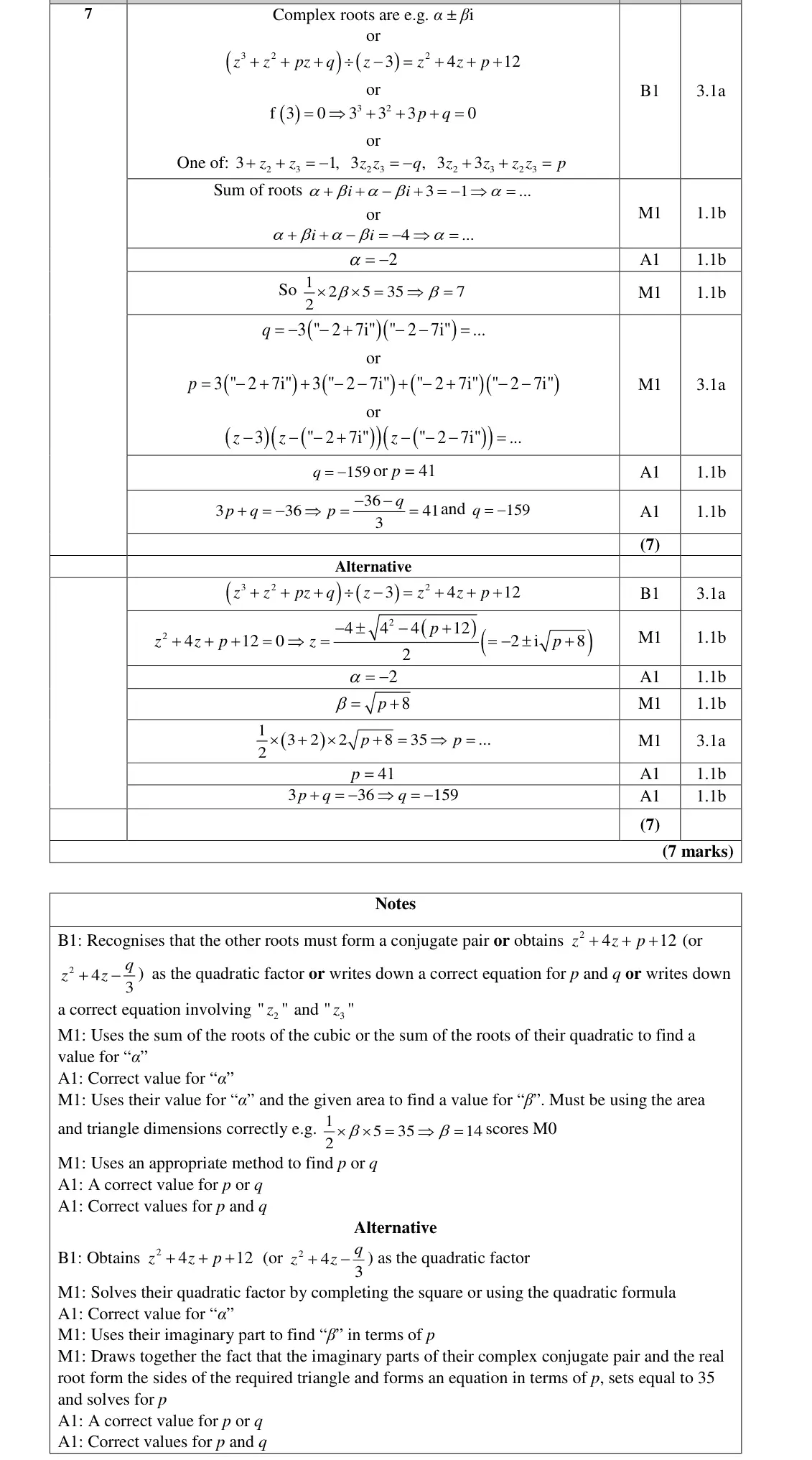
The majority of students found this an accessible start to the paper with many fully correct solutions, and the most common error being a failure to sketch the roots correctly on their diagram for part (b). In part (a) almost all of the candidates got the B mark for the complex conjugate as another root and the majority were able to find all four roots correctly. Only a very small number of candidates gave the wrong “conjugate” root, 2 5i -- , with omission of the question altogether being a more common reason for the loss of the B mark. The most direct and simplest method for finding the remaining roots was to find the quadratic factor 2 4 29 z z - + from the conjugate pair of roots and then factor out by inspection to obtain the second quadratic factor before solving. However, most using this method used polynomial division to obtain the other quadratic factor, which created a lot more work and potential for error, although it is mostly done well. Only a few answer this method in the most efficient way, but holistically this was marginally the most common method of those on the scheme. The other very common approach was using the formulae for the sum, sum of product pairs and product of roots (Alt 1). The inclusion of the manipulation of roots of polynomials on the specification seems to have made this a much more common approach. Again, this was done very well overall, usually resulting in the correct roots, though errors in manipulation were slightly more common in this approach (usually introducing a sign error in one term in the resulting quadratic). Explanations were often minimal in these approaches, sometime making it different to follow the work. Variations such as using i x y for the other two roots were also seen used, and generally successful. The factor theorem approach (Alt 2) was the least popular approach, seen on occasionally, and candidates adopting this method often stopped as they were unable to cope with the resulting algebra. They tended to be the most erratic and relied on calculator assistance to expand the complex equations and solve often incorrect quadratics that resulted. A difficulty that arose was that nearly correct quadratics could sometimes lead to the “correct” roots as candidates would round to nearest integers for the real and imaginary terms, but the accuracy marks were only permitted for fully correct work. It is also noteworthy that many candidates felt the need to find the values of a and b, which were not necessary to find in the main scheme or Alt 1 and not needed. This again created extra unnecessary work but was ignored if it was not part of the solution leading to the roots. An awareness of the demand of the question was lacking in many candidate who automatically assumed the needed to do this. Within all methods used there were the usual numerical errors, usually focussing on incorrect multiplication of complex numbers and not using i2 as -1.