D1.4.3 Algorithm for finding the critical path. Earliest and latest event…
Section
D1.4 Critical path analysis
Level
AS & A level
Statement
Algorithm for finding the critical path. Earliest and latest event times. Earliest and latest start and finish times for activities. Identification of critical activities and critical path(s).
Guidance
Calculating the lower bound for the number of workers required to complete the project in the shortest possible time is required.
Mark scheme (whole question; this part is marked with the orange bar)
Examiner's comment
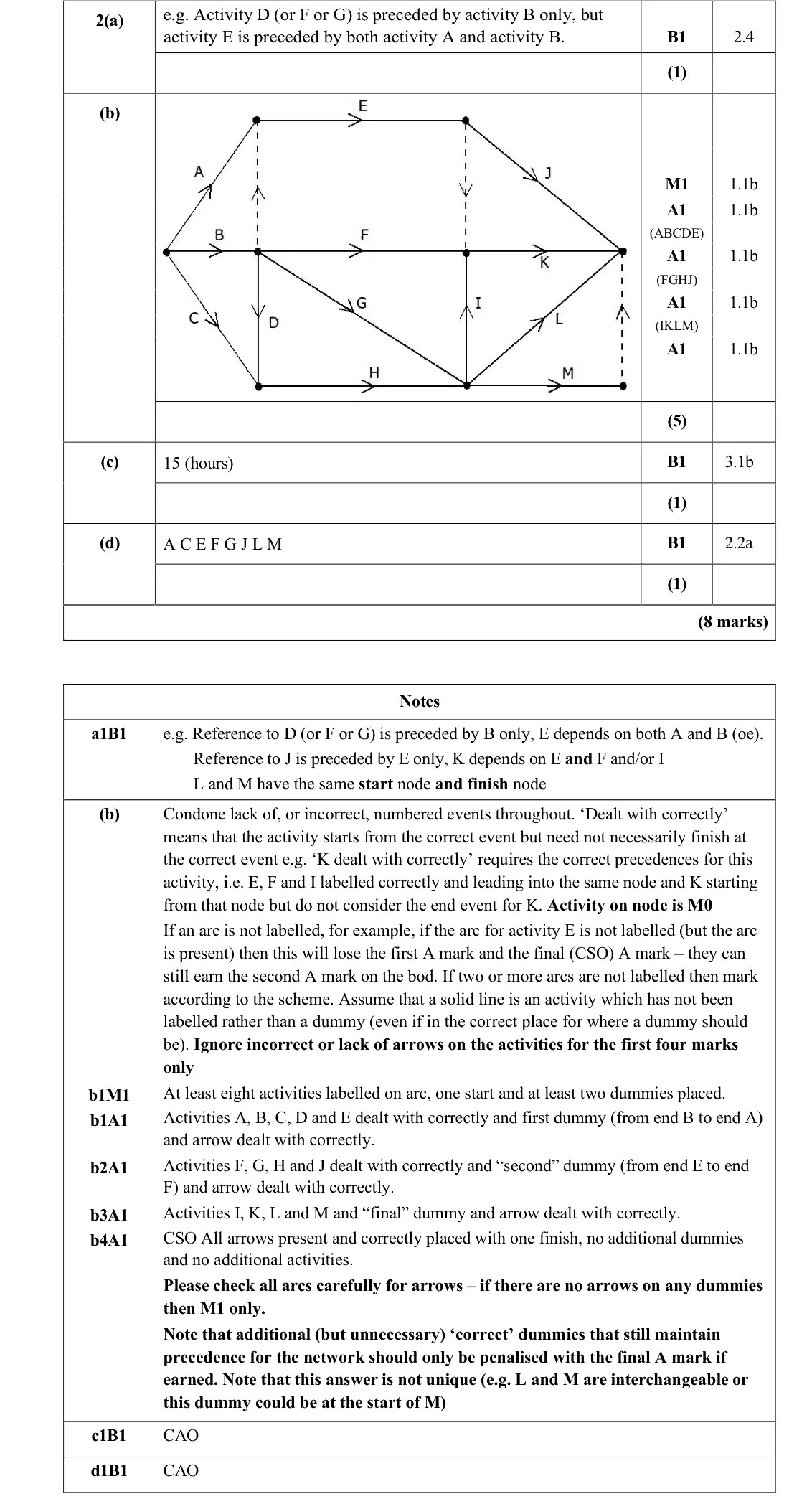
The first two parts of this question were very standard definitions and procedures and therefore very accessible to all learners, however the advanced understanding required for the final two parts were able to clearly discriminate between learners who could follow procedure and those at the higher end of the scoring scale who really understood it. Part a) was generally well answered with a majority of learners scoring this mark for a correct explanation. The most common non-scoring response was to only consider the dependency of E on A and B, which was not acceptable in the context of the whole network. Those attempting to use the unique argument sometimes failed to mention both the start and end notes, and a loss of the B mark in this question was often due to lack of accuracy rather than a wrong idea. Part b) was generally very well drawn overall, with a large number of responses scoring full marks. The most common error was to share the same start and end node for L and M, thus losing the last two marks, otherwise learners handled the network well (though some of the responses were not user-friendly to navigate. A small number of activity-on-node responses were attempted; learners should be aware that this scores no marks. A few did not have a single start node, which also scored no marks. Lack of arrows on the dummies caused some to gain only the M mark. A more common error tended to be either the lack of Activity J, or additional activities when the candidate’s lines were not long enough or they used additional dummies. Part c) was answered correctly on approximately half of the scripts. It was still well attempted, however a full range of multiples of 3 seen from 9 to 39 which demonstrated a lack of understanding of this particular application. Part d) was only answered correctly by the most able learners. Those that did get 15 generally found at least some of the non-critical activities, often listing only a small number of the required list. Those that first identified the critical path generally found the full set.
Key points from the mark scheme and examiner's report
longest path has five activities (B, D, H, I, K): 5 × 3 = 15 hours
any multiple of 3 from 9 to 39 seen
June 2025 · AS Paper 2 (Decision 1) · Q2(d)1 mark
Mark scheme (whole question; this part is marked with the orange bar)
Examiner's comment
The first two parts of this question were very standard definitions and procedures and therefore very accessible to all learners, however the advanced understanding required for the final two parts were able to clearly discriminate between learners who could follow procedure and those at the higher end of the scoring scale who really understood it. Part a) was generally well answered with a majority of learners scoring this mark for a correct explanation. The most common non-scoring response was to only consider the dependency of E on A and B, which was not acceptable in the context of the whole network. Those attempting to use the unique argument sometimes failed to mention both the start and end notes, and a loss of the B mark in this question was often due to lack of accuracy rather than a wrong idea. Part b) was generally very well drawn overall, with a large number of responses scoring full marks. The most common error was to share the same start and end node for L and M, thus losing the last two marks, otherwise learners handled the network well (though some of the responses were not user-friendly to navigate. A small number of activity-on-node responses were attempted; learners should be aware that this scores no marks. A few did not have a single start node, which also scored no marks. Lack of arrows on the dummies caused some to gain only the M mark. A more common error tended to be either the lack of Activity J, or additional activities when the candidate’s lines were not long enough or they used additional dummies. Part c) was answered correctly on approximately half of the scripts. It was still well attempted, however a full range of multiples of 3 seen from 9 to 39 which demonstrated a lack of understanding of this particular application. Part d) was only answered correctly by the most able learners. Those that did get 15 generally found at least some of the non-critical activities, often listing only a small number of the required list. Those that first identified the critical path generally found the full set.
Key points from the mark scheme and examiner's report
activities with float of at least 1 hour, i.e. all non-critical: A, C, E, F, G, J, L, M
easiest after finding the critical path B, D, H, I, K
June 2025 · Paper 3D (Decision 1) · Q6(b)4 marks
Mark scheme (whole question; this part is marked with the orange bar)
Examiner's comment
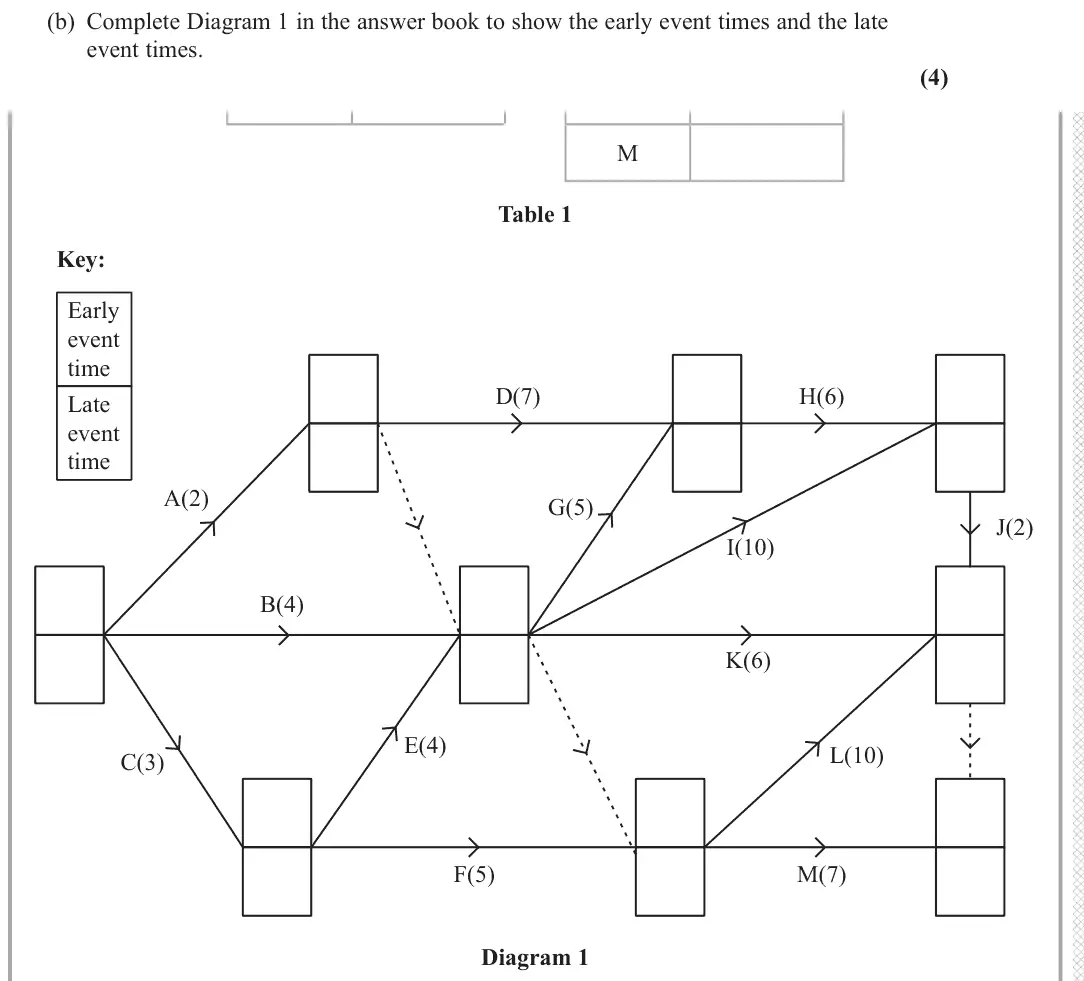
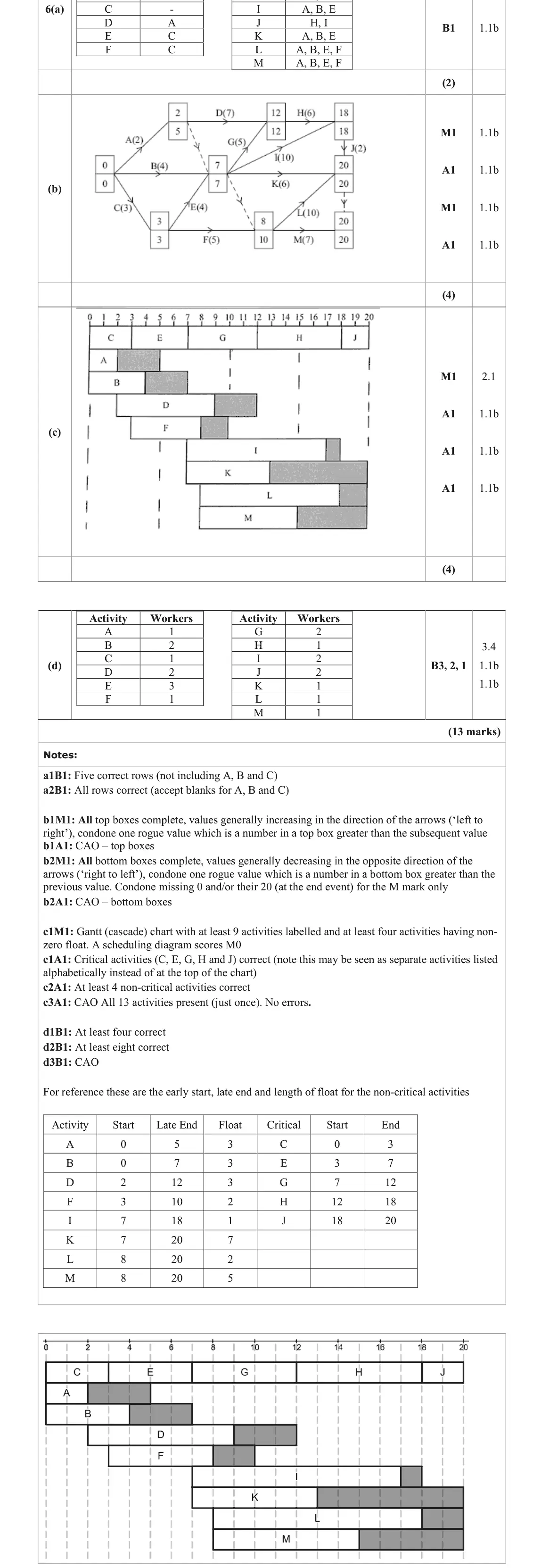
In part (b) the activity network diagram was generally completed well. Most candidates achieved full marks, and when errors did occur, they were often limited to a single miscalculated event time. A frequent mistake was recording 13 instead of 10 as the late event time for a activity F.
Key points from the mark scheme and examiner's report
forward and backward passes, project length 20
late event time at the end of F is 10 (13 was the common error)
June 2025 · Paper 3D (Decision 1) · Q6(c)4 marks
Mark scheme (whole question; this part is marked with the orange bar)
Examiner's comment
In part (c) the Gantt chart was also completed well and better than in previous series. Only a small number of candidates submitted no response, and most mistakes stemmed from errors in part (b) that carried forward. Very few attempted a scheduling diagram, and most followed the standard format. Overall, this was one of the strongest parts of the question.
Key points from the mark scheme and examiner's report
cascade chart: critical C, E, G, H, J on top row
non-critical activities at earliest start with floats shaded (e.g. K float 7, M float 5)
a scheduling diagram scores 0
June 2024 · AS Paper 2 (Decision 1) · Q2(b)3 marks
Mark scheme (whole question; this part is marked with the orange bar)
Examiner's comment
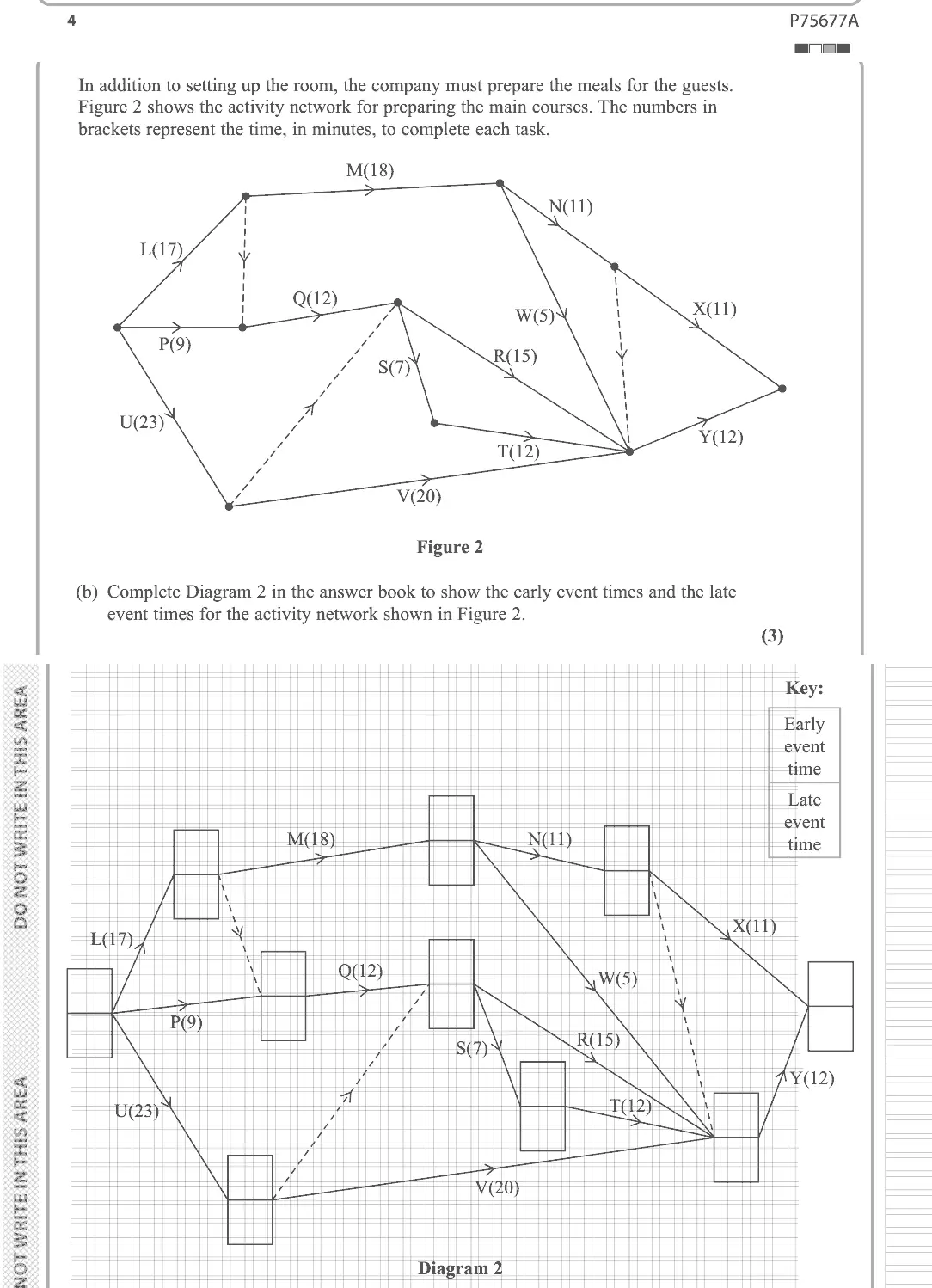
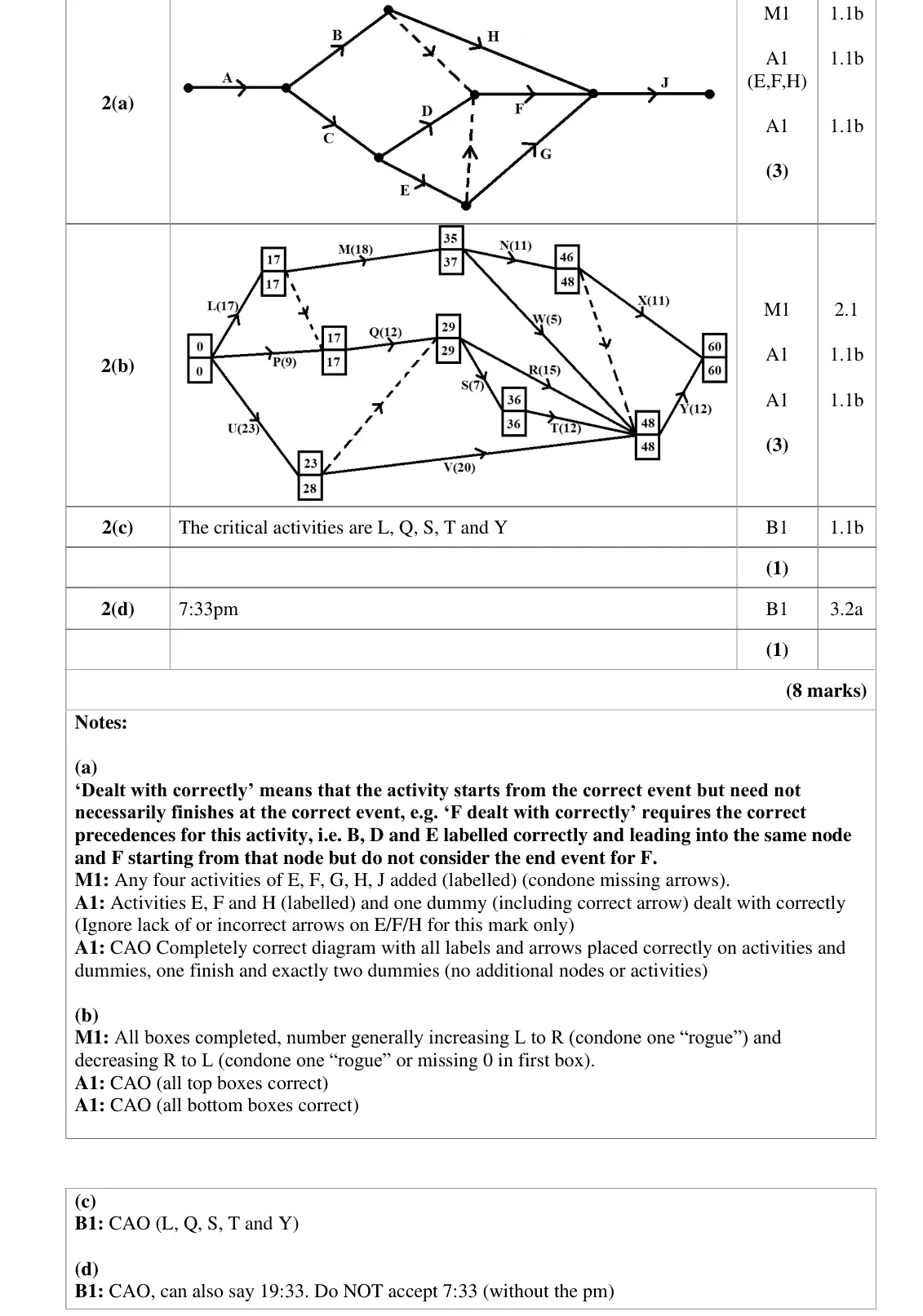
This was generally a high-scoring question, with the vast majority of candidates scoring at least 6 out of a possible 8 marks. Part a) was a relatively straightforward network, with the additional scaffold of a partially drawn network. Whilst the significant majority of candidates scored full marks, a surprising number lost the last accuracy mark for omitting activity J. Despite the network being given, several candidates still attempted to put activities on nodes. However fewer candidates lost marks for missing arrows, or additional dummies. Part b) was again well-answered with the majority scoring 2 or 3 marks. The most frequent errors were in the late times for U (29), M (38) and N (49, leading to a rogue value here) but mistakes were exceptionally rare in the forward pass. In part c) the majority of candidates correctly identified the critical activities, although activity P was included by some. Part d) caused issues for less secure candidates; some obtained 7:27pm (subtracting 33 minutes from 8pm), many achieved 7:29pm and 7:31pm or 7:34pm following numerical errors or misusing the 4 minutes of float. A surprising number seemed to misinterpret the question and gave answers beyond 8pm. Others correctly identified 33 minutes but then failed to add the pm for the correct time or gave a time of 8.33pm. This served as a reasonable discriminator mark for stronger candidates.
Key points from the mark scheme and examiner's report
completion 60 minutes
forward pass rarely wrong
late-time errors at U (29), M (38) and N (49)
June 2024 · AS Paper 2 (Decision 1) · Q2(c)1 mark
Mark scheme (whole question; this part is marked with the orange bar)
Examiner's comment
This was generally a high-scoring question, with the vast majority of candidates scoring at least 6 out of a possible 8 marks. Part a) was a relatively straightforward network, with the additional scaffold of a partially drawn network. Whilst the significant majority of candidates scored full marks, a surprising number lost the last accuracy mark for omitting activity J. Despite the network being given, several candidates still attempted to put activities on nodes. However fewer candidates lost marks for missing arrows, or additional dummies. Part b) was again well-answered with the majority scoring 2 or 3 marks. The most frequent errors were in the late times for U (29), M (38) and N (49, leading to a rogue value here) but mistakes were exceptionally rare in the forward pass. In part c) the majority of candidates correctly identified the critical activities, although activity P was included by some. Part d) caused issues for less secure candidates; some obtained 7:27pm (subtracting 33 minutes from 8pm), many achieved 7:29pm and 7:31pm or 7:34pm following numerical errors or misusing the 4 minutes of float. A surprising number seemed to misinterpret the question and gave answers beyond 8pm. Others correctly identified 33 minutes but then failed to add the pm for the correct time or gave a time of 8.33pm. This served as a reasonable discriminator mark for stronger candidates.
Key points from the mark scheme and examiner's report
L, Q, S, T and Y
P sometimes included
June 2024 · AS Paper 2 (Decision 1) · Q2(d)1 mark
Mark scheme (whole question; this part is marked with the orange bar)
Examiner's comment
This was generally a high-scoring question, with the vast majority of candidates scoring at least 6 out of a possible 8 marks. Part a) was a relatively straightforward network, with the additional scaffold of a partially drawn network. Whilst the significant majority of candidates scored full marks, a surprising number lost the last accuracy mark for omitting activity J. Despite the network being given, several candidates still attempted to put activities on nodes. However fewer candidates lost marks for missing arrows, or additional dummies. Part b) was again well-answered with the majority scoring 2 or 3 marks. The most frequent errors were in the late times for U (29), M (38) and N (49, leading to a rogue value here) but mistakes were exceptionally rare in the forward pass. In part c) the majority of candidates correctly identified the critical activities, although activity P was included by some. Part d) caused issues for less secure candidates; some obtained 7:27pm (subtracting 33 minutes from 8pm), many achieved 7:29pm and 7:31pm or 7:34pm following numerical errors or misusing the 4 minutes of float. A surprising number seemed to misinterpret the question and gave answers beyond 8pm. Others correctly identified 33 minutes but then failed to add the pm for the correct time or gave a time of 8.33pm. This served as a reasonable discriminator mark for stronger candidates.
Key points from the mark scheme and examiner's report
project starts at 7 pm (60 minutes before 8 pm)
R must start by 48 − 15 = 33 minutes, so 7:33 pm (pm needed)
7:27 pm, 7:29 pm and 8:33 pm were common errors
June 2024 · Paper 3D (Decision 1) · Q6(b)4 marks
Mark scheme (whole question; this part is marked with the orange bar)
Examiner's comment
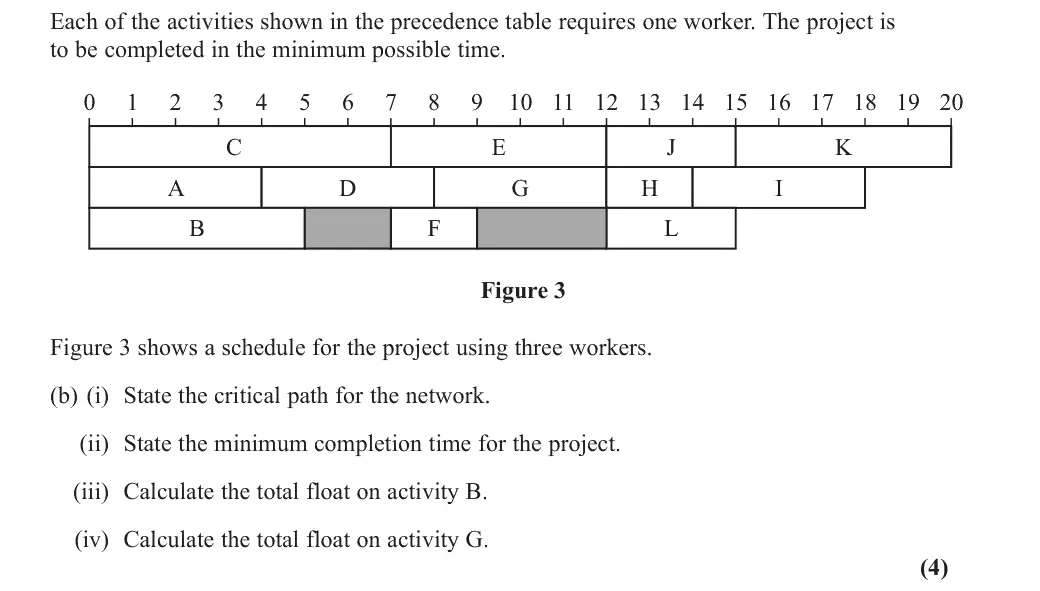
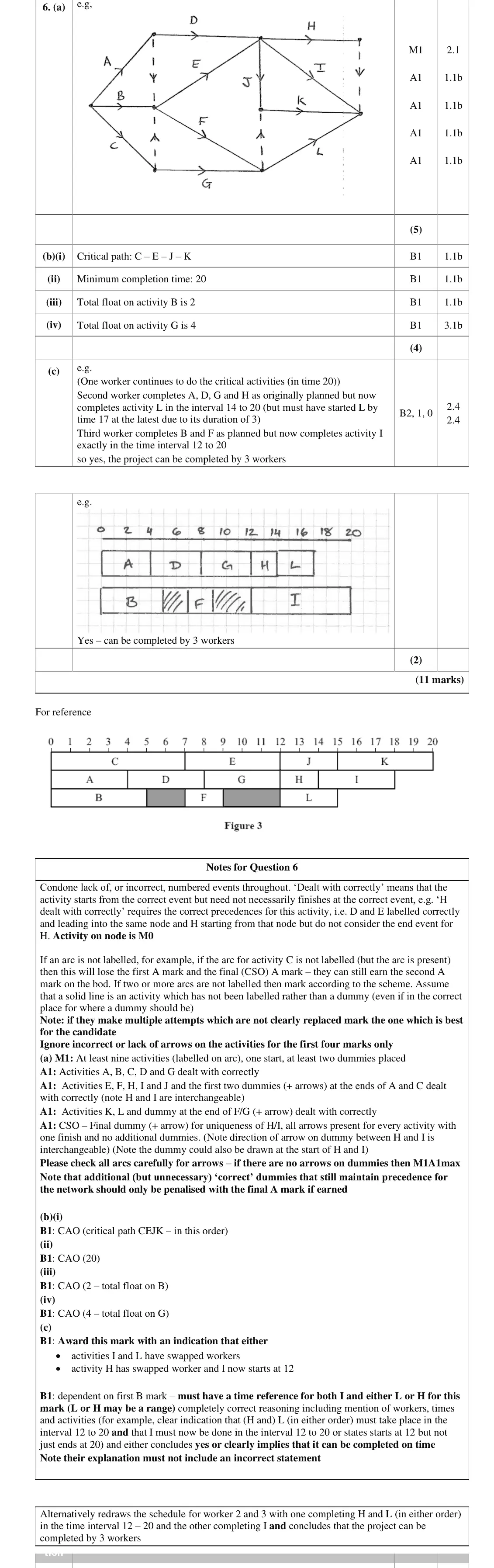
Overall, this question was very accessible with at least the first three marks in part (a) and the first mark in part (b) gained by most candidates. In part (b) nearly all candidates gained the first mark for the correct critical path, CEJK, with many also gaining the mark for the correct minimum completion time of 20 hours. A significant number of candidates calculated the correct float on Activity B of 2 hours, but It was rare to see a correct calculation for the total float on Activity G. Many candidates gave the float incorrectly as 0 (zero stated or 12 – 8 – 4 due to H starting immediately after G on the given scheduling diagram) or as 1 (as G depends on C which finishes at 7 but G starts at 8 on scheduling diagram).
Key points from the mark scheme and examiner's report
critical path C–E–J–K, 20 hours
float on B = 2
float on G = 15 − 7 − 4 = 4 (K must start by 15
use the network, not the schedule)
many gave 0 or 1 for G from the schedule
June 2023 · AS Paper 2 (Decision 1) · Q2(b)3 marks
Mark scheme (whole question; this part is marked with the orange bar)
Examiner's comment
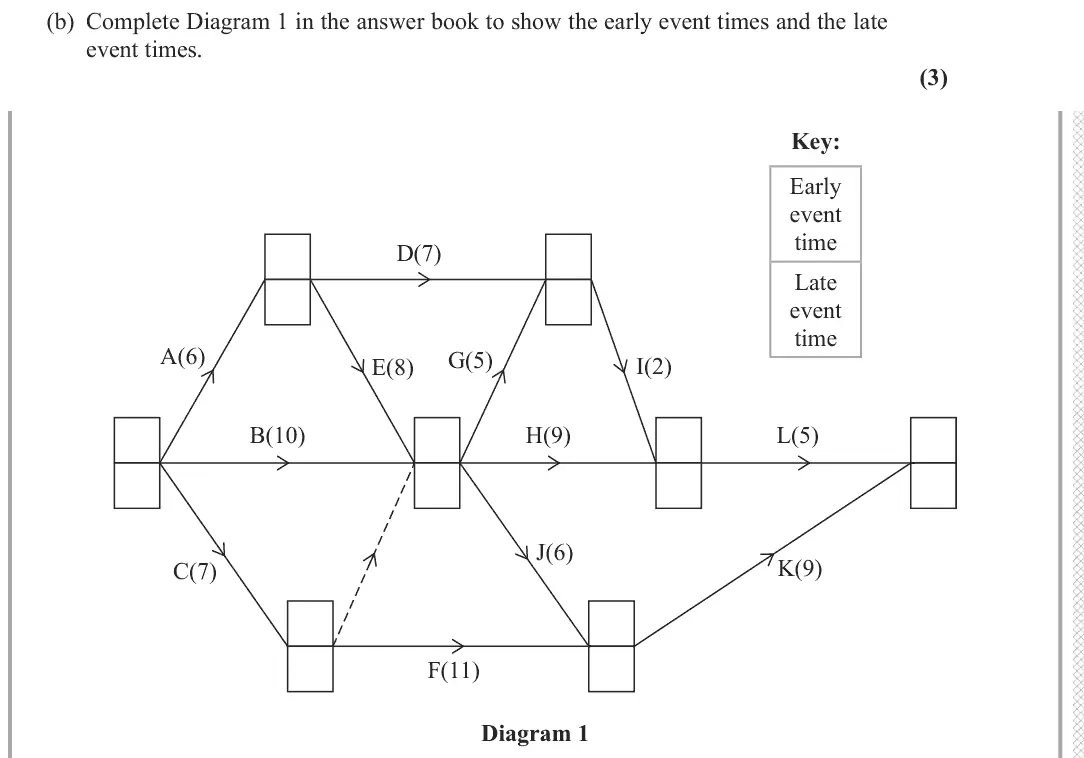
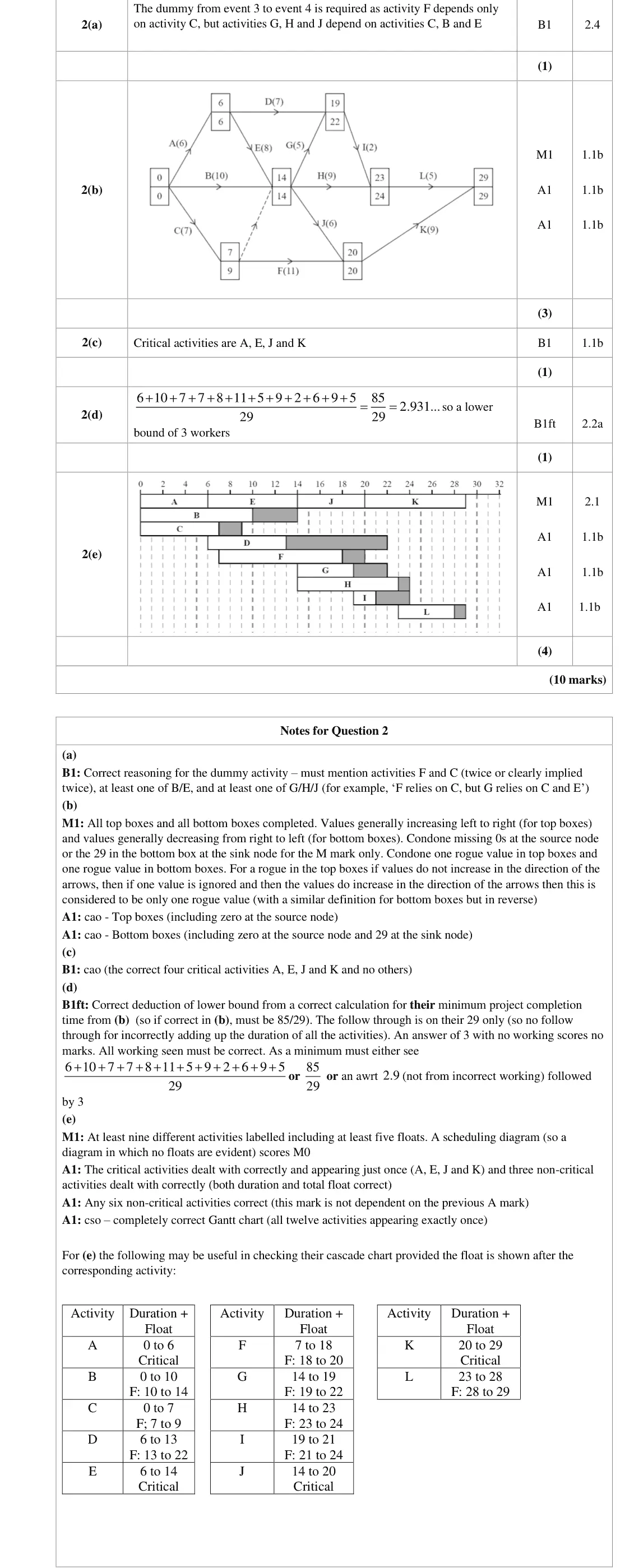
The completing of the early and late event times in part (b) was done well with almost all candidates scoring the first method mark (and most picking up one of the two accuracy marks too) – if errors occurred it was usually on the backward pass (either at the beginning of either activity F or H). Most candidates went on to correctly state the critical activities in part (c) and
Key points from the mark scheme and examiner's report
forward and backward passes
finish 29 hours
errors usually on the backward pass at the start of F or H
June 2023 · AS Paper 2 (Decision 1) · Q2(c)1 mark
Mark scheme (whole question; this part is marked with the orange bar)
Examiner's comment
activity F or H). Most candidates went on to correctly state the critical activities in part (c) and to use the correct method to calculate the lower bound in (d) (although some candidates are still
Key points from the mark scheme and examiner's report
A, E, J and K
June 2023 · AS Paper 2 (Decision 1) · Q2(d)1 mark
Mark scheme (whole question; this part is marked with the orange bar)
Examiner's comment
to use the correct method to calculate the lower bound in (d) (although some candidates are still doing the incorrect calculations of: project completion time / total number of activities). The drawing of the cascade chart in part (e) was done well by most candidates with the majority
Key points from the mark scheme and examiner's report
85 ÷ 29 = 2.93…, so at least 3 workers
completion time ÷ number of activities is a recurring wrong method
June 2023 · Paper 3D (Decision 1) · Q2(a)3 marks
Mark scheme (whole question; this part is marked with the orange bar)
Examiner's comment
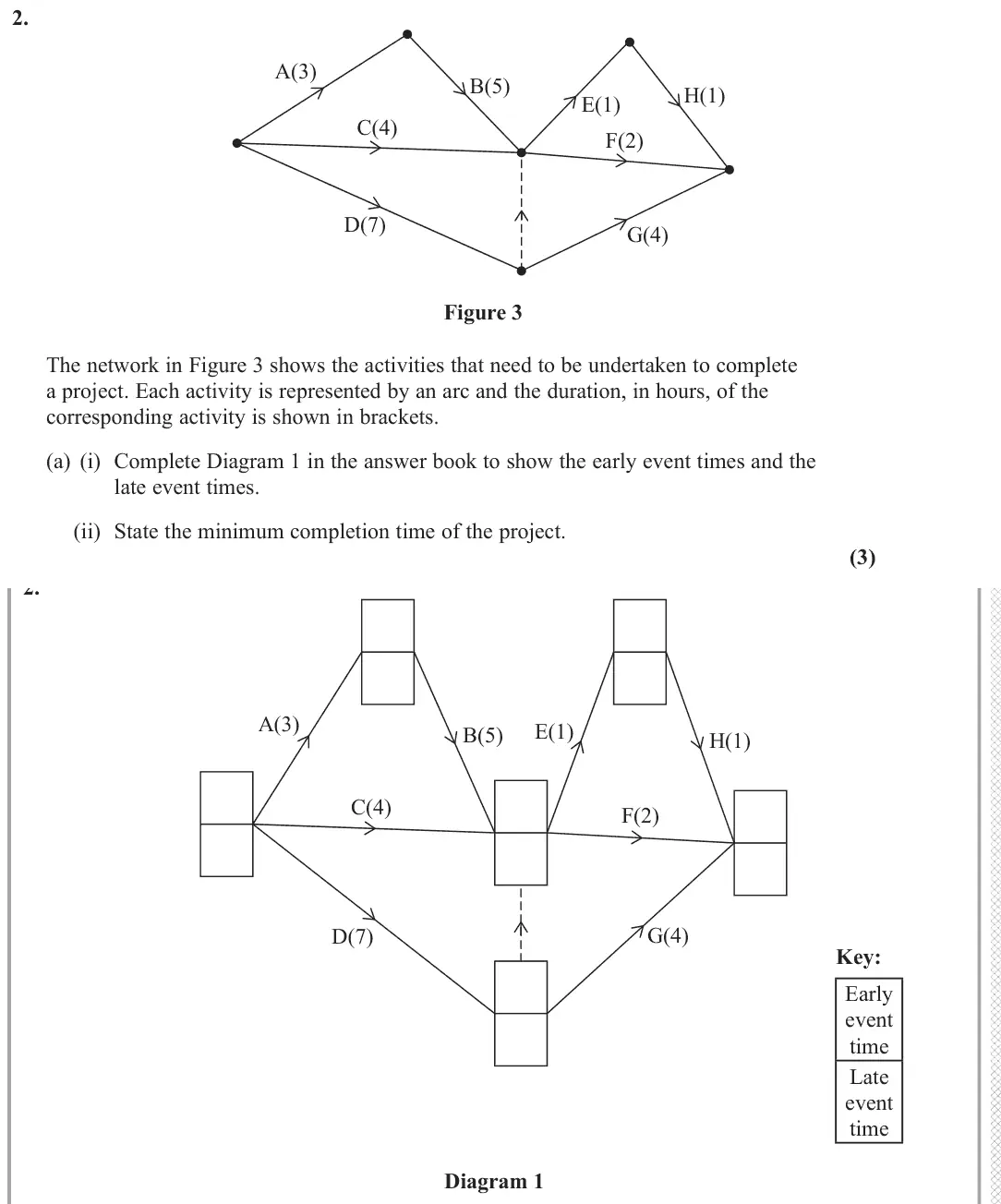
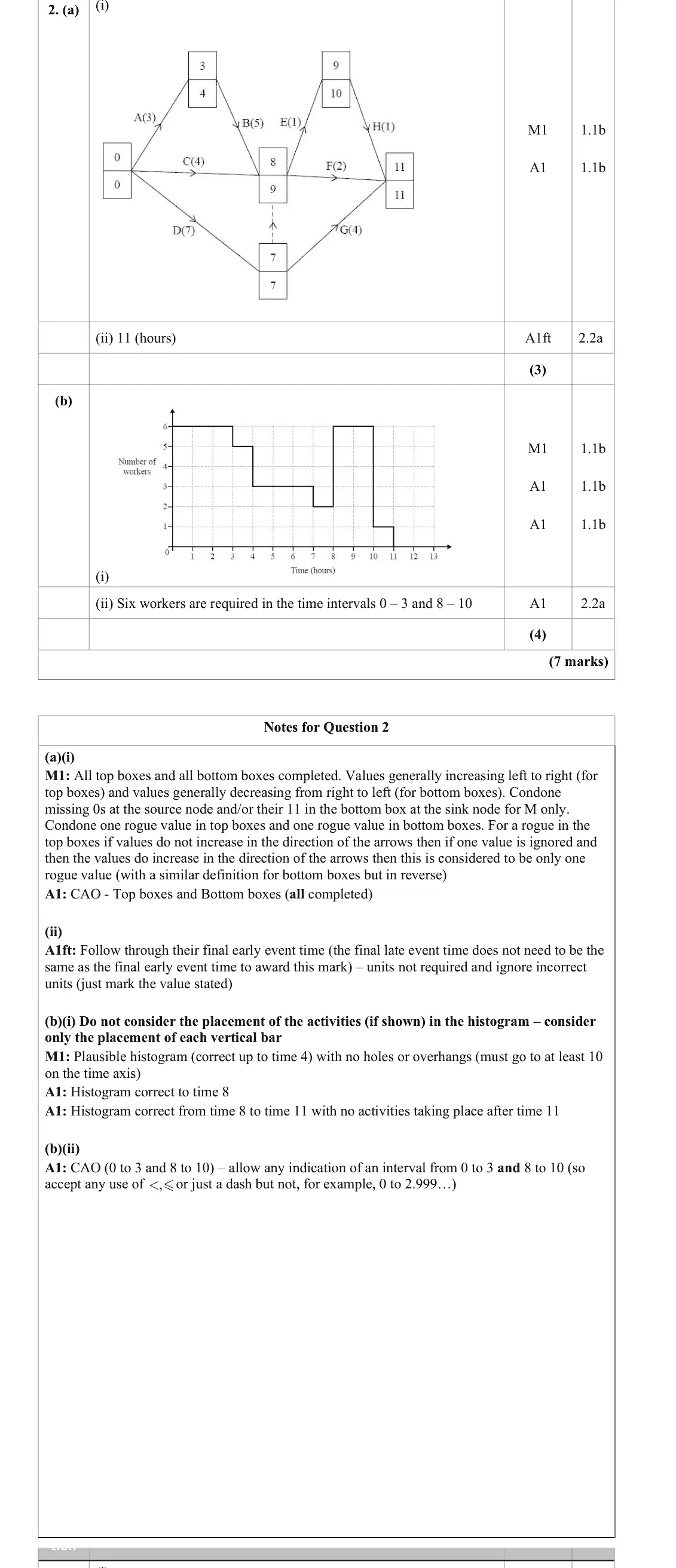
This question proved accessible to most candidates. The most common error was a 3 as the
Key points from the mark scheme and examiner's report
forward and backward passes including the dummy
late time at the end of A is 4 (3 was the common error)
minimum completion time 11 hours
June 2023 · Paper 3D (Decision 1) · Q6(b)1 mark
Mark scheme (whole question; this part is marked with the orange bar)
Examiner's comment
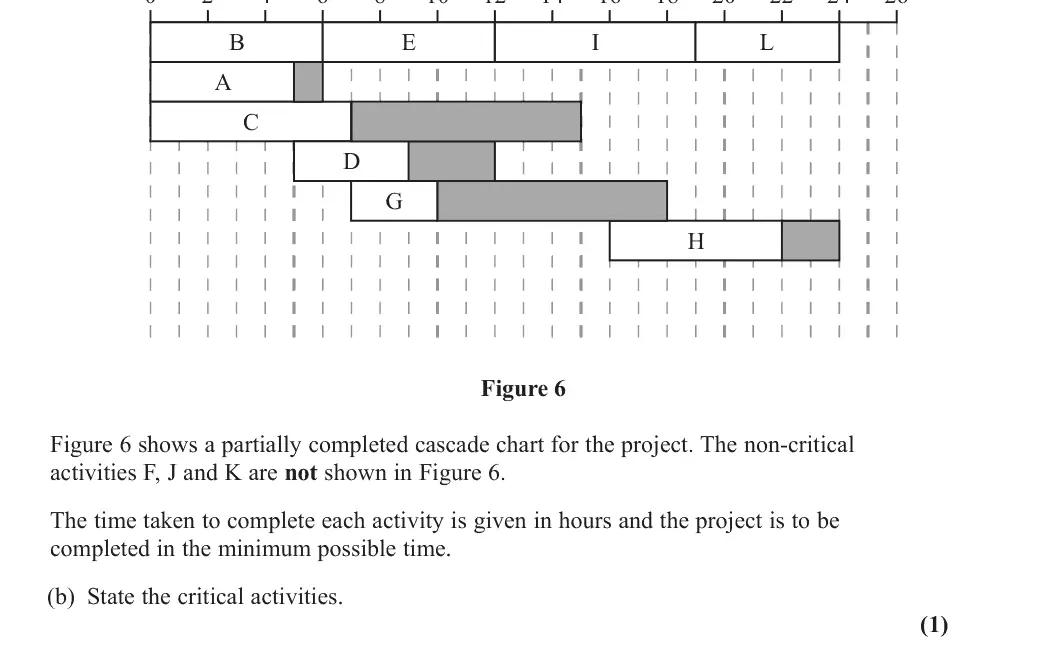
Part (b) was answered correctly in all but a small handful of responses. Part (c) by contrast was far more of a challenge and was frequently left blank. Many candidates were unsuccessful in identifying the relevant values for the window in which activity F could occur, with many incorrectly assuming the latest F could finish was at time 16. The most common incorrect duration stated was ‘2’ which was probably more common than the correct value of ‘4’.
Key points from the mark scheme and examiner's report
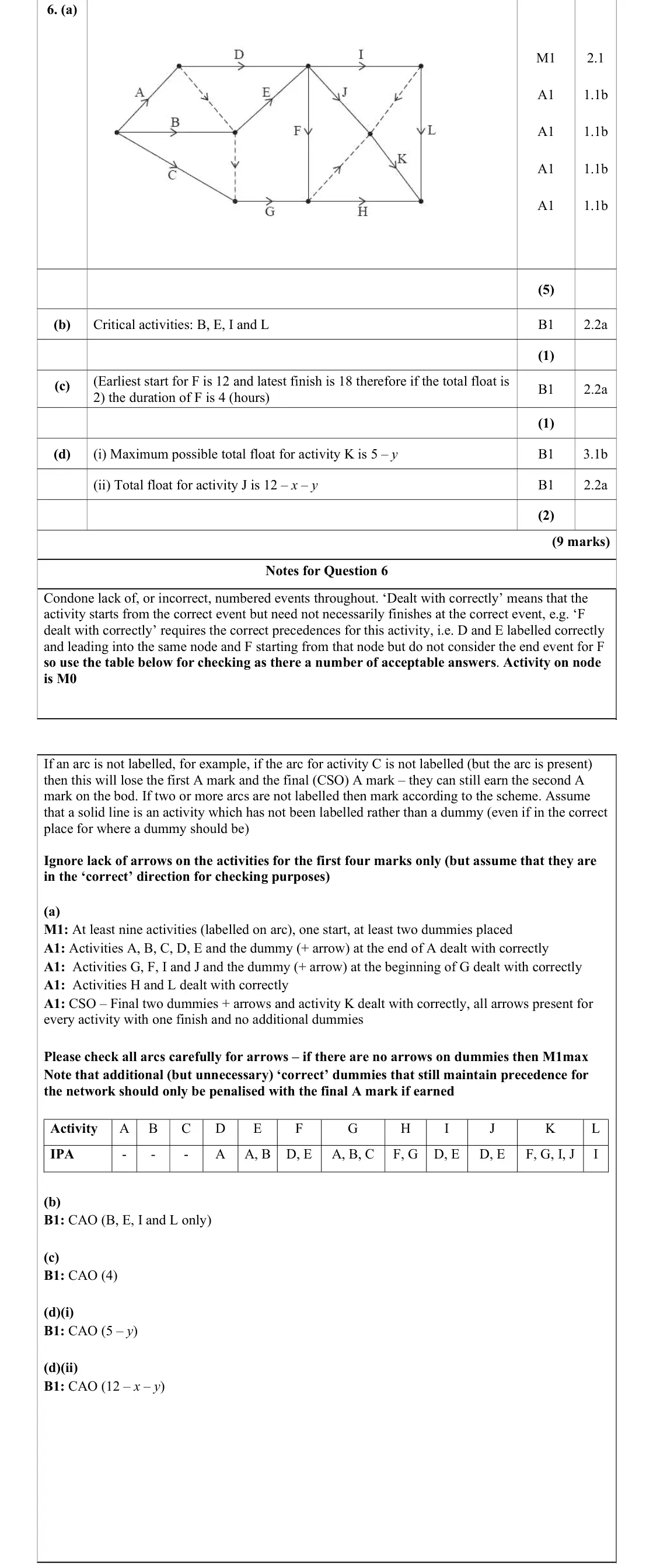
critical activities B, E, I, L (the bars with no float in the cascade chart)
June 2023 · Paper 3D (Decision 1) · Q6(d)2 marks
Mark scheme (whole question; this part is marked with the orange bar)
Examiner's comment
Part (d) was not answered well by many candidates and proved to be a good discriminator. There was confusion evident in both parts with incorrect values being used in many cases. For the float of activity K, a reasonable number of candidates correctly identified the interval 19 – 24 and knew that this interval was shared between the float and activity length. A common error was assuming that the length of activity J influenced this in the stated maximum case, despite the question stating that it should be in terms of 𝑦. For the float of J, few candidates identified the correct interval from 12 – 24, with a common error using the earliest finish time of activity D or the end of activity I. Other incorrect answers involved incorrectly using the float of activity K rather than the duration of K e.g. 24 -12 -𝑥-(5 -𝑦).
Key points from the mark scheme and examiner's report
K sits in the window 19–24: maximum float 5 − y
J from 12 to the start of K at 24 − y: float 12 − x − y
good discriminator
June 2022 · AS Paper 2 (Decision 1) · Q2(c)2 marks
Mark scheme (whole question; this part is marked with the orange bar)
Examiner's comment
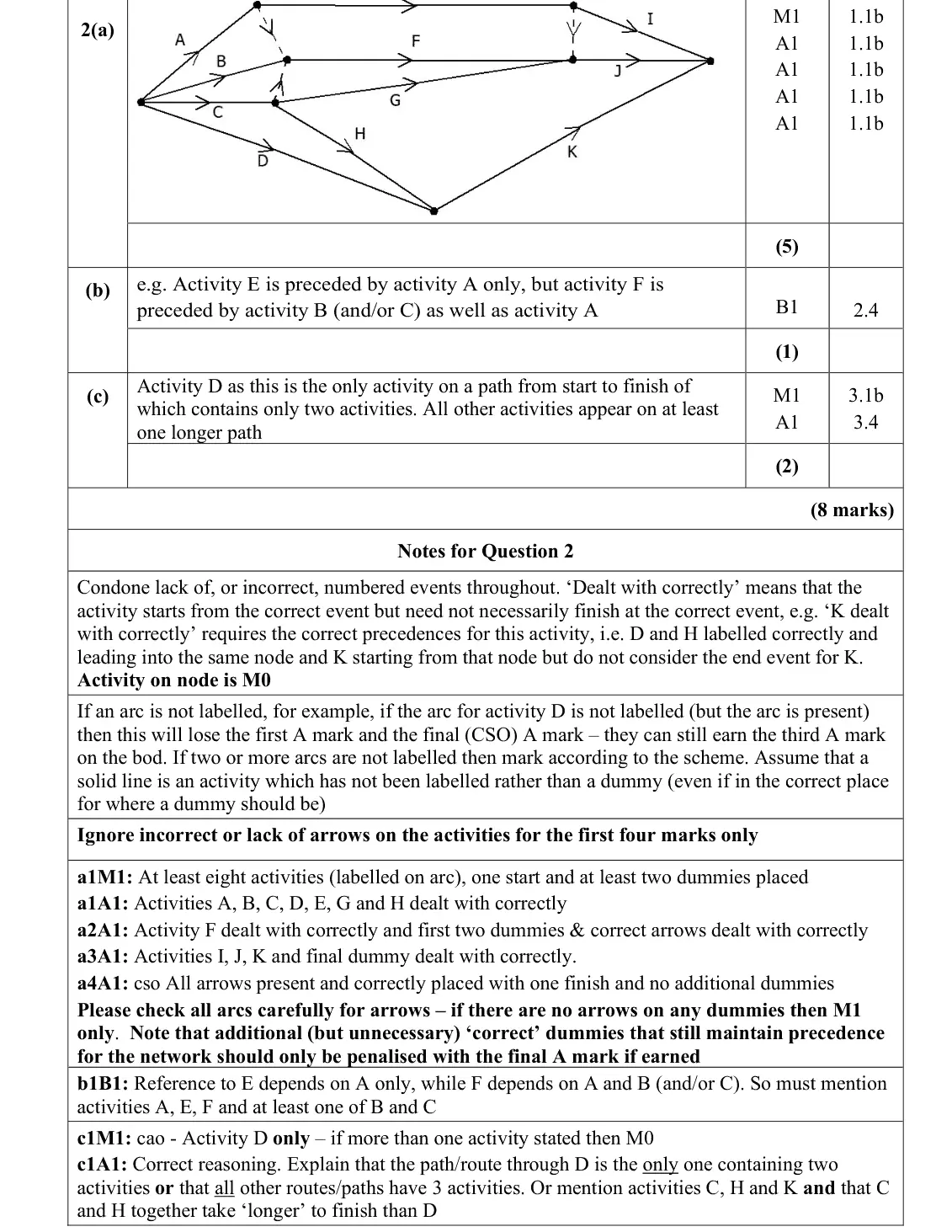
Most candidates were able to make a good attempt, using activity on arc, gaining at least three relevant activities, which were E, F, A, plus B and/or C. As expected, (c) differentiated well with very few candidates scoring both marks. Of those who realised that activity D could not be critical only a few were able to explain why.
Key points from the mark scheme and examiner's report
D only: the path through D has only two activities while every other activity lies on a path of three
few could justify
June 2022 · Paper 3D (Decision 1) · Q5(b)1 mark
Mark scheme (whole question; this part is marked with the orange bar)
Examiner's comment
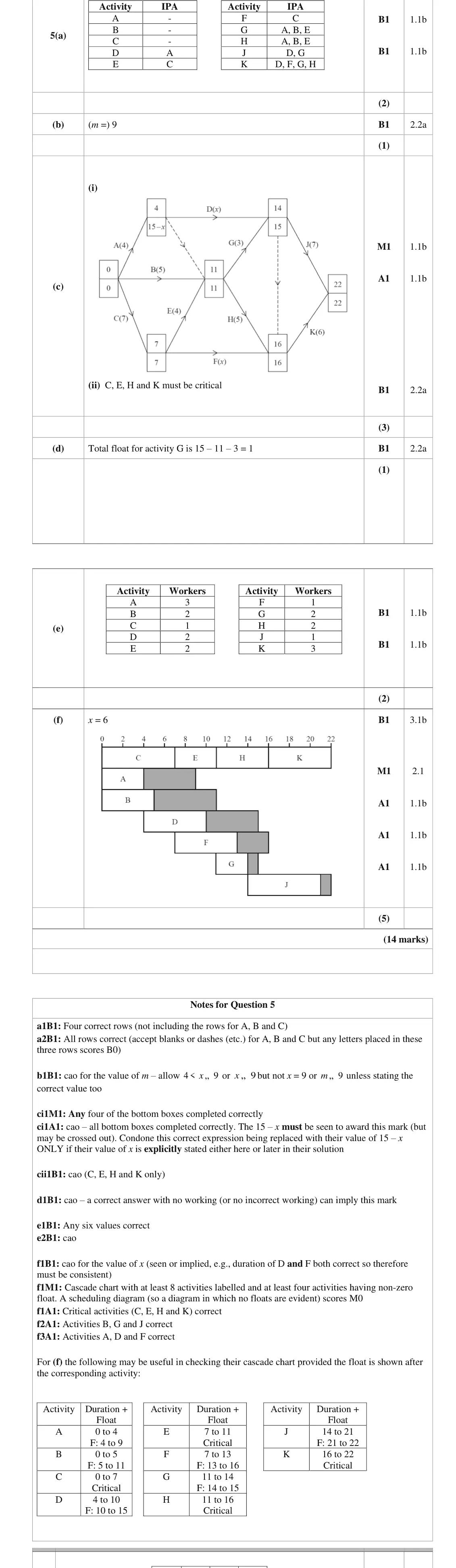
This question was accessible to most candidates. In (a) most candidates were able to list the immediately preceding activities, although a small number made errors e.g., omitting one of the activities from K or listing A, B, C instead of A, B, E for G and H. Most candidates recognized that the value of m depended on the late event times of D and F and the majority gave the correct value of 9. However, some gave an incorrect value of 8 or 10 and others incorrectly stated that x = 9. Answers giving the correct value of m as an inequality for x were accepted. In (c) most candidates made a good attempt at completing the late event times although many failed to give the correct expression of (15 – x) for the late event time at the end of activity A. Most candidates stated the correct critical activities and the value of the float for G in (d). Virtually all candidates extracted the required number of workers from the resource histogram and completed the table correctly in (e). In (f) most candidates attempted to draw a Gantt Chart, although some did not attempt this, and a small number drew a scheduling diagram instead. Those candidates who attempted the Gantt Chart drew the critical activities correctly and most also drew activities B, G and J correctly. Some candidates explicitly stated the value of x and then went on to draw D and F correctly and others implied the correct value of x from D and F shown on their Gantt Chart. A significant number of candidates made errors with the float for activity A.
Key points from the mark scheme and examiner's report
early event times 14 and 16 fix the durations of D and F: 4 + x ≤ 14 and 7 + x ≤ 16 give m = 9
8, 10 or "x = 9" seen
June 2022 · Paper 3D (Decision 1) · Q5(c)3 marks
Mark scheme (whole question; this part is marked with the orange bar)
Examiner's comment
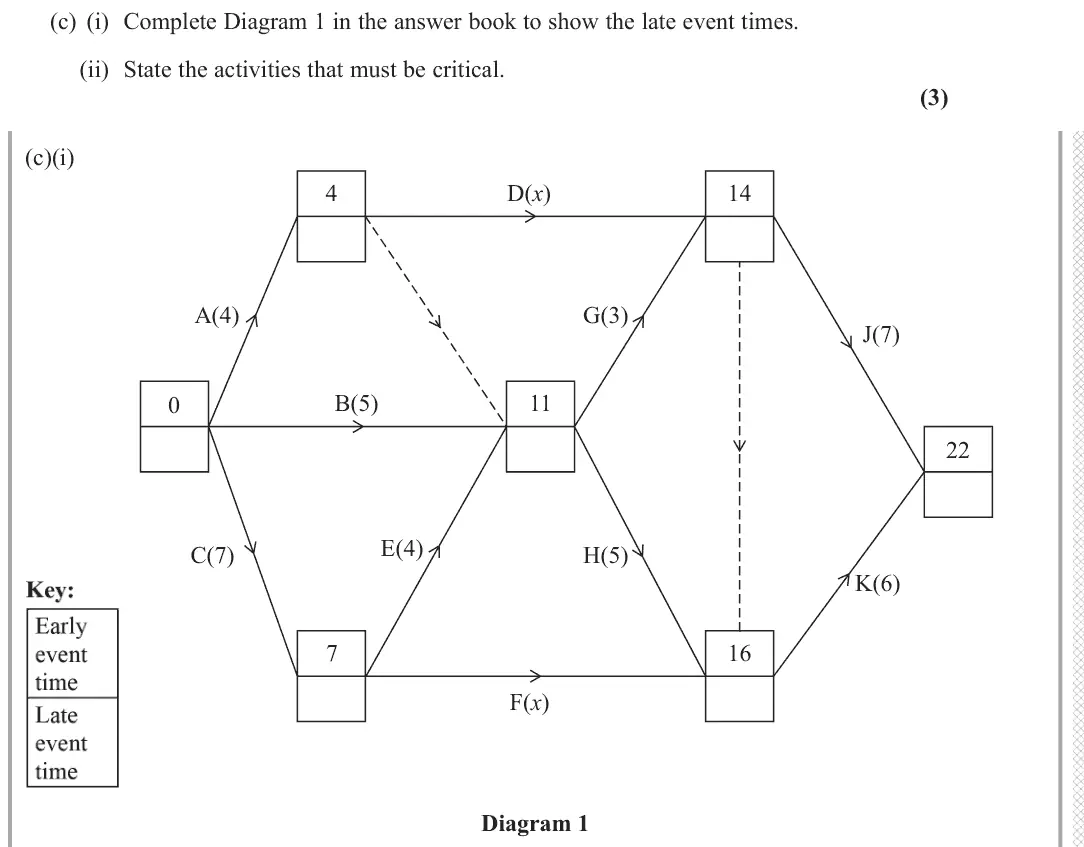
In (c) most candidates made a good attempt at completing the late event times although many failed to give the correct expression of (15 – x) for the late event time at the end of activity A. Most candidates stated the correct critical activities and the value of the float for G in (d).
Key points from the mark scheme and examiner's report
backward pass: late time at the end of A is 15 − x
C, E, H and K must be critical
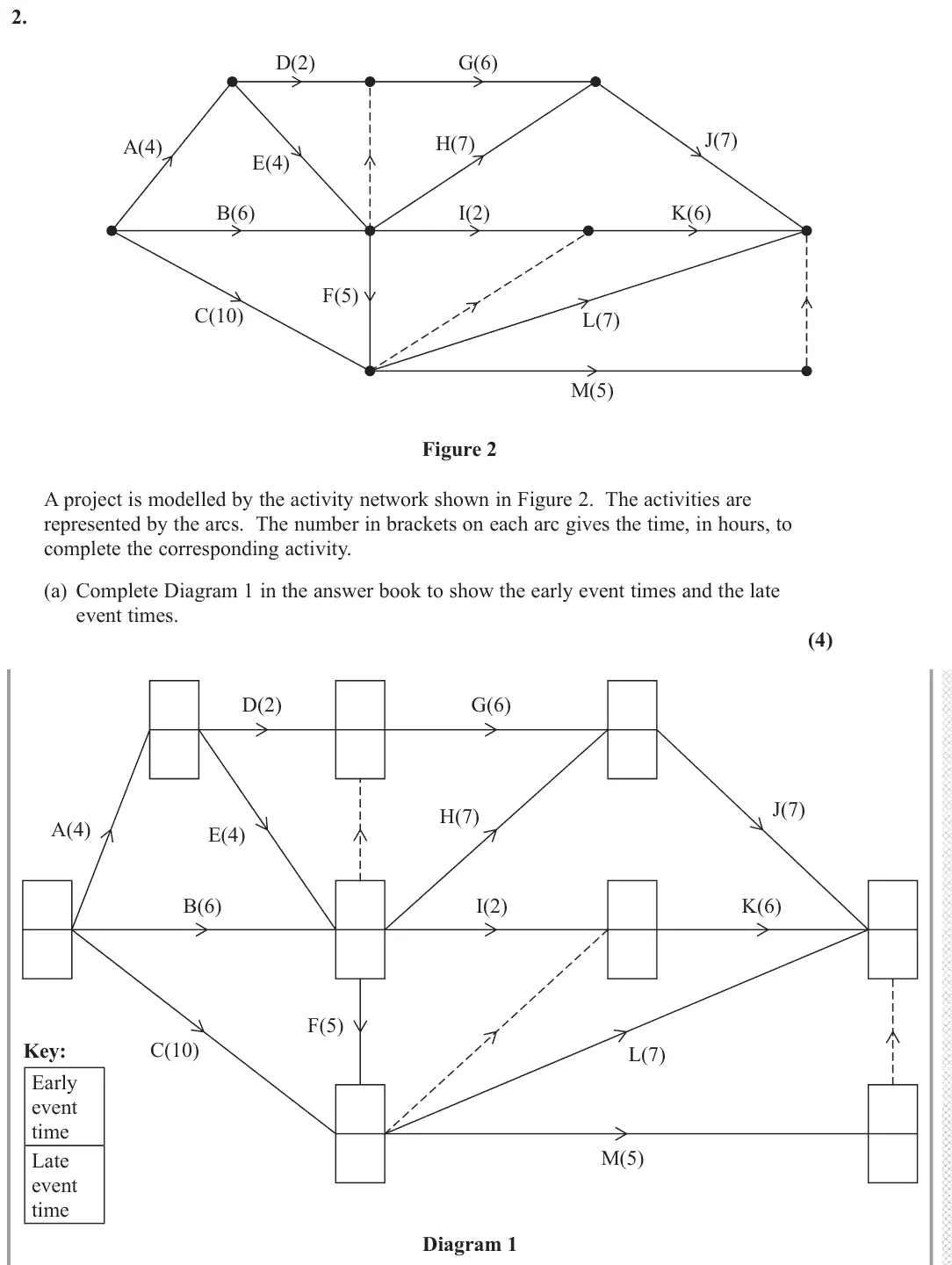
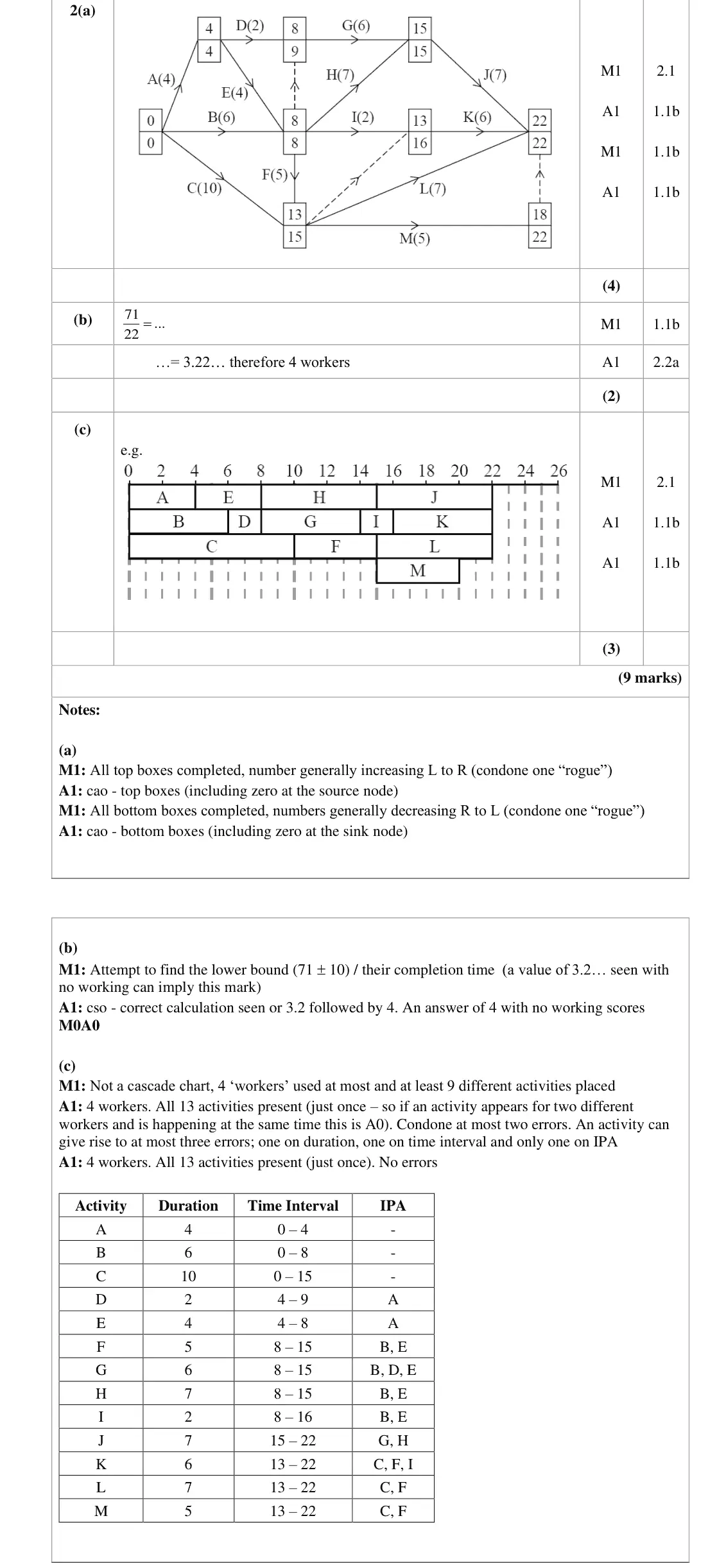
Nov 2021 · Paper 3D (Decision 1) · Q2(a)4 marks
Mark scheme (whole question; this part is marked with the orange bar)
Examiner's comment
This was a standard question on critical path analysis and was a good source of marks for most
Key points from the mark scheme and examiner's report
forward pass for early, backward pass for late event times including dummies
project length 22 hours
Nov 2021 · Paper 3D (Decision 1) · Q2(b)2 marks
Mark scheme (whole question; this part is marked with the orange bar)
Examiner's comment
This was a standard question on critical path analysis and was a good source of marks for most
Key points from the mark scheme and examiner's report
71/22 = 3.2… so at least 4 workers
4 with no working scores 0
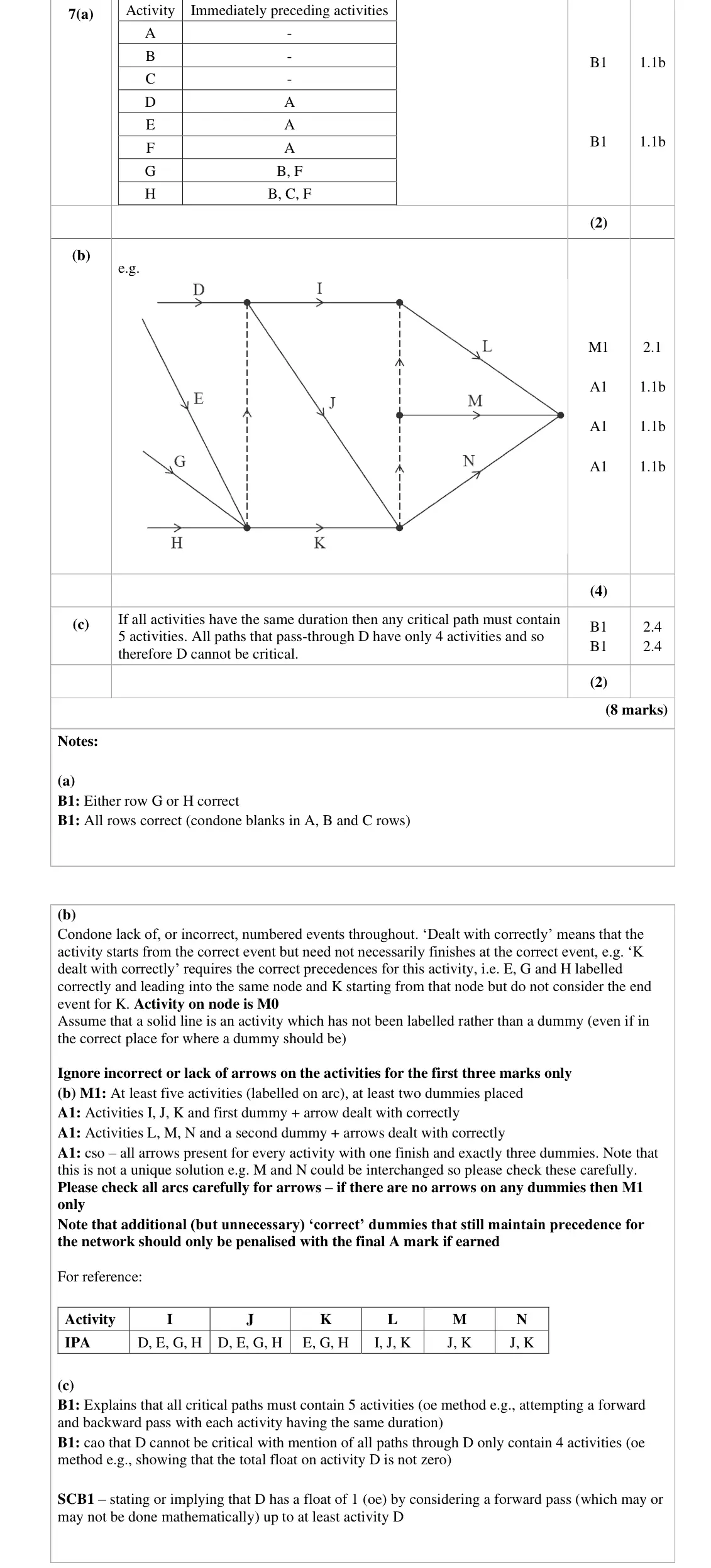
Nov 2021 · Paper 3D (Decision 1) · Q7(c)2 marks
Mark scheme (whole question; this part is marked with the orange bar)
Examiner's comment
This second question on critical path analysis was answered extremely well with most scoring marks in the first two parts. Part (c), in which candidates had to explain why activity D could not be critical, was quite demanding with very few realising that if all activities have the same duration, then any critical path must contain 5 activities, and as all paths that pass-through D have only 4 activities D cannot be critical.
Key points from the mark scheme and examiner's report
equal durations so a critical path has the most activities (5)
every path through D has only 4, so D has float and cannot be critical
very few saw this
Oct 2020 · AS Paper 2 (Decision 1) · Q2(b)3 marks
Mark scheme (whole question; this part is marked with the orange bar)
Examiner's comment
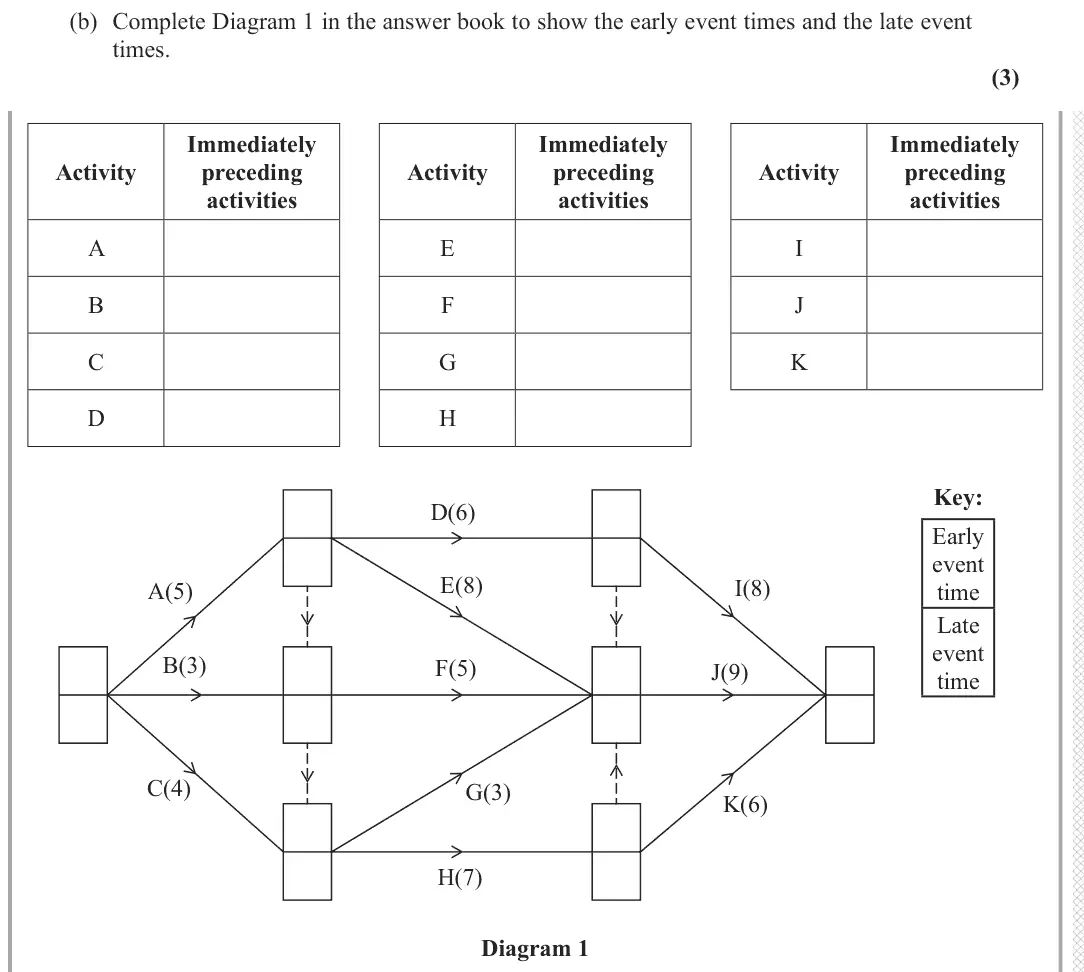
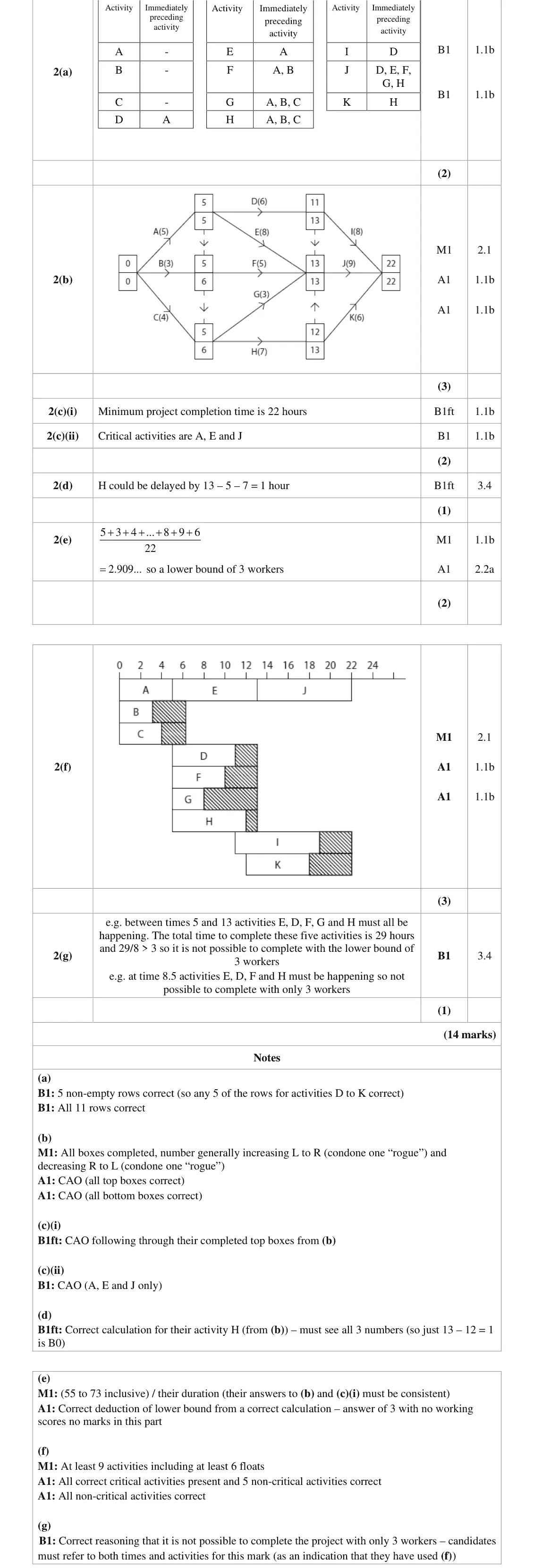
This question on critical path analysis was answered extremely well by many candidates. Part (b), in which candidates had to complete the early event times and late event times, was often done extremely well. Errors occasionally occurred in the event times at the beginning of G and/or J. However, either full marks or two marks out of three were common in this part. Nearly all candidates correctly stated the minimum project completion time and critical activities in part (c). accurately and neatly with most errors occurring following through from errors in (b). From time-to-time activities were mis-plotted – for example, sometimes at the start of I and K. Examiners noted that some responses had missing activities. The three critical activities were rarely incorrect.
Key points from the mark scheme and examiner's report
forward pass for early times, backward pass for late times
finish 22
errors at the start of G and J
Oct 2020 · AS Paper 2 (Decision 1) · Q2(c)2 marks
Mark scheme (whole question; this part is marked with the orange bar)
Examiner's comment
This question on critical path analysis was answered extremely well by many candidates. activities in part (c).
Key points from the mark scheme and examiner's report
22 hours
critical activities A, E and J
Oct 2020 · AS Paper 2 (Decision 1) · Q2(e)2 marks
Mark scheme (whole question; this part is marked with the orange bar)
Examiner's comment
This question on critical path analysis was answered extremely well by many candidates. Part (e) was generally very successfully attempted. Most candidates carried out a correct calculation and rounded their value up to give the correct lower bound for the number of workers. It was rare to see ’22’ (the minimum project completion time) divided by 11 (the number of activities). Most candidates in part (f) were well-versed in how to construct a cascade chart and examiners shortest possible time using the number of workers found in part (e). The most common approach seen by examiners was to realise that at time 8.5 activities E, D, F & H must be happening, so it is not possible to complete the project with three workers. Candidates are reminded that simply stating the activities that must be happening (together) without a specific reference to a time will not be credited with full marks.
Key points from the mark scheme and examiner's report
sum of activity times 64 ÷ 22 = 2.909…, round UP to 3 workers
answer 3 with no working scores 0
Oct 2020 · AS Paper 2 (Decision 1) · Q2(g)1 mark
Mark scheme (whole question; this part is marked with the orange bar)
Examiner's comment
This question on critical path analysis was answered extremely well by many candidates. Part (g) required the candidates to explain why it was not possible to complete the project in the shortest possible time using the number of workers found in part (e). The most common
Key points from the mark scheme and examiner's report
at time 8.5 activities D, E, F and H must all be happening, so 3 workers is not enough
must refer to a specific time and the activities
Oct 2020 · Paper 3D (Decision 1) · Q2(c)6 marks
Mark scheme (whole question; this part is marked with the orange bar)
Examiner's comment
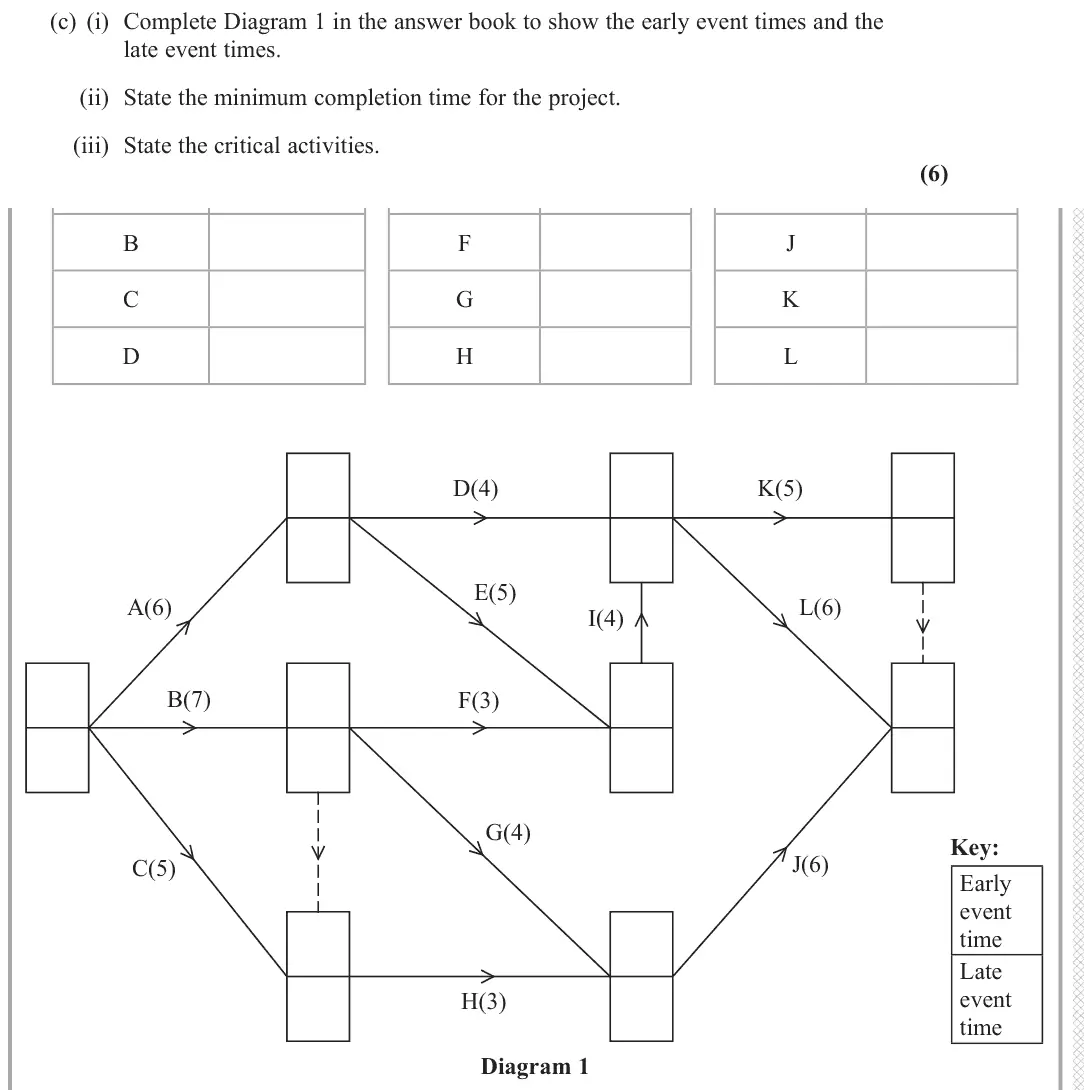
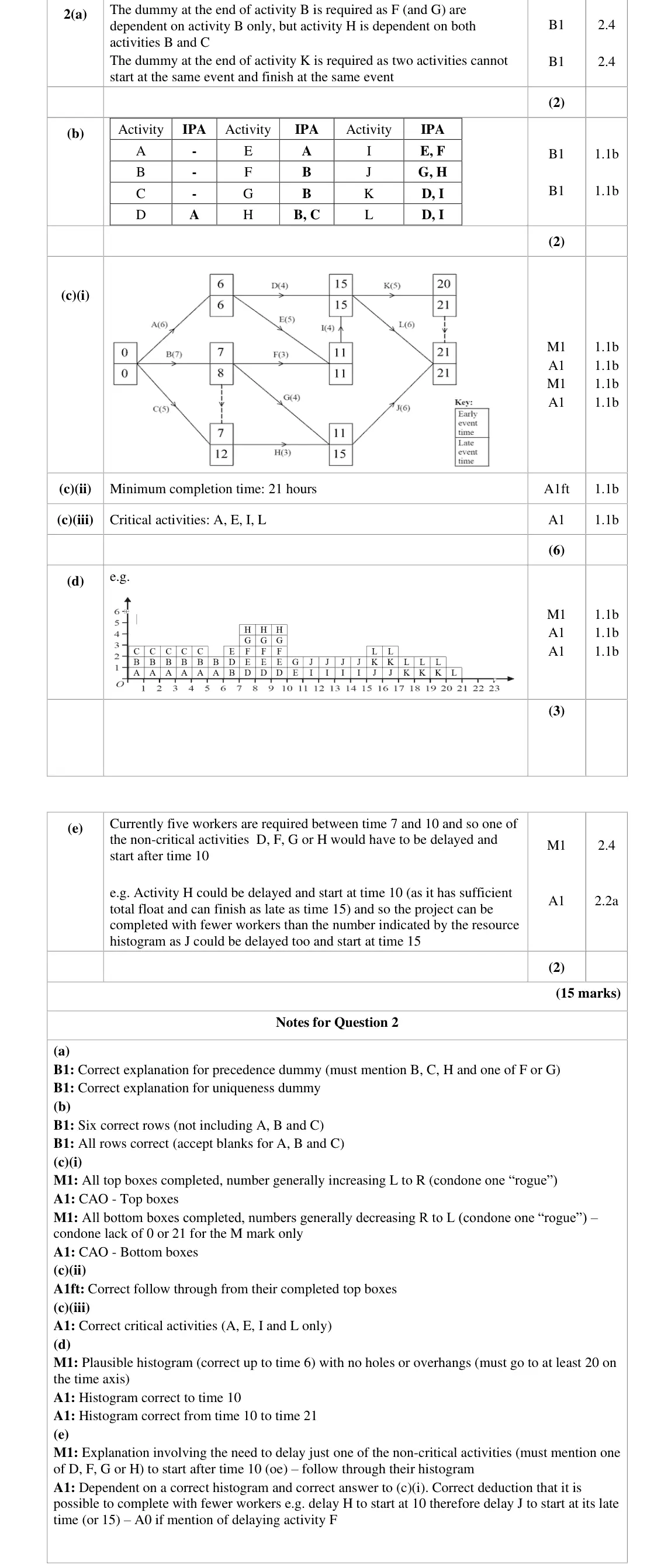
The explanations in (a) describing the necessity for dummy activities were sometimes omitted or only stated in general terms. Candidates should be advised to name all relevant activities, using equivalent wording to that in this and previous mark schemes. In (b) most candidates showed their understanding of preceding activities, scoring both marks. Fully correct early and late event times diagrams were commonly seen. The most frequent error was 5, instead of 7, as the early time at the end of C, due to the failure to take account of the dummy activity. Minimum completion time and the critical activities were usually correct following a correct diagram. The resource histogram is a recent addition to the specification, and quite a few candidates did not attempt this in (d) or made a start but quickly gave up. From those who persevered there were many perfect histograms, and only a few lost all marks due to holes or overhangs. It was apparent that candidates had difficulty interpreting their histogram for (e). A number of candidates managed partial answers involving reduction from five workers to four by delaying D, G or H to time 10 or beyond, but it was very rare to see a complete correct answer.
Key points from the mark scheme and examiner's report
forward and backward passes
early time at the end of C is 7, not 5 (dummy)
minimum completion time 21 hours
critical activities A, E, I, L
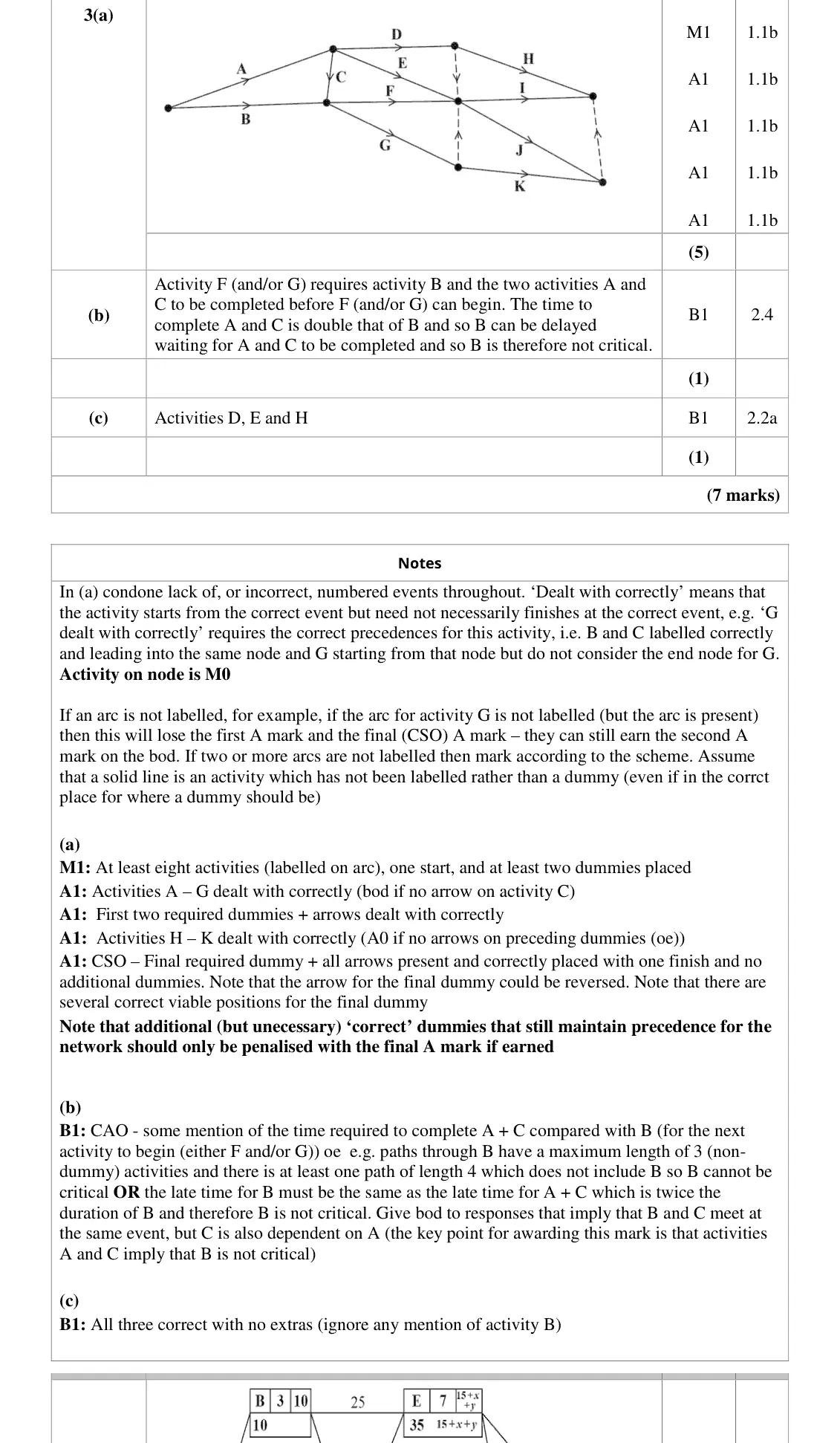
June 2019 · AS Paper 2 (Decision 1) · Q3(b)1 mark
Mark scheme (whole question; this part is marked with the orange bar)
Examiner's comment
Candidates were on more familiar territory here and most candidates were able to earn a good number In part (b), many candidates could clearly identify the reasons why activity B is not critical. However, articulating these reasons sometimes proved to be more of a challenge. Common responses which were insufficient for the mark included statements such as: “because F and G depend on B and C” which did not draw attention to the fact that C also depends on A; or “B is not on the shortest path” which did not give enough detail. Similarly, “B does not have a zero float” which was also too vague and was perhaps purely a learned definition for a critical activity. The most successful responses highlighted the dependency of C on A and the dependency of other activities (F and G) on both C and B. Other successful responses involved discussion of event times and the duration of A + the duration of C compared to the duration of activity B.
Key points from the mark scheme and examiner's report
F and G need B and C, but C follows A, so A + C takes twice as long as B and B can be delayed
"B is not on the longest path" or "B has non-zero float" too vague
June 2019 · AS Paper 2 (Decision 1) · Q3(c)1 mark
Mark scheme (whole question; this part is marked with the orange bar)
Examiner's comment
Candidates were on more familiar territory here and most candidates were able to earn a good number Part (c) was challenging for many candidates and it was relatively rare to see a correct answer here perhaps highlighting a lack of understanding of critical paths. Usually, candidates listed several activities. Some candidates were almost correct but incorrectly believed that K was not critical – perhaps failing to spot the path through K from A. Overall this question was successful in providing both access for less able candidates and differentiation amongst the more able ones.
Key points from the mark scheme and examiner's report
D, E and H
K often wrongly thought non-critical (path A, C, G, K)
June 2019 · Paper 3D (Decision 1) · Q4(a)2 marks
Mark scheme (whole question; this part is marked with the orange bar)
Examiner's comment
In part (a) very few candidates explained, with detailed reasoning, why x = 11. For the first mark candidates had to give a correct reason why the total float on activity H was given by 25 – 7 – x (e.g. mention that the early event time at the end of activity C is 7) and for the second mark (which was dependent on the first) a reason why the expression 25 – 7 – x leads to the given answer. Far too many candidates gave no reasoning at all and simply wrote down the equation 25 – 7 – x = 7 and then stated that x = 11.
Key points from the mark scheme and examiner's report
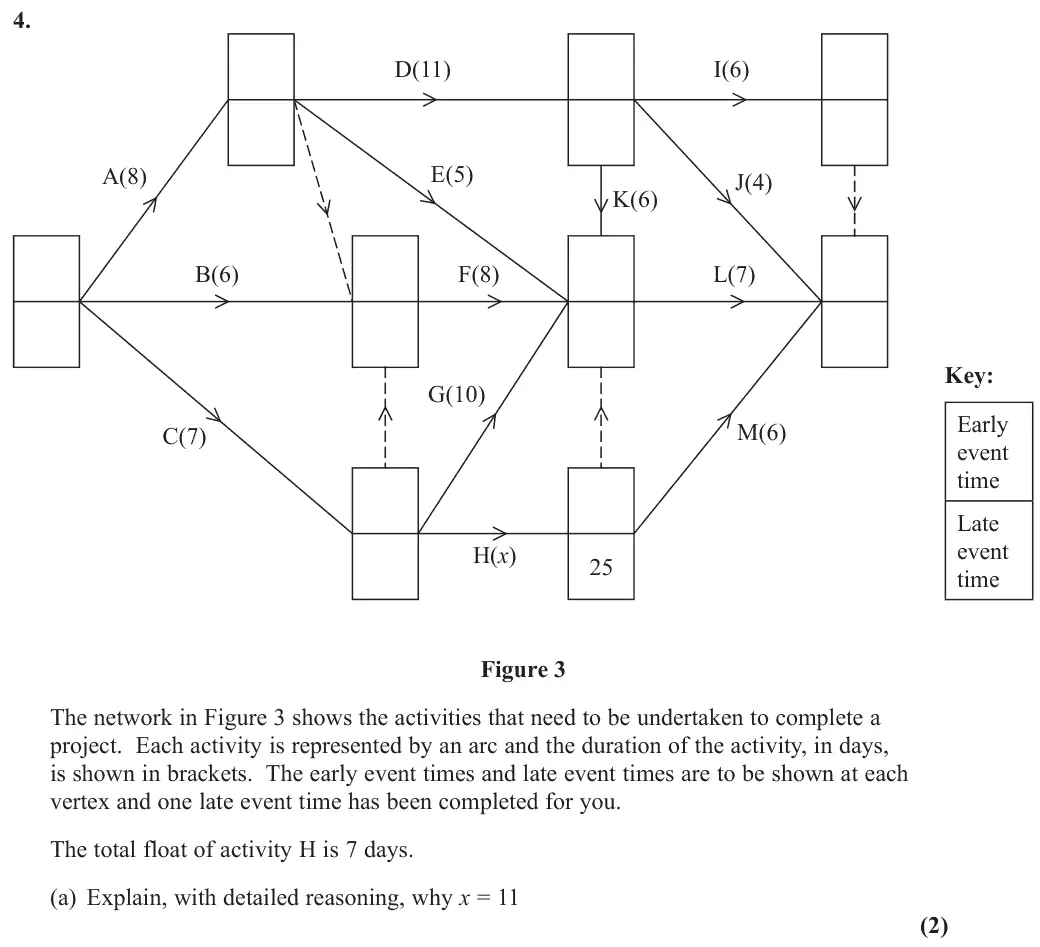
early event time at the end of C is 7, so float on H = 25 − 7 − x = 7 gives x = 11
must explain where 25 − 7 − x comes from
many just wrote the equation
June 2019 · Paper 3D (Decision 1) · Q4(b)3 marks
Mark scheme (whole question; this part is marked with the orange bar)
Examiner's comment
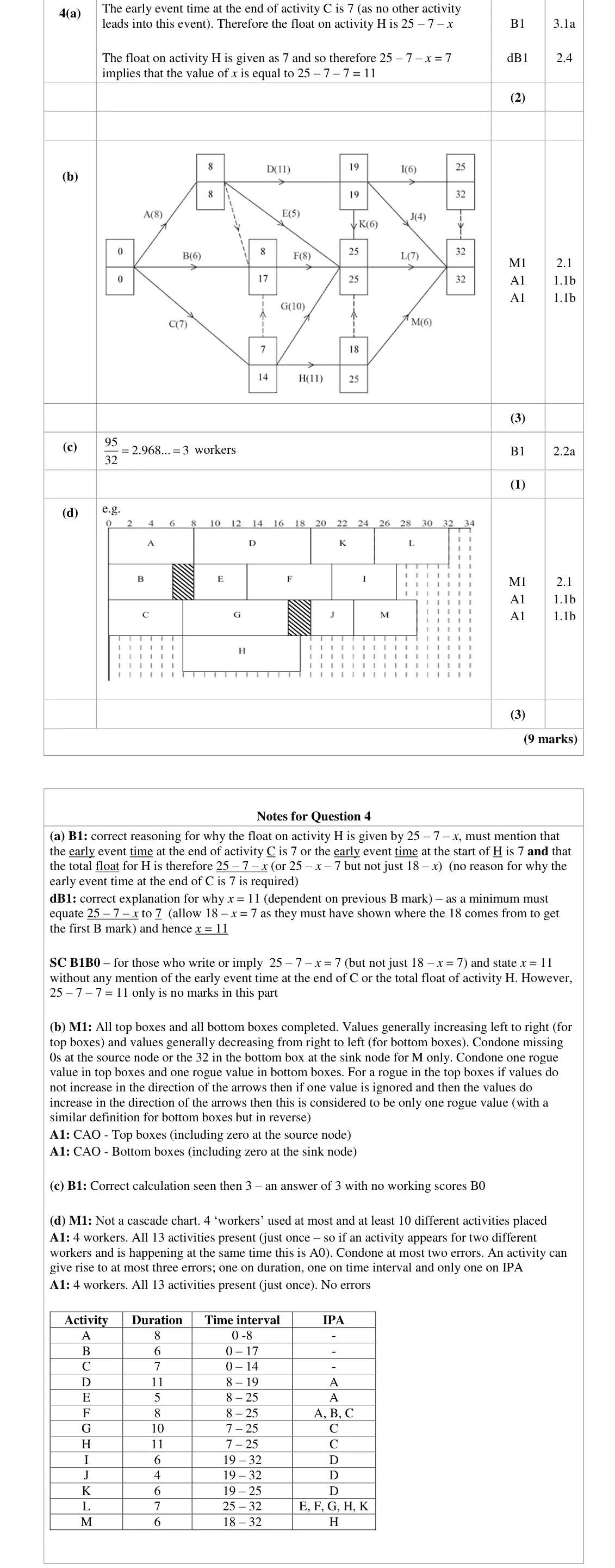
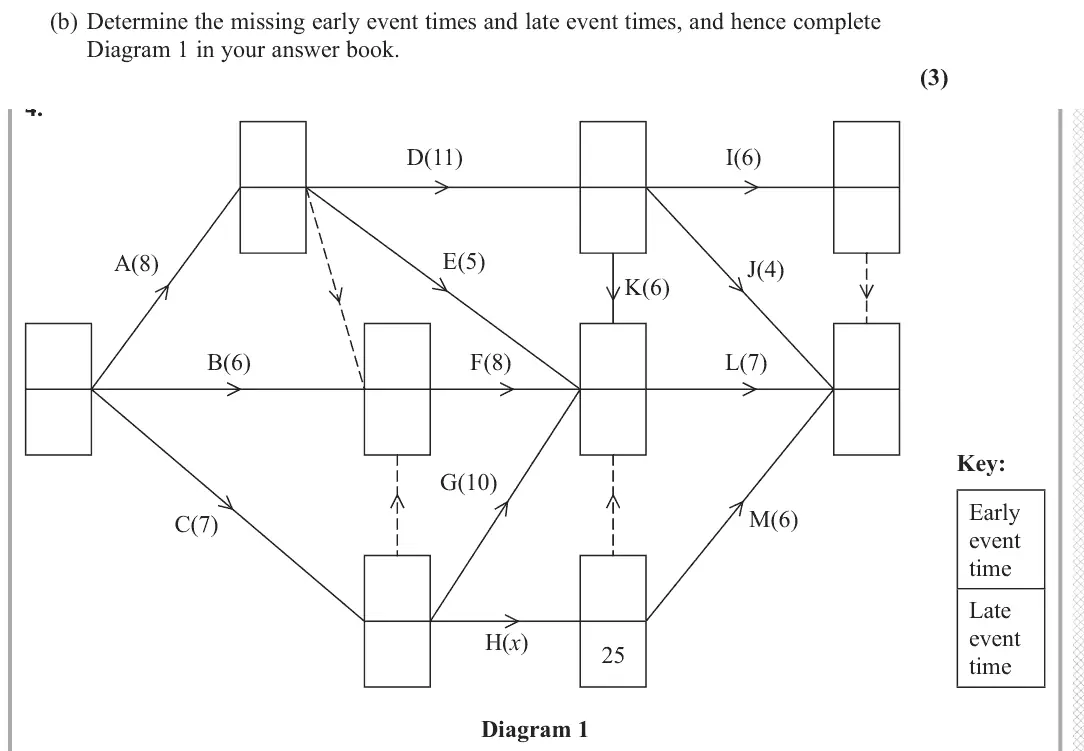
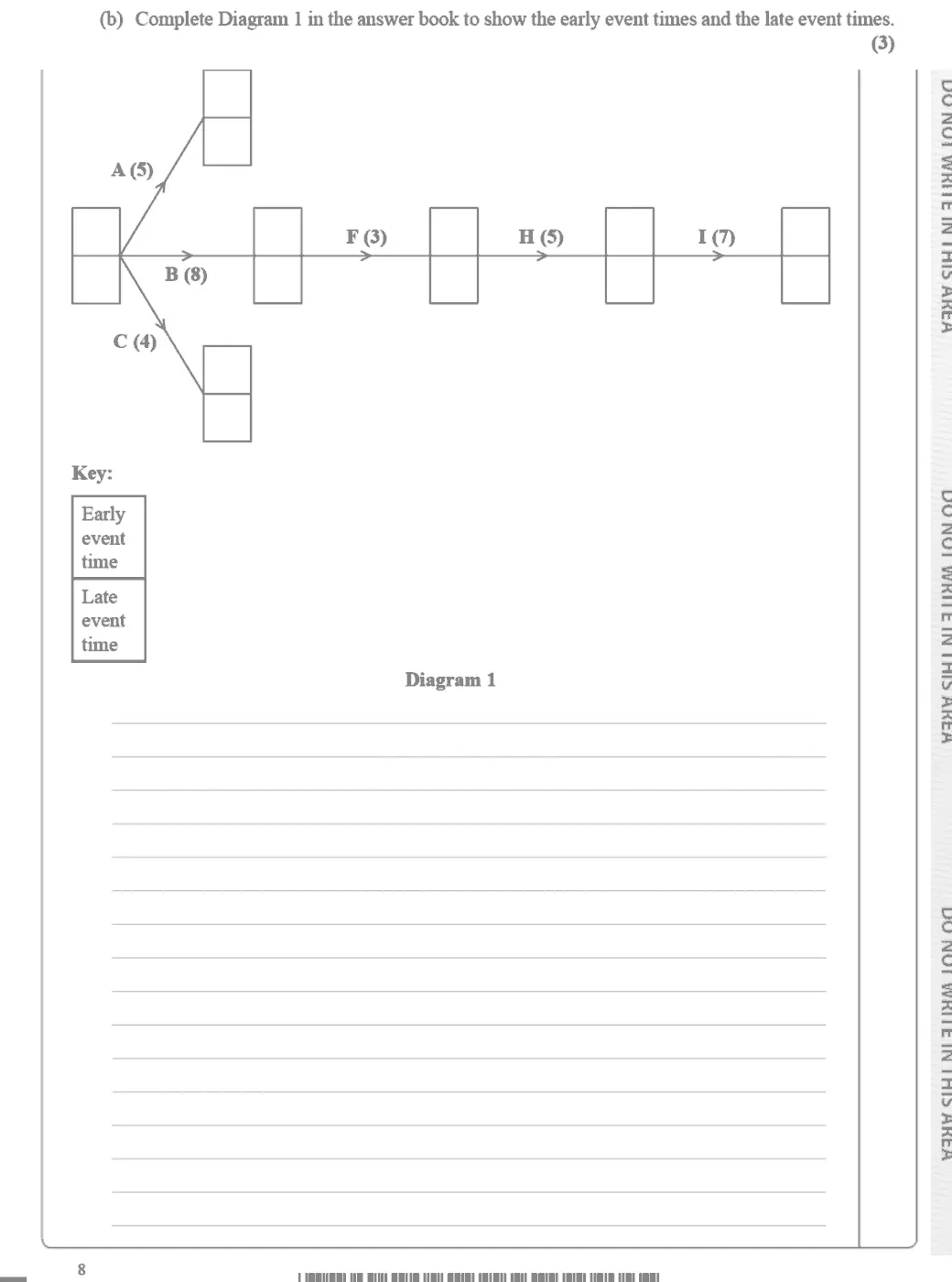
Part (b) was answered extremely well with many candidates correctly complete the diagram with the early event times and late event times. When errors did occur, they mostly occurred at the ends of activities B, F and/or H.
Key points from the mark scheme and examiner's report
forward pass for early, backward pass for late event times
project length 32
errors mostly at the ends of B, F and H
June 2019 · Paper 3D (Decision 1) · Q4(c)1 mark
Mark scheme (whole question; this part is marked with the orange bar)
Examiner's comment
Examiners noted that part (c) was generally answered correctly with nearly all showing a correct calculation.
Key points from the mark scheme and examiner's report
total activity time over critical time: 95/32 = 2.97 so 3 workers
answer without the calculation scores 0
June 2019 · Paper 3D (Decision 1) · Q5(b)1 mark
Mark scheme (whole question; this part is marked with the orange bar)
Examiner's comment
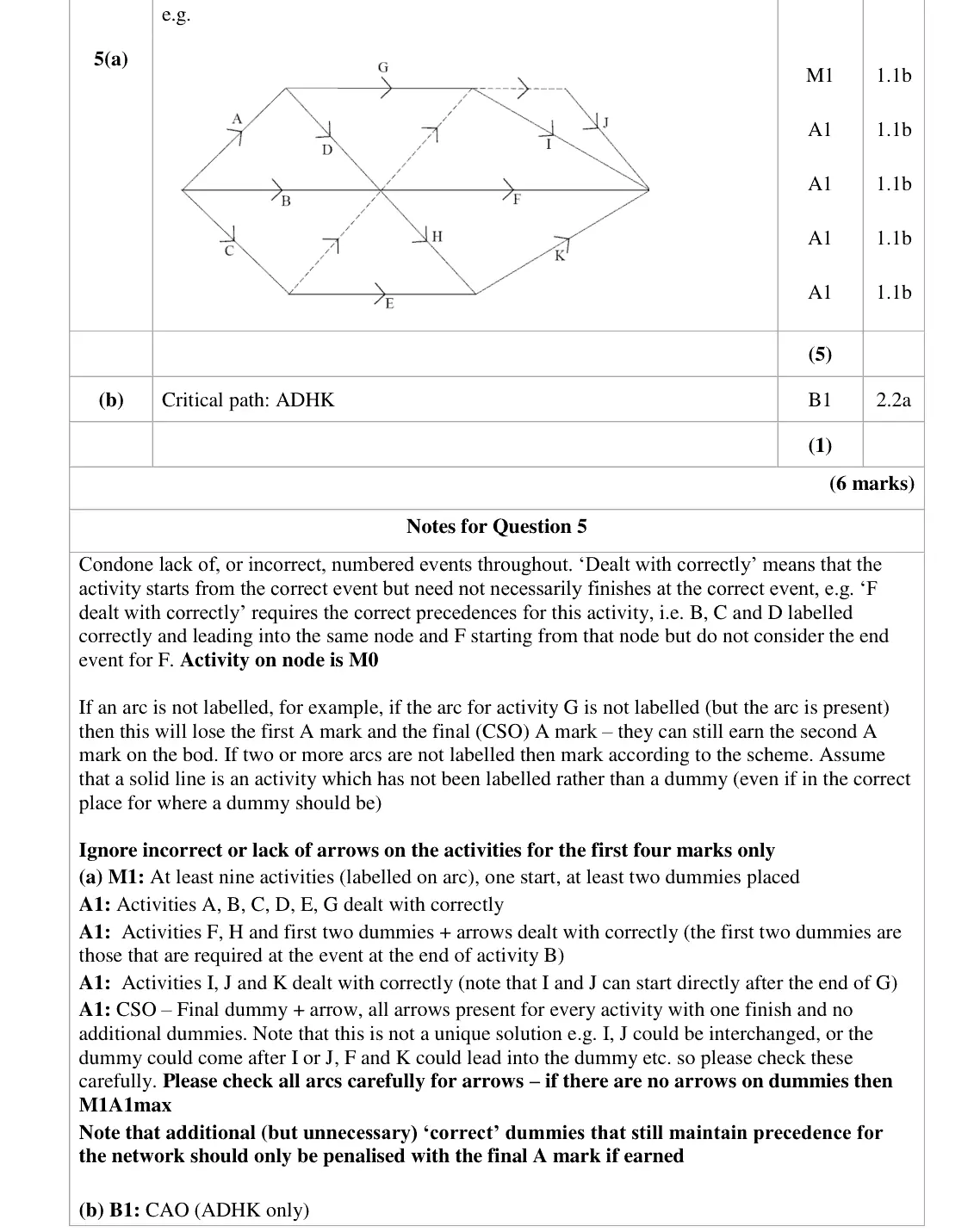
Candidates generally showed a good understanding of the process of constructing an activity network In part (b) only the most able candidates realised that if all the activities have the same duration then ADHK was the critical path.
Key points from the mark scheme and examiner's report
equal durations so the critical path is the one with most activities: ADHK
few candidates spotted this
June 2018 · AS Paper 2 (Decision 1) · Q3(b)3 marks
Mark scheme (whole question; this part is marked with the orange bar)
Examiner's comment
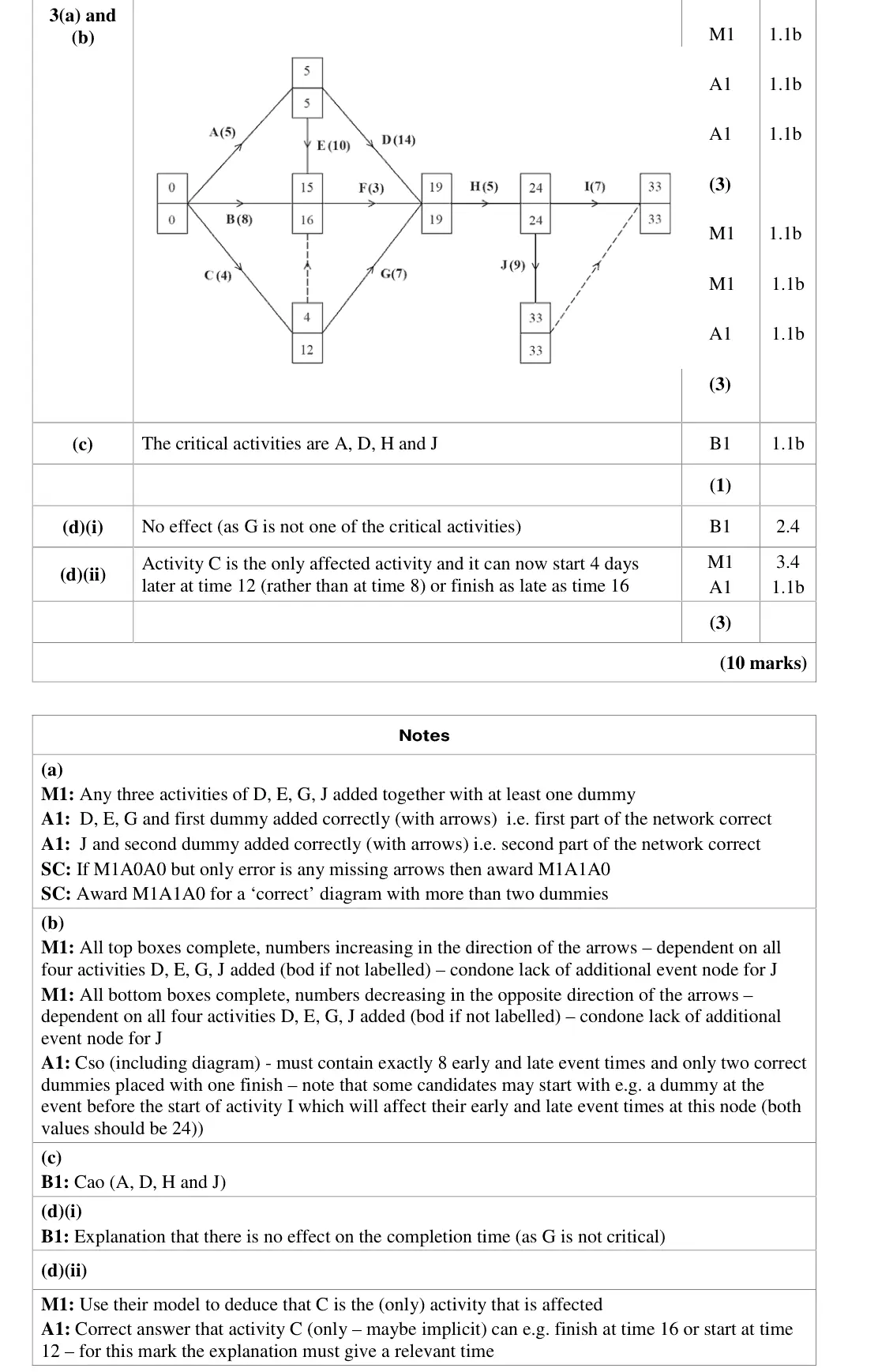
This question was, at times, very well answered but the construction of an activity network with an efficient number of dummies proved to be something of a challenge for many students. Some of the issues noted by examiners were: There were often several extra dummies added after activities. Students often drew straight lines for activities and whenever a change in direction was required to connect the activity to the correct node, an event was added followed by a dummy. In addition, dummies were added joining the node at the end of activities A or C to the end point of the network. Missing dummy between the nodes at the end of activities I and J so that the network had two end points. Or occasionally, I and J violated the uniqueness rule by both passing between these two nodes. Both dummies and activities had missing arrows for a significant number of students. Sometimes no arrows whatsoever were added but more often there were one or two missing arrows. Activities G and D were drawn incorrectly feeding into the node at the start of activity J. Activity J missing. A missing event node at the end of activity J. Diagrams were often unclear and some students redrew their diagrams multiple times. For those students who were able to draw a workable activity network it was quite straightforward to write
Key points from the mark scheme and examiner's report
early times increase along arrows, late times decrease backwards
finish 33 days
must contain exactly 8 event nodes
June 2018 · AS Paper 2 (Decision 1) · Q3(c)1 mark
Mark scheme (whole question; this part is marked with the orange bar)
Examiner's comment
down the critical activities in (c). Although activity I appeared regularly in place of J or as an addition to A, D, H and J.
Key points from the mark scheme and examiner's report
A, D, H and J
I often given in place of or as well as J
June 2018 · AS Paper 2 (Decision 1) · Q3(d)3 marks
Mark scheme (whole question; this part is marked with the orange bar)
Examiner's comment
In (d)(i), most students were able to recognise that the removal of activity G would have no effect on the shortest completion time. Although some did state that it would be reduced. Similarly, for (d)(ii), the question asked for a comment on the timings of the remaining activities – so to gain both marks here, students needed to mention both that activity C was the only affected activity, and also that the timing of this activity would now be adjusted to finish at time 16 (or start as late as time 12).
Key points from the mark scheme and examiner's report
(i) no effect as G is not critical
(ii) only C is affected: it can now start at 12 or finish as late as 16
many omitted a relevant time
Find an Edexcel Further Maths tutor
Stuck on this? Book a trial lesson with our Further Maths tutor.