FM1.4.1 Direct impact of elastic spheres. Newton’s law of restitution.…
Section
FM1.4 Elastic collisions in one dimension
Level
AS & A level
Statement
Direct impact of elastic spheres. Newton’s law of restitution. Loss of kinetic energy due to impact.
Guidance
Students will be expected to know and use the inequalities 0 ≤ e ≤ 1 (where e is the coefficient of restitution). The spheres may be modelled as particles.
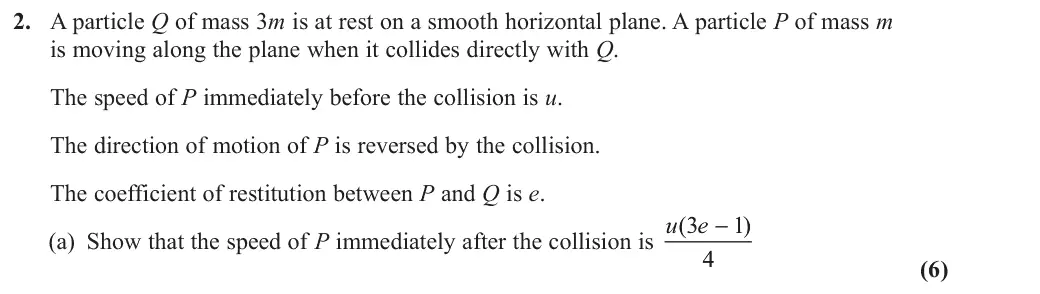
June 2025 · AS Paper 2 (Further Mechanics 1) · Q2(a)6 marks
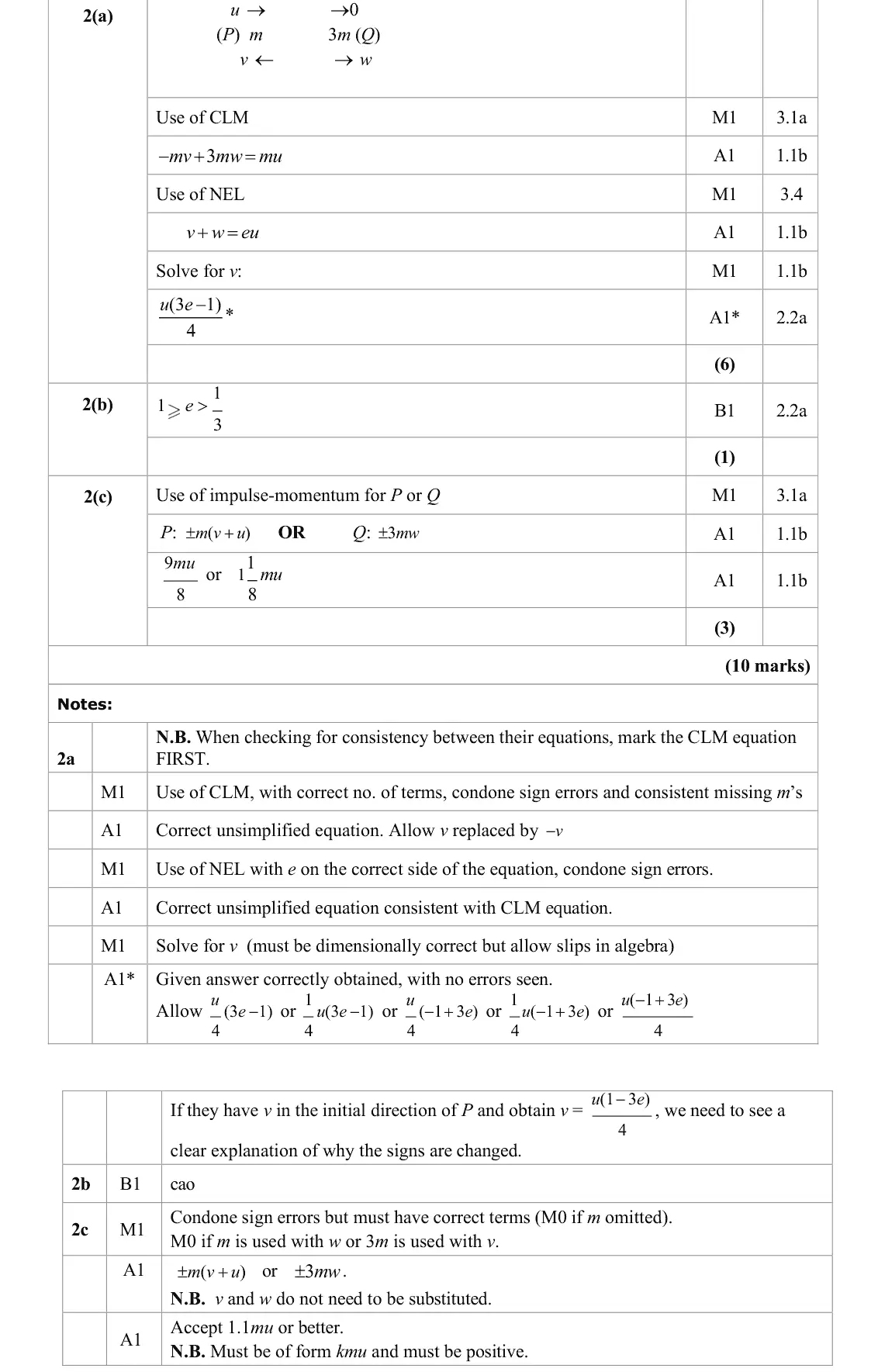
Mark scheme (whole question; this part is marked with the orange bar)
Examiner's comment
There were many fully correct responses in part (a), particularly from those who took onboard from the start the fact that the direction of motion of P was reversed by the collision. Those who didn’t just made life difficult for themselves, not only in part (a) but also in the later parts. Most, however, were able to write down a CLM and an NEL equation, do the necessary elimination and obtain the given answer, sometimes with some adjusting of the signs.
Key points from the mark scheme and examiner's report
CLM −mv + 3mw = mu and NLR v + w = eu with P's velocity reversed
solve for v = u(3e − 1)/4
if v is taken in the original direction a clear explanation of the sign change is needed
June 2025 · AS Paper 2 (Further Mechanics 1) · Q2(b)1 mark
Mark scheme (whole question; this part is marked with the orange bar)
Examiner's comment
Part (b) was not answered well and proved to be a good discriminator, with a whole range of incorrect answers being given: 0 ⩽ 𝑒𝑒 ⩽ 1 3, 1 3 e > , 1 3 < 𝑒𝑒< 1,…
Key points from the mark scheme and examiner's report
P reverses so v > 0 needs e > 1/3, with e ≤ 1: 1/3 < e ≤ 1
good discriminator, wrong inequalities common (e.g. 0 ≤ e ≤ 1/3)
June 2025 · AS Paper 2 (Further Mechanics 1) · Q2(c)3 marks
Mark scheme (whole question; this part is marked with the orange bar)
Examiner's comment
Part (c) was often correctly done. The most common error was finding the velocity of Q but using m rather than 3m when calculating the magnitude of the impulse, closely followed by using P but making a sign error when dealing with the rebound velocity.
Key points from the mark scheme and examiner's report
e = 1/2: v = u/8, w = 3u/8
impulse = m(v + u) or 3mw = 9mu/8
common errors: mass m used with Q's velocity, sign error with P's rebound
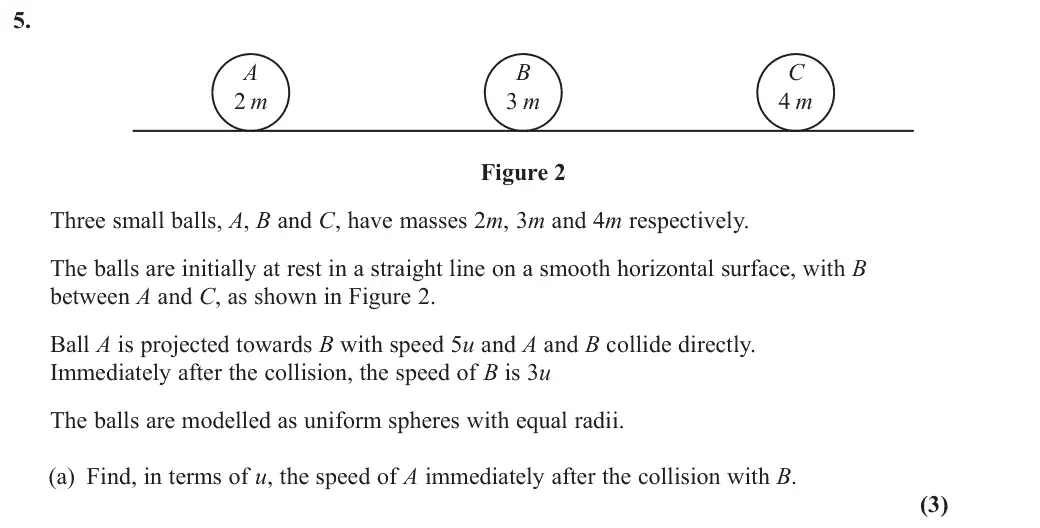
June 2025 · Paper 3C (Further Mechanics 1) · Q5(a)3 marks
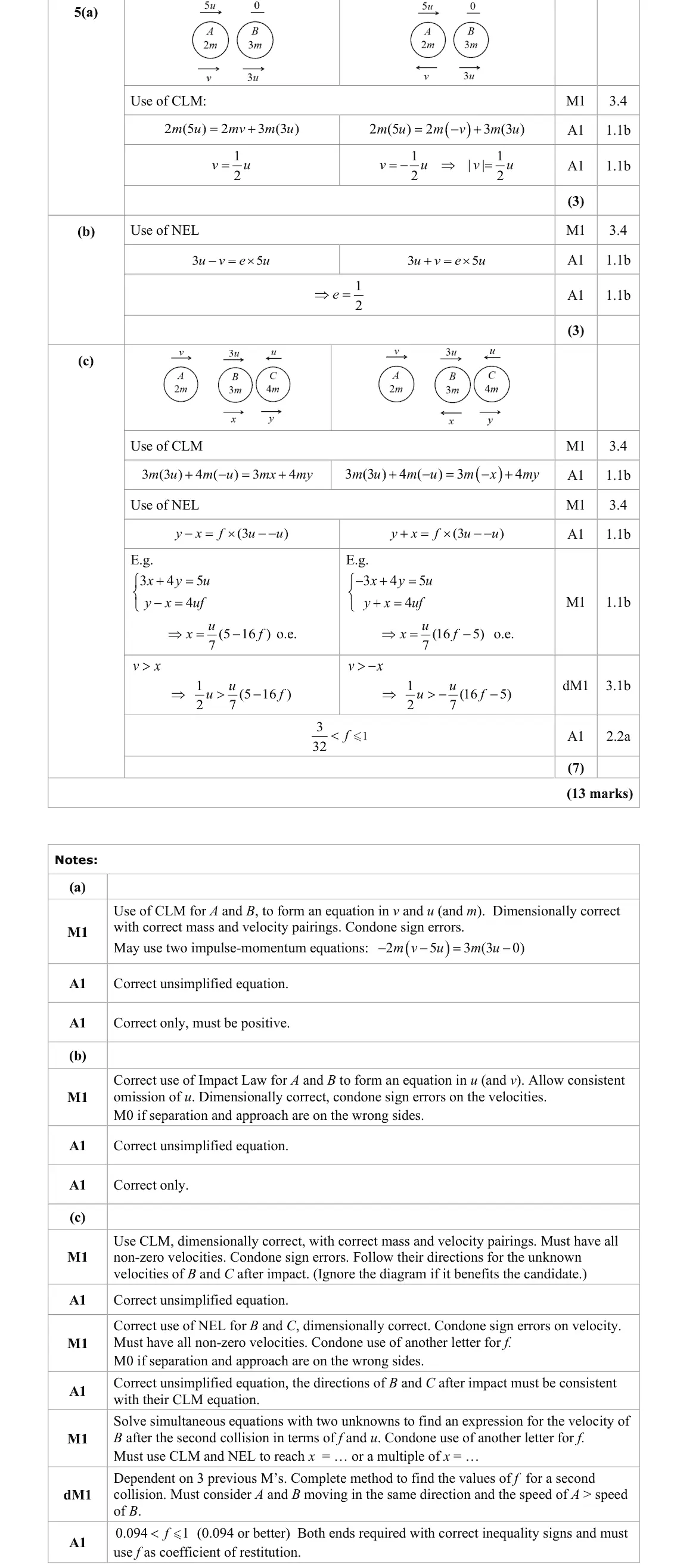
Mark scheme (whole question; this part is marked with the orange bar)
Examiner's comment
Candidates across the grades made a confident start to this question on successive direct collisions with most gaining the first 6 marks in a few lines of neat working. Forming a CLM equation in part (a) was very straightforward with few sign errors seen and the modulus taken, if necessary, to give the speed of A after the first collision. Using the impact law in part (b) brought almost the same level of success with any errors deriving from incorrect
Key points from the mark scheme and examiner's report
CLM 2m(5u) = 2mv + 3m(3u): speed of A is u/2
June 2025 · Paper 3C (Further Mechanics 1) · Q5(b)3 marks
Mark scheme (whole question; this part is marked with the orange bar)
Examiner's comment
Candidates across the grades made a confident start to this question on successive direct collisions with most gaining the first 6 marks in a few lines of neat working. law in part (b) brought almost the same level of success with any errors deriving from incorrect signs.
Key points from the mark scheme and examiner's report
NLR 3u − u/2 = 5ue: e = 1/2
June 2024 · AS Paper 2 (Further Mechanics 1) · Q1(b)3 marks
Mark scheme (whole question; this part is marked with the orange bar)
Examiner's comment
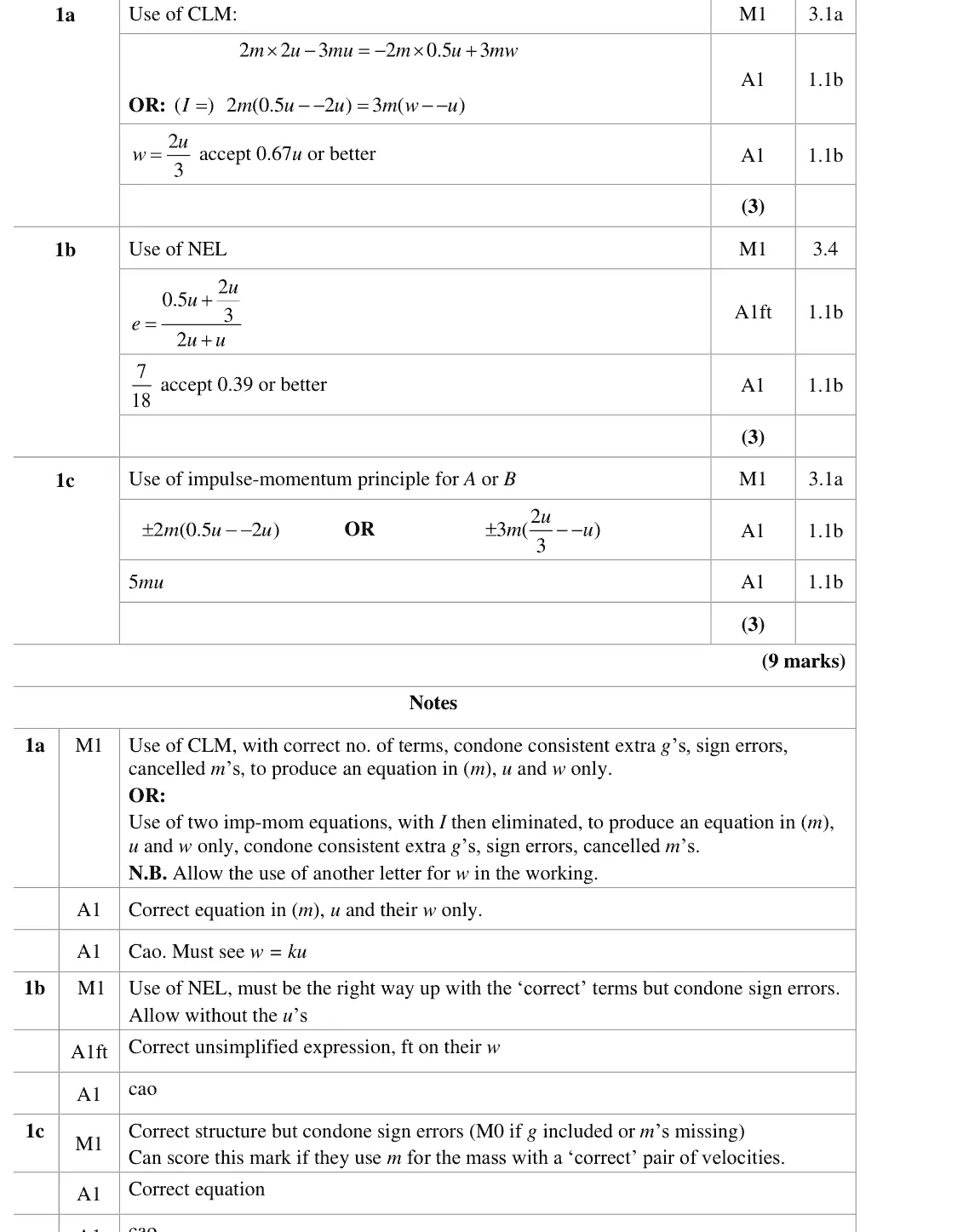
In part (b), NEL was almost always used correctly, and any mistakes tended to be sign errors.
Key points from the mark scheme and examiner's report
NLR e = (0.5u + 2u/3)/(2u + u) = 7/18 (0.39)
ratio must be the right way up
June 2024 · AS Paper 2 (Further Mechanics 1) · Q4(a)3 marks
Mark scheme (whole question; this part is marked with the orange bar)
Examiner's comment
Part (a) was well answered with those candidates who used NEL making fewer sign errors than those who used CLM where the algebra was more difficult. Some candidates seemed unable to simplify their answer by collecting like terms.
Key points from the mark scheme and examiner's report
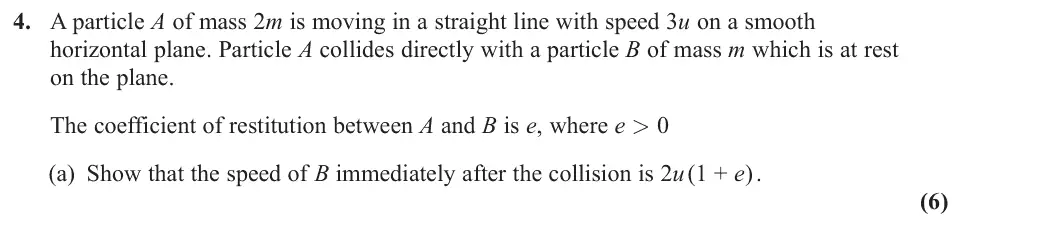
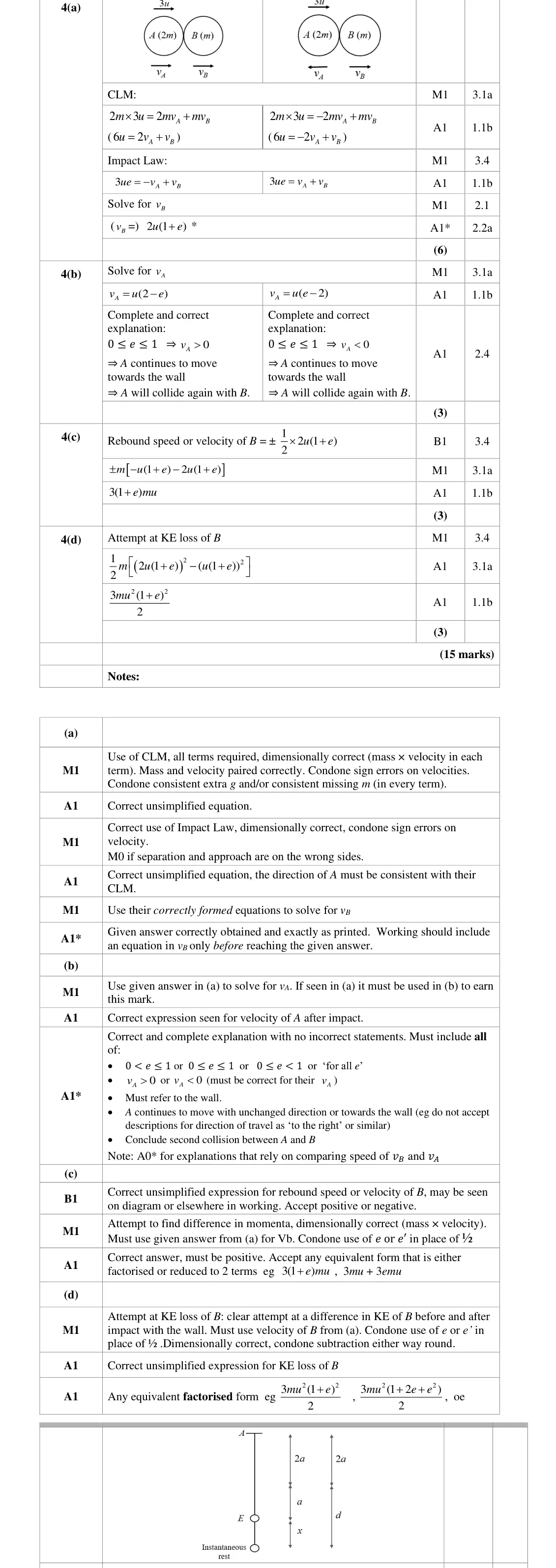
June 2024 · Paper 3C (Further Mechanics 1) · Q4(a)6 marks
Mark scheme (whole question; this part is marked with the orange bar)
Examiner's comment
This was a very popular question with candidates at all levels achieving most of the marks available. In part (a) candidates confidently established equations for the conservation of linear momentum and Newton’s Experimental Law. This routine process was well-rehearsed and candidates who made sign errors were able to use the given answer to identify the error and often made a full recovery by returning to their initial equations to follow the correction through. There was other evidence of good exam technique with candidates re-writing their velocity of B to match the printed answer exactly. Candidates who were successful in part (a) usually earned the first two marks in part (b) for finding the velocity of A. However, the final mark required clear reasoning and precise language which presented more of a challenge and distinguished between the grades. Centres should advise candidates to avoid describing the direction of motion as ‘to the left’ or ‘to the right’. It is much better to use phrases such as ‘continues in the direction of motion’ or ‘reverses the direction of motion’ or to describe the motion relative to an object defined in the question, in this case, a fixed wall. Most candidates quickly identified the speed of B after colliding with the wall and used it successfully in part (b) to find the magnitude of the impulse, and in part (c) to find the loss in
Key points from the mark scheme and examiner's report
CLM 6u = 2v_A + v_B and NLR 3ue = v_B − v_A give v_B = 2u(1 + e)
given answer helped correct sign errors
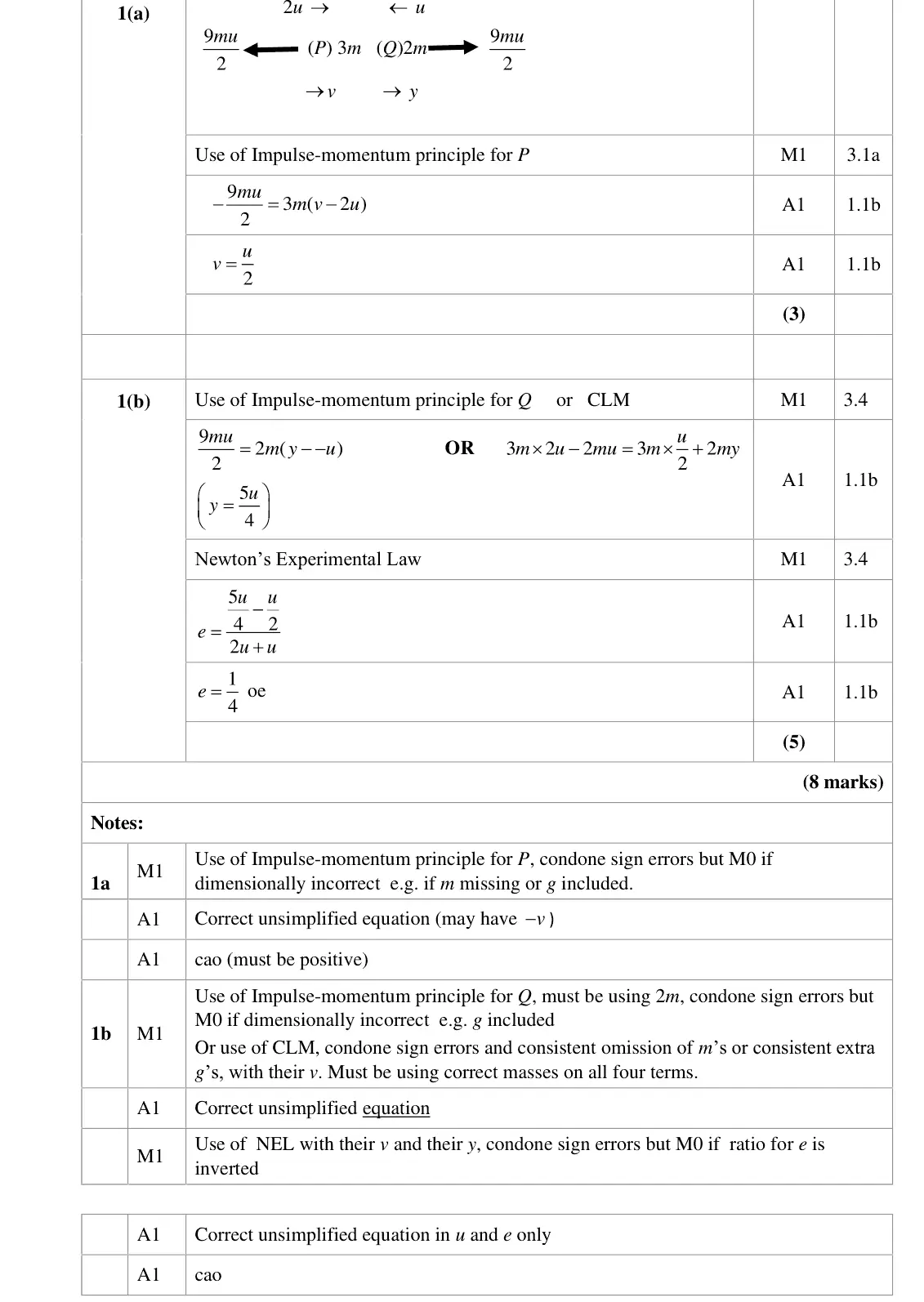
June 2023 · AS Paper 2 (Further Mechanics 1) · Q1(b)5 marks
Mark scheme (whole question; this part is marked with the orange bar)
Examiner's comment
the A marks in (b). Most knew that the answer needed to be positive but some gave a negative value for the speed and lost a mark. In part (b), most opted to first use CLM to find the speed of Q after the collision but the down side of this was that it involved using their answer to (a) which if wrong, led to the loss of all the A marks in the second part. Those who used the impulse-momentum principle on Q could get (a) wrong but (b) fully correct. Most then applied NEL correctly, with a correct approach speed of 3u but many got the wrong answer due to an earlier error. A minority of candidates tried to solve (b) by substituting an expression for vQ obtained using NEL into their CLM equation (or vice versa) and then substituting the value of vP from (a). Some did this successfully to obtain a correct value for e. However, some never actually substituted their vP so were unable to obtain an answer.
Key points from the mark scheme and examiner's report
impulse on Q 9mu/2 = 2m(y + u) or CLM gives y = 5u/4
NLR e = (5u/4 − u/2)/(2u + u) = 1/4
using the impulse on Q avoids follow-on from an error in (a)
approach speed is 3u
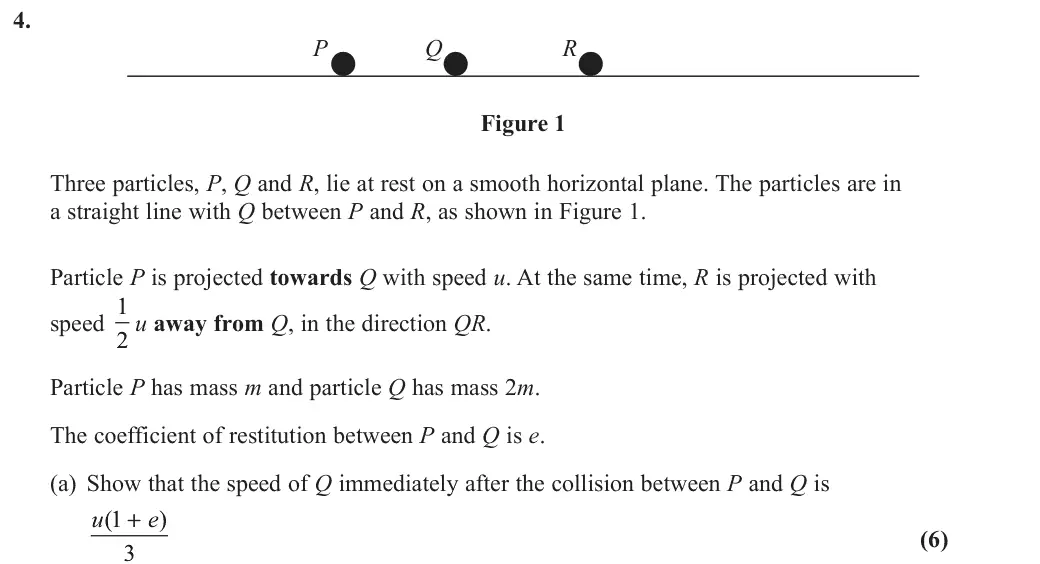
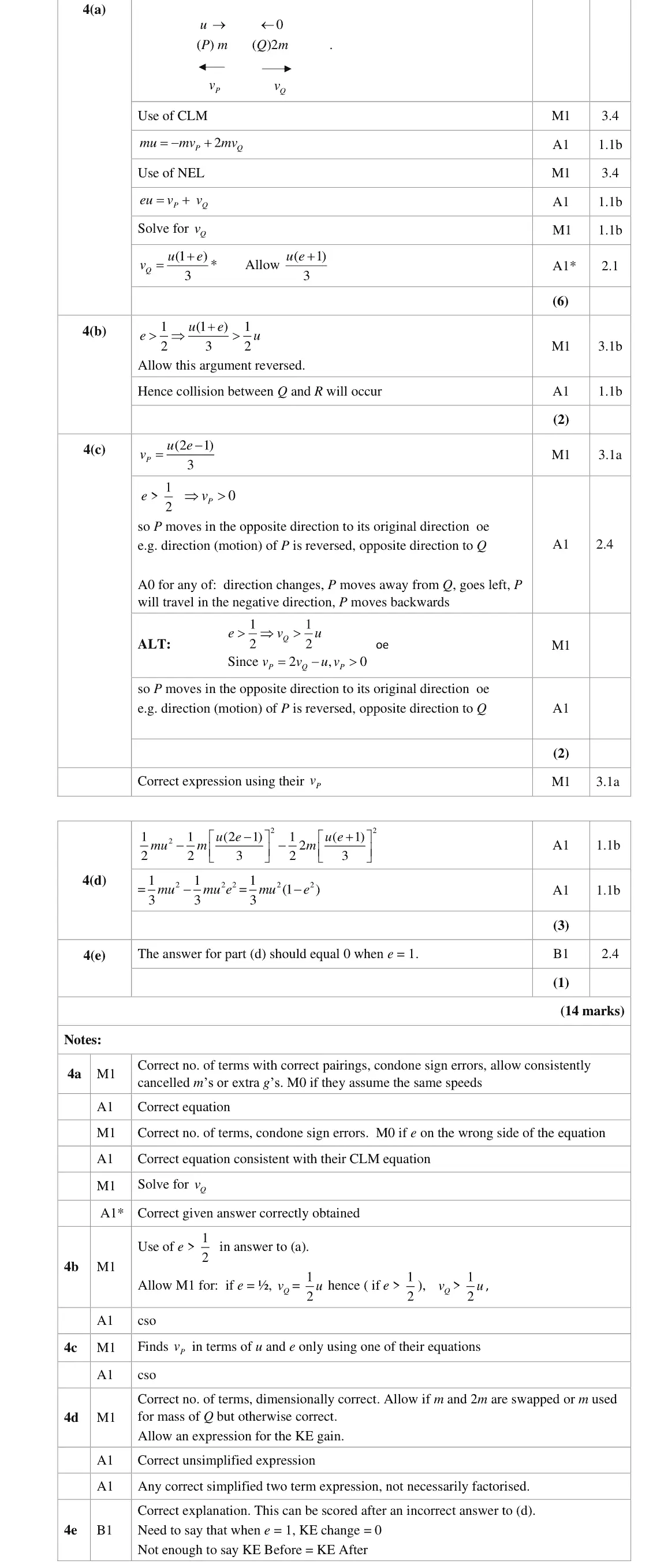
June 2023 · AS Paper 2 (Further Mechanics 1) · Q4(a)6 marks
Mark scheme (whole question; this part is marked with the orange bar)
Examiner's comment
Part (a) was well answered with most candidates producing and solving the two simultaneous equations using CLM and NEL. The method of solution of the equations varied, and some found vP before vQ , but most ensured they achieved the required expression correctly. used for P in part (a) and so incorrectly interpreted their expression. Many candidates are still unable to specify a direction correctly and there was a variety of incorrect vague answers: moving left, west, backwards, away from Q, in the negative direction etc with even strong candidates, who achieved full marks in the rest of the question, unable to give a precise answer.
Key points from the mark scheme and examiner's report
CLM mu = −mv_P + 2mv_Q and NLR eu = v_P + v_Q
solve for v_Q = u(1 + e)/3
June 2023 · AS Paper 2 (Further Mechanics 1) · Q4(c)2 marks
Mark scheme (whole question; this part is marked with the orange bar)
Examiner's comment
In the third part, most candidates realised that finding an expression for the speed of P would be of help in determining its direction. Those who found a correct expression and considered the effect of the inequality for e did not always remember to consider the initial direction they had used for P in part (a) and so incorrectly interpreted their expression. Many candidates are still
Key points from the mark scheme and examiner's report
v_P = u(2e − 1)/3 > 0 (in the direction taken as reversed) since e > 1/2, so P's direction of motion is reversed (moves away from Q)
vague answers like "left", "backwards", "negative direction" score A0
June 2023 · AS Paper 2 (Further Mechanics 1) · Q4(d)3 marks
Mark scheme (whole question; this part is marked with the orange bar)
Examiner's comment
In part (d), many candidates knew what was required and had a correct unsimplified expression but were unable to deal with the algebra. Some candidates worked separately with the KE after the collision, simplified it and then placed it into the expression for the loss. A number did, however, achieve a correct simplified answer. In the final part, many who had not attempted earlier parts of the question, were able to score the mark. Since part (d) was about calculating the total KE loss, stating that the total KE loss would be 0 should have been the obvious answer, but many, who clearly knew the answer, were unable to express it.
Key points from the mark scheme and examiner's report
June 2023 · AS Paper 2 (Further Mechanics 1) · Q4(e)1 mark
Mark scheme (whole question; this part is marked with the orange bar)
Examiner's comment
In the final part, many who had not attempted earlier parts of the question, were able to score the mark. Since part (d) was about calculating the total KE loss, stating that the total KE loss
Key points from the mark scheme and examiner's report
when e = 1 the collision is perfectly elastic, so the KE loss in (d) should be 0
"KE before = KE after" alone is not enough
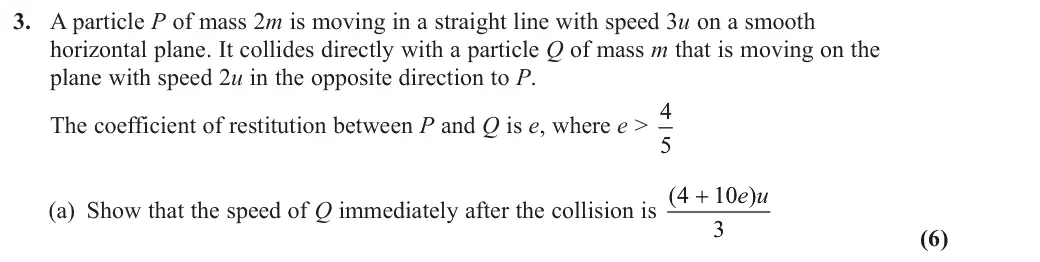
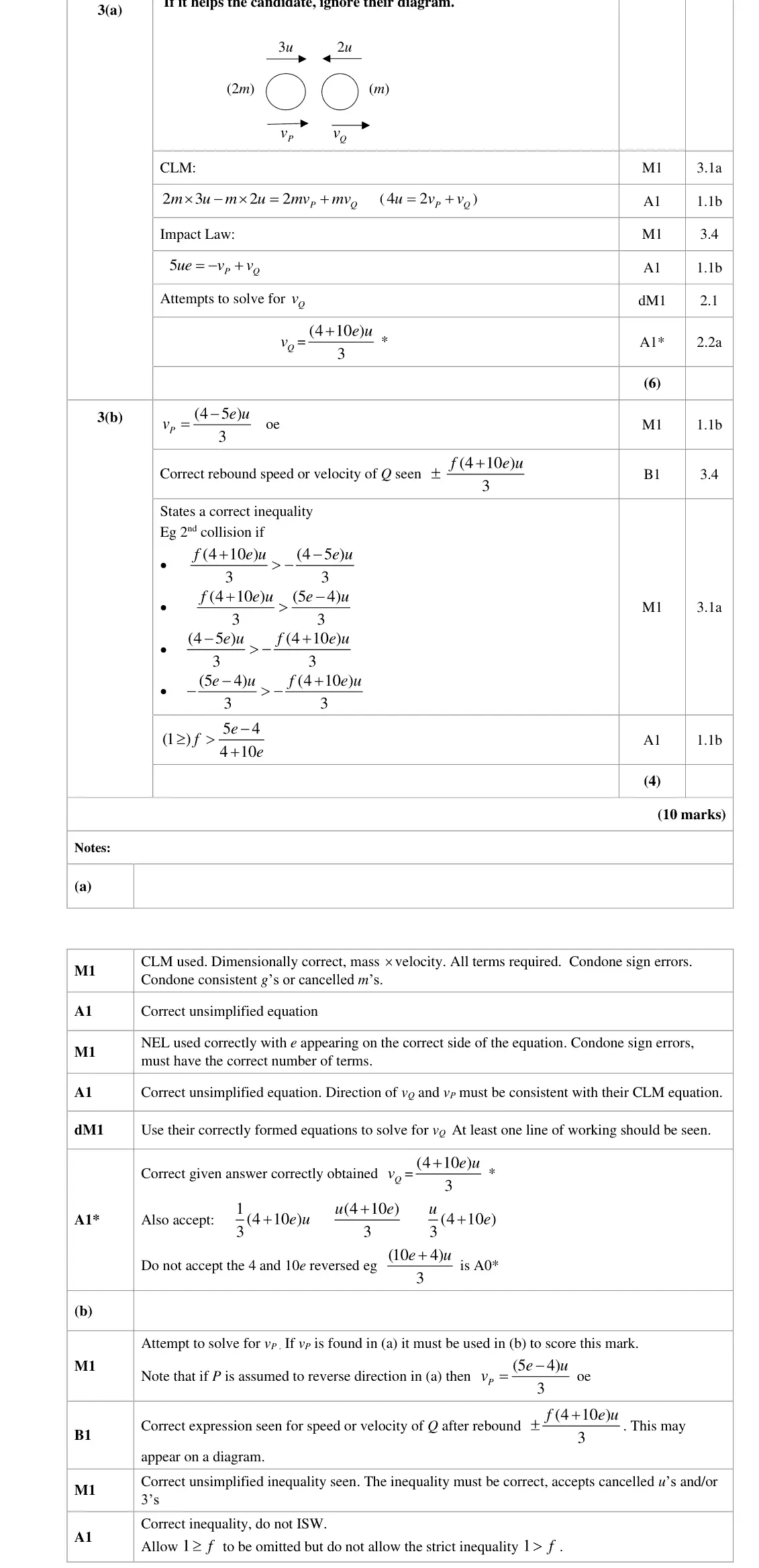
June 2023 · Paper 3C (Further Mechanics 1) · Q3(a)6 marks
Mark scheme (whole question; this part is marked with the orange bar)
Examiner's comment
This question performed second best on the paper with the vast majority of candidates scoring most, if not all, the available marks. Part (a) was the first ‘show that’ question in the paper and candidates confidently established equations for the conservation of linear momentum and Newton’s Experimental Law. This routine process was well-rehearsed and candidates who made sign errors were able to use the given answer to identify the error and often made a full recovery by returning to their initial equations to follow the correction through. There was other evidence of good exam technique with candidates re-writing their final answer to match the printed answer exactly. On this occasion, alternative equivalent expressions correctly combining 1, and (4 10 ) + 3 u e were also condoned. This level of flexibility should not be an expectation and centres are advised to continue warning candidates that not writing the answer exactly as printed is likely to forfeit a mark. Candidates who were successful in part (a) usually earned the first 2 marks in part (b) for the velocity of P and the rebound speed of Q. However, setting up an inequality for the final 2 marks presented more challenge. The most common successful approach was to assume that P reversed its direction in (a) resulting in comparable velocities. Those who assumed that P maintained its direction of motion after the collision often failed to consider the sign when setting up the inequality and lost the final 2 marks.
Key points from the mark scheme and examiner's report
CLM 4u = 2v_P + v_Q and NLR 5ue = v_Q − v_P give v_Q = (4 + 10e)u/3
the given answer helped candidates correct sign errors
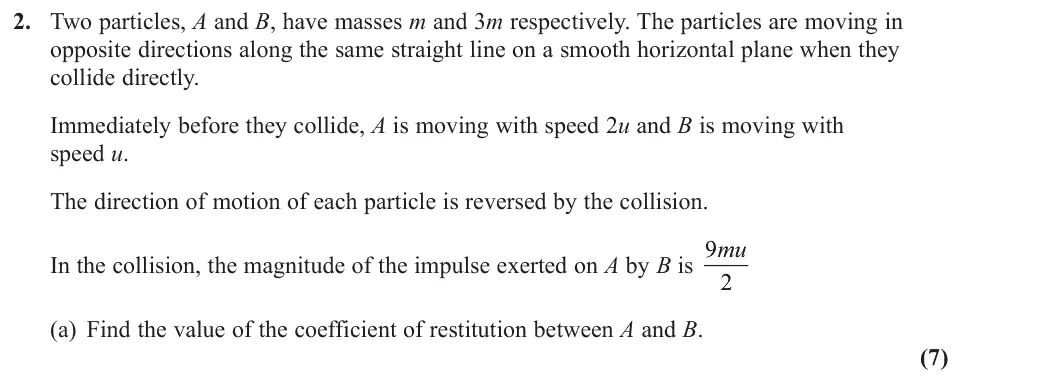
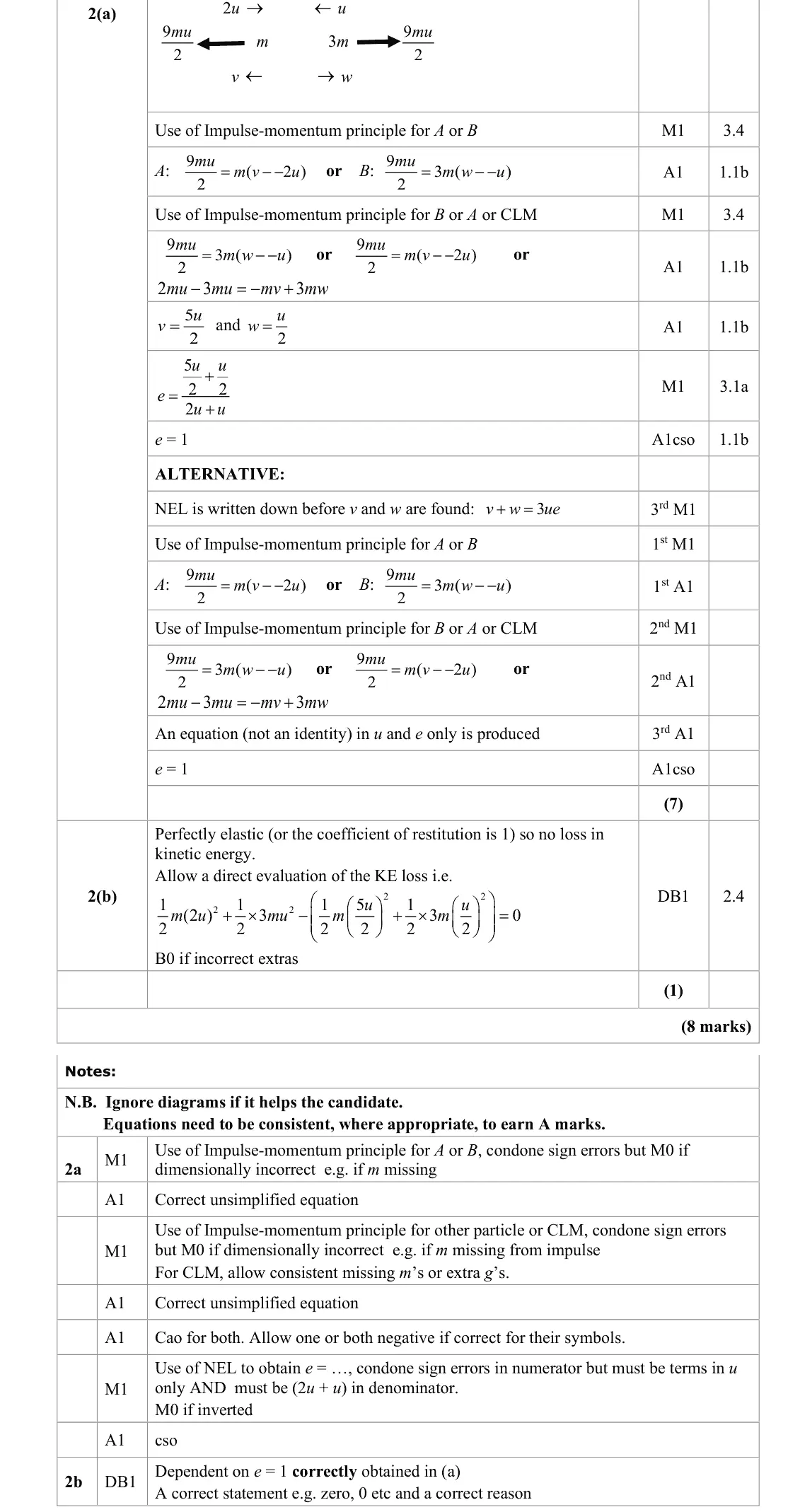
June 2022 · AS Paper 2 (Further Mechanics 1) · Q2(a)7 marks
Mark scheme (whole question; this part is marked with the orange bar)
Examiner's comment
In part (a), the most efficient method for finding e was to use the impulse-momentum principle for each particle to find the speeds after the collision and then substitute these values, with the correct signs into NEL. This was the most common and successful method. Those candidates who obtained expressions for either or both speeds in terms of e often lost their way in the algebra involved, usually due to incorrect multiplying out of brackets. Most candidates wrote down a correct CLM equation, but errors occurred most often in the Impulse-momentum equations, usually in assigning the correct direction to the impulse on the particle. Other errors occurred through a lack of consistency in the use of signs assigned to velocities. A few wrote the NEL equation with 3u in the numerator or had (2u – u) in the denominator. In the second part, almost all who obtained e = 1 by a
Key points from the mark scheme and examiner's report
impulse-momentum for each particle: 9mu/2 = m(v + 2u) and 9mu/2 = 3m(w + u) give v = 5u/2, w = u/2
NLR e = (5u/2 + u/2)/(2u + u) = 1
errors in the direction of the impulse and inconsistent signs
denominator must be 3u
June 2022 · AS Paper 2 (Further Mechanics 1) · Q2(b)1 mark
Mark scheme (whole question; this part is marked with the orange bar)
Examiner's comment
or had (2u – u) in the denominator. In the second part, almost all who obtained e = 1 by a correct method went on to gain the final B mark. Most of these stated that the collision was perfectly elastic because e = 1 so there was no loss in KE, but a few actually calculated the change in KE, sometimes as a check.
Key points from the mark scheme and examiner's report
e = 1 so the collision is perfectly elastic and no kinetic energy is lost (0)
mark depends on e = 1 found correctly
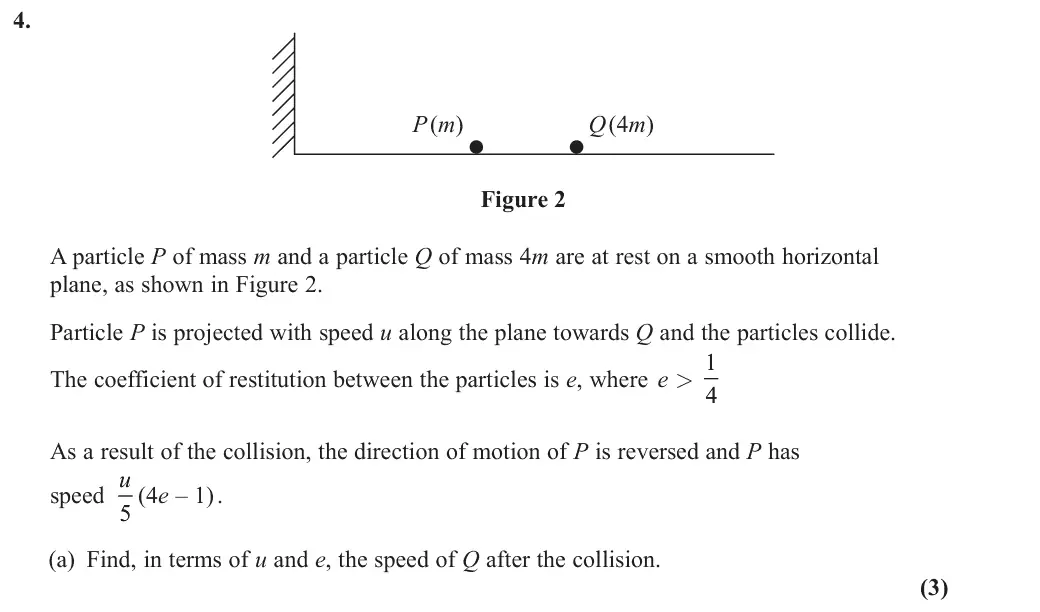
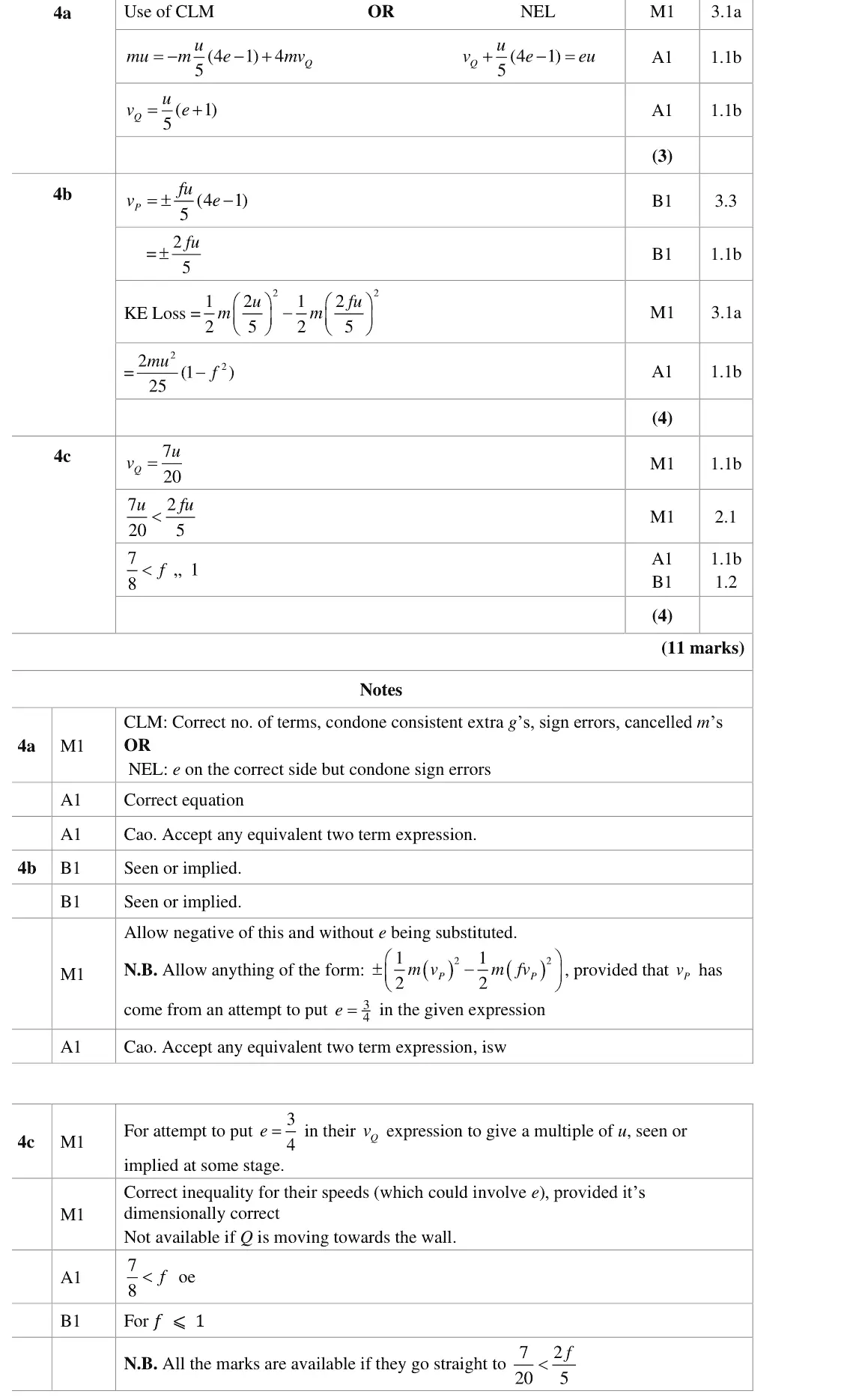
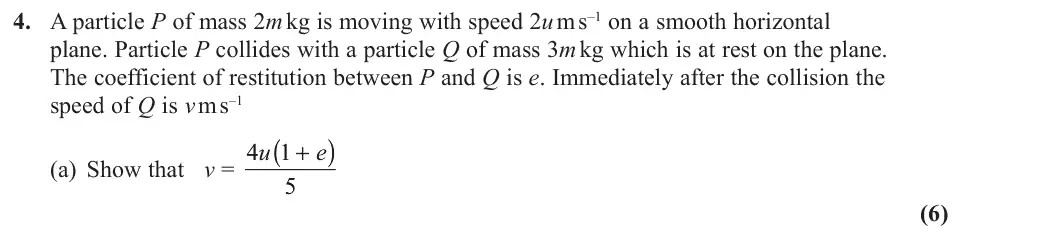
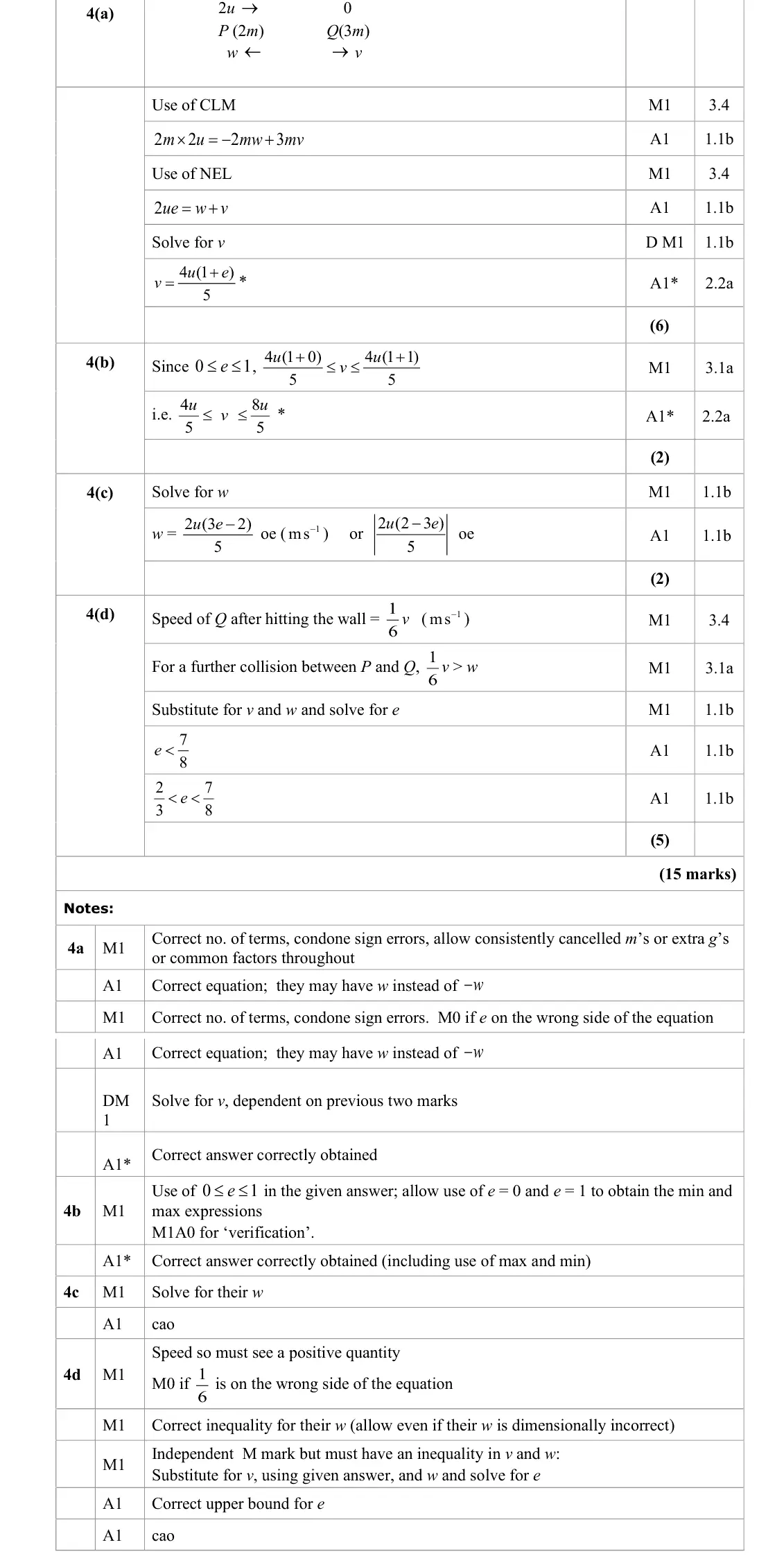
June 2022 · AS Paper 2 (Further Mechanics 1) · Q4(a)6 marks
Mark scheme (whole question; this part is marked with the orange bar)
Examiner's comment
In part (a), the given result was successfully proven by almost all of the many candidates who attempted this question. Those who stumbled with initial inconsistent directions in their CLM and NEL equations usually recovered well. The algebra required was not a problem with various substitutions or eliminations handled competently. Most gave a correct verification in part (b) by substituting e = 0 and e = 1 into the expression for v to
Key points from the mark scheme and examiner's report
CLM 4mu = −2mw + 3mv and NLR 2ue = w + v
eliminate w: v = 4u(1 + e)/5
keep directions consistent
June 2022 · AS Paper 2 (Further Mechanics 1) · Q4(b)2 marks
Mark scheme (whole question; this part is marked with the orange bar)
Examiner's comment
correct verification in part (b) by substituting e = 0 and e = 1 into the expression for v to find the max and min values. Some rearranged the expression for v to make e the subject and then used 0 <= e <= 1 to set up an inequality. A few stated that 1 <= e + 1 <= 2 and substituted 1 and 2 into their expression for v. In the third part, most solved their CLM
Key points from the mark scheme and examiner's report
use 0 ≤ e ≤ 1 in the given answer for v (e = 0 and e = 1 give the bounds)
a bare "verification" scores M1A0
June 2022 · AS Paper 2 (Further Mechanics 1) · Q4(c)2 marks
Mark scheme (whole question; this part is marked with the orange bar)
Examiner's comment
substituted 1 and 2 into their expression for v. In the third part, most solved their CLM and NEL equations simultaneously to find an expression for w. The most common answer 5 (2 3 ) e was 2 . Some realised that the direction had changed so added a minus sign in - u front of their answer. A couple added the modulus symbol. Quite a few rewrote their CLM and NEL equations with minus signs for w and so obtained a correct speed for P. Some didn’t attempt part (d), but of those that did, the majority scored the first M mark 5 (2 3 ) e Some of those who gave an answer of in part (c) did not include the minus - - 2 u sign in part (d). So most candidates scored M1M0M1A0A0 for part (d). Of those who
Key points from the mark scheme and examiner's report
solve the CLM/NLR pair for w: speed 2u(3e − 2)/5
sign/direction of P must give a positive speed
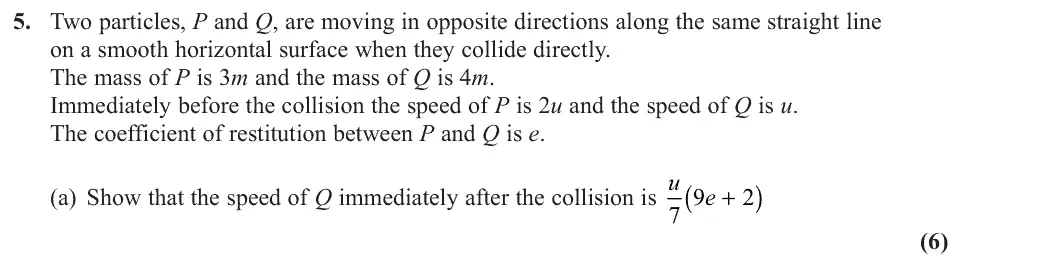
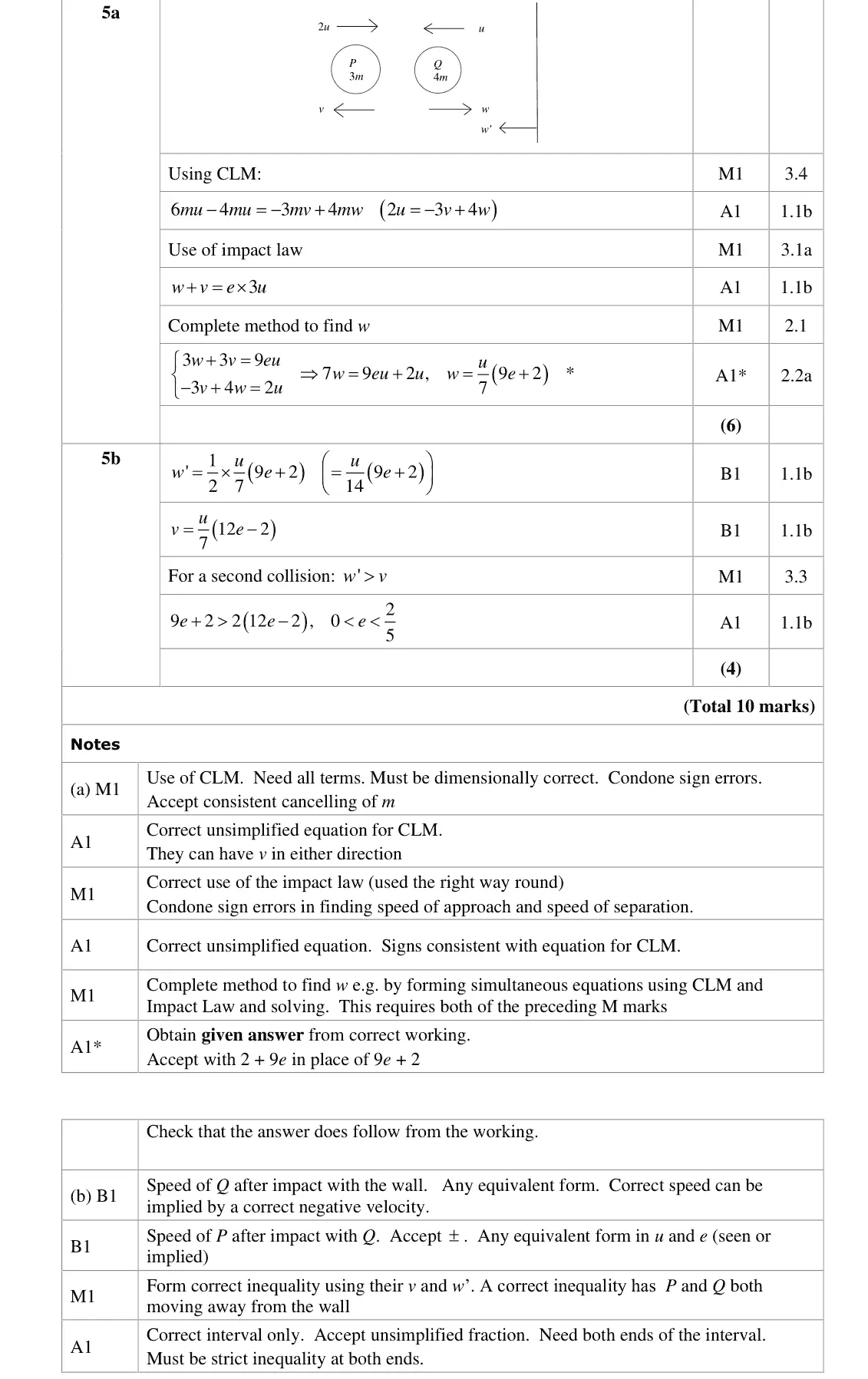
June 2022 · Paper 3C (Further Mechanics 1) · Q5(a)6 marks
Mark scheme (whole question; this part is marked with the orange bar)
Examiner's comment
(a) This was a familiar task and answered well by the majority of candidates. There were many clearly labelled diagrams defining the direction of motions for P and Q, and this enabled the candidates to form consistent equations for Conservation of Momentum and the Impact Law. A minority of candidates who were unable to reach the given result tried to adjust their working to generate the required result as opposed to identifying errors they had made, or reattempting the question. Candidates should be reminded that fortuitous answers from incorrect working will not gain credit.
Key points from the mark scheme and examiner's report
CLM 2u = −3v + 4w and NLR w + v = 3eu give w = u(9e + 2)/7
a clear direction diagram helped
fudging to the given answer gains no credit
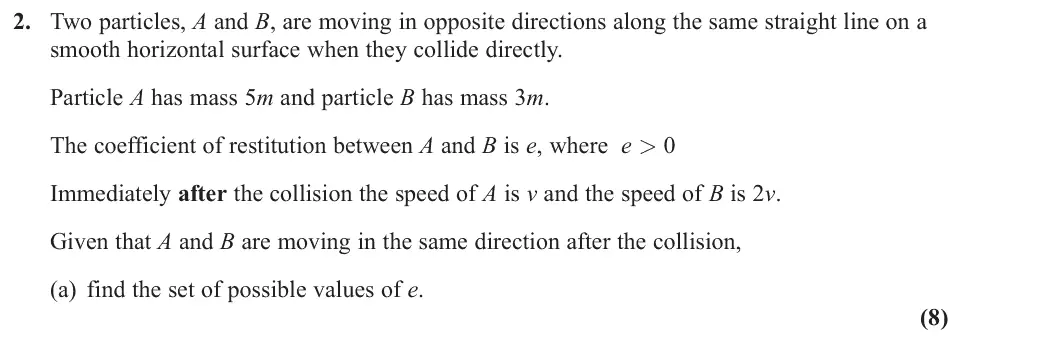
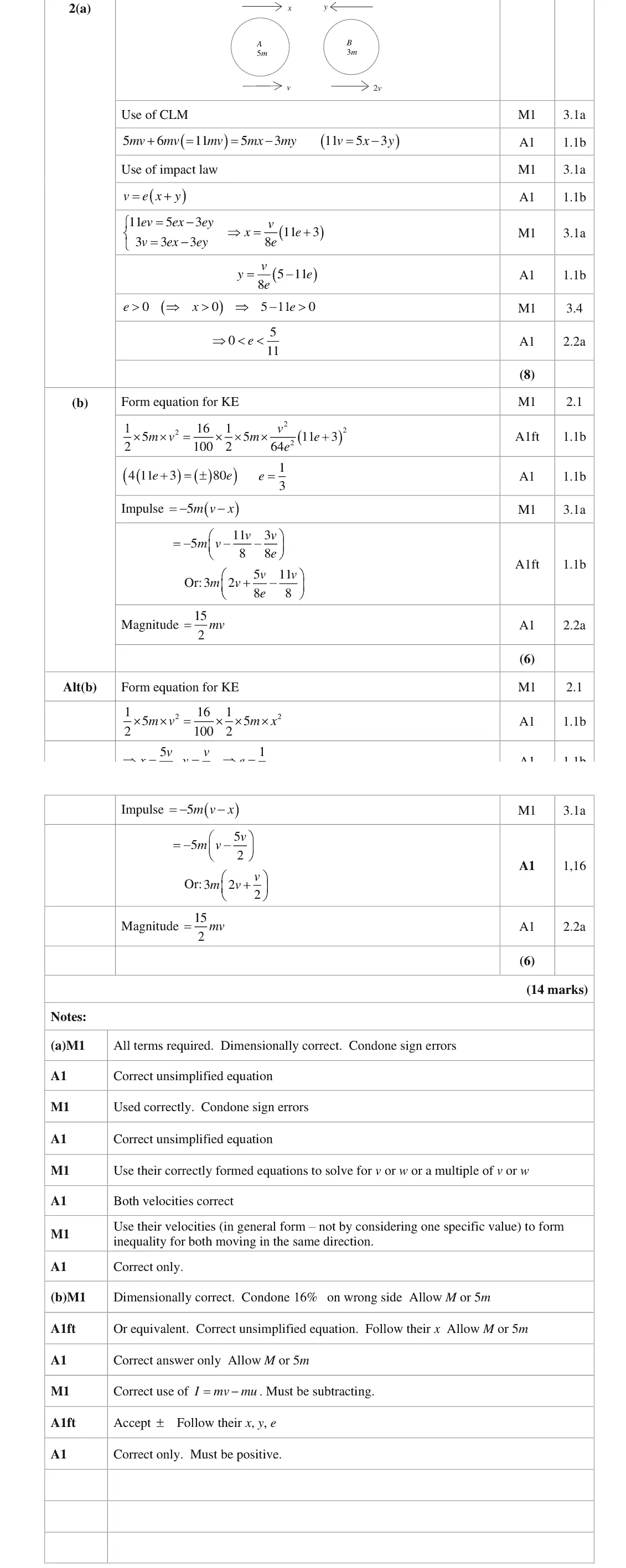
Nov 2021 · Paper 3C (Further Mechanics 1) · Q2(a)8 marks
Mark scheme (whole question; this part is marked with the orange bar)
Examiner's comment
(a) The majority of candidates achieved the first four marks by setting up the equations for conservation of momentum and Newton's Experimental Law. The direction of motion was given in the question and candidates who chose not to use this did make the task more difficult for themselves. Few candidates could see how to proceed from that point - some did attempt to find the two speeds, but rarely understood how to combine the results with the information about the directions of motion.
Key points from the mark scheme and examiner's report
use the given same direction after impact
CLM and NLR give x = v(11e + 3)/(8e), y = v(5 − 11e)/(8e)
B's initial direction y > 0 needs 5 − 11e > 0, so 0 < e < 5/11
few could combine speeds with the direction information
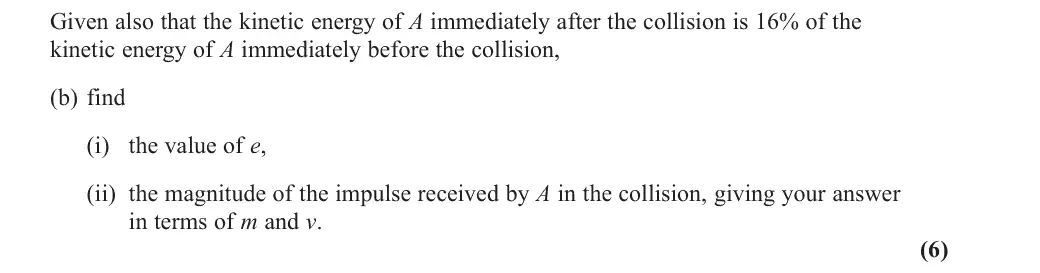
Nov 2021 · Paper 3C (Further Mechanics 1) · Q2(b)6 marks
Mark scheme (whole question; this part is marked with the orange bar)
Examiner's comment
(b) Several candidates understood the methods required here and were able to score marks for finding the value of e and the magnitude of impulse.
Key points from the mark scheme and examiner's report
KE of A after = 16% of before, so x = 5v/2 and e = 1/3
impulse = 5m(v − x), magnitude 15mv/2 (must be positive)
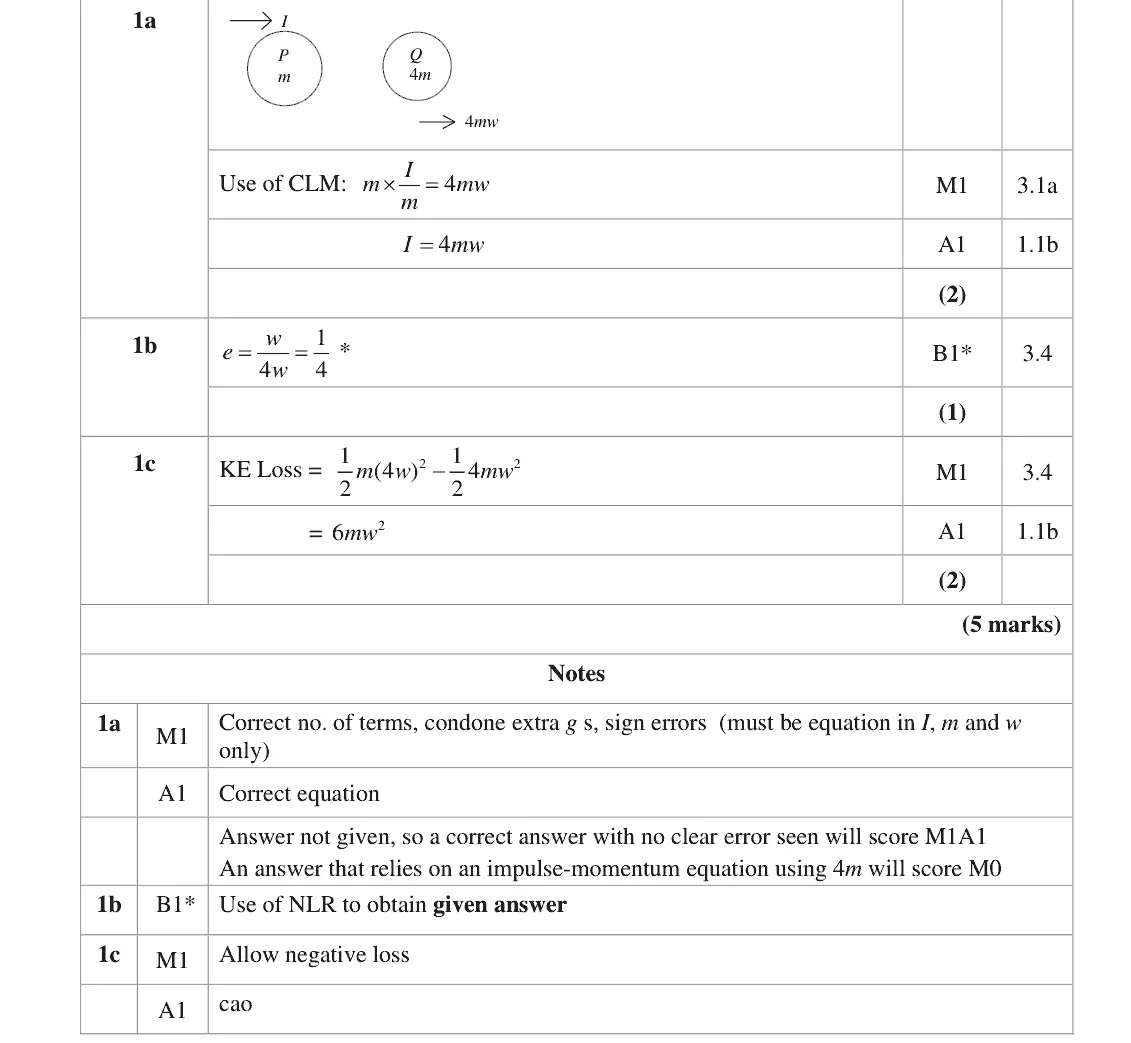
Oct 2020 · AS Paper 2 (Further Mechanics 1) · Q1(b)1 mark
Mark scheme (whole question; this part is marked with the orange bar)
Examiner's comment
(b) Those candidates who had found the speed of P immediately before the collision with 1 . Q usually gave a correct justification of Many candidates quoted the formula e = 4 speed of separation and showed the correct substitution of values. Some misquoted e = speed of approach a formula in us and vs, making a sign error and obtained the negative of the required 1 1 . answer. Rather than trace their error they simply stated that - = 4 4
Key points from the mark scheme and examiner's report
NLR: e = w/(4w) = 1/4
misquoting the formula then "fixing" −1/4 to 1/4
Oct 2020 · AS Paper 2 (Further Mechanics 1) · Q1(c)2 marks
Mark scheme (whole question; this part is marked with the orange bar)
Examiner's comment
(c) The majority of candidates understood how to find the change in kinetic energy, although some made errors in simplifying to obtain the answer. The most common errors were in processing ( ) 2 or not using the correct masses for the particles. 4w
Key points from the mark scheme and examiner's report
½m(4w)² − ½(4m)w² = 6mw²
errors squaring 4w or using the wrong masses
Oct 2020 · AS Paper 2 (Further Mechanics 1) · Q3(a)8 marks
Mark scheme (whole question; this part is marked with the orange bar)
Examiner's comment
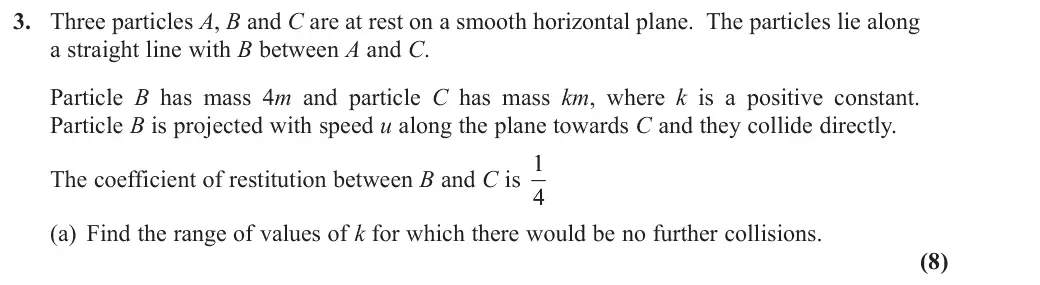
(a) The majority of candidates were familiar with the conservation of linear momentum and with the impact law and most applied these correctly to score the first four marks. Only a few candidates correctly identified the condition for no further collision. Some candidates thought that it depended on the velocity of C and did not attempt to find an expression for the velocity of B. The most common condition used was although v v > C B some candidates came much closer with not appreciating that if B were at rest 0, v > B there would be no further collisions. Fully correct solutions were unusual. The candidates were free to select their own names for the velocities of B and C after their collision, so it was a little surprising to find candidates calling them v and v - such a A B choice has the potential to cause confusion. Some candidates considered only the case when B was at rest after the collision. Although they demonstrated understanding of the conservation of momentum and of the impact law, there was nothing in their responses to justify considering only the limiting value, or to justify their decision about the final inequality.
Key points from the mark scheme and examiner's report
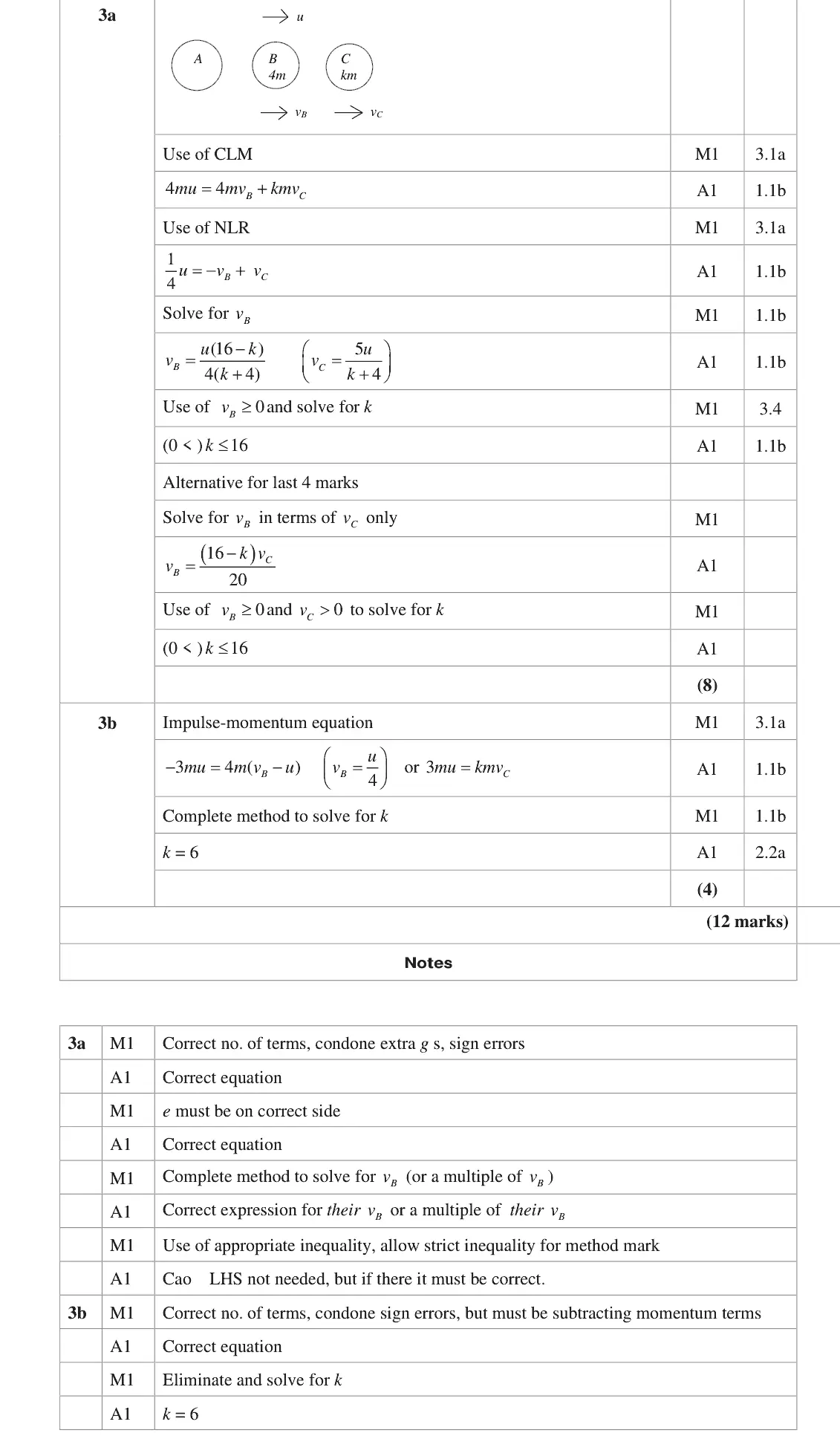
CLM and NLR (e = 1/4) give v_B = u(16 − k)/(4(k + 4))
no further collisions requires v_B ≥ 0 (B must not move back to A), so 0 < k ≤ 16
many used v_C > v_B or v_B > 0, or worked with the velocity of C
Oct 2020 · AS Paper 2 (Further Mechanics 1) · Q3(b)4 marks
Mark scheme (whole question; this part is marked with the orange bar)
Examiner's comment
(b) Those candidates who wrote down an equation for the impulse on B were more likely to make a sign error than those candidates who considered the impulse on C. Here again candidates who started with a correct equation often made arithmetical and algebraic errors in reaching their final answers.
Key points from the mark scheme and examiner's report
impulse on C: 3mu = kmv_C, or on B: −3mu = 4m(v_B − u) giving v_B = u/4
then k = 6
sign errors more common when using the impulse on B
Oct 2020 · AS Paper 2 (Further Mechanics 1) · Q4(c)1 mark
Mark scheme (whole question; this part is marked with the orange bar)
Examiner's comment
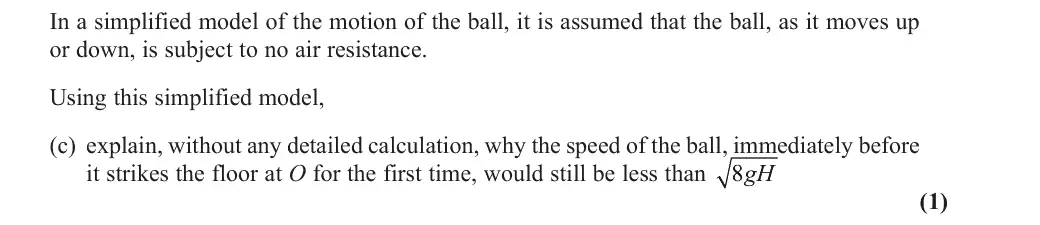
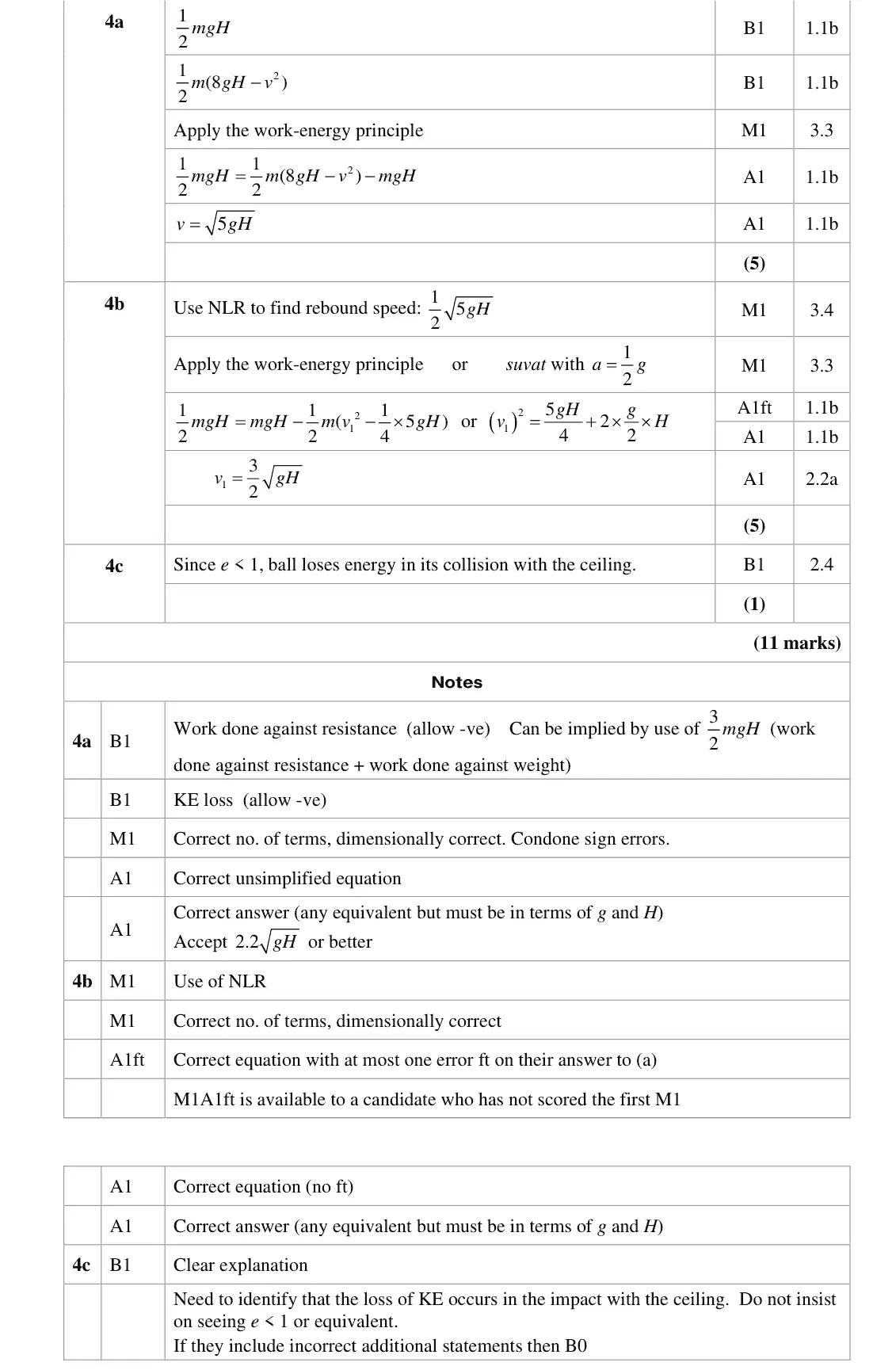
(c) The key factor that the candidates were expected to note was the loss in kinetic energy in the collision with the ceiling. Although the question states that the revised model assumes no air resistance, many responses referred to air resistance.
Key points from the mark scheme and examiner's report
e < 1 so kinetic energy is lost in the impact with the ceiling
answers about air resistance score 0 since the simplified model has none
Oct 2020 · Paper 3C (Further Mechanics 1) · Q3(a)8 marks
Mark scheme (whole question; this part is marked with the orange bar)
Examiner's comment
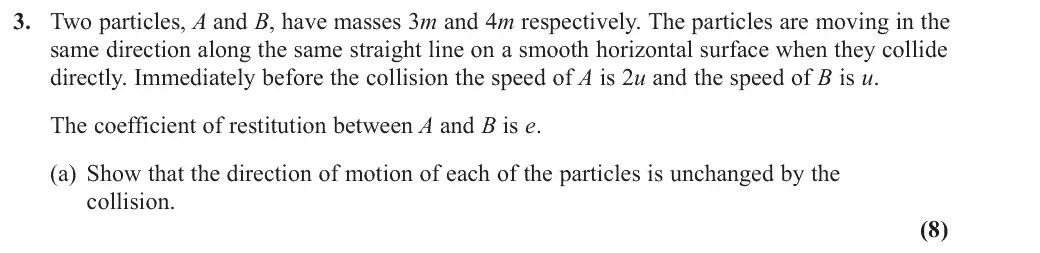
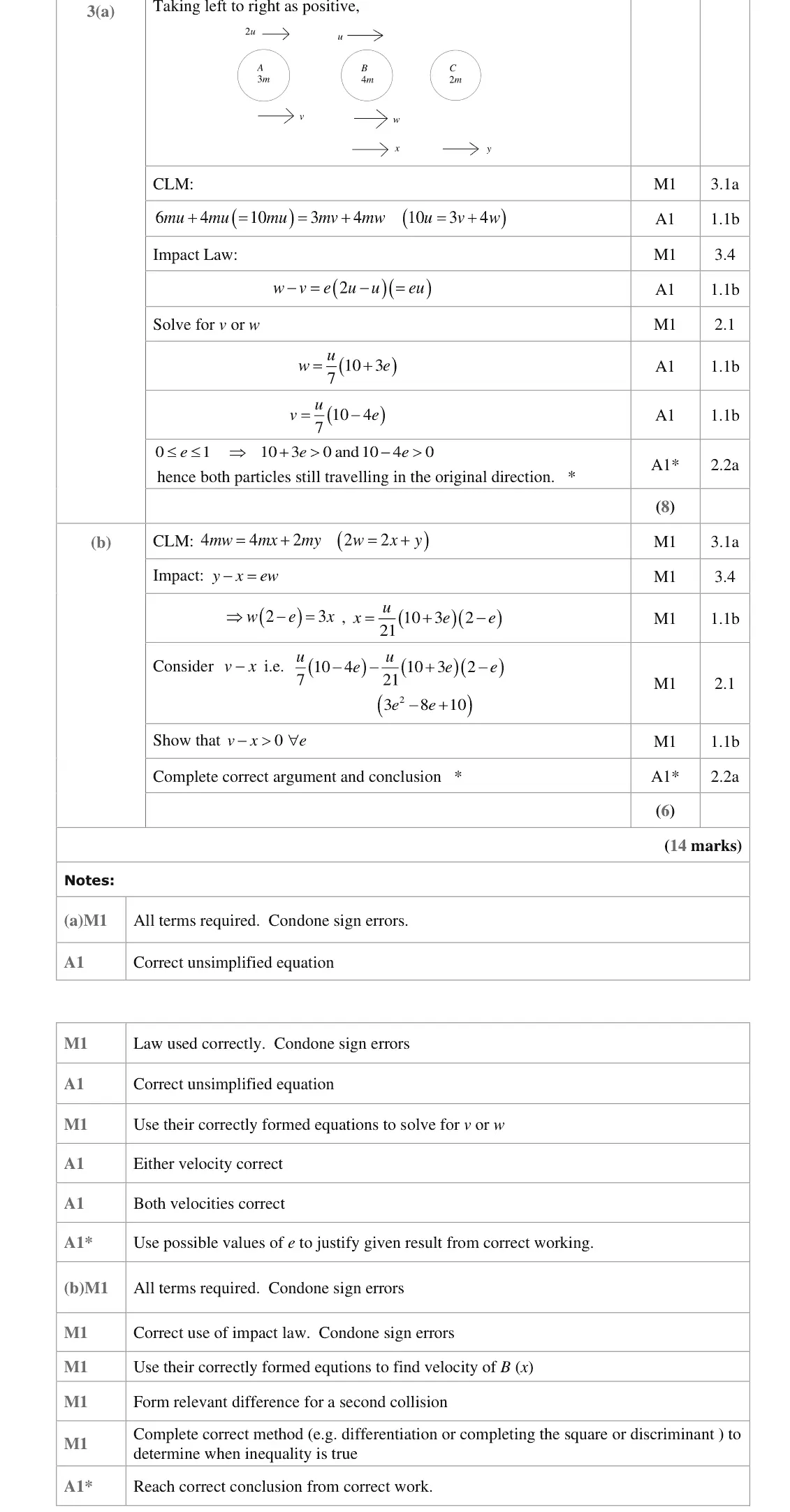
(a) The majority of candidates used conservation of momentum and the impact law correctly. There were several slips in the algebra, but many obtained correct expressions for the speeds of the two particles after the collision. The final mark required candidates to use the known range of possible values for e to demonstrate that the particles would continue moving in the same direction. Some arguments were incorrect, and some lacked clarity.
Key points from the mark scheme and examiner's report
CLM and NLR: v = u(10 − 4e)/7, w = u(10 + 3e)/7
use 0 ≤ e ≤ 1 to show both positive
arguments often unclear or incorrect
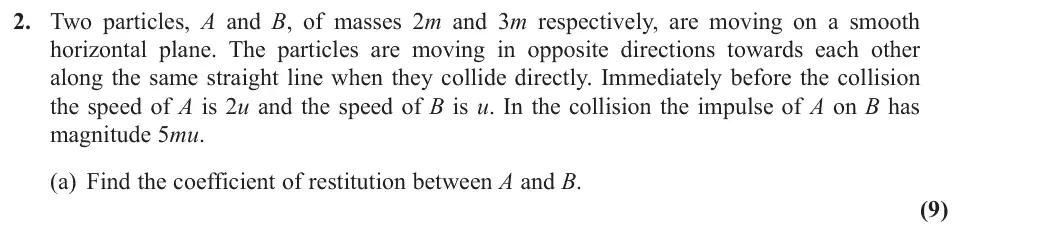
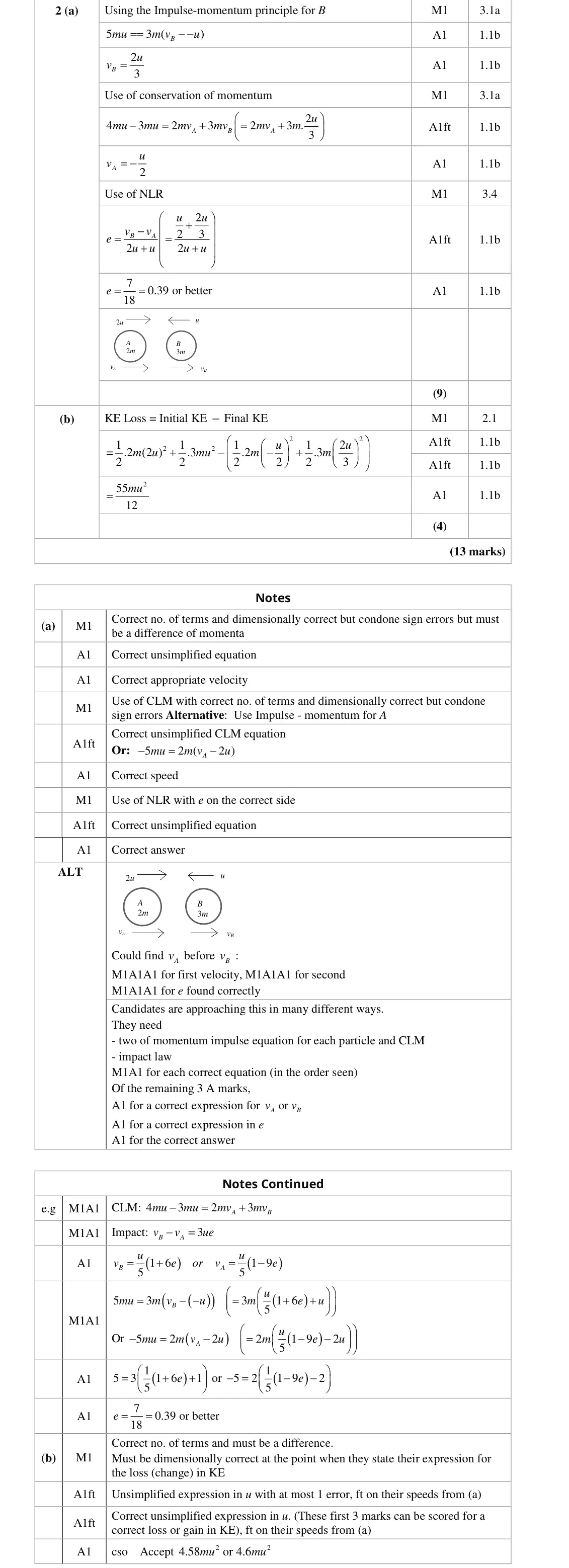
June 2019 · AS Paper 2 (Further Mechanics 1) · Q2(a)9 marks
Mark scheme (whole question; this part is marked with the orange bar)
Examiner's comment
(a) Most candidates demonstrated some knowledge of the methods required here, but there were many sign errors. Candidates using the impulse-momentum principle usually recognised that they should be subtracting the initial momentum from the final momentum, but for particle B, candidates often did not take account of the change in direction, and for particle A they did not use an impulse of . The impact law was usually used with e on the correct side, but here again there were sign errors through confusion over directions. Candidates should be encouraged to draw a diagram in a question like this to help to confirm the directions of motion. Candidates need to take care with basic arithmetic and algebra – several solutions were spoiled through errors in manipulating equations. Some candidates created opportunities for error by using the same letter for both of the unknown velocities. the correct use of their values from part (a). A few candidates scored no marks because, although they found correct expressions for the initial kinetic energy and the final kinetic energy, they never combined the two to form an expression for the change in kinetic energy. Some candidates found the initial kinetic energy and the final kinetic energy and then “cancelled” the before subtracting, so they never had a dimensionally correct expression for the change in kinetic energy and scored no marks. The question asked candidates to find the loss in kinetic energy, so the final answer should be positive.
Key points from the mark scheme and examiner's report
draw a diagram and use different letters for the two velocities
June 2019 · AS Paper 2 (Further Mechanics 1) · Q2(b)4 marks
Mark scheme (whole question; this part is marked with the orange bar)
Examiner's comment
(b) Most candidates who attempted this part of the question used a correct expression for kinetic energy. Many reached the correct answer, or were able to score at least three marks for the correct use of their values from part (a). A few candidates scored no marks
Key points from the mark scheme and examiner's report
initial KE − final KE using speeds from (a): 55mu²/12
follow-through allowed on (a) speeds
June 2019 · AS Paper 2 (Further Mechanics 1) · Q4(a)9 marks
Mark scheme (whole question; this part is marked with the orange bar)
Examiner's comment
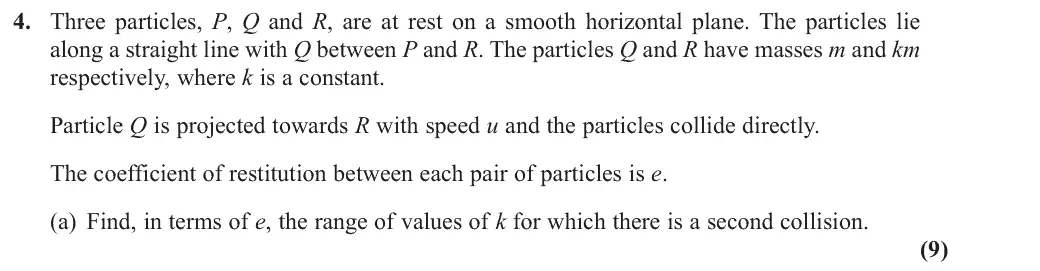
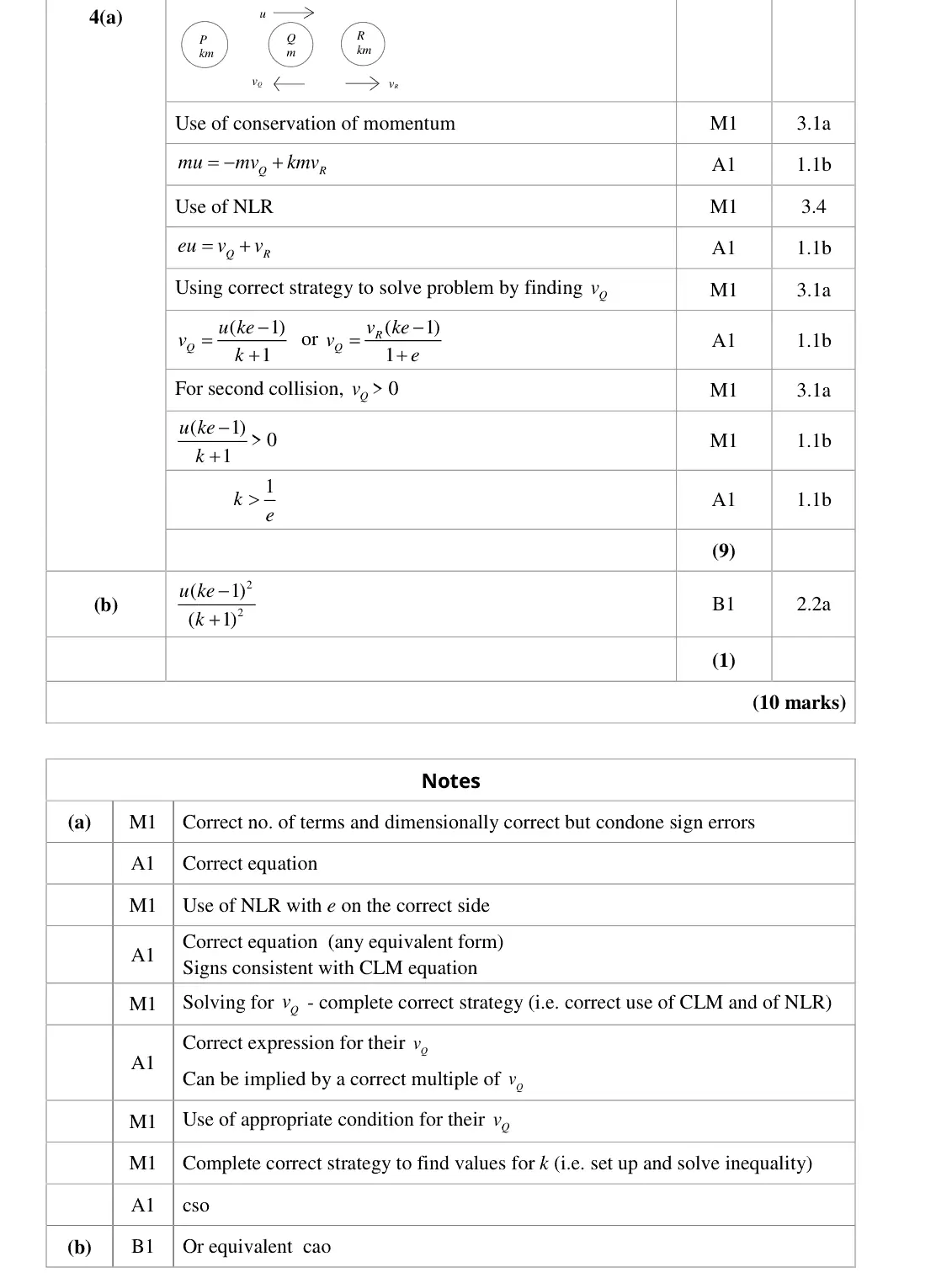
(a) Many candidates made a confident start in this question, with the majority scoring the first four marks for a correct equation using conservation of linear momentum, and for correct use of the impact law. A few candidates, usually those who had not drawn a diagram, lost a mark due to the inconsistent use of the direction of motion for Q. If there is to be a second collision then the direction of motion of Q must be reversed. Candidates needed to start by finding an expression for the velocity of Q and then form an appropriate inequality. Many candidates did complete this stage correctly. The most common errors were to focus on the velocity of R, or to form an inequality involving the velocity of R.
Key points from the mark scheme and examiner's report
CLM mu = −mv_Q + kmv_R and NLR eu = v_Q + v_R give v_Q = u(ke − 1)/(k + 1)
second collision needs Q to move back towards P so v_Q > 0, giving k > 1/e
common error: forming the inequality with the velocity of R
June 2019 · Paper 3C (Further Mechanics 1) · Q5(a)8 marks
Mark scheme (whole question; this part is marked with the orange bar)
Examiner's comment
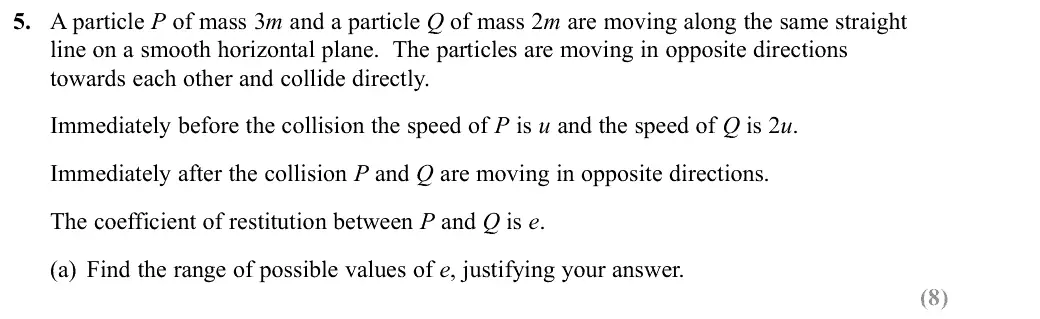
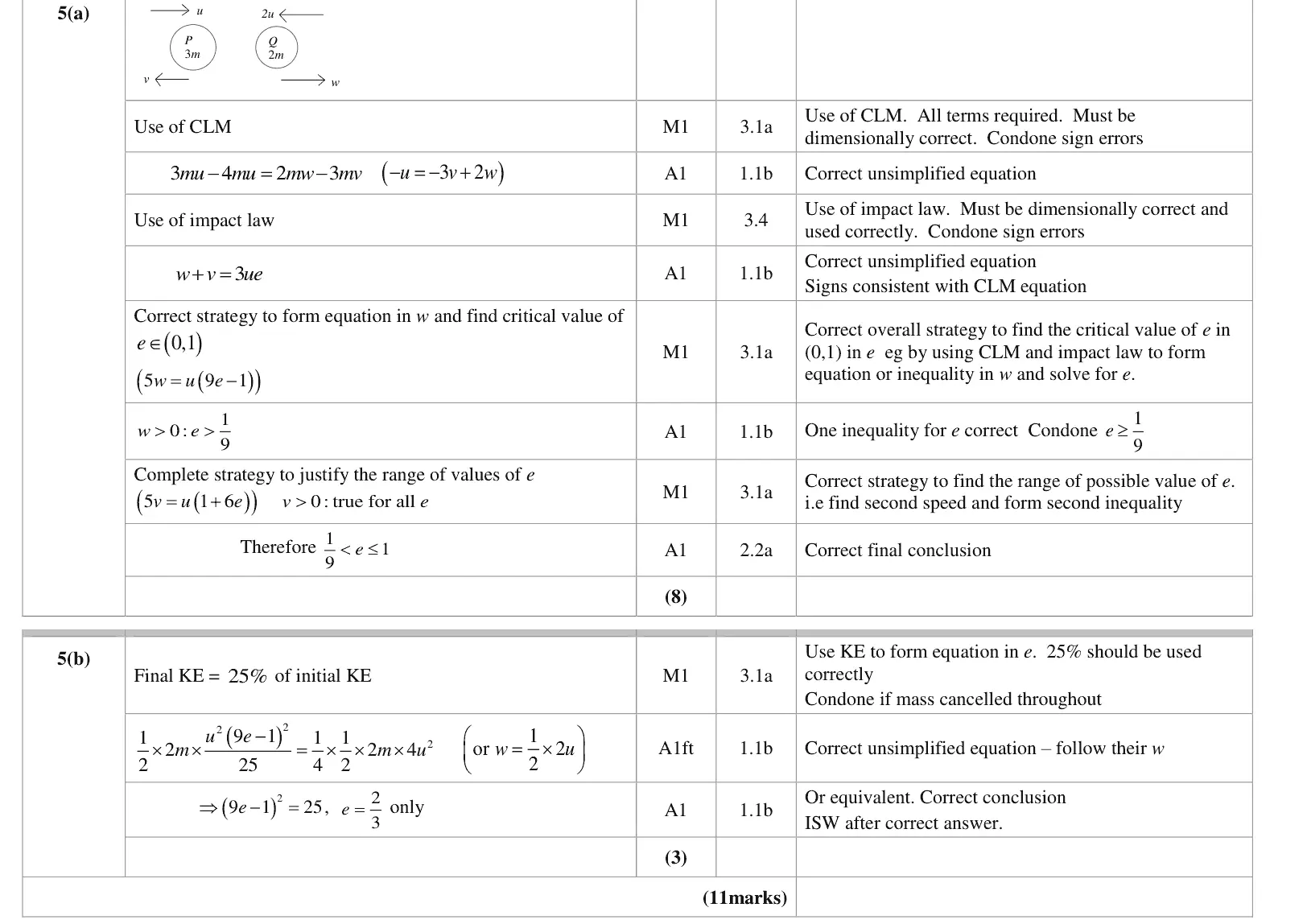
(a) The majority of candidates scored the first four marks here, with correct use of the conservation of momentum, and correct use of the impact law. Some candidates stopped at that point, but most went on to find an expression for the velocity of P or the velocity of Q. At this point, candidates who had taken the time to draw a clear diagram showing the directions of motion of the two particles were able to form a correct inequality and deduce a corresponding range of values for e. Candidates without a diagram were more likely to state an incorrect inequality, but some candidates with a diagram contradicted their diagram. Only a minority of candidates went on to consider the direction of motion of the second particle and complete their solution.
Key points from the mark scheme and examiner's report
CLM and NLR: 5w = u(9e − 1), 5v = u(1 + 6e)
w > 0 gives e > 1/9 and v > 0 for all e, so 1/9 < e ≤ 1
a clear diagram of directions avoided wrong inequalities
few checked the second direction
June 2019 · Paper 3C (Further Mechanics 1) · Q5(b)3 marks
Mark scheme (whole question; this part is marked with the orange bar)
Examiner's comment
(b) Many candidates with a correct expression for the speed of Q formed a correct equation for the loss in kinetic energy and reached the correct answer. The most common errors were to form an equation about the total kinetic energy lost (for both particles), or to use the percentage loss incorrectly.
Key points from the mark scheme and examiner's report
final KE of Q is 25% of initial, so w = u (half the speed): (9e − 1)² = 25, e = 2/3 only
errors: total KE of both particles or misusing the percentage
June 2018 · AS Paper 2 (Further Mechanics 1) · Q1(b)3 marks
Mark scheme (whole question; this part is marked with the orange bar)
Examiner's comment
(b) The method for finding loss in kinetic energy was widely understood. Students were able to score at least two of the three marks because of the follow-through on their answer from part (a). A minority of students used an initial or final speed of zero - usually the same students who had been confused between the speed of release and the speed of impact in part (a).
Key points from the mark scheme and examiner's report
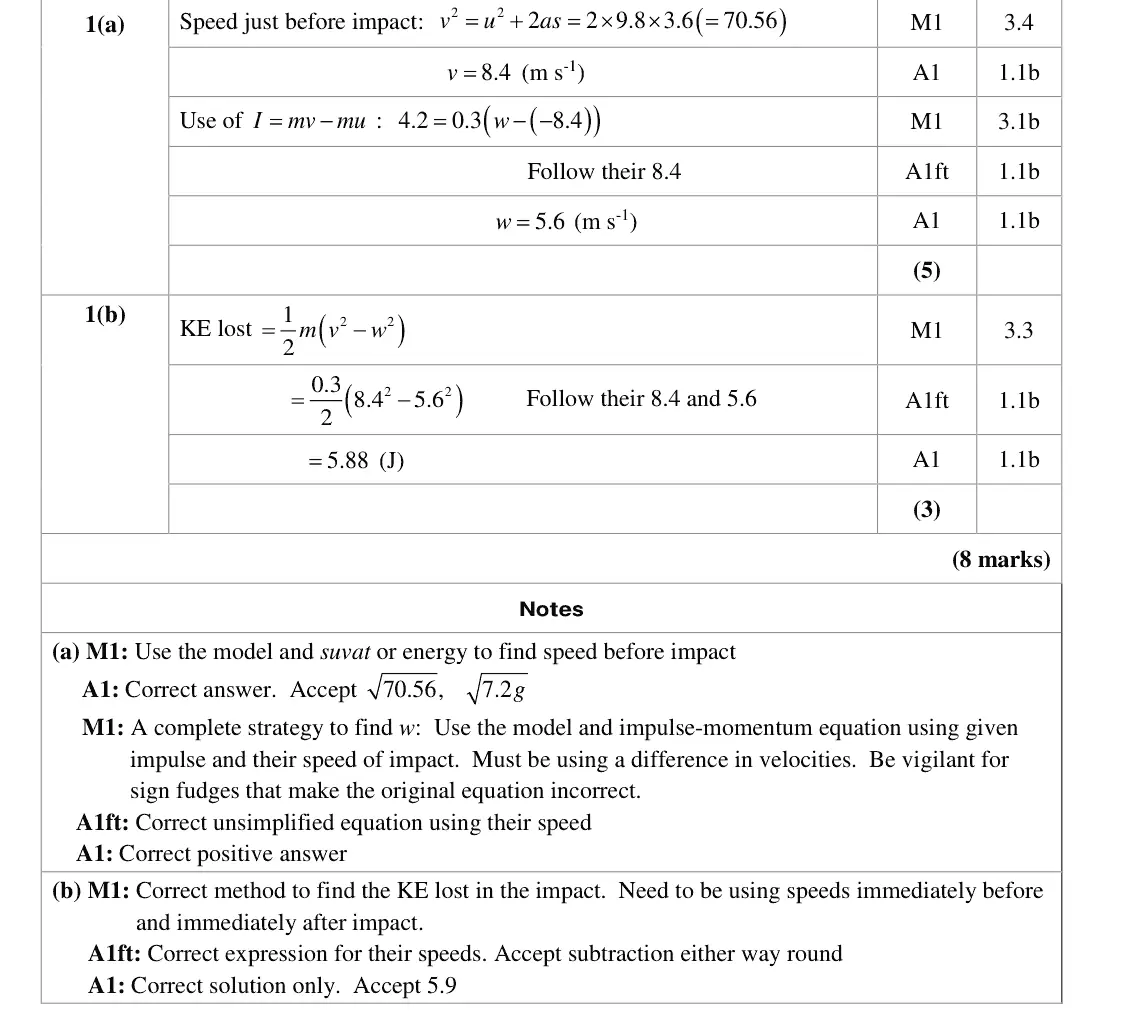
KE lost = ½(0.3)(8.4² − 5.6²) = 5.88 J
must use speeds immediately before and after impact, not the release speed 0
June 2018 · AS Paper 2 (Further Mechanics 1) · Q4(a)6 marks
Mark scheme (whole question; this part is marked with the orange bar)
Examiner's comment
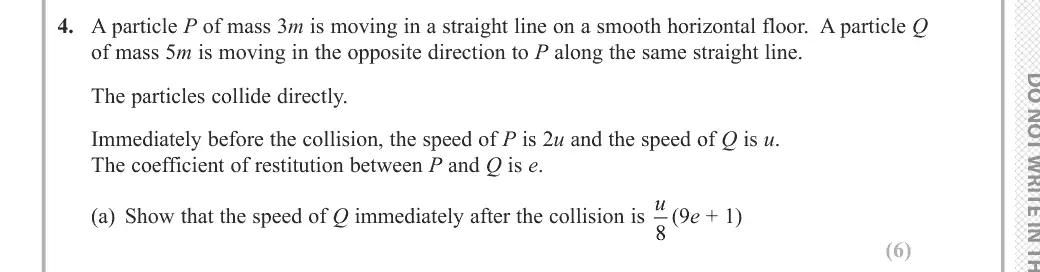
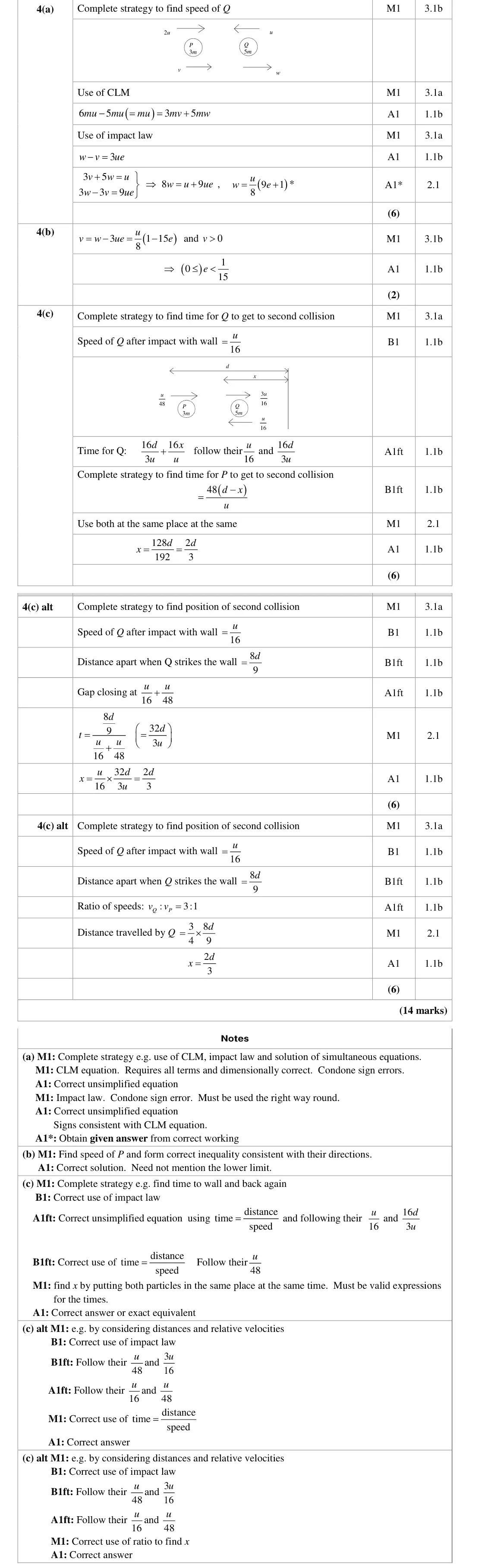
(a) Students who had used papers from the old specification for practice had encountered many questions like this. The majority of solutions were completed correctly, but some would have benefitted from a diagram to help keep track of which particle was moving in which direction. A small minority of students showed insufficient working to confirm that they had reached the given answer correctly.
Key points from the mark scheme and examiner's report
CLM 6mu − 5mu = 3mv + 5mw with impact law w − v = 3ue
solve simultaneously for w = u(9e + 1)/8
draw a diagram to keep directions consistent
June 2018 · AS Paper 2 (Further Mechanics 1) · Q4(b)2 marks
Mark scheme (whole question; this part is marked with the orange bar)
Examiner's comment
(b) There were many questions like this in the old papers. It was a little surprising to see several students thinking that the direction of motion of P depended on its speed relative to Q. A lot of students set up a correct inequality but gave an incorrect final answer due to incorrect work with the inequality and negative values.
Key points from the mark scheme and examiner's report
v = u(1 − 15e)/8 > 0 so 0 ≤ e < 1/15
errors handling inequalities with negatives
direction of P does not depend on its speed relative to Q
Find an Edexcel Further Maths tutor
Stuck on this? Book a trial lesson with our Further Maths tutor.