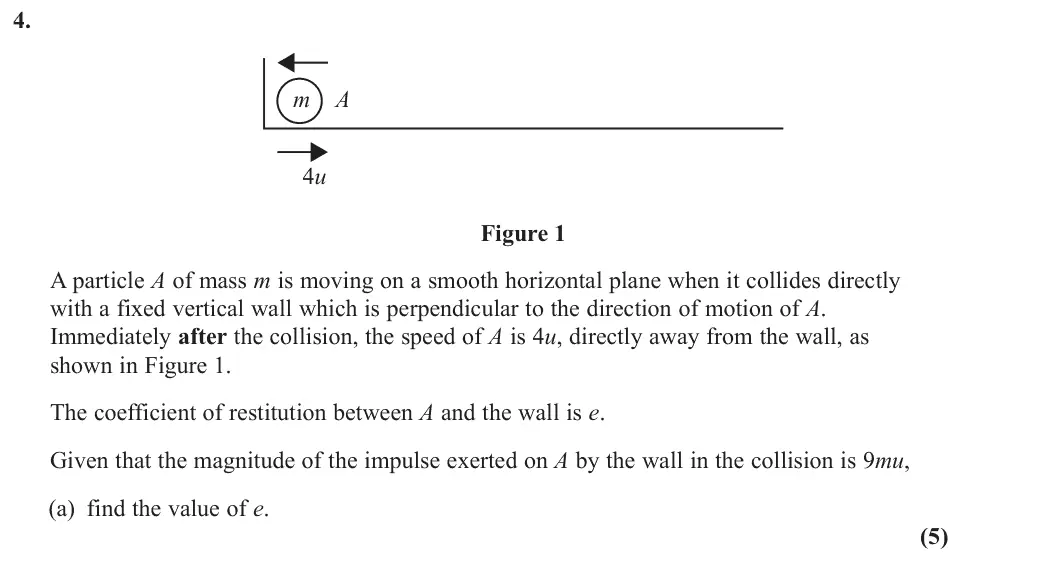
June 2025 · AS Paper 2 (Further Mechanics 1) · Q4(a)5 marks
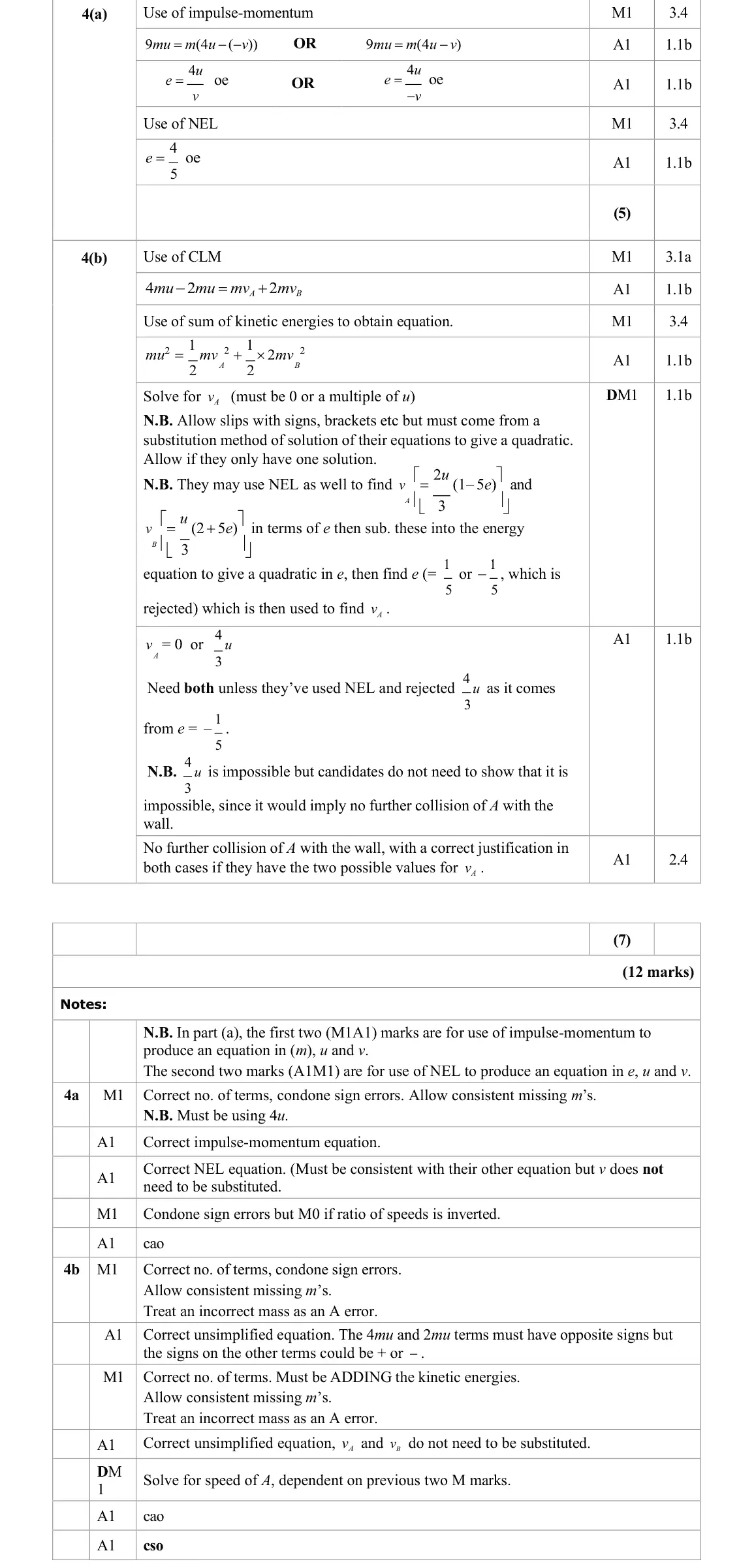
Mark scheme (whole question; this part is marked with the orange bar)
Examiner's comment
Part (a) caused some problems, although there many correct answers. The most common error occurred when dealing with the change in direction and there were sign errors in the impulse- momentum equation often leading to an answer of 4/13 instead of 4/5. The second part proved to be challenging for all but the very best students and there were very
Key points from the mark scheme and examiner's report
9mu = m(4u − (−v)) gives approach speed v = 5u
NLR e = 4u/5u = 4/5
sign errors from the change of direction gave 4/13
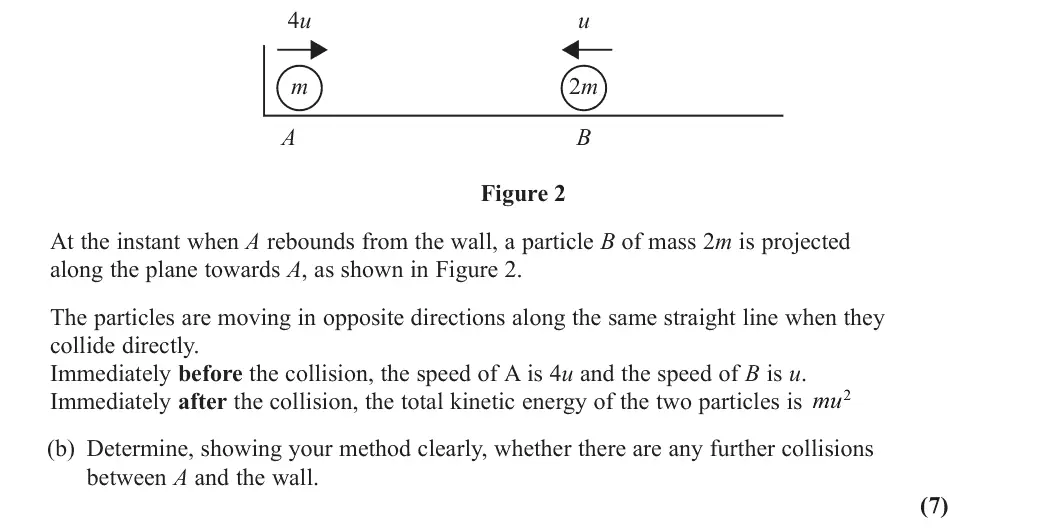
June 2025 · AS Paper 2 (Further Mechanics 1) · Q4(b)7 marks
Mark scheme (whole question; this part is marked with the orange bar)
Examiner's comment
The second part proved to be challenging for all but the very best students and there were very few completely correct solutions. The first 4 marks were very straightforward but a surprisingly large number omitted the 2 in one or other of the CLM and KE equations. This often then led to pages of incorrect algebra. Learners would be well advised to check their equations carefully 2 before using them. Another common error was to treat mu as the KE loss rather than the final KE which again resulted in lots of unnecessary algebra. This often wasn’t helped by some very 2 2 basic fundamental mistakes being made – a common one being . A few chose u v u v + = + to include NEL, despite not being given the coefficient of restitution between the particles and made life a lot more difficult for themselves. However, some of these did struggle through, found the correct values for e, and went on to produce fully correct solutions. Some learners, who were close to producing a fully correct answer, fell at the final hurdle by cancelling the variable from their quadratic (forgetting that it could be zero). This left only one solution which unfortunately was the wrong one.
Key points from the mark scheme and examiner's report
CLM 4mu − 2mu = mv_A + 2mv_B with total KE ½mv_A² + ½(2m)v_B² = mu²
quadratic gives v_A = 0 (or 4u/3, impossible): A is at rest so no further collision with the wall
mu² is the final KE, not the loss
the 2 often dropped from a mass
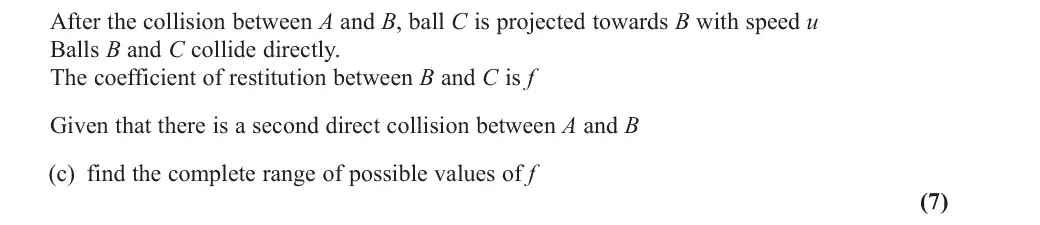
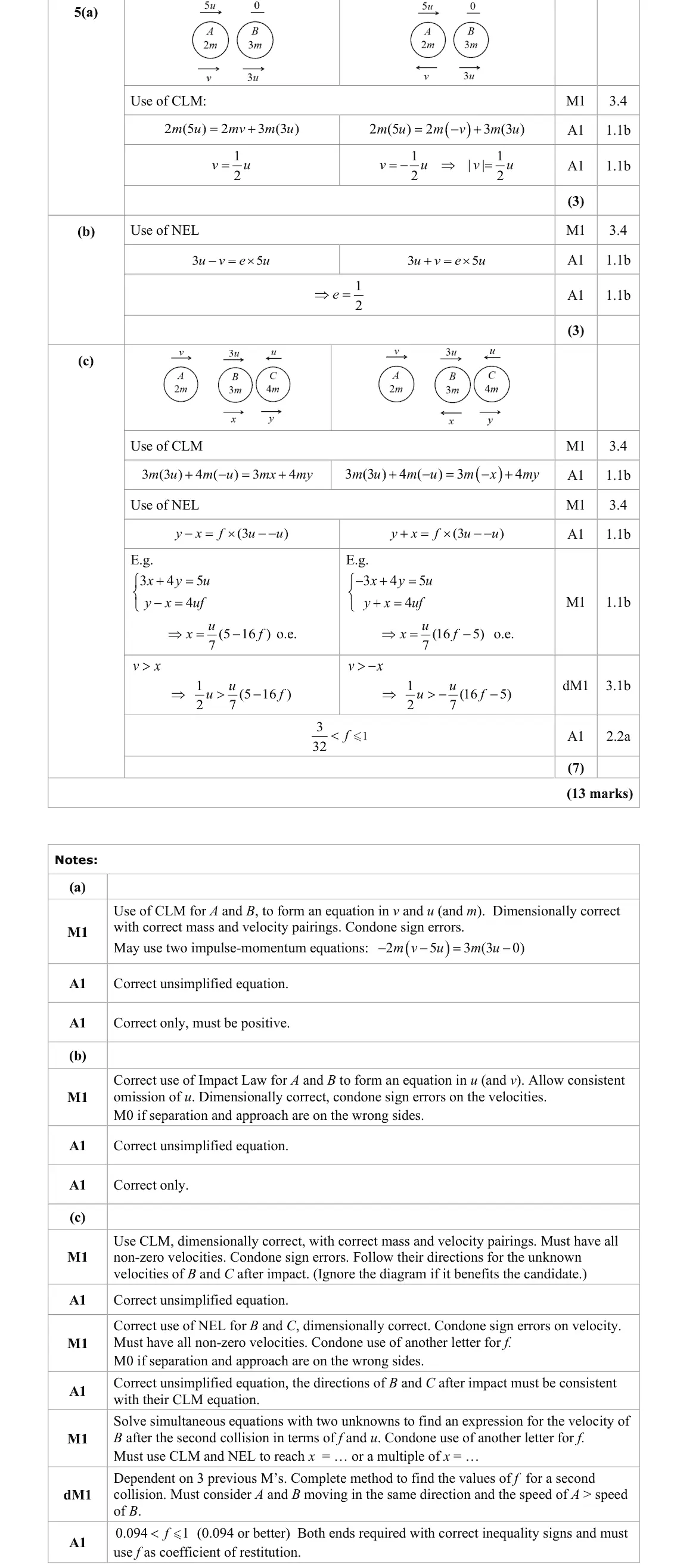
June 2025 · Paper 3C (Further Mechanics 1) · Q5(c)7 marks
Mark scheme (whole question; this part is marked with the orange bar)
Examiner's comment
Candidates across the grades made a confident start to this question on successive direct collisions with most gaining the first 6 marks in a few lines of neat working. In part (c), the second collision caused a significant challenge for less able learners who were required to find the speed of B and compare it with the speed of A, to find the full range of values for the coefficient of restitution. Attempts at CLM and NEL were prone to sign errors and occasionally learners did not pair the correct mass with the relevant speed. It is important to read the information given in a question carefully; in this case several learners overlooked the projected speed of C, assuming that it remained at rest. This assumption over-simplified the problem and became a costly error. Some found a correct expression for the velocity of B 0 but solved which did not consider the direction of A and so no further marks were v < in full by combining with 0 ⩽𝑓𝑓⩽1. B available. Those who established the correct inequality almost always completed the question
Key points from the mark scheme and examiner's report
C moves towards B with speed u (not at rest)
CLM 3x + 4y = 5u and NLR y − x = 4uf give x = u(5 − 16f)/7
second A–B collision needs u/2 > x: 3/32 < f ≤ 1
sign errors and wrong mass-speed pairs
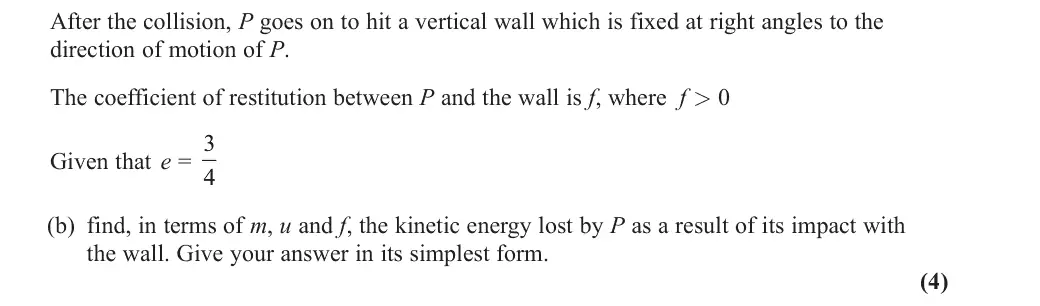
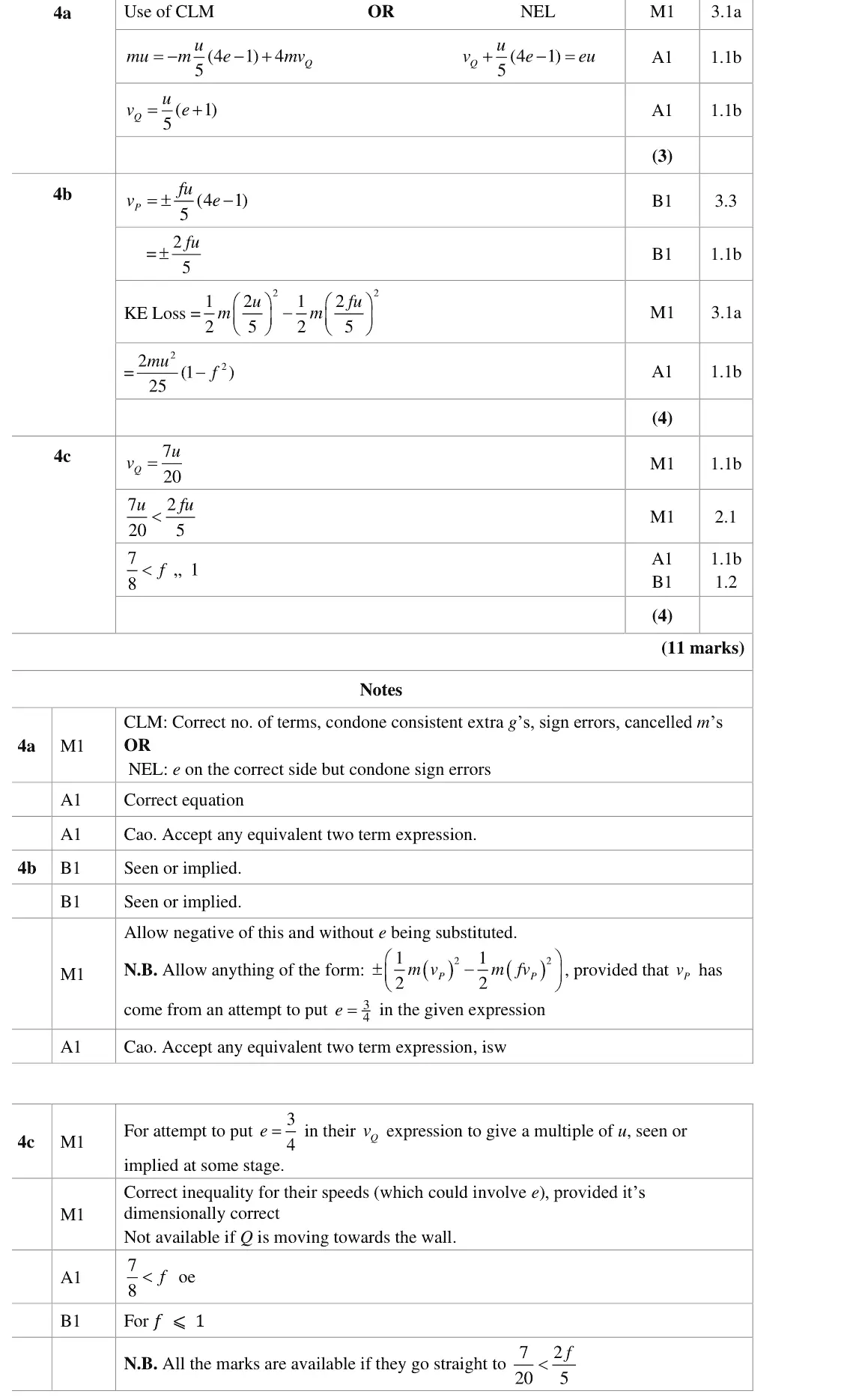
June 2024 · AS Paper 2 (Further Mechanics 1) · Q4(b)4 marks
Mark scheme (whole question; this part is marked with the orange bar)
Examiner's comment
In part (b), many candidates delayed the substitution of e = ¾ until the end and were left with extensive algebra which often led to errors. Some subtracted the KE terms the wrong way round and a few had f in the denominator. In the third part, some candidates tried to use KE instead of comparing two velocities and some
Key points from the mark scheme and examiner's report
e = 3/4 gives P's speed 2u/5, rebound speed 2fu/5
KE lost = ½m(2u/5)² − ½m(2fu/5)² = (2mu²/25)(1 − f²)
substitute e = 3/4 early to avoid heavy algebra
KE terms reversed
June 2024 · AS Paper 2 (Further Mechanics 1) · Q4(c)4 marks
Mark scheme (whole question; this part is marked with the orange bar)
Examiner's comment
In the third part, some candidates tried to use KE instead of comparing two velocities and some candidates who found that f > 7/8 then changed it and gave 0 < f < 7/8 as their answer. Although f > 7/8 was common, relatively few included f „ 1 in their final answer.
Key points from the mark scheme and examiner's report
v_Q = 7u/20
P must catch Q: 2fu/5 > 7u/20 so f > 7/8
also f ≤ 1, giving 7/8 < f ≤ 1
comparing KE instead of velocities
the upper bound f ≤ 1 was often omitted
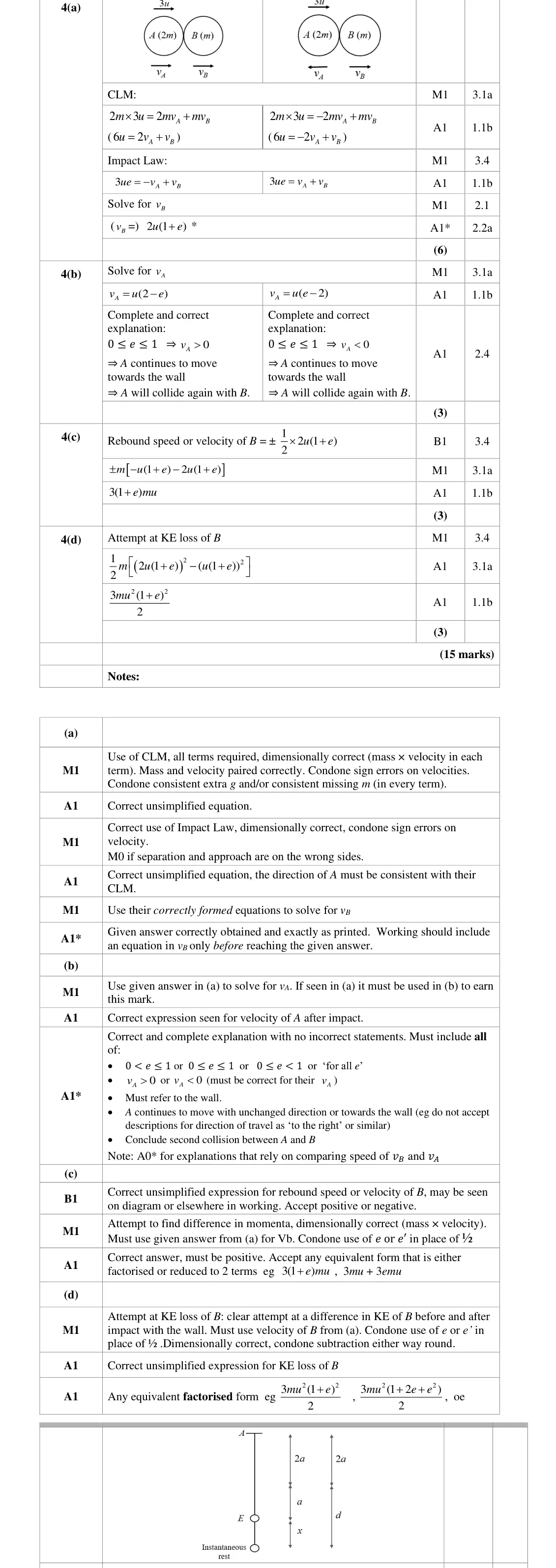
June 2024 · Paper 3C (Further Mechanics 1) · Q4(b)3 marks
Mark scheme (whole question; this part is marked with the orange bar)
Examiner's comment
This was a very popular question with candidates at all levels achieving most of the marks available. Candidates who were successful in part (a) usually earned the first two marks in part (b) for finding the velocity of A. However, the final mark required clear reasoning and precise language which presented more of a challenge and distinguished between the grades. Centres should advise candidates to avoid describing the direction of motion as ‘to the left’ or ‘to the right’. It is much better to use phrases such as ‘continues in the direction of motion’ or ‘reverses the direction of motion’ or to describe the motion relative to an object defined in the question, in this case, a fixed wall. Most candidates quickly identified the speed of B after colliding with the wall and used it successfully in part (b) to find the magnitude of the impulse, and in part (c) to find the loss in KE. The most common error in part (b) was a sign error in the rebound velocity which led to an incorrect impulse. Those who subtracted terms the wrong way round in parts (b) and (c) were more likely to recognise and correct the error.
Key points from the mark scheme and examiner's report
v_A = u(2 − e) > 0 for 0 ≤ e ≤ 1, so A keeps moving towards the wall and meets the rebounding B
precise language needed (not "to the left")
June 2024 · Paper 3C (Further Mechanics 1) · Q4(c)3 marks
Mark scheme (whole question; this part is marked with the orange bar)
Examiner's comment
This was a very popular question with candidates at all levels achieving most of the marks available. successfully in part (b) to find the magnitude of the impulse, and in part (c) to find the loss in KE. The most common error in part (b) was a sign error in the rebound velocity which led to an incorrect impulse. Those who subtracted terms the wrong way round in parts (b) and (c) were more likely to recognise and correct the error.
Key points from the mark scheme and examiner's report
B rebounds at u(1 + e)
impulse m(u(1 + e) + 2u(1 + e)) = 3mu(1 + e)
sign of the rebound velocity the commonest error
June 2024 · Paper 3C (Further Mechanics 1) · Q4(d)3 marks
Mark scheme (whole question; this part is marked with the orange bar)
Examiner's comment
This was a very popular question with candidates at all levels achieving most of the marks available.
Key points from the mark scheme and examiner's report
½m[(2u(1 + e))² − (u(1 + e))²] = 3mu²(1 + e)²/2
simplified form required
June 2023 · AS Paper 2 (Further Mechanics 1) · Q4(b)2 marks
Mark scheme (whole question; this part is marked with the orange bar)
Examiner's comment
In part (b), some candidates produced a rigorous argument moving from an inequality for e to an inequality for vQ, or vice versa, and hence a conclusion. The majority, however, chose to show that vQ = ½u when e = ½ and then argued therefore that when e > ½ , vQ > ½u and hence the conclusion. In the third part, most candidates realised that finding an expression for the speed of P would be
Key points from the mark scheme and examiner's report
e > 1/2 gives v_Q > u/2, the speed of R, so Q catches R and a collision occurs
a clear inequality argument and conclusion needed
June 2023 · Paper 3C (Further Mechanics 1) · Q3(b)4 marks
Mark scheme (whole question; this part is marked with the orange bar)
Examiner's comment
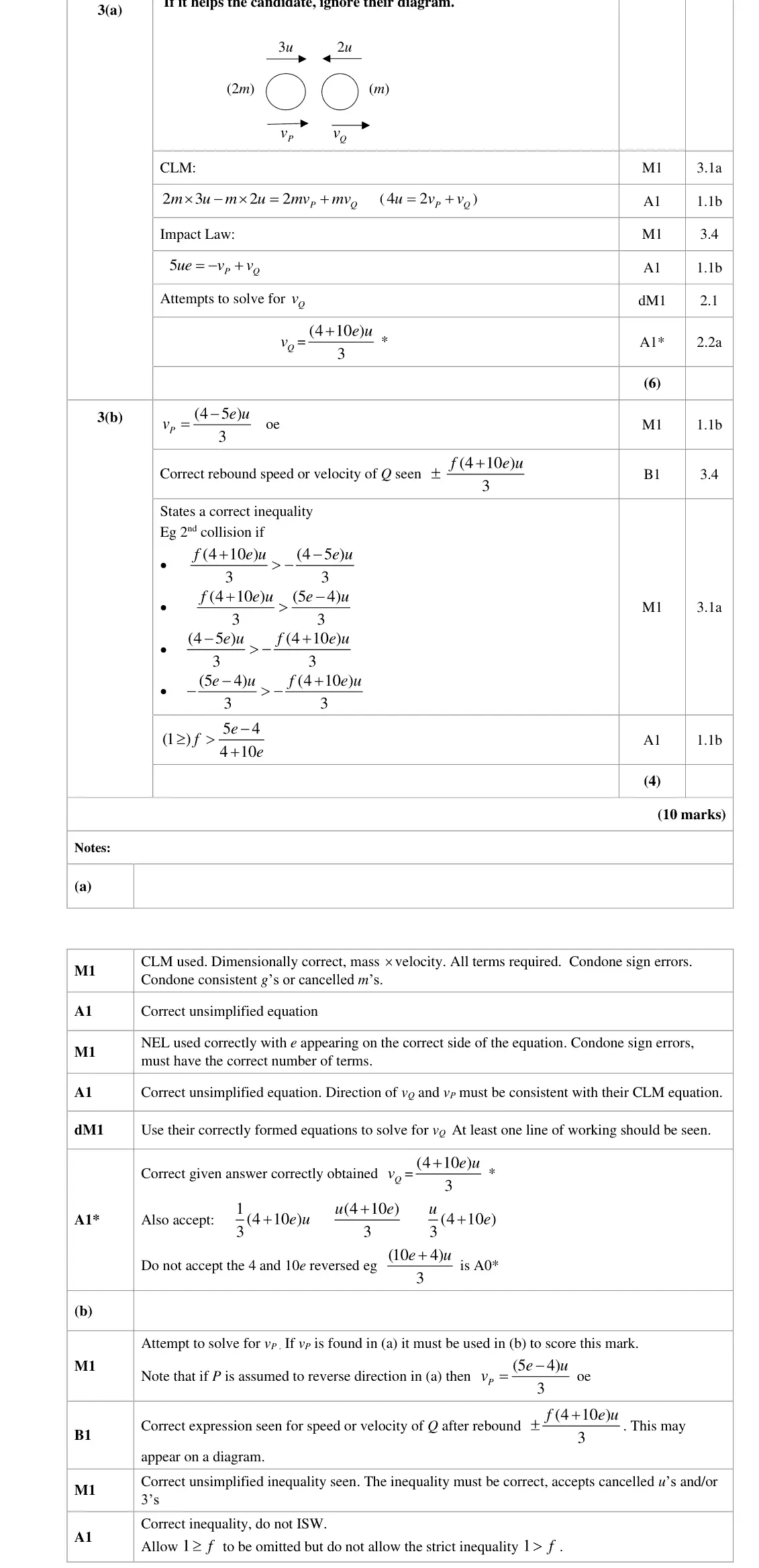
This question performed second best on the paper with the vast majority of candidates scoring most, if not all, the available marks. mark. Candidates who were successful in part (a) usually earned the first 2 marks in part (b) for the velocity of P and the rebound speed of Q. However, setting up an inequality for the final 2 marks presented more challenge. The most common successful approach was to assume that P reversed its direction in (a) resulting in comparable velocities. Those who assumed that P
Key points from the mark scheme and examiner's report
v_P = (4 − 5e)u/3, so P reverses as e > 4/5
Q rebounds at f(4 + 10e)u/3
second collision needs f(4 + 10e) > 5e − 4: (1 ≥) f > (5e − 4)/(4 + 10e)
setting up the inequality was the hard step
June 2022 · AS Paper 2 (Further Mechanics 1) · Q4(d)5 marks
Mark scheme (whole question; this part is marked with the orange bar)
Examiner's comment
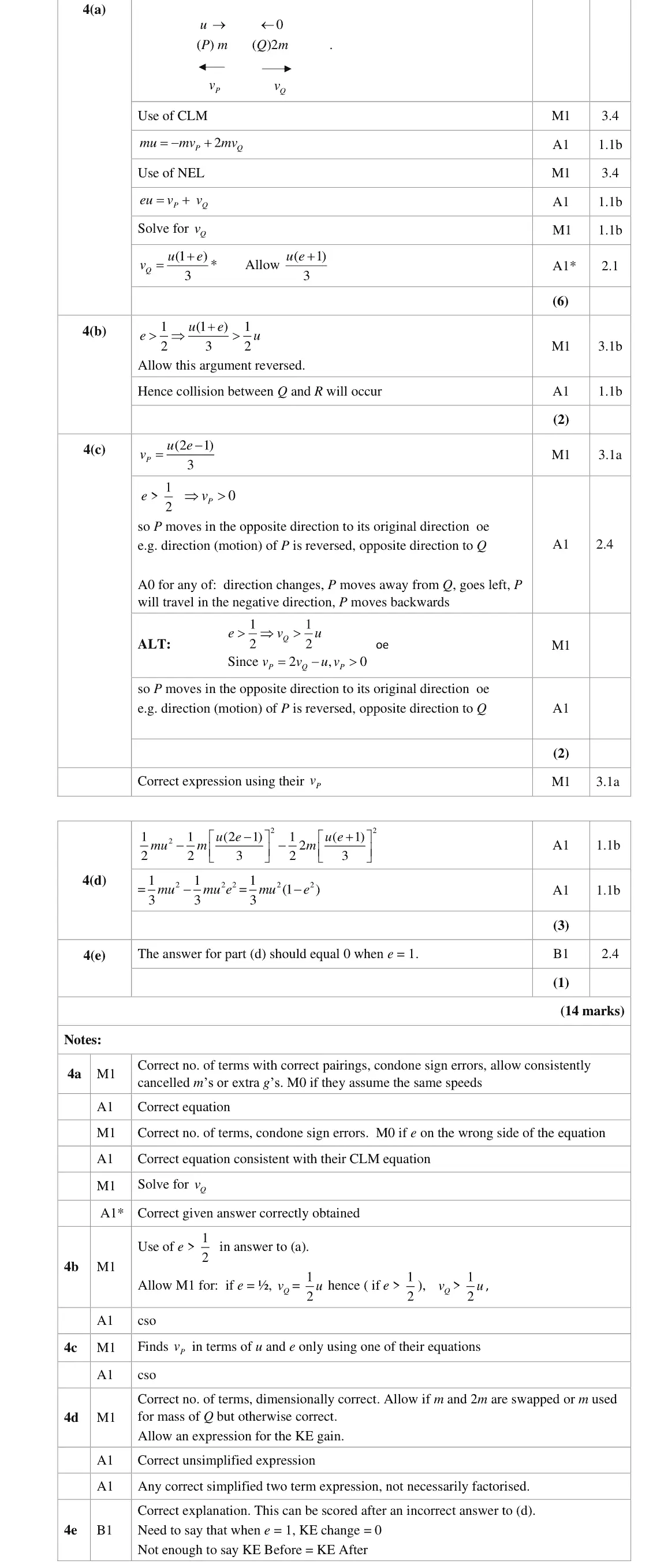
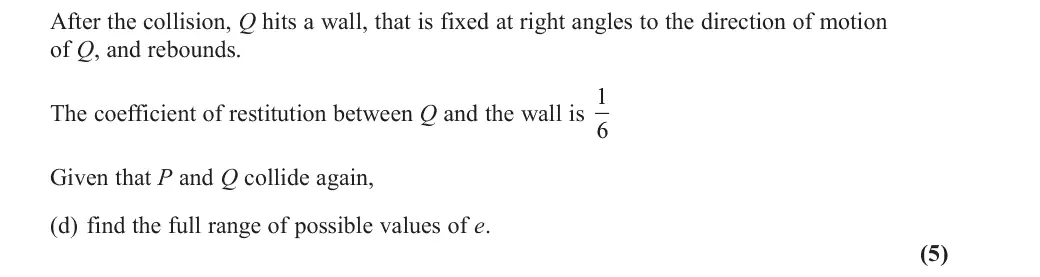
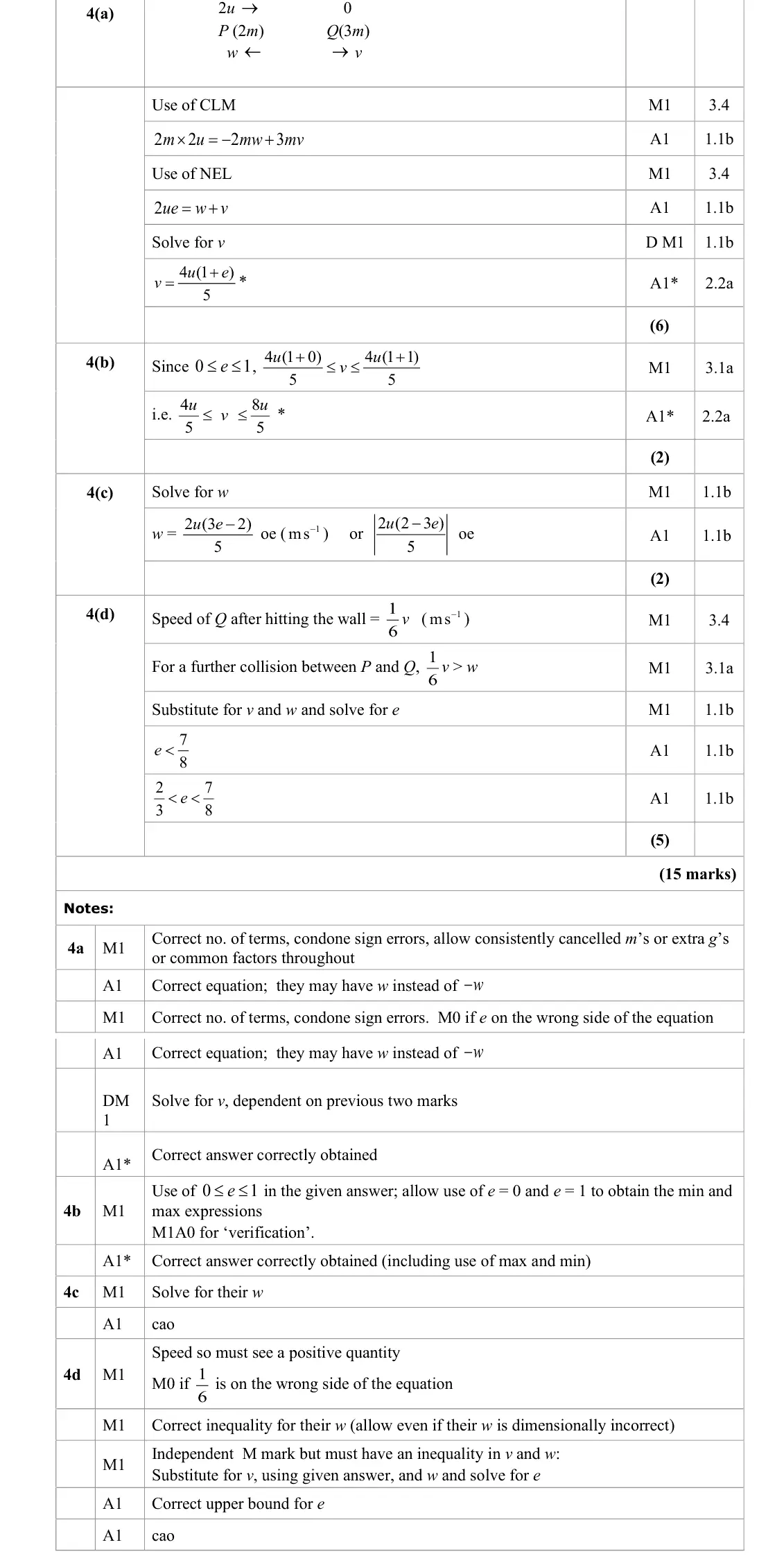
Some didn’t attempt part (d), but of those that did, the majority scored the first M mark but didn’t gain the second M mark because the sign of their speed for P was incorrect. 5 (2 3 ) e Some of those who gave an answer of in part (c) did not include the minus - - 2 u sign in part (d). So most candidates scored M1M0M1A0A0 for part (d). Of those who wrote a correct inequality and solved it correctly to get e < 7/8 only a handful realised that they also needed to solve 2u/5(3e – 2) > 0 or 2u/5(2 – 3e) < 0 to find the lower bound for e.
Key points from the mark scheme and examiner's report
Q rebounds from the wall at v/6
further collision needs v/6 > w, giving e < 7/8
P must also be moving back (w > 0) so e > 2/3: 2/3 < e < 7/8
very few found the lower bound
sign of P's speed often wrong
June 2022 · Paper 3C (Further Mechanics 1) · Q5(b)4 marks
Mark scheme (whole question; this part is marked with the orange bar)
Examiner's comment
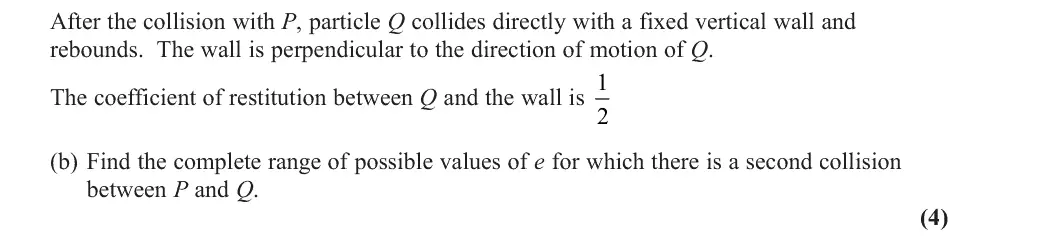
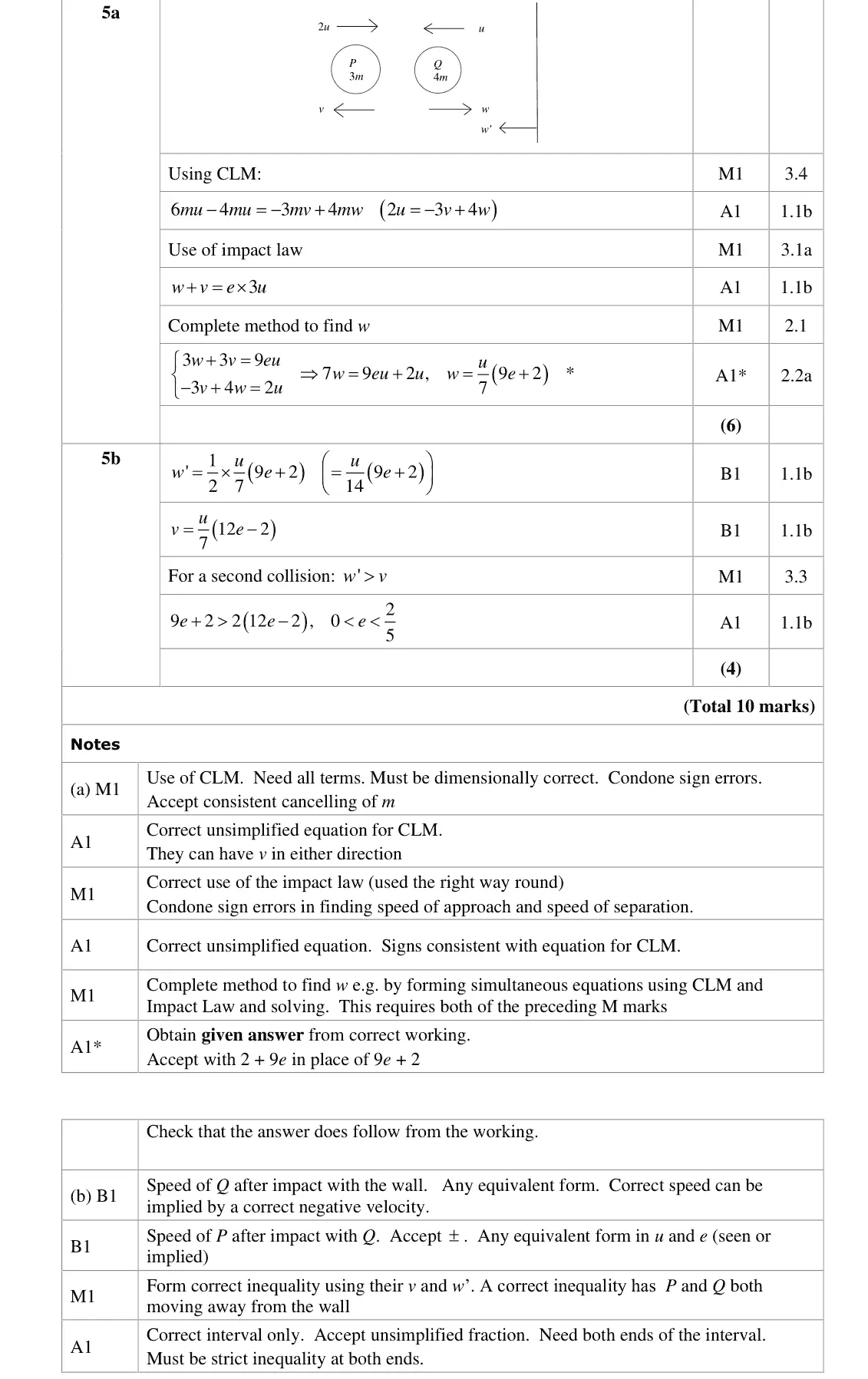
(b) This proved to be more challenging, particularly for candidates who did not consider that the direction of motion of P might change in the collision. Although most candidates were able to find expressions for the speed of P and the speed of Q after its collision with the wall, there was often confusion over how to use these values to determine the conditions for a subsequent collision. Those candidates who defined the direction of motion of A following the collision as being away from the wall were more successful as they had already covered the issue of the change in direction. Many candidates did not correctly deduce that the lower bound 𝑒= 0 did not lead to a subsequent collision as the particles would coalesce and therefore not collide again.
Key points from the mark scheme and examiner's report
Q rebounds at u(9e + 2)/14
v = u(12e − 2)/7
second collision needs w' > v: 0 < e < 2/5 (strict at both ends)
many ignored P reversing direction or the e = 0 case
Oct 2020 · AS Paper 2 (Further Mechanics 1) · Q3(a)8 marks
Mark scheme (whole question; this part is marked with the orange bar)
Examiner's comment
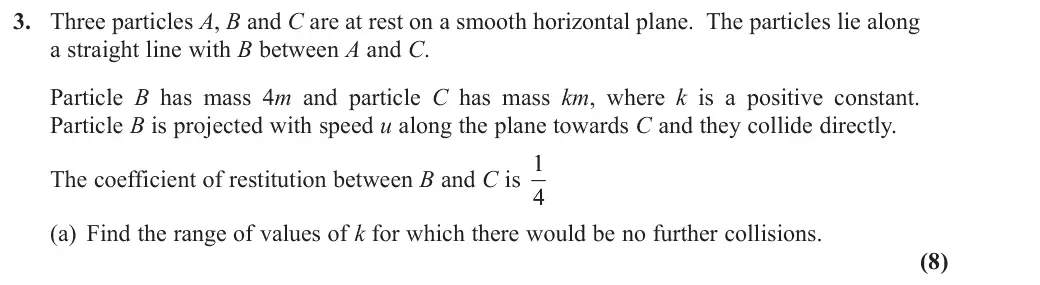
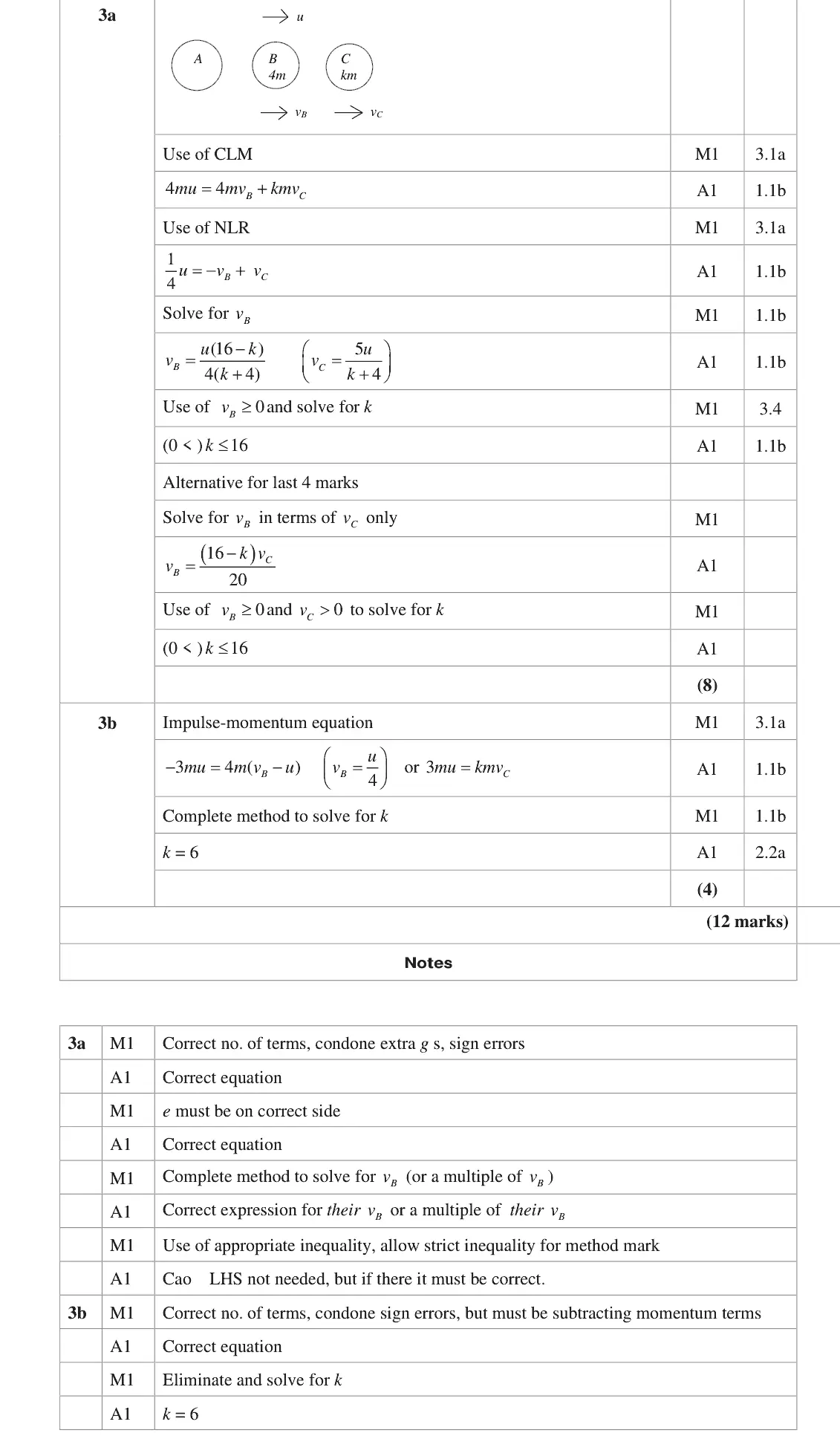
(a) The majority of candidates were familiar with the conservation of linear momentum and with the impact law and most applied these correctly to score the first four marks. Only a few candidates correctly identified the condition for no further collision. Some candidates thought that it depended on the velocity of C and did not attempt to find an expression for the velocity of B. The most common condition used was although v v > C B some candidates came much closer with not appreciating that if B were at rest 0, v > B there would be no further collisions. Fully correct solutions were unusual. The candidates were free to select their own names for the velocities of B and C after their collision, so it was a little surprising to find candidates calling them v and v - such a A B choice has the potential to cause confusion. Some candidates considered only the case when B was at rest after the collision. Although they demonstrated understanding of the conservation of momentum and of the impact law, there was nothing in their responses to justify considering only the limiting value, or to justify their decision about the final inequality.
Key points from the mark scheme and examiner's report
CLM and NLR (e = 1/4) give v_B = u(16 − k)/(4(k + 4))
no further collisions requires v_B ≥ 0 (B must not move back to A), so 0 < k ≤ 16
many used v_C > v_B or v_B > 0, or worked with the velocity of C
Oct 2020 · AS Paper 2 (Further Mechanics 1) · Q4(b)5 marks
Mark scheme (whole question; this part is marked with the orange bar)
Examiner's comment
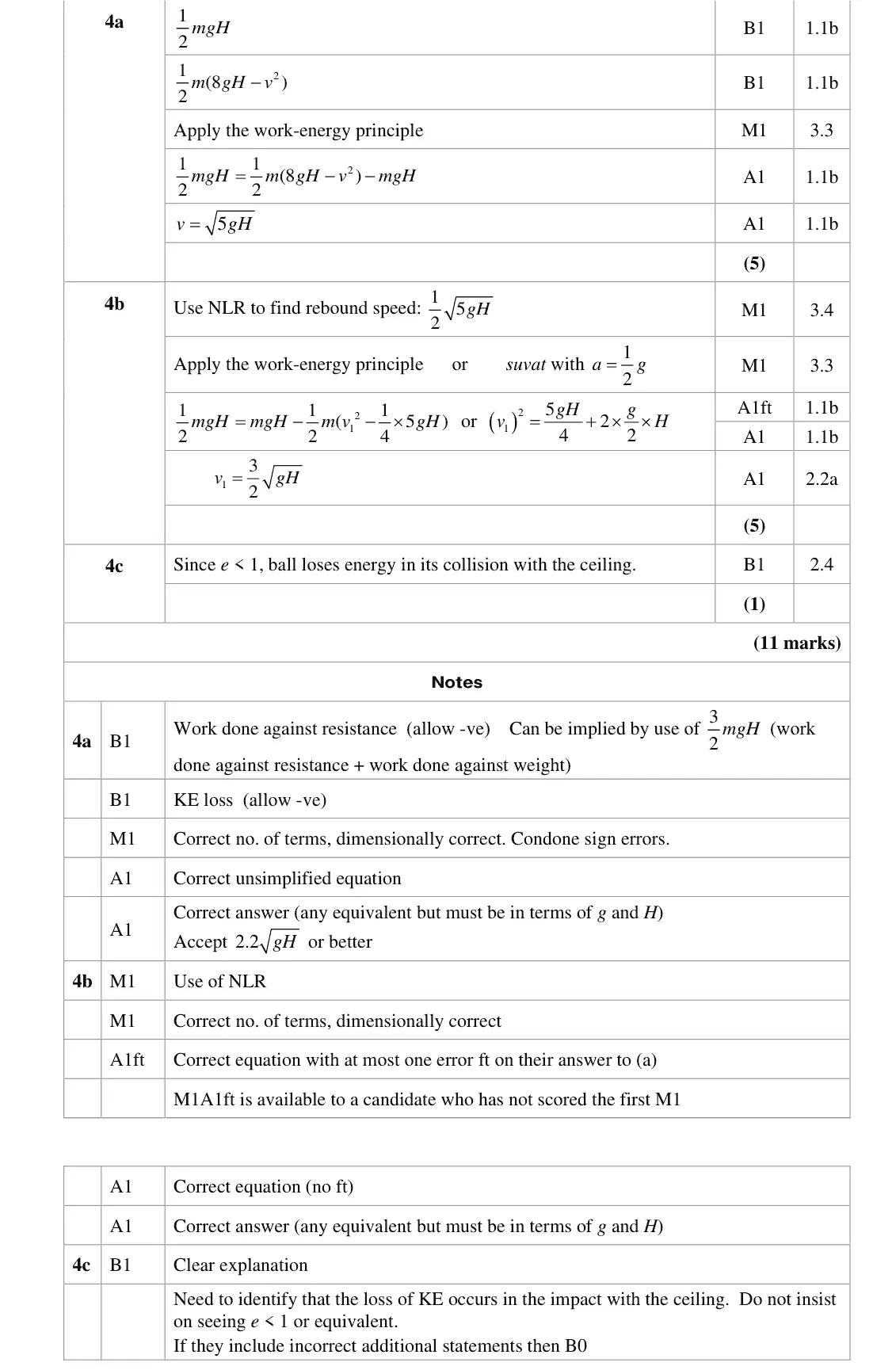
(b) Most candidates made a correct start by using the coefficient of restitution correctly. Several candidates used the work-energy principle again. If they had made an error in the work-energy equation in part (a) they usually repeated the same error here.
Key points from the mark scheme and examiner's report
rebound speed ½√(5gH) by NLR, then work-energy or suvat with a = g/2 (not g or 3g/2): v = (3/2)√(gH)
Oct 2020 · Paper 3C (Further Mechanics 1) · Q3(b)6 marks
Mark scheme (whole question; this part is marked with the orange bar)
Examiner's comment
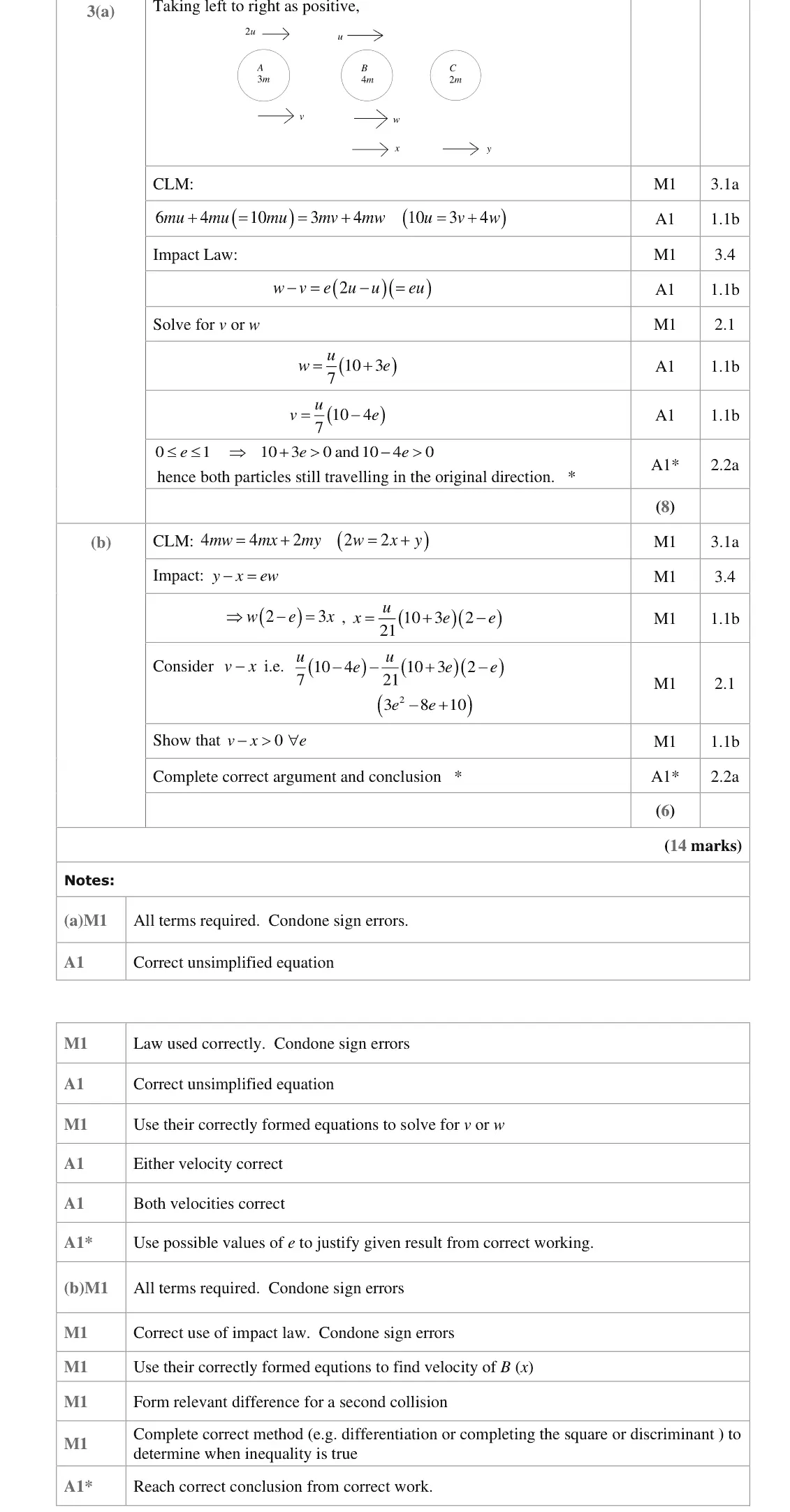
(b) Most candidates started with a correct attempt to find the speed of B after the collision with C. In order to confirm that there will be a second collision between A and B it is necessary to demonstrate that, for all values of e, the speed of A after the first collision is greater that the speed of B after the second collision. Many candidates simply substituted values for e and did not consider the behaviour of the quadratic function in e over the full range of possibilities.
Key points from the mark scheme and examiner's report
B's velocity after hitting C: x = u(10 + 3e)(2 − e)/21
v − x proportional to 3e² − 8e + 10 > 0 for all e (discriminant or completing the square)
substituting particular values of e is not enough
June 2019 · AS Paper 2 (Further Mechanics 1) · Q4(a)9 marks
Mark scheme (whole question; this part is marked with the orange bar)
Examiner's comment
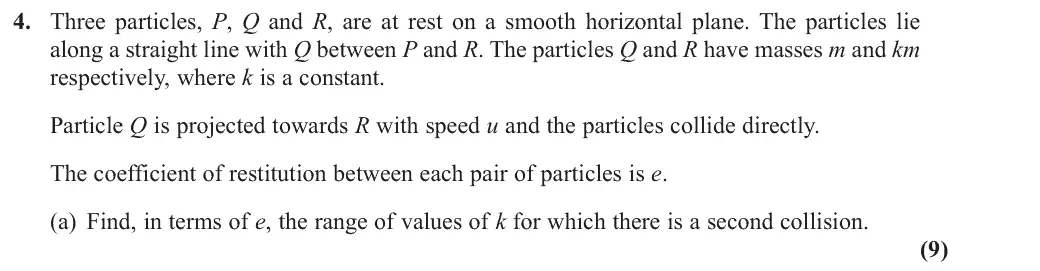
(a) Many candidates made a confident start in this question, with the majority scoring the first four marks for a correct equation using conservation of linear momentum, and for correct use of the impact law. A few candidates, usually those who had not drawn a diagram, lost a mark due to the inconsistent use of the direction of motion for Q. If there is to be a second collision then the direction of motion of Q must be reversed. Candidates needed to start by finding an expression for the velocity of Q and then form an appropriate inequality. Many candidates did complete this stage correctly. The most common errors were to focus on the velocity of R, or to form an inequality involving the velocity of R.
Key points from the mark scheme and examiner's report
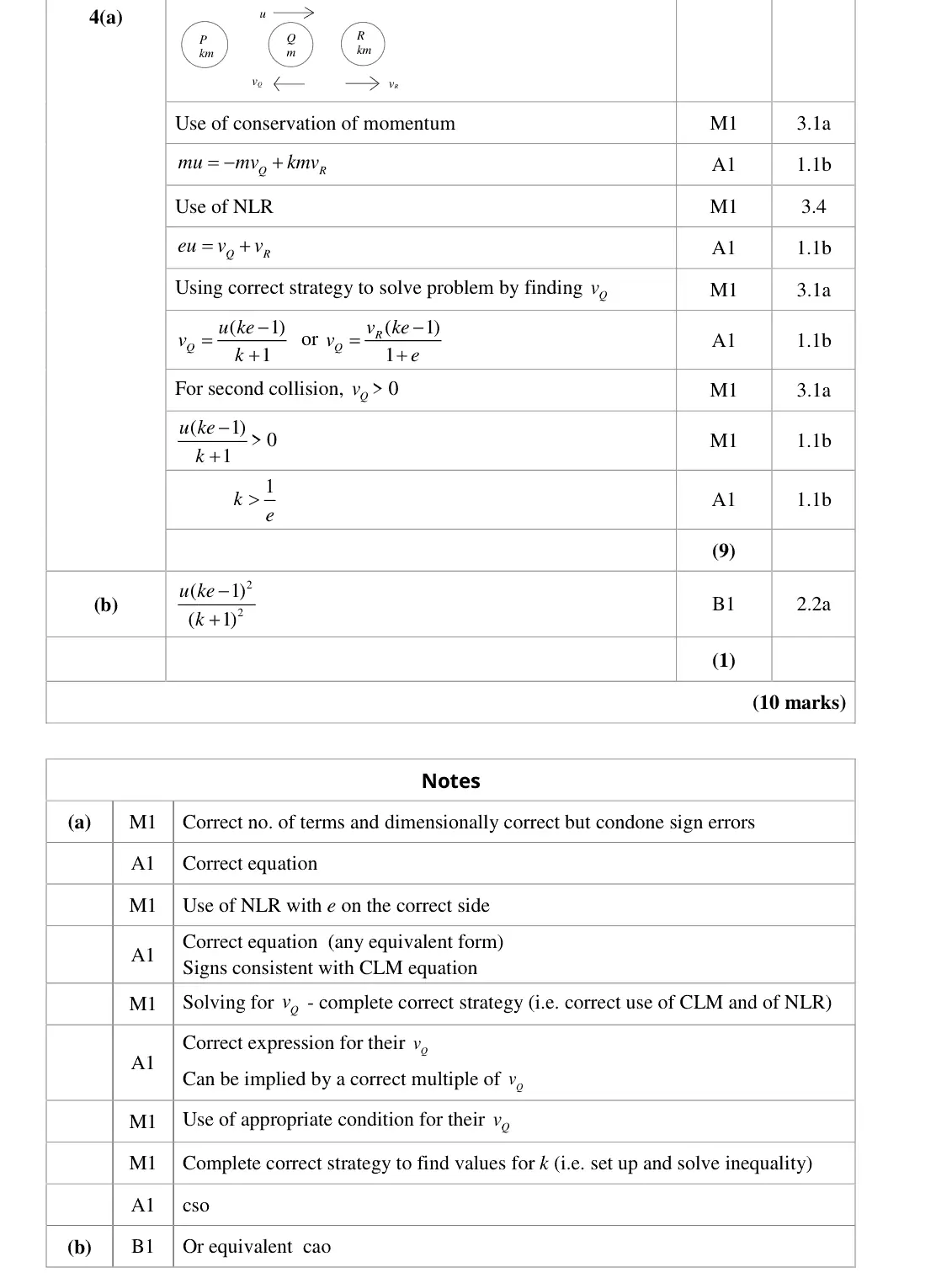
CLM mu = −mv_Q + kmv_R and NLR eu = v_Q + v_R give v_Q = u(ke − 1)/(k + 1)
second collision needs Q to move back towards P so v_Q > 0, giving k > 1/e
common error: forming the inequality with the velocity of R
June 2019 · AS Paper 2 (Further Mechanics 1) · Q4(b)1 mark
Mark scheme (whole question; this part is marked with the orange bar)
Examiner's comment
(b) A small group of candidates gave the correct answer here. Some candidates recognised that the ratio of the masses of the particles involved in the second collision was identical to that in the first collision and simply wrote down the answer. Some candidates worked through the entire process a second time and reached the correct answer. The majority of candidates who worked through the process a second time made arithmetic or algebraic errors in the course of their working.
Key points from the mark scheme and examiner's report
same mass ratio as the first collision, so speed u(ke − 1)²/(k + 1)² can be written down
reworking from scratch led to algebra slips
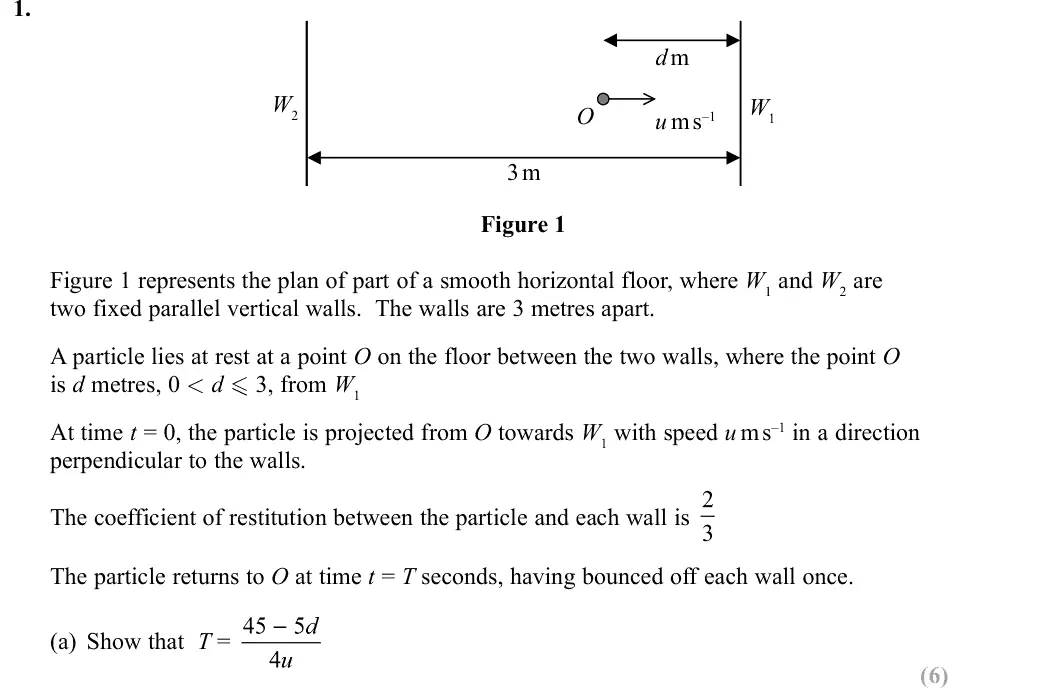
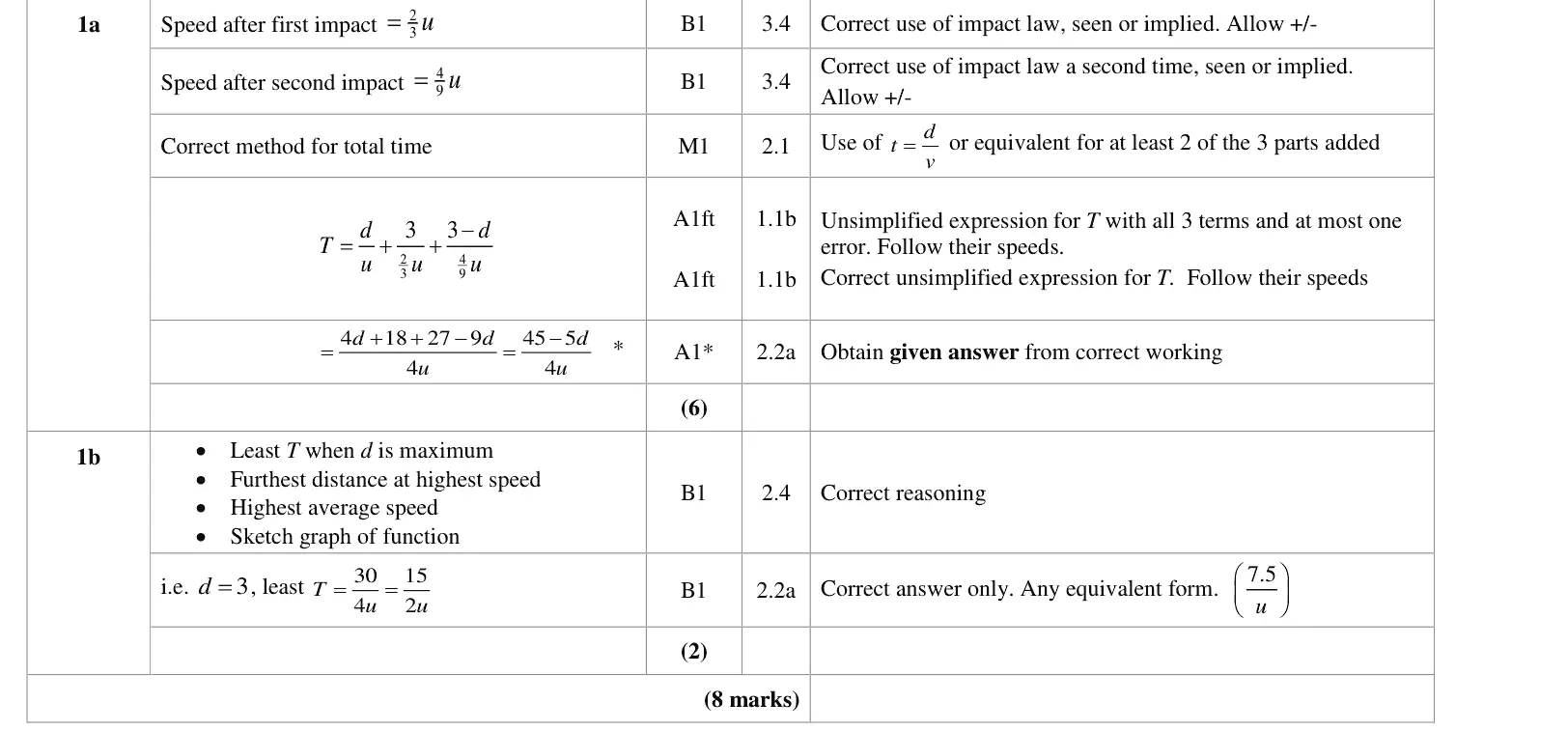
June 2019 · Paper 3C (Further Mechanics 1) · Q1(a)6 marks
Mark scheme (whole question; this part is marked with the orange bar)
Examiner's comment
(a) The majority of candidates scored the first two marks for correct statements of the speed of the particle after its impact with each wall. Many went on to form a correct equation for the total time taken and reach the given answer. Some candidates made errors in the use of distance time speed and some went wrong because they tried to use the average speed.
Key points from the mark scheme and examiner's report
speeds after impacts 2u/3 and 4u/9
T = d/u + 3/(2u/3) + (3 − d)/(4u/9)
errors in distance-time-speed and trying to use an average speed
June 2019 · Paper 3C (Further Mechanics 1) · Q1(b)2 marks
Mark scheme (whole question; this part is marked with the orange bar)
Examiner's comment
(b) The candidates used a variety of approaches to determine the least possible value of T. Some simply argued that they needed to minimise the numerator of the given fraction, some drew a sketch of the function, and some tried to use calculus. Many did reach a correct conclusion, but a significant minority did not.
Key points from the mark scheme and examiner's report
least T when d is greatest (furthest distance at highest speed), so d = 3, T = 15/(2u)
reason required
a significant minority reached the wrong conclusion
June 2018 · AS Paper 2 (Further Mechanics 1) · Q4(c)6 marks
Mark scheme (whole question; this part is marked with the orange bar)
Examiner's comment
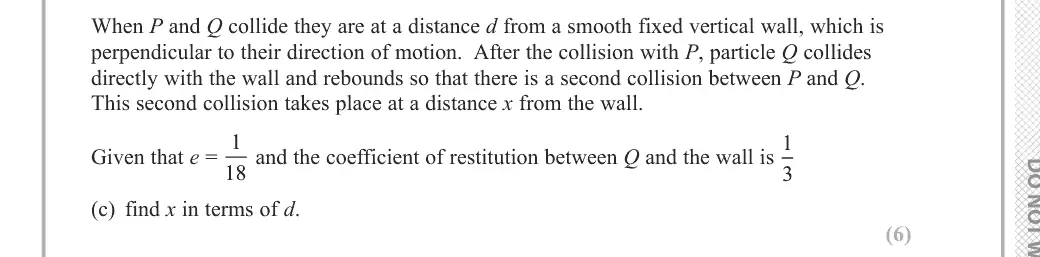
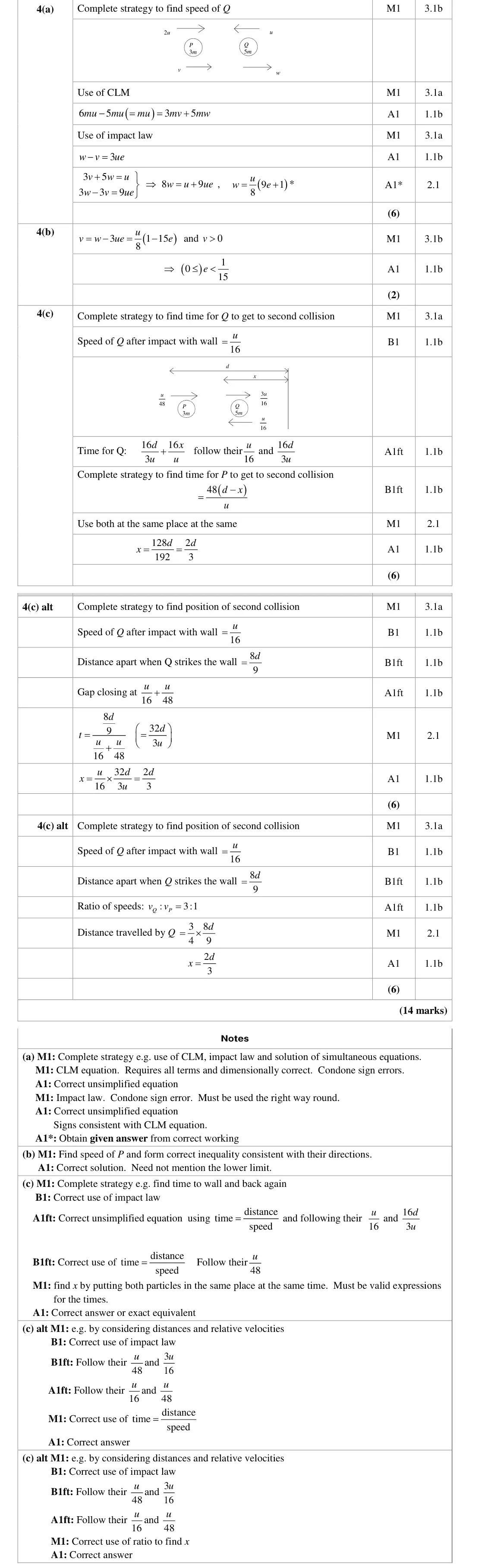
(c) For the majority of students, this was the most challenging part of the paper. Some completely misunderstood what they needed to do and set about forming equations to find the speeds of P and Q after a second collision between the two particles. Although many students wrote down a correct expression for the speed of Q after the impact with the wall, very few students showed any sign of the problem solving skills necessary to think through what was happening. This was not helped by having particles moving in the wrong direction and misuse of the relationship between speed, distance and time.
Key points from the mark scheme and examiner's report
Q rebounds from the wall at u/16, P moves at u/48
equate times (16d/3u + 16x/u = 48(d − x)/u) or use the gap 8d/9 closing at u/16 + u/48: x = 2d/3
many wrongly modelled a second P-Q collision
hardest part of the paper
Find an Edexcel Further Maths tutor
Stuck on this? Book a trial lesson with our Further Maths tutor.