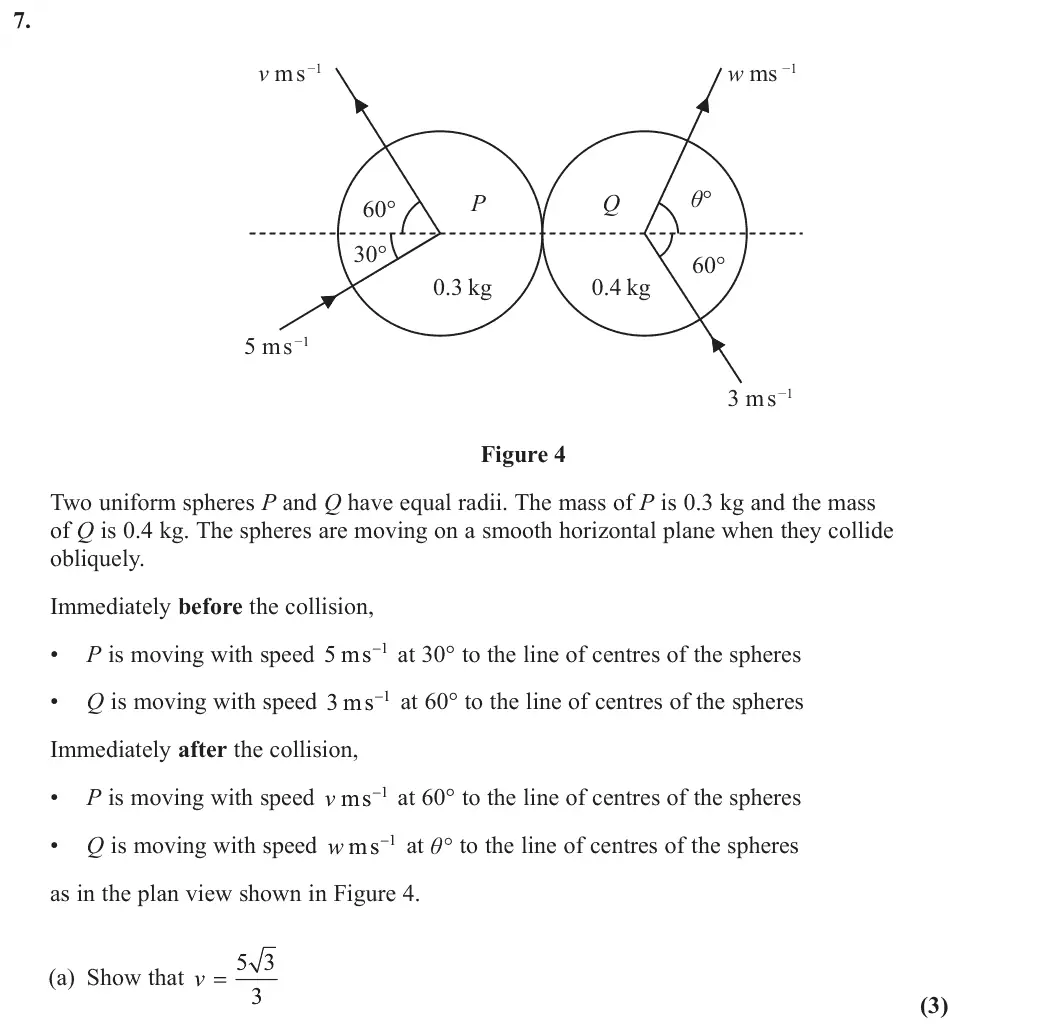
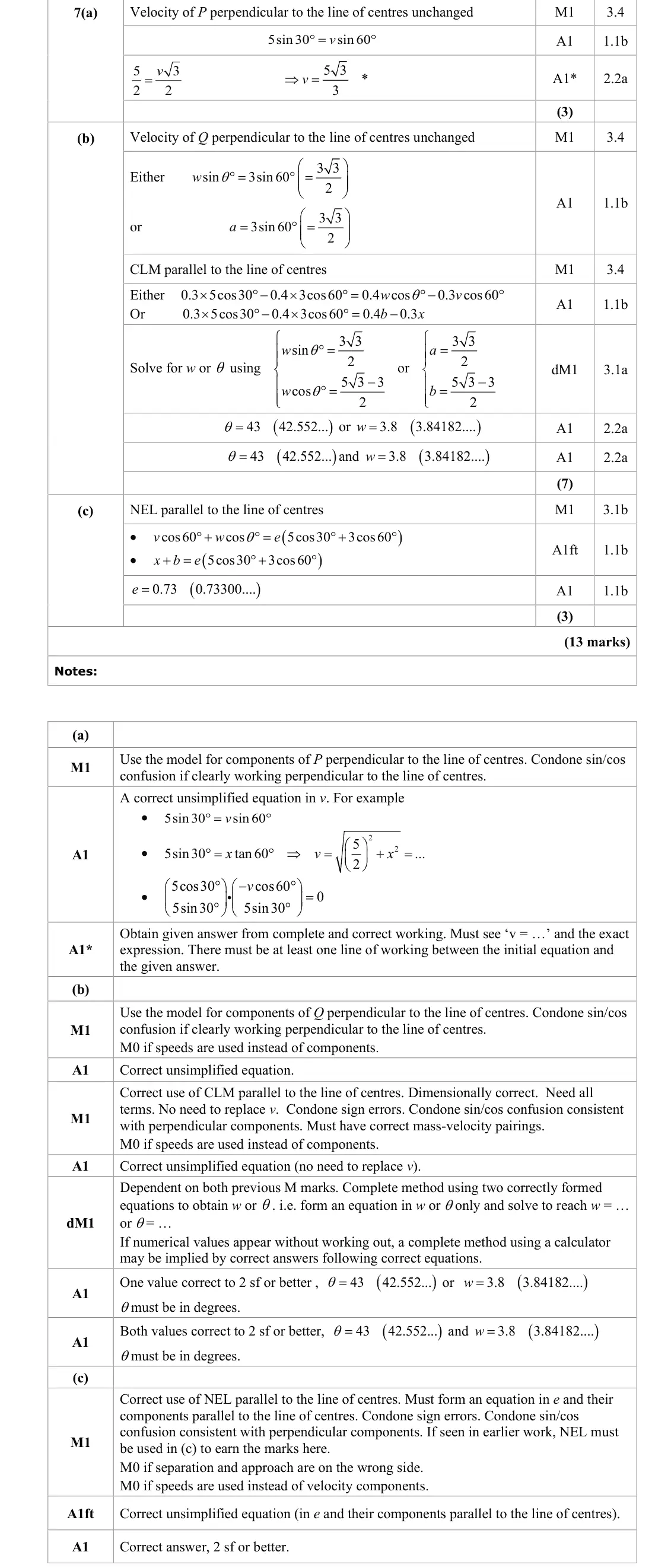
June 2025 · Paper 3C (Further Mechanics 1) · Q7(a)3 marks
Mark scheme (whole question; this part is marked with the orange bar)
Examiner's comment
centres are unchanged to establish an equation in v for part (a). With the requirements of a given answer, learners usually included a trivial rearrangement to show how v is obtained and earned all available marks. A few rushed straight into CLM along the line of centres and produced several pages of working and re-starts before abandoning the question completely. Although the 7 marks available in part (b) involved fairly routine bookwork, it required
Key points from the mark scheme and examiner's report
P's component perpendicular to the line of centres unchanged: 5 sin 30° = v sin 60°, v = 5√3/3
some launched into CLM and lost their way
June 2025 · Paper 3C (Further Mechanics 1) · Q7(b)(ii)7 marks
Mark scheme (whole question; this part is marked with the orange bar)
Examiner's comment
Although the 7 marks available in part (b) involved fairly routine bookwork, it required following the directions indicated in the given figure and careful labelling of components. High achievers produced fluent solutions by forming two equations which were solved to find w and theta . Those who failed to use components or forgot either mass made very little progress.
Key points from the mark scheme and examiner's report
(i) and (ii): w sin θ = 3 sin 60° (unchanged) and CLM along the line of centres 0.3(5 cos 30°) − 0.4(3 cos 60°) = 0.4w cos θ − 0.3v cos 60°: θ = 42.6, w = 3.84
forgetting a mass or not using components
June 2025 · Paper 3C (Further Mechanics 1) · Q7(c)3 marks
Mark scheme (whole question; this part is marked with the orange bar)
Examiner's comment
In part (c), a follow through mark on the values for w and theta resulted in many learners scoring at least 2 out of the 3 marks available and rewarded those who understood how to use the impact law for oblique impact.
Key points from the mark scheme and examiner's report
NLR along the line of centres: v cos 60° + w cos θ = e(5 cos 30° + 3 cos 60°), e = 0.733
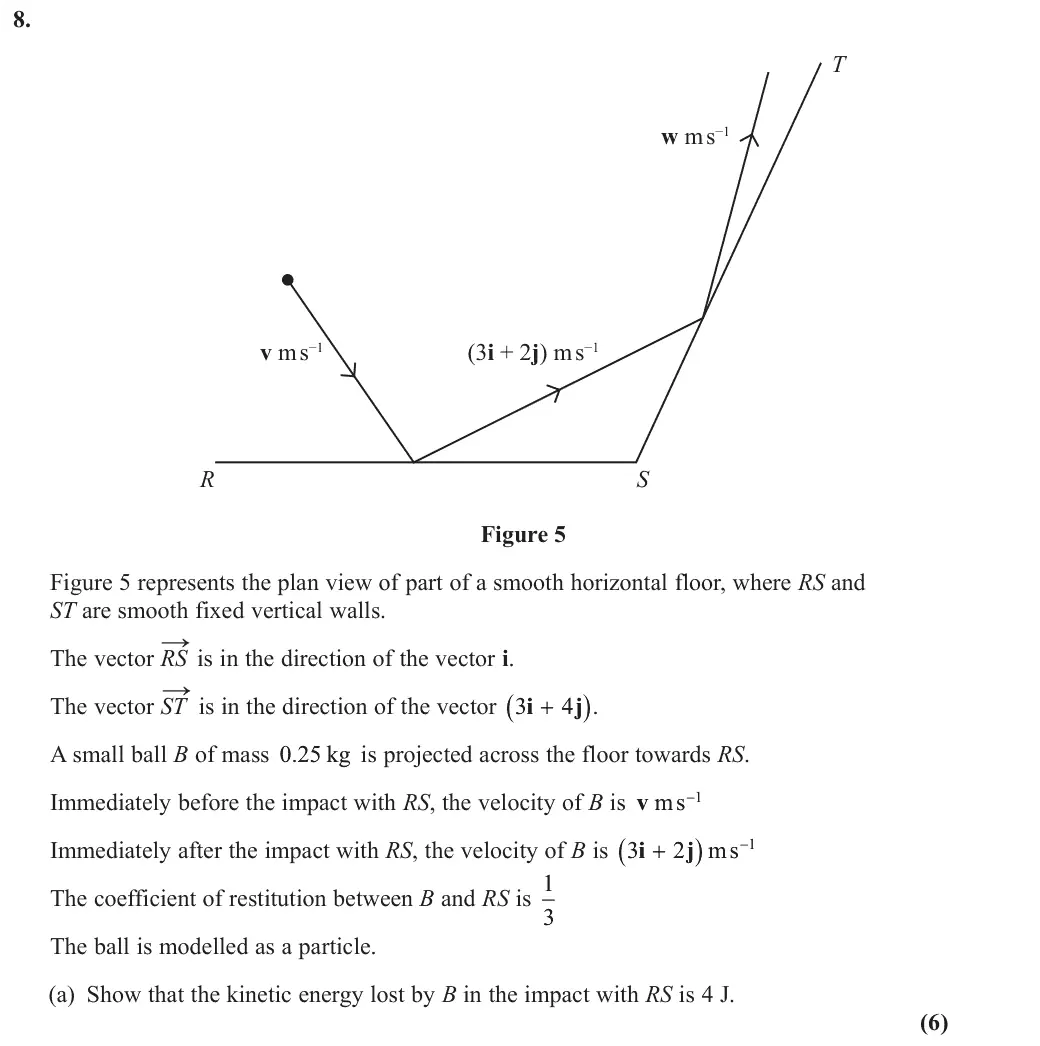
June 2025 · Paper 3C (Further Mechanics 1) · Q8(a)6 marks
Mark scheme (whole question; this part is marked with the orange bar)
Examiner's comment
As expected, the final question on the paper brought with it a significant level of challenge to stretch the most able and there were several blank responses. The information was given in vector form and those who were confident working with vectors were far more successful. Those who insisted on changing all vectors to speeds and directions made the process far more complicated and often introduced sign errors or was working with unnecessarily complicated algebra. Part (a) awarded 6 marks for showing the kinetic energy lost by B. However, since the answer was given in the question, clear reasoning with sufficient working was required to earn all 6 available marks. Those who clearly labelled the diagram and used vectors usually scored higher than those who did not. For example, learners who used speeds and angles rarely stated that the component parallel to the surface is unchanged. Learners should use the number of marks available for questions to ensure they show sufficient workings. In this question, some learners treated the instructions as ‘find’ rather than ‘show that’.
Key points from the mark scheme and examiner's report
v = 3i − 6j (parallel component unchanged, perpendicular 2 ÷ 1/3 = 6 towards RS)
KE loss ½(0.25)(45) − ½(0.25)(13) = 4 J
only perpendicular-component KE is incomplete
vector working far easier than speeds and angles
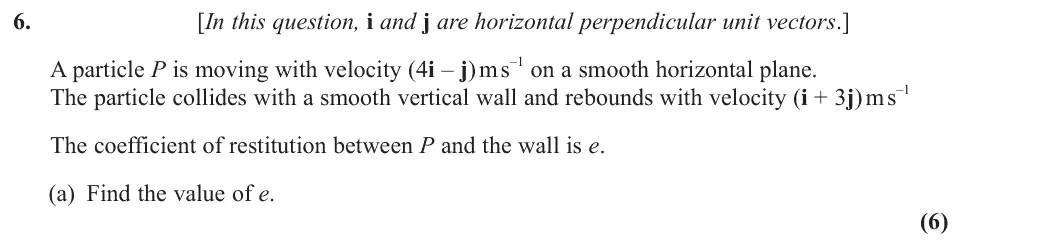
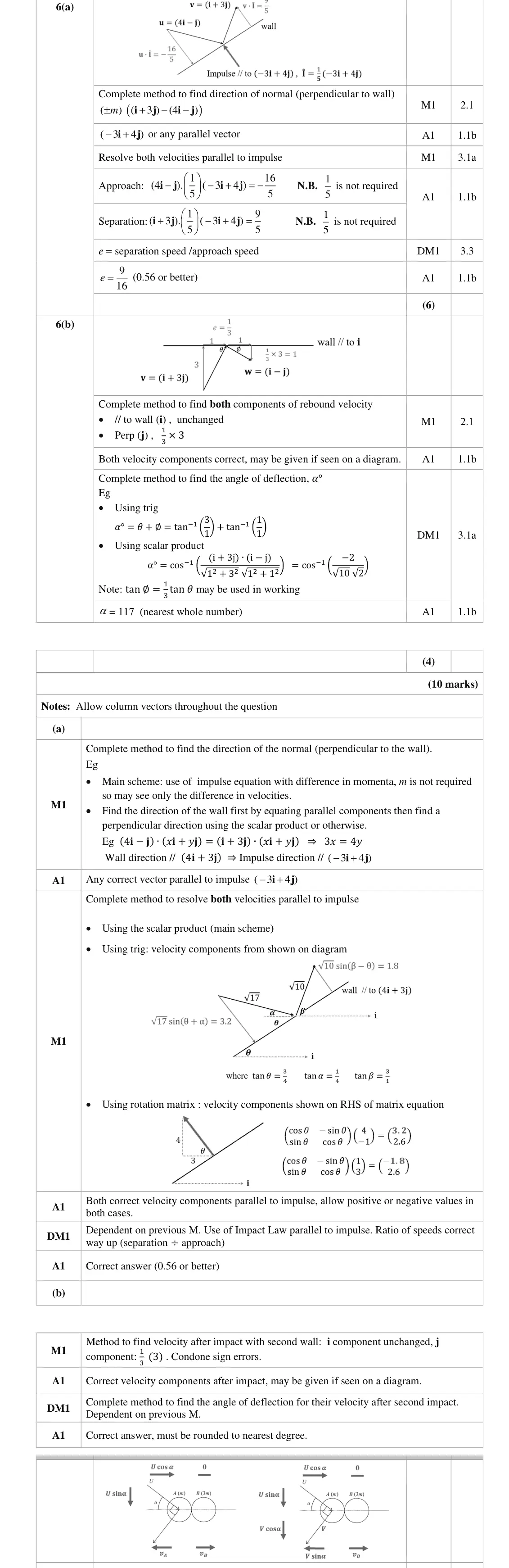
June 2024 · Paper 3C (Further Mechanics 1) · Q6(a)6 marks
Mark scheme (whole question; this part is marked with the orange bar)
Examiner's comment
For many, the first part of this question on oblique impact, was the most challenging on the paper and candidates attempted a variety of approaches. The most successful, shown on the v I = = - main mark scheme, used u followed by e . Well-prepared candidates used m m I v - u I this approach with ease to obtain the correct answer. = + d x i y j A second popular and fairly successful, technique was to state the wall direction as = - + I y i x j. Those with strong algebraic skills produced and the impulse direction as v I = = simultaneous equations from v d and e processing them to obtain e. u d - u I It was very rare for candidates to use a matrix approach but those who did, demonstrated a solid understanding and usually did so successfully. Those who attempted to use trigonometry produced cumbersome algebra and were usually unsuccessful. Many who struggled with part (a) made no attempt at part (b) despite it being more accessible. Those who produced a diagram usually found the required velocity successfully and progressed to find the angle of deflection using the scalar product. The inverse tan alternative was less popular but well-executed when accompanied by a diagram.
Key points from the mark scheme and examiner's report
impulse direction (i + 3j) − (4i − j) parallel to −3i + 4j
resolve both velocities along it: approach 16/5, separation 9/5, e = 9/16
trig approaches less successful
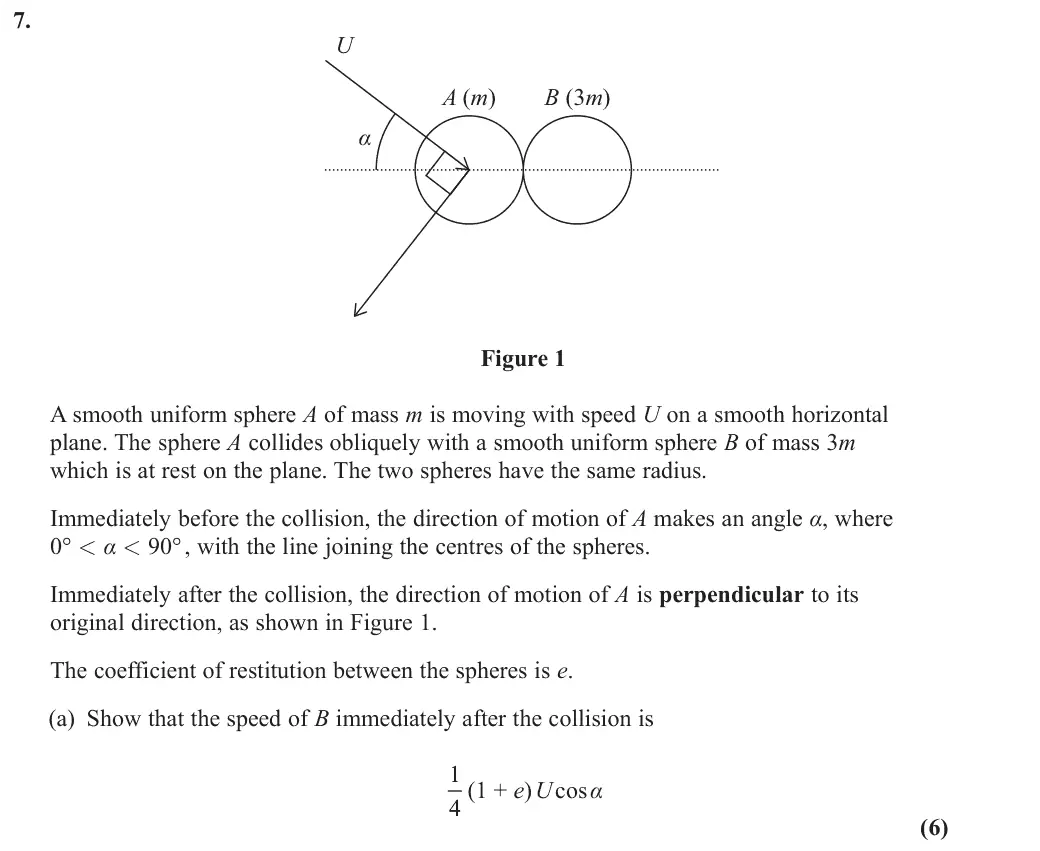
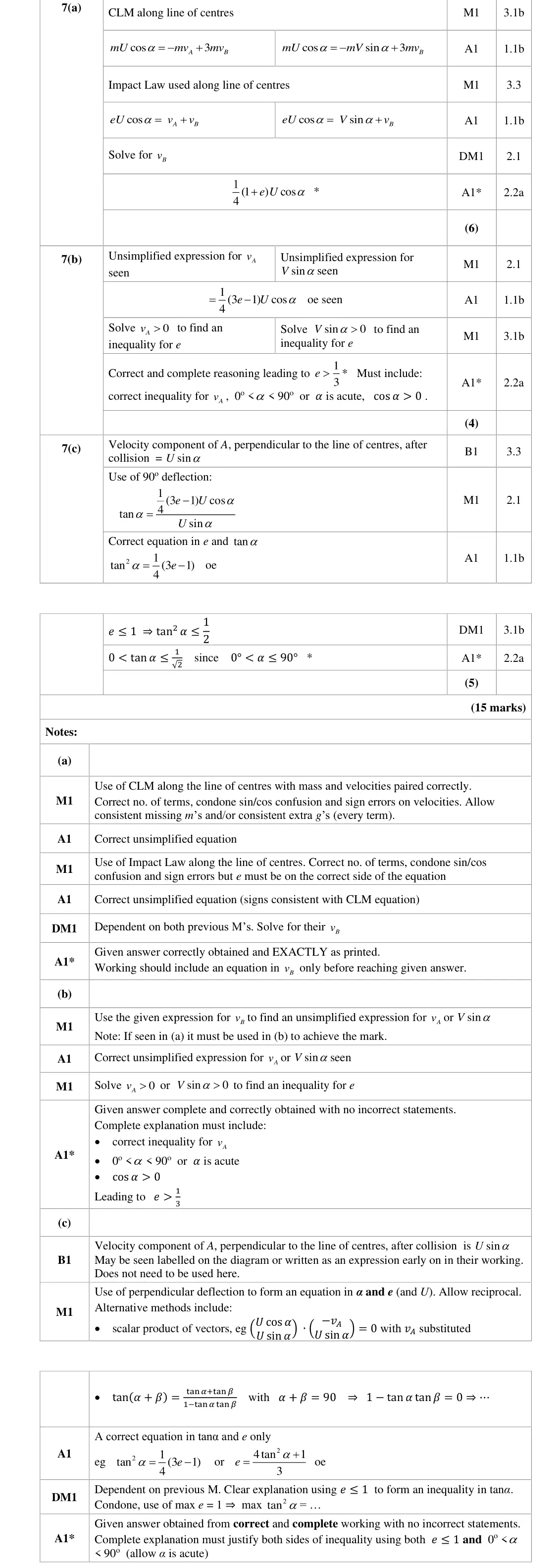
June 2024 · Paper 3C (Further Mechanics 1) · Q7(a)6 marks
Mark scheme (whole question; this part is marked with the orange bar)
Examiner's comment
The final question on the paper contained three parts, each with a given answer, providing an appropriate level of challenge to stretch high attainers. Whilst part (a) was routine bookwork, parts (b) and (c) demanded clear reasoning and precise language, providing candidates with an opportunity to demonstrate their knowledge and understanding of mechanics. Many candidates at all levels made a confident start to part (a), labelling components on the given figure and making use of the directions of motion of A. Most assigned v as the speed of A after impact and w as the speed of B after impact. The majority recognised that the velocity component of A perpendicular to the line of centres remained unchanged, that B would move parallel to the line of centres and labelled the angle appropriately for the motion of A after impact. Well-prepared candidates produced fluent solutions, forming equations for the conservation of linear momentum and Newton’s Experimental Law and combined them to reach the given answer. It was rare for sign errors to occur, and these were easily rectified. Good exam technique was demonstrated with at least one line of working shown before reaching the given answer and the final answer re-written, if necessary, to ensure it was exactly as printed in the question. Errors in part (a) were more likely to occur in solutions where candidates chose to draw their own diagram. These candidates were more likely to ignore the angle of deflection, producing a generic solution with additional angles for both particles after impact. With additional angles and sign differences, some solutions lacked fluency and failed to obtain the given answer from fully correct working. Candidates are advised to annotate a Figure when one is provided in the question, as it is usually in place to support understanding and aid progression.
Key points from the mark scheme and examiner's report
CLM along the line of centres mU cos α = −mv_A + 3mv_B and NLR eU cos α = v_A + v_B: v_B = ¼(1 + e)U cos α
A's perpendicular component unchanged and B moves along the line of centres
June 2024 · Paper 3C (Further Mechanics 1) · Q7(b)4 marks
Mark scheme (whole question; this part is marked with the orange bar)
Examiner's comment
The final question on the paper contained three parts, each with a given answer, providing an appropriate level of challenge to stretch high attainers. Whilst part (a) was routine bookwork, parts (b) and (c) demanded clear reasoning and precise language, providing candidates with an opportunity to demonstrate their knowledge and understanding of mechanics. Those who were well-prepared and successful in part (a) were quick to earn the first two marks in (b) by completing their simultaneous equations and finding an expression for the velocity component of A parallel to the line of centres after impact. The subsequent method mark was for establishing an appropriate inequality based on the direction of motion of A and high attainers showed confidence using mathematical notation. Weaker candidates were more likely to attempt an explanation using phrases such as ‘to the left’ which are not acceptable. To achieve the final mark in part (b), candidates were required to provide correct and complete reasoning to obtain the given answer, 1 3 e , including justification of why dividing by cos did not change the inequality sign. Only the best candidates produced a fully correct solution. Some candidates attempted part (b) without considering the context and proceeded along a path of trigonometric identities and algebraic manipulation. Solutions became very chaotic, and it was rare for any marks to be awarded.
Key points from the mark scheme and examiner's report
A's component along the line of centres reversed: v_A = ¼(3e − 1)U cos α > 0 (cos α > 0 as α acute) gives e > 1/3
reasoning about direction needed
June 2024 · Paper 3C (Further Mechanics 1) · Q7(c)5 marks
Mark scheme (whole question; this part is marked with the orange bar)
Examiner's comment
The final question on the paper contained three parts, each with a given answer, providing an appropriate level of challenge to stretch high attainers. Whilst part (a) was routine bookwork, parts (b) and (c) demanded clear reasoning and precise language, providing candidates with an opportunity to demonstrate their knowledge and understanding of mechanics. The first mark in part (c) was given for recognising that the velocity component of A perpendicular to the line of centres is unchanged after impact. Although many candidates had abandoned the question by this point, the mark was often achieved by those who had clearly labelled the Figure provided. To reach the given inequality for tan , candidates were required to consider the context of the question, in particular the perpendicular deflection of A. Those who were able to produce a correct equation in tan and e were usually able to justify the upper limit by stating 1 e and processing correctly to reach 1 tan 2 . However, it was common for candidates to incorrectly use 1 3 e , rather than the range of values of , in an attempt to justify the lower limit. Despite the level of challenge in this question, it was pleasing to see many well-presented and efficient solutions.
Key points from the mark scheme and examiner's report
perpendicular deflection: tan α = ¼(3e − 1)U cos α / (U sin α) so tan²α = (3e − 1)/4
e ≤ 1 gives tan²α ≤ ½, so 0 < tan α ≤ 1/√2
few completed
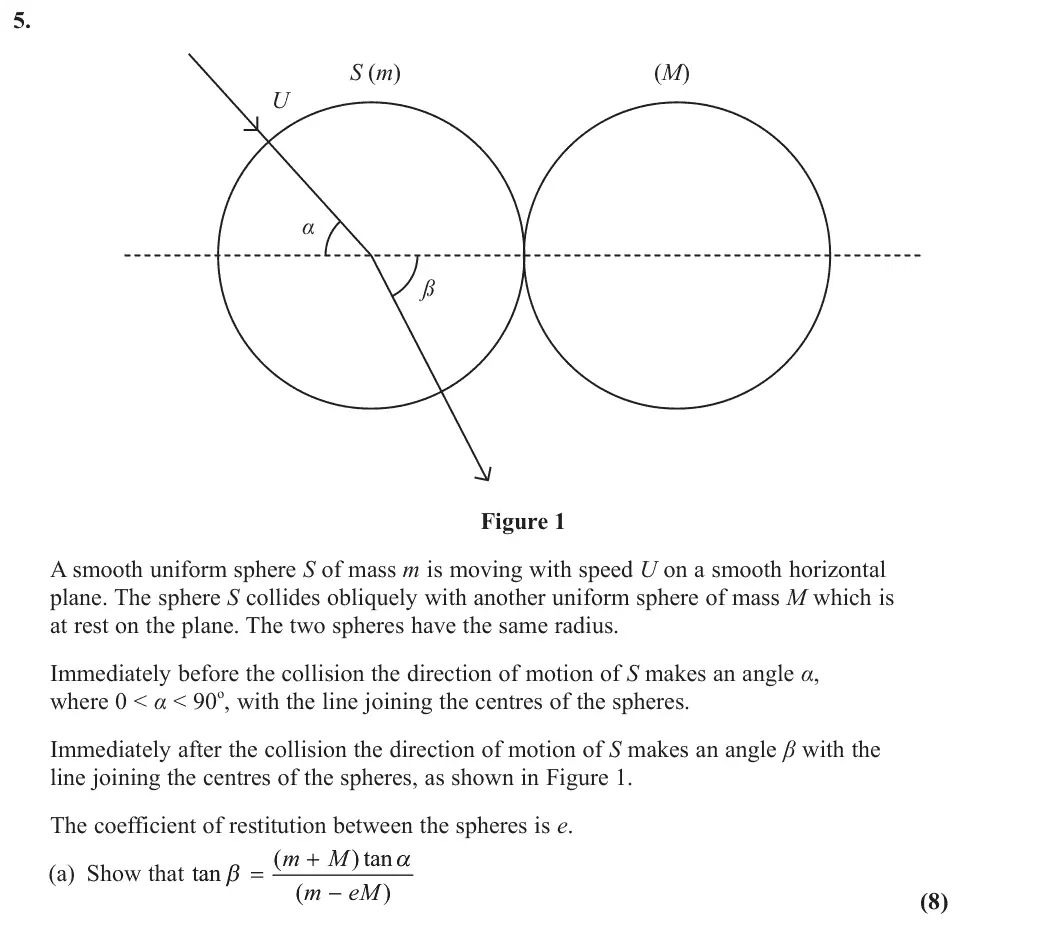
June 2023 · Paper 3C (Further Mechanics 1) · Q5(a)8 marks
Mark scheme (whole question; this part is marked with the orange bar)
Examiner's comment
This was a very successful question with the majority of candidates scoring highly and achieving most of the available marks. Part (a) was a ‘show that’ question worth a substantial 8 marks. The given answer enabled many candidates to correct sign errors and get themselves back onto the right track, improving their performance in this part. Most candidates recognised that the velocity component of S perpendicular to the line of centres remained unchanged. The equation for the conservation of linear momentum was often correct, although some candidates did not recognise immediately that the direction of motion of the second sphere would be parallel to the line of centres, and instead introduced a third angle. Newton’s Experimental Law was usually well-executed and sign errors were rare. However, it was surprising to see that some candidates additionally stated = the result tan tan e in their working. The relationship cannot be used in this scenario. The two subsequent method marks required substitution and algebraic manipulation. Whilst many candidates produced a neat, fluent response, others were chaotic and spread their solution across several pages with working that was very difficult to follow and mark. There were many examples of good exam technique in part (a) with candidates re-writing their final answer to match the printed answer exactly. Unfortunately, some candidates found the algebraic manipulation very cumbersome and after reaching the required result, did not check that it matched the printed answer exactly, earning 7 marks out of the 8 marks available. Those who abandoned part (a) rarely attempted part (b) despite all the necessary information = 90 being available. The most common approach to part (b) was identifying that , although
Key points from the mark scheme and examiner's report
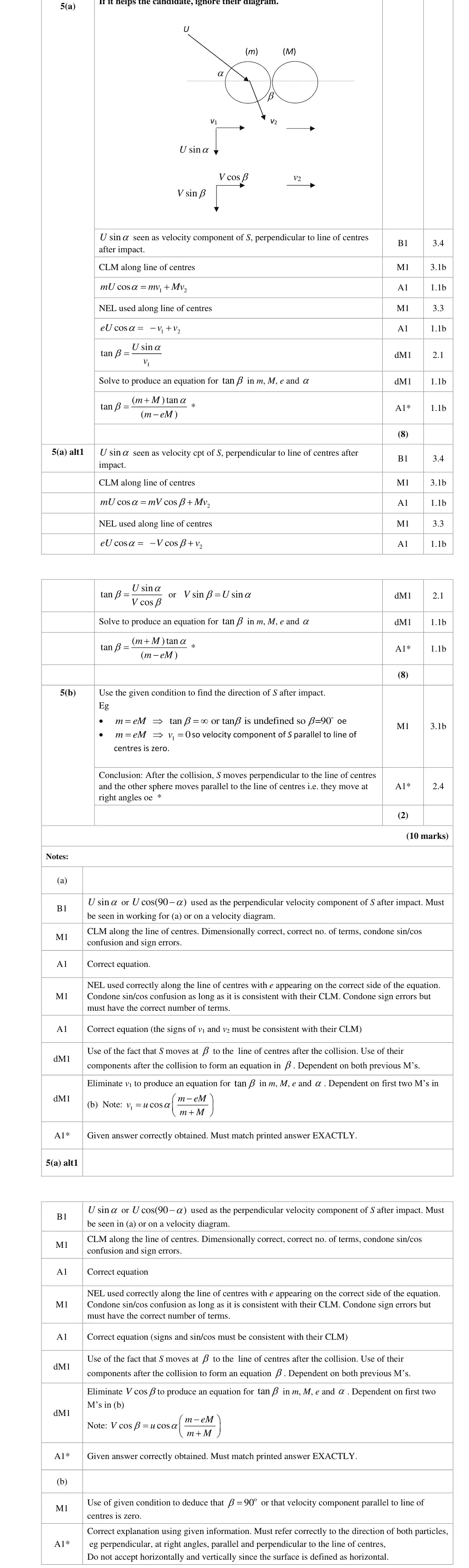
U sin α unchanged perpendicular to line of centres
CLM mU cos α = mv₁ + Mv₂ and NLR eU cos α = v₂ − v₁
tan β = U sin α / v₁
the second sphere moves along the line of centres (no new angle needed)
June 2023 · Paper 3C (Further Mechanics 1) · Q5(b)2 marks
Mark scheme (whole question; this part is marked with the orange bar)
Examiner's comment
This was a very successful question with the majority of candidates scoring highly and achieving most of the available marks. Those who abandoned part (a) rarely attempted part (b) despite all the necessary information = 90 being available. The most common approach to part (b) was identifying that , although some showed that the velocity component of S parallel to the line of centres was zero, which was equally valid. Requiring a sufficient explanation to reach the given conclusion, the final mark was awarded much less often. Many candidates gave no reasoning at all and simply stated ‘hence perpendicular’ without referring to the second sphere. Another common incorrect response arose when candidates described the motion of S as vertical and the motion of the other sphere as horizontal. This was not acceptable since both particles were already described in the question as moving across a horizontal surface.
Key points from the mark scheme and examiner's report
m = eM makes tan β undefined (β = 90°), i.e. v₁ = 0
S moves perpendicular to the line of centres and the other sphere along it, so perpendicular
must refer to both spheres
June 2023 · Paper 3C (Further Mechanics 1) · Q6(a)5 marks
Mark scheme (whole question; this part is marked with the orange bar)
Examiner's comment
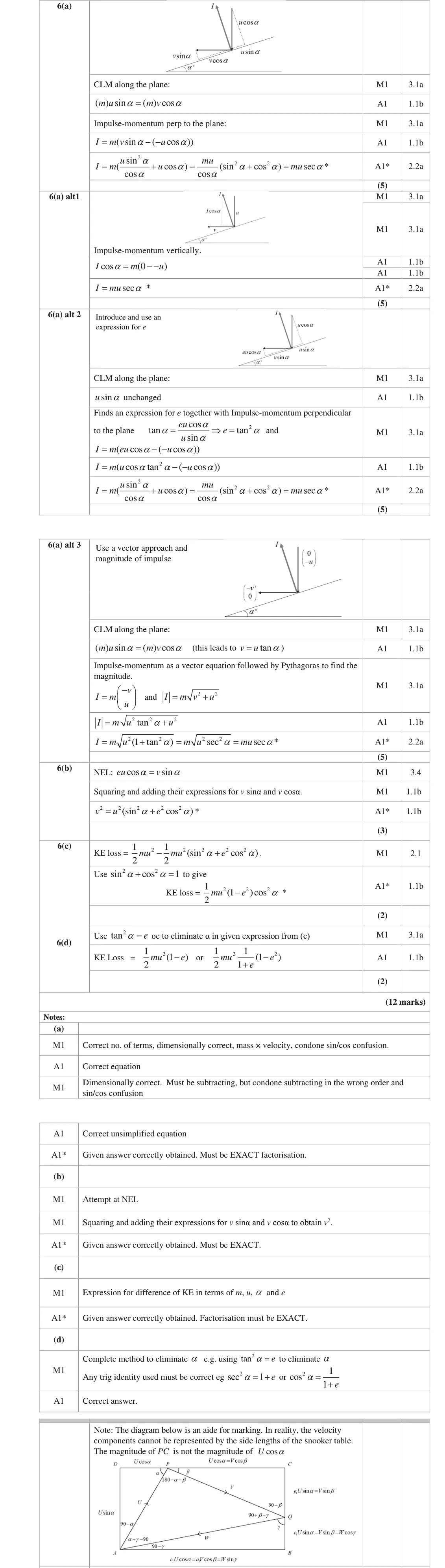
There were four parts to this question with parts (a), (b) and (c) all having given answers. Unfortunately, many candidates abandoned attempts at (d) or left it completely blank. Part (a) had at least four possible approaches and the presentation from candidates as they attempted to combine different pathways to reach the given answer was often poor. To make any progress, candidates needed to recognise that the angle between the final velocity and the slope was also alpha . Those who introduced a new angle rarely progressed to the given answer. The most common correct response was the main scheme followed by the vector alternative 3 approach. Some candidates took longer to reach the answer by introducing e but the intermediary result, 2 tan e = , gave them an advantage in part (d).
Key points from the mark scheme and examiner's report
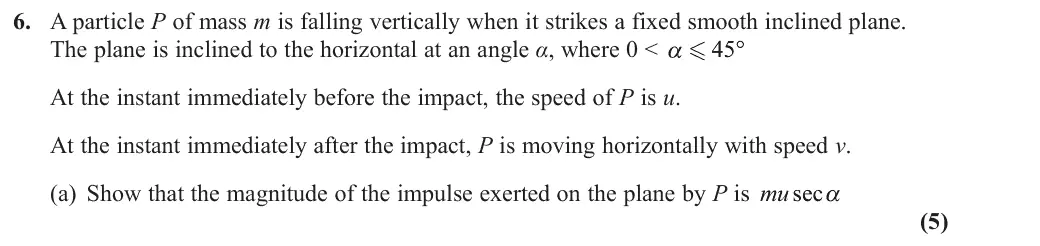
final velocity also makes angle α with the plane
component along the plane conserved: u sin α = v cos α
impulse perpendicular to plane m(v sin α + u cos α) = mu sec α
a new angle rarely led anywhere
June 2023 · Paper 3C (Further Mechanics 1) · Q6(b)3 marks
Mark scheme (whole question; this part is marked with the orange bar)
Examiner's comment
Part (b) was very well answered as candidates often had an expression for cos v and sin v already and combined them via a diagram or a trigonometric identity to reach the given answer.
Key points from the mark scheme and examiner's report
NLR eu cos α = v sin α
square and add with v cos α = u sin α
exact working required
June 2023 · Paper 3C (Further Mechanics 1) · Q6(c)2 marks
Mark scheme (whole question; this part is marked with the orange bar)
Examiner's comment
The given answer in part (c) could be reached very easily from part (b). The formula for Kinetic Energy was almost always stated correctly and even when the terms had been subtracted the wrong way round, candidates were able to rectify their solution due to the given answer.
Key points from the mark scheme and examiner's report
½mu² − ½mu²(sin²α + e² cos²α) = ½mu²(1 − e²)cos²α
June 2023 · Paper 3C (Further Mechanics 1) · Q6(d)2 marks
Mark scheme (whole question; this part is marked with the orange bar)
Examiner's comment
Part (d) was not answered well and discriminated between the grades. Candidates who understood the mechanics and also had strong Pure skills continued to perform well in the final part. In contrast, others had relied upon the scaffolding and given answers to guide their solutions and once this was removed were unable to answer part (d) at the same level.
Key points from the mark scheme and examiner's report
tan²α = e (from the two components) so cos²α = 1/(1 + e)
KE lost ½mu²(1 − e)
poorly answered, often blank
June 2022 · Paper 3C (Further Mechanics 1) · Q49 marks
Mark scheme (whole question; this part is marked with the orange bar)
Examiner's comment
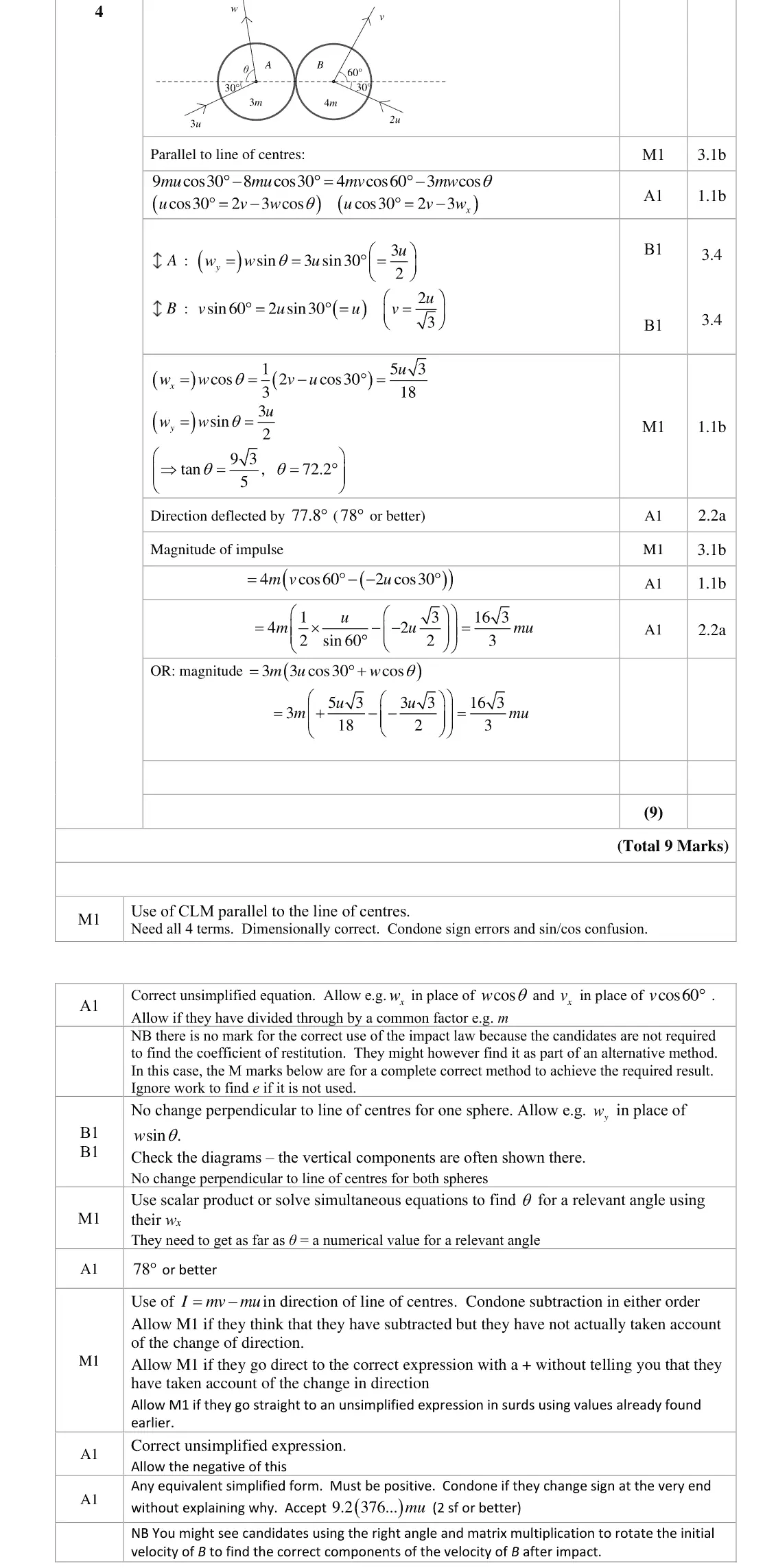
This question was accessible to all candidates, with virtually no blank responses. The candidates who were most successful started with a clearly labelled diagram. marking angles appropriately, and in particular assigning directions to velocities. Those who assigned a negative component to the velocity of A parallel to the line of centres after impact were more successful. Realising that the component of velocity perpendicular to the line of centres was unchanged for each mass was key to reaching a successful solution. Many marked this on their diagram. Most candidates understood that Conservation of Momentum parallel to line of centres should be used. There were few sign errors. A few candidates attempted to use the impact law, but that was not needed in this case. Those candidates who used vectors to represent the velocities and used the scalar product usually obtained the correct angle. Candidates who considered the components of the velocity often found a relevant angle, but they did not always use that correctly to find the required angle: the incorrect answer 102.2 was very common. Despite a large number of sign errors, many candidates did obtain the correct exact value for the magnitude of the impulse.
Key points from the mark scheme and examiner's report
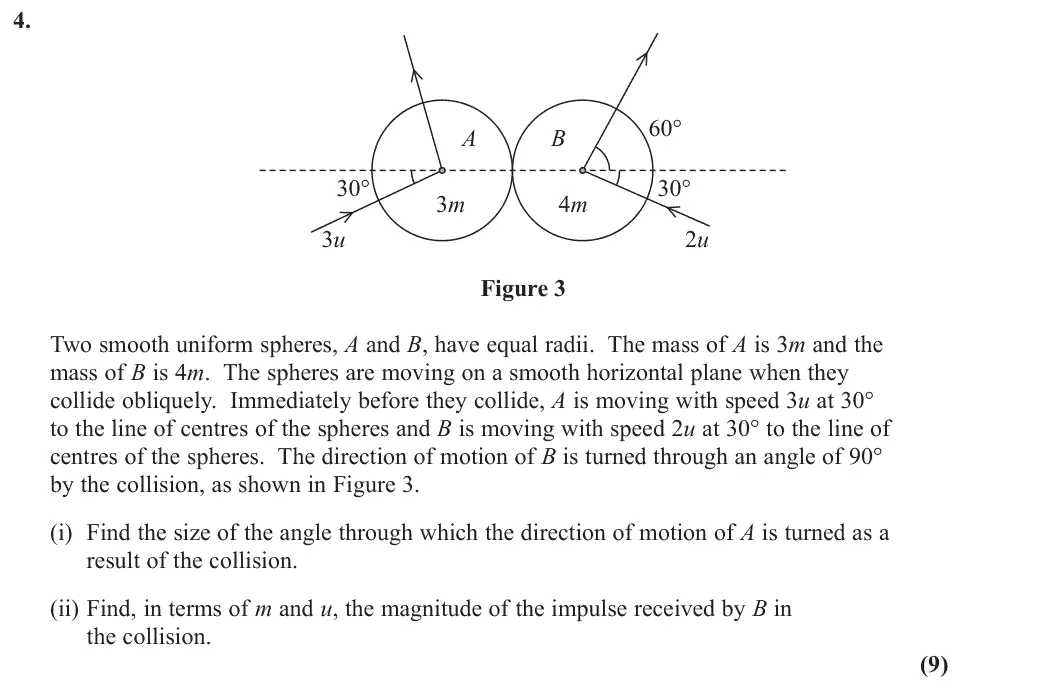
perpendicular components unchanged
B turned 90° gives v = 2u/√3
CLM along the line of centres (no impact law needed)
A deflected 77.8°
impulse on B 16√3mu/3 = 9.24mu (positive)
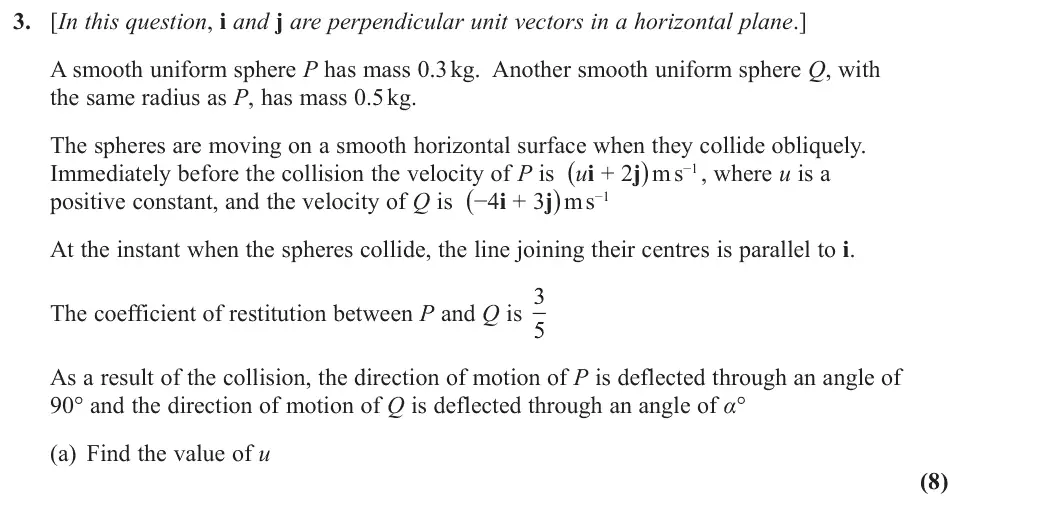
Nov 2021 · Paper 3C (Further Mechanics 1) · Q3(a)8 marks
Mark scheme (whole question; this part is marked with the orange bar)
Examiner's comment
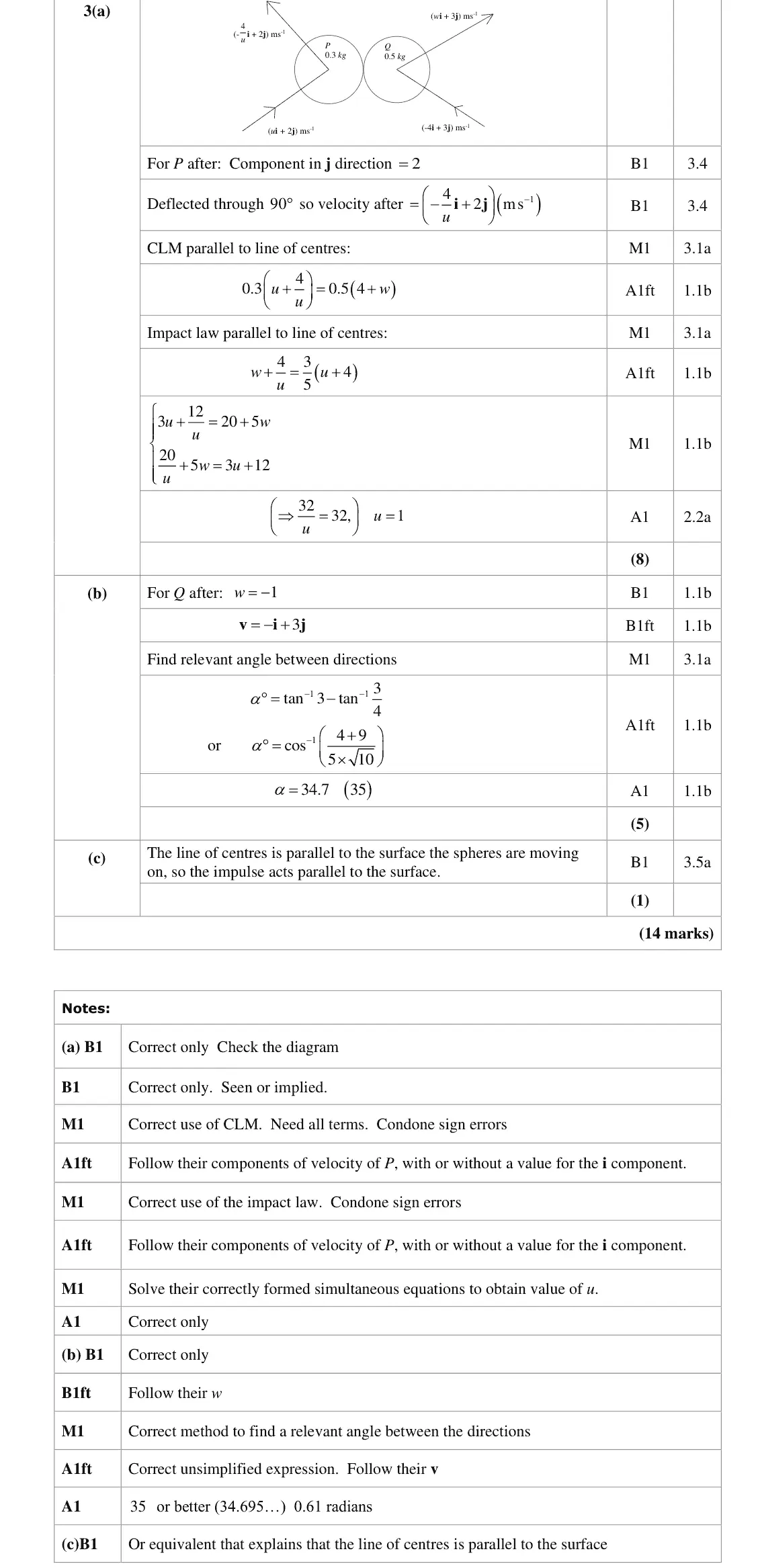
(a) Many candidates started by drawing a diagram and were able to use it to show the correct components of the velocities in the direction of j after the impact. Those candidates who were confident working with vectors were usually able to set up the equations for conservation of momentum and Newton’s Experimental Law parallel to the line of centres. The inclusion of the components perpendicular to the line of centres in these equations was a common error. Very few candidates made efficient use of the information given about the angle of deflection: most worked through with an unknown component and then used trigonometry rather than simply writing down the velocity of P 4 after the collision as i j 1 2 ms . - - + u
Key points from the mark scheme and examiner's report
j components unchanged
90° deflection gives v_P = −(4/u)i + 2j directly
CLM and NLR along i only: 32/u = 32, u = 1
including perpendicular components in CLM was a common error
Nov 2021 · Paper 3C (Further Mechanics 1) · Q3(b)5 marks
Mark scheme (whole question; this part is marked with the orange bar)
Examiner's comment
(b) For candidates who found a velocity vector, the most common approach to finding the angle was using the scalar product. Candidates who used this technique were able to find their angle correctly. Those candidates who used trigonometry to find the angle between the two velocities often made errors in combining the angles correctly.
Key points from the mark scheme and examiner's report
w = −1 so v_Q = −i + 3j
angle between −4i + 3j and −i + 3j: α = 34.7
scalar product most reliable, combining trig angles caused errors
Nov 2021 · Paper 3C (Further Mechanics 1) · Q3(c)1 mark
Mark scheme (whole question; this part is marked with the orange bar)
Examiner's comment
(c) It was very rare to see a correct answer to part (c) with many candidates referring to j-components when they should have referred to components parallel and perpendicular to the surface.
Key points from the mark scheme and examiner's report
equal radii mean the line of centres is parallel to the surface, so the impulse acts parallel to the surface
very rarely answered correctly (references to j components not accepted)
Nov 2021 · Paper 3C (Further Mechanics 1) · Q5(a)5 marks
Mark scheme (whole question; this part is marked with the orange bar)
Examiner's comment
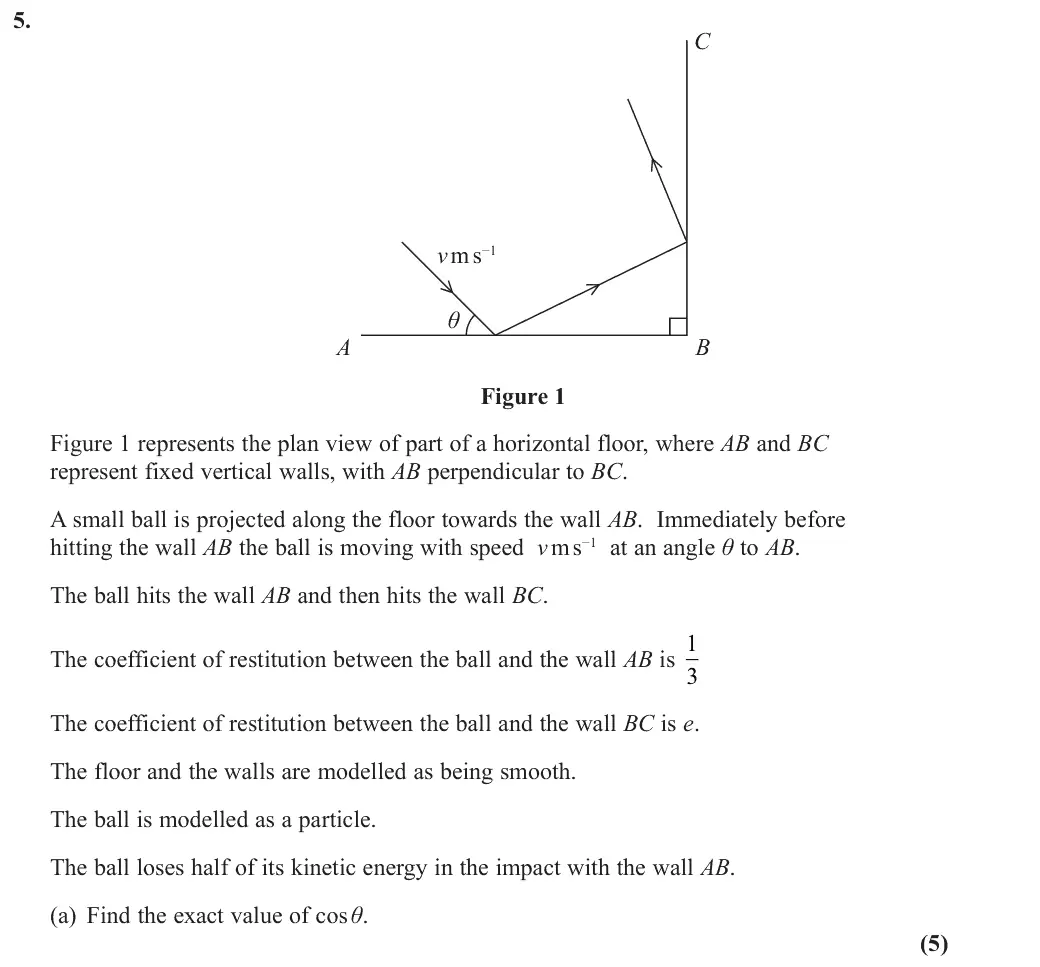
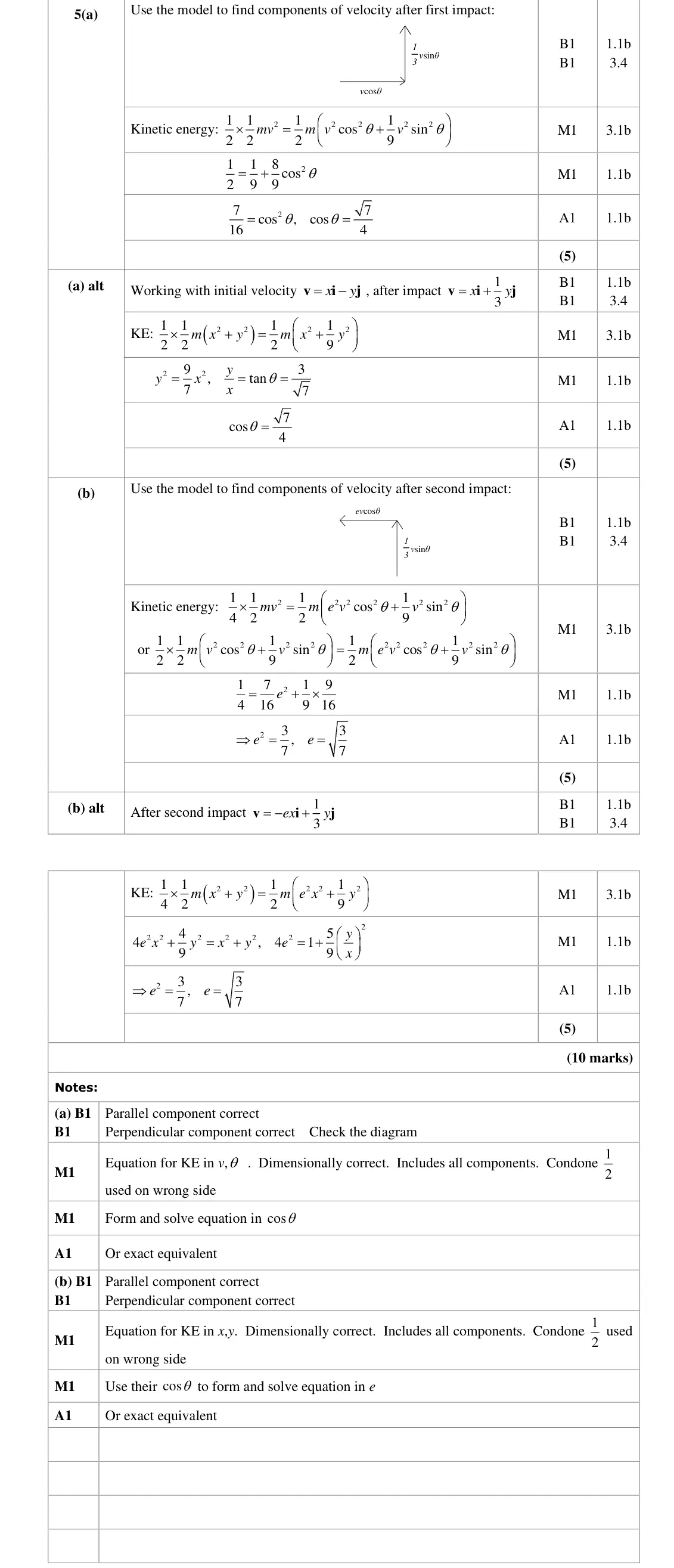
(a) Those candidates who started by giving the components of the velocity after the impact with AB in terms of v and theta were noticeably more successful than those who introduced a new speed and a new angle. Some candidates started by introducing unit vectors parallel and perpendicular to AB and working with an initial velocity j v i : x y = - if worked through correctly this was very efficient and effective.
Key points from the mark scheme and examiner's report
after AB: v cos θ and (1/3)v sin θ
half KE lost: 1/2 = 1/9 + (8/9)cos²θ, cos θ = √7/4
introducing a new speed and angle made it harder
Nov 2021 · Paper 3C (Further Mechanics 1) · Q7(a)6 marks
Mark scheme (whole question; this part is marked with the orange bar)
Examiner's comment
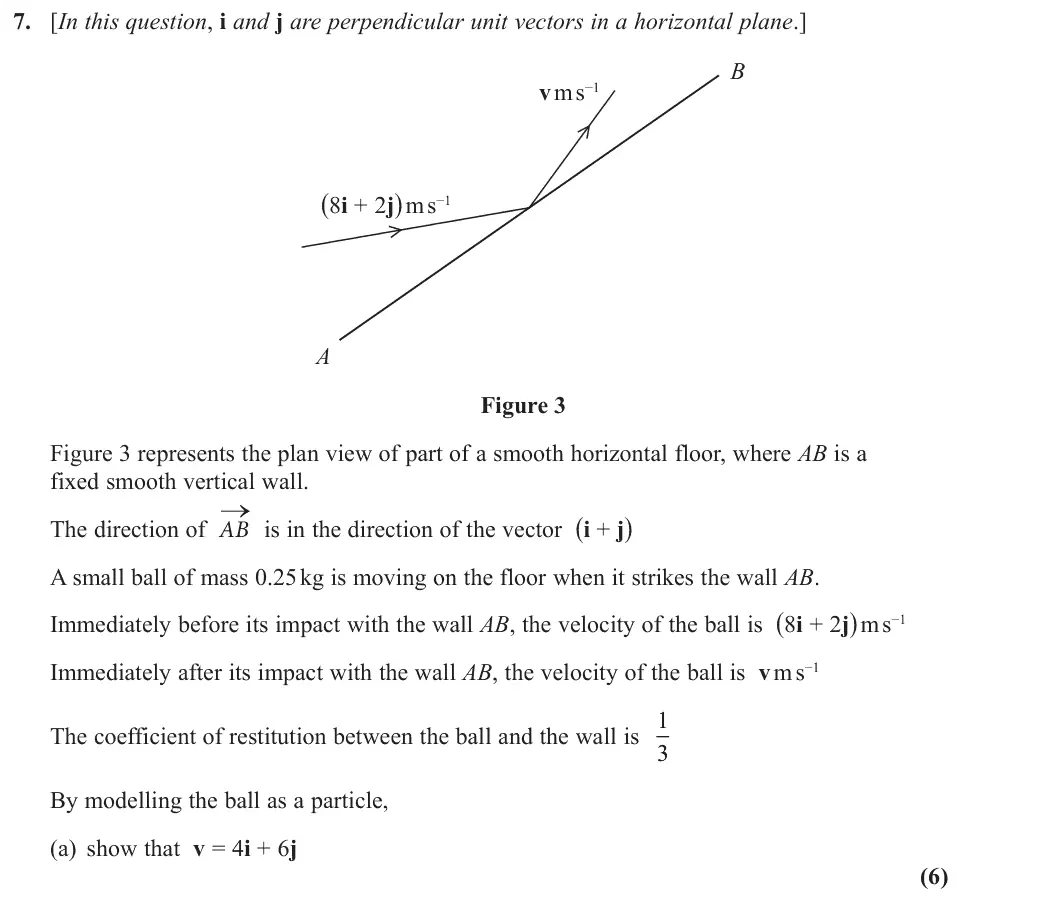
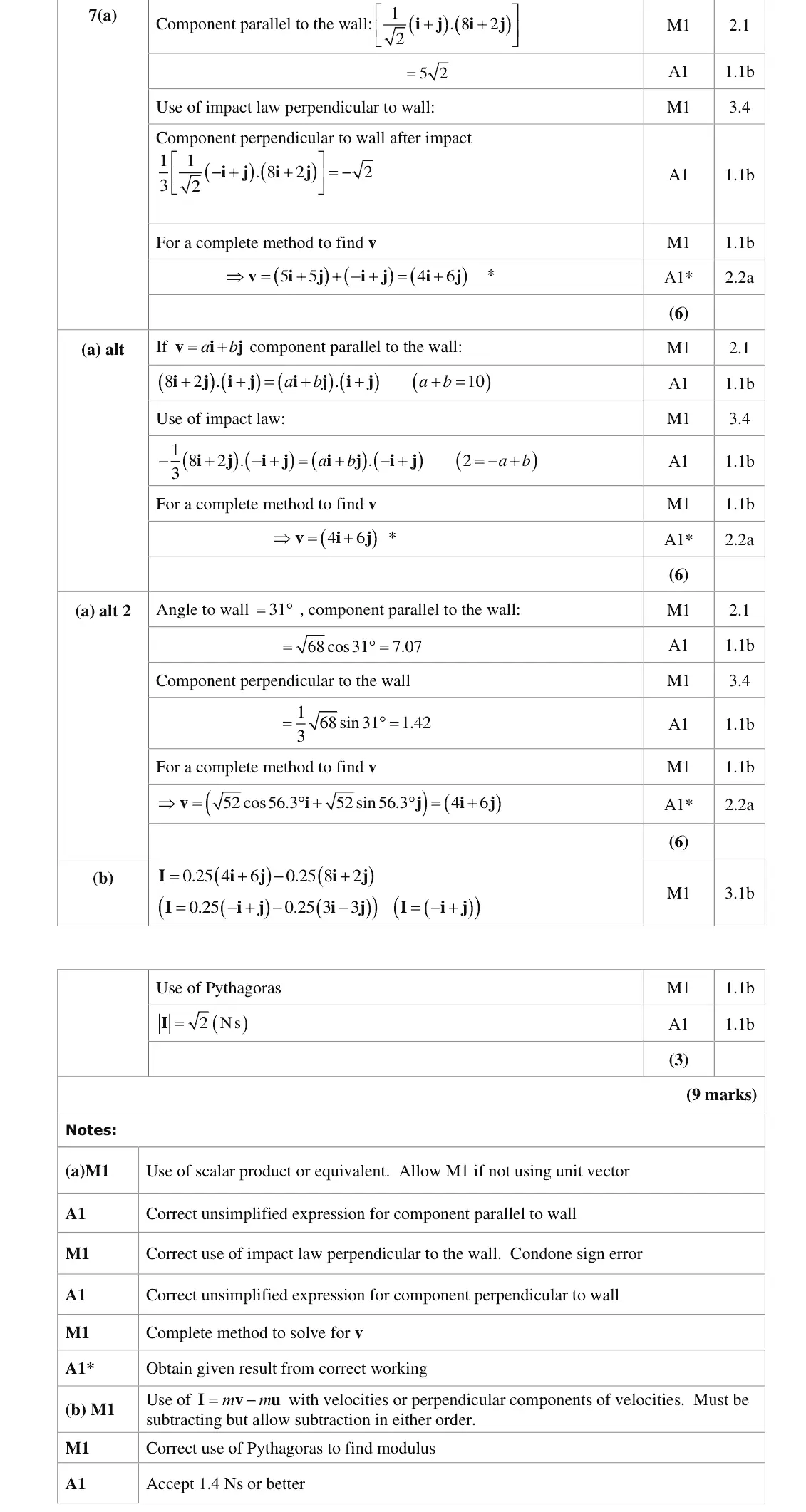
(a) Some candidates made good use of the scalar product to find the components of the velocities parallel and perpendicular to the wall. Those candidates who preferred to work in terms of speeds and angles often made rounding errors in calculator work and did not reach the exact answer required. Rather than work through in terms of impact with an oblique surface, one candidate used matrices to rotate the problem 45° clockwise at the start of their solution and then 45° anticlockwise to finish. The given answer did not assist those candidates who did not know how to approach the problem. (b) Many candidates used the given result from part (a) to score full marks for finding the magnitude of the impulse.
Key points from the mark scheme and examiner's report
scalar product with unit vectors along (i + j) and (−i + j): parallel component 5√2 unchanged, perpendicular −√2 after e = 1/3
v = 4i + 6j
speeds and angles led to rounding errors
Nov 2021 · Paper 3C (Further Mechanics 1) · Q7(b)3 marks
Mark scheme (whole question; this part is marked with the orange bar)
Examiner's comment
(b) Many candidates used the given result from part (a) to score full marks for finding the magnitude of the impulse.
Key points from the mark scheme and examiner's report
I = 0.25((4i + 6j) − (8i + 2j)) = −i + j
magnitude √2 = 1.41 N s
Oct 2020 · Paper 3C (Further Mechanics 1) · Q4(a)4 marks
Mark scheme (whole question; this part is marked with the orange bar)
Examiner's comment
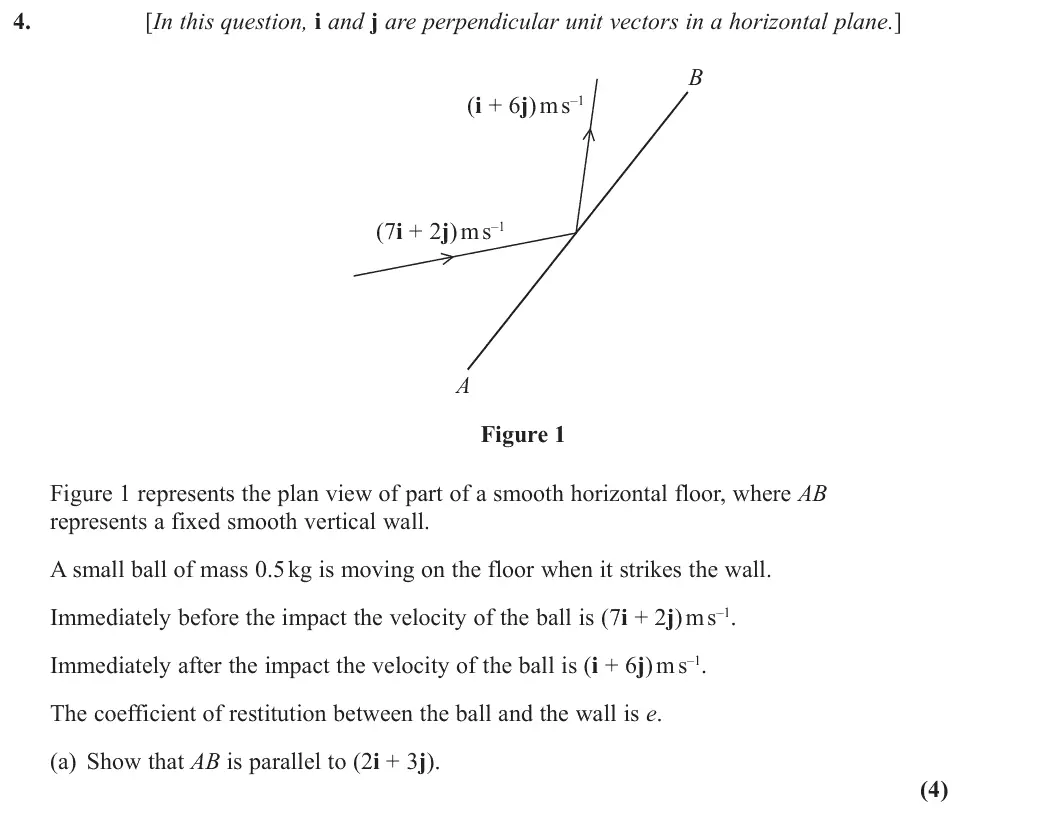
(a) There are several ways to tackle this question, some more succinct than others. The simplest approach is to find the impulse acting on the ball and then form the scalar product with 2 3 + i j to show that the impulse is perpendicular to 2 3 . + i j Several candidates spent time and effort trying to find angles and components of the initial and final velocity; some of these methods were successful.
Key points from the mark scheme and examiner's report
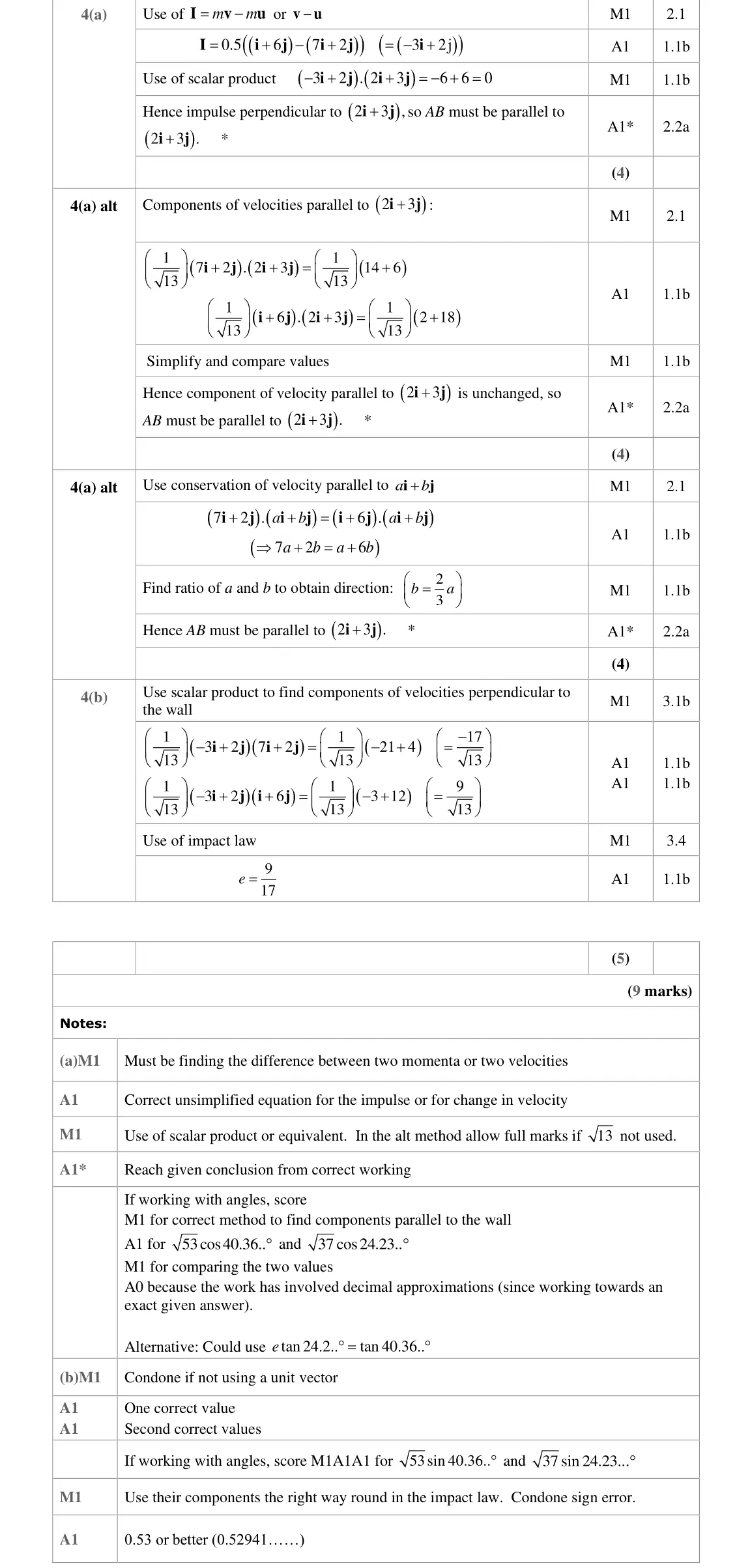
impulse 0.5(−6i + 4j) is perpendicular to the wall
(−3i + 2j).(2i + 3j) = 0 so AB parallel to 2i + 3j
or equal velocity components parallel to 2i + 3j
working with decimal angles loses the final mark
Oct 2020 · Paper 3C (Further Mechanics 1) · Q4(b)5 marks
Mark scheme (whole question; this part is marked with the orange bar)
Examiner's comment
(b) In this part the candidates need to consider the components of the velocity perpendicular to the wall. Use of the scalar product gives a simple and accurate way of solving the problem, but those candidates who had found the correct angles in part (a) were able to use their answers here. Candidates using the angles were more likely to make accuracy errors due to premature approximation.
Key points from the mark scheme and examiner's report
perpendicular components −17/√13 and 9/√13 by scalar product with the unit vector along −3i + 2j
e = 9/17 = 0.529
premature approximation of angles common
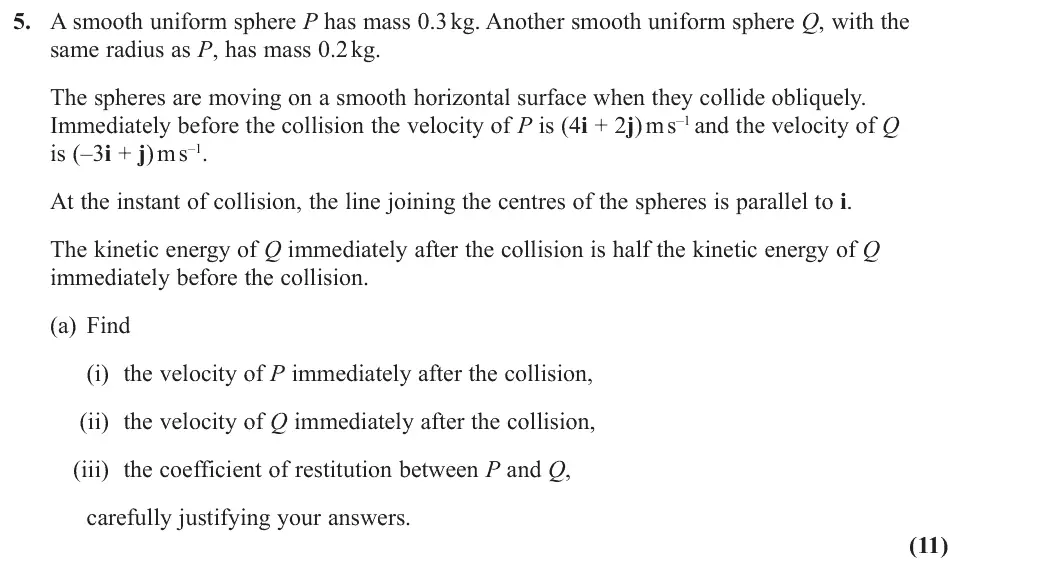
Oct 2020 · Paper 3C (Further Mechanics 1) · Q5(a)11 marks
Mark scheme (whole question; this part is marked with the orange bar)
Examiner's comment
(a) Those candidates who started with a diagram with the correct line of centres clearly marked were most likely to reach correct conclusions. Many candidates did form correct equations for conservation of momentum and for the impact law working parallel to the line of centres, but there were several candidates who wrote down equations in two dimensions. Some candidates wrote down an equation for the combined kinetic energy of P and Q, but the information given relates only to Q. The simplest way to solve the resulting simultaneous equations is to use the kinetic energy equation to find the velocity of Q and then use the other two equations. Candidates who started by finding the components of the speeds of P and Q in terms of e had more complicated algebra to deal with. The reason for the question asking the candidates to "carefully justify" their answers is that there are two possible solutions to the equations, one of which is not possible. In order to gain the final mark, the candidates needed to say why the second solution was not possible - very few candidates scored this mark.
Key points from the mark scheme and examiner's report
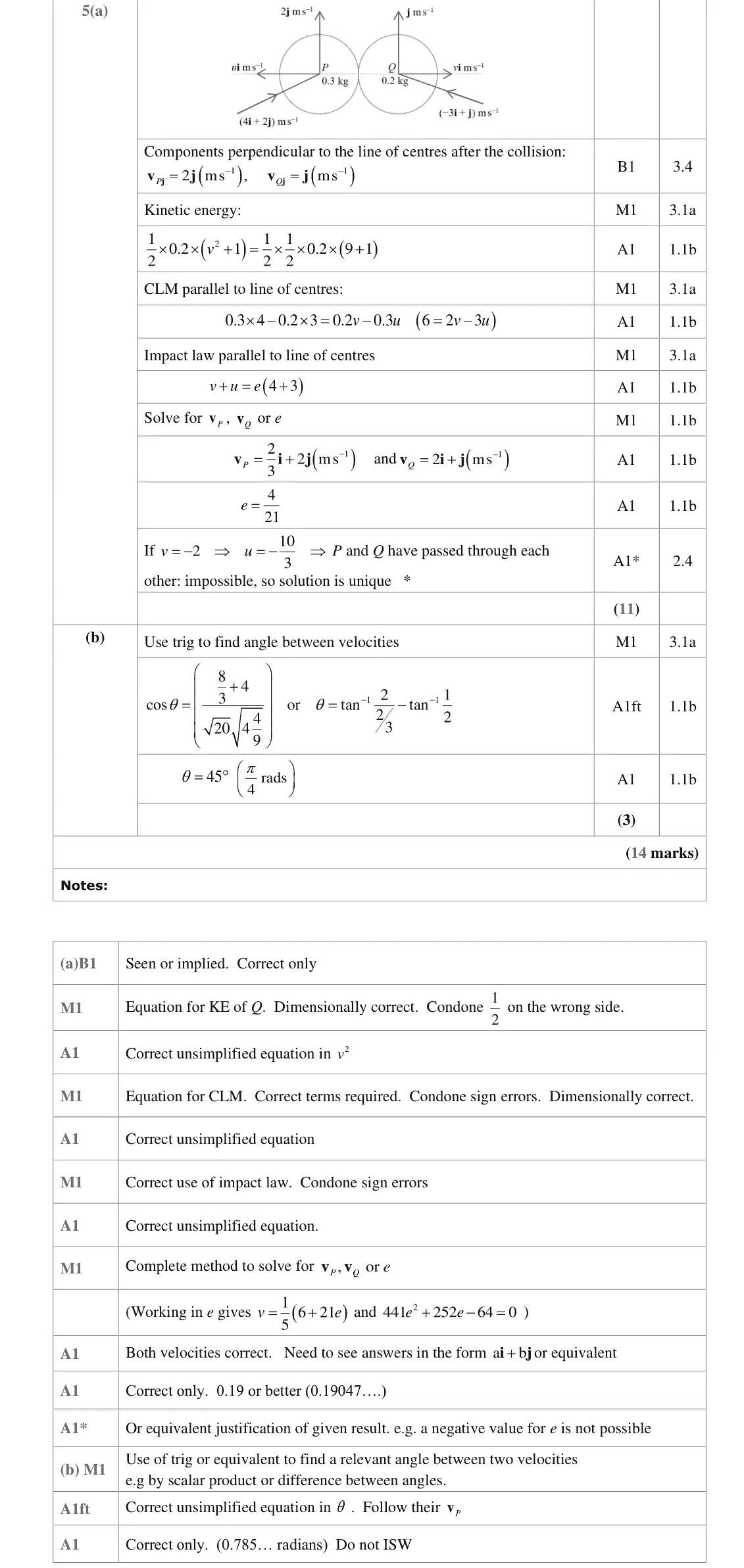
j components unchanged
KE of Q gives v² = 4 (KE of Q only, not both)
CLM and NLR along i: v_P = (2/3)i + 2j, v_Q = 2i + j, e = 4/21
reject v = −2 (particles would pass through each other)
some wrote 2-D equations
Oct 2020 · Paper 3C (Further Mechanics 1) · Q5(b)3 marks
Mark scheme (whole question; this part is marked with the orange bar)
Examiner's comment
(b) Most candidates did attempt to find the angle between the velocity of P before the collision and the velocity of P after the collision. Working in vectors was the simplest approach but not the only possible approach.
Key points from the mark scheme and examiner's report
scalar product of 4i + 2j and (2/3)i + 2j, or difference of angles: 45°
vectors simplest
Oct 2020 · Paper 3C (Further Mechanics 1) · Q7(b)4 marks
Mark scheme (whole question; this part is marked with the orange bar)
Examiner's comment
(b) The majority of the errors in this part of the question were in the processing of the arithmetic: most candidates were able to form an expression for the kinetic energy lost and to express this as a percentage of the initial kinetic energy of the ball.
Key points from the mark scheme and examiner's report
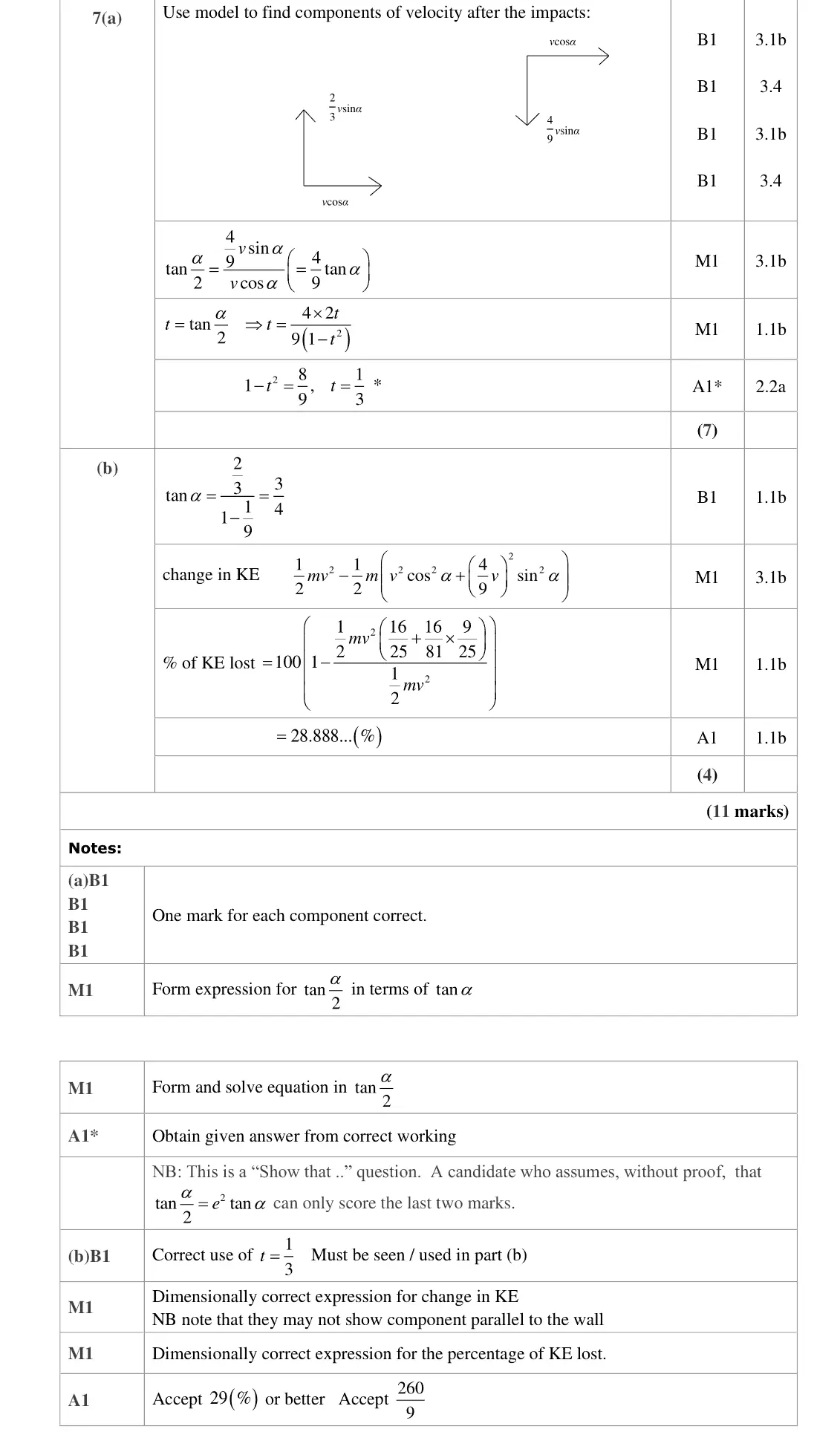
tan α = 3/4 from t = 1/3
final KE ½m v²(16/25 + (16/81)(9/25))
28.9% (260/9) of KE lost
arithmetic slips
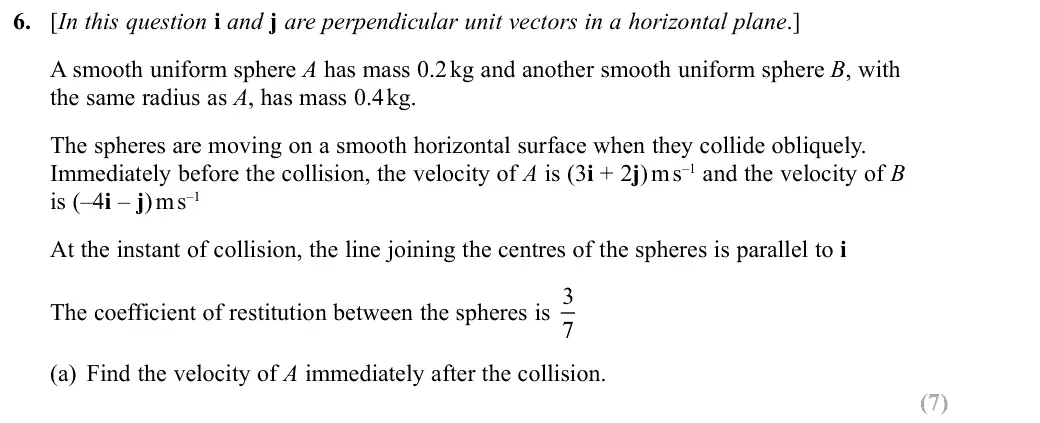
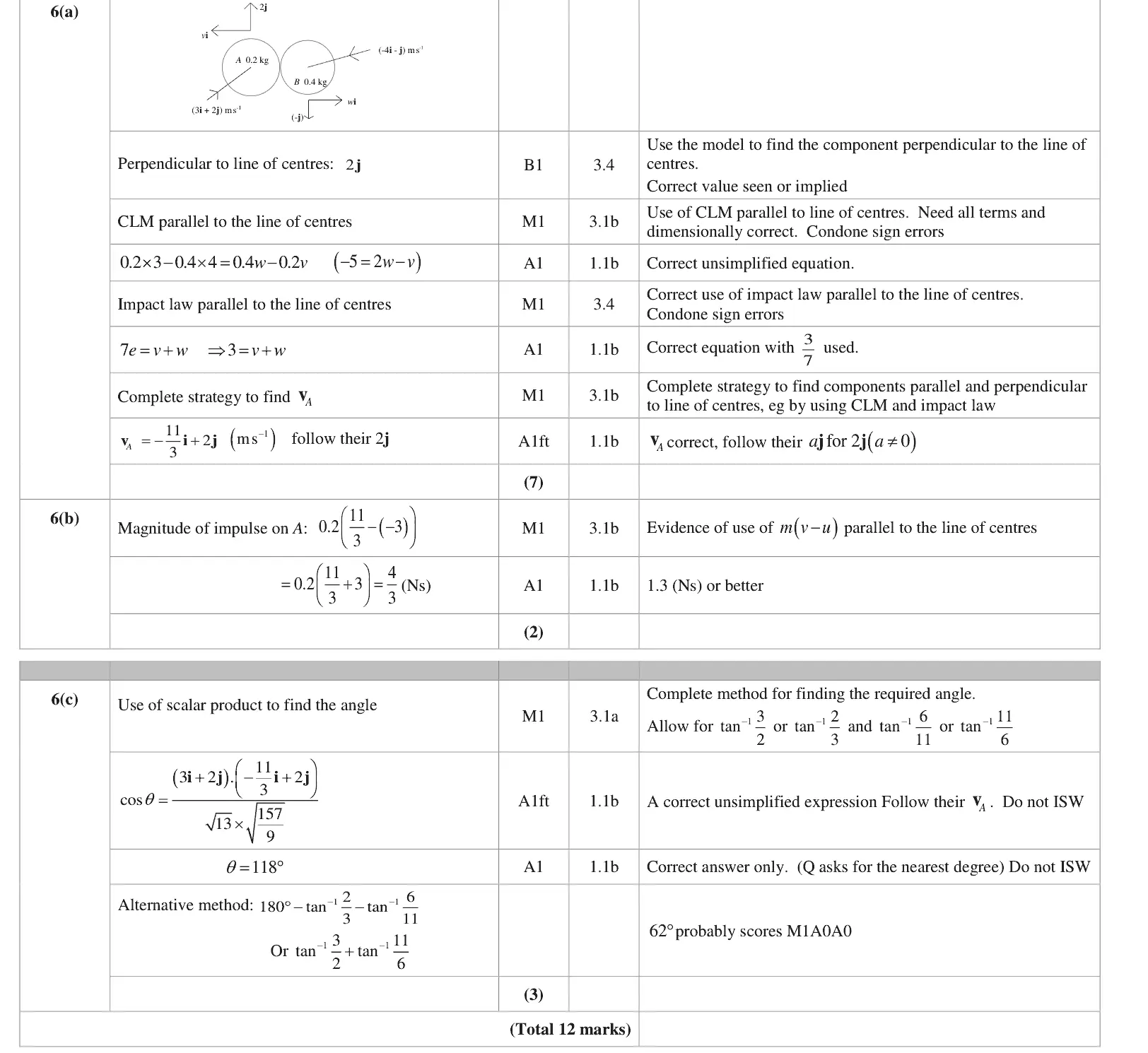
June 2019 · Paper 3C (Further Mechanics 1) · Q6(a)7 marks
Mark scheme (whole question; this part is marked with the orange bar)
Examiner's comment
(a) Many candidates had clearly seen questions like this as part of their preparation for the exam, and they gave clear, confident responses. The question asks for the velocity of A. Several candidates found the speed without ever stating the velocity, and did not state the direction of motion. The final answer 11 2 3 A v i j was quite common when candidates had all the correct working but did not take account of directions. A minority of candidates made the working unnecessarily complicated by working with speeds and angles. A small number of candidates worked with the line of centres of the spheres parallel to j.
Key points from the mark scheme and examiner's report
j component unchanged (2j)
CLM and NLR parallel to i: v_A = −(11/3)i + 2j m s⁻¹
must give the velocity, not just speed
(11/3)i + 2j from ignoring directions was common
June 2019 · Paper 3C (Further Mechanics 1) · Q6(b)2 marks
Mark scheme (whole question; this part is marked with the orange bar)
Examiner's comment
(b) Those candidates who worked with the velocities in vector form usually obtained the correct value for the magnitude of the impulse. The most common errors were due to working with speeds, or not giving the final answer as a positive number.
Key points from the mark scheme and examiner's report
impulse along the line of centres only: 0.2(11/3 + 3) = 4/3 N s
errors from working with speeds or giving a negative magnitude
June 2019 · Paper 3C (Further Mechanics 1) · Q6(c)3 marks
Mark scheme (whole question; this part is marked with the orange bar)
Examiner's comment
(c) Those candidates who worked with the scalar product usually obtained the correct answer, although some mistakenly thought they were looking for an acute angle and therefore used cos . Candidates working with a diagram had a clear advantage if they were using trigonometry to find the change in the two directions - the incorrect answer 62 was quite common.
Key points from the mark scheme and examiner's report
scalar product of (3i + 2j) and the new velocity: 118°
62° (acute angle) common and scores M1 only
Find an Edexcel Further Maths tutor
Stuck on this? Book a trial lesson with our Further Maths tutor.