FP2.1.1 The Axioms of a group.

Section
FP2.1 Groups
Level
AS & A level
Statement
The Axioms of a group.
Guidance
The terms ‘binary operation, closure, associativity, identity and inverse’.
Since 2018
19 parts, 48 marks · topic pages: Groups: axioms, Cayley tables, subgroups, Lagrange and isomorphism

Back to the checklist

June 2025 · AS Paper 2 (Further Pure 2) · Q2(ii)(b) 1 mark
(b) State the inverse of the element 7 (1)
June 2024 · AS Paper 2 (Further Pure 2) · Q1(i)(a) 1 mark
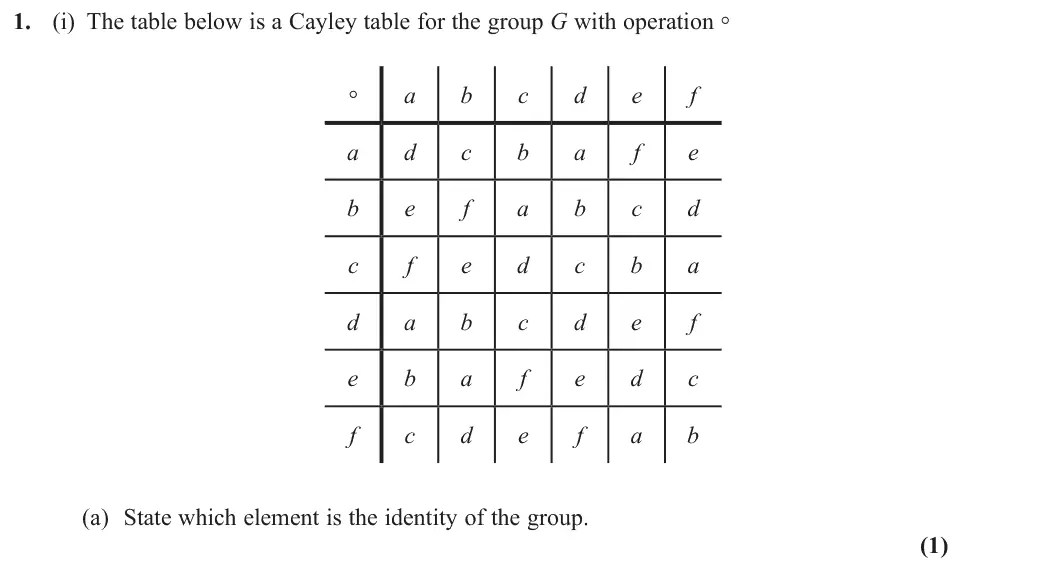
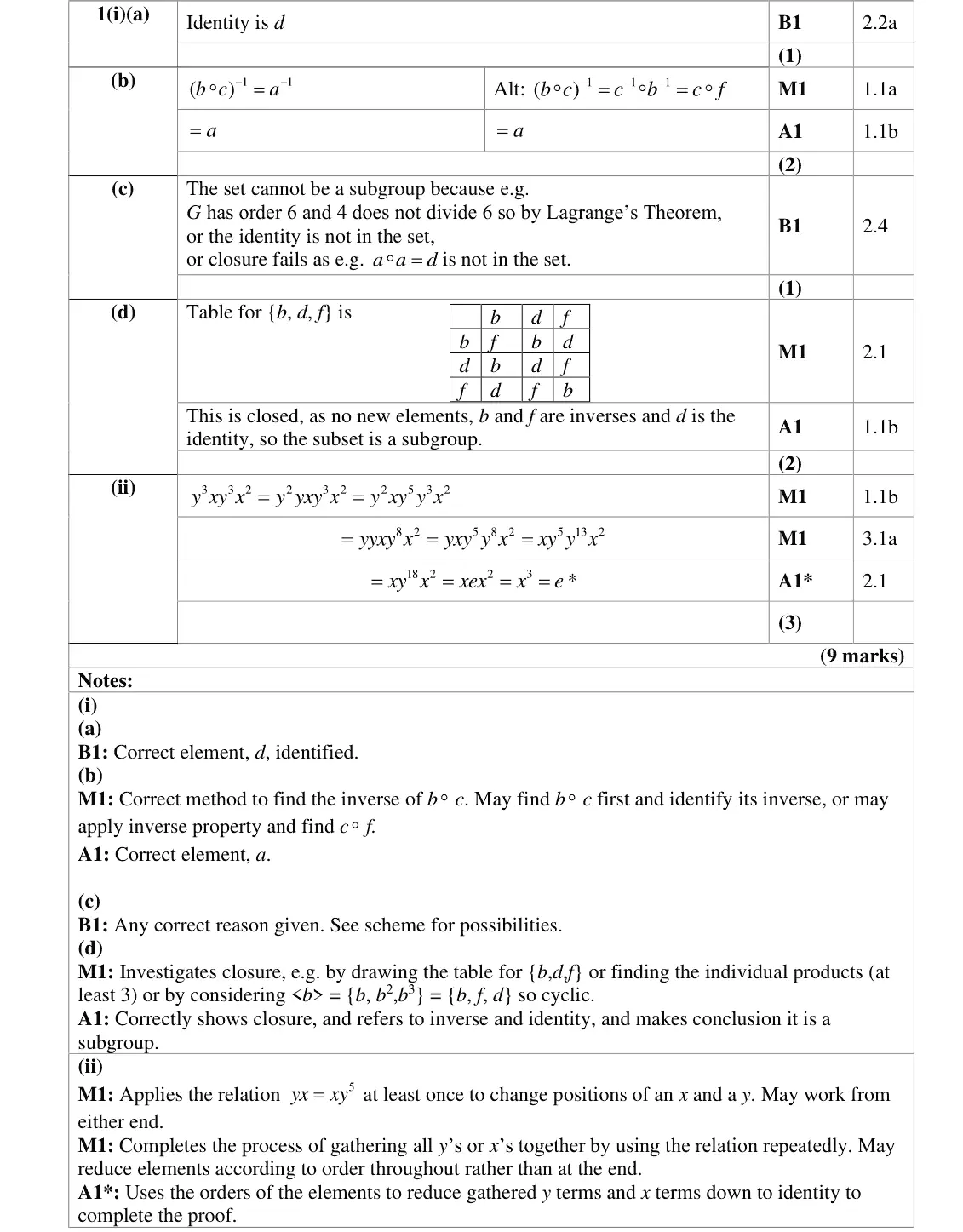
1. (i) The table below is a Cayley table for the group G with operation ° a b c d e f ° a d c b a f e b e f a b c d c f e d c b a d a b c d e f e b a f e d c f c d e f a b (a) State which element is the identity of the group. (1)
June 2024 · AS Paper 2 (Further Pure 2) · Q1(i)(b) 2 marks
(b) Determine the inverse of the element (b°c) (2)
June 2024 · AS Paper 2 (Further Pure 2) · Q1(ii) 3 marks
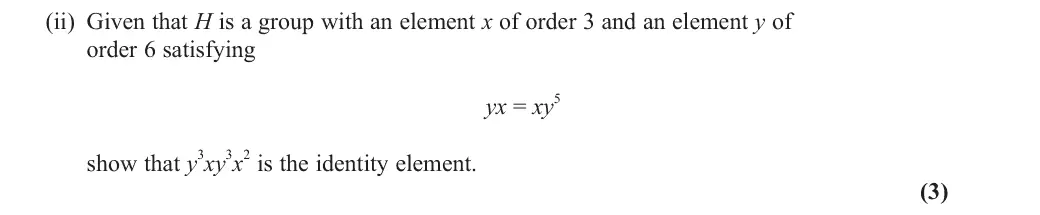
(ii) Given that H is a group with an element x of order 3 and an element y of order 6 satisfying yx = xy 3xy 3x 2 is the identity element. show that y (3)
June 2023 · AS Paper 2 (Further Pure 2) · Q1(b) 3 marks
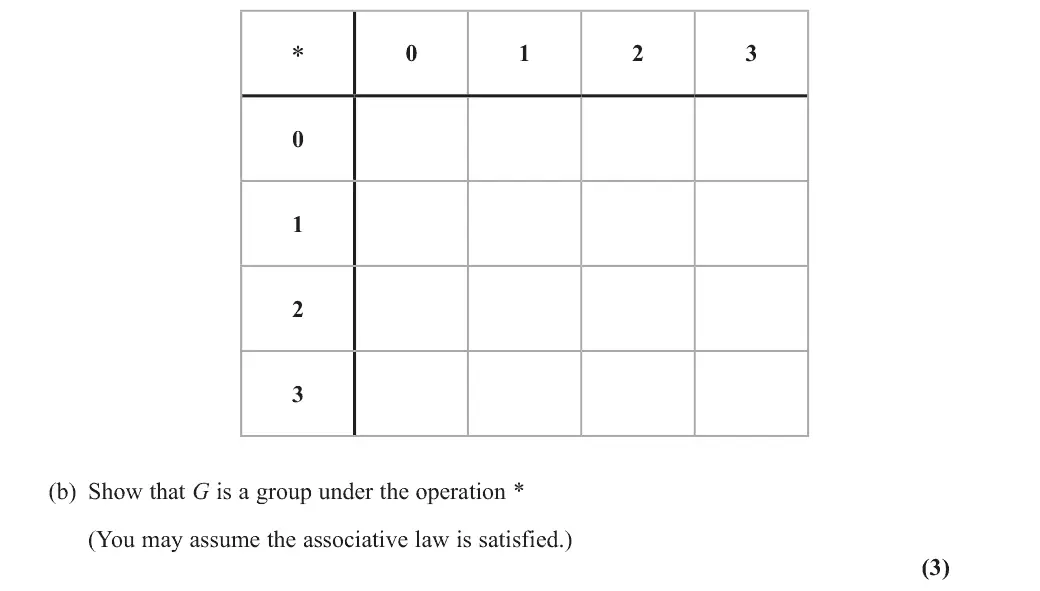
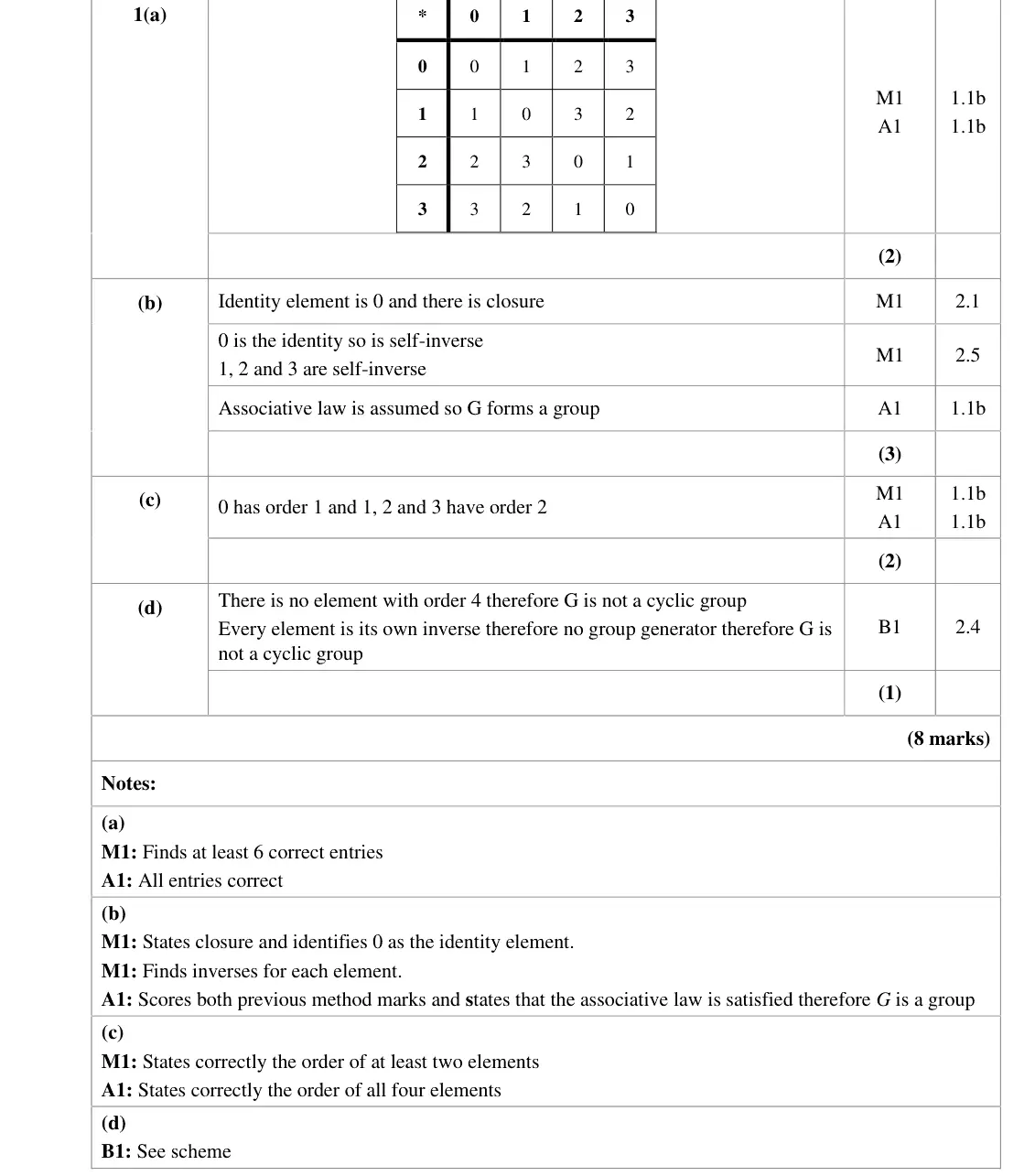
* (b) Show that G is a group under the operation * (You may assume the associative law is satisfied.) (3)
June 2023 · Paper 4A (Further Pure 2) · Q7(a) 2 marks
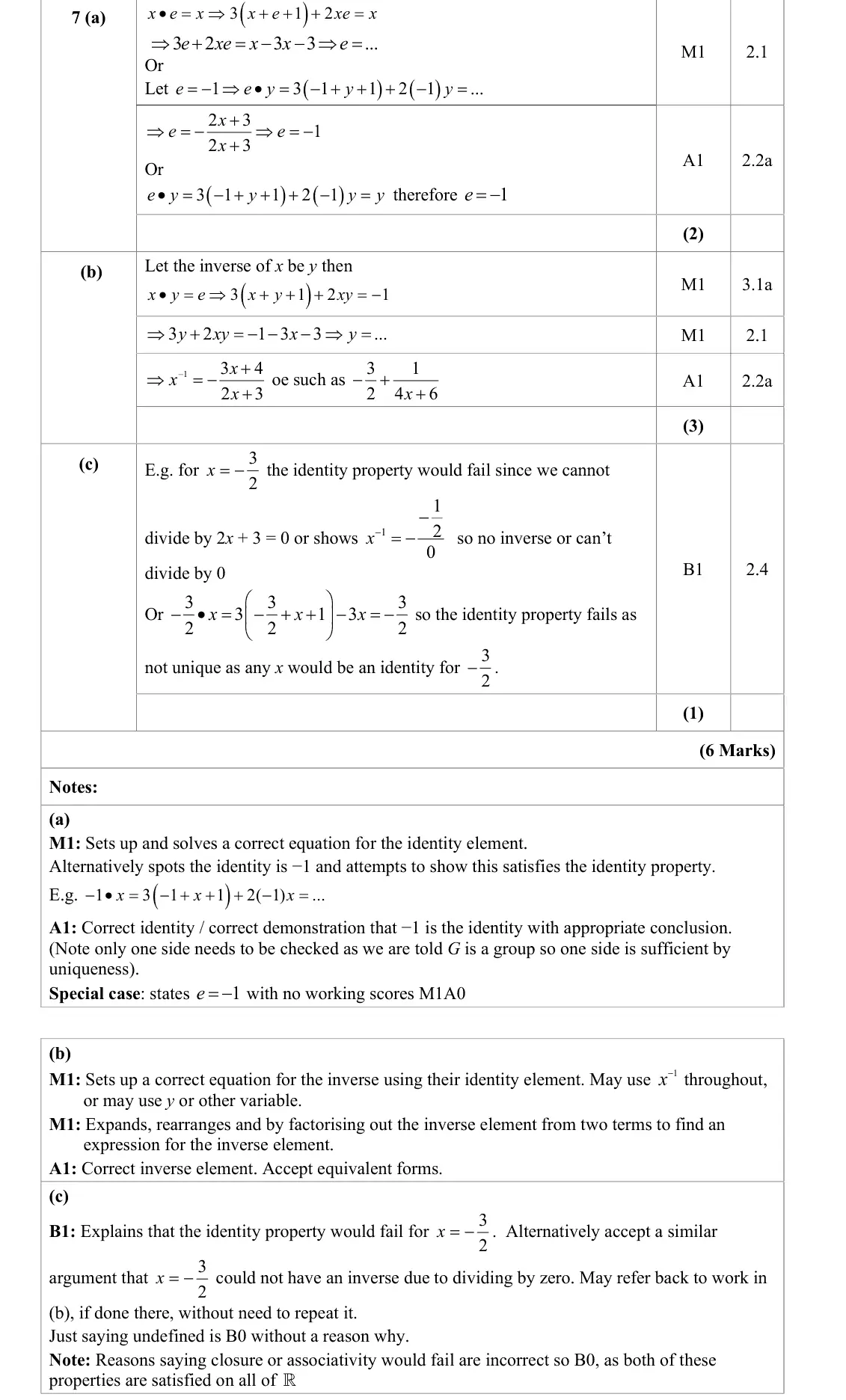
/ 1 7. The set G 2 with the operation of x < y x y xy forms a group. < (a) Determine the identity element of this group. (2)
June 2023 · Paper 4A (Further Pure 2) · Q7(b) 3 marks
(b) Determine the inverse of a general element x in this group. (3)
June 2023 · Paper 4A (Further Pure 2) · Q7(c) 1 mark
(c) Explain why the value -3 must be excluded from G in order for this to be a group. (1)
June 2022 · AS Paper 2 (Further Pure 2) · Q3(ii) 6 marks
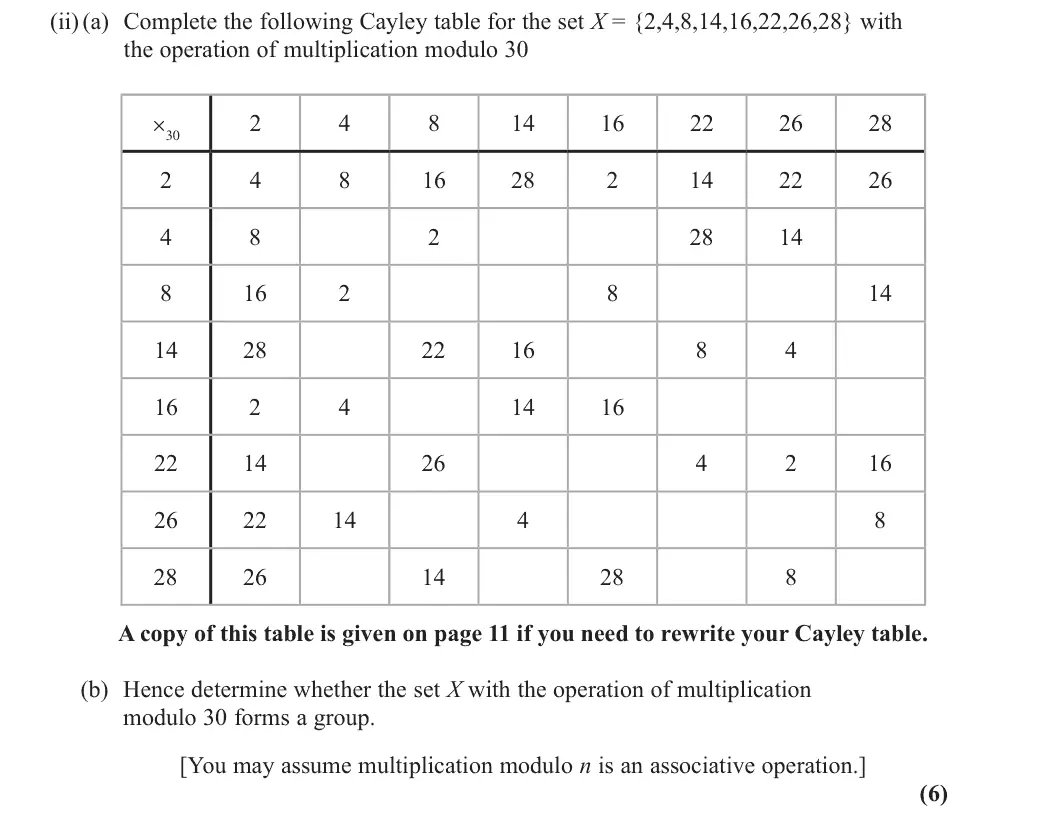
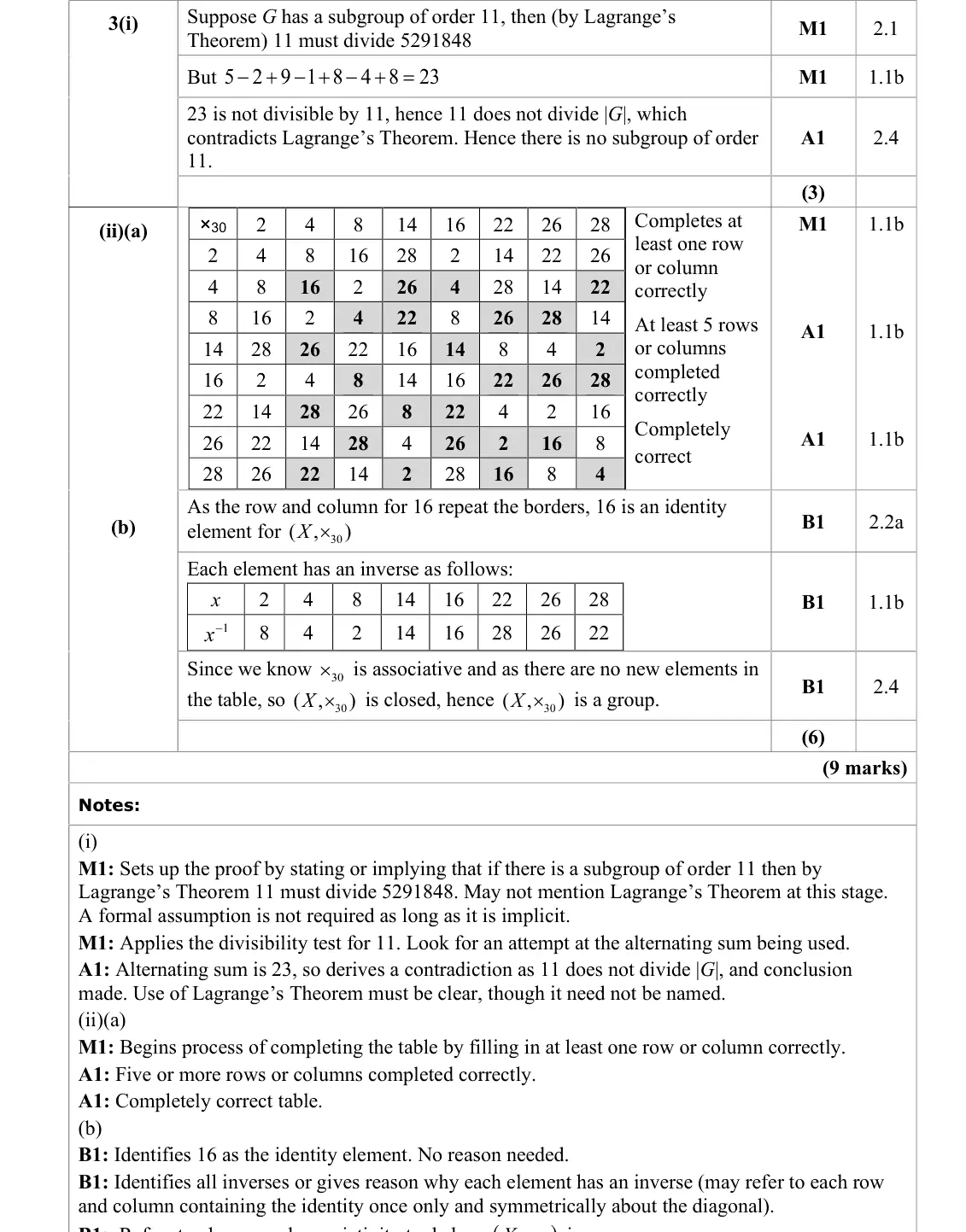
(ii) (a) Complete the following Cayley table for the set X = {2,4,8,14,16,22,26,28} with the operation of multiplication modulo 30 x 30 A copy of this table is given on page 11 if you need to rewrite your Cayley table. (b) Hence determine whether the set X with the operation of multiplication modulo 30 forms a group. [You may assume multiplication modulo n is an associative operation.] (6)
June 2022 · Paper 4A (Further Pure 2) · Q1(b) 1 mark
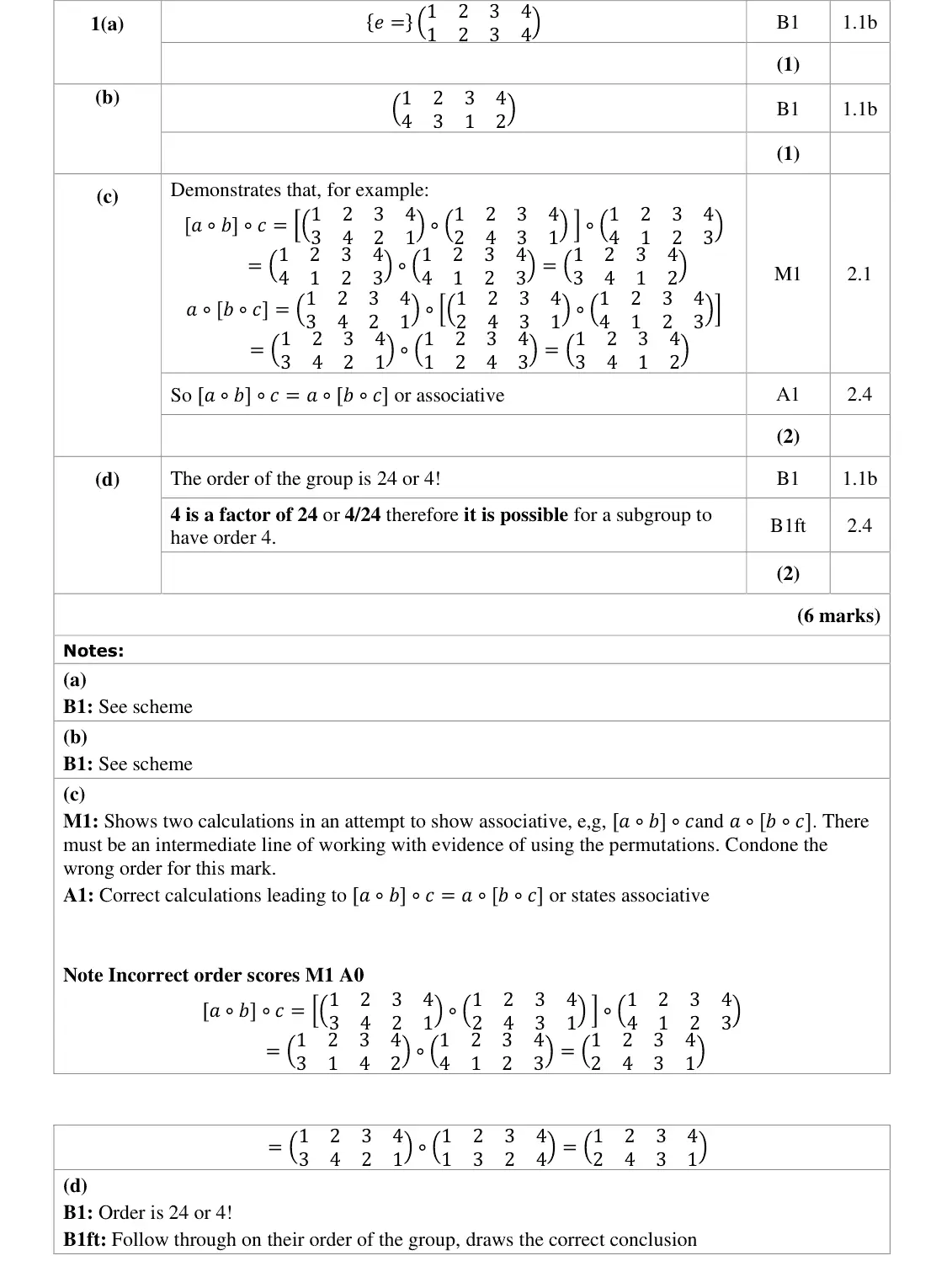
(b) write down the inverse of the element a, where < a = ;: (1)
June 2022 · Paper 4A (Further Pure 2) · Q1(c) 2 marks
(c) demonstrate that the operation of composition is associative using the following elements < < < a = 87 b = 87 and c = ;: ;: ;: (2)
Nov 2021 · Paper 4A (Further Pure 2) · Q2(a) 1 mark
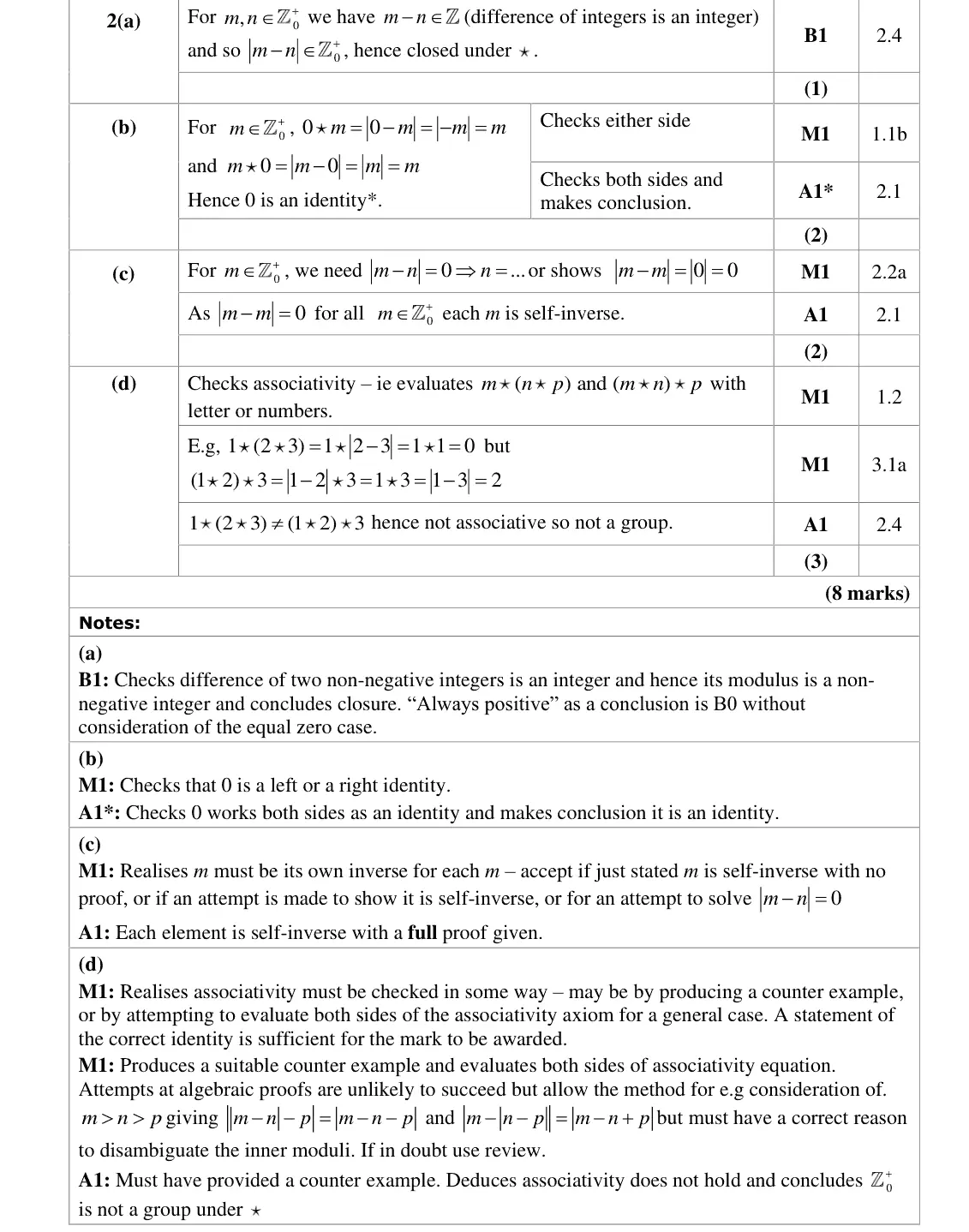
2. A binary operation on the set of non‑negative integers, + 0, is defined by m n = ½m – n½ m, n ∈ + + (a) Explain why 0 is closed under the operation (1)
Nov 2021 · Paper 4A (Further Pure 2) · Q2(b) 2 marks
+ (b) Show that 0 is an identity for ( 0, ) (2)
Nov 2021 · Paper 4A (Further Pure 2) · Q2(c) 2 marks
+ (c) Show that all elements of 0 have an inverse under (2)
Nov 2021 · Paper 4A (Further Pure 2) · Q2(d) 3 marks
+ (d) Determine if 0 forms a group under , giving clear justification for your answer. (3)
Oct 2020 · AS Paper 2 (Further Pure 2) · Q1(a) 3 marks
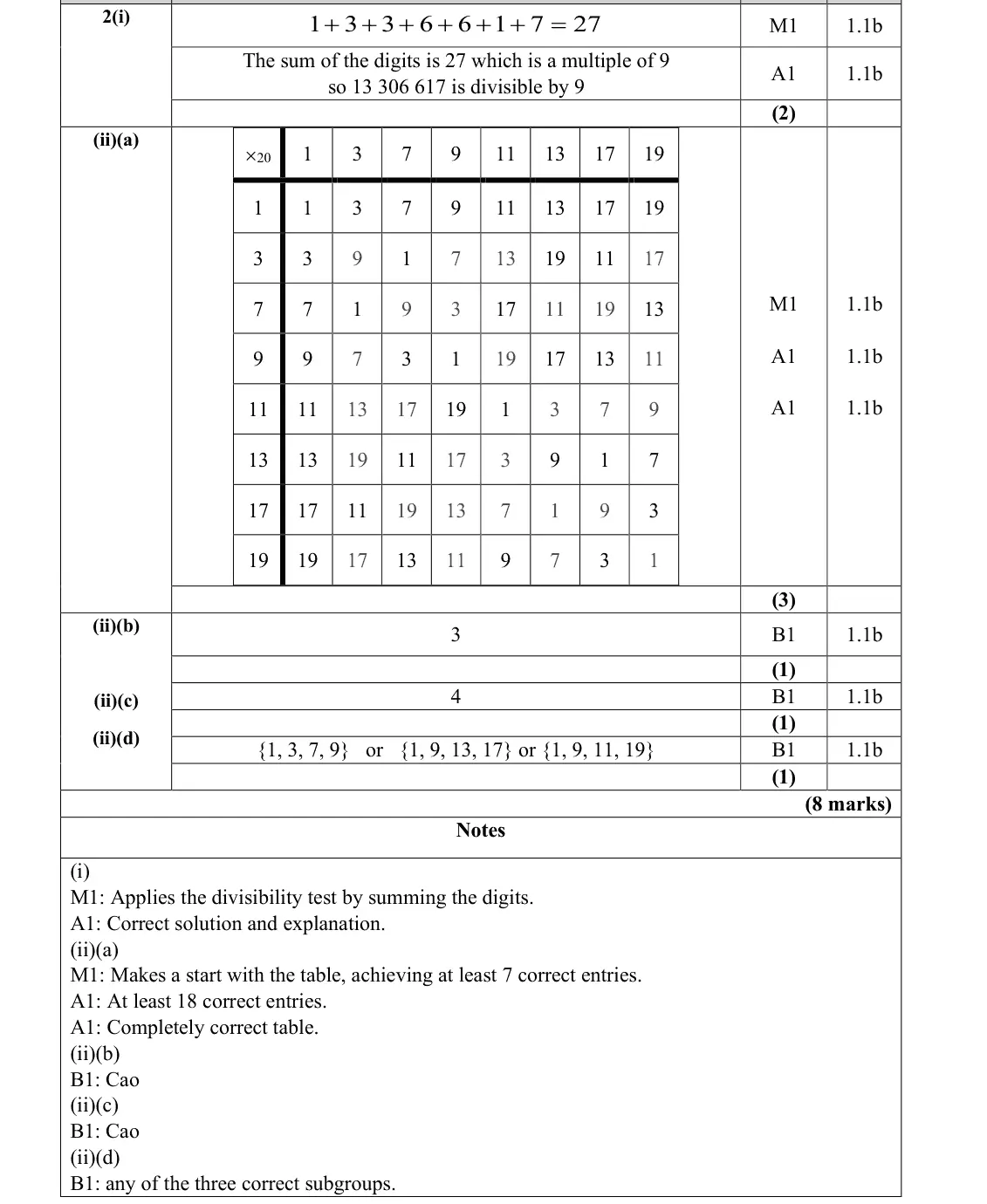
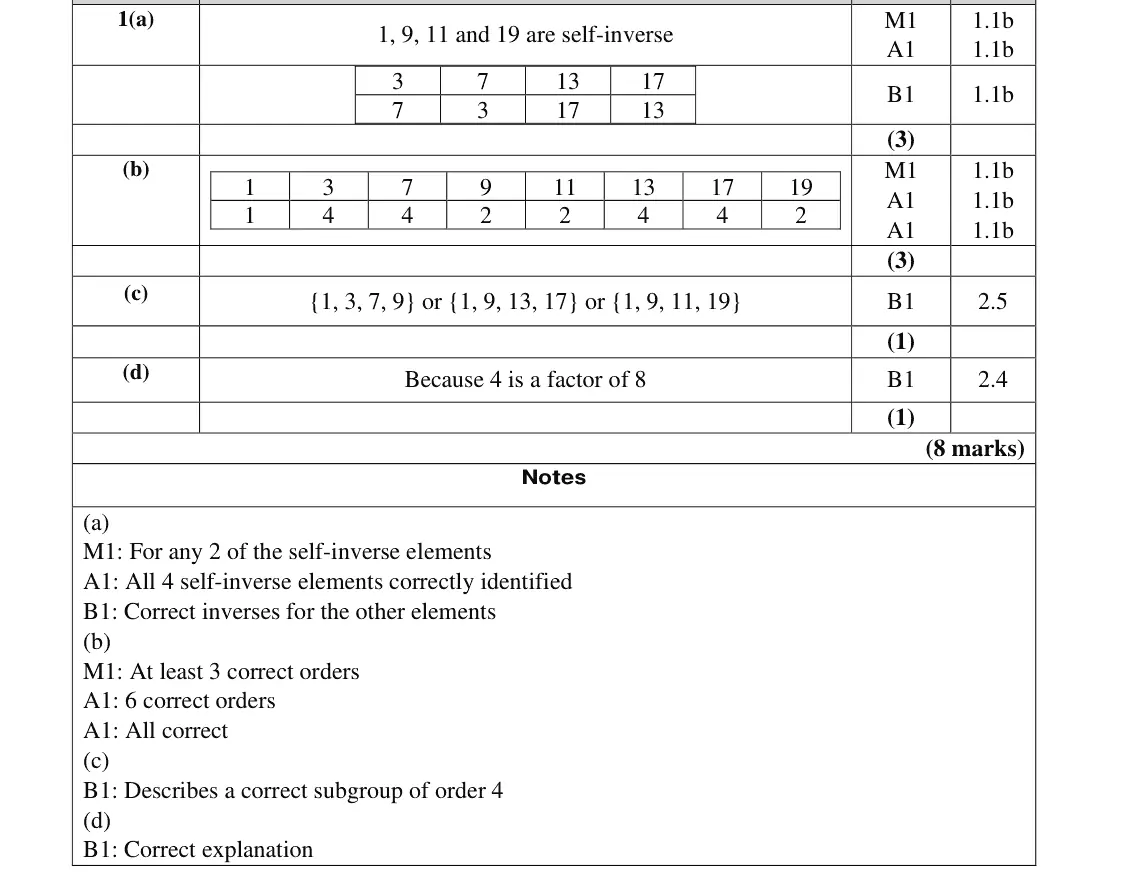
1. The set G = {1, 3, 7, 9, 11, 13, 17, 19} under the binary operation of multiplication modulo 20 forms a group. (a) Find the inverse of each element of G. (3)
June 2019 · AS Paper 2 (Further Pure 2) · Q4(a) 2 marks
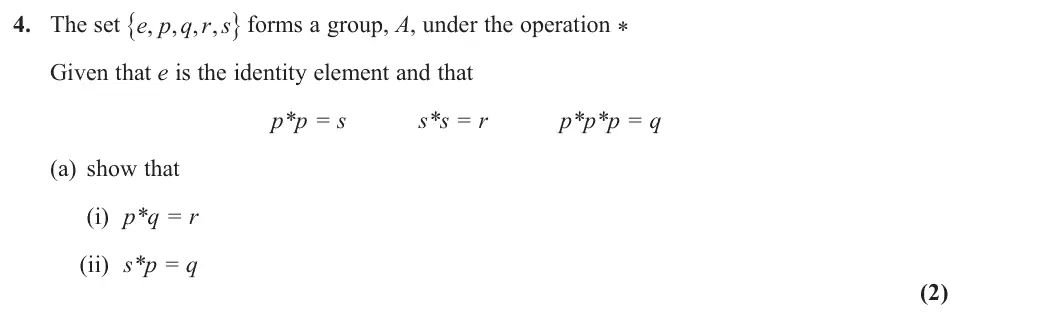
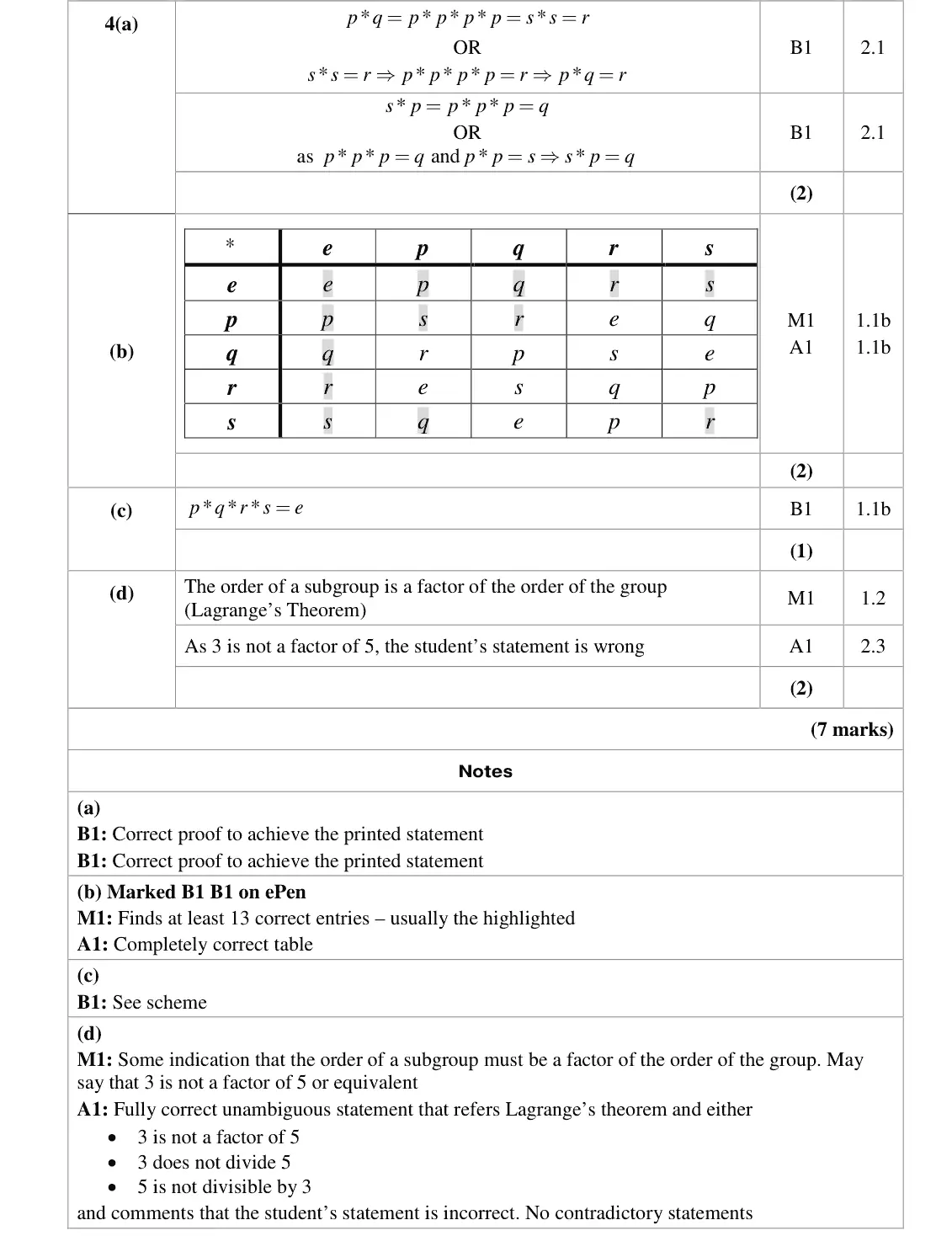
{ } forms a group, A, under the operation * 4. The set e p q r s , , , , Given that e is the identity element and that p*p = s s*s = r p*p*p = q (a) show that (i) p*q = r (ii) s*p = q (2)
June 2019 · Paper 4A (Further Pure 2) · Q6(i) 4 marks
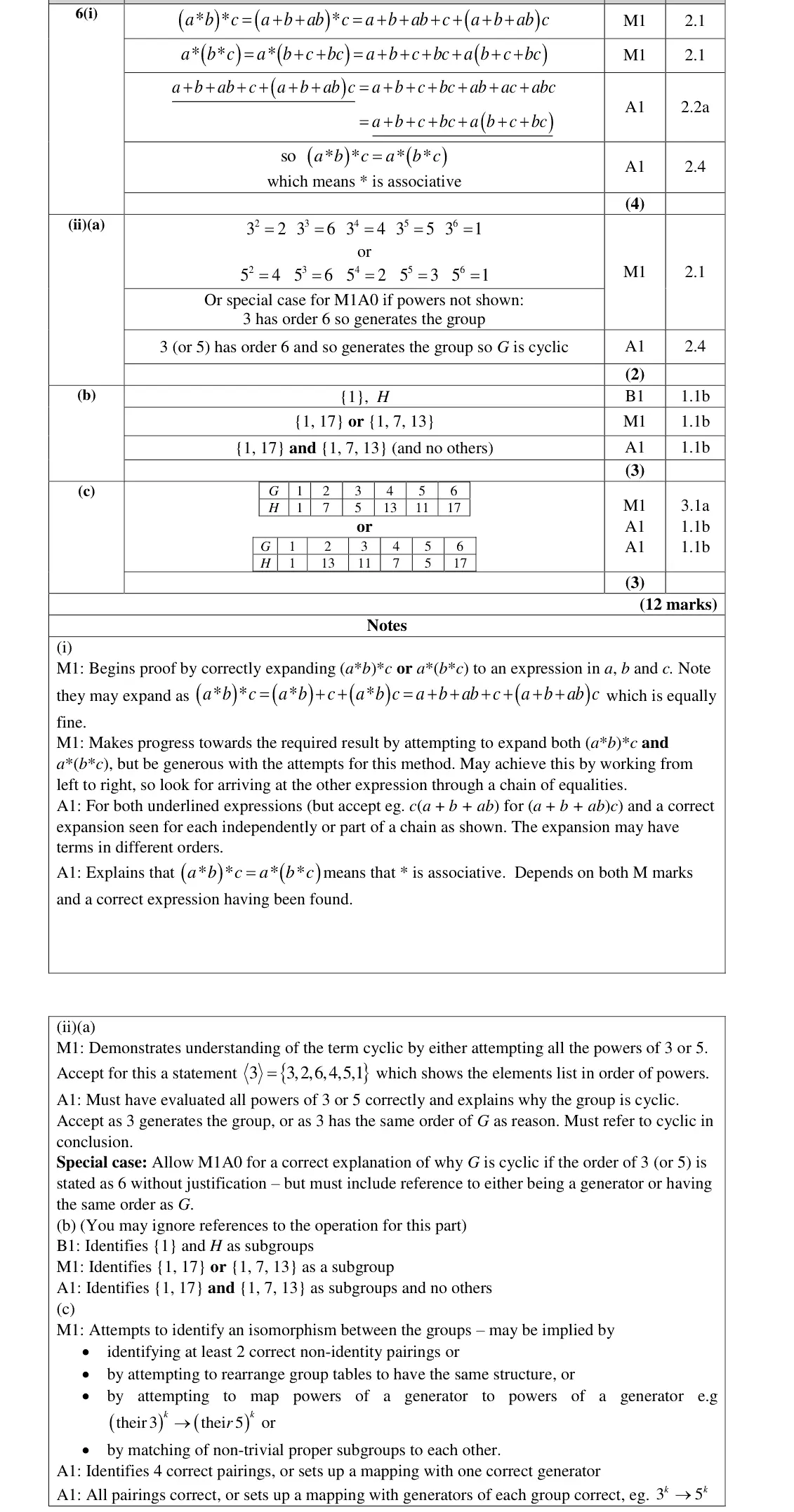
6. (i) A binary operation * is defined on positive real numbers by a * b = a + b + ab Prove that the operation * is associative. (4)
June 2018 · AS Paper 2 (Further Pure 2) · Q2(a) 6 marks
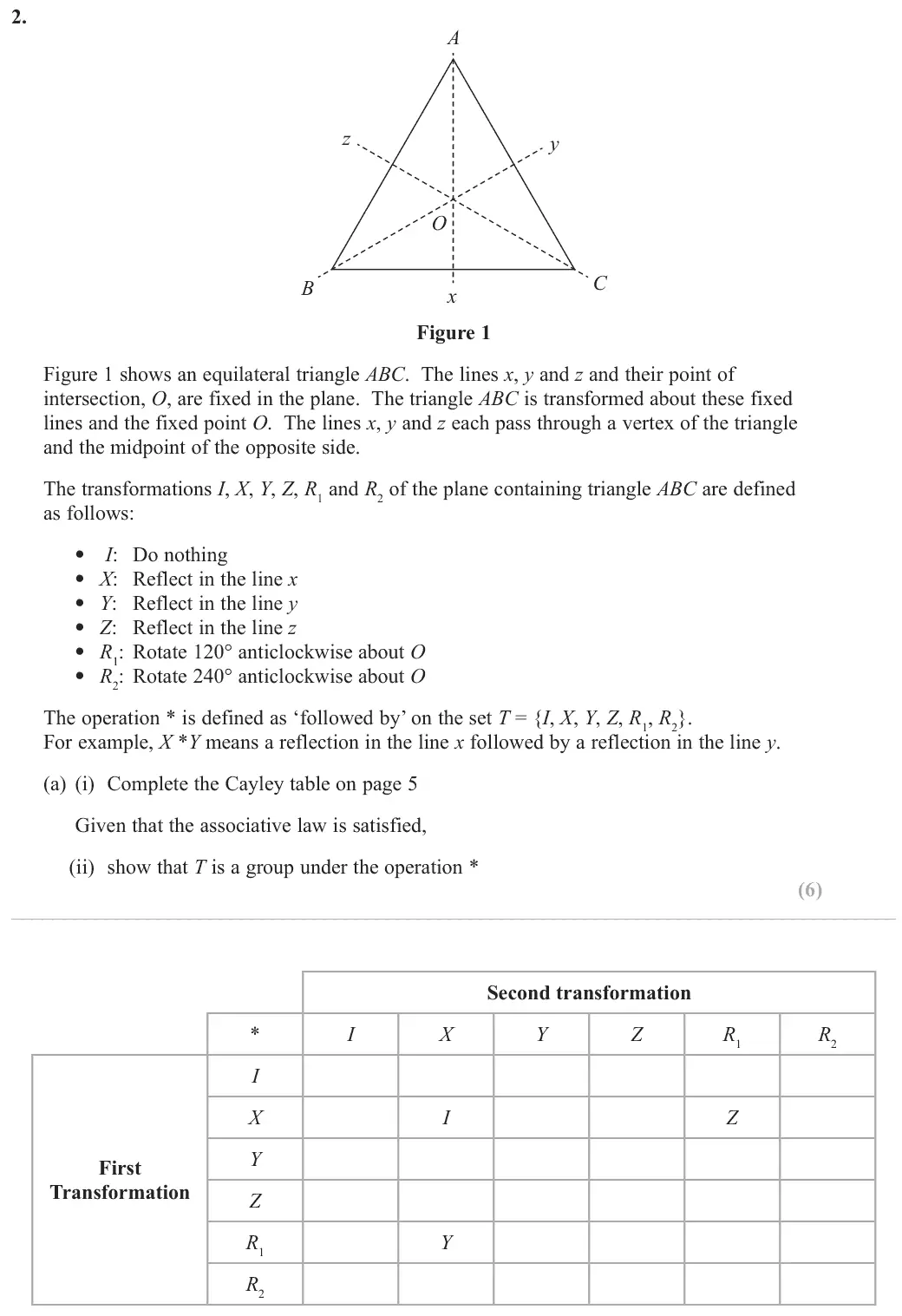
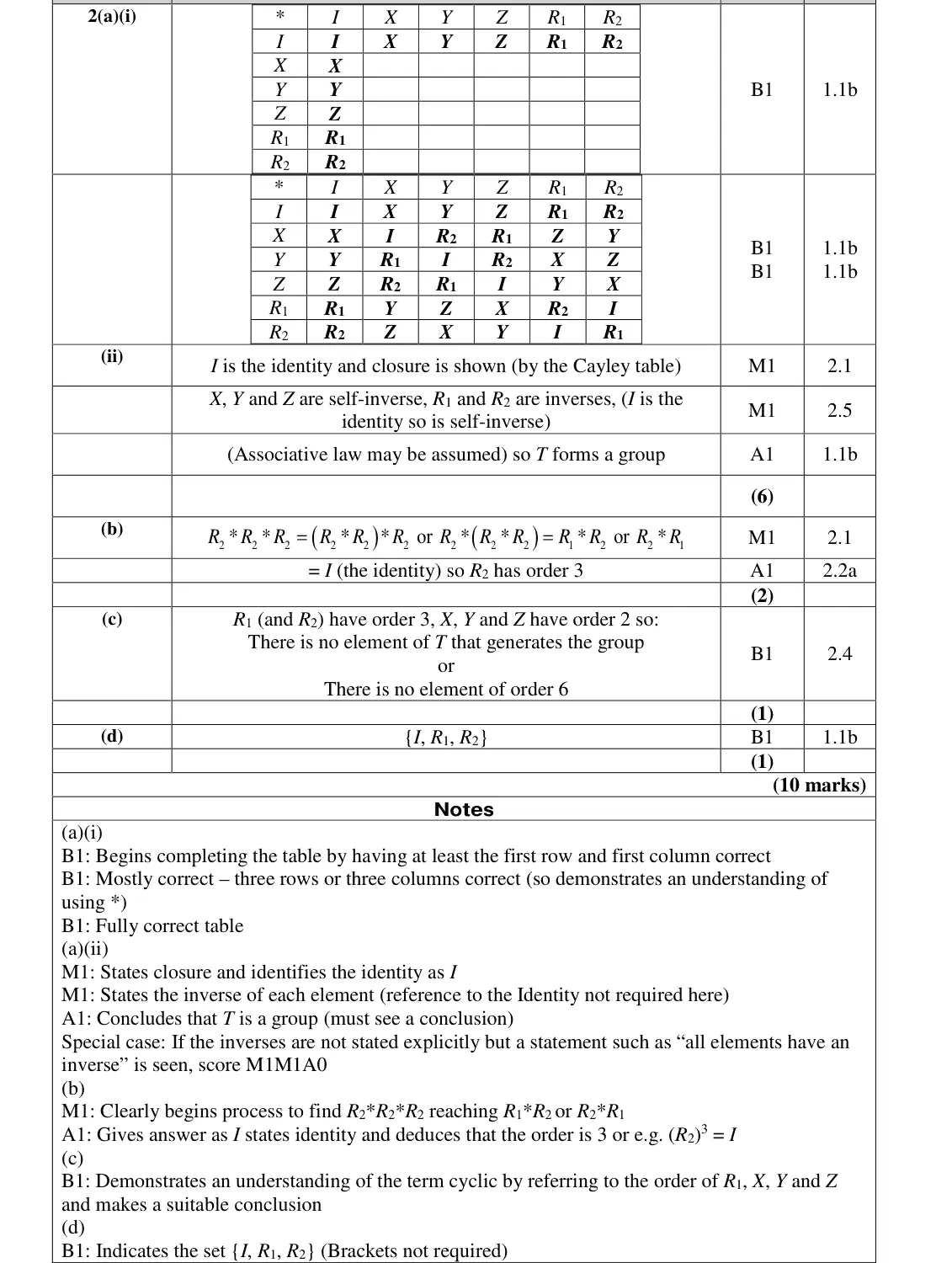
2. A z y C B x Figure 1 Figure 1 shows an equilateral triangle ABC. The lines x, y and z and their point of intersection, O, are fixed in the plane. The triangle ABC is transformed about these fixed lines and the fixed point O. The lines x, y and z each pass through a vertex of the triangle and the midpoint of the opposite side. The transformations I, X, Y, Z, R1 and R2 of the plane containing triangle ABC are defined as follows: • I: Do nothing • X: Reflect in the line x • Y: Reflect in the line y • Z: Reflect in the line z • R1: Rotate 120° anticlockwise about O • R2: Rotate 240° anticlockwise about O The operation * is defined as ‘followed by’ on the set T = {I, X, Y, Z, R1, R2}. For example, X *Y means a reflection in the line x followed by a reflection in the line y. (a) (i) Complete the Cayley table on page 5 Given that the associative law is satisfied, (ii) show that T is a group under the operation * (6)

Find an Edexcel Further Maths tutor

Stuck on this? Book a trial lesson with our Further Maths tutor.

Prefer email? Send an enquiry

If you are under 18, please include a parent's contact details. Enquiries go to enquiries@alevelfurthermathstutor.com and are deleted once handled.