Notes, worked examples and practice for this topic are being written by our tutors. The past-paper questions below are ready now: work each one on paper, then open the mark scheme and the examiner's comment.
Tap a question to zoom it. Mark scheme and examiner's comment open under each question.
June 2025 · AS Paper 2 (Further Pure 2) · Q2(ii)(a)3 marks
Mark scheme (whole question; this part is marked with the orange bar)
Examiner's comment
This question also proved very accessible with most scoring at least 6 of the 8 marks. A couple made slips to score fewer, while some attempted only the filling in of the table (even those who made little progress elsewhere had some success in the group table for (ii)(a)). Part (i) was generally completed successfully even though sometimes a little unclear on the explanation. The divisibility test was well understood by most, with students showing appreciation that a number is divisible by 9 provided the digit sum is divisible by 9, and the sum was always correct when attempted. Conclusions were often sparse but did enough to convey the idea that since the sum was divisible by 9, so the original number is also. E.g. “1+3+3+0+6+6+1+7=27 9 | 27 ⸫ 9| 13306617” was a minimalist answer. One student did seem to misread and use the divisibility test for 11 instead, while a couple did not answer this part at all, possibly missing it was there if their eye was drawn to the group table. For part (ii), most made some attempt at the group table with the majority completing it all correctly, only one made a single slip, though a couple made only partial attempts (discounting those who did not offer any answer at all). Identifying the inverse of 7 was also done well by most who proceed further than the group table but stating the order and then writing down a subgroup were incrementally less well attempted. The final mark was only scored by a minority. Overall it was pleasing to see engagement and reasonable success with the group theory question on the paper.
Key points from the mark scheme and examiner's report
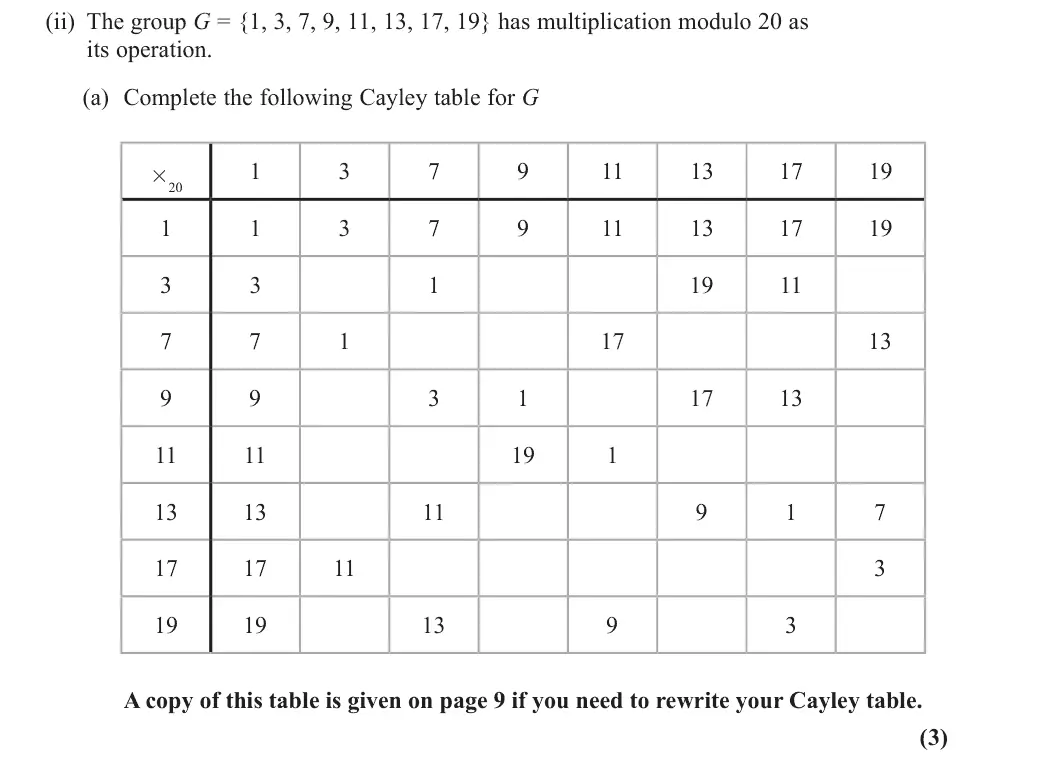
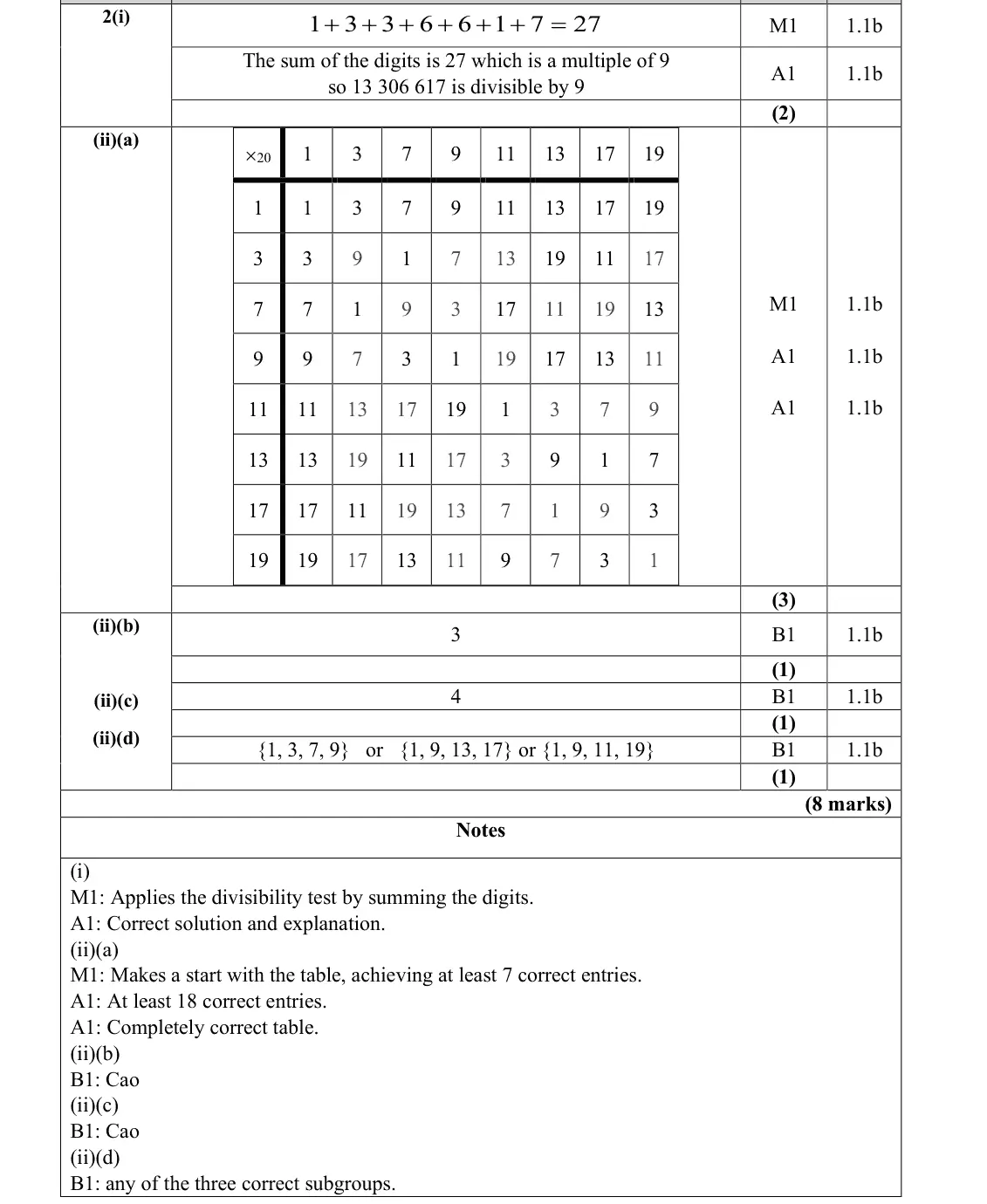
complete the multiplication-mod-20 Cayley table
at least 7 correct entries for M1, 18 for the first A1
mostly completed correctly
June 2025 · AS Paper 2 (Further Pure 2) · Q2(ii)(b)1 mark
Mark scheme (whole question; this part is marked with the orange bar)
Examiner's comment
This question also proved very accessible with most scoring at least 6 of the 8 marks. A couple made slips to score fewer, while some attempted only the filling in of the table (even those who made little progress elsewhere had some success in the group table for (ii)(a)). Part (i) was generally completed successfully even though sometimes a little unclear on the explanation. The divisibility test was well understood by most, with students showing appreciation that a number is divisible by 9 provided the digit sum is divisible by 9, and the sum was always correct when attempted. Conclusions were often sparse but did enough to convey the idea that since the sum was divisible by 9, so the original number is also. E.g. “1+3+3+0+6+6+1+7=27 9 | 27 ⸫ 9| 13306617” was a minimalist answer. One student did seem to misread and use the divisibility test for 11 instead, while a couple did not answer this part at all, possibly missing it was there if their eye was drawn to the group table. For part (ii), most made some attempt at the group table with the majority completing it all correctly, only one made a single slip, though a couple made only partial attempts (discounting those who did not offer any answer at all). Identifying the inverse of 7 was also done well by most who proceed further than the group table but stating the order and then writing down a subgroup were incrementally less well attempted. The final mark was only scored by a minority. Overall it was pleasing to see engagement and reasonable success with the group theory question on the paper.
Key points from the mark scheme and examiner's report
7 × 3 = 21 ≡ 1 so the inverse of 7 is 3
June 2025 · AS Paper 2 (Further Pure 2) · Q2(ii)(c)1 mark
Mark scheme (whole question; this part is marked with the orange bar)
Examiner's comment
This question also proved very accessible with most scoring at least 6 of the 8 marks. A couple made slips to score fewer, while some attempted only the filling in of the table (even those who made little progress elsewhere had some success in the group table for (ii)(a)). Part (i) was generally completed successfully even though sometimes a little unclear on the explanation. The divisibility test was well understood by most, with students showing appreciation that a number is divisible by 9 provided the digit sum is divisible by 9, and the sum was always correct when attempted. Conclusions were often sparse but did enough to convey the idea that since the sum was divisible by 9, so the original number is also. E.g. “1+3+3+0+6+6+1+7=27 9 | 27 ⸫ 9| 13306617” was a minimalist answer. One student did seem to misread and use the divisibility test for 11 instead, while a couple did not answer this part at all, possibly missing it was there if their eye was drawn to the group table. For part (ii), most made some attempt at the group table with the majority completing it all correctly, only one made a single slip, though a couple made only partial attempts (discounting those who did not offer any answer at all). Identifying the inverse of 7 was also done well by most who proceed further than the group table but stating the order and then writing down a subgroup were incrementally less well attempted. The final mark was only scored by a minority. Overall it was pleasing to see engagement and reasonable success with the group theory question on the paper.
Key points from the mark scheme and examiner's report
13² ≡ 9, 13⁴ ≡ 1 so order 4
June 2025 · AS Paper 2 (Further Pure 2) · Q2(ii)(d)1 mark
Mark scheme (whole question; this part is marked with the orange bar)
Examiner's comment
This question also proved very accessible with most scoring at least 6 of the 8 marks. A couple made slips to score fewer, while some attempted only the filling in of the table (even those who made little progress elsewhere had some success in the group table for (ii)(a)). Part (i) was generally completed successfully even though sometimes a little unclear on the explanation. The divisibility test was well understood by most, with students showing appreciation that a number is divisible by 9 provided the digit sum is divisible by 9, and the sum was always correct when attempted. Conclusions were often sparse but did enough to convey the idea that since the sum was divisible by 9, so the original number is also. E.g. “1+3+3+0+6+6+1+7=27 9 | 27 ⸫ 9| 13306617” was a minimalist answer. One student did seem to misread and use the divisibility test for 11 instead, while a couple did not answer this part at all, possibly missing it was there if their eye was drawn to the group table. For part (ii), most made some attempt at the group table with the majority completing it all correctly, only one made a single slip, though a couple made only partial attempts (discounting those who did not offer any answer at all). Identifying the inverse of 7 was also done well by most who proceed further than the group table but stating the order and then writing down a subgroup were incrementally less well attempted. The final mark was only scored by a minority. Overall it was pleasing to see engagement and reasonable success with the group theory question on the paper.
Key points from the mark scheme and examiner's report
{1, 3, 7, 9}, {1, 9, 13, 17} or {1, 9, 11, 19}
June 2025 · Paper 4A (Further Pure 2) · Q1(a)3 marks
Mark scheme (whole question; this part is marked with the orange bar)
Examiner's comment
A very easy opening to the paper in part (a) turned a lot more challenging by part (c), where students were asked to show two groups are isomorphic, something which has not been tested extensively on previous papers. Part (a) was answered very well with very few failing to obtain all three marks. Very occasional slips were made, and sometimes the values were not reduced modulo 14, but more likely was a failure to answer the question at all.
Key points from the mark scheme and examiner's report
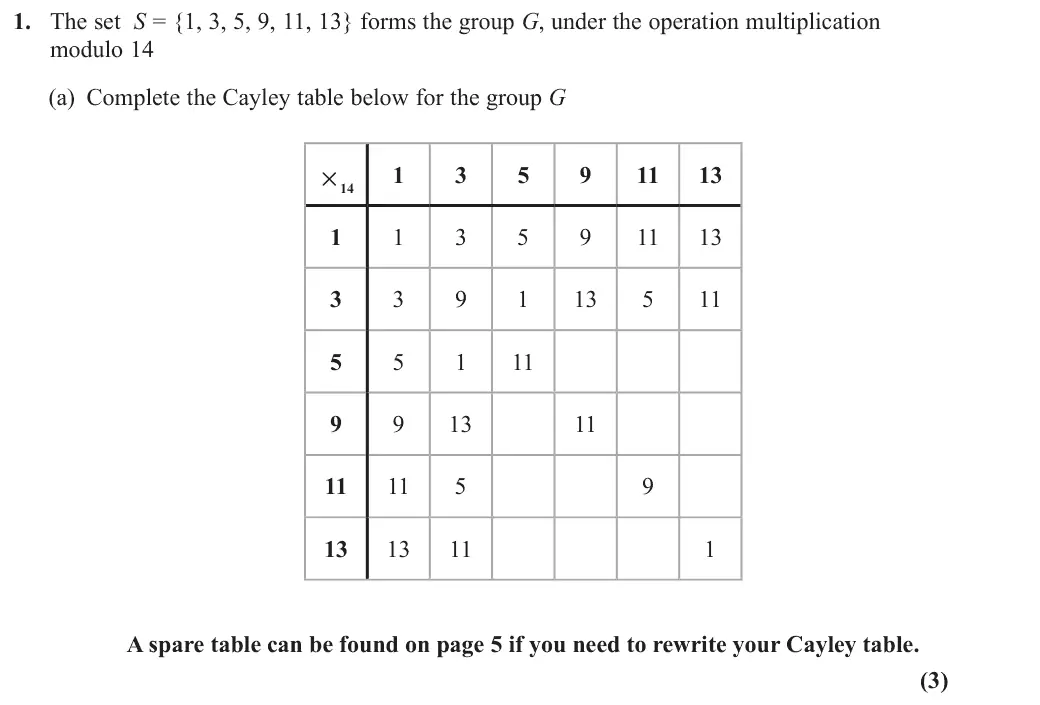
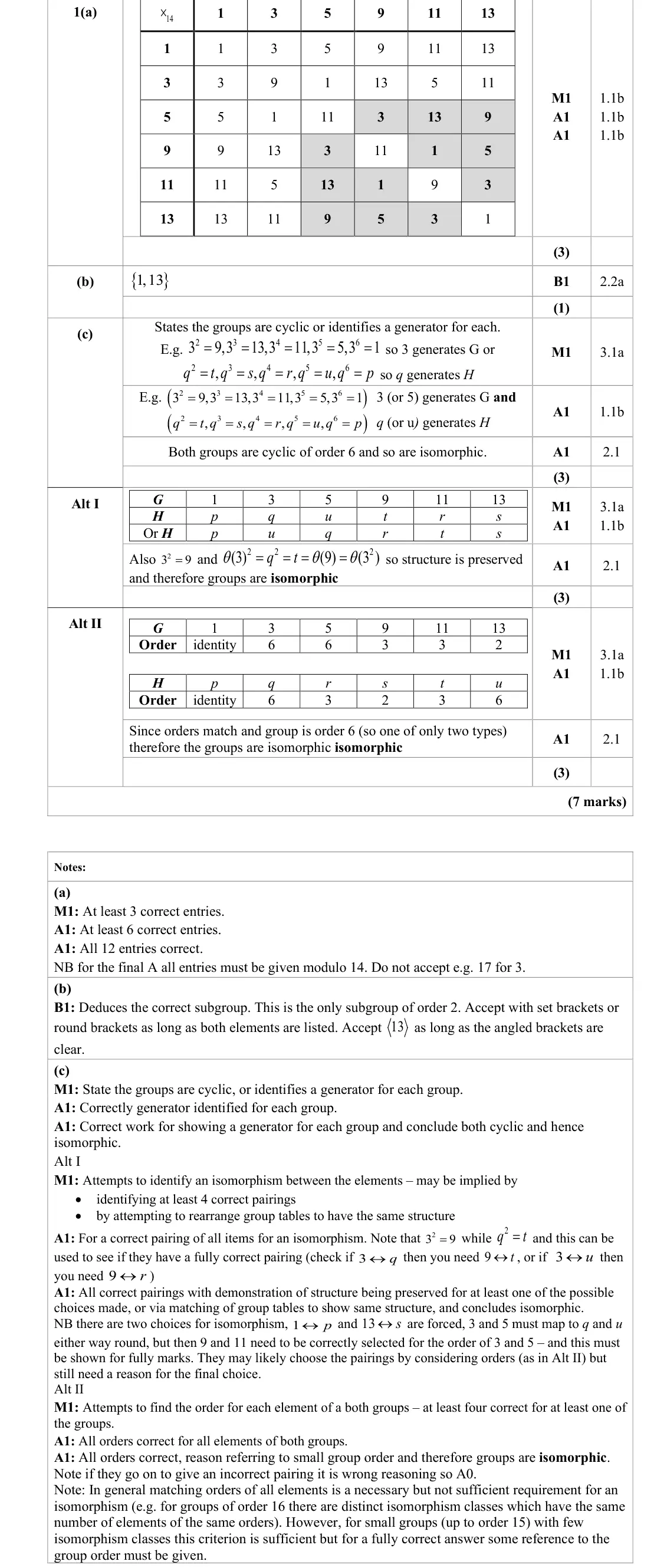
fill the 12 missing products, all reduced mod 14 (e.g. 3 not 17)
June 2025 · Paper 4A (Further Pure 2) · Q1(b)1 mark
Mark scheme (whole question; this part is marked with the orange bar)
Examiner's comment
There was slightly less success in part (b), though the majority still managed to give the required subgroup successfully. A small number were unsure what a subgroup is, it seems, giving an answer that did not include the identity, 1, e.g. {11,13} was seen a few times. Others included the identity but not the element of order 2 but though any element would suffice.
Key points from the mark scheme and examiner's report
{1, 13}, the only subgroup of order 2
it must contain the identity
June 2025 · Paper 4A (Further Pure 2) · Q1(c)3 marks
Mark scheme (whole question; this part is marked with the orange bar)
Examiner's comment
Part (c) was even less well answered overall, and inconsistent in approach. Candidates largely seemed surprised by the question and did not have a clear approach in their mind, which may be because it is more common for an isomorphism to be asked for than for groups to have to be shown to be isomorphic. Indeed, many simply focussed on finding an isomorphism as the main emphasis, with the reasons why the groups are therefore isomorphic lacking. Those who realised there was a bit more to it often reasoned via the orders of elements but without clear reason why having elements on matching orders would mean they are isomorphic (not something that is true in general). There was a fair mix of the three alternatives seen of the scheme, as well as variations on these, with probably fewer mentions of cyclic groups or generators, although these were the most likely responses to score full marks, as they were by students who had an appreciation of what isomorphism means and a certain condition – being cyclic of the same order – for it. There were a few errors in identifying correct generators for each, meaning some only score one mark despite having this approach, though. But the reason was usually given. Those who used element pairing often did not think about the structure but simply paired either be the order of the borders of the table (which score no marks as there were insufficient correct matches) or via elements of the same order with giving due consideration to preserving order, often matching 3 to q but 9 (=32) to r and not t (=q2). Even where correct pairings were given it was rare to see the required justification for the final mark though a few did show this. Group table matching as a whole was seen occasionally, but again quite rare. For those working out the orders of all the elements, this was more successful in achieving all the correct orders, with only occasional errors made determining orders, but the final justification was again lacking with only very few referring to the order of the group being only 6 and therefore sufficient for same element orders to imply an isomorphism. Couple with this, students using this approach often went on to give an incorrect pairing of the elements anyway, showing the lack of understanding that there is more to it than just pairing up elements by order. But amongst the many attempts there were also some very confident and coherently expressed reasons given, sometimes showing the isomorphism by a mapping (an extension of the cyclic subgroup reasoning) and occasionally some reasoning by conjugacy classes, and recognising both groups were dihedral. Overall, this question successfully differentiated between levels of ability, enabling stronger candidates to demonstrate their understanding, while also offering accessible marks to support lower-attaining candidates.
Key points from the mark scheme and examiner's report
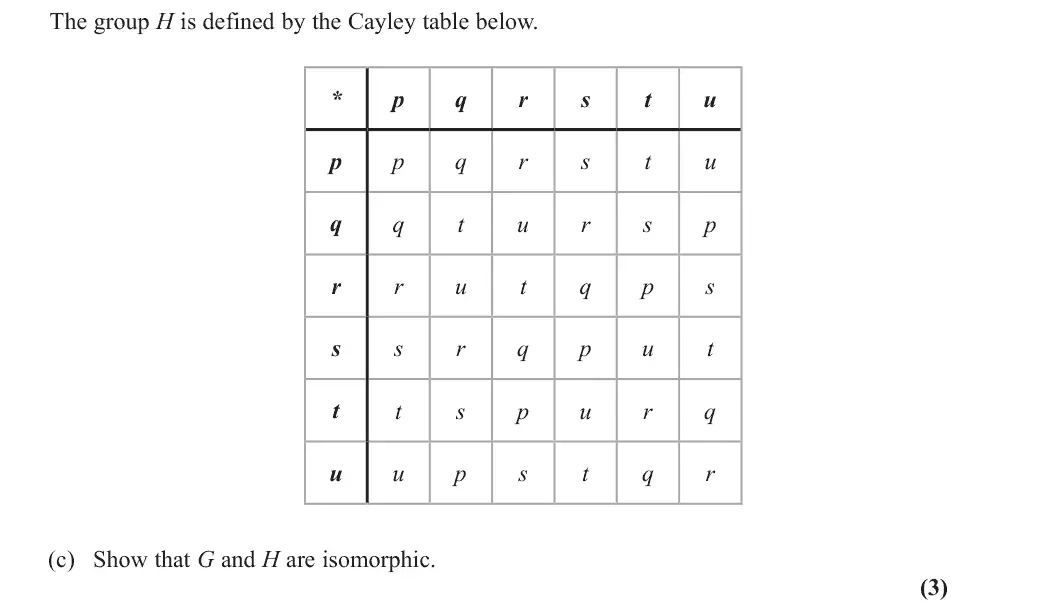
best route: 3 generates G and q generates H, so both cyclic of order 6, hence isomorphic
a pairing must keep the structure (3 to q forces 9 to t)
matching orders needs the reason that the group order is only 6
pairing table borders scores 0
June 2024 · AS Paper 2 (Further Pure 2) · Q1(i)(a)1 mark
Mark scheme (whole question; this part is marked with the orange bar)
Examiner's comment
(i) Part (a) the majority of candidates were able to identify the identity element. Part (b) many candidates did not many to find the inverse of b c , mistaking thinking that instead of a. Candidates who did find b c correctly found the inverse. b c e a = = Part (c) Candidates where able to explain why the set of 4 elements cannot be a subgroup of G, The majority said that it does not satisfy Lagrange’s Theorem, with some showing that closure fails as e.g. a a is not in the set. d = ° Part (d) To show that the set { } , , is a subgroup of G candidates needed to find the Cayley b d f table and concluded that it is closed, b and f are inverses and d is the identity, so the subset is a subgroup. Many candidates only showed the result for a few products so not able to prove closure and gained only 1 mark. (ii) This part was found very demanding by the majority of candidates, with many making no 5 yx xy 3 2 3 attempt. A few candidates scored a method mark for using the relation once on = y xy x but made no further progress. There were only 2 candidates who managed to successfully that 3 2 3 y xy x is the identity.
Key points from the mark scheme and examiner's report
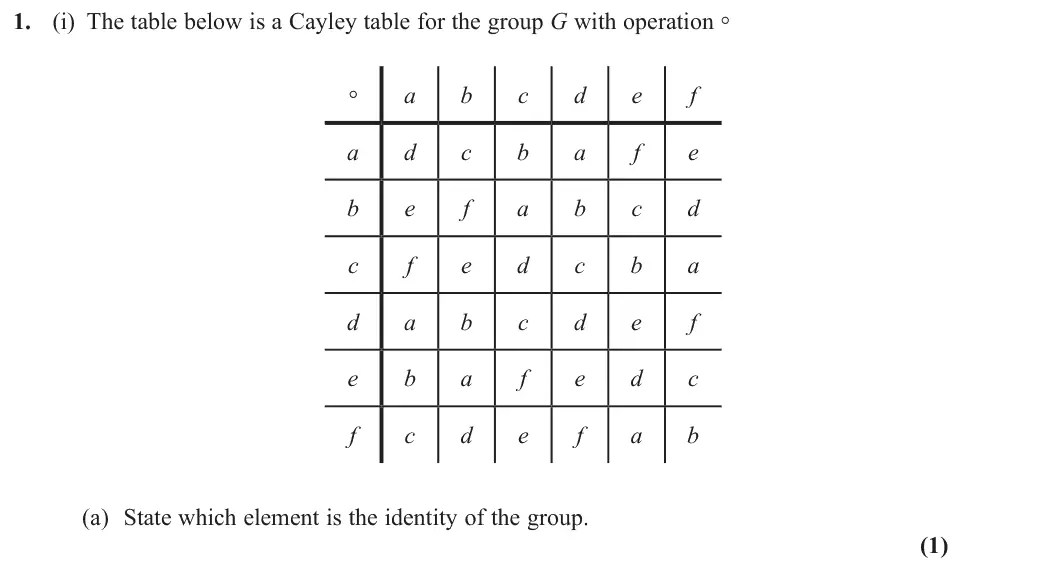
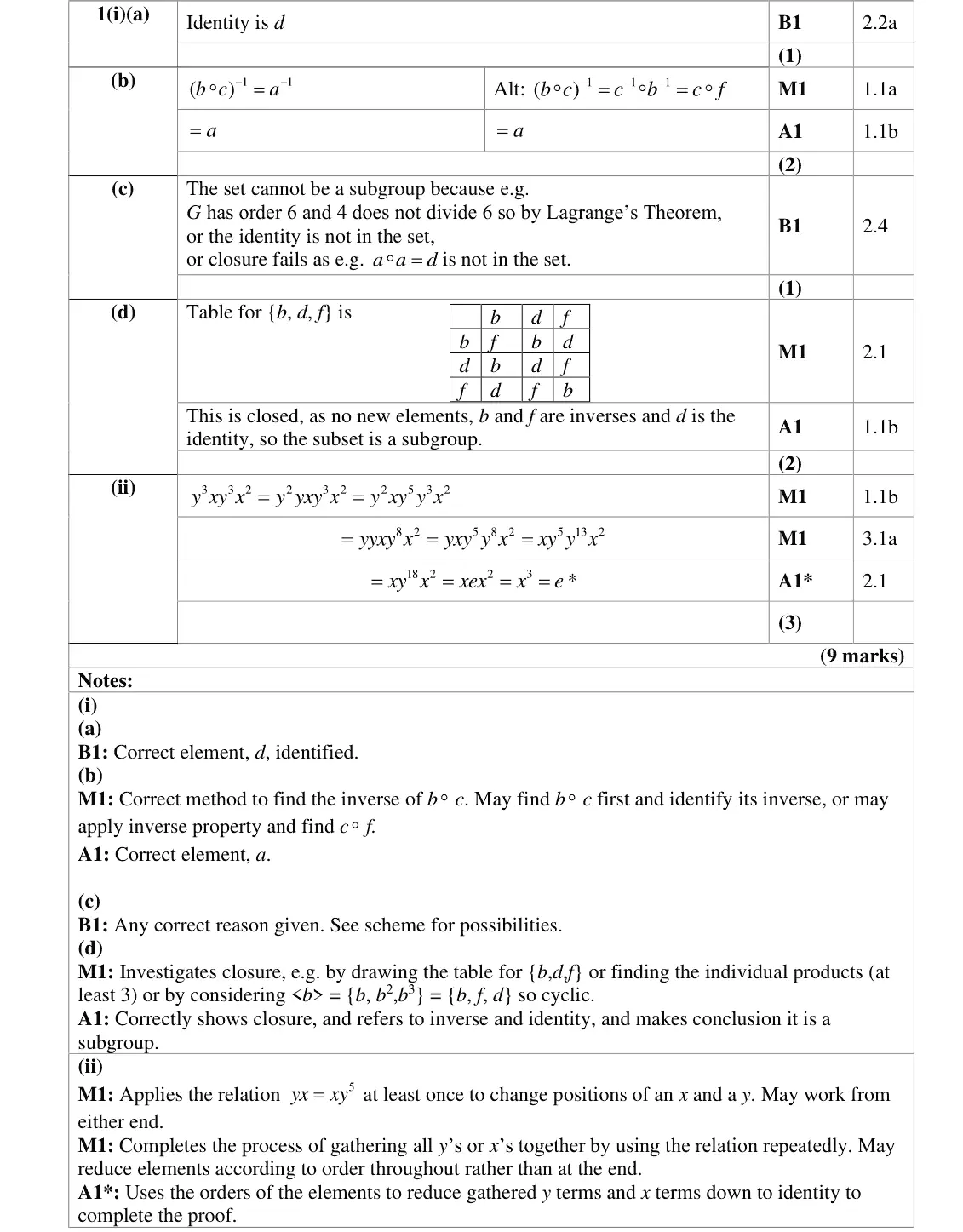
the identity is d (its row and column repeat the borders)
June 2024 · AS Paper 2 (Further Pure 2) · Q1(i)(b)2 marks
Mark scheme (whole question; this part is marked with the orange bar)
Examiner's comment
(i) Part (a) the majority of candidates were able to identify the identity element. Part (b) many candidates did not many to find the inverse of b c , mistaking thinking that instead of a. Candidates who did find b c correctly found the inverse. b c e a = = Part (c) Candidates where able to explain why the set of 4 elements cannot be a subgroup of G, The majority said that it does not satisfy Lagrange’s Theorem, with some showing that closure fails as e.g. a a is not in the set. d = ° Part (d) To show that the set { } , , is a subgroup of G candidates needed to find the Cayley b d f table and concluded that it is closed, b and f are inverses and d is the identity, so the subset is a subgroup. Many candidates only showed the result for a few products so not able to prove closure and gained only 1 mark. (ii) This part was found very demanding by the majority of candidates, with many making no 5 yx xy 3 2 3 attempt. A few candidates scored a method mark for using the relation once on = y xy x but made no further progress. There were only 2 candidates who managed to successfully that 3 2 3 y xy x is the identity.
Key points from the mark scheme and examiner's report
b∘c = a from the table, and a is self-inverse (a∘a = d), so the inverse is a
or (b∘c)⁻¹ = c⁻¹∘b⁻¹ = c∘f = a
many misread b∘c from the table
June 2024 · AS Paper 2 (Further Pure 2) · Q1(i)(c)1 mark
Mark scheme (whole question; this part is marked with the orange bar)
Examiner's comment
(i) Part (a) the majority of candidates were able to identify the identity element. Part (b) many candidates did not many to find the inverse of b c , mistaking thinking that instead of a. Candidates who did find b c correctly found the inverse. b c e a = = Part (c) Candidates where able to explain why the set of 4 elements cannot be a subgroup of G, The majority said that it does not satisfy Lagrange’s Theorem, with some showing that closure fails as e.g. a a is not in the set. d = ° Part (d) To show that the set { } , , is a subgroup of G candidates needed to find the Cayley b d f table and concluded that it is closed, b and f are inverses and d is the identity, so the subset is a subgroup. Many candidates only showed the result for a few products so not able to prove closure and gained only 1 mark. (ii) This part was found very demanding by the majority of candidates, with many making no 5 yx xy 3 2 3 attempt. A few candidates scored a method mark for using the relation once on = y xy x but made no further progress. There were only 2 candidates who managed to successfully that 3 2 3 y xy x is the identity.
Key points from the mark scheme and examiner's report
by Lagrange 4 does not divide 6
or the identity d is not in the set
or not closed (a∘a = d)
June 2024 · AS Paper 2 (Further Pure 2) · Q1(i)(d)2 marks
Mark scheme (whole question; this part is marked with the orange bar)
Examiner's comment
(i) Part (a) the majority of candidates were able to identify the identity element. Part (b) many candidates did not many to find the inverse of b c , mistaking thinking that instead of a. Candidates who did find b c correctly found the inverse. b c e a = = Part (c) Candidates where able to explain why the set of 4 elements cannot be a subgroup of G, The majority said that it does not satisfy Lagrange’s Theorem, with some showing that closure fails as e.g. a a is not in the set. d = ° Part (d) To show that the set { } , , is a subgroup of G candidates needed to find the Cayley b d f table and concluded that it is closed, b and f are inverses and d is the identity, so the subset is a subgroup. Many candidates only showed the result for a few products so not able to prove closure and gained only 1 mark. (ii) This part was found very demanding by the majority of candidates, with many making no 5 yx xy 3 2 3 attempt. A few candidates scored a method mark for using the relation once on = y xy x but made no further progress. There were only 2 candidates who managed to successfully that 3 2 3 y xy x is the identity.
Key points from the mark scheme and examiner's report
Cayley table for {b, d, f}: closed, d is the identity, b and f are inverses, so a subgroup
checking only a few products does not show closure
June 2024 · AS Paper 2 (Further Pure 2) · Q1(ii)3 marks
Mark scheme (whole question; this part is marked with the orange bar)
Examiner's comment
(i) Part (a) the majority of candidates were able to identify the identity element. Part (b) many candidates did not many to find the inverse of b c , mistaking thinking that instead of a. Candidates who did find b c correctly found the inverse. b c e a = = Part (c) Candidates where able to explain why the set of 4 elements cannot be a subgroup of G, The majority said that it does not satisfy Lagrange’s Theorem, with some showing that closure fails as e.g. a a is not in the set. d = ° Part (d) To show that the set { } , , is a subgroup of G candidates needed to find the Cayley b d f table and concluded that it is closed, b and f are inverses and d is the identity, so the subset is a subgroup. Many candidates only showed the result for a few products so not able to prove closure and gained only 1 mark. (ii) This part was found very demanding by the majority of candidates, with many making no 5 yx xy 3 2 3 attempt. A few candidates scored a method mark for using the relation once on = y xy x but made no further progress. There were only 2 candidates who managed to successfully that 3 2 3 y xy x is the identity.
Key points from the mark scheme and examiner's report
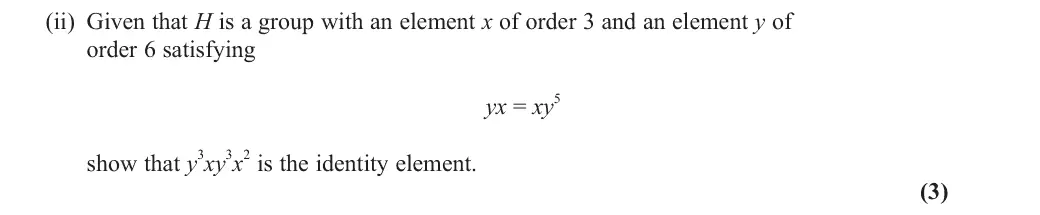
use yx = xy⁵ repeatedly to gather the y's: y³xy³x² = xy¹⁸x² = x³ = e using y⁶ = e and x³ = e
very demanding, most made no progress
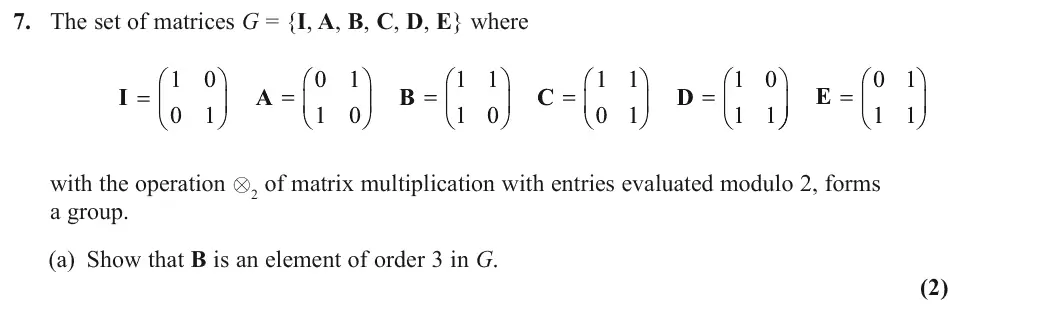
June 2024 · Paper 4A (Further Pure 2) · Q7(a)2 marks
Mark scheme (whole question; this part is marked with the orange bar)
Examiner's comment
Candidates demonstrated that they understood the group terminology the order of an element/ group and isomorphic groups. Part (a) the majority of candidates score both marks for finding 3 B and showing that it was equivalent to ( ) 1 0 mod2 0 1 . A few candidates alternatively showed that 4 = B B. Candidates draw a conclusion to score the final mark.
Key points from the mark scheme and examiner's report
B² = E, B³ = I (mod 2) and B ≠ I so order 3
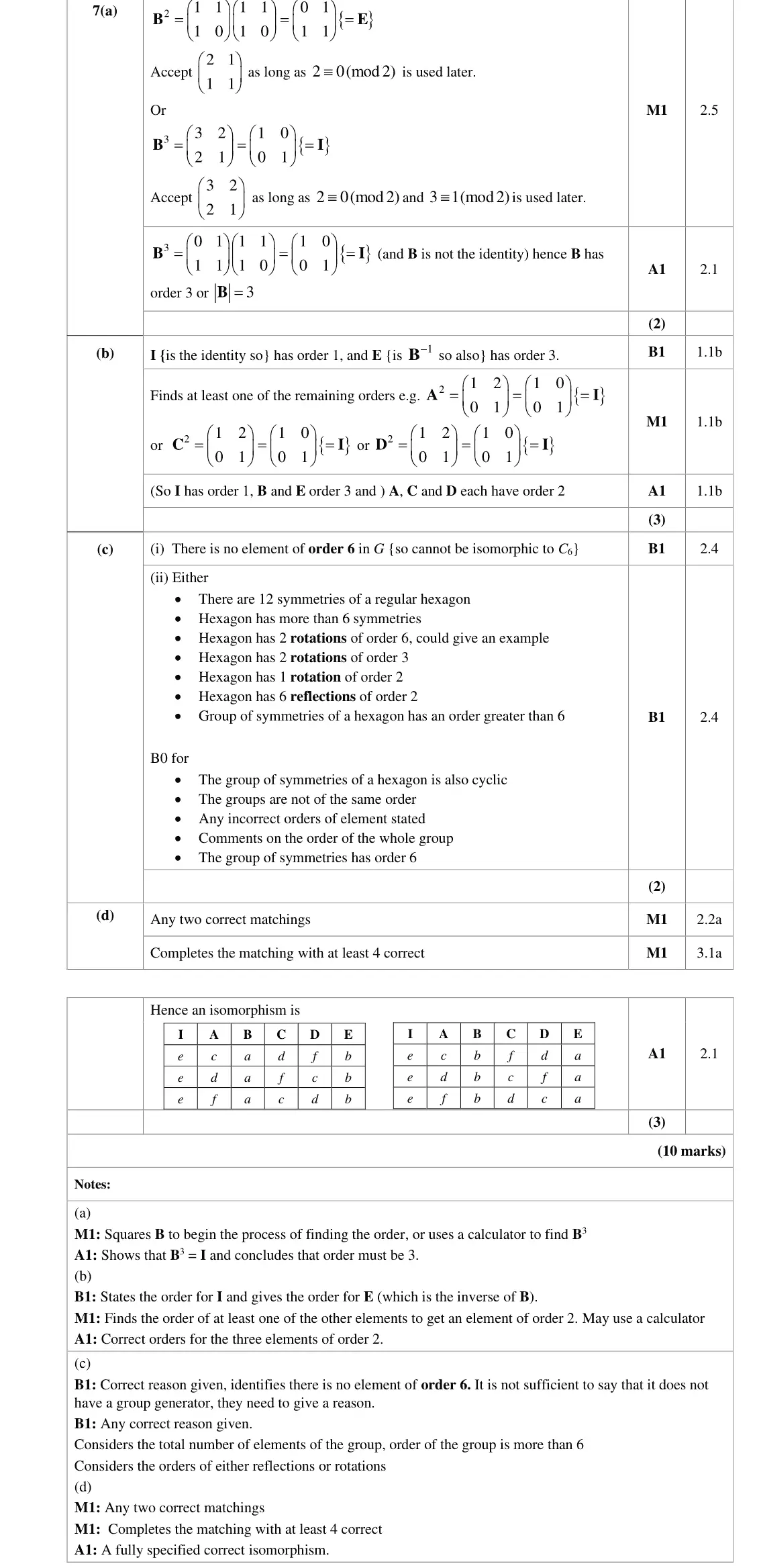
June 2024 · Paper 4A (Further Pure 2) · Q7(b)3 marks
Mark scheme (whole question; this part is marked with the orange bar)
Examiner's comment
Candidates demonstrated that they understood the group terminology the order of an element/ group and isomorphic groups. Part (b) the majority of candidates were able to find the order of the other elements of the group. The common error was not to state the order of the identity element so scored 2/3 marks.
Key points from the mark scheme and examiner's report
I order 1, E order 3, A, C, D order 2
forgetting the identity lost a mark
June 2024 · Paper 4A (Further Pure 2) · Q7(c)2 marks
Mark scheme (whole question; this part is marked with the orange bar)
Examiner's comment
Candidates demonstrated that they understood the group terminology the order of an element/ group and isomorphic groups. Part (c) This part was not done very well by most of the candidates. (i) candidates needed to say that there is no element of G with order 6. Some candidates said that there is no group generator but did not say why. (ii) There were many reasons that candidates could give including the order of the group, order of elements and compare with G and the symmetries of the regular hexagon. If candidate stated an incorrect order, e.g. symmetries has an element of order 4 this scores B0.
Key points from the mark scheme and examiner's report
(i) no element of order 6
'no generator' without reason not enough
(ii) hexagon symmetry group has order 12 (or elements of order 6)
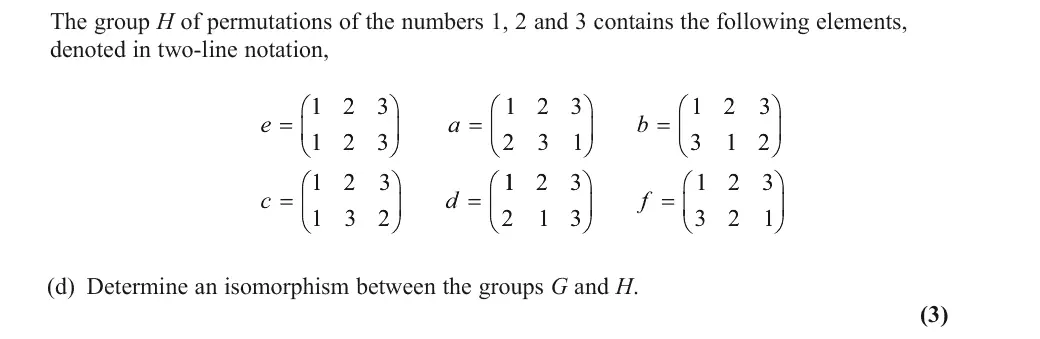
June 2024 · Paper 4A (Further Pure 2) · Q7(d)3 marks
Mark scheme (whole question; this part is marked with the orange bar)
Examiner's comment
Candidates demonstrated that they understood the group terminology the order of an element/ group and isomorphic groups. Part (d) the majority of candidate scored full marks demonstrating that the understand isomorphic groups and permutations. Candidates’ eithers scored no marks or full marks.
Key points from the mark scheme and examiner's report
match orders: I→e, B and E → a and b, A, C, D → the transpositions c, d, f, consistent with products, e.g. I e, A c, B a, C d, D f, E b
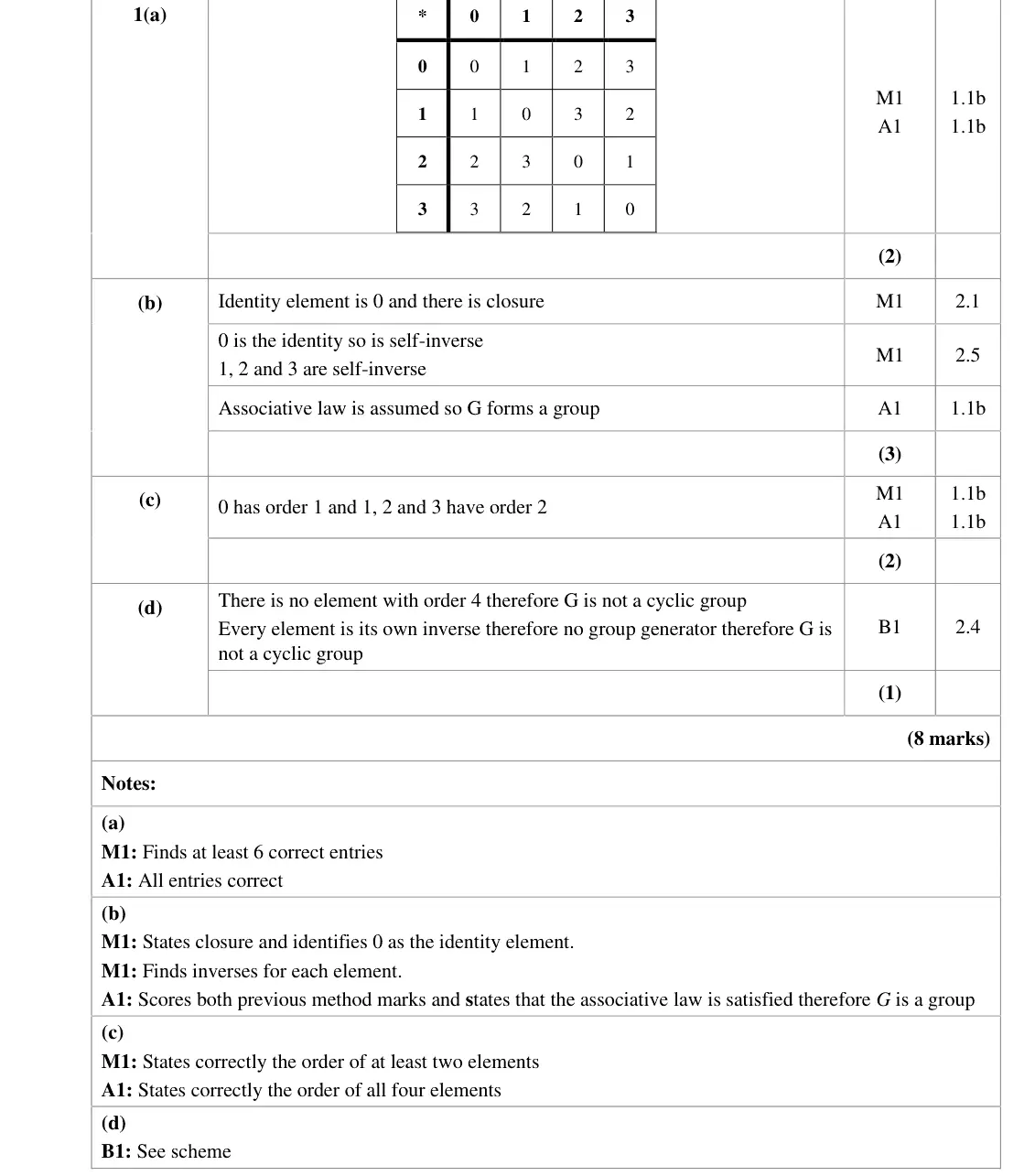
June 2023 · AS Paper 2 (Further Pure 2) · Q1(a)2 marks
Mark scheme (whole question; this part is marked with the orange bar)
Examiner's comment
Candidates found that this was a good starter question and they were able to demonstrate their understanding of what a group is. Part (a) was very accessible for all candidates, the majority scored 2 out of 2
Key points from the mark scheme and examiner's report
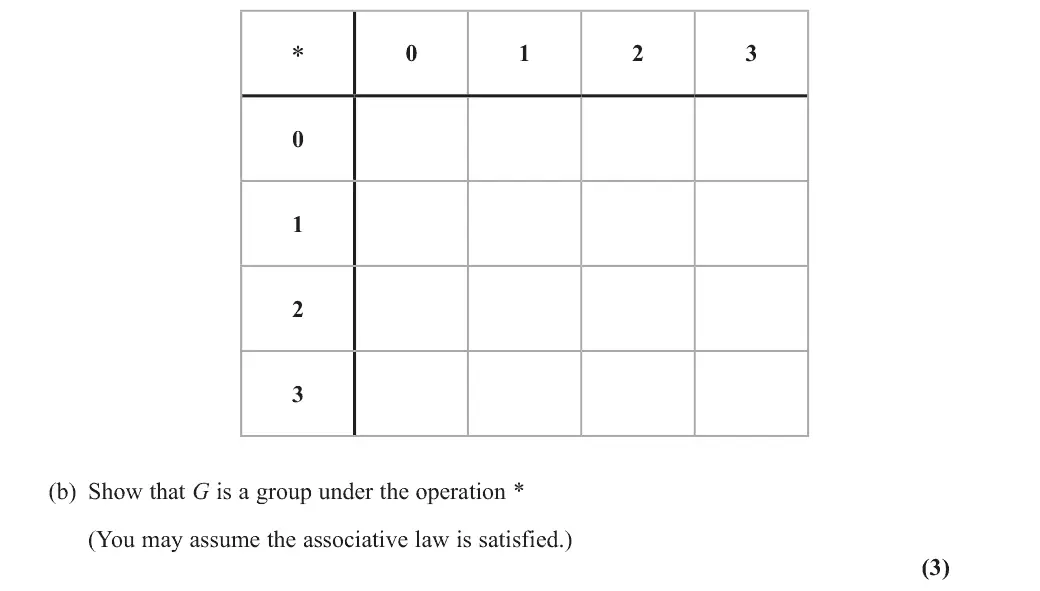
evaluate x + y − 2xy mod 4 for each pair
rows 0 1 2 3 / 1 0 3 2 / 2 3 0 1 / 3 2 1 0
very accessible
June 2023 · AS Paper 2 (Further Pure 2) · Q1(b)3 marks
Mark scheme (whole question; this part is marked with the orange bar)
Examiner's comment
Candidates found that this was a good starter question and they were able to demonstrate their understanding of what a group is. Part (b) Candidates clearly knew the axioms of a group and the majority were able to explain why G was a group.
Key points from the mark scheme and examiner's report
from the table: closure, identity 0, every element self-inverse, associativity given, so G is a group
must state each inverse and conclude
June 2023 · AS Paper 2 (Further Pure 2) · Q1(c)2 marks
Mark scheme (whole question; this part is marked with the orange bar)
Examiner's comment
Candidates found that this was a good starter question and they were able to demonstrate their understanding of what a group is. Part (c) Candidates clearly knew the term cyclic group and were able to give a reason why G was not cyclic.
Key points from the mark scheme and examiner's report
0 has order 1
1, 2 and 3 have order 2
June 2023 · AS Paper 2 (Further Pure 2) · Q1(d)1 mark
Mark scheme (whole question; this part is marked with the orange bar)
Examiner's comment
Candidates found that this was a good starter question and they were able to demonstrate their understanding of what a group is.
Key points from the mark scheme and examiner's report
not cyclic: no element of order 4, so no generator
June 2023 · Paper 4A (Further Pure 2) · Q7(a)2 marks
Mark scheme (whole question; this part is marked with the orange bar)
Examiner's comment
(a) The majority of candidates knew how to find identity element. Some used trial and error and showed that the identity element was – 1 which was fine.
Key points from the mark scheme and examiner's report
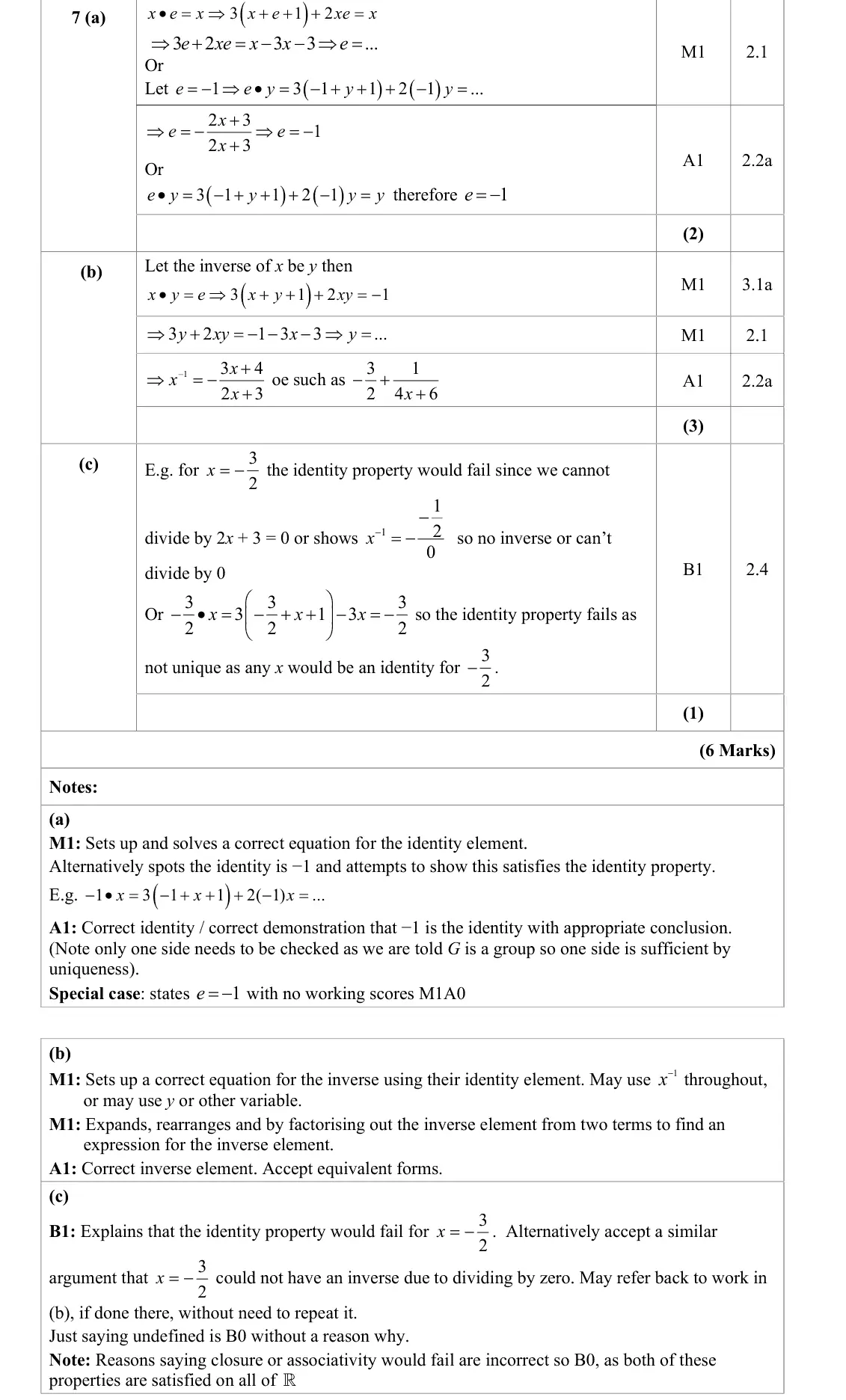
3(x + e + 1) + 2xe = x gives e = −1
June 2023 · Paper 4A (Further Pure 2) · Q7(b)3 marks
Mark scheme (whole question; this part is marked with the orange bar)
Examiner's comment
(b) There was less success with this part, setting the operation = –1 and rearranging to find the inverse. A common error was thinking that 1 1 xx-= - when substitutes into the operation, this lost 2 marks.
Key points from the mark scheme and examiner's report
x • y = −1 (not 1): y = −(3x + 4)/(2x + 3)
taking x⁻¹ as 1/x lost marks
June 2023 · Paper 4A (Further Pure 2) · Q7(c)1 mark
Mark scheme (whole question; this part is marked with the orange bar)
Examiner's comment
(c) The least well-done part. Many candidates stated that the inverse is undefined but did not say why. Candidates are reminded to give clear reasoning for their answers. Some candidates showed that 𝑥• - 3 2 = - 3 2 but concluded therefore it has no inverse instead of all elements are its inverse.
Key points from the mark scheme and examiner's report
x = −3/2 has no inverse (division by 2x + 3 = 0), or −3/2 • x = −3/2 for all x
'undefined' with no reason scores 0
closure/associativity reasons are wrong
June 2022 · AS Paper 2 (Further Pure 2) · Q3(i)3 marks
Mark scheme (whole question; this part is marked with the orange bar)
Examiner's comment
The question overall worked well as far as can be ascertained from the small candidature. However, it is clear group theory is still an unfamiliar topic which has yet to settle in candidates minds. Over time, with more past papers to practice, no doubt the topic will become more familiar, but still early in the new specification there are still some new ideas being assessed. It was the only question in which maximum marks was not achieved by any of the small candidature, though each individual mark was awarded to some. Part (i) was left out entirely by most, but those who did attempt it were generally successful. The idea of a proof perhaps put off some people, but the need for the divisibility test was shown by all those attempting. Not all identified Lagrange’s theorem explicitly, though most at least alluded to the result. Setting up a formal assumption for contradiction was not well done, but the scheme allowed flexibility with the approach. Two or three marks were common for those attempting this part. In part (ii) many did just the table and nothing more, picking up a few easy marks without attempting the rest. Only a couple left out the question entirely, but the modal score for the question was 3 marks, usually for the table and nothing more, though a couple made an error in the table but picked up one mark elsewhere. Spotting 16 as the identity proved the most difficult challenge to the group axioms, with some assuming it should be 1, and concluding there is no identity so not a group (for which a special case was allowed for one of the last three marks). Those who were able to spot the identity generally went on to score full marks for part (ii).
Key points from the mark scheme and examiner's report
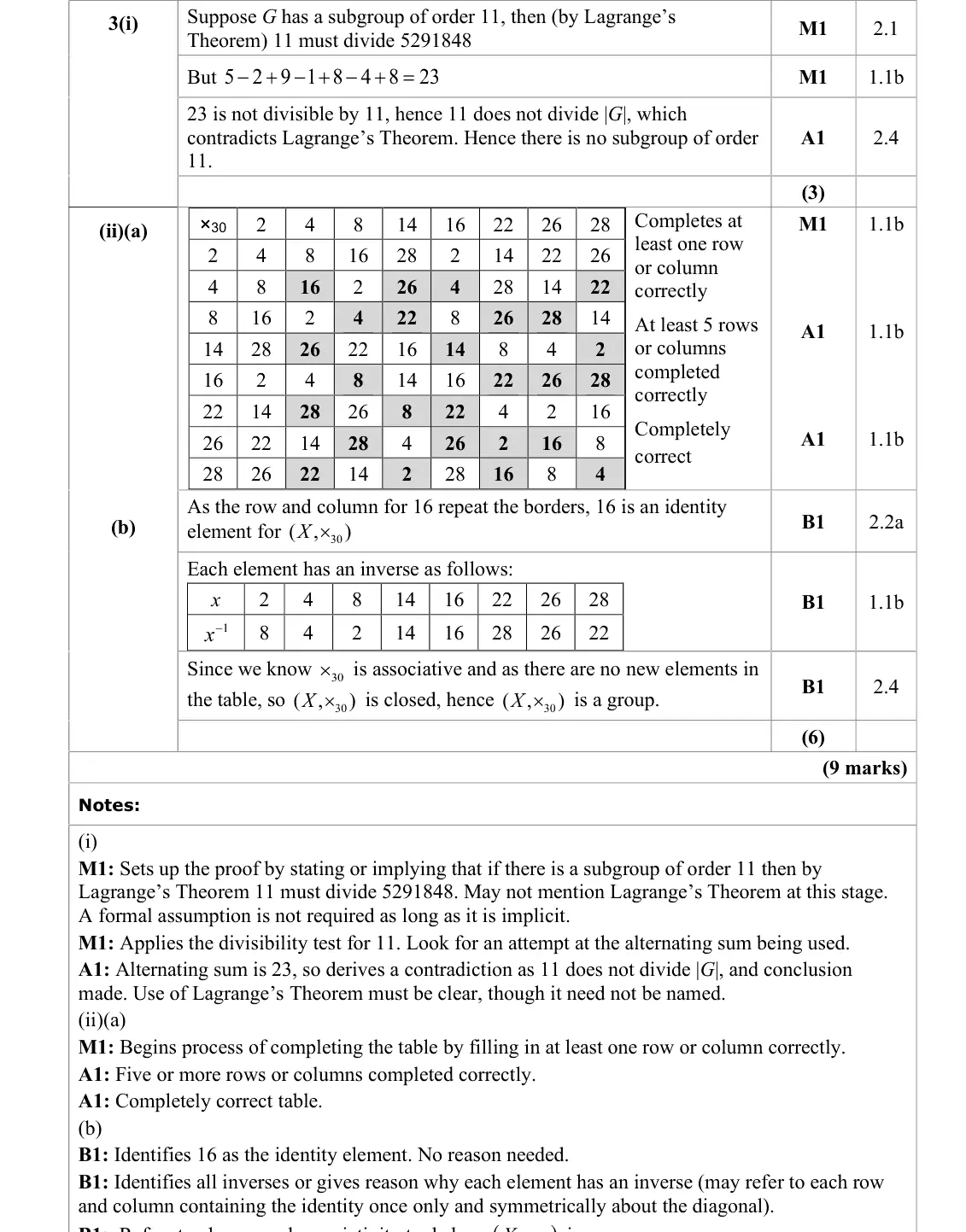
assume a subgroup of order 11 exists, so by Lagrange 11 divides 5 291 848
alternating digit sum 23 is not divisible by 11: contradiction
most omitted this part
the formal assumption was often weak
June 2022 · AS Paper 2 (Further Pure 2) · Q3(ii)6 marks
Mark scheme (whole question; this part is marked with the orange bar)
Examiner's comment
The question overall worked well as far as can be ascertained from the small candidature. However, it is clear group theory is still an unfamiliar topic which has yet to settle in candidates minds. Over time, with more past papers to practice, no doubt the topic will become more familiar, but still early in the new specification there are still some new ideas being assessed. It was the only question in which maximum marks was not achieved by any of the small candidature, though each individual mark was awarded to some. Part (i) was left out entirely by most, but those who did attempt it were generally successful. The idea of a proof perhaps put off some people, but the need for the divisibility test was shown by all those attempting. Not all identified Lagrange’s theorem explicitly, though most at least alluded to the result. Setting up a formal assumption for contradiction was not well done, but the scheme allowed flexibility with the approach. Two or three marks were common for those attempting this part. In part (ii) many did just the table and nothing more, picking up a few easy marks without attempting the rest. Only a couple left out the question entirely, but the modal score for the question was 3 marks, usually for the table and nothing more, though a couple made an error in the table but picked up one mark elsewhere. Spotting 16 as the identity proved the most difficult challenge to the group axioms, with some assuming it should be 1, and concluding there is no identity so not a group (for which a special case was allowed for one of the last three marks). Those who were able to spot the identity generally went on to score full marks for part (ii).
Key points from the mark scheme and examiner's report
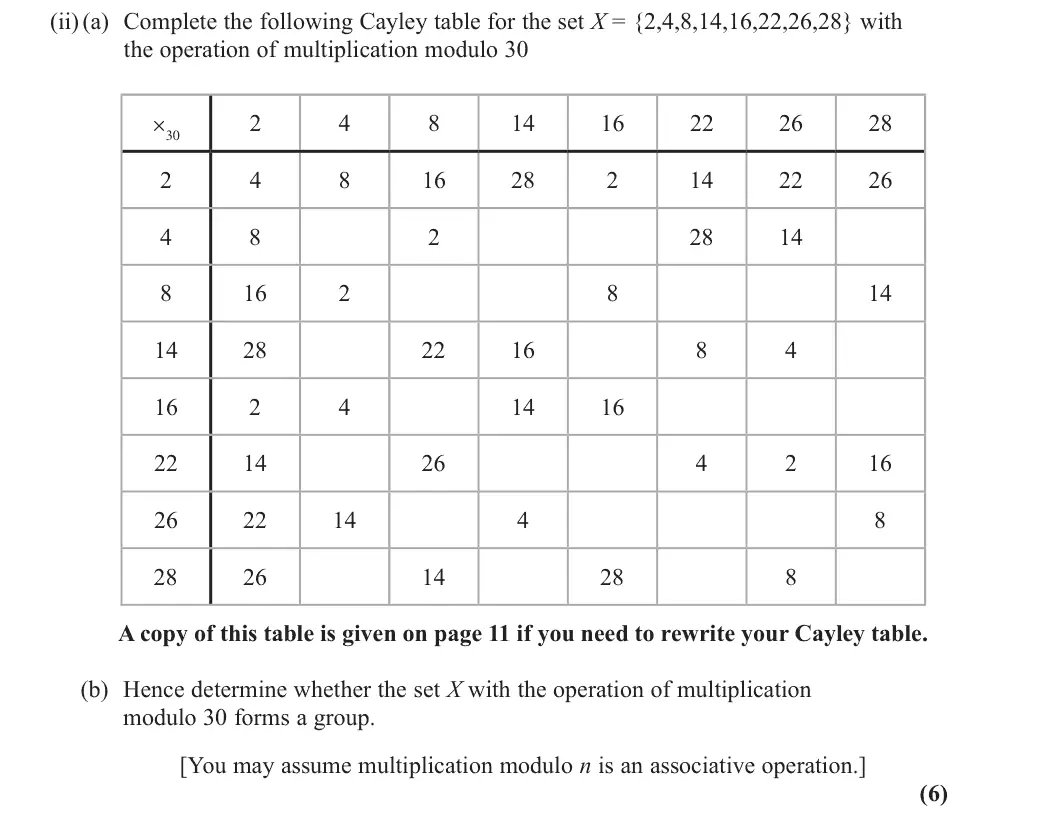
complete the Cayley table mod 30
the identity is 16 (not 1)
inverses 2↔8, 4, 14, 16 self-inverse, 22↔28, 26
closure and given associativity so X is a group
many did only the table
spotting 16 as the identity was the main difficulty
June 2022 · Paper 4A (Further Pure 2) · Q1(a)1 mark
Mark scheme (whole question; this part is marked with the orange bar)
Examiner's comment
Most candidates made good progress with this question, demonstrating good knowledge of permutation notation, although some only wrote ‘1’ or ‘e’ for the identity, and expressed the inverse in an unconventional order.
Key points from the mark scheme and examiner's report
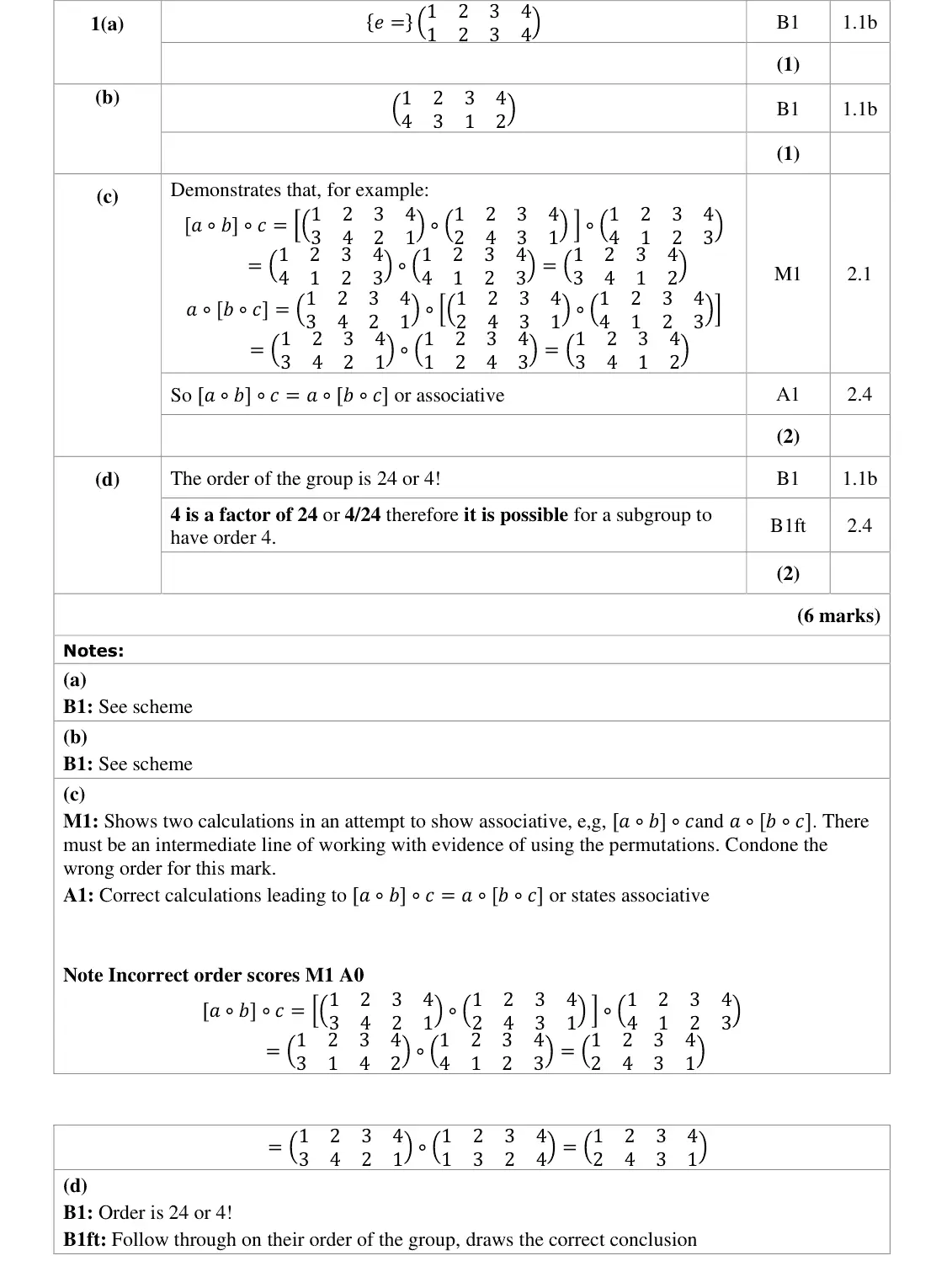
identity is the permutation (1 2 3 4 / 1 2 3 4)
'1' or 'e' alone not enough
June 2022 · Paper 4A (Further Pure 2) · Q1(b)1 mark
Mark scheme (whole question; this part is marked with the orange bar)
Examiner's comment
Most candidates made good progress with this question, demonstrating good knowledge of permutation notation, although some only wrote ‘1’ or ‘e’ for the identity, and expressed the inverse in an unconventional order.
Key points from the mark scheme and examiner's report
inverse of a is (1 2 3 4 / 4 3 1 2)
write the top row in order
June 2022 · Paper 4A (Further Pure 2) · Q1(c)2 marks
Mark scheme (whole question; this part is marked with the orange bar)
Examiner's comment
Part (c) caused more issues. Candidates demonstrated that the axiom associative with many candidates however composing the permutations the wrong way round.
Key points from the mark scheme and examiner's report
compute (a∘b)∘c and a∘(b∘c) with intermediate permutations: both (1 2 3 4 / 3 4 1 2)
composing in the wrong order (left to right) scores M1 A0
June 2022 · Paper 4A (Further Pure 2) · Q1(d)2 marks
Mark scheme (whole question; this part is marked with the orange bar)
Examiner's comment
Part (d) most candidates demonstrated that they knew the required condition on subgroup orders, but many gave the wrong value for the order of S4.
Key points from the mark scheme and examiner's report
order of S₄ is 4! = 24 and 4 divides 24, so Lagrange allows it
many gave the wrong order for S₄
Nov 2021 · Paper 4A (Further Pure 2) · Q2(a)1 mark
Mark scheme (whole question; this part is marked with the orange bar)
Key points from the mark scheme and examiner's report
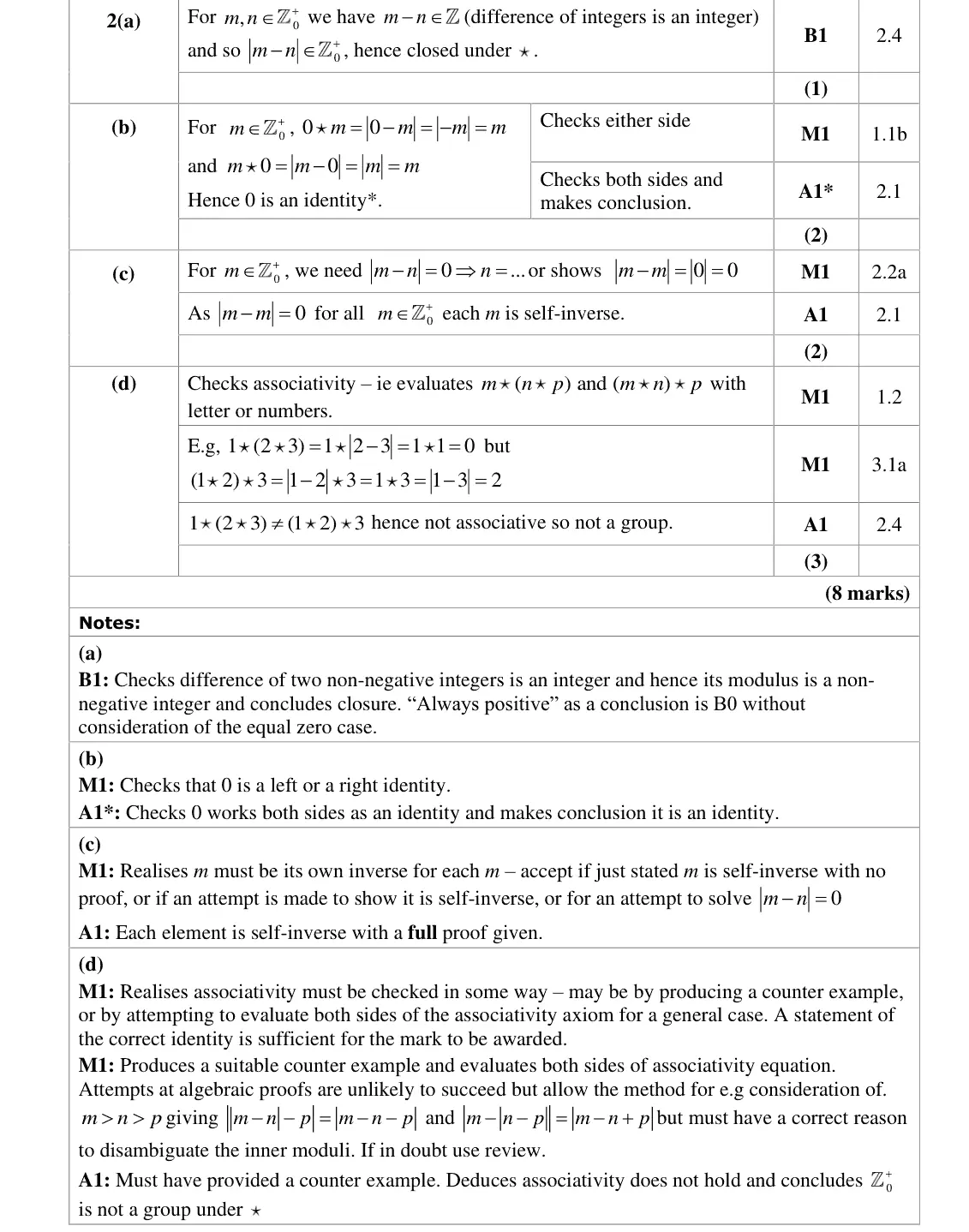
difference of integers is an integer, so its modulus is a non-negative integer
'always positive' ignores the zero case
Nov 2021 · Paper 4A (Further Pure 2) · Q2(b)2 marks
Mark scheme (whole question; this part is marked with the orange bar)
Key points from the mark scheme and examiner's report
check both 0 ★ m and m ★ 0 equal m, then conclude
Nov 2021 · Paper 4A (Further Pure 2) · Q2(c)2 marks
Mark scheme (whole question; this part is marked with the orange bar)
Key points from the mark scheme and examiner's report
modulus of m − m = 0 so every element is self-inverse
full proof needed
Nov 2021 · Paper 4A (Further Pure 2) · Q2(d)3 marks
Mark scheme (whole question; this part is marked with the orange bar)
Key points from the mark scheme and examiner's report
not associative, e.g. 1 ★ (2 ★ 3) = 0 but (1 ★ 2) ★ 3 = 2, so not a group
a counter-example must be given
Nov 2021 · Paper 4A (Further Pure 2) · Q47 marks
Mark scheme (whole question; this part is marked with the orange bar)
Key points from the mark scheme and examiner's report
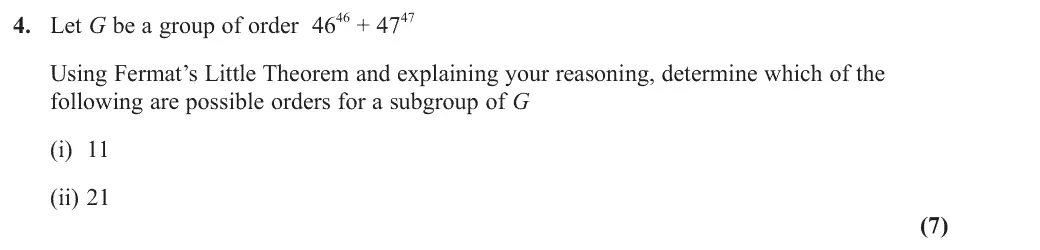
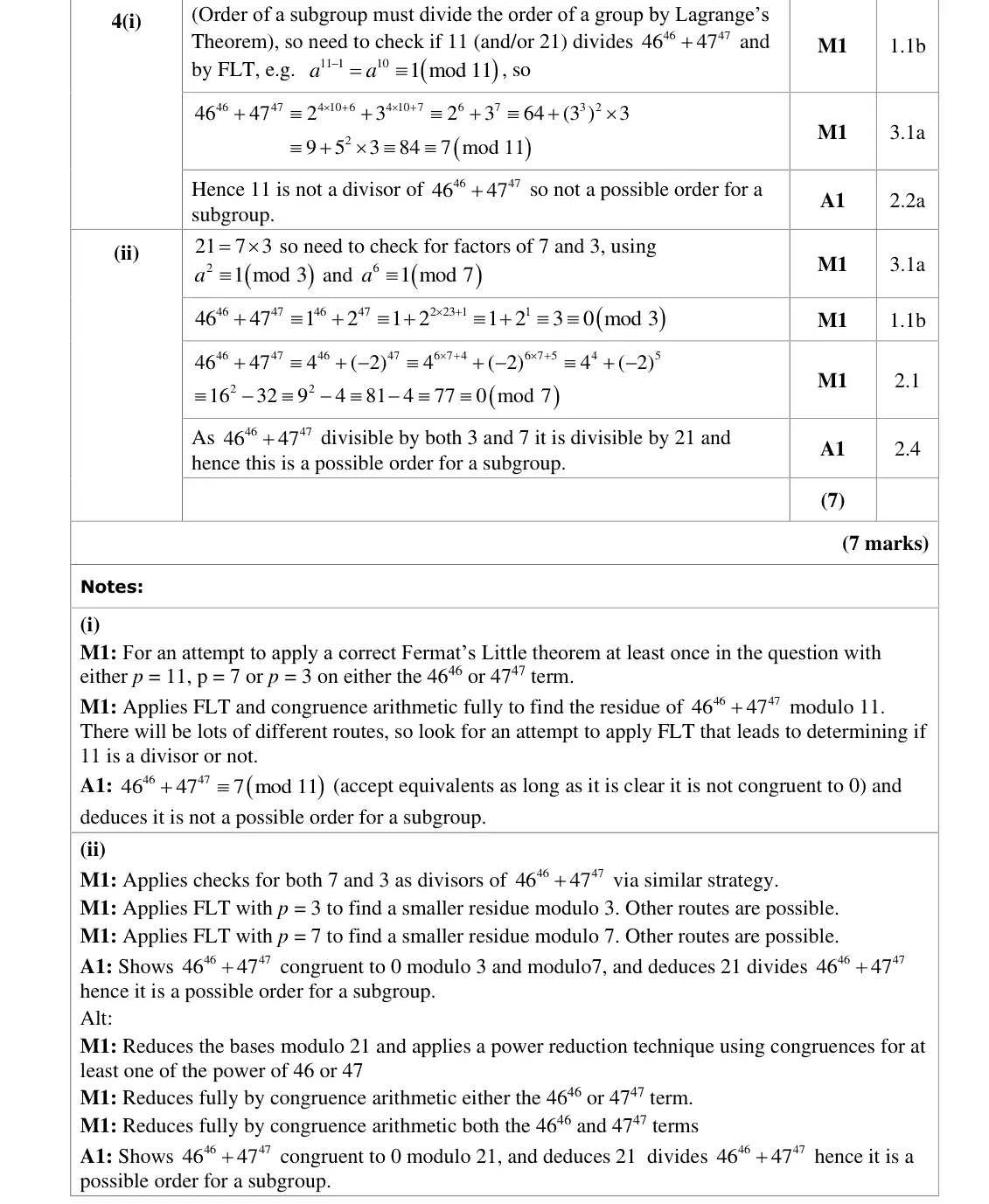
Lagrange: a subgroup order must divide 46⁴⁶ + 47⁴⁷
FLT mod 11 gives residue 7 so 11 is not possible
mod 3 and mod 7 both give 0, so 21 divides it and is possible
Oct 2020 · AS Paper 2 (Further Pure 2) · Q1(a)3 marks
Mark scheme (whole question; this part is marked with the orange bar)
Key points from the mark scheme and examiner's report
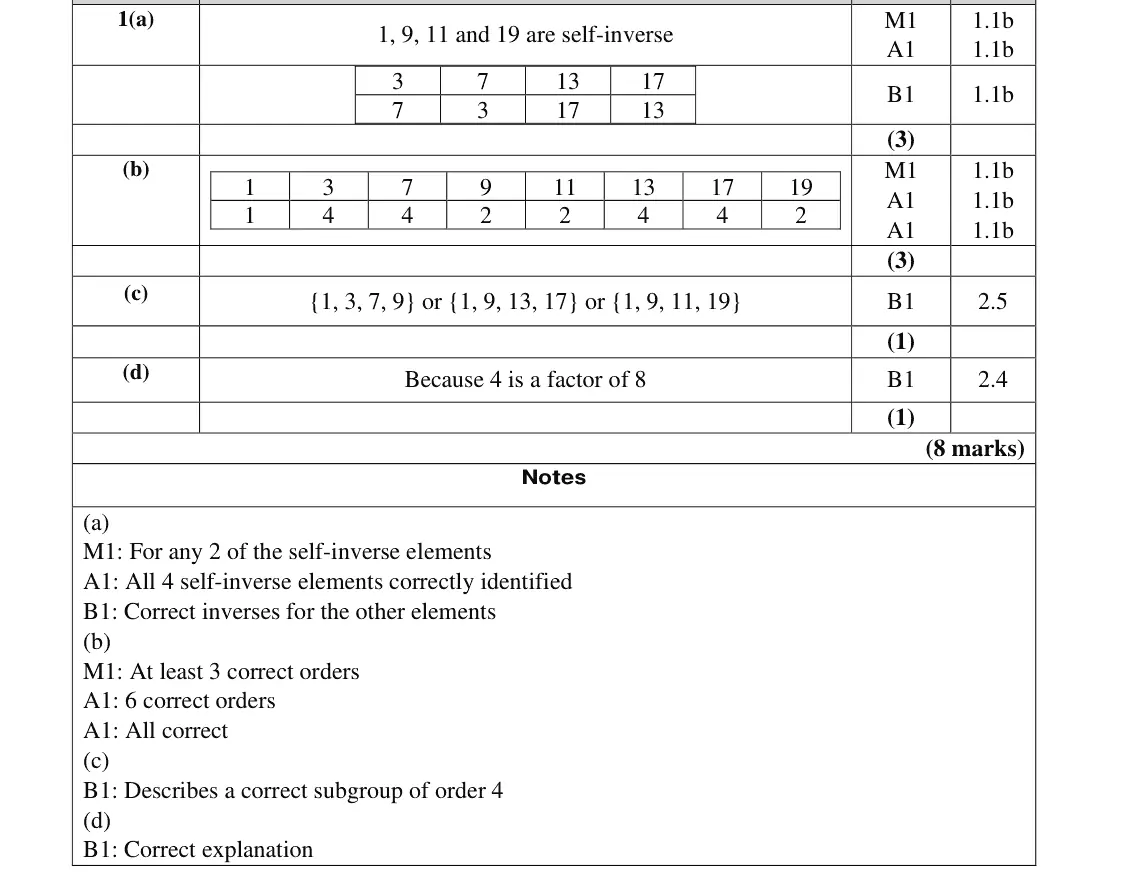
1, 9, 11 and 19 are self-inverse
3 and 7, 13 and 17 are inverse pairs (products ≡ 1 mod 20)
Oct 2020 · AS Paper 2 (Further Pure 2) · Q1(b)3 marks
Mark scheme (whole question; this part is marked with the orange bar)
Key points from the mark scheme and examiner's report
orders: 1 has order 1
9, 11, 19 order 2
3, 7, 13, 17 order 4
Oct 2020 · AS Paper 2 (Further Pure 2) · Q1(c)1 mark
Mark scheme (whole question; this part is marked with the orange bar)
Key points from the mark scheme and examiner's report
{1, 3, 7, 9}, {1, 9, 13, 17} or {1, 9, 11, 19}
must be closed
Oct 2020 · AS Paper 2 (Further Pure 2) · Q1(d)1 mark
Mark scheme (whole question; this part is marked with the orange bar)
Key points from the mark scheme and examiner's report
the subgroup order 4 is a factor of the group order 8
Oct 2020 · Paper 4A (Further Pure 2) · Q6(a)2 marks
Mark scheme (whole question; this part is marked with the orange bar)
Key points from the mark scheme and examiner's report
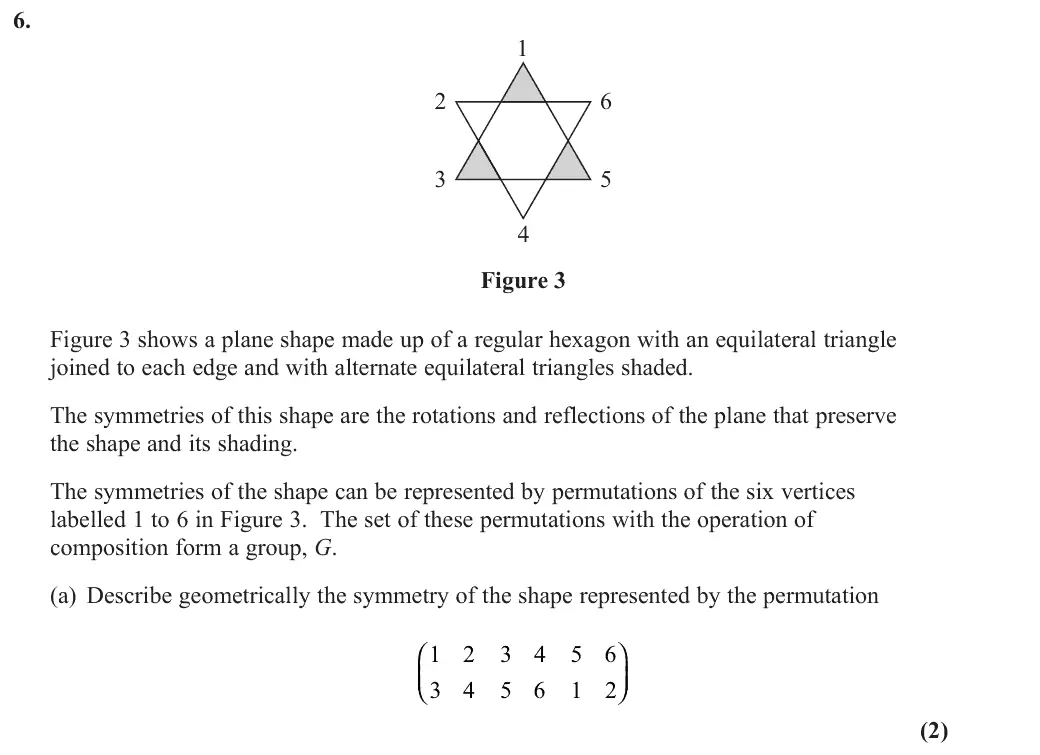
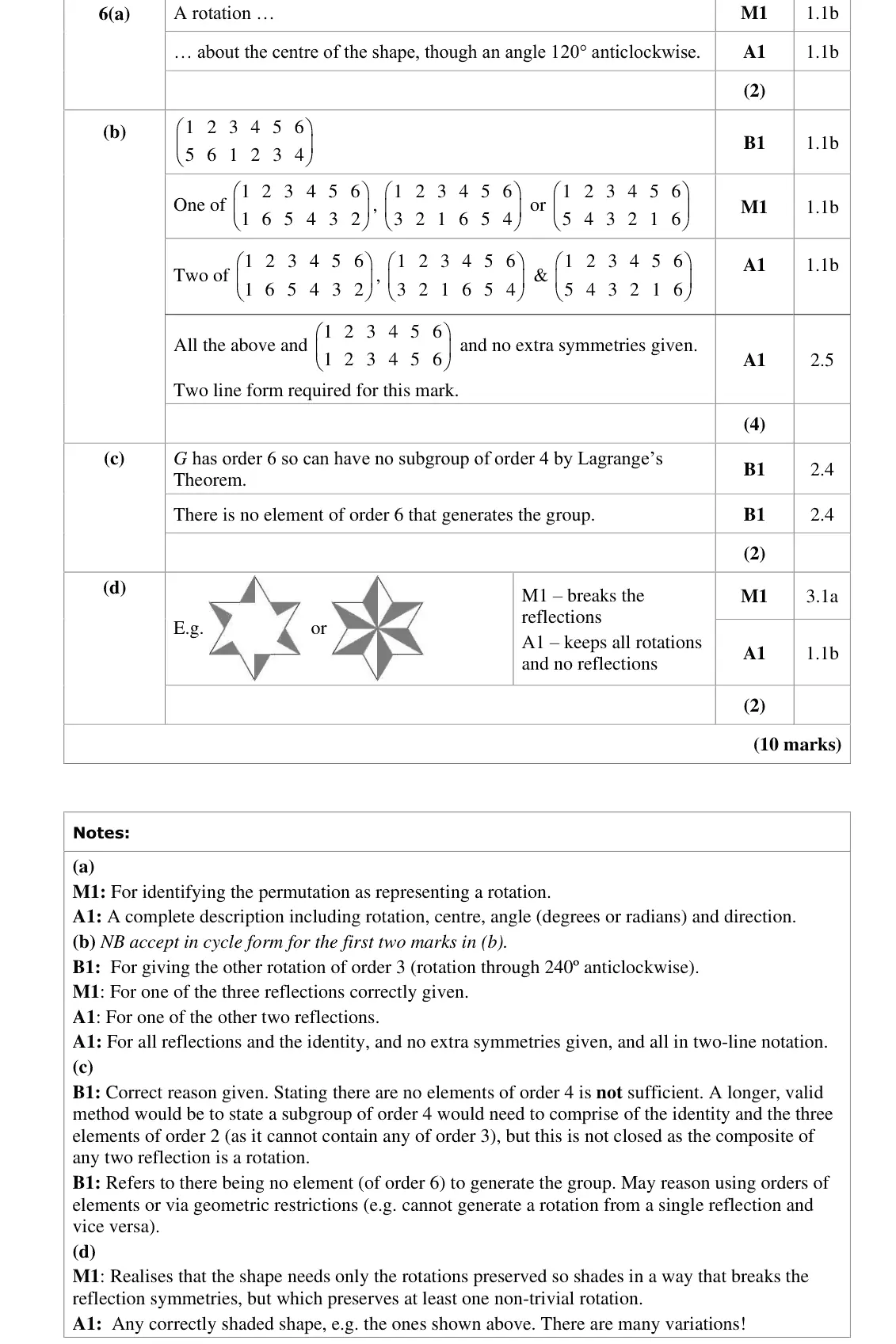
rotation about the centre through 120° anticlockwise
centre, angle and direction all needed
Oct 2020 · Paper 4A (Further Pure 2) · Q6(b)4 marks
Mark scheme (whole question; this part is marked with the orange bar)
Key points from the mark scheme and examiner's report
the other rotation (240°), the three reflections and the identity, all in two-line notation and no extras
Oct 2020 · Paper 4A (Further Pure 2) · Q6(c)2 marks
Mark scheme (whole question; this part is marked with the orange bar)
Key points from the mark scheme and examiner's report
(i) order 6, and 4 does not divide 6 (Lagrange)
saying no elements have order 4 is not enough
(ii) no element of order 6 to generate G
Oct 2020 · Paper 4A (Further Pure 2) · Q6(d)2 marks
Mark scheme (whole question; this part is marked with the orange bar)
Key points from the mark scheme and examiner's report
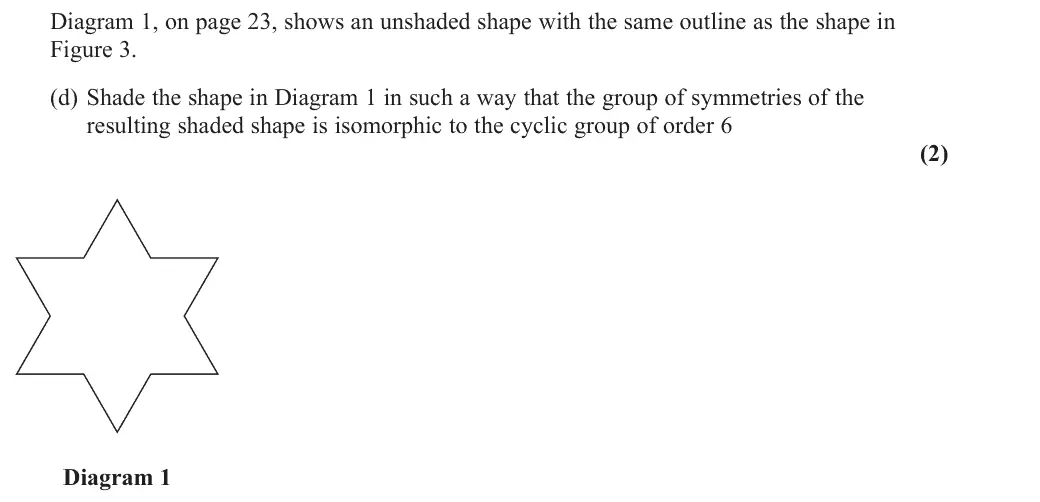
shade so that all rotations are kept but every reflection is broken, e.g. one half of each point shaded in the same rotational sense
June 2019 · AS Paper 2 (Further Pure 2) · Q4(a)2 marks
Mark scheme (whole question; this part is marked with the orange bar)
Examiner's comment
The majority of candidates where able to have a good attempt at this question on groups. Part (a) Most of the candidates were able to prove at least of the two statements. A few did not start from the left-hand side so did not achieve the printed statement e.g. * * * * p p p p s s r * * * * * p q p p p p s s r instead of
Key points from the mark scheme and examiner's report
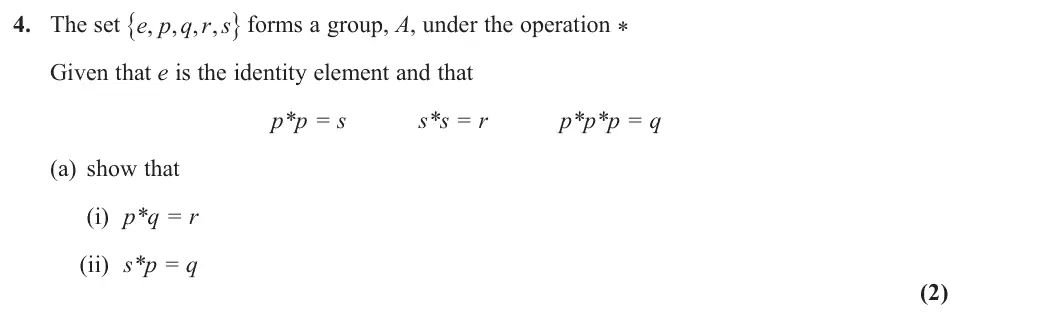
p*q = p*p*p*p = s*s = r
s*p = p*p*p = q
start from the left-hand side, not the given result
June 2019 · AS Paper 2 (Further Pure 2) · Q4(b)2 marks
Mark scheme (whole question; this part is marked with the orange bar)
Examiner's comment
The majority of candidates where able to have a good attempt at this question on groups. Part (b) All the candidates were able to fill in some elements in the Cayley table, with most completing the first row and column using the identity element and the given results. Many then stopped at this point and did not complete the table.
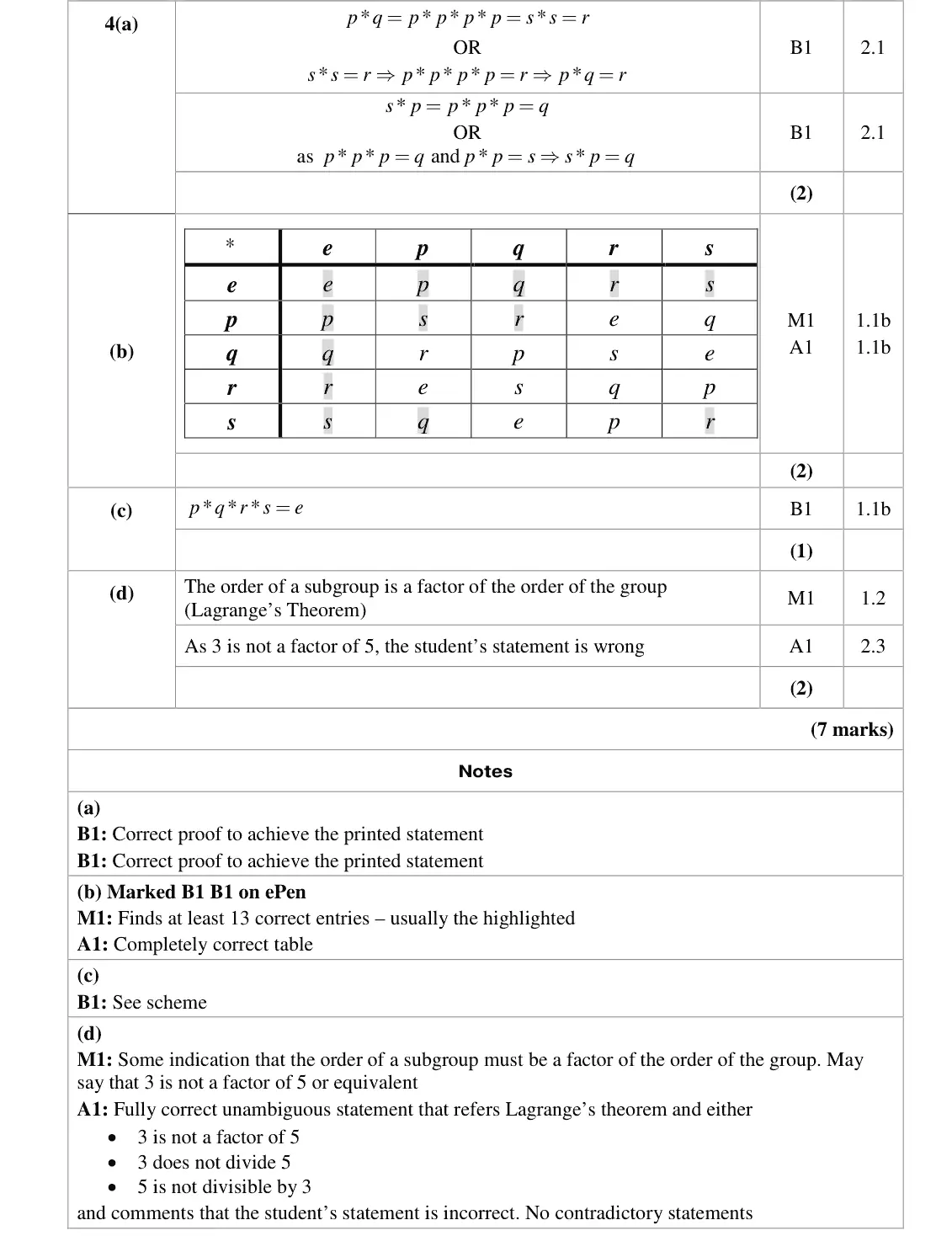
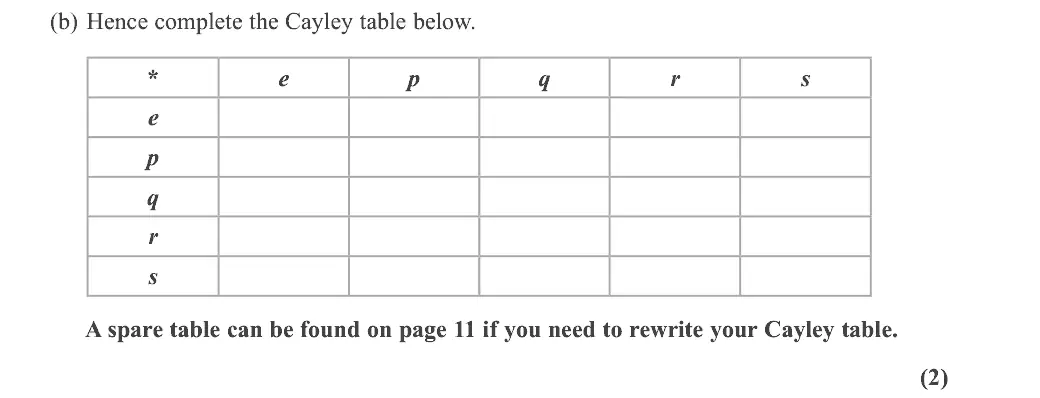
Key points from the mark scheme and examiner's report
use the identity and the given results
at least 13 correct entries for M1
many stopped after the first row and column
June 2019 · AS Paper 2 (Further Pure 2) · Q4(c)1 mark
Mark scheme (whole question; this part is marked with the orange bar)
Examiner's comment
The majority of candidates where able to have a good attempt at this question on groups. Part (c) This required candidates to make reference to Lagrange’s theorem, the order of a subgroup must be a factor of the order of the group. They needed to say that as 3 is not a factor of 5 the candidate’s statement is incorrect. Again, candidates need to refer to the demand of the question, comment on the validity of the statement. Some candidates did not refer to the statement in their conclusion.
Key points from the mark scheme and examiner's report
p*q*r*s = e
June 2019 · AS Paper 2 (Further Pure 2) · Q4(d)2 marks
Mark scheme (whole question; this part is marked with the orange bar)
Examiner's comment
The majority of candidates where able to have a good attempt at this question on groups.
Key points from the mark scheme and examiner's report
Lagrange's theorem: the order of a subgroup divides the order of the group
3 is not a factor of 5 so the statement is wrong
must comment on the student's statement
June 2019 · Paper 4A (Further Pure 2) · Q6(i)4 marks
Mark scheme (whole question; this part is marked with the orange bar)
Examiner's comment
Another fresh topic to the new specification, but once again it was answer well by most, certainly part (i). It is clear that the new topics have been covered well in preparing candidates for the exam. In part (i) the most common score profile was M1 M1 A0 A1. The general outline of the proof was attempted well, but many lacked the rigour required as they did not achieve suitable expressions for the expansions to verify both yielded the same. The definition of associativity was understood by nearly all of the candidates sitting the paper, but a small number of them gave a numerical example of it working for once case, rather than a proof. A single example will be required in order to show an operation is not associative, but is not sufficient to prove an operation is. Part (ii) is where the most of the difficulty in this question lay. For part (a) many candidates realised the group was cyclic since 3 (only a small number used 5) was a generator, but some merely stated this was so because its order is 6 and did not show how it generated the rest of the group. Those who listed the powers of 3 (or 5) would usually gain both marks for completing the argument that the group was cyclic. Others assumed that writing out the group tables was proof of being cyclic. Identifying the subgroups in part (b) produced a variety of response, but usually scoring two of the available marks. The subgroup {1, 17} was usually identified correctly, but {1,7,13} was sometimes missed, as were one or other of {1} and H itself. many also identified spurious subgroups such as {1,5}, {1,7}, {1,13} and so on, assuming 1 and any element formed a subgroup. Nevertheless, many were able to identify the three correct subgroups and no others. Part (c) proved provided the most challenge for candidates in this question. Most commonly either 3 or 0 marks were scored on this part as candidates either knew what to do and got it correct, or did not even know where to start. Many would just match up elements in ascending order, which did not gain access to marks. Others attempted to explain what an isomorphism is in general terms rather than identify a specific isomorphism for the group. There were some good attempts at defining mappings algebraically by identifying that powers of a generator needed to map to powers of a generator. Candidates attempting such an approach usually scored well. Partially correct attempts at this approach tended to stem from attempting to match elements by order, which would give correct pairings 1→ 1 and 6 → 17 and that {2,4} → {7, 13} and {3,5} → {5,11}, but would then choose incorrect pairings for the latter two elements for their pairings for {2,4}. Some did not make a selection at all, but left the set-wise mappings, which was not sufficient information to identify an isomorphism.
Key points from the mark scheme and examiner's report
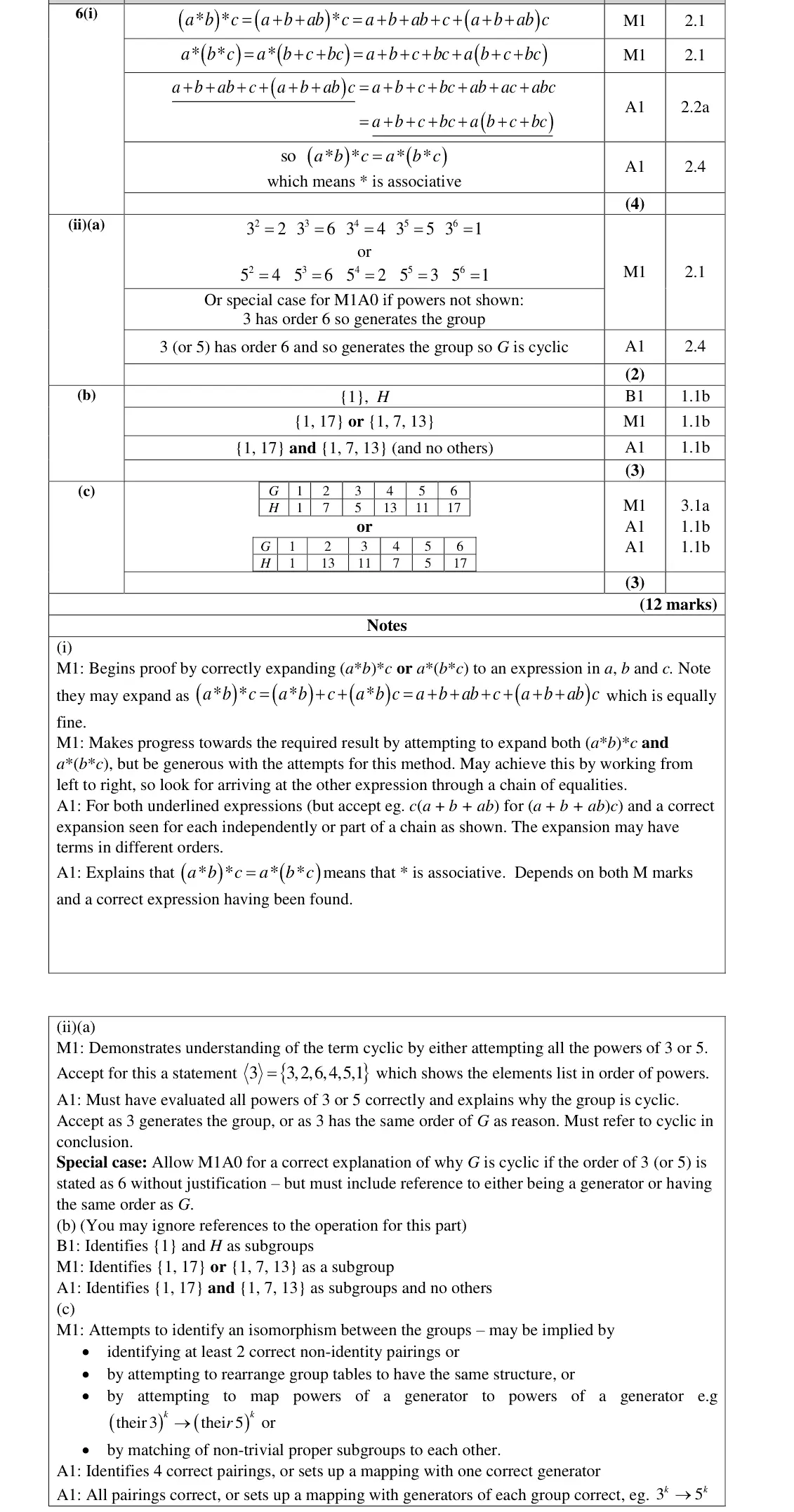
expand both (a*b)*c and a*(b*c) fully to a + b + c + ab + bc + ac + abc and conclude
a numerical example is not a proof
most common score M1M1A0A1
June 2019 · Paper 4A (Further Pure 2) · Q6(ii)(a)2 marks
Mark scheme (whole question; this part is marked with the orange bar)
Examiner's comment
Another fresh topic to the new specification, but once again it was answer well by most, certainly part (i). It is clear that the new topics have been covered well in preparing candidates for the exam. In part (i) the most common score profile was M1 M1 A0 A1. The general outline of the proof was attempted well, but many lacked the rigour required as they did not achieve suitable expressions for the expansions to verify both yielded the same. The definition of associativity was understood by nearly all of the candidates sitting the paper, but a small number of them gave a numerical example of it working for once case, rather than a proof. A single example will be required in order to show an operation is not associative, but is not sufficient to prove an operation is. Part (ii) is where the most of the difficulty in this question lay. For part (a) many candidates realised the group was cyclic since 3 (only a small number used 5) was a generator, but some merely stated this was so because its order is 6 and did not show how it generated the rest of the group. Those who listed the powers of 3 (or 5) would usually gain both marks for completing the argument that the group was cyclic. Others assumed that writing out the group tables was proof of being cyclic. Identifying the subgroups in part (b) produced a variety of response, but usually scoring two of the available marks. The subgroup {1, 17} was usually identified correctly, but {1,7,13} was sometimes missed, as were one or other of {1} and H itself. many also identified spurious subgroups such as {1,5}, {1,7}, {1,13} and so on, assuming 1 and any element formed a subgroup. Nevertheless, many were able to identify the three correct subgroups and no others. Part (c) proved provided the most challenge for candidates in this question. Most commonly either 3 or 0 marks were scored on this part as candidates either knew what to do and got it correct, or did not even know where to start. Many would just match up elements in ascending order, which did not gain access to marks. Others attempted to explain what an isomorphism is in general terms rather than identify a specific isomorphism for the group. There were some good attempts at defining mappings algebraically by identifying that powers of a generator needed to map to powers of a generator. Candidates attempting such an approach usually scored well. Partially correct attempts at this approach tended to stem from attempting to match elements by order, which would give correct pairings 1→ 1 and 6 → 17 and that {2,4} → {7, 13} and {3,5} → {5,11}, but would then choose incorrect pairings for the latter two elements for their pairings for {2,4}. Some did not make a selection at all, but left the set-wise mappings, which was not sufficient information to identify an isomorphism.
Key points from the mark scheme and examiner's report
list the powers of 3 (or 5) mod 7 to show it has order 6 and generates G
stating the order without the powers scores M1A0
June 2019 · Paper 4A (Further Pure 2) · Q6(ii)(b)3 marks
Mark scheme (whole question; this part is marked with the orange bar)
Examiner's comment
Another fresh topic to the new specification, but once again it was answer well by most, certainly part (i). It is clear that the new topics have been covered well in preparing candidates for the exam. In part (i) the most common score profile was M1 M1 A0 A1. The general outline of the proof was attempted well, but many lacked the rigour required as they did not achieve suitable expressions for the expansions to verify both yielded the same. The definition of associativity was understood by nearly all of the candidates sitting the paper, but a small number of them gave a numerical example of it working for once case, rather than a proof. A single example will be required in order to show an operation is not associative, but is not sufficient to prove an operation is. Part (ii) is where the most of the difficulty in this question lay. For part (a) many candidates realised the group was cyclic since 3 (only a small number used 5) was a generator, but some merely stated this was so because its order is 6 and did not show how it generated the rest of the group. Those who listed the powers of 3 (or 5) would usually gain both marks for completing the argument that the group was cyclic. Others assumed that writing out the group tables was proof of being cyclic. Identifying the subgroups in part (b) produced a variety of response, but usually scoring two of the available marks. The subgroup {1, 17} was usually identified correctly, but {1,7,13} was sometimes missed, as were one or other of {1} and H itself. many also identified spurious subgroups such as {1,5}, {1,7}, {1,13} and so on, assuming 1 and any element formed a subgroup. Nevertheless, many were able to identify the three correct subgroups and no others. Part (c) proved provided the most challenge for candidates in this question. Most commonly either 3 or 0 marks were scored on this part as candidates either knew what to do and got it correct, or did not even know where to start. Many would just match up elements in ascending order, which did not gain access to marks. Others attempted to explain what an isomorphism is in general terms rather than identify a specific isomorphism for the group. There were some good attempts at defining mappings algebraically by identifying that powers of a generator needed to map to powers of a generator. Candidates attempting such an approach usually scored well. Partially correct attempts at this approach tended to stem from attempting to match elements by order, which would give correct pairings 1→ 1 and 6 → 17 and that {2,4} → {7, 13} and {3,5} → {5,11}, but would then choose incorrect pairings for the latter two elements for their pairings for {2,4}. Some did not make a selection at all, but left the set-wise mappings, which was not sufficient information to identify an isomorphism.
Key points from the mark scheme and examiner's report
{1}, H, {1, 17}, {1, 7, 13} and no others
spurious {1, 5}, {1, 7} etc. common
{1, 7, 13} often missed
June 2019 · Paper 4A (Further Pure 2) · Q6(ii)(c)3 marks
Mark scheme (whole question; this part is marked with the orange bar)
Examiner's comment
Another fresh topic to the new specification, but once again it was answer well by most, certainly part (i). It is clear that the new topics have been covered well in preparing candidates for the exam. In part (i) the most common score profile was M1 M1 A0 A1. The general outline of the proof was attempted well, but many lacked the rigour required as they did not achieve suitable expressions for the expansions to verify both yielded the same. The definition of associativity was understood by nearly all of the candidates sitting the paper, but a small number of them gave a numerical example of it working for once case, rather than a proof. A single example will be required in order to show an operation is not associative, but is not sufficient to prove an operation is. Part (ii) is where the most of the difficulty in this question lay. For part (a) many candidates realised the group was cyclic since 3 (only a small number used 5) was a generator, but some merely stated this was so because its order is 6 and did not show how it generated the rest of the group. Those who listed the powers of 3 (or 5) would usually gain both marks for completing the argument that the group was cyclic. Others assumed that writing out the group tables was proof of being cyclic. Identifying the subgroups in part (b) produced a variety of response, but usually scoring two of the available marks. The subgroup {1, 17} was usually identified correctly, but {1,7,13} was sometimes missed, as were one or other of {1} and H itself. many also identified spurious subgroups such as {1,5}, {1,7}, {1,13} and so on, assuming 1 and any element formed a subgroup. Nevertheless, many were able to identify the three correct subgroups and no others. Part (c) proved provided the most challenge for candidates in this question. Most commonly either 3 or 0 marks were scored on this part as candidates either knew what to do and got it correct, or did not even know where to start. Many would just match up elements in ascending order, which did not gain access to marks. Others attempted to explain what an isomorphism is in general terms rather than identify a specific isomorphism for the group. There were some good attempts at defining mappings algebraically by identifying that powers of a generator needed to map to powers of a generator. Candidates attempting such an approach usually scored well. Partially correct attempts at this approach tended to stem from attempting to match elements by order, which would give correct pairings 1→ 1 and 6 → 17 and that {2,4} → {7, 13} and {3,5} → {5,11}, but would then choose incorrect pairings for the latter two elements for their pairings for {2,4}. Some did not make a selection at all, but left the set-wise mappings, which was not sufficient information to identify an isomorphism.
Key points from the mark scheme and examiner's report
map powers of a generator to powers of a generator, e.g. 3ᵏ → 5ᵏ: 1→1, 2→7, 3→5, 4→13, 5→11, 6→17
matching in ascending order or by order only scores nothing
June 2018 · AS Paper 2 (Further Pure 2) · Q2(a)6 marks
Mark scheme (whole question; this part is marked with the orange bar)
Examiner's comment
(a)(i) There were many cases here where the Cayley table had been completed fully correctly or with one or two errors so often contributed as least 2 marks. (a)(ii) The majority of students clearly knew the axioms for a group. Many referred to closure and the fact that there was an identity element and that each element had its own inverse. However, it was expected that for full marks, students should identify specifically, the inverse of each element rather than just state “each element has an inverse”. For the final mark, it was also expected that students should make a conclusion such as “so T forms a group”.
Key points from the mark scheme and examiner's report
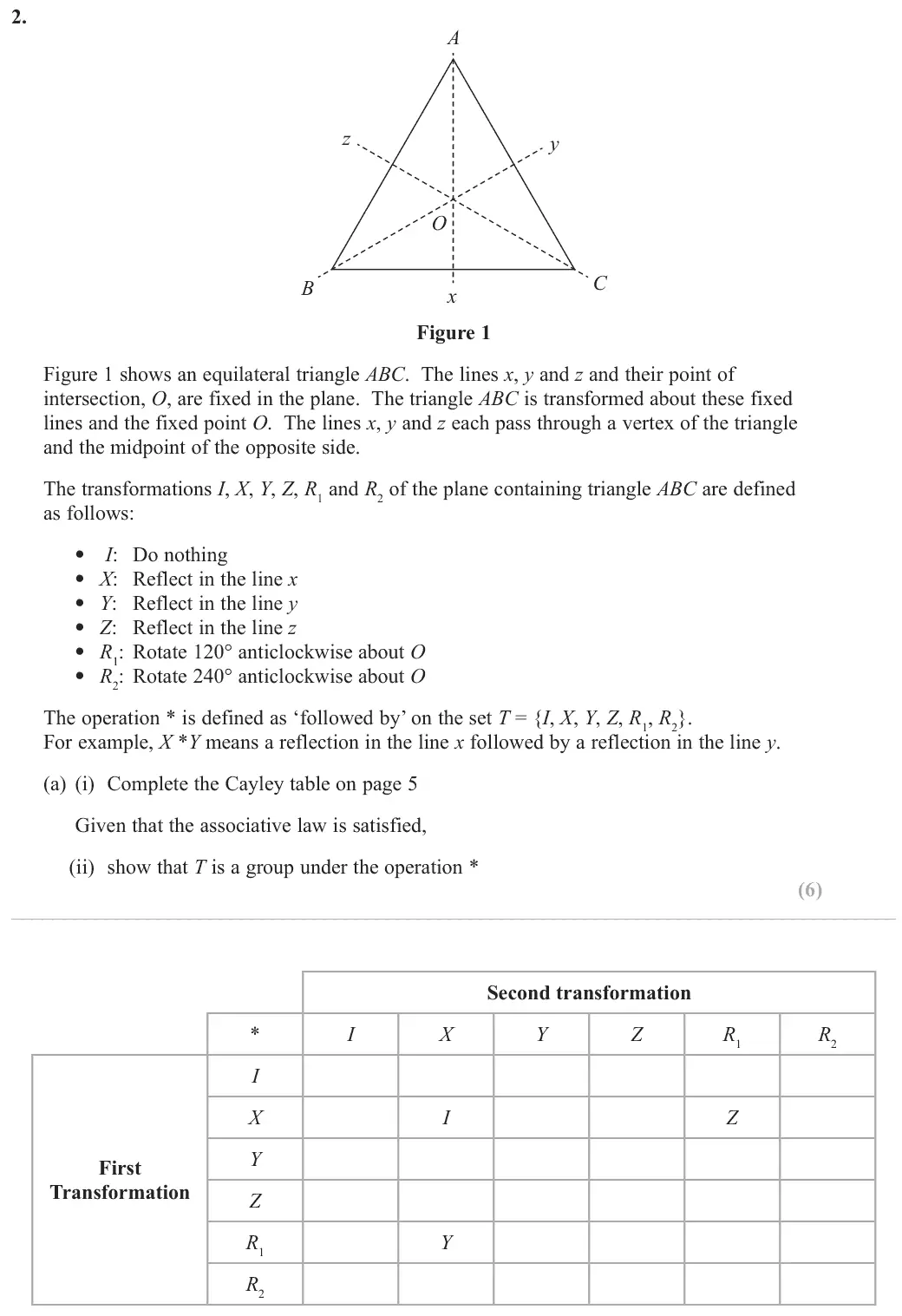
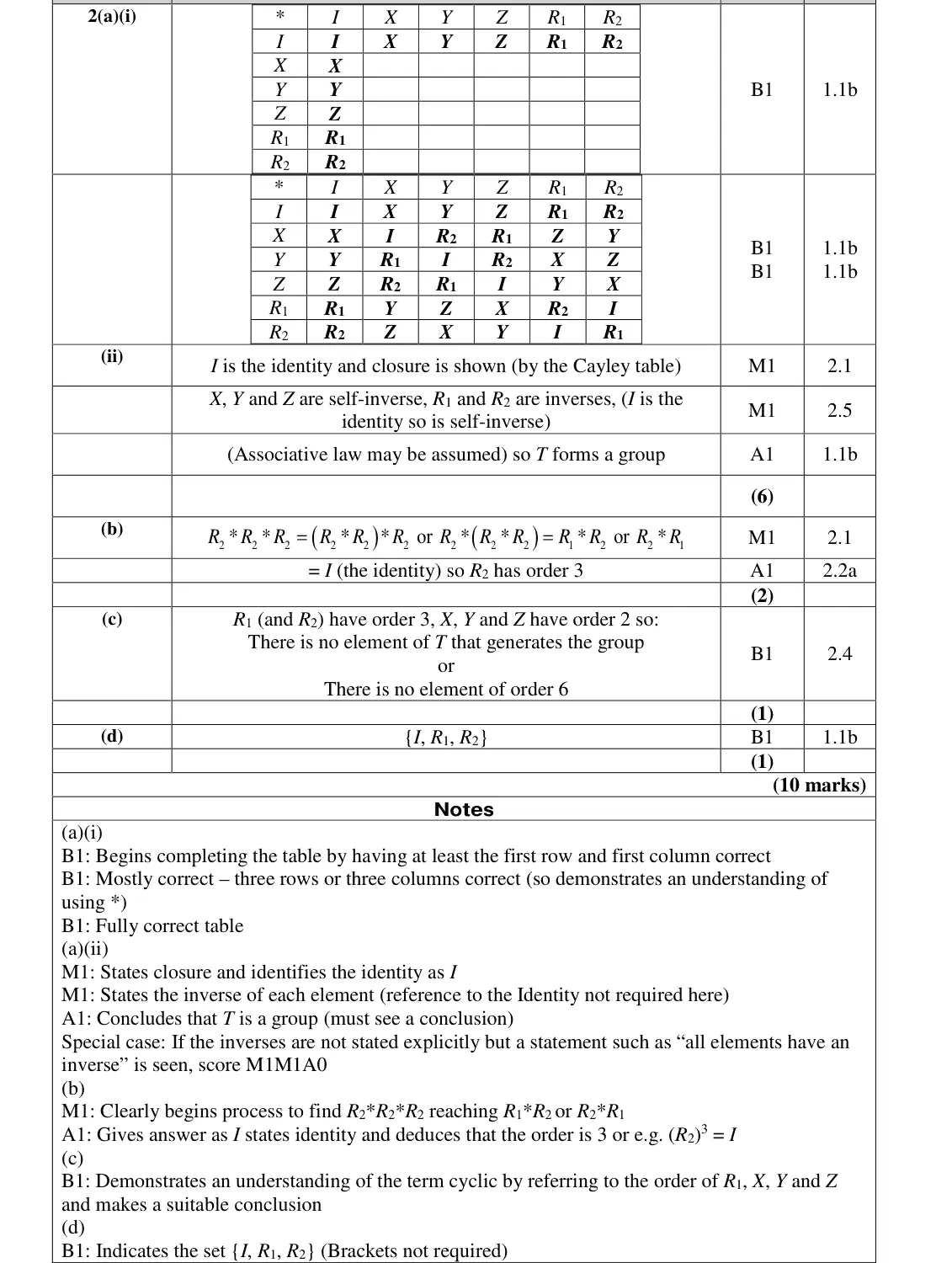
complete the Cayley table for the symmetries of an equilateral triangle
state closure, identity I and the inverse of EACH element (X, Y, Z self-inverse, R₁ and R₂ inverses)
"every element has an inverse" loses a mark
must conclude T is a group
June 2018 · AS Paper 2 (Further Pure 2) · Q2(b)2 marks
Mark scheme (whole question; this part is marked with the orange bar)
Examiner's comment
(b) For those students who attempted this part, most could present a valid argument such as R2*R2*R2 = (R2*R2)*R2=R1*R2 = I and so R2 has order 3 but again some students failed to provide a conclusion, thereby forfeiting the second mark. Some students also made an acceptable reasoned argument in terms of the actual transformations.
Key points from the mark scheme and examiner's report
R₂*R₂*R₂ = R₁*R₂ = I so order 3
a conclusion is needed for the A mark
June 2018 · AS Paper 2 (Further Pure 2) · Q2(c)1 mark
Mark scheme (whole question; this part is marked with the orange bar)
Examiner's comment
(c) It was expected here that students went beyond giving a general comment such as “no element generates the group”. To score the mark here, students needed to describe the order of the elements and then make a conclusion as the general comment obviously applies for any non-cyclic group.
Key points from the mark scheme and examiner's report
must give the orders: R₁, R₂ order 3, X, Y, Z order 2, so no element of order 6 / no generator
a general "no element generates the group" alone scores 0
June 2018 · AS Paper 2 (Further Pure 2) · Q2(d)1 mark
Mark scheme (whole question; this part is marked with the orange bar)
Examiner's comment
(d) It was not clear if students knew what to do here and some probably made a guess although several correct answers were seen.
Key points from the mark scheme and examiner's report
{I, R₁, R₂}
Find an Edexcel Further Maths tutor
Stuck on this? Book a trial lesson with our Further Maths tutor.