FP2.1.2 Examples of groups. Cayley tables. Cyclic groups.

Section
FP2.1 Groups
Level
AS & A level
Statement
Examples of groups. Cayley tables. Cyclic groups.
Guidance
For example, symmetries of geometrical figures, non-singular matrices, integers modulo n with operation addition, and/or multiplication permutation groups.
Since 2018
20 parts, 49 marks · topic pages: Groups: axioms, Cayley tables, subgroups, Lagrange and isomorphism

Back to the checklist

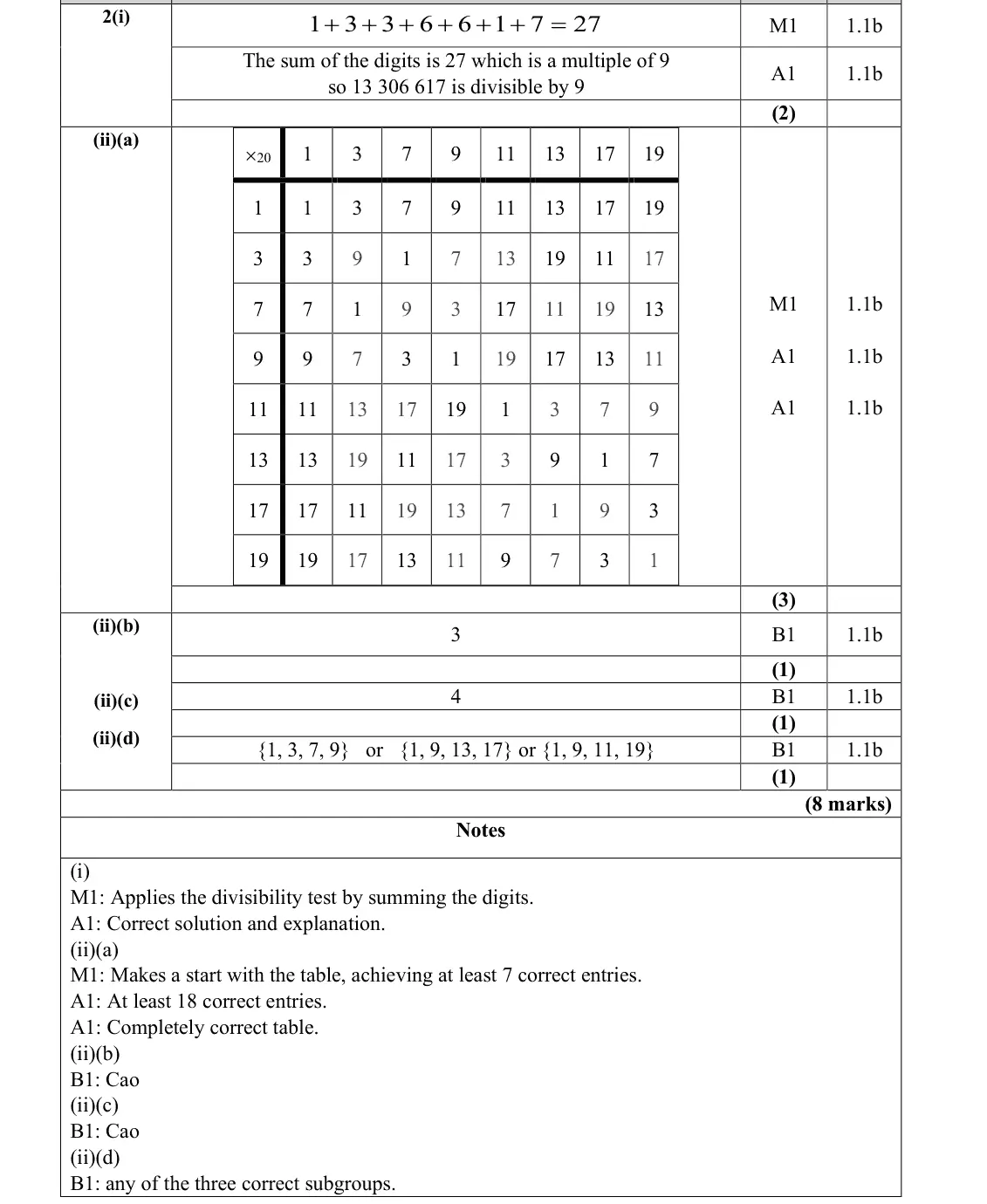
June 2025 · AS Paper 2 (Further Pure 2) · Q2(ii)(a) 3 marks
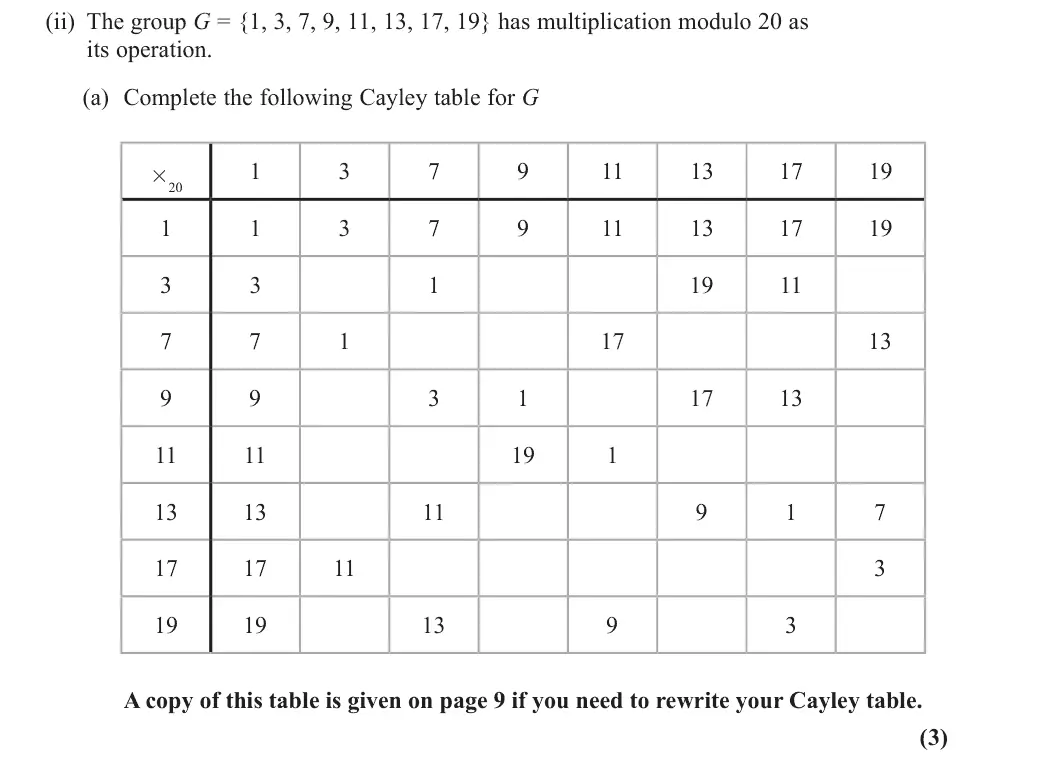
(ii) The group G = {1, 3, 7, 9, 11, 13, 17, 19} has multiplication modulo 20 as its operation. (a) Complete the following Cayley table for G x 20 A copy of this table is given on page 9 if you need to rewrite your Cayley table. (3)
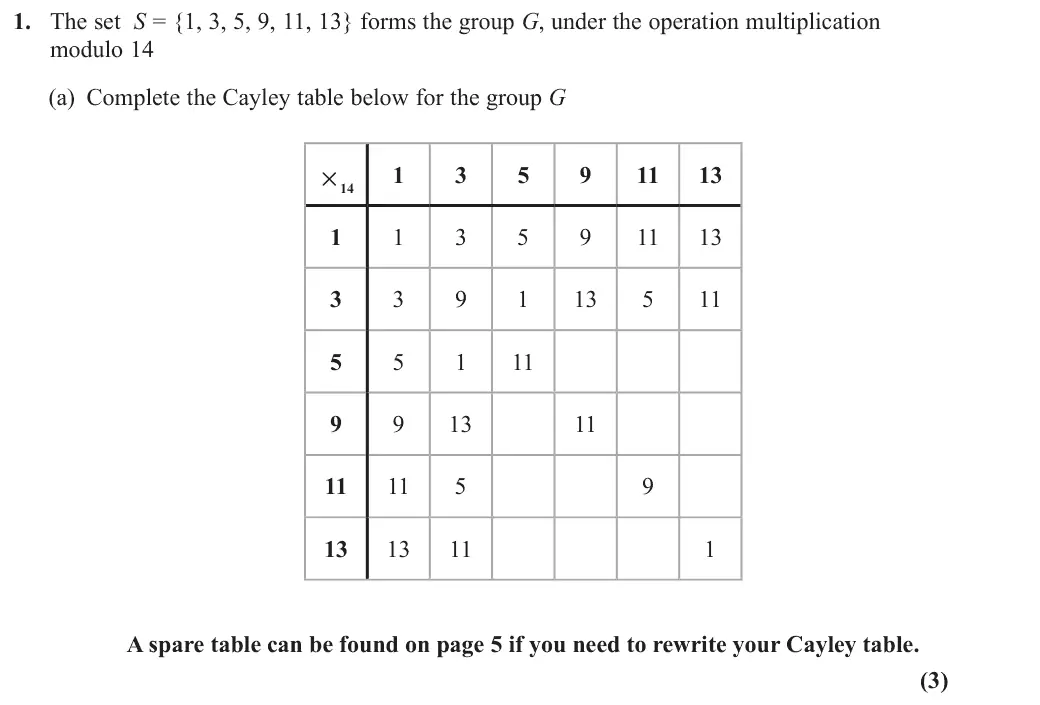
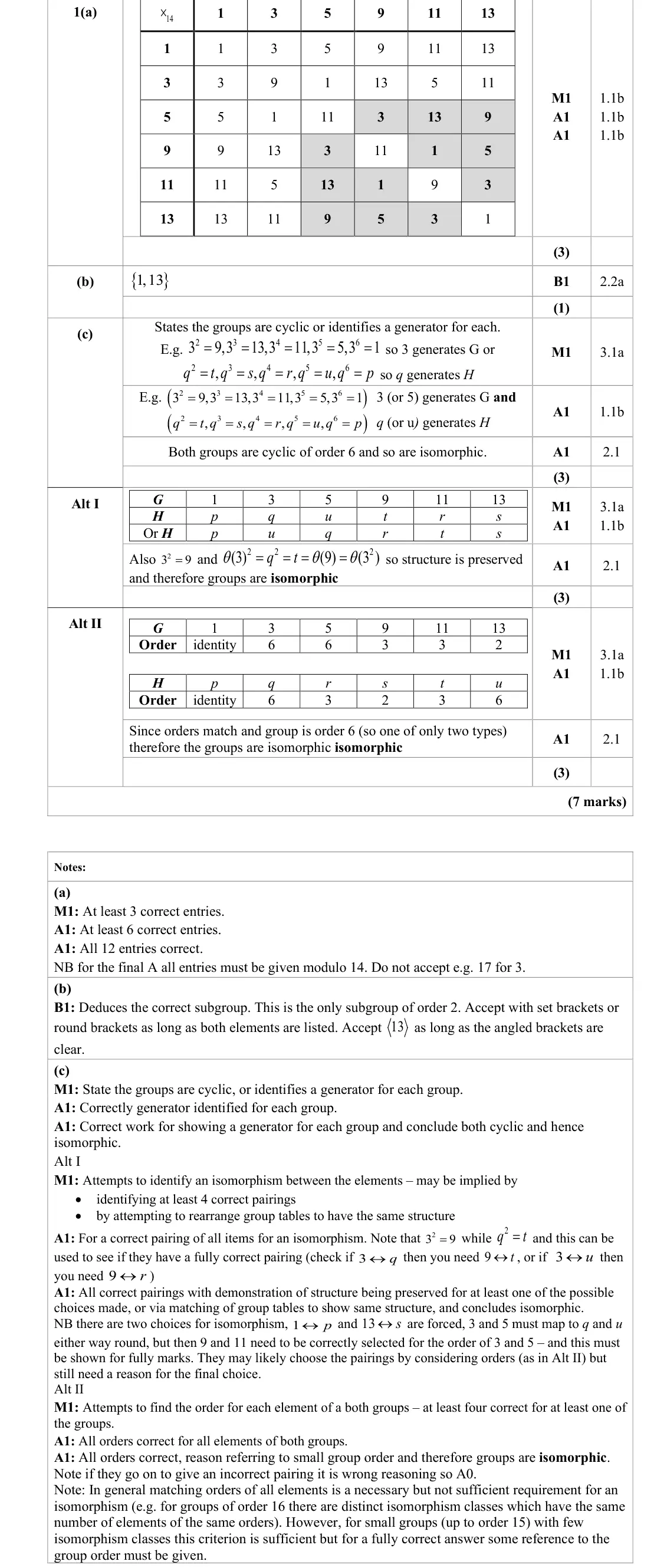
June 2025 · Paper 4A (Further Pure 2) · Q1(a) 3 marks
1. The set S = {1, 3, 5, 9, 11, 13} forms the group G, under the operation multiplication modulo 14 (a) Complete the Cayley table below for the group G x 14 A spare table can be found on page 5 if you need to rewrite your Cayley table. (3)
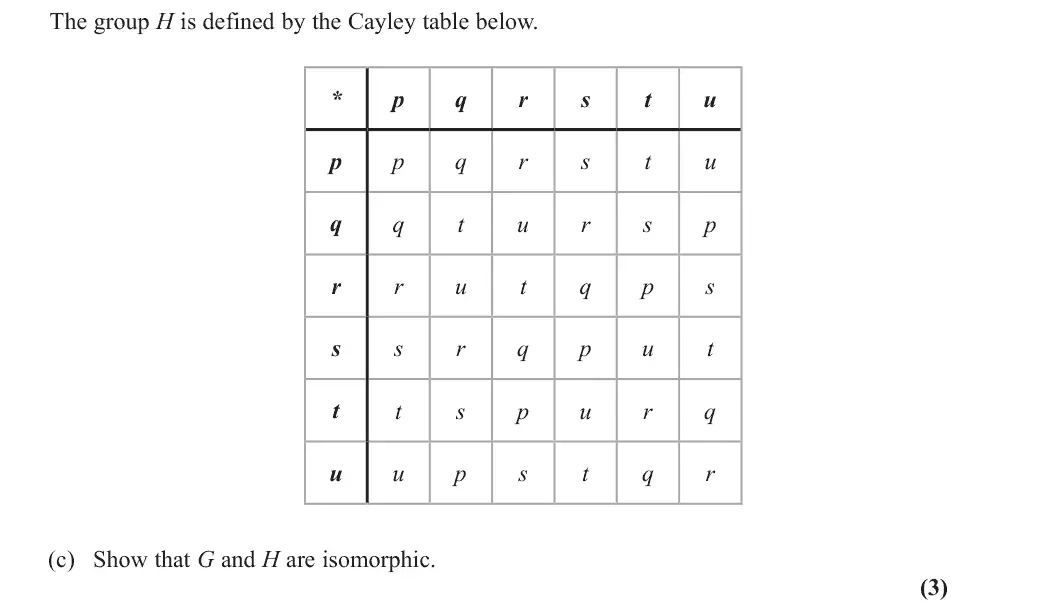
June 2025 · Paper 4A (Further Pure 2) · Q1(c) 3 marks
The group H is defined by the Cayley table below. * p q r s t u p p q r s t u q q t u r s p r r u t q p s s s r q p u t t t s p u r q u u p s t q r (c) Show that G and H are isomorphic. (3)
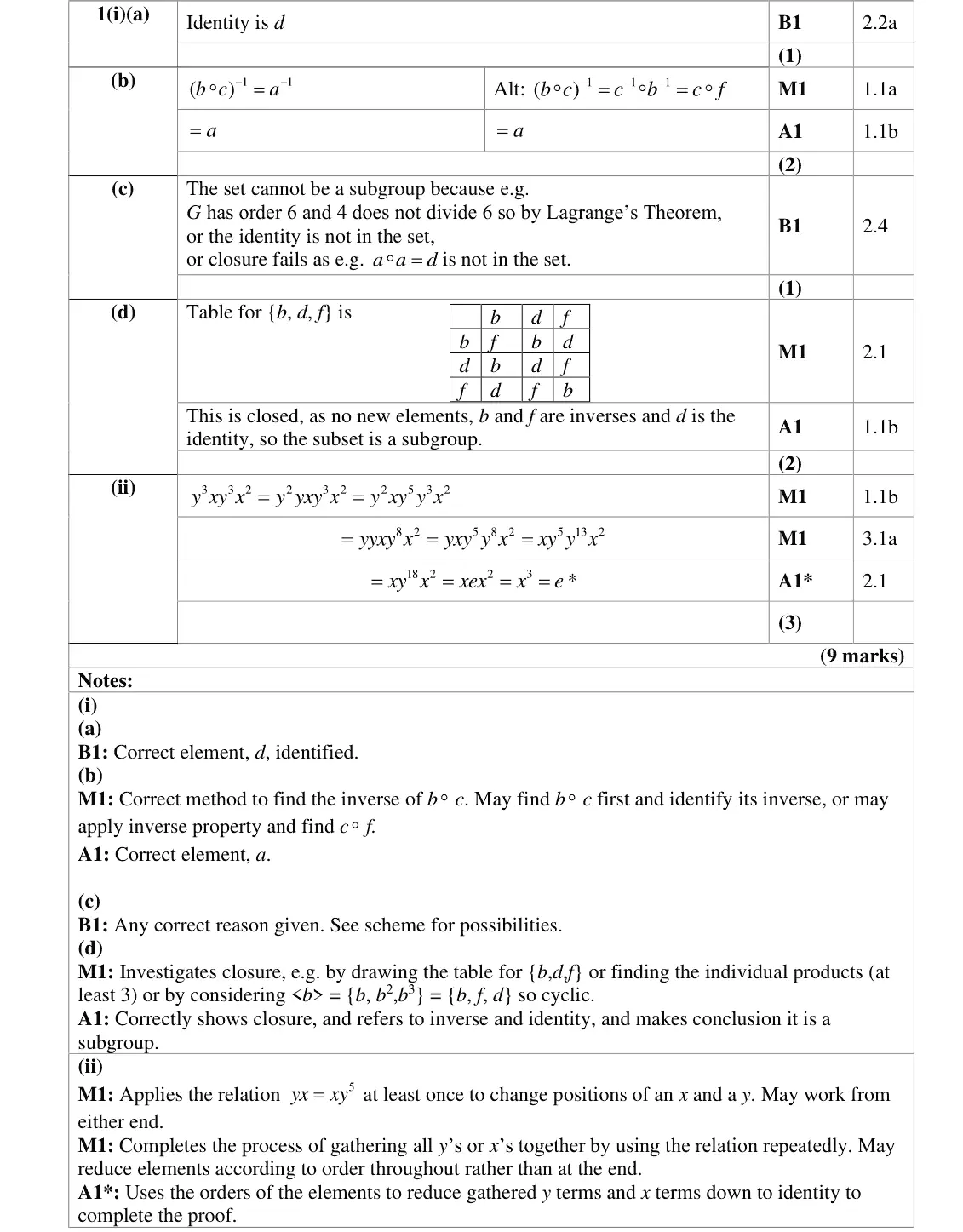
June 2024 · AS Paper 2 (Further Pure 2) · Q1(i)(b) 2 marks
(b) Determine the inverse of the element (b°c) (2)
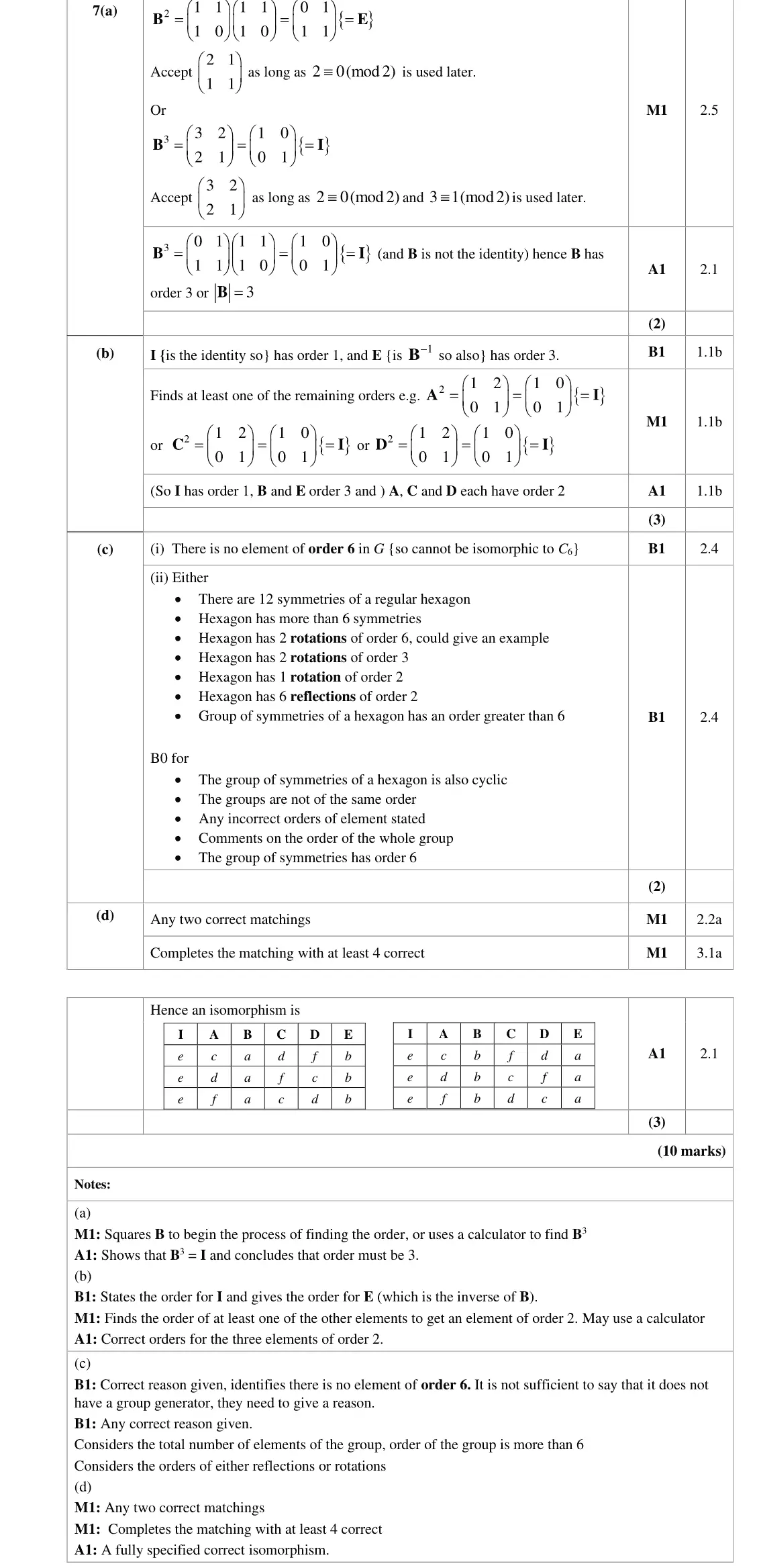
June 2024 · Paper 4A (Further Pure 2) · Q7(c) 2 marks
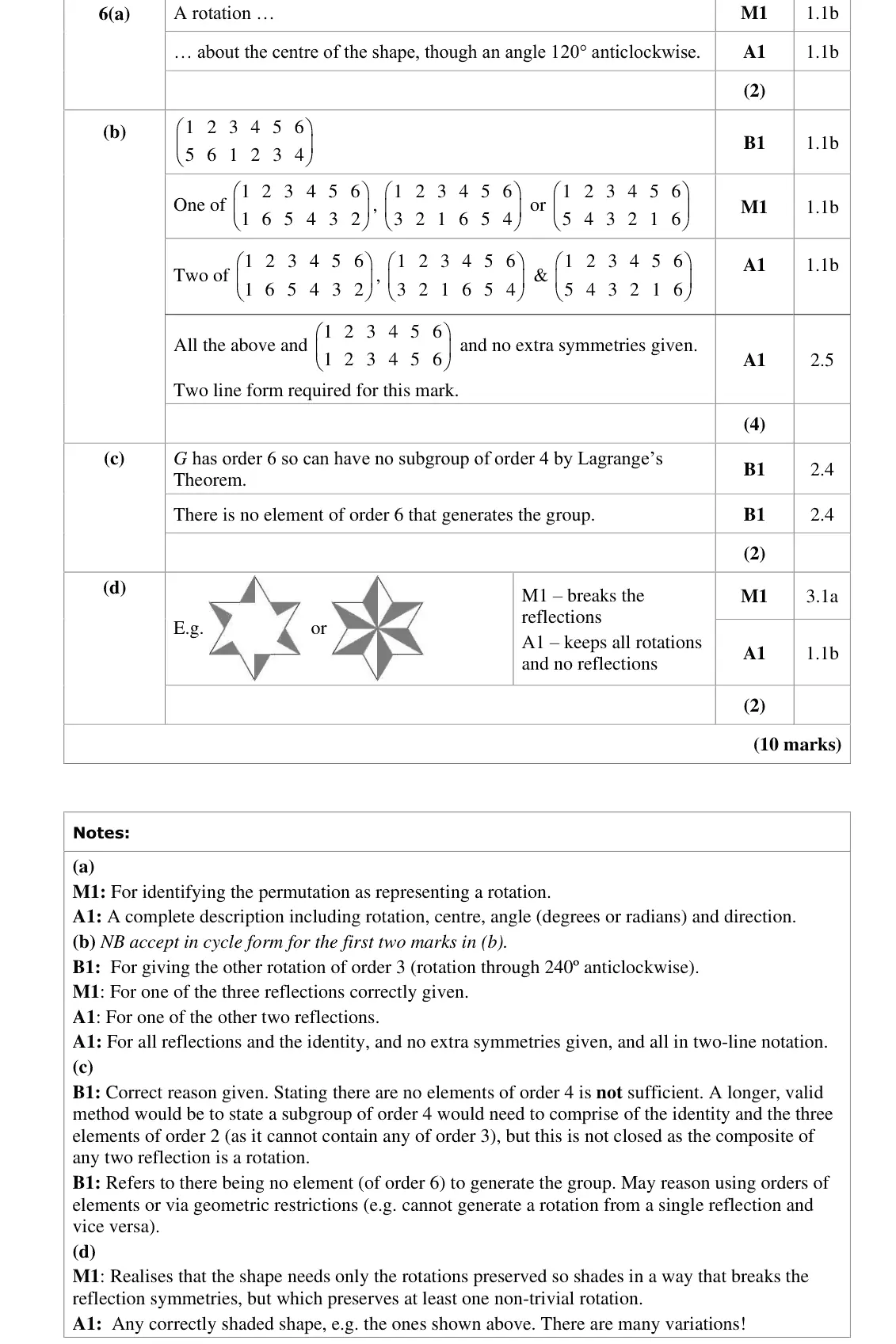
(c) Give a reason why G is not isomorphic to (i) a cyclic group of order 6 (ii) the group of symmetries of a regular hexagon. (2)
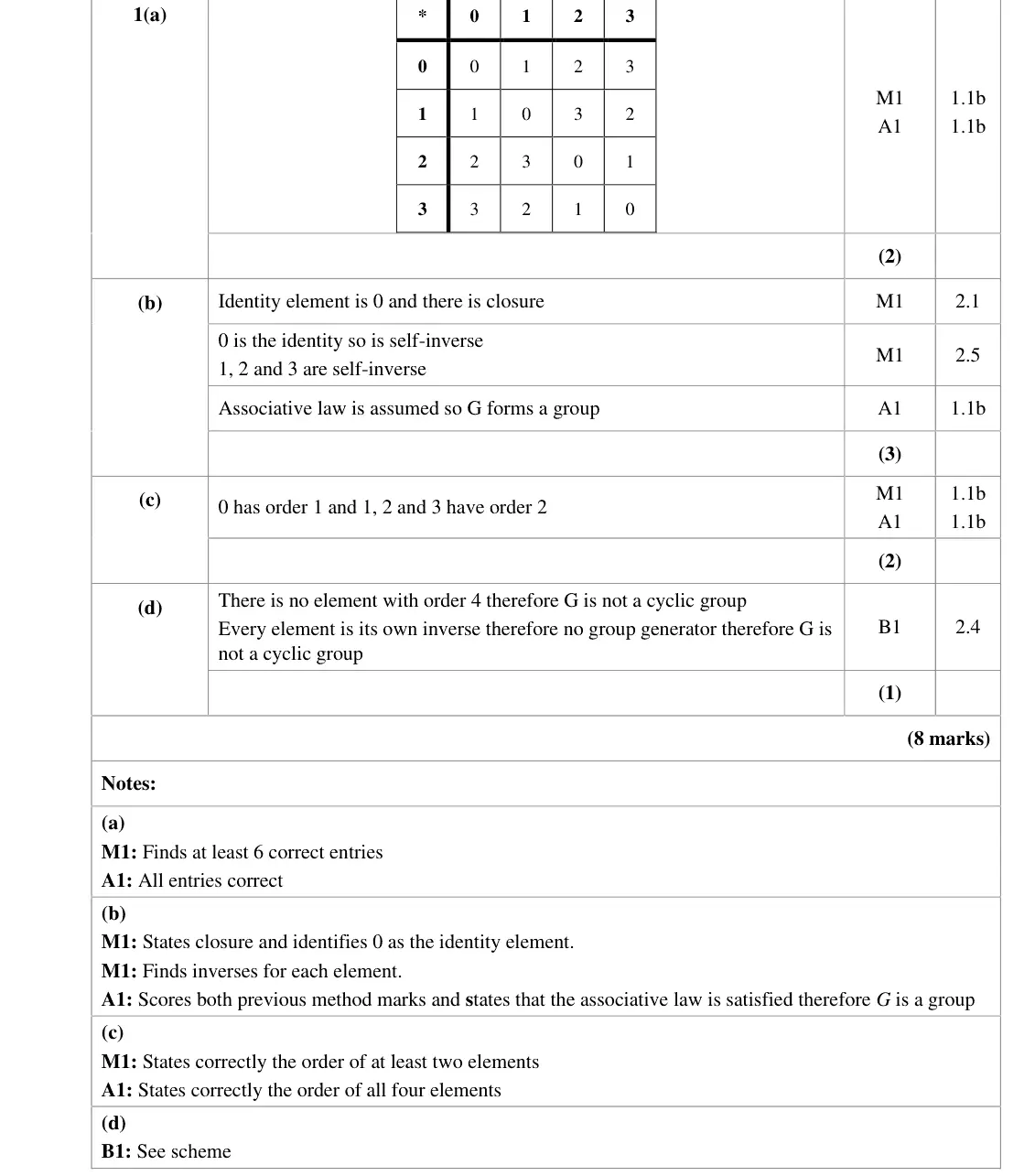
June 2023 · AS Paper 2 (Further Pure 2) · Q1(a) 2 marks
1. The operation * is defined on the set G = {0, 1, 2, 3} by x * y ≡ x + y – 2xy (mod 4) (a) Complete the Cayley table below. (2)
June 2023 · AS Paper 2 (Further Pure 2) · Q1(d) 1 mark
(d) State whether G is a cyclic group, giving a reason for your answer. (1)
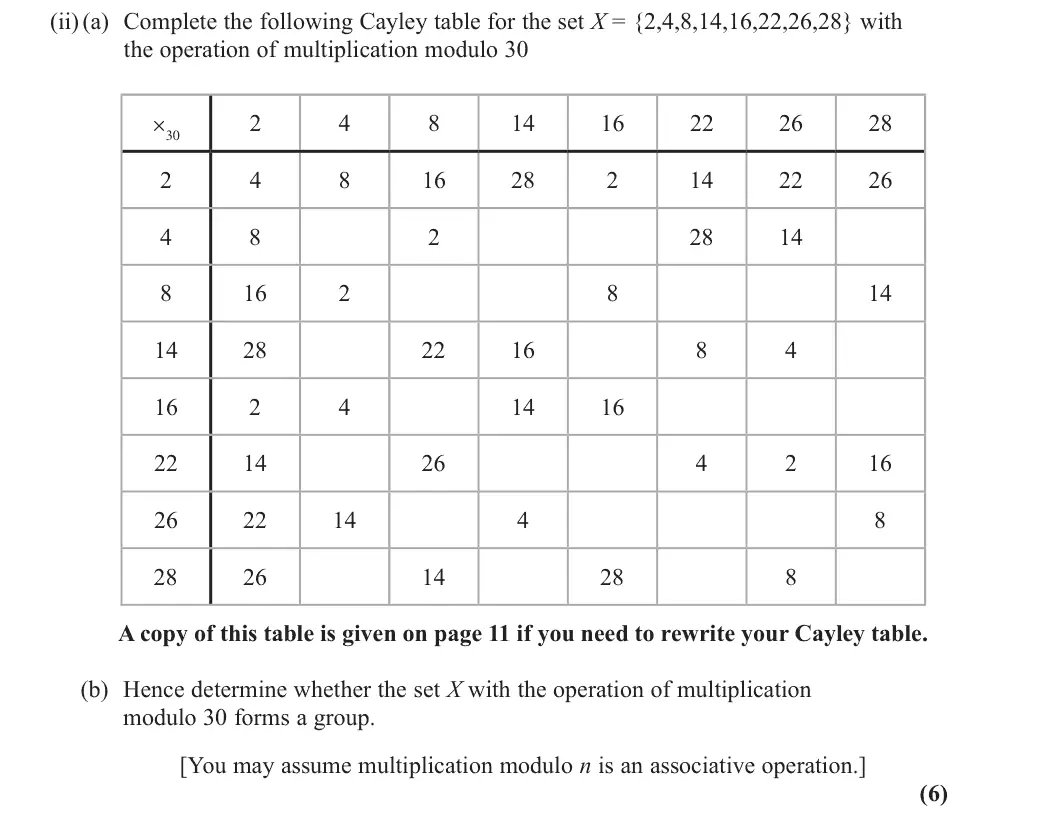
June 2022 · AS Paper 2 (Further Pure 2) · Q3(ii) 6 marks
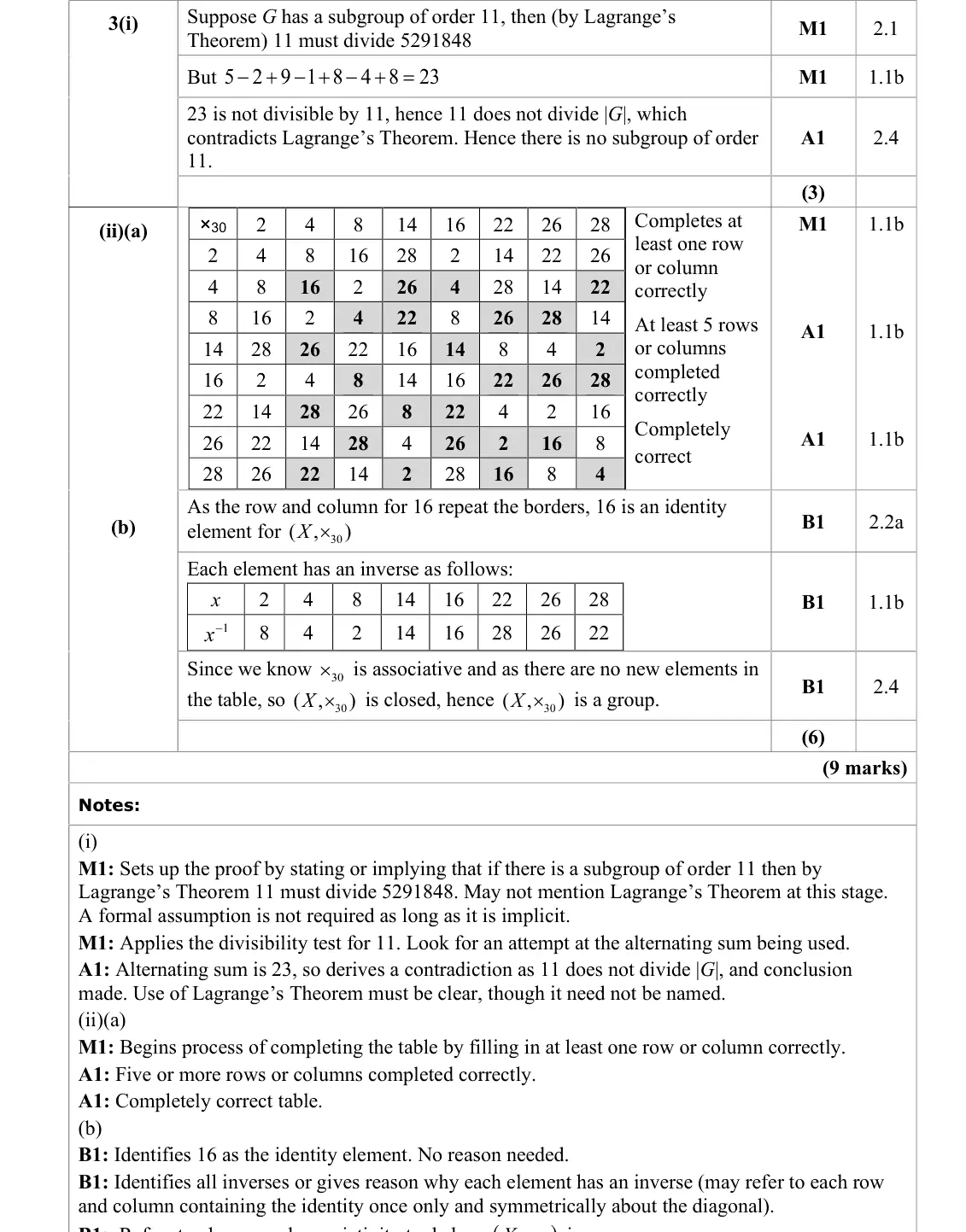
(ii) (a) Complete the following Cayley table for the set X = {2,4,8,14,16,22,26,28} with the operation of multiplication modulo 30 x 30 A copy of this table is given on page 11 if you need to rewrite your Cayley table. (b) Hence determine whether the set X with the operation of multiplication modulo 30 forms a group. [You may assume multiplication modulo n is an associative operation.] (6)
June 2022 · Paper 4A (Further Pure 2) · Q1(a) 1 mark
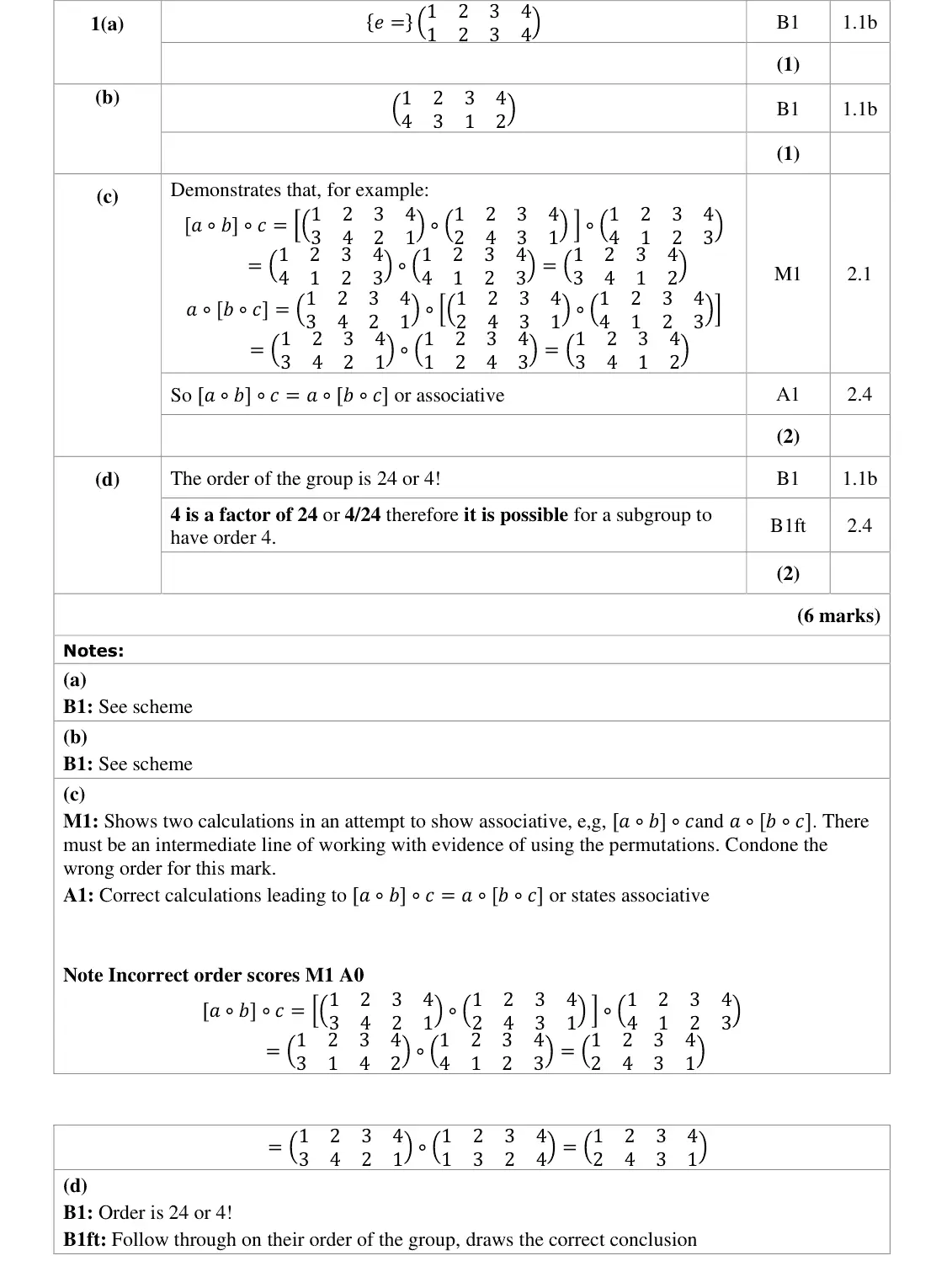
1. The group S4 is the set of all possible permutations that can be performed on the four numbers 1, 2, 3 and 4, under the operation of composition. For the group S4 (a) write down the identity element, (1)
June 2022 · Paper 4A (Further Pure 2) · Q1(b) 1 mark
(b) write down the inverse of the element a, where < a = ;: (1)
June 2022 · Paper 4A (Further Pure 2) · Q1(c) 2 marks
(c) demonstrate that the operation of composition is associative using the following elements < < < a = 87 b = 87 and c = ;: ;: ;: (2)
Oct 2020 · AS Paper 2 (Further Pure 2) · Q1(a) 3 marks
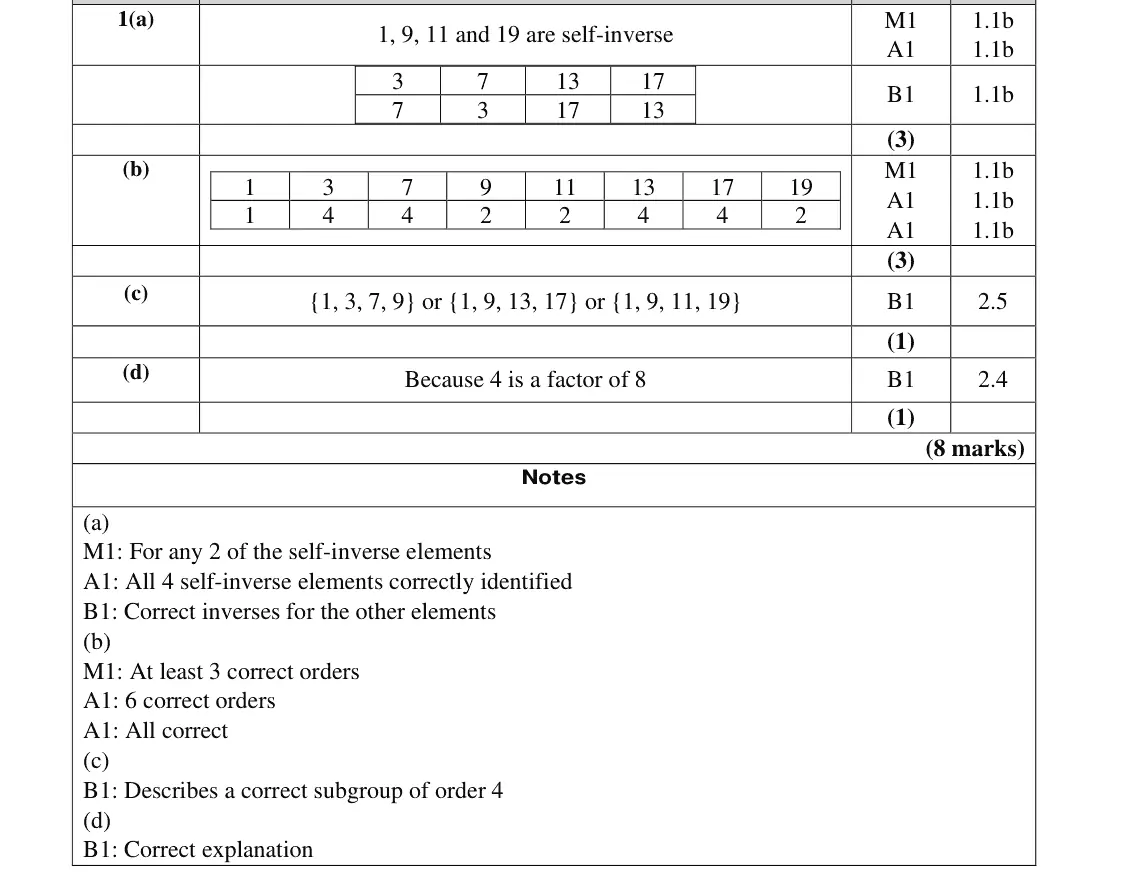
1. The set G = {1, 3, 7, 9, 11, 13, 17, 19} under the binary operation of multiplication modulo 20 forms a group. (a) Find the inverse of each element of G. (3)
Oct 2020 · Paper 4A (Further Pure 2) · Q6(a) 2 marks
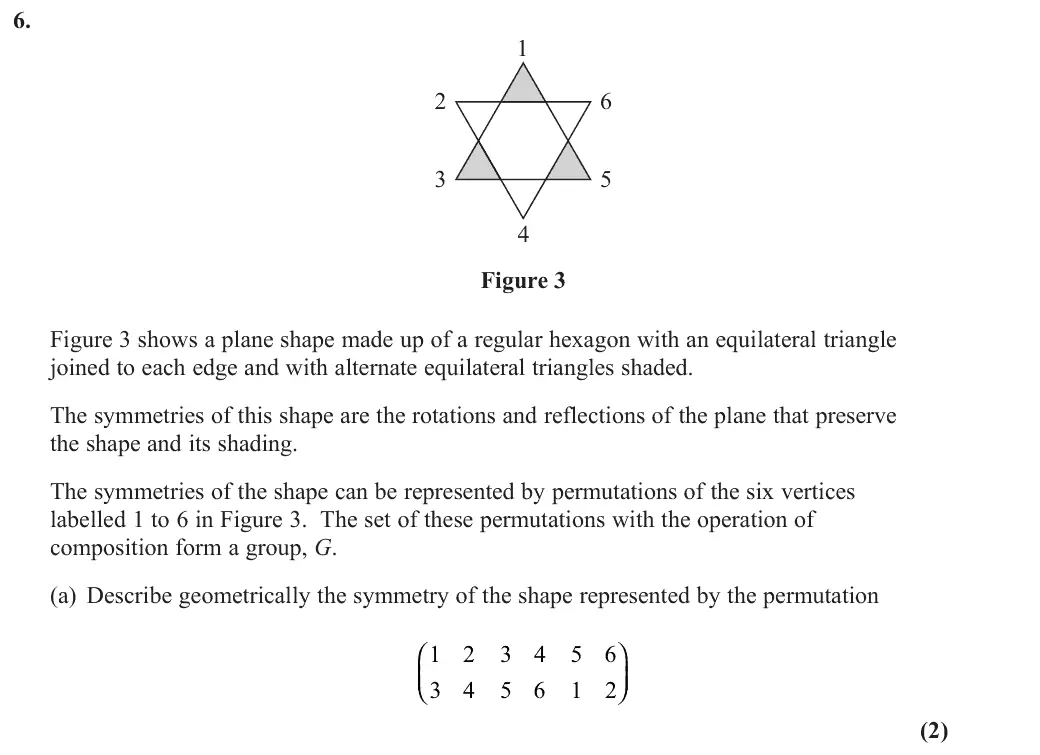
6. Figure 3 Figure 3 shows a plane shape made up of a regular hexagon with an equilateral triangle joined to each edge and with alternate equilateral triangles shaded. The symmetries of this shape are the rotations and reflections of the plane that preserve the shape and its shading. The symmetries of the shape can be represented by permutations of the six vertices labelled 1 to 6 in Figure 3. The set of these permutations with the operation of composition form a group, G. (a) Describe geometrically the symmetry of the shape represented by the permutation (2)
Oct 2020 · Paper 4A (Further Pure 2) · Q6(b) 4 marks
(b) Write down, in similar two‑line notation, the remaining elements of the group G. (4)
Oct 2020 · Paper 4A (Further Pure 2) · Q6(d) 2 marks
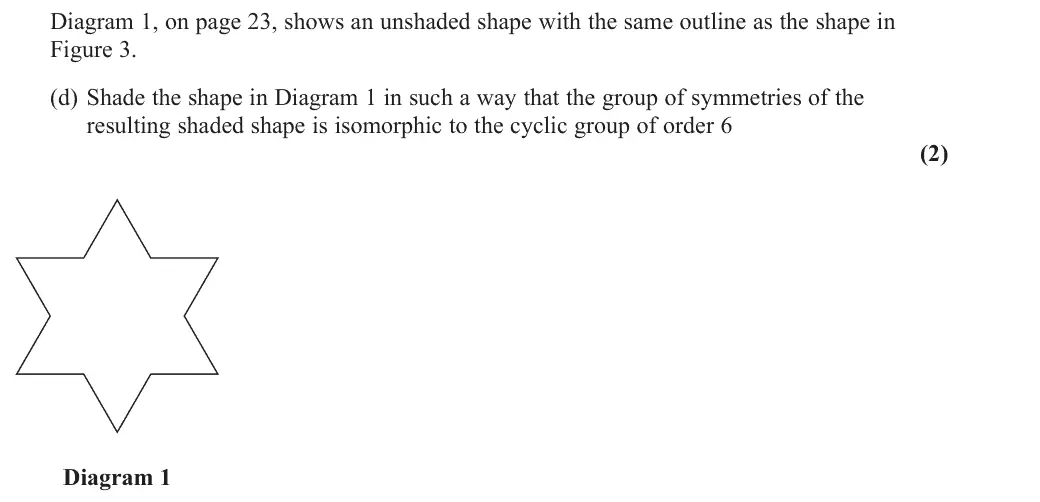
Diagram 1, on page 23, shows an unshaded shape with the same outline as the shape in Figure 3. (d) Shade the shape in Diagram 1 in such a way that the group of symmetries of the resulting shaded shape is isomorphic to the cyclic group of order 6 (2)
June 2019 · AS Paper 2 (Further Pure 2) · Q4(b) 2 marks
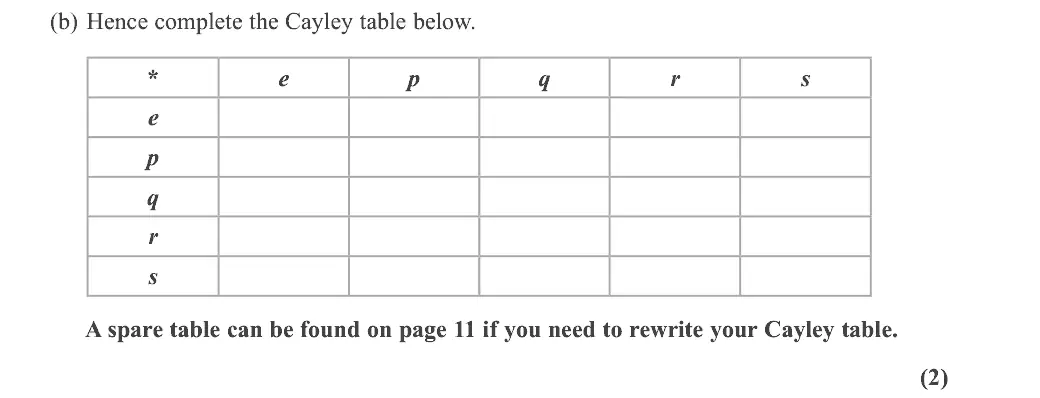
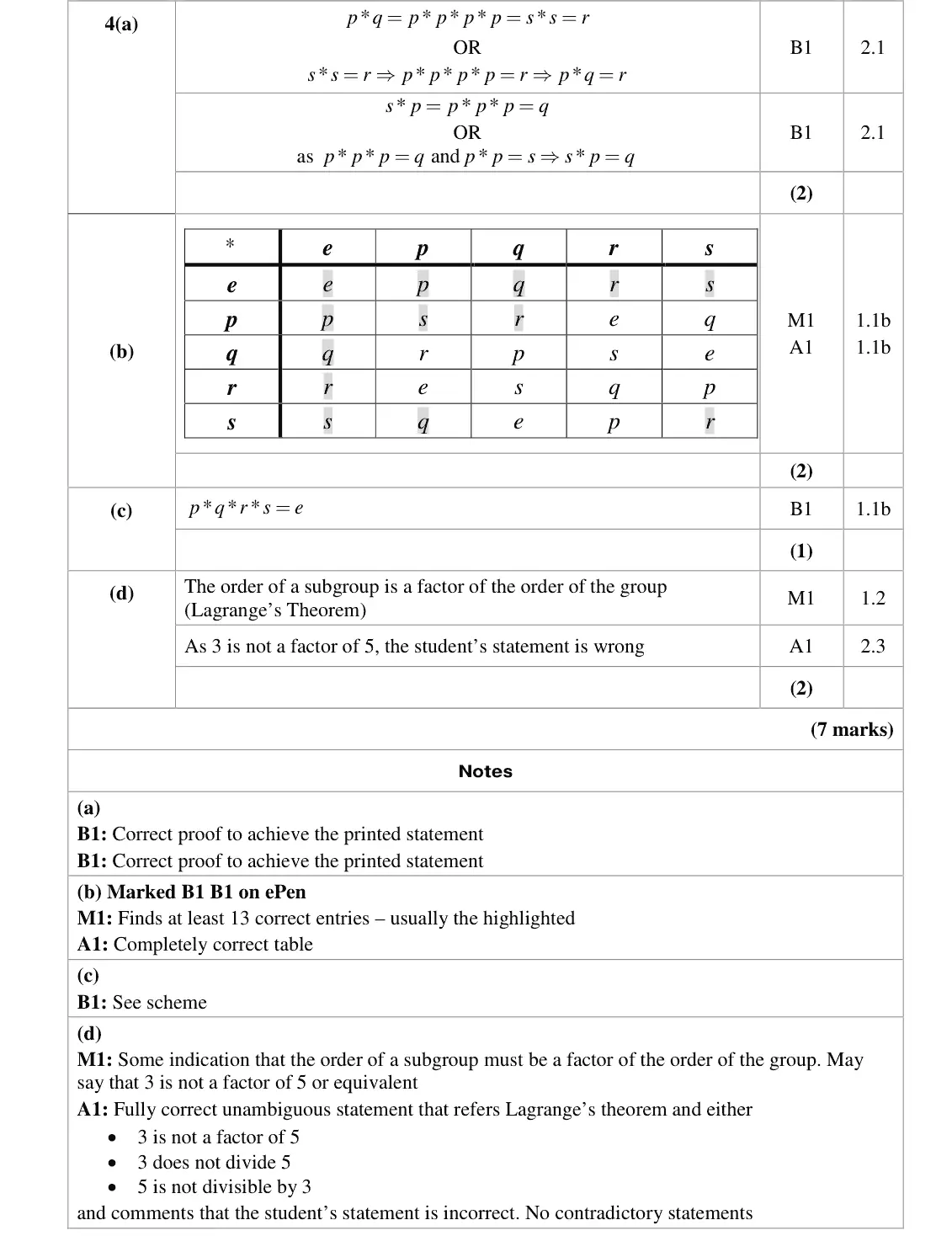
(b) Hence complete the Cayley table below. * e p q r s e p q r s A spare table can be found on page 11 if you need to rewrite your Cayley table. (2)
June 2019 · AS Paper 2 (Further Pure 2) · Q4(c) 1 mark
(c) Use your table to find p*q*r*s (1)
June 2019 · Paper 4A (Further Pure 2) · Q6(ii)(a) 2 marks
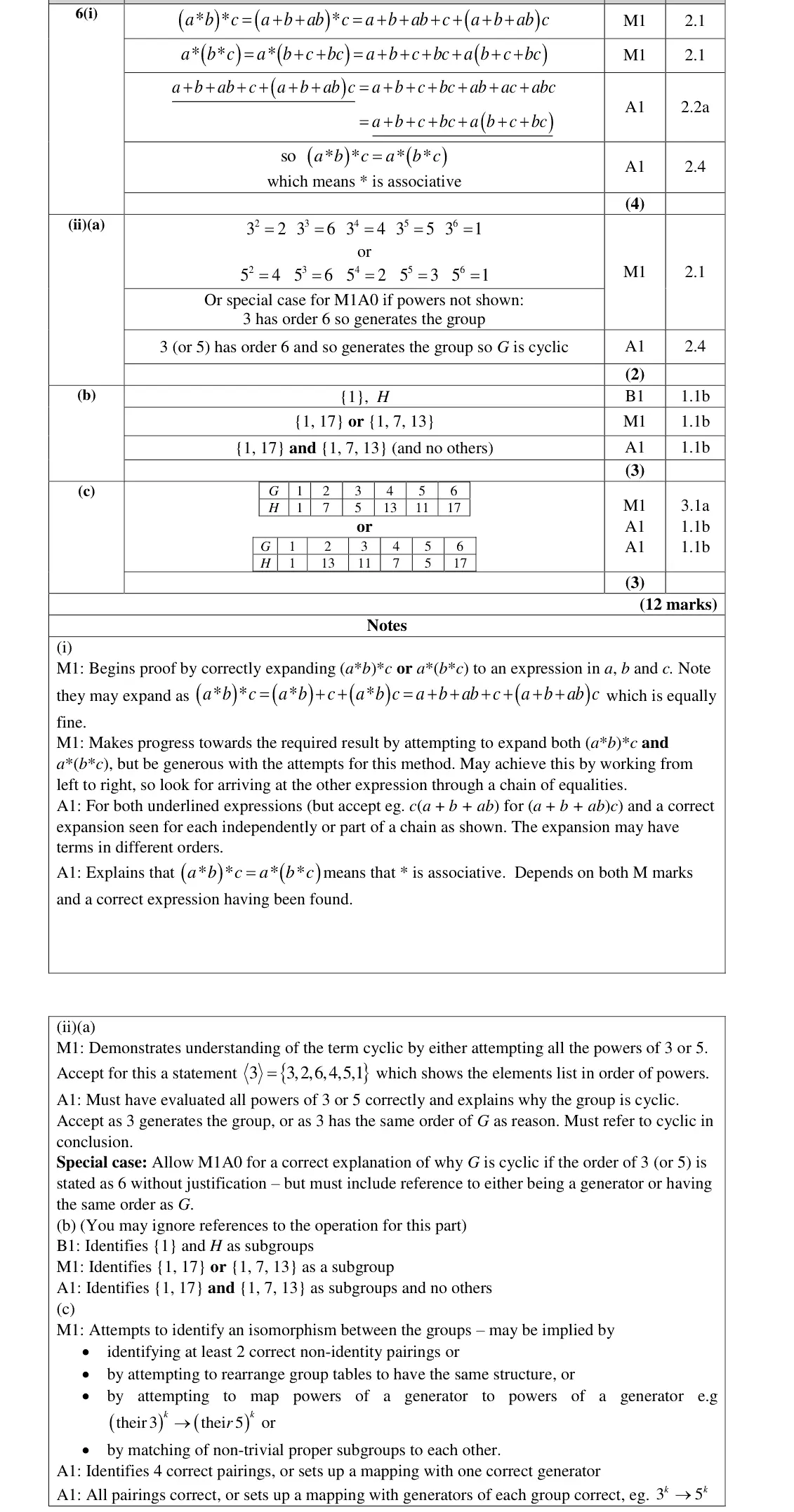
(ii) The set G = {1, 2, 3, 4, 5, 6` forms a group under the operation of multiplication modulo 7 (a) Show that G is cyclic. (2)
June 2018 · AS Paper 2 (Further Pure 2) · Q2(a) 6 marks
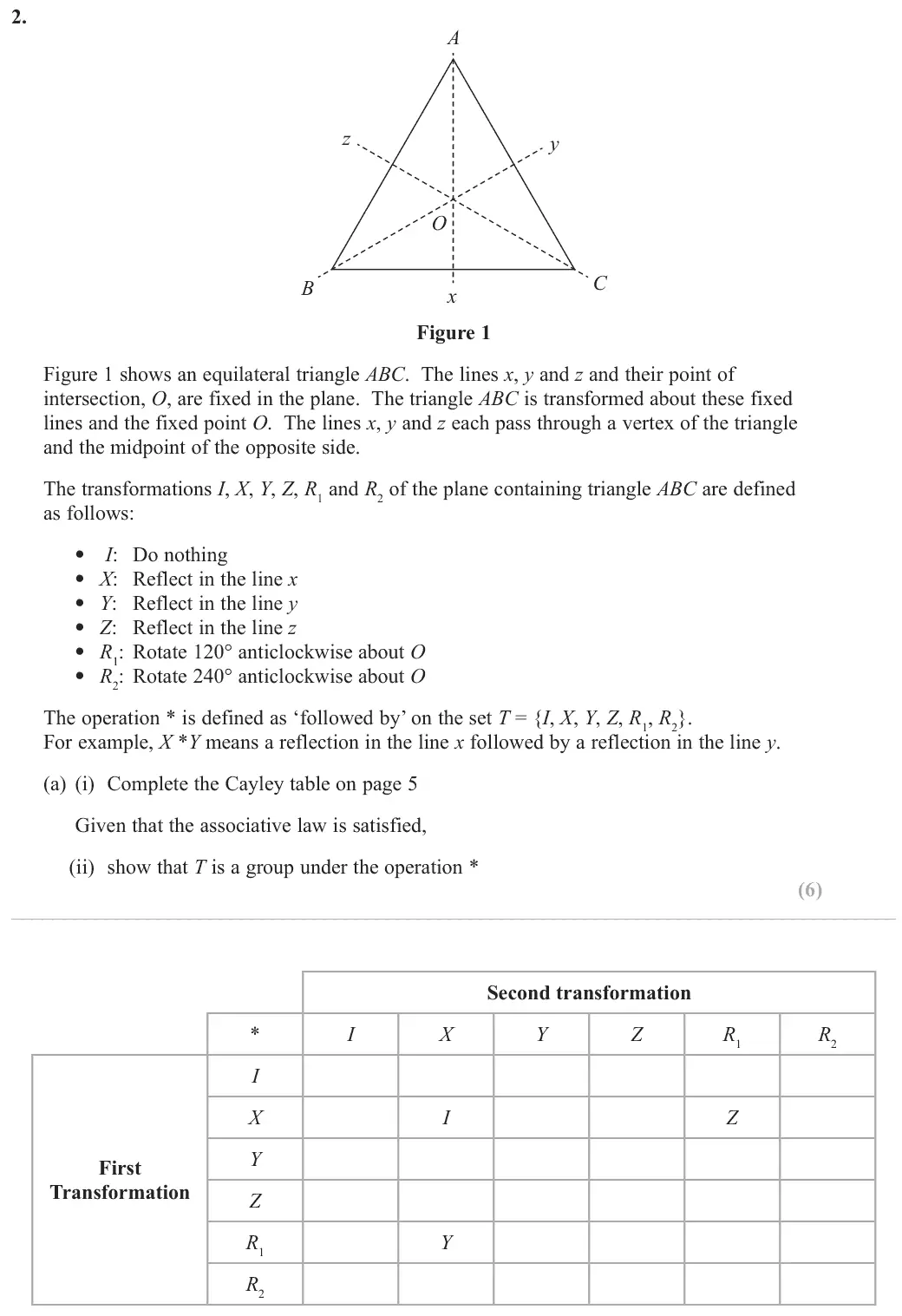
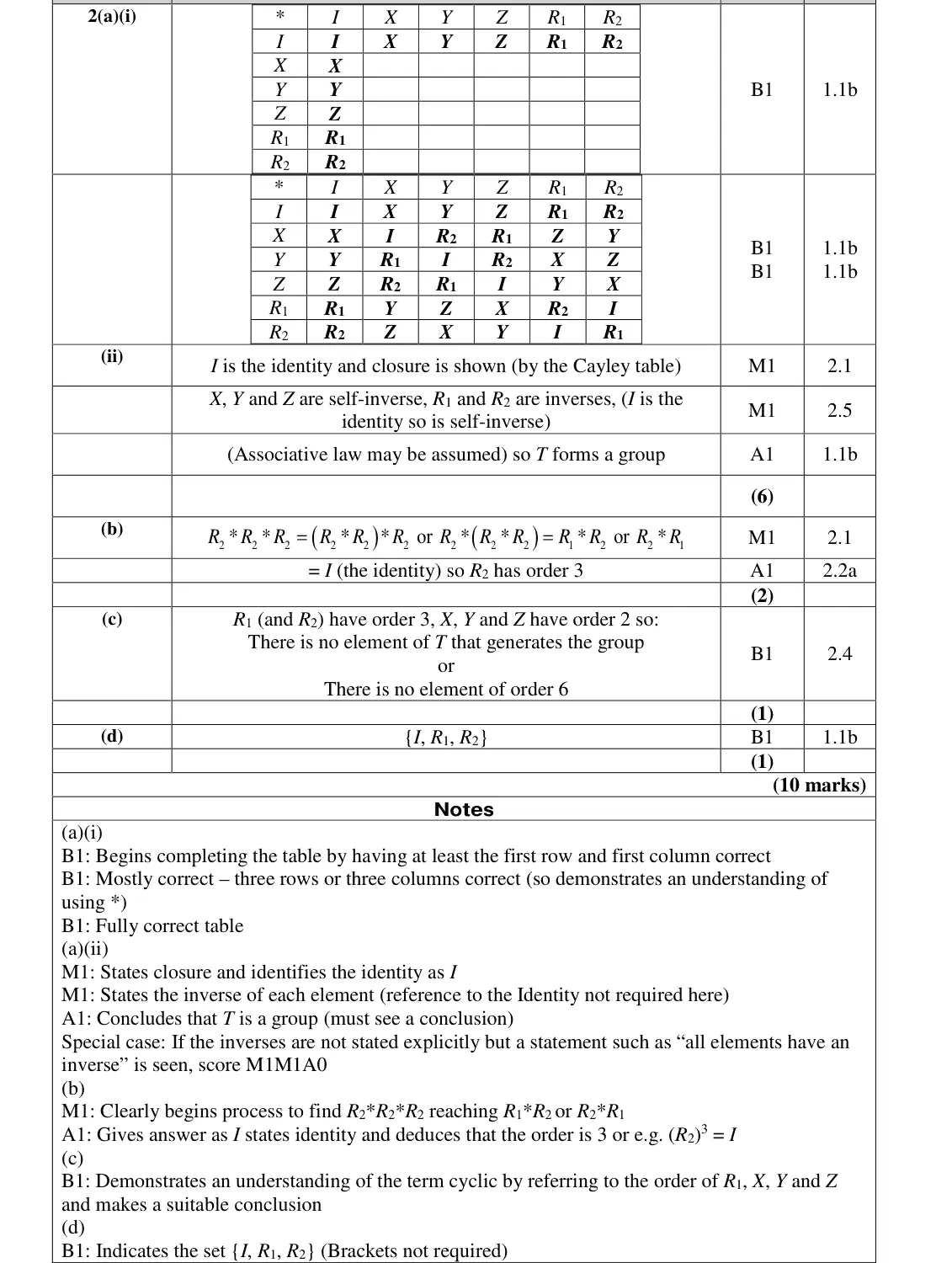
2. A z y C B x Figure 1 Figure 1 shows an equilateral triangle ABC. The lines x, y and z and their point of intersection, O, are fixed in the plane. The triangle ABC is transformed about these fixed lines and the fixed point O. The lines x, y and z each pass through a vertex of the triangle and the midpoint of the opposite side. The transformations I, X, Y, Z, R1 and R2 of the plane containing triangle ABC are defined as follows: • I: Do nothing • X: Reflect in the line x • Y: Reflect in the line y • Z: Reflect in the line z • R1: Rotate 120° anticlockwise about O • R2: Rotate 240° anticlockwise about O The operation * is defined as ‘followed by’ on the set T = {I, X, Y, Z, R1, R2}. For example, X *Y means a reflection in the line x followed by a reflection in the line y. (a) (i) Complete the Cayley table on page 5 Given that the associative law is satisfied, (ii) show that T is a group under the operation * (6)
June 2018 · AS Paper 2 (Further Pure 2) · Q2(c) 1 mark
(c) Explain why T is not a cyclic group. (1)

Find an Edexcel Further Maths tutor

Stuck on this? Book a trial lesson with our Further Maths tutor.

Prefer email? Send an enquiry

If you are under 18, please include a parent's contact details. Enquiries go to enquiries@alevelfurthermathstutor.com and are deleted once handled.