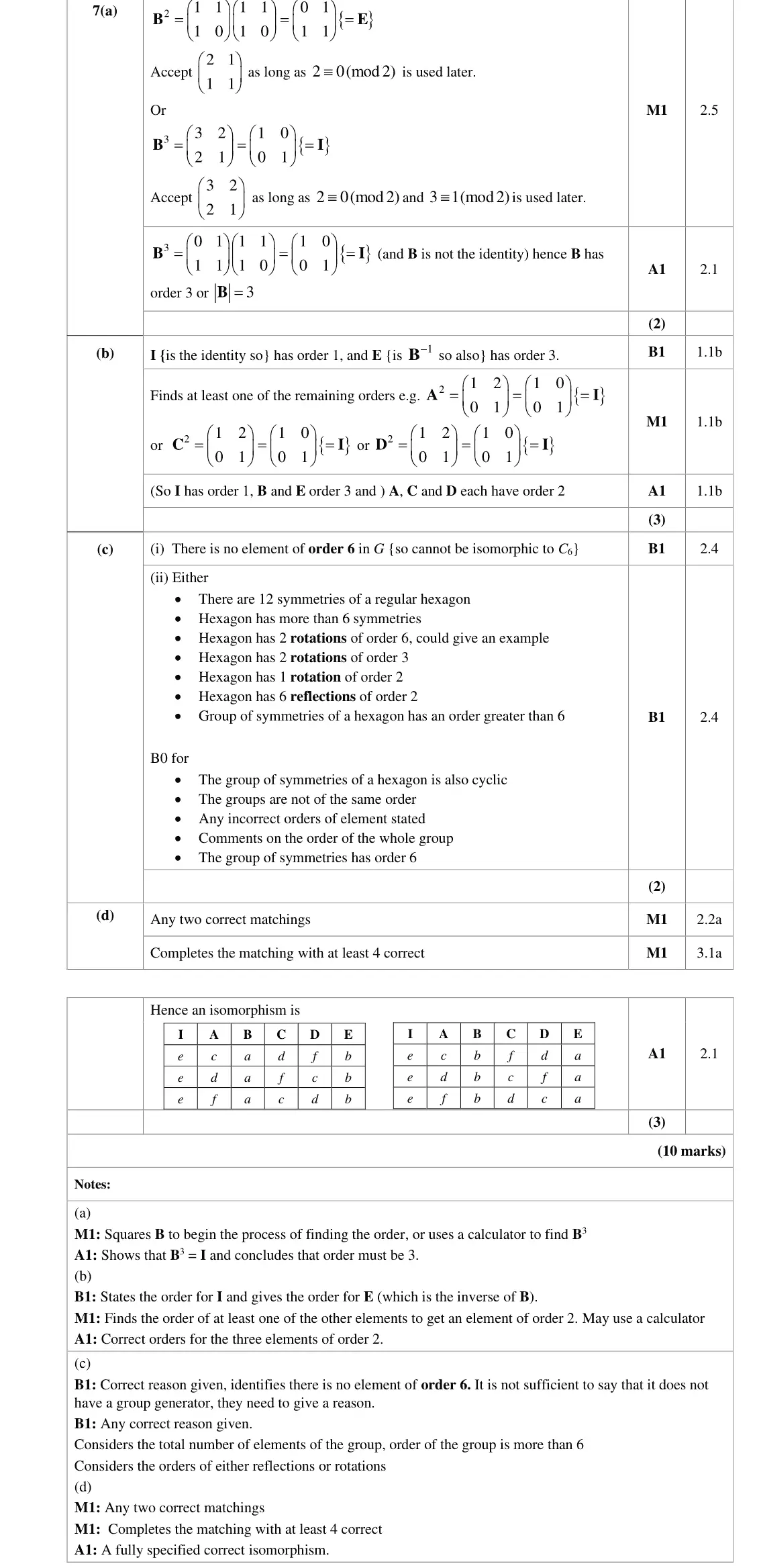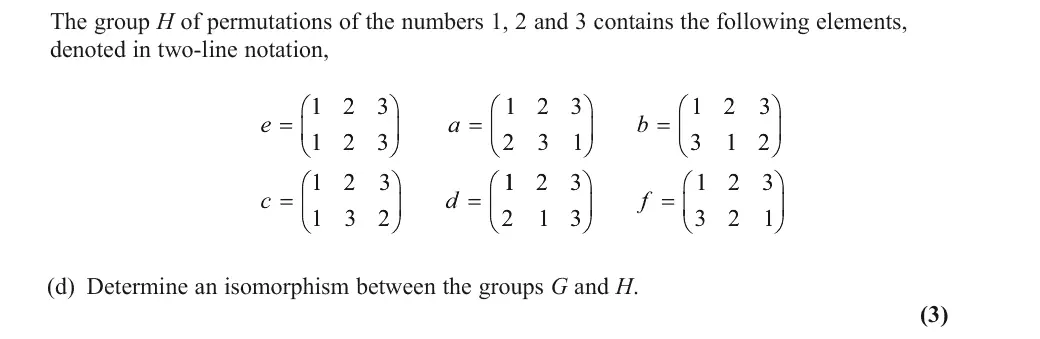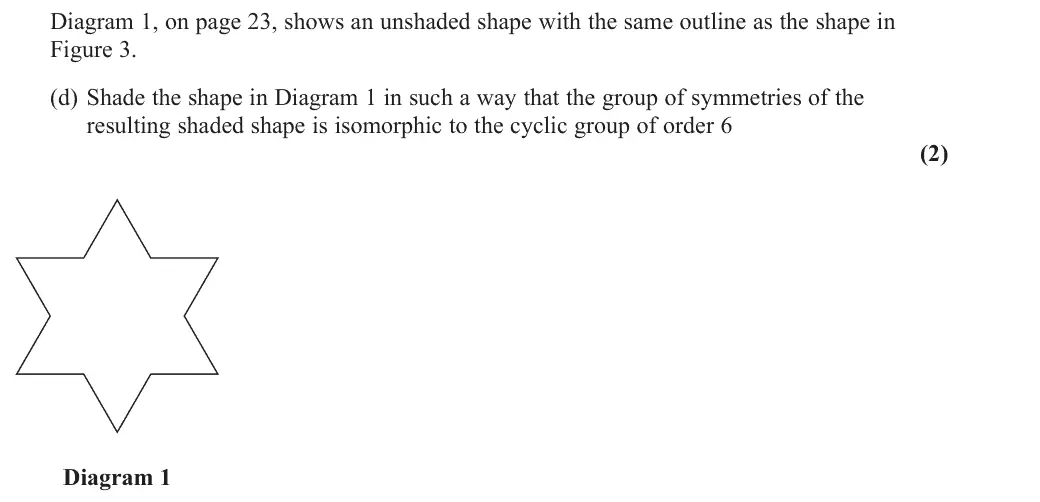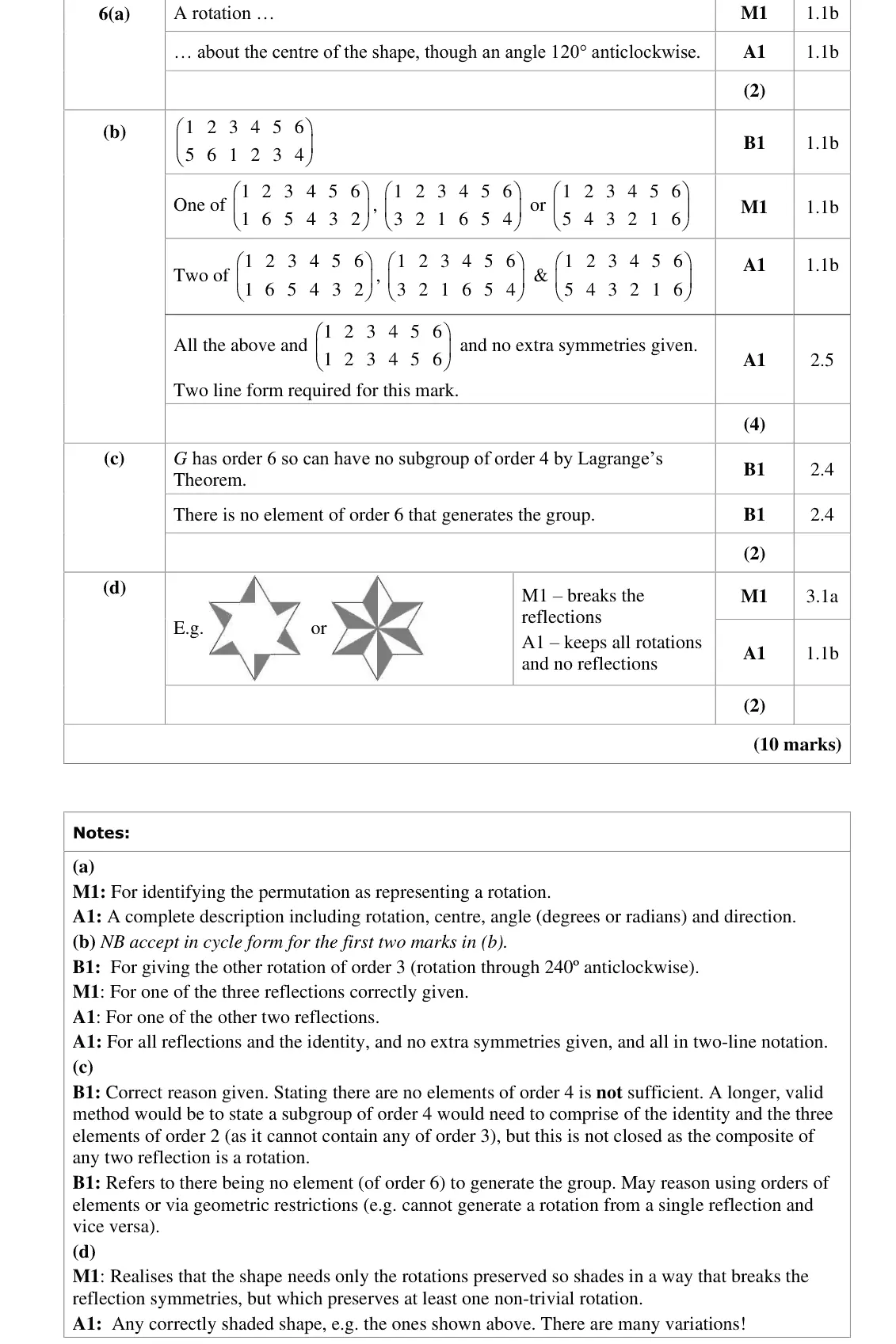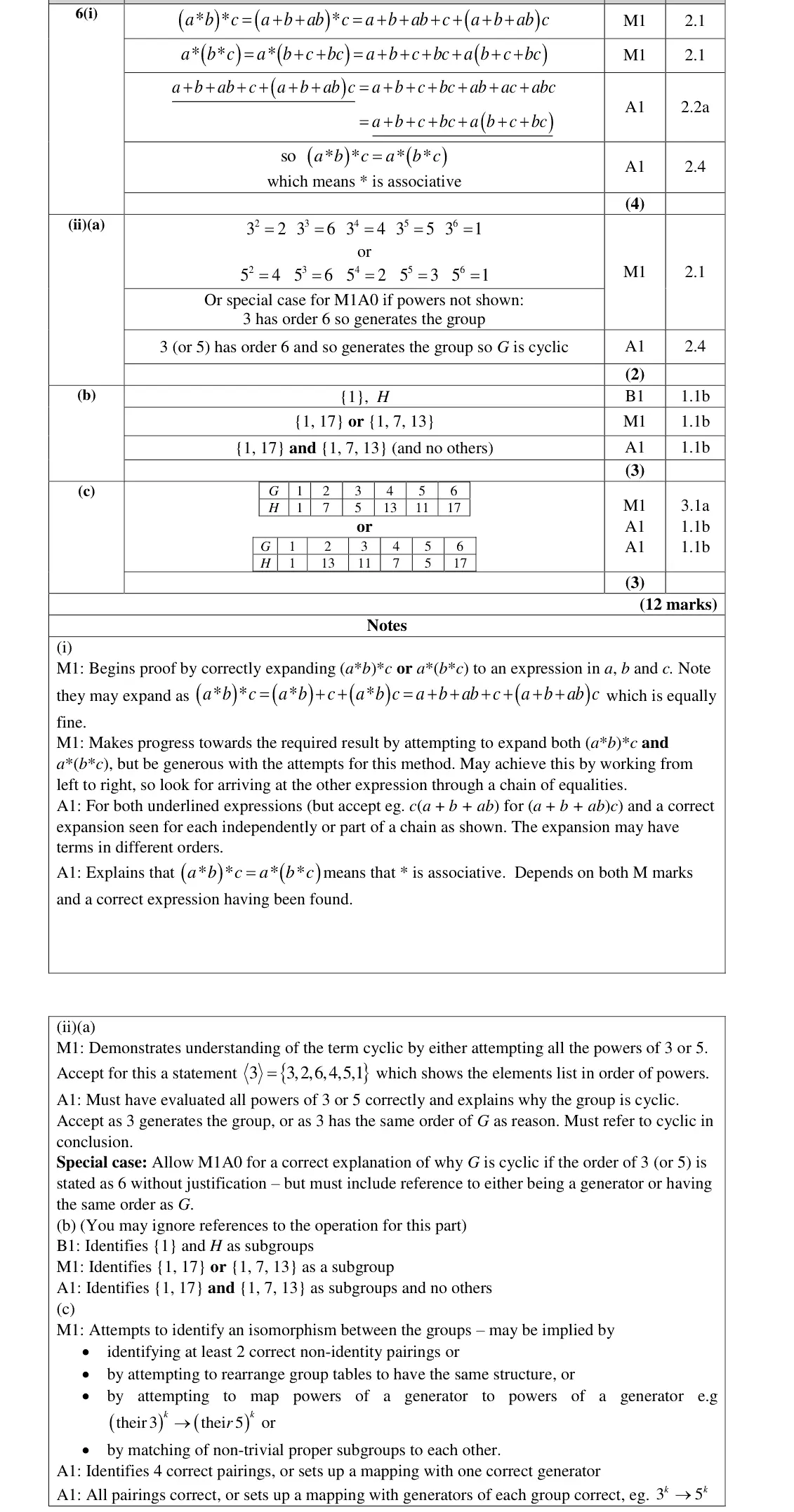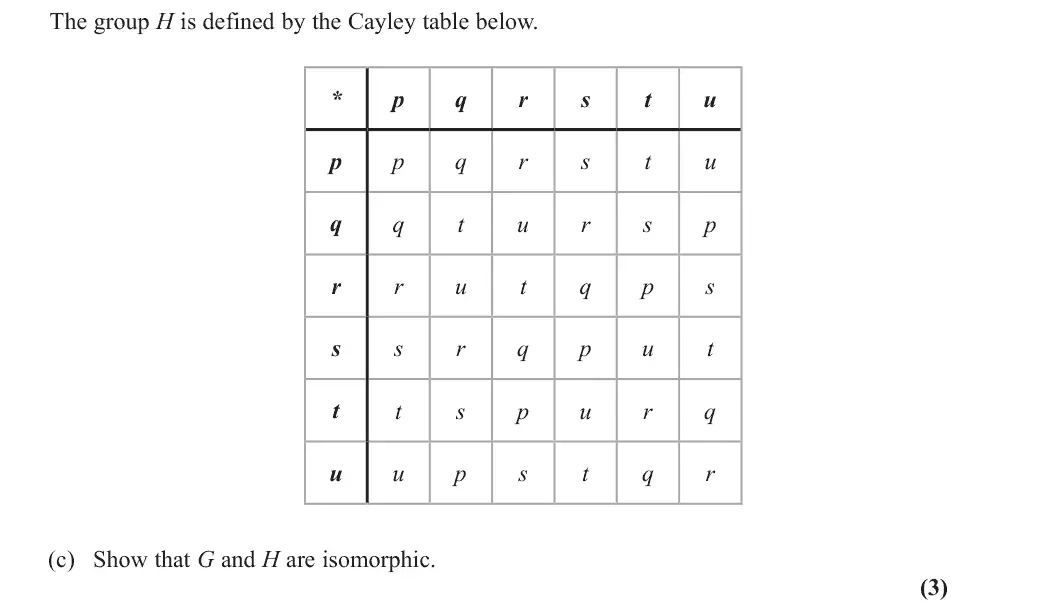
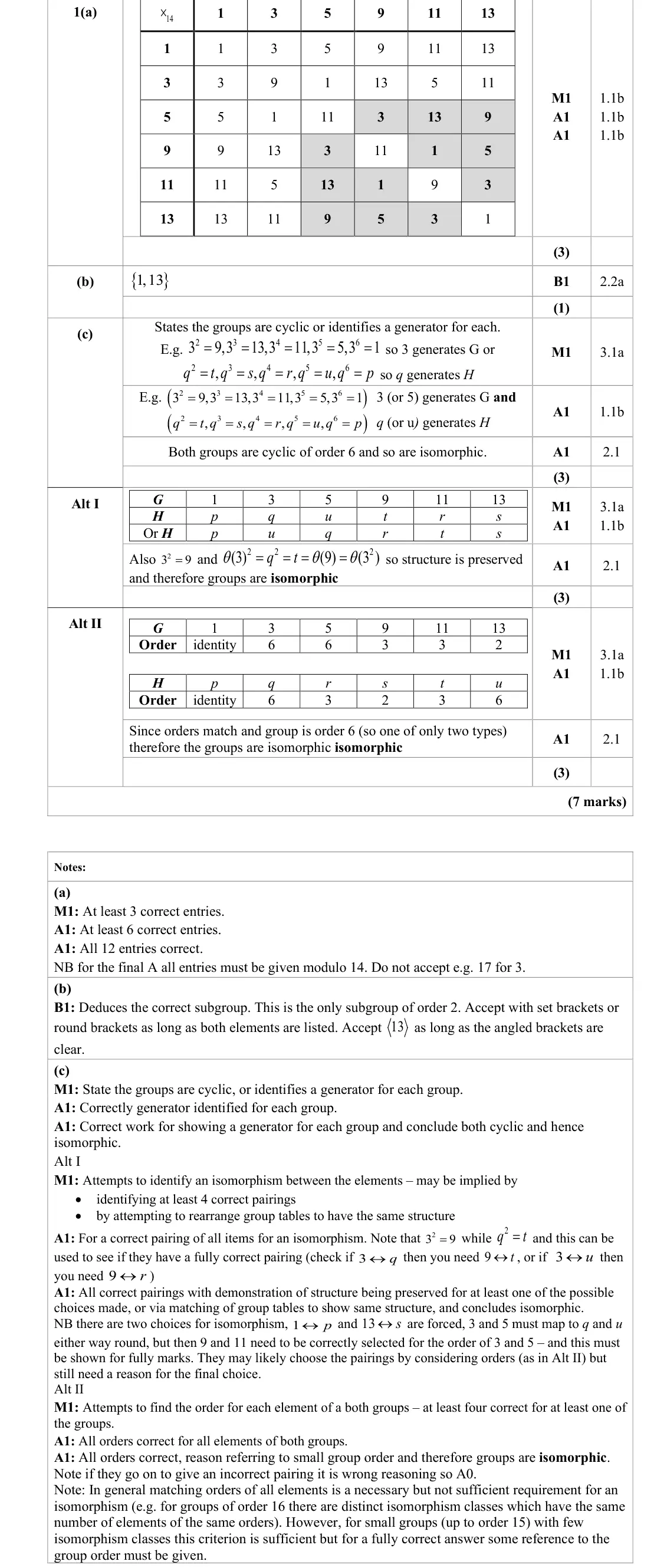
Mark scheme (whole question; this part is marked with the orange bar)
Examiner's comment
Part (c) was even less well answered overall, and inconsistent in approach. Candidates largely seemed surprised by the question and did not have a clear approach in their mind, which may be because it is more common for an isomorphism to be asked for than for groups to have to be shown to be isomorphic. Indeed, many simply focussed on finding an isomorphism as the main emphasis, with the reasons why the groups are therefore isomorphic lacking. Those who realised there was a bit more to it often reasoned via the orders of elements but without clear reason why having elements on matching orders would mean they are isomorphic (not something that is true in general). There was a fair mix of the three alternatives seen of the scheme, as well as variations on these, with probably fewer mentions of cyclic groups or generators, although these were the most likely responses to score full marks, as they were by students who had an appreciation of what isomorphism means and a certain condition – being cyclic of the same order – for it. There were a few errors in identifying correct generators for each, meaning some only score one mark despite having this approach, though. But the reason was usually given. Those who used element pairing often did not think about the structure but simply paired either be the order of the borders of the table (which score no marks as there were insufficient correct matches) or via elements of the same order with giving due consideration to preserving order, often matching 3 to q but 9 (=32) to r and not t (=q2). Even where correct pairings were given it was rare to see the required justification for the final mark though a few did show this. Group table matching as a whole was seen occasionally, but again quite rare. For those working out the orders of all the elements, this was more successful in achieving all the correct orders, with only occasional errors made determining orders, but the final justification was again lacking with only very few referring to the order of the group being only 6 and therefore sufficient for same element orders to imply an isomorphism. Couple with this, students using this approach often went on to give an incorrect pairing of the elements anyway, showing the lack of understanding that there is more to it than just pairing up elements by order. But amongst the many attempts there were also some very confident and coherently expressed reasons given, sometimes showing the isomorphism by a mapping (an extension of the cyclic subgroup reasoning) and occasionally some reasoning by conjugacy classes, and recognising both groups were dihedral. Overall, this question successfully differentiated between levels of ability, enabling stronger candidates to demonstrate their understanding, while also offering accessible marks to support lower-attaining candidates.
Key points from the mark scheme and examiner's report
- best route: 3 generates G and q generates H, so both cyclic of order 6, hence isomorphic
- a pairing must keep the structure (3 to q forces 9 to t)
- matching orders needs the reason that the group order is only 6
- pairing table borders scores 0