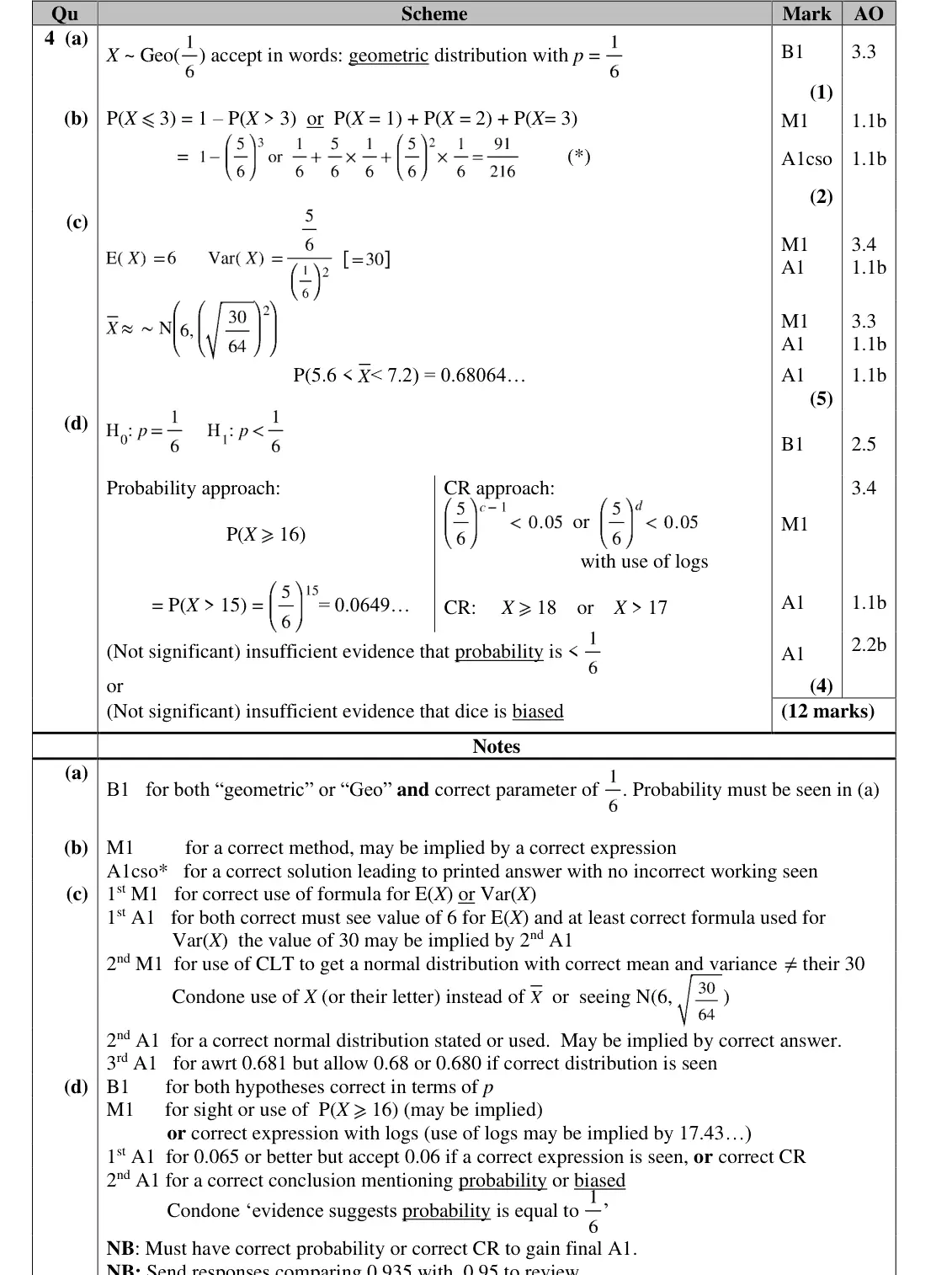
Mark scheme (whole question; this part is marked with the orange bar)
Examiner's comment
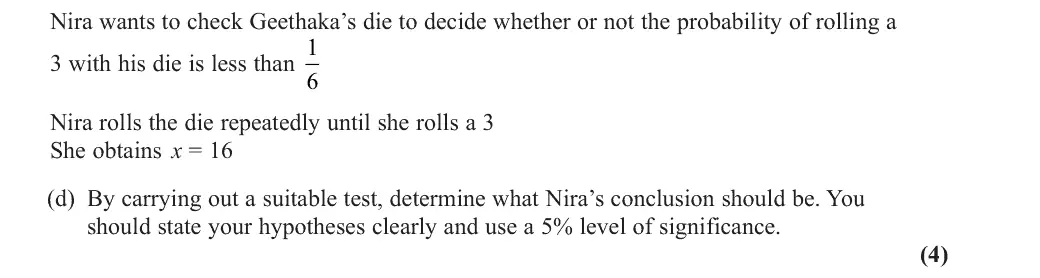
Part (d) was answered well in general. Most candidates gave the hypotheses correctly – though some gave them in words and hence did not gain the mark. A few candidates used P(X = 16), but the majority were able to reach the correct probability, going on to conclude correctly and gain all the marks in (d). A small number chose a critical region approach, and these candidates did so correctly in general. However, overall, it seemed that the critical region approach was less likely to lead to a correct answer, since some candidates gave a critical value of 17 rather than 18 due to not solving the inequality correctly. A small number of candidates chose to compare 0.935 with 0.95, but again, those that did generally did so successfully. Overall, candidates showed a lot of skill when answering Question 5. They showed they were generally adept at modelling with different distributions (including the more challenging aspects such as use of CLT) and were able to conduct a Geometric hypothesis test correctly in the majority of cases.
Key points from the mark scheme and examiner's report
- H0: p = 1/6, H1: p < 1/6 (in symbols)
- P(X ≥ 16) = (5/6)¹⁵ = 0.0649 > 0.05, not significant: no evidence the probability of a 3 is less than 1/6
- P(X = 16) used in error
- CR route gives X ≥ 18 (17 a slip)