June 2019: A level Paper 3C: Further Mechanics 1

75 marks · 17 question parts · Question paper, mark scheme and examiner's report on Pearson's site

Question by question

QTopicMarksDifficulty
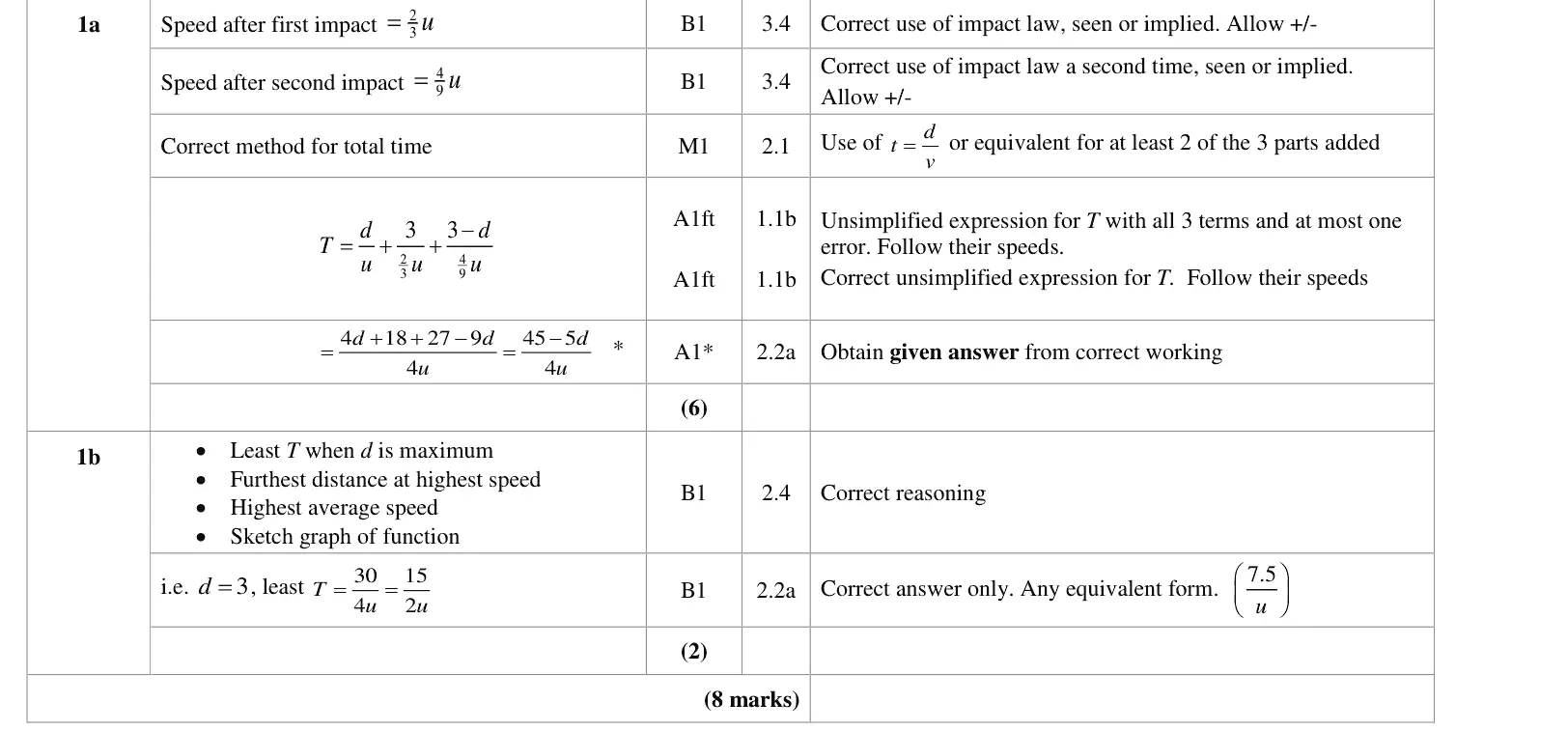
1(a) Elastic collisions in one dimension 6 —
1(b) Elastic collisions in one dimension 2 —
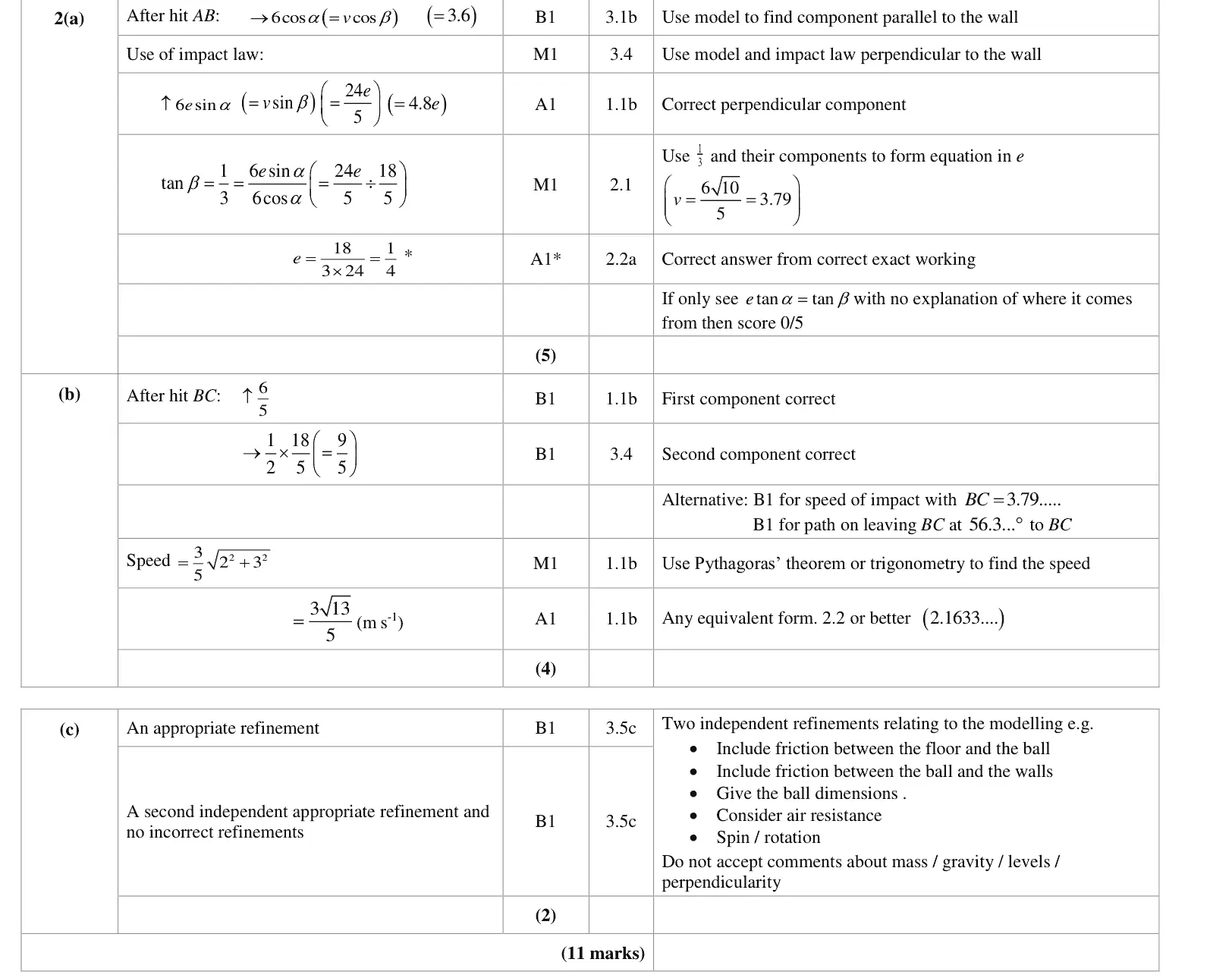
2(a) Elastic collisions in two dimensions (oblique impact) 5 —
2(b) Elastic collisions in two dimensions (oblique impact) 4 —
2(c) Elastic collisions in two dimensions (oblique impact) 2 —
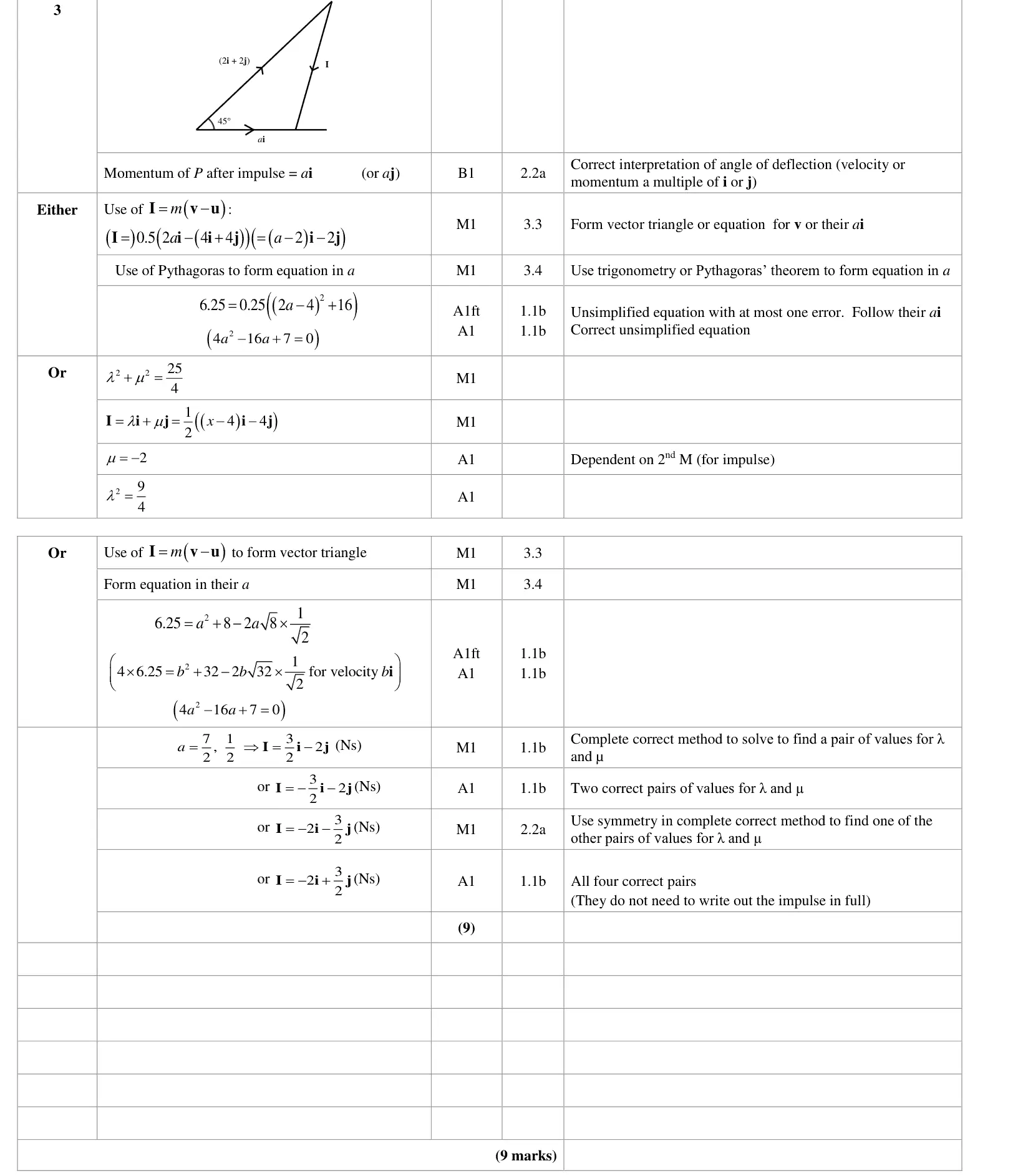
3 Momentum and impulse 9 —
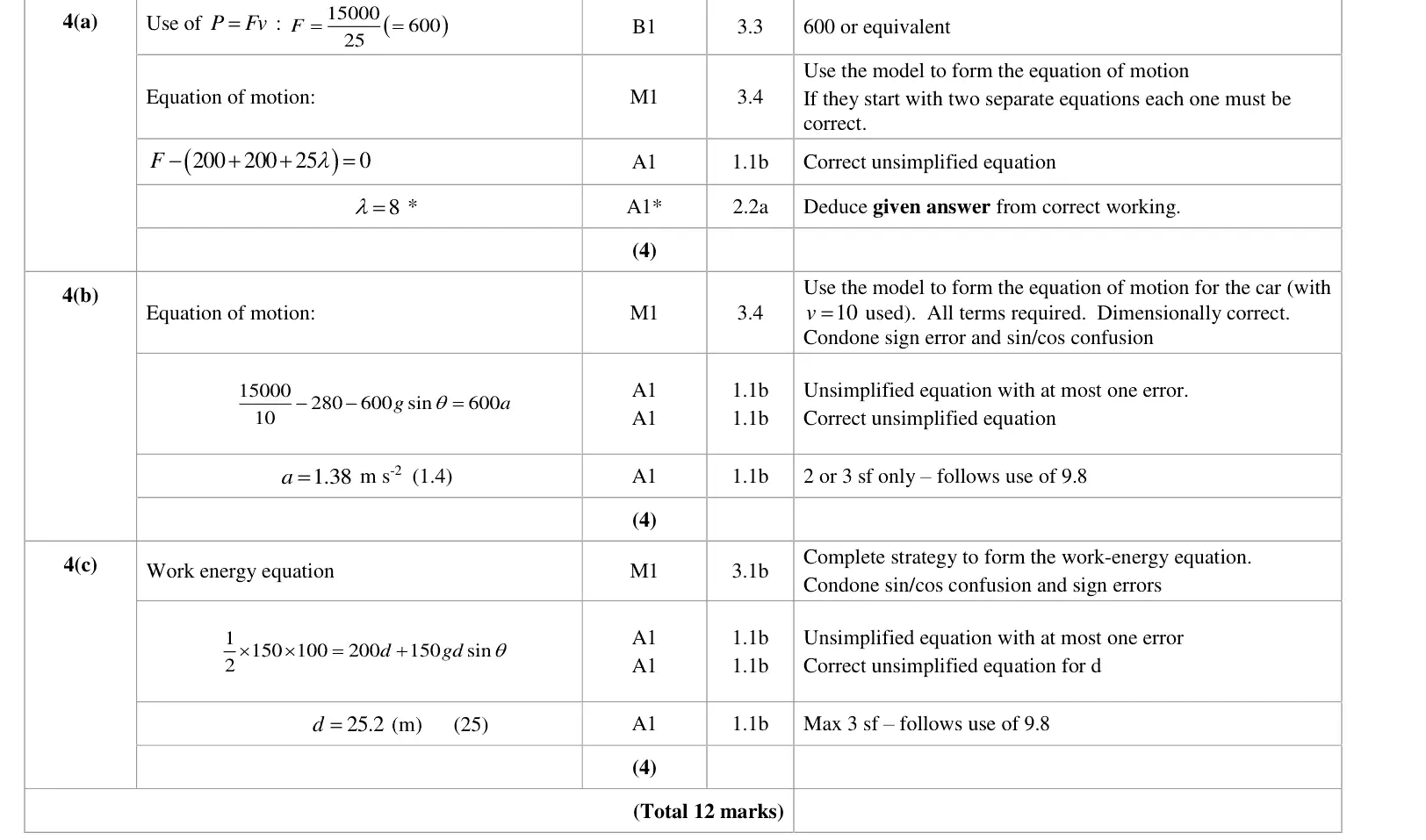
4(a) Work, energy and power 4 —
4(b) Work, energy and power 4 —
4(c) Work, energy and power 4 —
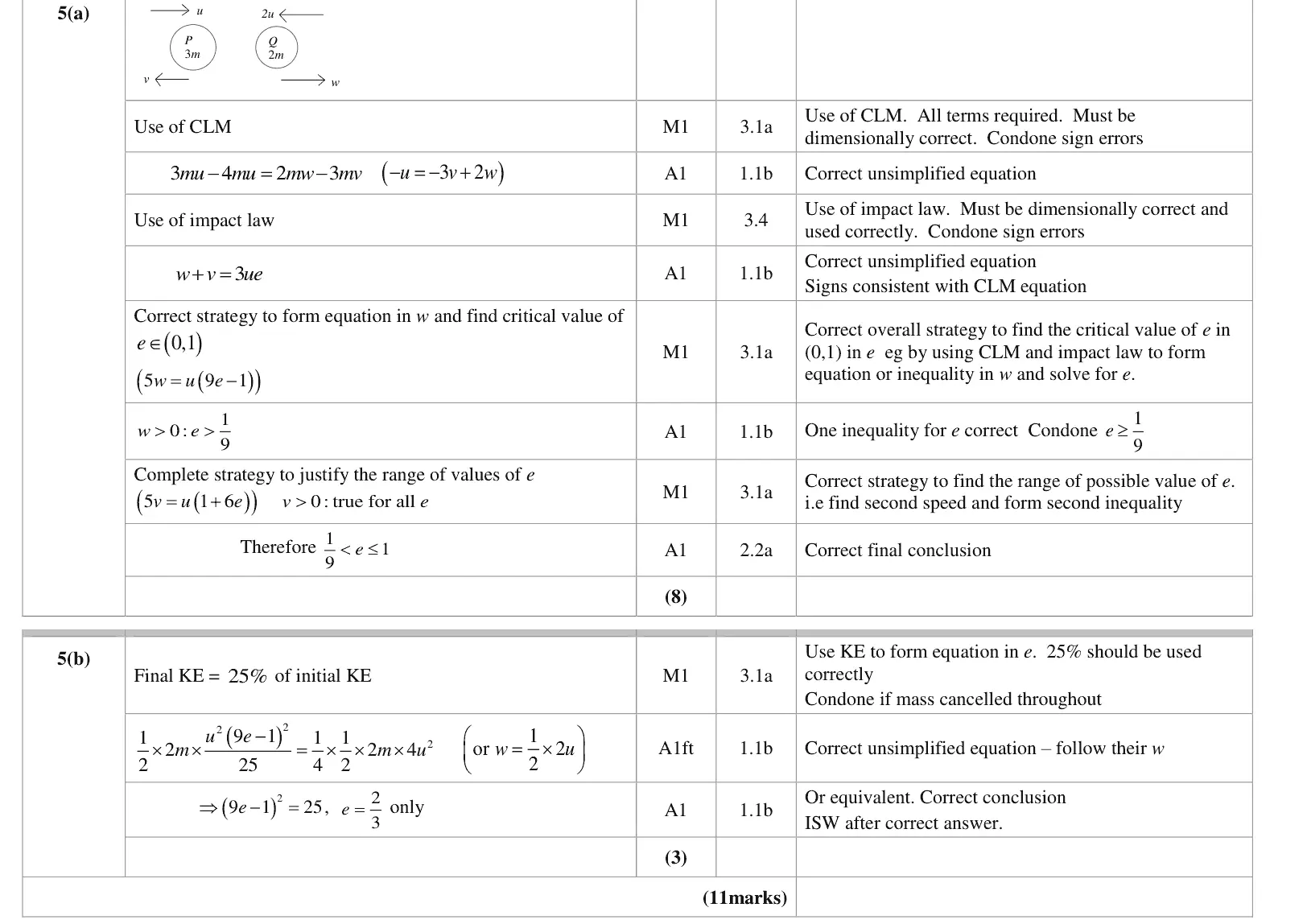
5(a) Elastic collisions in one dimension 8 —
5(b) Elastic collisions in one dimension 3 —
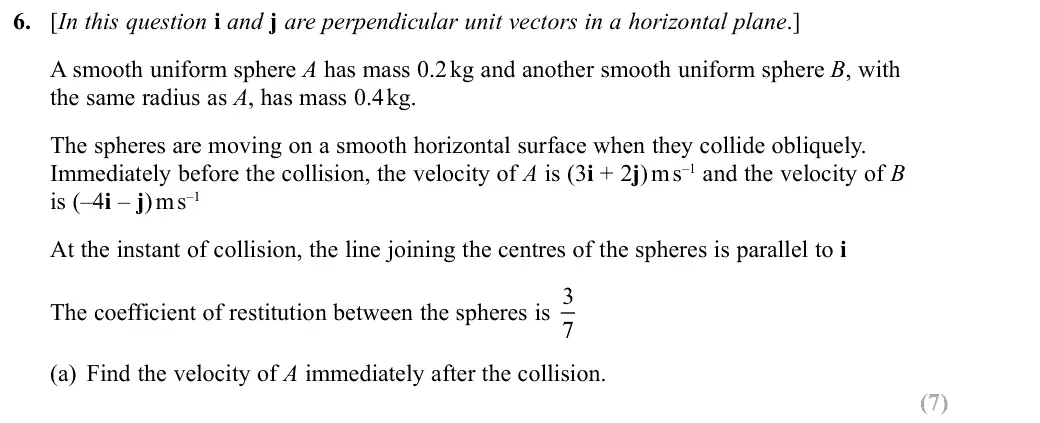
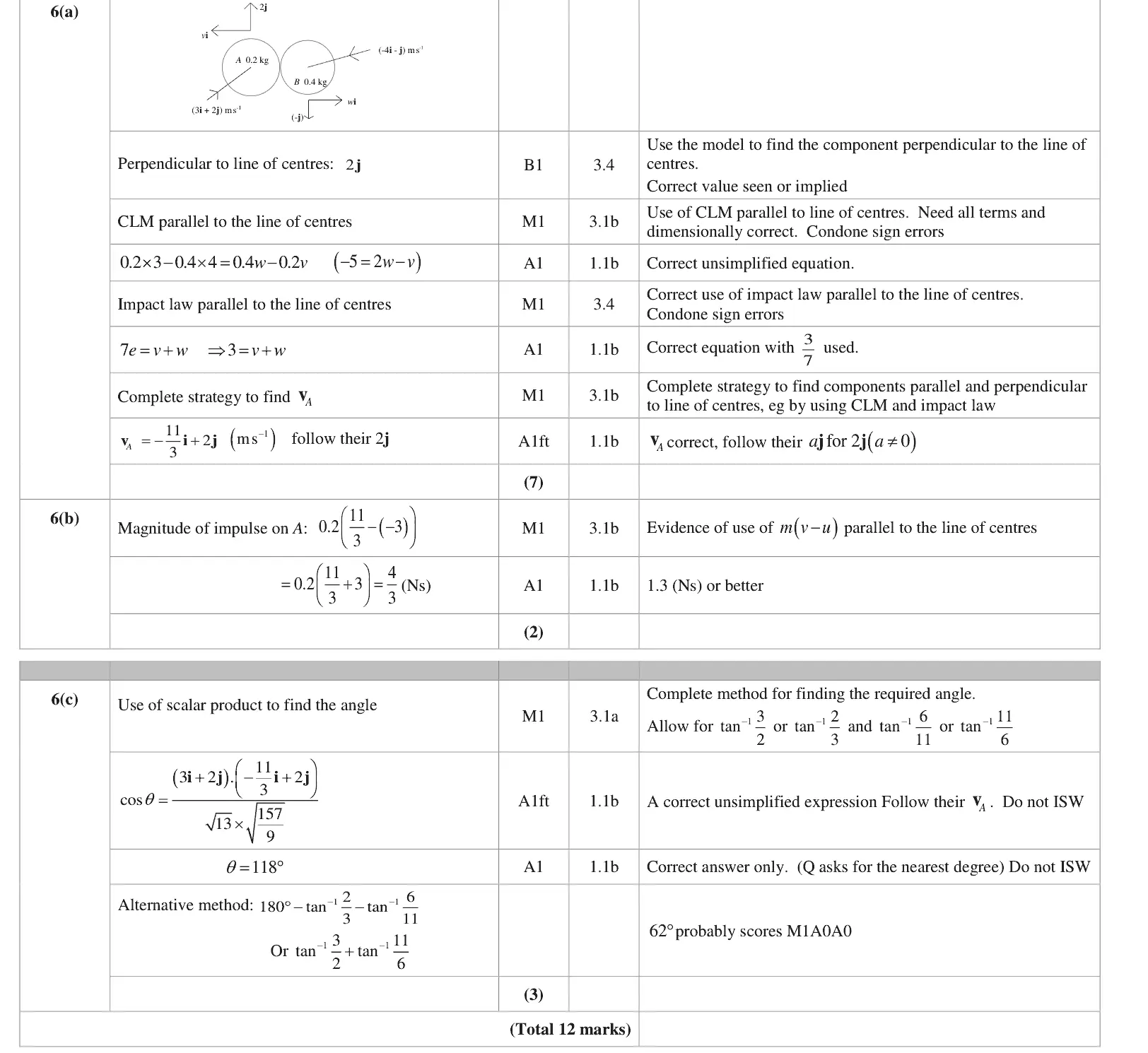
6(a) Elastic collisions in two dimensions (oblique impact) 7 —
6(b) Momentum and impulse 2 —
6(c) Elastic collisions in two dimensions (oblique impact) 3 —
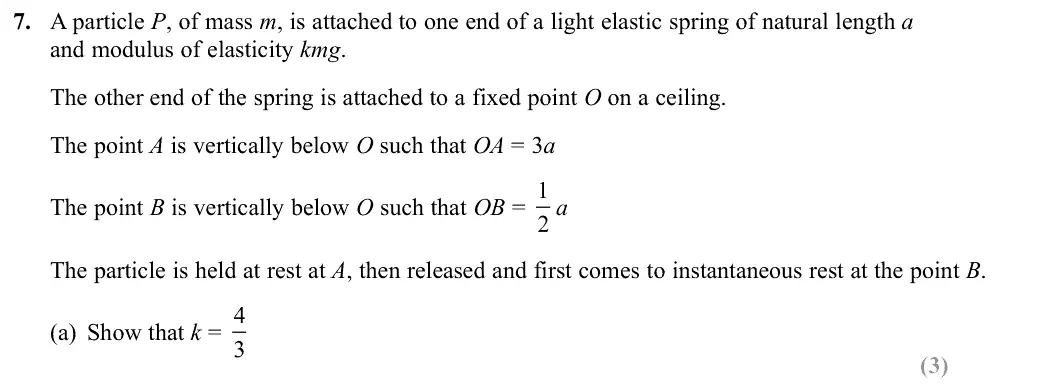
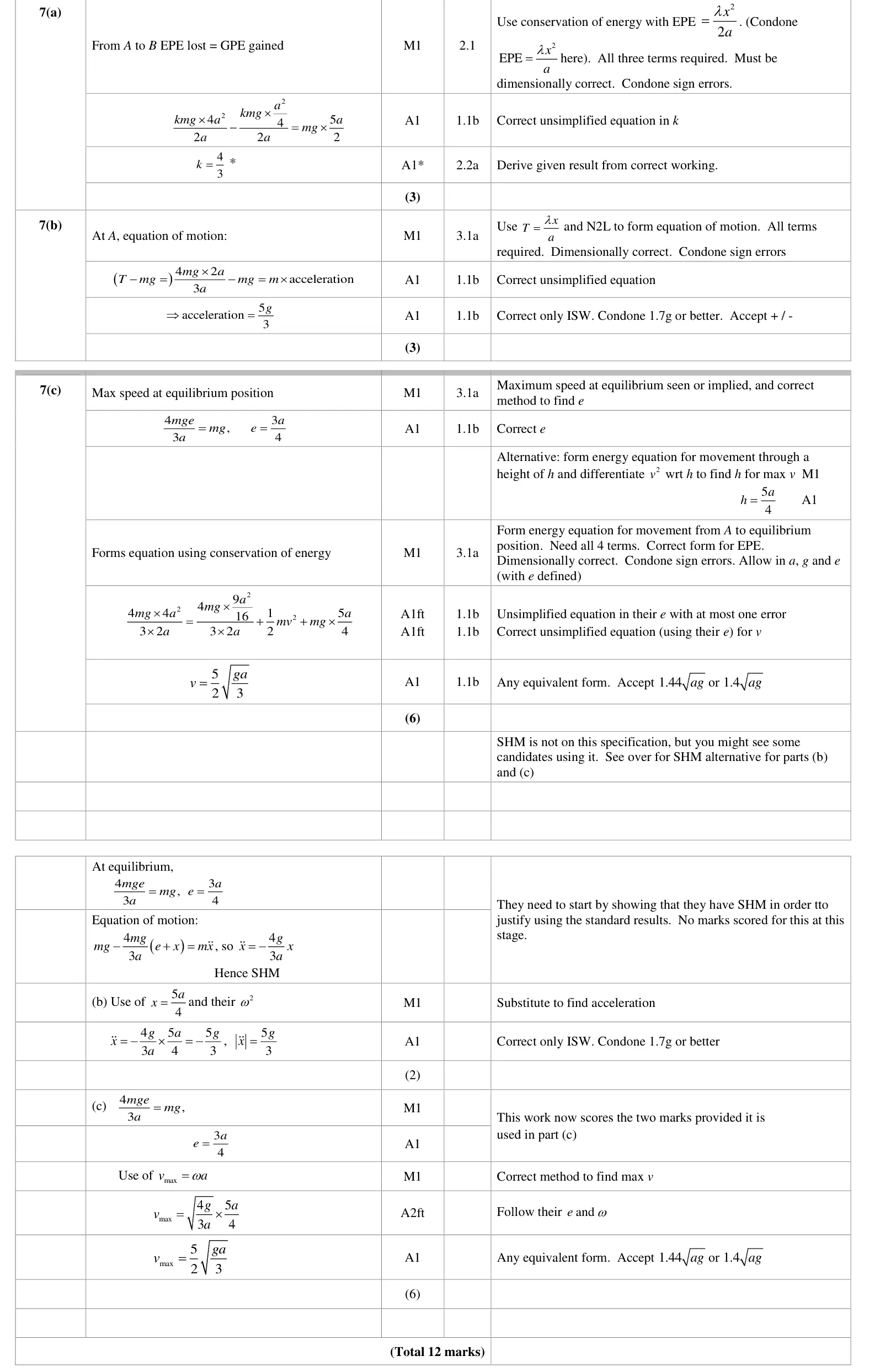
7(a) Elastic strings and springs, Hooke's law and elastic energy 3 —
7(b) Elastic strings and springs, Hooke's law and elastic energy 3 —
7(c) Elastic strings and springs, Hooke's law and elastic energy 6 —

The questions

1(a)1(b)2(a)2(b)2(c)34(a)4(b)4(c)5(a)5(b)6(a)6(b)6(c)7(a)7(b)7(c)
June 2019 · Paper 3C (Further Mechanics 1) · Q1(a) 6 marks collisions in one dimension
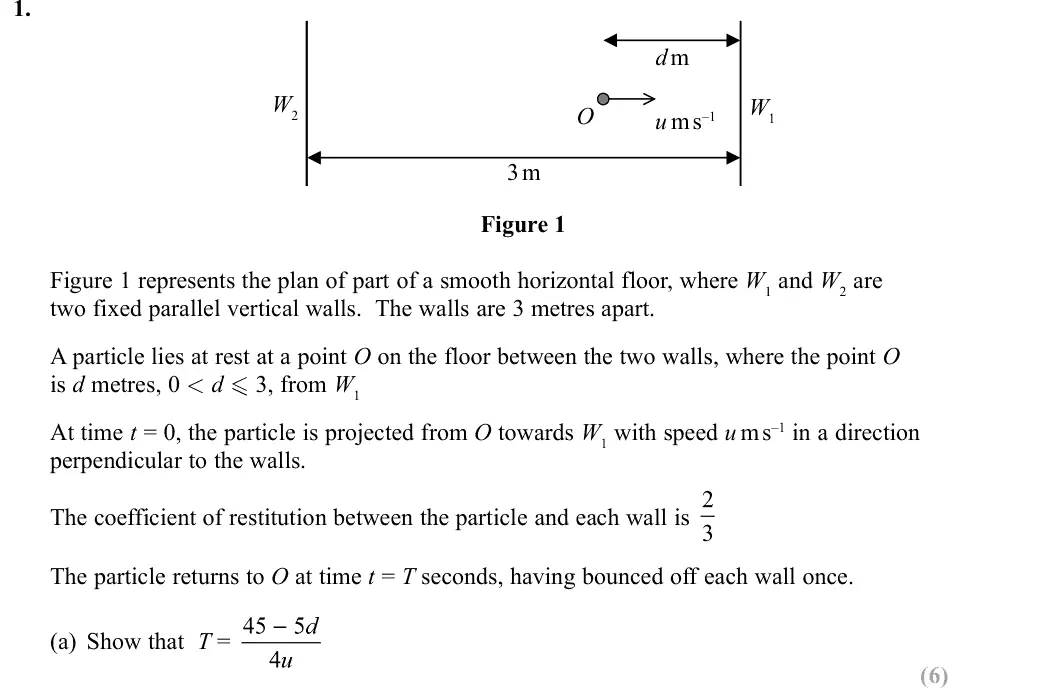
1. d m W2 W1 u m s–1 3 m Figure 1 Figure 1 represents the plan of part of a smooth horizontal floor, where W1 and W2 are two fixed parallel vertical walls. The walls are 3 metres apart. A particle lies at rest at a point O on the floor between the two walls, where the point O is d metres, 0 d 3, from W1 At time t = 0, the particle is projected from O towards W1 with speed u m s–1 in a direction perpendicular to the walls. The coefficient of restitution between the particle and each wall is The particle returns to O at time t = T seconds, having bounced off each wall once. (a) Show that T = (6)
June 2019 · Paper 3C (Further Mechanics 1) · Q1(b) 2 marks collisions in one dimension
The value of u is fixed, the particle still hits each wall once but the value of d can now vary. (b) Find the least possible value of T, giving your answer in terms of u. You must give a reason for your answer. (2)
June 2019 · Paper 3C (Further Mechanics 1) · Q2(a) 5 marks oblique collisions
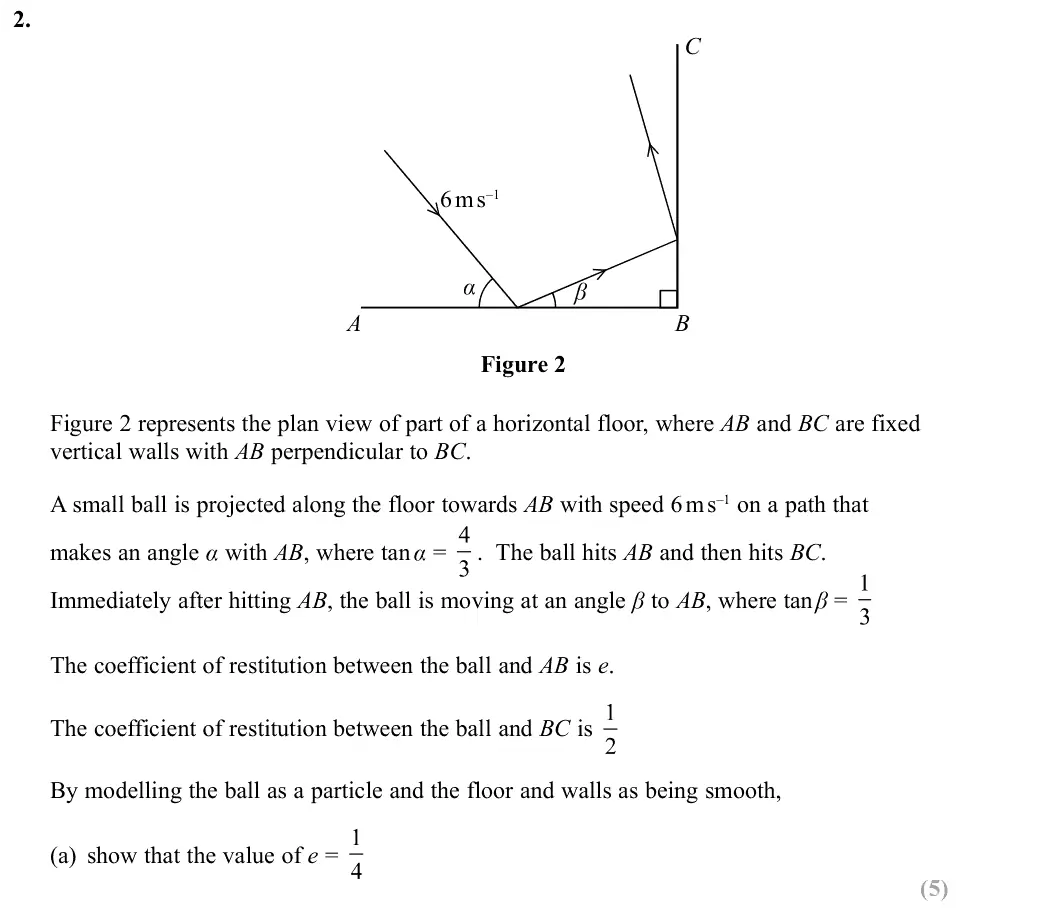
2. C 6 m s–1 A B Figure 2 Figure 2 represents the plan view of part of a horizontal floor, where AB and BC are fixed vertical walls with AB perpendicular to BC. A small ball is projected along the floor towards AB with speed 6 m s–1 on a path that makes an angle with AB, where tan = . The ball hits AB and then hits BC. Immediately after hitting AB, the ball is moving at an angle to AB, where tan = The coefficient of restitution between the ball and AB is e. The coefficient of restitution between the ball and BC is By modelling the ball as a particle and the floor and walls as being smooth, (a) show that the value of e = (5)
June 2019 · Paper 3C (Further Mechanics 1) · Q2(b) 4 marks oblique collisions
(b) find the speed of the ball immediately after it hits BC. (4)
June 2019 · Paper 3C (Further Mechanics 1) · Q2(c) 2 marks oblique collisions
(c) Suggest two ways in which the model could be refined to make it more realistic. (2)
June 2019 · Paper 3C (Further Mechanics 1) · Q3 9 marks momentum and impulse
3. A particle P, of mass 0.5 kg, is moving with velocity (4i + 4j) m s–1 when it receives an impulse I of magnitude 2.5 Ns. As a result of the impulse, the direction of motion of P is deflected through an angle of 45 Given that I = ( i + j) Ns, find all the possible pairs of values of and . (9)
June 2019 · Paper 3C (Further Mechanics 1) · Q4(a) 4 marks work energy and power
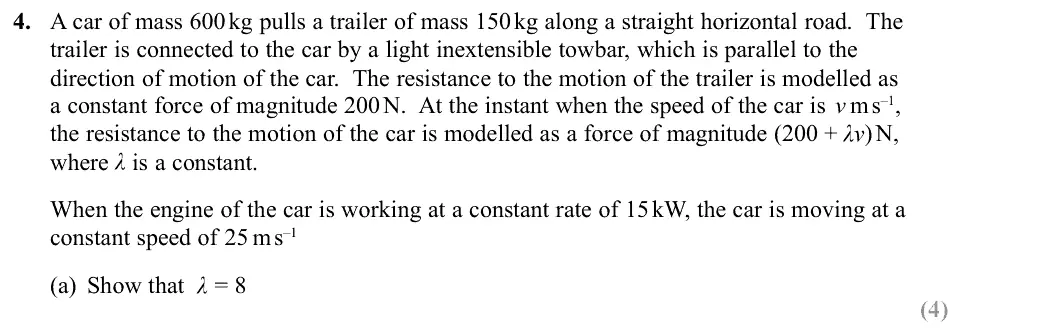
4. A car of mass 600 kg pulls a trailer of mass 150 kg along a straight horizontal road. The trailer is connected to the car by a light inextensible towbar, which is parallel to the direction of motion of the car. The resistance to the motion of the trailer is modelled as a constant force of magnitude 200 N. At the instant when the speed of the car is v m s–1, the resistance to the motion of the car is modelled as a force of magnitude (200 + ) N, where is a constant. When the engine of the car is working at a constant rate of 15 kW, the car is moving at a constant speed of 25 m s–1 (a) Show that = 8 (4)
June 2019 · Paper 3C (Further Mechanics 1) · Q4(b) 4 marks work energy and power
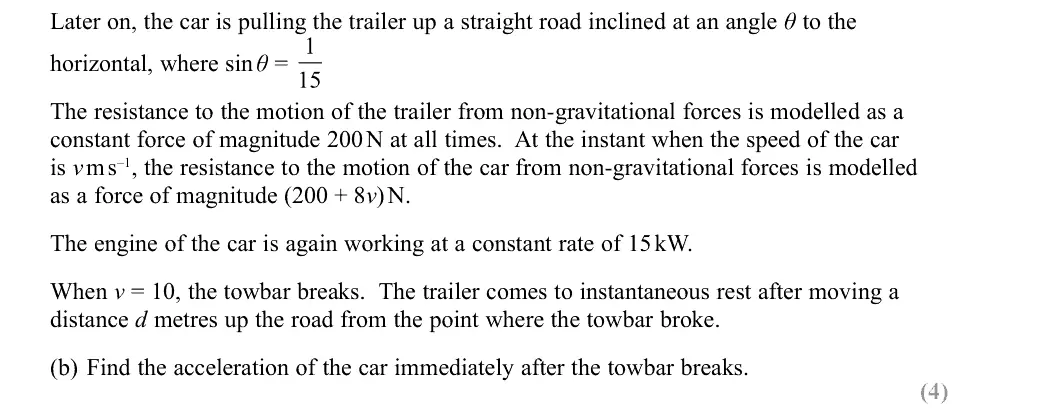
Later on, the car is pulling the trailer up a straight road inclined at an angle to the horizontal, where sin = The resistance to the motion of the trailer from non-gravitational forces is modelled as a constant force of magnitude 200 N at all times. At the instant when the speed of the car is v m s–1, the resistance to the motion of the car from non-gravitational forces is modelled as a force of magnitude (200 + 8v) N. The engine of the car is again working at a constant rate of 15 kW. When v = 10, the towbar breaks. The trailer comes to instantaneous rest after moving a distance d metres up the road from the point where the towbar broke. (b) Find the acceleration of the car immediately after the towbar breaks. (4)
June 2019 · Paper 3C (Further Mechanics 1) · Q4(c) 4 marks work energy and power
(c) Use the work-energy principle to find the value of d. (4)
June 2019 · Paper 3C (Further Mechanics 1) · Q5(a) 8 marks collisions in one dimension
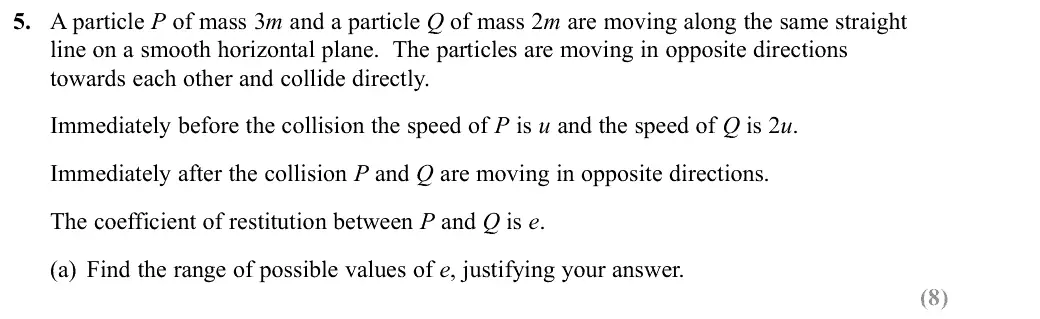
5. A particle P of mass 3m and a particle Q of mass 2m are moving along the same straight line on a smooth horizontal plane. The particles are moving in opposite directions towards each other and collide directly. Immediately before the collision the speed of P is u and the speed of Q is 2u. Immediately after the collision P and Q are moving in opposite directions. The coefficient of restitution between P and Q is e. (a) Find the range of possible values of e, justifying your answer. (8)
June 2019 · Paper 3C (Further Mechanics 1) · Q5(b) 3 marks collisions in one dimension
Given that Q loses 75% of its kinetic energy as a result of the collision, (b) find the value of e. (3)
June 2019 · Paper 3C (Further Mechanics 1) · Q6(a) 7 marks oblique collisions
6. [In this question i and j are perpendicular unit vectors in a horizontal plane.] A smooth uniform sphere A has mass 0.2 kg and another smooth uniform sphere B, with the same radius as A, has mass 0.4 kg. The spheres are moving on a smooth horizontal surface when they collide obliquely. Immediately before the collision, the velocity of A is (3i + 2j) m s–1 and the velocity of B is (–4i – j) m s–1 At the instant of collision, the line joining the centres of the spheres is parallel to i The coefficient of restitution between the spheres is (a) Find the velocity of A immediately after the collision. (7)
June 2019 · Paper 3C (Further Mechanics 1) · Q6(b) 2 marks momentum and impulse
(b) Find the magnitude of the impulse received by A in the collision. (2)
June 2019 · Paper 3C (Further Mechanics 1) · Q6(c) 3 marks oblique collisions
(c) Find, to the nearest degree, the size of the angle through which the direction of motion of A is deflected as a result of the collision. (3)
June 2019 · Paper 3C (Further Mechanics 1) · Q7(a) 3 marks elastic strings and springs
7. A particle P, of mass m, is attached to one end of a light elastic spring of natural length a and modulus of elasticity kmg. The other end of the spring is attached to a fixed point O on a ceiling. The point A is vertically below O such that OA = 3a The point B is vertically below O such that OB = a The particle is held at rest at A, then released and first comes to instantaneous rest at the point B. (a) Show that k = (3)
June 2019 · Paper 3C (Further Mechanics 1) · Q7(b) 3 marks elastic strings and springs
(b) Find, in terms of g, the acceleration of P immediately after it is released from rest at A. (3)
June 2019 · Paper 3C (Further Mechanics 1) · Q7(c) 6 marks elastic strings and springs
(c) Find, in terms of g and a, the maximum speed attained by P as it moves from A to B. (6)

Find an Edexcel Further Maths tutor

Want this paper marked and gone through with a Further Maths tutor? Message us.

Prefer email? Send an enquiry

If you are under 18, please include a parent's contact details. Enquiries go to enquiries@alevelfurthermathstutor.com and are deleted once handled.