June 2023: AS Paper 28: Decision Mathematics 2

40 marks · 14 question parts · Question paper, mark scheme and examiner's report on Pearson's site

Question by question

QTopicMarksDifficulty
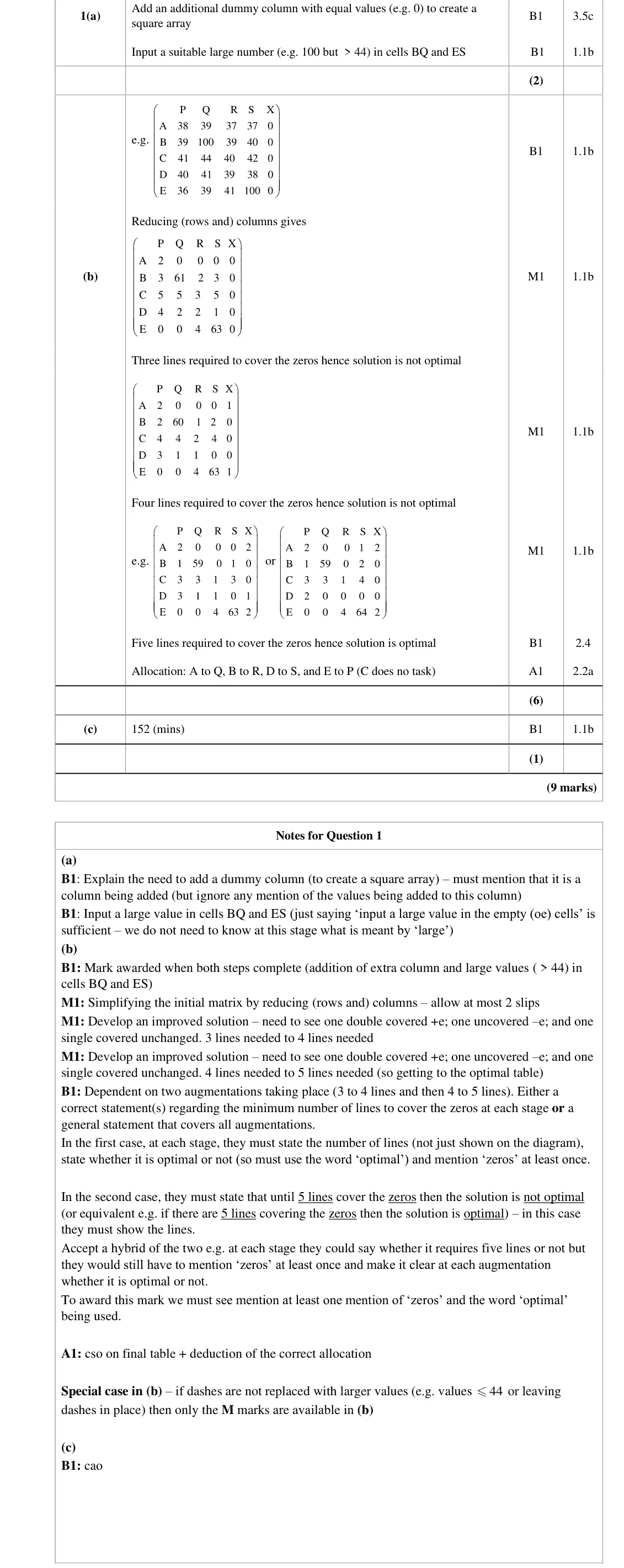
1(a) Allocation (assignment) problems and the Hungarian algorithm 2 —
1(b) Allocation (assignment) problems and the Hungarian algorithm 6 —
1(c) Allocation (assignment) problems and the Hungarian algorithm 1 —
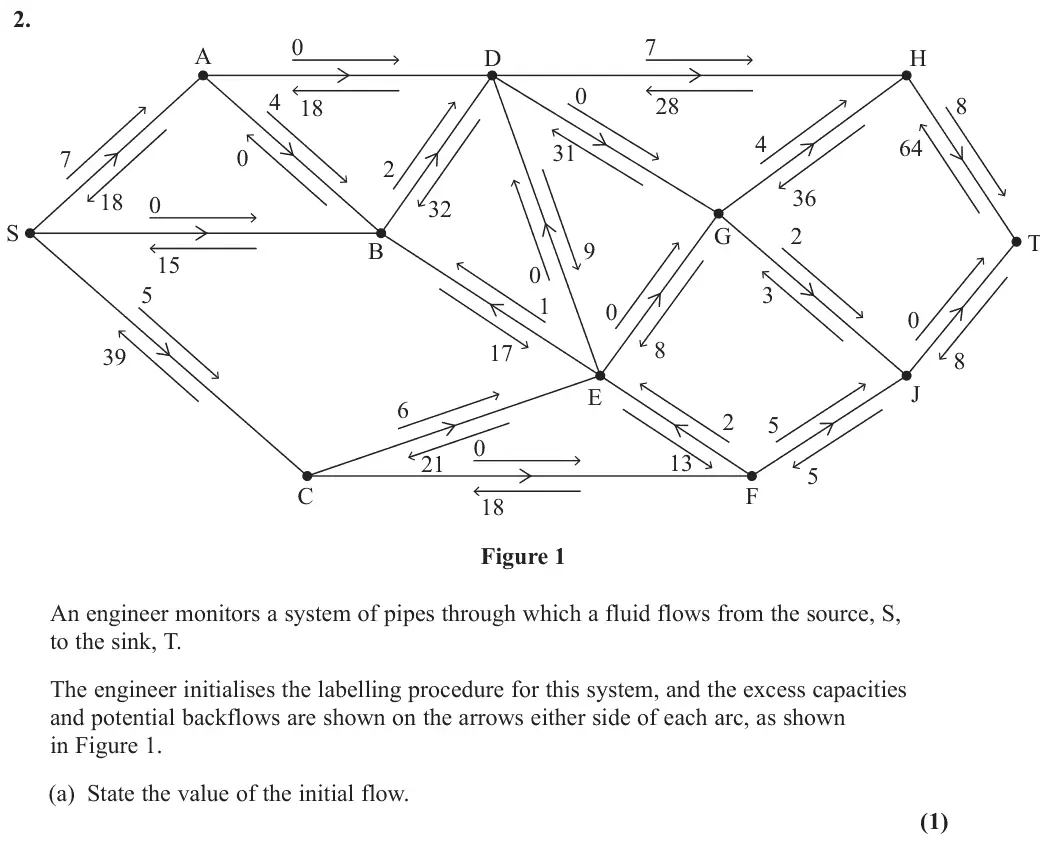
2(a) Flows in networks 1 —
2(b) Flows in networks 1 —
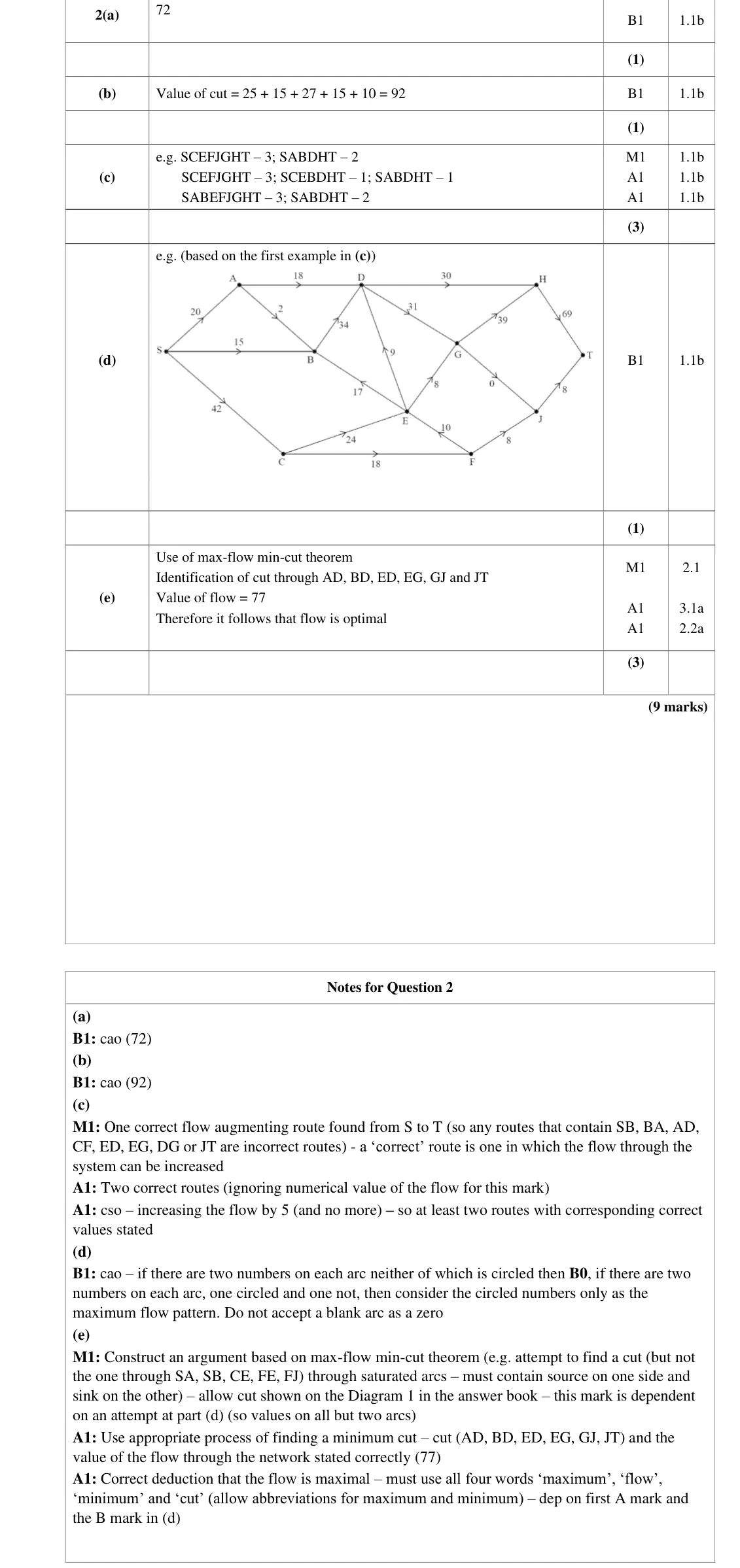
2(c) Flows in networks 3 —
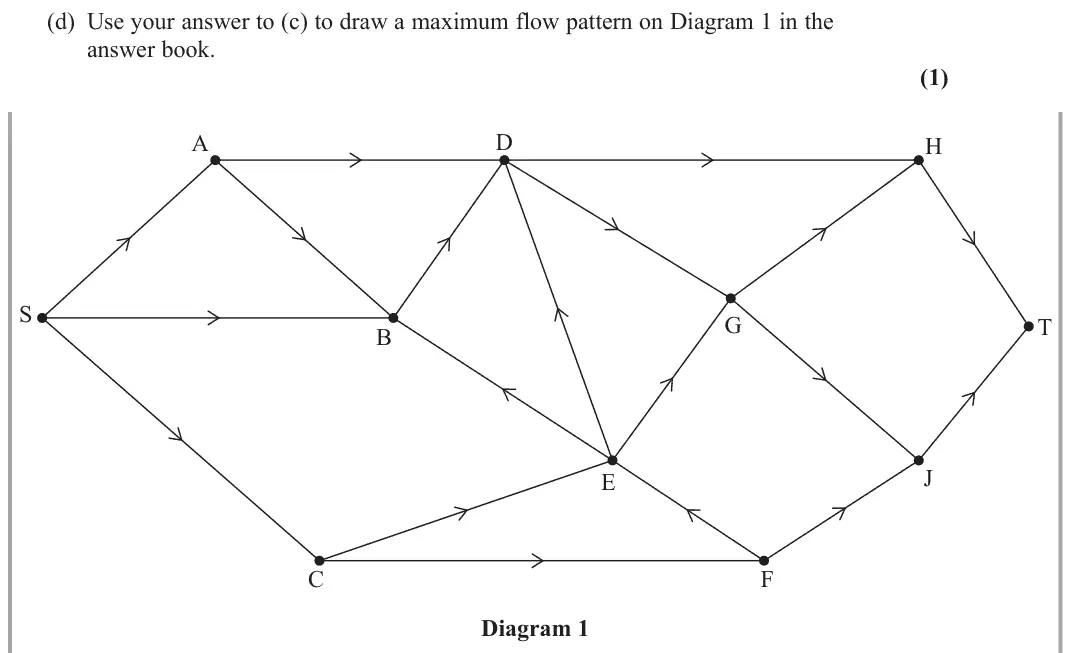
2(d) Flows in networks 1 —
2(e) Flows in networks 3 —
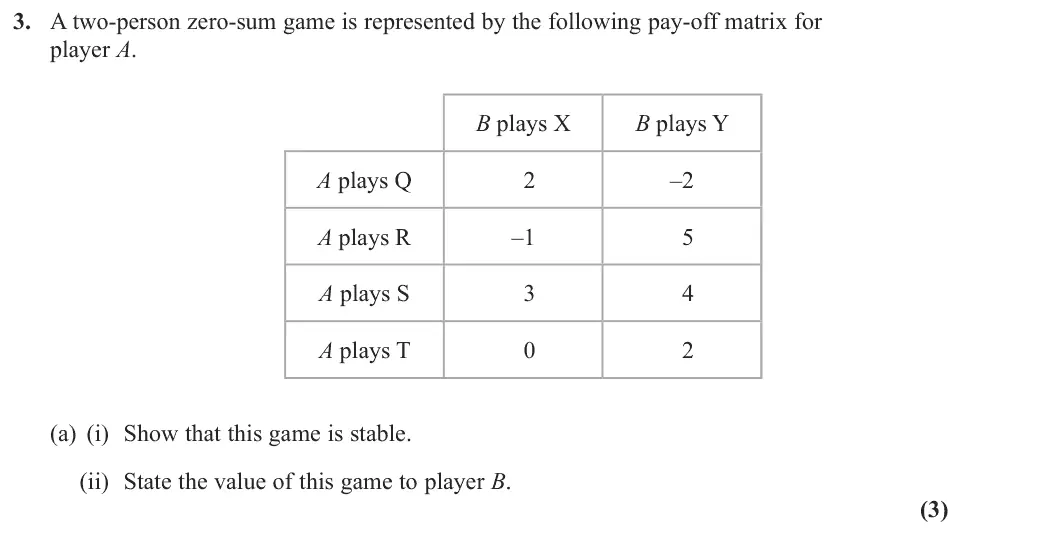
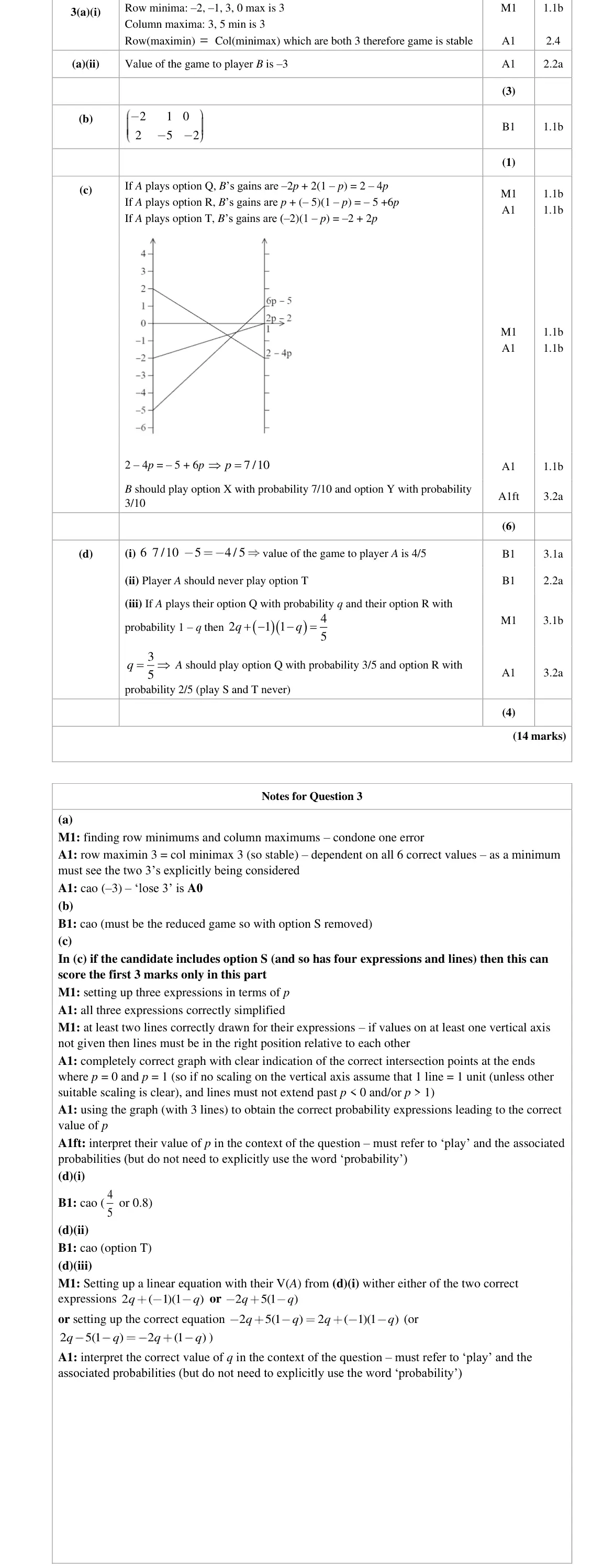
3(a) Game theory 3 —
3(b) Game theory 1 —
3(c) Game theory 6 —
3(d) Game theory 4 —
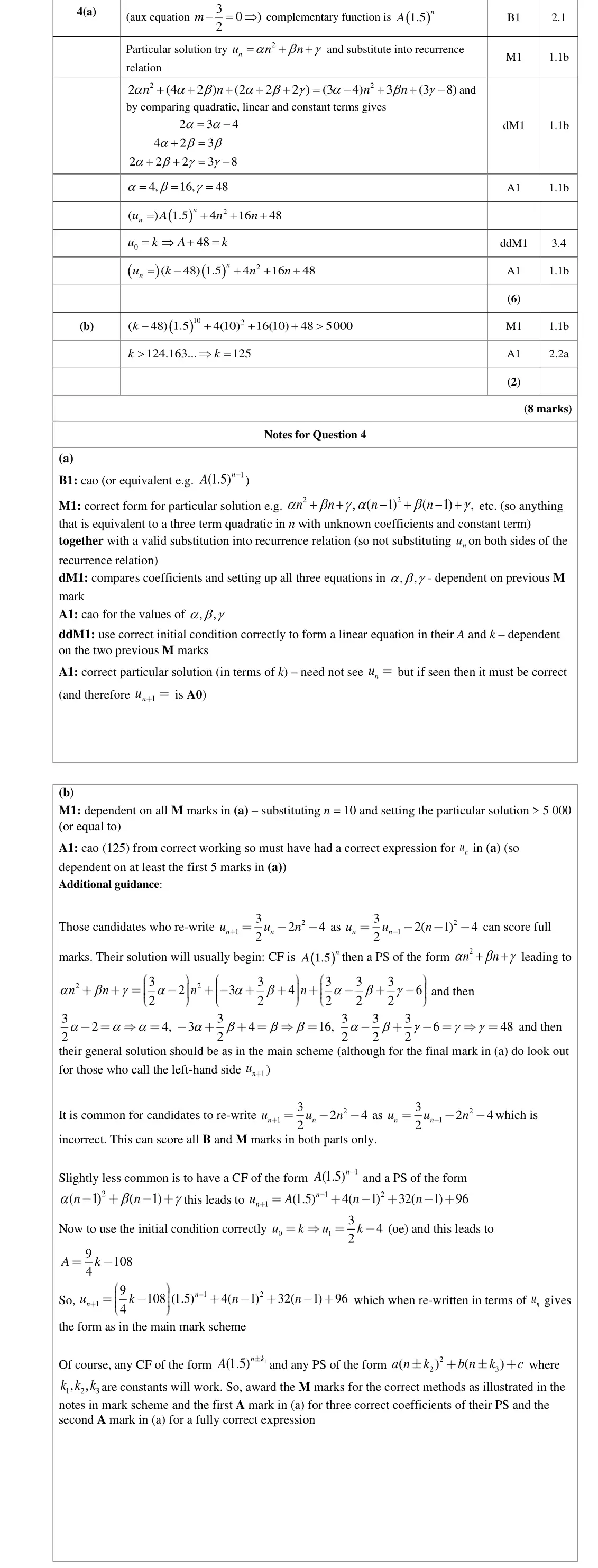
4(a) Recurrence relations (Decision 2) 6 —
4(b) Recurrence relations (Decision 2) 2 —

The questions

1(a)1(b)1(c)2(a)2(b)2(c)2(d)2(e)3(a)3(b)3(c)3(d)4(a)4(b)
June 2023 · AS Paper 2 (Decision 2) · Q1(a) 2 marks allocation problems
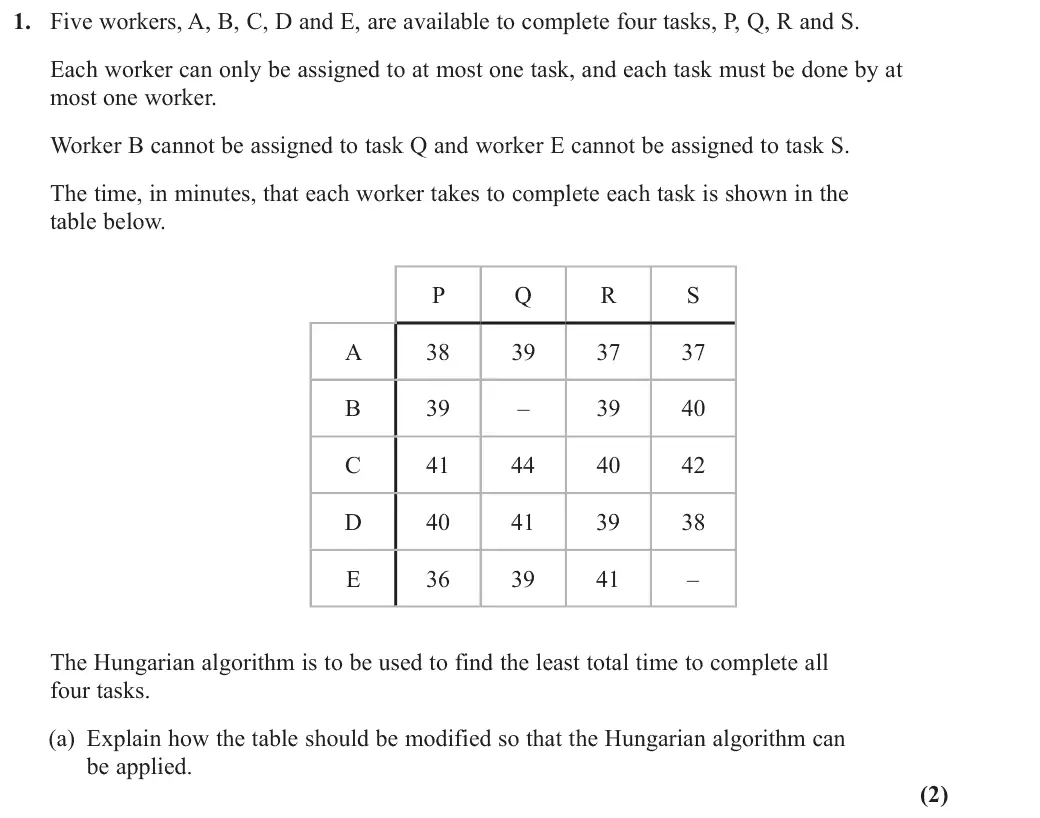
1. Five workers, A, B, C, D and E, are available to complete four tasks, P, Q, R and S. Each worker can only be assigned to at most one task, and each task must be done by at most one worker. Worker B cannot be assigned to task Q and worker E cannot be assigned to task S. The time, in minutes, that each worker takes to complete each task is shown in the table below. P Q R S A B – C E – The Hungarian algorithm is to be used to find the least total time to complete all four tasks. (a) Explain how the table should be modified so that the Hungarian algorithm can be applied. (2)
June 2023 · AS Paper 2 (Decision 2) · Q1(b) 6 marks allocation problems
(b) (i) Use the Hungarian algorithm to obtain an allocation that minimises the total time. (ii) Explain how you determined if the table was optimal at each stage. (6)
June 2023 · AS Paper 2 (Decision 2) · Q1(c) 1 mark allocation problems
(c) Calculate the least total time to complete all four tasks. (1)
June 2023 · AS Paper 2 (Decision 2) · Q2(a) 1 mark flows in networks
2. A H S G B J E C F Figure 1 An engineer monitors a system of pipes through which a fluid flows from the source, S, to the sink, T. The engineer initialises the labelling procedure for this system, and the excess capacities and potential backflows are shown on the arrows either side of each arc, as shown in Figure 1. (a) State the value of the initial flow. (1)
June 2023 · AS Paper 2 (Decision 2) · Q2(b) 1 mark flows in networks
(b) Obtain the capacity of the cut that passes through the arcs SA, SB, CE, FE and FJ. (1)
June 2023 · AS Paper 2 (Decision 2) · Q2(c) 3 marks flows in networks
(c) Use the labelling procedure to find a maximum flow through the network. You must list each flow‑augmenting route you use, together with its flow. (3)
June 2023 · AS Paper 2 (Decision 2) · Q2(d) 1 mark flows in networks
(d) Use your answer to (c) to draw a maximum flow pattern on Diagram 1 in the answer book. (1)
June 2023 · AS Paper 2 (Decision 2) · Q2(e) 3 marks flows in networks
(e) Prove that the answer to (d) is optimal. (3)
June 2023 · AS Paper 2 (Decision 2) · Q3(a) 3 marks game theory
3. A two‑person zero‑sum game is represented by the following pay‑off matrix for player A. B plays X B plays Y A plays Q –2 A plays R –1 A plays S A plays T (a) (i) Show that this game is stable. (ii) State the value of this game to player B. (3)
June 2023 · AS Paper 2 (Decision 2) · Q3(b) 1 mark game theory
Option S is removed from player A’s choices and the reduced game, with option S removed, is no longer stable. (b) Write down the reduced pay‑off matrix for player B. (1)
June 2023 · AS Paper 2 (Decision 2) · Q3(c) 6 marks game theory
Let B play option X with probability p and option Y with probability 1 – p. (c) Use a graphical method to find the optimal value of p and hence find the best strategy for player B in the reduced game. (6)
June 2023 · AS Paper 2 (Decision 2) · Q3(d) 4 marks game theory
(d) (i) Find the value of the reduced game to player A. (ii) State which option player A should never play in the reduced game. (iii) Hence find the best strategy for player A in the reduced game. (4)
June 2023 · AS Paper 2 (Decision 2) · Q4(a) 6 marks recurrence relations d2
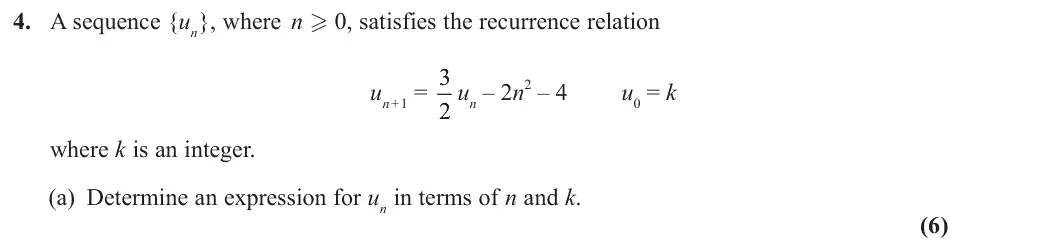
4. A sequence {un}, where n 0, satisfies the recurrence relation un + 1 = 3 2 un – 2n 2 – 4 u0 = k where k is an integer. (a) Determine an expression for un in terms of n and k. (6)
June 2023 · AS Paper 2 (Decision 2) · Q4(b) 2 marks recurrence relations d2
Given that u10 > 5000 (b) determine the minimum possible value of k. (2)

Find an Edexcel Further Maths tutor

Want this paper marked and gone through with a Further Maths tutor? Message us.

Prefer email? Send an enquiry

If you are under 18, please include a parent's contact details. Enquiries go to enquiries@alevelfurthermathstutor.com and are deleted once handled.