Nov 2021: A level Paper 3C: Further Mechanics 1

75 marks · 14 question parts · Question paper, mark scheme and examiner's report on Pearson's site

Question by question

QTopicMarksDifficulty
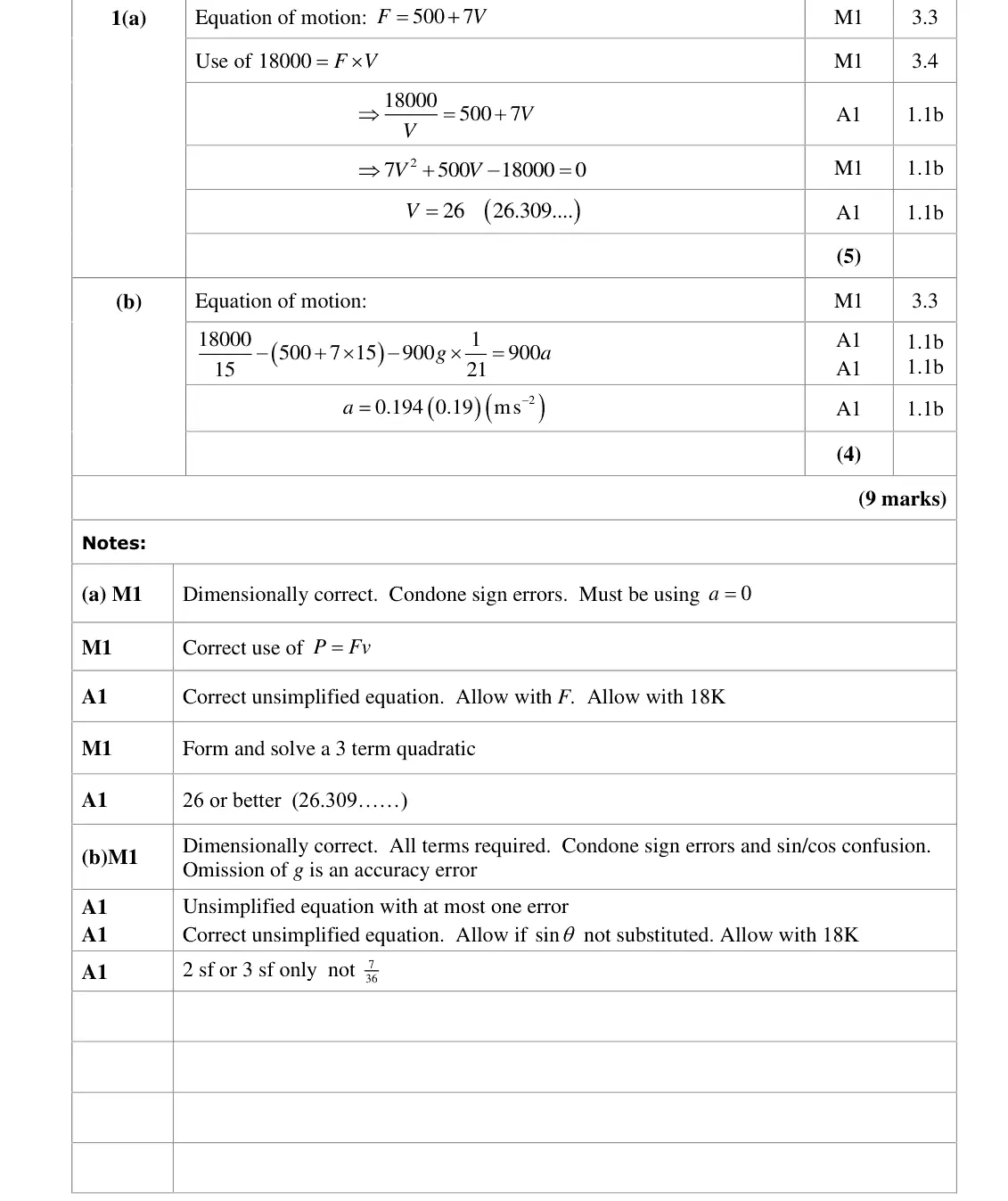
1(a) Work, energy and power 5 —
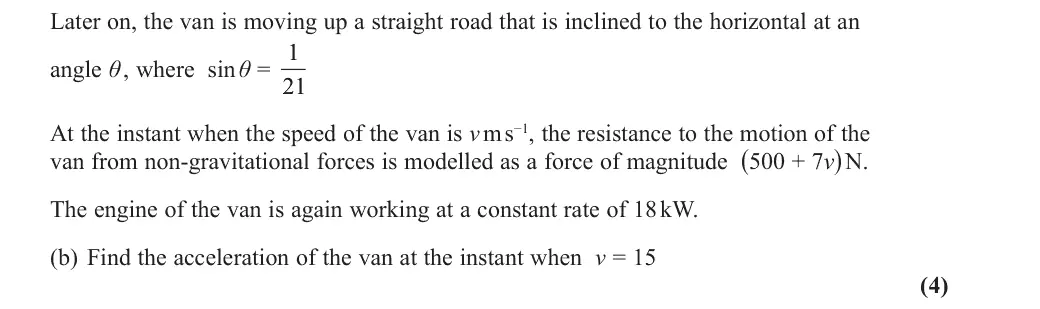
1(b) Work, energy and power 4 —
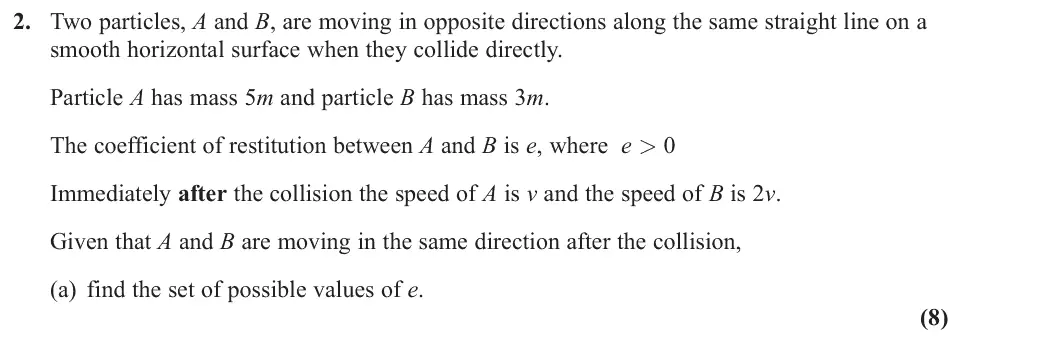
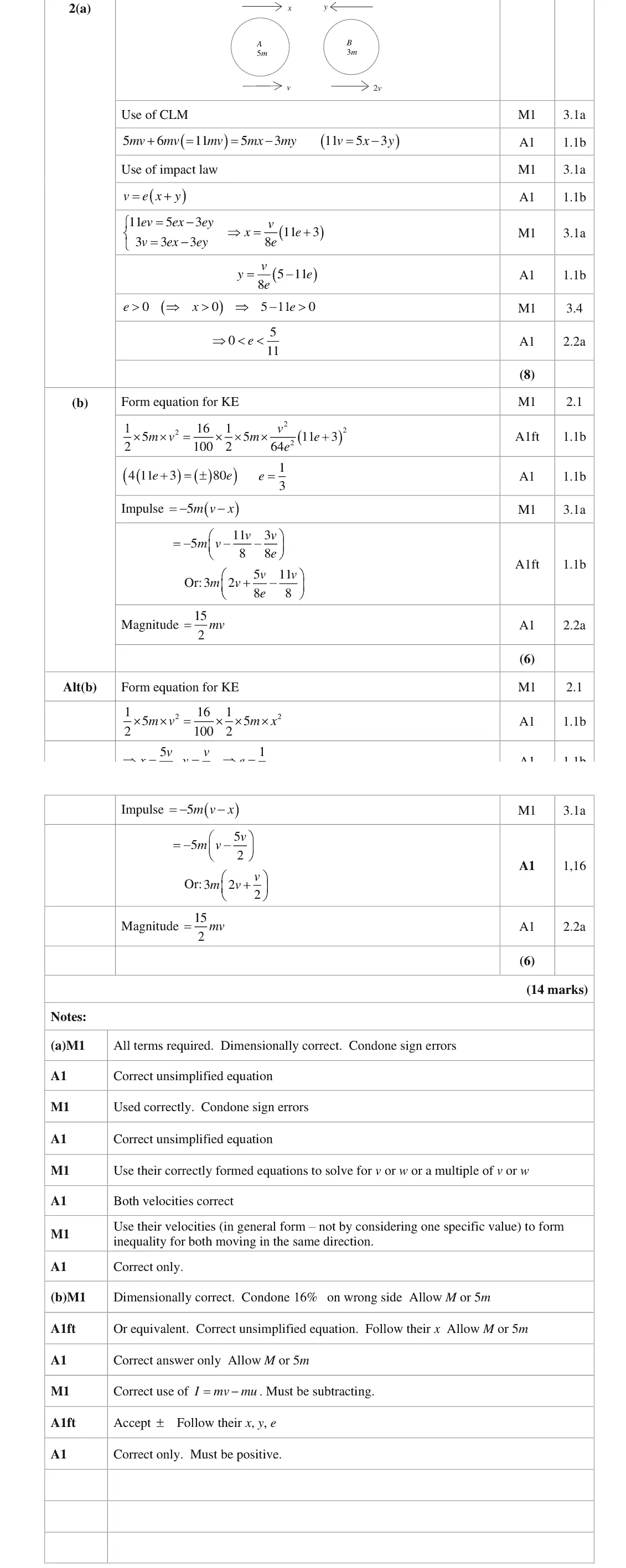
2(a) Elastic collisions in one dimension 8 —
2(b) Elastic collisions in one dimension, Momentum and impulse 6 —
3(a) Elastic collisions in two dimensions (oblique impact) 8 —
3(b) Elastic collisions in two dimensions (oblique impact) 5 —
3(c) Elastic collisions in two dimensions (oblique impact) 1 —
4 Momentum and impulse 8 —
5(a) Elastic collisions in two dimensions (oblique impact) 5 —
5(b) Elastic collisions in two dimensions (oblique impact) 5 —
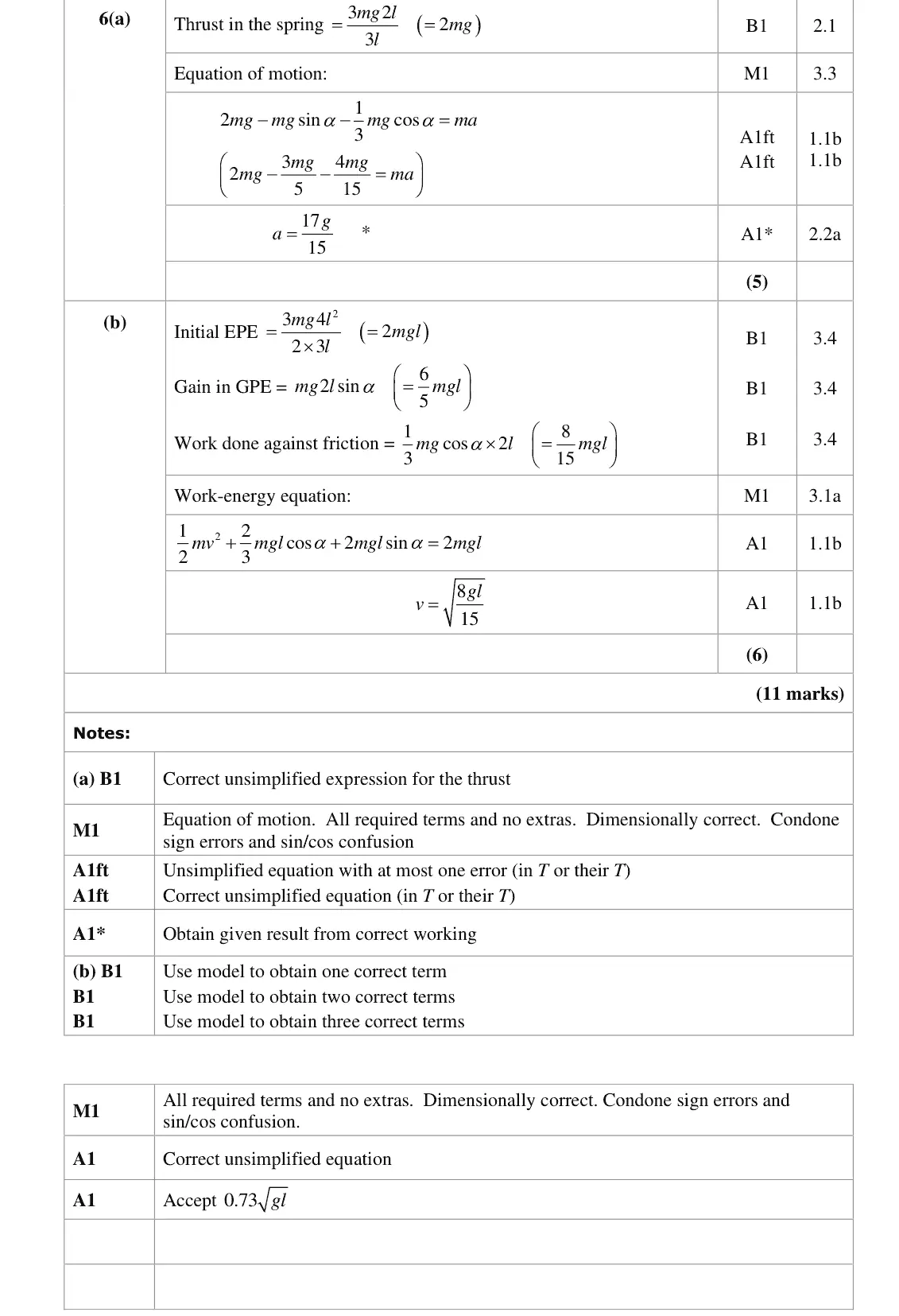
6(a) Elastic strings and springs, Hooke's law and elastic energy 5 —
6(b) Elastic strings and springs, Hooke's law and elastic energy, Work, energy and power 6 —
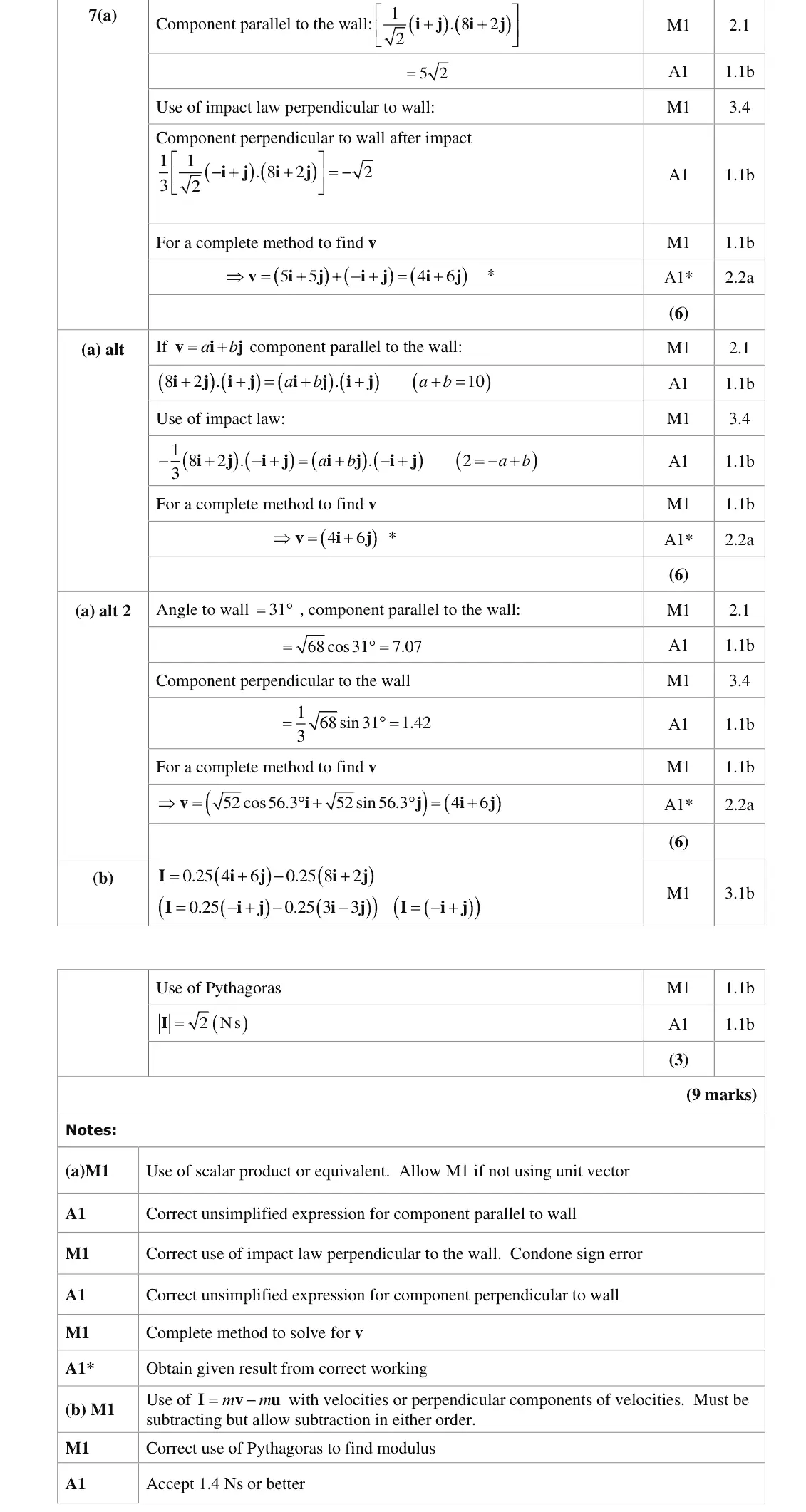
7(a) Elastic collisions in two dimensions (oblique impact) 6 —
7(b) Momentum and impulse 3 —

The questions

1(a)1(b)2(a)2(b)3(a)3(b)3(c)45(a)5(b)6(a)6(b)7(a)7(b)
Nov 2021 · Paper 3C (Further Mechanics 1) · Q1(a) 5 marks work energy and power
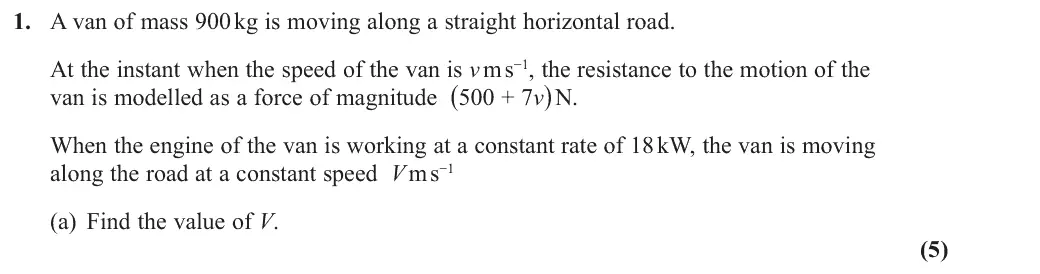
1. A van of mass 900 kg is moving along a straight horizontal road. At the instant when the speed of the van is v m s-1, the resistance to the motion of the van is modelled as a force of magnitude (500 + 7v) N. When the engine of the van is working at a constant rate of 18 kW, the van is moving along the road at a constant speed V m s-1 (a) Find the value of V. (5)
Nov 2021 · Paper 3C (Further Mechanics 1) · Q1(b) 4 marks work energy and power
Later on, the van is moving up a straight road that is inclined to the horizontal at an angle theta , where sin theta = 1 At the instant when the speed of the van is v m s-1, the resistance to the motion of the van from non-gravitational forces is modelled as a force of magnitude (500 + 7v) N. The engine of the van is again working at a constant rate of 18 kW. (b) Find the acceleration of the van at the instant when v = 15 (4)
Nov 2021 · Paper 3C (Further Mechanics 1) · Q2(a) 8 marks collisions in one dimension
2. Two particles, A and B, are moving in opposite directions along the same straight line on a smooth horizontal surface when they collide directly. Particle A has mass 5m and particle B has mass 3m. The coefficient of restitution between A and B is e, where e > 0 Immediately after the collision the speed of A is v and the speed of B is 2v. Given that A and B are moving in the same direction after the collision, (a) find the set of possible values of e. (8)
Nov 2021 · Paper 3C (Further Mechanics 1) · Q2(b) 6 marks collisions in one dimensionmomentum and impulse
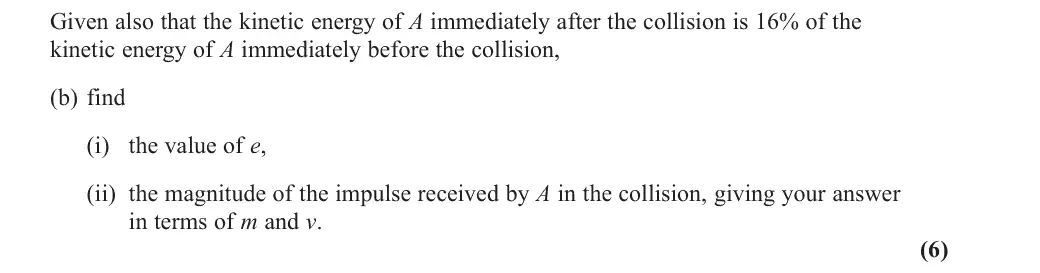
Given also that the kinetic energy of A immediately after the collision is 16% of the kinetic energy of A immediately before the collision, (b) find (i) the value of e, (ii) the magnitude of the impulse received by A in the collision, giving your answer in terms of m and v. (6)
Nov 2021 · Paper 3C (Further Mechanics 1) · Q3(a) 8 marks oblique collisions
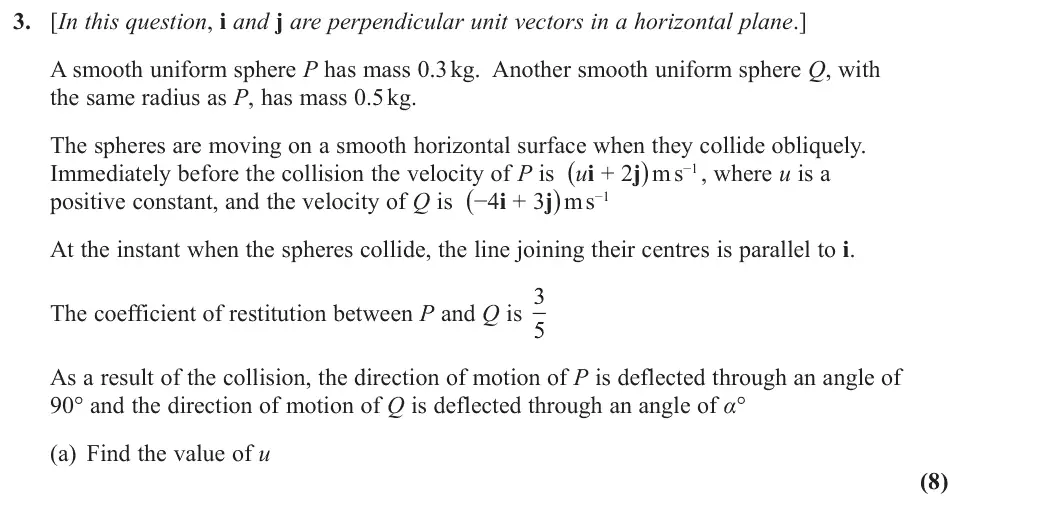
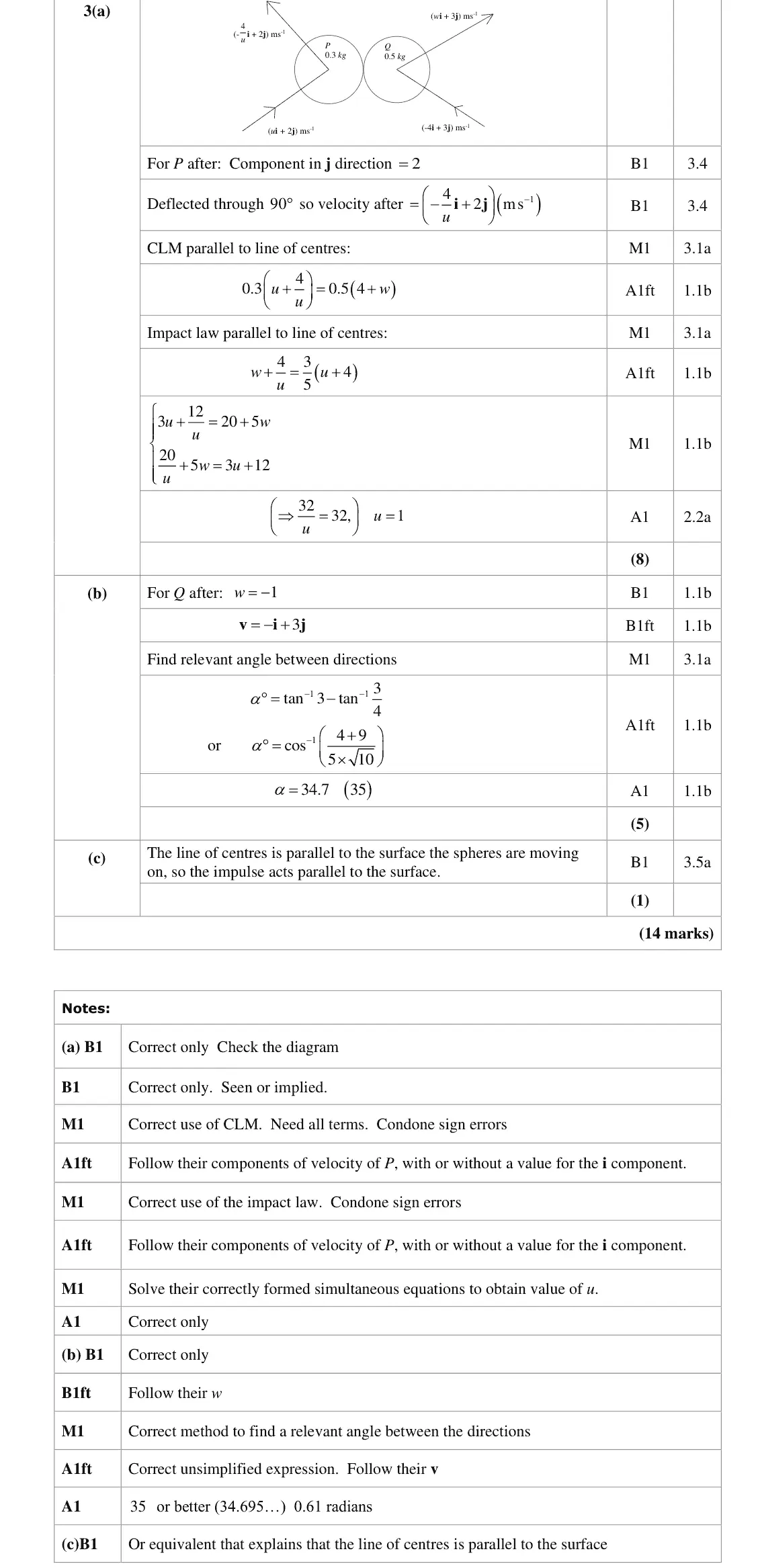
3. [In this question, i and j are perpendicular unit vectors in a horizontal plane.] A smooth uniform sphere P has mass 0.3 kg. Another smooth uniform sphere Q, with the same radius as P, has mass 0.5 kg. The spheres are moving on a smooth horizontal surface when they collide obliquely. Immediately before the collision the velocity of P is (ui + 2j) m s-1 , where u is a positive constant, and the velocity of Q is (-4i + 3j) m s-1 At the instant when the spheres collide, the line joining their centres is parallel to i. The coefficient of restitution between P and Q is 3 As a result of the collision, the direction of motion of P is deflected through an angle of 90° and the direction of motion of Q is deflected through an angle of alpha ° (a) Find the value of u (8)
Nov 2021 · Paper 3C (Further Mechanics 1) · Q3(b) 5 marks oblique collisions
(b) Find the value of alpha (5)
Nov 2021 · Paper 3C (Further Mechanics 1) · Q3(c) 1 mark oblique collisions
(c) State how you have used the fact that P and Q have equal radii. (1)
Nov 2021 · Paper 3C (Further Mechanics 1) · Q4 8 marks momentum and impulse
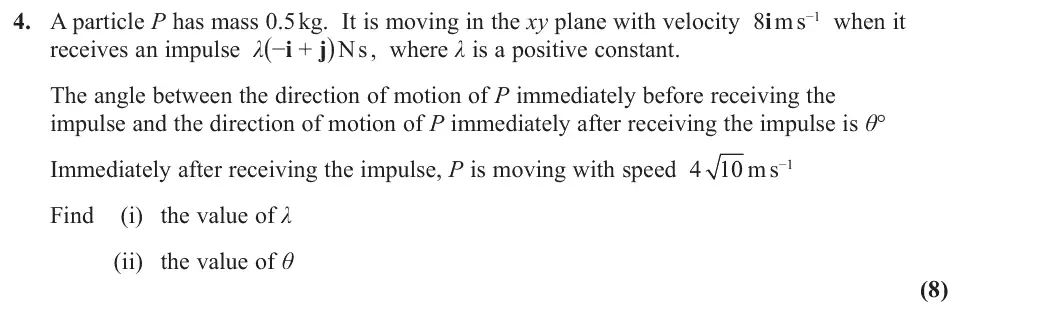
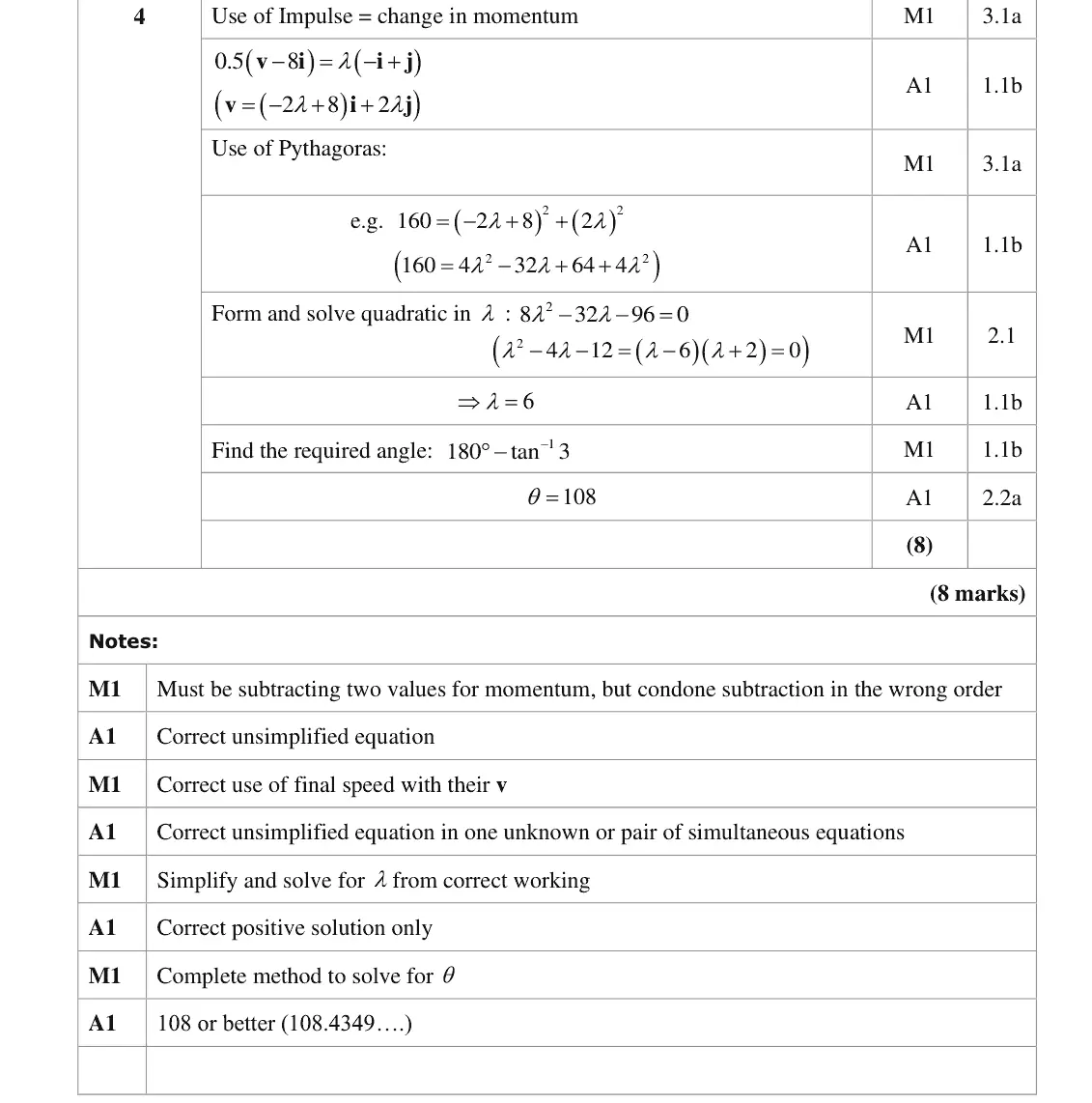
4. A particle P has mass 0.5 kg. It is moving in the xy plane with velocity 8i m s-1 when it receives an impulse λ(-i + j) N s , where λ is a positive constant. The angle between the direction of motion of P immediately before receiving the impulse and the direction of motion of P immediately after receiving the impulse is theta ° Immediately after receiving the impulse, P is moving with speed 4 10 m s-1 Find (i) the value of λ (ii) the value of theta (8)
Nov 2021 · Paper 3C (Further Mechanics 1) · Q5(a) 5 marks oblique collisions
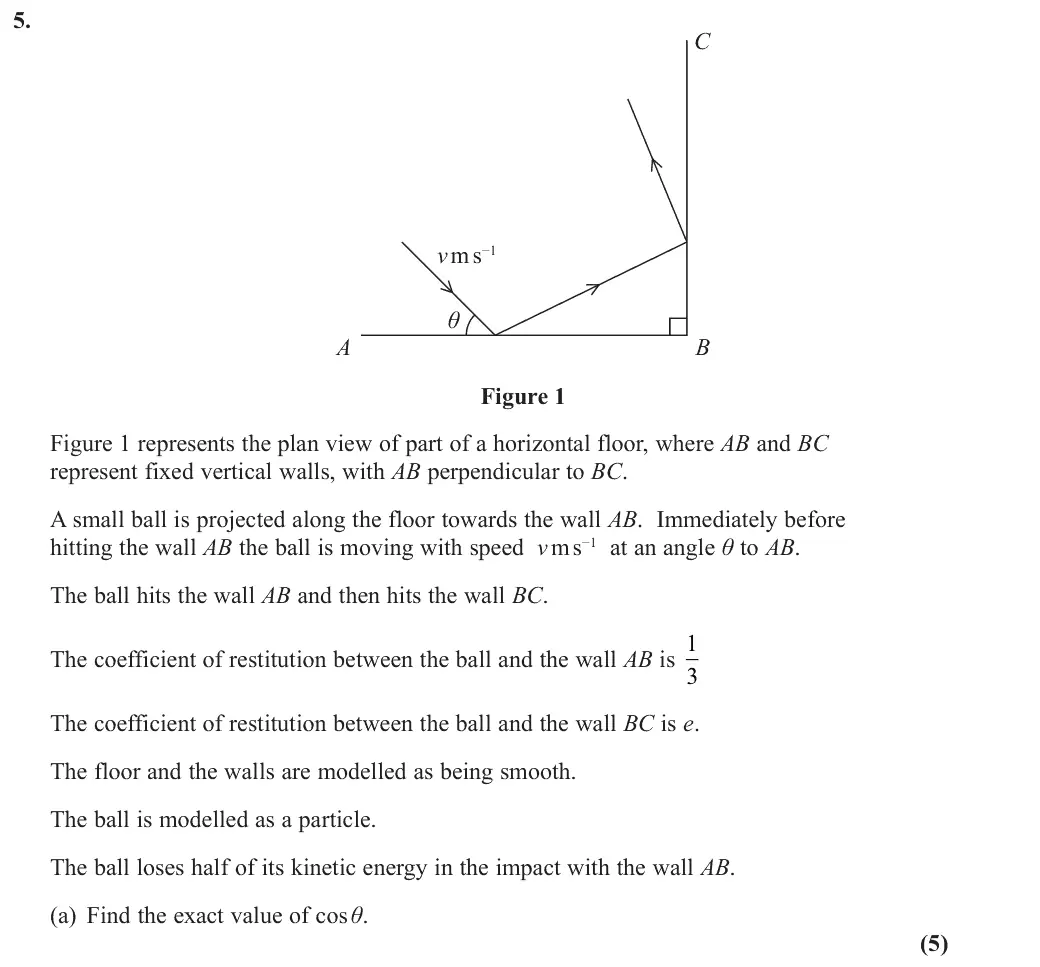
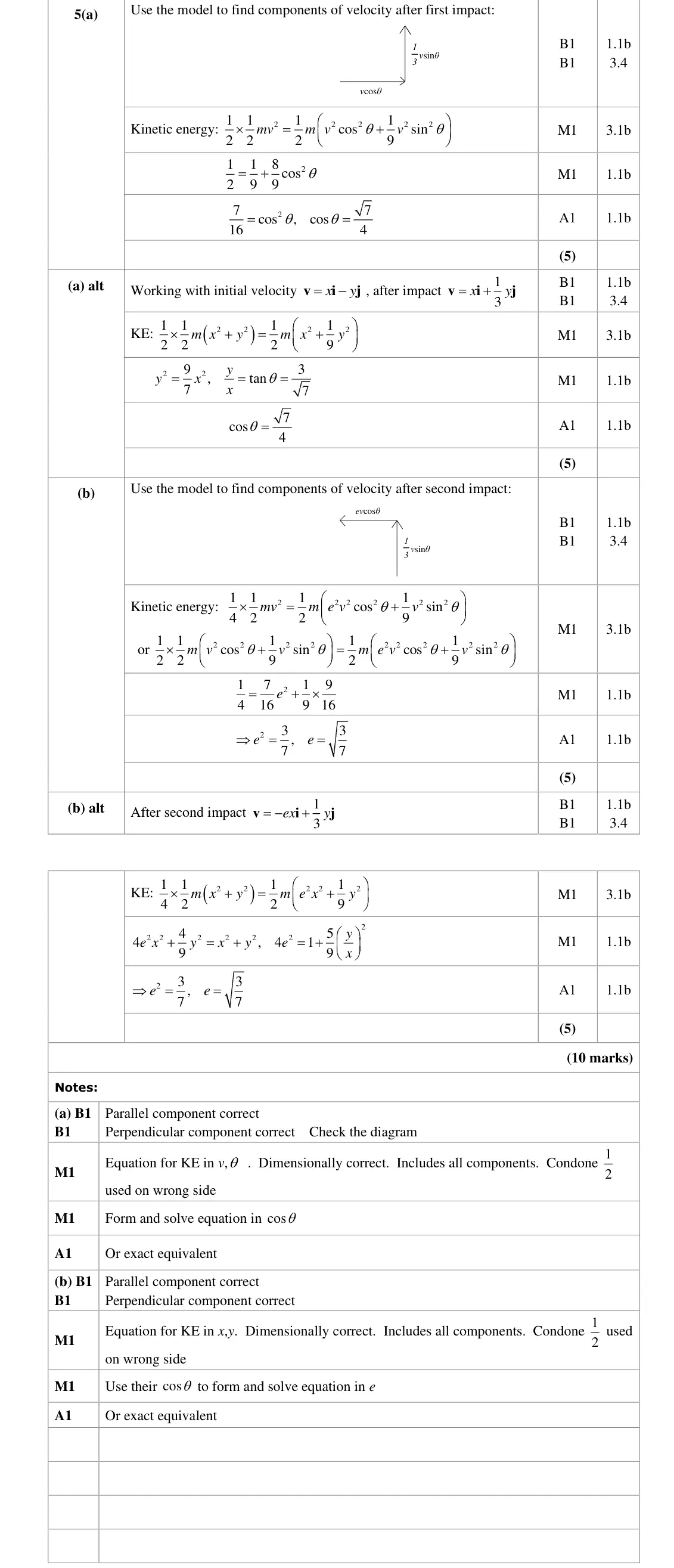
5. C v m s-1 theta A B Figure 1 Figure 1 represents the plan view of part of a horizontal floor, where AB and BC represent fixed vertical walls, with AB perpendicular to BC. A small ball is projected along the floor towards the wall AB. Immediately before hitting the wall AB the ball is moving with speed v m s-1 at an angle theta to AB. The ball hits the wall AB and then hits the wall BC. The coefficient of restitution between the ball and the wall AB is 1 The coefficient of restitution between the ball and the wall BC is e. The floor and the walls are modelled as being smooth. The ball is modelled as a particle. The ball loses half of its kinetic energy in the impact with the wall AB. (a) Find the exact value of cos theta . (5)
Nov 2021 · Paper 3C (Further Mechanics 1) · Q5(b) 5 marks oblique collisions
The ball loses half of its remaining kinetic energy in the impact with the wall BC. (b) Find the exact value of e. (5)
Nov 2021 · Paper 3C (Further Mechanics 1) · Q6(a) 5 marks elastic strings and springs
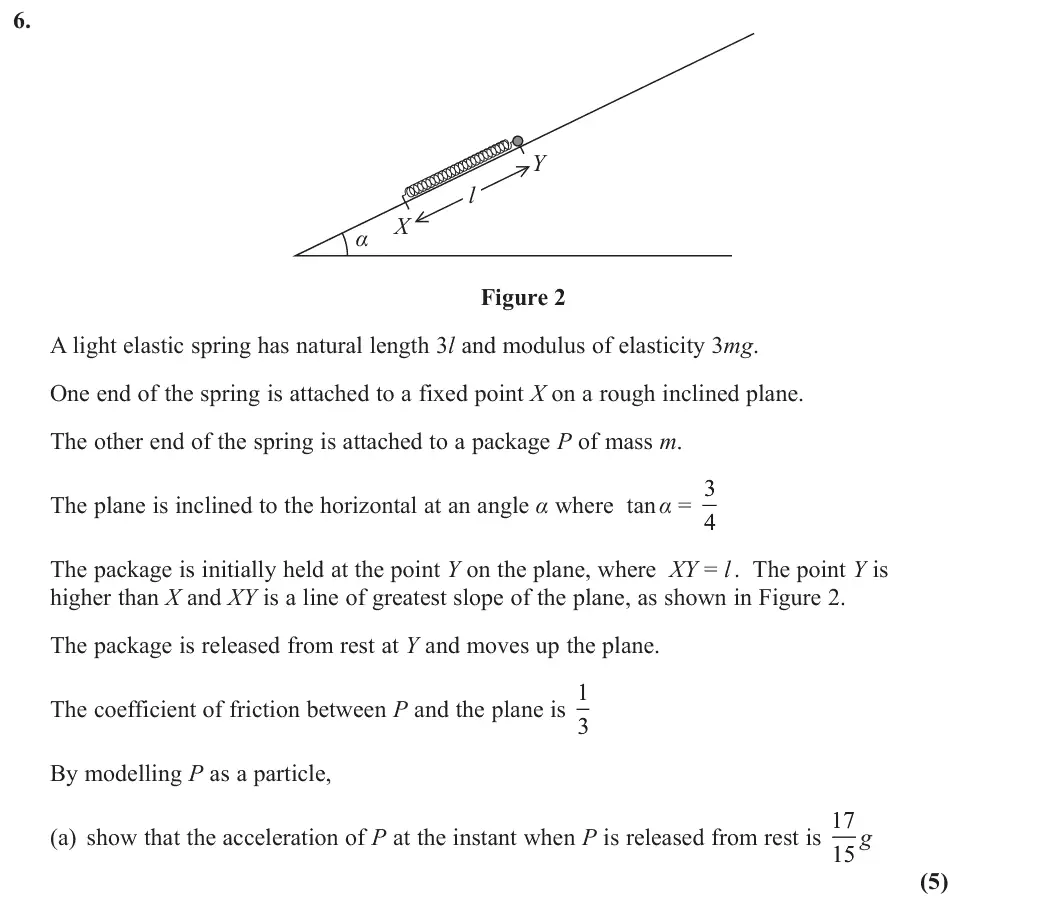
6. Y l X alpha Figure 2 A light elastic spring has natural length 3l and modulus of elasticity 3mg. One end of the spring is attached to a fixed point X on a rough inclined plane. The other end of the spring is attached to a package P of mass m. The plane is inclined to the horizontal at an angle alpha where tan alpha = 3 The package is initially held at the point Y on the plane, where XY = l . The point Y is higher than X and XY is a line of greatest slope of the plane, as shown in Figure 2. The package is released from rest at Y and moves up the plane. The coefficient of friction between P and the plane is 1 By modelling P as a particle, (a) show that the acceleration of P at the instant when P is released from rest is 17 15 g (5)
Nov 2021 · Paper 3C (Further Mechanics 1) · Q6(b) 6 marks elastic strings and springswork energy and power
(b) find, in terms of g and l , the speed of P at the instant when the spring first reaches its natural length of 3l . (6)
Nov 2021 · Paper 3C (Further Mechanics 1) · Q7(a) 6 marks oblique collisions
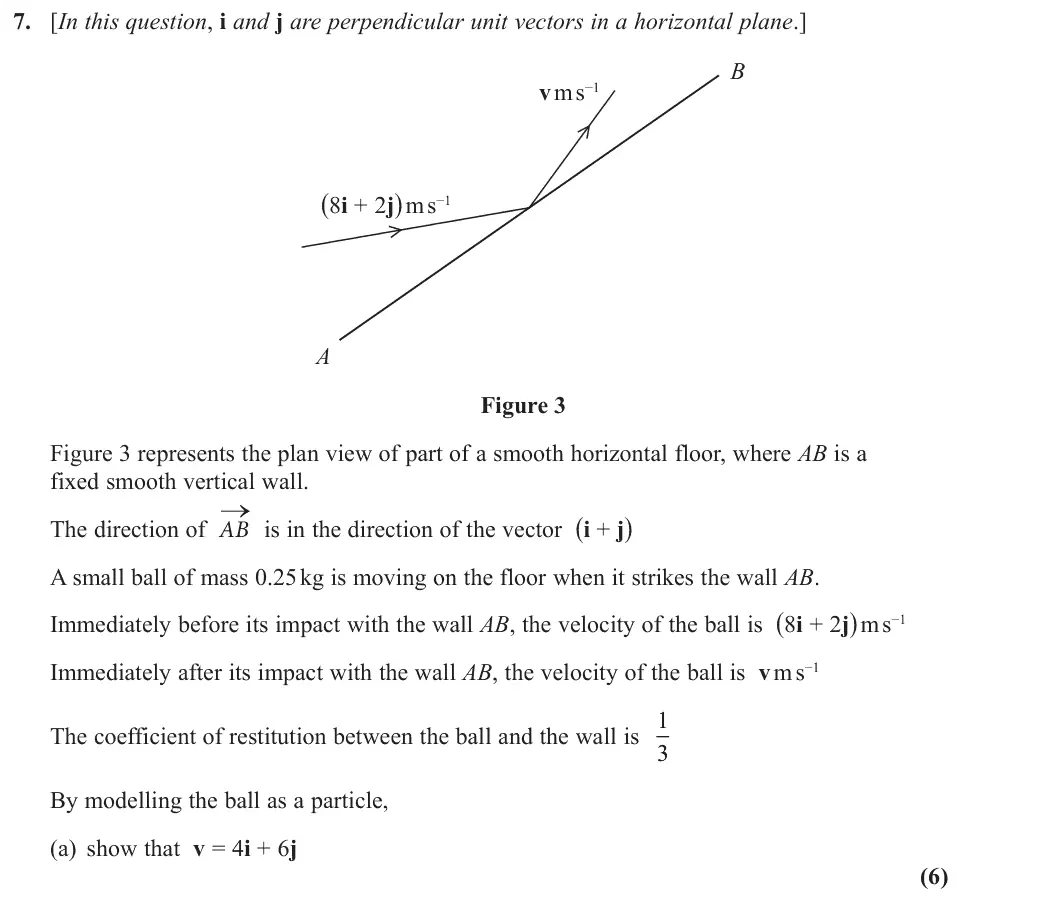
7. [In this question, i and j are perpendicular unit vectors in a horizontal plane.] B v m s-1 (8i + 2j) m s-1 A Figure 3 Figure 3 represents the plan view of part of a smooth horizontal floor, where AB is a fixed smooth vertical wall. → is in the direction of the vector (i + j) The direction of AB A small ball of mass 0.25 kg is moving on the floor when it strikes the wall AB. Immediately before its impact with the wall AB, the velocity of the ball is (8i + 2j) m s-1 Immediately after its impact with the wall AB, the velocity of the ball is v m s-1 The coefficient of restitution between the ball and the wall is 1 By modelling the ball as a particle, (a) show that v = 4i + 6j (6)
Nov 2021 · Paper 3C (Further Mechanics 1) · Q7(b) 3 marks momentum and impulse
(b) Find the magnitude of the impulse received by the ball in the impact. (3)

Find an Edexcel Further Maths tutor

Want this paper marked and gone through with a Further Maths tutor? Message us.

Prefer email? Send an enquiry

If you are under 18, please include a parent's contact details. Enquiries go to enquiries@alevelfurthermathstutor.com and are deleted once handled.