Oct 2020: AS Paper 28: Decision Mathematics 2
40 marks · 13 question parts · Question paper, mark scheme and examiner's report on Pearson's site
Question by question
The questions
Mark scheme (whole question; this part is marked with the orange bar)
Key points from the mark scheme and examiner's report
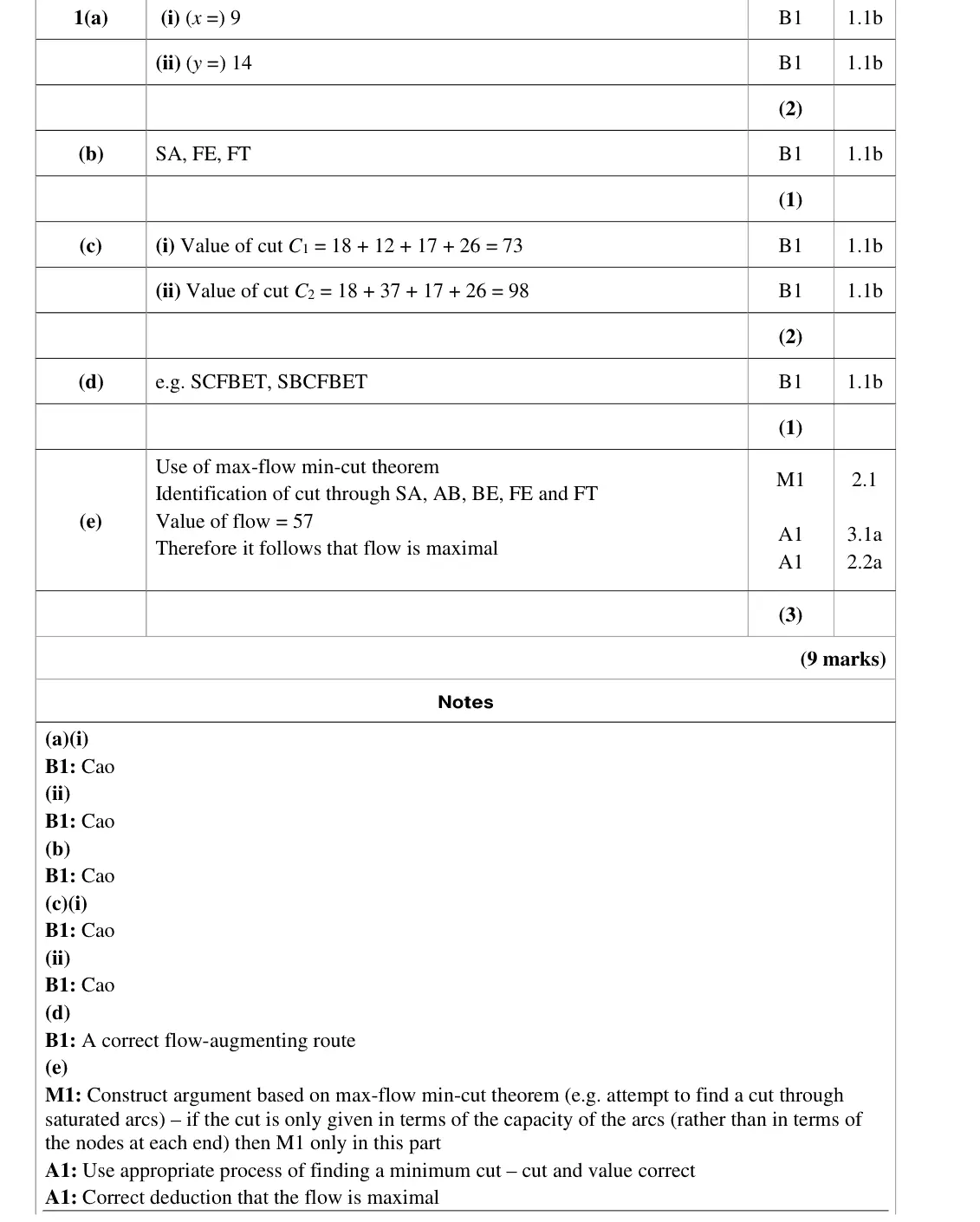
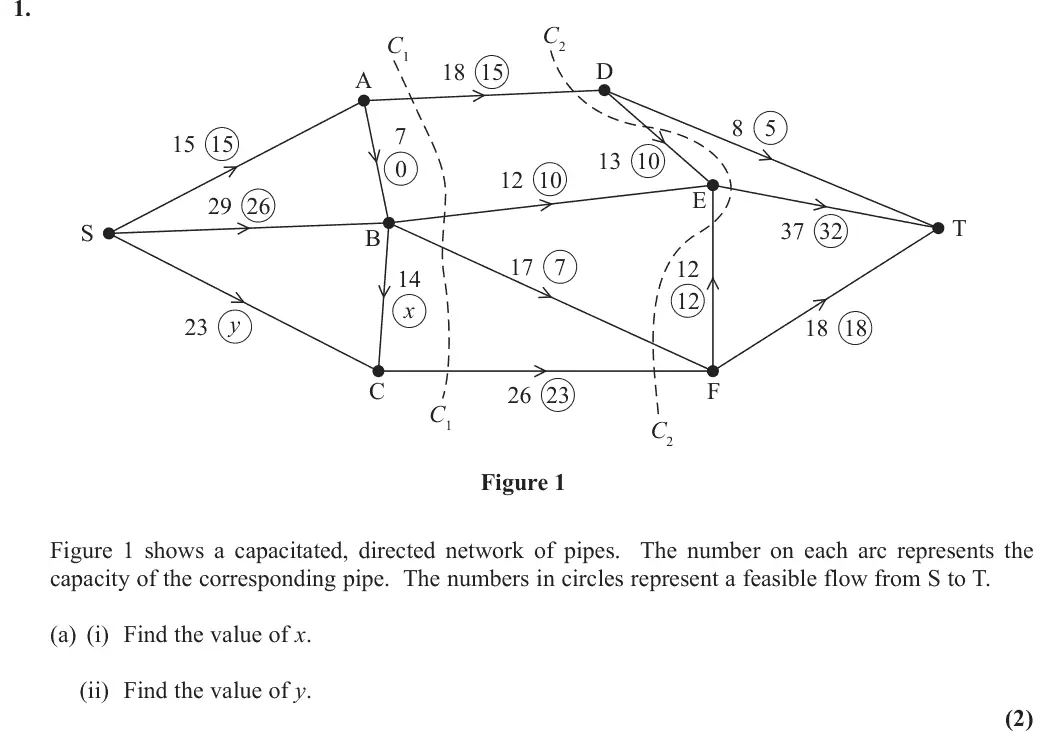
- flow in = flow out at each vertex: x = 9, y = 14

Mark scheme (whole question; this part is marked with the orange bar)
Key points from the mark scheme and examiner's report
- saturated arcs SA, FE, FT (flow equals capacity)
Mark scheme (whole question; this part is marked with the orange bar)
Key points from the mark scheme and examiner's report
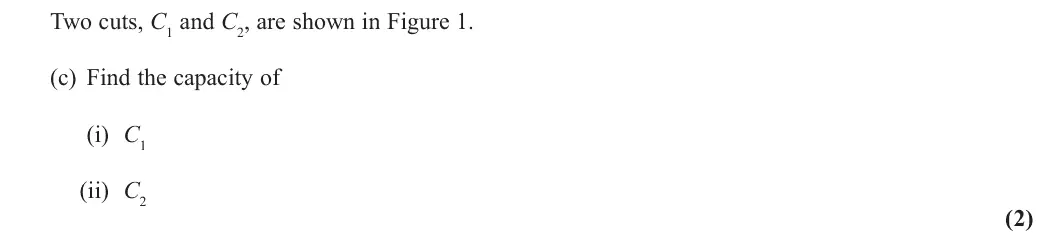
- C₁ = 18 + 12 + 17 + 26 = 73, C₂ = 18 + 37 + 17 + 26 = 98
- arcs directed from the sink side back to the source side count zero

Mark scheme (whole question; this part is marked with the orange bar)
Key points from the mark scheme and examiner's report
- a route using CF with spare capacity 2 along every forward arc and backflow on BF, e.g. SCFBET

Mark scheme (whole question; this part is marked with the orange bar)
Key points from the mark scheme and examiner's report
- cut through SA, AB, BE, FE, FT has value 57 = new flow
- cut must be given by its arcs or nodes, not just capacities
- state maximum flow = minimum cut
Mark scheme (whole question; this part is marked with the orange bar)
Key points from the mark scheme and examiner's report
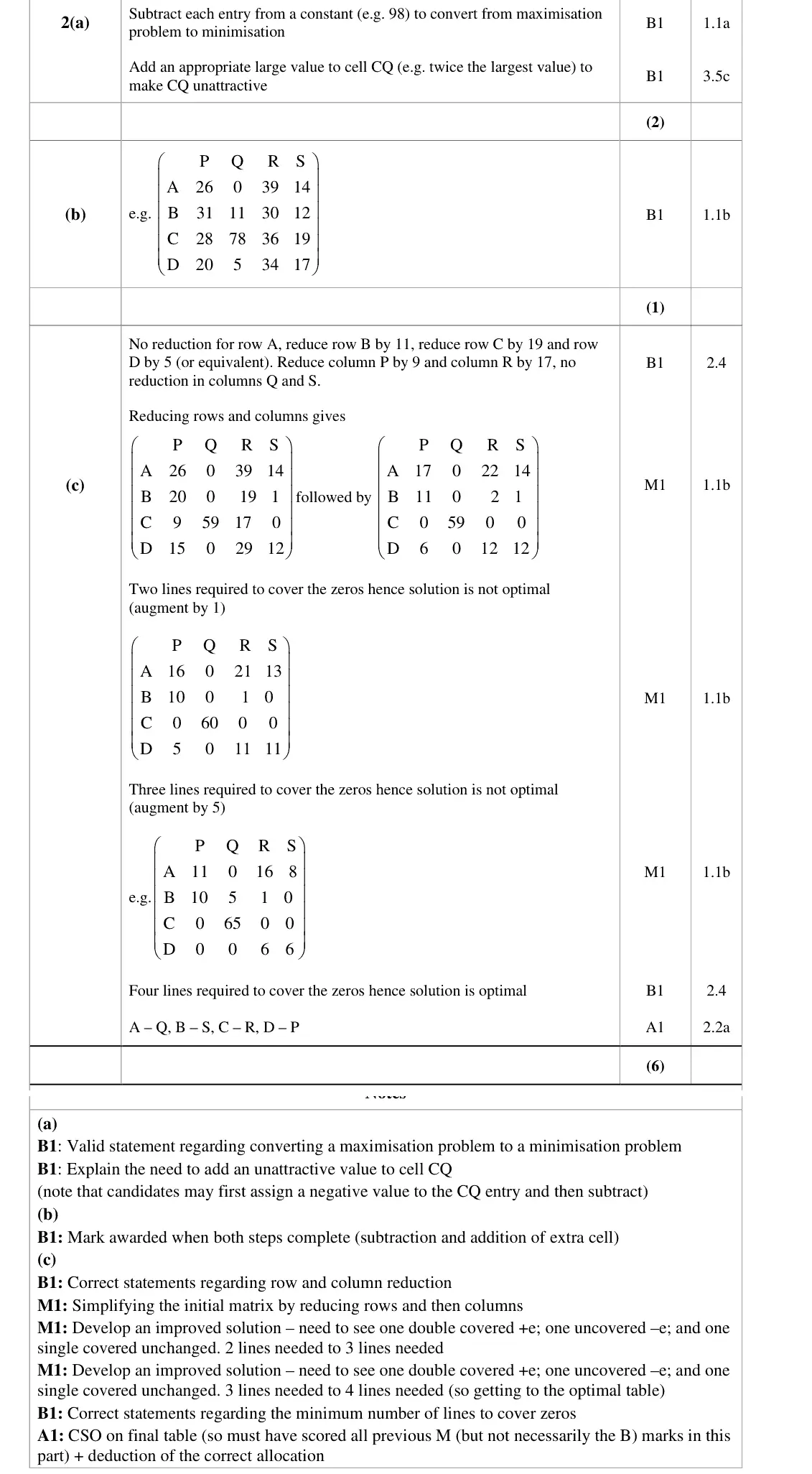
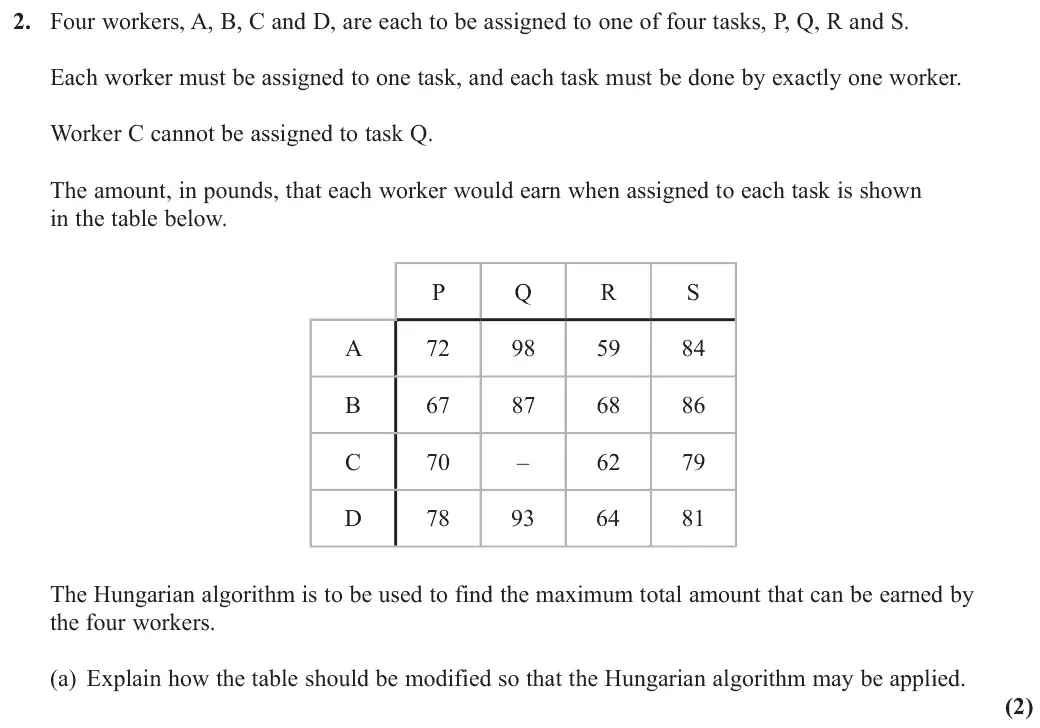
- subtract every entry from a constant (e.g. 98) to convert to minimising
- put a large value in cell CQ (e.g. twice the largest) so it is never chosen

Mark scheme (whole question; this part is marked with the orange bar)
Key points from the mark scheme and examiner's report
- 98 minus each value, CQ given e.g. 78 after subtraction
- mark needs both steps

Mark scheme (whole question; this part is marked with the orange bar)
Key points from the mark scheme and examiner's report
- rows reduced by 0, 11, 19, 5 then columns P by 9 and R by 17
- 2 lines, augment by 1
- 3 lines, augment by 5
- 4 lines so optimal
- A–Q, B–S, C–R, D–P
- reductions and line counts must be explained
Mark scheme (whole question; this part is marked with the orange bar)
Key points from the mark scheme and examiner's report
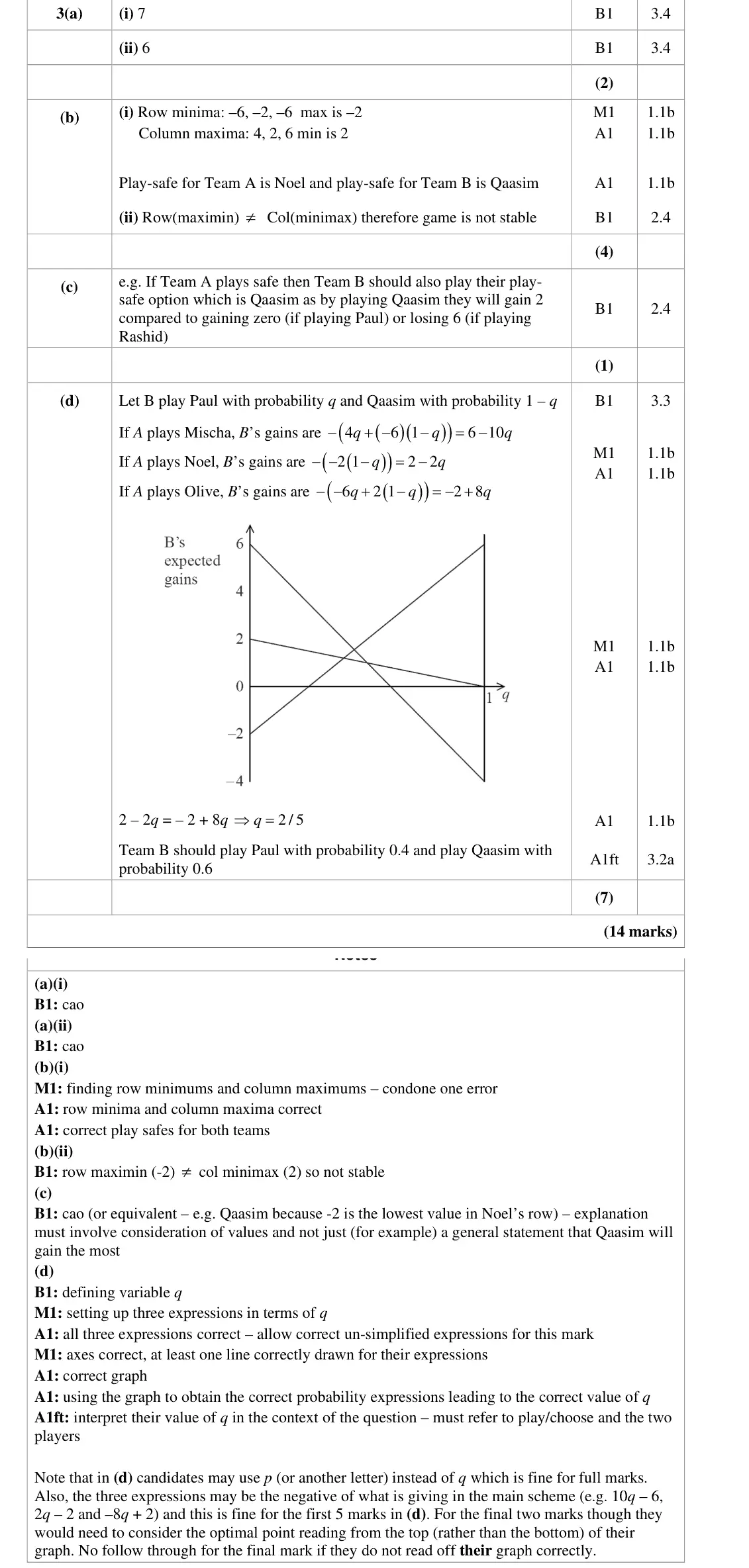
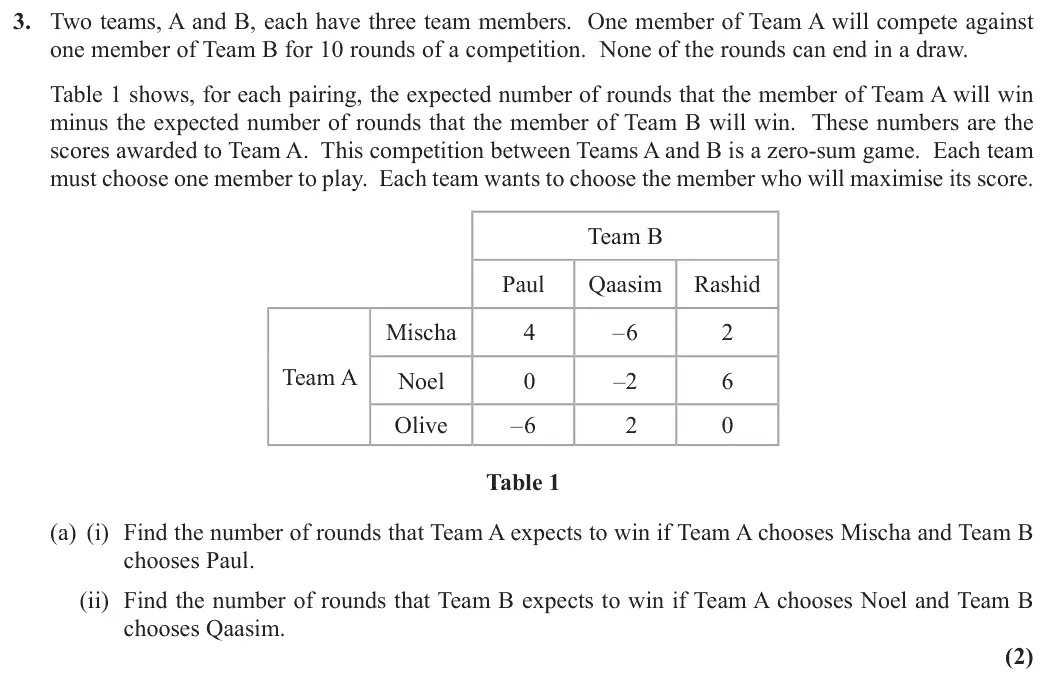
- wins sum to 10 and differ by the table value: (i) 4 so A wins 7 (ii) −2 so B wins 6

Mark scheme (whole question; this part is marked with the orange bar)
Key points from the mark scheme and examiner's report
- row minima −6, −2, −6 (maximin −2), column maxima 4, 2, 6 (minimax 2)
- play safe A Noel, B Qaasim
- −2 ≠ 2 so not stable

Mark scheme (whole question; this part is marked with the orange bar)
Key points from the mark scheme and examiner's report
- A plays Noel, so B picks Qaasim, gaining 2 rather than 0 (Paul) or −6 (Rashid)
- the reason must use the values, not a general statement

Mark scheme (whole question; this part is marked with the orange bar)
Key points from the mark scheme and examiner's report
- define q = P(B plays Paul)
- B's gains are the negatives of the table: 6 − 10q, 2 − 2q, −2 + 8q
- graph for 0 ≤ q ≤ 1 and take the highest point of the lowest boundary
- 2 − 2q = −2 + 8q gives q = 0.4: Paul 0.4, Qaasim 0.6
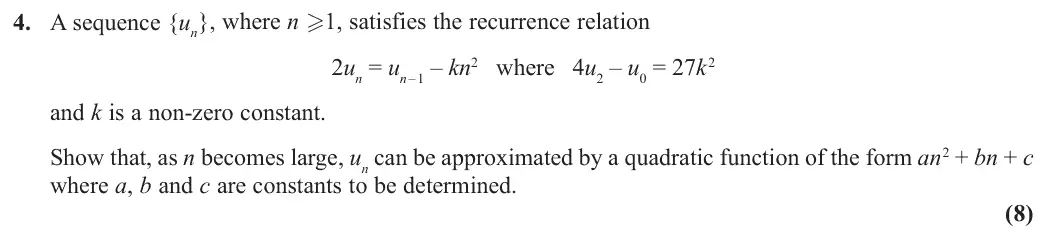
Mark scheme (whole question; this part is marked with the orange bar)
Key points from the mark scheme and examiner's report
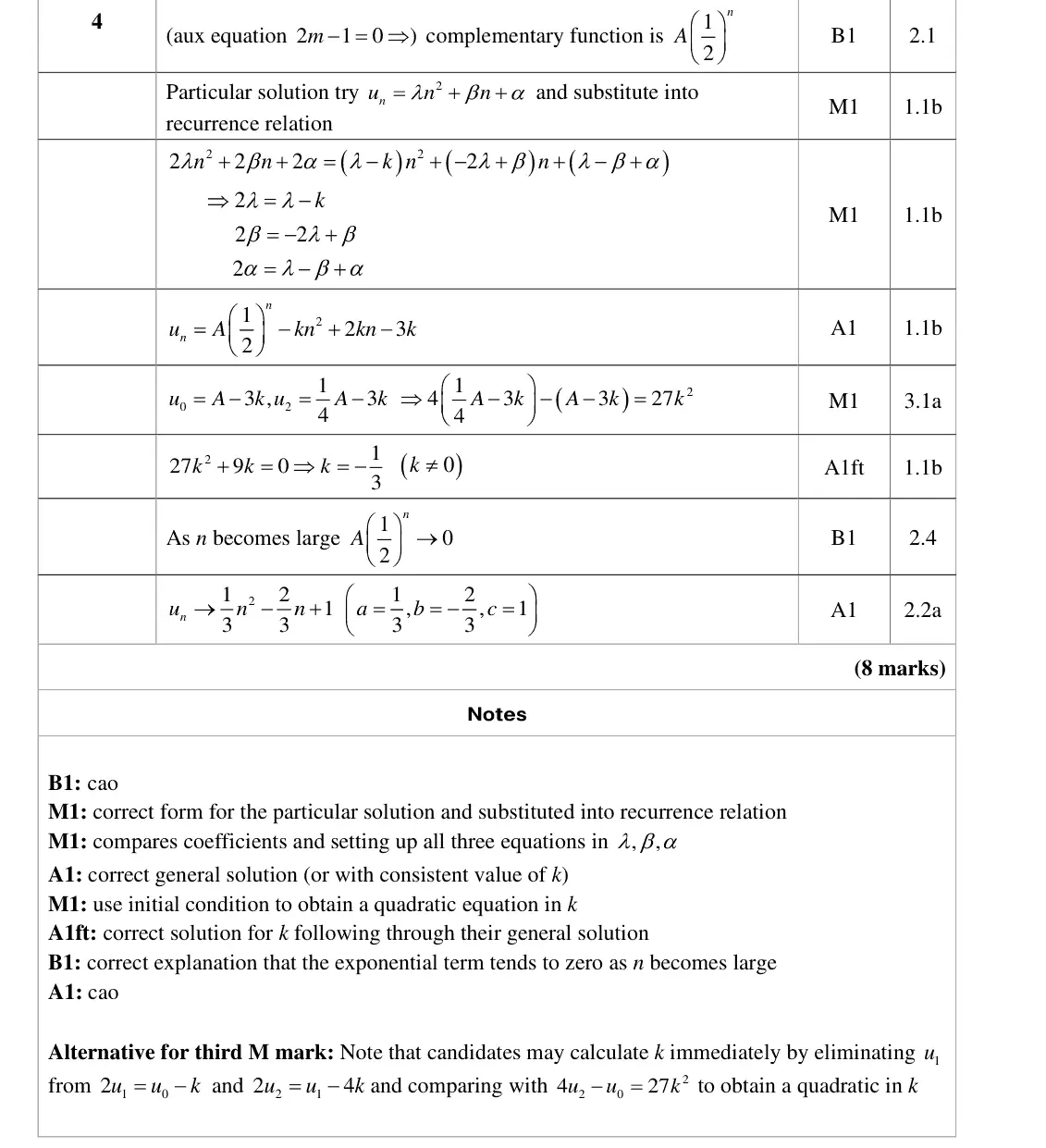
- CF A(1/2)ⁿ
- try λn² + βn + α and compare coefficients: uₙ = A(1/2)ⁿ − kn² + 2kn − 3k
- the condition gives 27k² + 9k = 0 so k = −1/3
- (1/2)ⁿ → 0 so uₙ ≈ n²/3 − 2n/3 + 1
Find an Edexcel Further Maths tutor
Want this paper marked and gone through with a Further Maths tutor? Message us.
Prefer email? Send an enquiry