24 question parts, 104 marks, 2 with a difficulty rating from the examiner's report
Notes, worked examples and practice for this topic are being written by our tutors. The past-paper questions below are ready now: work each one on paper, then open the mark scheme and the examiner's comment.
Tap a question to zoom it. Mark scheme and examiner's comment open under each question.
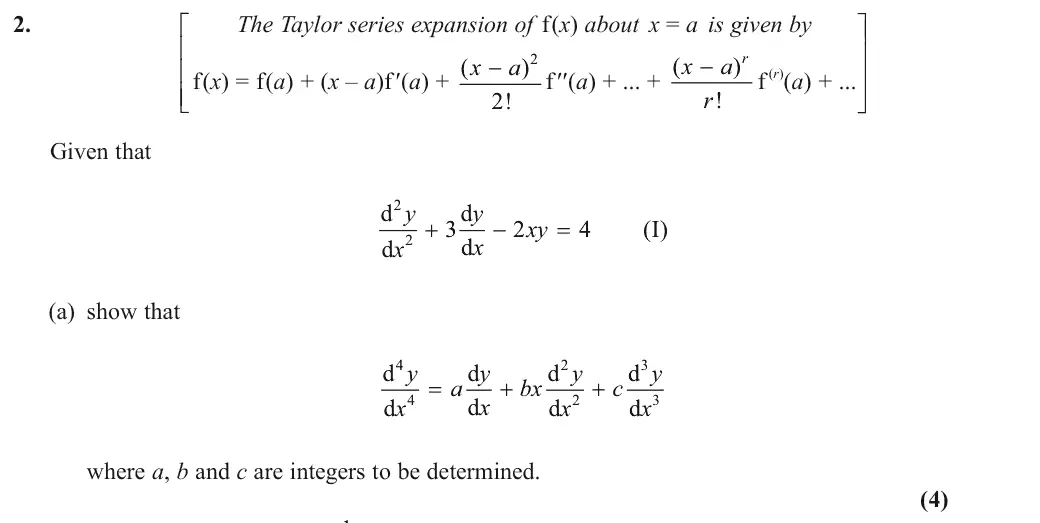
June 2025 · Paper 3A (Further Pure 1) · Q2(a)4 marks
Mark scheme (whole question; this part is marked with the orange bar)
Examiner's comment
A slight twist on this type of question as the function to be expanded was given within a differential equation involving the product of the function and its variable leading to using the product rule efficiently, most learners coped well with the question, with inaccuracies in part (b) being the main cause of loss of marks. Part (a) was straightforward for most candidate, used the product rule correctly leading to the correct third and fourth derivative of 𝑦𝑦.
Key points from the mark scheme and examiner's report
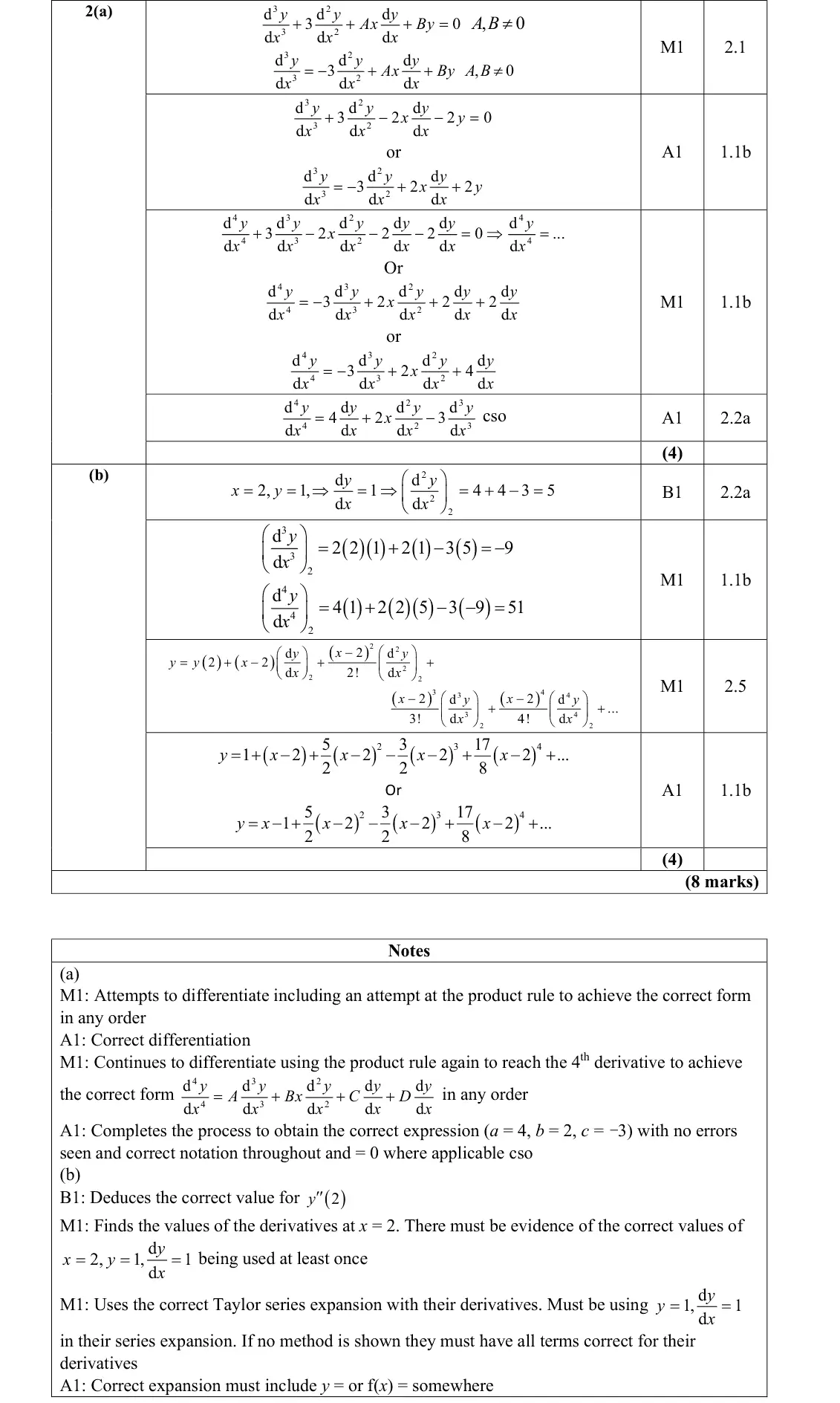
differentiate (I) twice with the product rule on 2xy: y''' = −3y'' + 2xy' + 2y, y'''' = 4y' + 2xy'' − 3y'''
a = 4, b = 2, c = −3
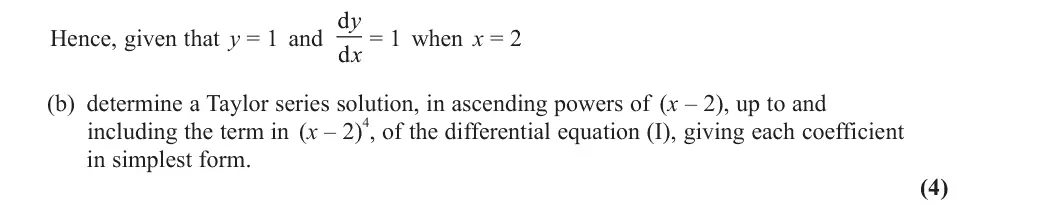
June 2025 · Paper 3A (Further Pure 1) · Q2(b)4 marks
Mark scheme (whole question; this part is marked with the orange bar)
Examiner's comment
A slight twist on this type of question as the function to be expanded was given within a differential equation involving the product of the function and its variable leading to using the product rule efficiently, most learners coped well with the question, with inaccuracies in part (b) being the main cause of loss of marks. Part (b), most learners deduced the correct value of 𝑑𝑑2𝑦𝑦 𝑑𝑑𝑥𝑥2ቚ 𝑥𝑥=2 but most mistakes happened when evaluating 𝑑𝑑4𝑦𝑦 𝑑𝑑𝑥𝑥4ቚ 𝑥𝑥=2 as student substituted the wrong value of 𝑥𝑥. There were a few with sloppy notation when it comes to forming the Taylor series, but the large majority recognizing the need for (𝑥𝑥-2) terms (which shouldn't be surprising given the wording of the question), but still one or two leaving in terms of (𝑥𝑥-𝑎𝑎)or simply x. One or two who, after achieving a correct expansion, proceeded to expand out all their brackets to rewrite as an expansion in powers of x. Even those who got some of the earlier numbers wrong generally had a Taylor series consistent with their values for y'', y''' and y''''. Unfortunately many learners lost marks for not including 𝑦𝑦=. .. or 𝑓𝑓(𝑥𝑥) =. .., the other most common error was an incorrect y0 term, either omitted completely or using 2 instead of 1. Also few learners used 𝑓𝑓(𝑥𝑥-2) =. ..
Key points from the mark scheme and examiner's report
June 2025 · Paper 3A (Further Pure 1) · Q7(a)3 marks
Mark scheme (whole question; this part is marked with the orange bar)
Examiner's comment
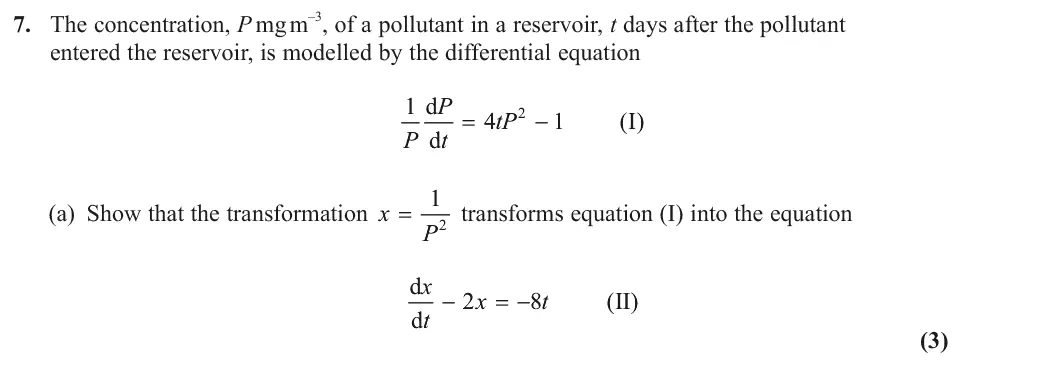
Part (a) was a common type of question requiring the use of a given transformation to transform a given differential equation into one that could be solved. Learners know how to proceed but it was frequently difficult to follow the steps being performed with much crossing out and changing of work. Having reached the stated differential equation, most learners used the integrating factor method to proceed. There were few instances of an incorrect integrating factor being obtained and how to proceed using integration by parts was well done. A few learners omitted the constant of integration Occasional learners incorrectly use 𝐼𝐼𝐼𝐼= 𝑒𝑒2𝑡𝑡 or e-2𝑥𝑥 instead of 𝐼𝐼𝐼𝐼= 𝑒𝑒-2𝑡𝑡 and could not proceed correctly. Some learners attempted to find the complementary function, solving 𝑚𝑚-2 = 0 but quite a few had the incorrect form 𝑦𝑦= 𝐴𝐴𝑒𝑒2𝑥𝑥+ 𝐵𝐵. They then commonly had an incorrect form for the particular integral using 𝑦𝑦= 𝛼𝛼𝛼𝛼 instead of 𝑦𝑦= 𝛼𝛼𝛼𝛼+ 𝛽𝛽. Both of these led to the lose of marks. In part (c) it was necessary to use the value t = 3 to find the value of P and to compare that to the
Key points from the mark scheme and examiner's report
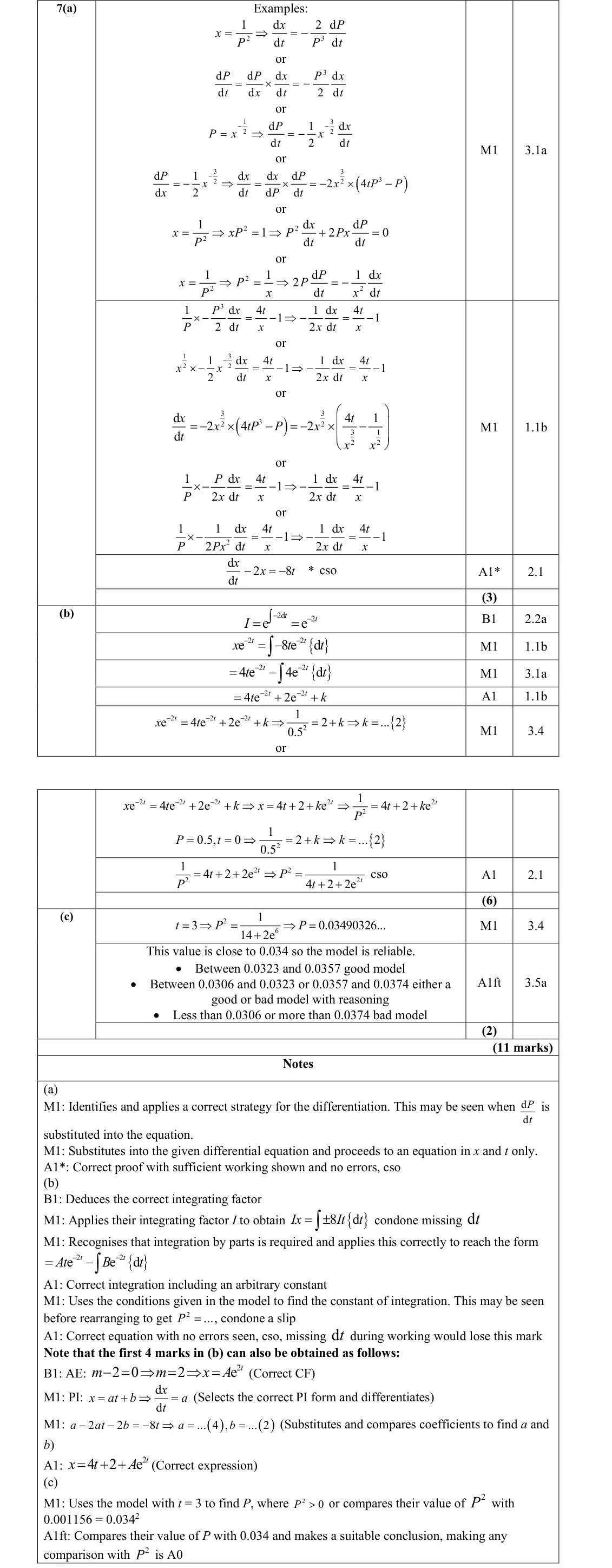
dx/dt = −2P⁻³ dP/dt
substitute dP/dt = P(4tP² − 1) and P⁻² = x to dx/dt − 2x = −8t
working often hard to follow
June 2025 · Paper 3A (Further Pure 1) · Q7(b)6 marks
Mark scheme (whole question; this part is marked with the orange bar)
Examiner's comment
Part (a) was a common type of question requiring the use of a given transformation to transform a given differential equation into one that could be solved. Learners know how to proceed but it was frequently difficult to follow the steps being performed with much crossing out and changing of work. Having reached the stated differential equation, most learners used the integrating factor method to proceed. There were few instances of an incorrect integrating factor being obtained and how to proceed using integration by parts was well done. A few learners omitted the constant of integration Occasional learners incorrectly use 𝐼𝐼𝐼𝐼= 𝑒𝑒2𝑡𝑡 or e-2𝑥𝑥 instead of 𝐼𝐼𝐼𝐼= 𝑒𝑒-2𝑡𝑡 and could not proceed correctly. Some learners attempted to find the complementary function, solving 𝑚𝑚-2 = 0 but quite a few had the incorrect form 𝑦𝑦= 𝐴𝐴𝑒𝑒2𝑥𝑥+ 𝐵𝐵. They then commonly had an incorrect form for the particular integral using 𝑦𝑦= 𝛼𝛼𝛼𝛼 instead of 𝑦𝑦= 𝛼𝛼𝛼𝛼+ 𝛽𝛽. Both of these led to the lose of marks. In part (c) it was necessary to use the value t = 3 to find the value of P and to compare that to the given value 0.034. It was then possible to make a statement about the reliability of the model. Most learners could perform these steps successfully, with many using the percentage error Some chose to evaluate P2 rather than P. This was allowed for the M mark provided that they compared it with 0.0342. The final mark was lost by those who did not proceed to then find P.
Key points from the mark scheme and examiner's report
integrating factor e⁻²ᵗ (not e²ᵗ)
integration by parts: xe⁻²ᵗ = 4te⁻²ᵗ + 2e⁻²ᵗ + k
x = 4 at t = 0 gives k = 2
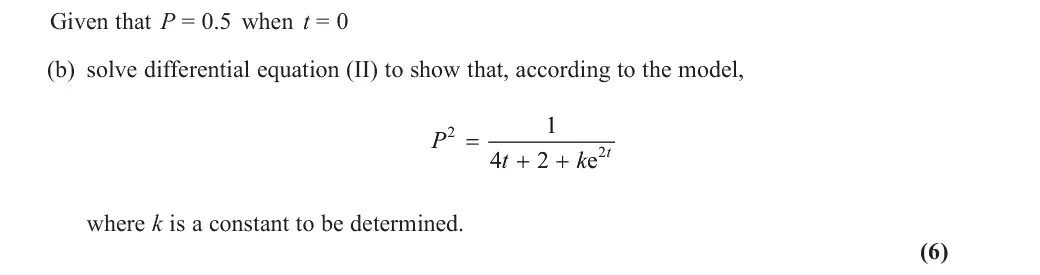
P² = 1/(4t + 2 + 2e²ᵗ)
constant of integration sometimes omitted
June 2025 · Paper 3A (Further Pure 1) · Q7(c)2 marks
Mark scheme (whole question; this part is marked with the orange bar)
Examiner's comment
Occasional learners incorrectly use 𝐼𝐼𝐼𝐼= 𝑒𝑒2𝑡𝑡 or e-2𝑥𝑥 instead of 𝐼𝐼𝐼𝐼= 𝑒𝑒-2𝑡𝑡 and could not proceed correctly. Some learners attempted to find the complementary function, solving 𝑚𝑚-2 = 0 but quite a few had the incorrect form 𝑦𝑦= 𝐴𝐴𝑒𝑒2𝑥𝑥+ 𝐵𝐵. They then commonly had an incorrect form for the particular integral using 𝑦𝑦= 𝛼𝛼𝛼𝛼 instead of 𝑦𝑦= 𝛼𝛼𝛼𝛼+ 𝛽𝛽. Both of these led to the lose of marks. In part (c) it was necessary to use the value t = 3 to find the value of P and to compare that to the given value 0.034. It was then possible to make a statement about the reliability of the model. Most learners could perform these steps successfully, with many using the percentage error Some chose to evaluate P2 rather than P. This was allowed for the M mark provided that they compared it with 0.0342. The final mark was lost by those who did not proceed to then find P.
Key points from the mark scheme and examiner's report
t = 3: P = 0.0349…, close to 0.034 so the model is reliable (percentage error)
compare P not P²
June 2024 · Paper 3A (Further Pure 1) · Q4(a)2 marks
Mark scheme (whole question; this part is marked with the orange bar)
Examiner's comment
A slight twist on this type of question in the use of a stationary point, but candidates coped well and the question proved relatively straightforward overall, with inaccuracies in part (b) being the main cause of loss of marks. Part (a) was straightforward for most candidate, who were able to find the value for 2 2 d d y x from the given information and interpret correctly. However, some failed to realise that they needed to substitute d 0 d y x = at the stationary point, and therefore could not obtain a value for the second derivative, so moved on to the next part, while a few others made slips in the calculation and obtain a wrong value. Most who found the correct value recognised that the stationary point was a maximum, though some did think it was a minimum, while a very few referred to concave curves. More common was to not justify the answer, simply stating the type and so lose the accuracy mark.
Key points from the mark scheme and examiner's report
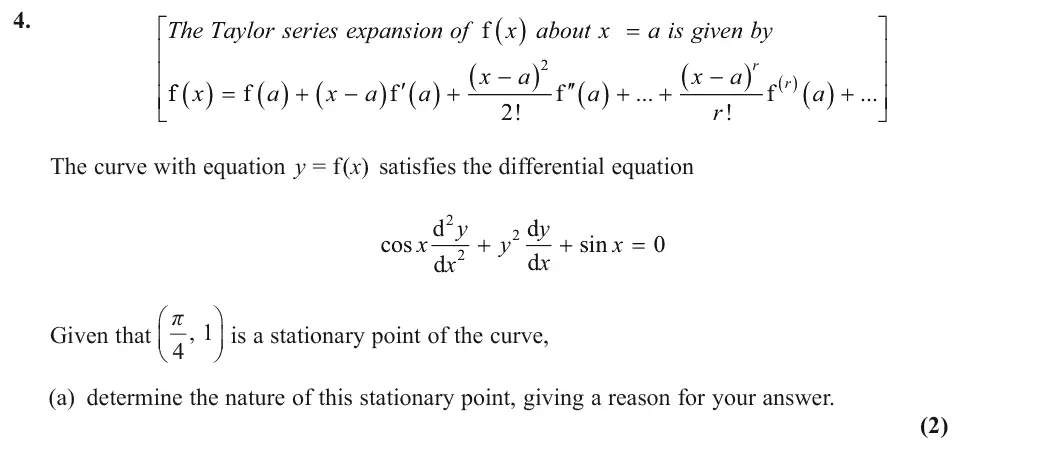
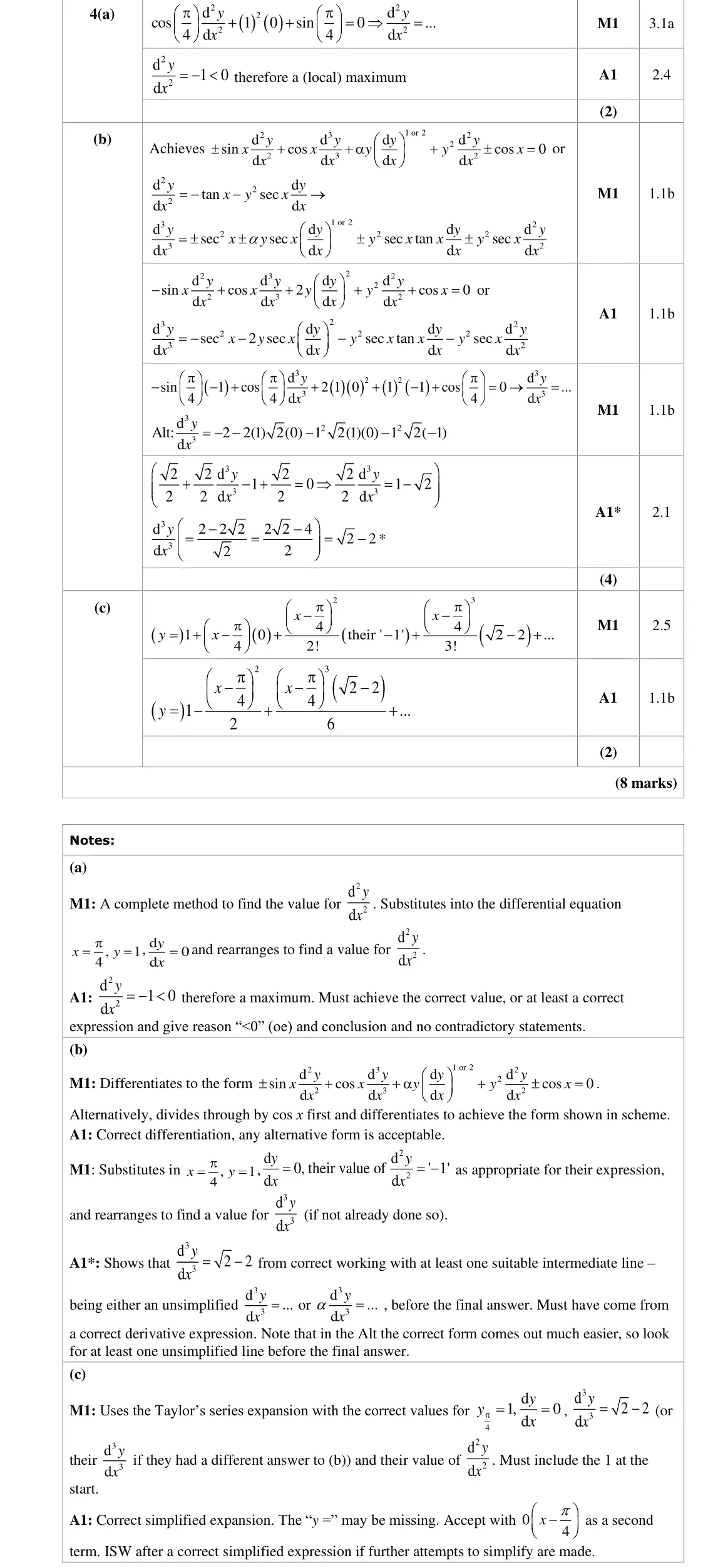
at (π/4, 1) with dy/dx = 0: (√2/2)y'' + √2/2 = 0, y'' = −1 < 0 so a maximum
reason must be given
June 2024 · Paper 3A (Further Pure 1) · Q4(b)4 marks
Mark scheme (whole question; this part is marked with the orange bar)
Examiner's comment
A slight twist on this type of question in the use of a stationary point, but candidates coped well and the question proved relatively straightforward overall, with inaccuracies in part (b) being the main cause of loss of marks. In part (b) many candidates differentiated correctly and proceeded to achieve full marks. Only a few failed to achieve the second method following an attempt at differentiation. However, there were many who had errors in the differentiation, but which often led to the correct answer (due to the values 0 and 1 for the values of d d y x and y), with the most common error being the omission of the square in the 2 d d y x term. Consequently, examiners had to check the work closely as some seemingly correct answers actually lost both accuracy marks. A few candidates tried to differentiate at the stationary point, substituting in d 0 d y x = before attempting the rest of the differentiation, so could make only limited progress. Those who rearranged to make 2 2 d d y x the subject before differentiation met with mixed fortunes – converting the differential equation to a quotient at the start a tended to result in mismanaging the differentiation. Substitution of values following differentiation was done well and rearrangement to the correct answer was usually completed correctly though there were a few calculation errors, but again the level of justification was sometimes lacking. As this was a given answer there sufficient working must be shown to convince it was reached genuinely. Several candidates did not attain the last mark as they did not illustrate at least one suitable intermediate line of working.
Key points from the mark scheme and examiner's report
differentiate the whole equation implicitly (product rule on y² dy/dx, keep the (dy/dx)² term) before substituting
y''' = √2 − 2
substituting dy/dx = 0 before differentiating fails
June 2024 · Paper 3A (Further Pure 1) · Q4(c)2 marks
Mark scheme (whole question; this part is marked with the orange bar)
Examiner's comment
A slight twist on this type of question in the use of a stationary point, but candidates coped well and the question proved relatively straightforward overall, with inaccuracies in part (b) being the main cause of loss of marks. Part (c) was again generally very well answered with most attaining both marks – the given answers being a big help. The most common error was an incorrect y0 term, either omitted completely (y0 =0) or using 0 4 y = or 2 2 . Occasionally the final mark was lost through the corruption of signs in the final term.
Key points from the mark scheme and examiner's report
y = 1 − ½(x − π/4)² + ((√2 − 2)/6)(x − π/4)³
common error: missing or wrong constant term y₀ = 1
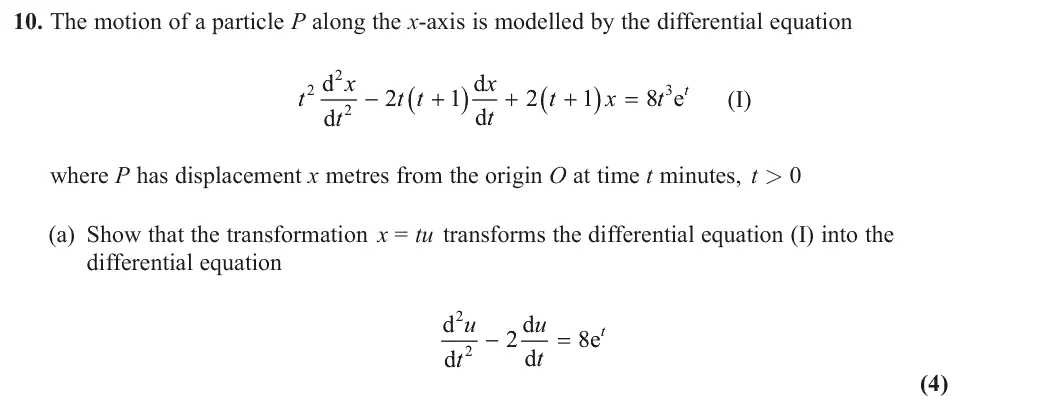
June 2024 · Paper 3A (Further Pure 1) · Q10(a)4 marks
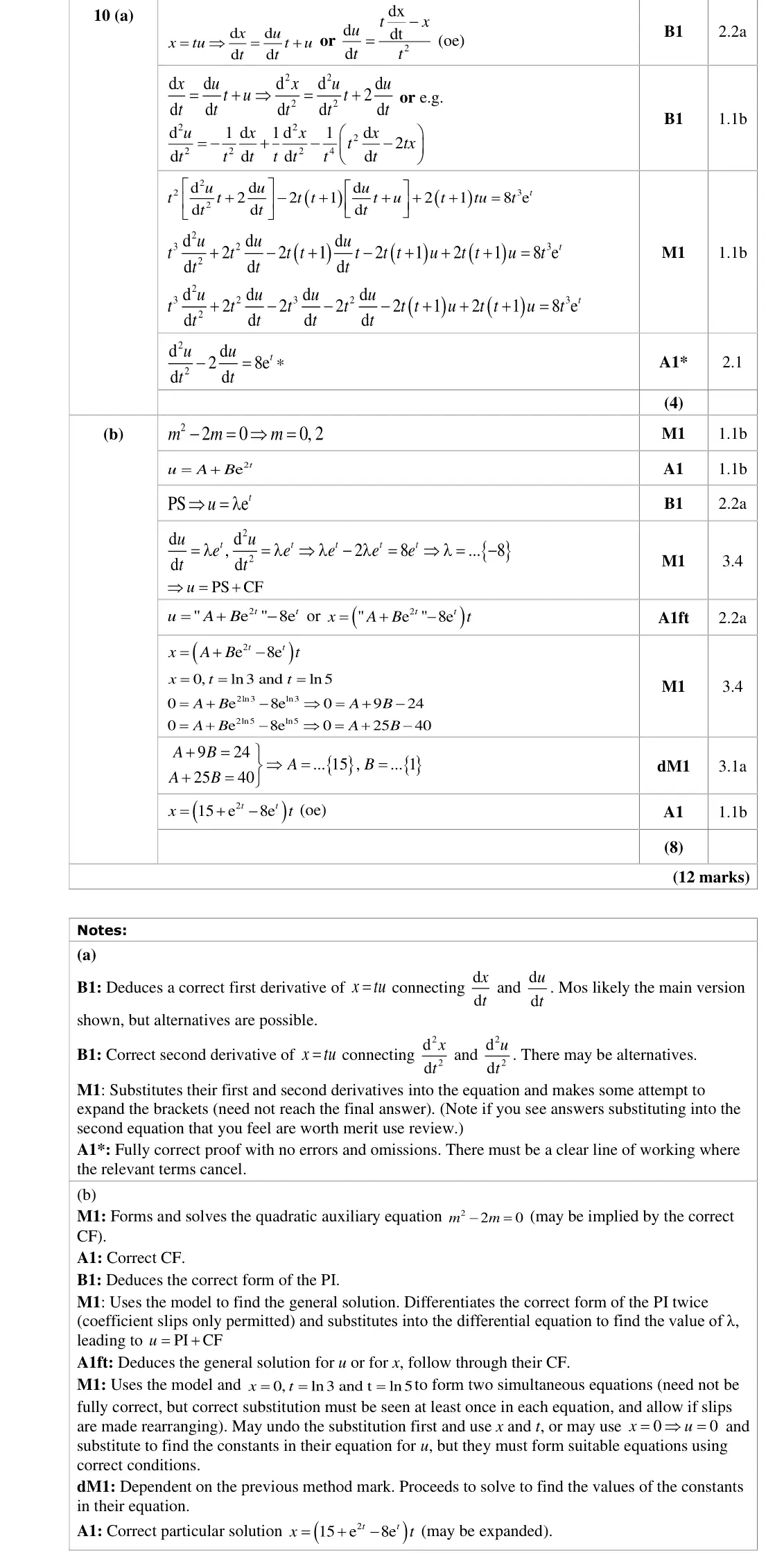
Mark scheme (whole question; this part is marked with the orange bar)
Examiner's comment
Although this was a challenging question, many candidates were able to gain some marks for at least one part of the question, particularly part (b), when the more demanding part (a) had not been accessible to them. Solution of a second order differential equation is a very well- versed topic, and a good source of marks for candidates. In part (a), most of the responses were correct in their approach, accurately differentiating x = tu to the second derivative and substituting these into the given equation and with a valid attempt at expanding brackets. Occasionally candidates showed confusion with regards to which derivative was required, resulting in convoluted or altogether unsuccessful attempts at finding d d x t and 2 2 d d x t or even in some cases attempts at 2 2 d d t x . When the two B marks were gained, the M mark almost always followed. Most candidates were able to reach the given result, but some fell short due to sign errors, errors in expanding, or sometimes an insufficiently clear line of working where it was not shown how the relevant terms cancel.
Key points from the mark scheme and examiner's report
dx/dt = u + t du/dt, d²x/dt² = 2du/dt + t d²u/dt²
substitute, expand and cancel to u'' − 2u' = 8eᵗ
sign and expansion errors
June 2024 · Paper 3A (Further Pure 1) · Q10(b)8 marks
Mark scheme (whole question; this part is marked with the orange bar)
Examiner's comment
Although this was a challenging question, many candidates were able to gain some marks for at least one part of the question, particularly part (b), when the more demanding part (a) had not been accessible to them. Solution of a second order differential equation is a very well- versed topic, and a good source of marks for candidates. In part (b), many fully correct attempts were seen, as well as some that fell just short but with good initial work. The correct general approach of solving the auxiliary equation, finding the associated complementary function, finding the particular integral and then combining these to form a general solution is known by most, but many candidates did not show all the steps clearly. Perhaps as it is so routine, some are forming the habit of doing many steps in one go, and it was not uncommon to only see the complementary function as a part of the general solution. The most common error at the start of the process was using ( ) 2e t y At B = + as the complementary function. Others left the e0t in the equation throughout, or at least until the latter stages, but this is not incorrect, just needless, and some used x instead of t in the complementary function, which was usually recovered later though a few persisted with it. There were seldom errors with the form of the particular integral, and the process of differentiation and substitution to find the constant was carried out well, but some then erroneously use -8 as the particular integral, forgetting the form they had set out. Most of the candidates went on to use the boundary conditions to form and solve simultaneous equations in their equation and to deduce the overall particular solution of the given differential equation. Many first reversed the substitution to get an equation for x first and needed to use logs in the simultaneous equations only for them to cancel, but the more astute candidates realised they could find the value of u at x = 0 first and this simplified the equations. In otherwise correct responses, the main reasons for any loss of marks at this stage were due to errors in dealing with the log terms, or sign errors in the working. A significant minority of the cohort lost the final mark due to giving the final particular solution for u, rather than x, and thus omitting the required factor of t. But most were able to complete to a correct solution, with full marks being the most common score for this part.
Key points from the mark scheme and examiner's report
m² − 2m = 0, CF A + Be²ᵗ (not (At + B)e²ᵗ)
PI λeᵗ with λ = −8
x = tu
x = 0 at t = ln 3 and ln 5 give A = 15, B = 1: x = t(15 + e²ᵗ − 8eᵗ)
steps often skipped
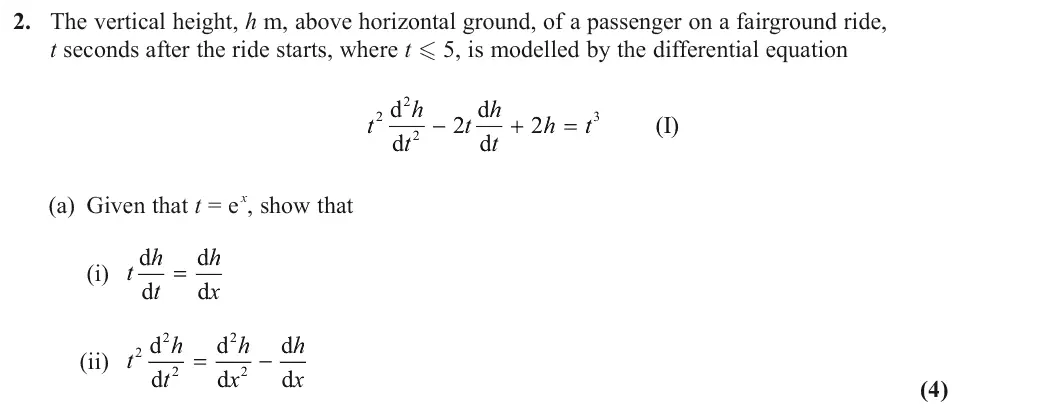
June 2023 · Paper 3A (Further Pure 1) · Q2(a)4 marks
Mark scheme (whole question; this part is marked with the orange bar)
Examiner's comment
This question, though lengthy, was well structured to give plenty of entry points for students, with part (a) proving the most challenging part, but many able to pick up from part (b) onwards and achieve high scores. Part (a) was a test of students’ skills in applying the chain rule and product rule to form linking equations between derivatives and proved challenging for many in being able to correctly apply the chain rule when taking the second derivative in part (ii). Very often the only lost marks in the question came in part (a), most commonly the two marks of (ii). There were some very convoluted answers to this part and it was difficult at times to distinguish t from h and occasionally x, as handwriting was not always clear. This was presumably due to the students themselves being confused as to which variables to be using in which places to make the proof work. However, most students were able apply a correct chain rule for the first derivative equation in part (i). A variety of approaches were seen, some starting with one of the forms of the chain rule before substituting for d t h and rearranging, d others opting to differentiate the given transformation with respect to h and use the chain rule. Mostly this was clear, though some who basically started with the given result with t = ex substituted did not provide sufficient evidence for the proof. In part (a)(ii) students who differentiated the d h t t with respect to t were generally the most d successful, provided they applied the chain rule to the other side, as the result came out directly. But only relatively few took this approach with attempts to differentiate with respect to x more prevalent, and often failing to use the chain rule and either grinding to a halt or forcing the proof. Students were not always clear what they were differentiating with respect to, often differentiating one side with respect to t and the other side with respect to x but realising they were doing so. There were also numerous attempts to differentiate with respect 2 d t to h seen, from a rearranged, and false reciprocal laws on h attempted. It was clear that 2 d this part was the least comfortable for students in this question. However, as both results were given in part (a), part (b) was a very routine operation of substitution into the equation (I). This was correctly done by nearly all students, with only occasional slips noted, and very few non-attempts.
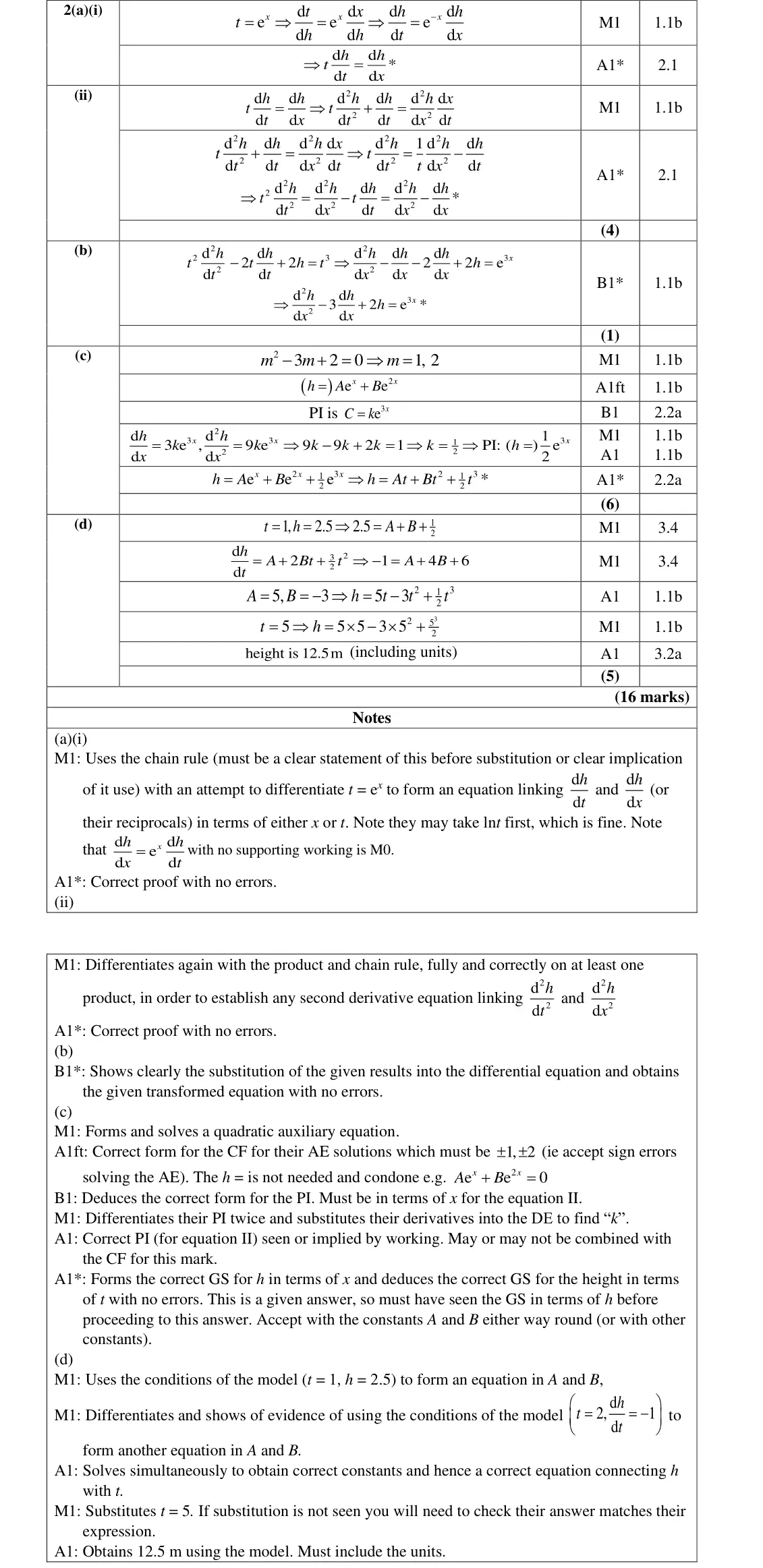
Key points from the mark scheme and examiner's report
(i) chain rule dh/dx = dh/dt × dt/dx = t dh/dt
(ii) differentiate again with product and chain rule: t²d²h/dt² = d²h/dx² − dh/dx
(ii) found hardest, variables confused
June 2023 · Paper 3A (Further Pure 1) · Q2(b)1 mark
Mark scheme (whole question; this part is marked with the orange bar)
Examiner's comment
This question, though lengthy, was well structured to give plenty of entry points for students, with part (a) proving the most challenging part, but many able to pick up from part (b) onwards and achieve high scores. However, as both results were given in part (a), part (b) was a very routine operation of substitution into the equation (I). This was correctly done by nearly all students, with only occasional slips noted, and very few non-attempts.
Key points from the mark scheme and examiner's report
substitute both results into (I) with t³ = e³ˣ to reach d²h/dx² − 3dh/dx + 2h = e³ˣ
June 2023 · Paper 3A (Further Pure 1) · Q2(c)6 marks
Mark scheme (whole question; this part is marked with the orange bar)
Examiner's comment
This question, though lengthy, was well structured to give plenty of entry points for students, Part (c), solving of a second order differential equation, is a very expected topic, and so is well rehearsed and largely carried out correctly. Forming and solving the auxiliary equation was usually done well, although some students neglected to show full working, with some going directly to the complementary function - deducible from the given answer, and so lost marks. Others showed the auxiliary equation first before stating the complementary function, and gained credit, while some, after solving the auxiliary equation, went directly to a + + 2 2 t t complementary function in terms of t (either or sometimes was seen), At Bt e e A B losing accuracy marks. Aside from these, errors of an incorrect form of the complementary function were very rare. Likewise, where students correctly worked in terms of x to start with, errors in the form of the particular integral were uncommon, this particular case being a very standard one. Where 3e t , the latter unable or just errors did occur, the most likely incorrect forms were either e t to access further marks. Most were able to carry out the procedure of differentiating twice and substituting to find any constants in their particular integral and achieve the method, and there were very many fully correct attempts. Those who worked in x throughout would then successfully convert into an equation in t, though there was often some confusion in the naming of the constants if their A and B were the wrong way round in the original complementary function. Some explained well that they could simply be renamed as they are arbitrary constants, but it was more common to see “correction” backtracked. Those who simply left them the other way around were awarded full credit. 2t There were numerous attempts to work in t throughout, and form a particular integral , clearly with the aim of the given answer in sight. These often went wrong as students would generally substitute into the transformed equation, for which the particular integral was 3e x , leading to forcing of the incorrect, and difficulties would arise when trying to equate to result. Also, this belied a lack of realisation a full quadratic should really be used for this type of particular integral, as terms may need to cancel. This was the case even among those who went back to equation (I) to substitute into. Such attempts at working directly with t did not satisfy the demand of the question, and were often poorly done. Students should heed words such as “hence”, which not only specify particular methods but are also there as guidance to the correct route through a question.
Key points from the mark scheme and examiner's report
m² − 3m + 2 = 0 (must be shown, not just the CF), CF Aeˣ + Be²ˣ, PI ½e³ˣ
then t = eˣ gives h = At + Bt² + ½t³
jumping straight to a CF in t loses marks
June 2023 · Paper 3A (Further Pure 1) · Q2(d)5 marks
Mark scheme (whole question; this part is marked with the orange bar)
Examiner's comment
This question, though lengthy, was well structured to give plenty of entry points for students, Part (d) was the most successfully answered part, often being correct even when earlier work had gone wrong. The process of finding a particular solution was well demonstrated, especially since the general solution had been given, so students could simply pick up from part (d). The most common error in the process was to apply the second boundary condition at t = 1 instead of t = 2, losing the last three marks, but this was not very common. There was some poor arithmetic in evidence with otherwise excellent solutions for the rest of the question marred by an inability to substitute values in formulas accurately, or to solve incorrectly for the constants, while some who had their A and B the other way to that given in the question sometimes mixed up the order when substituting back in to the equation. There were mistakes seen in evaluating the solution at t = 5 and the final mark was lost by those who omitted to give the necessary units of the answer, but again this was uncommon. It would be advisable for students to show their substitutions into equations to gain method marks, as there were cases where final values did not follow the students’ equation and could not be awarded the method mark for substitution into the equation as it was not seen or implied.
Key points from the mark scheme and examiner's report
A + B + ½ = 2.5 and A + 4B + 6 = −1 give A = 5, B = −3
h(5) = 12.5 m (units needed)
error: using t = 1 for the derivative condition
June 2022 · Paper 3A (Further Pure 1) · Q9(a)5 marksEasy
Mark scheme (whole question; this part is marked with the orange bar)
Examiner's comment
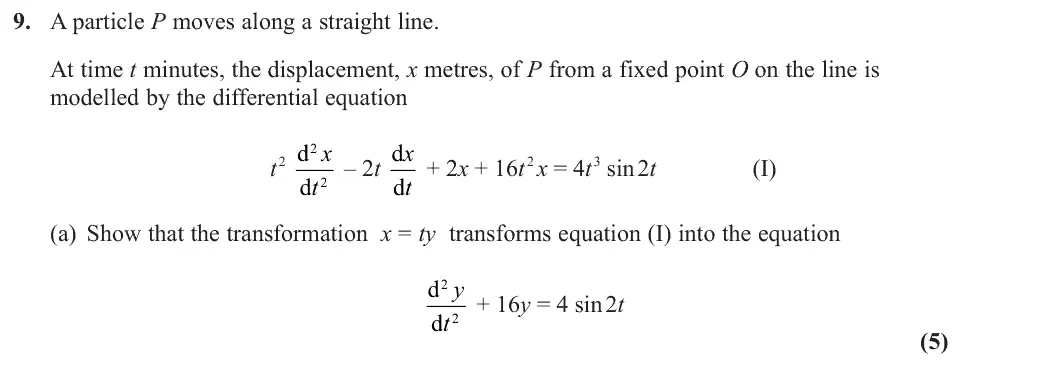
Just under 50% achieved the modal full mark score for this question, which proved to be routine to many, though a substantial amount forgot to undo the substitution at the end of (b). The second most common mark 11/13, usually for the reason cited, though in some cases two accuracy marks were lost due to a slip in either the complementary function or particular integral. The 5% scoring no marks in this case was partially due to being the last question, and so a stretch for some to proceed this deep into the paper, with a few blank responses noted for this question. In part (a) it was clear that most candidates had a good knowledge of how to find the relevant derivatives, and the correct equation was reached by nearly all candidates that attempted this question, although slips in working did occur in some cases. A few were unable to obtain a correct first derivative and usually these made little relevant progress in this part.
Key points from the mark scheme and examiner's report
dx/dt = y + t dy/dt, d²x/dt² = 2dy/dt + t d²y/dt²
substitute and simplify to y'' + 16y = 4sin 2t
June 2022 · Paper 3A (Further Pure 1) · Q9(b)8 marksEasy
Mark scheme (whole question; this part is marked with the orange bar)
Examiner's comment
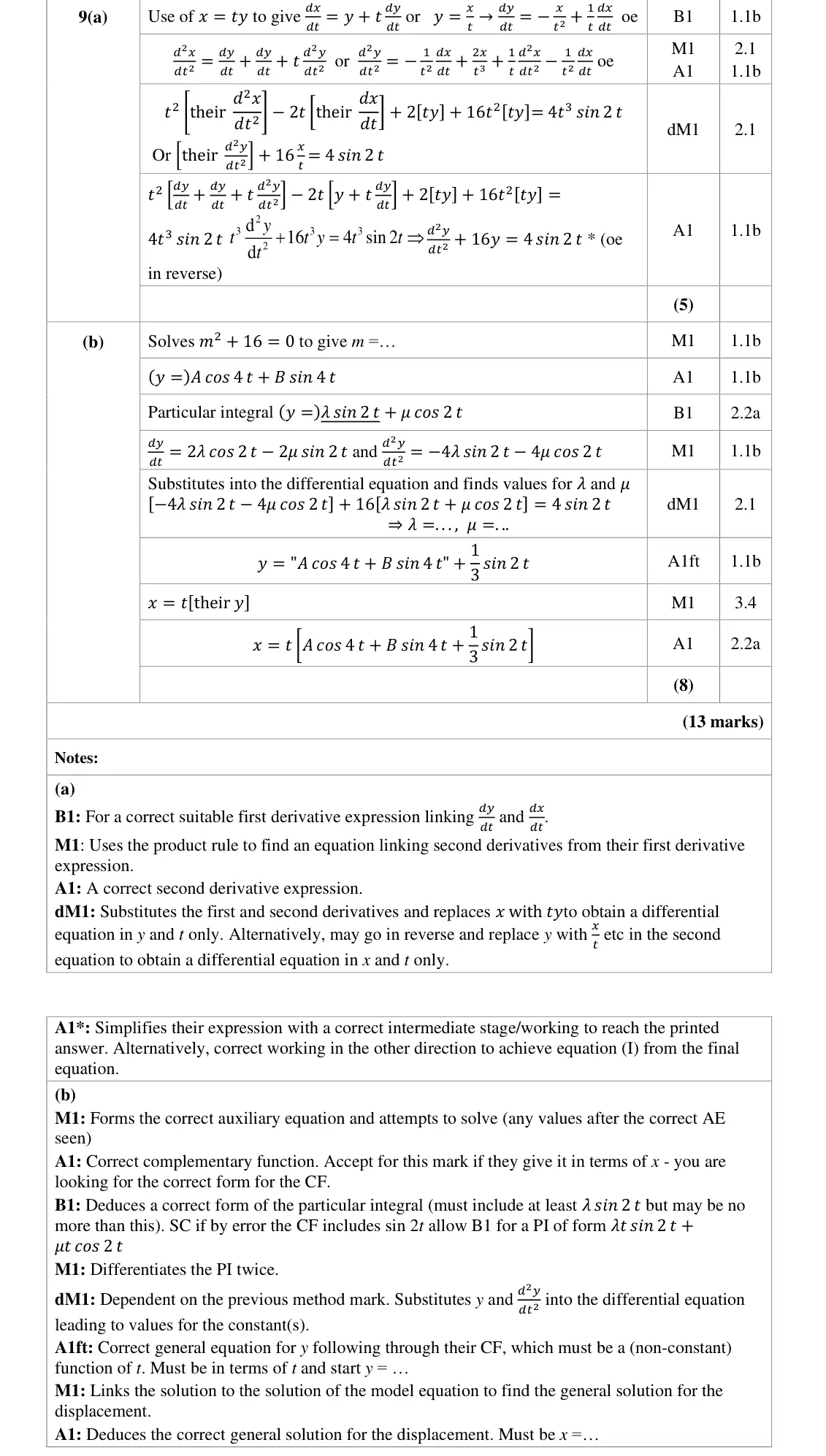
Just under 50% achieved the modal full mark score for this question, which proved to be routine to many, though a substantial amount forgot to undo the substitution at the end of (b). The second most common mark 11/13, usually for the reason cited, though in some cases two accuracy marks were lost due to a slip in either the complementary function or particular integral. The 5% scoring no marks in this case was partially due to being the last question, and so a stretch for some to proceed this deep into the paper, with a few blank responses noted for this question. For part (b), candidates seemed very comfortable solving this type of non-homogenous differential equation. The first 6 marks were achieved very frequently, with the most common errors here involving coefficient slips or errors in writing the auxiliary equation. The auxiliary equation was usually correctly formed and solved, leading to a correct complementary function. A common mistake, however, was an forming m2 + 16m = 0 for the auxiliary equation, the missing middle term confusing some and losing the first two marks. Such errors were not fatal as the next 5 marks were all still available following this. Most candidates successfully selected a suitable particular integral and found values for λ and μ, leading to a correct particular integral, though 3sin2t was a fairly common error following correct work up to the point of stating the integral. Errors usually arose from mistakes in manipulation, leading to incorrect values and hence an incorrect PI. The last two marks were more elusive, with many candidates failing to write the general solution using the original variable, x. Those who did not even identify the preceding equation as being for y also lost the A1ft mark, but this was rare. Overall this topic proves a good source of marks for all grades, and was well approached, with some very good solutions seen.
Key points from the mark scheme and examiner's report
m² + 16 = 0 (not m² + 16m = 0), CF A cos 4t + B sin 4t
PI (1/3)sin 2t
then x = ty: x = t(A cos 4t + B sin 4t + (1/3)sin 2t)
many forgot to undo the substitution
Nov 2021 · Paper 3A (Further Pure 1) · Q8(b)3 marks
Mark scheme (whole question; this part is marked with the orange bar)
Examiner's comment
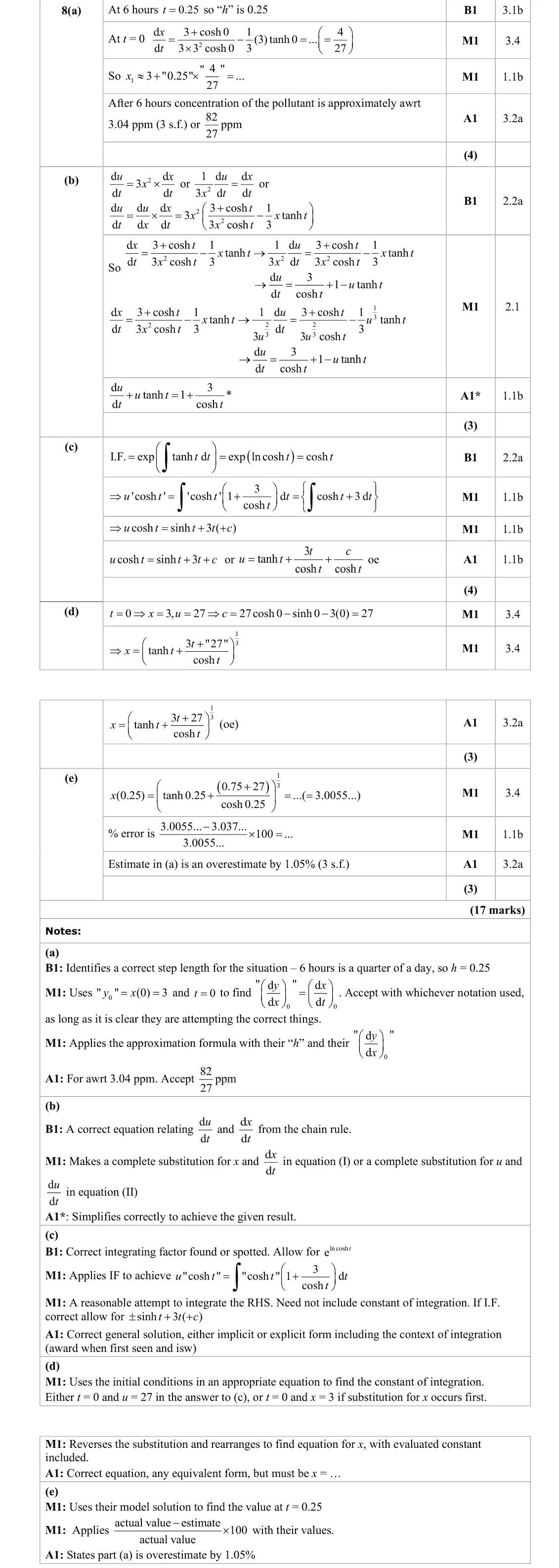
Many candidates demonstrated very good differentiate equation skills. Part (b) Candidates were well practiced in transforming differential equations and showed the result successfully. Starting with 2 d d d d 3 x t u x t x = and using the substitution to replace all the x’s with u’s.
Key points from the mark scheme and examiner's report
du/dt = 3x² dx/dt, then replace x³ by u to reach (II)
Nov 2021 · Paper 3A (Further Pure 1) · Q8(c)4 marks
Mark scheme (whole question; this part is marked with the orange bar)
Examiner's comment
Many candidates demonstrated very good differentiate equation skills. Part (c) Candidates recognised that that needed to find the integrating factor and did so successfully. They multiplied thorough and recognised that they had the derivative of cosh u t on the left-hand side leading to h d cosh cos 3 u t t t = + ∫ . Candidates correctly integrated and remembered the constant of integration.
Key points from the mark scheme and examiner's report
integrating factor cosh t
u cosh t = sinh t + 3t + c
remember the constant
Nov 2021 · Paper 3A (Further Pure 1) · Q8(d)3 marks
Mark scheme (whole question; this part is marked with the orange bar)
Examiner's comment
Many candidates demonstrated very good differentiate equation skills. Part (d) Candidates who has be successful with part (d) used the initial conditions to find the constant of integration. The substitution was reversed and the particular solution for x was found. Occasionally candidates left their answer as 3 3 2 h cosh 7 tan t t x t + = + the question asked for an equation for the concentration of pollutant.
Key points from the mark scheme and examiner's report
t = 0, u = 27 gives c = 27
reverse the substitution: x = (tanh t + (3t + 27)/cosh t)^(1/3)
leaving the answer as x³ = … not accepted as the concentration
June 2019 · Paper 3A (Further Pure 1) · Q3(a)4 marks
Mark scheme (whole question; this part is marked with the orange bar)
Examiner's comment
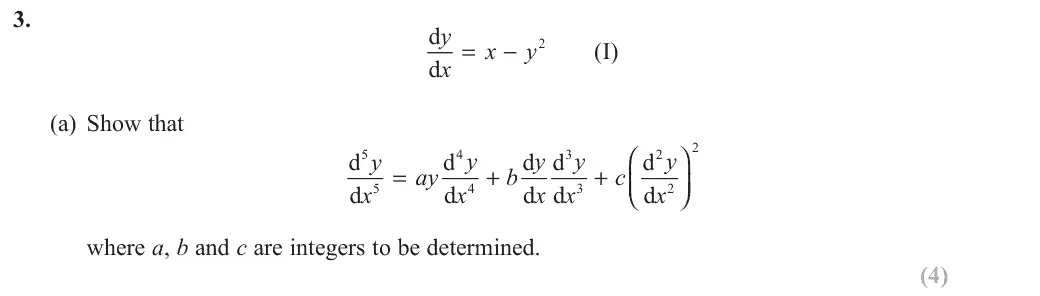
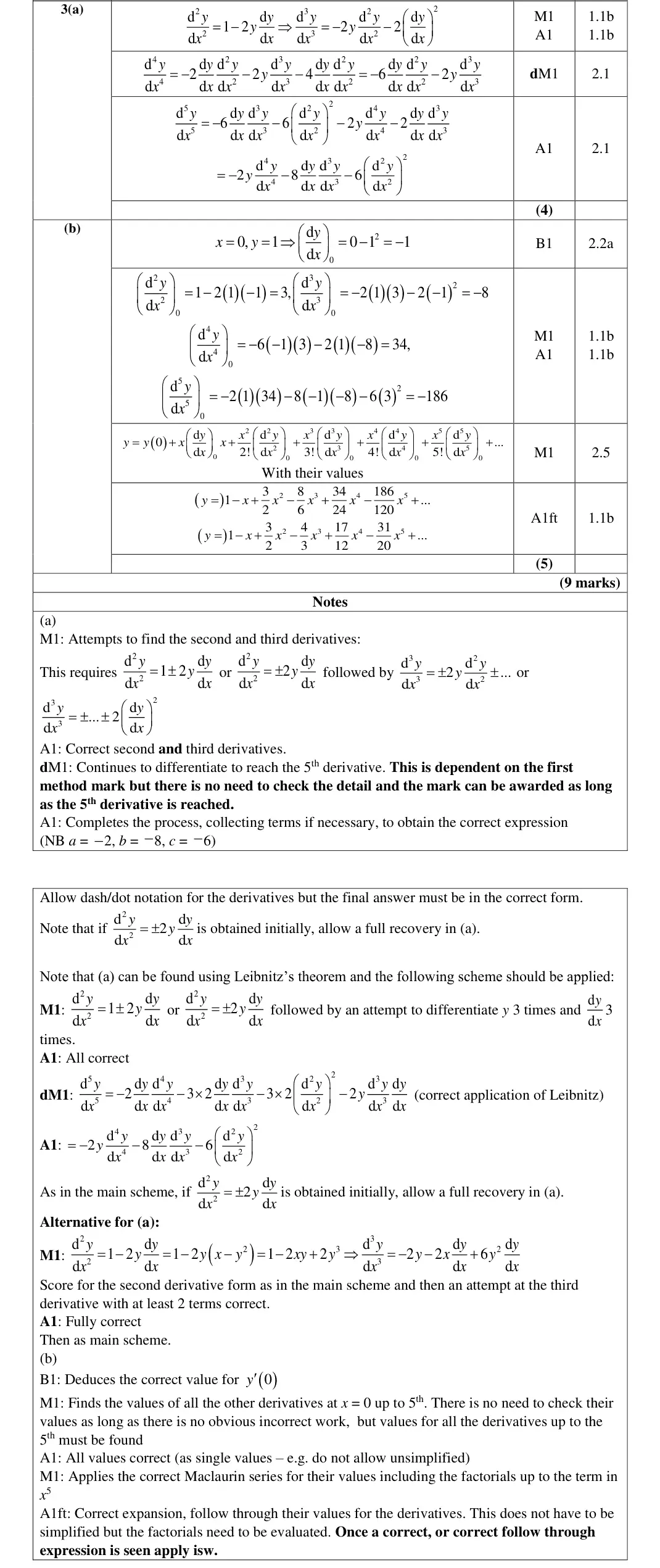
This was another question in which most candidates could make very good progress. Candidates appreciated the correct strategy required and found the first five derivatives, evaluated them at x = 0 𝑑𝑦 and then substituted into the Maclaurin formula. A common error was to obtain y’’ = -2y 𝑑𝑥 (losing the 1) but they were allowed to recover. Another error seen fairly often was the omission of the constant term in the second derivative but this did not prevent candidates from continuing to find the other derivatives required. Other errors noted by examiners included the miscopying of previous work and collecting terms incorrectly. It was also common to see the product rule applied incorrectly in the 4th derivative which then led to the middle term on the 5th derivative giving a coefficient of -4 or -6 instead of -8. In the subsequent work, there were errors in calculation of the values of the derivatives seen and also, less frequently, an incorrect structure for the Maclaurin series. One calculation error seen on several candidates’ work was in finding y’’ = 2 (not 3). This gave the remaining derivatives as -6, 24 and -120 leading to the series 1 – x + x2 - x3 + x4 - x5 A few candidates quoted a series expansion without 1 +… despite obtaining all the other coefficients correctly and this was a costly error.
Key points from the mark scheme and examiner's report
a = −2, b = −8, c = −6
implicit differentiation with the product rule each time
common slips: y'' = −2yy' (losing the 1) and product-rule error in the 4th derivative giving −4 or −6 instead of −8
June 2019 · Paper 3A (Further Pure 1) · Q3(b)5 marks
Mark scheme (whole question; this part is marked with the orange bar)
Examiner's comment
This was another question in which most candidates could make very good progress. Candidates appreciated the correct strategy required and found the first five derivatives, evaluated them at x = 0 𝑑𝑦 and then substituted into the Maclaurin formula. A common error was to obtain y’’ = -2y 𝑑𝑥 (losing the 1) but they were allowed to recover. Another error seen fairly often was the omission of the constant term in the second derivative but this did not prevent candidates from continuing to find the other derivatives required. Other errors noted by examiners included the miscopying of previous work and collecting terms incorrectly. It was also common to see the product rule applied incorrectly in the 4th derivative which then led to the middle term on the 5th derivative giving a coefficient of -4 or -6 instead of -8. In the subsequent work, there were errors in calculation of the values of the derivatives seen and also, less frequently, an incorrect structure for the Maclaurin series. One calculation error seen on several candidates’ work was in finding y’’ = 2 (not 3). This gave the remaining derivatives as -6, 24 and -120 leading to the series 1 – x + x2 - x3 + x4 - x5 A few candidates quoted a series expansion without 1 +… despite obtaining all the other coefficients correctly and this was a costly error.
Key points from the mark scheme and examiner's report
June 2019 · Paper 3A (Further Pure 1) · Q6(a)5 marks
Mark scheme (whole question; this part is marked with the orange bar)
Examiner's comment
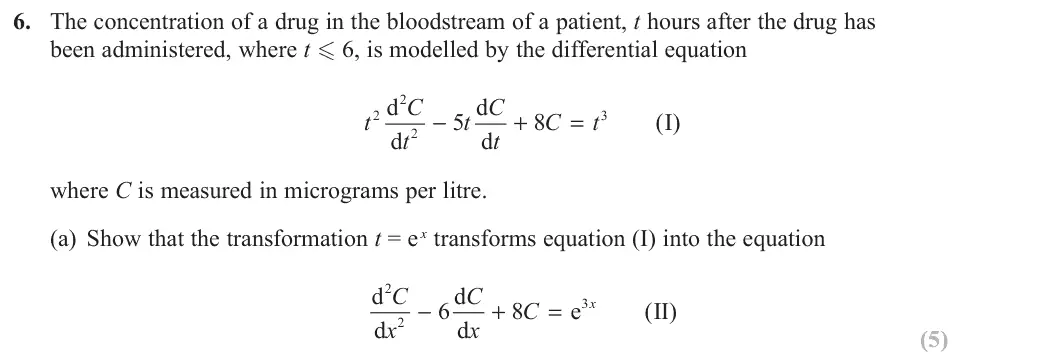
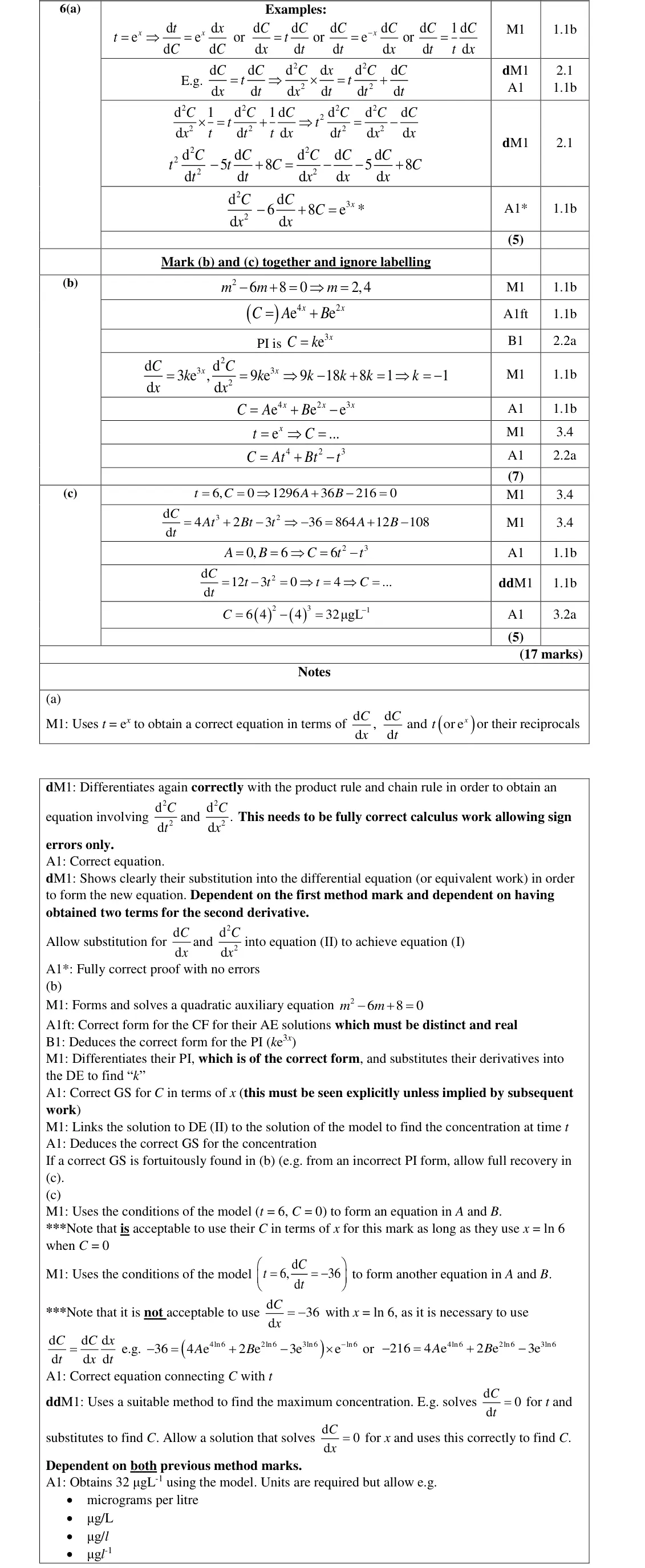
Part (a) was poorly answered by a good number of candidates, with many incorrect attempts at applying both the product and chain rule seen. It was also common to see candidates trying to ‘fudge’ their answer to make it fit with the printed differential equation. The most successful approach seemed to be differentiating with respect to 𝑡 after obtaining 𝑑𝐶 𝑑𝑡 . Differentiating with respect to a different variable seemed to cause difficulties in all but the more prepared candidates, despite the fact that this is a very basic element of calculus in A Level Further Mathematics. Some very poor responses were seen asserting that, for example, 𝑑2𝐶 𝑑𝑡2 = 𝑑2𝐶 𝑑𝑥2 x 𝑑𝑥2 𝑑𝑡2.
Key points from the mark scheme and examiner's report
dC/dt = (1/t)dC/dx
second derivative needs product and chain rule: t²d²C/dt² = d²C/dx² − dC/dx
poorly answered, fudging to the printed equation and invalid d²C/dx² × dx²/dt² seen
June 2019 · Paper 3A (Further Pure 1) · Q6(b)7 marks
Mark scheme (whole question; this part is marked with the orange bar)
Examiner's comment
However, the majority of candidates made a sound attempt at part (b) with many fully correct solutions seen. There was a sound knowledge of the technique of solving a second order linear differential equation and only the occasional slip prevented a candidate from achieving the correct form for C in terms of x. Some candidates did not transform C into a function of t which did lead to some problems whilst attempting to fit their general solution to the initial conditions of the problem.
Key points from the mark scheme and examiner's report
m² − 6m + 8 = 0, CF Ae⁴ˣ + Be²ˣ, PI ke³ˣ with k = −1
must convert back using x = ln t: C = At⁴ + Bt² − t³
June 2019 · Paper 3A (Further Pure 1) · Q6(c)5 marks
Mark scheme (whole question; this part is marked with the orange bar)
Examiner's comment
Part (c) was also well attempted with many fully correct solutions seen. By far the most common error here was to see candidates substitute -36 into an equation which had been differentiated with respect to 𝑥 rather than 𝑡 and in some instances also using x = 6 rather than ln6. However, some candidates rectified this by using -6 x 36 for the value of 𝑑𝐶 𝑑𝑥 at 𝑡= 6. Quite a few candidates also failed to give appropriate units in their final answer.
Key points from the mark scheme and examiner's report
t = 6, C = 0 and dC/dt = −36 give A = 0, B = 6, C = 6t² − t³
dC/dt = 0 at t = 4: 32 μg per litre (units needed)
common error: using −36 for dC/dx or x = 6 instead of ln 6
Find an Edexcel Further Maths tutor
Stuck on this? Book a trial lesson with our Further Maths tutor.