Examiner's comment
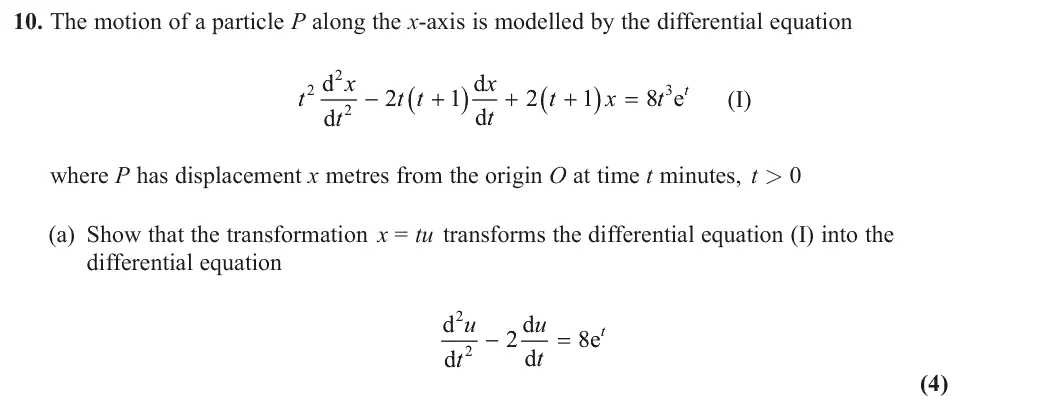
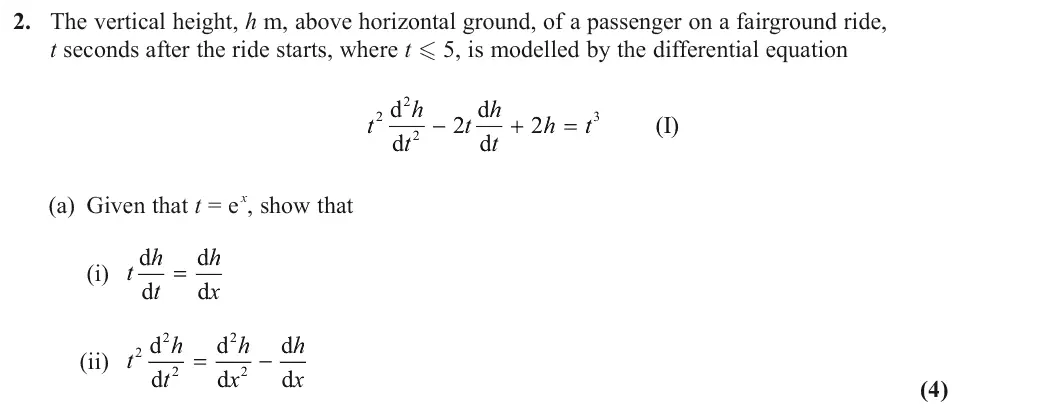
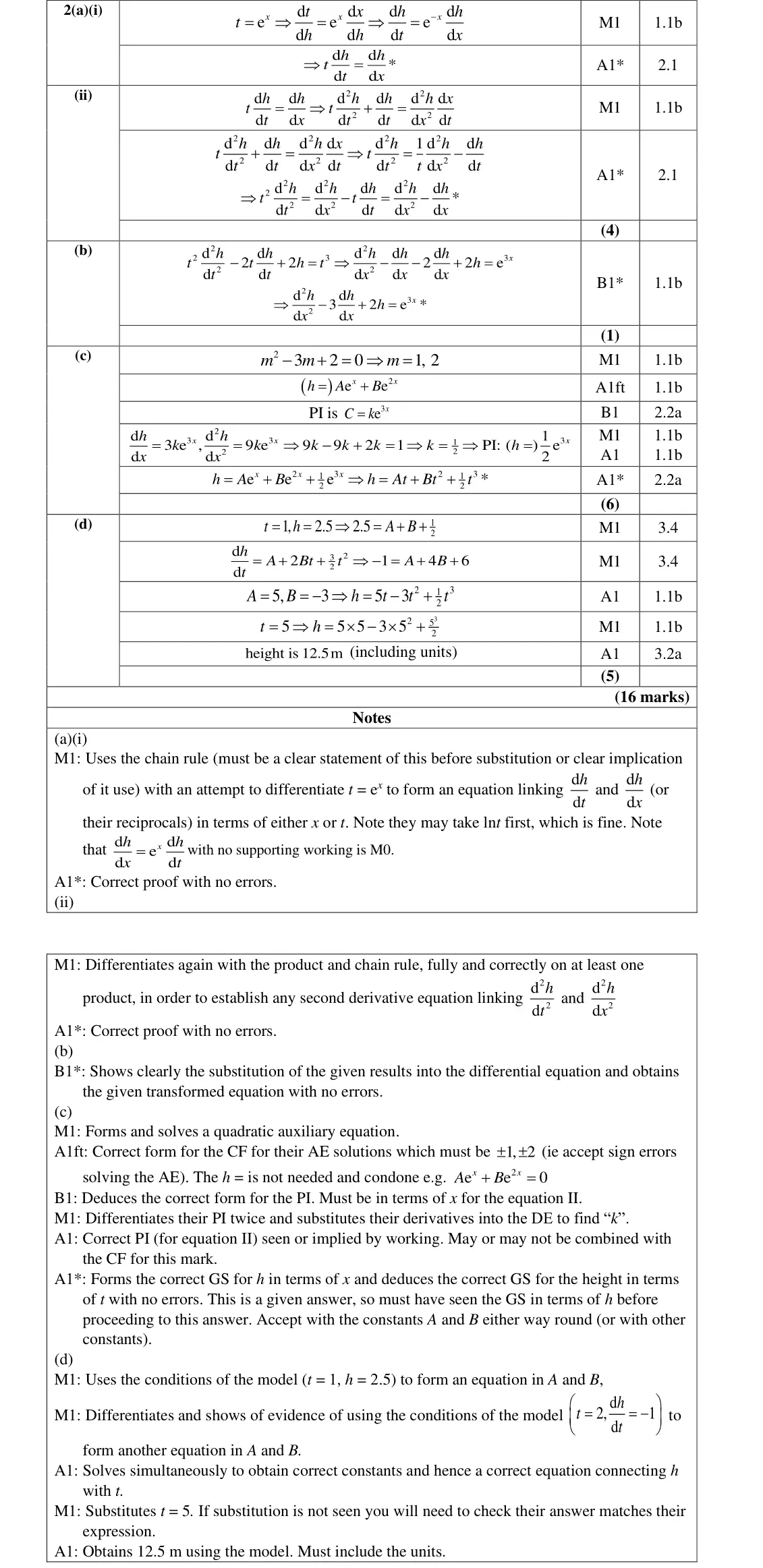
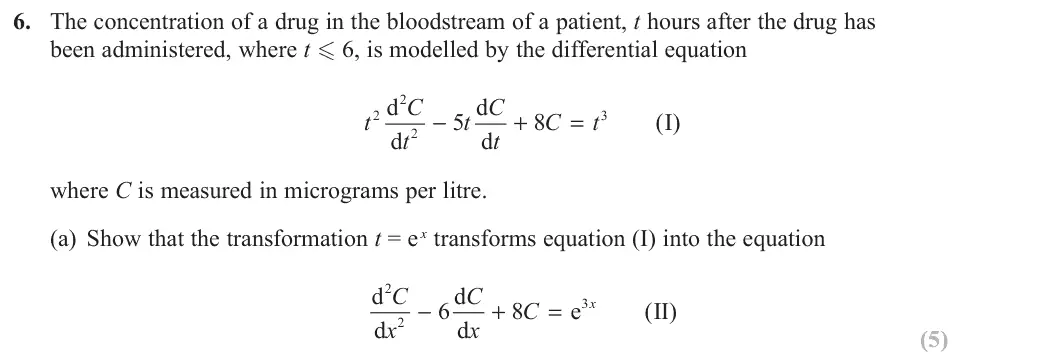
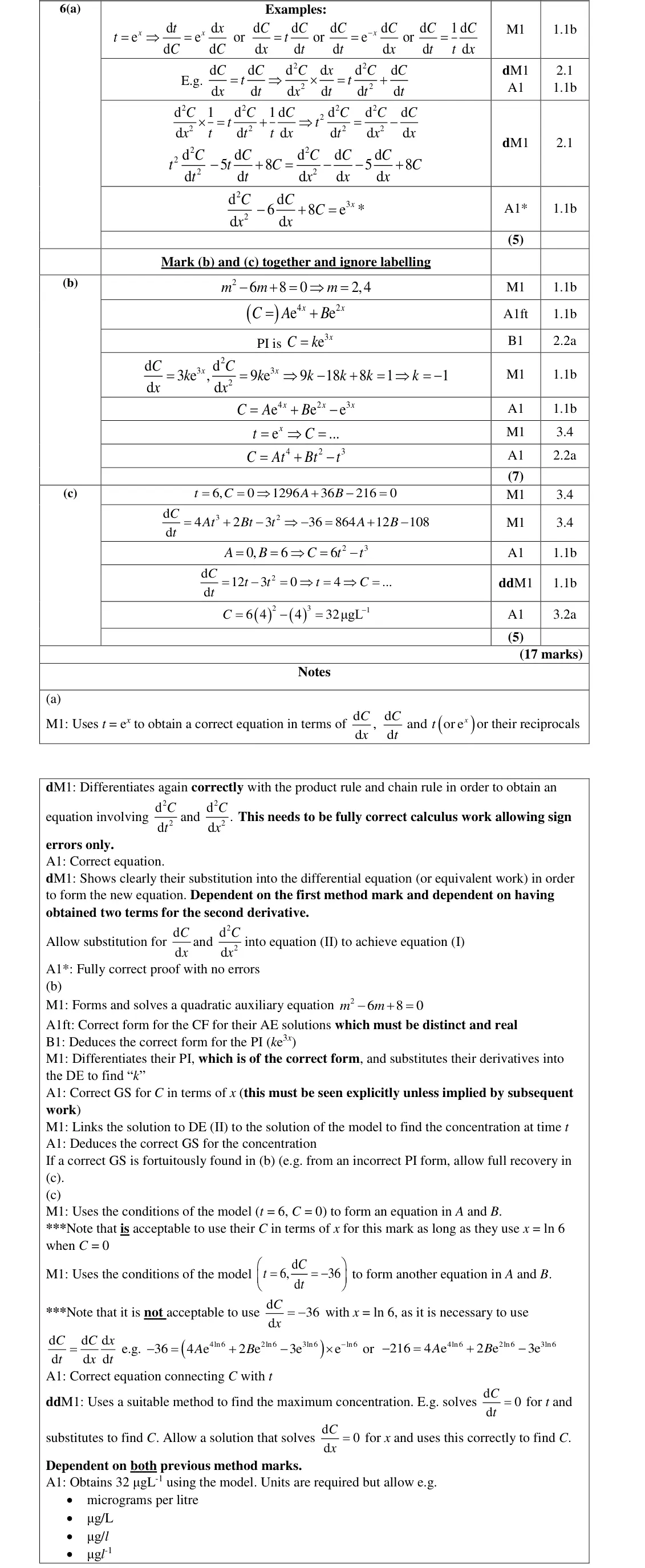
This question, though lengthy, was well structured to give plenty of entry points for students, Part (c), solving of a second order differential equation, is a very expected topic, and so is well rehearsed and largely carried out correctly. Forming and solving the auxiliary equation was usually done well, although some students neglected to show full working, with some going directly to the complementary function - deducible from the given answer, and so lost marks. Others showed the auxiliary equation first before stating the complementary function, and gained credit, while some, after solving the auxiliary equation, went directly to a + + 2 2 t t complementary function in terms of t (either or sometimes was seen), At Bt e e A B losing accuracy marks. Aside from these, errors of an incorrect form of the complementary function were very rare. Likewise, where students correctly worked in terms of x to start with, errors in the form of the particular integral were uncommon, this particular case being a very standard one. Where 3e t , the latter unable or just errors did occur, the most likely incorrect forms were either e t to access further marks. Most were able to carry out the procedure of differentiating twice and substituting to find any constants in their particular integral and achieve the method, and there were very many fully correct attempts. Those who worked in x throughout would then successfully convert into an equation in t, though there was often some confusion in the naming of the constants if their A and B were the wrong way round in the original complementary function. Some explained well that they could simply be renamed as they are arbitrary constants, but it was more common to see “correction” backtracked. Those who simply left them the other way around were awarded full credit. 2t There were numerous attempts to work in t throughout, and form a particular integral , clearly with the aim of the given answer in sight. These often went wrong as students would generally substitute into the transformed equation, for which the particular integral was 3e x , leading to forcing of the incorrect, and difficulties would arise when trying to equate to result. Also, this belied a lack of realisation a full quadratic should really be used for this type of particular integral, as terms may need to cancel. This was the case even among those who went back to equation (I) to substitute into. Such attempts at working directly with t did not satisfy the demand of the question, and were often poorly done. Students should heed words such as “hence”, which not only specify particular methods but are also there as guidance to the correct route through a question.