FP1.3.1 Use of Taylor series method for series solution of differential…

Section
FP1.3 Further differential equations
Level
A level only
Statement
Use of Taylor series method for series solution of differential equations.
Guidance
For example, derivation of the series solution in powers of x, as far as the term in x⁴, of the differential equation d²y/dx² + x dy/dx + y = 0, where y = 1, dy/dx = 0 at x = 0.
Since 2018
7 parts, 25 marks · topic pages: Further differential equations: Taylor series solutions and substitutions, Taylor series, limits, Leibnitz's theorem, L'Hospital's rule and the Weierstrass substitution

Back to the checklist

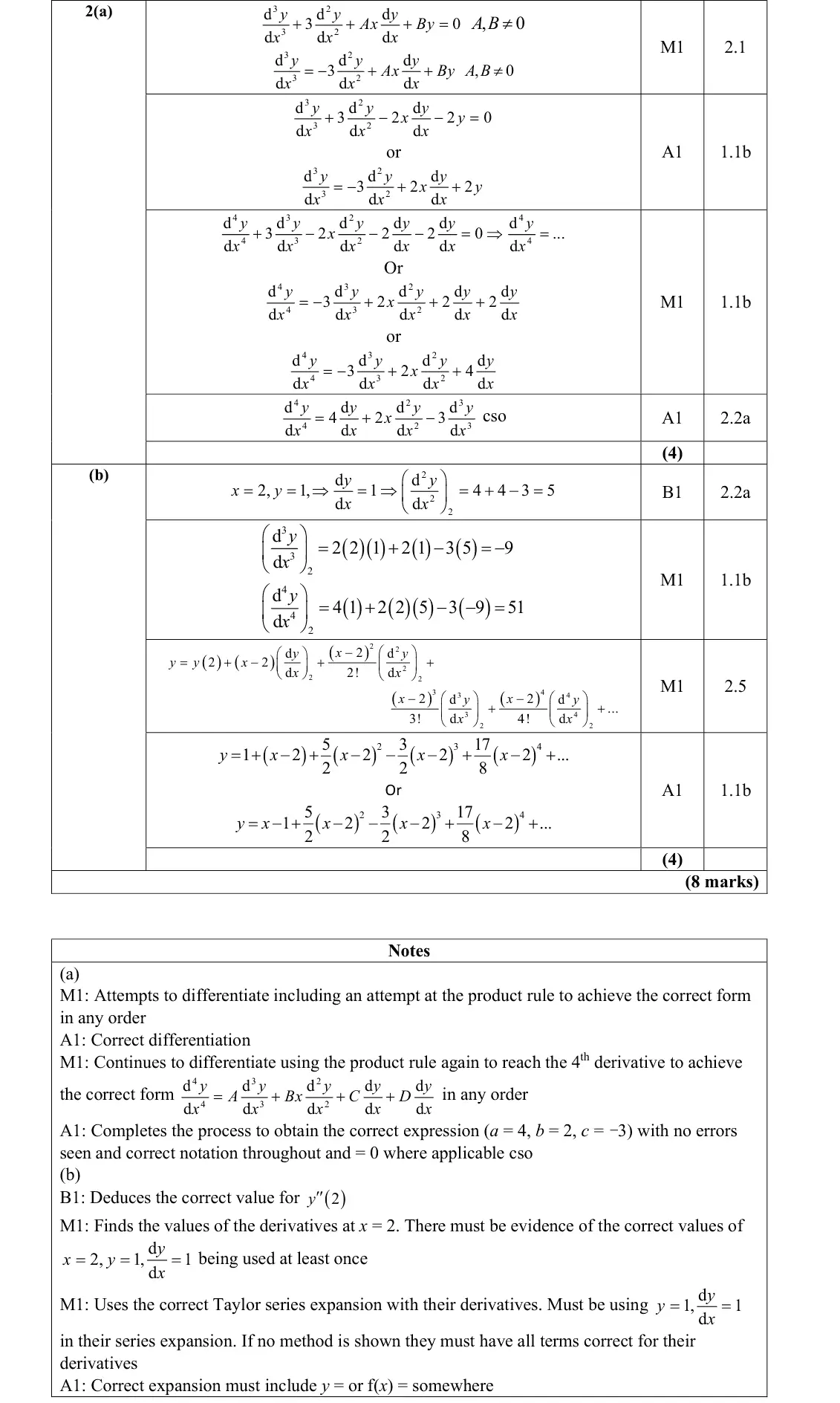
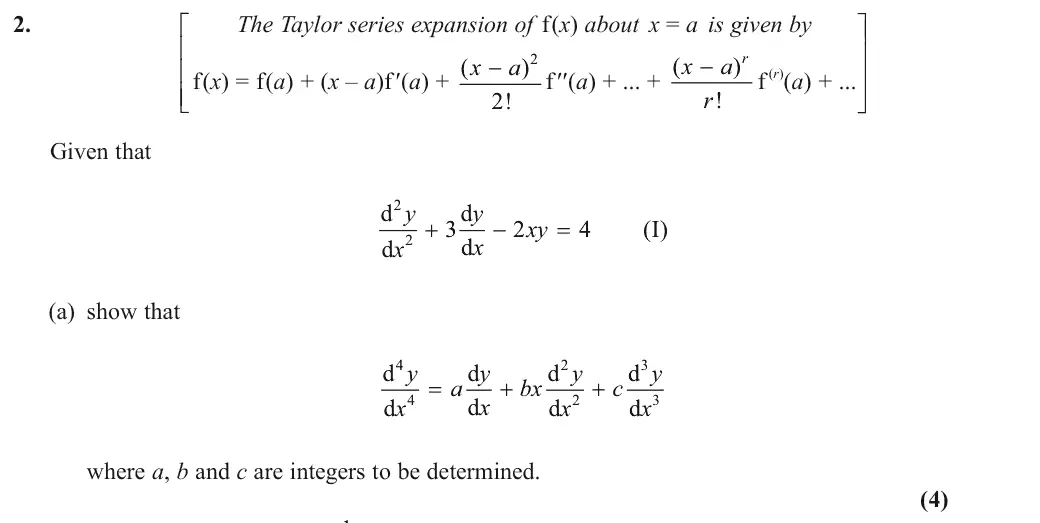
June 2025 · Paper 3A (Further Pure 1) · Q2(a) 4 marks
2. The Taylor series expansion of f(x) about x = a is given by < ; : : : r x a f′′(a) + ... + ( x - a ) f(x) = f(a) + (x – a)f′(a) + ( - ) : (r)(a) + ... : f : r ! ; ! < Given that y y d d xy ( ) I x d x d (a) show that y a y y y d d d d bx c x d x d d x d x where a, b and c are integers to be determined. (4)
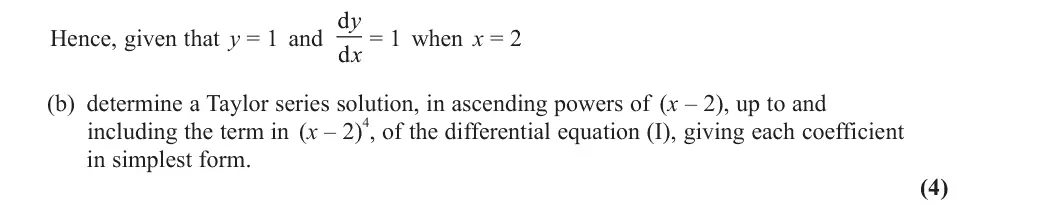
June 2025 · Paper 3A (Further Pure 1) · Q2(b) 4 marks
Hence, given that y = 1 and d y x = 1 when x = 2 d (b) determine a Taylor series solution, in ascending powers of (x – 2), up to and including the term in (x – 2) 4, of the differential equation (I), giving each coefficient in simplest form. (4)
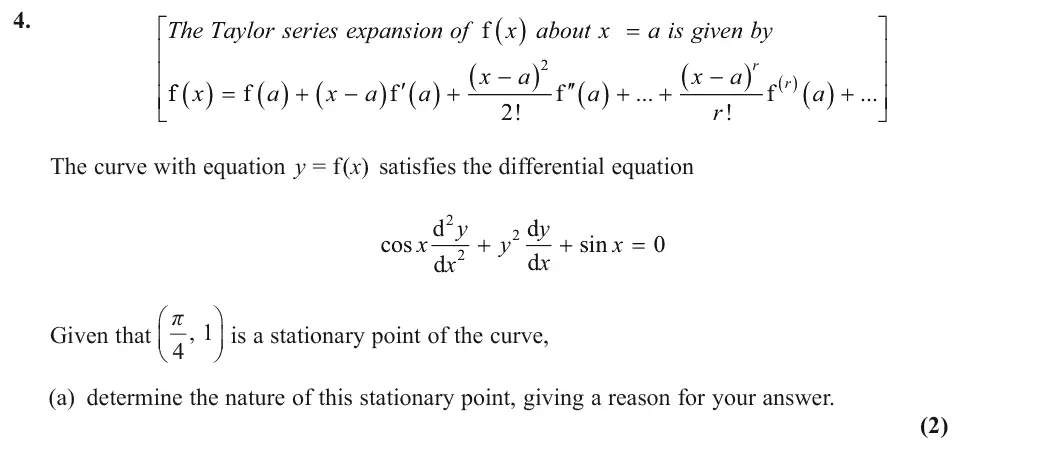
June 2024 · Paper 3A (Further Pure 1) · Q4(a) 2 marks
4. . / The Taylor series exp ansion of f x about x a is given by / / r x a x a . / O . / 1 / ∑. / 1 ∑∑. / 1 . / . / 1 r x a x a a a a f f f f f r 2! ! The curve with equation y = f(x) satisfies the differential equation d y d y cos x y sin x x d x d pi < ; , 1 Given that 7 is a stationary point of the curve, : (a) determine the nature of this stationary point, giving a reason for your answer. (2)
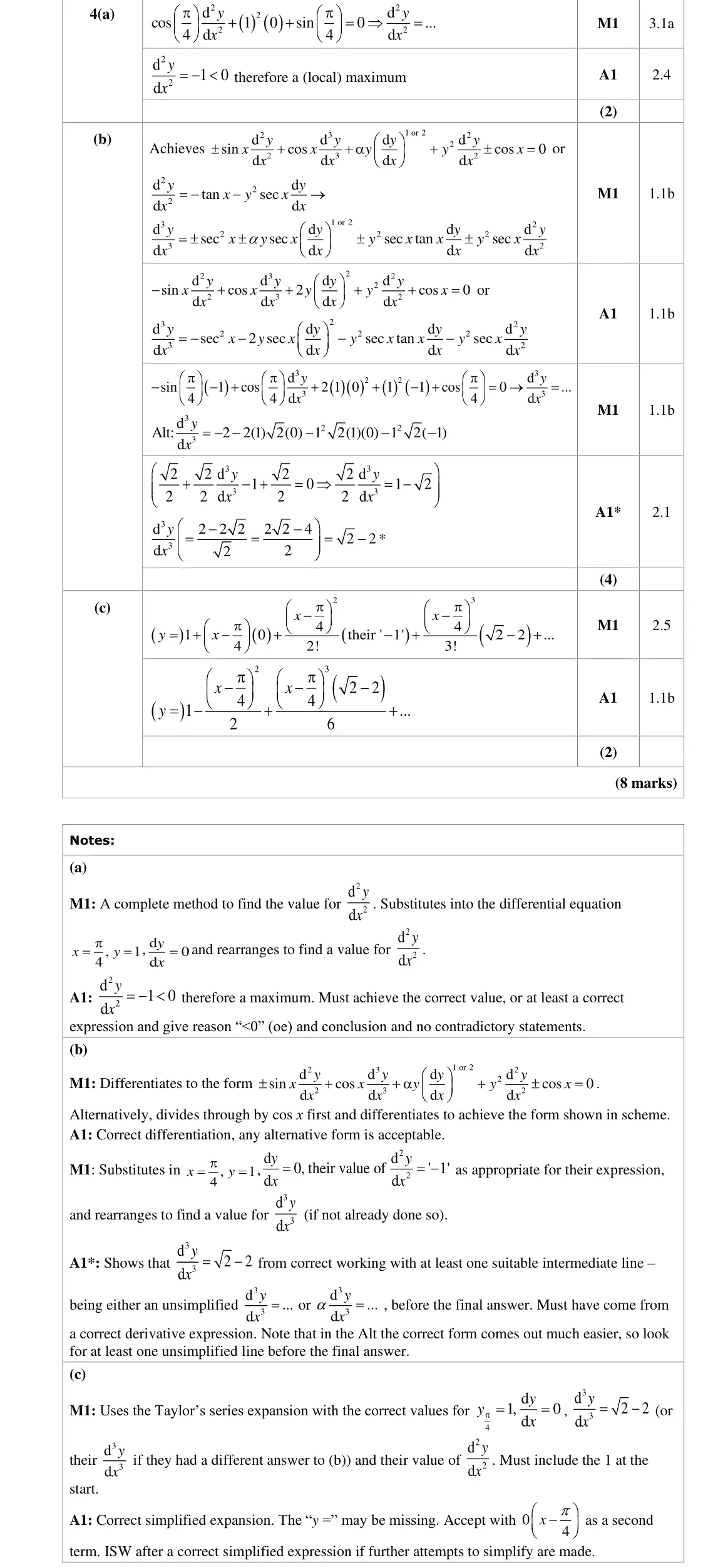
June 2024 · Paper 3A (Further Pure 1) · Q4(b) 4 marks
(b) Show that d y at this stationary point. x d (4)
June 2024 · Paper 3A (Further Pure 1) · Q4(c) 2 marks
pi < ; (c) Hence determine a series solution for y, in ascending powers of up to and x pi < ; including the term in x , giving each coefficient in simplest form. (2)
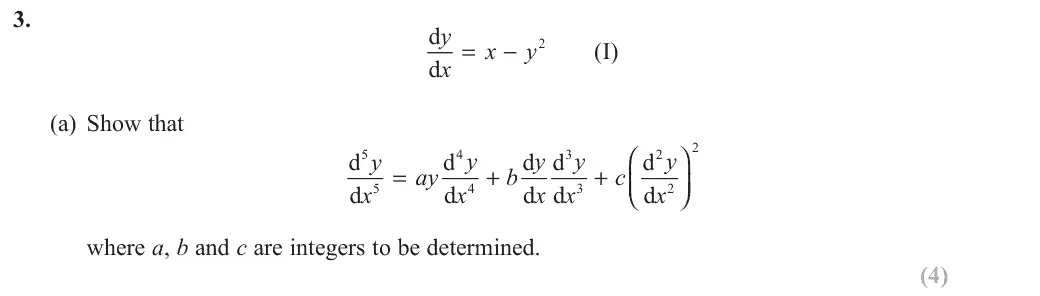
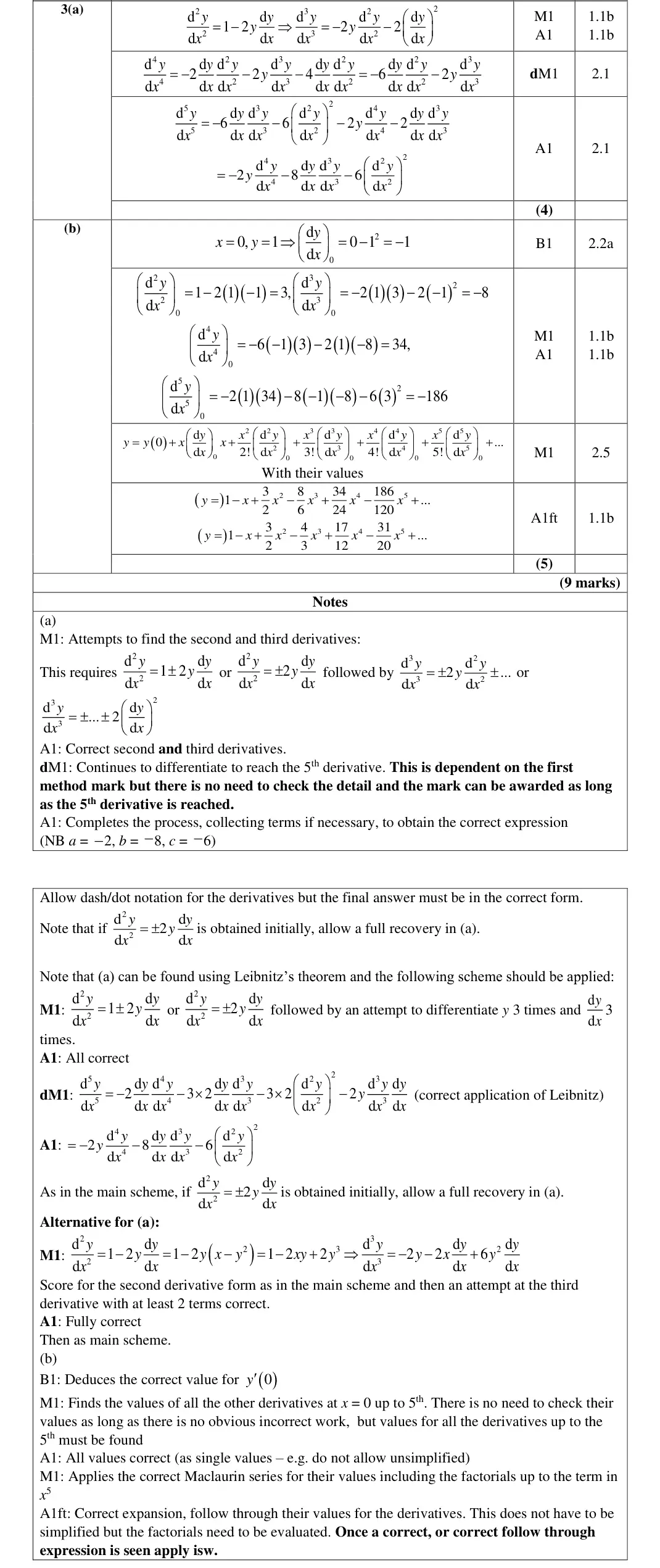
June 2019 · Paper 3A (Further Pure 1) · Q3(a) 4 marks
3. d y x y ( ) I = - d x (a) Show that d y d y b y d d y d y ⎛ ⎞ ay c = + + ⎝⎜ ⎠⎟ d x d x d x d x d x where a, b and c are integers to be determined. (4)
June 2019 · Paper 3A (Further Pure 1) · Q3(b) 5 marks
(b) Hence find a series solution, in ascending powers of x as far as the term in x5, of the differential equation (I), given that y = 1 at x = 0 (5)

Find an Edexcel Further Maths tutor

Stuck on this? Book a trial lesson with our Further Maths tutor.

Prefer email? Send an enquiry

If you are under 18, please include a parent's contact details. Enquiries go to enquiries@alevelfurthermathstutor.com and are deleted once handled.