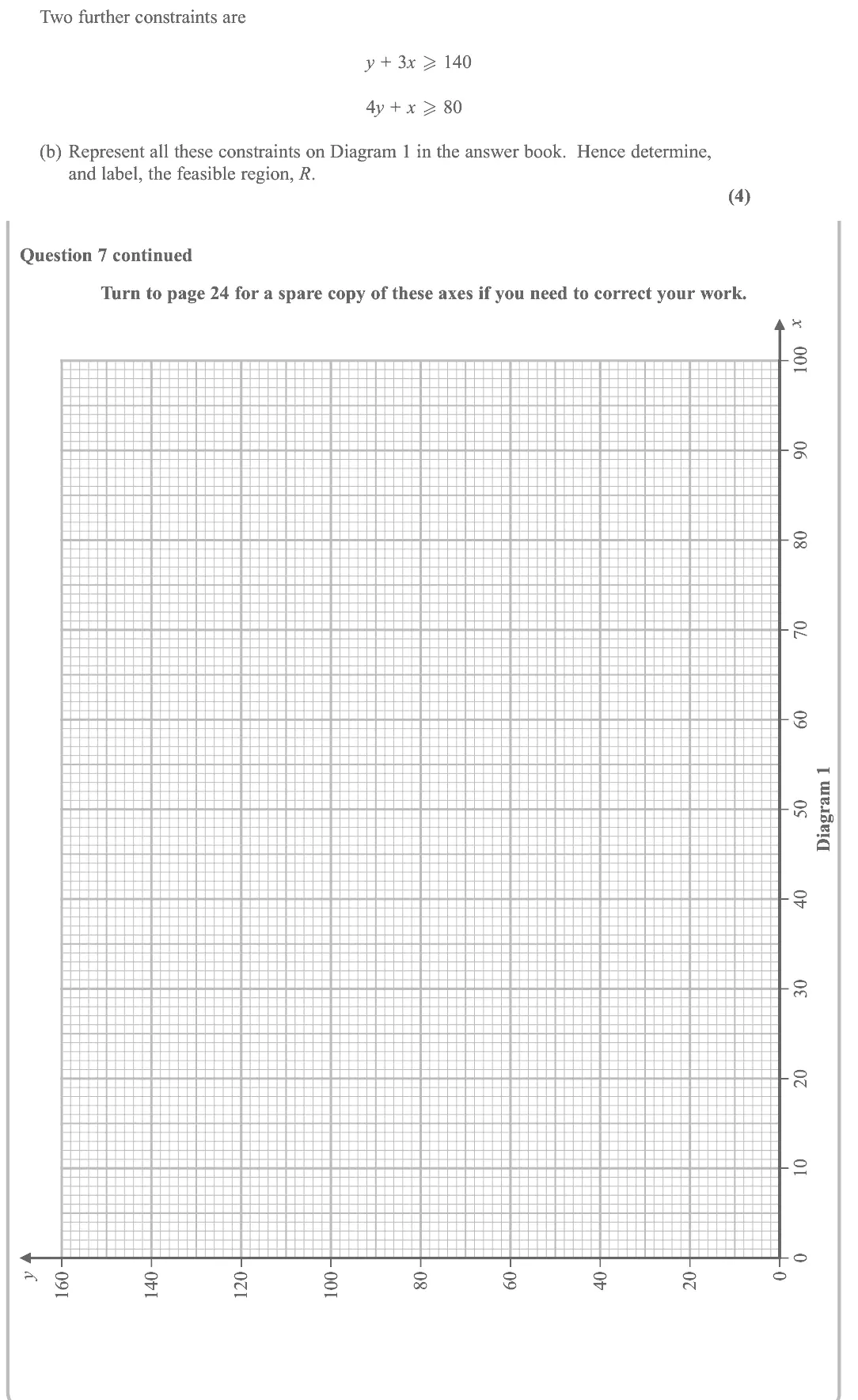
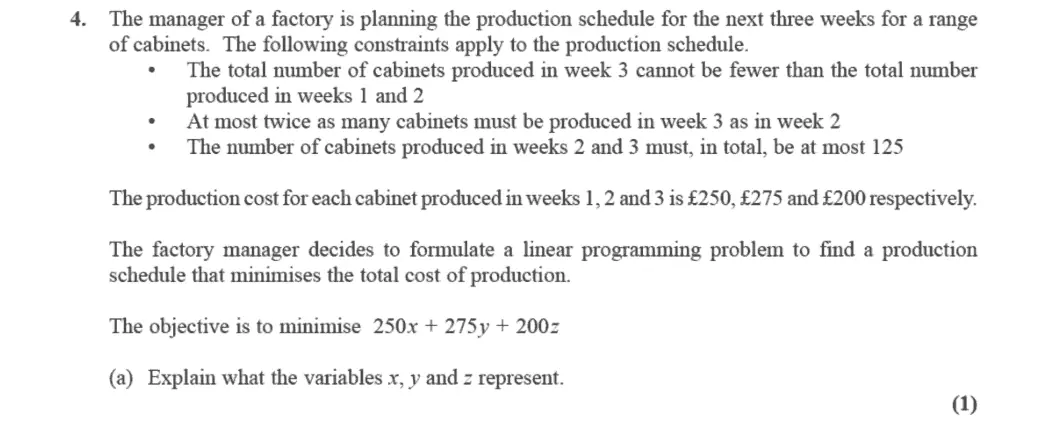
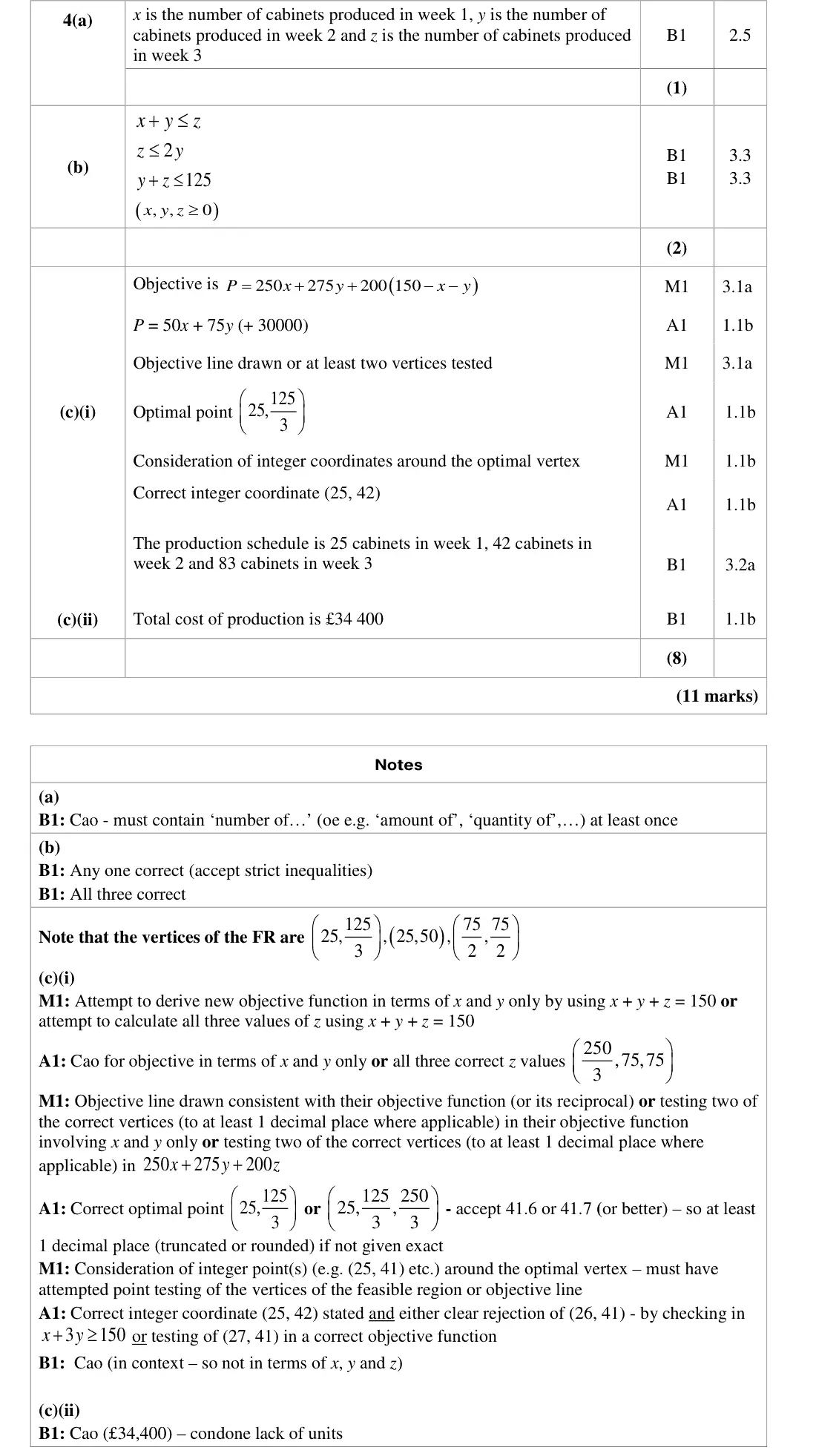
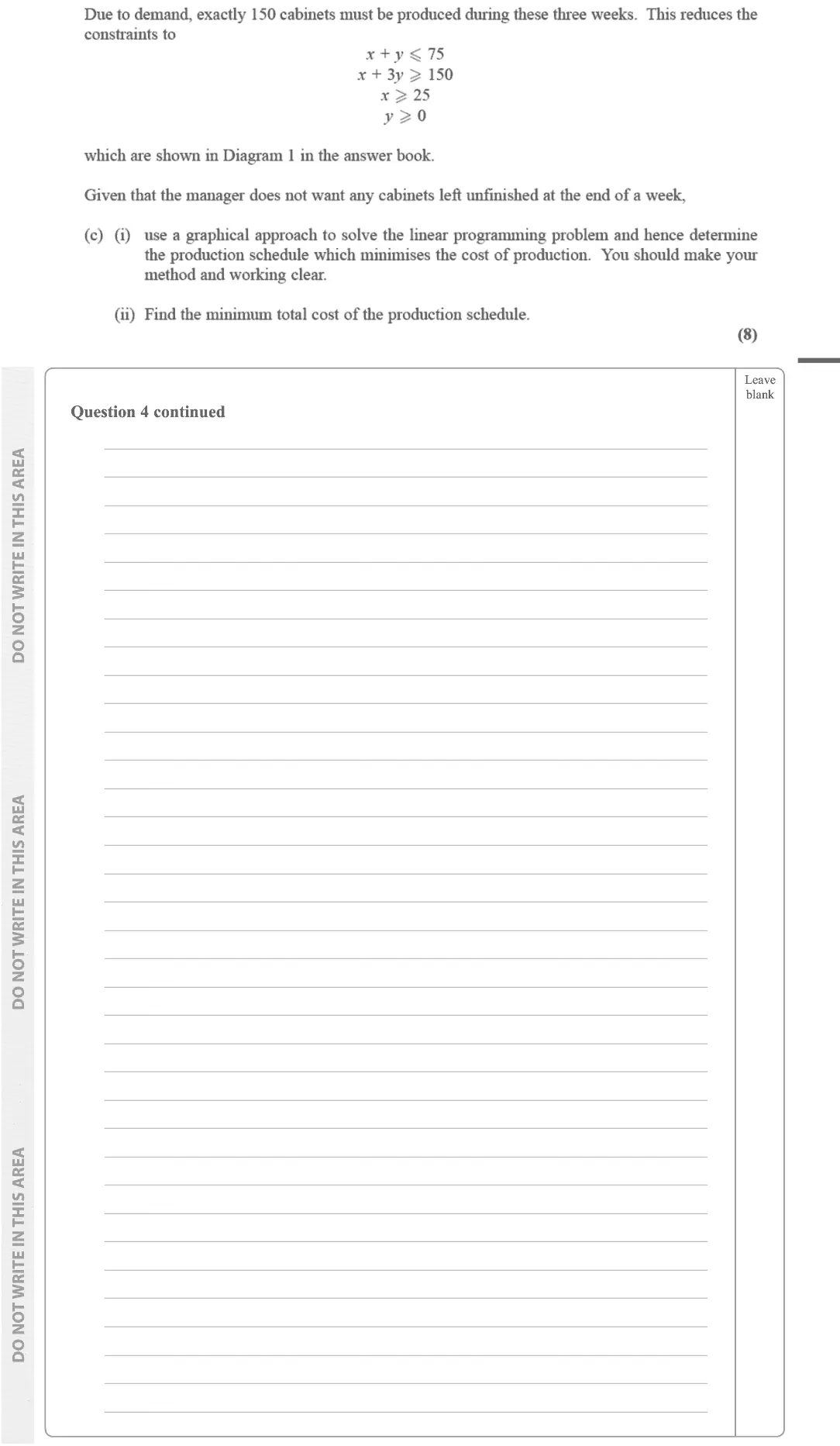
Notes, worked examples and practice for this topic are being written by our tutors. The past-paper questions below are ready now: work each one on paper, then open the mark scheme and the examiner's comment.
Tap a question to zoom it. Mark scheme and examiner's comment open under each question.
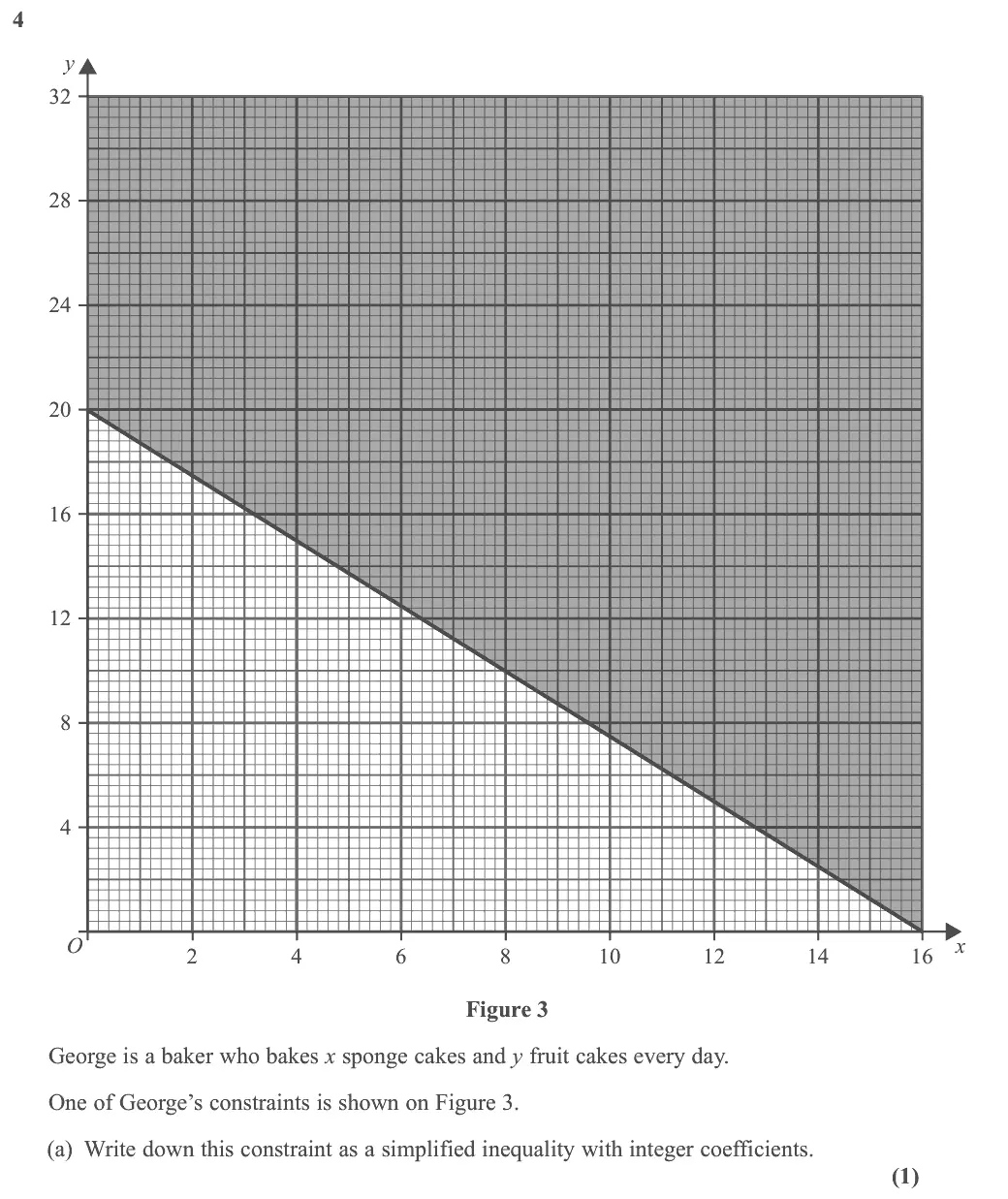
June 2025 · AS Paper 2 (Decision 1) · Q4(a)1 mark
Mark scheme (whole question; this part is marked with the orange bar)
Examiner's comment
Once again, this question was accessible to the vast majority of responses and was well placed at the end of the paper with a range of marks being awarded. Full marks were seen, but not often. The question was still well attempted with no evidence that learners were running short of time. Part a) was generally completed well although some learners lost the mark by failing to find the integer coefficients or failing to multiply by 4 effectively ending up with a constant of 20 or 100. Part b) also provided marks for the majority of learners; most gained the first mark although although the 3x >= 2y inequality often caused the most issues and was therefore allocated two some used x instead of y for the first inequality. It was common to see errors of x >= 4 out of the three available marks for this part. Indeed, every combination of 3, x, 2, y and also scored the first B mark in bii) for drawing 2𝑥𝑥+ 𝑦𝑦 <= 28 and 𝑦𝑦 >= 4. However, direction of inequality was seen with reasonably even frequency. A large majority of learners unsurprisingly, the issues in finding the final constraint then led to further inaccuracies in drawing this constraint, and as such only a minority of learners scored the final B mark in b). A few also lost the final mark by failing to label their R. Part c) produced a range of responses with varying degrees of understanding as to the requirement. A significant number of learners did not follow the instruction to use vertex testing, and instead either used the objective line method or just focused on the optimal point and completed integer testing just around this point. If they had the correct optimal point then
Key points from the mark scheme and examiner's report
line through (0, 20) and (16, 0): 5x + 4y ≤ 80
constants 20 or 100 from failing to clear fractions
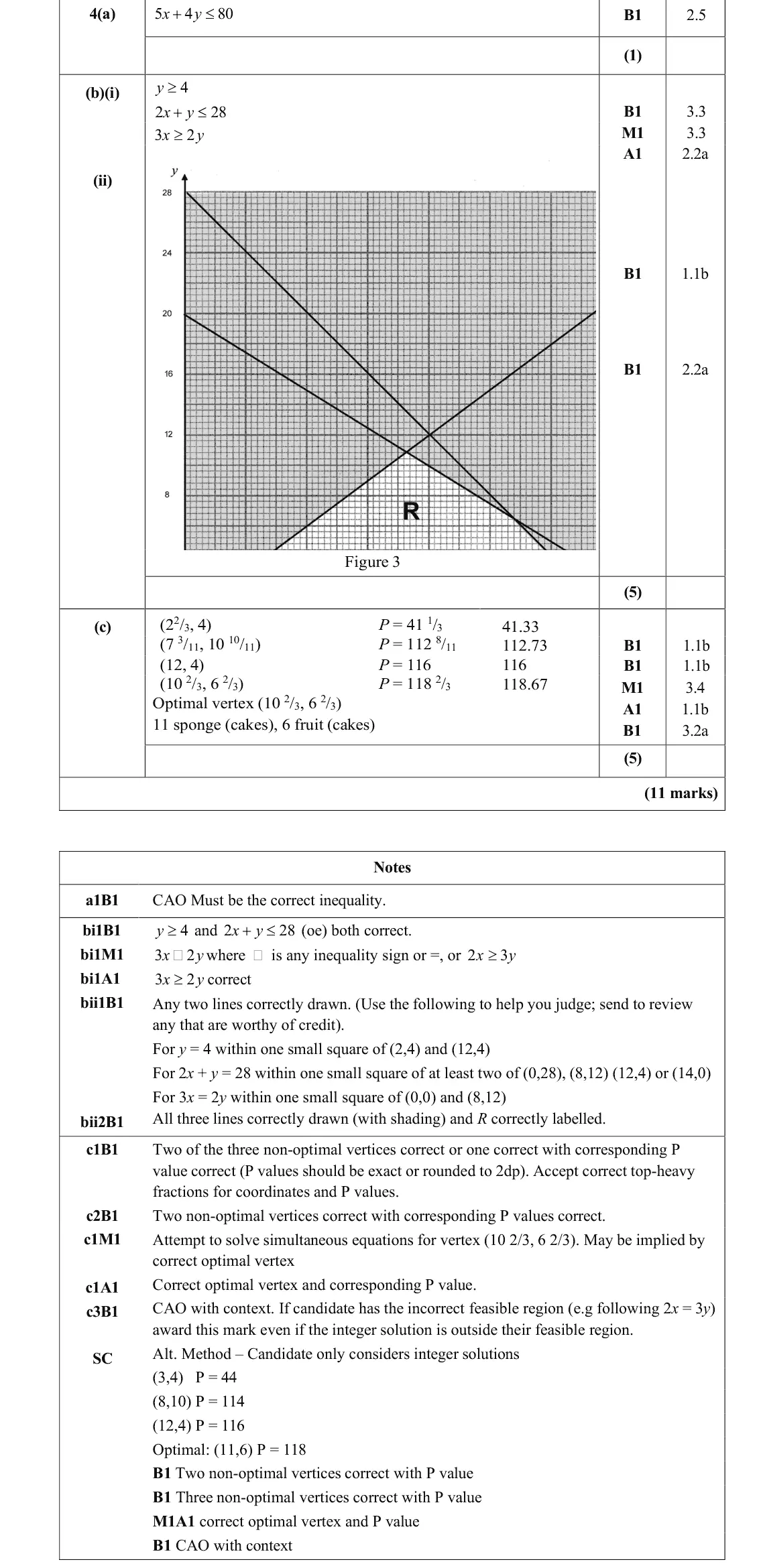
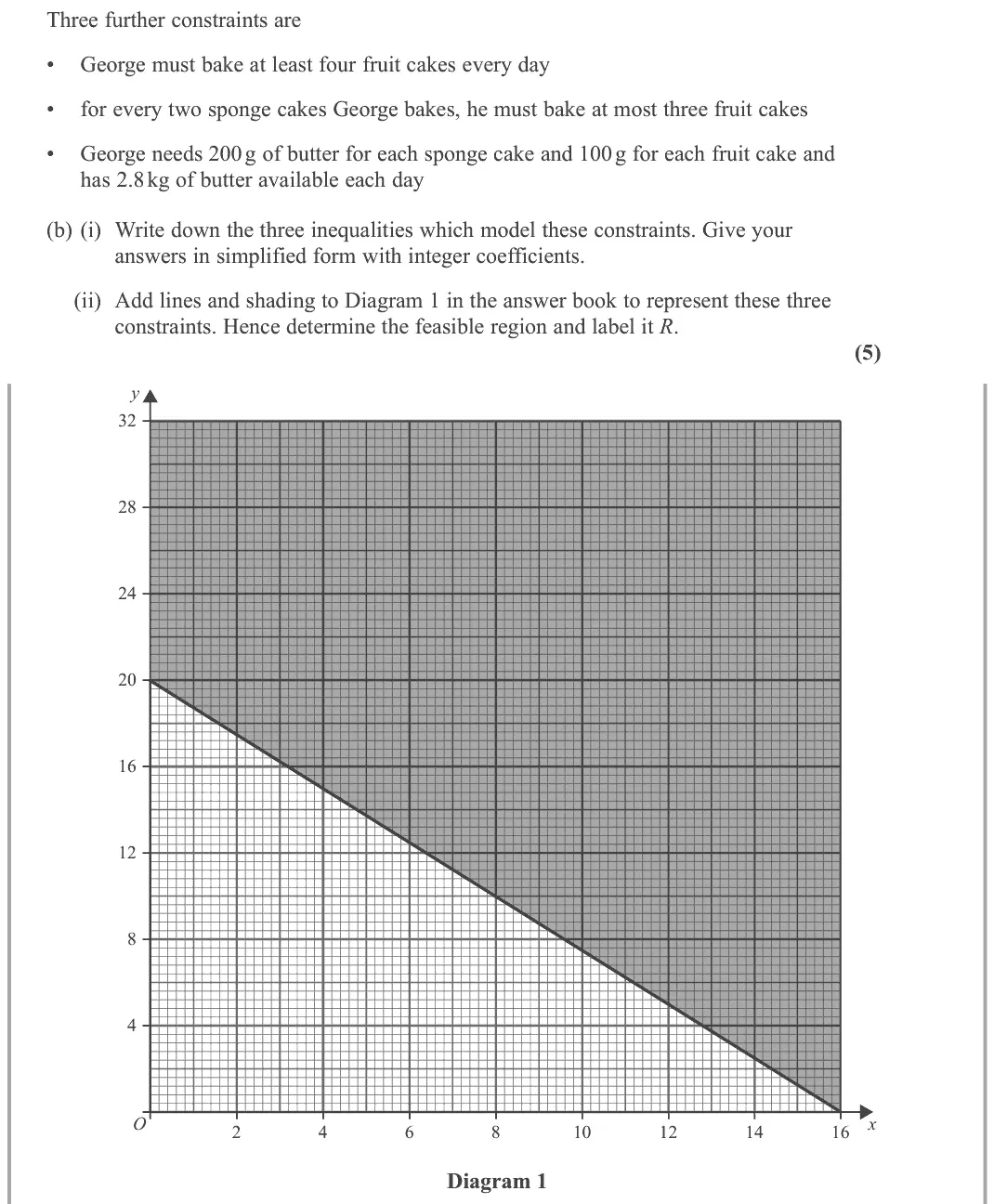
June 2025 · AS Paper 2 (Decision 1) · Q4(b)5 marks
Mark scheme (whole question; this part is marked with the orange bar)
Examiner's comment
this could still score well, but if errors had been made in (b) it was common to see lots of incorrect working leading to only one mark in part (c), most commonly from testing (12,4)
Key points from the mark scheme and examiner's report
y ≥ 4, 2x + y ≤ 28, 3x ≥ 2y (this one most often wrong, every arrangement seen)
draw lines, shade out and label R
June 2025 · AS Paper 2 (Decision 1) · Q4(c)5 marks
Mark scheme (whole question; this part is marked with the orange bar)
Examiner's comment
incorrect working leading to only one mark in part (c), most commonly from testing (12,4) and achieving P=116. Those who did test all the vertices by solving the equations found the coordinates, but many failed to calculate P with at least 2d.p. of accuracy or at all. Some learners correctly identified the region but assumed it was triangular and only looked for three vertices. Many learners gave a detailed attempt at multiple points; however they reached a final incorrect answer of 10 or 11 sponge cakes with 7 fruit cakes. The final mark was surprisingly accessible, with some learners achieving the correct values despite errors in their inequalities or their graphs. Those that found the optimal vertex generally concluded the correct number of cakes in context.
Key points from the mark scheme and examiner's report
test all four vertices (2⅔, 4), (7 3/11, 10 10/11), (12, 4), (10⅔, 6⅔): optimum P = 118⅔ at (10⅔, 6⅔)
integer answer 11 sponge and 6 fruit cakes
some assumed a triangular region or answered 10 or 11 sponge with 7 fruit
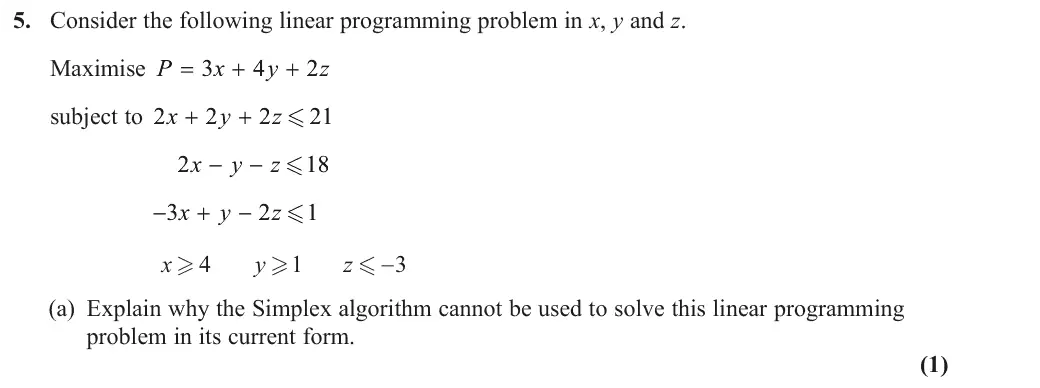
June 2025 · Paper 3D (Decision 1) · Q5(a)1 mark
Mark scheme (whole question; this part is marked with the orange bar)
Examiner's comment
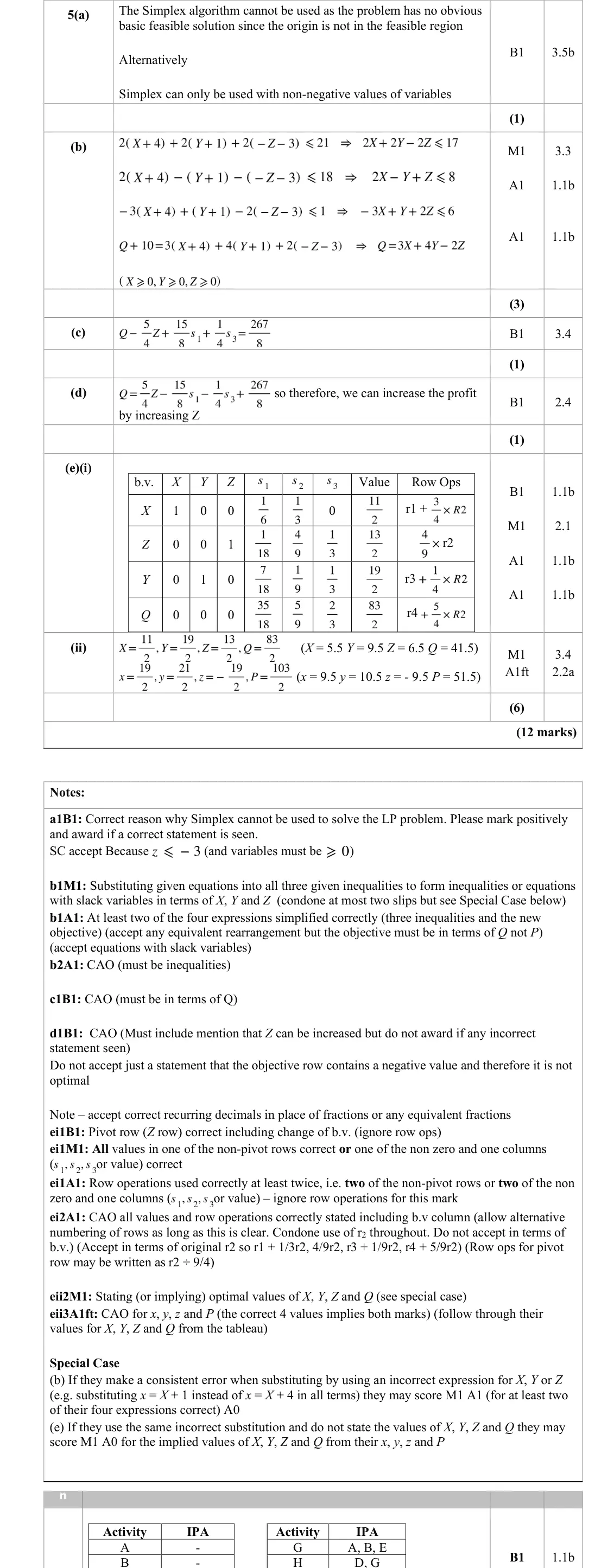
Part (a) was generously marked and candidates earned the mark here for any indication that the origin was not a feasible solution. This was rarely explicitly stated by candidates, but often candidates were along the right track with statements such as ‘the inequalities for x, y and z should be > 0’ or even ‘because z < -3’ which was accepted here.
Key points from the mark scheme and examiner's report
x ≥ 4, y ≥ 1, z ≤ −3 mean the origin is not feasible (Simplex needs non-negative variables and the origin as a starting solution)
June 2025 · Paper 3D (Decision 1) · Q5(b)3 marks
Mark scheme (whole question; this part is marked with the orange bar)
Examiner's comment
Part (b) was well-attempted by most candidates. Those who gave equations with slack variables rather than inequalities were only penalised with one mark and this was seen in perhaps approximately 50% of responses. In other cases, marks were usually lost for forgetting to transform the objective function in terms of Q, or for algebraic slips made in the simplification of the substitutions.
Key points from the mark scheme and examiner's report
2X + 2Y − 2Z ≤ 17, 2X − Y + Z ≤ 8, −3X + Y + 2Z ≤ 6
maximise Q = 3X + 4Y − 2Z
X, Y, Z ≥ 0
give inequalities, not equations
objective must be in Q
June 2025 · Paper 3D (Decision 1) · Q5(c)1 mark
Mark scheme (whole question; this part is marked with the orange bar)
Examiner's comment
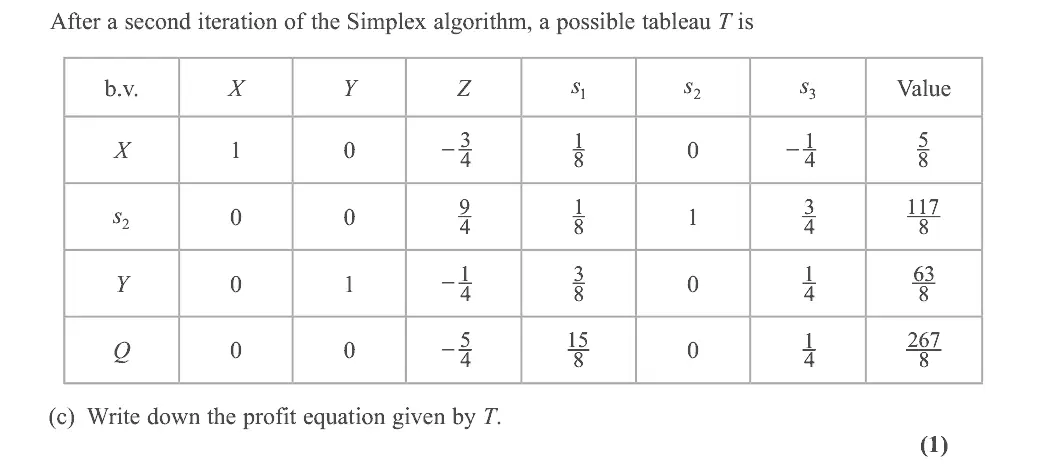
Part (c) was not as well answered, and many candidates were unable to successfully extract the profit equation from the tableau. Often there were sign errors or a missing ‘Q’, or indeed no attempt made.
Key points from the mark scheme and examiner's report
Q − (5/4)Z + (15/8)s₁ + (1/4)s₃ = 267/8
sign errors and missing Q common
June 2025 · Paper 3D (Decision 1) · Q5(d)1 mark
Mark scheme (whole question; this part is marked with the orange bar)
Examiner's comment
Part (d) was also challenging for most candidates. Overwhelmingly, candidates referred to ‘a negative in the profit row’ or stated that ‘Z is negative’ and some others stated that ‘increasing Z will decrease profit so not optimal’. It was rare to see a correct response given.
Key points from the mark scheme and examiner's report
Q = 267/8 + (5/4)Z − …, so increasing Z increases Q
"negative in the profit row" or "Z is negative" scored 0
June 2025 · Paper 3D (Decision 1) · Q5(e)6 marks
Mark scheme (whole question; this part is marked with the orange bar)
Examiner's comment
The tableau in part (e) was generally well attempted. There were some blank tableaux seen but, in most cases, candidates were able to at least complete the pivot row correctly. There were some numerical errors seen and occasional issues with the statement of row operations (but this seemed greatly improved on previous series). From time to time the bottom row of the tableau was missing and it is unclear whether this was due to a lack of understanding or a lack of time. In (e)(ii) candidates were asked to find the optimum value of P and the corresponding values of x, y, z. In most cases candidates were able to read off values for Q, X, Y and Z correctly from the tableau and only very rarely were e.g. X = Y = Z = 0 seen (taken from the bottom row). Occasionally however, candidates forgot that the tableau was in terms of X, Y, Z and Q rather than x, y, z and P and so lost marks for stating e.g. P = 83/2. Others made mistakes making the simple transformations of values from the tableau back into values for x, y, and z and sometimes one or more of the values were omitted which lost both marks here. Either decimal or fraction form was accepted here, and both were equally seen and equally accurate.
Key points from the mark scheme and examiner's report
pivot 9/4 in the s₂ row (Z column)
row operations stated
X = 11/2, Y = 19/2, Z = 13/2, Q = 83/2, so x = 9.5, y = 10.5, z = −9.5, P = 51.5
convert back to x, y, z and P
June 2025 · Paper 3D (Decision 1) · Q7(a)7 marks
Mark scheme (whole question; this part is marked with the orange bar)
Examiner's comment
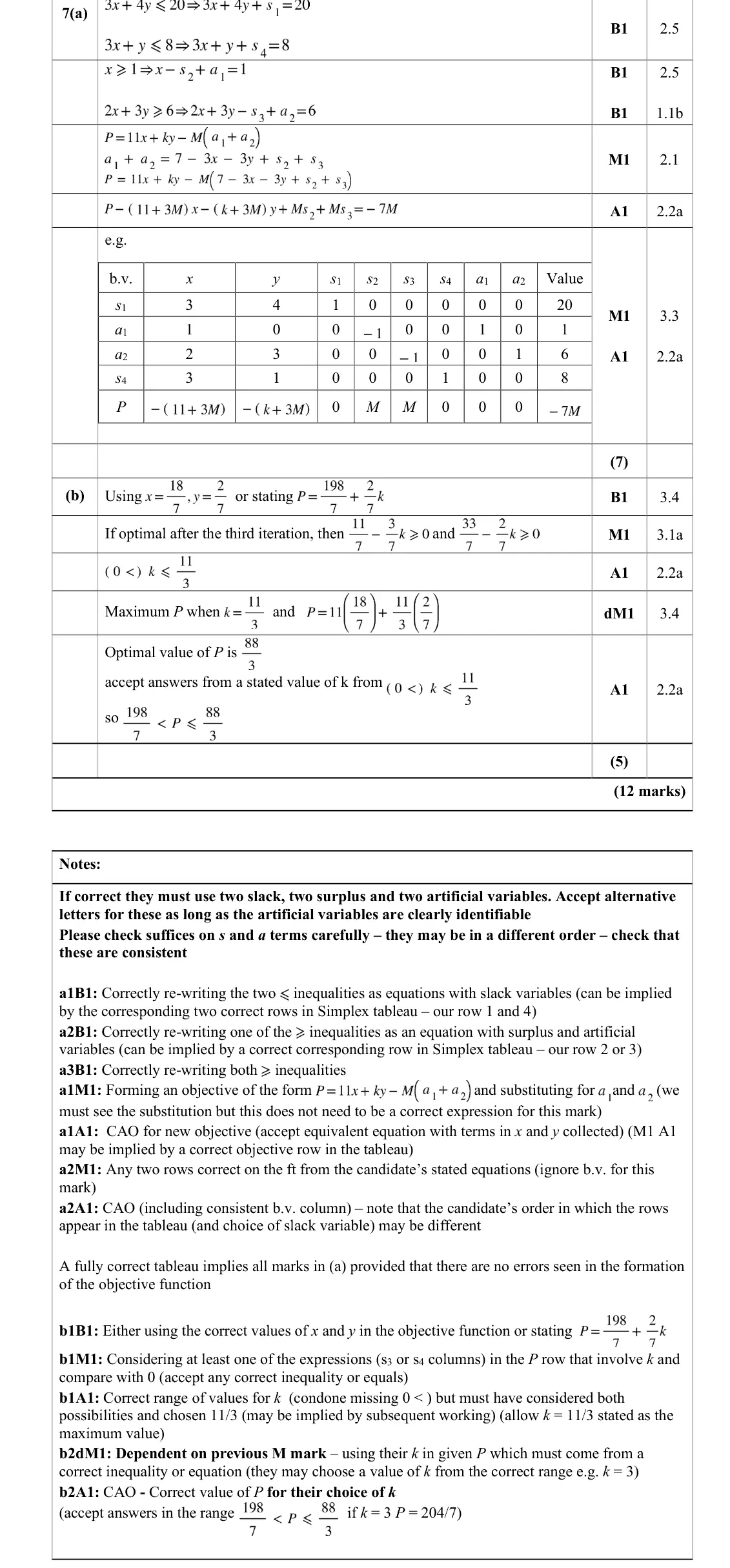
In part (a) the majority of candidates attempted to set up the initial tableau, mostly with reasonable success. Some marks were lost owing to (minor) slips in translating from their equations to the tableau. A small number of candidates confused which equations needed slack variables versus which needed surplus and artificial variables. A small number of candidates added surplus variables and subtracted artificial variables, rather than the reverse. Most understood the process of employing big-M, with occasional slips in gathering terms leading to an incorrect objective function, although some did not form an objective function of the right format. Populating the table correctly was achieved by many candidates – with errors in correct identification of basic variables in each row indicated perhaps a lack of depth of understanding of the overall approach and what the simplex tableau is achieving.
Key points from the mark scheme and examiner's report
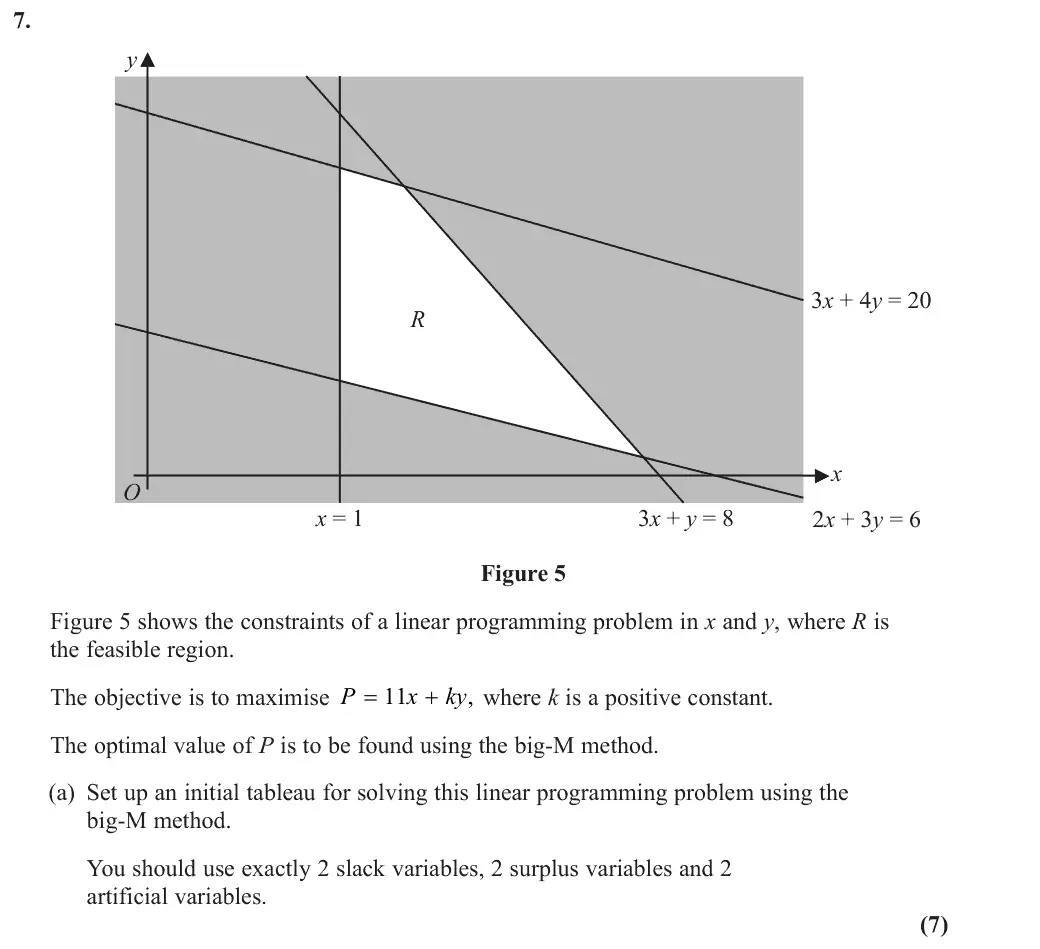
read constraints from Figure 5: 3x + 4y ≤ 20, 3x + y ≤ 8 (slacks), x ≥ 1, 2x + 3y ≥ 6 (surplus and artificial)
P = 11x + ky − M(a₁ + a₂) with a₁ + a₂ = 7 − 3x − 3y + s₂ + s₃
P row −(11 + 3M), −(k + 3M), …, −7M
June 2025 · Paper 3D (Decision 1) · Q7(b)5 marks
Mark scheme (whole question; this part is marked with the orange bar)
Examiner's comment
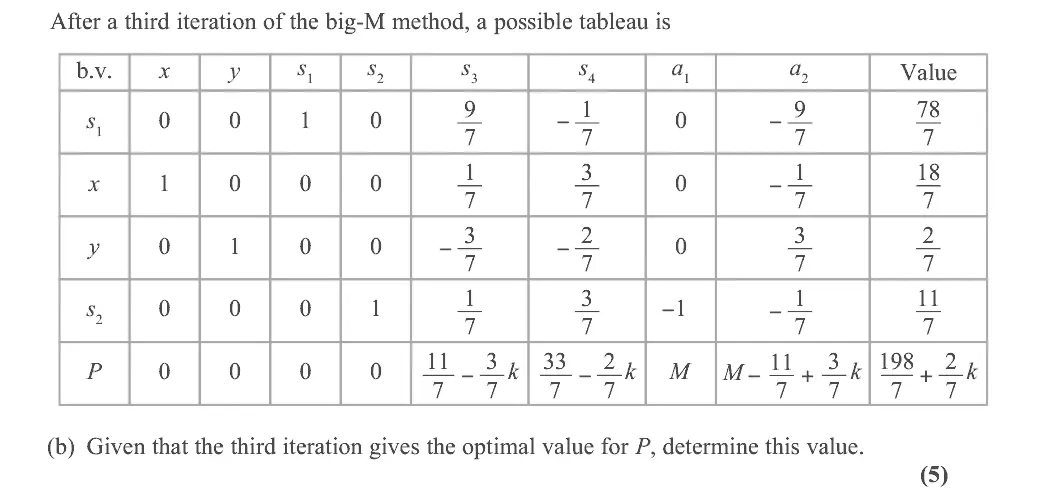
Part (b) was less well answered. A good number of candidates did score full marks, or just lost one mark, if they did not show consideration of both inequalities. Most arrived at the equation for P and scored the first mark, and some wrote at least one correct inequality. If they used a correct inequality, candidates generally chose k = 11/3 as their value of k to substitute into their equation, meaning if a value for P was found it was often 88/3. Some considered both inequalities but then chose the wrong range, using k = 16.5. A small number of candidates used the expression from the a2 column to form an inequality, which was incorrect. Some candidates decided that k needed to be an integer and typically chose k = 3 as the greatest integer less than 11/3. This could score full marks, as could the very small number of candidates who stated a range of possible values for P. Several candidates decided to use the original graph to answer this part of the question instead of the simplex tableau. Although this was a valid approach, it involved significant additional work and generally restricted the candidate to a maximum of 4 out of 5 marks as they only compared one vertex with the optimal point. Candidates should be reminded that questions are designed to be answered from the information provided, which in this case was the simplex tableau.
Key points from the mark scheme and examiner's report
P = 198/7 + 2k/7 at x = 18/7, y = 2/7
optimal needs 11/7 − 3k/7 ≥ 0 and 33/7 − 2k/7 ≥ 0, so k ≤ 11/3 and P = 88/3 at k = 11/3
consider both inequalities (16.5 chosen wrongly by some)
June 2024 · AS Paper 2 (Decision 1) · Q4(a)3 marks
Mark scheme (whole question; this part is marked with the orange bar)
Examiner's comment
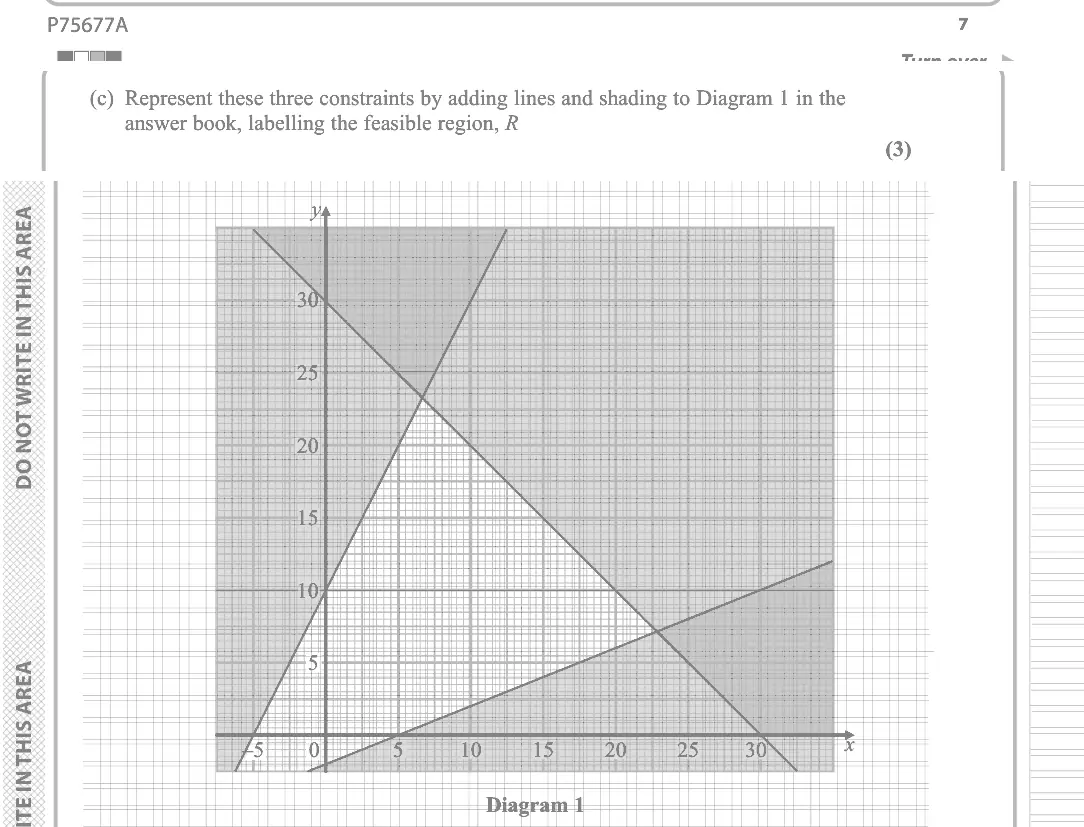
This question highlighted just how challenging many students find it to accurately use and understand inequalities in terms of shading regions. There may have also been an issue with time management with many incomplete or even blank responses. A majority of students in part a) understood how to find the line equations correctly but slipped up on one or more inequalities. Most achieved at least two of the required inequalities, however the equation 5y=2x-10 tended to be the one causing loss of the final mark, either due to poor multiplying from a fractional gradient or failing to multiply out to get integer coefficients. A not insignificant number of candidates stated all three inequalities the incorrect way around, however scored a generous M mark through the special case. Part b) saw a range of responses, with some candidates incorrectly confusing multiplication (e.g. y = 10x) and addition (y = x + 5 e.g.), whilst others continued to struggle with the inequalities, and many inverted the relationship between the stated x and y (e.g. y = x + 10 and x = 5y). The frequent errors in part b) led to further issues with candidates in part c) drawing an array of lines; scores of M1A1ftA0 were frequent as the MS generously allowed the ft on their erroneous lines if a line of gradients 1, 5 or 1/5 were seen. Line drawing and shading inequalities caused significant difficult for a large proportion of candidates. Drawing y =1 first, seemed to cause a lot of confusion between the line and the axis, although there were many x=1 lines drawn, even when the other diagonal lines were drawn correctly. It should be noted that a significant number of candidates either didn’t shade at all or shaded on the wrong side of the line. Some shading was difficult to follow, and general accuracy levels and clarity on the diagram was poor with many candidates failing to label the feasible region. It was also disheartening to see a number of candidates attempt to indicate a region already shaded out by the examiner as invalid. Part di) enforced the requirement for candidates to demonstrate their methods fully, and as such a large number of candidates scored zero despite their work indicating they may have identified the optimal vertex. A significant number of candidates did not know to (or chose not to) draw an OL on their graph to demonstrate the method. Of those who did, some drew the reciprocal so were only able to score one mark, and of those who got the correct objective line, many went on to find the correct optimal point. In part dii), very few candidates scored the final two marks, as tables of integer points and inequality testing were rarely seen. Those that did mostly identified the correct point, but then failed to calculate the total to achieve the final mark. Very few full mark responses were seen. A good number of candidates actually identified the optimal solution/value but without demonstrating how they had reached their integer solution. A number of candidates gave solutions outside the range, whilst others erroneously thought an integer solution just involved rounding their x, y and/or value obtained. Some candidates gave non-integer values, not appreciating the context of the question in this part.
Key points from the mark scheme and examiner's report
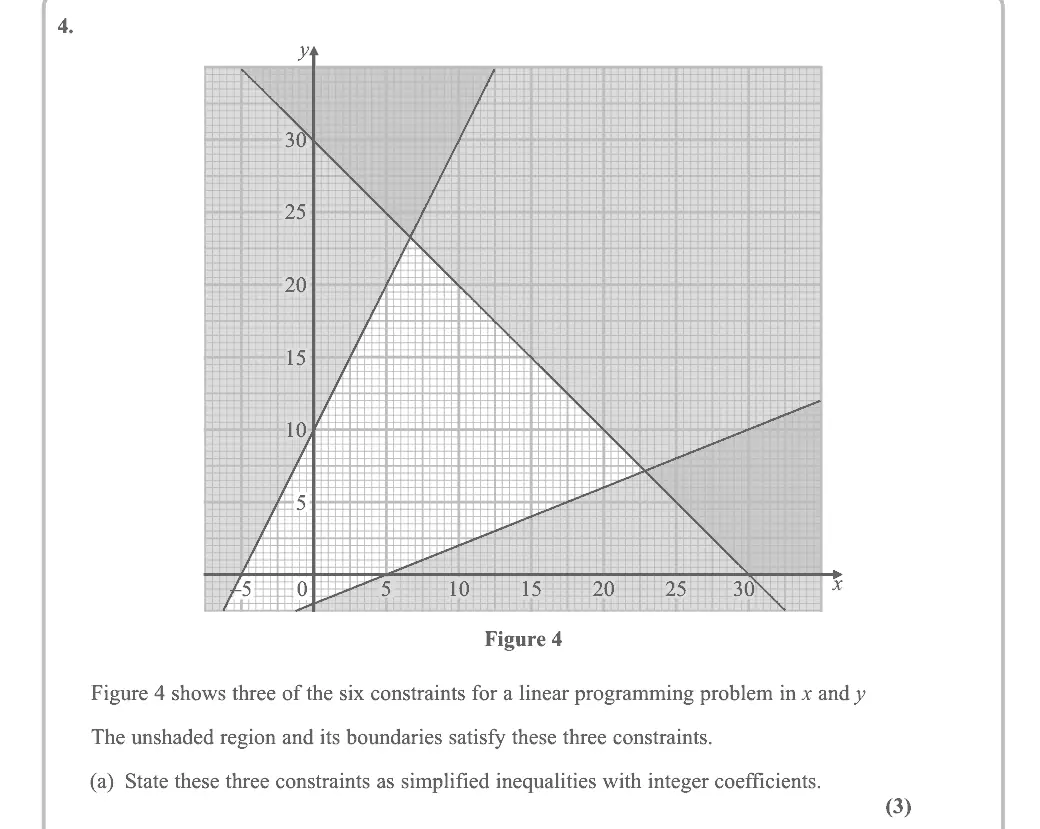
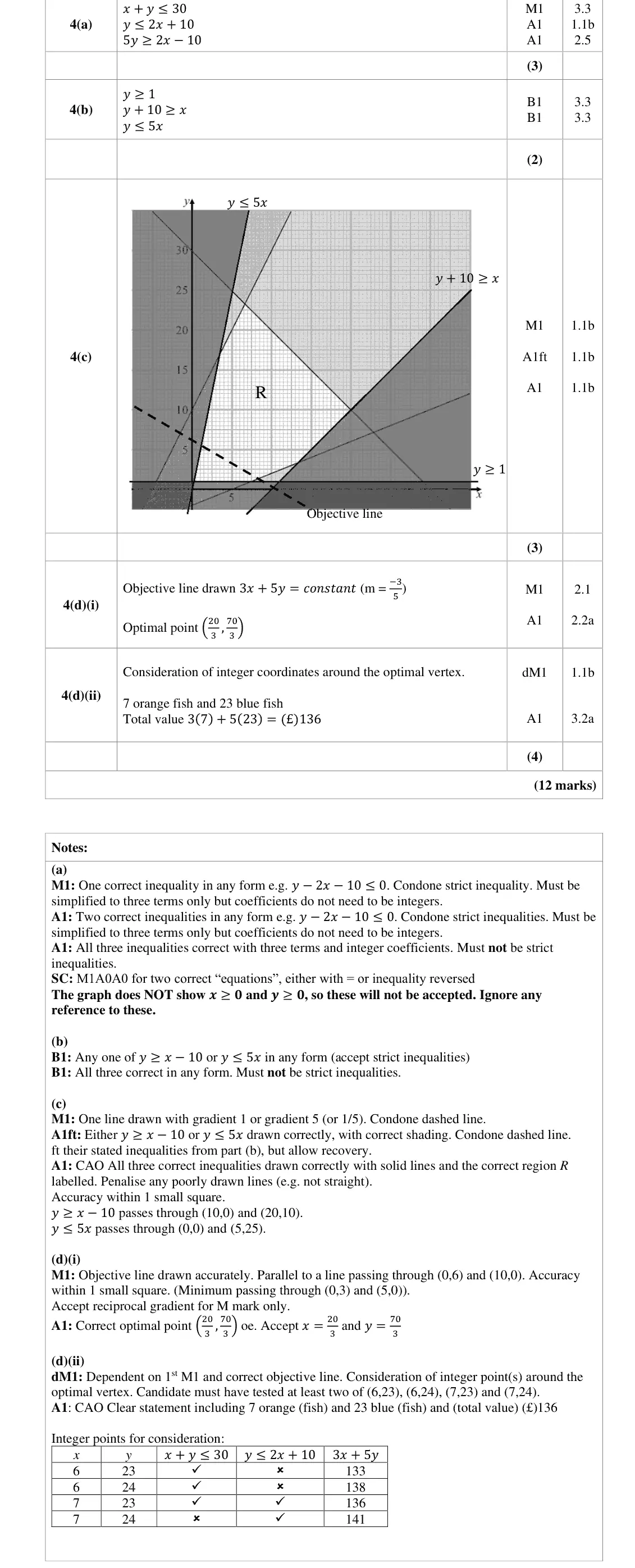
x + y ≤ 30, y ≤ 2x + 10, 5y ≥ 2x − 10
integer coefficients and non-strict
the 5y = 2x − 10 line caused most errors
x, y ≥ 0 not shown so not accepted
June 2024 · AS Paper 2 (Decision 1) · Q4(b)2 marks
Mark scheme (whole question; this part is marked with the orange bar)
Examiner's comment
This question highlighted just how challenging many students find it to accurately use and understand inequalities in terms of shading regions. There may have also been an issue with time management with many incomplete or even blank responses. A majority of students in part a) understood how to find the line equations correctly but slipped up on one or more inequalities. Most achieved at least two of the required inequalities, however the equation 5y=2x-10 tended to be the one causing loss of the final mark, either due to poor multiplying from a fractional gradient or failing to multiply out to get integer coefficients. A not insignificant number of candidates stated all three inequalities the incorrect way around, however scored a generous M mark through the special case. Part b) saw a range of responses, with some candidates incorrectly confusing multiplication (e.g. y = 10x) and addition (y = x + 5 e.g.), whilst others continued to struggle with the inequalities, and many inverted the relationship between the stated x and y (e.g. y = x + 10 and x = 5y). The frequent errors in part b) led to further issues with candidates in part c) drawing an array of lines; scores of M1A1ftA0 were frequent as the MS generously allowed the ft on their erroneous lines if a line of gradients 1, 5 or 1/5 were seen. Line drawing and shading inequalities caused significant difficult for a large proportion of candidates. Drawing y =1 first, seemed to cause a lot of confusion between the line and the axis, although there were many x=1 lines drawn, even when the other diagonal lines were drawn correctly. It should be noted that a significant number of candidates either didn’t shade at all or shaded on the wrong side of the line. Some shading was difficult to follow, and general accuracy levels and clarity on the diagram was poor with many candidates failing to label the feasible region. It was also disheartening to see a number of candidates attempt to indicate a region already shaded out by the examiner as invalid. Part di) enforced the requirement for candidates to demonstrate their methods fully, and as such a large number of candidates scored zero despite their work indicating they may have identified the optimal vertex. A significant number of candidates did not know to (or chose not to) draw an OL on their graph to demonstrate the method. Of those who did, some drew the reciprocal so were only able to score one mark, and of those who got the correct objective line, many went on to find the correct optimal point. In part dii), very few candidates scored the final two marks, as tables of integer points and inequality testing were rarely seen. Those that did mostly identified the correct point, but then failed to calculate the total to achieve the final mark. Very few full mark responses were seen. A good number of candidates actually identified the optimal solution/value but without demonstrating how they had reached their integer solution. A number of candidates gave solutions outside the range, whilst others erroneously thought an integer solution just involved rounding their x, y and/or value obtained. Some candidates gave non-integer values, not appreciating the context of the question in this part.
Key points from the mark scheme and examiner's report
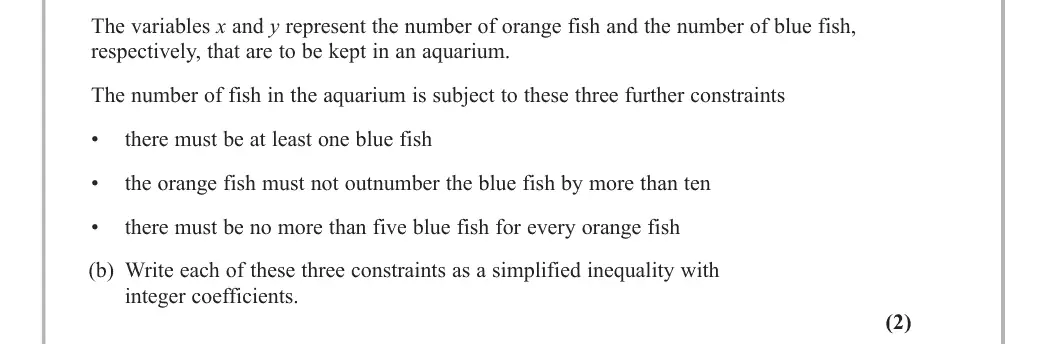
y ≥ 1, y + 10 ≥ x, y ≤ 5x
common errors y = 10x, y ≥ x + 10, x ≤ 5y (variables inverted)
June 2024 · AS Paper 2 (Decision 1) · Q4(c)3 marks
Mark scheme (whole question; this part is marked with the orange bar)
Examiner's comment
This question highlighted just how challenging many students find it to accurately use and understand inequalities in terms of shading regions. There may have also been an issue with time management with many incomplete or even blank responses. A majority of students in part a) understood how to find the line equations correctly but slipped up on one or more inequalities. Most achieved at least two of the required inequalities, however the equation 5y=2x-10 tended to be the one causing loss of the final mark, either due to poor multiplying from a fractional gradient or failing to multiply out to get integer coefficients. A not insignificant number of candidates stated all three inequalities the incorrect way around, however scored a generous M mark through the special case. Part b) saw a range of responses, with some candidates incorrectly confusing multiplication (e.g. y = 10x) and addition (y = x + 5 e.g.), whilst others continued to struggle with the inequalities, and many inverted the relationship between the stated x and y (e.g. y = x + 10 and x = 5y). The frequent errors in part b) led to further issues with candidates in part c) drawing an array of lines; scores of M1A1ftA0 were frequent as the MS generously allowed the ft on their erroneous lines if a line of gradients 1, 5 or 1/5 were seen. Line drawing and shading inequalities caused significant difficult for a large proportion of candidates. Drawing y =1 first, seemed to cause a lot of confusion between the line and the axis, although there were many x=1 lines drawn, even when the other diagonal lines were drawn correctly. It should be noted that a significant number of candidates either didn’t shade at all or shaded on the wrong side of the line. Some shading was difficult to follow, and general accuracy levels and clarity on the diagram was poor with many candidates failing to label the feasible region. It was also disheartening to see a number of candidates attempt to indicate a region already shaded out by the examiner as invalid. Part di) enforced the requirement for candidates to demonstrate their methods fully, and as such a large number of candidates scored zero despite their work indicating they may have identified the optimal vertex. A significant number of candidates did not know to (or chose not to) draw an OL on their graph to demonstrate the method. Of those who did, some drew the reciprocal so were only able to score one mark, and of those who got the correct objective line, many went on to find the correct optimal point. In part dii), very few candidates scored the final two marks, as tables of integer points and inequality testing were rarely seen. Those that did mostly identified the correct point, but then failed to calculate the total to achieve the final mark. Very few full mark responses were seen. A good number of candidates actually identified the optimal solution/value but without demonstrating how they had reached their integer solution. A number of candidates gave solutions outside the range, whilst others erroneously thought an integer solution just involved rounding their x, y and/or value obtained. Some candidates gave non-integer values, not appreciating the context of the question in this part.
Key points from the mark scheme and examiner's report
draw y = 1, y = x − 10 and y = 5x accurately, shade the unwanted side and label R
many did not shade or shaded the wrong side
June 2024 · AS Paper 2 (Decision 1) · Q4(d)4 marks
Mark scheme (whole question; this part is marked with the orange bar)
Examiner's comment
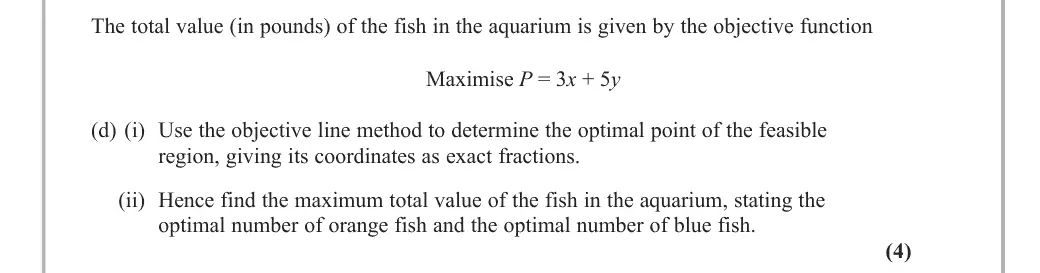
This question highlighted just how challenging many students find it to accurately use and understand inequalities in terms of shading regions. There may have also been an issue with time management with many incomplete or even blank responses. A majority of students in part a) understood how to find the line equations correctly but slipped up on one or more inequalities. Most achieved at least two of the required inequalities, however the equation 5y=2x-10 tended to be the one causing loss of the final mark, either due to poor multiplying from a fractional gradient or failing to multiply out to get integer coefficients. A not insignificant number of candidates stated all three inequalities the incorrect way around, however scored a generous M mark through the special case. Part b) saw a range of responses, with some candidates incorrectly confusing multiplication (e.g. y = 10x) and addition (y = x + 5 e.g.), whilst others continued to struggle with the inequalities, and many inverted the relationship between the stated x and y (e.g. y = x + 10 and x = 5y). The frequent errors in part b) led to further issues with candidates in part c) drawing an array of lines; scores of M1A1ftA0 were frequent as the MS generously allowed the ft on their erroneous lines if a line of gradients 1, 5 or 1/5 were seen. Line drawing and shading inequalities caused significant difficult for a large proportion of candidates. Drawing y =1 first, seemed to cause a lot of confusion between the line and the axis, although there were many x=1 lines drawn, even when the other diagonal lines were drawn correctly. It should be noted that a significant number of candidates either didn’t shade at all or shaded on the wrong side of the line. Some shading was difficult to follow, and general accuracy levels and clarity on the diagram was poor with many candidates failing to label the feasible region. It was also disheartening to see a number of candidates attempt to indicate a region already shaded out by the examiner as invalid. Part di) enforced the requirement for candidates to demonstrate their methods fully, and as such a large number of candidates scored zero despite their work indicating they may have identified the optimal vertex. A significant number of candidates did not know to (or chose not to) draw an OL on their graph to demonstrate the method. Of those who did, some drew the reciprocal so were only able to score one mark, and of those who got the correct objective line, many went on to find the correct optimal point. In part dii), very few candidates scored the final two marks, as tables of integer points and inequality testing were rarely seen. Those that did mostly identified the correct point, but then failed to calculate the total to achieve the final mark. Very few full mark responses were seen. A good number of candidates actually identified the optimal solution/value but without demonstrating how they had reached their integer solution. A number of candidates gave solutions outside the range, whilst others erroneously thought an integer solution just involved rounding their x, y and/or value obtained. Some candidates gave non-integer values, not appreciating the context of the question in this part.
Key points from the mark scheme and examiner's report
objective line gradient −3/5 must be drawn
optimal vertex (20/3, 70/3)
test integer points (6, 23), (6, 24), (7, 23), (7, 24): 7 orange and 23 blue fish, £136
few showed integer testing
June 2024 · Paper 3D (Decision 1) · Q5(a)6 marks
Mark scheme (whole question; this part is marked with the orange bar)
Examiner's comment
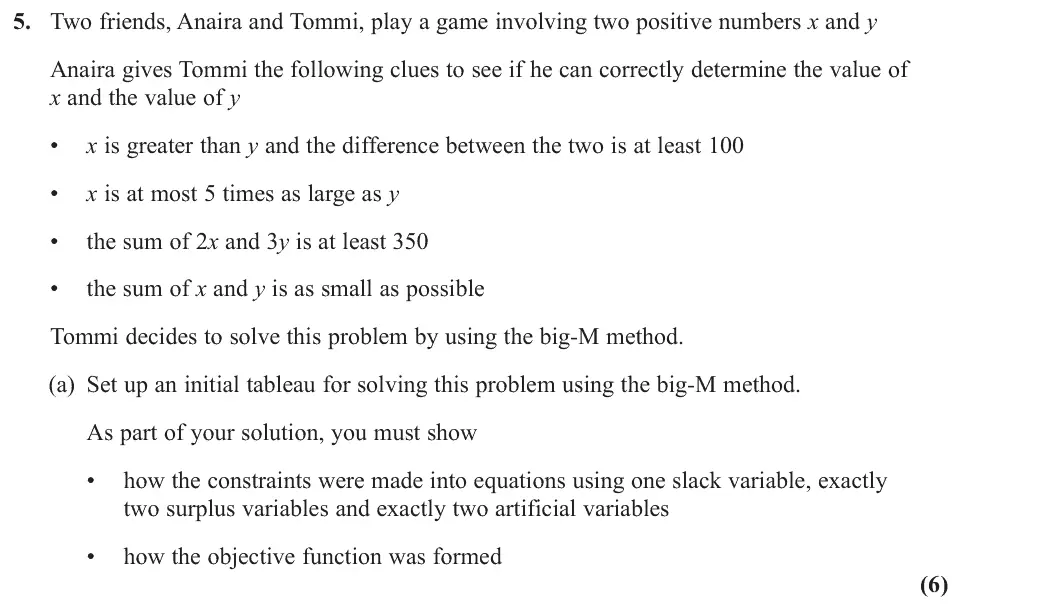
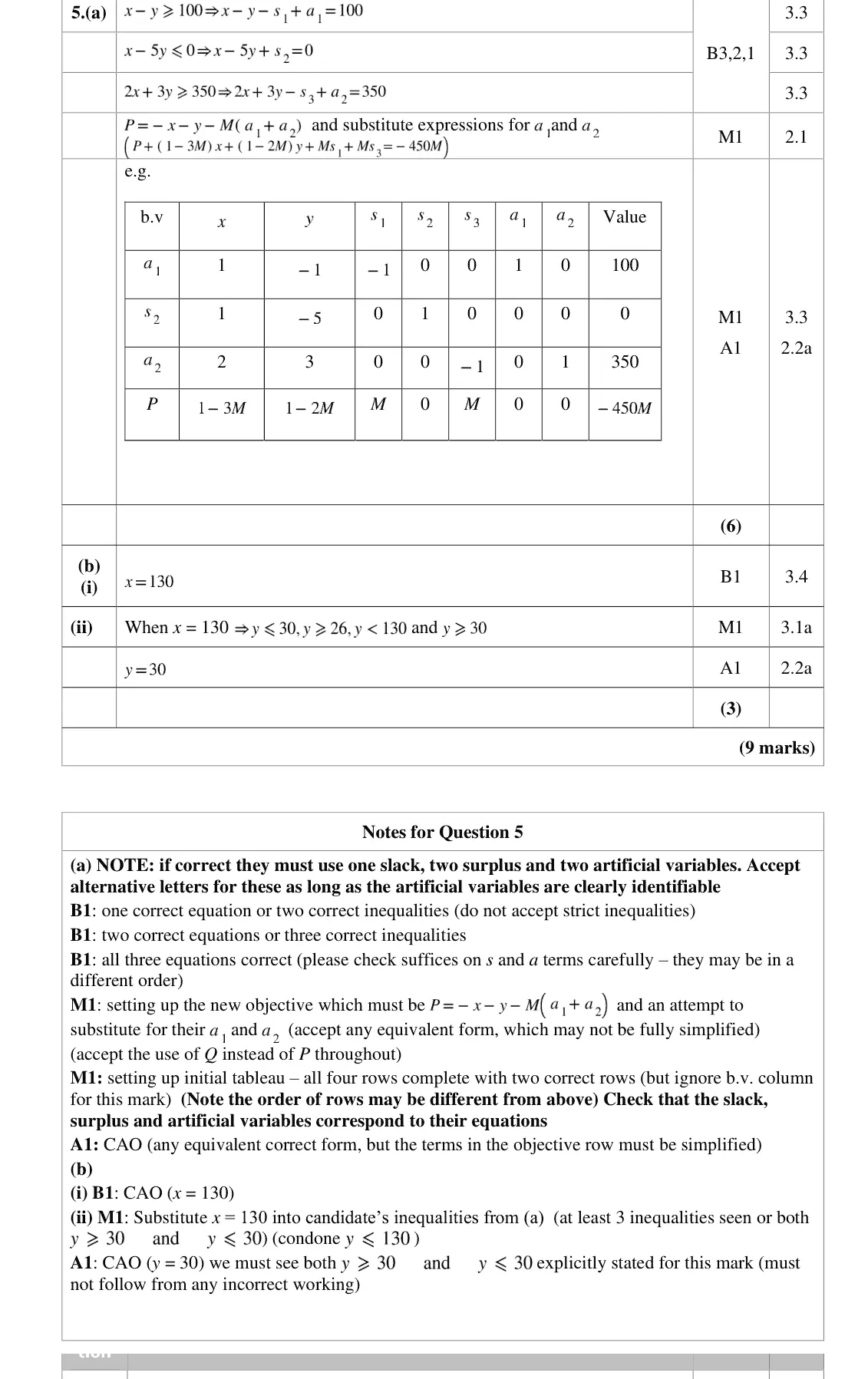
In part (a) many responses demonstrated that candidates understood how to use slack, surplus and artificial variables to construct their constraints successfully. However, there were errors seen in establishing the initial inequalities including a common error in translation of the multiplicative relationship between x and y resulting in rather than Errors in the direction of one or more inequalities were also seen which, of course, impacted on the introduction of the dummy variables. Setting up the new the objective function was the least successful part of the process, with seen frequently. Sign issues were almost usually the barrier here. In fact, many candidates omitted this step completely perhaps highlighting a lack of understanding for this aspect of the specification. In most cases, candidates could transfer their constraints to the tableau although, again, some issues with signs were seen, as were errors in the basic variable labels.
Key points from the mark scheme and examiner's report
x − y ≥ 100, x ≤ 5y, 2x + 3y ≥ 350
minimise x + y as maximise P = −x − y − M(a₁ + a₂) with a₁, a₂ substituted
P row 1 − 3M, 1 − 2M, M, 0, M, … −450M
x ≤ 5y often written y ≤ 5x
June 2024 · Paper 3D (Decision 1) · Q5(b)3 marks
Mark scheme (whole question; this part is marked with the orange bar)
Examiner's comment
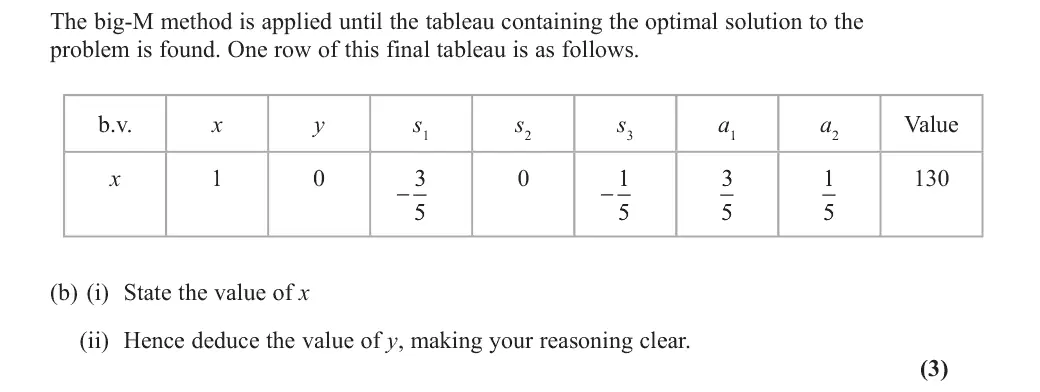
Part (b)(i) was usually correct, and most candidates went on to substitute this into at least one inequality. However, substitution into all three constraint inequalities or the critical two was not always seen and the required processing to obtain was sometimes not achieved. Insufficient reasoning therefore meant that the conclusion was not always fully justified for the award of the final mark. A common incorrect answer was the use of to obtain .
Key points from the mark scheme and examiner's report
x = 130 from the row
substitute into all constraints: y ≤ 30 from x − y ≥ 100 and y ≥ 30 from 2x + 3y ≥ 350, so y = 30
June 2024 · Paper 3D (Decision 1) · Q7(a)2 marks
Mark scheme (whole question; this part is marked with the orange bar)
Examiner's comment
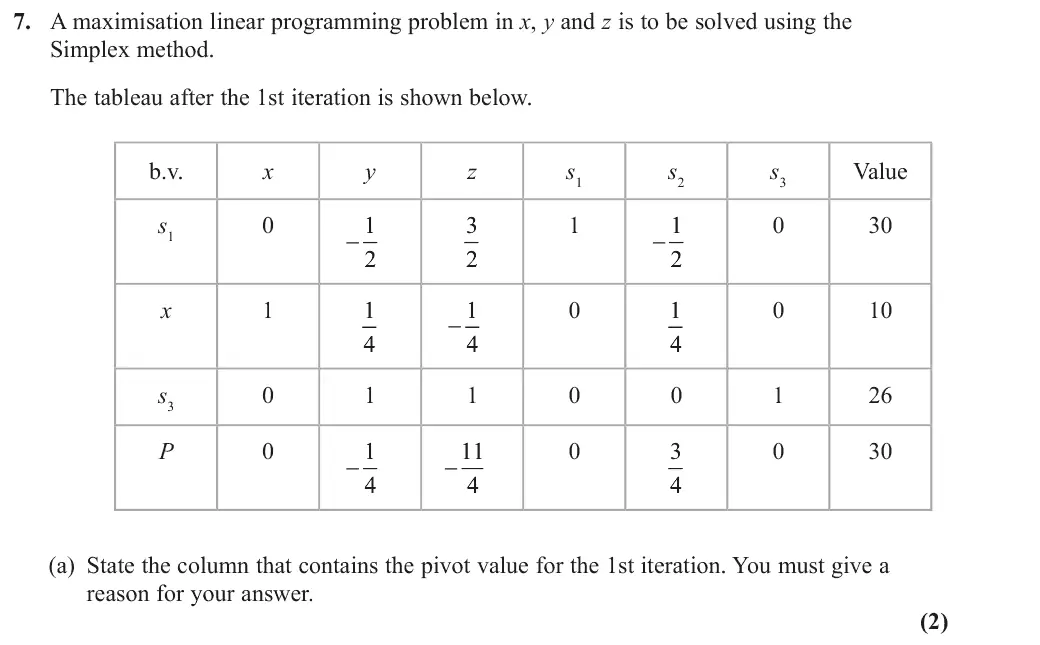
This question was attempted by most candidates, suggesting that they were able to complete the paper in time. Many candidates appeared unsure about parts (a) and (b) but were able to gain marks in the later parts. Part (a) was frequently misunderstood with candidates indicating the next pivot, z, rather than the previous one, x. However, it was encouraging to see a minority of candidates rethinking their answer, crossing out z and restarting with x, perhaps after starting to attempt (b). It was quite common to see candidates state x but have difficulty expressing a correct reason, losing one mark.
Key points from the mark scheme and examiner's report
the x column, as x is now a basic variable (s₂ row replaced by x)
many named z, the next pivot
June 2024 · Paper 3D (Decision 1) · Q7(b)5 marks
Mark scheme (whole question; this part is marked with the orange bar)
Examiner's comment
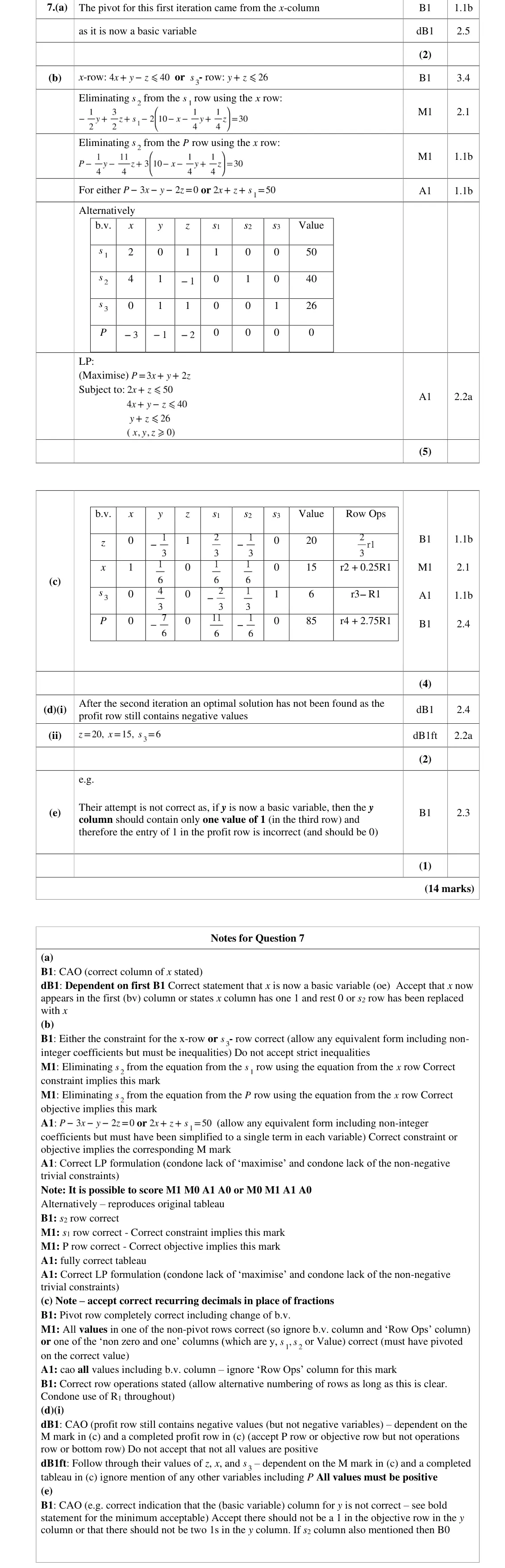
This question was attempted by most candidates, suggesting that they were able to complete the paper in time. Many candidates appeared unsure about parts (a) and (b) but were able to gain marks in the later parts. Part (b) proved to be the most challenging part of the paper. It was evident that many candidates found it difficult, or impossible, to apply their knowledge to work backwards towards the initial tableau. Some recognised how to deduce two constraints, and/or , from the tableau rows involving one slack variable only, gaining just one mark for either. Examiners commented that a remarkable proportion of candidates failed to multiply the RHS of the first constraint, so they often saw “ ”. A pleasing number of candidates were successful though, using one of two possible methods, either reverse row operations or the algebraic approach eliminating s2 from equations for the third constraint and the objective. Some used a hybrid of the two methods but got there in the end.
Key points from the mark scheme and examiner's report
x-row gives 4x + y − z ≤ 40, s₃ row y + z ≤ 26
eliminate s₂ from the s₁ and P rows: 2x + z ≤ 50, maximise P = 3x + y + 2z
hardest part of the paper
June 2024 · Paper 3D (Decision 1) · Q7(c)4 marks
Mark scheme (whole question; this part is marked with the orange bar)
Examiner's comment
This question was attempted by most candidates, suggesting that they were able to complete the paper in time. Many candidates appeared unsure about parts (a) and (b) but were able to gain marks in the later parts. Part (c) was a routine application of the Simplex algorithm, with many candidates able to gain all four marks, or losing just one due to an arithmetic error. Most wrote the row operations correctly though some were not fully expressed and lost a mark, as they had actually used the correct operations. Rather than retaining fractions some candidates expressed numbers as terminating decimals, which meant they lost an accuracy mark.
Key points from the mark scheme and examiner's report
most negative −11/4 in the z column, pivot 3/2 in the s₁ row
row operations r2 + 0.25R1, r3 − R1, r4 + 2.75R1
keep fractions
June 2024 · Paper 3D (Decision 1) · Q7(d)2 marks
Mark scheme (whole question; this part is marked with the orange bar)
Examiner's comment
This question was attempted by most candidates, suggesting that they were able to complete the paper in time. Many candidates appeared unsure about parts (a) and (b) but were able to gain marks in the later parts. In part (d) almost all candidates, who had completed tableau T, recognised the significance of negatives in the profit row and most went on to correctly state the values of the basic variables. The more able just stated the three values required, but those that also stated the value of P and/or the other non-basic variables were not penalised. Some incorrect language was seen here, with candidates just referring to the bottom row and this was penalised.
Key points from the mark scheme and examiner's report
profit row still has a negative entry (−7/6 for y) so not optimal
z = 20, x = 15, s₃ = 6
"bottom row" not accepted
June 2024 · Paper 3D (Decision 1) · Q7(e)1 mark
Mark scheme (whole question; this part is marked with the orange bar)
Examiner's comment
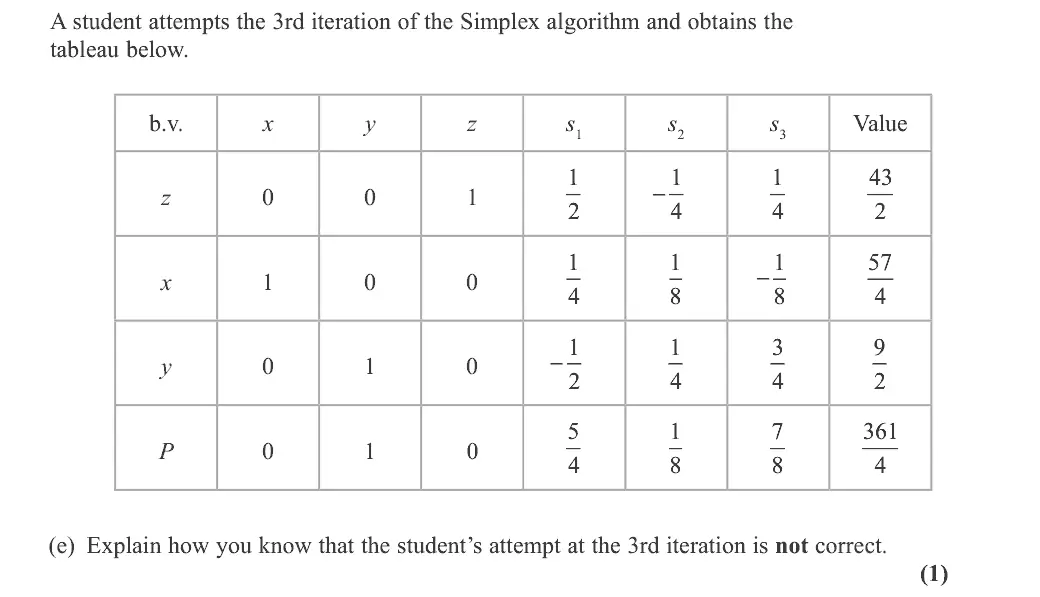
This question was attempted by most candidates, suggesting that they were able to complete the paper in time. Many candidates appeared unsure about parts (a) and (b) but were able to gain marks in the later parts. In part (e) a good proportion of candidates offered an explanation here. Most spotted the error and were able to describe it, some clearly and concisely, other in a rambling fashion.
Key points from the mark scheme and examiner's report
y is basic so its column must be a unit column: the 1 in the profit row should be 0
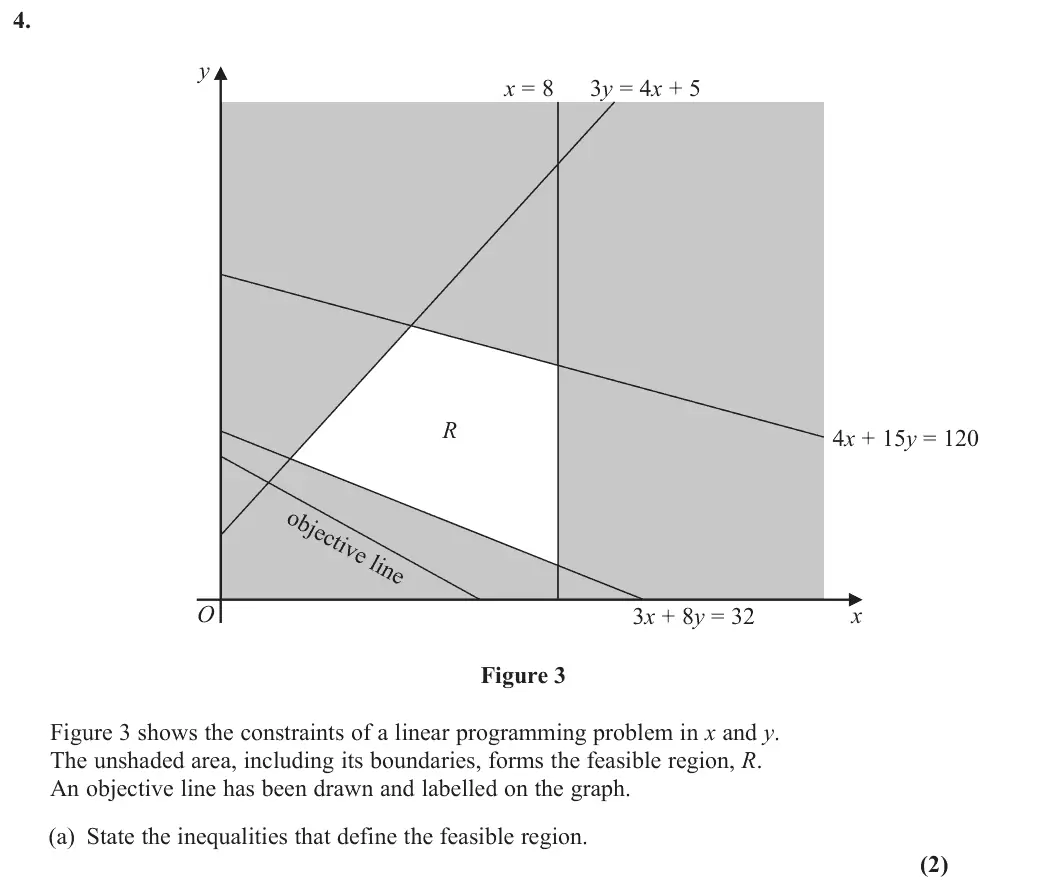
June 2023 · AS Paper 2 (Decision 1) · Q4(a)2 marks
Mark scheme (whole question; this part is marked with the orange bar)
Examiner's comment
In part (a) most candidates scored at least one mark for stating at least two correct inequalities that defined the given feasible region. Even though the stem specifically said that the feasible region included its boundaries several candidates used strict inequalities.
Key points from the mark scheme and examiner's report
x ≤ 8, 3x + 8y ≥ 32, 3y ≤ 4x + 5, 4x + 15y ≤ 120
boundaries included so no strict inequalities
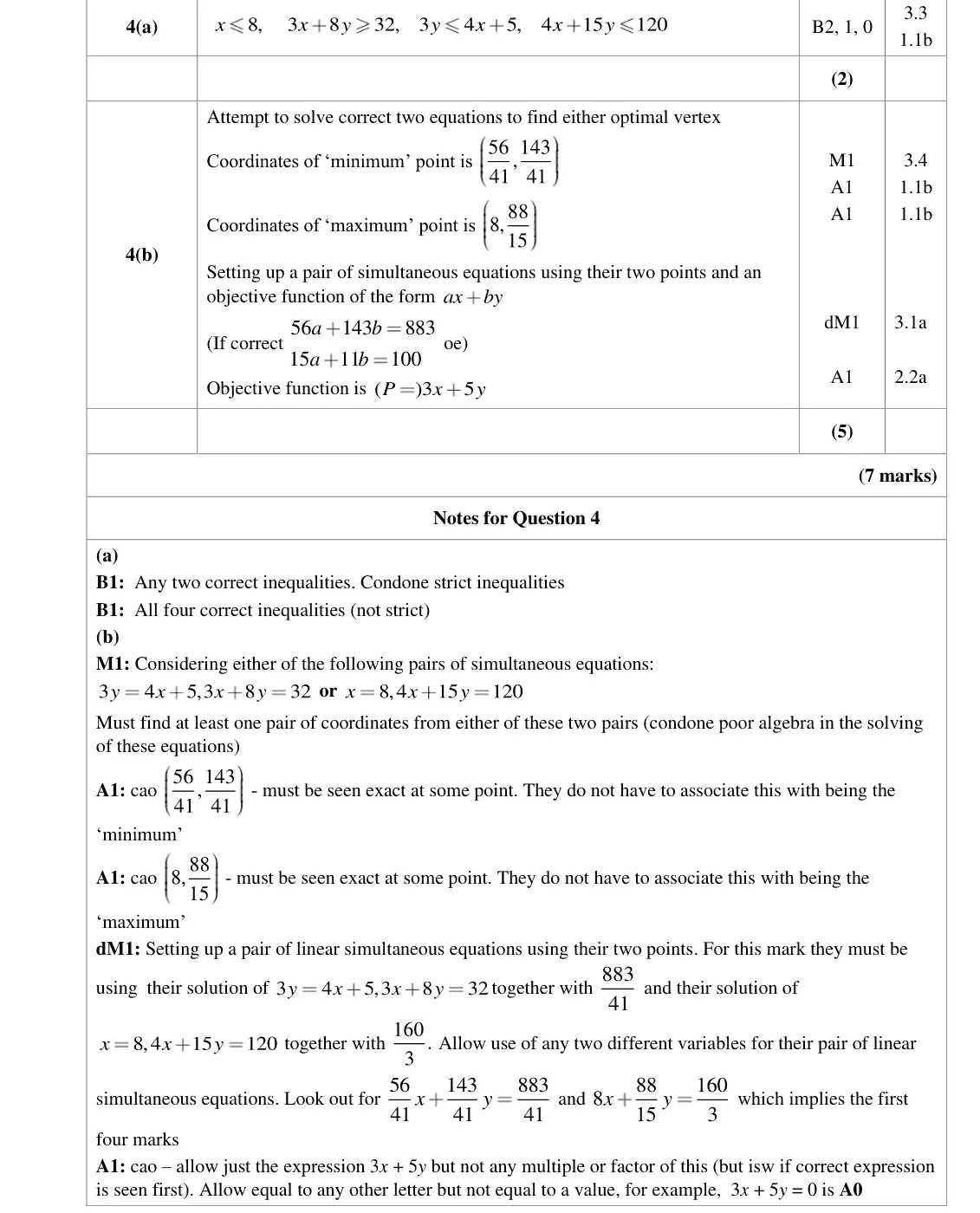
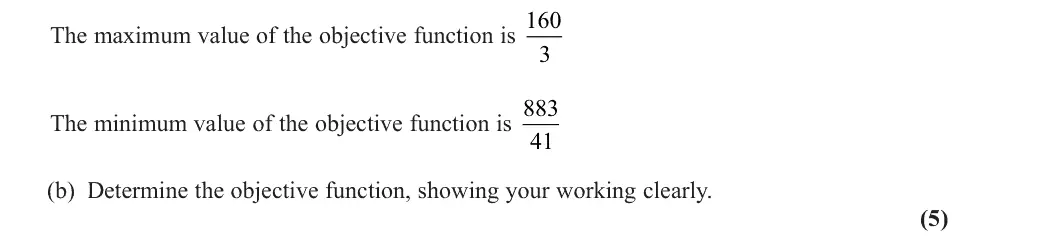
June 2023 · AS Paper 2 (Decision 1) · Q4(b)5 marks
Mark scheme (whole question; this part is marked with the orange bar)
Examiner's comment
A good number of candidates, in part (b), went on to solve the correct pairs of simultaneous equations and found the coordinates of the maximum and minimum vertices (so scoring the first three marks in this part). However, very few used the given values of the objective function (at these two points) to successfully derive the correct linear expression for the objective function.
Key points from the mark scheme and examiner's report
minimum vertex (56/41, 143/41) on the objective-line side, maximum vertex (8, 88/15)
form ax + by equal to 883/41 and 160/3 at these and solve: P = 3x + 5y
few used the two given values
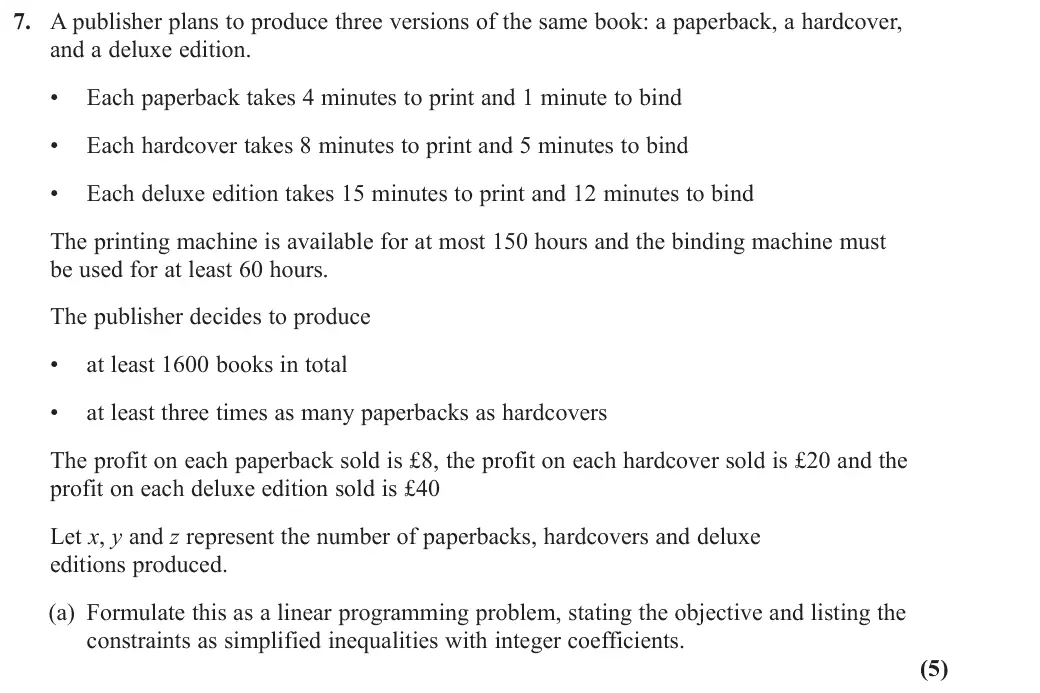
June 2023 · Paper 3D (Decision 1) · Q7(a)5 marks
Mark scheme (whole question; this part is marked with the orange bar)
Examiner's comment
Almost all candidates attempted this question, though it seemed that some ran out of time part way through. Only a few candidates gained full marks. There were several common mistakes occurring in candidates’ responses to part (a). These were: failing to state “maximise” when defining the objective function, failing to convert the 150 and 60 hours to 9000 and 3600 minutes when defining the constraints, and writing the constraint “at least three times as many paperbacks as hardcovers” incorrectly as 3x >= y rather than x >= 3y. Errors in part (a) then led to incorrect responses in part (b). In general, most candidates were confident using
Key points from the mark scheme and examiner's report
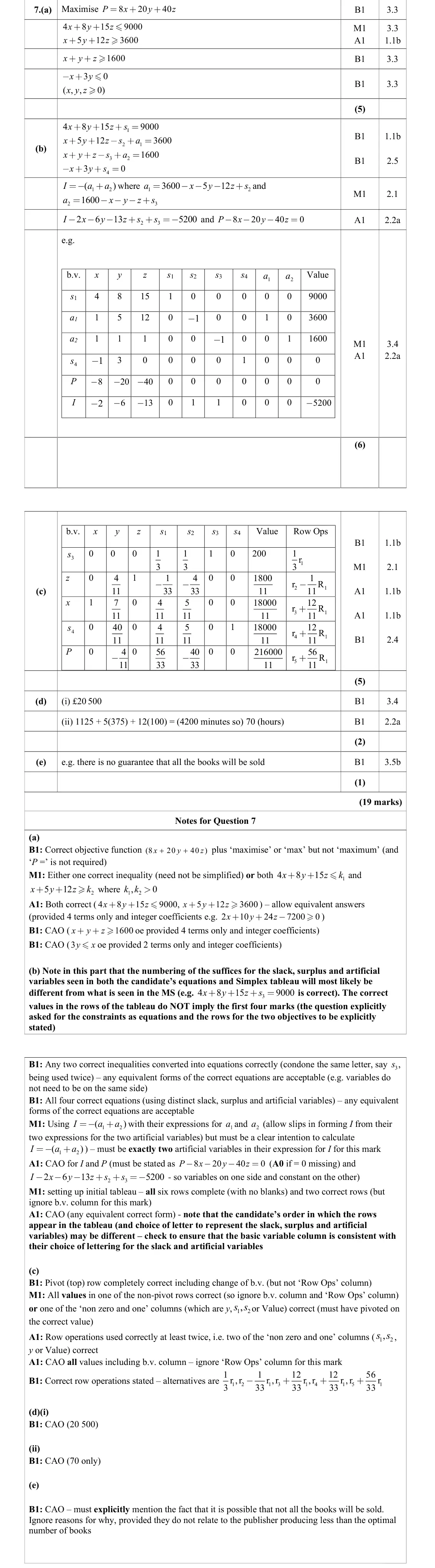
maximise P = 8x + 20y + 40z
4x + 8y + 15z ≤ 9000, x + 5y + 12z ≥ 3600 (hours into minutes), x + y + z ≥ 1600, x ≥ 3y
"maximise" omitted and 3x ≥ y were common errors
June 2023 · Paper 3D (Decision 1) · Q7(b)6 marks
Mark scheme (whole question; this part is marked with the orange bar)
Examiner's comment
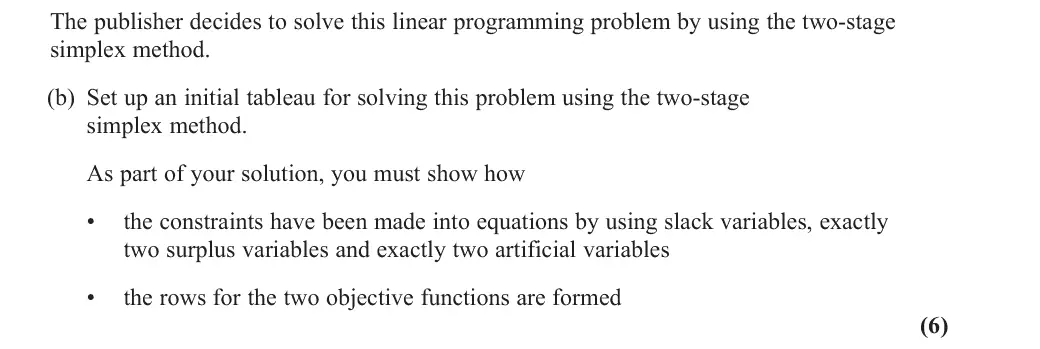
Almost all candidates attempted this question, though it seemed that some ran out of time part way through. Only a few candidates gained full marks. There were several common mistakes then led to incorrect responses in part (b). In general, most candidates were confident using slack, surplus and artificial variables. One recurrent error was to rearrange the constraint x >= 3y as x – 3y >= 0 so that a third artificial variable was incorrectly introduced, in spite of the question stating, “using exactly two artificial variables”. Those candidates who did have two artificial variables usually went on to set up an equation for I using their a1 and a2, gaining the associated method mark. But the correct corresponding accuracy mark was frequently lost by candidates not explicitly stating the correct equations for both I and P, with variables on one side and constant on the other, before filling in the tableau. Most candidates managed to complete the tableau and achieve the method mark for two completely correct rows, though the associated accuracy mark was often lost due to prior errors. For a few candidates their only error was to write surplus variables, rather than artificial variables, in the basic variable column. The answer to part (c) was independent of the earlier parts of the question, providing
Key points from the mark scheme and examiner's report
slacks s₁, s₄, surplus s₂, s₃ and artificials a₁, a₂
I = −(a₁ + a₂) gives I − 2x − 6y − 13z + s₂ + s₃ = −5200
equations must be shown, not just the tableau
June 2023 · Paper 3D (Decision 1) · Q7(c)5 marks
Mark scheme (whole question; this part is marked with the orange bar)
Examiner's comment
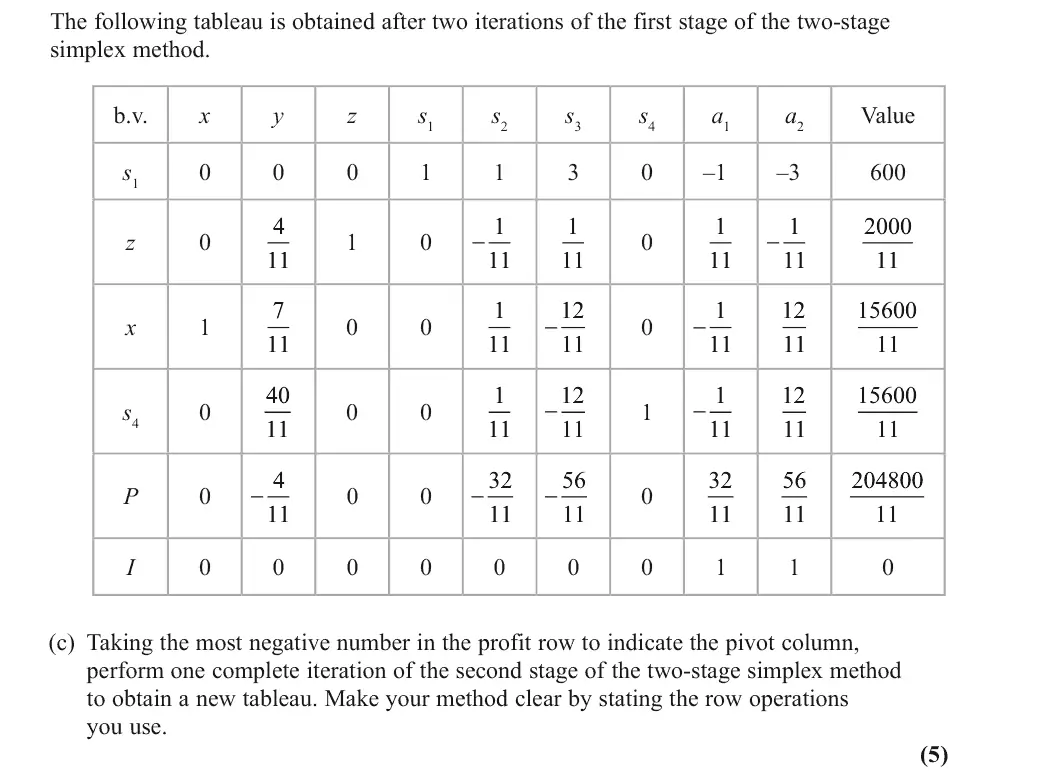
Almost all candidates attempted this question, though it seemed that some ran out of time part way through. Only a few candidates gained full marks. There were several common mistakes column. The answer to part (c) was independent of the earlier parts of the question, providing an opportunity for those who had struggled previously to still make progress. Most candidates appeared well prepared in performing an iteration of the Simplex method, so many gained all five marks or lost just one mark due to a computational slip. There were some tables left blank, possibly due to timing issues. Only a handful of candidates chose the wrong pivot. Many candidates gained the mark in part (d)(i) for reading off the correct answer of £20 500
Key points from the mark scheme and examiner's report
most negative is −56/11 in the s₃ column, pivot 3 in the s₁ row (s₃ enters, s₁ leaves)
state row operations
P = 216000/11
June 2023 · Paper 3D (Decision 1) · Q7(d)2 marks
Mark scheme (whole question; this part is marked with the orange bar)
Examiner's comment
Almost all candidates attempted this question, though it seemed that some ran out of time part way through. Only a few candidates gained full marks. There were several common mistakes Many candidates gained the mark in part (d)(i) for reading off the correct answer of £20 500 from the given table. For part (d)(ii) some candidates correctly calculated the time in minutes but lost the mark for failing to convert their answer to the requested hours. A pleasing number of candidates earned the final mark in (e), but a significant proportion gave spurious
Key points from the mark scheme and examiner's report
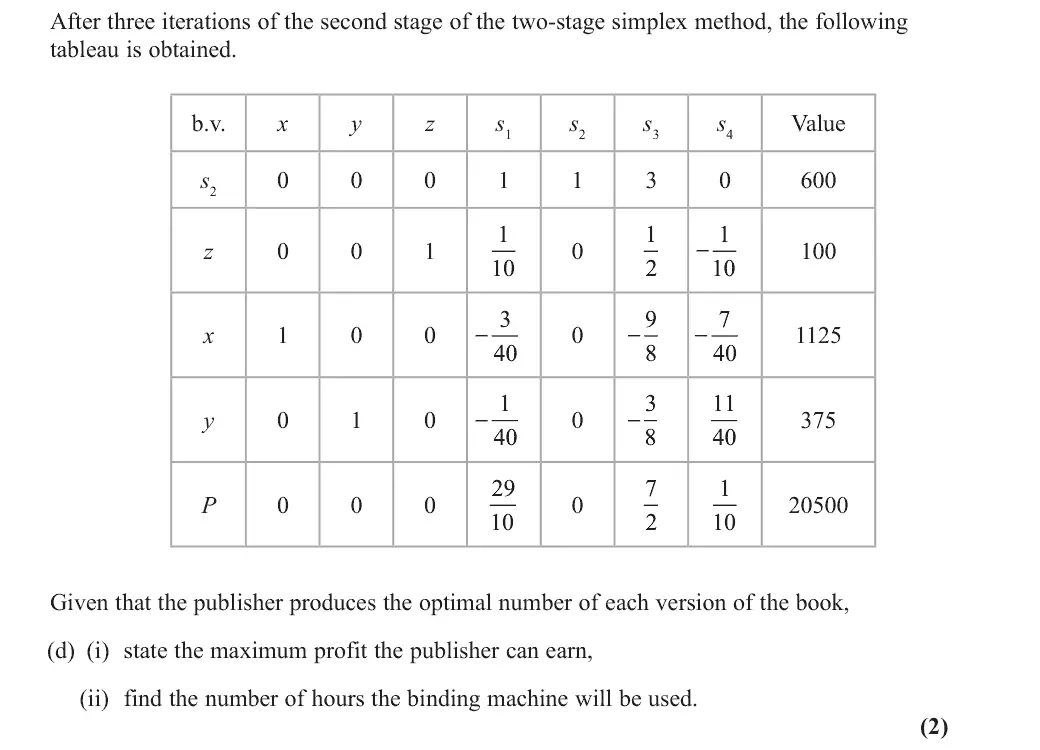
read P = £20 500
binding time 1125 + 5(375) + 12(100) = 4200 minutes = 70 hours (convert to hours)
June 2023 · Paper 3D (Decision 1) · Q7(e)1 mark
Mark scheme (whole question; this part is marked with the orange bar)
Examiner's comment
Almost all candidates attempted this question, though it seemed that some ran out of time part way through. Only a few candidates gained full marks. There were several common mistakes number of candidates earned the final mark in (e), but a significant proportion gave spurious answers about the efficiency of the machines or other costs that might arise, rather than considering the direct context of the question.
Key points from the mark scheme and examiner's report
not all the books may be sold
comments on machine efficiency or other costs scored 0
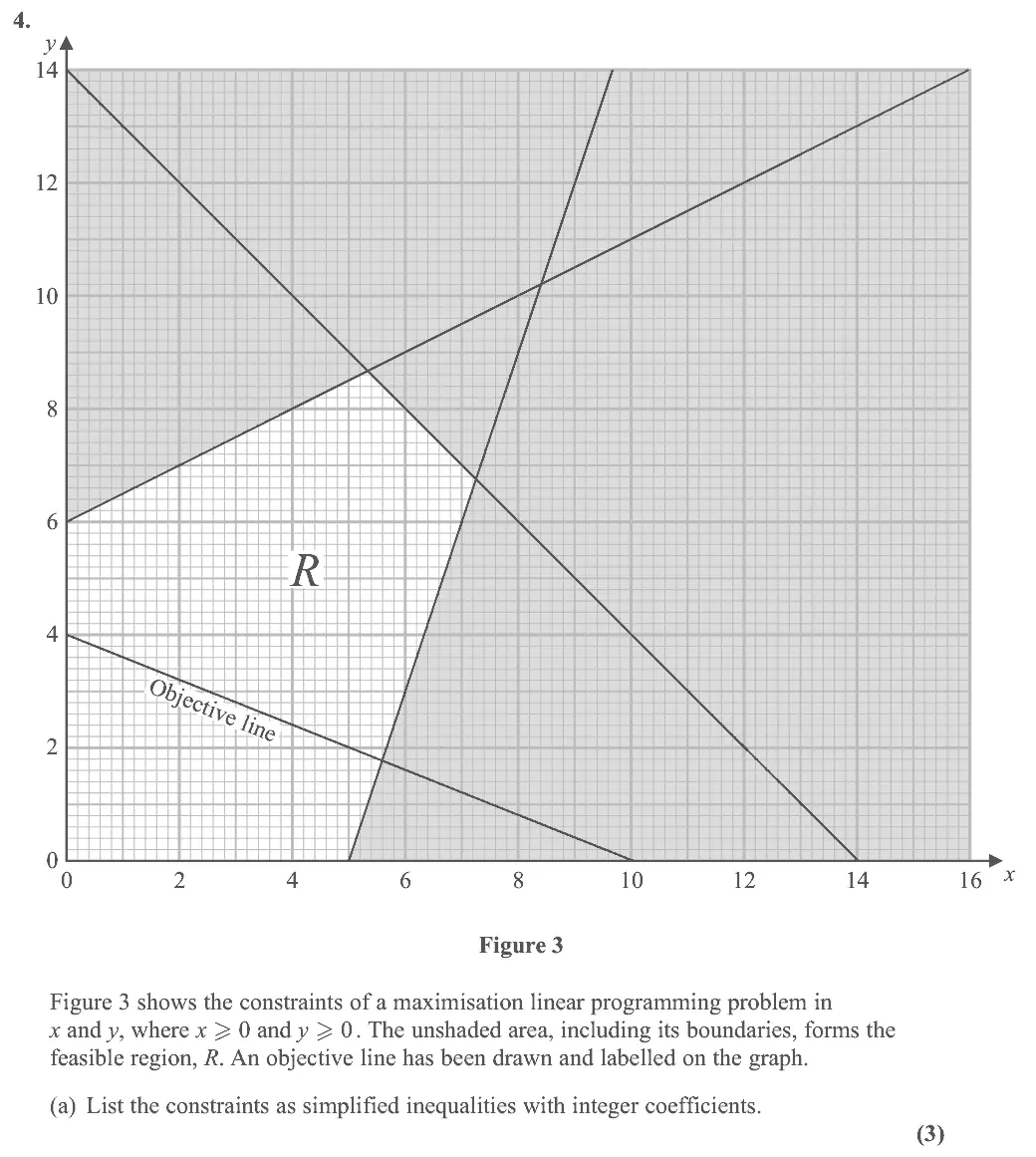
June 2022 · AS Paper 2 (Decision 1) · Q4(a)3 marks
Mark scheme (whole question; this part is marked with the orange bar)
Examiner's comment
A surprising number of candidates failed to gain the three marks in (a), for listing the three inequalities shown on the graph. Many candidates attempted to write down the equations of the 14 x y three lines, but many had difficulties at this stage. The inequality was mostly stated correctly, though some candidates struggled to arrive at the corresponding equation for this inequality. Algebraic errors sometimes produced 2 6 rather than 2 12, y x y x or similar. A good number of candidates, in (b), went on to solve the correct pair of simultaneous
Key points from the mark scheme and examiner's report
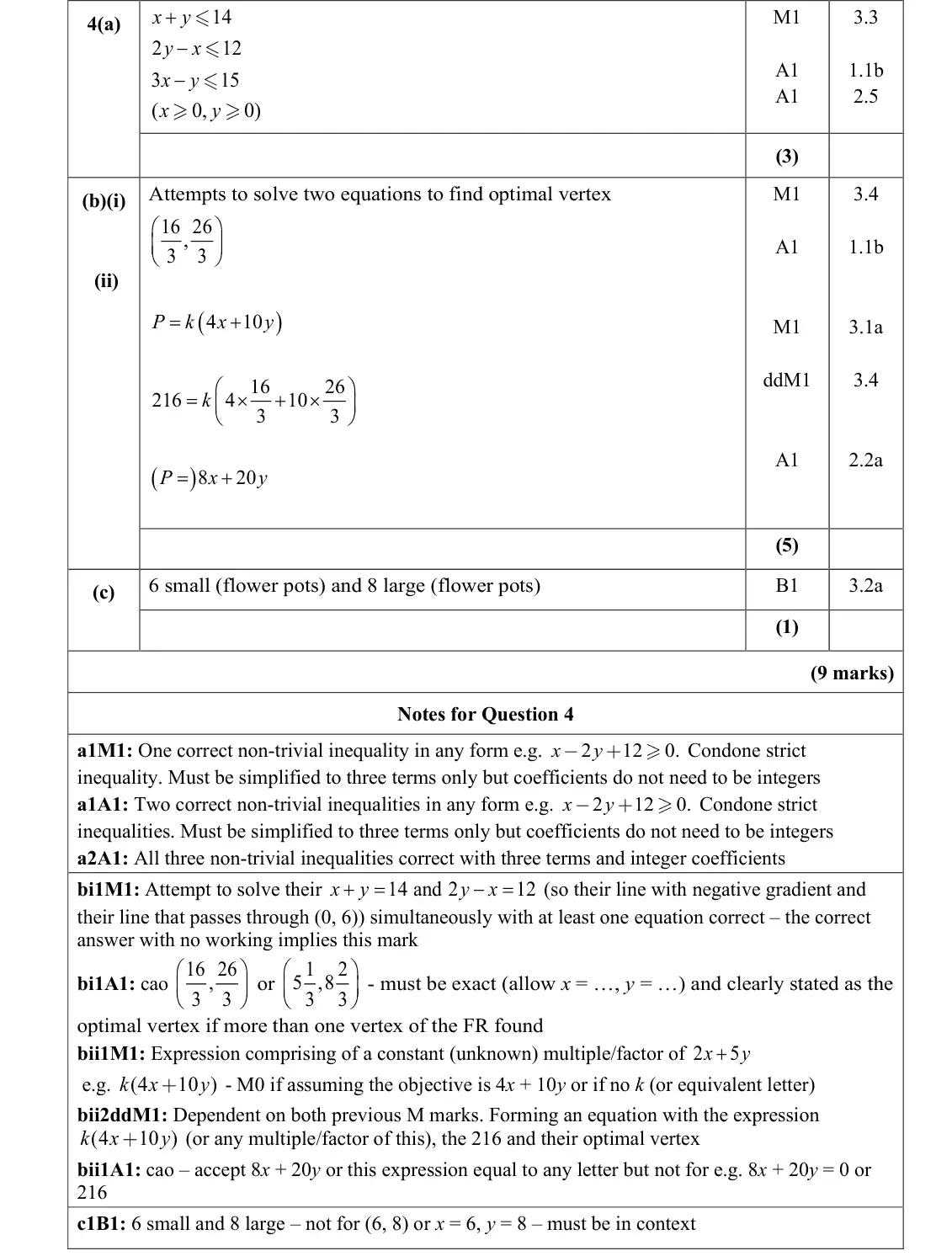
x + y ≤ 14, 2y − x ≤ 12, 3x − y ≤ 15
integer coefficients
line through (0, 6) often mis-derived (e.g. y ≤ 2x + 6)
June 2022 · AS Paper 2 (Decision 1) · Q4(b)5 marks
Mark scheme (whole question; this part is marked with the orange bar)
Examiner's comment
similar. A good number of candidates, in (b), went on to solve the correct pair of simultaneous equations and found the coordinates of the optimal vertex. However, very few used the given value of 216 successfully to derive the objective function. In (c), the optimal solution (in
Key points from the mark scheme and examiner's report
optimal vertex from x + y = 14 and 2y − x = 12: (16/3, 26/3) exactly
objective is a multiple of 2x + 5y (parallel to the objective line): 216 at V gives P = 8x + 20y
few used the 216
June 2022 · AS Paper 2 (Decision 1) · Q4(c)1 mark
Mark scheme (whole question; this part is marked with the orange bar)
Examiner's comment
value of 216 successfully to derive the objective function. In (c), the optimal solution (in context) was rarely found, though a few candidates made the correct deduction without prior working.
Key points from the mark scheme and examiner's report
integer optimum: 6 small and 8 large flower pots, in context, not just (6, 8)
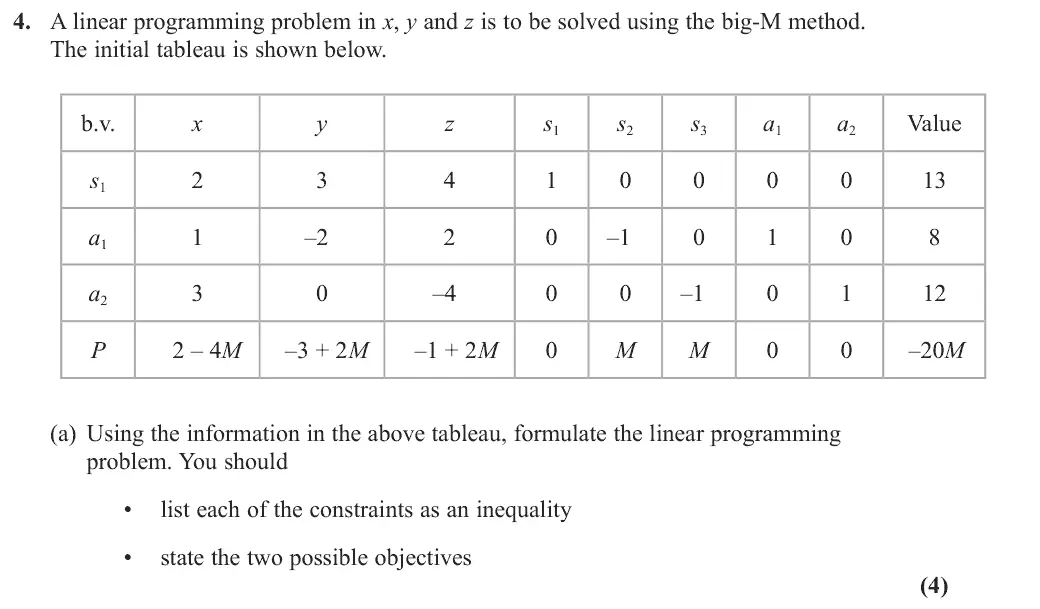
June 2022 · Paper 3D (Decision 1) · Q4(a)4 marks
Mark scheme (whole question; this part is marked with the orange bar)
Examiner's comment
This question proved to be a good discriminator between candidates. A not-insignificant number of candidates left this question out entirely, but the vast majority attempted it and were able to access one or more marks, with a reasonable number achieving full marks. The first half of (a) was generally answered well. A significant majority of candidates were able to give the correct inequalities for the three constraints, and the modal score for the two independent accuracy marks was full marks by some margin. The mistakes that were seen, with relatively low frequency, were to use strict inequalities, to reverse the direction of the inequality or, most commonly of these, to include the use of slack/artificial variables in their inequalities, thereby losing both marks. A small number of numerical slips were also seen.
Key points from the mark scheme and examiner's report
Mark scheme (whole question; this part is marked with the orange bar)
Examiner's comment
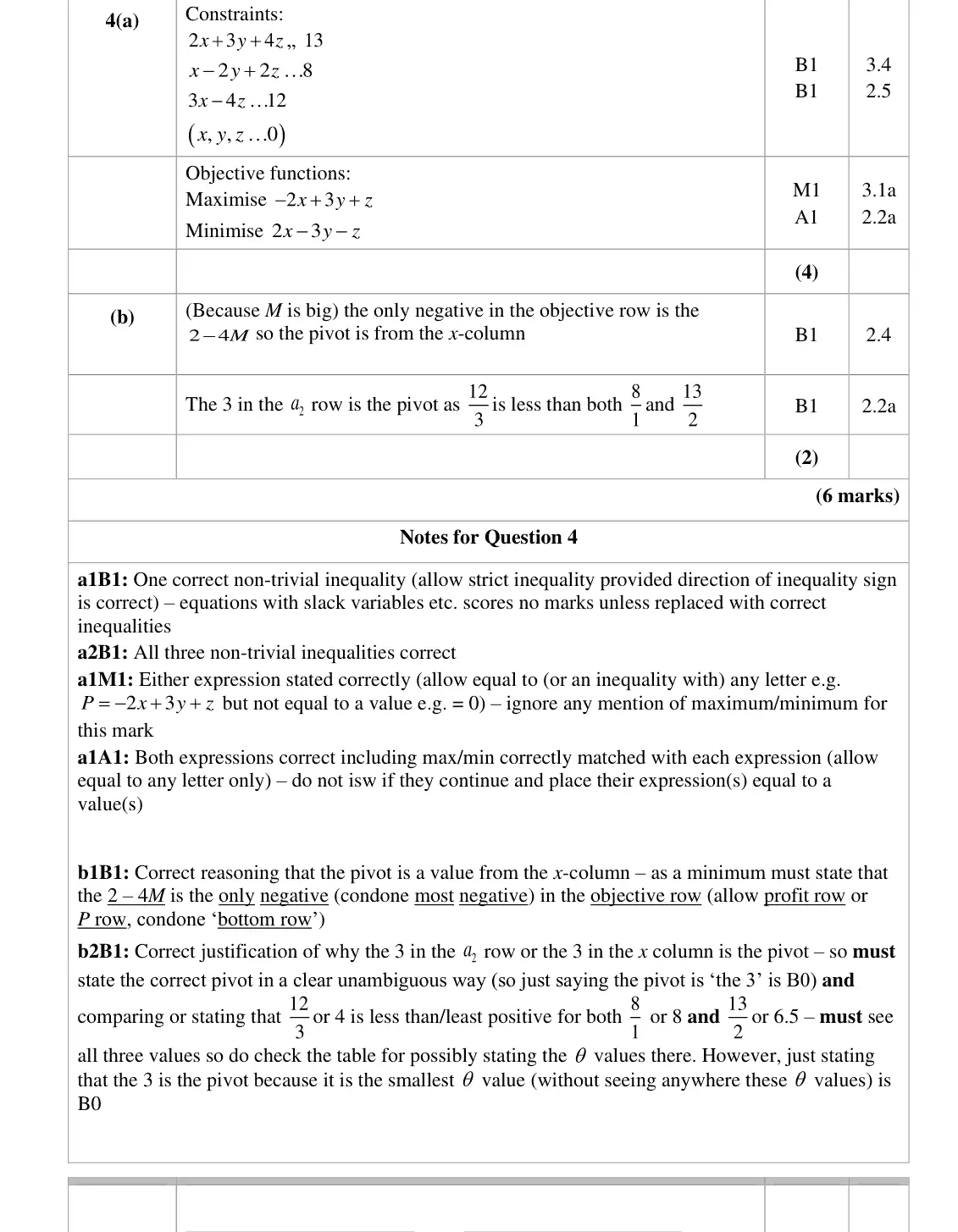
In the second part of (a) candidates were asked to give the two possible objective functions. The standard on this part was much more variable. Several candidates omitted this part; a huge number of objective functions featuring M or artificial variables were also seen. Of those who did achieve a function, was marginally the more common. 2 x - + 3 y z + A few candidates did correctly state both functions, but many did not attempt to classify them as max/min objectives. Part (b) was unusual, in that several candidates clearly understood how to find the correct pivot but were either partially or entirely unable to explain what they were doing. For the first mark, a good majority knew that pivoting on the x-column was required, and generally ‘most negative’ (in the objective row) was given as reasoning. However, several candidates failed to refer to either/both the ‘2 – 4M’ or the objective row. There were very few mentions of M being arbitrarily large, however this was not required (on this occasion) to achieve the mark. Many candidates failed to score the second mark as they simply stated that “3 (in the x- column/a2 row) is the pivot because the 𝜃 value is the least (positive)” (or equivalent). This did not achieve the mark because it did not show the calculations for all the 𝜃-values. A number of candidates also lost the mark for simply stating “3 is the pivot” after comparing the correct values – due to this being ambiguous it could not score full marks. Overall, it was a minority of candidates who responded with sufficient precision to earn this mark, and less than a quarter of responses seen scored both marks in (b). As well as the above errors in (b), a surprisingly number completed the correct calculations but then proceeded to pivot on the incorrect item or stated the correct column but then proceeded to calculate 𝜃-values for the wrong column. 6
Key points from the mark scheme and examiner's report
2 − 4M is the only negative in the objective row so x column
ratios 12/3 = 4 < 8/1 and 13/2 so pivot 3 in the a₂ row
must show all three ratios
June 2022 · Paper 3D (Decision 1) · Q7(a)5 marks
Mark scheme (whole question; this part is marked with the orange bar)
Examiner's comment
Candidates found this to be one of the most challenging questions on the paper, with very few candidates scoring full marks. Each part of this question was independent of each other and therefore candidates who performed poorly, or didn’t attempt some parts, were in some cases still able to score on other parts of the question. For (a), many candidates chose not to write down the equations for the feasible region, choosing otherwise to complete the tableau immediately. For these candidates, the tableau had to be completely correct, whereas those candidates who had written down their equations with slack variables could gain some credit for these even if their tableau was incorrect. There were obviously many correct variations other than the one shown in the mark scheme which were perfectly acceptable, as the order of equations was not specified in the question. The main errors in the tableau involved sign errors, usually in the objective line or in the inequality 2 1 y x - „ where several candidates failed to appreciate that negative values are not acceptable.
Key points from the mark scheme and examiner's report
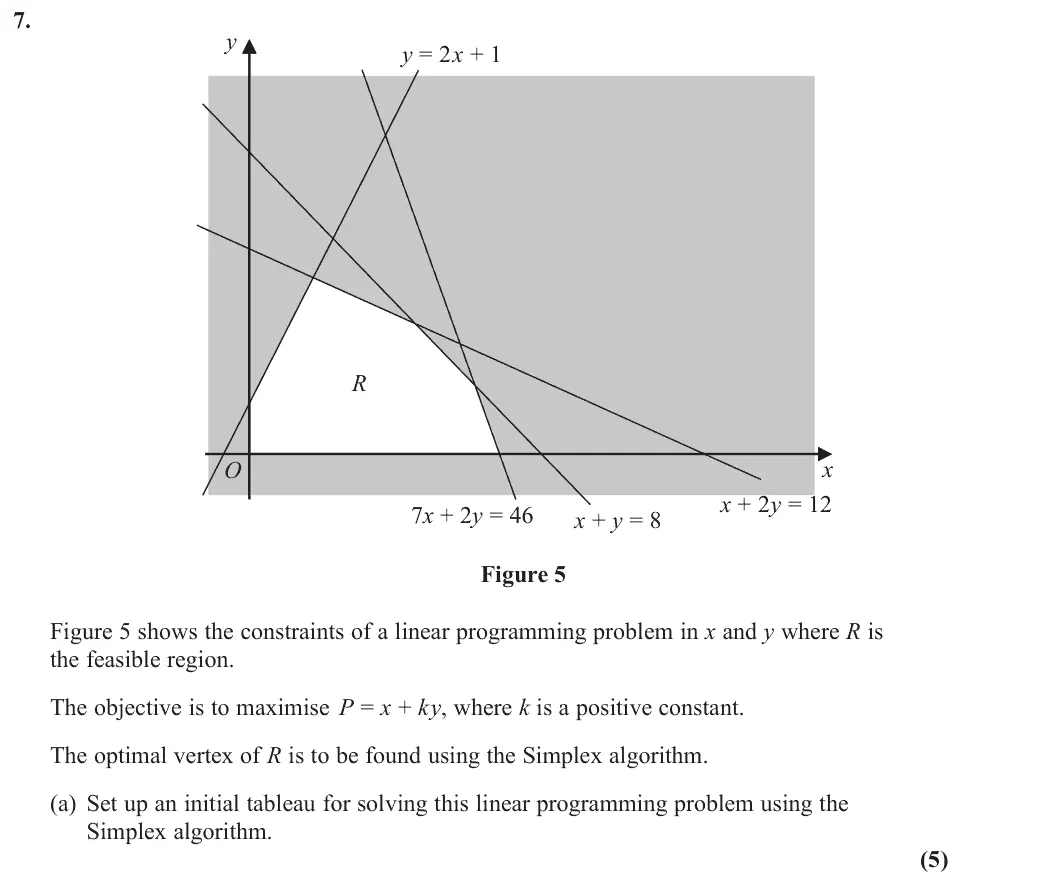
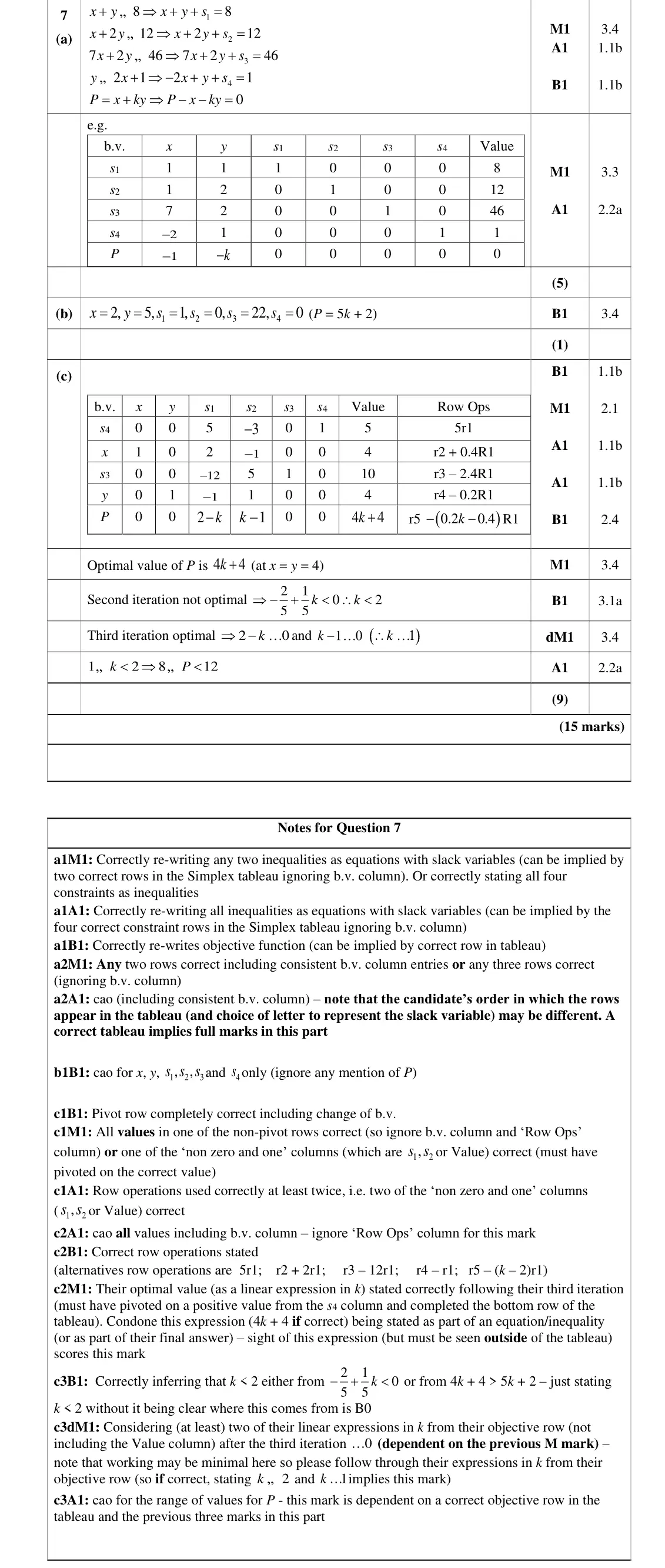
read the four constraints from Figure 5: x + y ≤ 8, x + 2y ≤ 12, 7x + 2y ≤ 46, y − 2x ≤ 1 with slacks
P − x − ky = 0 objective row
June 2022 · Paper 3D (Decision 1) · Q7(b)1 mark
Mark scheme (whole question; this part is marked with the orange bar)
Examiner's comment
Candidates found this to be one of the most challenging questions on the paper, with very few candidates scoring full marks. Each part of this question was independent of each other and therefore candidates who performed poorly, or didn’t attempt some parts, were in some cases still able to score on other parts of the question. Most candidates gained the mark in (b). The most common error was omitting non-basic variables from the list and in a few cases adding in an extra z variable.
Key points from the mark scheme and examiner's report
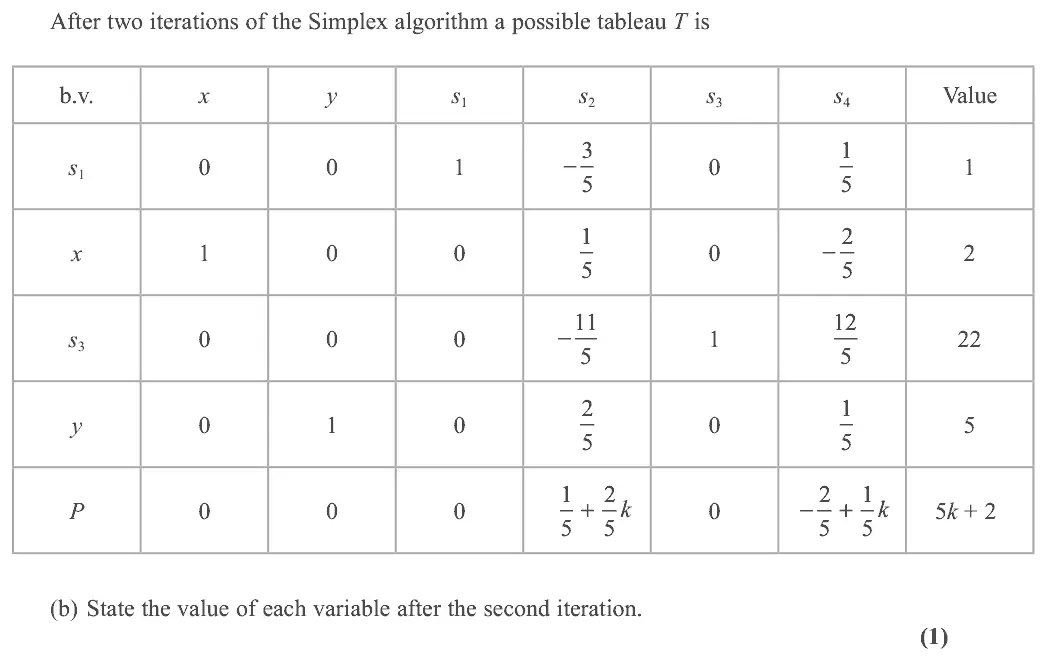
x = 2, y = 5, s₁ = 1, s₃ = 22, s₂ = s₄ = 0
non-basic variables often omitted
June 2022 · Paper 3D (Decision 1) · Q7(c)9 marks
Mark scheme (whole question; this part is marked with the orange bar)
Examiner's comment
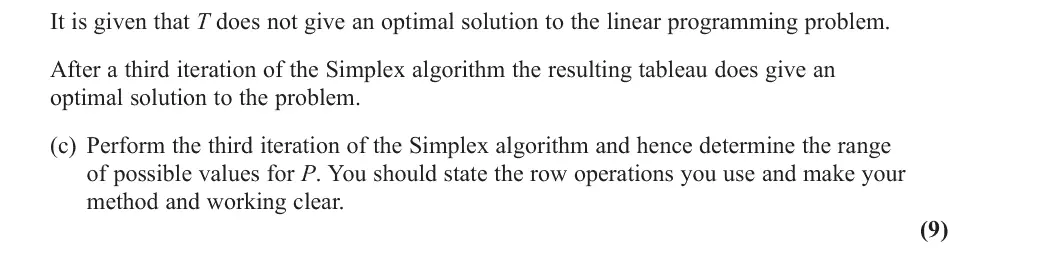
Candidates found this to be one of the most challenging questions on the paper, with very few candidates scoring full marks. Each part of this question was independent of each other and therefore candidates who performed poorly, or didn’t attempt some parts, were in some cases still able to score on other parts of the question. For (c), performing the iteration of the Simplex algorithm at the beginning of this part was generally well done. The vast majority used the correct pivot and so were able to make some progress, and most gained the mark for expressing their row operations correctly. A significant number of candidates gained partially correct solutions with errors on the objective row, some minor and some leaving values out, presumable because they did not know how to deal with the variable in this row. A few candidates chose a negative pivot and so therefore scored very few marks in this part. Whilst most candidates were confident with the mechanics of applying the Simplex algorithm, very few were able to show that they fully understood how simplex worked to get the correct range of values for P. Many candidates did not attempt this, and of those who did, many did not make their working clear. Most who attempted this seemed to be either unclear about whether their inequality should be strict or not or tried to skip steps in their method in order to reach a solution. Therefore most failed to realise that k < 2 (from the knowledge that one of the entries in the pivot row of T must be negative), rather than 2 k „ (from the fact that all the entries in their pivot row of their final tableau must be non-negative), leading to P < 12 rather than 12. P „ Fully correct solutions to this question were therefore extremely rare. 8
Key points from the mark scheme and examiner's report
pivot on 1/5 in the s₄ column (s₁ row)
optimal P = 4k + 4 at (4, 4)
T not optimal gives k < 2, new tableau optimal gives k ≥ 1
so 8 ≤ P < 12
objective row with k was the main difficulty
Nov 2021 · Paper 3D (Decision 1) · Q8(a)5 marks
Mark scheme (whole question; this part is marked with the orange bar)
Examiner's comment
It wasn’t obvious if time was a factor in why a few attempts at the final question were left blank or whether it was the demand(s) of the question itself. Most candidates who did attempt this question scored a good number of marks in (a) and (b) for setting up the linear programming problem and the corresponding two-stage Simplex tableau. Most candidates knew what to do in
Key points from the mark scheme and examiner's report
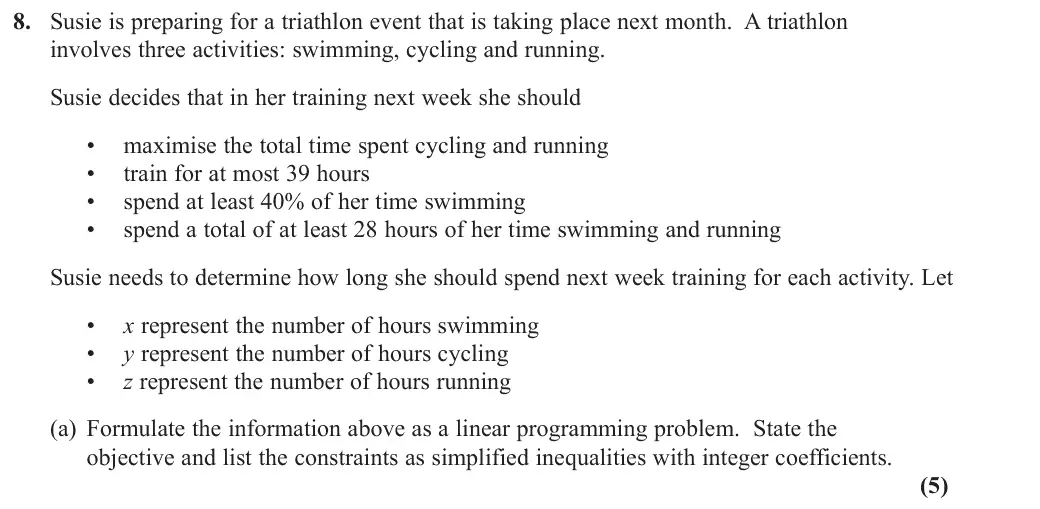
maximise P = y + z
x + y + z ≤ 39
2/5(x + y + z) ≤ x i.e. −3x + 2y + 2z ≤ 0
x + z ≥ 28
"maximise" must be stated
Nov 2021 · Paper 3D (Decision 1) · Q8(b)6 marks
Mark scheme (whole question; this part is marked with the orange bar)
Examiner's comment
It wasn’t obvious if time was a factor in why a few attempts at the final question were left blank or whether it was the demand(s) of the question itself. Most candidates who did attempt this question scored a good number of marks in (a) and (b) for setting up the linear programming problem and the corresponding two-stage Simplex tableau. Most candidates knew what to do in
Key points from the mark scheme and examiner's report
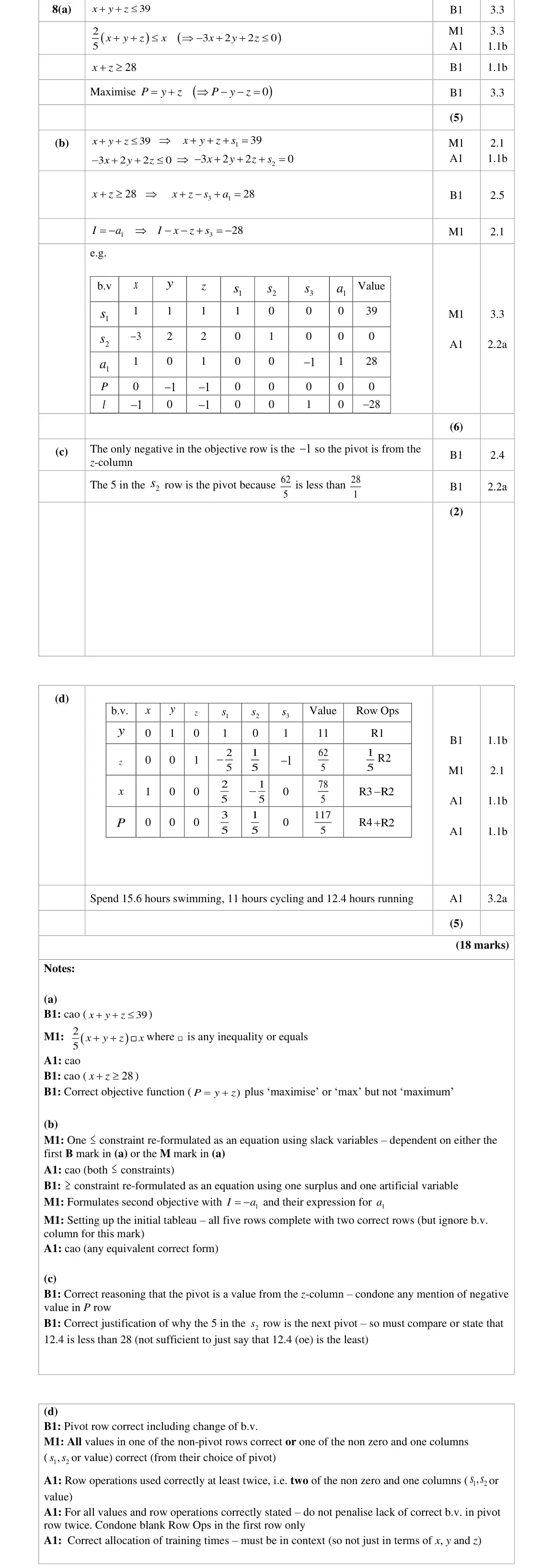
slacks s₁, s₂, surplus s₃ and artificial a₁ for x + z ≥ 28
I = −a₁ gives I − x − z + s₃ = −28
five-row tableau
Nov 2021 · Paper 3D (Decision 1) · Q8(c)2 marks
Mark scheme (whole question; this part is marked with the orange bar)
Examiner's comment
It wasn’t obvious if time was a factor in why a few attempts at the final question were left blank or whether it was the demand(s) of the question itself. Most candidates who did attempt this part (c) but didn’t give sufficient detail for why the 5 in the 2s row was the pivot. In part (d) many attempted the iteration of the second stage, and while some got the correct values of x, y, and z, many did not give their final answer in the context of the number of hours spent swimming, cycling, and running.
Key points from the mark scheme and examiner's report
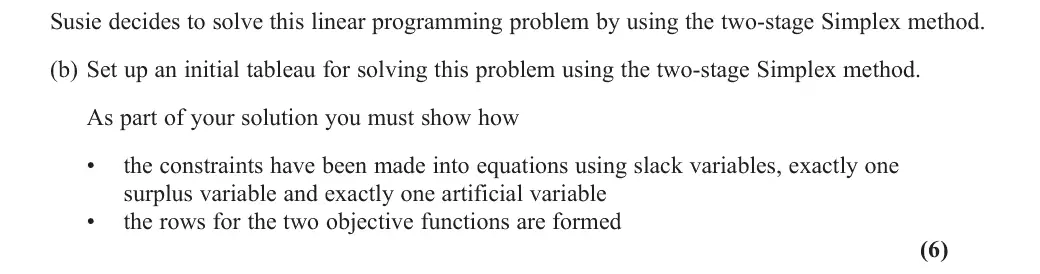
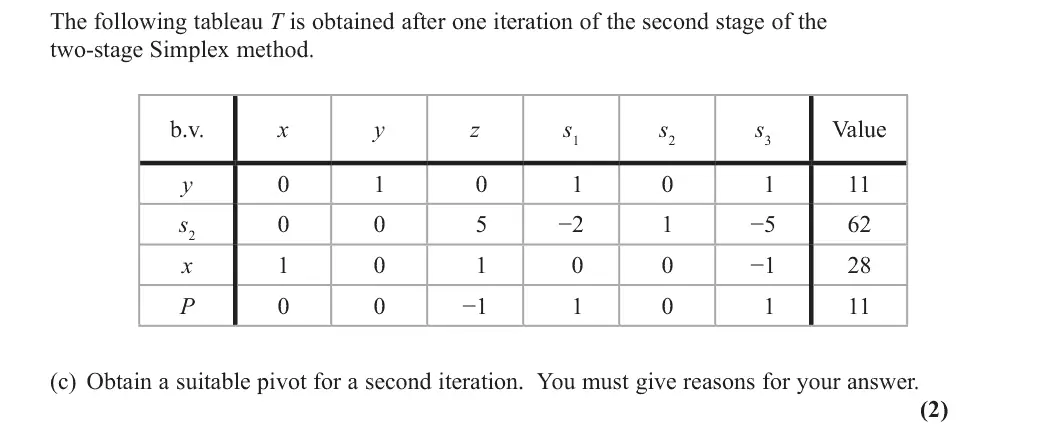
only negative in P row is −1 (z column)
62/5 = 12.4 < 28/1 so pivot 5 in the s₂ row
must compare the ratios, not just say "least"
Nov 2021 · Paper 3D (Decision 1) · Q8(d)5 marks
Mark scheme (whole question; this part is marked with the orange bar)
Examiner's comment
It wasn’t obvious if time was a factor in why a few attempts at the final question were left blank or whether it was the demand(s) of the question itself. Most candidates who did attempt this part (c) but didn’t give sufficient detail for why the 5 in the 2s row was the pivot. In part (d) many attempted the iteration of the second stage, and while some got the correct values of x, y, and z, many did not give their final answer in the context of the number of hours spent swimming, cycling, and running.
Key points from the mark scheme and examiner's report
row operations stated
x = 78/5, y = 11, z = 62/5, P = 117/5
answer in context: 15.6 h swimming, 11 h cycling, 12.4 h running (context often missing)
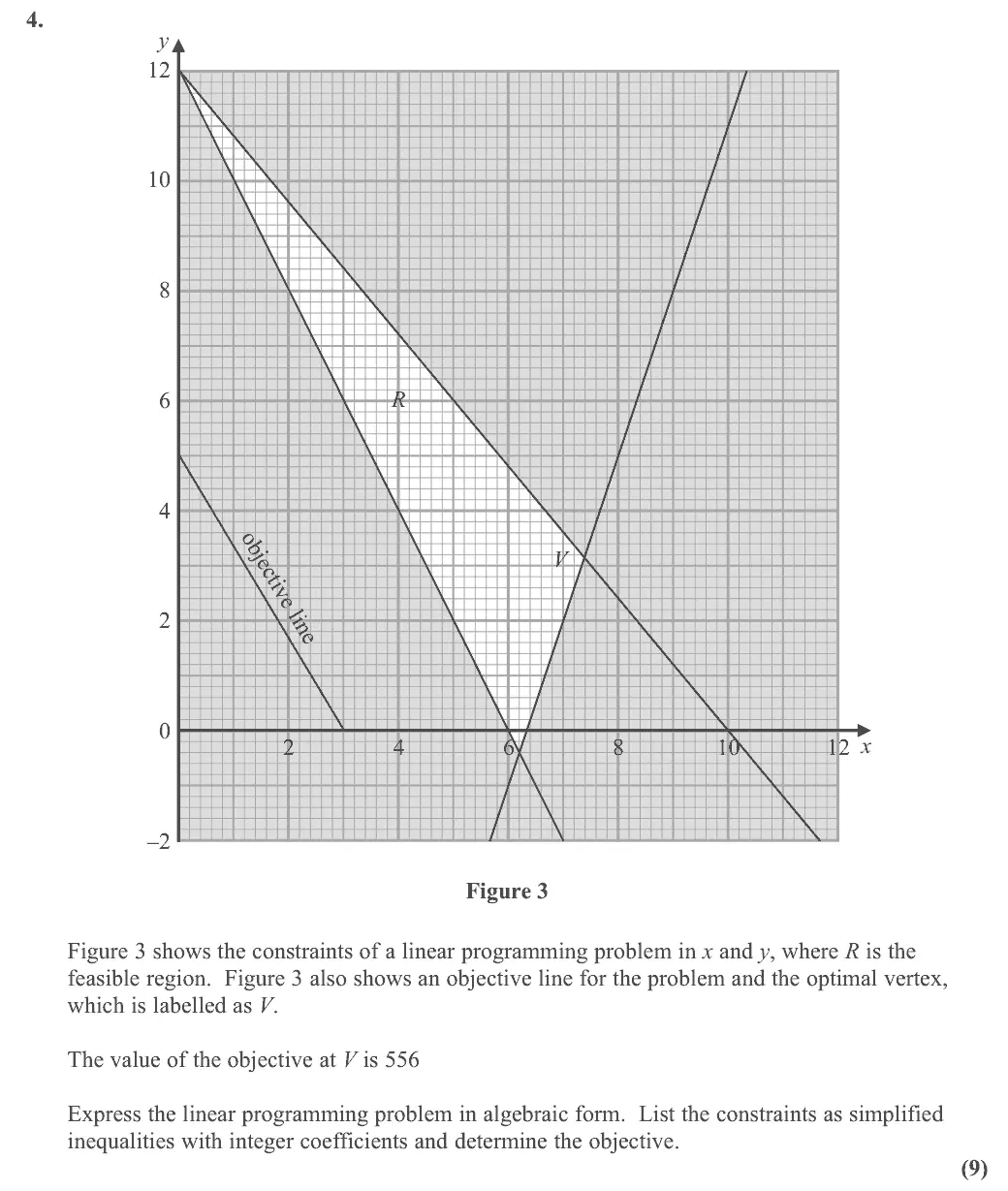
Oct 2020 · AS Paper 2 (Decision 1) · Q49 marks
Mark scheme (whole question; this part is marked with the orange bar)
Examiner's comment
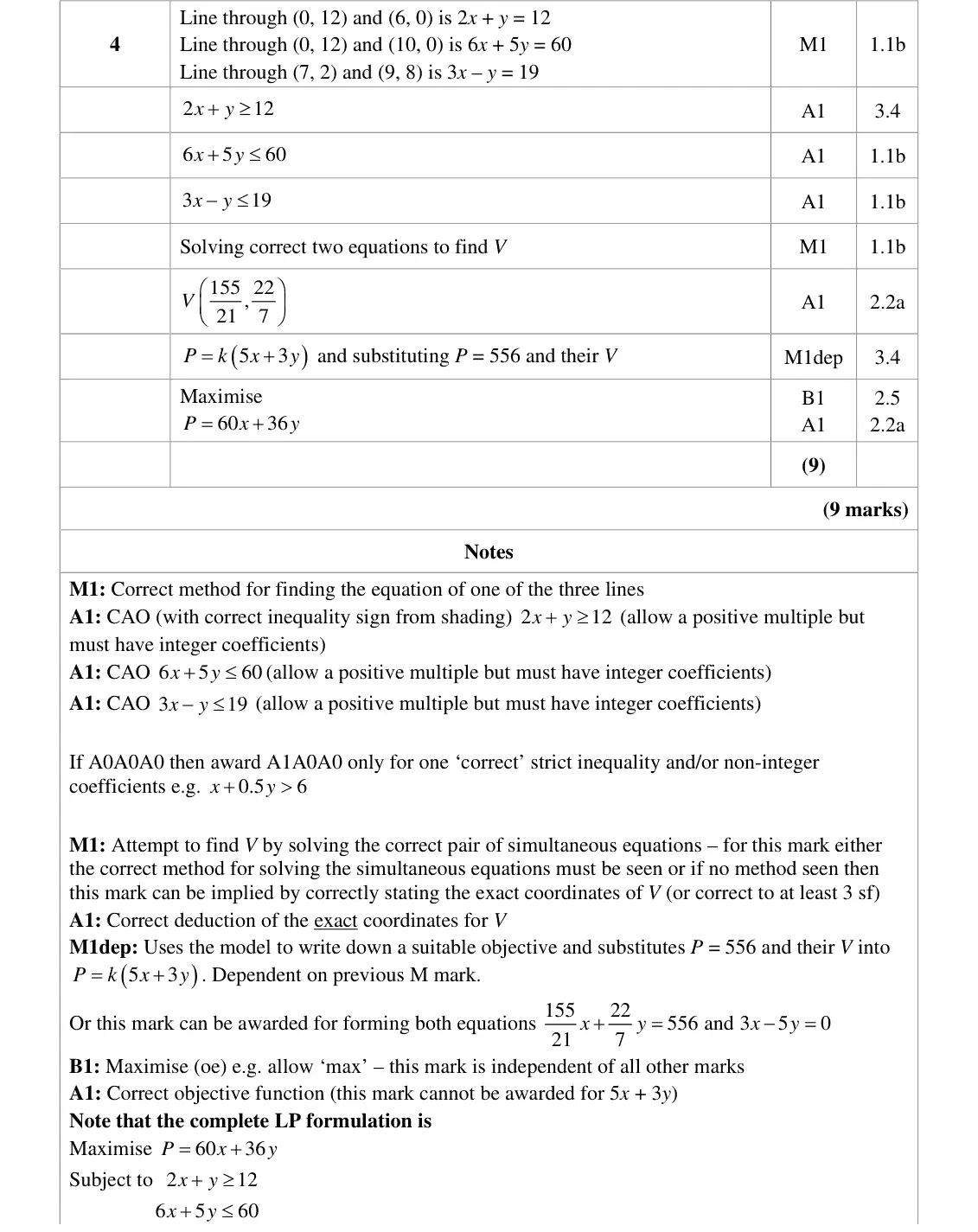
It was noted by examiners that this final question was attempted by most candidates and thus indicated that time pressure was unlikely to have been an issue for many. Some responses were incomplete but most of the time it seems that candidates completed as much as they were able to do. This question provided a variety of responses due to its unfamiliarity when compared to what has been seen on previous assessments. Candidates were given a linear programming problem in two variables graphically, the value of the objective at the optimal vertex, and were then asked to form the linear programming problem in algebraic form. Most candidates who attempted this question realised that they had to find the equations of the lines and hence inequalities that defined the feasible region. The most common errors were with forming the equation of the line passing through the points (7, 2) and (9, 8) and with incorrect inequality signs. While many candidates correctly found the inequalities that defined the feasible region only a small percentage could find the correct expression for the objective function. Most candidates believed that because the given objective line passed through 5 on the y-axis and 3 on the x-axis that therefore the objective function was simply 5 3 x y + when in fact the objective could be any multiple of this expression (also candidates should have realised that if the objective was 5 3 x y + then the information given in the question regarding the value of the objective at V was 556 was therefore irrelevant). What candidates had to do was to find the exact coordinates of the optimal point, substitute these values into 5 3 x y + and solve ( ) 5 3 P k x y = + with P = 556 which would have led them to the correct objective function of 60 36 . P x y = + Finally candidates are reminded that when they are asked to define a linear programming problem that they must state whether the objective is to be maximised or minimised (in this case maximised).
Key points from the mark scheme and examiner's report
lines 2x + y ≥ 12, 6x + 5y ≤ 60, 3x − y ≤ 19 (line through (7, 2) and (9, 8) often wrong
inequality signs from the shading)
V = (155/21, 22/7)
objective line gives P = k(5x + 3y), 556 at V so maximise P = 60x + 36y
few found the objective
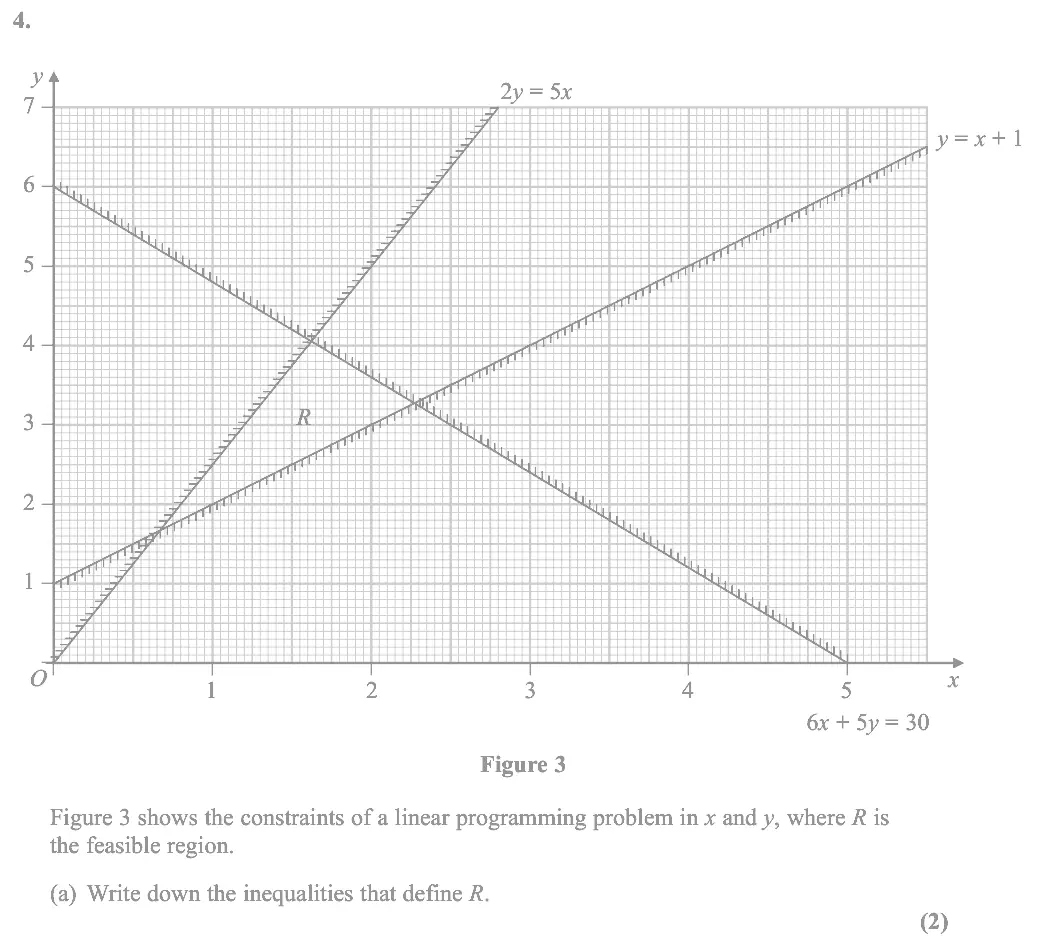
Oct 2020 · Paper 3D (Decision 1) · Q4(a)2 marks
Mark scheme (whole question; this part is marked with the orange bar)
Examiner's comment
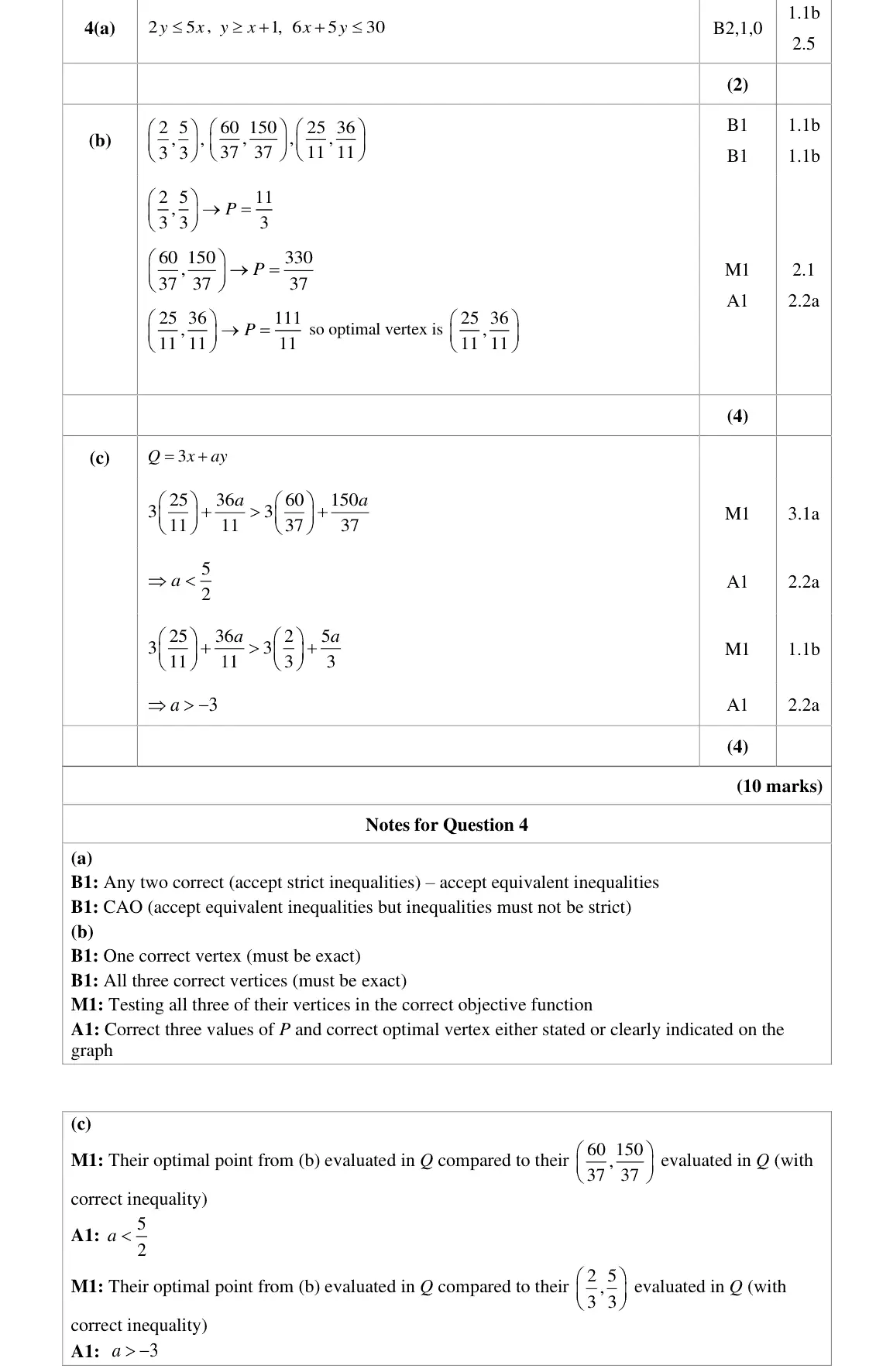
By no means all candidates wrote down the correct three constraints defining R in (a), some confusing the direction of their inequalities and others writing the strict inequality symbol. The four marks in (b) were for finding the exact value of
Key points from the mark scheme and examiner's report
2y ≤ 5x, y ≥ x + 1, 6x + 5y ≤ 30, not strict
inequality directions often confused
Oct 2020 · Paper 3D (Decision 1) · Q4(b)4 marks
Mark scheme (whole question; this part is marked with the orange bar)
Examiner's comment
By no means all candidates wrote down the correct three constraints defining R strict inequality symbol. The four marks in (b) were for finding the exact value of P, as stated in the question, at each of the three vertices, and deducing the optimal vertex. Candidates should be reminded that ‘exact’ is the key word here so both vertex coordinates and P values must be left as fractions, which can be readily found from their calculator. Part (c) proved to be a challenge to all but
Key points from the mark scheme and examiner's report
Mark scheme (whole question; this part is marked with the orange bar)
Examiner's comment
By no means all candidates wrote down the correct three constraints defining R readily found from their calculator. Part (c) proved to be a challenge to all but the most able candidates, who compared expressions for Q at the relevant two pairs of vertices. Several excellent solutions were seen. Attempts at using the gradient comparison approach were not successful, on this occasion, probably due to the fractions involved.
Key points from the mark scheme and examiner's report
compare Q at V with Q at each adjacent vertex: −3 < a < 5/2
gradient comparison rarely worked
only the most able succeeded
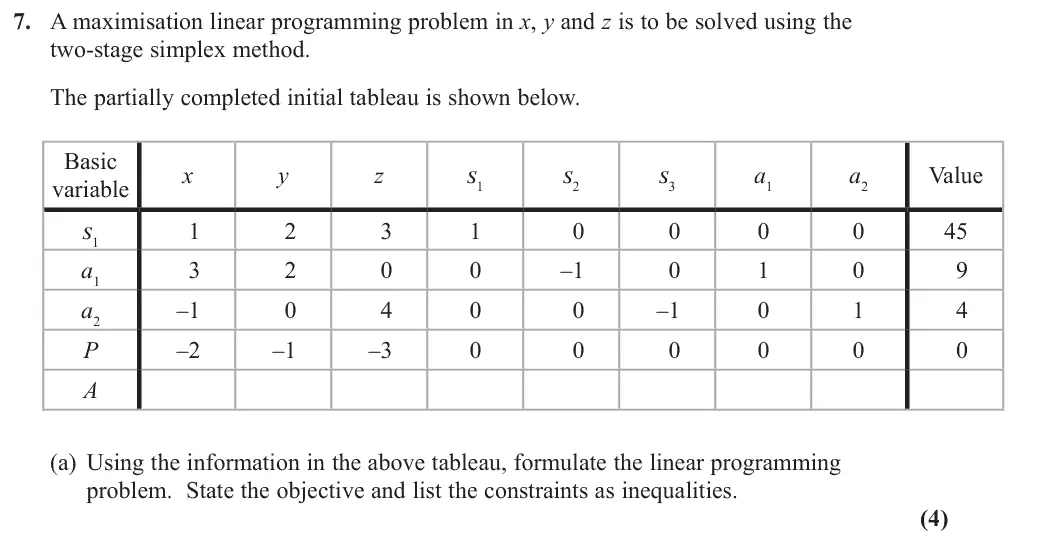
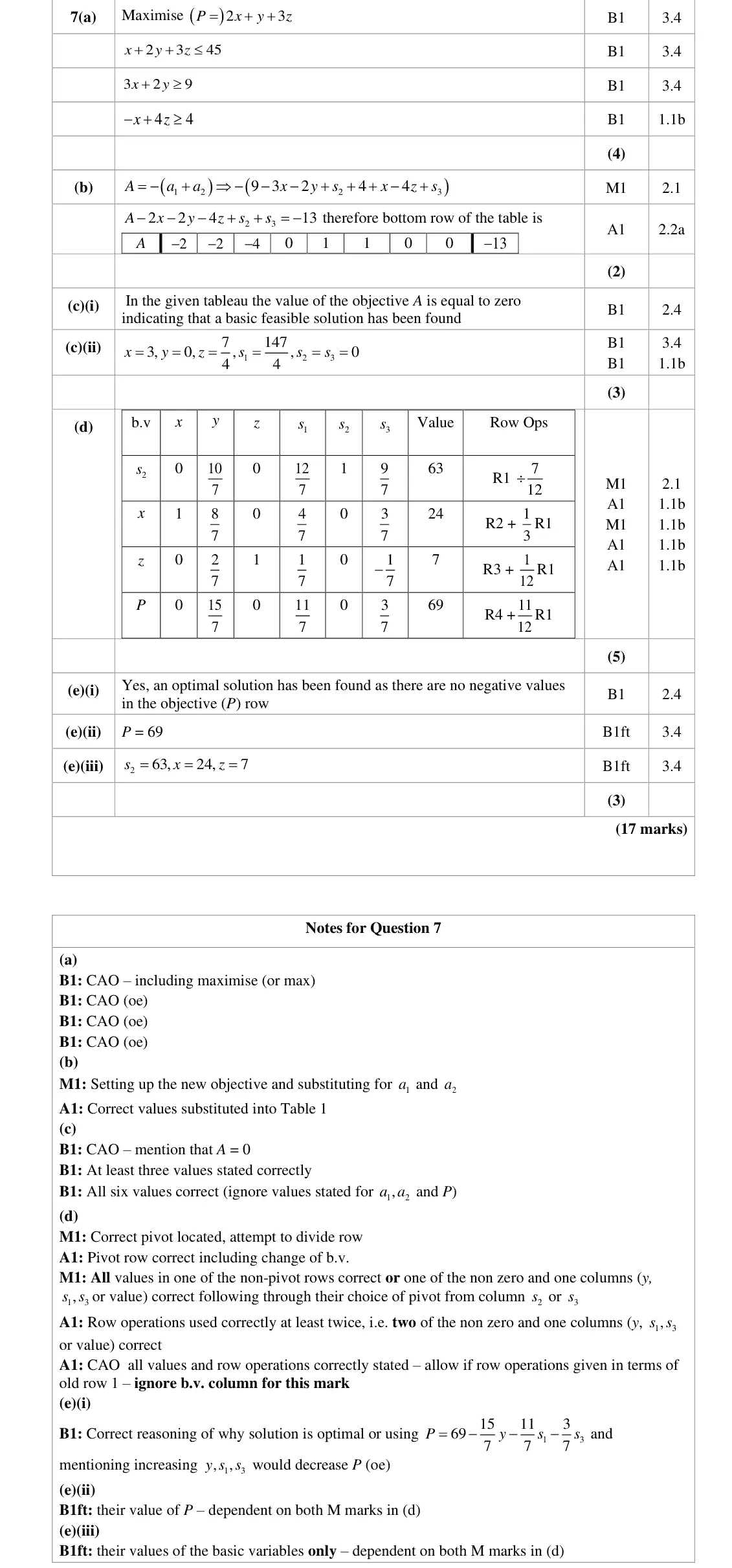
Oct 2020 · Paper 3D (Decision 1) · Q7(a)4 marks
Mark scheme (whole question; this part is marked with the orange bar)
Examiner's comment
Only a few candidates were unable to make any attempt here. The two stage simplex is another recent addition to the specification, but a good proportion of candidates showed at least some understanding of the method. Many candidates realised what was required to formulate the linear programming problem and were able to interpret the content of the simplex tableau accordingly, though some had all three constraint inequalities reversed. Candidates should recognise that it is essential to state whether the objective is to be maximised or minimised and failure to do so will always result in one mark lost. It was pleasing to see a proportion of candidates showing clear working in order to go
Key points from the mark scheme and examiner's report
read the tableau back: maximise P = 2x + y + 3z subject to x + 2y + 3z ≤ 45, 3x + 2y ≥ 9, −x + 4z ≥ 4
must say maximise
reversed inequalities seen
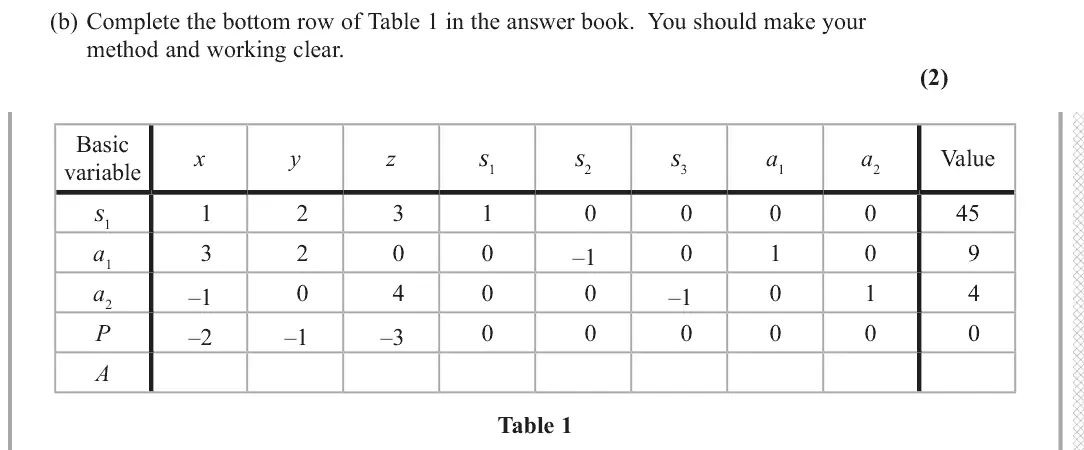
Oct 2020 · Paper 3D (Decision 1) · Q7(b)2 marks
Mark scheme (whole question; this part is marked with the orange bar)
Examiner's comment
on to correctly complete the bottom row of the tableau in (b). In (c) (i) was often answered correctly but many then lost a mark when omitting the zero valued variables in (ii). There was some indication that candidates could be running out of time on this question with partially completed simplex tableaux, but a good number of continuing candidates scored four or five marks. Instances of choosing an incorrect pivot were extremely rare. The final three marks in (e)
Key points from the mark scheme and examiner's report
A = −(a₁ + a₂) with a₁, a₂ substituted: A row −2, −2, −4, 0, 1, 1, 0, 0, −13
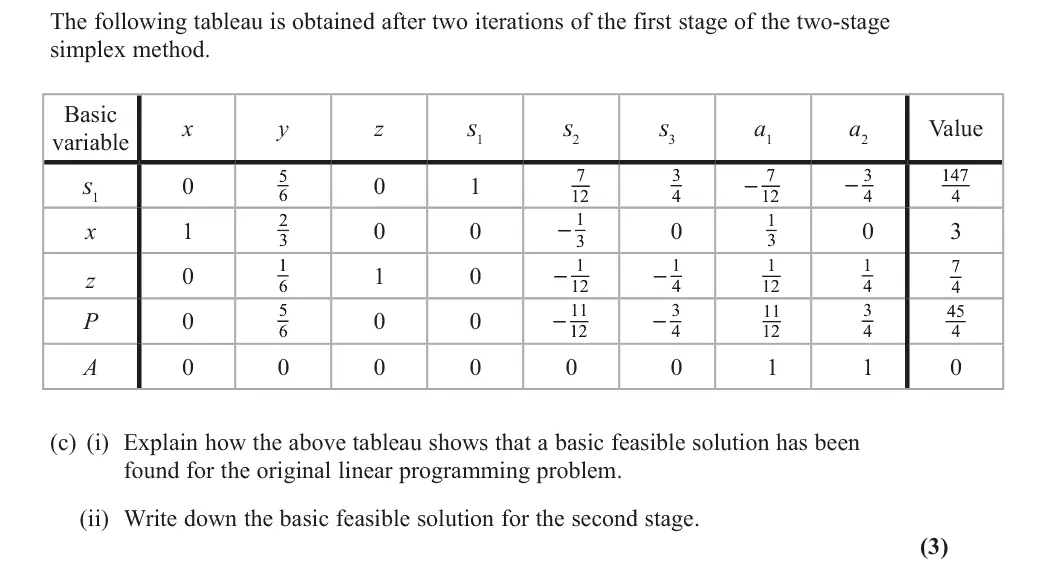
Oct 2020 · Paper 3D (Decision 1) · Q7(c)3 marks
Mark scheme (whole question; this part is marked with the orange bar)
Examiner's comment
on to correctly complete the bottom row of the tableau in (b). In (c) (i) was often answered correctly but many then lost a mark when omitting the zero valued variables in (ii). There was some indication that candidates could be running out of time on this question with partially completed simplex tableaux, but a good number of continuing candidates scored four or five marks. Instances of choosing an incorrect pivot were extremely rare. The final three marks in (e)
Key points from the mark scheme and examiner's report
A = 0 so the artificial variables are zero and a basic feasible solution is found
x = 3, z = 7/4, s₁ = 147/4, y = s₂ = s₃ = 0 (zero variables often omitted)
Oct 2020 · Paper 3D (Decision 1) · Q7(d)5 marks
Mark scheme (whole question; this part is marked with the orange bar)
Examiner's comment
Only a few candidates were unable to make any attempt here. The two stage simplex is another recent addition to the specification, but a good proportion of candidates showed at least some understanding of the method. Many candidates realised what was required to formulate the linear programming problem and were able to interpret the content of the simplex tableau accordingly, though some had all three constraint inequalities reversed. Candidates should recognise that it is essential to state whether the objective is to be maximised or minimised and failure to do so will always result in one mark lost. It was pleasing to see a proportion of candidates showing clear working in order to go
Key points from the mark scheme and examiner's report
most negative is −11/12 in the s₂ column, pivot 7/12 in the s₁ row
state row operations
P = 69
Oct 2020 · Paper 3D (Decision 1) · Q7(e)3 marks
Mark scheme (whole question; this part is marked with the orange bar)
Examiner's comment
of choosing an incorrect pivot were extremely rare. The final three marks in (e) were only accessible to those who had completed their tableau. The last mark penalised those who stated values for all six variables as the question specifically asked for just the basic variables.
Key points from the mark scheme and examiner's report
no negative entries in the P row so optimal
P = 69
basic variables only: s₂ = 63, x = 24, z = 7
June 2019 · AS Paper 2 (Decision 1) · Q5(a)7 marks
Mark scheme (whole question; this part is marked with the orange bar)
Examiner's comment
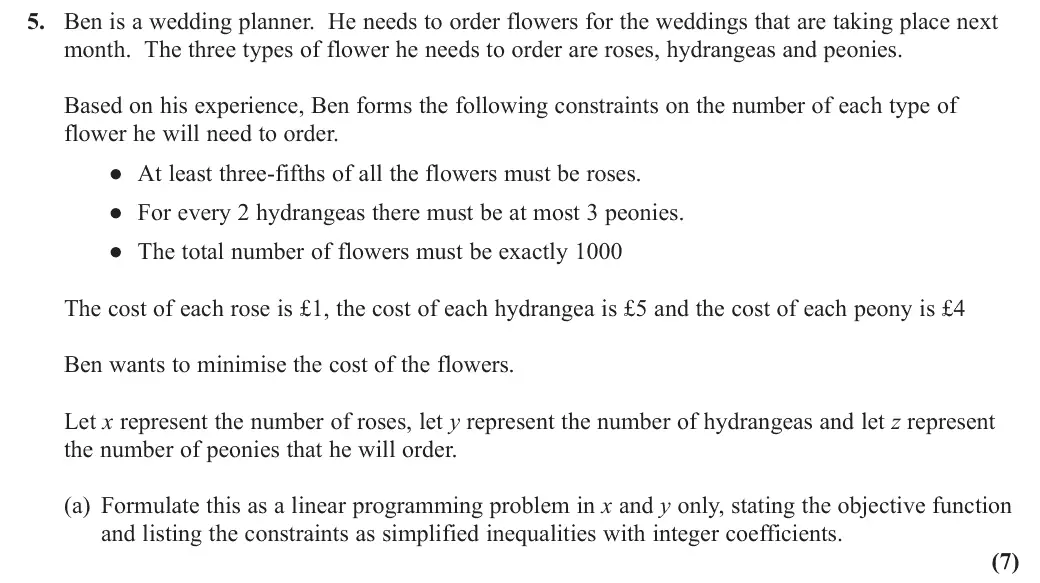
at least initially in part (a), was standard and the question gave rise to the usual errors that have been observed over many previous sessions. Almost all candidates worked with the provided variables x, y and z. Some candidates initially began formulating the problem in terms of r, p and h although usually they switched to x, y and z and rewrote their work with the required variables. Those that didn’t convert their variables usually petered out before getting very far with the question. Most candidates stated the objective function correctly and many remembered to ‘minimise’ although this was certainly not universally the case. Many candidates were able to state the equality constraint for the total number of flowers although some candidates believed there were 100 flowers rather than the given 1000. As is usually the case, the inequality constraints were generally more problematic. Most x 600. candidates had success with the roses constraint and many immediately deduced that Sometimes though, this inequality was in the wrong direction and les able candidates gave other 3 5 . x y z incorrect interpretations including By far the most challenging constraint was the hydrangea/peony constraint which was often incorrect. It was common to see the incorrect inequality 2 3 y z but also 3 2 y z or 2 3 . y z Sometimes all the constraints were stated as equations with no inequalities and examiners also observed strict inequalities being used from time to time. Often candidates did not seem to realise that they had been asked to eliminate z and many simply worked with the constraints in all three variables. Of those that did attempt to eliminate z however, some candidates set the hydrangea/peony constraint to be an equality and used this to eliminate z rather than using the correct x + y + z = 1000 constraint. Some candidates who did make headway eliminating z from the constraints, neglected to eliminate z from the objective function. Often candidates were able to pick up marks in part (b) despite incomplete responses to part (a). Most recognised the need for the total number of flowers to equal 1000 and correspondingly stated values to fit their constraints. Occasionally though, the minimum value of x was not used as had been stipulated and quite often candidates did not state their solution in context despite being asked for the number of each type of flower. Indeed, some candidates seemed to become muddled with the variables and flowers and stated solutions that were not compatible with their constraints - seemingly mixing up hydrangeas and peonies. On several occasions, examiners saw responses where candidates had only stated the required values for x and y and omitted the value for z. Occasionally the total cost was not stated. Overall, the question performed well providing a wide range of marks and the opportunity for differentiation amongst the candidates.
Key points from the mark scheme and examiner's report
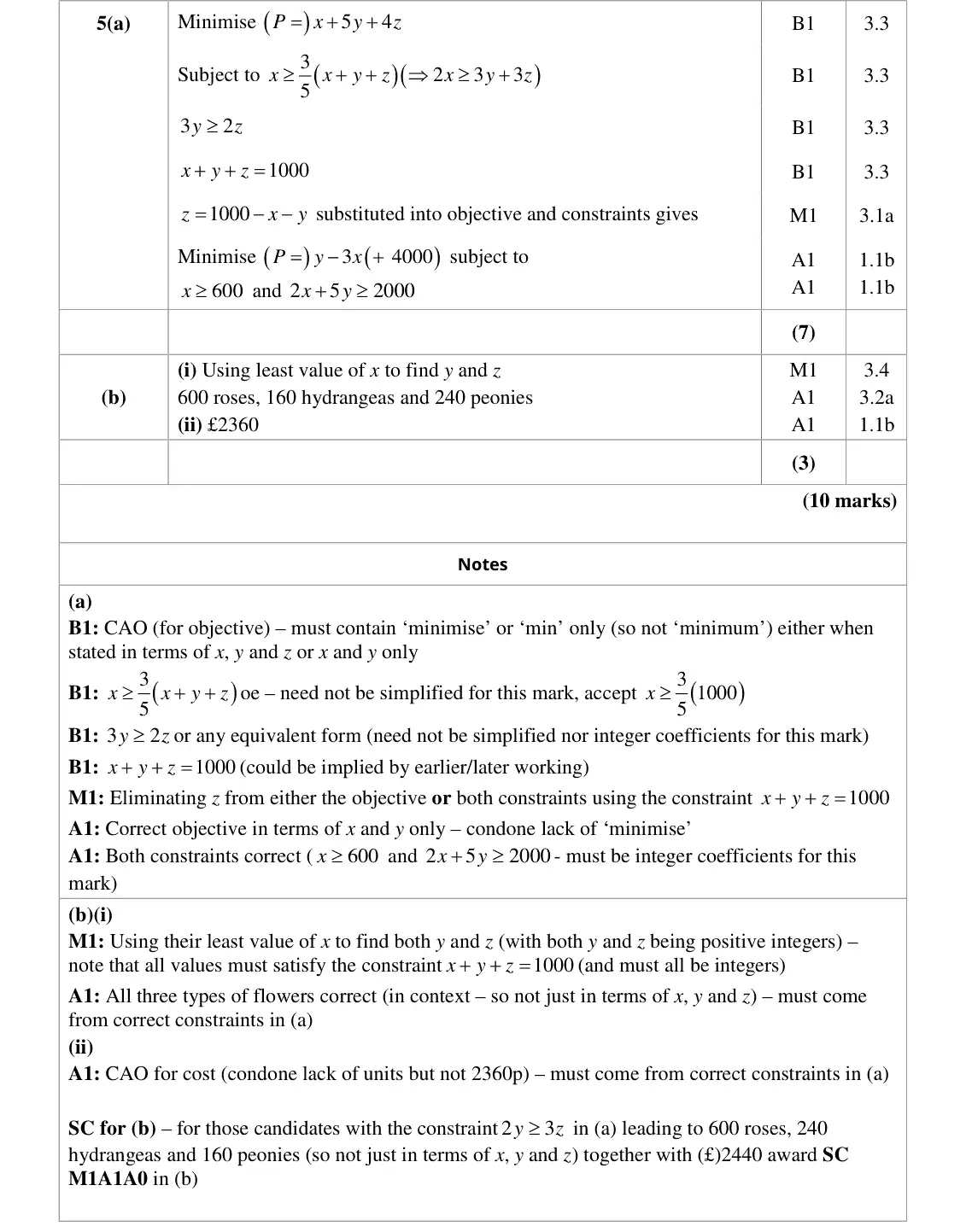
minimise x + 5y + 4z with x ≥ 3/5(x + y + z), 3y ≥ 2z, x + y + z = 1000
eliminate z: minimise y − 3x (+4000) subject to x ≥ 600, 2x + 5y ≥ 2000
"minimum" not accepted for minimise
2y ≥ 3z reversal common
100 for 1000
June 2019 · AS Paper 2 (Decision 1) · Q5(b)3 marks
Mark scheme (whole question; this part is marked with the orange bar)
Examiner's comment
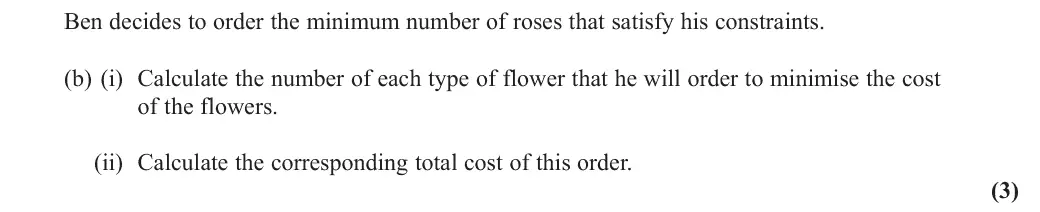
Often candidates were able to pick up marks in part (b) despite incomplete responses to part (a). Most recognised the need for the total number of flowers to equal 1000 and correspondingly stated values to fit their constraints. Occasionally though, the minimum value of x was not used as had been stipulated and quite often candidates did not state their solution in context despite being asked for the number of each type of flower. Indeed, some candidates seemed to become muddled with the variables and flowers and stated solutions that were not compatible with their constraints - seemingly mixing up hydrangeas and peonies. On several occasions, examiners saw responses where candidates had only stated the required values for x and y and omitted the value for z. Occasionally the total cost was not stated. Overall, the question performed well providing a wide range of marks and the opportunity for differentiation amongst the candidates.
Key points from the mark scheme and examiner's report
x = 600 gives y = 160, z = 240: 600 roses, 160 hydrangeas, 240 peonies, £2360
give the answer in context and include z
June 2019 · Paper 3D (Decision 1) · Q6(a)1 mark
Mark scheme (whole question; this part is marked with the orange bar)
Examiner's comment
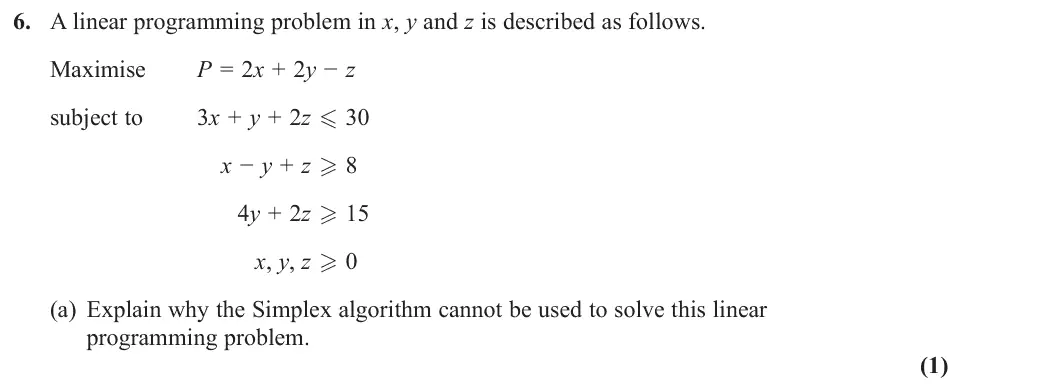
In part (a) many candidates gave a correct response, but these varied from statements such as “the problem contains >= constraints”, to “simplex can only deal with <= constraints” through to a thorough explanation that “for this problem the origin is not in the feasible region as 8 x y z and therefore the problem had to be modified to accommodate this”. Incorrect responses included statements such as “the problem has three variables” or “it needs artificial variables”.
Key points from the mark scheme and examiner's report
the ≥ constraints mean the origin is not feasible, so Simplex (≤ constraints only) cannot start
"three variables" or "needs artificial variables" scored 0
June 2019 · Paper 3D (Decision 1) · Q6(b)7 marks
Mark scheme (whole question; this part is marked with the orange bar)
Examiner's comment
In part (b) most candidates made a good attempt at setting up the initial tableau, generally converting the three constraints into equations of the correct form. Most used the notation provided in the question, although a small number used r, s and t instead of 1 2 , s s and 3, s although only some candidates changed the headings in their tableau. A small number made sign errors with the second and third constraints, adding surplus variables and subtracting artificial variables. A significant number of candidates made mistakes with their objective function, ranging from the basic form with errors such as 1 2 2 2 0 P x y z M a a or 1 2 2 2 P x y z M a a seen or an expression with the equals sign omitted. Other errors followed when attempting to substitute for 1 2 a a or when simplifying the equation. There were some common errors seen in the three constraints when they were written in the tableau, such as 0 4 2 in the third row being entered as 4 2 0, the b.v. column being left empty or an x, y or z appearing in a cell. Some candidates left one or more cells blank. There were a significant number of errors made in the objective row, many of which came from simplification errors noted above. Common errors included 0 instead of 23M in the value column and M instead of M in the 2s and 3s columns.
Key points from the mark scheme and examiner's report
slack s₁, surplus s₂ s₃ and artificial a₁ a₂
P = 2x + 2y − z − M(a₁ + a₂) with a₁ + a₂ = 23 − x − 3y − 3z + s₂ + s₃ substituted
objective row errors were common
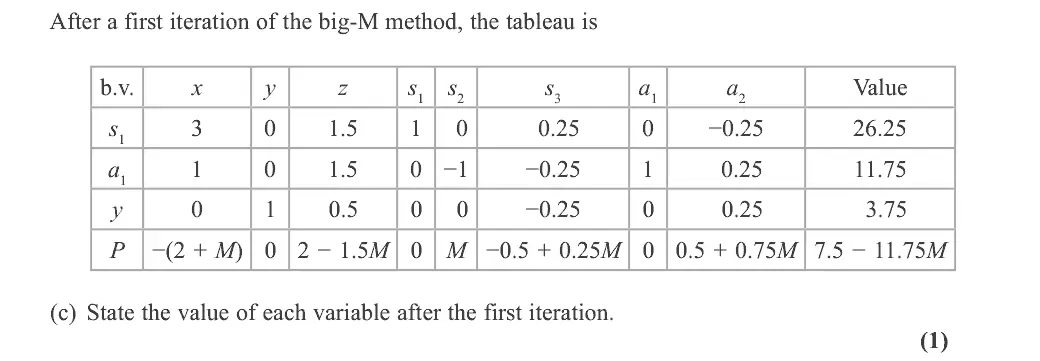
June 2019 · Paper 3D (Decision 1) · Q6(c)1 mark
Mark scheme (whole question; this part is marked with the orange bar)
Examiner's comment
In part (c) most candidates stated the correct values for the three non-zero variables although a small number made errors here. Some failed to state the value of the five zero variables and a small number of candidates either omitted one of these or added an extra one, sometimes duplicating one of the non- zero variables.
Key points from the mark scheme and examiner's report
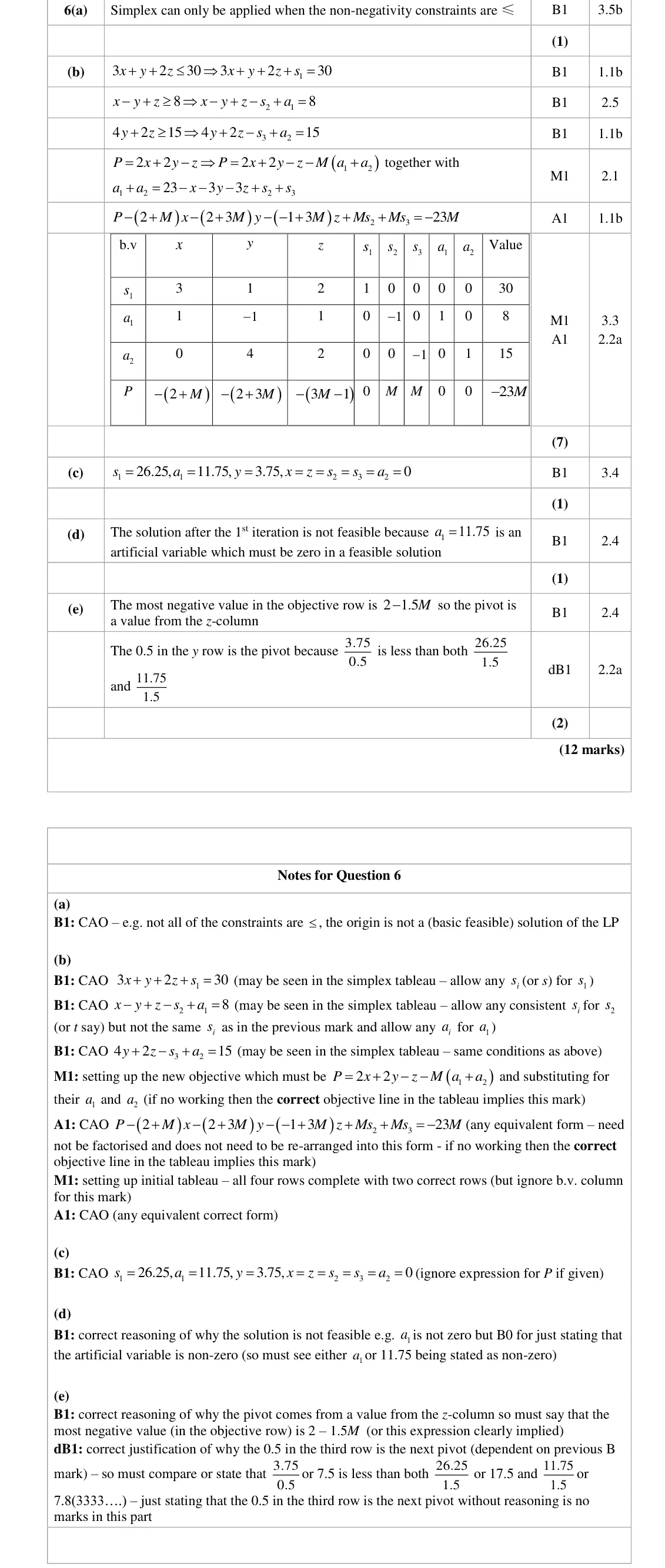
s₁ = 26.25, a₁ = 11.75, y = 3.75, x = z = s₂ = s₃ = a₂ = 0
state the zero variables too
June 2019 · Paper 3D (Decision 1) · Q6(d)1 mark
Mark scheme (whole question; this part is marked with the orange bar)
Examiner's comment
In part (d) the majority of candidates failed to give a correct reason or explanation of why the solution was not feasible, with many stating that there were negative values in the objective row or making a general comment such as “not all the artificial variables are zero” or “the sum of the artificial variables is not zero”. Other incorrect statements included “ 1a has a value”. Correct answers included “ 1a is not zero” and “ 1a = 11.75” or even a full statement to explain that 8 x y z is not satisfied with x = 0, y = 3.75 and z = 0 and therefore it is not a feasible solution.
Key points from the mark scheme and examiner's report
a₁ = 11.75 ≠ 0 and artificial variables must be zero in a feasible solution
"negative values in the objective row" scored 0
June 2019 · Paper 3D (Decision 1) · Q6(e)2 marks
Mark scheme (whole question; this part is marked with the orange bar)
Examiner's comment
In part (e) some candidates were unsure of the choice of pivot column with a significant number incorrectly choosing the x column. Some of those who chose the correct z column failed to state a reason for their choice. Of those who chose the z column and gave the correct reason, some then went on to simply stated that 0.5 had the smallest ratio value without showing the three calculations and others, who did show all their calculations correctly, stated that 7.5 was the next pivot.
Key points from the mark scheme and examiner's report
most negative entry 2 − 1.5M gives the z column
ratios 3.75/0.5 = 7.5 less than 26.25/1.5 and 11.75/1.5 so pivot 0.5 in the y row
many chose the x column or gave no ratios
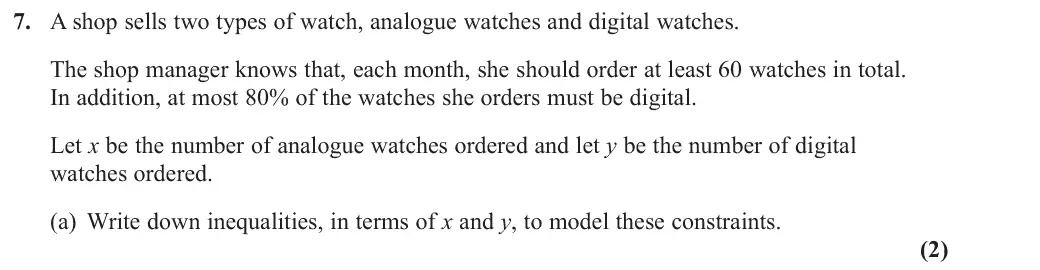
June 2019 · Paper 3D (Decision 1) · Q7(a)2 marks
Mark scheme (whole question; this part is marked with the orange bar)
Examiner's comment
In part (a) the first constraint (based on the manager ordering at least 60 watches) was usually stated correctly. The constraint which required “at most 80% of the watches to be digital” was either dealt with very well by candidates or not attempted at all with only a minority giving either the inequality or the variables transposed. Most candidates were able to draw the required lines correctly in (b) although some were unable to
Key points from the mark scheme and examiner's report
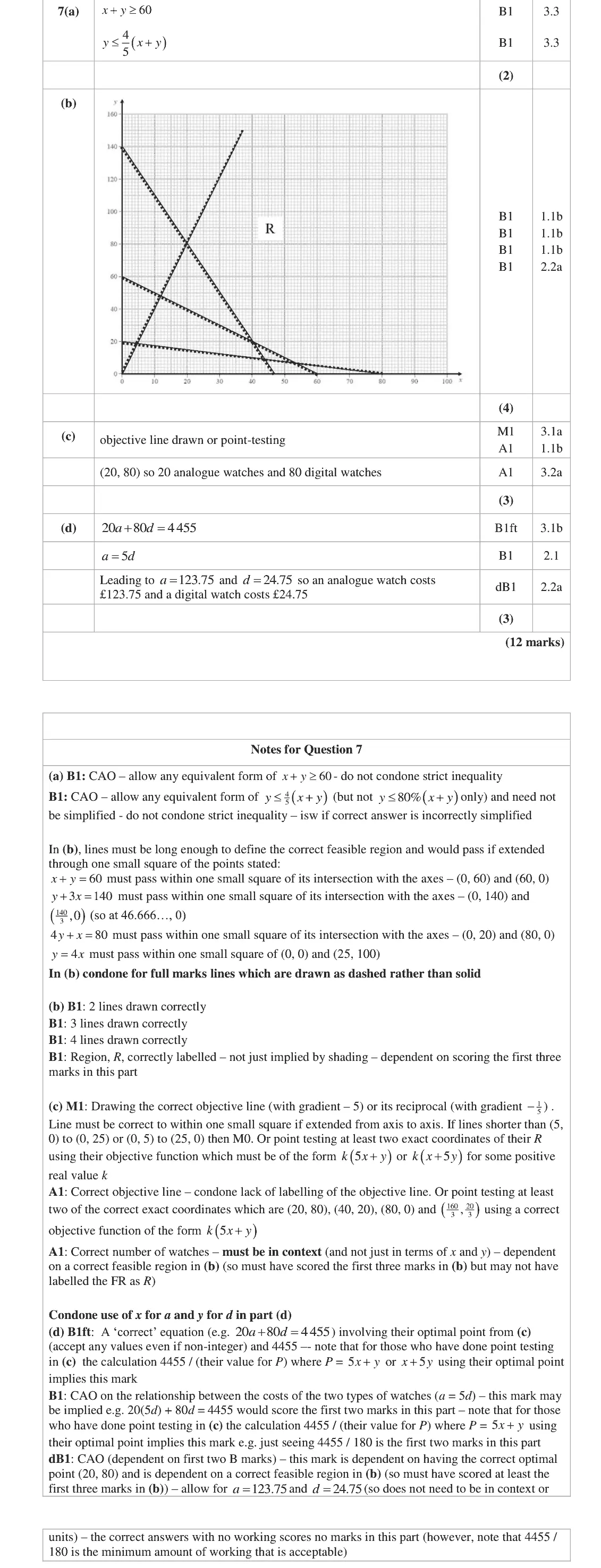
x + y ≥ 60
y ≤ 4/5(x + y) (not strict)
the 80% constraint was often omitted or transposed
June 2019 · Paper 3D (Decision 1) · Q7(b)4 marks
Mark scheme (whole question; this part is marked with the orange bar)
Examiner's comment
Most candidates were able to draw the required lines correctly in (b) although some were unable to draw lines sufficiently accurately (some drew lines without a ruler) or sufficiently long enough. As stated in previous reports on the legacy specification the following general principle should always be adopted by candidates. Lines should always be drawn which cover the entire graph paper supplied in the answer book and therefore, lines with negative gradient should always be drawn from axis to axis. The rationale behind this is that until all the lines are drawn (and shaded accordingly) it is unclear which lines (or parts of lines) will define the boundary of the feasible region. If candidates only draw the line segments that they believe define the boundary of the feasible region then examiners are unaware of the order in which the lines were drawn and therefore it is unclear to examiners why some parts of the lines have been omitted. In general, the lines and were drawn correctly. Furthermore, a 60 x y 4 y x significant number of candidates were unable to select (or even label) the correct feasible region.
Key points from the mark scheme and examiner's report
draw lines axis to axis with a ruler
y = 4x through (25, 100)
label R, not just shading
June 2019 · Paper 3D (Decision 1) · Q7(c)3 marks
Mark scheme (whole question; this part is marked with the orange bar)
Examiner's comment
In part (c) of the two possible methods that could be adopted the objective line method was predominantly the one seen and it could be argued the more appropriate for this problem. Reciprocal gradient objective lines were shown by a significant number, which of course usually meant choosing the wrong vertex. Where point testing was used there were a surprisingly large number of calculation errors. When vertices were read off the graph, they were rarely checked algebraically to confirm if they were correct. If candidates are to use point testing it would be advisable (in most cases) to find the intersection points using simultaneous equations rather than reading off the graph. Some candidates did not show a method at all and hence gained no marks in this part. A small number of candidates stated the correct values for x and y but failed to give these in terms of the number of watches the manager should order and so failed to gain the final accuracy mark in part (c). It was often the case that the final part of this question was left blank. Those candidates who did attempt (c). Many candidates in part (d) attempted to combine the two relationships, which involved the total cost of the watches and the relative costs of the two types of watches, into one step. While many candidates completed this successfully, a significant number made errors confusing analogue = 5(digital) with digital = 5(analogue). Several candidates in part (d) stated an incorrect equation that
Key points from the mark scheme and examiner's report
minimise 5x + y
objective line gradient −5 (reciprocal gradient a common error) or point testing exact vertices
(20, 80): 20 analogue and 80 digital, in context
June 2019 · Paper 3D (Decision 1) · Q7(d)3 marks
Mark scheme (whole question; this part is marked with the orange bar)
Examiner's comment
It was often the case that the final part of this question was left blank. Those candidates who did attempt this part usually scored at most two marks as they had failed to find the correct optimum point in part (c). Many candidates in part (d) attempted to combine the two relationships, which involved the total cost of the watches and the relative costs of the two types of watches, into one step. While many candidates completed this successfully, a significant number made errors confusing analogue = 5(digital) with digital = 5(analogue). Several candidates in part (d) stated an incorrect equation that related their objective function with the total cost of the watches. This meant that the equation analogue + 5(digital) = 4455 was often seen by examiners. Finally, several candidates made no use of the total cost of the watches in any part of their solution.
Key points from the mark scheme and examiner's report
20a + 80d = 4455 with a = 5d gives d = £24.75, a = £123.75
confusing a = 5d with d = 5a
often left blank
June 2018 · AS Paper 2 (Decision 1) · Q4(a)1 mark
Mark scheme (whole question; this part is marked with the orange bar)
Examiner's comment
This question proved to be very challenging for most students. Even the familiar parts of the question were not well answered and many students did not define the variables correctly. Many believed they referred to ‘cost’ or ‘time taken’ or simply stated ‘x = week one’ without referring to the fact that x is the number of cabinets produced in week 1, etc.
Key points from the mark scheme and examiner's report
x, y, z are the NUMBER of cabinets produced in weeks 1, 2, 3
"x = week 1" or cost/time answers score 0
June 2018 · AS Paper 2 (Decision 1) · Q4(b)2 marks
Mark scheme (whole question; this part is marked with the orange bar)
Examiner's comment
In (b) the inequalities were not always stated correctly but the vast majority of students got at least one correct. Often errors arose from students stating 2z <= y and the direction of the inequalities caused a number of problems too. For (c), the vast majority of students were simply unable to deal with the conversion of the 3-variable
Key points from the mark scheme and examiner's report
x + y ≤ z, z ≤ 2y, y + z ≤ 125 (with non-negativity)
2z ≤ y was a common reversal
June 2018 · AS Paper 2 (Decision 1) · Q4(c)8 marks
Mark scheme (whole question; this part is marked with the orange bar)
Examiner's comment
For (c), the vast majority of students were simply unable to deal with the conversion of the 3-variable problem to a 2-variable problem even though all the constraints had been done for the students. All students had to do was to realise that the information in the question implied that x + y + z = 150, re-write this equation in terms of z, substitute for z in the original objective function and then obtain a new objective function in terms of x and y only. The most common approach, however, was to simply ignore the z term in the objective function and to work with the constraint 250x + 275y. Some students were even more creative and eliminated z using one of the inequality constraints. Some students kept z in the objective function and ignored the fact that it was effectively then a variable and would take different values at different vertices. Most surprisingly of all, a significant number of students never stated an objective function at all. For the remaining part of this question candidate responses were split between the methods of objective line and point testing. For the objective line method, most students drew an acceptable line based on their objective function although the scale on the graph seemed to cause some difficulties. Furthermore, the often fairly complex gradients that students had produced for themselves provided a challenge for some. For those point testing, it was unfortunate that so many students took so long to calculate the coordinates of their vertices and then rounded to integer values before evaluating in the objective function. Some students calculated the coordinates of the vertices and then ruled out all vertices except (25, 50) because they were not integer-valued. There were quite a few students who did work with the exact coordinates and evaluated them correctly in the objective function but then did not consider the context that an integer solution was required. Examiners noted that a small minority of students calculated the z-values at each vertex although this also often involved premature rounding too. By the nature of the problem, even with incorrect objective functions, inaccurate objective line drawings and incorrect point testing, most students were able to get to the correct optimum vertex. The vast majority however did not give their solution in context and many forgot to reintroduce z at this point.
Key points from the mark scheme and examiner's report
substitute z = 150 − x − y to get P = 50x + 75y + 30000
optimal vertex (25, 125/3) then integer point (25, 42), rejecting (26, 41)
25, 42, 83 cabinets, £34 400
most ignored z or kept it constant
Find an Edexcel Further Maths tutor
Stuck on this? Book a trial lesson with our Further Maths tutor.