D1.5.3 The Simplex algorithm and tableau for maximising and minimising…
Section
D1.5 Linear programming
Level
A level only
Statement
The Simplex algorithm and tableau for maximising and minimising problems with ≤ constraints.
Guidance
Problems will be restricted to those with a maximum of four variables (excluding slack variables) and four constraints, in addition to non-negativity conditions.
Mark scheme (whole question; this part is marked with the orange bar)
Examiner's comment
Part (a) was generously marked and candidates earned the mark here for any indication that the origin was not a feasible solution. This was rarely explicitly stated by candidates, but often candidates were along the right track with statements such as ‘the inequalities for x, y and z should be > 0’ or even ‘because z < -3’ which was accepted here.
Key points from the mark scheme and examiner's report
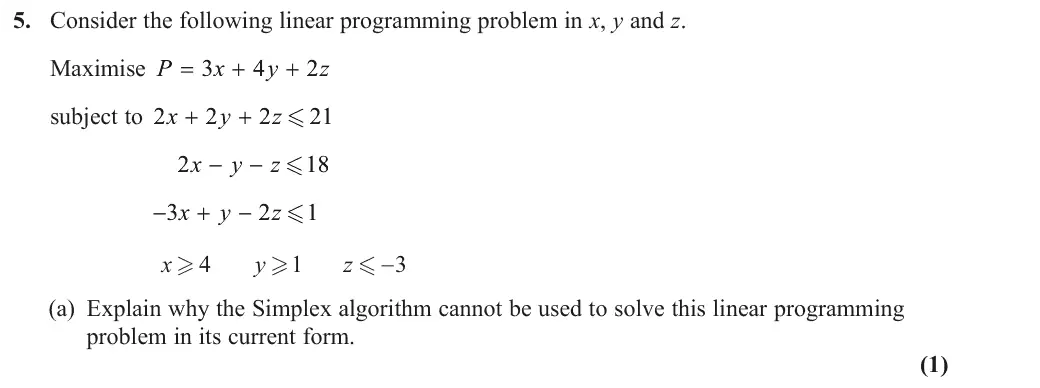
x ≥ 4, y ≥ 1, z ≤ −3 mean the origin is not feasible (Simplex needs non-negative variables and the origin as a starting solution)
June 2025 · Paper 3D (Decision 1) · Q5(b)3 marks
Mark scheme (whole question; this part is marked with the orange bar)
Examiner's comment
Part (b) was well-attempted by most candidates. Those who gave equations with slack variables rather than inequalities were only penalised with one mark and this was seen in perhaps approximately 50% of responses. In other cases, marks were usually lost for forgetting to transform the objective function in terms of Q, or for algebraic slips made in the simplification of the substitutions.
Key points from the mark scheme and examiner's report
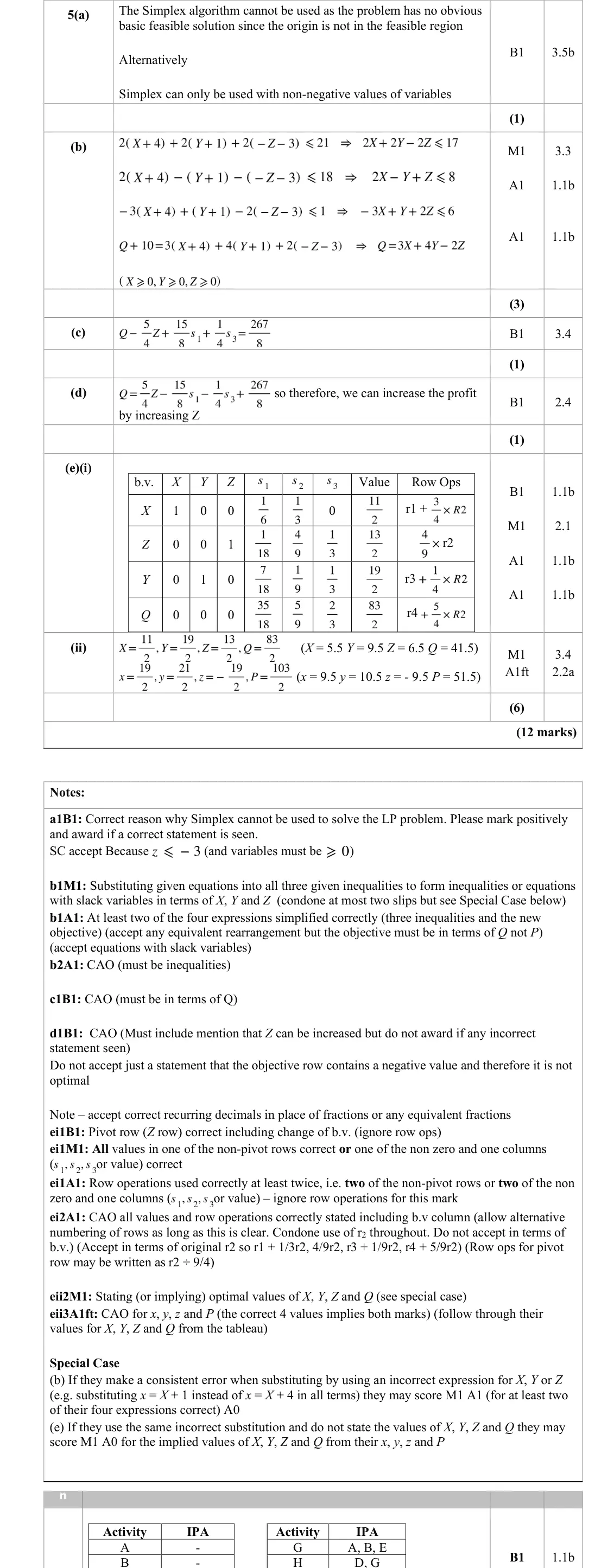
2X + 2Y − 2Z ≤ 17, 2X − Y + Z ≤ 8, −3X + Y + 2Z ≤ 6
maximise Q = 3X + 4Y − 2Z
X, Y, Z ≥ 0
give inequalities, not equations
objective must be in Q
June 2025 · Paper 3D (Decision 1) · Q5(c)1 mark
Mark scheme (whole question; this part is marked with the orange bar)
Examiner's comment
Part (c) was not as well answered, and many candidates were unable to successfully extract the profit equation from the tableau. Often there were sign errors or a missing ‘Q’, or indeed no attempt made.
Key points from the mark scheme and examiner's report
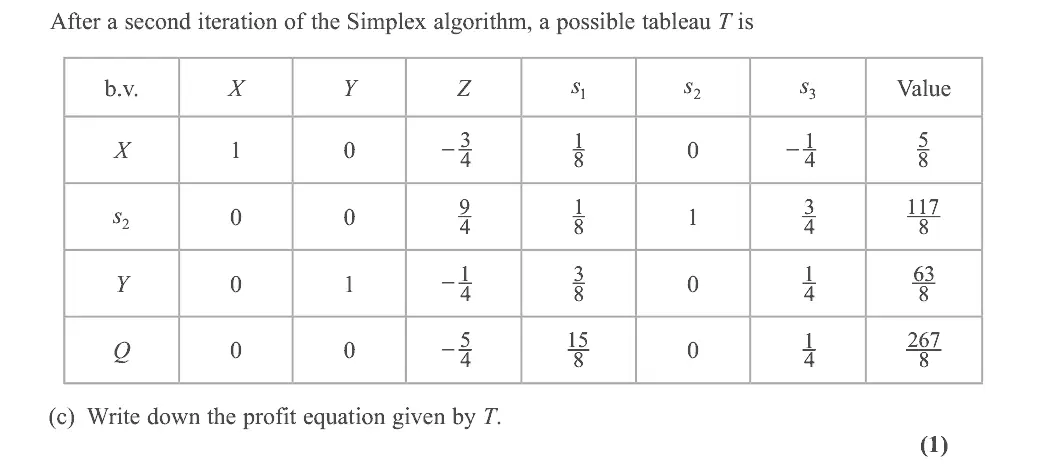
Q − (5/4)Z + (15/8)s₁ + (1/4)s₃ = 267/8
sign errors and missing Q common
June 2025 · Paper 3D (Decision 1) · Q5(d)1 mark
Mark scheme (whole question; this part is marked with the orange bar)
Examiner's comment
Part (d) was also challenging for most candidates. Overwhelmingly, candidates referred to ‘a negative in the profit row’ or stated that ‘Z is negative’ and some others stated that ‘increasing Z will decrease profit so not optimal’. It was rare to see a correct response given.
Key points from the mark scheme and examiner's report
Q = 267/8 + (5/4)Z − …, so increasing Z increases Q
"negative in the profit row" or "Z is negative" scored 0
June 2025 · Paper 3D (Decision 1) · Q5(e)6 marks
Mark scheme (whole question; this part is marked with the orange bar)
Examiner's comment
The tableau in part (e) was generally well attempted. There were some blank tableaux seen but, in most cases, candidates were able to at least complete the pivot row correctly. There were some numerical errors seen and occasional issues with the statement of row operations (but this seemed greatly improved on previous series). From time to time the bottom row of the tableau was missing and it is unclear whether this was due to a lack of understanding or a lack of time. In (e)(ii) candidates were asked to find the optimum value of P and the corresponding values of x, y, z. In most cases candidates were able to read off values for Q, X, Y and Z correctly from the tableau and only very rarely were e.g. X = Y = Z = 0 seen (taken from the bottom row). Occasionally however, candidates forgot that the tableau was in terms of X, Y, Z and Q rather than x, y, z and P and so lost marks for stating e.g. P = 83/2. Others made mistakes making the simple transformations of values from the tableau back into values for x, y, and z and sometimes one or more of the values were omitted which lost both marks here. Either decimal or fraction form was accepted here, and both were equally seen and equally accurate.
Key points from the mark scheme and examiner's report
pivot 9/4 in the s₂ row (Z column)
row operations stated
X = 11/2, Y = 19/2, Z = 13/2, Q = 83/2, so x = 9.5, y = 10.5, z = −9.5, P = 51.5
convert back to x, y, z and P
June 2025 · Paper 4D (Decision 2) · Q6(c)4 marks
Mark scheme (whole question; this part is marked with the orange bar)
Examiner's comment
intersection. Most stated the strategy based on their calculated value of p. In part (c) most candidates who attempted this, augmented the table by either 5 or 6 and then attempted to form the relevant equations for the tableau. However, some incorrectly used the rows of the table instead of the columns. In part (d) several candidates who attempted this, only calculated one
Key points from the mark scheme and examiner's report
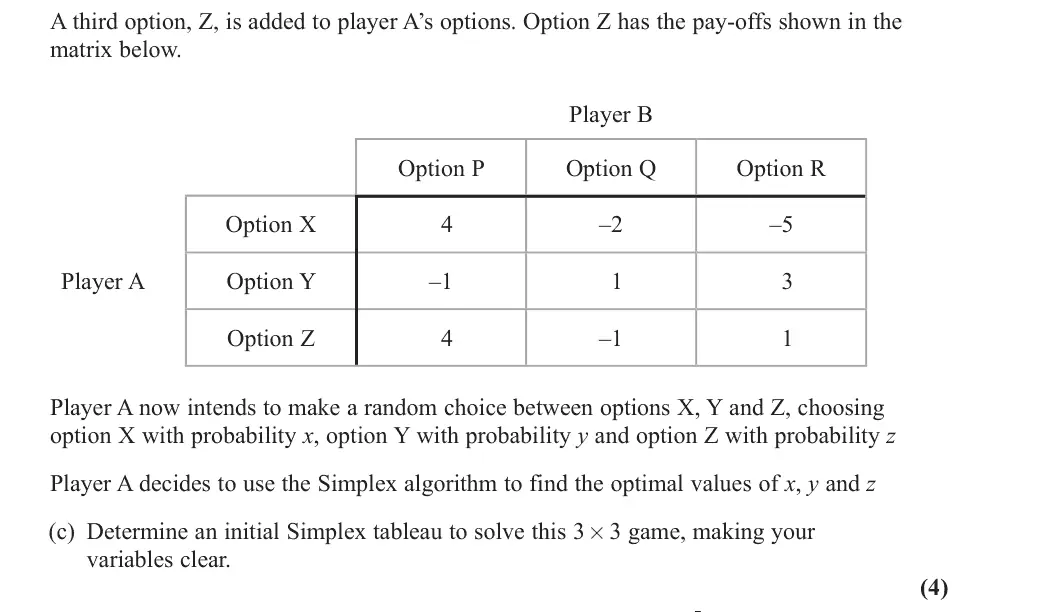
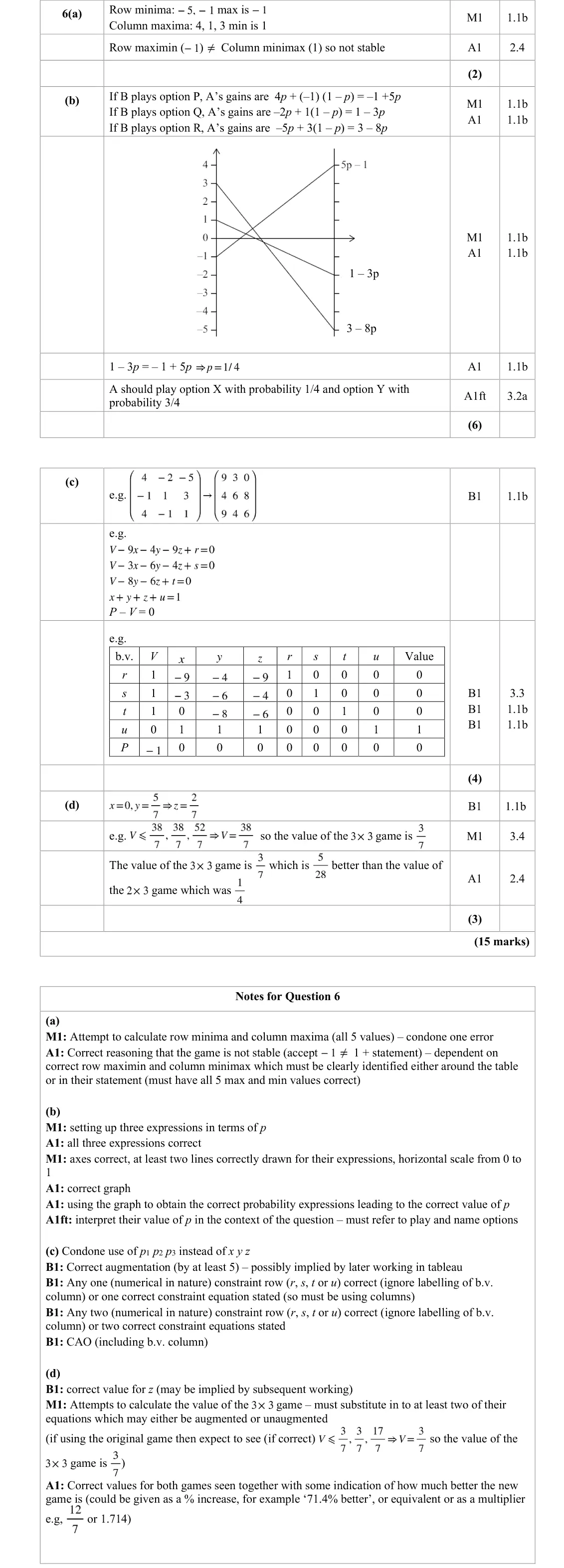
add 5 (or more) to every pay-off
equations from columns: V − 9x − 4y − 9z + r = 0, V − 3x − 6y − 4z + s = 0, V − 8y − 6z + t = 0, x + y + z + u = 1
objective P − V = 0
using rows instead of columns lost marks
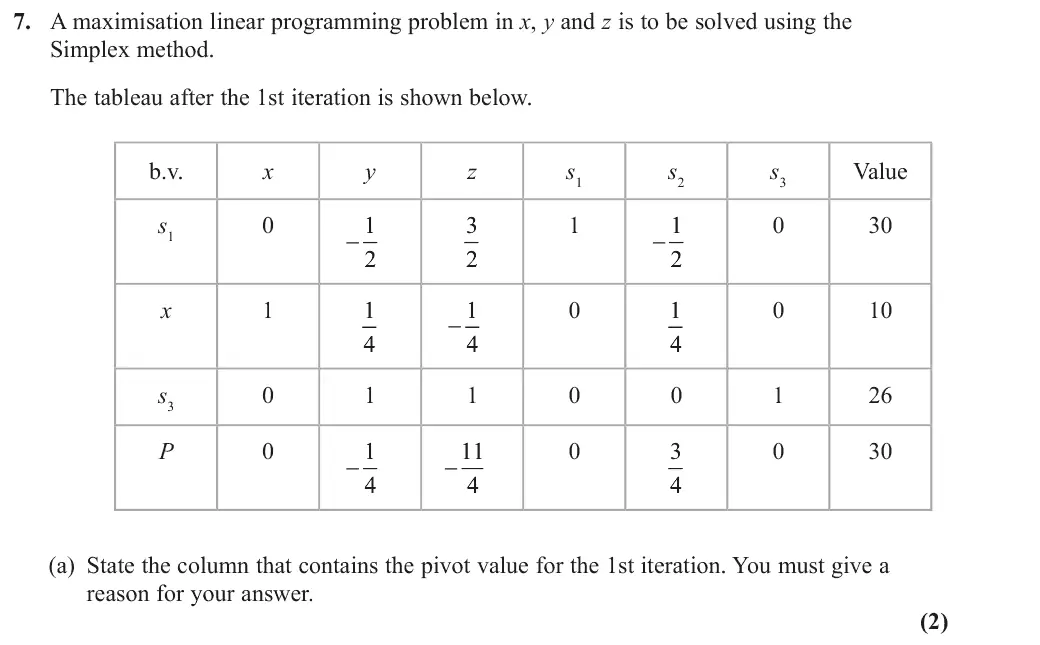
June 2024 · Paper 3D (Decision 1) · Q7(a)2 marks
Mark scheme (whole question; this part is marked with the orange bar)
Examiner's comment
This question was attempted by most candidates, suggesting that they were able to complete the paper in time. Many candidates appeared unsure about parts (a) and (b) but were able to gain marks in the later parts. Part (a) was frequently misunderstood with candidates indicating the next pivot, z, rather than the previous one, x. However, it was encouraging to see a minority of candidates rethinking their answer, crossing out z and restarting with x, perhaps after starting to attempt (b). It was quite common to see candidates state x but have difficulty expressing a correct reason, losing one mark.
Key points from the mark scheme and examiner's report
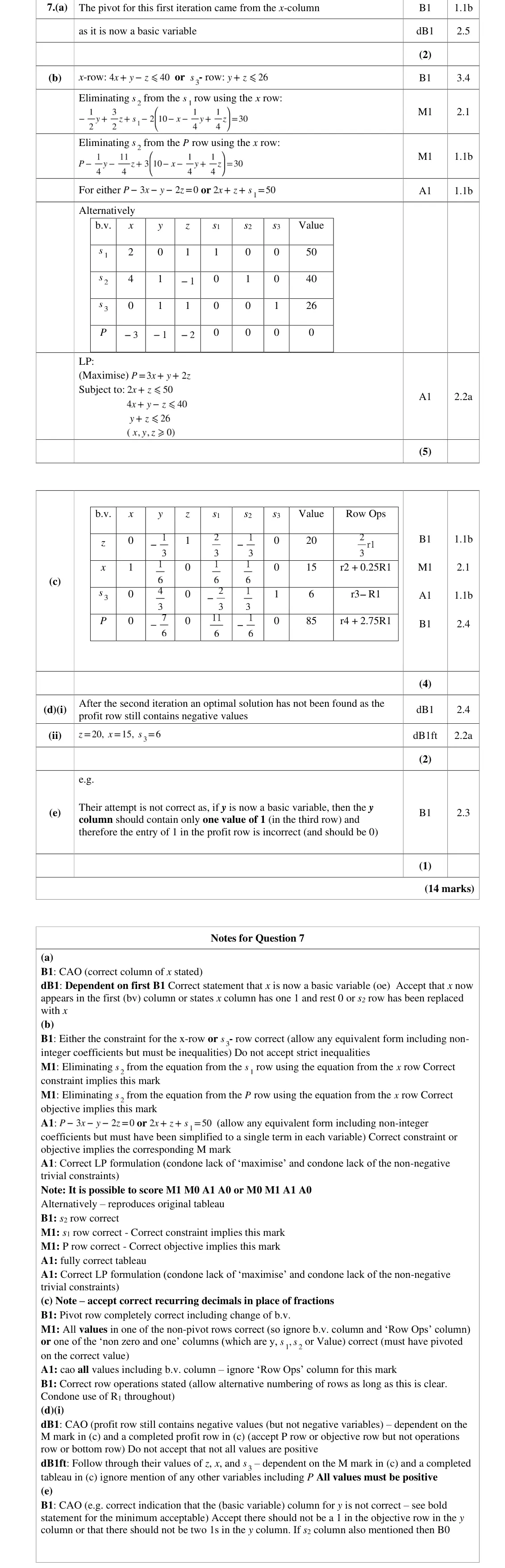
the x column, as x is now a basic variable (s₂ row replaced by x)
many named z, the next pivot
June 2024 · Paper 3D (Decision 1) · Q7(b)5 marks
Mark scheme (whole question; this part is marked with the orange bar)
Examiner's comment
This question was attempted by most candidates, suggesting that they were able to complete the paper in time. Many candidates appeared unsure about parts (a) and (b) but were able to gain marks in the later parts. Part (b) proved to be the most challenging part of the paper. It was evident that many candidates found it difficult, or impossible, to apply their knowledge to work backwards towards the initial tableau. Some recognised how to deduce two constraints, and/or , from the tableau rows involving one slack variable only, gaining just one mark for either. Examiners commented that a remarkable proportion of candidates failed to multiply the RHS of the first constraint, so they often saw “ ”. A pleasing number of candidates were successful though, using one of two possible methods, either reverse row operations or the algebraic approach eliminating s2 from equations for the third constraint and the objective. Some used a hybrid of the two methods but got there in the end.
Key points from the mark scheme and examiner's report
x-row gives 4x + y − z ≤ 40, s₃ row y + z ≤ 26
eliminate s₂ from the s₁ and P rows: 2x + z ≤ 50, maximise P = 3x + y + 2z
hardest part of the paper
June 2024 · Paper 3D (Decision 1) · Q7(c)4 marks
Mark scheme (whole question; this part is marked with the orange bar)
Examiner's comment
This question was attempted by most candidates, suggesting that they were able to complete the paper in time. Many candidates appeared unsure about parts (a) and (b) but were able to gain marks in the later parts. Part (c) was a routine application of the Simplex algorithm, with many candidates able to gain all four marks, or losing just one due to an arithmetic error. Most wrote the row operations correctly though some were not fully expressed and lost a mark, as they had actually used the correct operations. Rather than retaining fractions some candidates expressed numbers as terminating decimals, which meant they lost an accuracy mark.
Key points from the mark scheme and examiner's report
most negative −11/4 in the z column, pivot 3/2 in the s₁ row
row operations r2 + 0.25R1, r3 − R1, r4 + 2.75R1
keep fractions
June 2024 · Paper 3D (Decision 1) · Q7(d)2 marks
Mark scheme (whole question; this part is marked with the orange bar)
Examiner's comment
This question was attempted by most candidates, suggesting that they were able to complete the paper in time. Many candidates appeared unsure about parts (a) and (b) but were able to gain marks in the later parts. In part (d) almost all candidates, who had completed tableau T, recognised the significance of negatives in the profit row and most went on to correctly state the values of the basic variables. The more able just stated the three values required, but those that also stated the value of P and/or the other non-basic variables were not penalised. Some incorrect language was seen here, with candidates just referring to the bottom row and this was penalised.
Key points from the mark scheme and examiner's report
profit row still has a negative entry (−7/6 for y) so not optimal
z = 20, x = 15, s₃ = 6
"bottom row" not accepted
June 2024 · Paper 3D (Decision 1) · Q7(e)1 mark
Mark scheme (whole question; this part is marked with the orange bar)
Examiner's comment
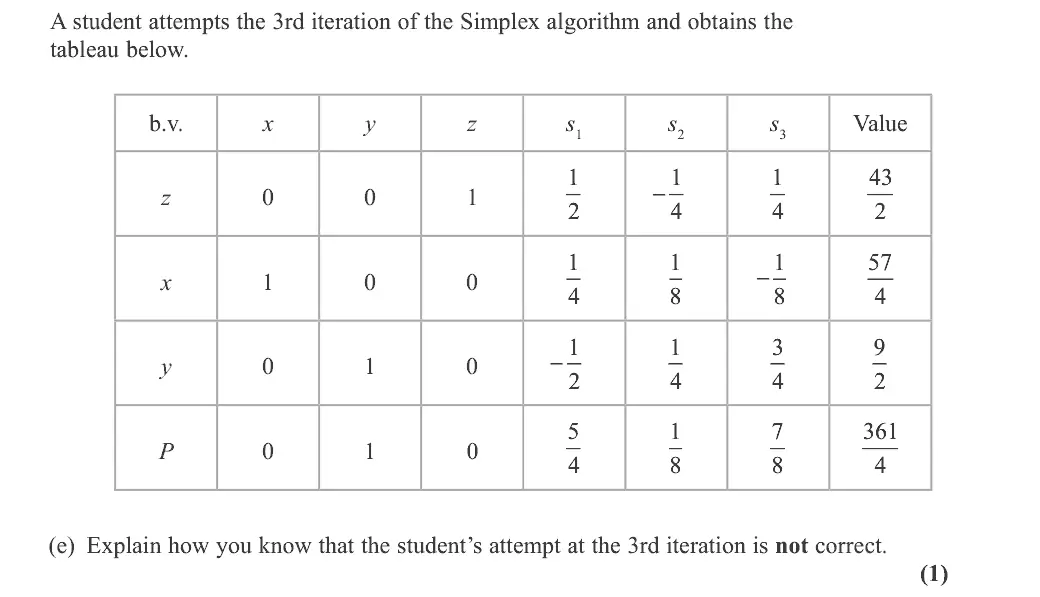
This question was attempted by most candidates, suggesting that they were able to complete the paper in time. Many candidates appeared unsure about parts (a) and (b) but were able to gain marks in the later parts. In part (e) a good proportion of candidates offered an explanation here. Most spotted the error and were able to describe it, some clearly and concisely, other in a rambling fashion.
Key points from the mark scheme and examiner's report
y is basic so its column must be a unit column: the 1 in the profit row should be 0
June 2024 · Paper 4D (Decision 2) · Q7(b)5 marks
Mark scheme (whole question; this part is marked with the orange bar)
Examiner's comment
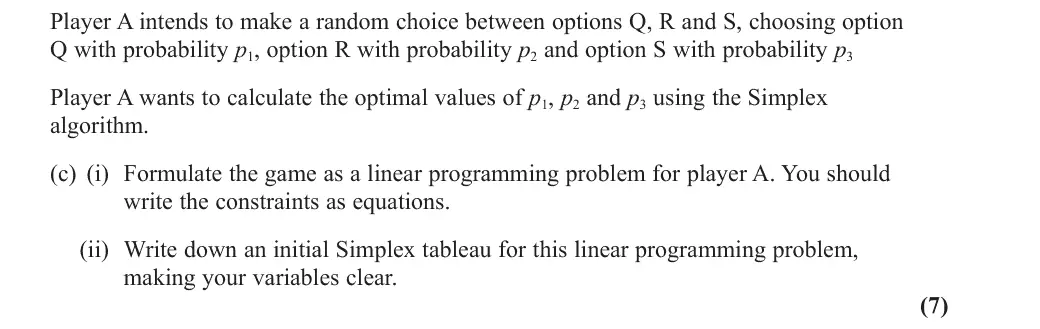
A significant number of candidates were able to make good progress with this question, with minima or by failing to show their working. In (b) the majority of candidates were able to augment the matrix correctly and attempted to form inequalities or equation in terms of V, p1. p2 and p3 although some used rows instead of columns. A good number of candidates then correctly set up the initial tableau. In (c), candidates generally wrote down the correct
Key points from the mark scheme and examiner's report
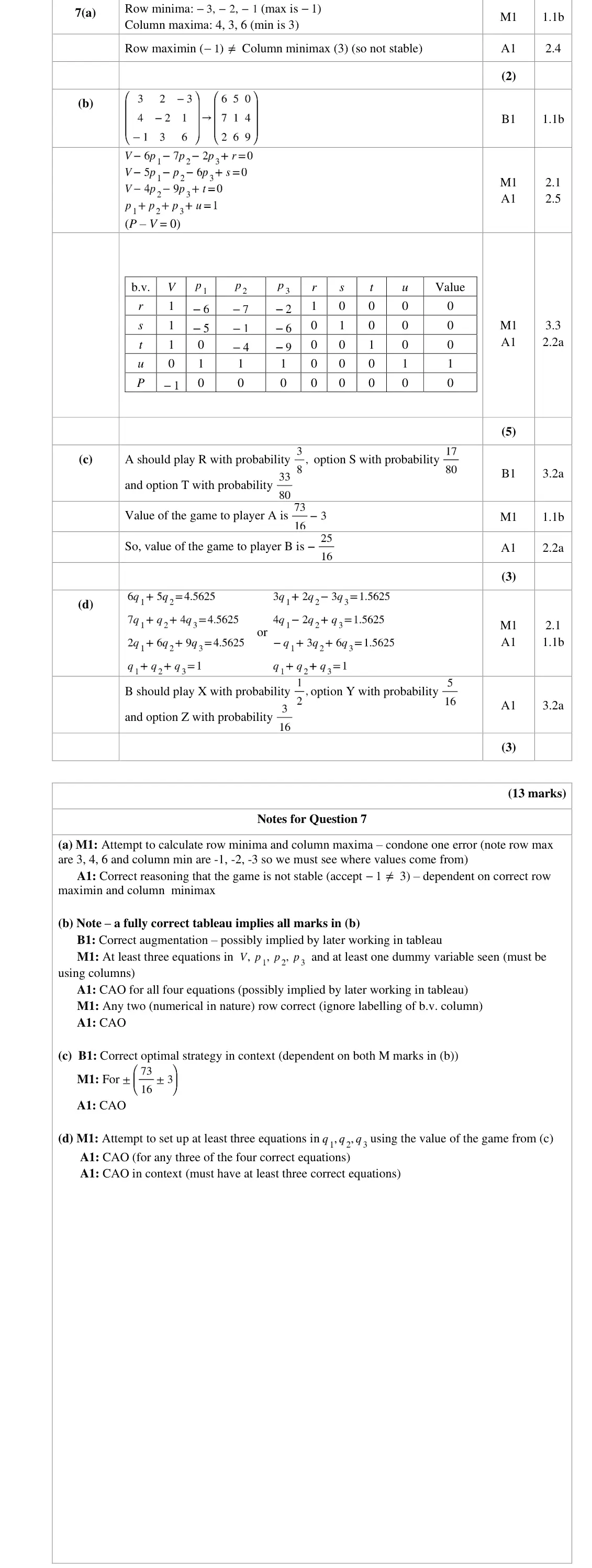
add 3 to every entry
equations from columns: V − 6p1 − 7p2 − 2p3 + r = 0, V − 5p1 − p2 − 6p3 + s = 0, V − 4p2 − 9p3 + t = 0, p1 + p2 + p3 + u = 1
objective row P − V = 0
using rows instead of columns was a common error
June 2023 · Paper 3D (Decision 1) · Q7(c)5 marks
Mark scheme (whole question; this part is marked with the orange bar)
Examiner's comment
Almost all candidates attempted this question, though it seemed that some ran out of time part way through. Only a few candidates gained full marks. There were several common mistakes column. The answer to part (c) was independent of the earlier parts of the question, providing an opportunity for those who had struggled previously to still make progress. Most candidates appeared well prepared in performing an iteration of the Simplex method, so many gained all five marks or lost just one mark due to a computational slip. There were some tables left blank, possibly due to timing issues. Only a handful of candidates chose the wrong pivot. Many candidates gained the mark in part (d)(i) for reading off the correct answer of £20 500
Key points from the mark scheme and examiner's report
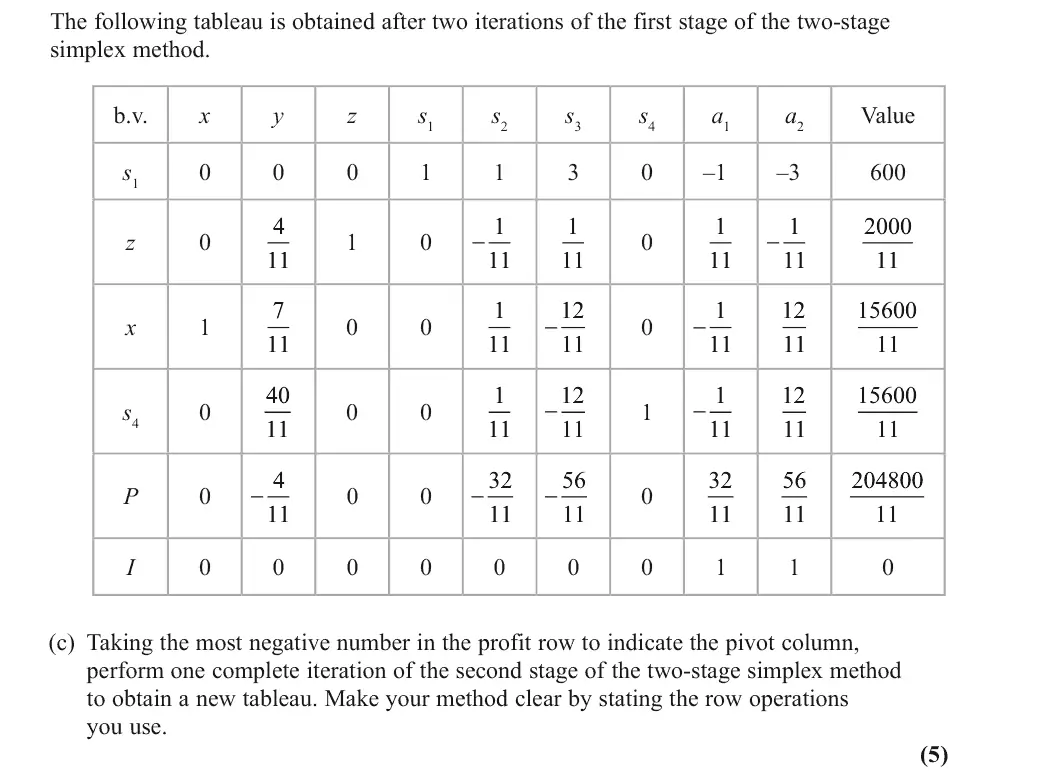
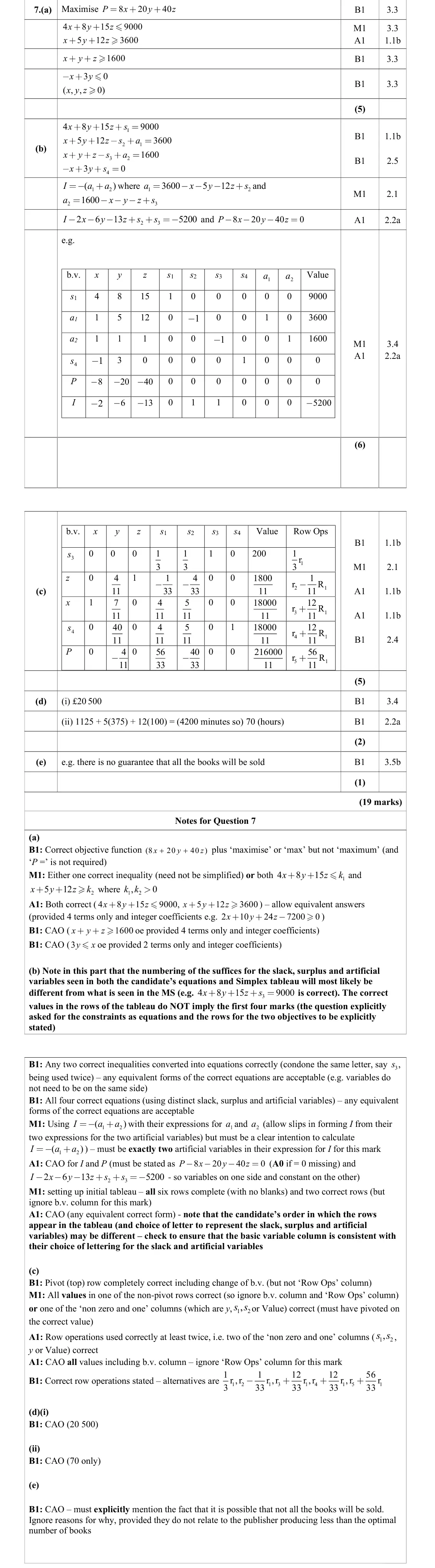
most negative is −56/11 in the s₃ column, pivot 3 in the s₁ row (s₃ enters, s₁ leaves)
state row operations
P = 216000/11
June 2023 · Paper 3D (Decision 1) · Q7(d)2 marks
Mark scheme (whole question; this part is marked with the orange bar)
Examiner's comment
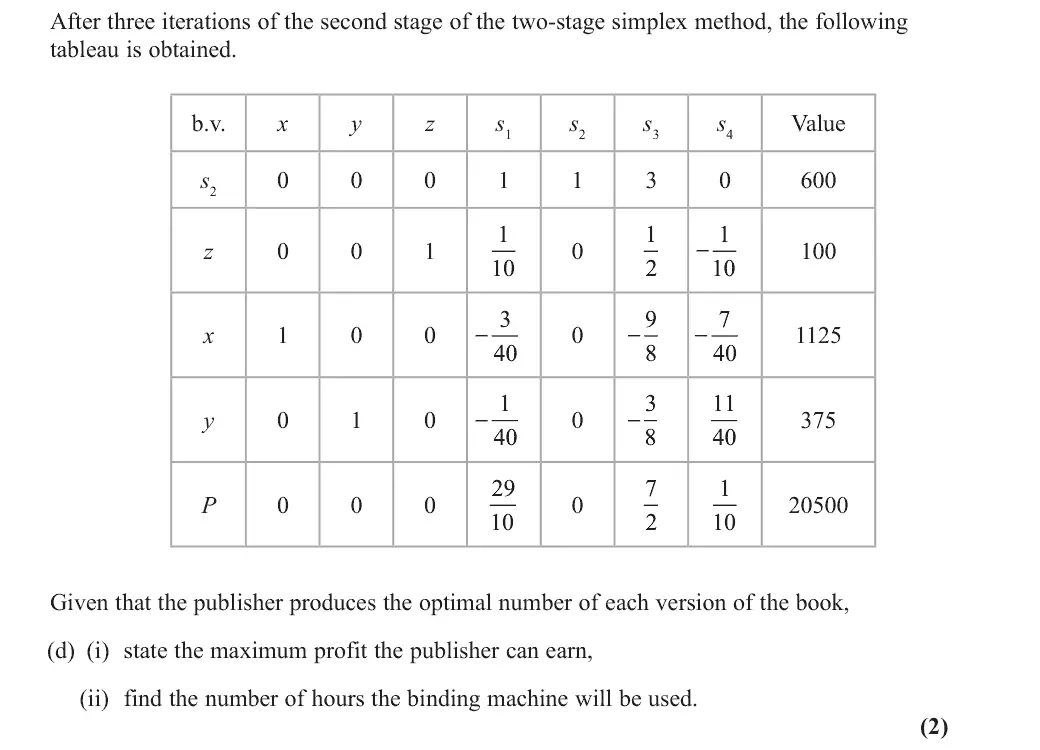
Almost all candidates attempted this question, though it seemed that some ran out of time part way through. Only a few candidates gained full marks. There were several common mistakes Many candidates gained the mark in part (d)(i) for reading off the correct answer of £20 500 from the given table. For part (d)(ii) some candidates correctly calculated the time in minutes but lost the mark for failing to convert their answer to the requested hours. A pleasing number of candidates earned the final mark in (e), but a significant proportion gave spurious
Key points from the mark scheme and examiner's report
read P = £20 500
binding time 1125 + 5(375) + 12(100) = 4200 minutes = 70 hours (convert to hours)
June 2023 · Paper 4D (Decision 2) · Q8(c)7 marks
Mark scheme (whole question; this part is marked with the orange bar)
Examiner's comment
Candidates’ attempts at this question gained marks across the full range.. Most candidates attempted to find the row minima and column maxima, although a small number found the row maxima and column minima, and then stated that the row maximin was not equal to the column minimax. Some candidates failed to clearly identify the maximin and minimax values and a few failed to show all the minima and maxima and were penalised. Most candidates realised that Option Q was always better than Option T, but a number failed to use the word dominate in their explanation and were penalised. Some candidates failed to list the three comparative inequalities to justify their explanation. Many candidates correctly augmented the table (either by adding 3 or 4) and attempted to set up the problem by writing down a series of constraints. Some candidates only listed these as inequalities instead of equations. A small number of candidates incorrectly used rows instead of columns to form their constraints. Most candidates wrote down the objective function, but a number omitted to state maximise with this. When writing the probability constraint, a number of candidates incorrectly set this equal to zero. Many candidates attempted to complete the simplex tableau, although some included errors from their earlier working. A very small number of candidates recognised that Option Y dominated Option Z for Player B and reduced the problem further at this stage, before writing down their constraints and completing the tableau. In part d, there were two alternative approaches seen, both of which produced fully correct solutions. Some candidates calculated the value of p3 and then used this to calculate the value of the game by considering all three options for B. Some candidates only used one option for B to obtain a possible value for the game and were penalised here. Candidates then defined probabilities for Player B, setting up and solving these correctly. They then stated the correct strategy for B, although a small number failed to state that B never plays Option Z. With the alternative approach, candidates recognised that Option Y dominated Option Z for B and reduced the problem accordingly. These candidates then defined probabilities for Player B, set up a pair of expressions or equations and solved these. Again, candidates stated the optimum strategy for B.
Key points from the mark scheme and examiner's report
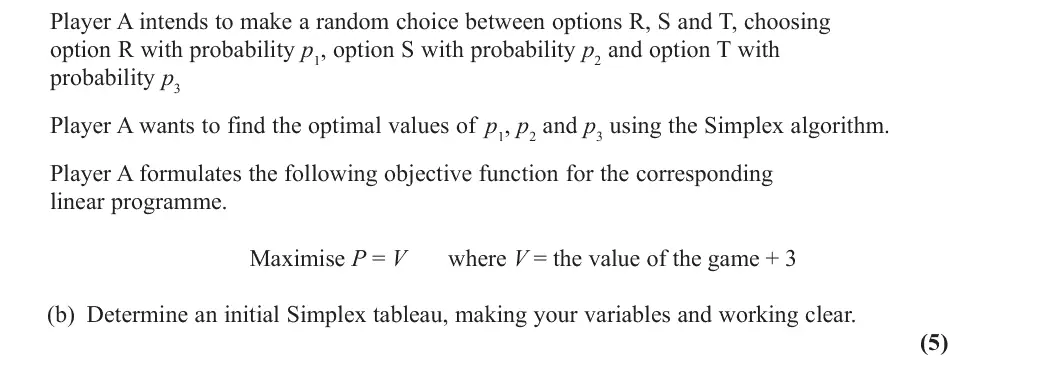
delete T, add 3 to make all values non-negative
maximise P = V
V − 5p2 − 7p3 + r = 0, V − 5p1 − 2p2 − p3 + s = 0, V − 8p1 − 3p2 − 2p3 + t = 0 (columns, not rows), p1 + p2 + p3 + u = 1
initial tableau with P − V = 0
June 2022 · Paper 3D (Decision 1) · Q7(a)5 marks
Mark scheme (whole question; this part is marked with the orange bar)
Examiner's comment
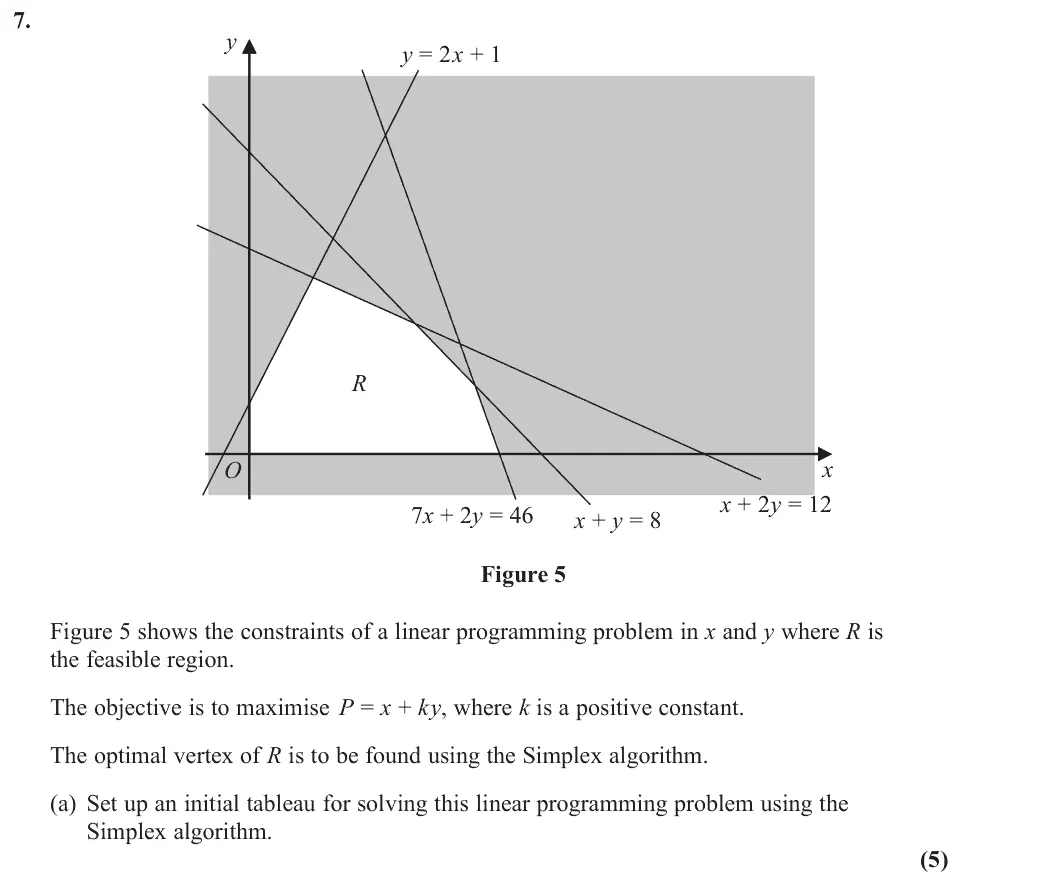
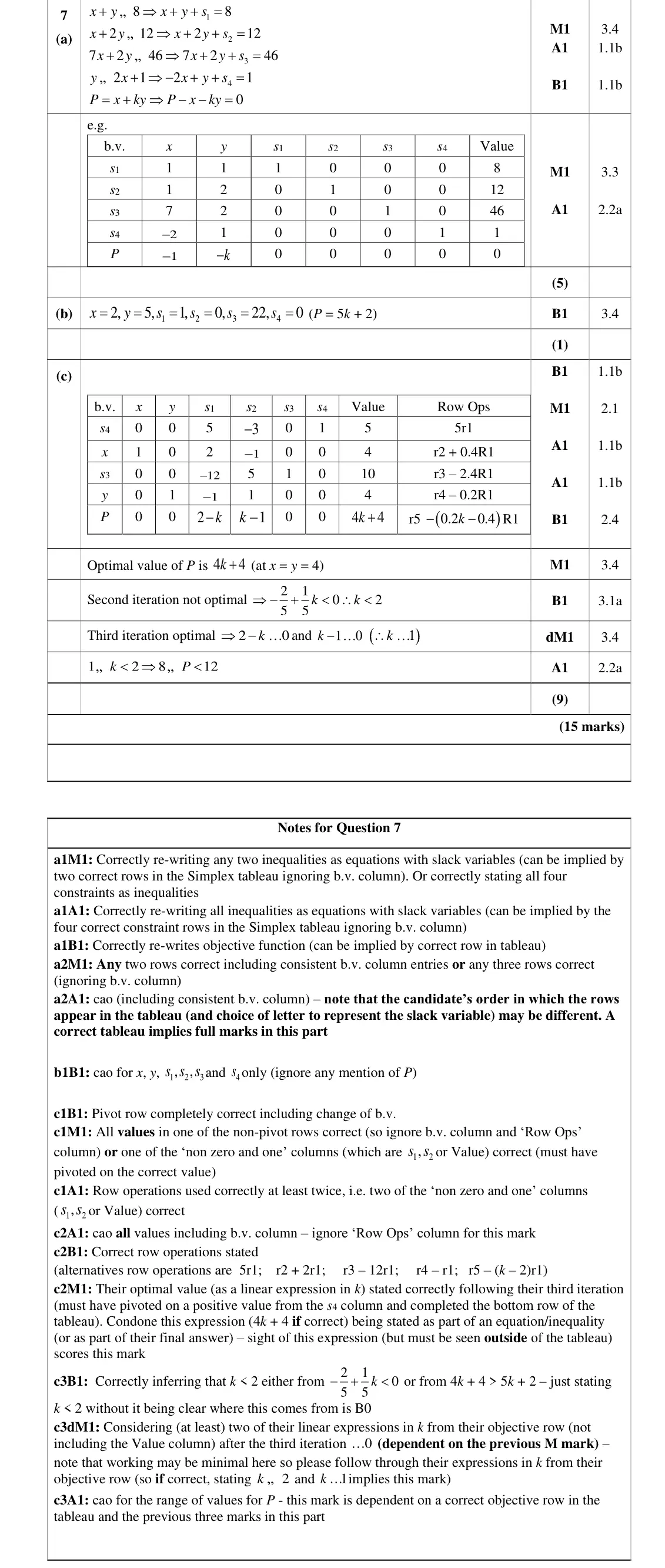
Candidates found this to be one of the most challenging questions on the paper, with very few candidates scoring full marks. Each part of this question was independent of each other and therefore candidates who performed poorly, or didn’t attempt some parts, were in some cases still able to score on other parts of the question. For (a), many candidates chose not to write down the equations for the feasible region, choosing otherwise to complete the tableau immediately. For these candidates, the tableau had to be completely correct, whereas those candidates who had written down their equations with slack variables could gain some credit for these even if their tableau was incorrect. There were obviously many correct variations other than the one shown in the mark scheme which were perfectly acceptable, as the order of equations was not specified in the question. The main errors in the tableau involved sign errors, usually in the objective line or in the inequality 2 1 y x - „ where several candidates failed to appreciate that negative values are not acceptable.
Key points from the mark scheme and examiner's report
read the four constraints from Figure 5: x + y ≤ 8, x + 2y ≤ 12, 7x + 2y ≤ 46, y − 2x ≤ 1 with slacks
P − x − ky = 0 objective row
June 2022 · Paper 3D (Decision 1) · Q7(b)1 mark
Mark scheme (whole question; this part is marked with the orange bar)
Examiner's comment
Candidates found this to be one of the most challenging questions on the paper, with very few candidates scoring full marks. Each part of this question was independent of each other and therefore candidates who performed poorly, or didn’t attempt some parts, were in some cases still able to score on other parts of the question. Most candidates gained the mark in (b). The most common error was omitting non-basic variables from the list and in a few cases adding in an extra z variable.
Key points from the mark scheme and examiner's report
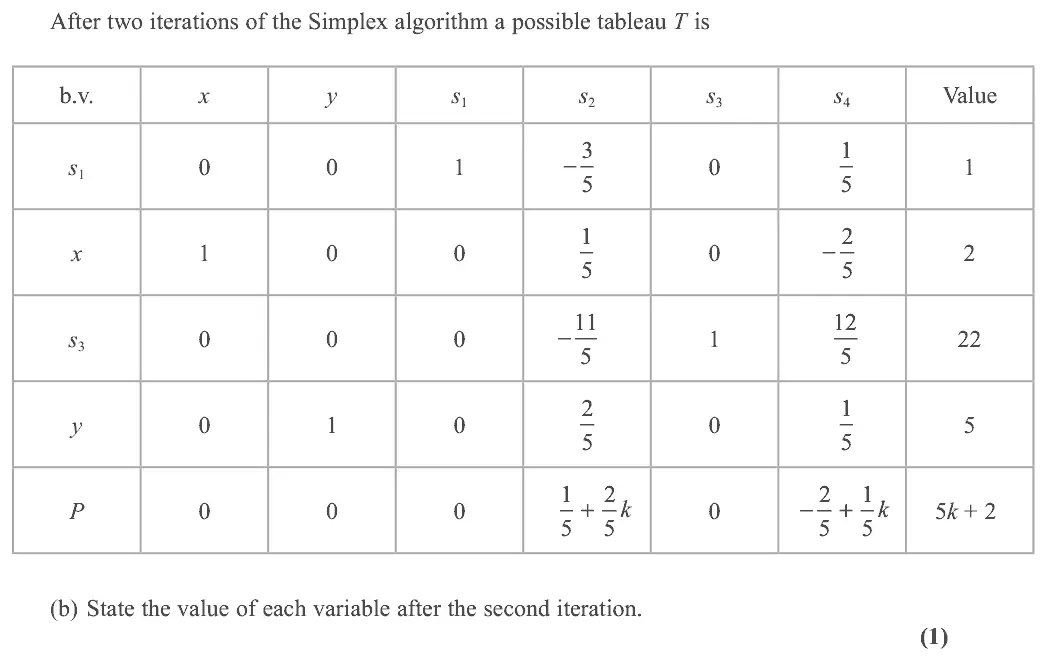
x = 2, y = 5, s₁ = 1, s₃ = 22, s₂ = s₄ = 0
non-basic variables often omitted
June 2022 · Paper 3D (Decision 1) · Q7(c)9 marks
Mark scheme (whole question; this part is marked with the orange bar)
Examiner's comment
Candidates found this to be one of the most challenging questions on the paper, with very few candidates scoring full marks. Each part of this question was independent of each other and therefore candidates who performed poorly, or didn’t attempt some parts, were in some cases still able to score on other parts of the question. For (c), performing the iteration of the Simplex algorithm at the beginning of this part was generally well done. The vast majority used the correct pivot and so were able to make some progress, and most gained the mark for expressing their row operations correctly. A significant number of candidates gained partially correct solutions with errors on the objective row, some minor and some leaving values out, presumable because they did not know how to deal with the variable in this row. A few candidates chose a negative pivot and so therefore scored very few marks in this part. Whilst most candidates were confident with the mechanics of applying the Simplex algorithm, very few were able to show that they fully understood how simplex worked to get the correct range of values for P. Many candidates did not attempt this, and of those who did, many did not make their working clear. Most who attempted this seemed to be either unclear about whether their inequality should be strict or not or tried to skip steps in their method in order to reach a solution. Therefore most failed to realise that k < 2 (from the knowledge that one of the entries in the pivot row of T must be negative), rather than 2 k „ (from the fact that all the entries in their pivot row of their final tableau must be non-negative), leading to P < 12 rather than 12. P „ Fully correct solutions to this question were therefore extremely rare. 8
Key points from the mark scheme and examiner's report
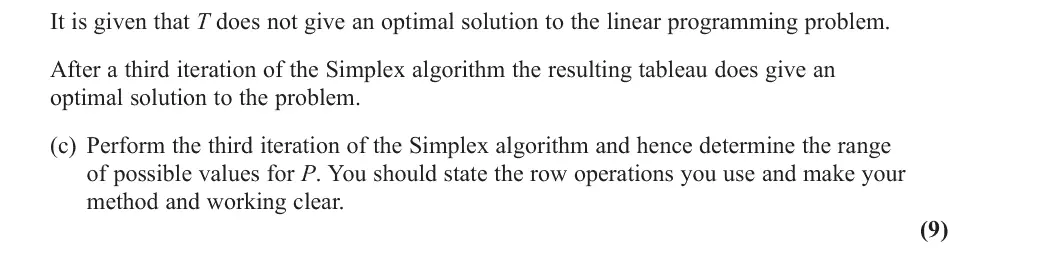
pivot on 1/5 in the s₄ column (s₁ row)
optimal P = 4k + 4 at (4, 4)
T not optimal gives k < 2, new tableau optimal gives k ≥ 1
so 8 ≤ P < 12
objective row with k was the main difficulty
June 2022 · Paper 4D (Decision 2) · Q7(d)7 marks
Mark scheme (whole question; this part is marked with the orange bar)
Examiner's comment
Almost all candidates found parts of this question challenging, so that very few gained full marks. In parts
Key points from the mark scheme and examiner's report
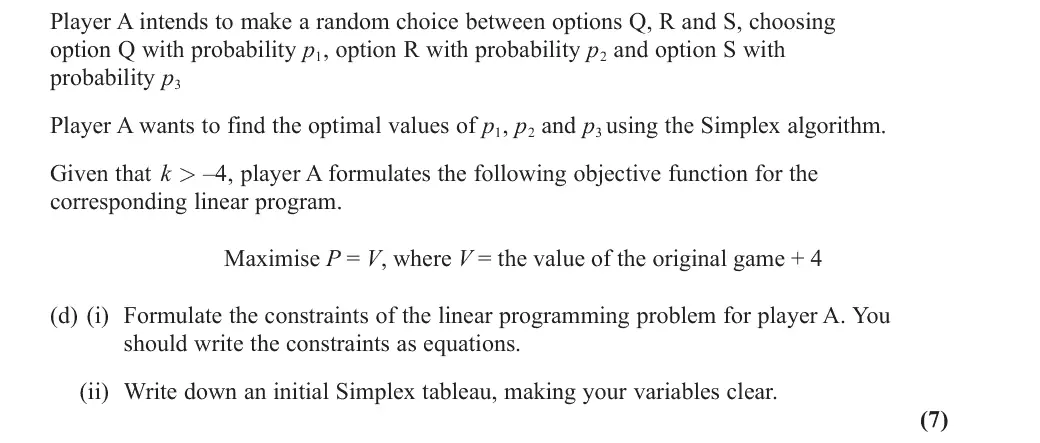
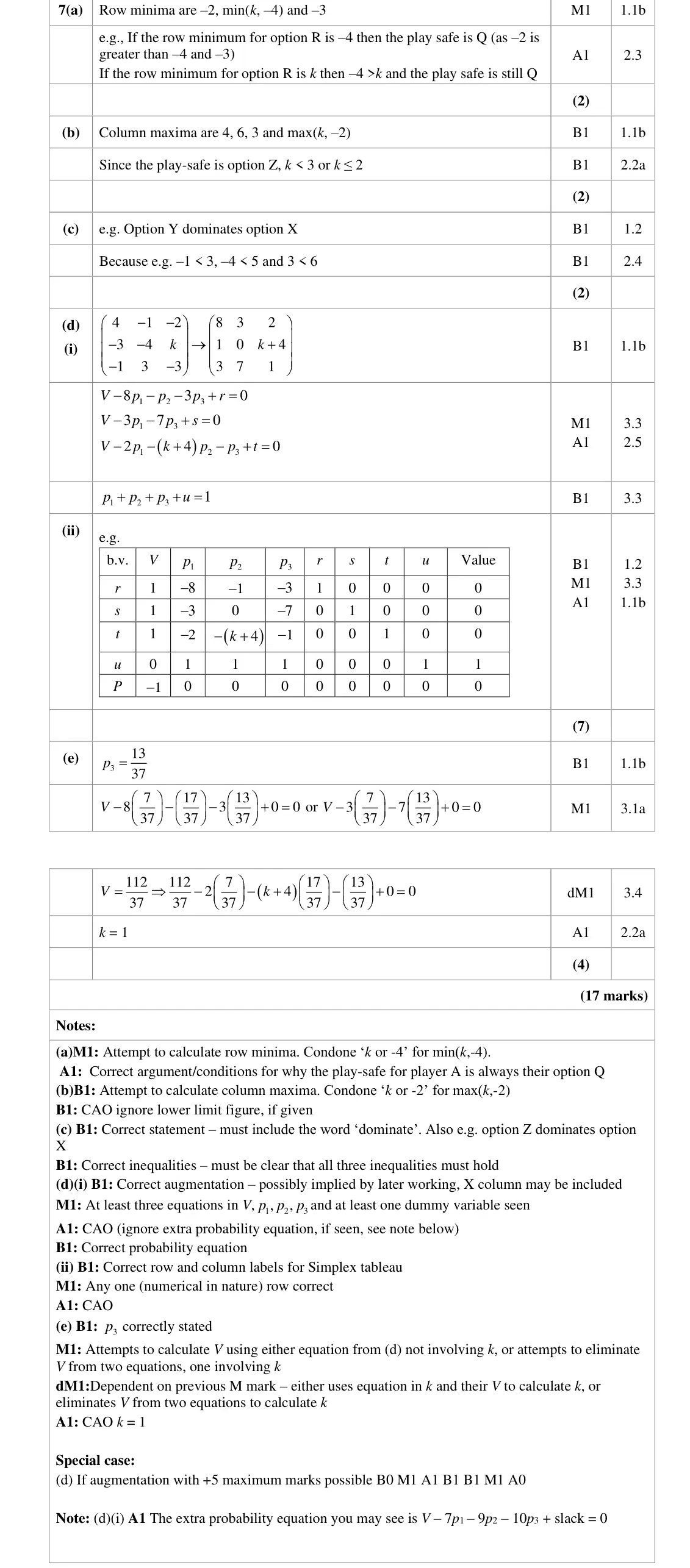
delete X and add 4: columns (8, 1, 3), (3, 0, 7), (2, k + 4, 1)
V − 8p1 − p2 − 3p3 + r = 0, V − 3p1 − 7p3 + s = 0, V − 2p1 − (k + 4)p2 − p3 + t = 0, p1 + p2 + p3 + u = 1
tableau with P − V = 0
using rows not columns or not deleting X were common errors
Nov 2021 · Paper 3D (Decision 1) · Q8(c)2 marks
Mark scheme (whole question; this part is marked with the orange bar)
Examiner's comment
It wasn’t obvious if time was a factor in why a few attempts at the final question were left blank or whether it was the demand(s) of the question itself. Most candidates who did attempt this part (c) but didn’t give sufficient detail for why the 5 in the 2s row was the pivot. In part (d) many attempted the iteration of the second stage, and while some got the correct values of x, y, and z, many did not give their final answer in the context of the number of hours spent swimming, cycling, and running.
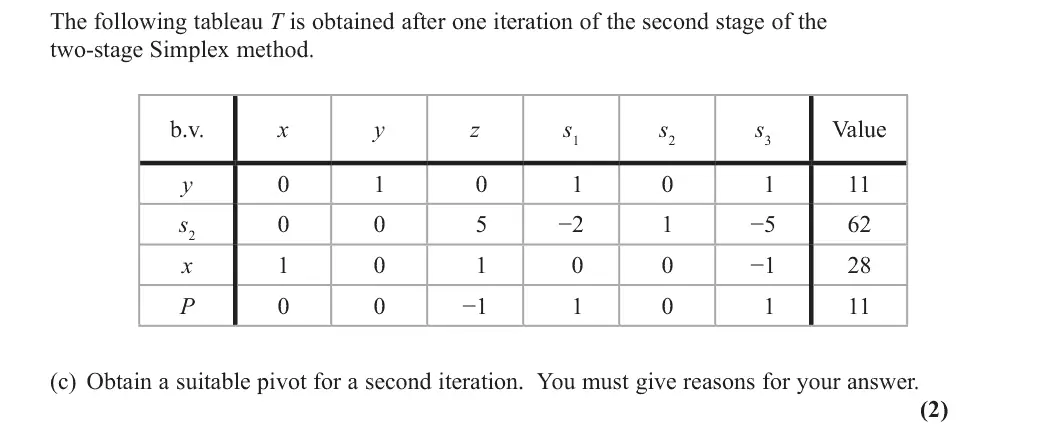
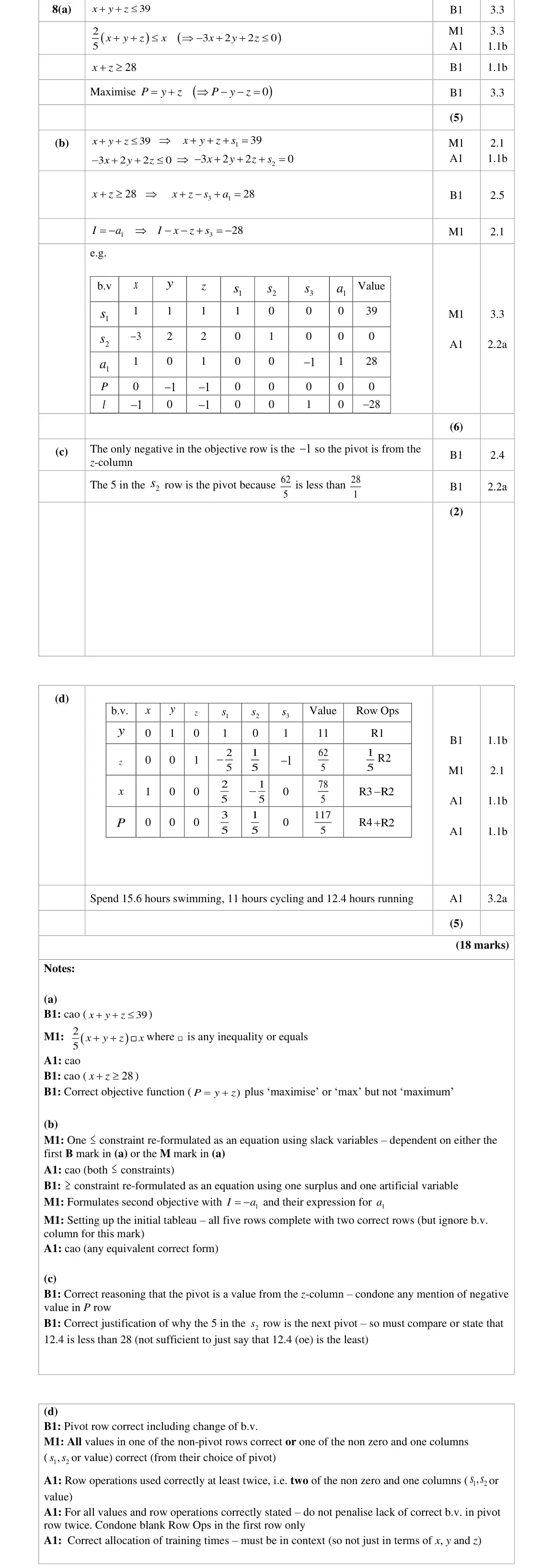
Key points from the mark scheme and examiner's report
only negative in P row is −1 (z column)
62/5 = 12.4 < 28/1 so pivot 5 in the s₂ row
must compare the ratios, not just say "least"
Nov 2021 · Paper 3D (Decision 1) · Q8(d)5 marks
Mark scheme (whole question; this part is marked with the orange bar)
Examiner's comment
It wasn’t obvious if time was a factor in why a few attempts at the final question were left blank or whether it was the demand(s) of the question itself. Most candidates who did attempt this part (c) but didn’t give sufficient detail for why the 5 in the 2s row was the pivot. In part (d) many attempted the iteration of the second stage, and while some got the correct values of x, y, and z, many did not give their final answer in the context of the number of hours spent swimming, cycling, and running.
Key points from the mark scheme and examiner's report
row operations stated
x = 78/5, y = 11, z = 62/5, P = 117/5
answer in context: 15.6 h swimming, 11 h cycling, 12.4 h running (context often missing)
Oct 2020 · Paper 3D (Decision 1) · Q7(d)5 marks
Mark scheme (whole question; this part is marked with the orange bar)
Examiner's comment
Only a few candidates were unable to make any attempt here. The two stage simplex is another recent addition to the specification, but a good proportion of candidates showed at least some understanding of the method. Many candidates realised what was required to formulate the linear programming problem and were able to interpret the content of the simplex tableau accordingly, though some had all three constraint inequalities reversed. Candidates should recognise that it is essential to state whether the objective is to be maximised or minimised and failure to do so will always result in one mark lost. It was pleasing to see a proportion of candidates showing clear working in order to go
Key points from the mark scheme and examiner's report
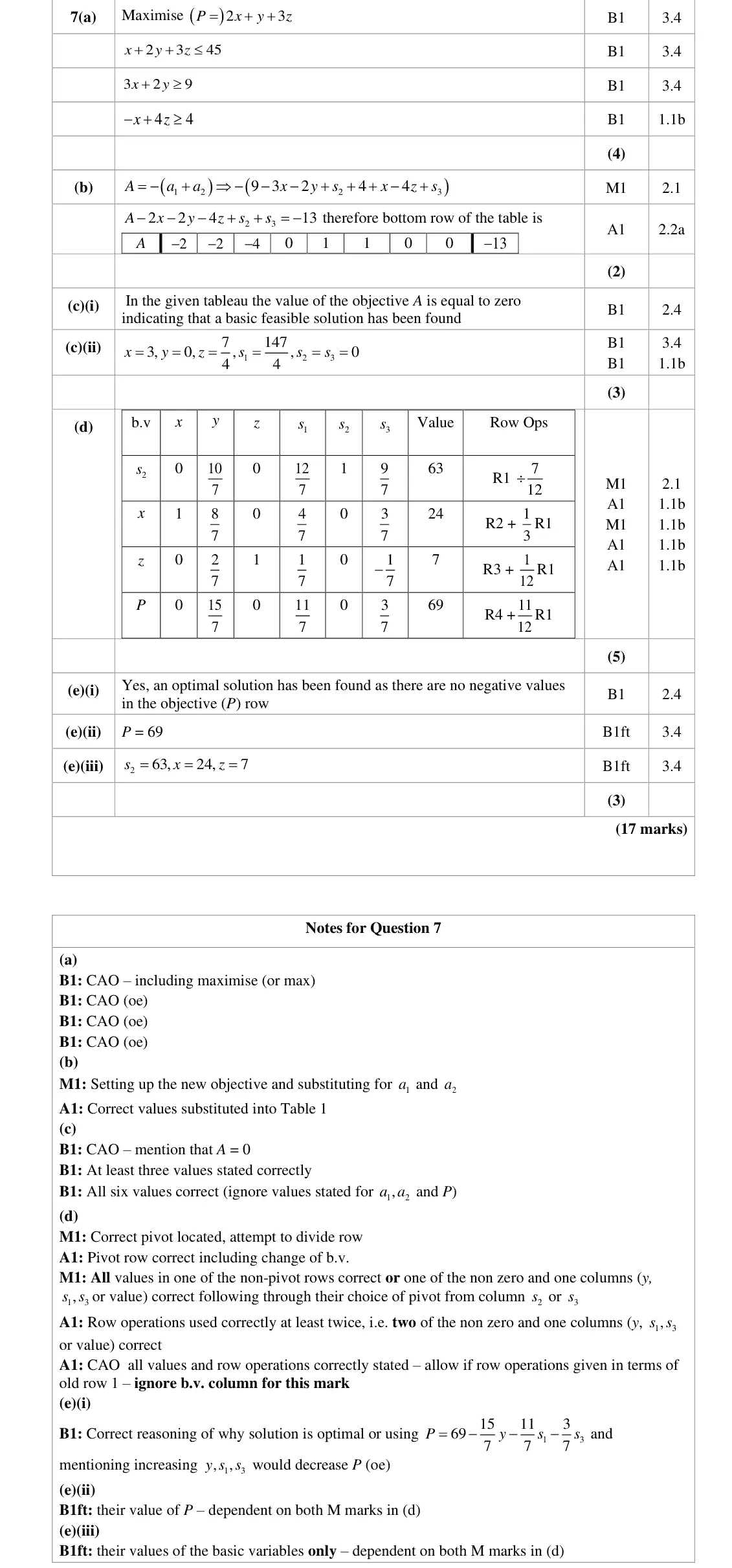
most negative is −11/12 in the s₂ column, pivot 7/12 in the s₁ row
state row operations
P = 69
Oct 2020 · Paper 3D (Decision 1) · Q7(e)3 marks
Mark scheme (whole question; this part is marked with the orange bar)
Examiner's comment
of choosing an incorrect pivot were extremely rare. The final three marks in (e) were only accessible to those who had completed their tableau. The last mark penalised those who stated values for all six variables as the question specifically asked for just the basic variables.
Key points from the mark scheme and examiner's report
no negative entries in the P row so optimal
P = 69
basic variables only: s₂ = 63, x = 24, z = 7
Oct 2020 · Paper 4D (Decision 2) · Q3(e)1 mark
Mark scheme (whole question; this part is marked with the orange bar)
Key points from the mark scheme and examiner's report
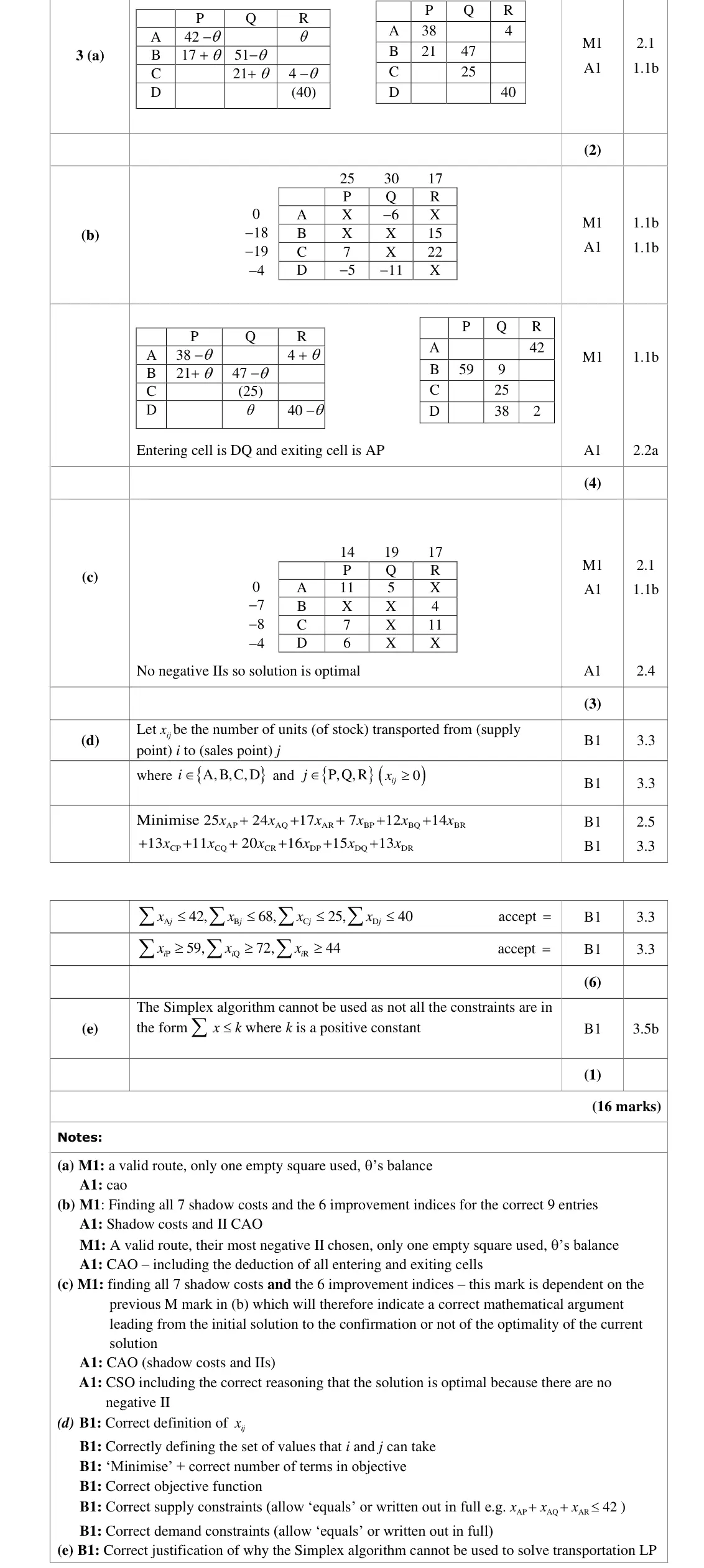
Simplex needs every constraint in the form sum ≤ positive constant
the demand constraints are ≥
Oct 2020 · Paper 4D (Decision 2) · Q6(d)1 mark
Mark scheme (whole question; this part is marked with the orange bar)
Key points from the mark scheme and examiner's report
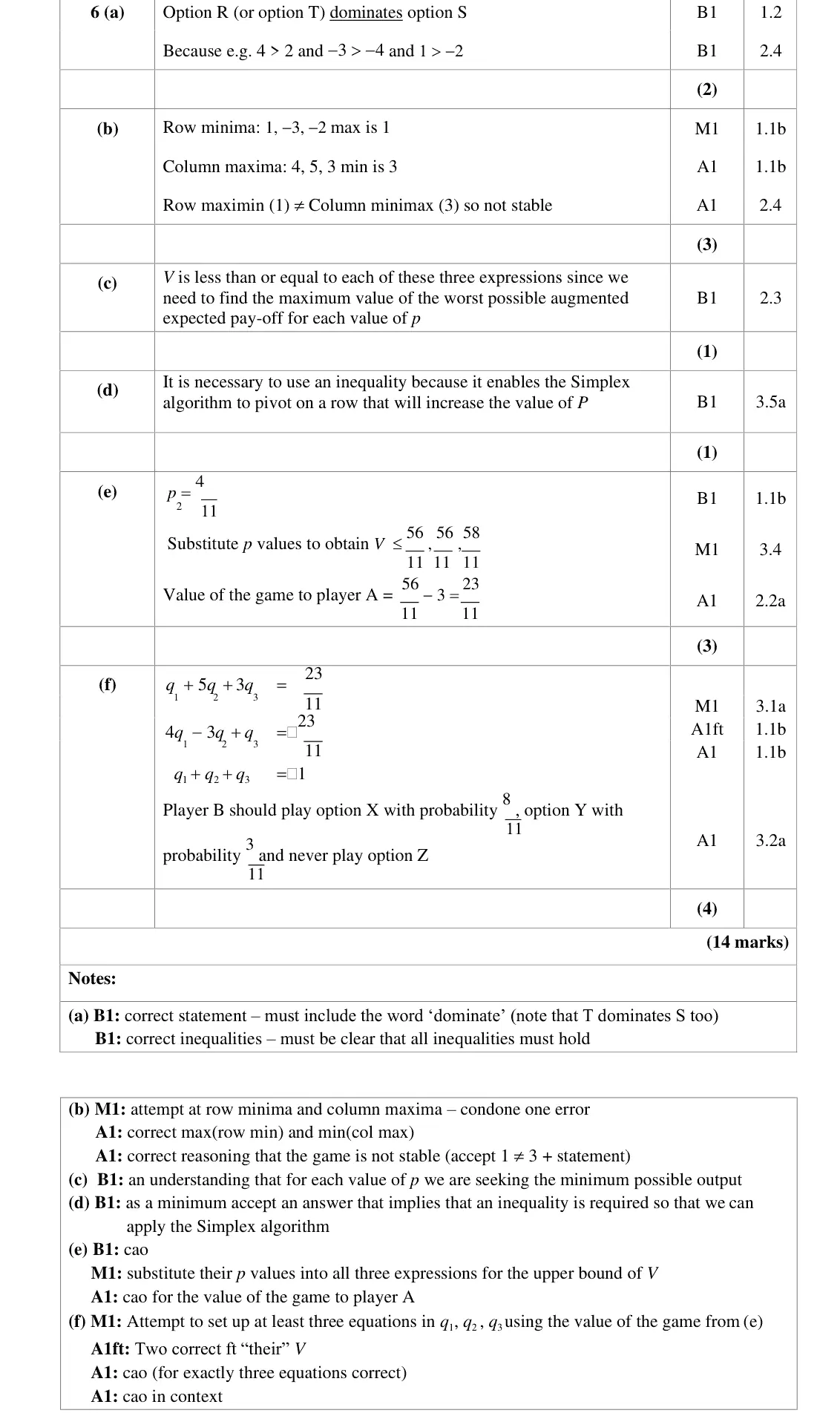
an inequality (not = 1) is needed so the Simplex algorithm can be applied and pivot to increase P
June 2019 · Paper 3D (Decision 1) · Q6(e)2 marks
Mark scheme (whole question; this part is marked with the orange bar)
Examiner's comment
In part (e) some candidates were unsure of the choice of pivot column with a significant number incorrectly choosing the x column. Some of those who chose the correct z column failed to state a reason for their choice. Of those who chose the z column and gave the correct reason, some then went on to simply stated that 0.5 had the smallest ratio value without showing the three calculations and others, who did show all their calculations correctly, stated that 7.5 was the next pivot.
Key points from the mark scheme and examiner's report
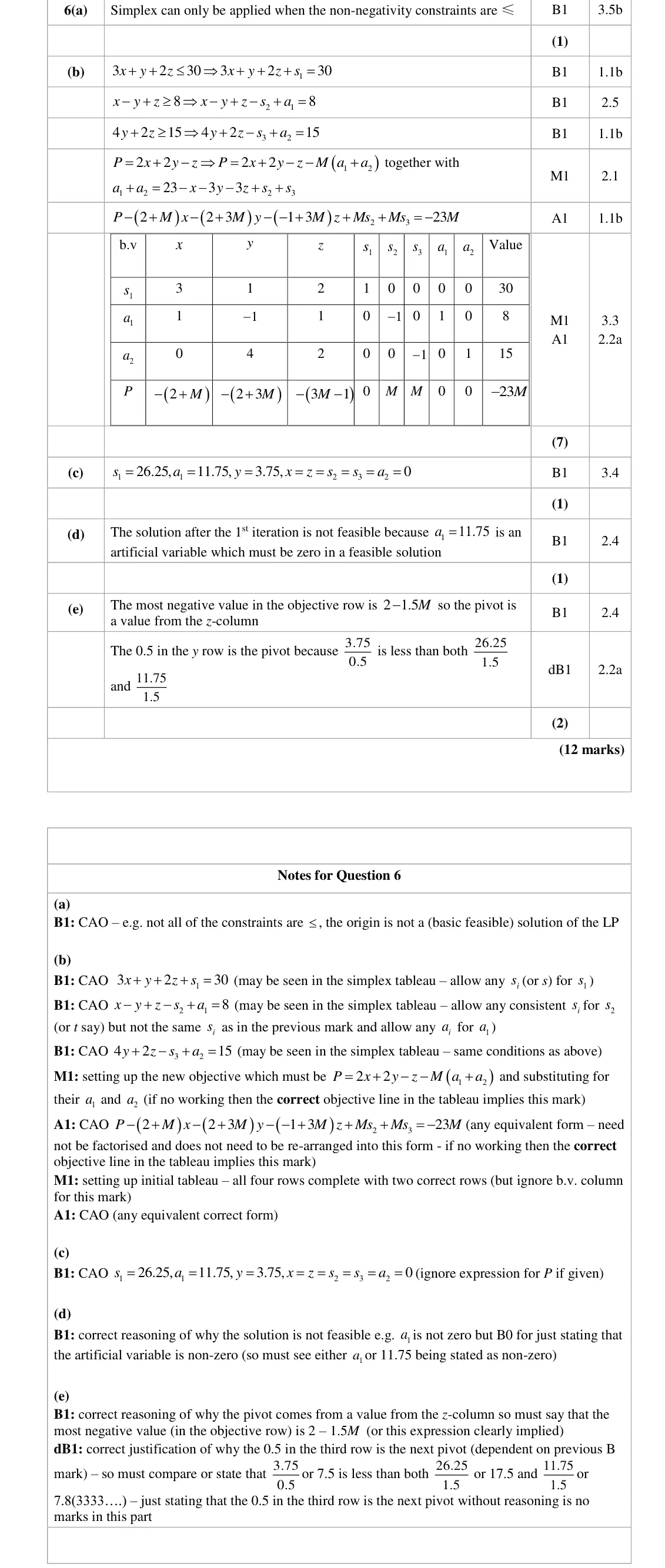
most negative entry 2 − 1.5M gives the z column
ratios 3.75/0.5 = 7.5 less than 26.25/1.5 and 11.75/1.5 so pivot 0.5 in the y row
many chose the x column or gave no ratios
June 2019 · Paper 4D (Decision 2) · Q4(c)3 marks
Mark scheme (whole question; this part is marked with the orange bar)
Examiner's comment
This question tested a far less familiar area of the specification and as such provided something of a part (c) was limited. It is clear that setting up a simplex tableau is a far less familiar area of the course and is one that a significant minority did not attempt. Of those candidates that did attempt to populate the tableau, a good number scored full marks. Those that lost marks, did so either due to incorrect constraints from earlier in the question or due to slips and misreading of their own handwriting or simply from a lack of understanding of which rows and columns were required. Parts d) and e) were somewhat unfamiliar and ultimately more challenging for many candidates. Whilst some candidates were able to substitute the values for p1, p2 and p3 into the constraints for V quite a significant proportion either did not attempt this part of the question or simply substituted the values into one constraint only. Sometimes, candidates who used the transformed constraints forgot to adjust the value to be correct for the original problem. Part (e) was a good discriminator at the top end. It was,
Key points from the mark scheme and examiner's report
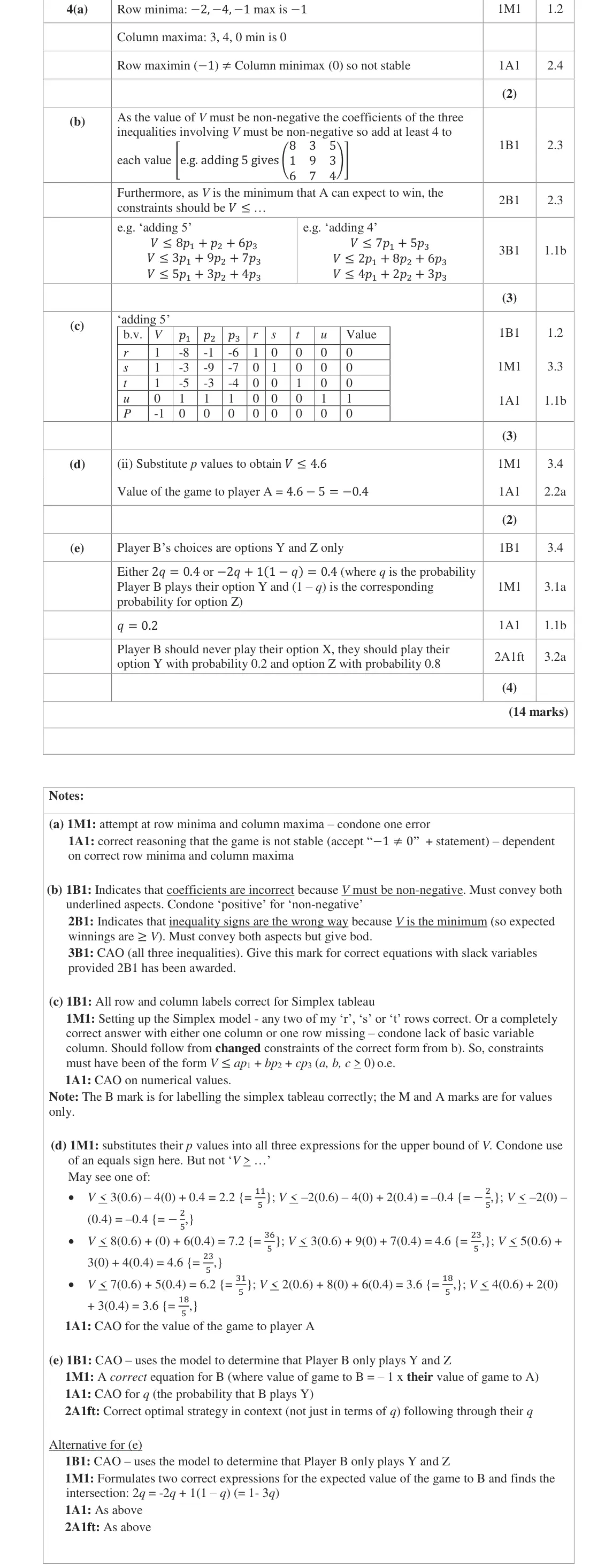
slack variables r, s, t, u
rows V − 8p1 − p2 − 6p3 + r = 0 etc. (adding 5), p1 + p2 + p3 + u = 1, objective row P − V = 0
often not attempted
Find an Edexcel Further Maths tutor
Stuck on this? Book a trial lesson with our Further Maths tutor.