The general Maclaurin series and the series for eˣ, ln(1 + x), sin x, cos x and arctan x are given, with their validity.
Since 2018
11 question parts, 27 marks
Notes, worked examples and practice for this topic are being written by our tutors. The past-paper questions below are ready now: work each one on paper, then open the mark scheme and the examiner's comment.
Tap a question to zoom it. Mark scheme and examiner's comment open under each question.
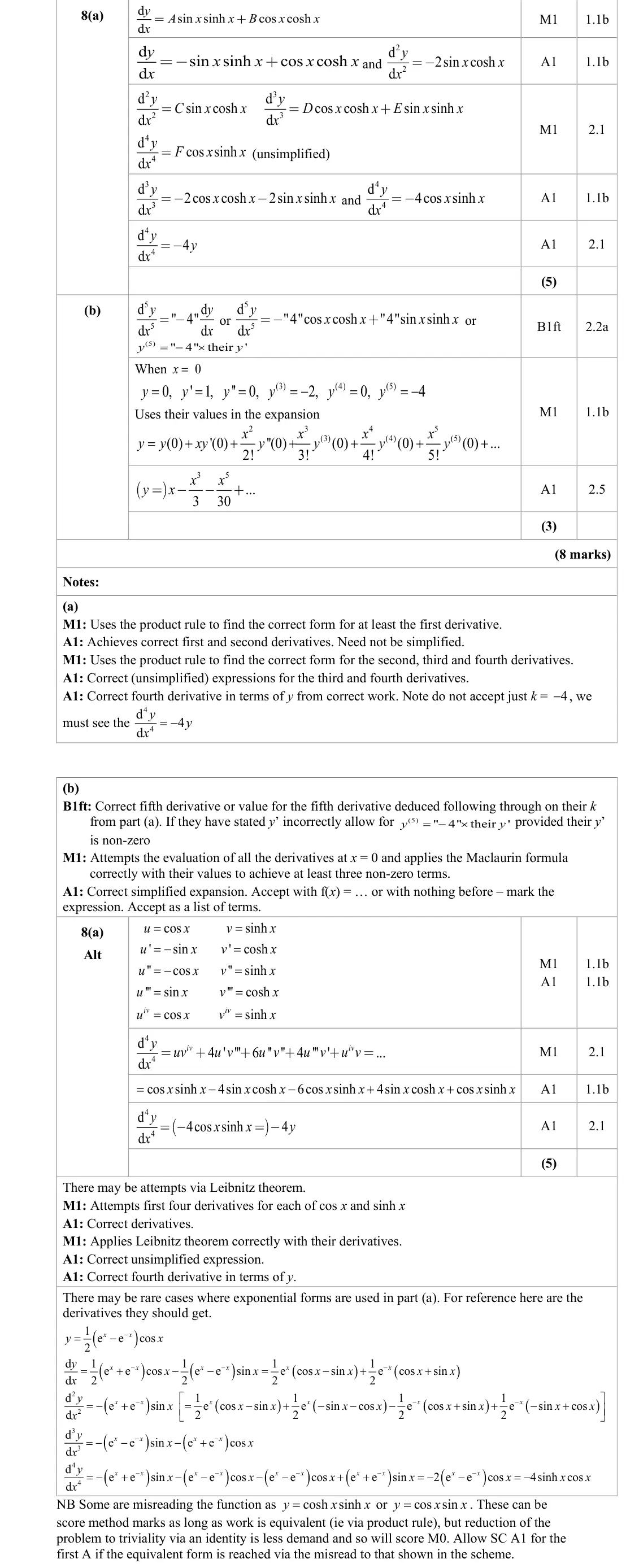
June 2025 · Paper 2 (Core Pure 2) · Q8(b)3 marks
Mark scheme (whole question; this part is marked with the orange bar)
Examiner's comment
This question was answered extremely well by the vast majority of candidates, providing a good source of marks late in the paper. Even at the lower grade boundary it would not be uncommon to see good attempts at this question. Part (b) was a routine question, but some errors were made due to the number of terms that needed to be evaluated. Not all candidates expanded to the x5 term, providing only two non- zero terms. Some incorrectly identified that 4 4 d d y x was non-zero, resulting in three non-zero terms without need of the fifth derivative, losing the B mark by default. Many found the fifth derivative from scratch instead of using the printed result, not picking up on the point of part (a). Usually these result in correct results, but an awareness of question structure is advised. Once the values of the derivatives were found, the Maclaurin series was usually constructed correctly. However, many candidates did not explicitly show the individual derivative values, instead writing the series directly. While correct answers were credited, marks could be forfeited if there were errors and the structure of the method was unclear. Candidates are strongly advised to first compute and clearly state the values of the derivatives at x = 0, and only then proceed to substitute them into the Maclaurin series formula. Attempting to combine all steps at once often leads to errors and lack of clarity. It is also important that factorials are included in the working to demonstrate use of the correct formula. A small number of candidates lost the final mark for failing to write the expansion in its simplest form often by failing to evaluate the factorials.
Key points from the mark scheme and examiner's report
use y⁽⁵⁾ = −4y′ (from (a)) rather than differentiating again
at x = 0: y′ = 1, y‴ = −2, y⁽⁵⁾ = −4: y = x − x³/3 − x⁵/30
y⁗(0) = 0 so the x⁵ term is needed
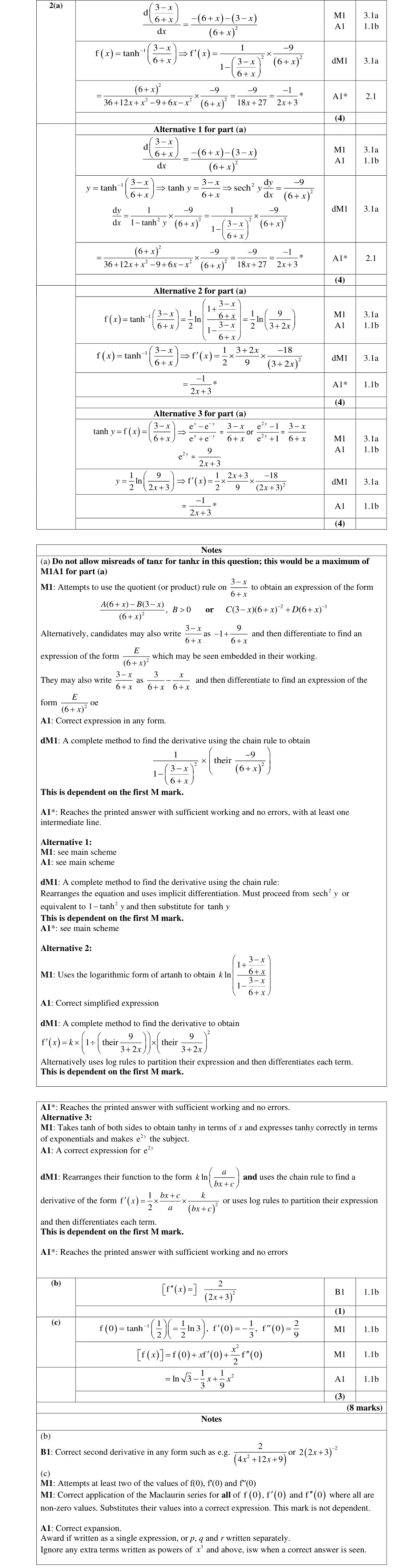
June 2024 · Paper 2 (Core Pure 2) · Q2(c)3 marks
Mark scheme (whole question; this part is marked with the orange bar)
Examiner's comment
This question saw the entire range of marks awarded. (c) This was generally well answered. Some candidates did not appear to realise that the Maclaurin expansion is a given formula in their booklets, mis-quoting formulae and thus 2x by 2. losing marks, with a significant minority failing to divide their coefficient of A small number of candidates did not process the 1 ln3 term into the required form. 2
Key points from the mark scheme and examiner's report
forgetting to halve f″(0) and leaving ½ln 3 not in the form ln p
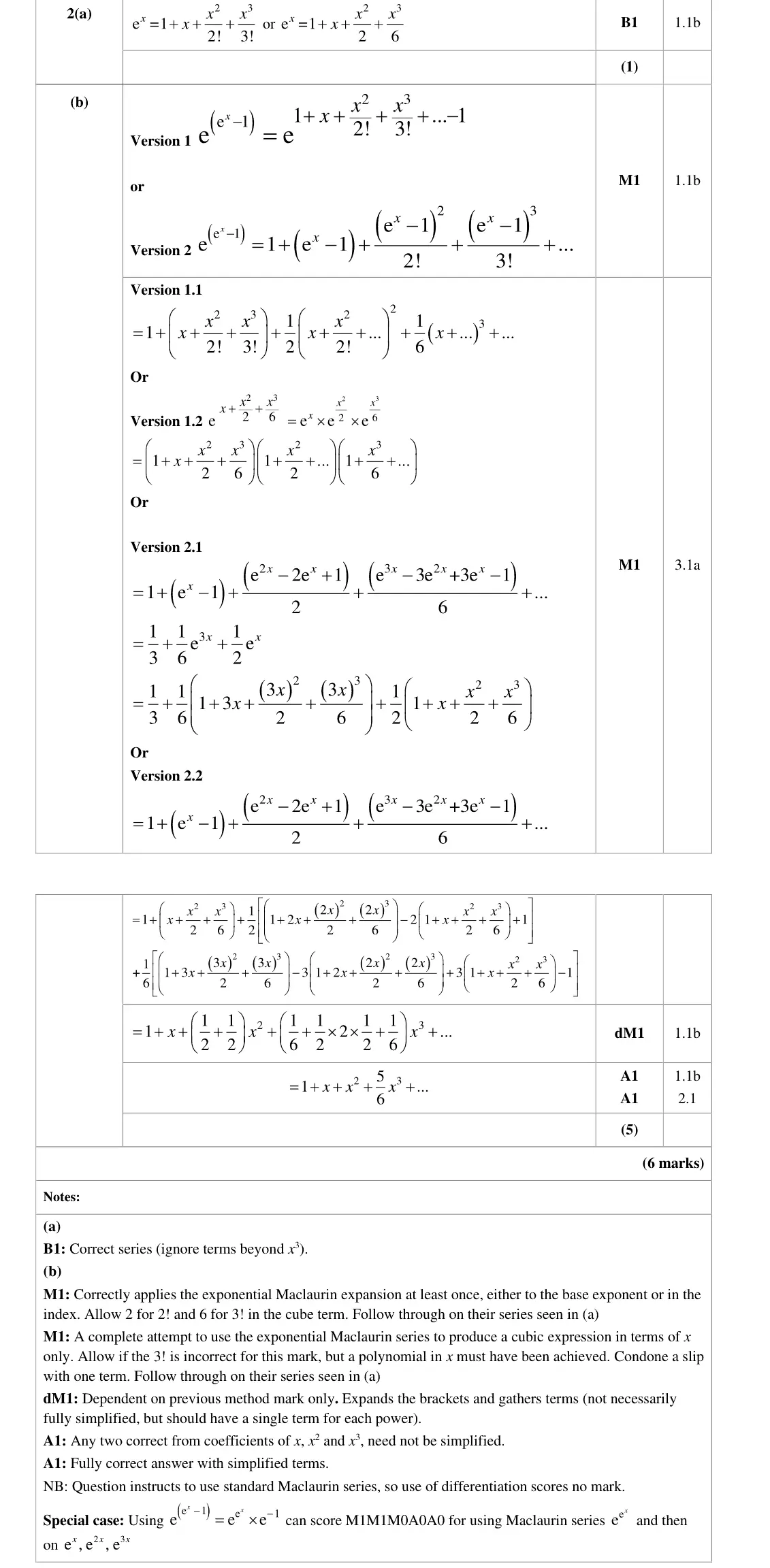
June 2023 · Paper 2 (Core Pure 2) · Q2(a)1 mark
Mark scheme (whole question; this part is marked with the orange bar)
Examiner's comment
(a) The large majority of candidates scored this mark. Some chose to derive this using differentiation techniques but most quoted the correct form as given in the formulae booklet. The only error seen was candidates writing the x3 term over 3.
Key points from the mark scheme and examiner's report
1 + x + x²/2 + x³/6
the only error was x³/3
June 2023 · Paper 2 (Core Pure 2) · Q2(b)5 marks
Mark scheme (whole question; this part is marked with the orange bar)
Examiner's comment
(b) Many candidates stopped after one application of Maclaurin’s series, giving an answer in terms of ex rather than a polynomial as requested. Of those that progressed further, the answers were mainly fully correct. Candidates could have simplified their working by rejecting higher powers earlier. With those methods involving expanding a lot of brackets, some inaccuracies occurred. There were also several candidates which multiplied their expression by 6 to remove the fractions, despite the expression not being equal to anything. The first approach expressed ex – 1 as a power series using the answer to (a). Most following this route then used the expansion from (a) with this power series for ex –1 substituted for the variable, expanded the brackets, and collected like terms. Another route from this starting point was to split the exponential into the product of three exponentials and use the series expansions to multiply out brackets. A second commonly used approach was to use ex – 1 directly in the series expansion from (a) and to expand brackets and rearrange to get a sum of exponentials. Many candidates who were unable to arrive at the final polynomial form typically achieved a function containing 𝑒𝑥, 𝑒2𝑥 and 𝑒3𝑥 and believed this was the final solution, not identifying a polynomial in x was required. Of those who then used the answer to (a) to express the exponentials as power series and collect like terms, many could produce the correct series. The candidates that manipulated the given function to 𝑒-1𝑒𝑒𝑥 were unable to make meaningful progress after applying the Maclaurin expansion once to 𝑒𝑒𝑥. Those that had 2 3 2 6 e x x x+ + were generally more successful in getting a cubic polynomial, but again the accuracy in the expansion of brackets was not particularly good overall.
Key points from the mark scheme and examiner's report
substitute the series for eˣ − 1 into the eᵘ series (or expand (eˣ − 1)ⁿ terms) and discard powers above x³: 1 + x + x² + (5/6)x³
many stopped with an answer still in eˣ
differentiating scores 0
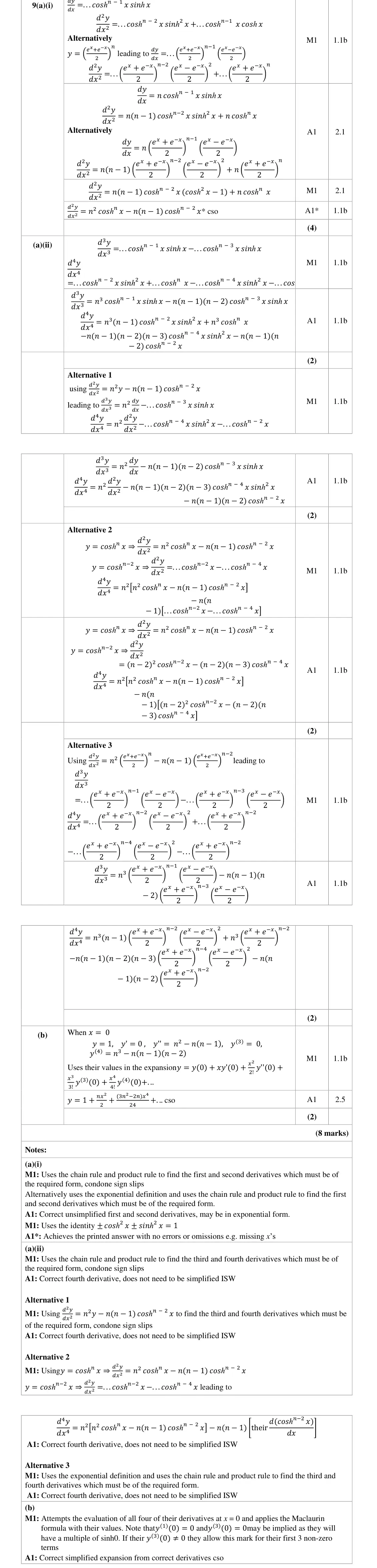
June 2022 · Paper 2 (Core Pure 2) · Q9(b)2 marks
Mark scheme (whole question; this part is marked with the orange bar)
Examiner's comment
This proved a demanding question for many candidates Part (b) many students struggled or did not fully attempt this part as they had got into a muddle in part (a). They need to then evaluate it at x = 0 and simplify was often the final straw and only the best reached the final answer. There were one or two who showed great understanding and made it look straightforward, but they were a small group. The most common mistakes seen were not showing the method for evaluating the derivatives at x = 0 and just making up values. The complexity of the differentiation in this question left many unable to demonstrate any ability they may have at Maclaurin.
Key points from the mark scheme and examiner's report
at x = 0: y = 1, y′ = 0, y″ = n, y‴ = 0, y⁗ = 3n² − 2n
y = 1 + nx²/2 + (3n² − 2n)x⁴/24
values must be shown evaluated, not made up
Nov 2021 · Paper 1 (Core Pure 1) · Q2(a)2 marks
Mark scheme (whole question; this part is marked with the orange bar)
Examiner's comment
(a) A little over half of candidates accessed the first mark. The most common x cos by approach was to make an acceptable attempt at the series for 2 3 x in the Maclaurin expansion for cos x and attempting to replacing x with 3 square. Some only used the first two terms for the cos x expansion, though many did go on to attempt to square. A few used the double angle identity for cos 2x, and these mostly scored both marks. Only about a quarter of candidates managed to simplify every term completely to score both marks. Some started from scratch and use differentiation to generate the series but these gained no marks as the cosine series was required.
Key points from the mark scheme and examiner's report
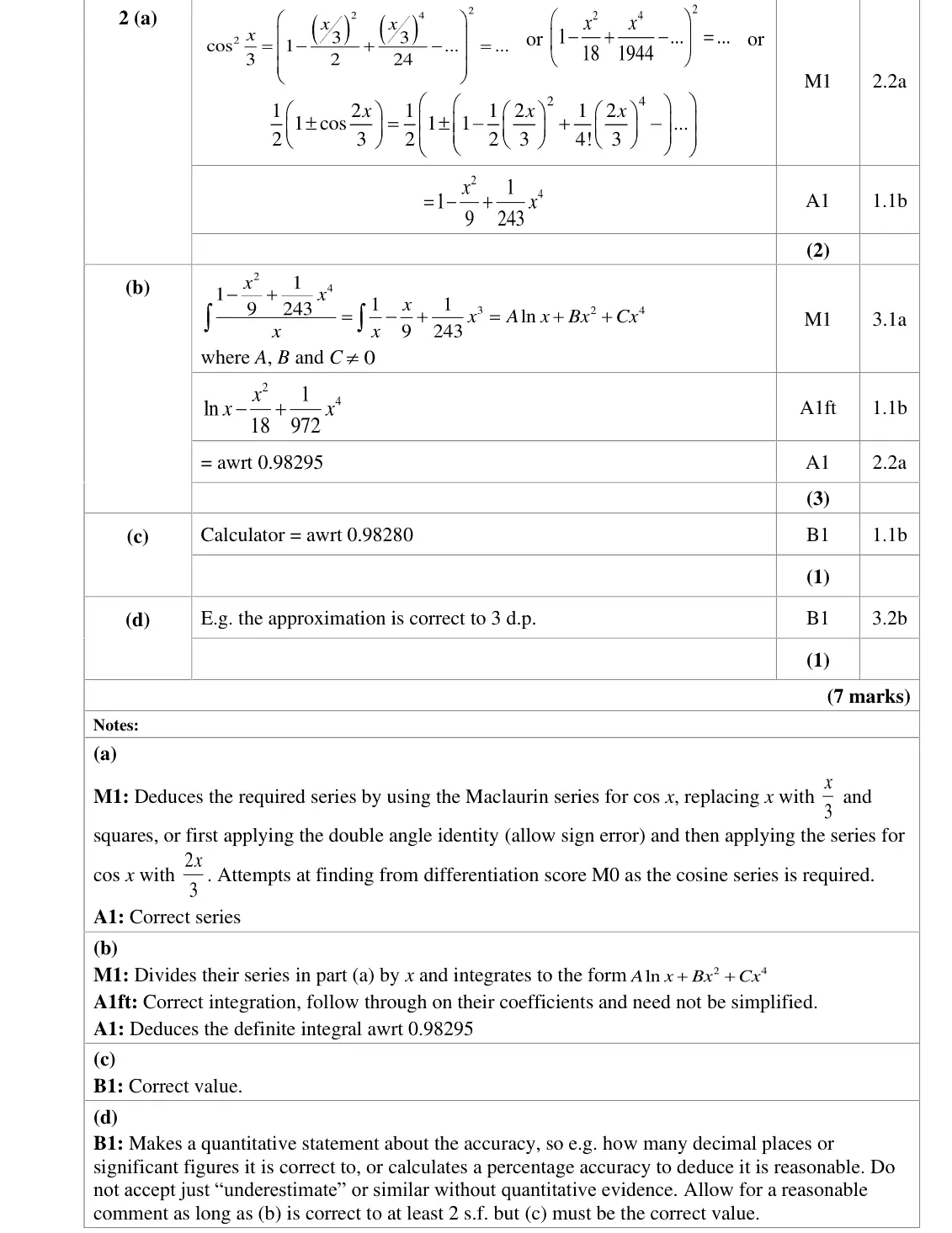
replace x by x/3 in the cos x series and square (or use cos²(x/3) = ½(1 + cos(2x/3))): 1 − x²/9 + x⁴/243
deriving the series by differentiation scores 0
Nov 2021 · Paper 1 (Core Pure 1) · Q2(b)3 marks
Mark scheme (whole question; this part is marked with the orange bar)
Examiner's comment
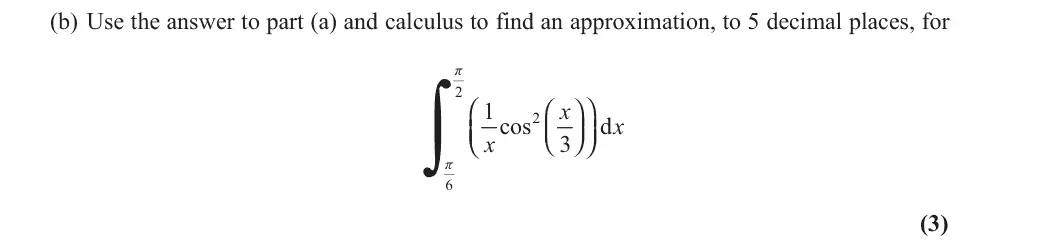
(b) This was less well attempted with less than half of candidates scoring the method. Most realised they had to multiply through by 1 x and if they then attempted the integral correctly usually gained the first two marks here. However, there were a few candidates who did not achieve a log term, so did not score the M. For those whose form was correct but who had incorrect coefficients only the final A mark for the value of their integral was generally lost. Many used an incorrect log base on their calculator so lost this mark even if their integration was completely correct.
Key points from the mark scheme and examiner's report
divide the series by x and integrate: ln x − x²/18 + x⁴/972, limits π/6 to π/2: awrt 0.98295
missing the log term
using the wrong log base on the calculator
Nov 2021 · Paper 1 (Core Pure 1) · Q2(c)1 mark
Mark scheme (whole question; this part is marked with the orange bar)
Examiner's comment
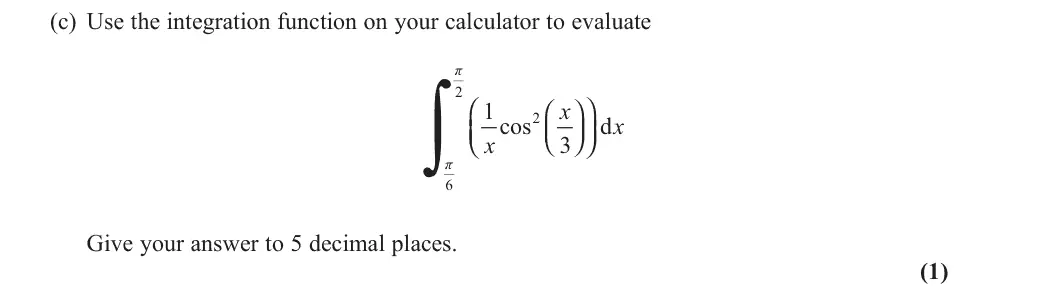
(c) Quite a few made no attempt at this part, suggesting they are not confident in using their calculators. Others were perhaps in an incorrect calculator mode and did not get this mark as the answer was incorrect with less than half scoring the mark. required, but this mark was only available if (b) was correct to 2sf and (c) was the correct value. Only a fifth of the candidates score this mark.
Key points from the mark scheme and examiner's report
calculator value awrt 0.98280
wrong calculator mode (degrees)
Nov 2021 · Paper 1 (Core Pure 1) · Q2(d)1 mark
Mark scheme (whole question; this part is marked with the orange bar)
Examiner's comment
(d) Most candidates realised that some form of quantitative statement was required, but this mark was only available if (b) was correct to 2sf and (c)
Key points from the mark scheme and examiner's report
a quantitative comment, e.g. the approximation is correct to 3 d.p.
"underestimate" alone scores 0
Nov 2021 · Paper 2 (Core Pure 2) · Q3(a)4 marks
Mark scheme (whole question; this part is marked with the orange bar)
Examiner's comment
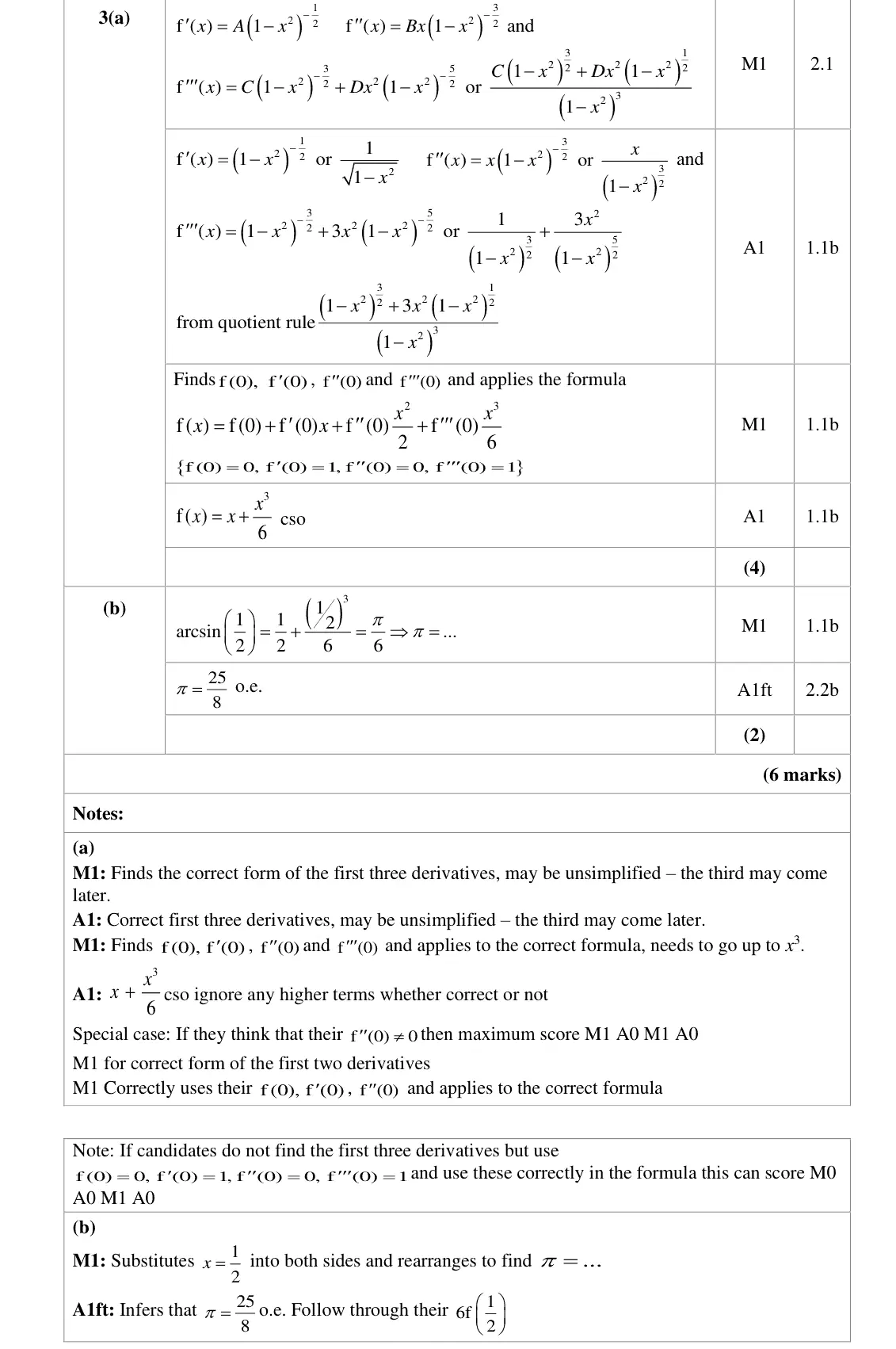
Part (a) Nearly all candidates knew what was expected and found the first and second differentials of f(x) correctly. However, a few problems occurred in progressing correctly to the third differential, particularly losing an x along the way. Generally, candidates were able to use their results correctly in the Maclaurin’s series to produce a series in x, in its simplest form.
Key points from the mark scheme and examiner's report
f′(x) = (1 − x²)^(−1/2), f″, f‴ (product or quotient rule, x often lost)
f(0) = 0, f′(0) = 1, f″(0) = 0, f‴(0) = 1
arcsin x ≈ x + x³/6
Nov 2021 · Paper 2 (Core Pure 2) · Q3(b)2 marks
Mark scheme (whole question; this part is marked with the orange bar)
Examiner's comment
Part (b) Most candidates substituted ½ for x in their expansion but a quite a few forgot to equate to substitute ½ into arcsin xto achieve ... 6 and thus failed to find an estimate for pi .
Key points from the mark scheme and examiner's report
arcsin ½ = π/6 ≈ ½ + 1/48, so π ≈ 25/8
must equate to π/6
Find an Edexcel Further Maths tutor
Stuck on this? Book a trial lesson with our Further Maths tutor.