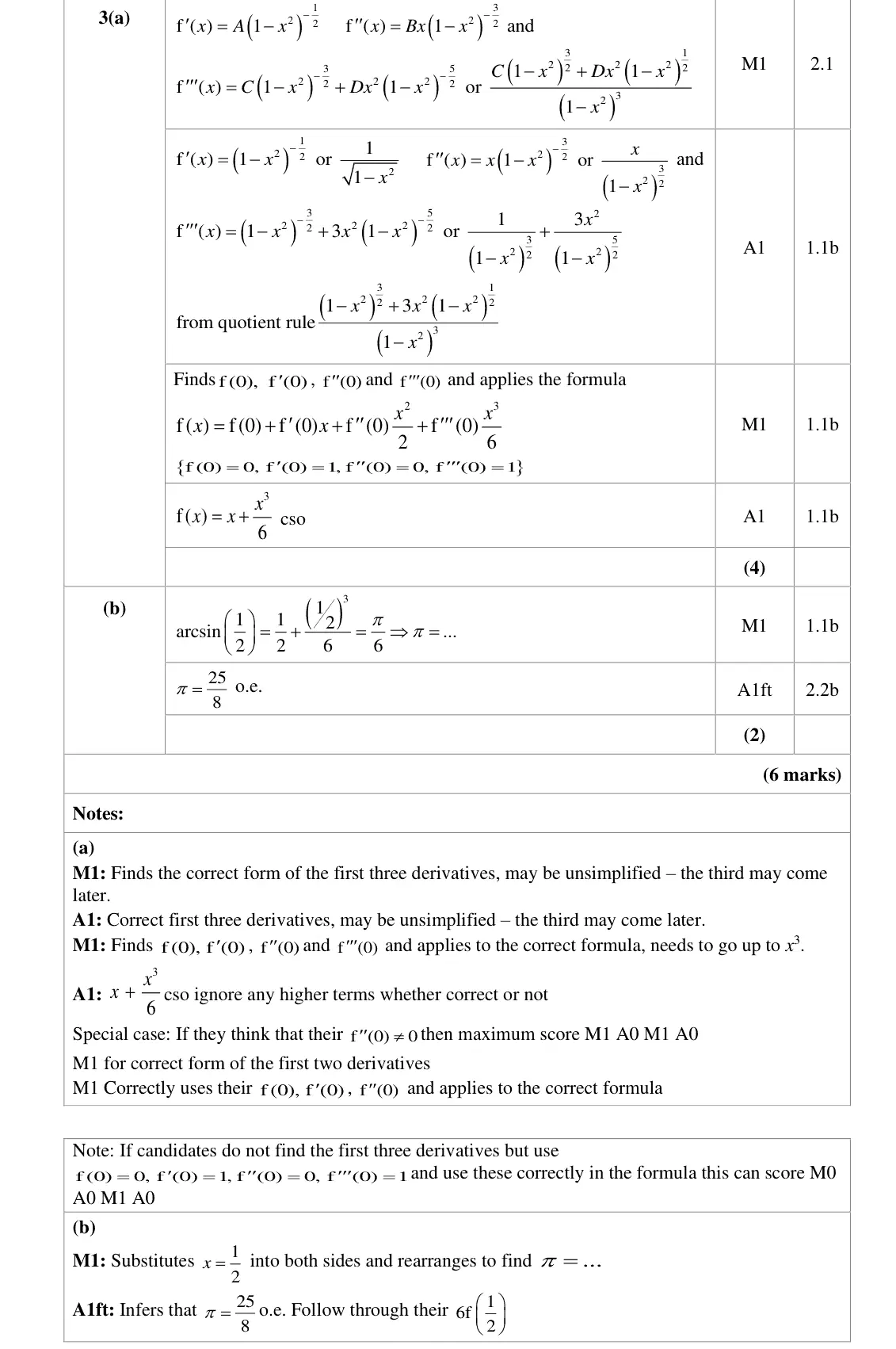
Mark scheme (whole question; this part is marked with the orange bar)
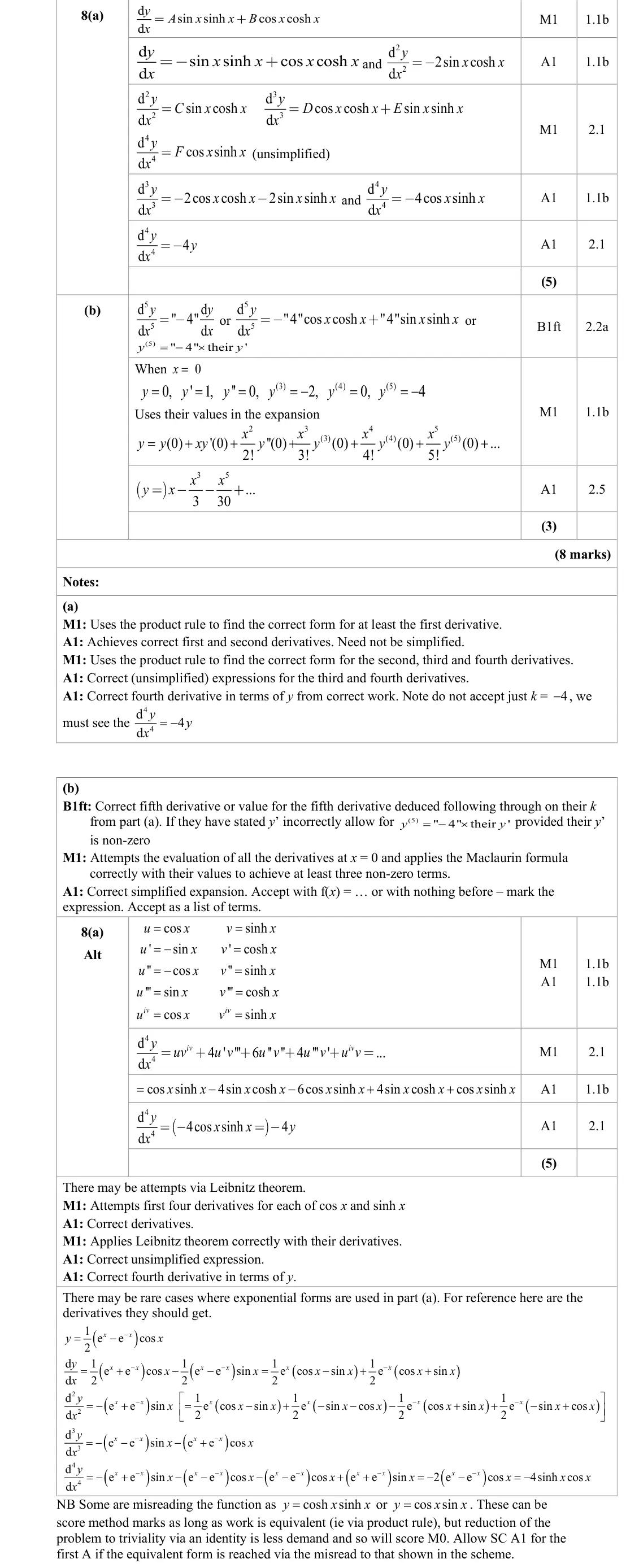
Examiner's comment
This question was answered extremely well by the vast majority of candidates, providing a good source of marks late in the paper. Even at the lower grade boundary it would not be uncommon to see good attempts at this question. Part (b) was a routine question, but some errors were made due to the number of terms that needed to be evaluated. Not all candidates expanded to the x5 term, providing only two non- zero terms. Some incorrectly identified that 4 4 d d y x was non-zero, resulting in three non-zero terms without need of the fifth derivative, losing the B mark by default. Many found the fifth derivative from scratch instead of using the printed result, not picking up on the point of part (a). Usually these result in correct results, but an awareness of question structure is advised. Once the values of the derivatives were found, the Maclaurin series was usually constructed correctly. However, many candidates did not explicitly show the individual derivative values, instead writing the series directly. While correct answers were credited, marks could be forfeited if there were errors and the structure of the method was unclear. Candidates are strongly advised to first compute and clearly state the values of the derivatives at x = 0, and only then proceed to substitute them into the Maclaurin series formula. Attempting to combine all steps at once often leads to errors and lack of clarity. It is also important that factorials are included in the working to demonstrate use of the correct formula. A small number of candidates lost the final mark for failing to write the expansion in its simplest form often by failing to evaluate the factorials.
Key points from the mark scheme and examiner's report
- use y⁽⁵⁾ = −4y′ (from (a)) rather than differentiating again
- at x = 0: y′ = 1, y‴ = −2, y⁽⁵⁾ = −4: y = x − x³/3 − x⁵/30
- y⁗(0) = 0 so the x⁵ term is needed