Examiner's comment
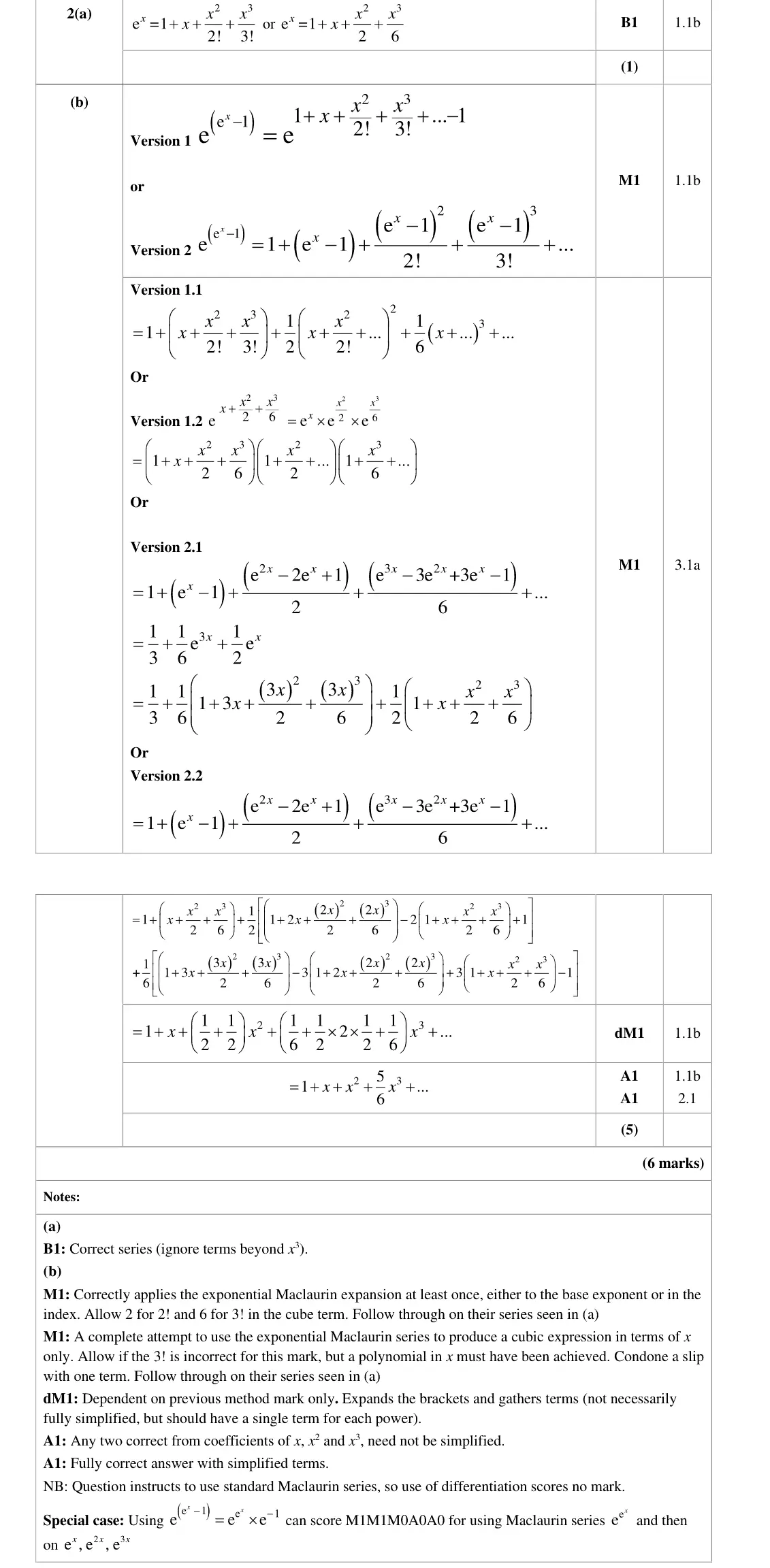
(b) Many candidates stopped after one application of Maclaurin’s series, giving an answer in terms of ex rather than a polynomial as requested. Of those that progressed further, the answers were mainly fully correct. Candidates could have simplified their working by rejecting higher powers earlier. With those methods involving expanding a lot of brackets, some inaccuracies occurred. There were also several candidates which multiplied their expression by 6 to remove the fractions, despite the expression not being equal to anything. The first approach expressed ex – 1 as a power series using the answer to (a). Most following this route then used the expansion from (a) with this power series for ex –1 substituted for the variable, expanded the brackets, and collected like terms. Another route from this starting point was to split the exponential into the product of three exponentials and use the series expansions to multiply out brackets. A second commonly used approach was to use ex – 1 directly in the series expansion from (a) and to expand brackets and rearrange to get a sum of exponentials. Many candidates who were unable to arrive at the final polynomial form typically achieved a function containing 𝑒𝑥, 𝑒2𝑥 and 𝑒3𝑥 and believed this was the final solution, not identifying a polynomial in x was required. Of those who then used the answer to (a) to express the exponentials as power series and collect like terms, many could produce the correct series. The candidates that manipulated the given function to 𝑒-1𝑒𝑒𝑥 were unable to make meaningful progress after applying the Maclaurin expansion once to 𝑒𝑒𝑥. Those that had 2 3 2 6 e x x x+ + were generally more successful in getting a cubic polynomial, but again the accuracy in the expansion of brackets was not particularly good overall.