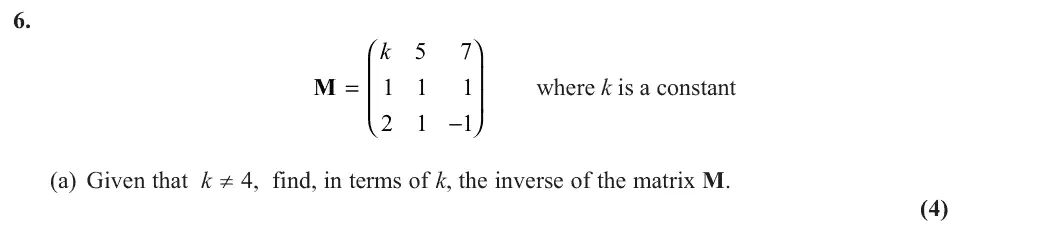
Nothing is given; determinants and inverses must be known.
Since 2018
50 question parts, 144 marks, 4 with a difficulty rating from the examiner's report
Notes, worked examples and practice for this topic are being written by our tutors. The past-paper questions below are ready now: work each one on paper, then open the mark scheme and the examiner's comment.
Tap a question to zoom it. Mark scheme and examiner's comment open under each question.
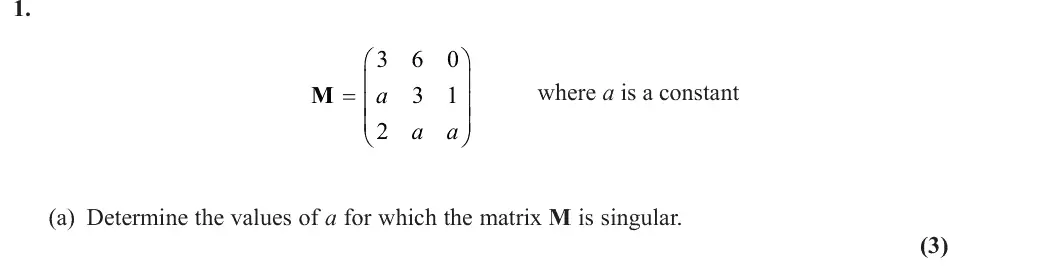
June 2025 · Paper 1 (Core Pure 1) · Q1(a)3 marks
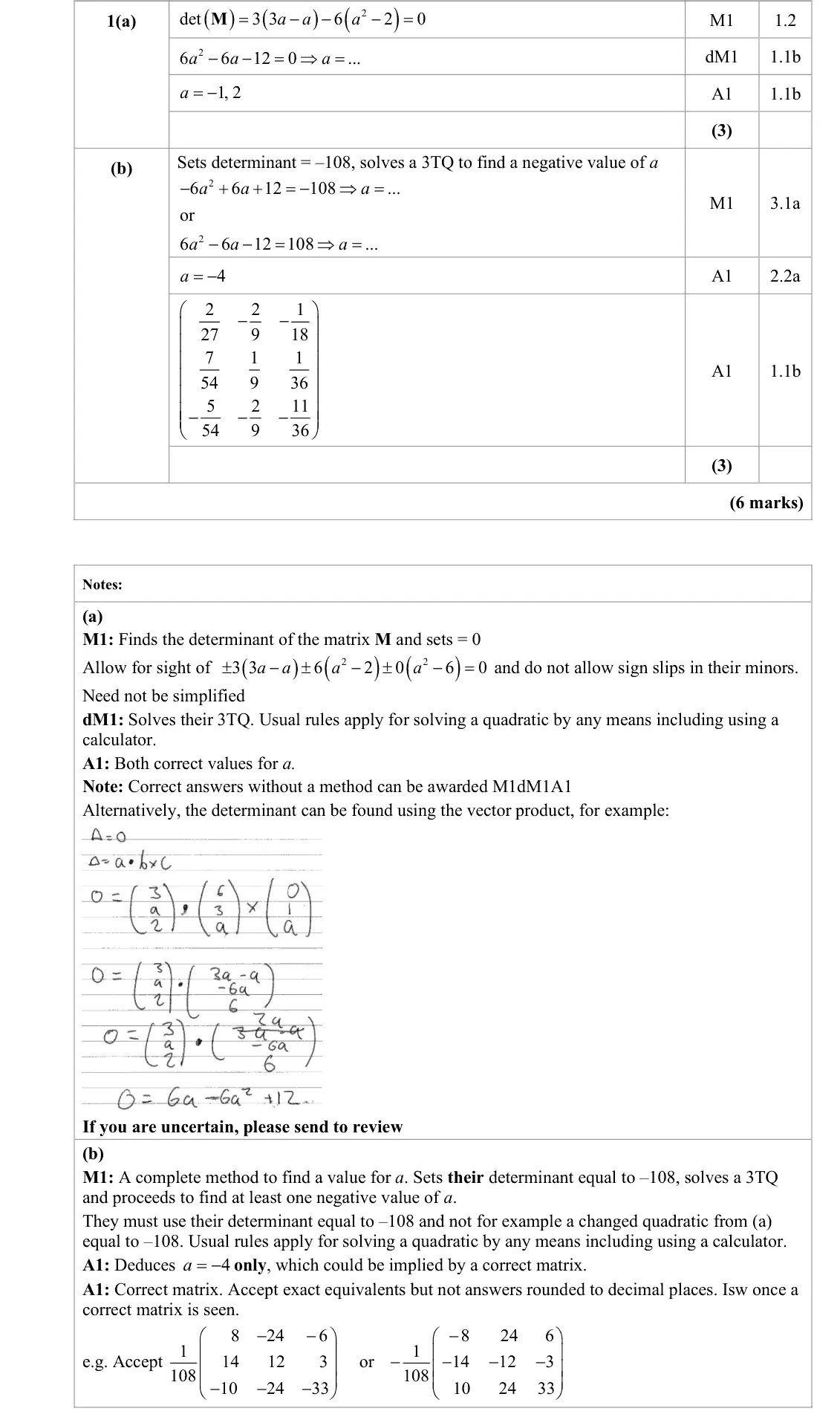
Mark scheme (whole question; this part is marked with the orange bar)
Examiner's comment
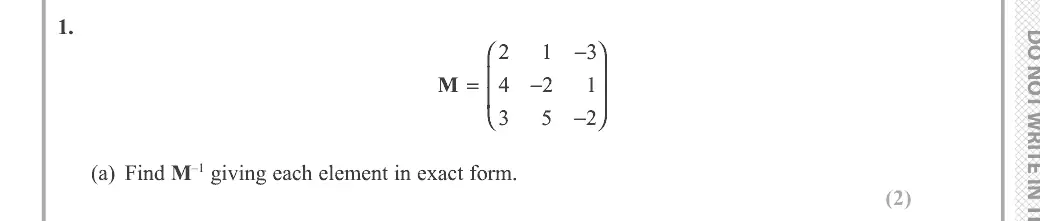
(a) Candidates needed to be able to determine the values of an unknown in a 3 by 3 matrix that made the matrix singular. They used the method of finding the determinant of the matrix, setting that equal to zero and solving the resulting three term quadratic equation. Finding the determinant using minors of the matrix was by far the most popular and straightforward. An alternative method seen was to use a scalar triple product, but this was only rarely seen. Most candidates scored full marks on this part with only errors in manipulation resulting in an incorrect quadratic equation and hence incorrect roots. The expression for the determinant in terms of the constant a had been found in part (a). However, some candidates instead of using the quadratic expression for the determinant – 6a2 + 6a + 12, used a changed quadratic such as 6a2 – 6a – 12 and so could not find a correct value for a. Some candidates did not use the condition for the constant to be negative. The method for finding the inverse of the matrix with their found constant was well known. There were slips in the signs of some elements of the final answer. Overall, this proved an accessible start to this paper with many candidates scoring full marks.
Key points from the mark scheme and examiner's report
det M = 3(3a − a) − 6(a² − 2) = 0 gives 6a² − 6a − 12 = 0: a = −1, 2
sign slips in the minors
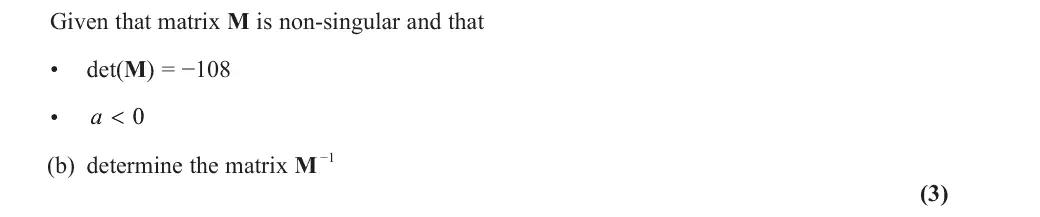
June 2025 · Paper 1 (Core Pure 1) · Q1(b)3 marks
Mark scheme (whole question; this part is marked with the orange bar)
Examiner's comment
(b) This required finding the inverse of the given 3 by 3 matrix, given that its determinant was a specified value and that the constant was negative. The expression for the determinant in terms of the constant a had been found in part (a).
Key points from the mark scheme and examiner's report
use the determinant from (a): −6a² + 6a + 12 = −108 gives a = −4 only (a < 0)
then M⁻¹ = (1/108)(8, −24, −6
14, 12, 3
−10, −24, −33) (calculator allowed)
exact values, not decimals
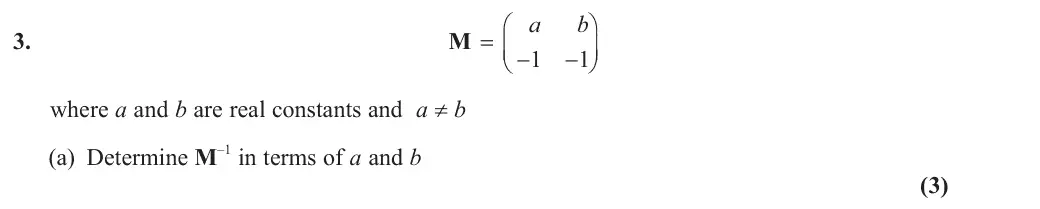
June 2025 · AS Paper 1 (Core Pure) · Q3(a)3 marks
Mark scheme (whole question; this part is marked with the orange bar)
Examiner's comment
Most learners understood how to proceed in this question and produced good responses. In part (a), the correct determinant was usually achieved. However there were errors seen in forming the inverse matrix with a common error being not changing the sign of the elements on the counter diagonal.
Key points from the mark scheme and examiner's report
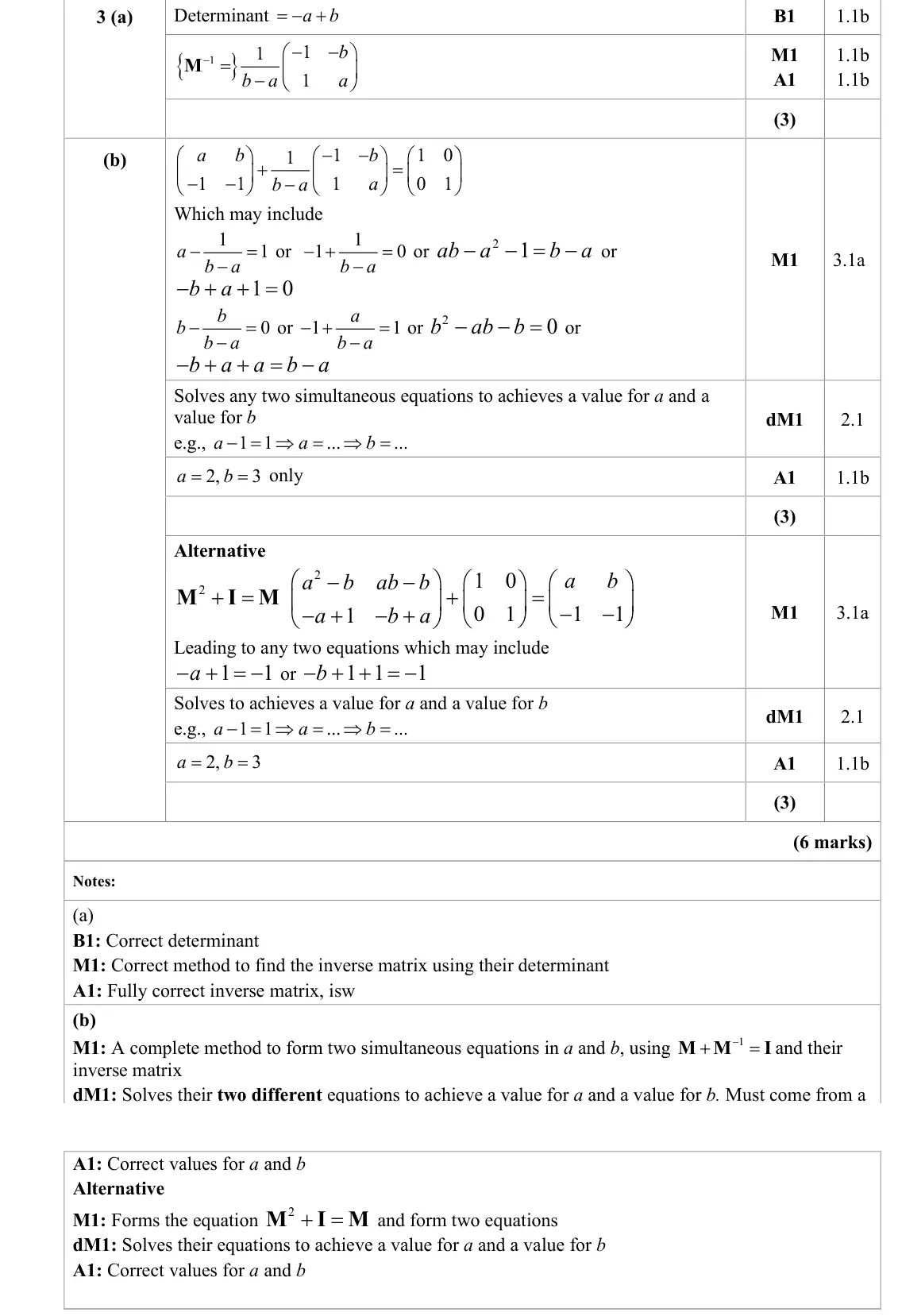
det = b − a
M⁻¹ = (1/(b − a))(−1 −b
1 a)
sign change on the counter-diagonal often missed
June 2025 · AS Paper 1 (Core Pure) · Q3(b)3 marks
Mark scheme (whole question; this part is marked with the orange bar)
Examiner's comment
Most learners understood how to proceed in this question and produced good responses. In part (b), learners were able to form two simultaneous equations correctly from the matrix equation. Algebraic errors in the manipulation of these equations led to a loss of marks. A common mistake was failing to multiply both sides of the equation completely when multiplying through by the denominator of the fraction.
Key points from the mark scheme and examiner's report
equate entries of M + M⁻¹ = I (or use M² + I = M) to get two equations
a = 2, b = 3
incomplete multiplying through by b − a
June 2025 · AS Paper 1 (Core Pure) · Q4(ii)7 marks
Mark scheme (whole question; this part is marked with the orange bar)
Examiner's comment
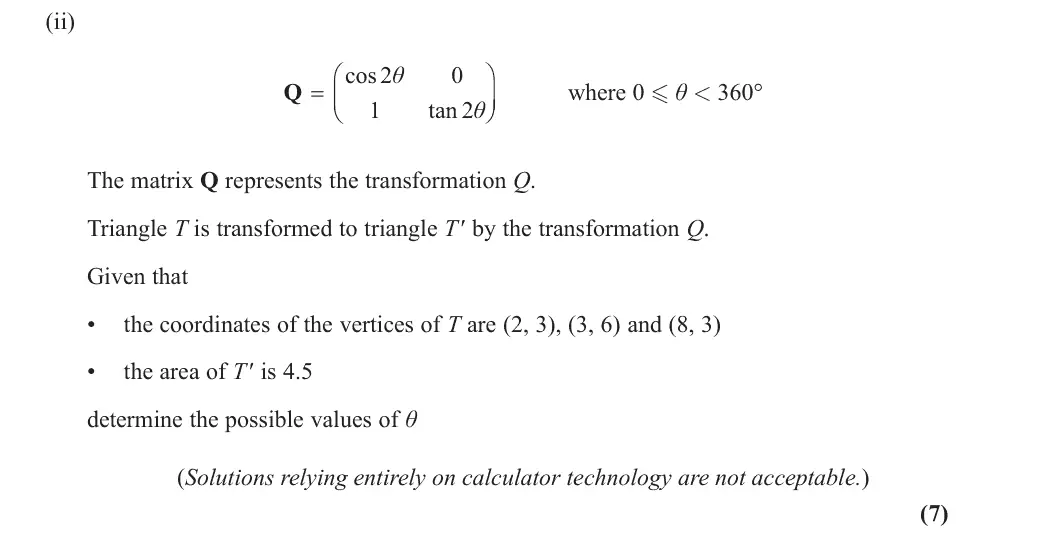
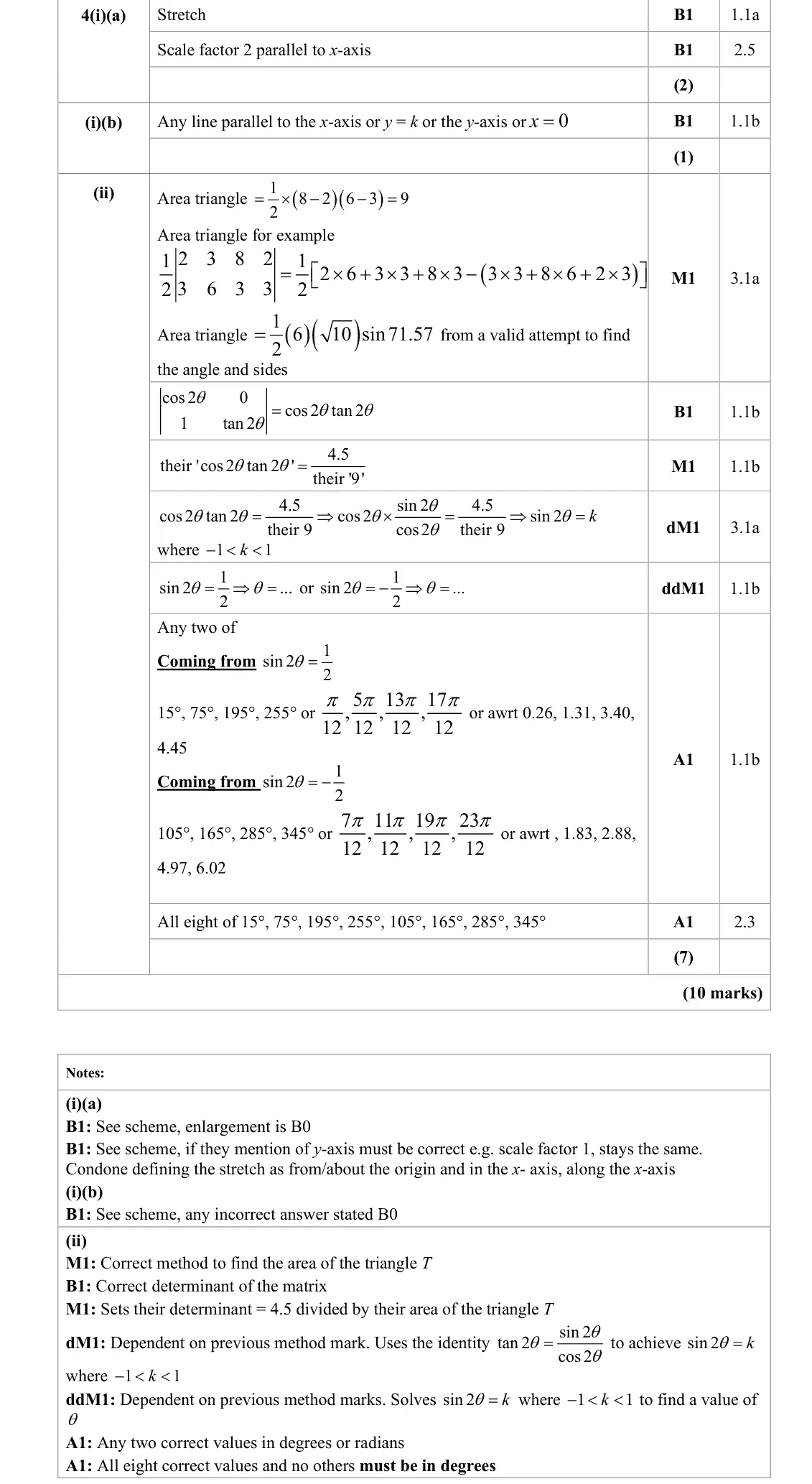
In part (i), the vast majority of the learners recognised that the matrix P represented a stretch with scale factor 2 parallel to the x-axis. Descriptions which involved stretches from the origin, about the origin, in the x-axis and along the x-axis were condoned here although representation by an enlargement was not allowed. A few learners commented that y-axis was invariant. An invariant line was correctly found by the majority of the cohort. In part (ii), the correct area of the triangle T and the correct determinant of the matrix Q were found by many of the cohort with the main error arising here being ( ) Q which subsequently resulted in a loss of marks. Obtaining an area det cos2 tan2 1 theta theta = - scale factor of ½ was obtained by the majority of the learners who then went on to find possible values of theta , having simplified the determinant of Q to sin 2 theta . Very few of the cohort identified the fact that det(Q) could equal ½ or – ½ and thus obtained only four of the eight possible values of theta .
Key points from the mark scheme and examiner's report
Mark scheme (whole question; this part is marked with the orange bar)
Examiner's comment
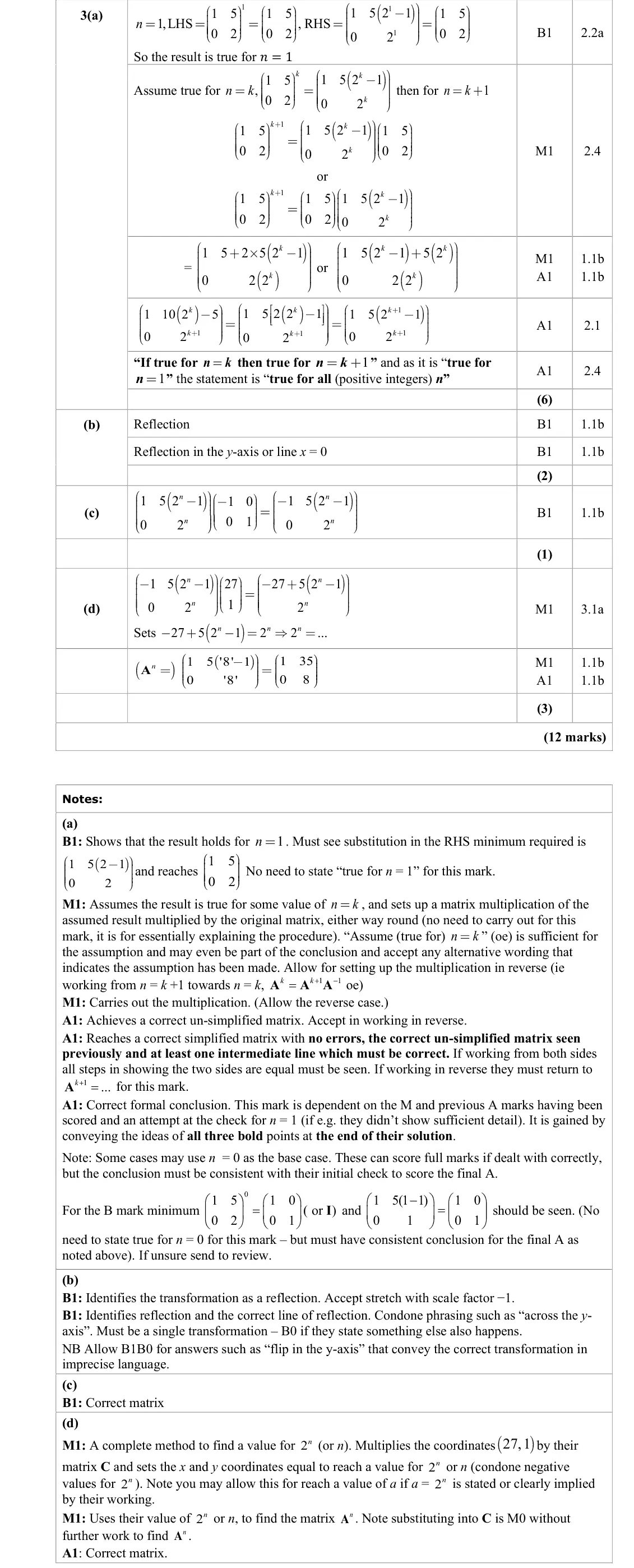
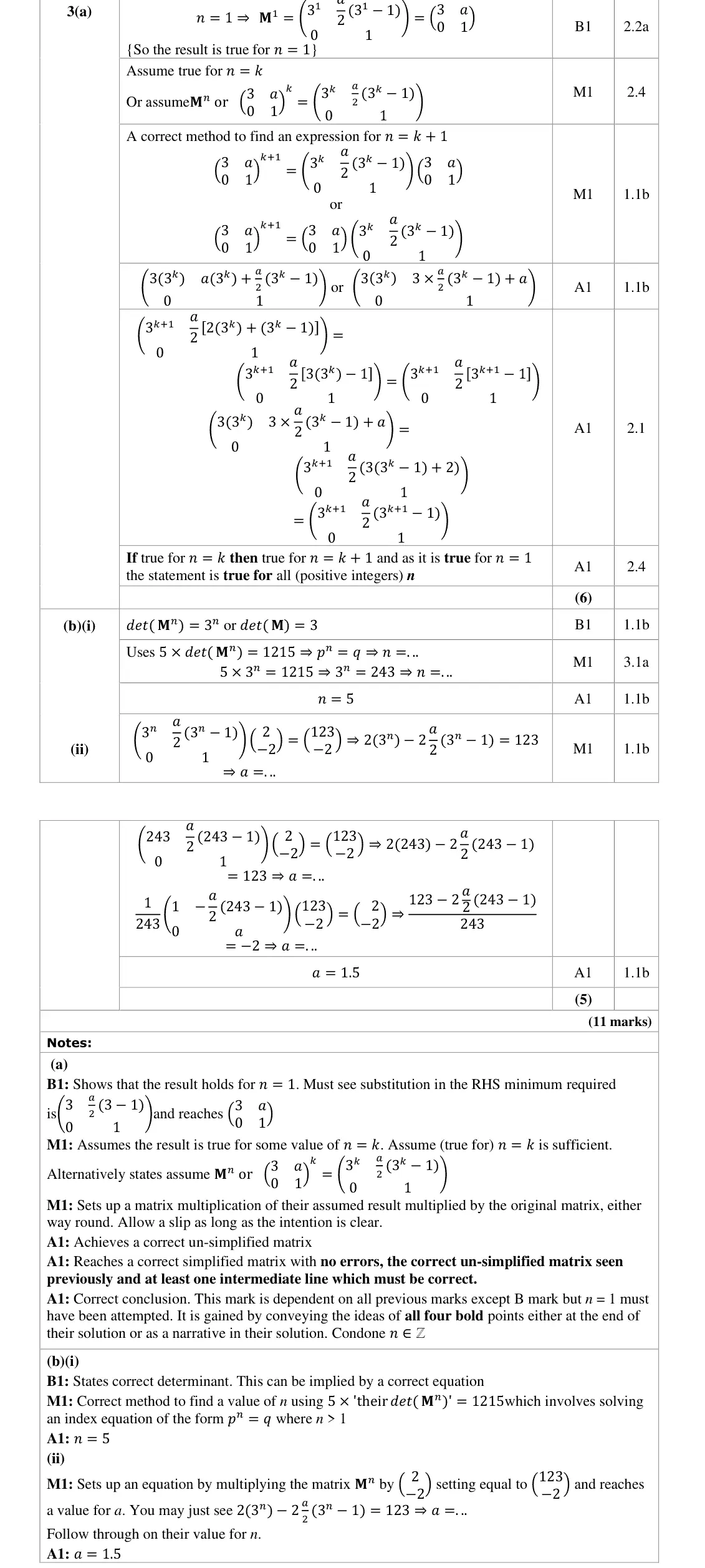
This question was well attempted with the proof by induction being well constructed by many candidates. The proof by induction of powers of matrices seems to be the most favoured of induction questions historically, and this was no exception. The work on transformation was also carried out well, although there was confusion over which matrix was required in the final part by some learners. There was again good work seen in part (c), which was mostly completely correct among those who attempted it. The only notable error was the incorrect order of matrix multiplication when performing transformations in a relatively small number of cases.
Key points from the mark scheme and examiner's report
P followed by Q is C = AⁿB (B first): C = (−1, 5(2ⁿ − 1)
0, 2ⁿ)
wrong order of multiplication
June 2025 · Paper 2 (Core Pure 2) · Q3(d)3 marks
Mark scheme (whole question; this part is marked with the orange bar)
Examiner's comment
This question was well attempted with the proof by induction being well constructed by many candidates. The proof by induction of powers of matrices seems to be the most favoured of induction questions historically, and this was no exception. The work on transformation was also carried out well, although there was confusion over which matrix was required in the final part by some learners. Part (d) was a bit less successfully completed, and indeed there were numerous cases of this part being left out by learners who did not know how to proceed. Those who attempted it seldom set up an incorrect equation for their answer to (c), though a few did set up the multiplication the wrong way round, and some others did not use C but An. After setting up a suitable equation most proceeded to find either 2n or n, but a few stopped at this point, forgetting to substitute back into the matrix, while others substituted back into the wrong matrix, C instead of An.
Key points from the mark scheme and examiner's report
C(27, 1) = (−27 + 5(2ⁿ − 1), 2ⁿ)
set the coordinates equal: 2ⁿ = 8
Q is Aⁿ = (1, 35
0, 8), not C
often omitted
June 2024 · AS Paper 1 (Core Pure) · Q2(d)2 marks
Mark scheme (whole question; this part is marked with the orange bar)
Examiner's comment
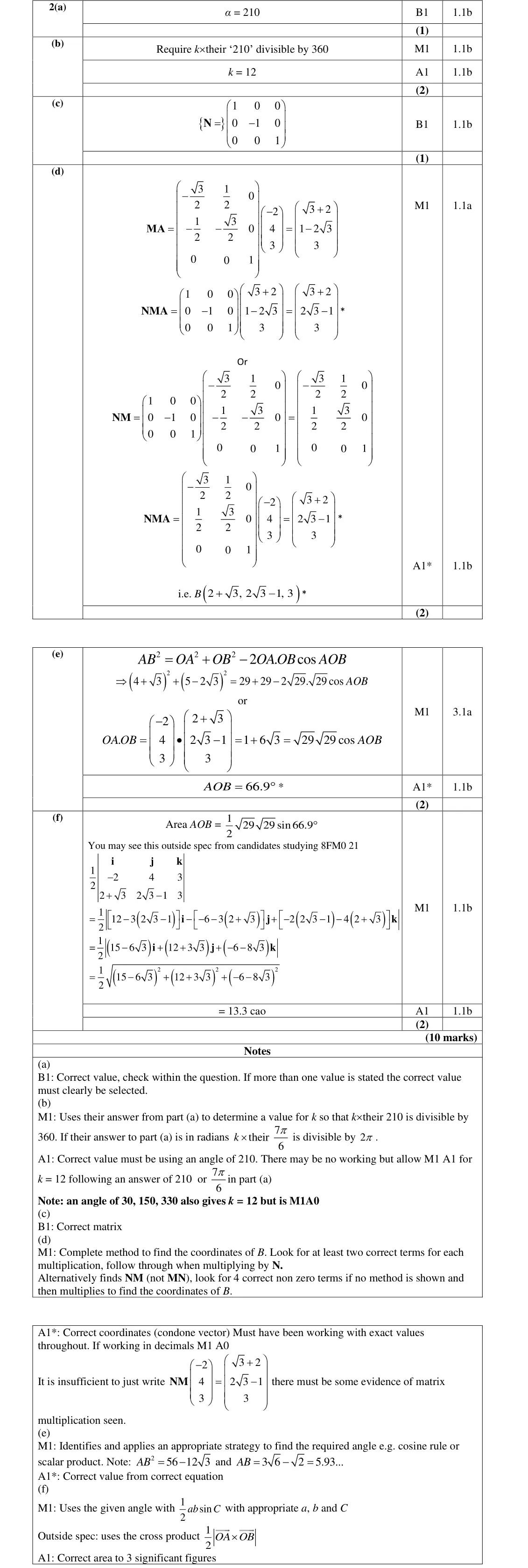
Part a) was often answered incorrectly and candidates failed to check their value worked consistently, common incorrect answers included 30 and 150 . ± Part b) was attempted by most students who recognised the need for alpha to be divisible exactly k by 360, it was common to see attempts involving trial and error or calculator use. The odd value of k however not the lowest. Many students who got 300 and 1500 in part a) were able to attempt at finding the LCM of alpha and 360 was seen which were generally successful in finding a calculate k, scoring M1A0. Part c) was very well answered with the large majority achieving this mark. It was pleasing to see candidates that although maybe couldn’t access a) and b) continued to read through the question and pick up marks here. Part d) was a show that question and whilst many candidates appreciated the need for matrix multiplication and furthermore understood the necessary order many failed to show evidence of matrix multiplication which was not sufficient. Those who did show their working generally did so correctly and were able to proceed to the correct answer. Some students left their answer as a vector which was condoned in this question. Candidates who drew a sketch were more successful in part e and f than those who didn’t. It was common to see both the cosine rule and scalar product used in part e), most candidates who selected a correct method were able to proceed to the final answer. Numerical and sign errors were more common when using the cosine rule and calculating AB . Part f) was generally well done although some candidates selected the wrong side and used AB in place of OA or OB, again a sketch helped with this. A small number of candidates failed to round to the required level of accuracy in e) and f) losing the final mark.
Key points from the mark scheme and examiner's report
M followed by N is NM
NMA = (2 + √3, 2√3 − 1, 3)
June 2024 · AS Paper 1 (Core Pure) · Q4(a)2 marks
Mark scheme (whole question; this part is marked with the orange bar)
Examiner's comment
In part (a), the vast majority of the cohort correctly found one of the terms on the leading diagonal of the product and was able to deduce that 1 c = .
Key points from the mark scheme and examiner's report
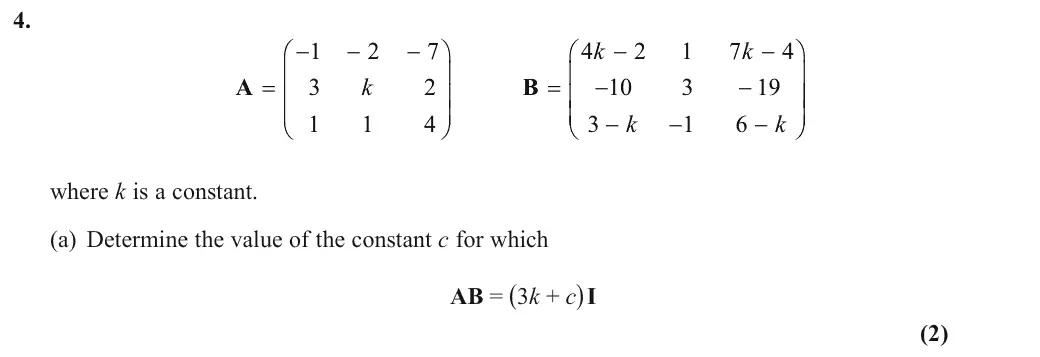
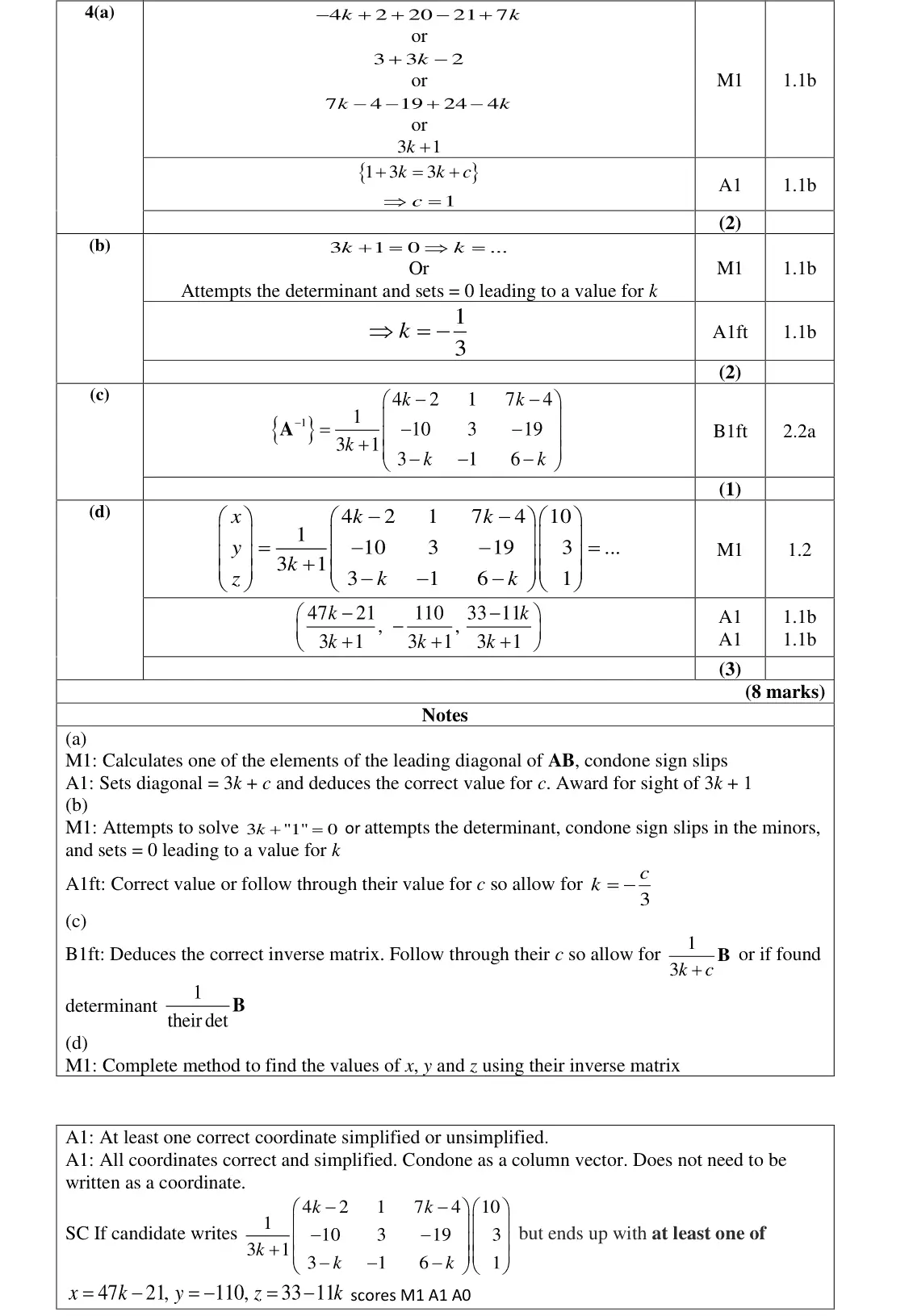
a leading-diagonal entry of AB = 3k + 1, so c = 1
June 2024 · AS Paper 1 (Core Pure) · Q4(b)2 marks
Mark scheme (whole question; this part is marked with the orange bar)
Examiner's comment
In part (b), many of the candidates did not recognise the link between finding the value of k and the part (a) and thus found the determinant of A and equated it to zero to find k.
Key points from the mark scheme and examiner's report
AB = (3k + 1)I so A is singular when 3k + 1 = 0: k = −1/3
most ignored (a) and found det A
June 2024 · AS Paper 1 (Core Pure) · Q4(c)1 mark
Mark scheme (whole question; this part is marked with the orange bar)
Examiner's comment
In part (c), as in the above, very few of the candidates identified how the result in part (a) could be used to write down the inverse matrix A-1 and thus proceeded with the well-rehearsed routine of using minors, cofactors and transposes.
Key points from the mark scheme and examiner's report
A⁻¹ = B/(3k + 1) written down from (a)
most used cofactors instead
June 2024 · Paper 2 (Core Pure 2) · Q8(a)4 marks
Mark scheme (whole question; this part is marked with the orange bar)
Examiner's comment
(a) Many candidates managed to invert the matrix accurately and there were pleasingly few slips in the involved calculations. Where marks where dropped this was overwhelmingly due to arithmetic errors when calculating either their determinant or matrix of minors that then led to an incorrect answer. Some students struggled to negate the correct terms at the end of the process. Unfortunately, those with an incorrect determinant would lose several marks on this question. Also, they had the opportunity to gain full marks even if their answer to part (a) was wrong.
Key points from the mark scheme and examiner's report
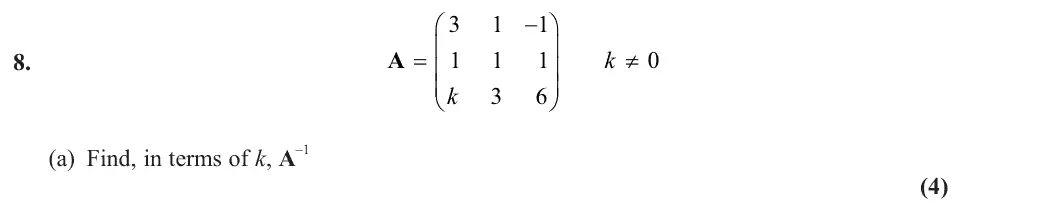
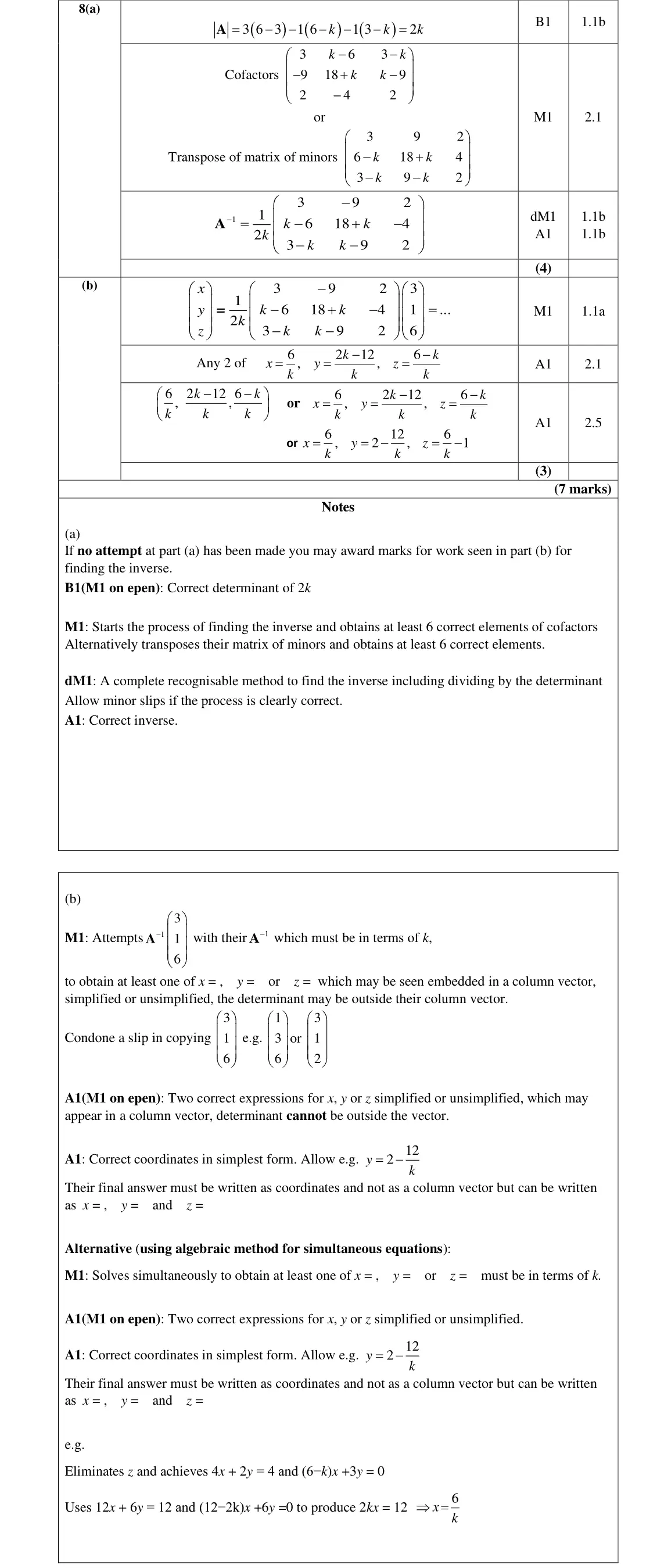
determinant 2k
matrix of cofactors, transpose, divide by 2k: A⁻¹ = (1/2k)(3, −9, 2
k − 6, 18 + k, −4
3 − k, k − 9, 2)
sign slips in cofactors
June 2023 · Paper 1 (Core Pure 1) · Q8(a)1 mark
Mark scheme (whole question; this part is marked with the orange bar)
Examiner's comment
This question was not attempted by all students, possibly due to the time constraints of the paper. The different parts generally proved accessible, even if the preceding parts had not been attempted. It seemed that many candidates were running out of time and were attempting the parts that they could quickly gain some credit for. A wide variety of marks was seen. Many candidates either did not answer part (a) or gave an incorrect reason (commonly that the age ranges for each category were uneven, claims that the categories overlapped, or it was difficult to determine the exact age of the mammal). Good correct answers tended to be that some mammals would become breeders before 3 months, or would become infertile after a length of time.
Key points from the mark scheme and examiner's report
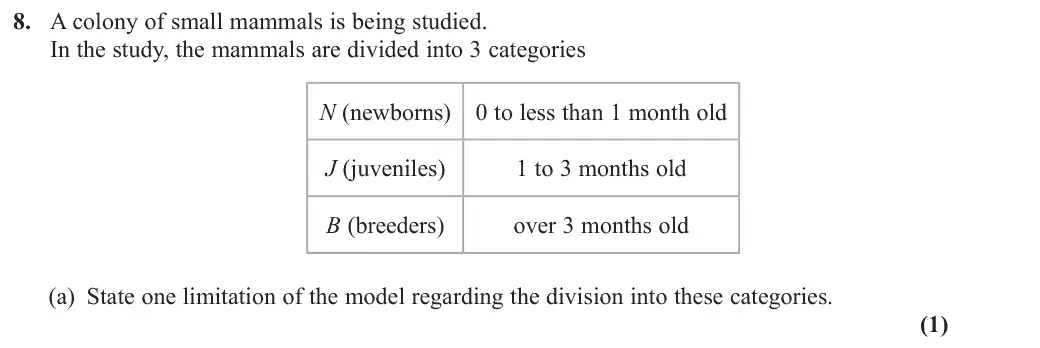
e.g. some mammals may breed before 3 months or stop breeding/become infertile
'categories are different sizes' or 'exact age unknown' scored 0
June 2023 · Paper 1 (Core Pure 1) · Q8(b)4 marks
Mark scheme (whole question; this part is marked with the orange bar)
Examiner's comment
This question was not attempted by all students, possibly due to the time constraints of the paper. The different parts generally proved accessible, even if the preceding parts had not been attempted. It seemed that many candidates were running out of time and were attempting the parts that they could quickly gain some credit for. A wide variety of marks was seen. For those who attempted part (b), this part was often done well and full marks awarded. However, a significant number of candidates failed to set up the initial matrix and apply it twice to form an equation for B0. Others only applied the matrix once and were only able to score the first mark. Some wrote equations in N0, J0 and B0 before finally realising that N0 and J0 were 0 which enabled them to proceed and solve for b and then a. Some candidates extracted the information required and formed a set of equations without writing down the matrix itself and this was an acceptable approach. Those who correctly obtained the value of 25 for B0 usually proceeded to correctly show the value of a to be 0.8.
Key points from the mark scheme and examiner's report
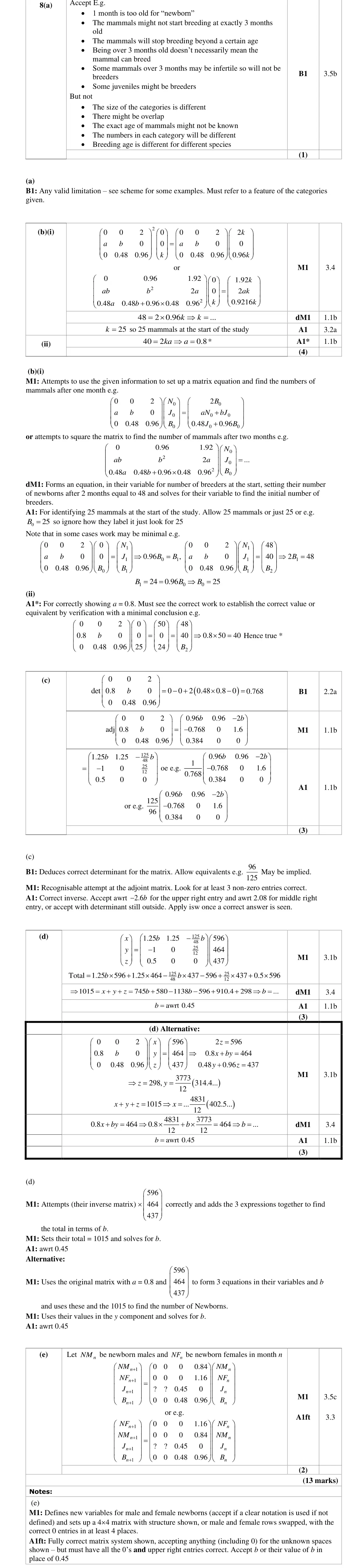
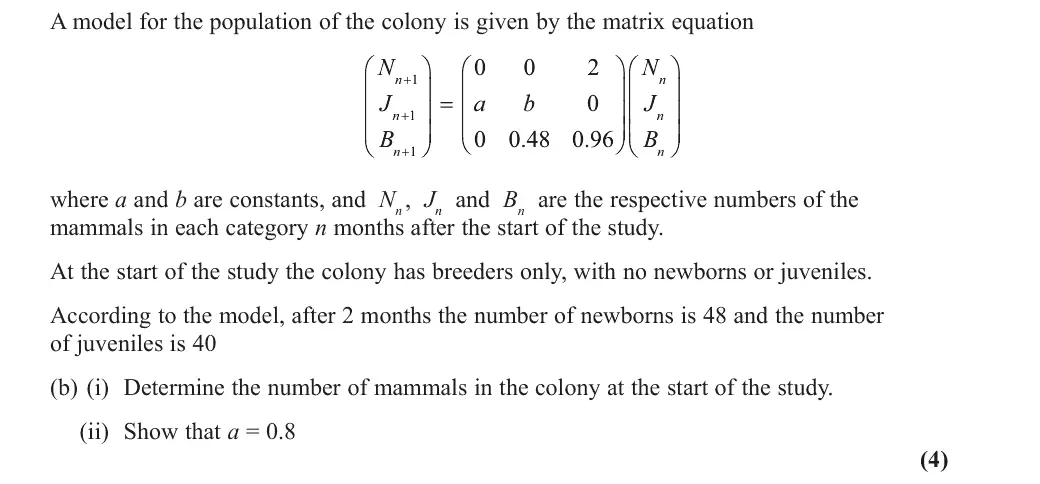
apply the matrix twice to (0, 0, k): 1.92k = 48 so k = 25 mammals
then 2ak = 40 gives a = 0.8
some applied the matrix only once
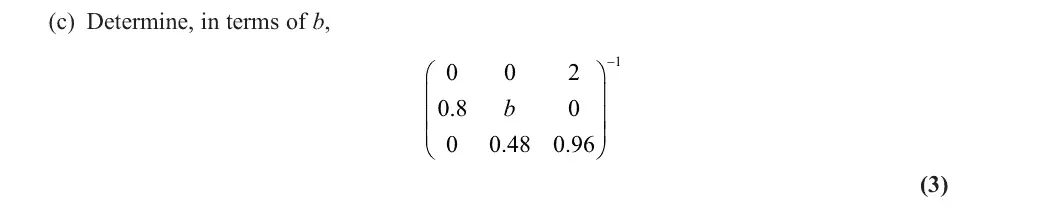
June 2023 · Paper 1 (Core Pure 1) · Q8(c)3 marks
Mark scheme (whole question; this part is marked with the orange bar)
Examiner's comment
This question was not attempted by all students, possibly due to the time constraints of the paper. The different parts generally proved accessible, even if the preceding parts had not been attempted. It seemed that many candidates were running out of time and were attempting the parts that they could quickly gain some credit for. A wide variety of marks was seen. Most candidates who attempted part (c) made a good attempt at finding the inverse matrix, although some made small arithmetical slips or sign errors, either in calculating the value of the determinant, or with one of the elements in their inverse. No doubt time pressure contributed to their accuracy in some cases.
Key points from the mark scheme and examiner's report
determinant 0.768 (96/125)
inverse with entries in b, e.g. first row (1.25b, 1.25, −125b/96)
sign and arithmetic slips in the inverse
June 2023 · Paper 1 (Core Pure 1) · Q8(d)3 marks
Mark scheme (whole question; this part is marked with the orange bar)
Examiner's comment
This question was not attempted by all students, possibly due to the time constraints of the paper. The different parts generally proved accessible, even if the preceding parts had not been attempted. It seemed that many candidates were running out of time and were attempting the parts that they could quickly gain some credit for. A wide variety of marks was seen. Using the inverse matrix and forming and solving an equation for the total number of mammals was the most common approach seen in part (d). This proved quite time consuming, but a significant number of candidates presented fully correct solutions. Working forwards using the original model, then solving the resulting equations was also commonly seen. Some of those with an incorrect inverse were able to score full marks in this question because they used the latter method. For the matrix approach, some multiplied the inverse by the values but never summed the resulting values so did not gain any marks.
Key points from the mark scheme and examiner's report
inverse × (596, 464, 437) and sum the entries = 1015, or work forwards with the original matrix
b ≈ 0.45
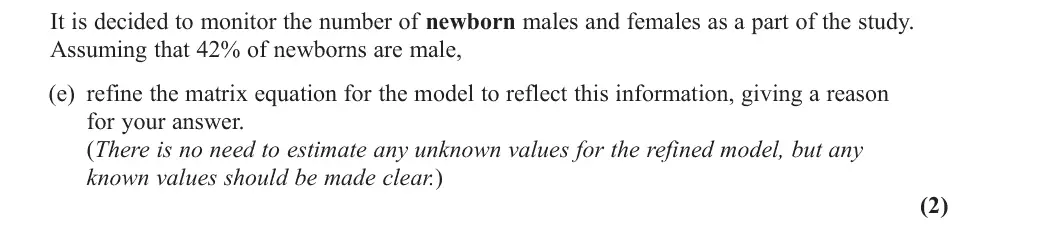
June 2023 · Paper 1 (Core Pure 1) · Q8(e)2 marks
Mark scheme (whole question; this part is marked with the orange bar)
Examiner's comment
This question was not attempted by all students, possibly due to the time constraints of the paper. The different parts generally proved accessible, even if the preceding parts had not been attempted. It seemed that many candidates were running out of time and were attempting the parts that they could quickly gain some credit for. A wide variety of marks was seen. Very few candidates attempted part (e) and while some realised that it was necessary to create two new categories, they then failed to use this to form a 4 4 matrix system. Those candidates who did form a 4 4 matrix were generally completely correct in their working. Several candidates tried to write about what they would do, but offered no actual matrix so gained no marks.
Key points from the mark scheme and examiner's report
split newborns into male and female: 4 × 4 matrix with 0.84 (= 2 × 0.42) and 1.16 (= 2 × 0.58) from breeders
very rarely attempted
describing without giving a matrix scored 0
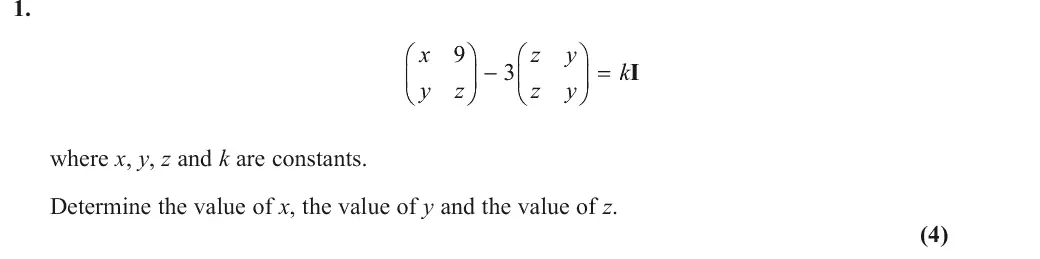
June 2023 · AS Paper 1 (Core Pure) · Q14 marks
Mark scheme (whole question; this part is marked with the orange bar)
Examiner's comment
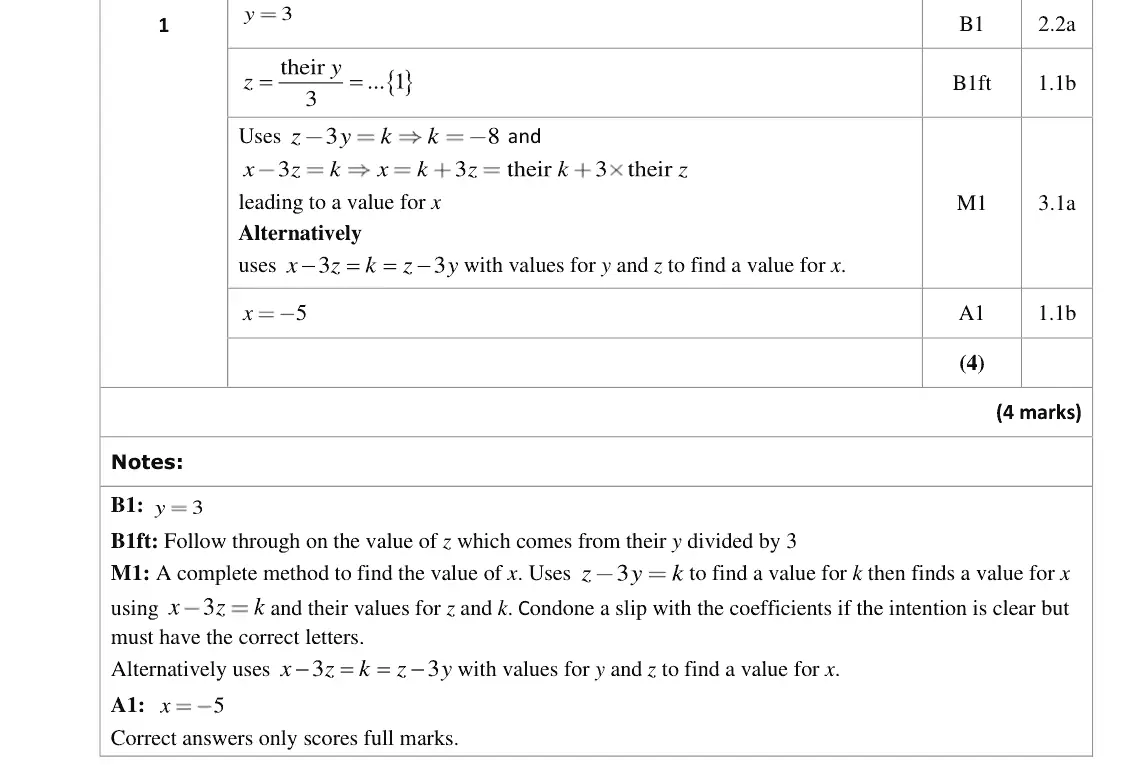
The vast majority of candidates obtained, by equating positional elements, four equations connecting x, y, z and k and then solved them simultaneously to find the required values. A number of candidates did not use the value of k and thus obtained the incorrect equations x – 3z = 1 and z – 3y = 1 resulting in a loss of marks. However, many candidates scored full marks on this question and found it a good start to the paper.
Key points from the mark scheme and examiner's report
equate elements: y = 3, 3z = y so z = 1
k = z − 3y = −8
x − 3z = k gives x = −5
forgetting to use k (x − 3z = 1) a common error
June 2023 · AS Paper 1 (Core Pure) · Q3(c)1 mark
Mark scheme (whole question; this part is marked with the orange bar)
Examiner's comment
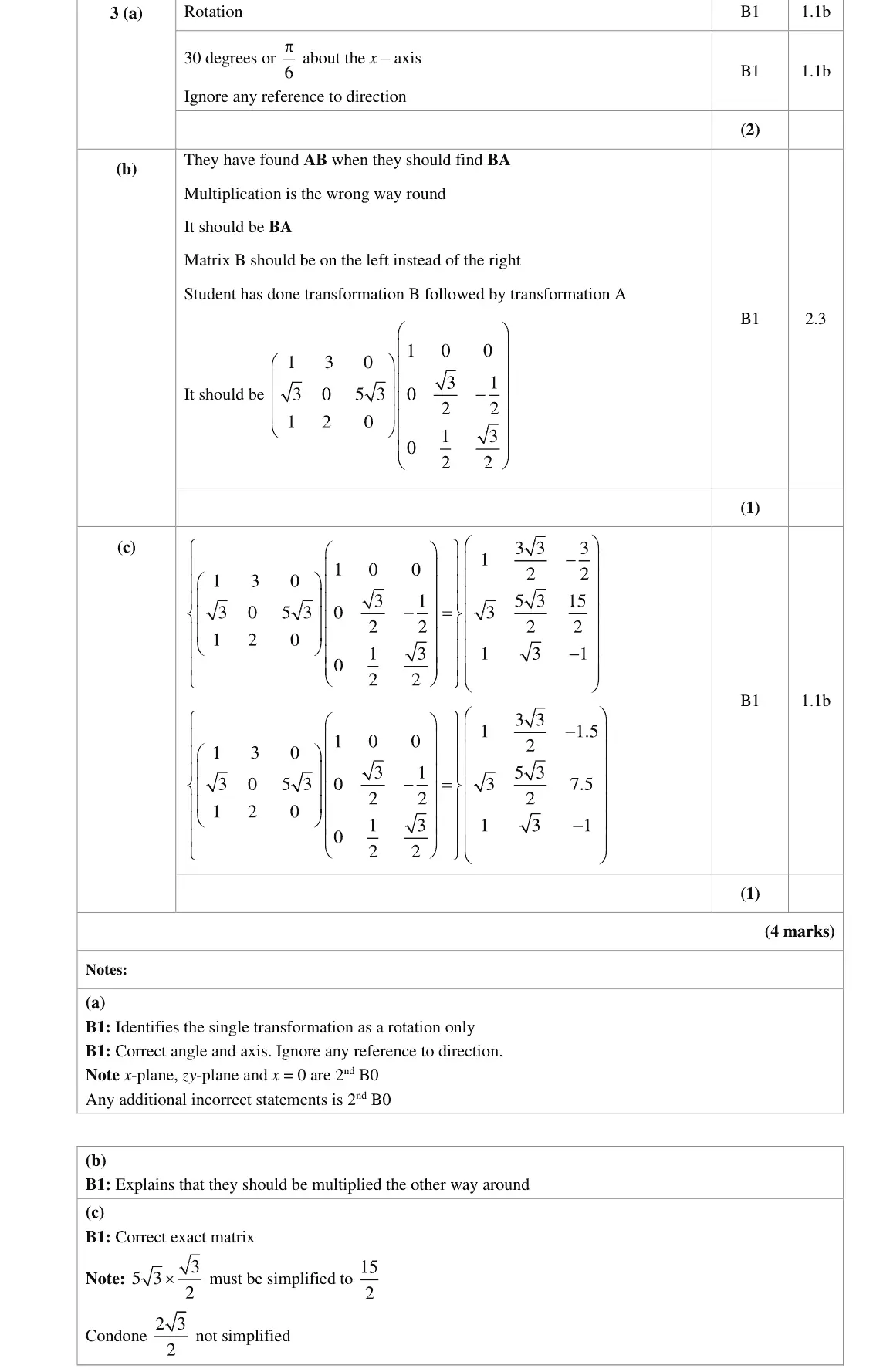
Nearly all candidates made some attempt at this question. In part (c), many gained this mark. Where it was lost this was either due to occasional errors in multiplication or, more often, giving the answers to 3sf rather than exact figures as requested. A few just stated the matrices in the correct order but did not proceed to multiply.
Key points from the mark scheme and examiner's report
C = BA = (1 3√3/2 −3/2
√3 5√3/2 15/2
1 √3 −1)
exact values, not 3 s.f.
June 2023 · AS Paper 1 (Core Pure) · Q9(i)4 marks
Mark scheme (whole question; this part is marked with the orange bar)
Examiner's comment
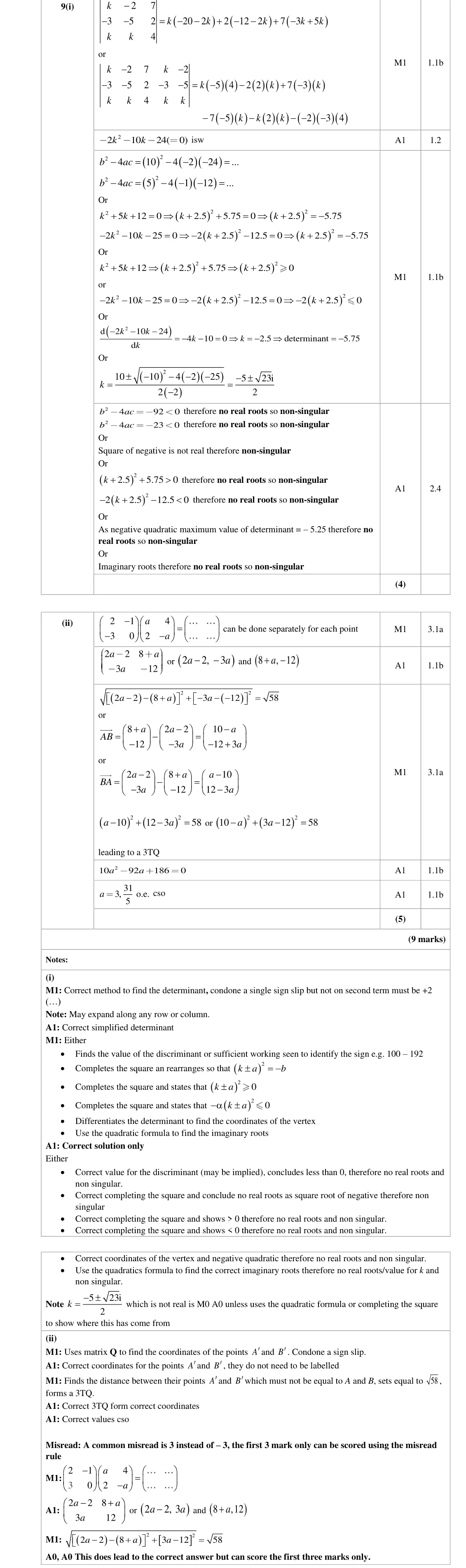
In part (i), the vast majority of the candidates expanded along the first row to find the determinant of the matrix P and much success was achieved. The most common error was not applying the change of sign rule which resulted in the loss of the first two marks at least. For those responses that had found the correct determinant, the proof of the non-singularity of P proved demanding and although the use of either the discriminant or completing the square were well identified methods, many solutions did not include all of the necessary details and thus fully complete solutions did not often appear. This is a show questions and candidates are remined that they do need to show the reasoning clearly. Just saying no real roots is insufficient they need to show why it has no real roots. In part (ii), the vast majority of the candidates correctly found the coordinates of A' and B' and then equated the distance between them to 58 to form the required quadratic equation. The occasional sign error or incorrect expansions were the main reasons here as to why marks were lost but much success was achieved in this part and many of the cohort scored full marks.
Key points from the mark scheme and examiner's report
det = −2k² − 10k − 24 (watch the sign of the middle cofactor)
discriminant −92 < 0 or complete the square, so det ≠ 0 for all real k
conclusion often incomplete
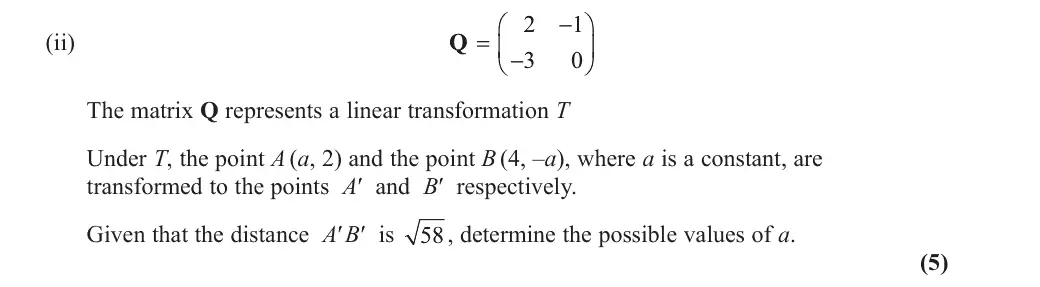
June 2023 · AS Paper 1 (Core Pure) · Q9(ii)5 marks
Mark scheme (whole question; this part is marked with the orange bar)
Examiner's comment
In part (i), the vast majority of the candidates expanded along the first row to find the determinant of the matrix P and much success was achieved. The most common error was not applying the change of sign rule which resulted in the loss of the first two marks at least. For those responses that had found the correct determinant, the proof of the non-singularity of P proved demanding and although the use of either the discriminant or completing the square were well identified methods, many solutions did not include all of the necessary details and thus fully complete solutions did not often appear. This is a show questions and candidates are remined that they do need to show the reasoning clearly. Just saying no real roots is insufficient they need to show why it has no real roots. In part (ii), the vast majority of the candidates correctly found the coordinates of A' and B' and then equated the distance between them to 58 to form the required quadratic equation. The occasional sign error or incorrect expansions were the main reasons here as to why marks were lost but much success was achieved in this part and many of the cohort scored full marks.
Key points from the mark scheme and examiner's report
A' = (2a − 2, −3a), B' = (8 + a, −12)
distance² = 58 gives 10a² − 92a + 186 = 0, a = 3 or 31/5
June 2023 · Paper 2 (Core Pure 2) · Q3(a)3 marks
Mark scheme (whole question; this part is marked with the orange bar)
Examiner's comment
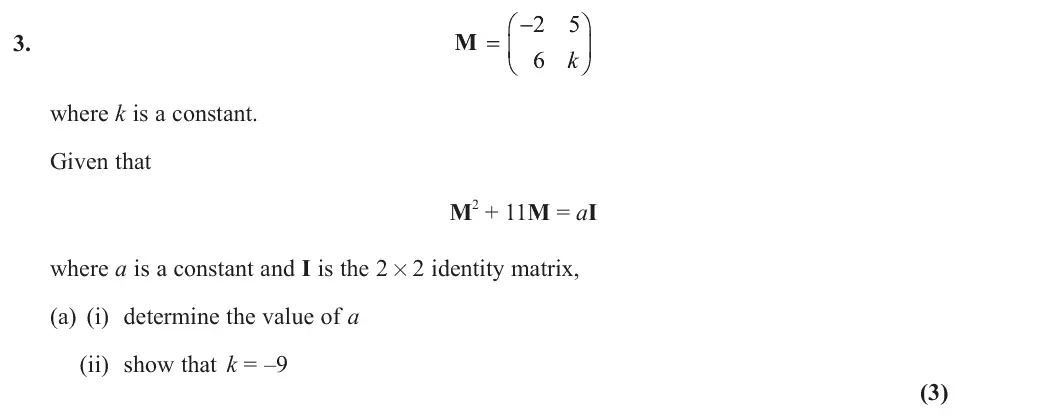
(a) The majority of students answered part (a) successfully, with most able to evaluate M2 and use this to find values of a and k using the off diagonals. Some slips were seen leading to incorrect values and a few candidates used the bottom right entry only to find the given value of k, which was not enough to justify this. A few candidates were careless when evaluating M2, particularly in the top left, leading to an incorrect value for a.
Key points from the mark scheme and examiner's report
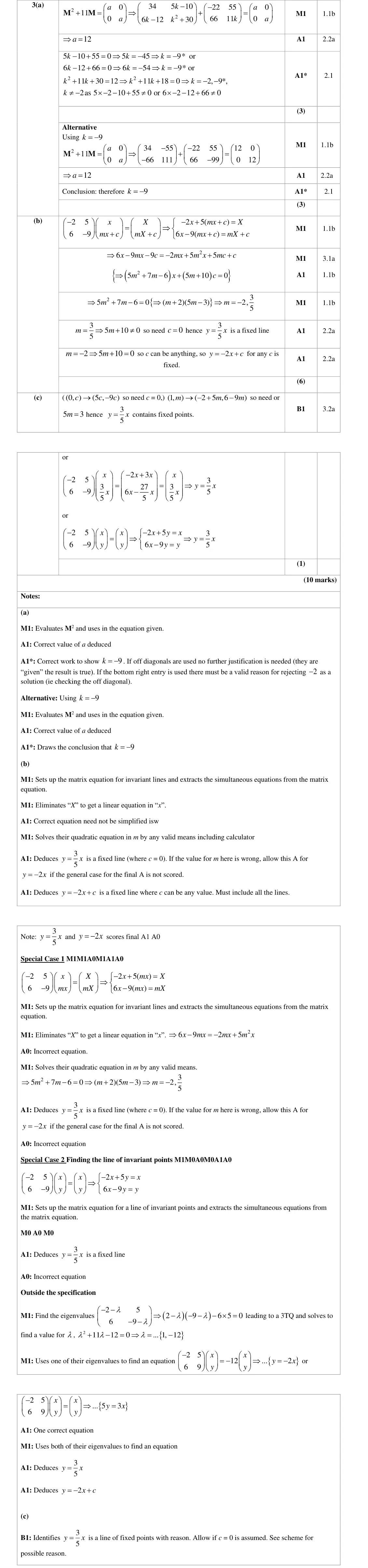
M² + 11M from the off-diagonal entries: a = 12, 5k − 10 + 55 = 0 gives k = −9
using only the bottom-right entry needs −2 rejected
slips in the top-left of M²
June 2022 · Paper 1 (Core Pure 1) · Q5(a)2 marksEasy
Mark scheme (whole question; this part is marked with the orange bar)
Examiner's comment
Another very well approached question with 96% scoring 4 or more marks out of the 6 available. Almost all candidates attempted to find the determinant, with most doing so correctly. Some candidates lost the A mark for either making a slip when simplifying their - - expression for the determinant, usually when dealing with the 3(2 incorrectly. a 12) Common incorrect values were 44 or 24, while some lost the A mark for not referencing that det M ≠ 0 within their conclusion, or failing to state the conclusion that the matrix was non- singular.
Key points from the mark scheme and examiner's report
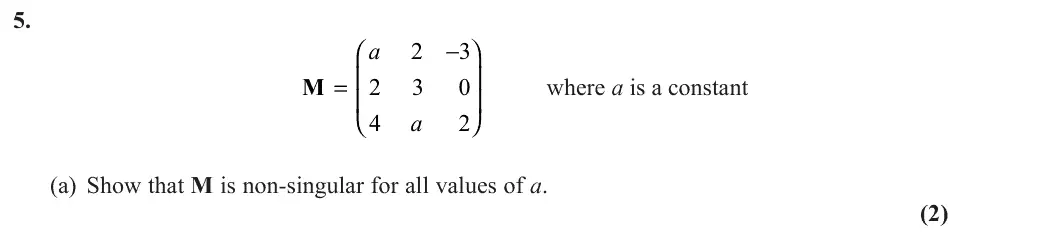
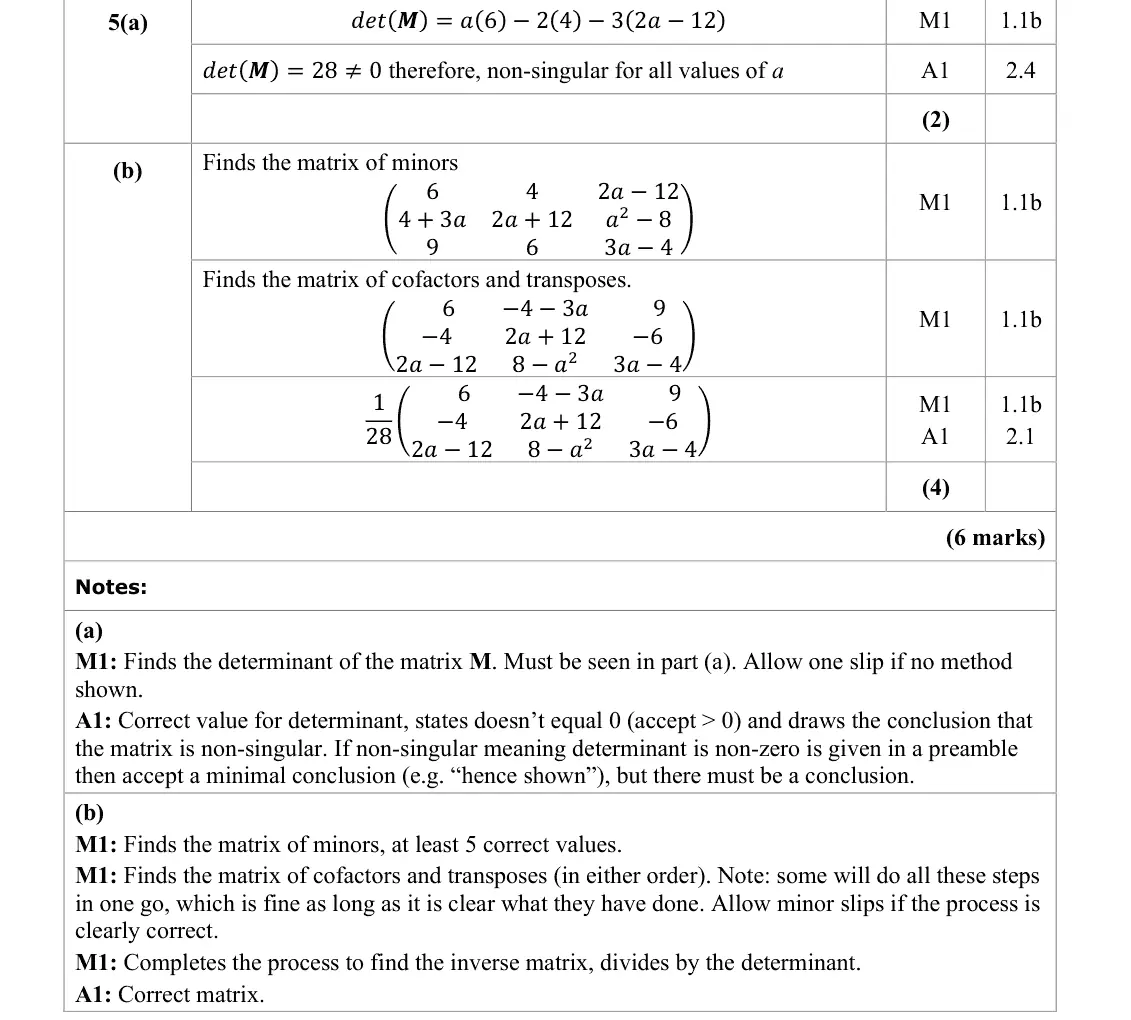
det M = 6a − 8 − 3(2a − 12) = 28 ≠ 0 so non-singular for all a
slips with −3(2a − 12) giving 44 or 24
conclusion needed
June 2022 · Paper 1 (Core Pure 1) · Q5(b)4 marks
Mark scheme (whole question; this part is marked with the orange bar)
Examiner's comment
In part (b) most candidates worked through all the correct stages in the process to find the inverse matrix, with only minor slips being made. A good attempt was generally made at finding the matrix of minors. Where candidates took one step at a time in the process of finding the inverse matrix they were more likely to be successful and more unlikely to make basic errors. Minor errors when finding the matrix of cofactors and/or transposing the matrix still enabled them to gain the method mark as long as the process was clearly correct. Most completed the process by dividing by their det M.
Key points from the mark scheme and examiner's report
minors, cofactors, transpose, divide by 28
one step at a time to avoid sign slips
June 2022 · AS Paper 1 (Core Pure) · Q1(a)4 marks
Mark scheme (whole question; this part is marked with the orange bar)
Examiner's comment
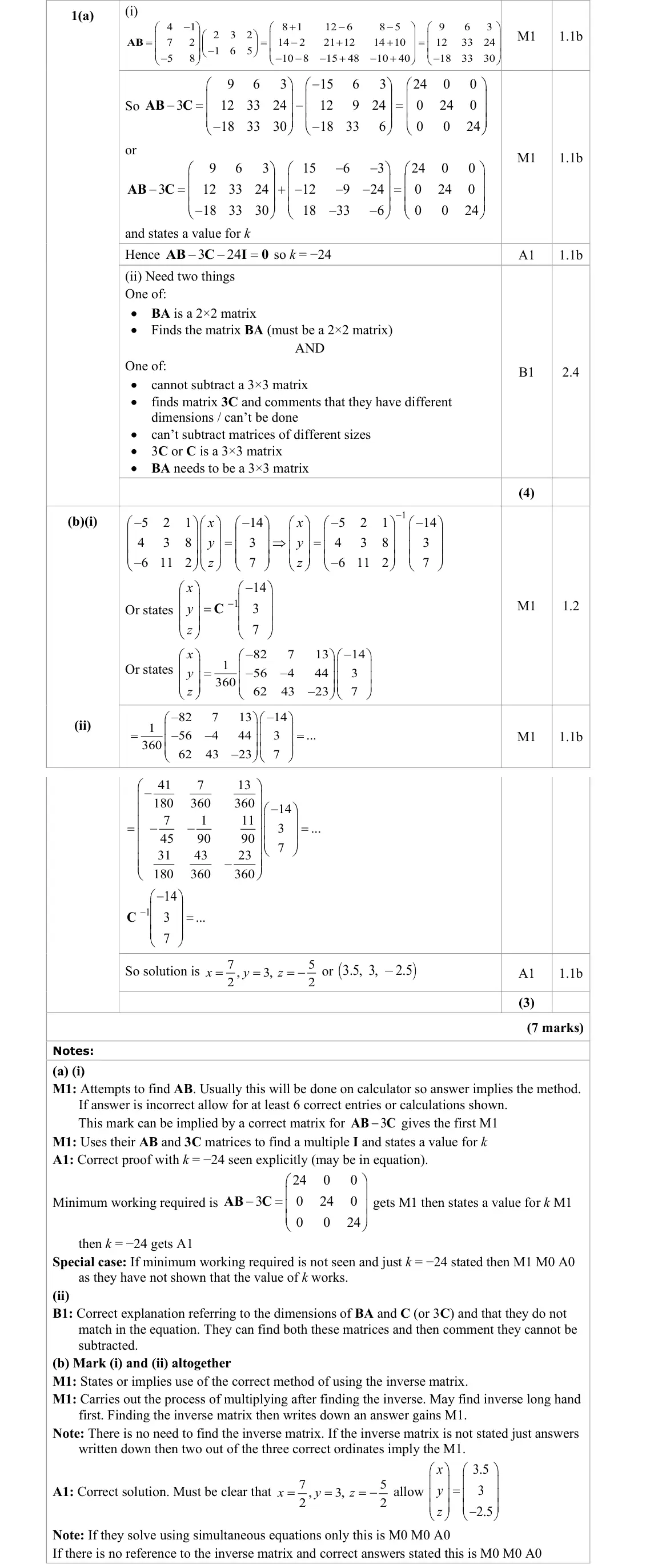
This was in general a very accessible question with the majority of candidates achieving 5 or more marks. All candidates managed to at least make an attempt on this question. In (a) the majority of candidates answered successfully. The common mistake was to give the answer of k = 24, instead of k = – 24. It was disappointing that candidates did not make a quick check if their value worked in the equation. A few just gained 1 mark as they failed to arrive at a matrix that was a multiple of the identity thus not showing that the found value of k worked for all elements.
Key points from the mark scheme and examiner's report
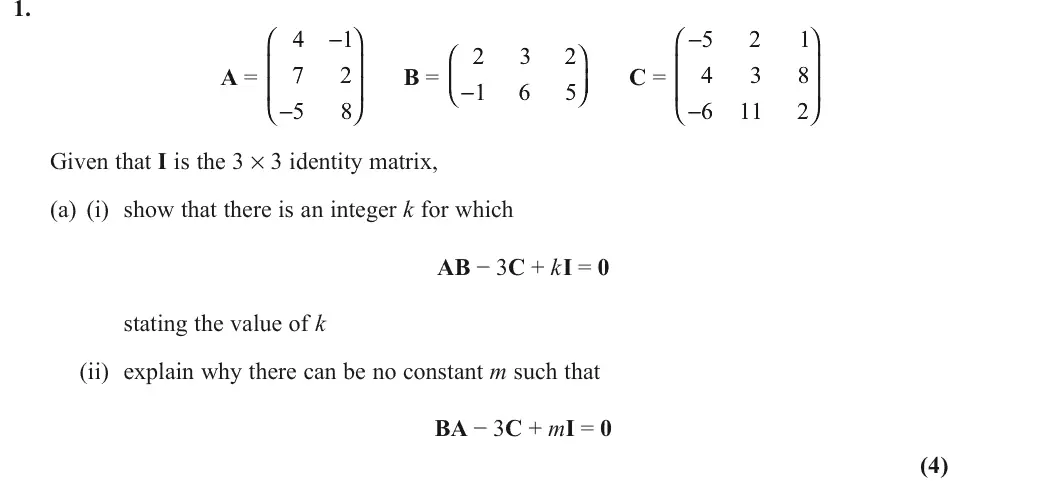
AB − 3C = 24I so k = −24 (k = 24 a common sign error)
must show the multiple of I
(ii) BA is 2 × 2 but C is 3 × 3, so they cannot be subtracted
many wrongly said AB could not be found
June 2022 · AS Paper 1 (Core Pure) · Q3(b)2 marks
Mark scheme (whole question; this part is marked with the orange bar)
Examiner's comment
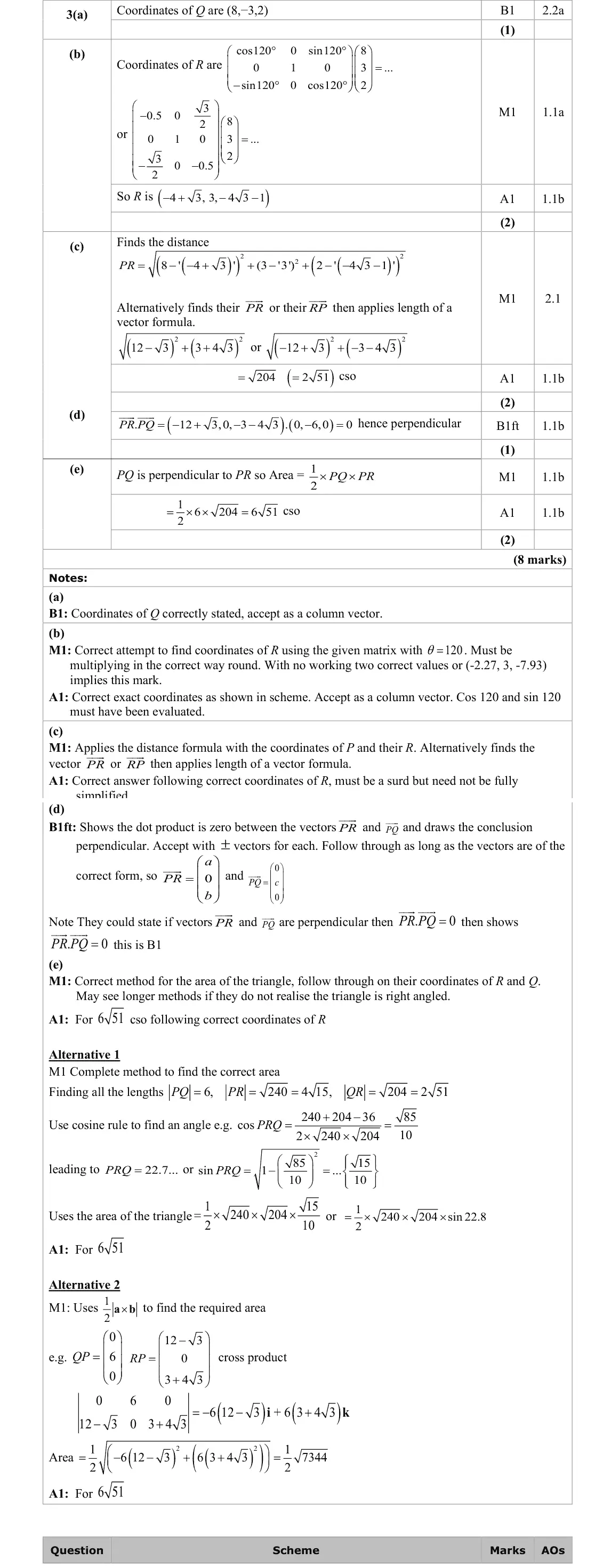
Typically, parts (b) and (c) were answered well. The provision of the matrix for the rotation enabled the vast majority of candidates to attempt part (b) successfully, although a disappointing number of students gave inexact answers for R or made slips with the exact values of sin120 or cos120 . More significant errors were seen, including multiplying P by the matrix the wrong way round, or using their position vector for Q instead of P, which led to no marks being scored in this part. In part (c), generally candidates subtracted the position vector for P from their
Key points from the mark scheme and examiner's report
multiply the given matrix with θ = 120° by (8, 3, 2): R = (−4 + √3, 3, −4√3 − 1)
exact values needed
using Q or the wrong order scores 0
June 2022 · Paper 2 (Core Pure 2) · Q2(b)4 marks
Mark scheme (whole question; this part is marked with the orange bar)
Examiner's comment
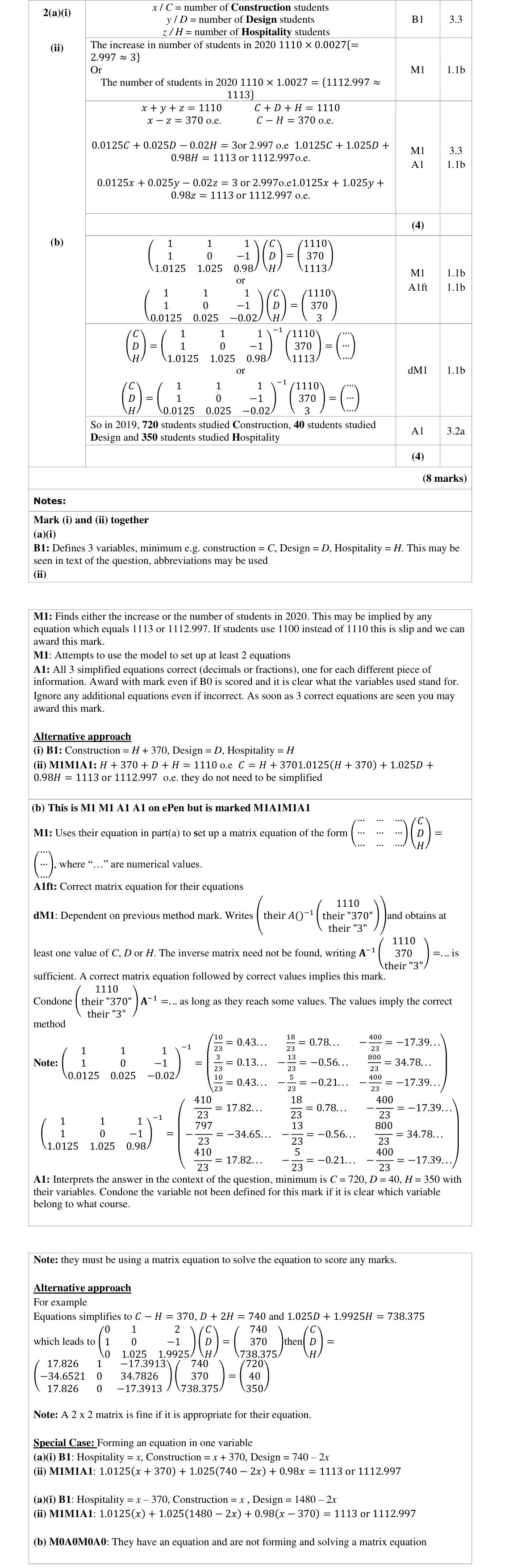
This question on a model involving matrices was generally well-answered, but there was less success in part (b). In part (b) most set up a matrix equation although some merely solved their set of linear simultaneous equations. The matrix equations tended to be correct for their equations and most knew that an inverse had to be obtained to solve for the variables. It was unfortunate to see manual attempts at matrix inversion – teachers and students are reminded that unless the question directs otherwise, it is expected that a matrix whose elements are fully numerical then a calculator can be used. A small number left their answer (sometimes unrounded) as a column vector instead of putting their values in context.
Key points from the mark scheme and examiner's report
must form and solve a matrix equation with the inverse (calculator inverse expected, manual inversion wastes time)
C = 720, D = 40, H = 350 given in context, not left as a column vector
solving simultaneous equations without matrices scores 0
June 2022 · Paper 2 (Core Pure 2) · Q3(b)5 marks
Mark scheme (whole question; this part is marked with the orange bar)
Examiner's comment
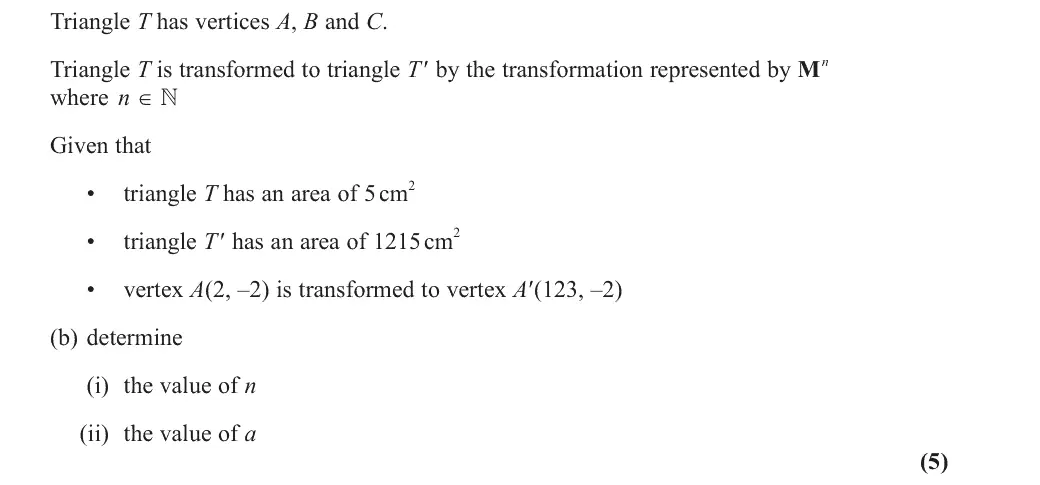
Part (b) This was well answered by the majority of candidates, a good number still The errors with (b) included using the square root of the determinant whilst a notable minority were unable to link them at all. A significant number of candidates failed to get a determinant. Part (c) Candidates who successfully found a value for n then went on to find a value for a successfully with only a very few making arithmetic slips. The most common mistakes were not setting their matrix multiplication equal to 123 2 - .
Key points from the mark scheme and examiner's report
det(Mⁿ) = 3ⁿ so 5 × 3ⁿ = 1215 gives n = 5 (not the square root of the determinant)
Mⁿ(2, −2) = (123, −2) gives a = 1.5
some failed to find a determinant at all
Nov 2021 · Paper 1 (Core Pure 1) · Q1(a)4 marks
Mark scheme (whole question; this part is marked with the orange bar)
Examiner's comment
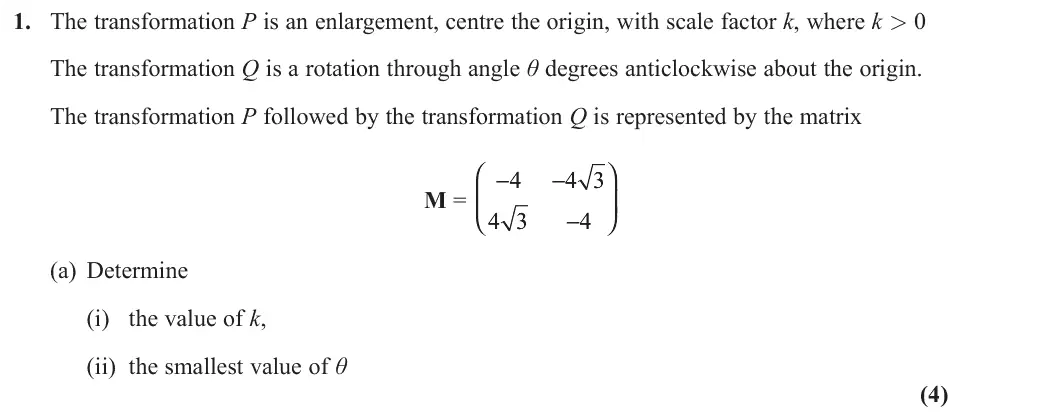
(a) Most candidates made a good attempt at this part. With over half accessing the first 3 marks. Some were able to just write down a value for k or found the square root of the determinant to give a value which was usually correct. Of the latter, a few did not take the square root, and these gained no marks here. Those who obtained a value for k were then usually able to write down a valid equation and proceed to find a value for theta . The most common error was to give their angle in radians, not degrees, losing the A mark. Those who used Way 2 had more work to do to gain the marks. Most used the correct matrices representing the transformations but were often unable to form and solve two simultaneous equations to find values for k and for theta .
Key points from the mark scheme and examiner's report
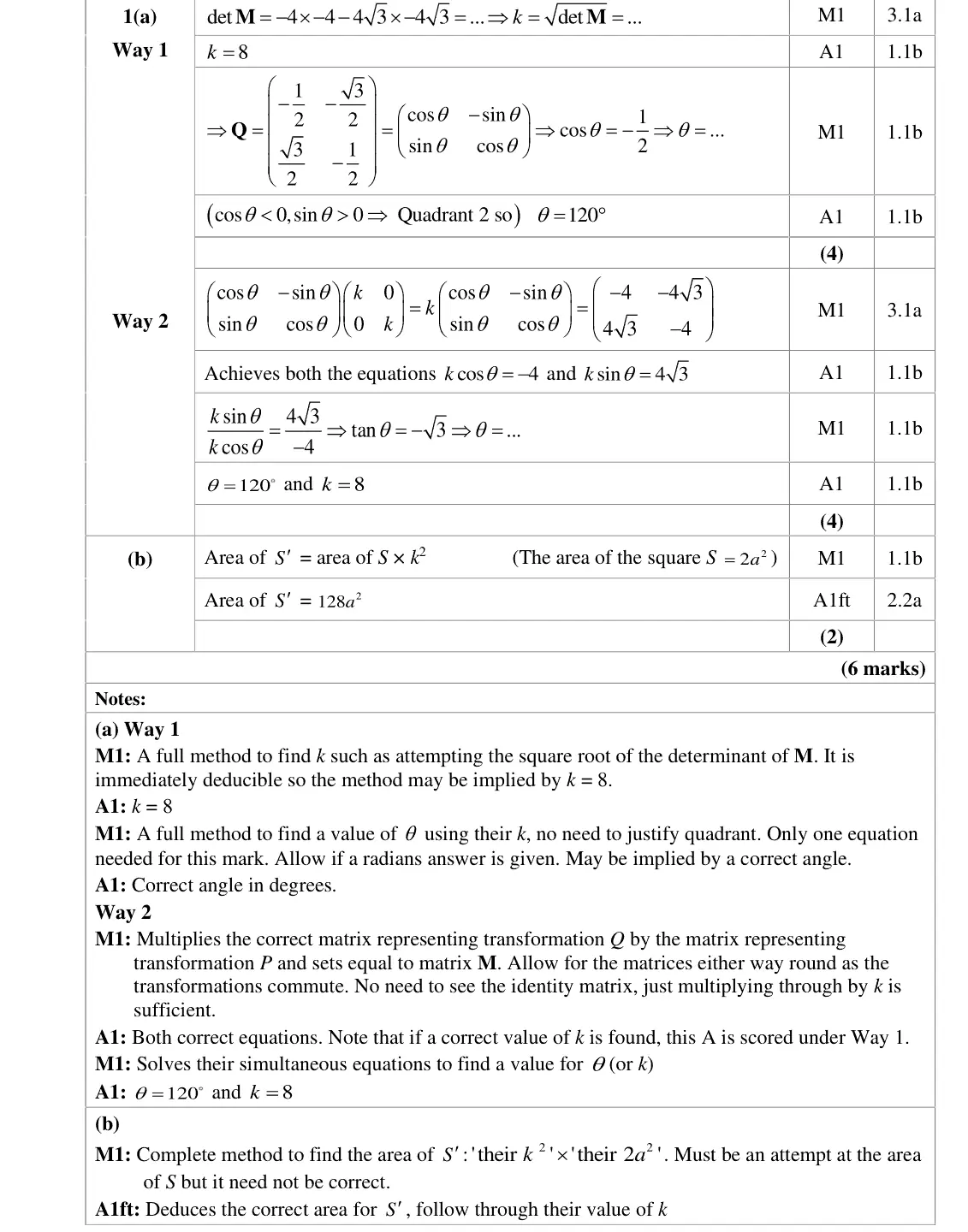
k² = det M = 64 so k = 8 (take the square root)
M = 8 × rotation matrix: cos θ = −½, sin θ > 0 so θ = 120° (degrees, not radians)
Nov 2021 · Paper 1 (Core Pure 1) · Q1(b)2 marks
Mark scheme (whole question; this part is marked with the orange bar)
Examiner's comment
(b) Just over half of the candidates applied a correct method to find the area of S’. Many of these used the determinant to do so and obtained full marks. The mark scheme allowed full marks in this part following on from their value for k, providing the area of the original shape S was correct. Finding the area of S however did seem to cause many problems, so many scored M1A0, with only a third scoring full marks for this part.
Key points from the mark scheme and examiner's report
area of S = 2a² (often wrong)
area of S′ = det M × area of S = 128a²
Nov 2021 · Paper 1 (Core Pure 1) · Q4(i)2 marksEasy
Mark scheme (whole question; this part is marked with the orange bar)
Examiner's comment
The overall performance on this question was better than the preceding questions, suggesting it is a more comfortable topic to students and could have appeared earlier in the paper, with the first 7 marks being score by over 50% of candidates, and only the final mark scored by fewer than 44%. (i) (i) An easy start to this question with the majority gaining at least one mark (over 70% scored the mark in (b)). A common error was to confuse rows with columns in their first statement meaning slightly fewer scored this mark (55%). (ii) There were several methods for finding the required values, mostly all successful with two thirds scoring the first two marks, and over 50% again scoring the third. Most obtained the correct inverse matrix, and there was a follow through on their λ. Some used their calculators with values for a and b, which was also fine, while there were also attempts at finding the inverse matrix from scratch, which seemed to be an awful lot of work for one mark! (iii) About two thirds of candidate successfully used a correct method to find the determinant and set it to 0. Many then did not realise that this reduced to cos3 theta = 0, and ended up using trigonometric identities for sin2 theta and cos2 theta to solve a more complicated equation. Very few gave all three possible values leading to the drop off noted above, commonly losing a value by dividing through by cos theta and not considering it could equal 0. Others just gave one value pi /6. These two marks were for solving a very straightforward trig equation which they should have been able to do in Maths A level
Key points from the mark scheme and examiner's report
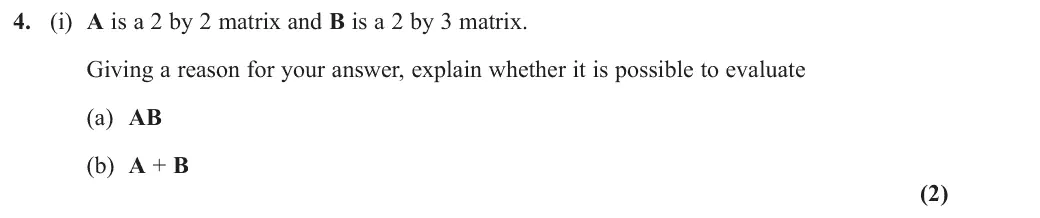
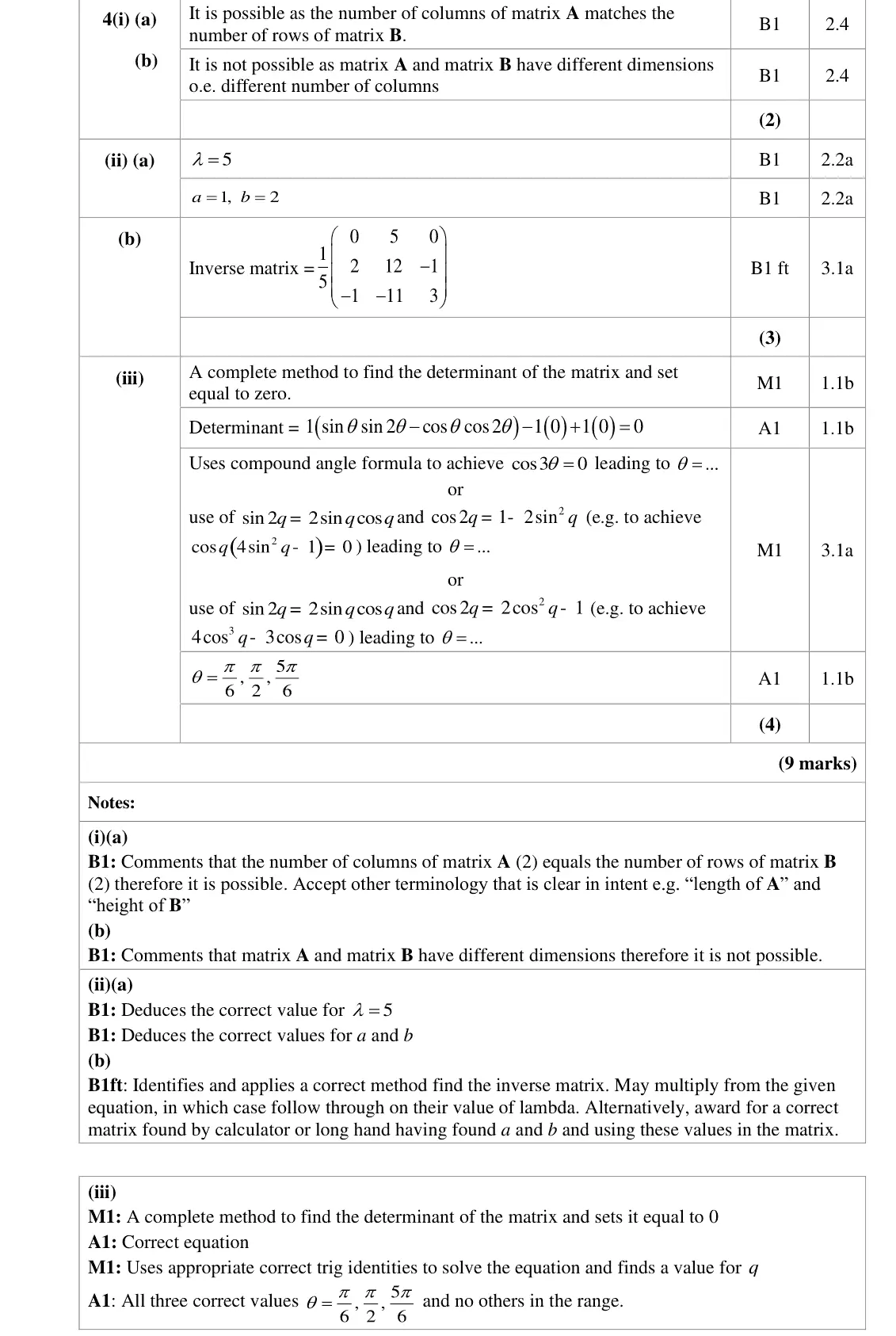
AB possible: columns of A (2) = rows of B (2)
A + B not possible as the dimensions differ
confusing rows with columns
Nov 2021 · Paper 1 (Core Pure 1) · Q4(ii)3 marksMedium
Mark scheme (whole question; this part is marked with the orange bar)
Examiner's comment
The overall performance on this question was better than the preceding questions, suggesting it is a more comfortable topic to students and could have appeared earlier in the paper, with the first 7 marks being score by over 50% of candidates, and only the final mark scored by fewer than 44%. (i) (i) An easy start to this question with the majority gaining at least one mark (over 70% scored the mark in (b)). A common error was to confuse rows with columns in their first statement meaning slightly fewer scored this mark (55%). (ii) There were several methods for finding the required values, mostly all successful with two thirds scoring the first two marks, and over 50% again scoring the third. Most obtained the correct inverse matrix, and there was a follow through on their λ. Some used their calculators with values for a and b, which was also fine, while there were also attempts at finding the inverse matrix from scratch, which seemed to be an awful lot of work for one mark! (iii) About two thirds of candidate successfully used a correct method to find the determinant and set it to 0. Many then did not realise that this reduced to cos3 theta = 0, and ended up using trigonometric identities for sin2 theta and cos2 theta to solve a more complicated equation. Very few gave all three possible values leading to the drop off noted above, commonly losing a value by dividing through by cos theta and not considering it could equal 0. Others just gave one value pi /6. These two marks were for solving a very straightforward trig equation which they should have been able to do in Maths A level
Key points from the mark scheme and examiner's report
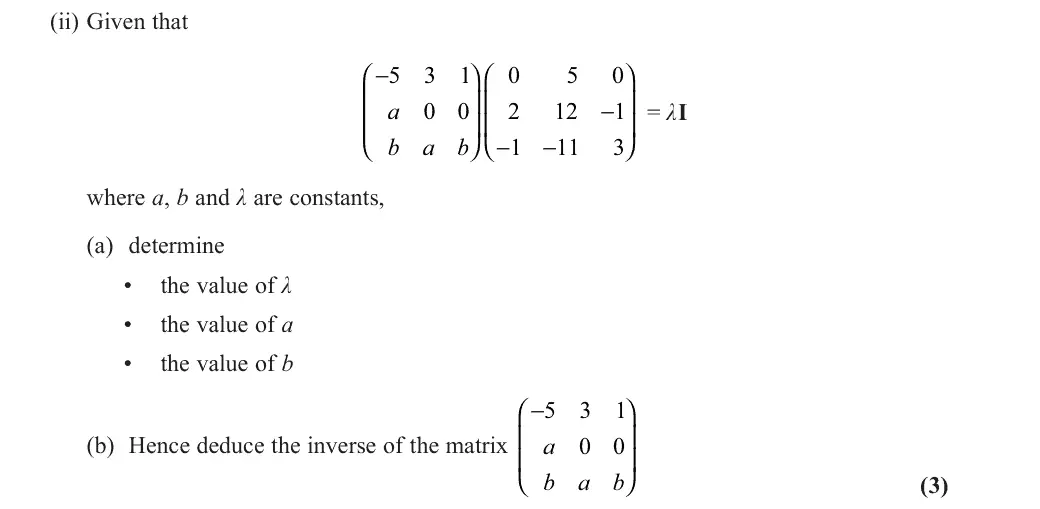
multiply out: λ = 5, a = 1, b = 2
inverse is (1/5) × the second matrix
Nov 2021 · Paper 1 (Core Pure 1) · Q4(iii)4 marksMedium
Mark scheme (whole question; this part is marked with the orange bar)
Examiner's comment
The overall performance on this question was better than the preceding questions, suggesting it is a more comfortable topic to students and could have appeared earlier in the paper, with the first 7 marks being score by over 50% of candidates, and only the final mark scored by fewer than 44%. (i) (i) An easy start to this question with the majority gaining at least one mark (over 70% scored the mark in (b)). A common error was to confuse rows with columns in their first statement meaning slightly fewer scored this mark (55%). (ii) There were several methods for finding the required values, mostly all successful with two thirds scoring the first two marks, and over 50% again scoring the third. Most obtained the correct inverse matrix, and there was a follow through on their λ. Some used their calculators with values for a and b, which was also fine, while there were also attempts at finding the inverse matrix from scratch, which seemed to be an awful lot of work for one mark! (iii) About two thirds of candidate successfully used a correct method to find the determinant and set it to 0. Many then did not realise that this reduced to cos3 theta = 0, and ended up using trigonometric identities for sin2 theta and cos2 theta to solve a more complicated equation. Very few gave all three possible values leading to the drop off noted above, commonly losing a value by dividing through by cos theta and not considering it could equal 0. Others just gave one value pi /6. These two marks were for solving a very straightforward trig equation which they should have been able to do in Maths A level
Key points from the mark scheme and examiner's report
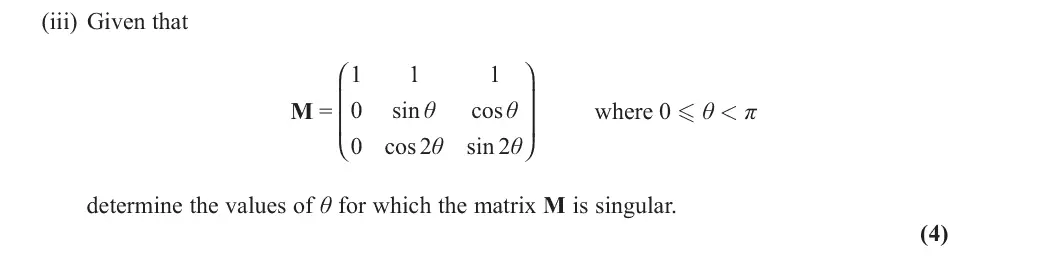
det M = sin θ sin 2θ − cos θ cos 2θ = −cos 3θ = 0
θ = π/6, π/2, 5π/6 (all three, no others)
Oct 2020 · AS Paper 1 (Core Pure) · Q1(a)2 marks
Mark scheme (whole question; this part is marked with the orange bar)
Examiner's comment
Very few students achieved full marks on this question. Many did not make any valid attempt for the full question. Part (a) the majority of candidates score full marks
Key points from the mark scheme and examiner's report
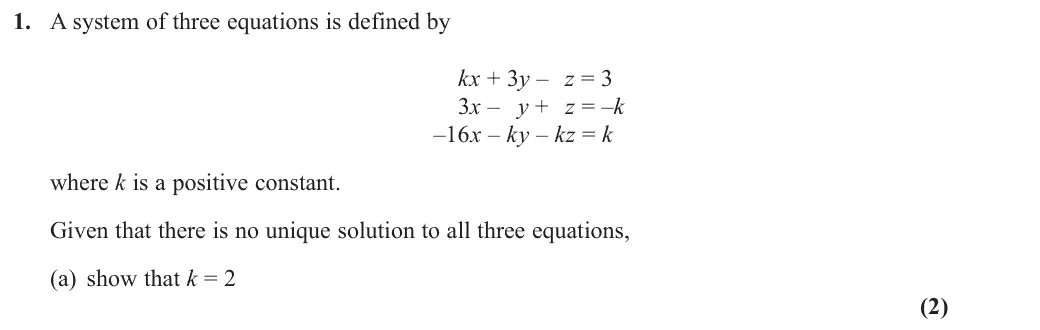
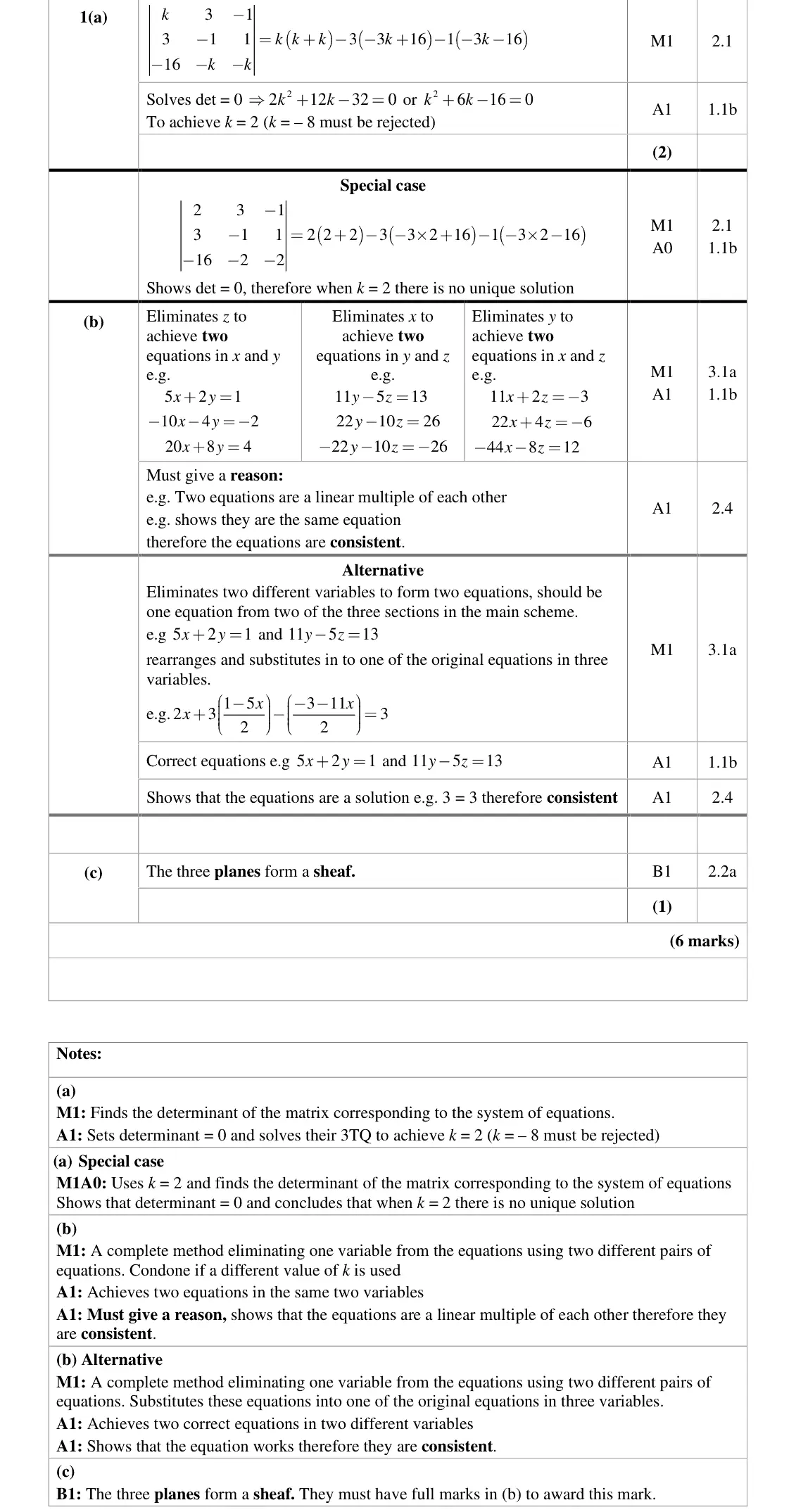
no unique solution means the coefficient matrix is singular: det = 2k² + 12k − 32 = 0, k² + 6k − 16 = 0
k = 2, reject k = −8 as k > 0
verifying det = 0 at k = 2 scores M1A0
Oct 2020 · AS Paper 1 (Core Pure) · Q6(i)(a)5 marks
Mark scheme (whole question; this part is marked with the orange bar)
Examiner's comment
(i) Part (a) - candidates that used the fact that for a matrix to be a self-inverse then AA = I and A A this did have some success 1 were very successful. However, the majority attempted but very often not. Often the two equations pulled out were not from the different diagonals meaning no marks awarded. Other incorrect methods seen were setting the determinant = 0 and AA I which does not lead to any equations. 1 using (i) Part (b) This was largely not attempted though those that were successful with part (a) were often successful. A common error was to use x and mx + c but then not fully complete the method. Section (ii) on the whole was much better answered Part (a) - only a small number failed to find the area of the object, those that did were often 5 p successful with this part with all candidates correctly discarding . The error that 3 occurred was a sign error in solving. Part (b) - very high success rate Part (c) - Due to the follow through marks available full marks where achieved on this part by nearly all who answered it. Very rarely the order of the matrices was incorrect.
Key points from the mark scheme and examiner's report
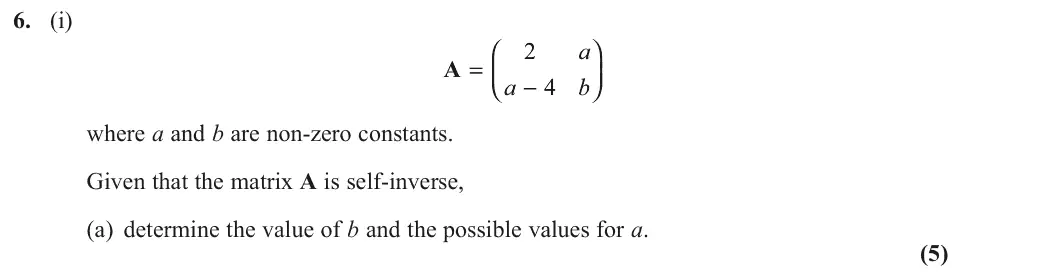
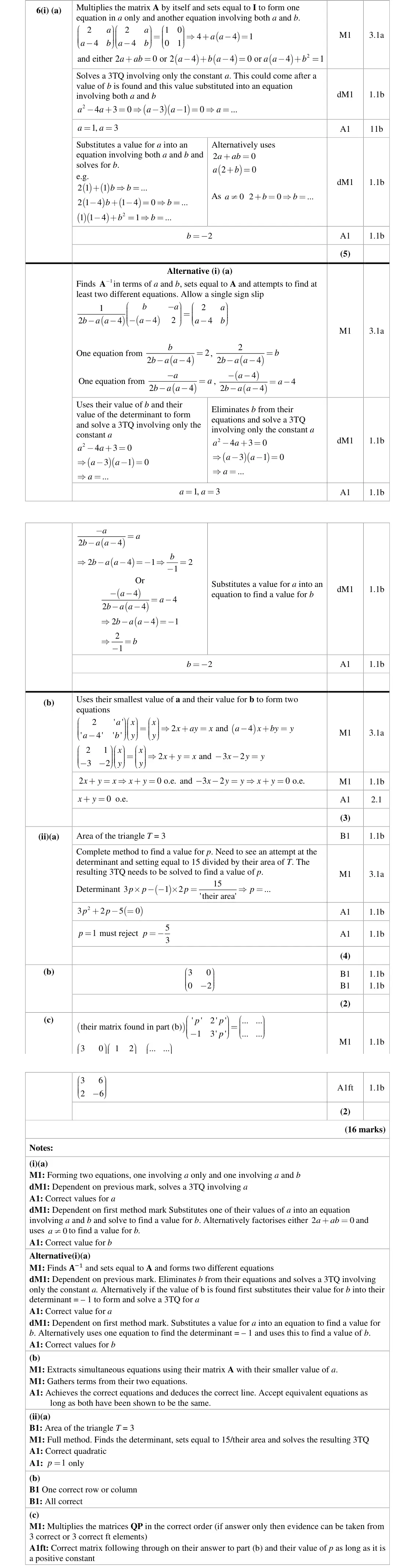
self-inverse means A² = I (or A⁻¹ = A)
equations from different entries: a² − 4a + 3 = 0, a = 1 or 3
2a + ab = 0 gives b = −2
setting det = 0 is wrong
Oct 2020 · AS Paper 1 (Core Pure) · Q6(ii)(a)4 marks
Mark scheme (whole question; this part is marked with the orange bar)
Examiner's comment
(i) Part (a) - candidates that used the fact that for a matrix to be a self-inverse then AA = I and A A this did have some success 1 were very successful. However, the majority attempted but very often not. Often the two equations pulled out were not from the different diagonals meaning no marks awarded. Other incorrect methods seen were setting the determinant = 0 and AA I which does not lead to any equations. 1 using (i) Part (b) This was largely not attempted though those that were successful with part (a) were often successful. A common error was to use x and mx + c but then not fully complete the method. Section (ii) on the whole was much better answered Part (a) - only a small number failed to find the area of the object, those that did were often 5 p successful with this part with all candidates correctly discarding . The error that 3 occurred was a sign error in solving. Part (b) - very high success rate Part (c) - Due to the follow through marks available full marks where achieved on this part by nearly all who answered it. Very rarely the order of the matrices was incorrect.
Key points from the mark scheme and examiner's report
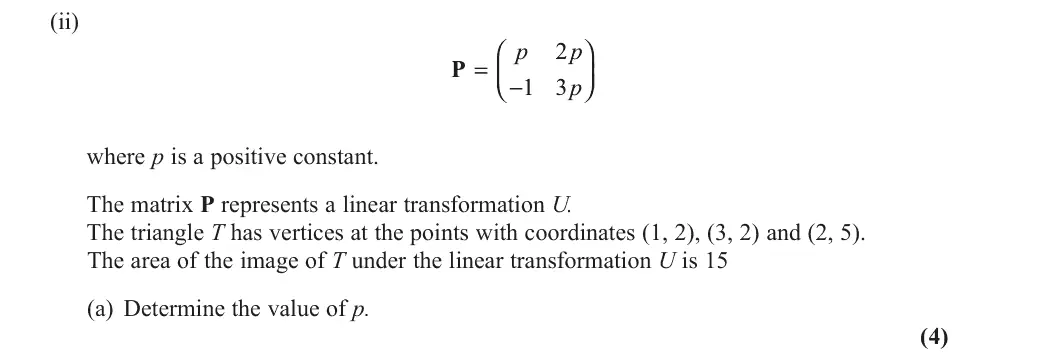
area of T = 3
det P = 3p² + 2p = 15/3 = 5
3p² + 2p − 5 = 0, p = 1 (reject −5/3)
Oct 2020 · AS Paper 1 (Core Pure) · Q6(ii)(c)2 marks
Mark scheme (whole question; this part is marked with the orange bar)
Examiner's comment
(i) Part (a) - candidates that used the fact that for a matrix to be a self-inverse then AA = I and A A this did have some success 1 were very successful. However, the majority attempted but very often not. Often the two equations pulled out were not from the different diagonals meaning no marks awarded. Other incorrect methods seen were setting the determinant = 0 and AA I which does not lead to any equations. 1 using (i) Part (b) This was largely not attempted though those that were successful with part (a) were often successful. A common error was to use x and mx + c but then not fully complete the method. Section (ii) on the whole was much better answered Part (a) - only a small number failed to find the area of the object, those that did were often 5 p successful with this part with all candidates correctly discarding . The error that 3 occurred was a sign error in solving. Part (b) - very high success rate Part (c) - Due to the follow through marks available full marks where achieved on this part by nearly all who answered it. Very rarely the order of the matrices was incorrect.
Key points from the mark scheme and examiner's report
U followed by V is QP (order matters)
R = (3 6
2 −6)
Oct 2020 · Paper 2 (Core Pure 2) · Q6(a)4 marks
Mark scheme (whole question; this part is marked with the orange bar)
Examiner's comment
Part (a) Virtually all candidates knew how to find the inverse of a 3 by 3 matrix and scored full marks. Slips in signs was generally the only error seen.
Key points from the mark scheme and examiner's report
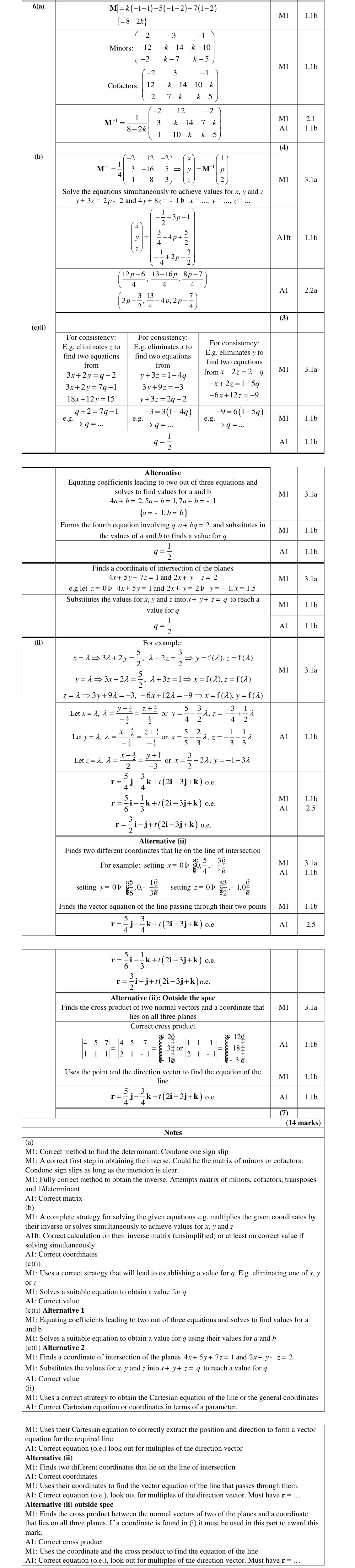
det M = 8 − 2k
minors, cofactors, transpose, divide by det
sign slips
June 2019 · AS Paper 1 (Core Pure) · Q1(a)2 marks
Mark scheme (whole question; this part is marked with the orange bar)
Key points from the mark scheme and examiner's report
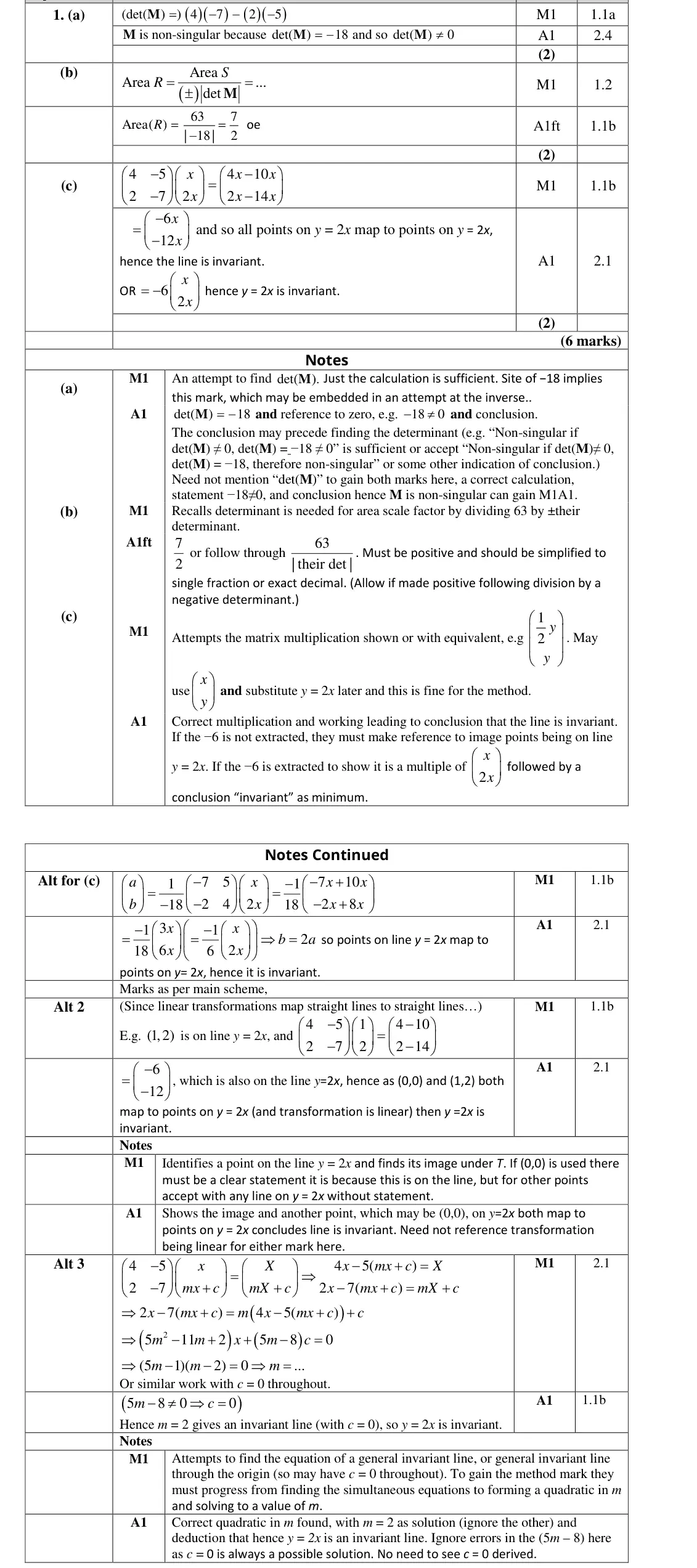
det M = (4)(−7) − (2)(−5) = −18
must state det ≠ 0 so M is non-singular
June 2019 · AS Paper 1 (Core Pure) · Q1(b)2 marks
Mark scheme (whole question; this part is marked with the orange bar)
Key points from the mark scheme and examiner's report
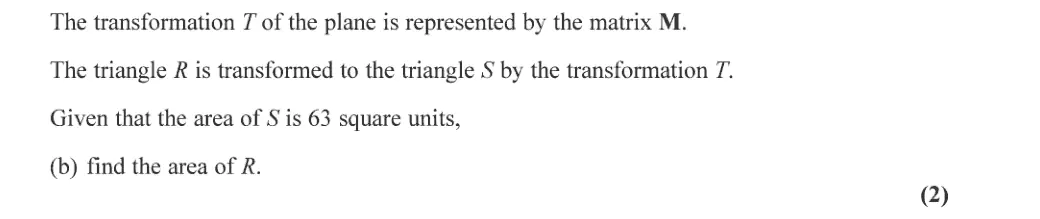
area of R = 63 ÷ modulus of det M = 63/18 = 7/2
answer must be positive
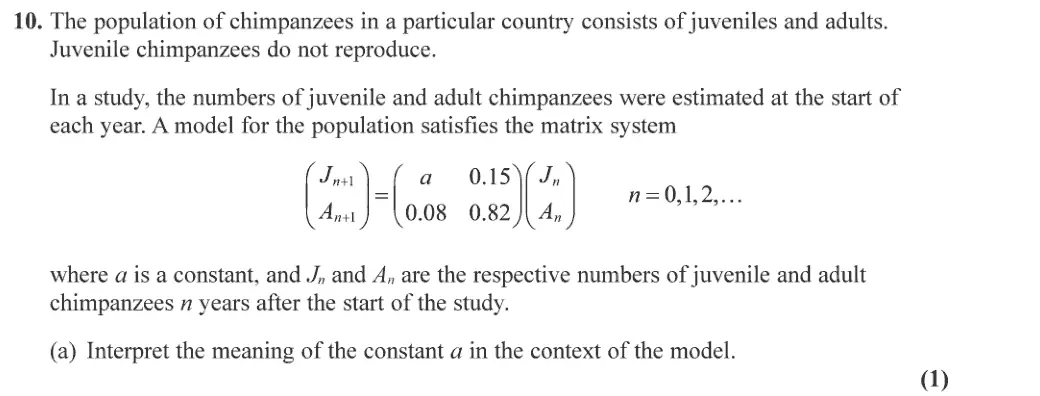
June 2019 · AS Paper 1 (Core Pure) · Q10(a)1 mark
Mark scheme (whole question; this part is marked with the orange bar)
Key points from the mark scheme and examiner's report
a is the proportion of juveniles that (survive and) remain juveniles the next year
"surviving juveniles" alone not accepted
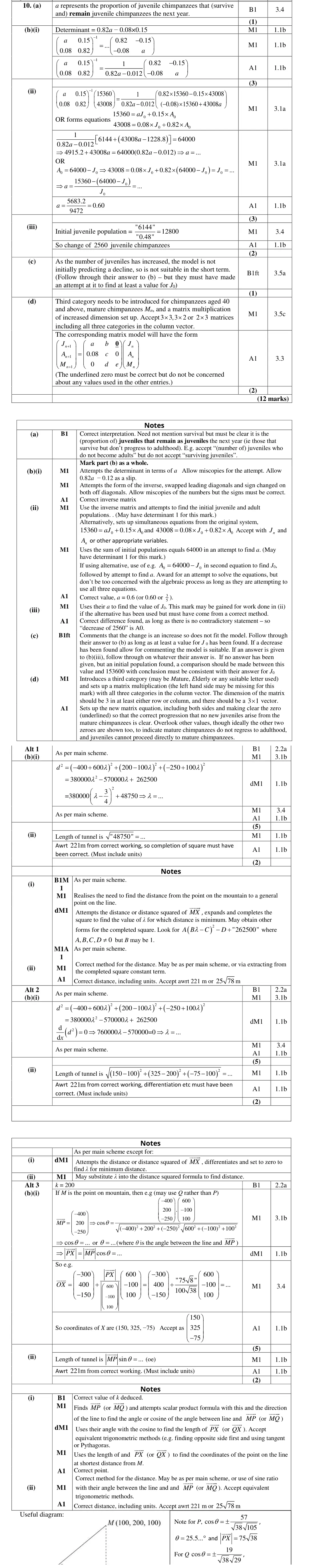
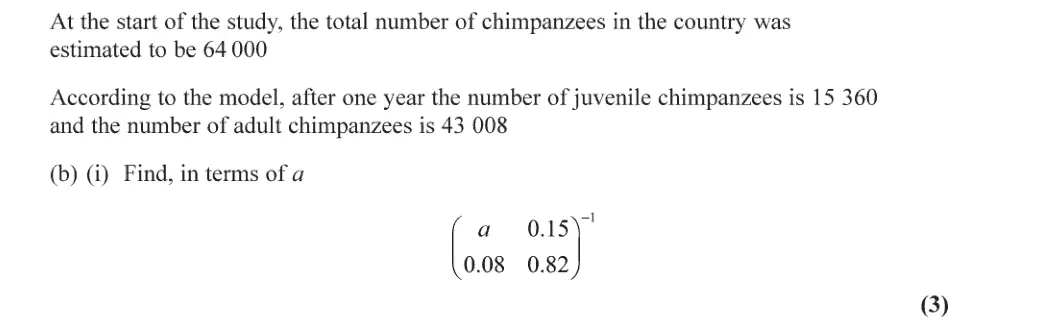
June 2019 · AS Paper 1 (Core Pure) · Q10(b)(i)3 marks
Mark scheme (whole question; this part is marked with the orange bar)
Key points from the mark scheme and examiner's report
determinant 0.82a − 0.012
inverse = (1/(0.82a − 0.012))(0.82 −0.15
−0.08 a)
June 2019 · AS Paper 1 (Core Pure) · Q10(b)(ii)3 marks
Mark scheme (whole question; this part is marked with the orange bar)
Key points from the mark scheme and examiner's report
apply the inverse to (15360, 43008) and use J₀ + A₀ = 64000 (or form simultaneous equations)
a = 0.6
June 2019 · AS Paper 1 (Core Pure) · Q10(b)(iii)2 marks
Mark scheme (whole question; this part is marked with the orange bar)
Key points from the mark scheme and examiner's report
J₀ = 12800, so the juveniles increase by 2560
"decrease of 2560" scores A0
June 2019 · AS Paper 1 (Core Pure) · Q10(c)1 mark
Mark scheme (whole question; this part is marked with the orange bar)
Key points from the mark scheme and examiner's report
the model predicts an increase in juveniles, not a decline, so it is not suitable in the short term
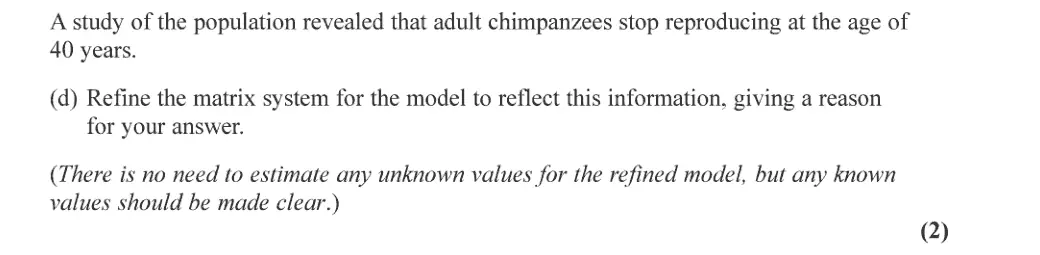
June 2019 · AS Paper 1 (Core Pure) · Q10(d)2 marks
Mark scheme (whole question; this part is marked with the orange bar)
Key points from the mark scheme and examiner's report
add a third class Mₙ (adults aged 40+) with a 3 × 3 matrix
the entry giving new juveniles from Mₙ must be 0
June 2019 · Paper 2 (Core Pure 2) · Q7(a)2 marks
Mark scheme (whole question; this part is marked with the orange bar)
Examiner's comment
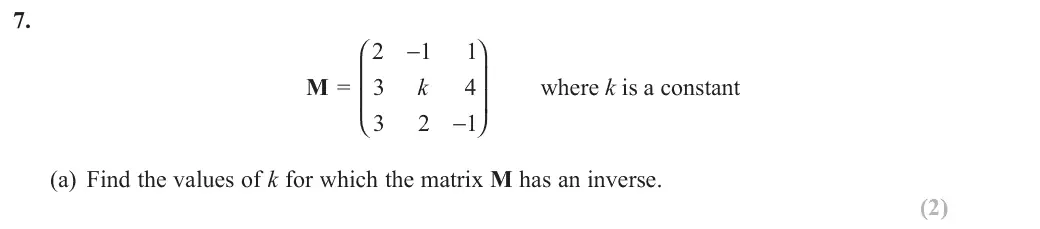
This matrix question also saw a wide range in the quality of response. In part (a) it was surprising to see a significant number of slips in obtaining an expression for the determinant. Most obtained an expression for det M conventionally although a few used the rule of Sarrus – usually correctly. A small number gave their answer as “k = 5” but the question required the values of k for which M had an inverse and not the value of k for which M was singular. attempts tried to use an inverse, even with candidates who had scored both marks in (a). Part (ii) required a geometric interpretation of the solution to the equations. Some neglected to mention “planes”. A few candidates did this successfully with a diagram. The unfortunate misspelling of “sheaf” was condoned!
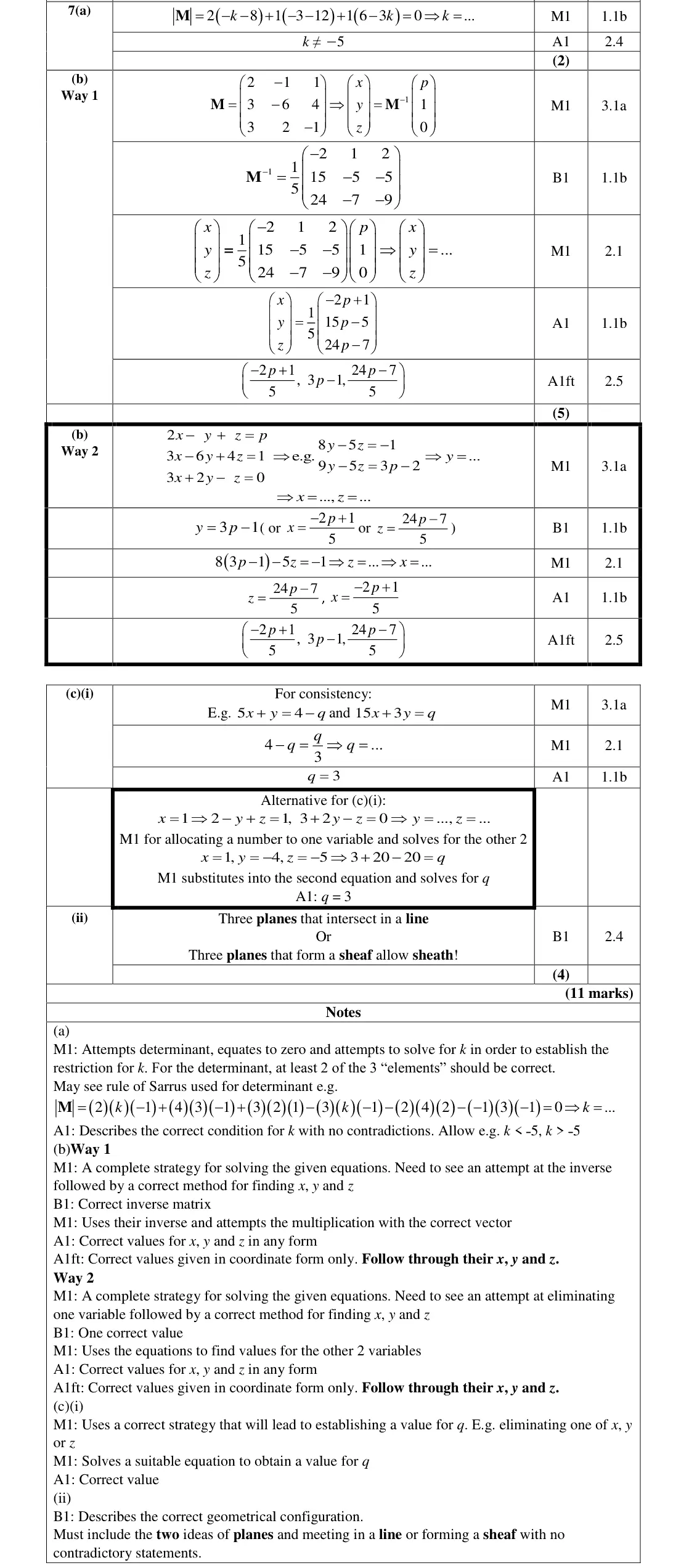
Key points from the mark scheme and examiner's report
det M = 5k + 25
inverse exists for k ≠ −5 (not "k = 5")
slips in the determinant
June 2019 · Paper 2 (Core Pure 2) · Q7(b)5 marks
Mark scheme (whole question; this part is marked with the orange bar)
Examiner's comment
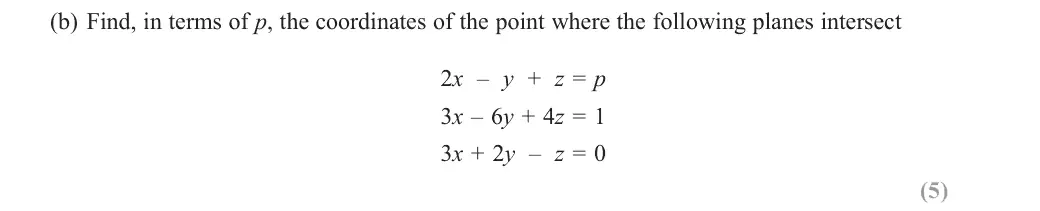
Part (b) required the point of intersection of three planes to be found and the most successful candidates used Way 1. It is acceptable to obtain an inverse of a matrix with no variables as elements using a calculator and it was unfortunate to see some embarking upon a step-by-step 1 method. This often led to errors such as omitting the det M multiplier. The correct inverse was seen fairly widely and the subsequent matrix multiplication was also often correct. This specification has an assessment objective for the use of correct notation so the point of intersection had to be given as coordinates. Those who chose to solve the system of equations were much less successful, with many unable to obtain x, y and z in terms of p (including a small number who attempted to find a value for p). Those who did not make any progress in (b) often left (c) unanswered but this part was still a reasonable source of marks for many. In part (i), correct strategies to obtain a value of q were common and although slips were evident, the correct q = 3 was often achieved. Weaker attempts tried to use an inverse, even with candidates who had scored both marks in (a). Part
Key points from the mark scheme and examiner's report
M⁻¹ with k = −6 (calculator allowed)
point ((−2p + 1)/5, 3p − 1, (24p − 7)/5) given as coordinates
omitting the 1/det factor
June 2018 · AS Paper 1 (Core Pure) · Q1(a)2 marks
Mark scheme (whole question; this part is marked with the orange bar)
Examiner's comment
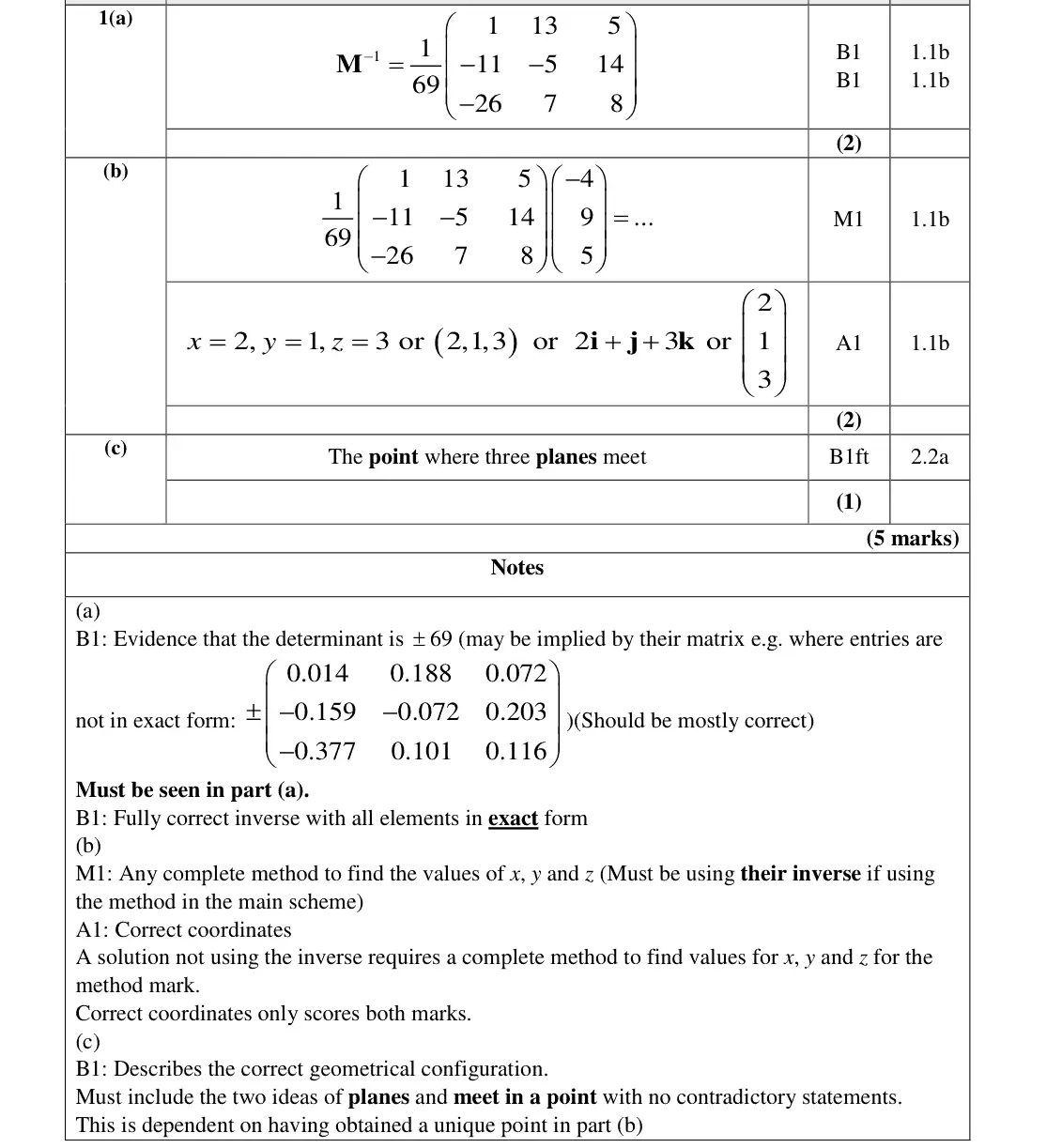
This question was generally well done with the majority gaining full marks for (a) and (b). (a) There were many correct responses many with clear evidence of manual calculation in some cases, although it was expected that students used their calculators. A few wrote each term as a decimal so were unable to gain more than one mark as an exact form was required. Many fully correct answers were seen.
Key points from the mark scheme and examiner's report
determinant 69
M⁻¹ = (1/69)(1 13 5
−11 −5 14
−26 7 8)
calculator expected
decimals lose the exact-form mark
June 2018 · AS Paper 1 (Core Pure) · Q5(c)2 marks
Mark scheme (whole question; this part is marked with the orange bar)
Examiner's comment
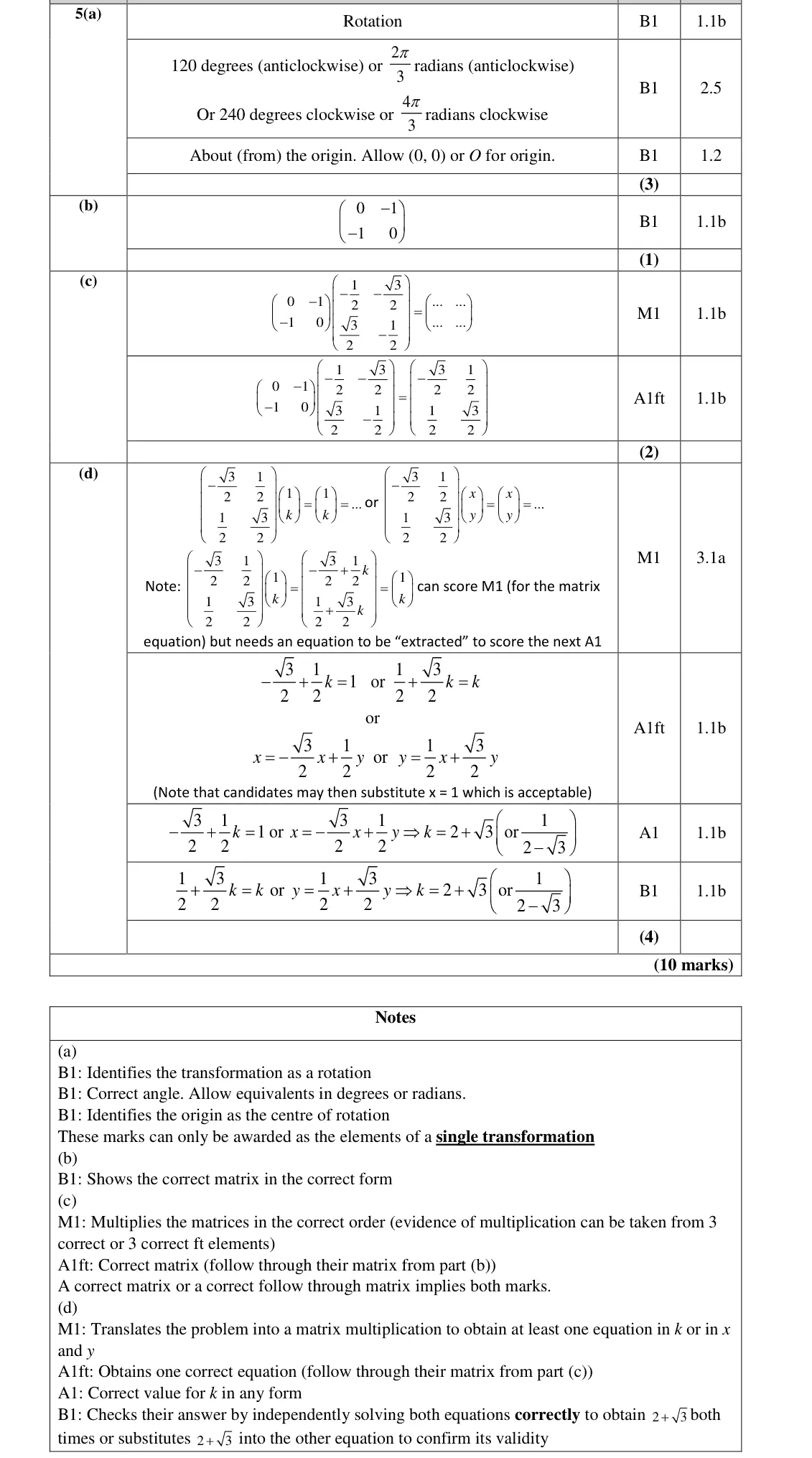
Parts (a), (b), (c) should have been routine procedures and it was surprising how any students made mistakes in these parts. Many students did manage to get full marks in (c) due to the follow through mark, however there was a surprising number who mixed up the order of matrix multiplication and hence gained no marks.
Key points from the mark scheme and examiner's report
U followed by V is BA, not AB
wrong order scores 0
Find an Edexcel Further Maths tutor
Stuck on this? Book a trial lesson with our Further Maths tutor.