CP3.6 Understand and use singular and non-singular matrices. Properties…
Section
CP3 Matrices
Level
AS & A level
Statement
Understand and use singular and non-singular matrices. Properties of inverse matrices. Calculate and use the inverse of non-singular 2 x 2 matrices and 3 x 3 matrices.
Guidance
Understanding the process of finding the inverse of a matrix is required. Students should be able to use a calculator to calculate the inverse of a matrix.
Mark scheme (whole question; this part is marked with the orange bar)
Examiner's comment
Most learners understood how to proceed in this question and produced good responses. In part (a), the correct determinant was usually achieved. However there were errors seen in forming the inverse matrix with a common error being not changing the sign of the elements on the counter diagonal.
Key points from the mark scheme and examiner's report
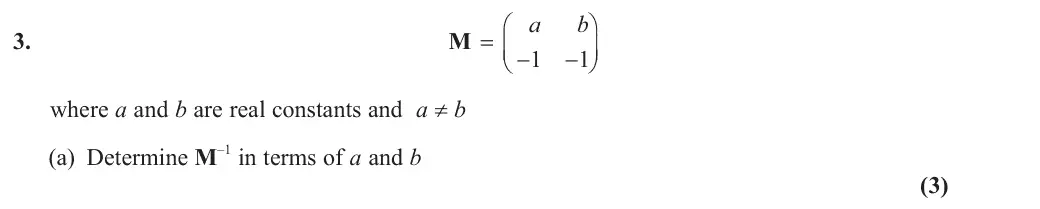
det = b − a
M⁻¹ = (1/(b − a))(−1 −b
1 a)
sign change on the counter-diagonal often missed
June 2025 · AS Paper 1 (Core Pure) · Q3(b)3 marks
Mark scheme (whole question; this part is marked with the orange bar)
Examiner's comment
Most learners understood how to proceed in this question and produced good responses. In part (b), learners were able to form two simultaneous equations correctly from the matrix equation. Algebraic errors in the manipulation of these equations led to a loss of marks. A common mistake was failing to multiply both sides of the equation completely when multiplying through by the denominator of the fraction.
Key points from the mark scheme and examiner's report
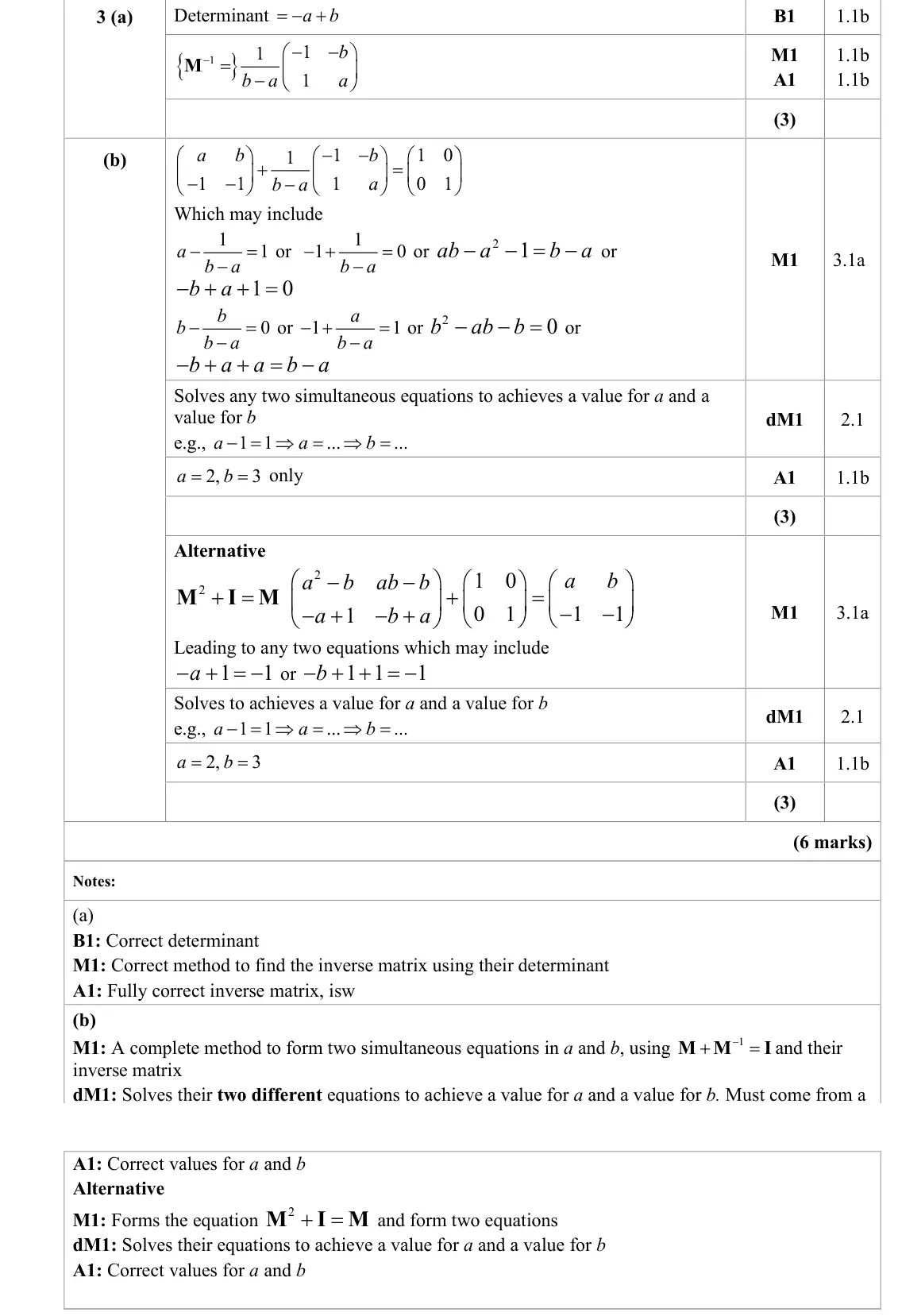
equate entries of M + M⁻¹ = I (or use M² + I = M) to get two equations
a = 2, b = 3
incomplete multiplying through by b − a
June 2025 · Paper 1 (Core Pure 1) · Q1(a)3 marks
Mark scheme (whole question; this part is marked with the orange bar)
Examiner's comment
(a) Candidates needed to be able to determine the values of an unknown in a 3 by 3 matrix that made the matrix singular. They used the method of finding the determinant of the matrix, setting that equal to zero and solving the resulting three term quadratic equation. Finding the determinant using minors of the matrix was by far the most popular and straightforward. An alternative method seen was to use a scalar triple product, but this was only rarely seen. Most candidates scored full marks on this part with only errors in manipulation resulting in an incorrect quadratic equation and hence incorrect roots. The expression for the determinant in terms of the constant a had been found in part (a). However, some candidates instead of using the quadratic expression for the determinant – 6a2 + 6a + 12, used a changed quadratic such as 6a2 – 6a – 12 and so could not find a correct value for a. Some candidates did not use the condition for the constant to be negative. The method for finding the inverse of the matrix with their found constant was well known. There were slips in the signs of some elements of the final answer. Overall, this proved an accessible start to this paper with many candidates scoring full marks.
Key points from the mark scheme and examiner's report
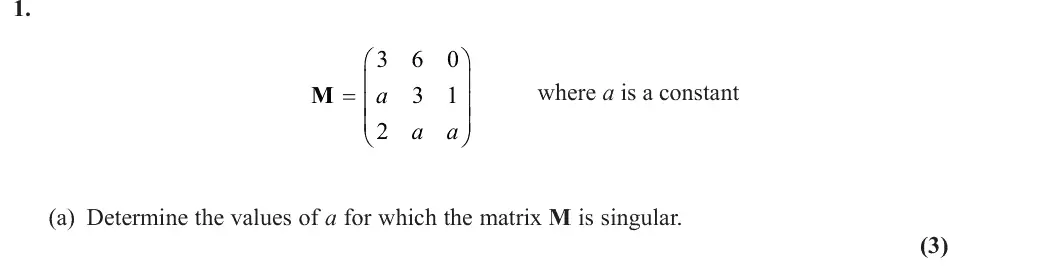
det M = 3(3a − a) − 6(a² − 2) = 0 gives 6a² − 6a − 12 = 0: a = −1, 2
sign slips in the minors
June 2025 · Paper 1 (Core Pure 1) · Q1(b)3 marks
Mark scheme (whole question; this part is marked with the orange bar)
Examiner's comment
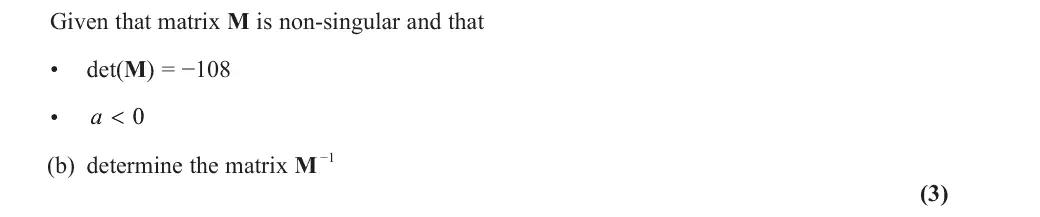
(b) This required finding the inverse of the given 3 by 3 matrix, given that its determinant was a specified value and that the constant was negative. The expression for the determinant in terms of the constant a had been found in part (a).
Key points from the mark scheme and examiner's report
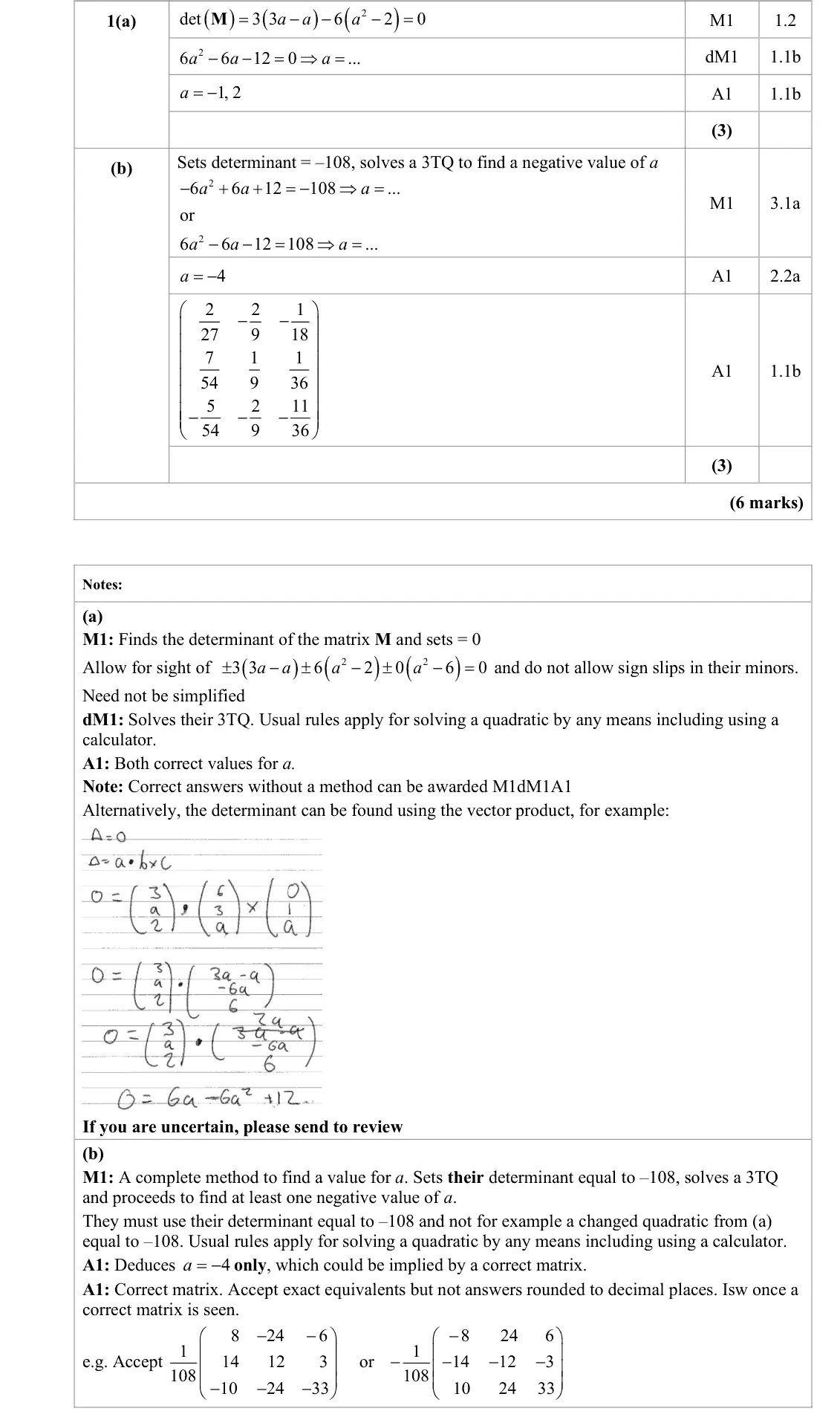
use the determinant from (a): −6a² + 6a + 12 = −108 gives a = −4 only (a < 0)
then M⁻¹ = (1/108)(8, −24, −6
14, 12, 3
−10, −24, −33) (calculator allowed)
exact values, not decimals
June 2025 · Paper 2 (Core Pure 2) · Q54 marks
Mark scheme (whole question; this part is marked with the orange bar)
Examiner's comment
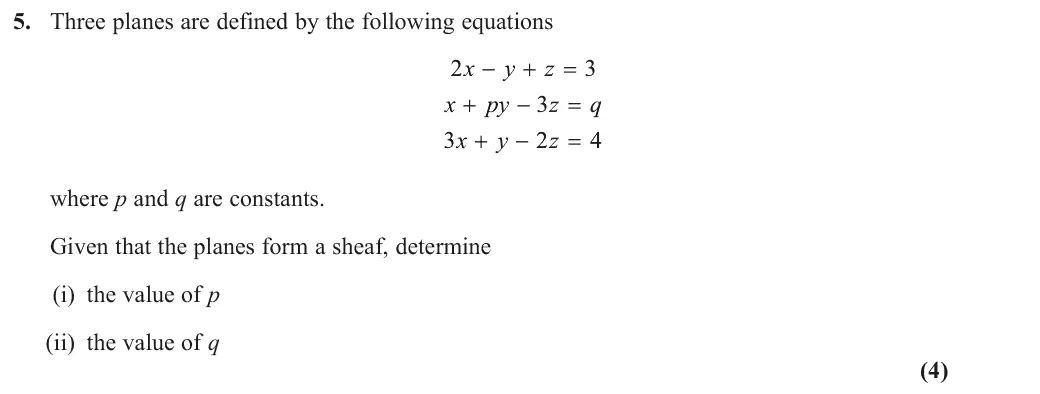
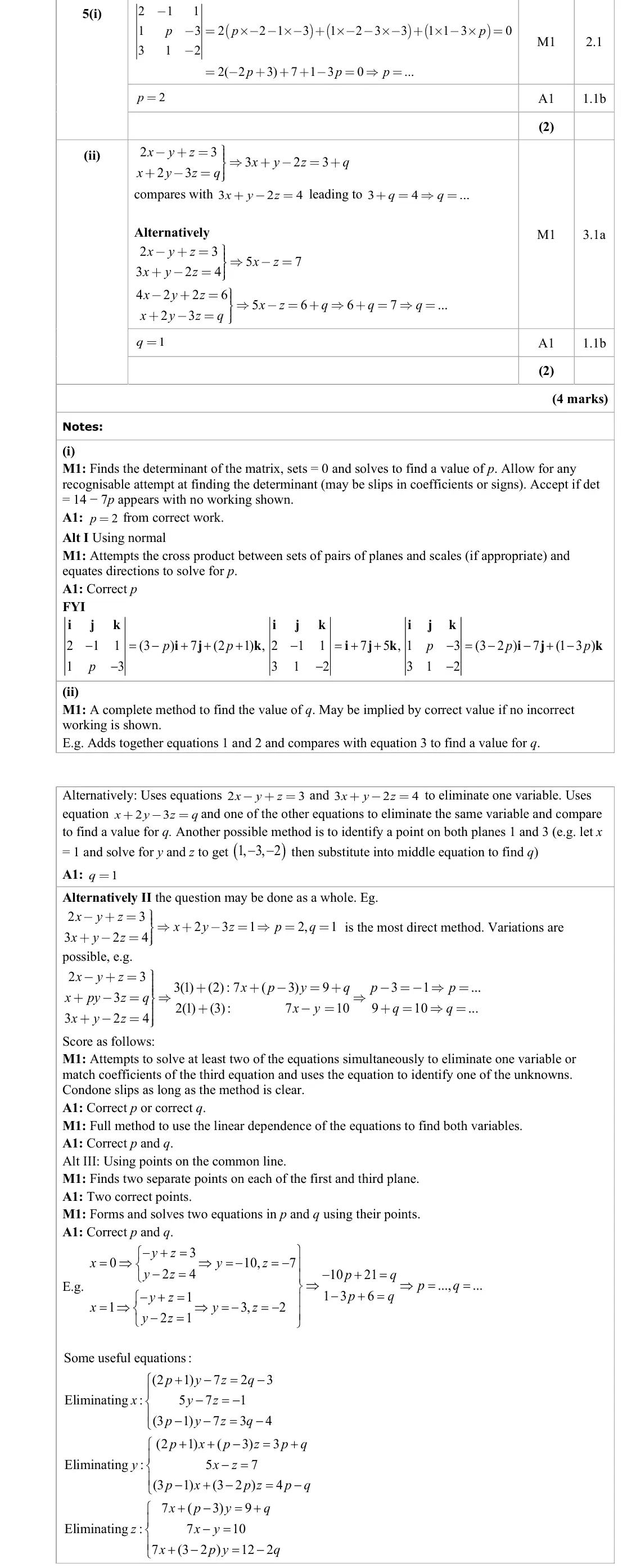
A deceptively simple looking question with a very efficient solution for those who appreciated the geometry of the situation and could see the third equation was the sum of the first two, this nevertheless produced a plethora of responses and proved difficult to mark. Most had an idea of what to do and tried to solve the equations simultaneously in some way, but with varying degrees of success. The most successful method used to find p was to form the matrix of the equations and set the determinant equal to 0. A few candidates found the determinant but failed to set it to zero. Once p was found, it was very much easier to find q and those candidates approaching the question this way had much more success. Most candidates knew that the equations had to be consistent and used this with their p to find q, though a few at this point instead reverted to solving the equations simultaneously, even though they had p. Many others went directly for the method of solving the equations, but many made slips causing problems, and so many managed to get method marks but lost the accuracy. Alternatively, to using the determinant, many learners were also able to find p and q by tackling the question as a whole, eliminating one variable and using linear dependence to find p and q. Occasionally candidates spotted the most direct method subtracting equation 1 from 3 and comparing coefficients with equation 2, but most took more convoluted roots, with varying degrees of success in eliminating one of p or q from the equations. Other methods were also used, with some successfully finding one point in common, or the common line, and solving from there. Some used the cross product to deduce the direction vector of the normal and used this in conjunction with the common line or with another normal direction from other equations. Various attempts at using vector or scalar products of various vectors formed from the equations were seen.
Key points from the mark scheme and examiner's report
sheaf: determinant of the coefficient matrix = 0 gives p = 2 (14 − 7p = 0)
spotting that row 3 = row 1 + row 2 is the efficient route
some found the determinant but did not set it to 0
June 2024 · AS Paper 1 (Core Pure) · Q4(b)2 marks
Mark scheme (whole question; this part is marked with the orange bar)
Examiner's comment
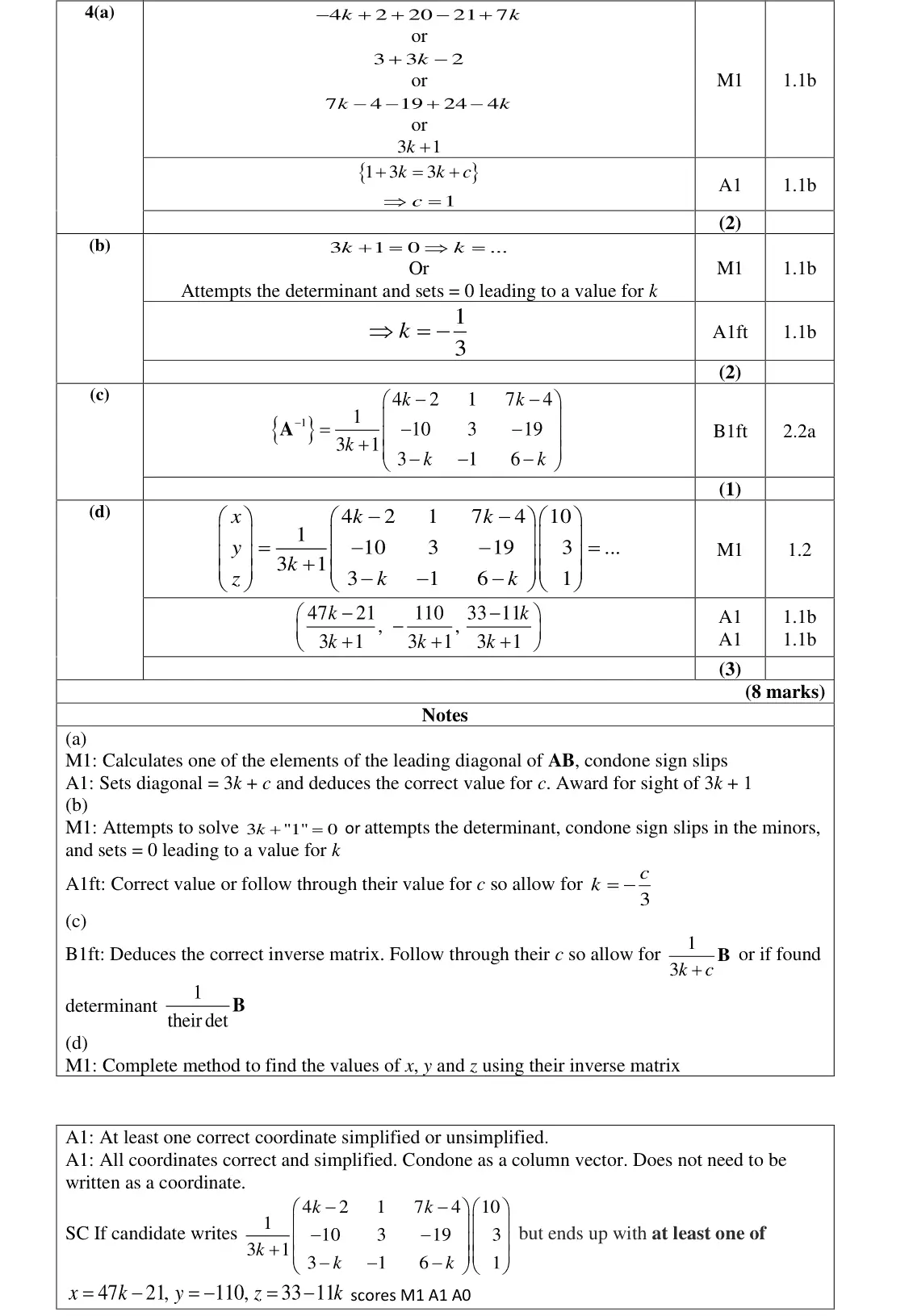
In part (b), many of the candidates did not recognise the link between finding the value of k and the part (a) and thus found the determinant of A and equated it to zero to find k.
Key points from the mark scheme and examiner's report
AB = (3k + 1)I so A is singular when 3k + 1 = 0: k = −1/3
most ignored (a) and found det A
June 2024 · AS Paper 1 (Core Pure) · Q4(c)1 mark
Mark scheme (whole question; this part is marked with the orange bar)
Examiner's comment
In part (c), as in the above, very few of the candidates identified how the result in part (a) could be used to write down the inverse matrix A-1 and thus proceeded with the well-rehearsed routine of using minors, cofactors and transposes.
Key points from the mark scheme and examiner's report
A⁻¹ = B/(3k + 1) written down from (a)
most used cofactors instead
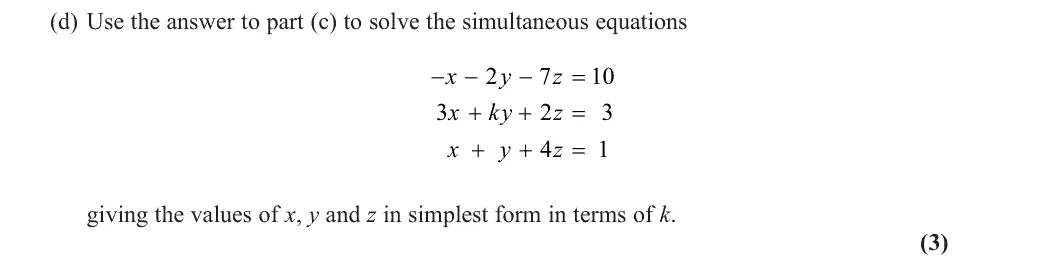
June 2024 · AS Paper 1 (Core Pure) · Q4(d)3 marks
Mark scheme (whole question; this part is marked with the orange bar)
Examiner's comment
In part (d), the vast majority of the candidates converted the given system of equations into a matrix equation and then used their inverse matrix to correctly solve for x, y and z. Any marks lost here were mainly due to sign errors.
Key points from the mark scheme and examiner's report
multiply A⁻¹ by (10, 3, 1): x = (47k − 21)/(3k + 1), y = −110/(3k + 1), z = (33 − 11k)/(3k + 1)
sign errors
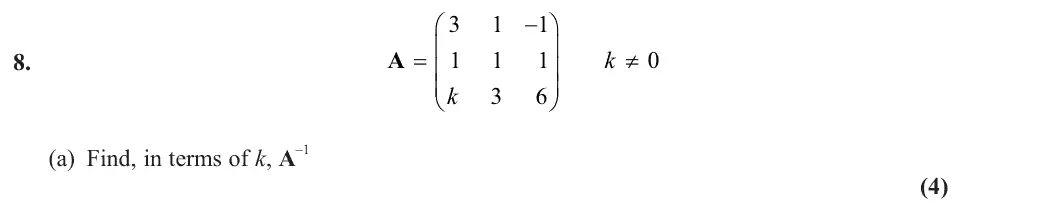
June 2024 · Paper 2 (Core Pure 2) · Q8(a)4 marks
Mark scheme (whole question; this part is marked with the orange bar)
Examiner's comment
(a) Many candidates managed to invert the matrix accurately and there were pleasingly few slips in the involved calculations. Where marks where dropped this was overwhelmingly due to arithmetic errors when calculating either their determinant or matrix of minors that then led to an incorrect answer. Some students struggled to negate the correct terms at the end of the process. Unfortunately, those with an incorrect determinant would lose several marks on this question. Also, they had the opportunity to gain full marks even if their answer to part (a) was wrong.
Key points from the mark scheme and examiner's report
determinant 2k
matrix of cofactors, transpose, divide by 2k: A⁻¹ = (1/2k)(3, −9, 2
k − 6, 18 + k, −4
3 − k, k − 9, 2)
sign slips in cofactors
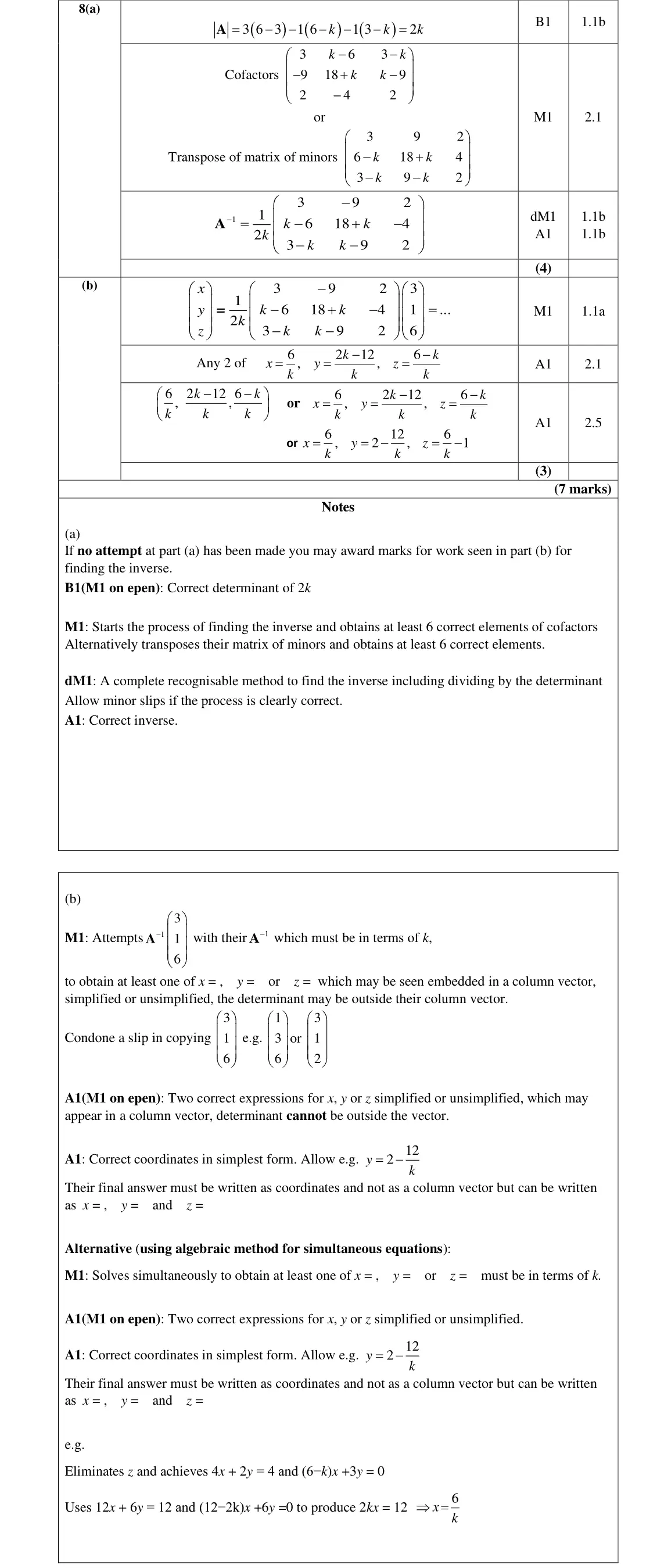
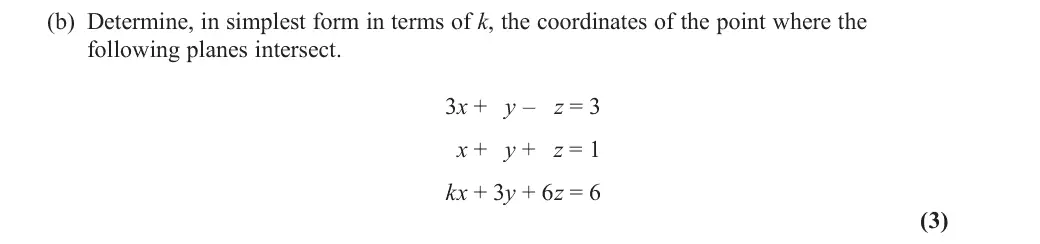
June 2024 · Paper 2 (Core Pure 2) · Q8(b)3 marks
Mark scheme (whole question; this part is marked with the orange bar)
Examiner's comment
(b) Most candidates solved the equation by multiplying the vector 3 1 6 by their inverse. Those who used the matrix approach often did not achieve all the marks. This was due to an incorrect answer in part (a) or basic arithmetic errors in their matrix multiplication and subsequent algebraic simplification. Several candidates lost the final mark because they didn’t give their answer as coordinates. A smaller number gave un-simplified answers. Leaving the determinant outside the vector was another cause of marks lost. A few candidates opted instead for the elimination method for solving their three equations simultaneously, sometimes abandoning halfway through. Those who were successful with this approach had the advantage of writing their answers automatically in the correct form.
Key points from the mark scheme and examiner's report
determinant left outside the vector or answer left as a column vector lost the last mark
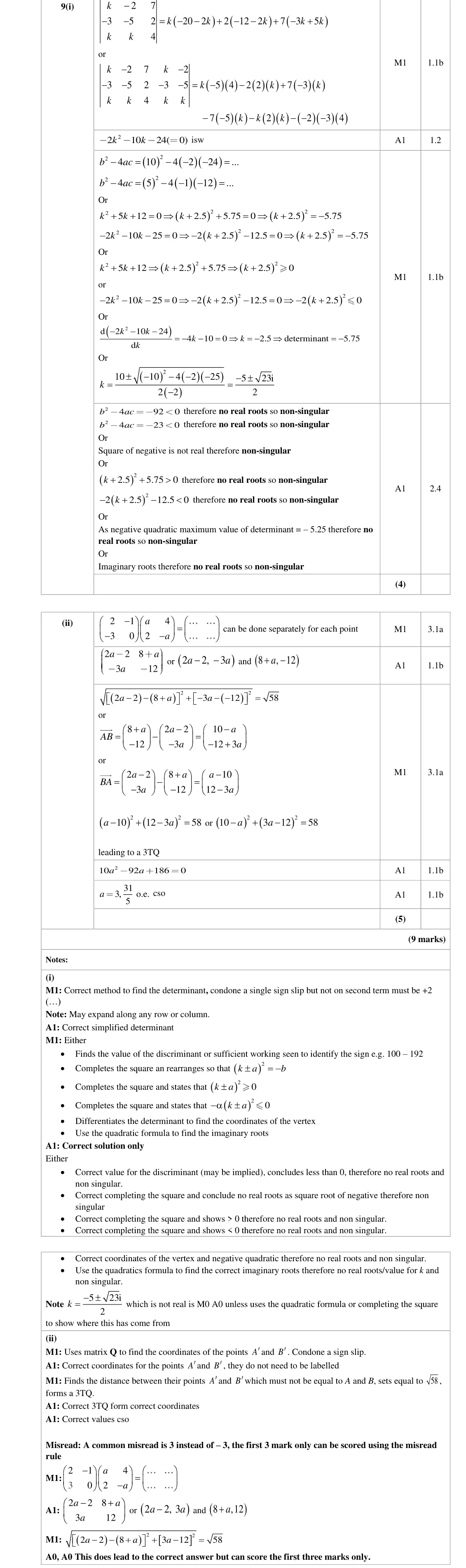
June 2023 · AS Paper 1 (Core Pure) · Q9(i)4 marks
Mark scheme (whole question; this part is marked with the orange bar)
Examiner's comment
In part (i), the vast majority of the candidates expanded along the first row to find the determinant of the matrix P and much success was achieved. The most common error was not applying the change of sign rule which resulted in the loss of the first two marks at least. For those responses that had found the correct determinant, the proof of the non-singularity of P proved demanding and although the use of either the discriminant or completing the square were well identified methods, many solutions did not include all of the necessary details and thus fully complete solutions did not often appear. This is a show questions and candidates are remined that they do need to show the reasoning clearly. Just saying no real roots is insufficient they need to show why it has no real roots. In part (ii), the vast majority of the candidates correctly found the coordinates of A' and B' and then equated the distance between them to 58 to form the required quadratic equation. The occasional sign error or incorrect expansions were the main reasons here as to why marks were lost but much success was achieved in this part and many of the cohort scored full marks.
Key points from the mark scheme and examiner's report
det = −2k² − 10k − 24 (watch the sign of the middle cofactor)
discriminant −92 < 0 or complete the square, so det ≠ 0 for all real k
conclusion often incomplete
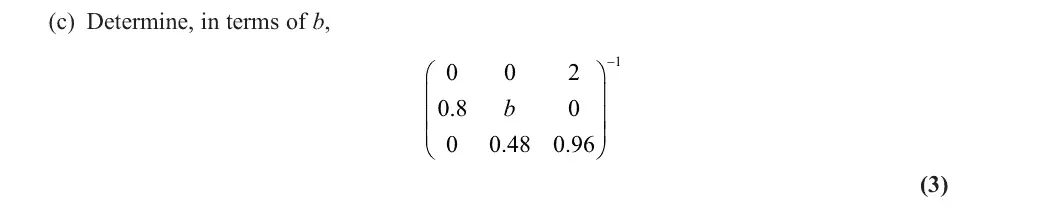
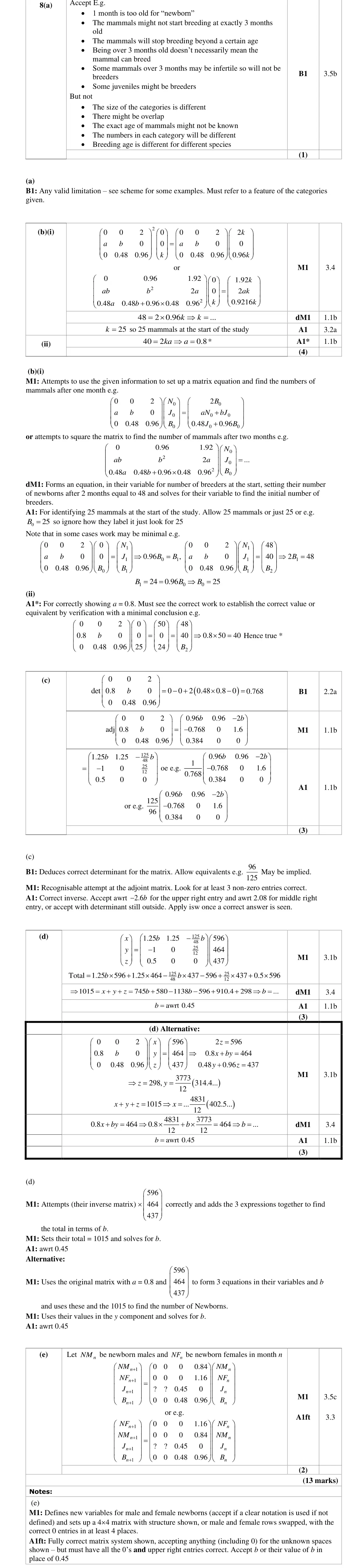
June 2023 · Paper 1 (Core Pure 1) · Q8(c)3 marks
Mark scheme (whole question; this part is marked with the orange bar)
Examiner's comment
This question was not attempted by all students, possibly due to the time constraints of the paper. The different parts generally proved accessible, even if the preceding parts had not been attempted. It seemed that many candidates were running out of time and were attempting the parts that they could quickly gain some credit for. A wide variety of marks was seen. Most candidates who attempted part (c) made a good attempt at finding the inverse matrix, although some made small arithmetical slips or sign errors, either in calculating the value of the determinant, or with one of the elements in their inverse. No doubt time pressure contributed to their accuracy in some cases.
Key points from the mark scheme and examiner's report
determinant 0.768 (96/125)
inverse with entries in b, e.g. first row (1.25b, 1.25, −125b/96)
sign and arithmetic slips in the inverse
June 2023 · Paper 1 (Core Pure 1) · Q8(d)3 marks
Mark scheme (whole question; this part is marked with the orange bar)
Examiner's comment
This question was not attempted by all students, possibly due to the time constraints of the paper. The different parts generally proved accessible, even if the preceding parts had not been attempted. It seemed that many candidates were running out of time and were attempting the parts that they could quickly gain some credit for. A wide variety of marks was seen. Using the inverse matrix and forming and solving an equation for the total number of mammals was the most common approach seen in part (d). This proved quite time consuming, but a significant number of candidates presented fully correct solutions. Working forwards using the original model, then solving the resulting equations was also commonly seen. Some of those with an incorrect inverse were able to score full marks in this question because they used the latter method. For the matrix approach, some multiplied the inverse by the values but never summed the resulting values so did not gain any marks.
Key points from the mark scheme and examiner's report
inverse × (596, 464, 437) and sum the entries = 1015, or work forwards with the original matrix
b ≈ 0.45
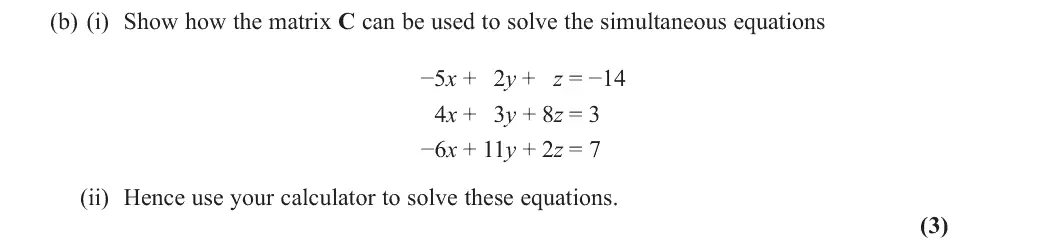
June 2022 · AS Paper 1 (Core Pure) · Q1(b)3 marks
Mark scheme (whole question; this part is marked with the orange bar)
Examiner's comment
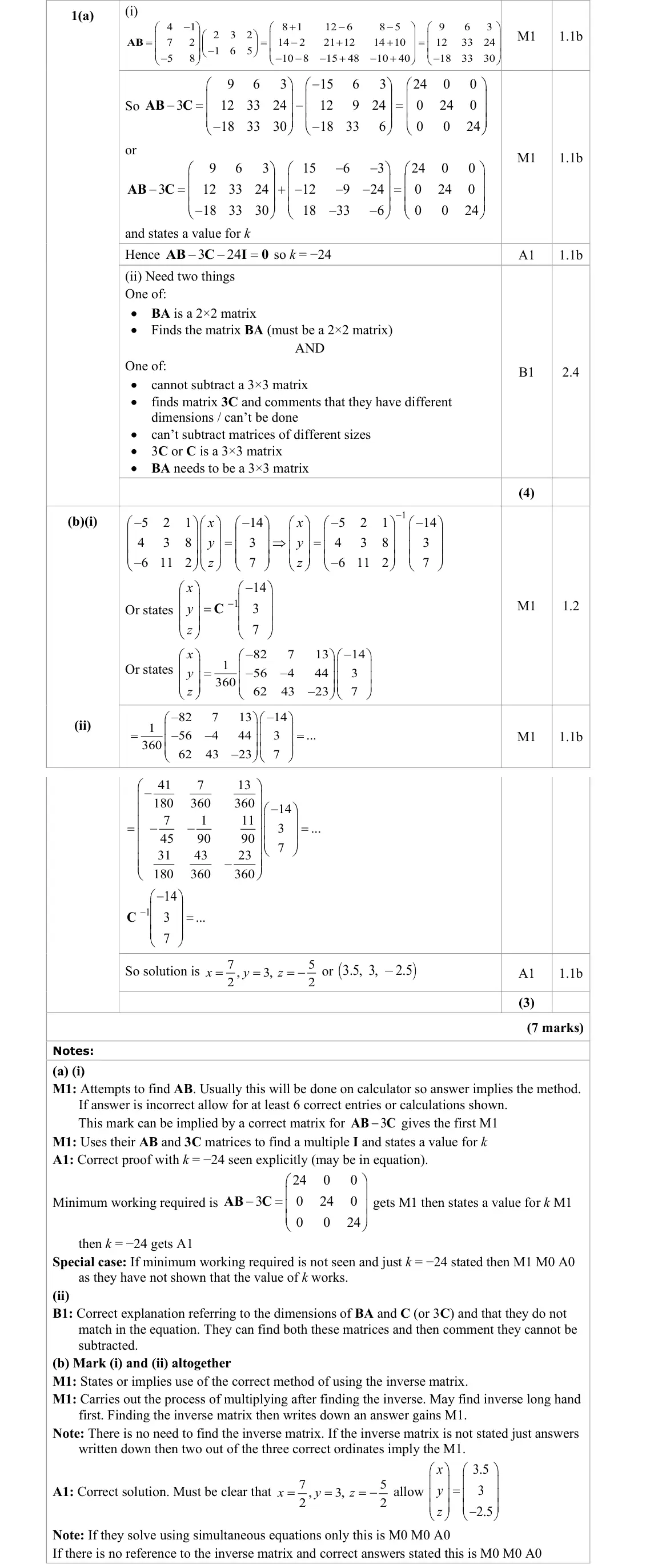
This was in general a very accessible question with the majority of candidates achieving 5 or more marks. All candidates managed to at least make an attempt on this question. For part (b) some of the successful candidates evaluated the matrix AB and concluded, however many just stated that AB was a 2 by 2 matrix and thus not possible to add to a 3 by 3 matrix. The most common misunderstanding for this part was that of the requirements of matrix multiplication with a number of candidates stating that AB was not possible to be calculated due to the dimensions. Part (c) was a very accessible question - most gained full marks. A small number of candidates used simultaneous equations and thus gained no marks since the questions asked for candidates to show how the matrix can be used to solve the equations. Some actually calculated the inverse going through all steps – whilst it is nice to see their ability it was a shame that these candidates had spent a lot of time disproportionate for the number of marks available. The question paper did say ‘Hence use your calculator…’ candidates are reminded that they can use their calculator to find inverse matrices and matrix algebra when matrices are fully numeric.
Key points from the mark scheme and examiner's report
write as C(x, y, z) = (−14, 3, 7) so (x, y, z) = C⁻¹(−14, 3, 7)
x = 3.5, y = 3, z = −2.5
solving by elimination or with no reference to the inverse scores 0
June 2022 · Paper 1 (Core Pure 1) · Q5(a)2 marksEasy
Mark scheme (whole question; this part is marked with the orange bar)
Examiner's comment
Another very well approached question with 96% scoring 4 or more marks out of the 6 available. Almost all candidates attempted to find the determinant, with most doing so correctly. Some candidates lost the A mark for either making a slip when simplifying their - - expression for the determinant, usually when dealing with the 3(2 incorrectly. a 12) Common incorrect values were 44 or 24, while some lost the A mark for not referencing that det M ≠ 0 within their conclusion, or failing to state the conclusion that the matrix was non- singular.
Key points from the mark scheme and examiner's report
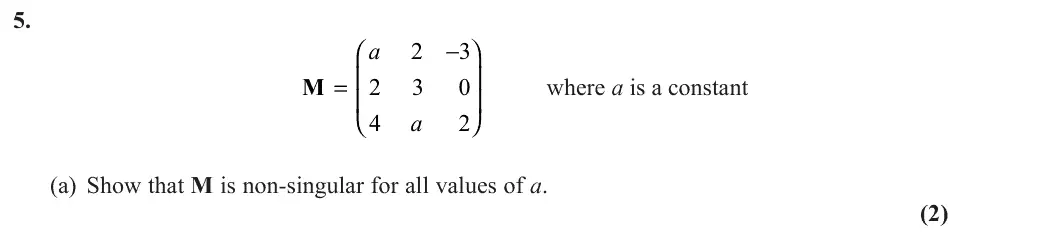
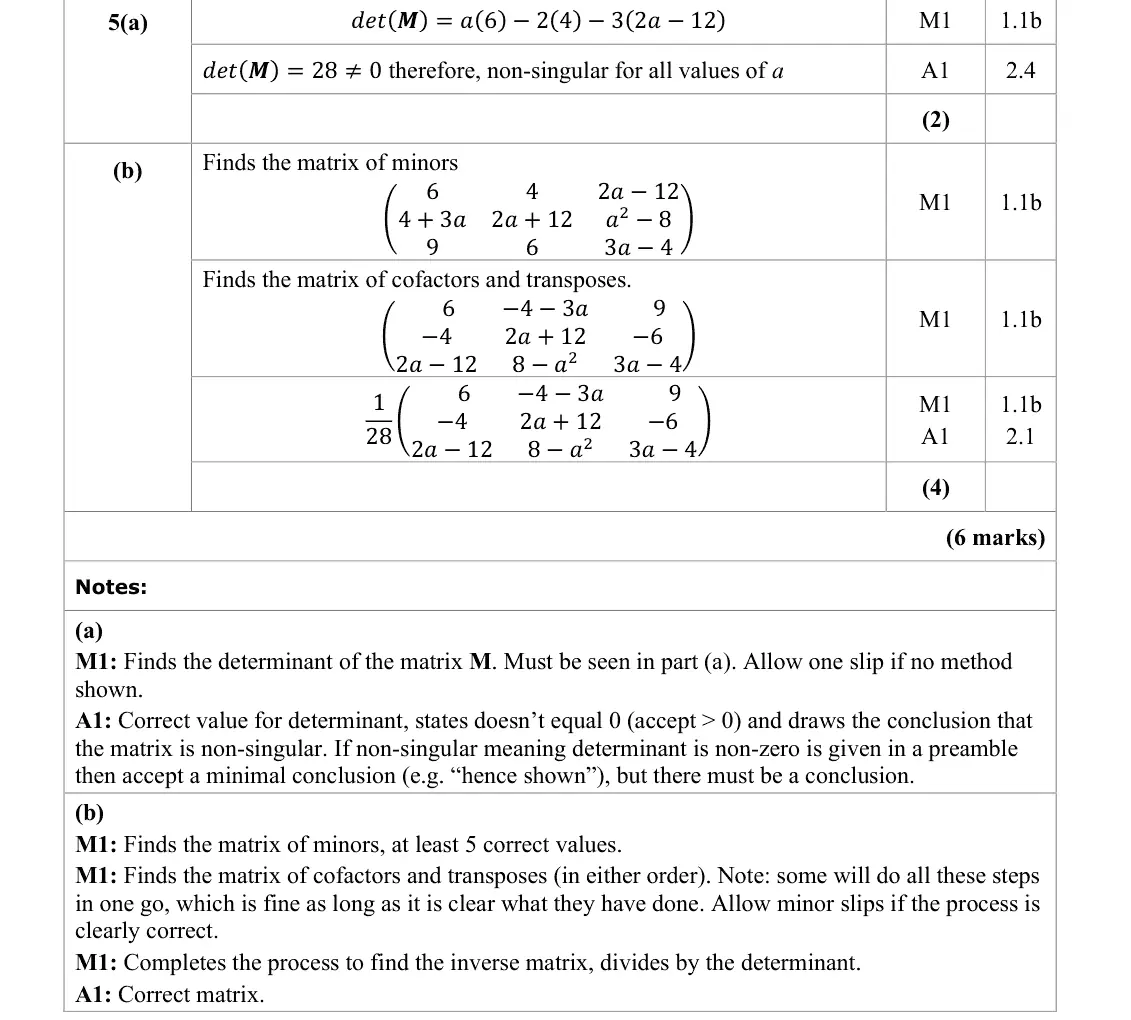
det M = 6a − 8 − 3(2a − 12) = 28 ≠ 0 so non-singular for all a
slips with −3(2a − 12) giving 44 or 24
conclusion needed
June 2022 · Paper 1 (Core Pure 1) · Q5(b)4 marks
Mark scheme (whole question; this part is marked with the orange bar)
Examiner's comment
In part (b) most candidates worked through all the correct stages in the process to find the inverse matrix, with only minor slips being made. A good attempt was generally made at finding the matrix of minors. Where candidates took one step at a time in the process of finding the inverse matrix they were more likely to be successful and more unlikely to make basic errors. Minor errors when finding the matrix of cofactors and/or transposing the matrix still enabled them to gain the method mark as long as the process was clearly correct. Most completed the process by dividing by their det M.
Key points from the mark scheme and examiner's report
minors, cofactors, transpose, divide by 28
one step at a time to avoid sign slips
June 2022 · Paper 2 (Core Pure 2) · Q2(b)4 marks
Mark scheme (whole question; this part is marked with the orange bar)
Examiner's comment
This question on a model involving matrices was generally well-answered, but there was less success in part (b). In part (b) most set up a matrix equation although some merely solved their set of linear simultaneous equations. The matrix equations tended to be correct for their equations and most knew that an inverse had to be obtained to solve for the variables. It was unfortunate to see manual attempts at matrix inversion – teachers and students are reminded that unless the question directs otherwise, it is expected that a matrix whose elements are fully numerical then a calculator can be used. A small number left their answer (sometimes unrounded) as a column vector instead of putting their values in context.
Key points from the mark scheme and examiner's report
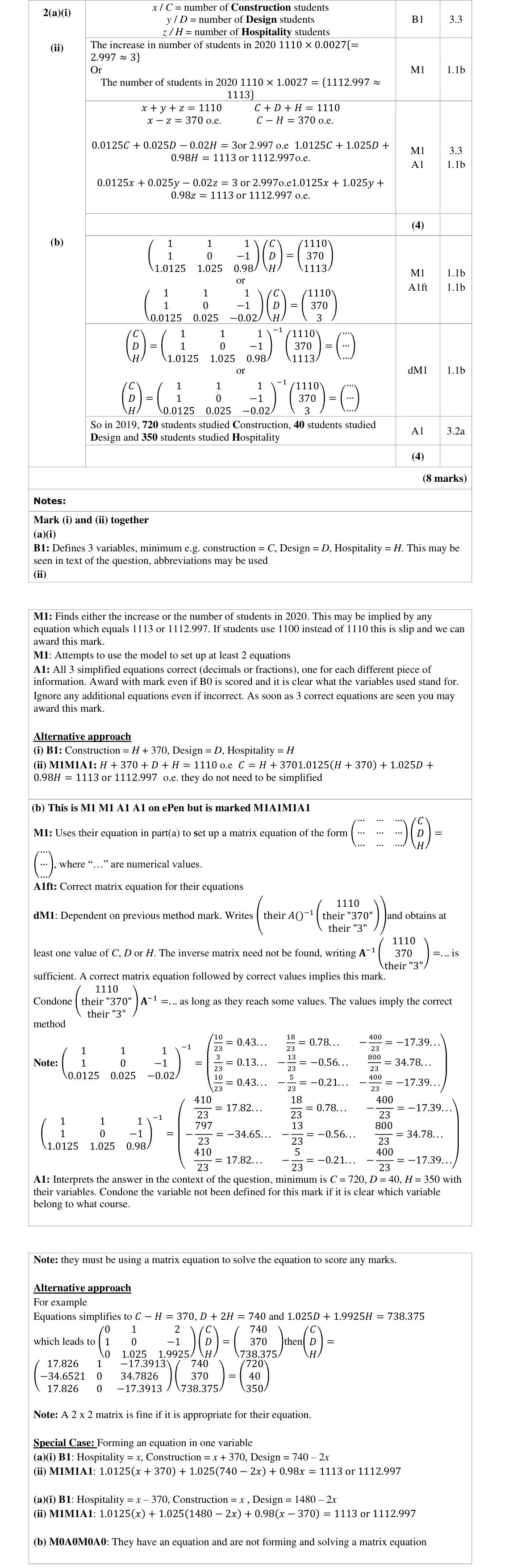
must form and solve a matrix equation with the inverse (calculator inverse expected, manual inversion wastes time)
C = 720, D = 40, H = 350 given in context, not left as a column vector
solving simultaneous equations without matrices scores 0
June 2022 · Paper 4A (Further Pure 2) · Q2(b)3 marks
Mark scheme (whole question; this part is marked with the orange bar)
Examiner's comment
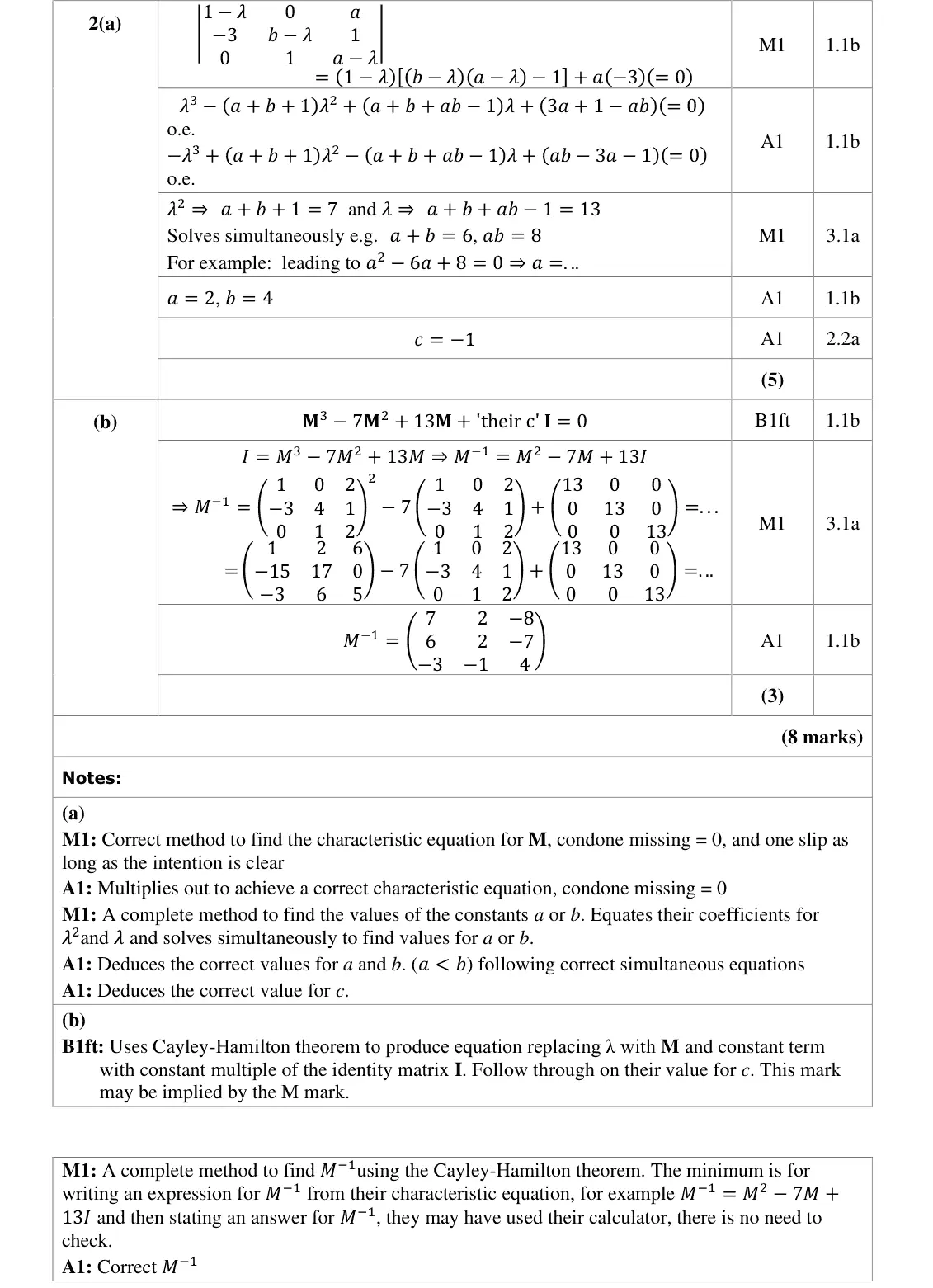
Part (b) Most candidates understood what they needed to do, using their values of a, b and c to find the Cayley Hamilton equation. They then were able to multiply through by M-1 and rearrange to find matrix expression for M-1. Due to an error in the value of c many failed to reach the correct answer, with some giving up before finding the required matrix.
Key points from the mark scheme and examiner's report
M³ − 7M² + 13M − I = 0 so M⁻¹ = M² − 7M + 13I
an error in c spoilt many answers
Nov 2021 · Paper 1 (Core Pure 1) · Q4(ii)3 marksMedium
Mark scheme (whole question; this part is marked with the orange bar)
Examiner's comment
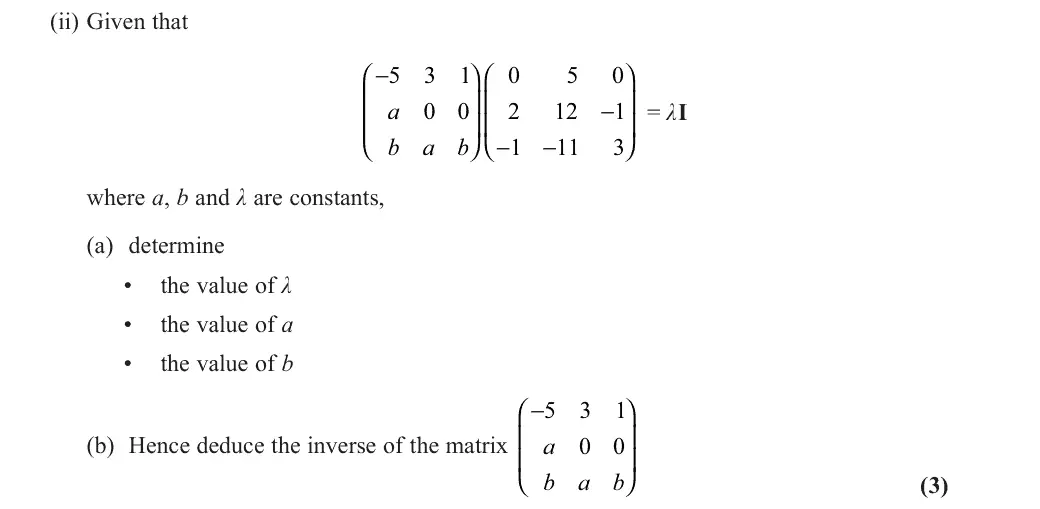
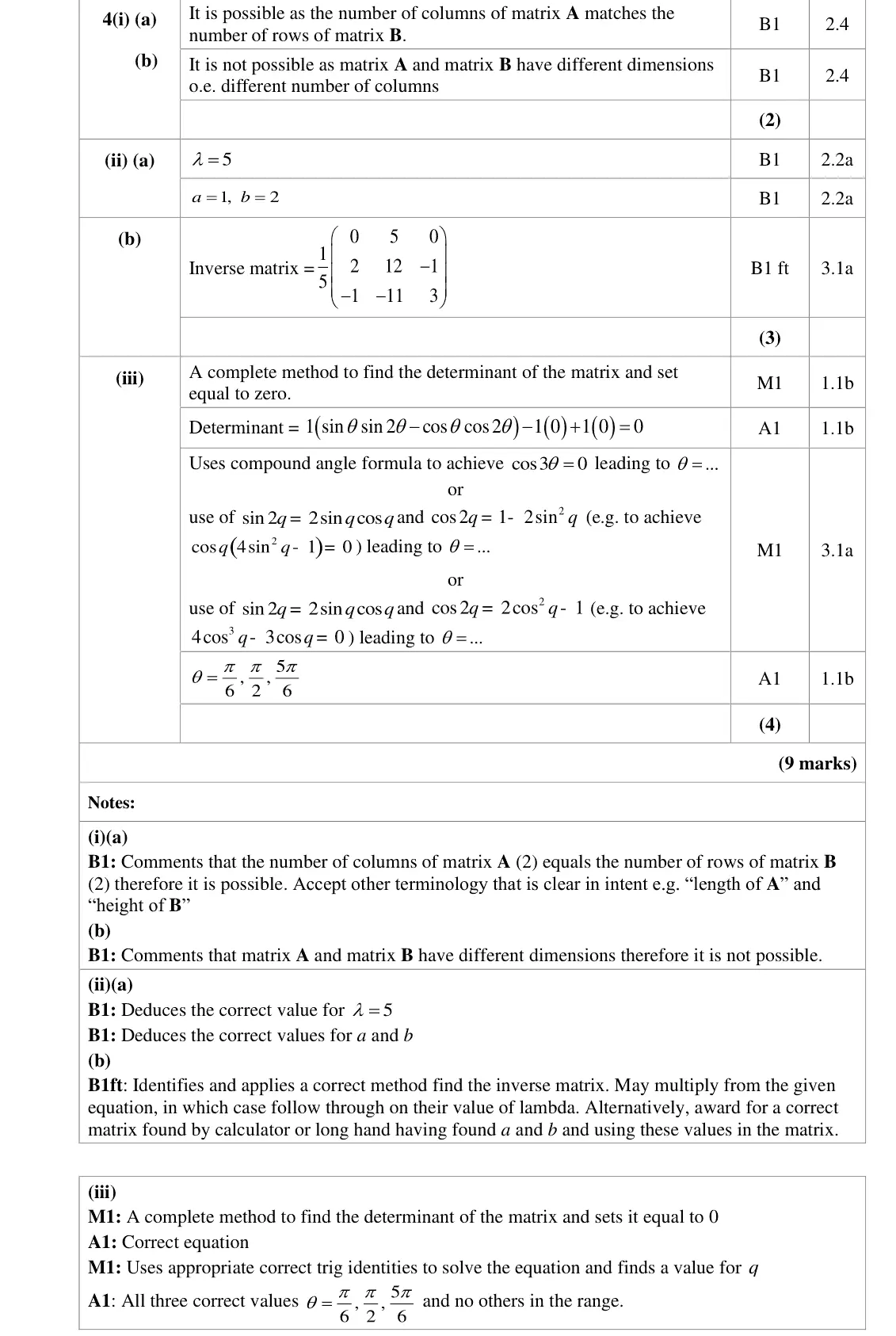
The overall performance on this question was better than the preceding questions, suggesting it is a more comfortable topic to students and could have appeared earlier in the paper, with the first 7 marks being score by over 50% of candidates, and only the final mark scored by fewer than 44%. (i) (i) An easy start to this question with the majority gaining at least one mark (over 70% scored the mark in (b)). A common error was to confuse rows with columns in their first statement meaning slightly fewer scored this mark (55%). (ii) There were several methods for finding the required values, mostly all successful with two thirds scoring the first two marks, and over 50% again scoring the third. Most obtained the correct inverse matrix, and there was a follow through on their λ. Some used their calculators with values for a and b, which was also fine, while there were also attempts at finding the inverse matrix from scratch, which seemed to be an awful lot of work for one mark! (iii) About two thirds of candidate successfully used a correct method to find the determinant and set it to 0. Many then did not realise that this reduced to cos3 theta = 0, and ended up using trigonometric identities for sin2 theta and cos2 theta to solve a more complicated equation. Very few gave all three possible values leading to the drop off noted above, commonly losing a value by dividing through by cos theta and not considering it could equal 0. Others just gave one value pi /6. These two marks were for solving a very straightforward trig equation which they should have been able to do in Maths A level
Key points from the mark scheme and examiner's report
multiply out: λ = 5, a = 1, b = 2
inverse is (1/5) × the second matrix
Nov 2021 · Paper 1 (Core Pure 1) · Q4(iii)4 marksMedium
Mark scheme (whole question; this part is marked with the orange bar)
Examiner's comment
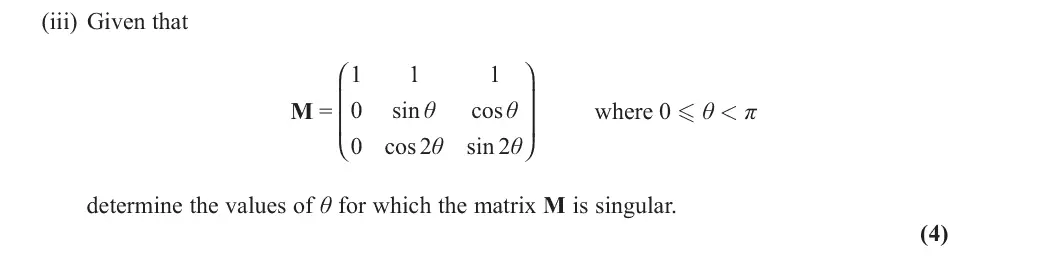
The overall performance on this question was better than the preceding questions, suggesting it is a more comfortable topic to students and could have appeared earlier in the paper, with the first 7 marks being score by over 50% of candidates, and only the final mark scored by fewer than 44%. (i) (i) An easy start to this question with the majority gaining at least one mark (over 70% scored the mark in (b)). A common error was to confuse rows with columns in their first statement meaning slightly fewer scored this mark (55%). (ii) There were several methods for finding the required values, mostly all successful with two thirds scoring the first two marks, and over 50% again scoring the third. Most obtained the correct inverse matrix, and there was a follow through on their λ. Some used their calculators with values for a and b, which was also fine, while there were also attempts at finding the inverse matrix from scratch, which seemed to be an awful lot of work for one mark! (iii) About two thirds of candidate successfully used a correct method to find the determinant and set it to 0. Many then did not realise that this reduced to cos3 theta = 0, and ended up using trigonometric identities for sin2 theta and cos2 theta to solve a more complicated equation. Very few gave all three possible values leading to the drop off noted above, commonly losing a value by dividing through by cos theta and not considering it could equal 0. Others just gave one value pi /6. These two marks were for solving a very straightforward trig equation which they should have been able to do in Maths A level
Key points from the mark scheme and examiner's report
det M = sin θ sin 2θ − cos θ cos 2θ = −cos 3θ = 0
θ = π/6, π/2, 5π/6 (all three, no others)
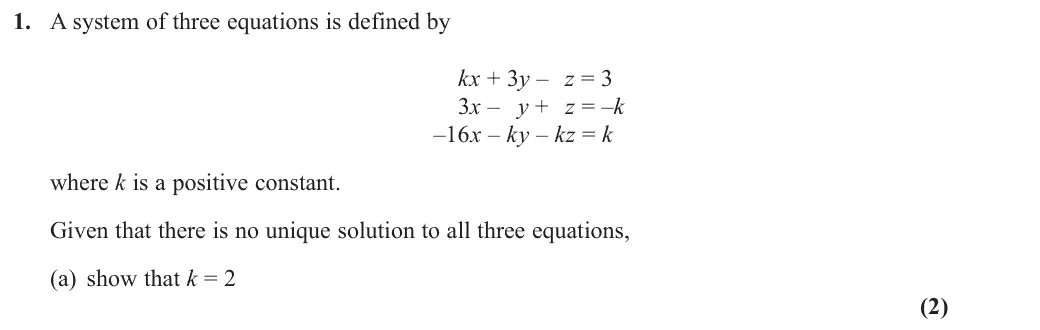
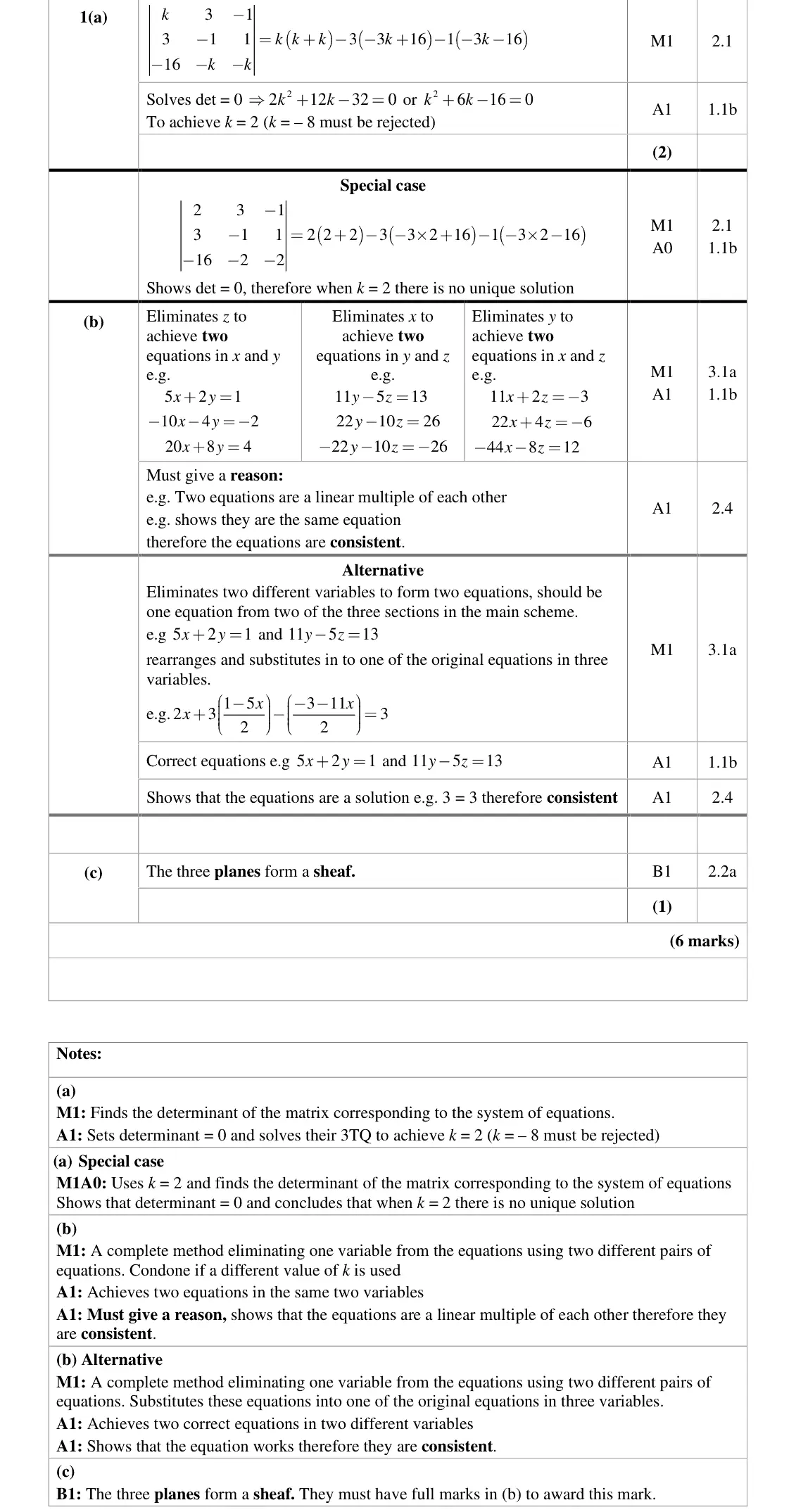
Oct 2020 · AS Paper 1 (Core Pure) · Q1(a)2 marks
Mark scheme (whole question; this part is marked with the orange bar)
Examiner's comment
Very few students achieved full marks on this question. Many did not make any valid attempt for the full question. Part (a) the majority of candidates score full marks
Key points from the mark scheme and examiner's report
no unique solution means the coefficient matrix is singular: det = 2k² + 12k − 32 = 0, k² + 6k − 16 = 0
k = 2, reject k = −8 as k > 0
verifying det = 0 at k = 2 scores M1A0
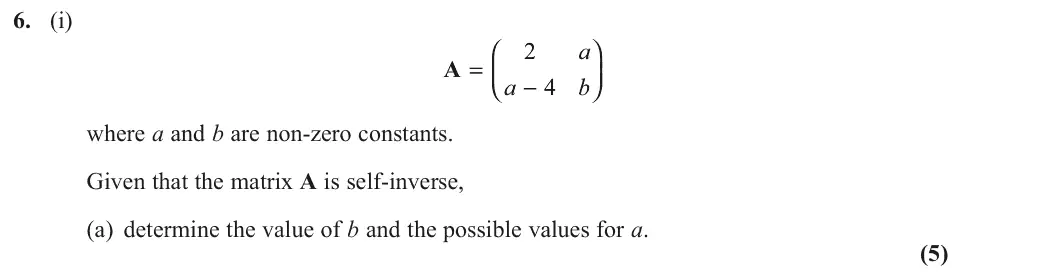
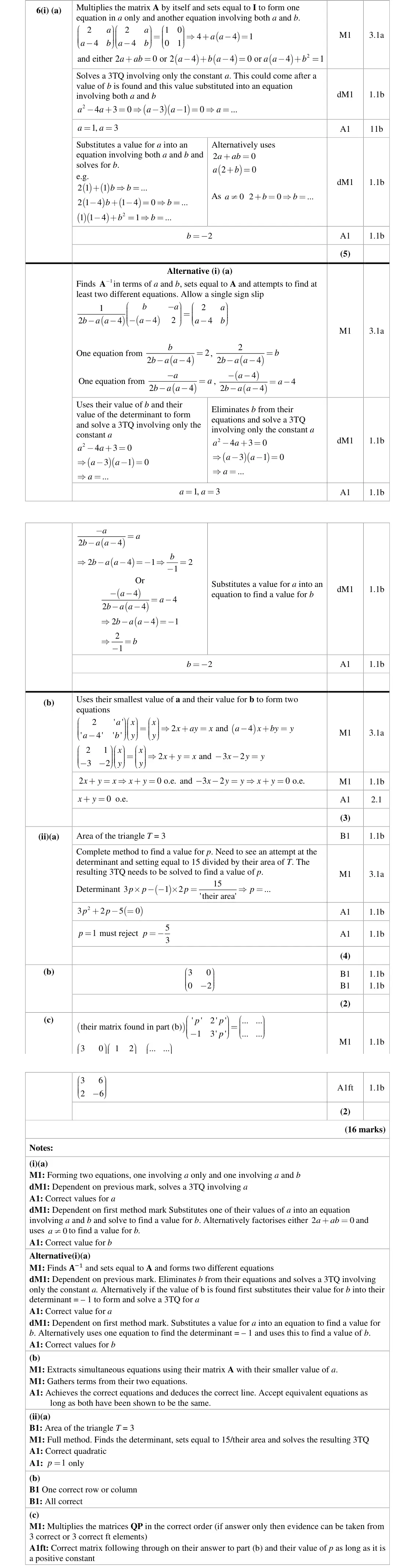
Oct 2020 · AS Paper 1 (Core Pure) · Q6(i)(a)5 marks
Mark scheme (whole question; this part is marked with the orange bar)
Examiner's comment
(i) Part (a) - candidates that used the fact that for a matrix to be a self-inverse then AA = I and A A this did have some success 1 were very successful. However, the majority attempted but very often not. Often the two equations pulled out were not from the different diagonals meaning no marks awarded. Other incorrect methods seen were setting the determinant = 0 and AA I which does not lead to any equations. 1 using (i) Part (b) This was largely not attempted though those that were successful with part (a) were often successful. A common error was to use x and mx + c but then not fully complete the method. Section (ii) on the whole was much better answered Part (a) - only a small number failed to find the area of the object, those that did were often 5 p successful with this part with all candidates correctly discarding . The error that 3 occurred was a sign error in solving. Part (b) - very high success rate Part (c) - Due to the follow through marks available full marks where achieved on this part by nearly all who answered it. Very rarely the order of the matrices was incorrect.
Key points from the mark scheme and examiner's report
self-inverse means A² = I (or A⁻¹ = A)
equations from different entries: a² − 4a + 3 = 0, a = 1 or 3
2a + ab = 0 gives b = −2
setting det = 0 is wrong
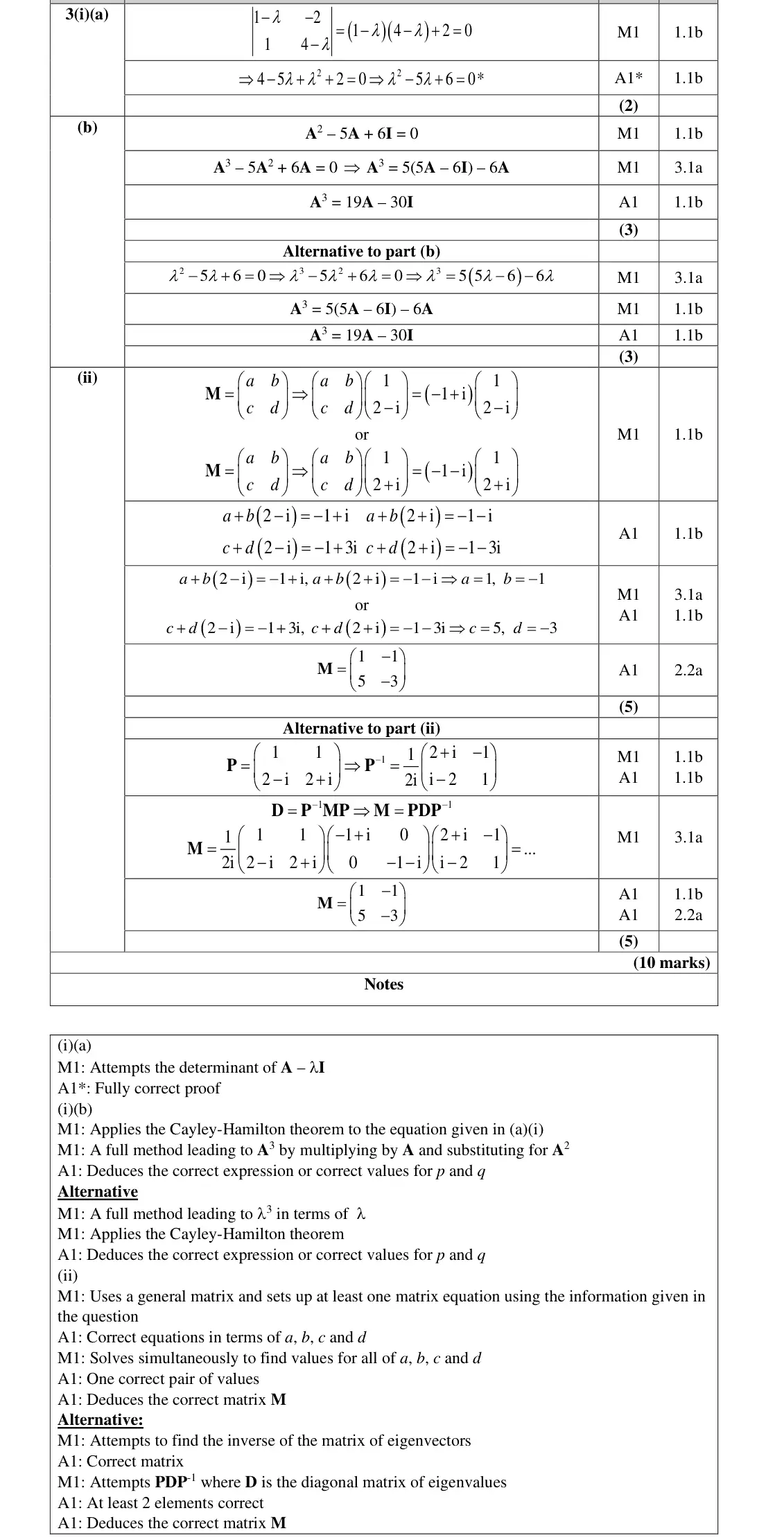
Oct 2020 · AS Paper 2 (Further Pure 2) · Q3(ii)5 marks
Mark scheme (whole question; this part is marked with the orange bar)
Key points from the mark scheme and examiner's report
M(1, 2 − i) = (−1 + i)(1, 2 − i) etc. gives equations in a, b, c, d
or M = PDP⁻¹ with P the eigenvector matrix
M = (1 −1
5 −3)
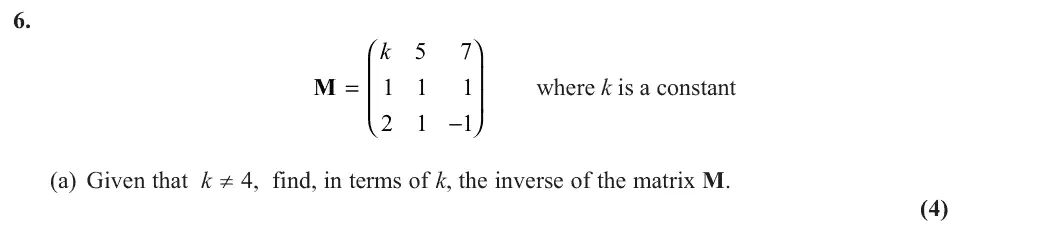
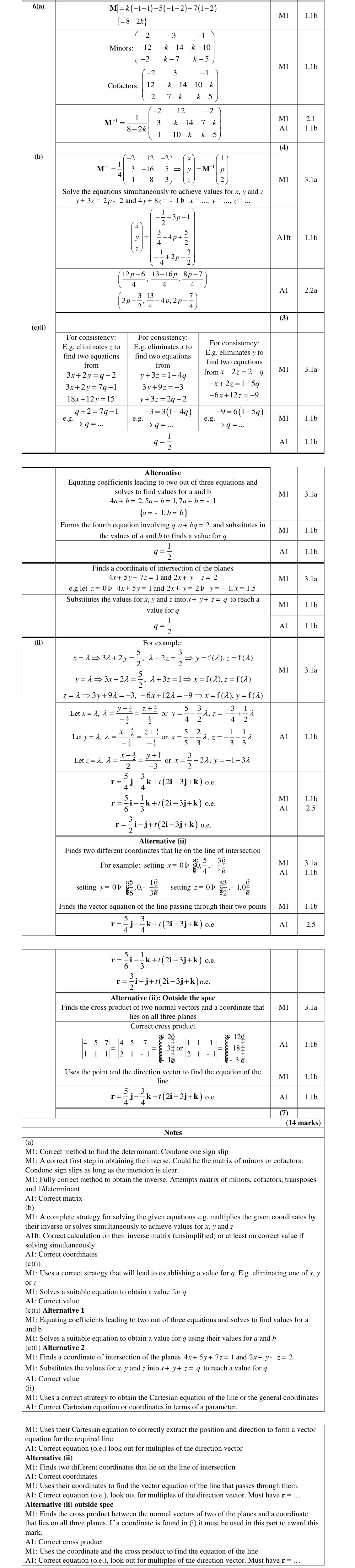
Oct 2020 · Paper 2 (Core Pure 2) · Q6(a)4 marks
Mark scheme (whole question; this part is marked with the orange bar)
Examiner's comment
Part (a) Virtually all candidates knew how to find the inverse of a 3 by 3 matrix and scored full marks. Slips in signs was generally the only error seen.
Key points from the mark scheme and examiner's report
det M = 8 − 2k
minors, cofactors, transpose, divide by det
sign slips
Oct 2020 · Paper 2 (Core Pure 2) · Q6(b)3 marks
Mark scheme (whole question; this part is marked with the orange bar)
Examiner's comment
Part (b) This part was answer well with many using their inverse matrix found in part (a) to find the point of intersection. A few candidates attempted to solve the three simultaneous equations where algebraic error often occurred.
Key points from the mark scheme and examiner's report
use the inverse from (a) with k = 2 (det 4): (3p − 3/2, 13/4 − 4p, 2p − 7/4) as coordinates
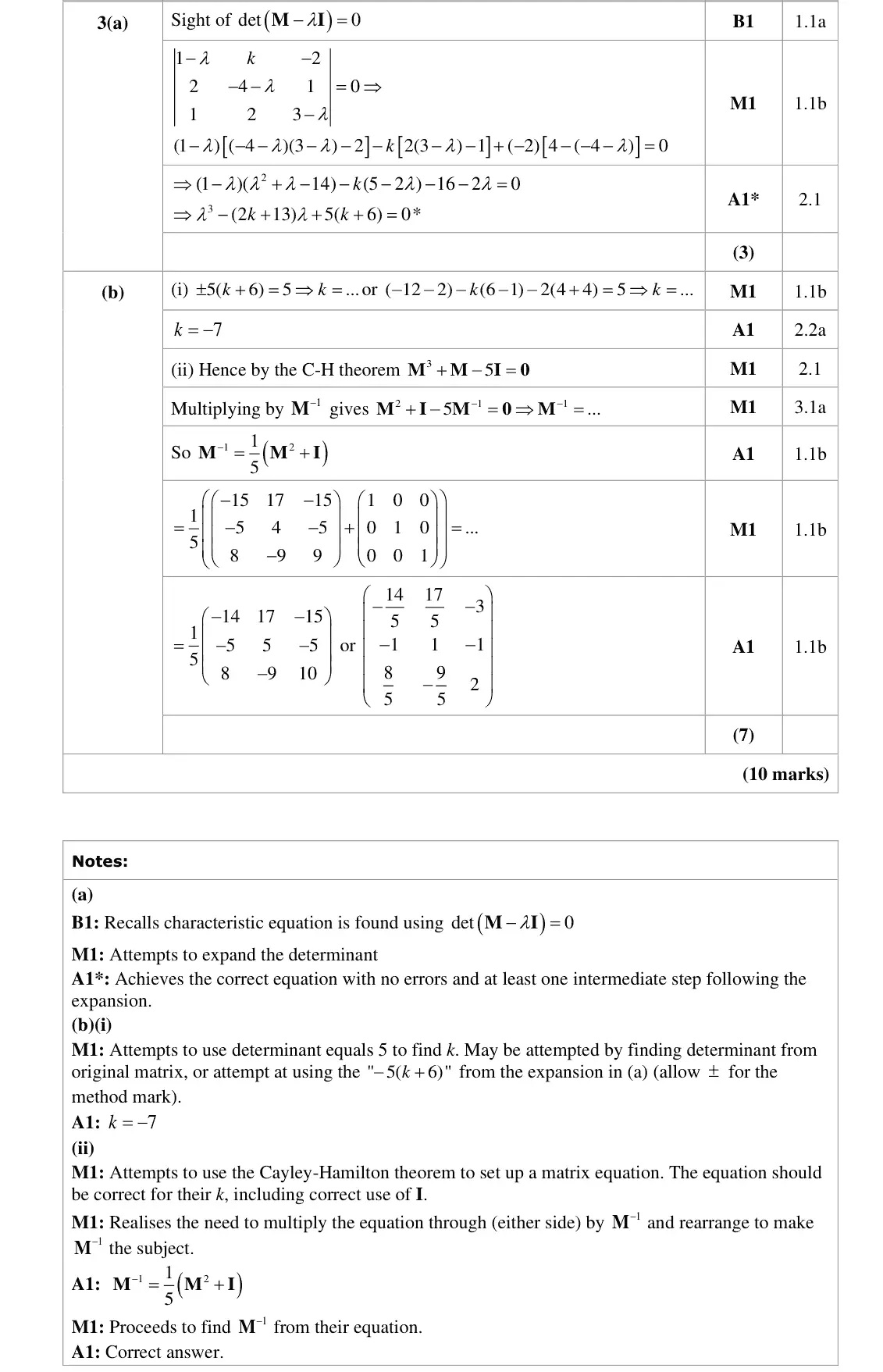
Oct 2020 · Paper 4A (Further Pure 2) · Q3(b)7 marks
Mark scheme (whole question; this part is marked with the orange bar)
Key points from the mark scheme and examiner's report
det M = 5 gives −5(k + 6) = 5 so k = −7
C-H: M³ + M − 5I = 0, multiply by M⁻¹: M⁻¹ = (M² + I)/5
then evaluate M²
June 2019 · AS Paper 1 (Core Pure) · Q1(a)2 marks
Mark scheme (whole question; this part is marked with the orange bar)
Key points from the mark scheme and examiner's report
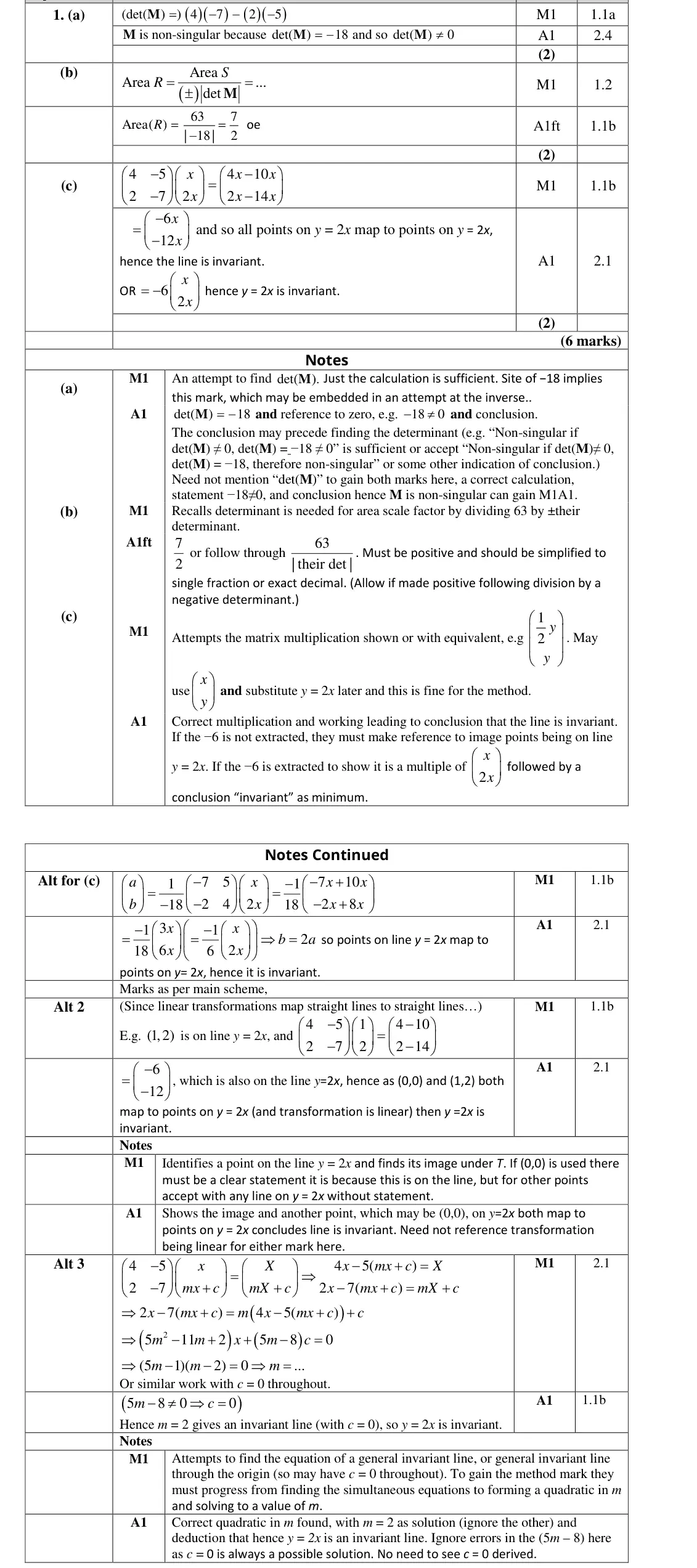
det M = (4)(−7) − (2)(−5) = −18
must state det ≠ 0 so M is non-singular
June 2019 · AS Paper 1 (Core Pure) · Q10(b)(i)3 marks
Mark scheme (whole question; this part is marked with the orange bar)
Key points from the mark scheme and examiner's report
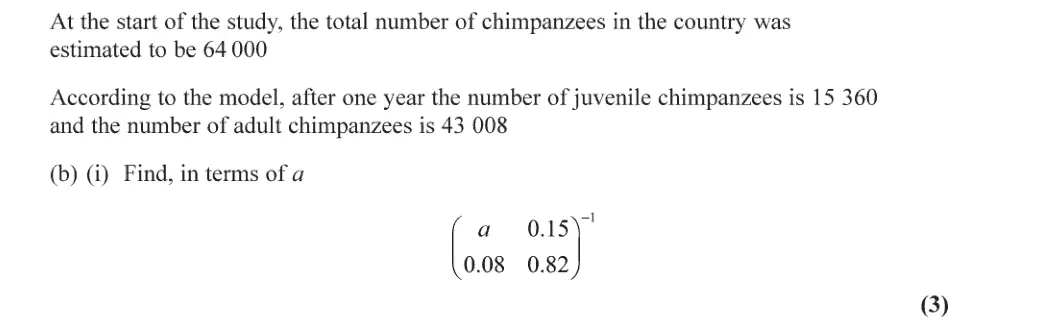
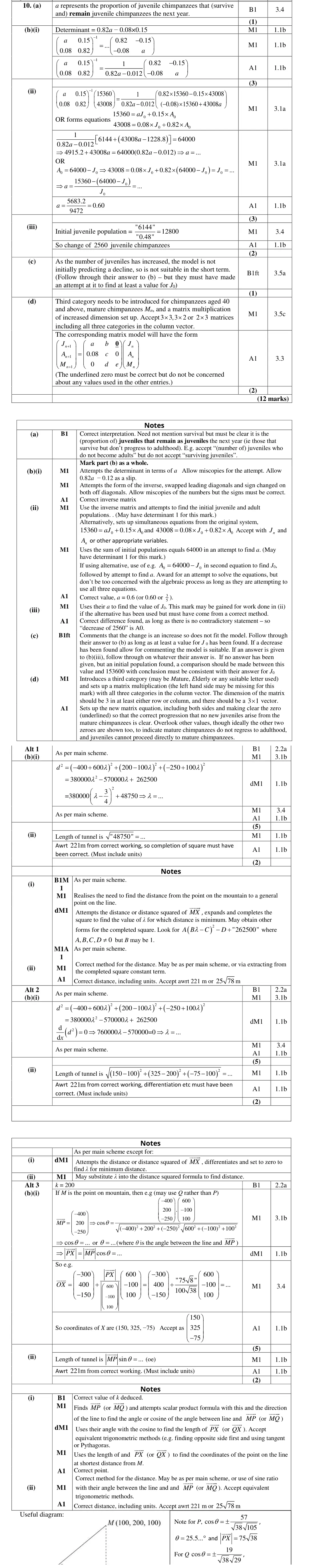
determinant 0.82a − 0.012
inverse = (1/(0.82a − 0.012))(0.82 −0.15
−0.08 a)
June 2019 · AS Paper 1 (Core Pure) · Q10(b)(ii)3 marks
Mark scheme (whole question; this part is marked with the orange bar)
Key points from the mark scheme and examiner's report
apply the inverse to (15360, 43008) and use J₀ + A₀ = 64000 (or form simultaneous equations)
a = 0.6
June 2019 · AS Paper 1 (Core Pure) · Q10(b)(iii)2 marks
Mark scheme (whole question; this part is marked with the orange bar)
Key points from the mark scheme and examiner's report
J₀ = 12800, so the juveniles increase by 2560
"decrease of 2560" scores A0
June 2019 · AS Paper 2 (Further Pure 2) · Q1(b)3 marks
Mark scheme (whole question; this part is marked with the orange bar)
Examiner's comment
This question was generally done well by candidates who were well prepared for this exam Part (b) the question stated ‘Hence’ requiring candidates to use their answer to part (a) and the Cayley-Hamilton Theorem. A few candidates found A-1 and then tried to express in terms of A and I, gaining no marks. Some candidates did not fully apply the Cayley Hamilton 2 2 5 2 0 A A 5 2 0 A A I Theorem writing instead of . Candidates who use the theorem correctly went on to achieve the correct result.
Key points from the mark scheme and examiner's report
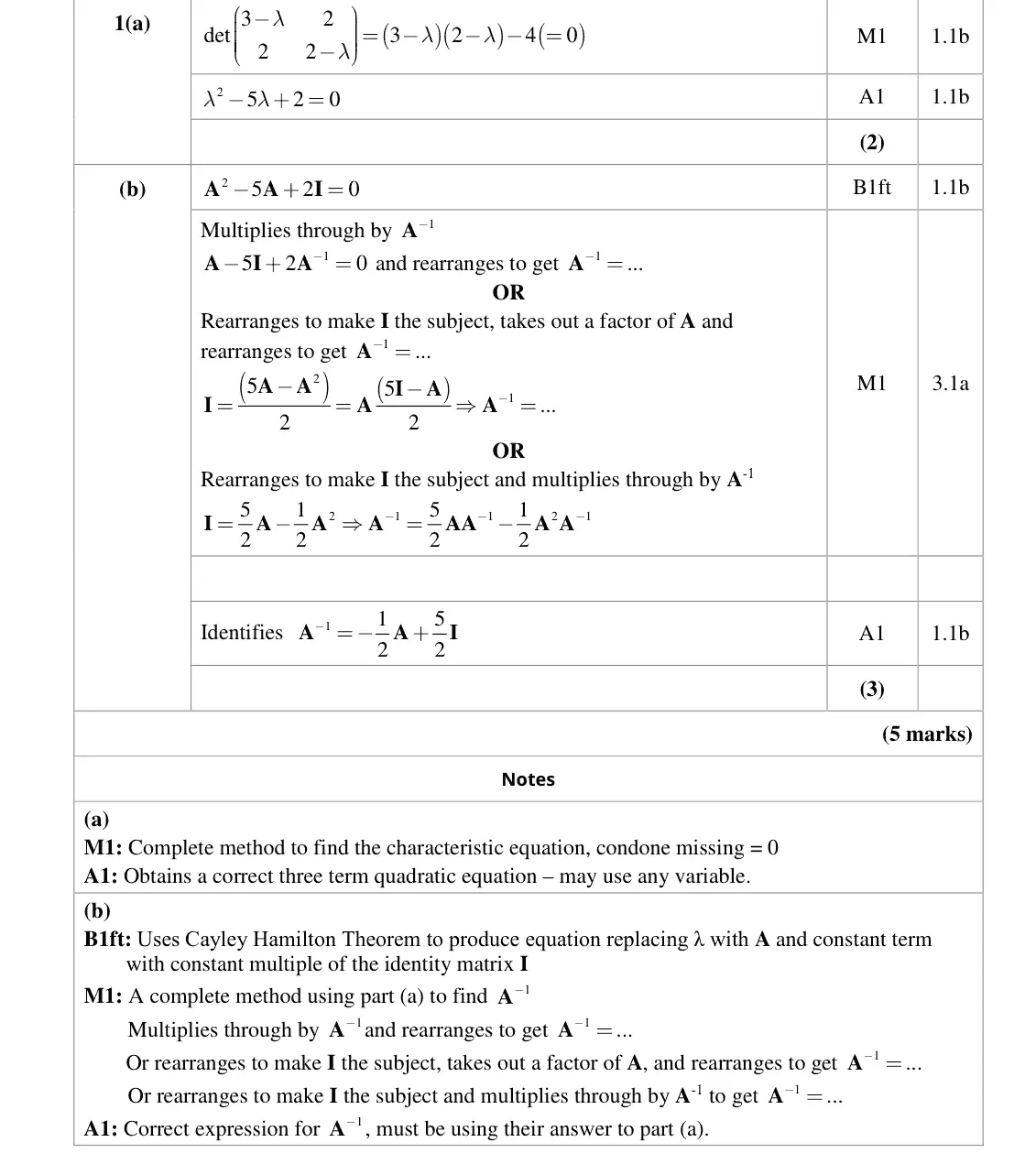
Cayley–Hamilton: A² − 5A + 2I = 0 (2I, not 2), multiply by A⁻¹
A⁻¹ = −½A + (5/2)I
finding A⁻¹ directly then matching scores 0
June 2019 · Paper 2 (Core Pure 2) · Q7(a)2 marks
Mark scheme (whole question; this part is marked with the orange bar)
Examiner's comment
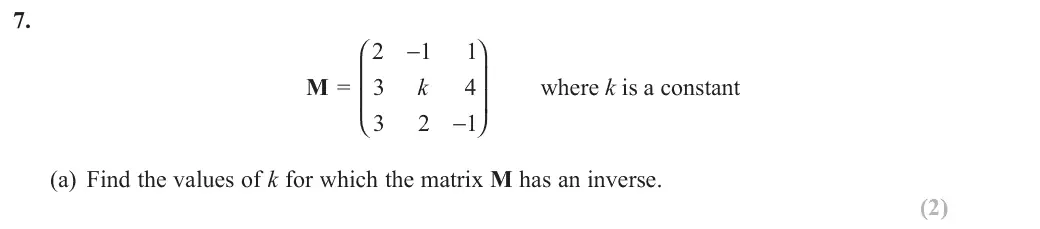
This matrix question also saw a wide range in the quality of response. In part (a) it was surprising to see a significant number of slips in obtaining an expression for the determinant. Most obtained an expression for det M conventionally although a few used the rule of Sarrus – usually correctly. A small number gave their answer as “k = 5” but the question required the values of k for which M had an inverse and not the value of k for which M was singular. attempts tried to use an inverse, even with candidates who had scored both marks in (a). Part (ii) required a geometric interpretation of the solution to the equations. Some neglected to mention “planes”. A few candidates did this successfully with a diagram. The unfortunate misspelling of “sheaf” was condoned!
Key points from the mark scheme and examiner's report
det M = 5k + 25
inverse exists for k ≠ −5 (not "k = 5")
slips in the determinant
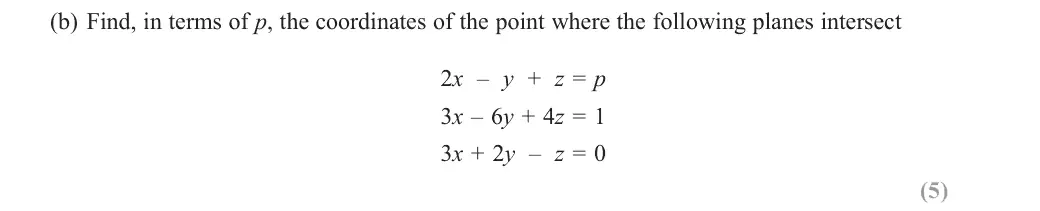
June 2019 · Paper 2 (Core Pure 2) · Q7(b)5 marks
Mark scheme (whole question; this part is marked with the orange bar)
Examiner's comment
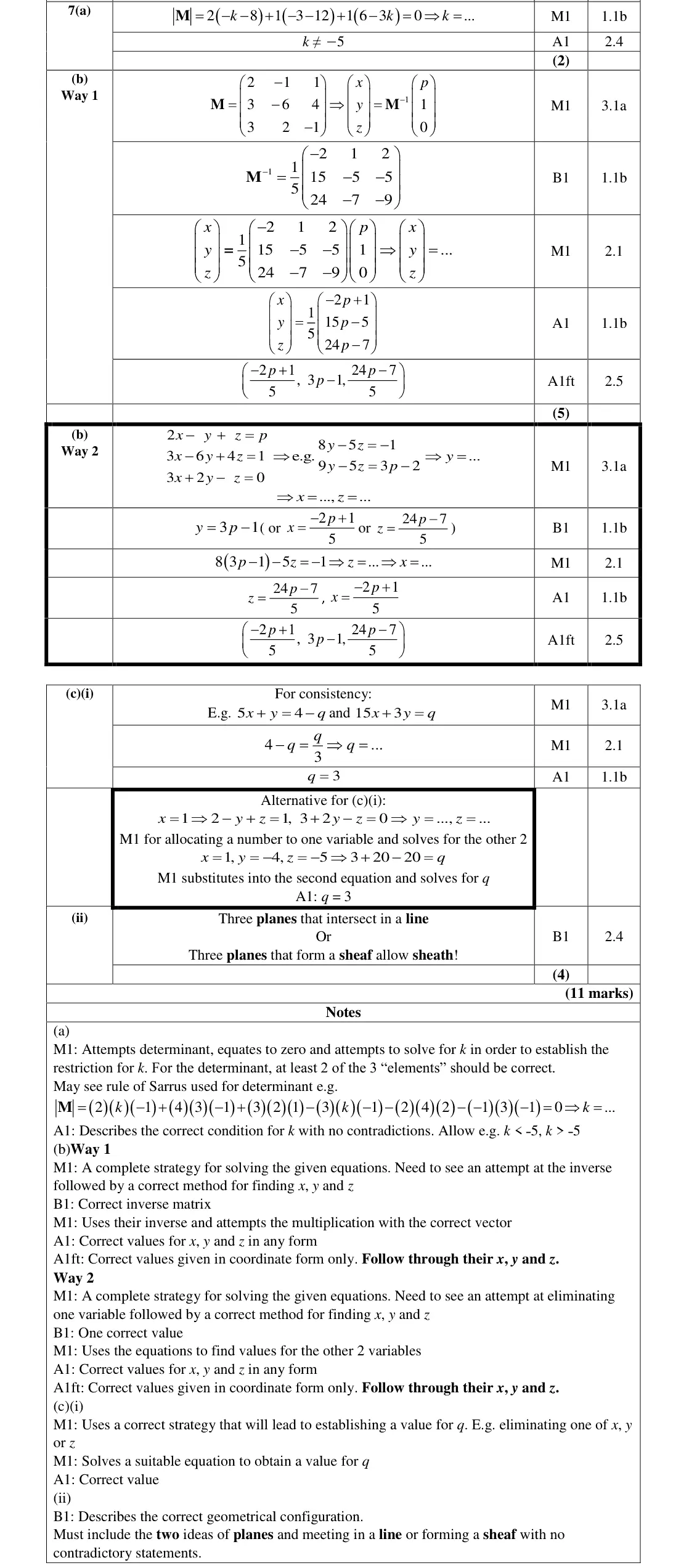
Part (b) required the point of intersection of three planes to be found and the most successful candidates used Way 1. It is acceptable to obtain an inverse of a matrix with no variables as elements using a calculator and it was unfortunate to see some embarking upon a step-by-step 1 method. This often led to errors such as omitting the det M multiplier. The correct inverse was seen fairly widely and the subsequent matrix multiplication was also often correct. This specification has an assessment objective for the use of correct notation so the point of intersection had to be given as coordinates. Those who chose to solve the system of equations were much less successful, with many unable to obtain x, y and z in terms of p (including a small number who attempted to find a value for p). Those who did not make any progress in (b) often left (c) unanswered but this part was still a reasonable source of marks for many. In part (i), correct strategies to obtain a value of q were common and although slips were evident, the correct q = 3 was often achieved. Weaker attempts tried to use an inverse, even with candidates who had scored both marks in (a). Part
Key points from the mark scheme and examiner's report
M⁻¹ with k = −6 (calculator allowed)
point ((−2p + 1)/5, 3p − 1, (24p − 7)/5) given as coordinates
omitting the 1/det factor
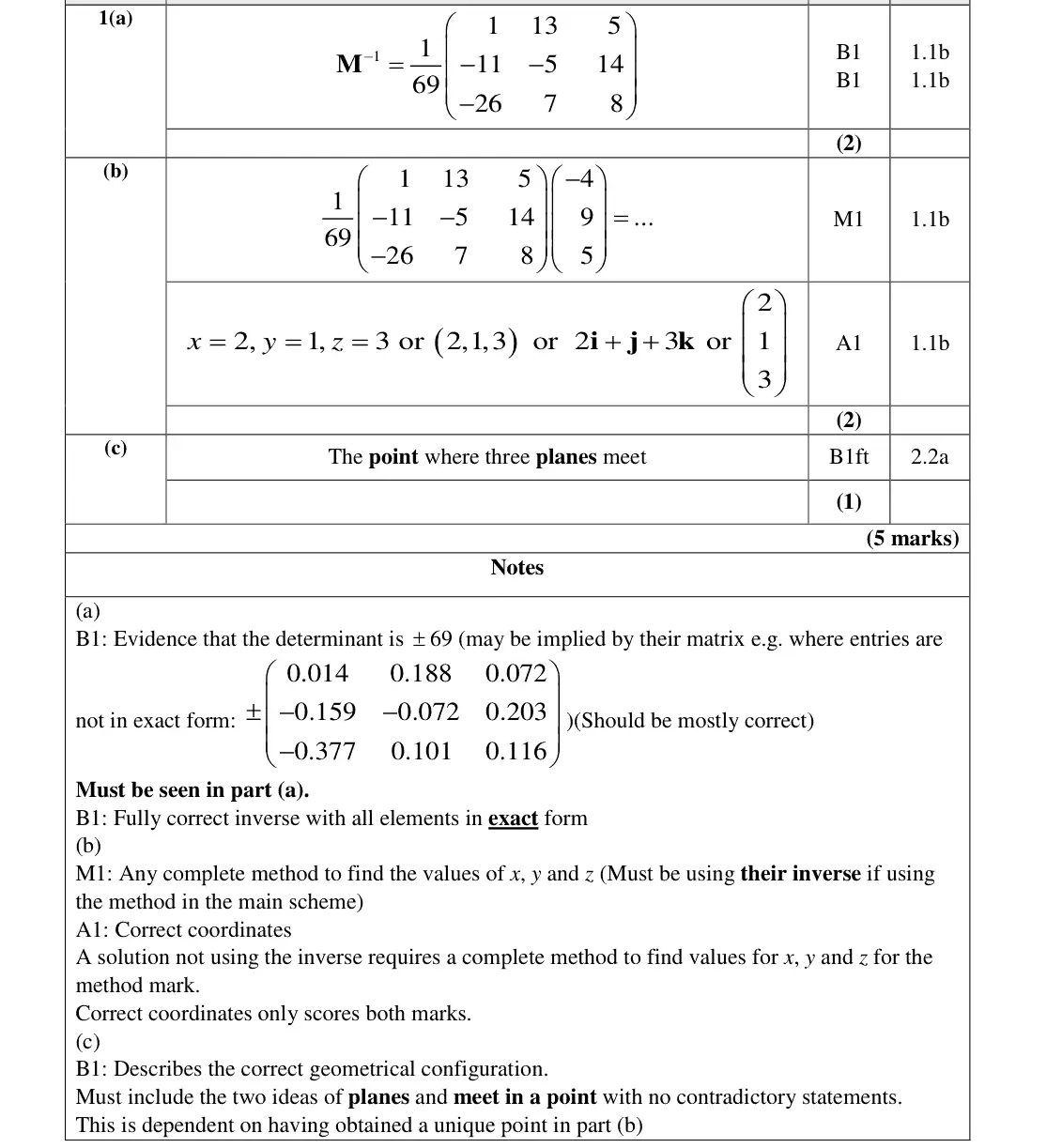
June 2018 · AS Paper 1 (Core Pure) · Q1(a)2 marks
Mark scheme (whole question; this part is marked with the orange bar)
Examiner's comment
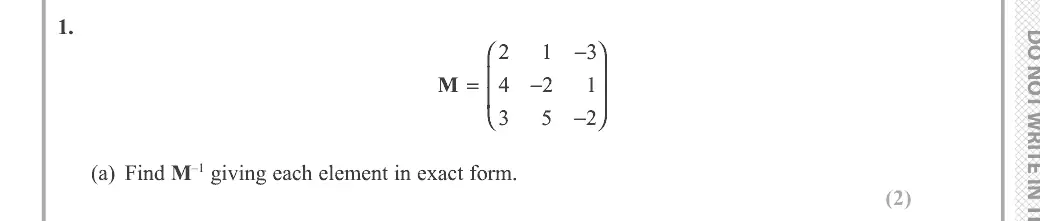
This question was generally well done with the majority gaining full marks for (a) and (b). (a) There were many correct responses many with clear evidence of manual calculation in some cases, although it was expected that students used their calculators. A few wrote each term as a decimal so were unable to gain more than one mark as an exact form was required. Many fully correct answers were seen.
Key points from the mark scheme and examiner's report
determinant 69
M⁻¹ = (1/69)(1 13 5
−11 −5 14
−26 7 8)
calculator expected
decimals lose the exact-form mark
Find an Edexcel Further Maths tutor
Stuck on this? Book a trial lesson with our Further Maths tutor.