The Maclaurin series are given. Leibnitz's theorem, L'Hospital's rule and the Taylor series about a are not.
Since 2018
35 question parts, 131 marks, 3 with a difficulty rating from the examiner's report
Notes, worked examples and practice for this topic are being written by our tutors. The past-paper questions below are ready now: work each one on paper, then open the mark scheme and the examiner's comment.
Tap a question to zoom it. Mark scheme and examiner's comment open under each question.
June 2025 · Paper 3A (Further Pure 1) · Q4(a)3 marks
Mark scheme (whole question; this part is marked with the orange bar)
Examiner's comment
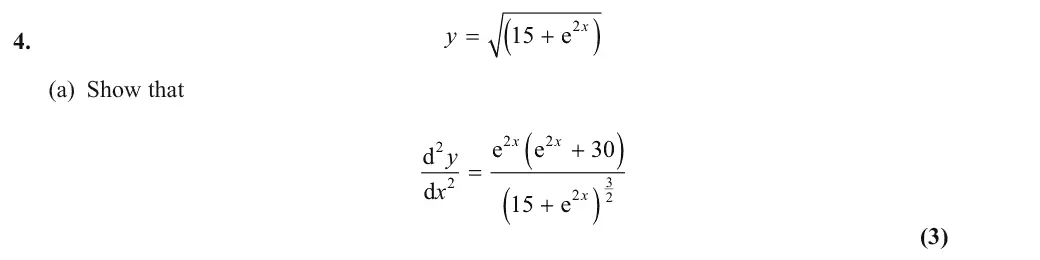
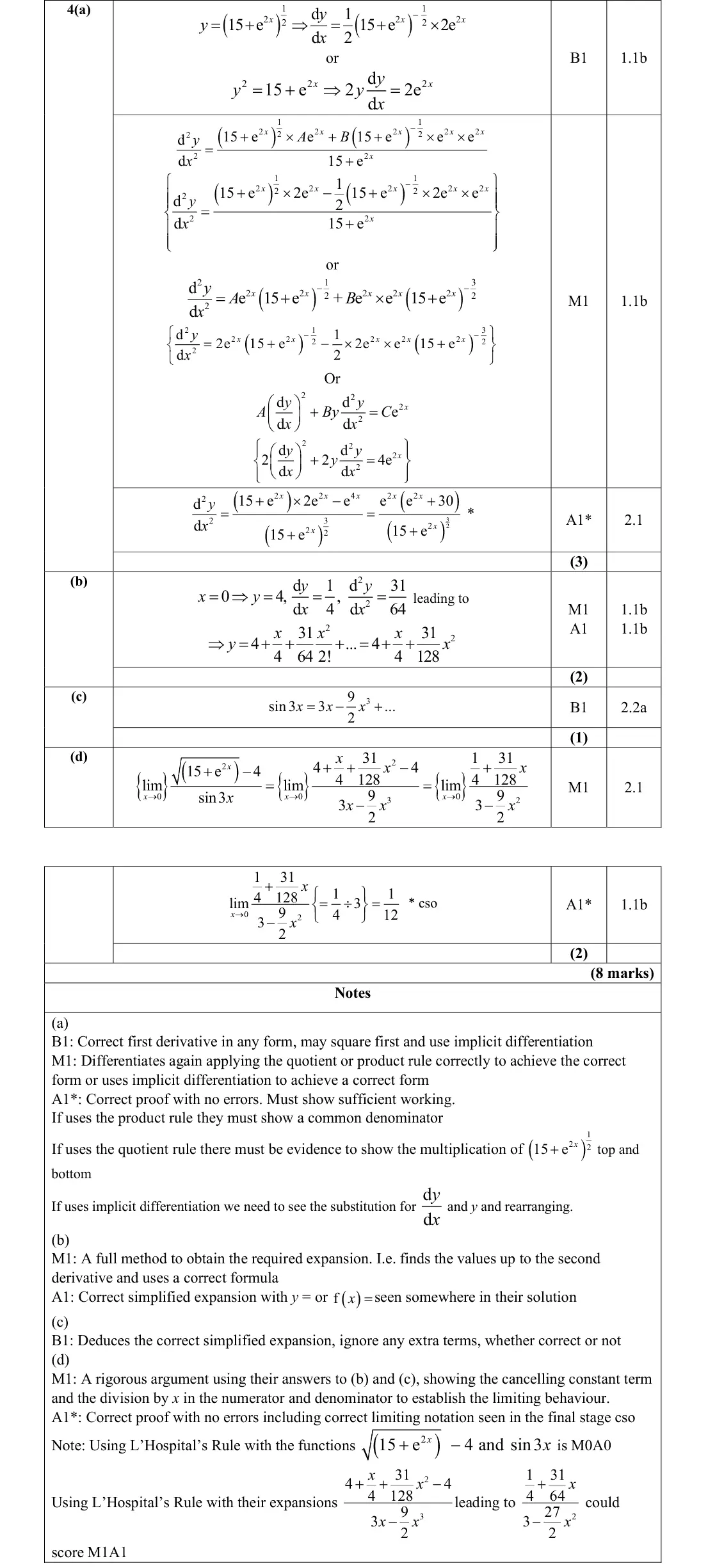
Part (a) of this question required learners to differentiate the given expression to obtain the second derivative. Most learners either used the product rule twice or after differentiating once using the product chose to rewrite the function as a quotient and then used the quotient rule. An alternative rarely seen was to square to get y2 and then to use implicit differentiation twice. There were errors seen particularly in powers which prevented reaching the printed answer correctly. However, this part proved a source of three marks for most learners.
Key points from the mark scheme and examiner's report
dy/dx = e²ˣ(15 + e²ˣ)^(−1/2)
product or quotient rule (or implicit from y² = 15 + e²ˣ) to e²ˣ(e²ˣ + 30)/(15 + e²ˣ)^(3/2)
errors in powers
June 2025 · Paper 3A (Further Pure 1) · Q4(b)2 marks
Mark scheme (whole question; this part is marked with the orange bar)
Examiner's comment
Part (b) required the use of a Maclaurin series to reach a series expansion for y. The method was well known but learners should be advised to write down the Maclaurin formula first before using it. Some learners lost both marks because they wrote down an incorrect expansion with no working. It was not possible to know if the error was in the values of the derivatives or in the formula. Learners should be advised to show all their working. The last mark was often lost because the answer did not refer to y = …. as the question asked for.
Key points from the mark scheme and examiner's report
June 2025 · Paper 3A (Further Pure 1) · Q4(c)1 mark
Mark scheme (whole question; this part is marked with the orange bar)
Examiner's comment
Part (c) required the use of the small angle approximation for sin 3x which was usually correct although there were slips in powers. A few learners used ether answers to (b) and (c) and then used l’Hospital’s rule correctly.
Key points from the mark scheme and examiner's report
sin 3x = 3x − 9x³/2 + …
June 2025 · Paper 3A (Further Pure 1) · Q4(d)2 marks
Mark scheme (whole question; this part is marked with the orange bar)
Examiner's comment
Part (d) required a correct and rigorous proof using the answers to (b) and (c) including the correct use of limit notation. Again, learners should be advised to show all working when an answer is given. Slips in powers particularly in the denominator lost the final mark.
Key points from the mark scheme and examiner's report
June 2025 · Paper 3A (Further Pure 1) · Q5(a)3 marks
Mark scheme (whole question; this part is marked with the orange bar)
Examiner's comment
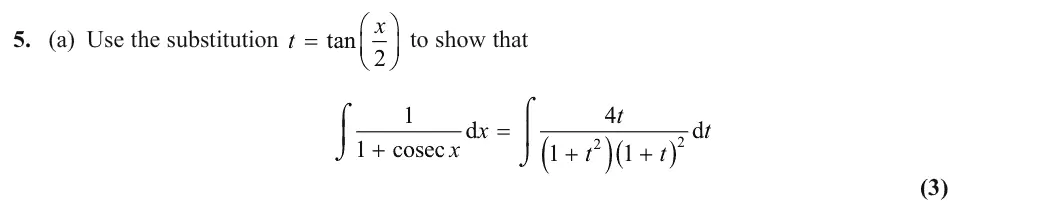
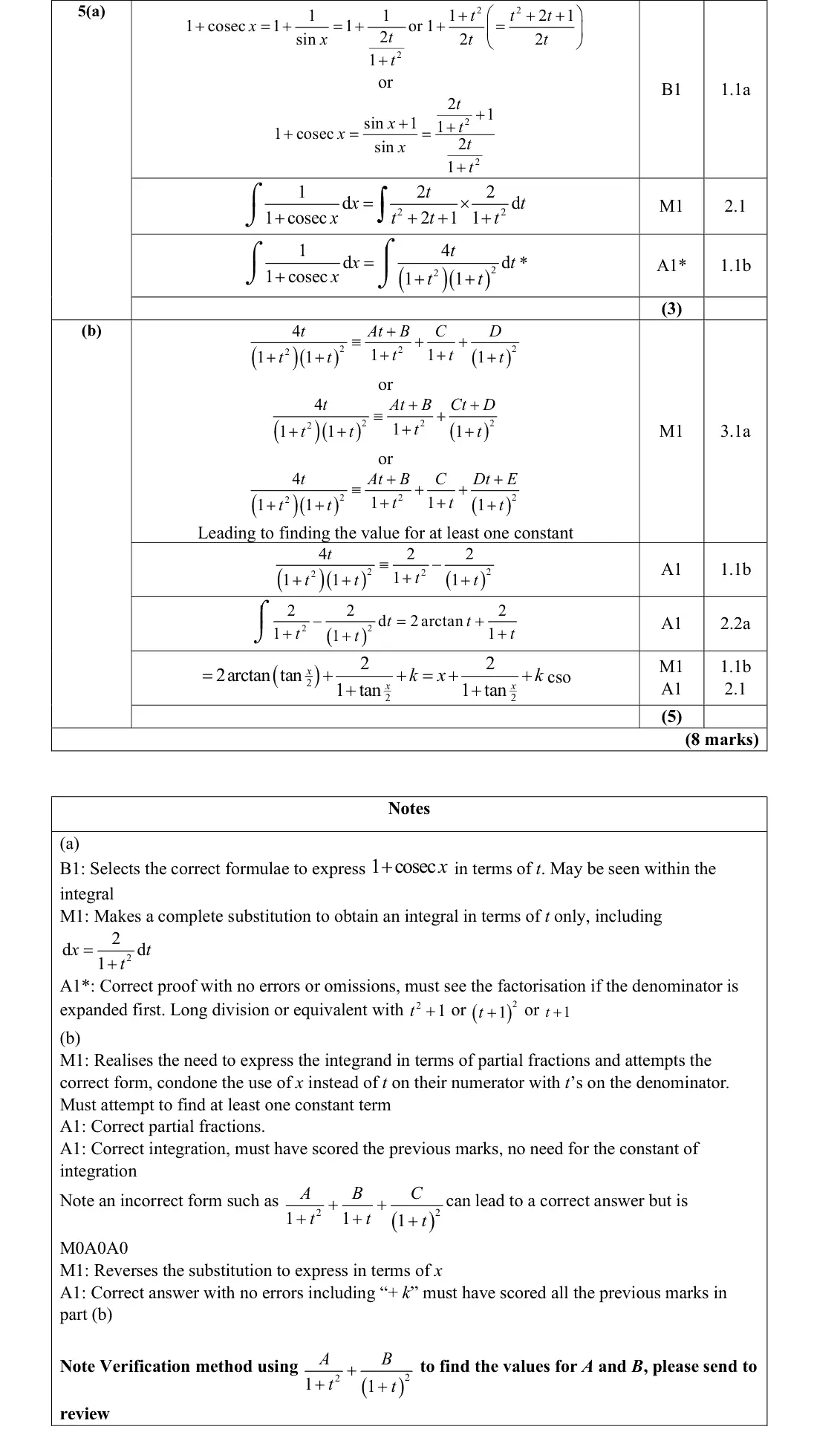
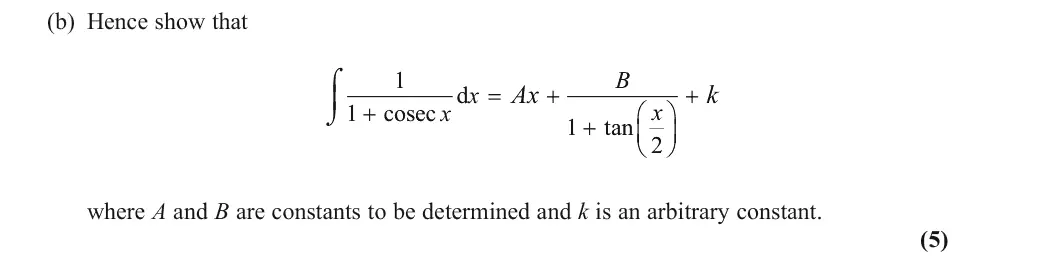
Part (a) Many learners used the given substitution in the correct t-formula of cosec x and moved forward with a correct change of variable within the given integral. Weaker responses exposed some inability to expand/multiply brackets correctly. Some did not place dt after the integrand.
Key points from the mark scheme and examiner's report
June 2025 · Paper 3A (Further Pure 1) · Q5(b)5 marks
Mark scheme (whole question; this part is marked with the orange bar)
Examiner's comment
Part (b) Many learners did not use the correct for of the partial fractions, often incorrectly using 𝐴𝐴 1+𝑡𝑡2 + 𝐵𝐵 (1+𝑡𝑡)2 which did lead to the correct expression but followed incorrect work so lost 4 marks. Learners were still able to score the method mark for reversing the substitution. Learners who correctly used 𝐴𝐴𝐴𝐴+𝐵𝐵 1+𝑡𝑡2 + 𝐶𝐶 1+𝑡𝑡+ 𝐷𝐷 (1+𝑡𝑡)2 often went on to successfully answer the question. A few struggled to find the correct values of the constants as it involved solving multiple simultaneous equations.
Key points from the mark scheme and examiner's report
June 2025 · Paper 3A (Further Pure 1) · Q6(i)4 marks
Mark scheme (whole question; this part is marked with the orange bar)
Examiner's comment
Part (i) Most learners understood what L'Hospital's rule was and realised that they needed to find the 𝑑𝑑𝑥𝑥2 = 𝑑𝑑2𝑦𝑦 derivatives of the numerator and denominator twice. Common mistakes included incorrect second 𝑑𝑑𝑥𝑥2 = 𝑐𝑐𝑐𝑐𝑐𝑐9 𝑥𝑥+ 𝑐𝑐𝑐𝑐𝑐𝑐9 𝑥𝑥+ 9 𝑐𝑐𝑐𝑐𝑐𝑐9 𝑥𝑥+ 81𝑥𝑥𝑐𝑐𝑐𝑐𝑐𝑐𝑥𝑥 or 𝑐𝑐𝑐𝑐𝑐𝑐9 𝑥𝑥+ 9 𝑐𝑐𝑐𝑐𝑐𝑐9 𝑥𝑥-9𝑥𝑥𝑐𝑐𝑐𝑐𝑐𝑐𝑥𝑥 instead of derivatives of the denominator with a slip in the sign or coefficient, incorrectly achieving 𝑑𝑑2𝑦𝑦 9 𝑐𝑐𝑐𝑐𝑐𝑐9 𝑥𝑥-81𝑥𝑥𝑐𝑐𝑐𝑐𝑐𝑐𝑥𝑥. This still lead to the correct answer but losing the final accuracy mark as an incorrect line of working in their proof. This question would still yield the correct result with various errors, so perhaps learners assumed the 'show-that' meant they didn't need to check their working as carefully. Correct limit notation was required with the majority of learners using the correct notation throughout. 49 18 can from, either 9 𝑐𝑐𝑐𝑐𝑐𝑐9𝑥𝑥+9 𝑐𝑐𝑐𝑐𝑐𝑐9𝑥𝑥-81𝑥𝑥𝑠𝑠𝑠𝑠𝑠𝑠9𝑥𝑥= 9+9 = 18 or 𝑙𝑙𝑙𝑙𝑙𝑙 18 𝑐𝑐𝑐𝑐𝑐𝑐9𝑥𝑥-81𝑥𝑥𝑠𝑠𝑠𝑠𝑠𝑠9𝑥𝑥= 𝑙𝑙𝑙𝑙𝑙𝑙 49 𝑐𝑐𝑐𝑐𝑐𝑐7𝑥𝑥 49 𝑐𝑐𝑐𝑐𝑐𝑐7𝑥𝑥 49 49 49 As this was a show question learners need to show where the final answer of 18 𝑥𝑥→0 𝑥𝑥→0 Part (ii) a & b: This proved to be more difficult for learners with most able to achieve the first two marks. Most to evaluate the 𝑘𝑘𝑡𝑡ℎ derivative of the function challenging. While most learners were able to learners were familiar with Leibnitz Theorem but many learners find it challenging to use the theorem differentiate correctly 𝑢𝑢= 𝑥𝑥2and 𝑣𝑣= 𝑒𝑒3𝑥𝑥three times and then acknowledging that 𝑑𝑑𝑥𝑥𝑘𝑘= 0for all 𝑑𝑑𝑘𝑘𝑦𝑦 values of 𝑘𝑘 greater than 3, unfortunately some candidate were not able to evaluate the 𝑘𝑘𝑡𝑡ℎderivative of 𝑑𝑑𝑥𝑥𝑘𝑘= 3𝑘𝑘𝑒𝑒3𝑥𝑥, which led them to rely on a trial-and-error approach, manually calculating 𝑑𝑑𝑘𝑘𝑣𝑣 the 2nd , 3rd , and 4th derivatives of 𝑦𝑦 to attempt to spot a pattern. This approach often led to the loss of 3x v e = as 3 out of the 5 marks allocated for Part (ii)(a), as it by passed the use of the theorem. binomial coefficient of the third term. Some incorrectly evaluated it as ቀ𝑘𝑘 2ቁ= 𝑘𝑘(𝑘𝑘-1). Some got Most learners who used the theorem correctly were still prone to a common error when computing the their binomial coefficients wrong, or just got muddled when trying to factorise out the power of 3. Following errors many learners did manage to achieve a correct answer as the structure of the answer was given but scored A0 Part (ii)(b)- This part served as a valuable opportunity for learners to secure a method mark, even if their final expression in part a-ii was incorrect, as long as they recognised that the solutions of the resulting quadratic equation must be real.
Key points from the mark scheme and examiner's report
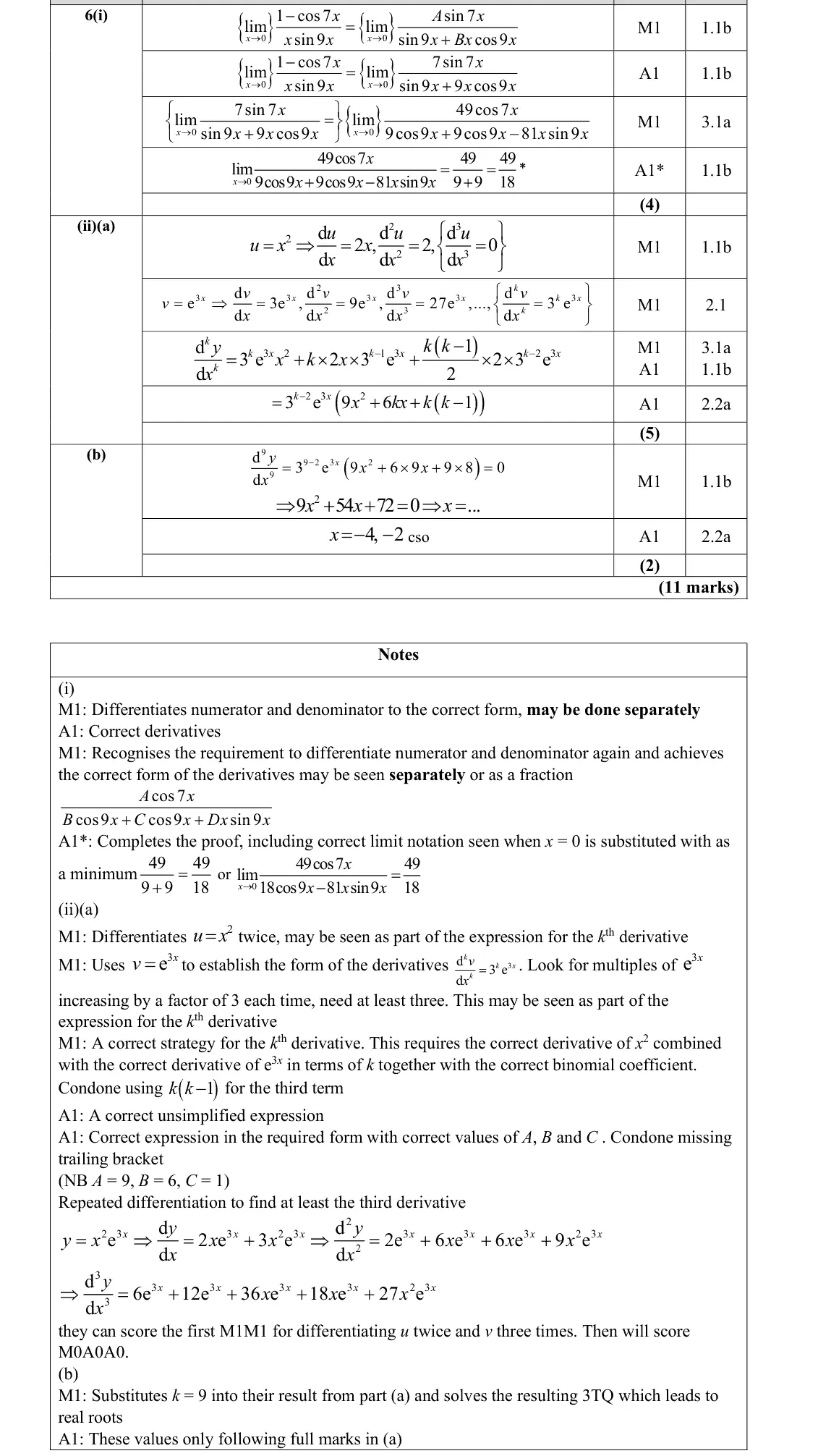
apply twice: 7sin 7x/(sin 9x + 9x cos 9x) still 0/0
then 49cos 7x/(18cos 9x − 81x sin 9x) → 49/18
slips in the second derivative of the denominator
limit notation needed
June 2025 · Paper 3A (Further Pure 1) · Q6(ii)(a)5 marks
Mark scheme (whole question; this part is marked with the orange bar)
Examiner's comment
Part (i) Most learners understood what L'Hospital's rule was and realised that they needed to find the 𝑑𝑑𝑥𝑥2 = 𝑑𝑑2𝑦𝑦 derivatives of the numerator and denominator twice. Common mistakes included incorrect second 𝑑𝑑𝑥𝑥2 = 𝑐𝑐𝑐𝑐𝑐𝑐9 𝑥𝑥+ 𝑐𝑐𝑐𝑐𝑐𝑐9 𝑥𝑥+ 9 𝑐𝑐𝑐𝑐𝑐𝑐9 𝑥𝑥+ 81𝑥𝑥𝑐𝑐𝑐𝑐𝑐𝑐𝑥𝑥 or 𝑐𝑐𝑐𝑐𝑐𝑐9 𝑥𝑥+ 9 𝑐𝑐𝑐𝑐𝑐𝑐9 𝑥𝑥-9𝑥𝑥𝑐𝑐𝑐𝑐𝑐𝑐𝑥𝑥 instead of derivatives of the denominator with a slip in the sign or coefficient, incorrectly achieving 𝑑𝑑2𝑦𝑦 9 𝑐𝑐𝑐𝑐𝑐𝑐9 𝑥𝑥-81𝑥𝑥𝑐𝑐𝑐𝑐𝑐𝑐𝑥𝑥. This still lead to the correct answer but losing the final accuracy mark as an incorrect line of working in their proof. This question would still yield the correct result with various errors, so perhaps learners assumed the 'show-that' meant they didn't need to check their working as carefully. Correct limit notation was required with the majority of learners using the correct notation throughout. 49 18 can from, either 9 𝑐𝑐𝑐𝑐𝑐𝑐9𝑥𝑥+9 𝑐𝑐𝑐𝑐𝑐𝑐9𝑥𝑥-81𝑥𝑥𝑠𝑠𝑠𝑠𝑠𝑠9𝑥𝑥= 9+9 = 18 or 𝑙𝑙𝑙𝑙𝑙𝑙 18 𝑐𝑐𝑐𝑐𝑐𝑐9𝑥𝑥-81𝑥𝑥𝑠𝑠𝑠𝑠𝑠𝑠9𝑥𝑥= 𝑙𝑙𝑙𝑙𝑙𝑙 49 𝑐𝑐𝑐𝑐𝑐𝑐7𝑥𝑥 49 𝑐𝑐𝑐𝑐𝑐𝑐7𝑥𝑥 49 49 49 As this was a show question learners need to show where the final answer of 18 𝑥𝑥→0 𝑥𝑥→0 Part (ii) a & b: This proved to be more difficult for learners with most able to achieve the first two marks. Most to evaluate the 𝑘𝑘𝑡𝑡ℎ derivative of the function challenging. While most learners were able to learners were familiar with Leibnitz Theorem but many learners find it challenging to use the theorem differentiate correctly 𝑢𝑢= 𝑥𝑥2and 𝑣𝑣= 𝑒𝑒3𝑥𝑥three times and then acknowledging that 𝑑𝑑𝑥𝑥𝑘𝑘= 0for all 𝑑𝑑𝑘𝑘𝑦𝑦 values of 𝑘𝑘 greater than 3, unfortunately some candidate were not able to evaluate the 𝑘𝑘𝑡𝑡ℎderivative of 𝑑𝑑𝑥𝑥𝑘𝑘= 3𝑘𝑘𝑒𝑒3𝑥𝑥, which led them to rely on a trial-and-error approach, manually calculating 𝑑𝑑𝑘𝑘𝑣𝑣 the 2nd , 3rd , and 4th derivatives of 𝑦𝑦 to attempt to spot a pattern. This approach often led to the loss of 3x v e = as 3 out of the 5 marks allocated for Part (ii)(a), as it by passed the use of the theorem. binomial coefficient of the third term. Some incorrectly evaluated it as ቀ𝑘𝑘 2ቁ= 𝑘𝑘(𝑘𝑘-1). Some got Most learners who used the theorem correctly were still prone to a common error when computing the their binomial coefficients wrong, or just got muddled when trying to factorise out the power of 3. Following errors many learners did manage to achieve a correct answer as the structure of the answer was given but scored A0 Part (ii)(b)- This part served as a valuable opportunity for learners to secure a method mark, even if their final expression in part a-ii was incorrect, as long as they recognised that the solutions of the resulting quadratic equation must be real.
Key points from the mark scheme and examiner's report
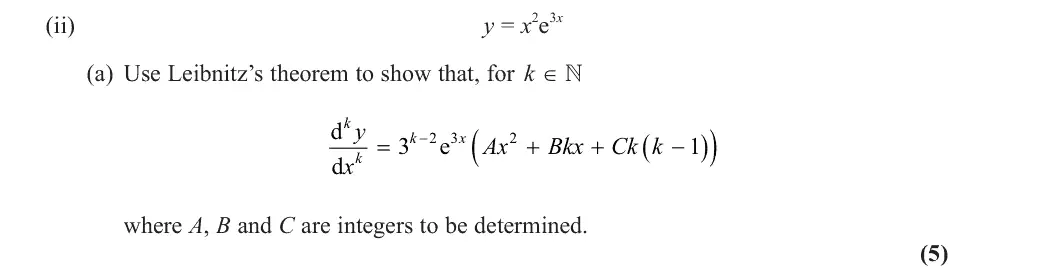
u = x² (vanishes after 2nd derivative), v = e³ˣ with kth derivative 3ᵏe³ˣ
3ᵏx² + 2k·3ᵏ⁻¹x + k(k − 1)3ᵏ⁻²: A = 9, B = 6, C = 1
June 2025 · Paper 3A (Further Pure 1) · Q6(ii)(b)2 marks
Mark scheme (whole question; this part is marked with the orange bar)
Examiner's comment
Part (i) Most learners understood what L'Hospital's rule was and realised that they needed to find the 𝑑𝑑𝑥𝑥2 = 𝑑𝑑2𝑦𝑦 derivatives of the numerator and denominator twice. Common mistakes included incorrect second 𝑑𝑑𝑥𝑥2 = 𝑐𝑐𝑐𝑐𝑐𝑐9 𝑥𝑥+ 𝑐𝑐𝑐𝑐𝑐𝑐9 𝑥𝑥+ 9 𝑐𝑐𝑐𝑐𝑐𝑐9 𝑥𝑥+ 81𝑥𝑥𝑐𝑐𝑐𝑐𝑐𝑐𝑥𝑥 or 𝑐𝑐𝑐𝑐𝑐𝑐9 𝑥𝑥+ 9 𝑐𝑐𝑐𝑐𝑐𝑐9 𝑥𝑥-9𝑥𝑥𝑐𝑐𝑐𝑐𝑐𝑐𝑥𝑥 instead of derivatives of the denominator with a slip in the sign or coefficient, incorrectly achieving 𝑑𝑑2𝑦𝑦 9 𝑐𝑐𝑐𝑐𝑐𝑐9 𝑥𝑥-81𝑥𝑥𝑐𝑐𝑐𝑐𝑐𝑐𝑥𝑥. This still lead to the correct answer but losing the final accuracy mark as an incorrect line of working in their proof. This question would still yield the correct result with various errors, so perhaps learners assumed the 'show-that' meant they didn't need to check their working as carefully. Correct limit notation was required with the majority of learners using the correct notation throughout. 49 18 can from, either 9 𝑐𝑐𝑐𝑐𝑐𝑐9𝑥𝑥+9 𝑐𝑐𝑐𝑐𝑐𝑐9𝑥𝑥-81𝑥𝑥𝑠𝑠𝑠𝑠𝑠𝑠9𝑥𝑥= 9+9 = 18 or 𝑙𝑙𝑙𝑙𝑙𝑙 18 𝑐𝑐𝑐𝑐𝑐𝑐9𝑥𝑥-81𝑥𝑥𝑠𝑠𝑠𝑠𝑠𝑠9𝑥𝑥= 𝑙𝑙𝑙𝑙𝑙𝑙 49 𝑐𝑐𝑐𝑐𝑐𝑐7𝑥𝑥 49 𝑐𝑐𝑐𝑐𝑐𝑐7𝑥𝑥 49 49 49 As this was a show question learners need to show where the final answer of 18 𝑥𝑥→0 𝑥𝑥→0 Part (ii) a & b: This proved to be more difficult for learners with most able to achieve the first two marks. Most to evaluate the 𝑘𝑘𝑡𝑡ℎ derivative of the function challenging. While most learners were able to learners were familiar with Leibnitz Theorem but many learners find it challenging to use the theorem differentiate correctly 𝑢𝑢= 𝑥𝑥2and 𝑣𝑣= 𝑒𝑒3𝑥𝑥three times and then acknowledging that 𝑑𝑑𝑥𝑥𝑘𝑘= 0for all 𝑑𝑑𝑘𝑘𝑦𝑦 values of 𝑘𝑘 greater than 3, unfortunately some candidate were not able to evaluate the 𝑘𝑘𝑡𝑡ℎderivative of 𝑑𝑑𝑥𝑥𝑘𝑘= 3𝑘𝑘𝑒𝑒3𝑥𝑥, which led them to rely on a trial-and-error approach, manually calculating 𝑑𝑑𝑘𝑘𝑣𝑣 the 2nd , 3rd , and 4th derivatives of 𝑦𝑦 to attempt to spot a pattern. This approach often led to the loss of 3x v e = as 3 out of the 5 marks allocated for Part (ii)(a), as it by passed the use of the theorem. binomial coefficient of the third term. Some incorrectly evaluated it as ቀ𝑘𝑘 2ቁ= 𝑘𝑘(𝑘𝑘-1). Some got Most learners who used the theorem correctly were still prone to a common error when computing the their binomial coefficients wrong, or just got muddled when trying to factorise out the power of 3. Following errors many learners did manage to achieve a correct answer as the structure of the answer was given but scored A0 Part (ii)(b)- This part served as a valuable opportunity for learners to secure a method mark, even if their final expression in part a-ii was incorrect, as long as they recognised that the solutions of the resulting quadratic equation must be real.
Key points from the mark scheme and examiner's report
k = 9: 9x² + 54x + 72 = 0, x = −4 or −2
June 2024 · Paper 3A (Further Pure 1) · Q36 marks
Mark scheme (whole question; this part is marked with the orange bar)
Examiner's comment
This question again provided good opportunity for the well-prepared candidate to score well, with the final mark being a bit of a discriminator for showing completeness of work. Most candidates realised the necessity combine to a single fraction to be able to use l’Hopital’s Rule, though a few did attempt to apply on the separate terms and so score no marks. Similarly, a few attempted the quotient rule, rather than differentiating numerator and denominator, and so score no marks. The majority, however, realised also the need to apply the rule twice as the 0 sin lim sin x x x x x → - and 0 1 sin lim sin cos x x x x x → - + are not in determinate form, but again, some faltered at the first derivative stage think that 0 0 0 = and so failing to complete the method. Where error led to a determinate for at the first derivative the final method was permitted for demonstrating the use of l’Hopital’s rule, but such cases were rare. However, most candidates did apply the rule twice, finding first derivative and second derivatives of the numerator and denominator before deducing the limit. The differentiation was very strong on the whole as expected at this level, with few making signs slips or other errors in the derivatives. Missing the 1 in the first derivative of the numerator was the most common such error. Though most went on to correctly apply l’Hopital’s rule and obtain the required limit for the final method mark, the final accuracy was harder to obtain, as many candidates did not show sufficient evidence of substitution into the second derivative of the denominator. Candidates should be advised to make all steps clear and show the substitution into each term.
Key points from the mark scheme and examiner's report
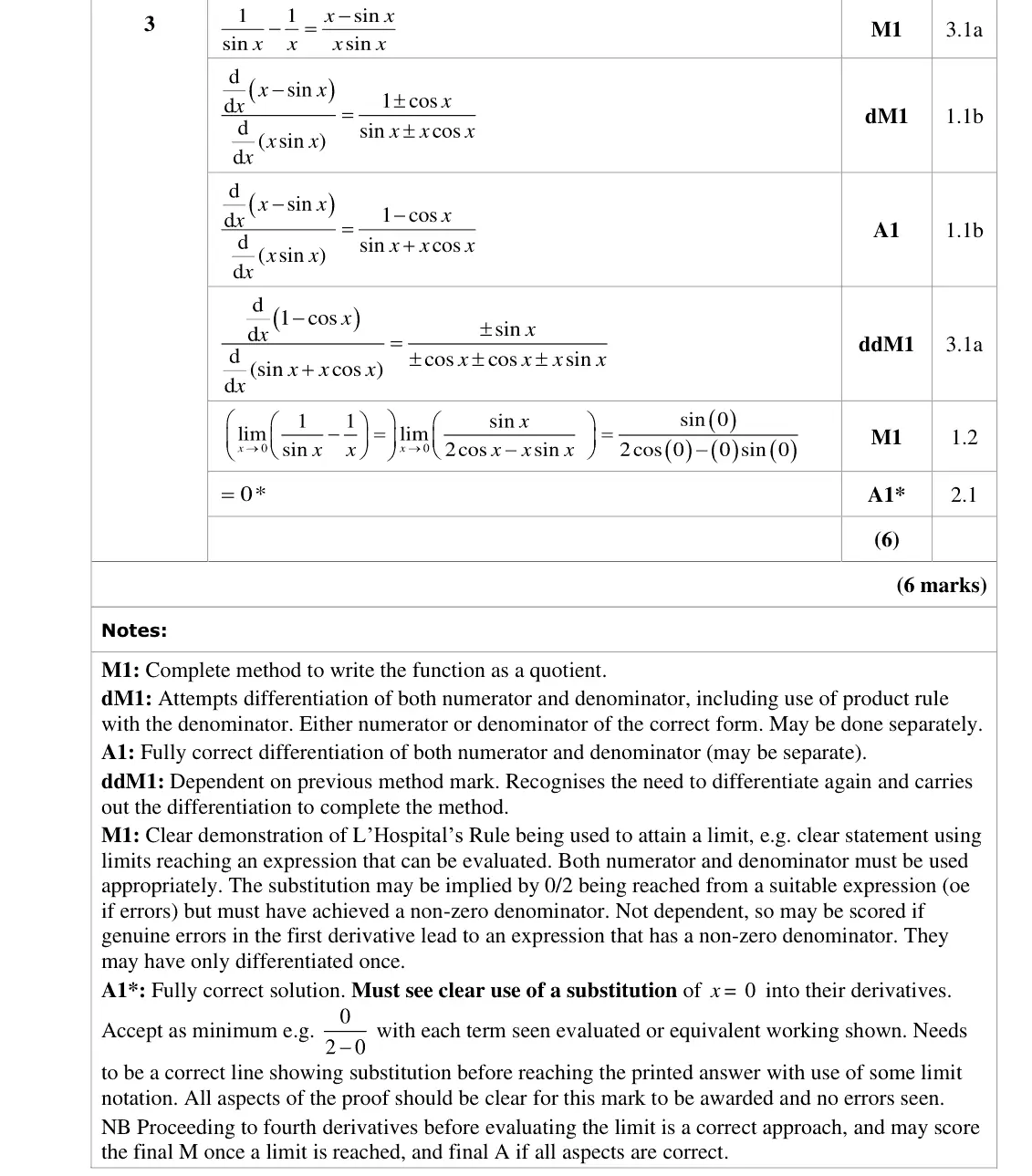
combine to (x − sin x)/(x sin x) first
apply the rule twice: (1 − cos x)/(sin x + x cos x) is still 0/0, then sin x/(2cos x − x sin x) = 0
applying to separate terms or using the quotient rule scores 0
must show x = 0 substituted
June 2024 · Paper 3A (Further Pure 1) · Q4(c)2 marks
Mark scheme (whole question; this part is marked with the orange bar)
Examiner's comment
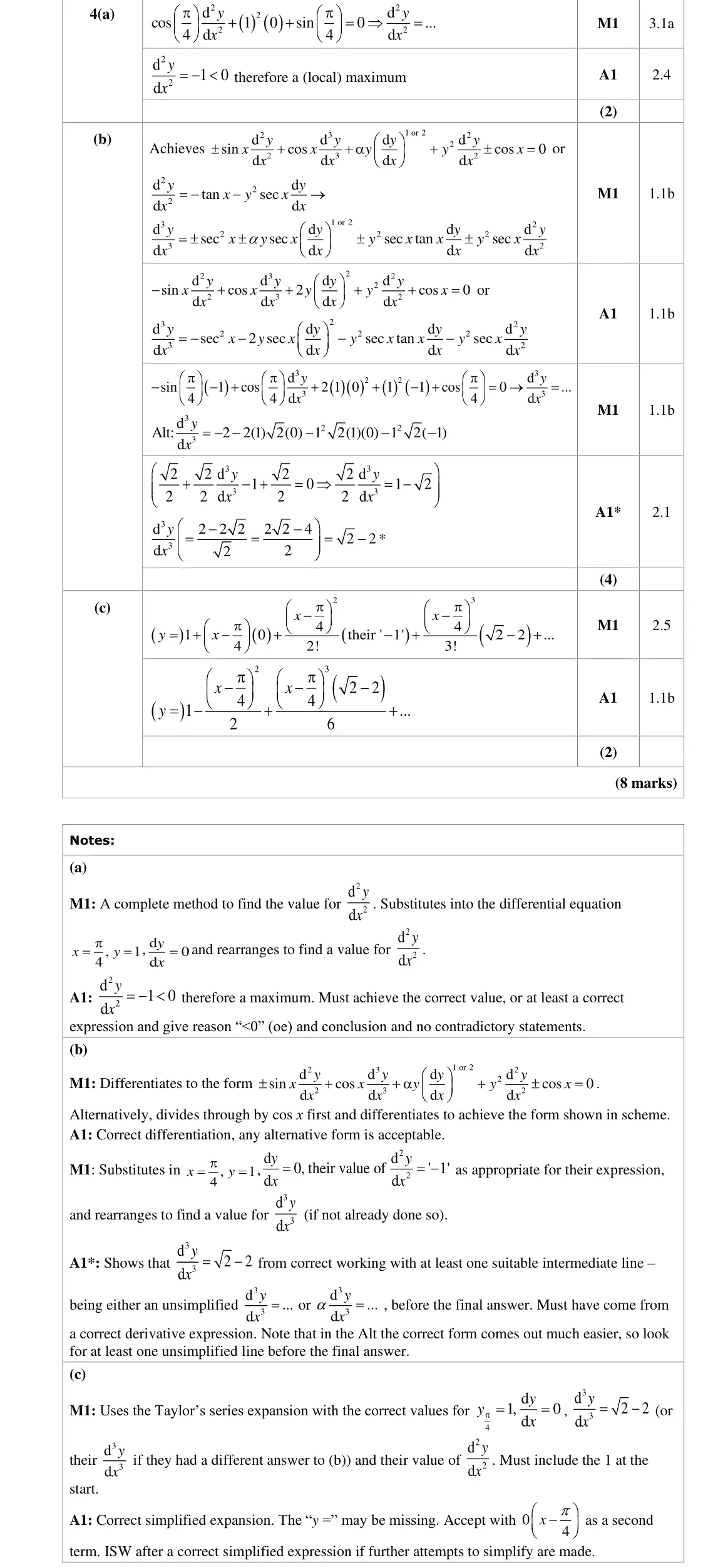
A slight twist on this type of question in the use of a stationary point, but candidates coped well and the question proved relatively straightforward overall, with inaccuracies in part (b) being the main cause of loss of marks. Part (c) was again generally very well answered with most attaining both marks – the given answers being a big help. The most common error was an incorrect y0 term, either omitted completely (y0 =0) or using 0 4 y = or 2 2 . Occasionally the final mark was lost through the corruption of signs in the final term.
Key points from the mark scheme and examiner's report
y = 1 − ½(x − π/4)² + ((√2 − 2)/6)(x − π/4)³
common error: missing or wrong constant term y₀ = 1
June 2024 · Paper 3A (Further Pure 1) · Q5(a)6 marks
Mark scheme (whole question; this part is marked with the orange bar)
Examiner's comment
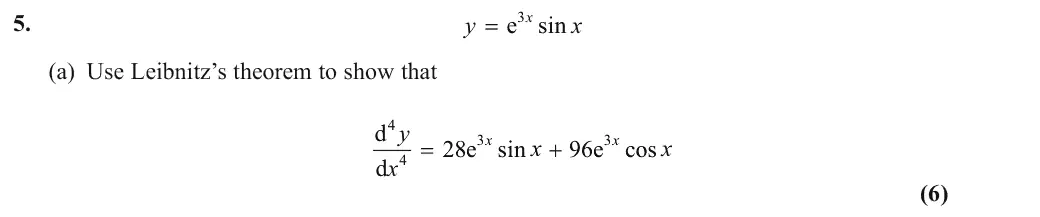
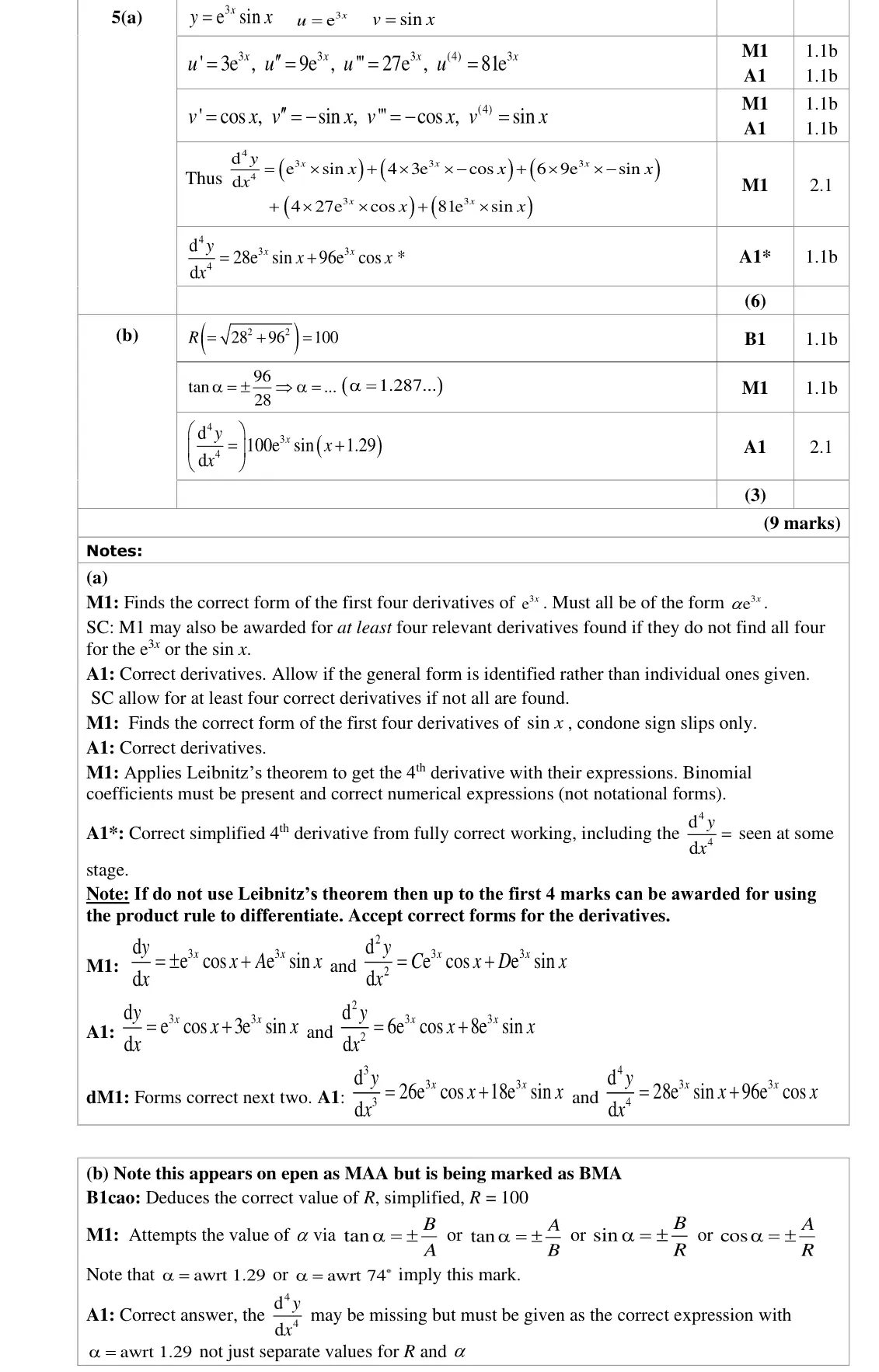
exponential and the trigonometric terms to swiftly pick up the first four marks of part (a). A very small number made slips at this stage, usually in the powers of the exponential, while some did not differentiate sufficient times, so limited access to the question. In applying the theorem, most stated coefficients from Pascal’s triangle while others used combinatorial notation before simplifying and collecting terms to reach the given answer, which was usually done very well. The majority went on to score full marks on this part, 4 d y although some omitted to mention x at all, and so lost the final mark. Other slips did 4 d occur but were rare. Candidates also performed well on part (b), with many able to quickly carry out the process
Key points from the mark scheme and examiner's report
derivatives of e³ˣ (3ⁿe³ˣ) and of sin x up to the 4th
coefficients 1, 4, 6, 4, 1: 28e³ˣ sin x + 96e³ˣ cos x
slips in powers of 3
June 2024 · Paper 3A (Further Pure 1) · Q5(b)3 marks
Mark scheme (whole question; this part is marked with the orange bar)
Examiner's comment
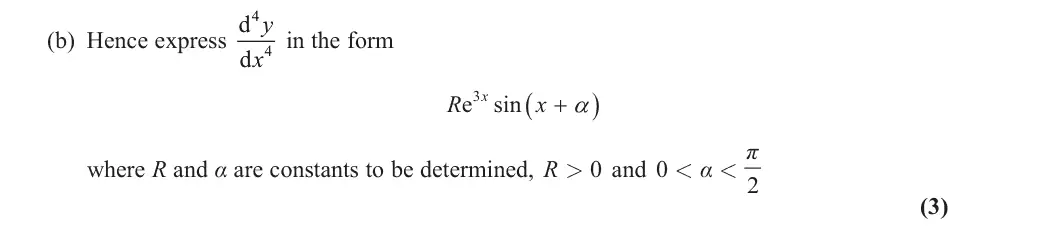
A very routine question at this stage of the paper, particularly as part (b) was pure synoptic A- level content – and yet surprisingly poorly attempted by a minority. Most candidates were familiar with Leibnitz Theorem and correctly differentiated the exponential and the trigonometric terms to swiftly pick up the first four marks of part (a). A Candidates also performed well on part (b), with many able to quickly carry out the process to find R and alpha , though there were occasional errors in the latter as is common at A-level in this type of question (the sign errors or fraction the wrong up around being the common errors). Misquote of the final result, either omitting the exponential term or the sin, did lose the final mark for some. Some weaker candidates clearly did not know the Rsin(x + alpha ) topic, and made no sensible progress at all, instead trying to split as Rsin x +Rsin alpha and it may be questioned if these candidates should be entered for this level of paper, as this routine synoptic topic should be well understood.
Key points from the mark scheme and examiner's report
R = √(28² + 96²) = 100, tan α = 96/28, α = 1.29: d⁴y/dx⁴ = 100e³ˣ sin(x + 1.29)
A-level R sin(x + α) content
errors: tan α inverted, dropping e³ˣ
June 2024 · Paper 3A (Further Pure 1) · Q7(a)3 marks
Mark scheme (whole question; this part is marked with the orange bar)
Examiner's comment
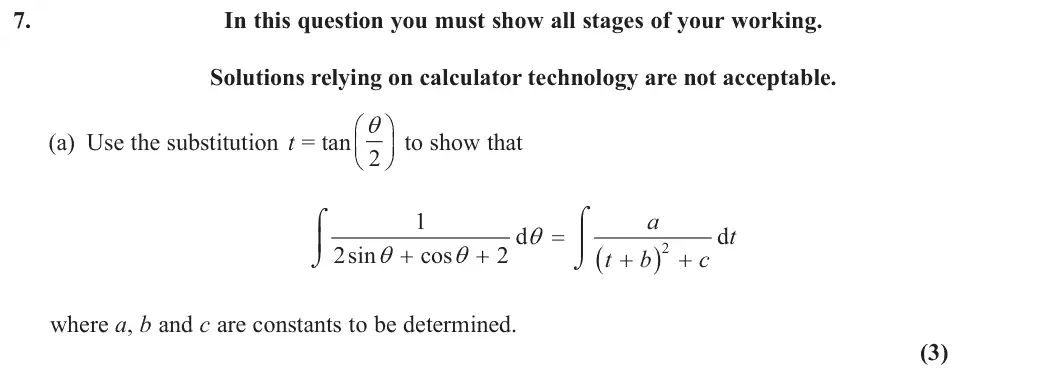
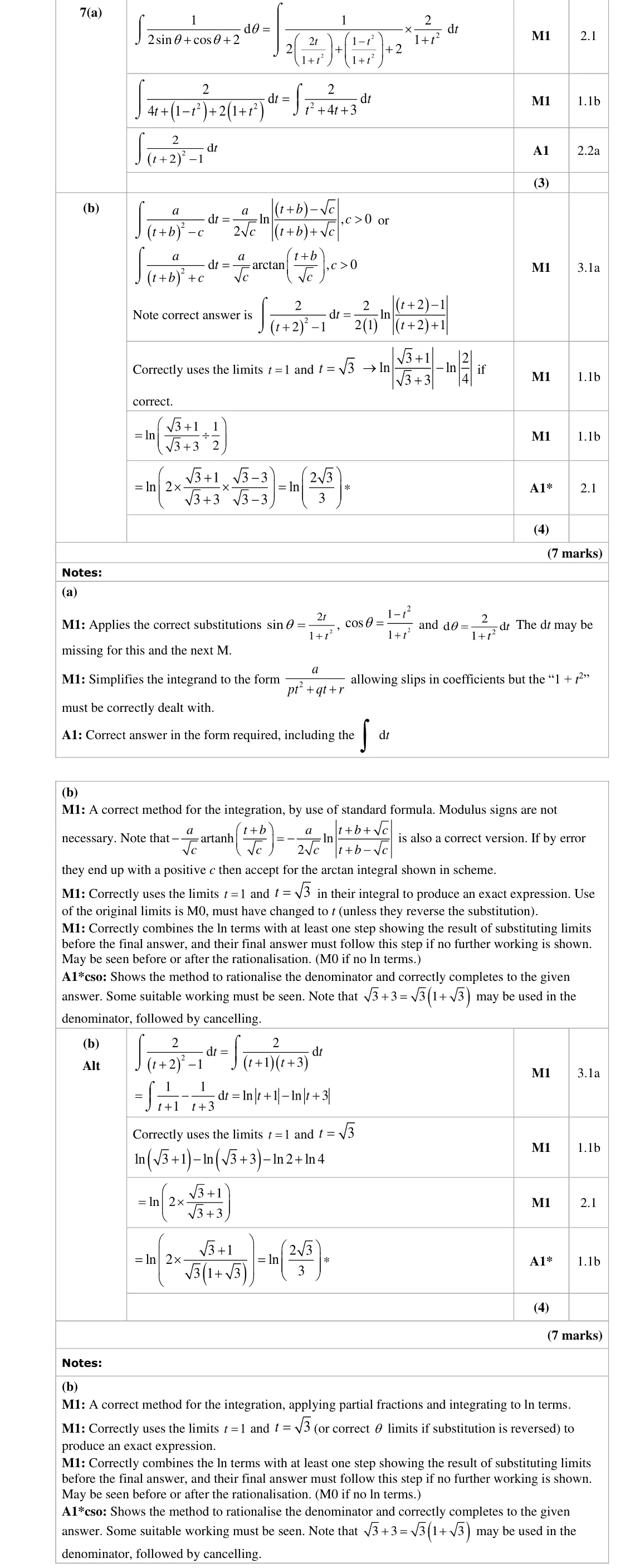
The main problem with this question seemed to be space. Most candidates clearly have not memorised the results for this half angle formulae and spent the first page of the answer booklet deriving them. That left only one page to complete both parts. Alternatively, an excessive number of lines of working simplifying the integral in part (a) pushed the solution quickly on to the second page, and many then tried to cram a lot of work into the margins, or erratically across the page, others used other pages of the answer booklet, while many others used additional answer booklets. The use of additional booklets is preferable to writing answers in other questions on the script. It is unfortunate that only two pages were assigned to this question, and is a lesson taken on board. The question itself, once results were derived, proved again highly accessible with only the final mark providing a degree of discrimination, largely due to the level of working required to establish a given answer – again. For part (a) most candidates made the correct substitutions, albeit after some hefty work to derive them sometimes. Where errors were made it was usually as some that did not remember the substitutions made errors when deriving them, with the d theta term causing most problems. Some left the substitution of the d theta until later in the proof, working with mixed variables to begin with, but generally finally managed to get to an integral in t only. Incorrect sin theta and cos theta identities did occasionally arise (e.g. 1 - t^2 used in the denominator of cos theta , or mixed-up sine and cosine identities), but these were not common. Simplifying to the quadratic denominator and completion of the square were carried out very well by the majority, and most did achieve the correct expression. The last mark was occasionally lost, either for forgetting the dt in the integral or the integral sign, or because they thought providing the values of a, b and c was sufficient.
Key points from the mark scheme and examiner's report
t-formulae and dθ = 2dt/(1 + t²)
integrand 2/(t² + 4t + 3) = 2/((t + 2)² − 1): a = 2, b = 2, c = −1
deriving the half-angle results used up the space
June 2024 · Paper 3A (Further Pure 1) · Q7(b)4 marks
Mark scheme (whole question; this part is marked with the orange bar)
Examiner's comment
The main problem with this question seemed to be space. Most candidates clearly have not memorised the results for this half angle formulae and spent the first page of the answer booklet deriving them. That left only one page to complete both parts. Alternatively, an excessive number of lines of working simplifying the integral in part (a) pushed the solution quickly on to the second page, and many then tried to cram a lot of work into the margins, or erratically across the page, others used other pages of the answer booklet, while many others used additional answer booklets. The use of additional booklets is preferable to writing answers in other questions on the script. It is unfortunate that only two pages were assigned to this question, and is a lesson taken on board. The question itself, once results were derived, proved again highly accessible with only the final mark providing a degree of discrimination, largely due to the level of working required to establish a given answer – again. For part (b) many candidates could use the standard form of the integral accurately and change the limits correctly to proceed to a correct integral. Indeed, even in cases where incorrect answers to part (a) were found, candidates were apt to select a correct standard form for their answer, though some did not realise the arctanh integral only works for limits in the correct range. This was not, however, penalised in this question, but credit was awarded positively. Those who had the correct form of answer were generally competent in manipulating the logs. However, most of these showed insufficient working on rationalising the resulting fraction to justify the given answer, and so full marks was not commonly gained in this part. Only the better prepared candidates seem to realise the need to show the full steps of working. Of those who did not simply use the standard forms, use of partial fractions was common and generally worked well. There were also a range of substitution methods employed, with the simplest (u = t + 2) being the most successful. On occasion a needless substitution towards the end of a solution resulted in the logs of negative values, which were not always recovered. Overall, the integration work on display by the majority was very good. Sight of the given answer may have caused some to overlook the process of rationalising their result, thus losing the final mark, but a better awareness of the need to show all work should be considered.
Key points from the mark scheme and examiner's report
limits t = 1 and t = √3
ln((t + 1)/(t + 3)) (logs, as c < 0, or partial fractions)
combine and rationalise to ln(2√3/3)
every step needed for the given answer
June 2023 · Paper 3A (Further Pure 1) · Q5(a)4 marks
Mark scheme (whole question; this part is marked with the orange bar)
Examiner's comment
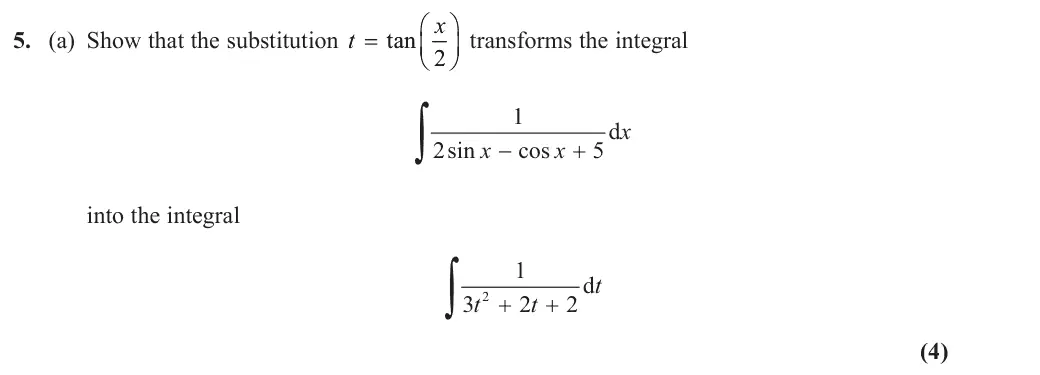
Another accessible question, which was liked more than the preceding question, with full or high marks being common (neglecting to return to x at the end of (b) being the main cause of the latter score profile). In part (a) the majority of students were able to replace successfully sin x and cos x with the t equivalents, with only very few cases of incorrect formulae used. Sometimes this was the only mark scored, but the majority were able to progress further by identifying a correct derivative statement and the dx to gain a complete integral in terms of t. They then were generally successful in rearranging, to gain the printed answer, and full marks in part (a) was very common. Occasionally slips in the derivative statement, or a rearrangement of it, did occur, while some did not identify a linking equation for dx and dt at all and were unable to progress. The style of proof, however, was a lot less satisfactory, with many making all the substitutions in one go, not having made their dx equation clear, and having to rely on implication to score the marks. A good, logical layout should be encouraged, and the best solutions were those that identified the relevant formulae first, before substituting. The algebra to simplify to the required form was good, with few forced proofs. Having the answer to aim for aided the students, who could correct when they spotted an error as they did not achieve the result.
Key points from the mark scheme and examiner's report
t-formulae for sin x and cos x and dx = 2dt/(1 + t²) stated clearly
simplify to ∫1/(3t² + 2t + 2)dt
poor layout with substitutions made all at once
June 2023 · Paper 3A (Further Pure 1) · Q5(b)4 marks
Mark scheme (whole question; this part is marked with the orange bar)
Examiner's comment
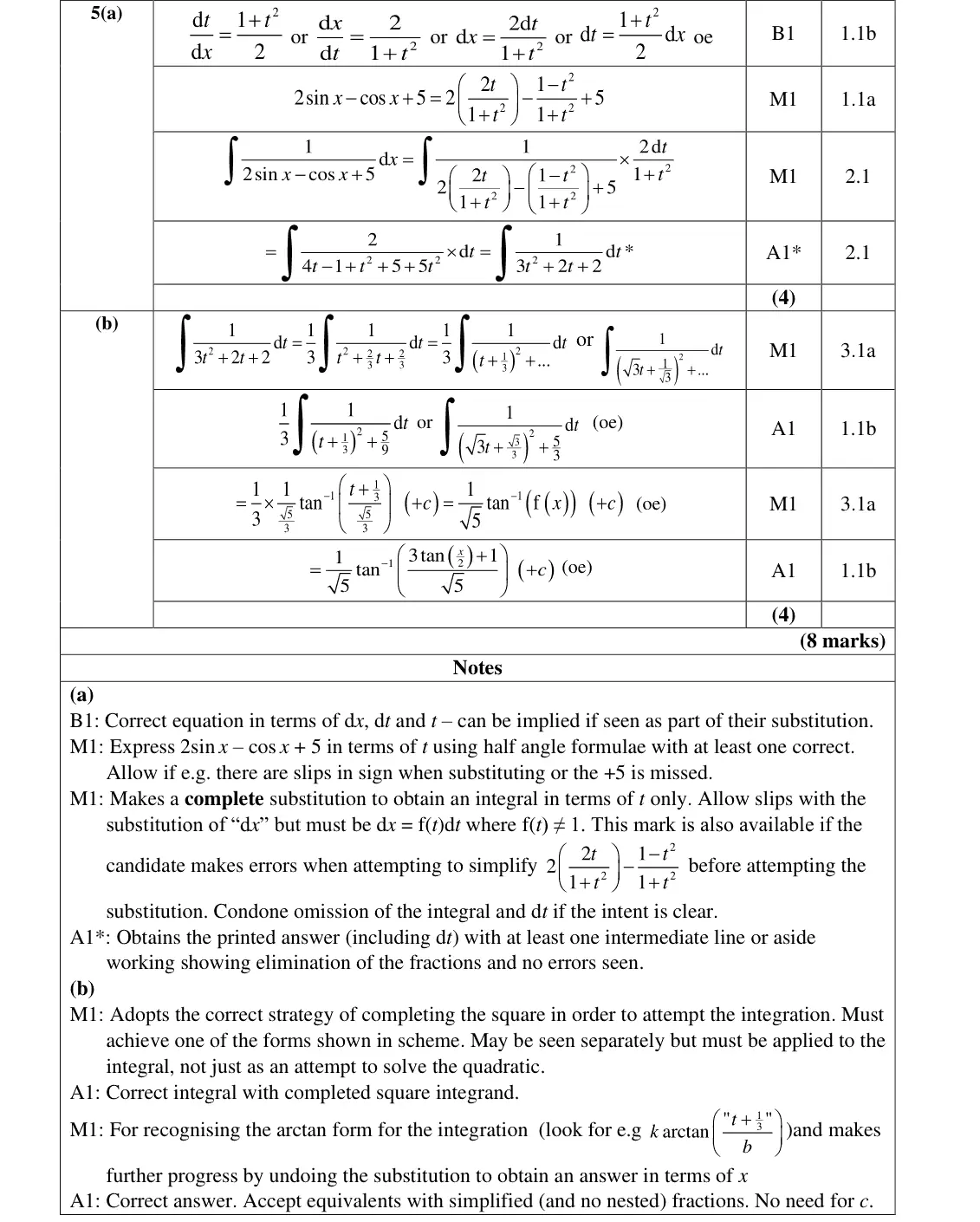
Another accessible question, which was liked more than the preceding question, with full or high marks being common (neglecting to return to x at the end of (b) being the main cause of the latter score profile). Part (b) was less accessible with many either not attempting or not being aware of the correct method to proceed and considering other (incorrect) methods, integration for functions in the form of 1/g(t), with logarithm expressions being frequently seen. Attempts at partial fractions were also noted. This type of integral is standard for the specification and it was surprising how many did not seem to be expecting one. Those that did complete the square were usually successful but there were some errors in coefficients when taking out the factor of 1 3, but usually a correct form had been seen. The completing of the square was sometimes seen to have been done separately to the integral initially, and some students then went on to solve their equation rather than relate it to the integral, and so lost all the marks. Those students who did complete the square and apply it to the integral were usually successful in recognising the arctan form but a large number lost the final two marks for failing to replace t with tan(x/2) in their answer. Others had fractions inverted, giving an answer with arctan (ax) rather than arctan(x/a), and some forgot to square root so had arctan(x/a2).
Key points from the mark scheme and examiner's report
complete the square: 3((t + ⅓)² + 5/9)
(1/√5)arctan((3tan(x/2) + 1)/√5) + c
many tried logs or partial fractions
must return to x
June 2023 · Paper 3A (Further Pure 1) · Q6(a)2 marks
Mark scheme (whole question; this part is marked with the orange bar)
Examiner's comment
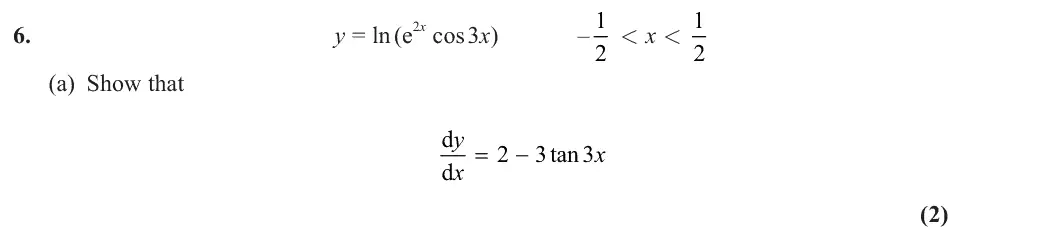
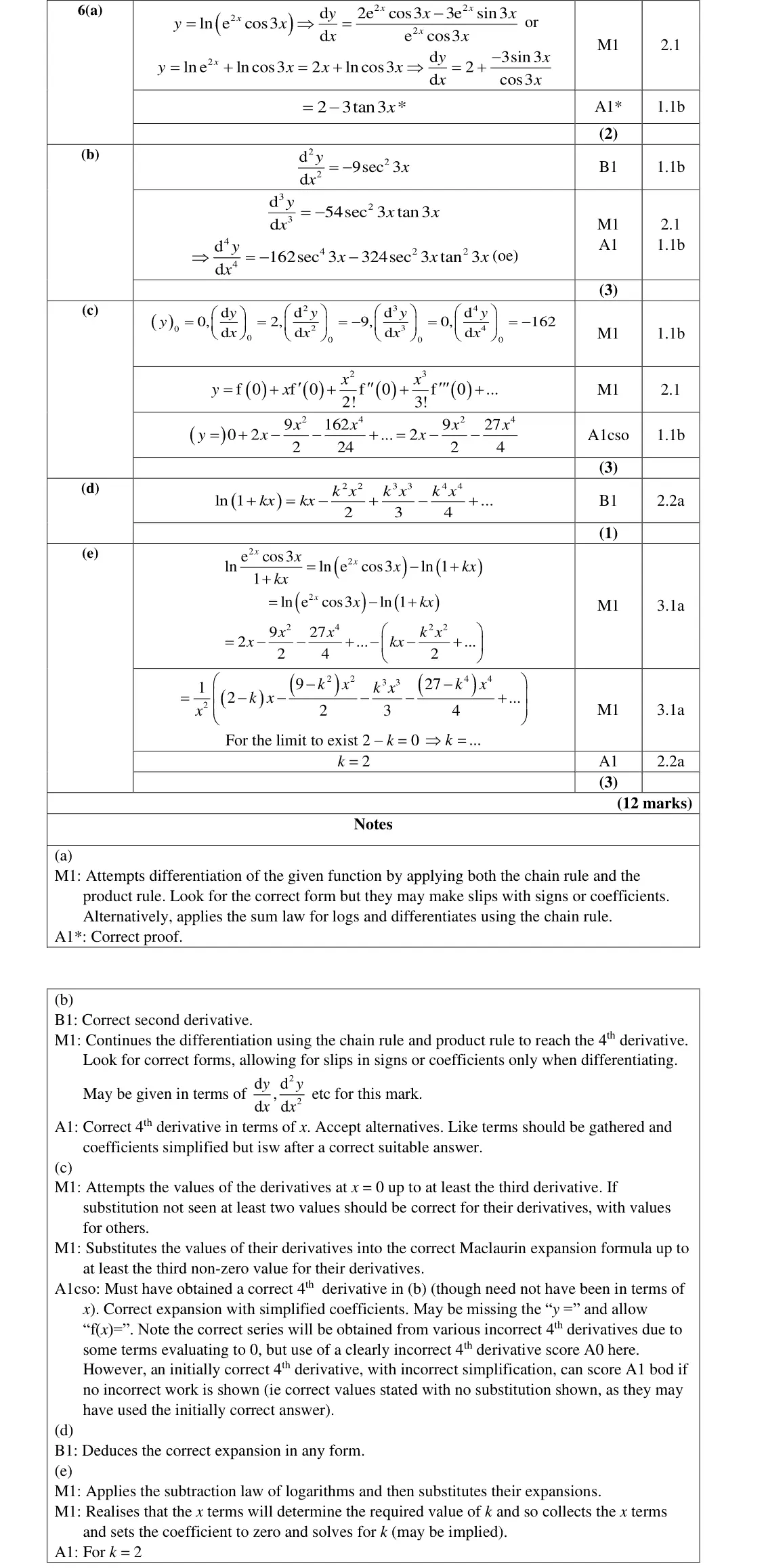
There were some discriminating aspects in this question, though also many accessible marks across grades, and there were many very good attempts. The last two marks were the most challenging, in understanding the requirement for the limit to exist, but many were able to progress through to the latter parts. Part (a) was completed well with most students successfully differentiating using the chain and product rules. Most attempted the main approach achieving a correct expression and cancelling exponential terms to simplify to the correct solution, and the method was apparent. For the minority who applied the log summation law first, the differentiation became easier but they did not always show all the steps leading to the given answer, and forfeited marks if a correct differentiation step was not shown. However, most were diligent in showing the fraction before cancelling.
Key points from the mark scheme and examiner's report
chain rule (or ln e²ˣ + ln cos 3x = 2x + ln cos 3x) to 2 − 3tan 3x
show the intermediate step
June 2023 · Paper 3A (Further Pure 1) · Q6(b)3 marks
Mark scheme (whole question; this part is marked with the orange bar)
Examiner's comment
There were some discriminating aspects in this question, though also many accessible marks across grades, and there were many very good attempts. The last two marks were the most challenging, in understanding the requirement for the limit to exist, but many were able to progress through to the latter parts. In part (b) most students were successful in differentiating for the second derivative and gaining the B mark, but errors in coefficients and powers for sec and tan for the third and fourth derivatives caused many students to lose either one or two marks depending on the error. Some simply made errors that resulted in the wrong coefficients, but gained derivatives of the correct form and losing just the accuracy, but many made errors in applying the chain rule and product rule, losing one of the terms, and therefore lost the method mark here. Often the 3 was missing from sec 3x or tan 3x or they had forgotten to apply the product rule correctly and a tan (3x) was missing from their final derivative. Another, less common error seen was to have functions of x rather than 3x. Many students used up time and effort applying trigonometric identities, which did not generally make the expressions easier to differentiate and sometimes introduced unnecessary errors. The majority of those who found 4 4 d d y x correctly did so without much rearranging.
Key points from the mark scheme and examiner's report
errors: missing 3 in sec 3x, product rule term lost
June 2023 · Paper 3A (Further Pure 1) · Q6(c)3 marks
Mark scheme (whole question; this part is marked with the orange bar)
Examiner's comment
There were some discriminating aspects in this question, though also many accessible marks across grades, and there were many very good attempts. The last two marks were the most challenging, in understanding the requirement for the limit to exist, but many were able to progress through to the latter parts. In part (c) students generally understood what was required for the Maclaurin expansion formula, errors in part (b) meant that many could not access full marks in this section. Most did evaluate all of their derivatives at zero, though some stopped at the third derivative, particular where errors meant they had three non-zero terms by that stage. Substitution into a correct Maclaurin formula usually followed, though a few, as is common, made errors with the factorial divisors. Some students substituted the wrong derivative values into the Maclaurin’s series with the fact that the third derivative was zero, appearing to cause some confusion. Many incorrect derivative functions from (b) led to the correct series, due to some trigonometric terms evaluating to zero or 1, but these were not permitted the accuracy to match the score of those with incorrect derivatives which did not give the correct coefficients.
Key points from the mark scheme and examiner's report
need the 4th derivative since the cubic term is zero
factorial slips
June 2023 · Paper 3A (Further Pure 1) · Q6(d)1 mark
Mark scheme (whole question; this part is marked with the orange bar)
Examiner's comment
There were some discriminating aspects in this question, though also many accessible marks across grades, and there were many very good attempts. The last two marks were the most challenging, in understanding the requirement for the limit to exist, but many were able to progress through to the latter parts. The majority of students successfully completed part (d) giving the expansion in full. A few students lost the mark by losing the power of k in some of their terms, having incorrect signs or having factorials in the numerators.
Key points from the mark scheme and examiner's report
ln(1 + kx) = kx − k²x²/2 + k³x³/3 − k⁴x⁴/4
slips: powers of k, signs, factorials
June 2023 · Paper 3A (Further Pure 1) · Q6(e)3 marks
Mark scheme (whole question; this part is marked with the orange bar)
Examiner's comment
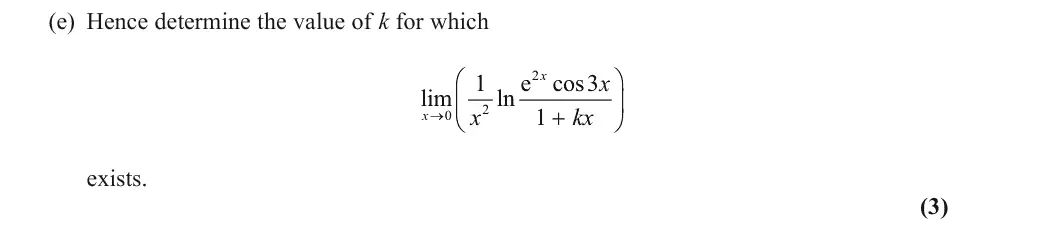
There were some discriminating aspects in this question, though also many accessible marks across grades, and there were many very good attempts. The last two marks were the most challenging, in understanding the requirement for the limit to exist, but many were able to progress through to the latter parts. Most students attempted part (e) but some failed to use the subtraction law of logarithms and were unable to progress. Those that did correctly substitute in their expansions usually went on to consider a value for k, though many instead attempted to find the limit, not the condition for its existence. Of those attempting to find k many used the x2 coefficient of the expansions and failed to find the correct value of k, usually k = ±3. Where the correct answer was attained, there was often no good explanation given for it, but just a statement k = 2, with no clear indication where it arose from, but these were permitted the mark. Clear explanations were rare to see.
Key points from the mark scheme and examiner's report
subtract the series using the log law
divided by x² the x term (2 − k)x must vanish for the limit to exist: k = 2
many tried to find the limit or used the x² coefficient (k = ±3)
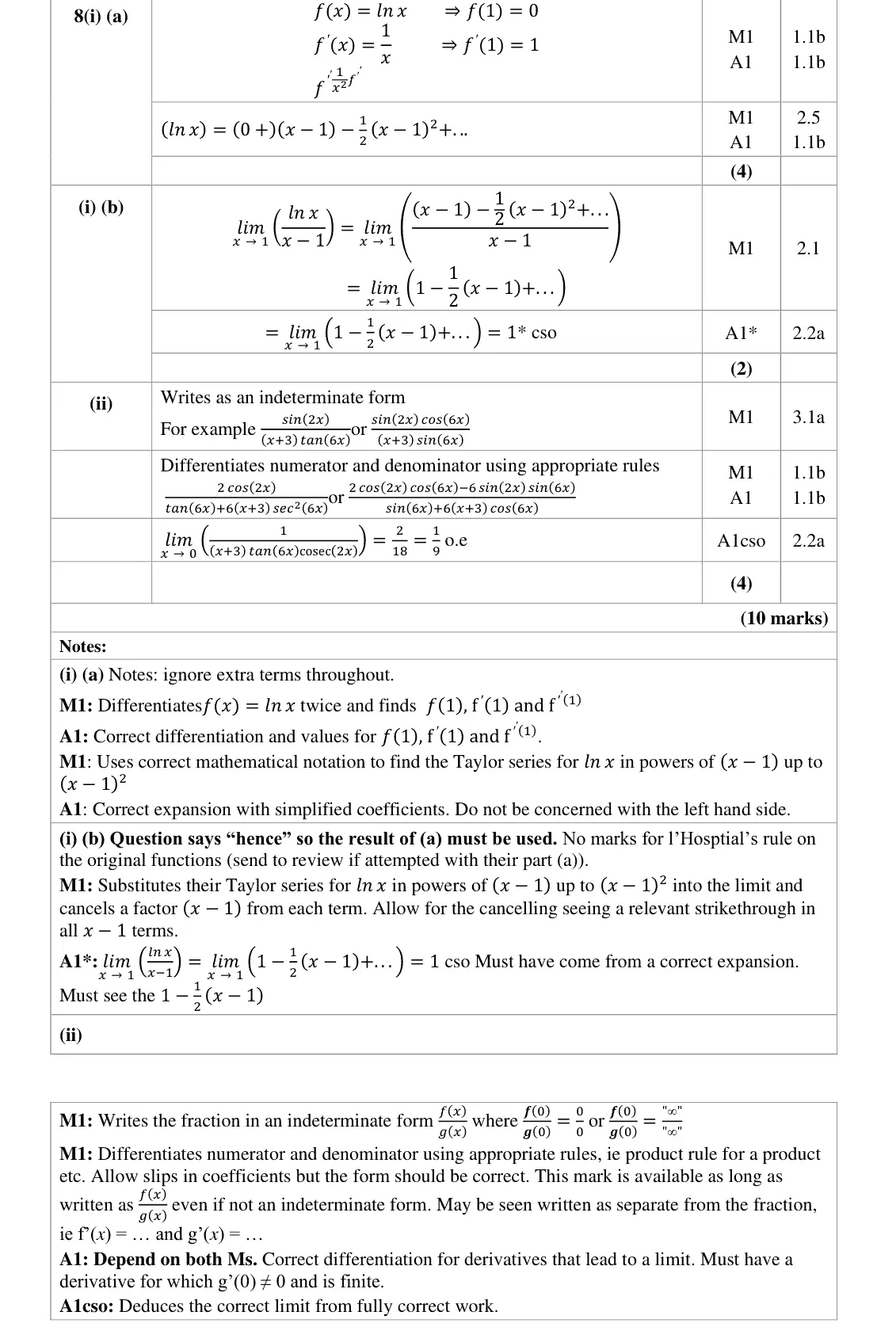
June 2022 · Paper 3A (Further Pure 1) · Q8(i)(a)4 marksEasy
Mark scheme (whole question; this part is marked with the orange bar)
Examiner's comment
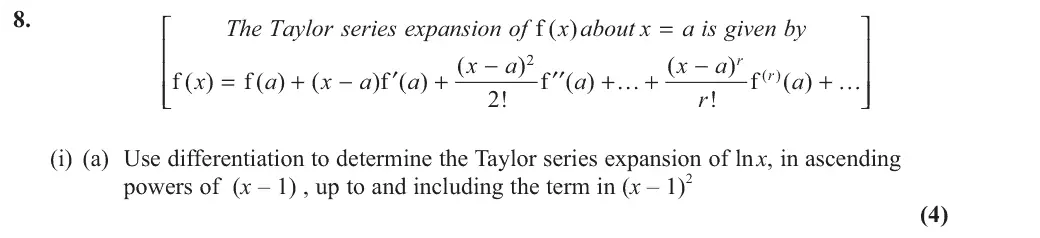
Over half of the candidates were able to score full marks for this question, by far the most common score. The rest generally scored in the range 4-8 marks, with only 5% scoring fewer than this. Part (i)(a) of this question was very generously given 4 marks and most candidates were able to obtain all of them with careful work showing their first and second derivatives evaluated at x = 1. Some candidates did not show f(1) and others substituted values directly into their Taylor’s series formula, which is risky strategy if errors are made when dong this as they may lose method marks if incorrect. Part (i)(b) also saw many successful attempts, though some candidates were careless with details for a “show” question and should be reminded to show every stage in their working. The most common mistake was not simplifying both terms correctly, but only cancelling the first term, while some lost the factor 1 2 in the second term. Also, candidates need to note that “hence prove that” means the previous result in (a) must be used, but some did not see (or ignored) the “hence” in the question and tried to use L’Hopitals rule with the original function to prove the limit, scoring no marks. Part (ii) was more of a differentiator, with finding a relevant indeterminate form elusive to some. However, many candidates did succeed in writing the given expression in a relevant indeterminate form and then attempting the differentiation. Though many were successful in this, some arrived at the “correct” answer via incorrect differentiation and this led to the loss of the final two marks. Some candidates persisted in differentiating the original denominator given in the question, and did not arrive at a limit, while others tried taking the “x + 3” into the numerator, so did not achieve a relevant form. A few mistook cosec as the reciprocal of cosine. The most successful strategy here was to rewrite in terms of sine and cosine functions, and some candidates diligently checked that the form evaluated to a quotient of zeroes. The sine and tangent approach was also common, but was more prone to error in the differentiation, usually losing the “6”. There were some excellent answers, with many candidates showing fluency with L’Hopital’s rule and appropriate rules of differentiation.
Key points from the mark scheme and examiner's report
f(1) = 0, f'(1) = 1, f''(1) = −1
ln x = (x − 1) − ½(x − 1)² + …
show the derivatives evaluated at 1
June 2022 · Paper 3A (Further Pure 1) · Q8(i)(b)2 marksEasy
Mark scheme (whole question; this part is marked with the orange bar)
Examiner's comment
Over half of the candidates were able to score full marks for this question, by far the most common score. The rest generally scored in the range 4-8 marks, with only 5% scoring fewer than this. Part (i)(a) of this question was very generously given 4 marks and most candidates were able to obtain all of them with careful work showing their first and second derivatives evaluated at x = 1. Some candidates did not show f(1) and others substituted values directly into their Taylor’s series formula, which is risky strategy if errors are made when dong this as they may lose method marks if incorrect. Part (i)(b) also saw many successful attempts, though some candidates were careless with details for a “show” question and should be reminded to show every stage in their working. The most common mistake was not simplifying both terms correctly, but only cancelling the first term, while some lost the factor 1 2 in the second term. Also, candidates need to note that “hence prove that” means the previous result in (a) must be used, but some did not see (or ignored) the “hence” in the question and tried to use L’Hopitals rule with the original function to prove the limit, scoring no marks. Part (ii) was more of a differentiator, with finding a relevant indeterminate form elusive to some. However, many candidates did succeed in writing the given expression in a relevant indeterminate form and then attempting the differentiation. Though many were successful in this, some arrived at the “correct” answer via incorrect differentiation and this led to the loss of the final two marks. Some candidates persisted in differentiating the original denominator given in the question, and did not arrive at a limit, while others tried taking the “x + 3” into the numerator, so did not achieve a relevant form. A few mistook cosec as the reciprocal of cosine. The most successful strategy here was to rewrite in terms of sine and cosine functions, and some candidates diligently checked that the form evaluated to a quotient of zeroes. The sine and tangent approach was also common, but was more prone to error in the differentiation, usually losing the “6”. There were some excellent answers, with many candidates showing fluency with L’Hopital’s rule and appropriate rules of differentiation.
Key points from the mark scheme and examiner's report
divide the series by (x − 1): 1 − ½(x − 1) + … → 1
must use (a): L'Hospital scores 0
careless cancelling, losing the ½
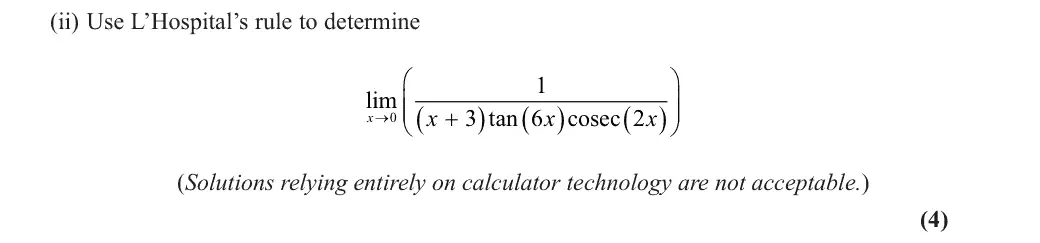
June 2022 · Paper 3A (Further Pure 1) · Q8(ii)4 marksEasy
Mark scheme (whole question; this part is marked with the orange bar)
Examiner's comment
Over half of the candidates were able to score full marks for this question, by far the most common score. The rest generally scored in the range 4-8 marks, with only 5% scoring fewer than this. Part (i)(a) of this question was very generously given 4 marks and most candidates were able to obtain all of them with careful work showing their first and second derivatives evaluated at x = 1. Some candidates did not show f(1) and others substituted values directly into their Taylor’s series formula, which is risky strategy if errors are made when dong this as they may lose method marks if incorrect. Part (i)(b) also saw many successful attempts, though some candidates were careless with details for a “show” question and should be reminded to show every stage in their working. The most common mistake was not simplifying both terms correctly, but only cancelling the first term, while some lost the factor 1 2 in the second term. Also, candidates need to note that “hence prove that” means the previous result in (a) must be used, but some did not see (or ignored) the “hence” in the question and tried to use L’Hopitals rule with the original function to prove the limit, scoring no marks. Part (ii) was more of a differentiator, with finding a relevant indeterminate form elusive to some. However, many candidates did succeed in writing the given expression in a relevant indeterminate form and then attempting the differentiation. Though many were successful in this, some arrived at the “correct” answer via incorrect differentiation and this led to the loss of the final two marks. Some candidates persisted in differentiating the original denominator given in the question, and did not arrive at a limit, while others tried taking the “x + 3” into the numerator, so did not achieve a relevant form. A few mistook cosec as the reciprocal of cosine. The most successful strategy here was to rewrite in terms of sine and cosine functions, and some candidates diligently checked that the form evaluated to a quotient of zeroes. The sine and tangent approach was also common, but was more prone to error in the differentiation, usually losing the “6”. There were some excellent answers, with many candidates showing fluency with L’Hopital’s rule and appropriate rules of differentiation.
Key points from the mark scheme and examiner's report
rewrite as an indeterminate 0/0 form, e.g. sin 2x / ((x + 3)tan 6x)
differentiate top and bottom: limit 2/18 = 1/9
finding a valid indeterminate form was the hurdle
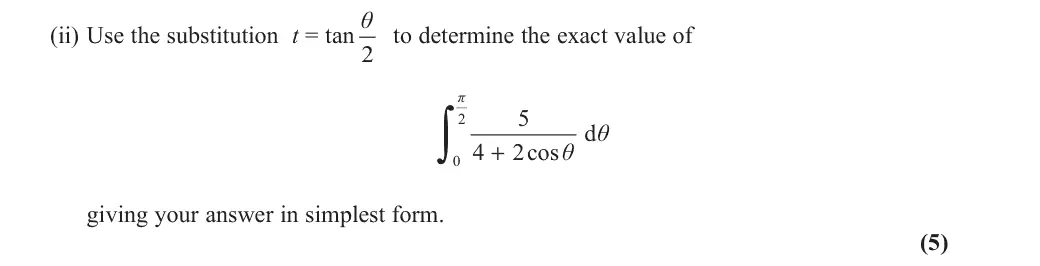
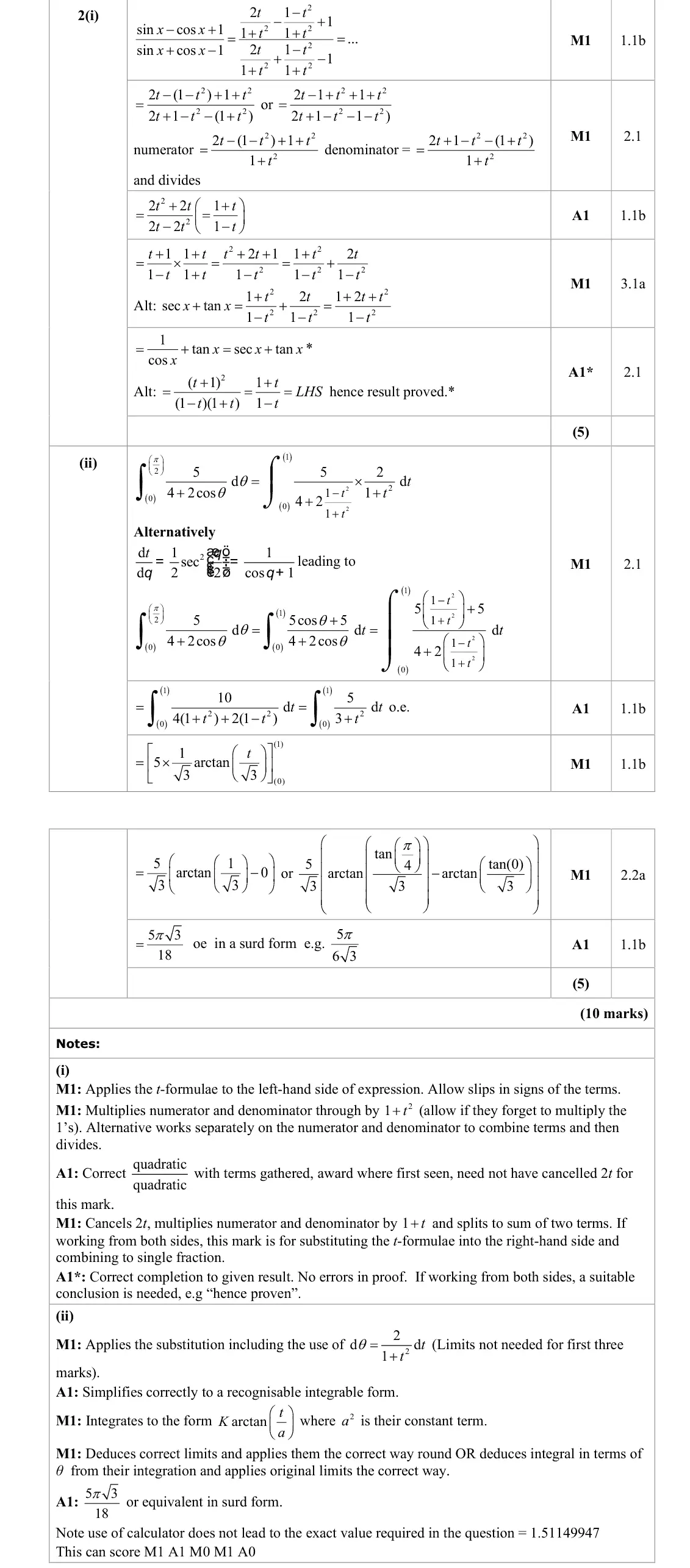
Nov 2021 · Paper 3A (Further Pure 1) · Q2(ii)5 marks
Mark scheme (whole question; this part is marked with the orange bar)
Examiner's comment
Part (a) was done well by the majority of the candidates. It was good to see that candidates could correctly recall the t formula. They substituted correctly int the left-hand side of the identity and dealt correctly with the fractions. It was pleasing to see that brackets were used especially with minus cosx. Once the left-hand side was simplified the majority of the candidates worked on the right-hand side to achieve the same simplified expression. Again, it was good to see that the madidates did then draw the correct conclusion to complete the proof. Part (b) caused more problems for candidates. A few candidates did not 2 1 t - recall how to deal with d theta , they replaced but struggled with cos with theta 2 1 t + 2 remembering that . Once candidates used the correct d d t theta = + 2 1 t substitutions, they successfully simplified recognised that it integrated to the form 1 arctan t which can be found in the formula book. After a a integrating candidates used the correct limits, most used t = 1 and t = 0, to achieve the correct exact answer.
Key points from the mark scheme and examiner's report
dθ = 2dt/(1 + t²) (often mishandled)
integrand 5/(3 + t²), limits 0 to 1
(5/√3)arctan(t/√3) gives 5√3π/18
a calculator decimal (1.511) loses the accuracy marks
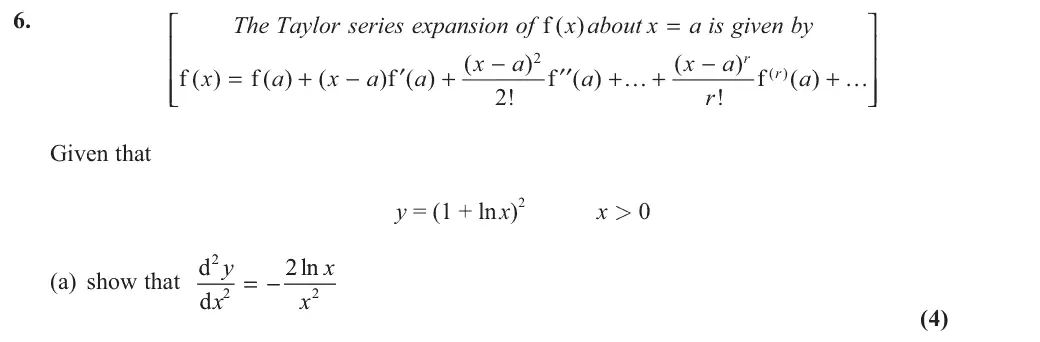
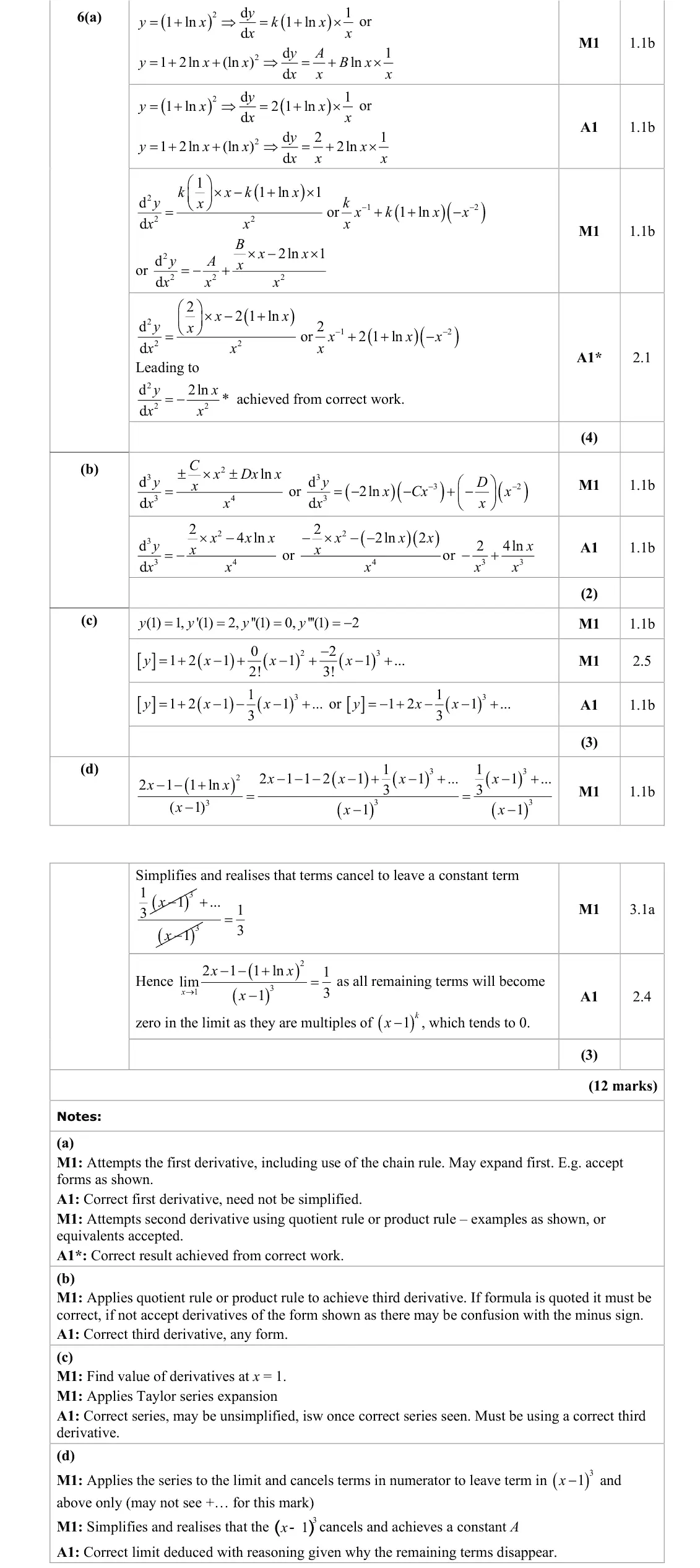
Nov 2021 · Paper 3A (Further Pure 1) · Q6(a)4 marks
Mark scheme (whole question; this part is marked with the orange bar)
Examiner's comment
Part (a) The majority of candidates had excellent differentiation skills and were able to find correctly that ( ) 2 1 ln d d x y x x + = using the product rule and using either the quotient or product rule to show correctly that 2 2 2 d 2ln d y x x x = - as required.
Key points from the mark scheme and examiner's report
dy/dx = 2(1 + ln x)/x (chain rule), then quotient or product rule to the printed −2ln x/x²
Nov 2021 · Paper 3A (Further Pure 1) · Q6(b)2 marks
Mark scheme (whole question; this part is marked with the orange bar)
Examiner's comment
Part (b) Again excellent differentiating skills were used to find the third derivative using again the quotient rule or product rule.
Key points from the mark scheme and examiner's report
d³y/dx³ = (4ln x − 2)/x³
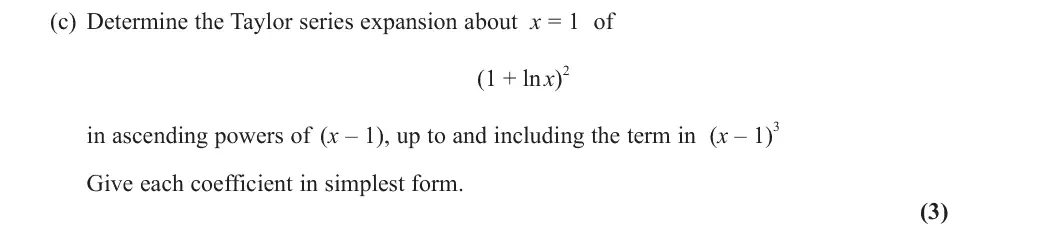
Nov 2021 · Paper 3A (Further Pure 1) · Q6(c)3 marks
Mark scheme (whole question; this part is marked with the orange bar)
Examiner's comment
Part (c) Candidates knew that they had to evaluate (1), '(1), ''(1), and '''(1) y y y y and then applied the Taylors series stated in the question and simplified their answer. A few candidates after finding the series when on and expanded the brackets. The question is asking for candidates to find the Taylor series in ascending powers of ( )1 x - , so they need to leave their answer in this form. This hindered them in answering part (d).
Key points from the mark scheme and examiner's report
y(1) = 1, y'(1) = 2, y''(1) = 0, y'''(1) = −2
1 + 2(x − 1) − (x − 1)³/3
leave in powers of (x − 1): expanding the brackets hindered (d)
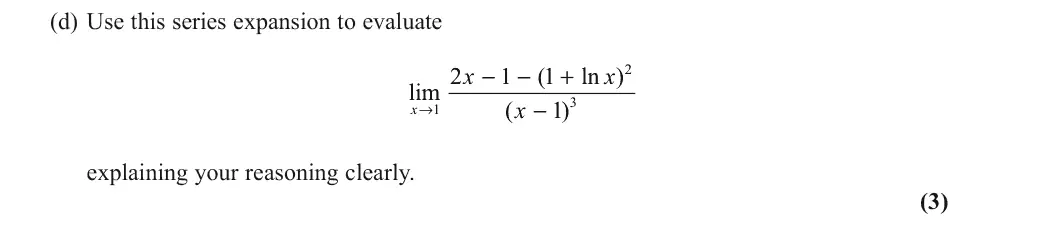
Nov 2021 · Paper 3A (Further Pure 1) · Q6(d)3 marks
Mark scheme (whole question; this part is marked with the orange bar)
Examiner's comment
Part (d) Candidates found this part more demanding. Candidates need to use their series found in part (c) and substitute it into the limit in place of ( ) 2 1 ln x + . The expression needed to be simplified and candidates needed to leave it as powers of ( )1 x - so that they could recognising cancelling of terms leading to a constant + … ( ) 3 1 1 3 x - ( ) 3 ... 1 x + - 1 3 = . The final mark required candidates to appreciate that limit would be of the form ( ) ( ) 2 1 1 1 ... 3 x x + - + - + so that as x tend to 1 the limit will tend towards 1 3 .
Key points from the mark scheme and examiner's report
substitute the series: numerator is (x − 1)³/3 + higher terms so the limit is 1/3
must say the remaining terms are multiples of (x − 1) which tend to 0
found demanding
Oct 2020 · Paper 3A (Further Pure 1) · Q15 marks
Mark scheme (whole question; this part is marked with the orange bar)
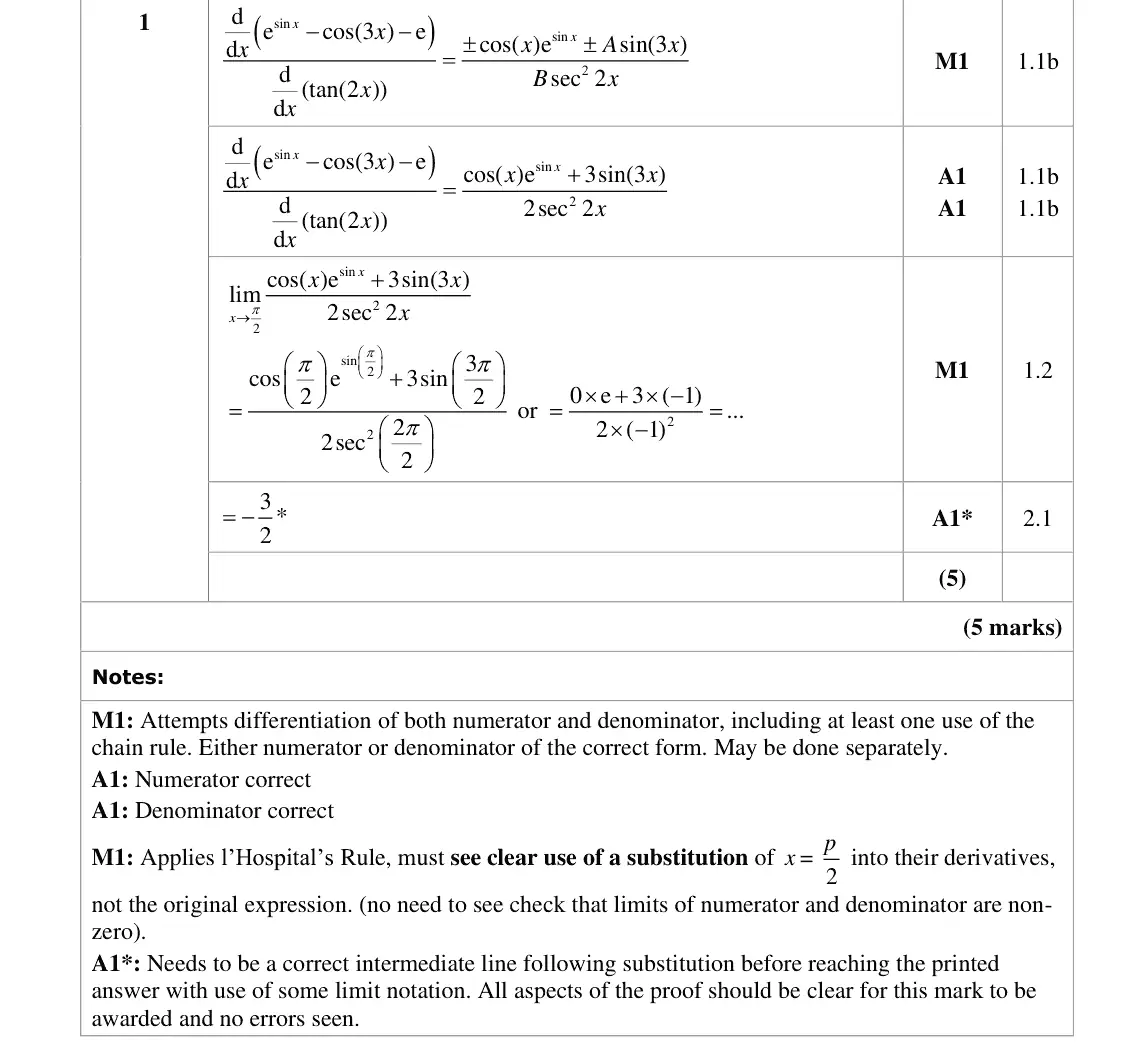
Examiner's comment
Most candidates understood what L’Hospital’s rule was and realised that they needed to find the derivatives of the numerator and denominator. Errors were fairly common in the derivative of the numerator, in particular errors in finding the derivative of esin x and not realising that the derivative of e is 0. A significant number of candidates did not show sufficient evidence of substitution of 2 x p = into their derivatives to demonstrate that the limit was the given answer. Candidates need to show the line with their ( ) ( ) 2 f lim g x x x → with x replaced with 2 p , as this is a show question.
Key points from the mark scheme and examiner's report
differentiate numerator and denominator separately: (cos x e^(sin x) + 3sin 3x)/(2sec²2x)
derivative of the constant e is 0 (often missed) and e^(sin x) slips
must show x = π/2 substituted into the derivatives for the printed −3/2
Oct 2020 · Paper 3A (Further Pure 1) · Q48 marks
Mark scheme (whole question; this part is marked with the orange bar)
Examiner's comment
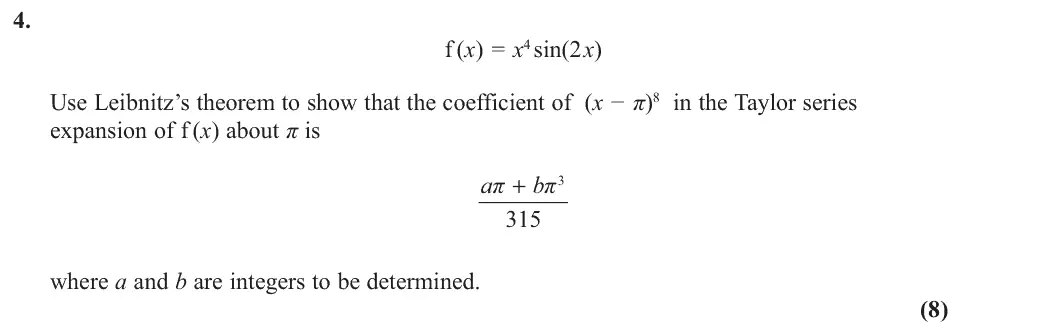
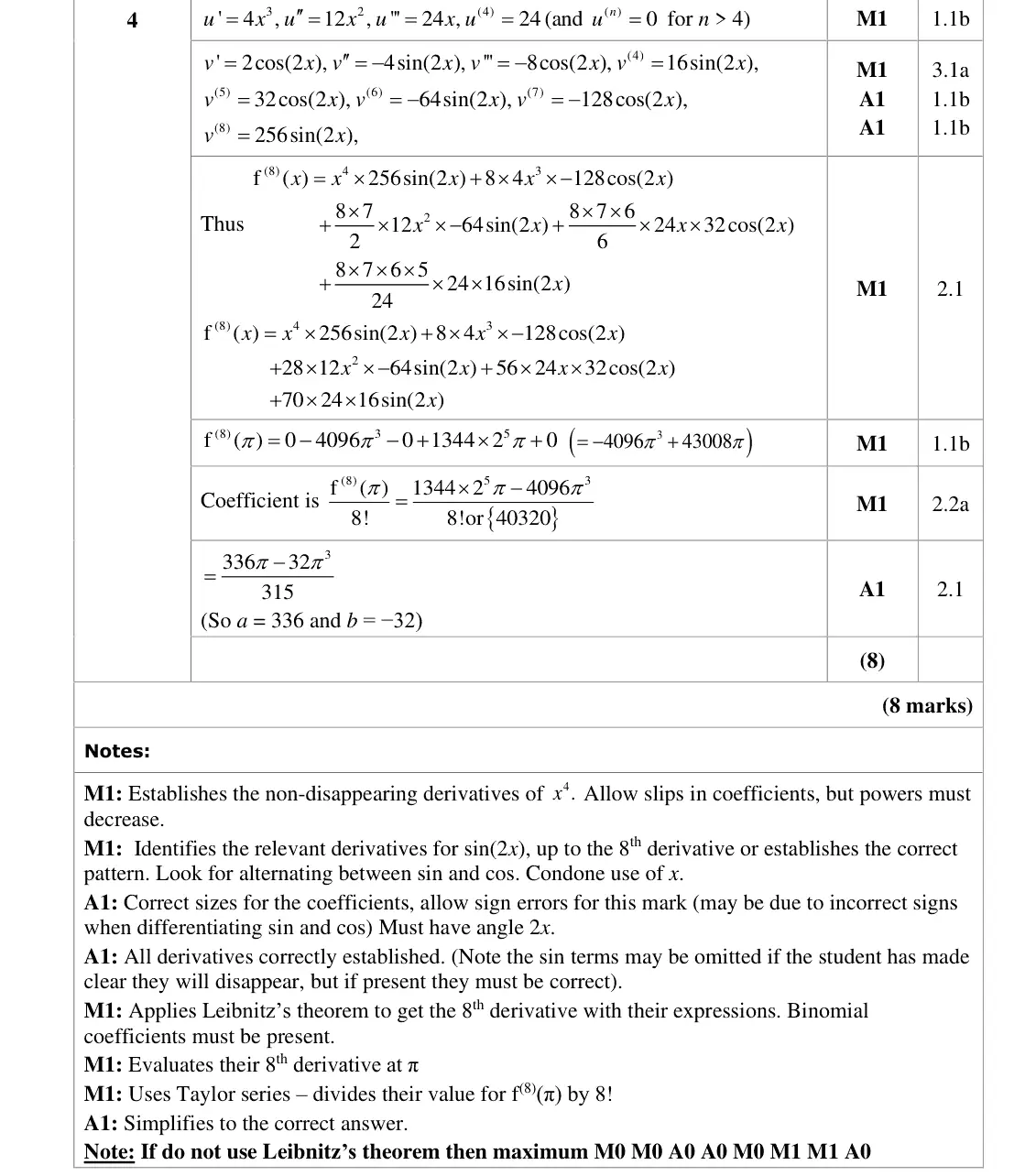
There was a significant proportion of students who did not know how to find the 8th derivative of f(x) in this question. Of those that did know what was expected most were able to find the required derivatives accurately, there were very few errors seen in establishing all 8 derivatives of sin 2x and the derivatives of x4. Candidates then went on to use their derivatives in an accurate application of Leibnitz’s rule which included the correct binomial coefficients. There were some students who appeared to be confused by the fact that the derivatives of x4 vanished after the 4th derivative and only found the first four derivatives of sin 2x, attempting a combination of these derivatives. The vast majority of candidates who found an 8th derivative went on to find f 8 ( pi ) and divide by 8!
Key points from the mark scheme and examiner's report
derivatives of x⁴ vanish after the 4th
8th derivative of x⁴sin 2x by Leibnitz, f⁽⁸⁾(π) = 43008π − 4096π³
divide by 8!: (336π − 32π³)/315, a = 336, b = −32
many did not know to find the 8th derivative or stopped at four derivatives of sin 2x
Oct 2020 · Paper 3A (Further Pure 1) · Q8(c)8 marks
Mark scheme (whole question; this part is marked with the orange bar)
Examiner's comment
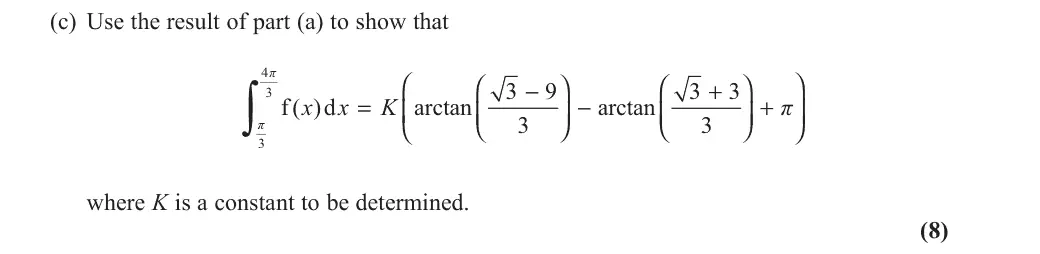
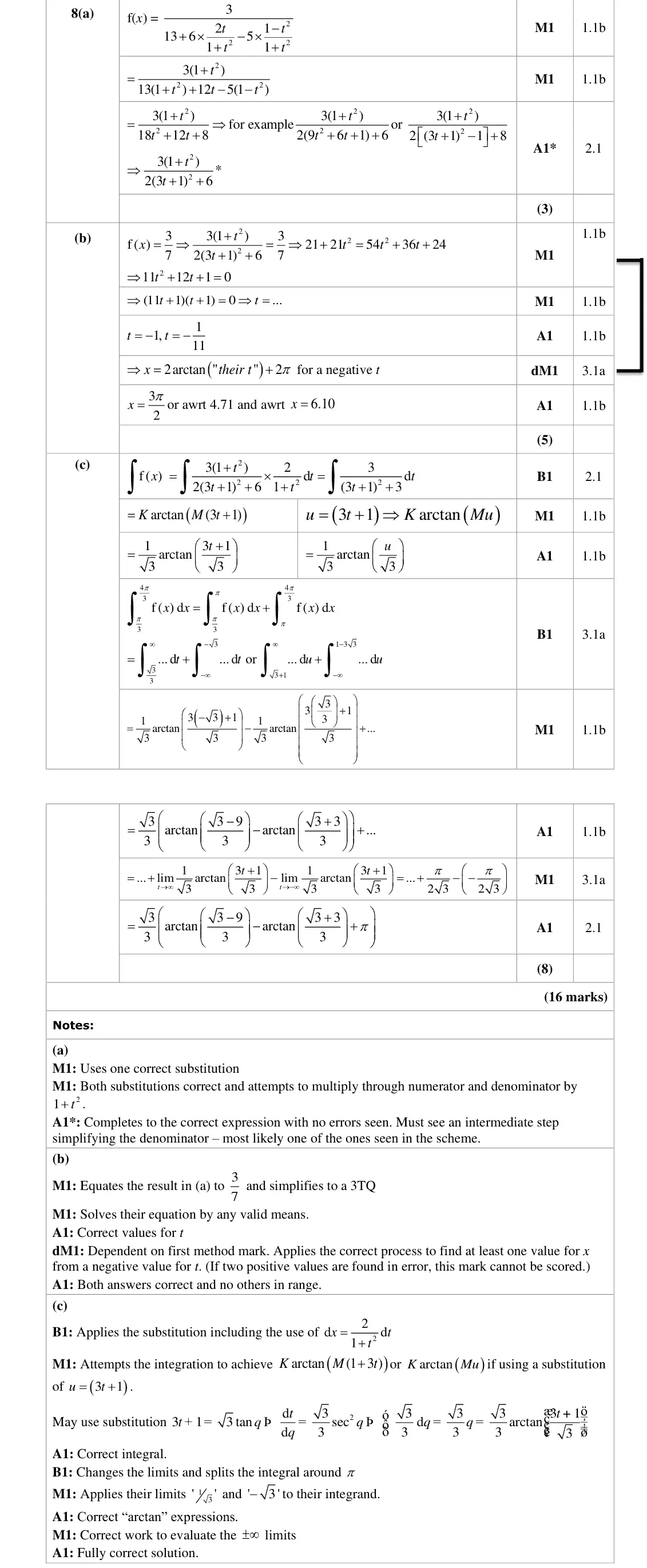
Again, part a was easily accessible to most candidates and most correctly substituted the correct t – formulae for cos x and sin x. Most candidates were able to manipulate their expressions to ( ) + 2 3 1 t reach but then wrote down the given answer in completed square form with no + + 2 18 12 8 t t further justification, losing the final accuracy mark. It should be reiterated to students that though it is relatively straightforward to check that the two denominators are equivalent, as the answer is given, they should be showing intermediate working to reach the given answer or writing down some other form of justification. Part b was generally well done with some arithmetic errors leading to an incorrect quadratic and so incorrect values of t. Some candidates either did not continue to find values of x or used an incorrect method to find values of x from their values of t. Part c was attempted by a good number of candidates but no-one got full marks. Candidates were so focussed on the process of integration that they did not consider the limits carefully enough and did not spot that this was in fact an improper integral. A significant number of candidates did not make a complete substitution, omitting the substitution for dx, and so struggled to make any further progress. Of those that did make a complete substitution most ( ) t + arctan 3 1 K M obtained an integral of the correct form but there were many errors, the most common being to forget to apply the reverse chain rule and so have additional factor of 3. Candidates using a further substitution of u = 3t + 1 generally avoided this error.
Key points from the mark scheme and examiner's report
x = π makes t infinite so split at π and use limits ±∞ (improper integral)
K = √3/3
no candidate scored full marks: limits through π not spotted
June 2019 · Paper 3A (Further Pure 1) · Q24 marks
Mark scheme (whole question; this part is marked with the orange bar)
Examiner's comment
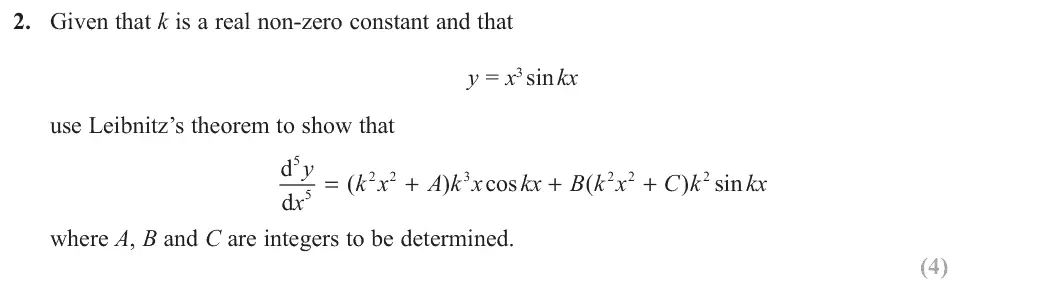
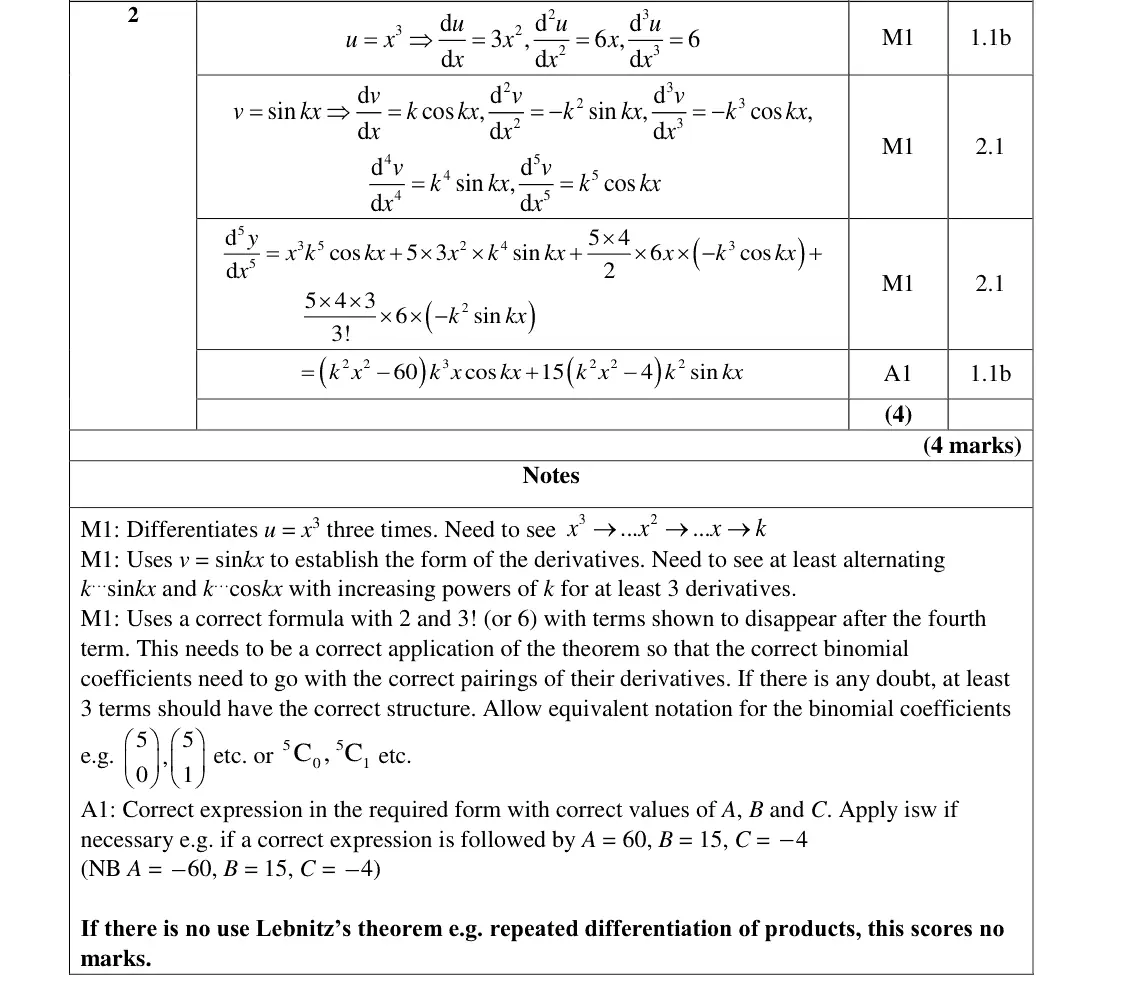
This question was the first of its kind on the new specification and it was obvious that most candidates had a good knowledge of how Leibnitz’s theorem was applied, with only a few attempts at repeated differentiation seen. There were very few candidates who were unable to make good progress in this question. Very few errors were seen in obtaining the derivatives that were required and there were similarly few errors seen in the structure of Leibnitz’s theorem. The most common errors seen in this short question were errors when collecting terms to obtain the final answer, or transcription errors when candidates copied their expressions from one line to the next. For the candidates not familiar with Leibnitz Theorem, it was common to see no binomial coefficients present, or for them to be incorrectly attached to their terms.
Key points from the mark scheme and examiner's report
A = −60, B = 15, C = −4
differentiate x³ three times and sin kx five times, binomial coefficients 5Cr with terms vanishing after the fourth
repeated differentiation of the product scores 0
errors mostly in collecting terms or miscopying
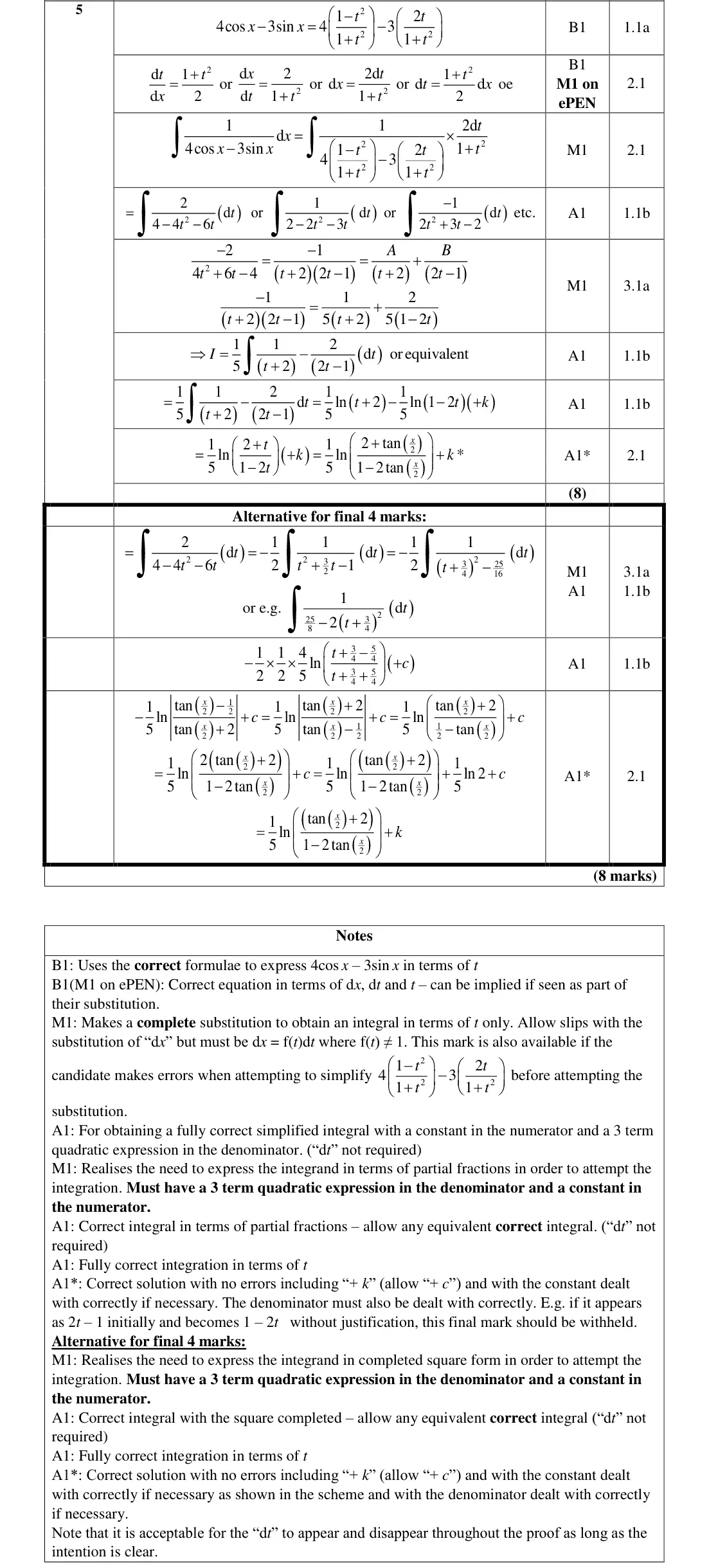
June 2019 · Paper 3A (Further Pure 1) · Q58 marks
Mark scheme (whole question; this part is marked with the orange bar)
Examiner's comment
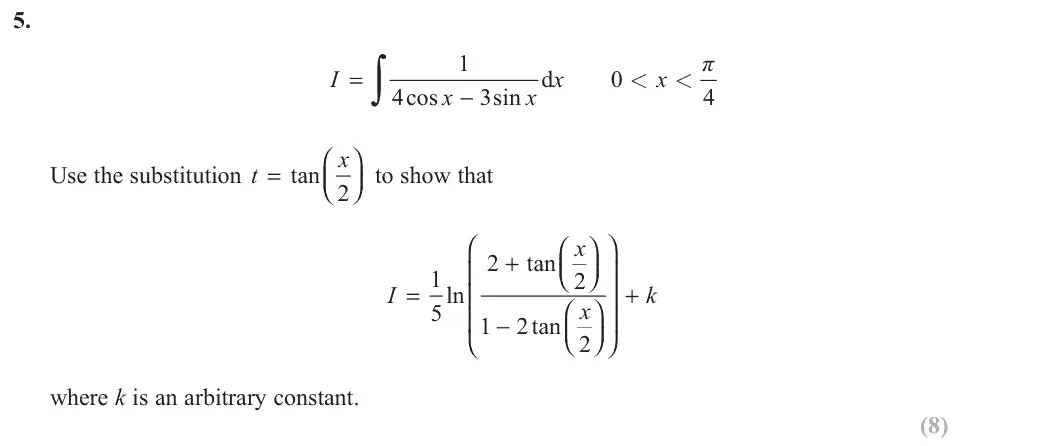
Most candidates could start to use the t formulae to express the given integral in terms of t. A minority of candidates forgot to change their dx in the integral to an expression involving dt. Candidates then proceeded to manipulate their integrand correctly to the required quadratic form. The two routes from there involved either partial fractions or completing the square. The negative ‘t2’ term caused some problems as many candidates couldn’t factorise the expression without bringing the minus out and this occasionally caused problems later on and such algebraic errors caused loss of 3 accuracy marks in the final part of the question. When using the partial fraction method, a fraction with a denominator of 2t – 1 was possible but few candidates could convincingly deal with changing this to 1 – 2t with |2t – 1| = 1 – 2t seen with no justification. Others left their answer with modulus signs in thus losing the final mark since they had not reached the required answer. Other candidates expressed their denominator in the form a2 – x2 or x2 – a2 in order that a standard integral could be used. This method usually resulted in a term ½ - t or t – ½ in the denominator which frequently changed into the required 1 – 2t with no explanation so losing credit.
Key points from the mark scheme and examiner's report
t-formulae for cos x and sin x and dx = 2dt/(1 + t²) (dx often not converted)
integrand 1/(2 + 3t − 2t²) then partial fractions or completing the square
must justify 1 − 2t rather than modulus of 2t − 1 to reach the printed answer
Find an Edexcel Further Maths tutor
Stuck on this? Book a trial lesson with our Further Maths tutor.