The cartesian line, the plane forms, the vector product and the scalar triple product are given.
Since 2018
47 question parts, 117 marks, 2 with a difficulty rating from the examiner's report
Notes, worked examples and practice for this topic are being written by our tutors. The past-paper questions below are ready now: work each one on paper, then open the mark scheme and the examiner's comment.
Tap a question to zoom it. Mark scheme and examiner's comment open under each question.
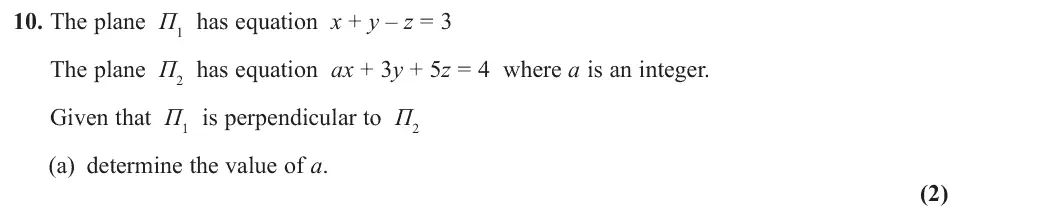
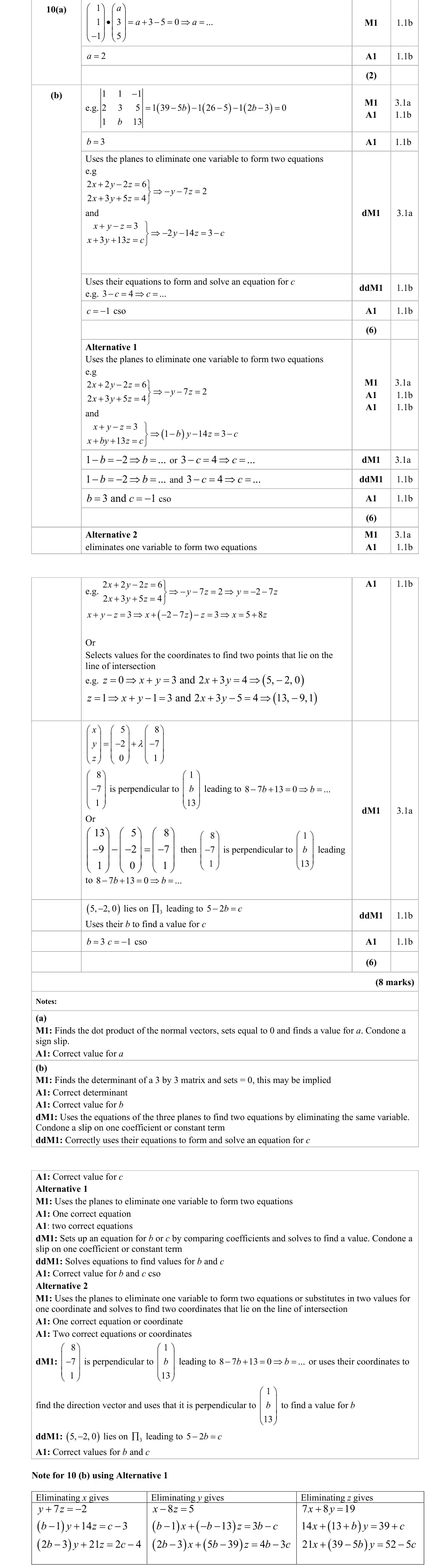
June 2025 · AS Paper 1 (Core Pure) · Q10(a)2 marks
Mark scheme (whole question; this part is marked with the orange bar)
Examiner's comment
In part (a), the vast majority of the learners recognised the need to equate the scalar product of the two normal vectors to zero and thus correctly found the value of a.
Key points from the mark scheme and examiner's report
normals perpendicular: (1, 1, −1).(a, 3, 5) = a − 2 = 0, a = 2
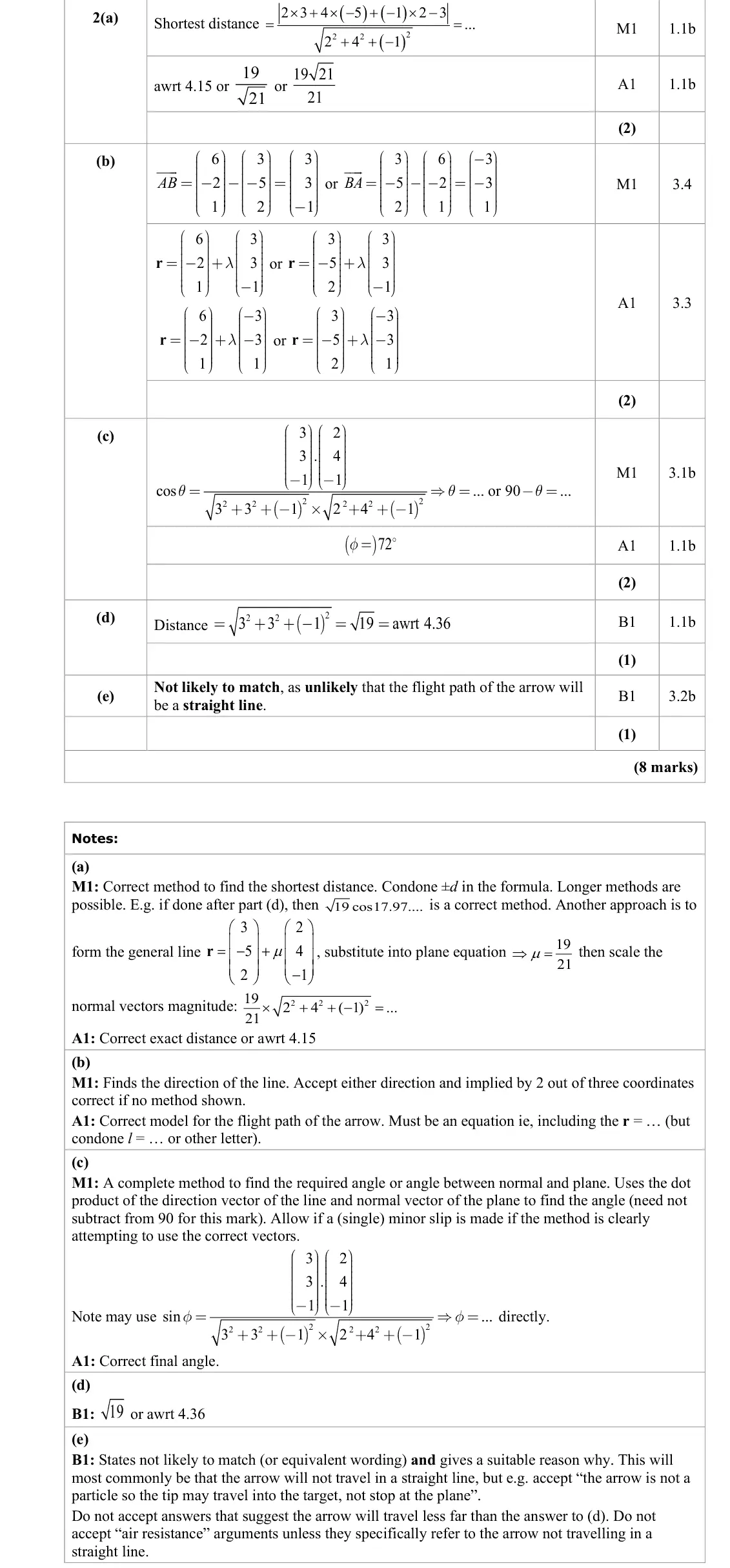
June 2025 · Paper 2 (Core Pure 2) · Q2(b)2 marks
Mark scheme (whole question; this part is marked with the orange bar)
Examiner's comment
In contrast to question 1, this was very well answered overall, proving to be an accessible vector model question, which traditionally causes problems. The context was straightforward enough to not obscure what was needed and learners made good progress with many identifying the shortcoming of the model at the end. Likewise part (b) was also well done. Most candidates found the direction vector and successfully used one of the points to produce the right-hand side of the equation. However, some neglected that an equation needs a left-hand side as well, i.e. ‘r =’, and so lost the accuracy mark. Numerical slips were occasionally made (e.g. one coordinate of the direction incorrect), but these were rare.
Key points from the mark scheme and examiner's report
direction (3, 3, −1) from the two points
r = (3, −5, 2) + λ(3, 3, −1)
must start 'r ='
slips in the direction vector
June 2025 · Paper 2 (Core Pure 2) · Q2(c)2 marks
Mark scheme (whole question; this part is marked with the orange bar)
Examiner's comment
In contrast to question 1, this was very well answered overall, proving to be an accessible vector model question, which traditionally causes problems. The context was straightforward enough to not obscure what was needed and learners made good progress with many identifying the shortcoming of the model at the end. Learners were slightly less successful in part (c), though still the majority made good progress. Learners were more likely to use incorrect vectors than in earlier parts, for example using the anchor point of the line rather than the direction vector in the scalar product and so losing all three marks. But many were successful in applying the formula with correct vectors and to produce either the angle or it complement. Many used sin theta directly when calculating the required angle, and these responses were almost always correct. Candidates who found cos theta first sometimes gave their final answer as 18°, either forgetting to subtract the value from 90° or not realising which angle they were being asked for.
Key points from the mark scheme and examiner's report
angle between the direction (3, 3, −1) and the normal (2, 4, −1), then 90° minus it (or use sin): 72°
using the position vector instead of the direction scored 0
June 2025 · Paper 2 (Core Pure 2) · Q2(d)1 mark
Mark scheme (whole question; this part is marked with the orange bar)
Examiner's comment
In contrast to question 1, this was very well answered overall, proving to be an accessible vector model question, which traditionally causes problems. The context was straightforward enough to not obscure what was needed and learners made good progress with many identifying the shortcoming of the model at the end. Once again part (d) was successfully answered by the majority of learners, though few realised that they could use the direction vector already found in (a) and embarked on long winded methods before eventually reaching the correct value. Whereas in part (a) most gave an exact value rather than decimal, here a decimal was favoured, probably due to the use of the angled calculated in part (c). But either was acceptable. There were a few arithmetic or calculation slips made, but accuracy overall was good.
Key points from the mark scheme and examiner's report
modulus of the direction vector found in (b): √19 ≈ 4.36
many used long-winded methods
June 2025 · Paper 2 (Core Pure 2) · Q2(e)1 mark
Mark scheme (whole question; this part is marked with the orange bar)
Examiner's comment
In contrast to question 1, this was very well answered overall, proving to be an accessible vector model question, which traditionally causes problems. The context was straightforward enough to not obscure what was needed and learners made good progress with many identifying the shortcoming of the model at the end. Finally, in part (e) there were a few misconceptions, but most did allude to the straight line versus the parabolic flight of a projectile, clearly stating or indicating that it would not be a straight line. A few responses did allude to the arrow penetrating the target which also gave them the mark for a considered answer. However, many just stated 'air resistance' or 'not a particle' or variation on this, and did not think enough about this specific question, which was not acceptable as learners are expected to engage with the model in hand. There were also a number of learners thinking it would travel less than distance found for various reasons given, not appreciating that the whole point of the model was assuming the shortest distance approach had been taken.
Key points from the mark scheme and examiner's report
not likely to match because the arrow will not travel in a straight line (curved/parabolic path), or the arrow penetrates the target
bare 'air resistance' or 'not a particle' scored 0
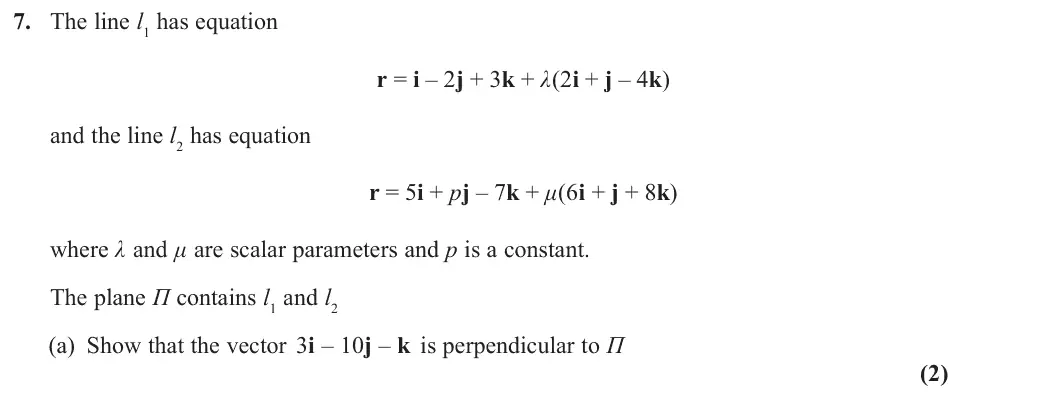
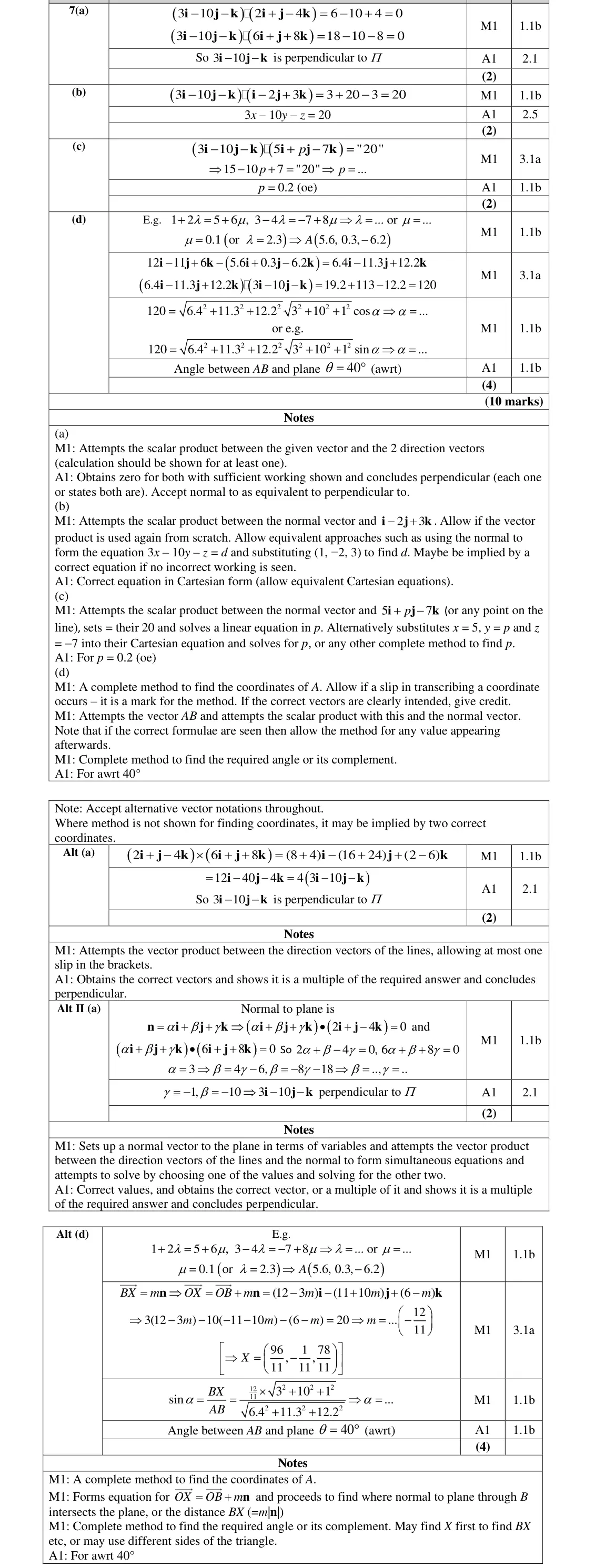
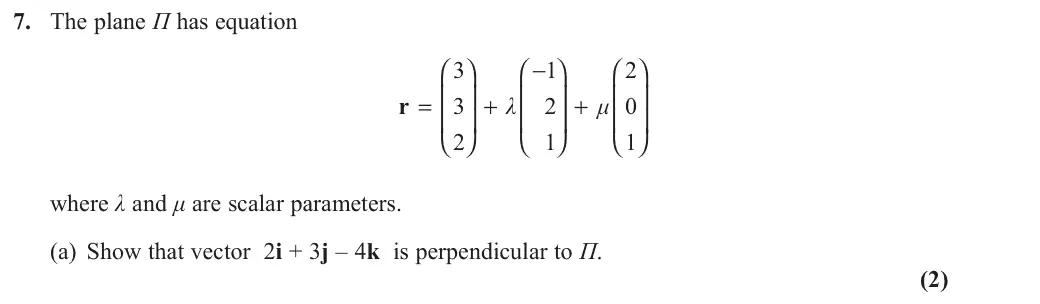
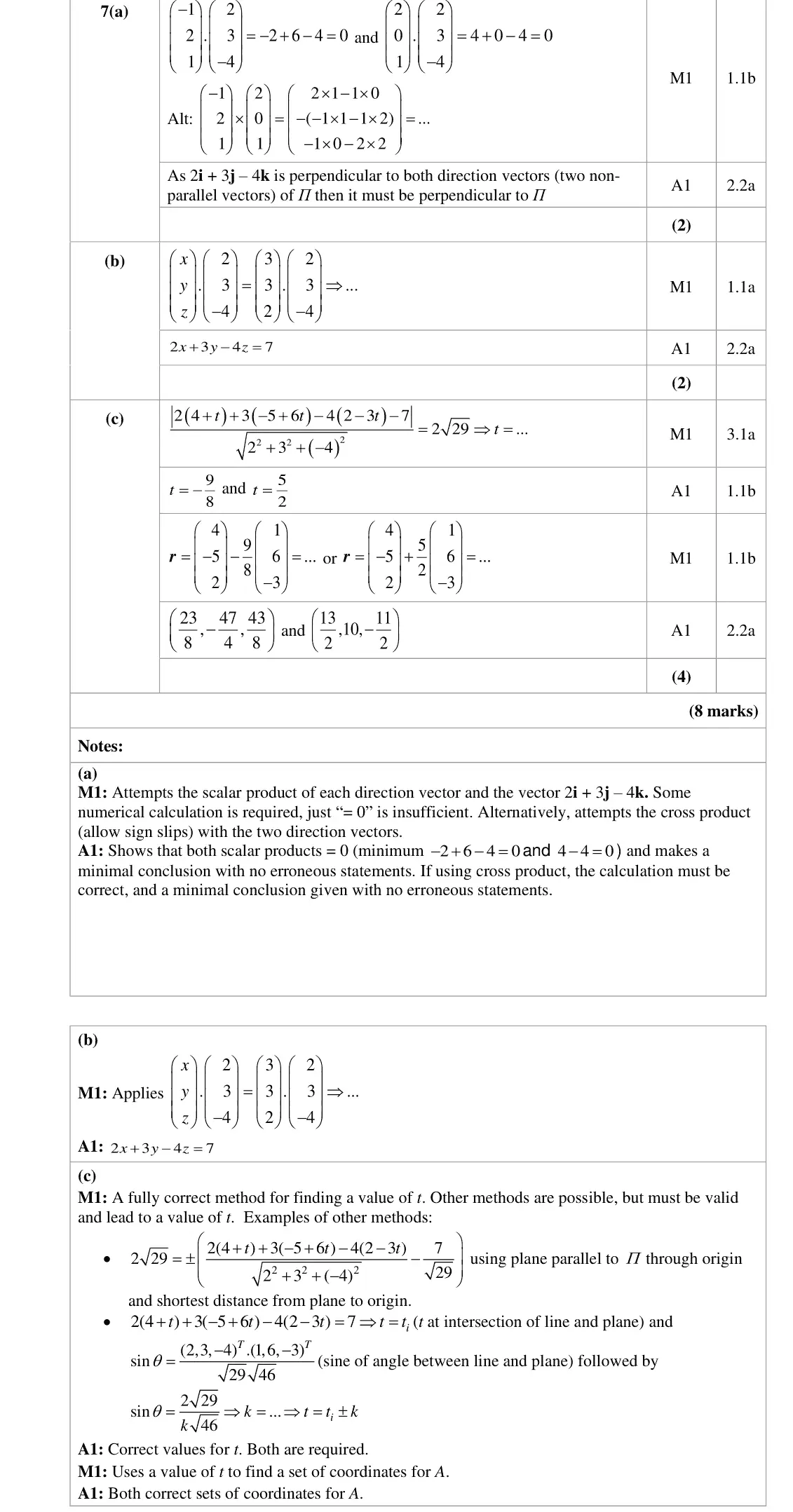
June 2024 · Paper 1 (Core Pure 1) · Q7(a)2 marks
Mark scheme (whole question; this part is marked with the orange bar)
Examiner's comment
Although vectors is not a favoured topic with candidates the first three parts of this question proved accessible to most, with the final part discriminating between the better candidates. Notation throughout was generally very good, with either column vectors or the i, j and k forms used, or coordinates where appropriate. For part (a) most attempted the dot product with each of the direction vectors to score the method, but it was fairly common to lose the accuracy because of an inadequate conclusion, or other slip. A few responses were seen in which candidates used the dot product with only one of the direction vectors, scoring no marks for an incomplete method. A few candidates overcomplicated the process by finding the dot product of the normal vector with ( ) ( ) ( ) 2 6 4 8 + + + + - + i j k (a linear combination of the two direction vectors), reaching 0. If this was followed by a correct conclusion, it achieved both marks. The Alt method, using the vector product, was also very common by those who have studied the further units. The product was usually correct, but occasionally a sign error was made, and the most common error in this approach was not showing the factor of 4 correctly. The second alternative, however, was much more rare to see and often went wrong during the process of solving equations when it was used.
Key points from the mark scheme and examiner's report
scalar product with BOTH direction vectors equals 0, plus a conclusion
June 2024 · Paper 1 (Core Pure 1) · Q7(b)2 marks
Mark scheme (whole question; this part is marked with the orange bar)
Examiner's comment
Although vectors is not a favoured topic with candidates the first three parts of this question proved accessible to most, with the final part discriminating between the better candidates. Notation throughout was generally very good, with either column vectors or the i, j and k forms used, or coordinates where appropriate. For part (b) the method mark was almost always scored by those who made some attempt at the part, though a few did use one of the direction vectors instead of a point on the line. There was the occasional arithmetic error, for example reaching 26 rather than 20, but usually the calculation was correct. The accuracy was also often lost by a candidate leaving their answer in vector rather than Cartesian form, not adhering to the instruction in the question.
Key points from the mark scheme and examiner's report
r.n = a.n using a point on l₁ (not a direction vector): 3x − 10y − z = 20
June 2024 · Paper 1 (Core Pure 1) · Q7(c)2 marks
Mark scheme (whole question; this part is marked with the orange bar)
Examiner's comment
Although vectors is not a favoured topic with candidates the first three parts of this question proved accessible to most, with the final part discriminating between the better candidates. Notation throughout was generally very good, with either column vectors or the i, j and k forms used, or coordinates where appropriate. It was rare to see errors in part (c), with most able to get the correct value of p, even in some instances where an incorrect equation had been found because they went back to use a correct vector. Occasionally a candidate would fail to solve a correct linear equation in p, but this was rare. There were also some who managed to correctly find p from work in part (d), without having attempted the plane equation at all.
Key points from the mark scheme and examiner's report
the point (5, p, −7) on l₂ satisfies the plane equation: p = 0.2
June 2024 · Paper 1 (Core Pure 1) · Q7(d)4 marks
Mark scheme (whole question; this part is marked with the orange bar)
Examiner's comment
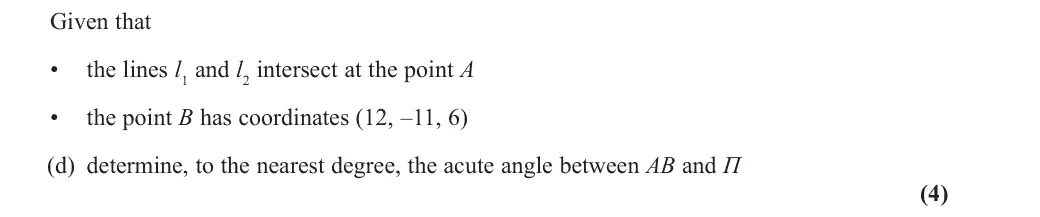
Although vectors is not a favoured topic with candidates the first three parts of this question proved accessible to most, with the final part discriminating between the better candidates. Notation throughout was generally very good, with either column vectors or the i, j and k forms used, or coordinates where appropriate. Part (d) was more challenging, and many were unable to see the way forward. Those who knew the process required usually carried it out correctly, but many only proceeded as far as finding the coordinates of point A. Indeed, most were able to complete the process to find the point A, wisely using the first and third ordinates to solve, and usually obtained the correct point, though some mixed up the variables after having found and correctly, while others used their incorrect p to find the coordinates instead of realising the other equation did not depend on p so would still yield a correct answer. Having obtained the point A most then realised AB was needed but did not make further progress, having not recalled the method for finding the angle between the line and plane. Those who did know the method would generally score the next two method marks and score at least three marks. However, it was fairly common for a candidate to lose the accuracy mark despite an otherwise correct process. Common slips were: arithmetic errors in calculating the coordinates of point A; arithmetic errors in calculating the vector AB; getting an angle of 50° using arccos, but then forgetting to then find by subtracting from 90°. Candidates who recalled the formula involving arcsin were more successful in attaining the correct answer rounding to 40°.
Key points from the mark scheme and examiner's report
find A from two components of l₁ = l₂ first
A = (5.6, 0.3, −6.2)
angle with the plane uses sin, or 90° minus the angle with the normal: 40° (50° from arccos is a common slip)
many stopped at A
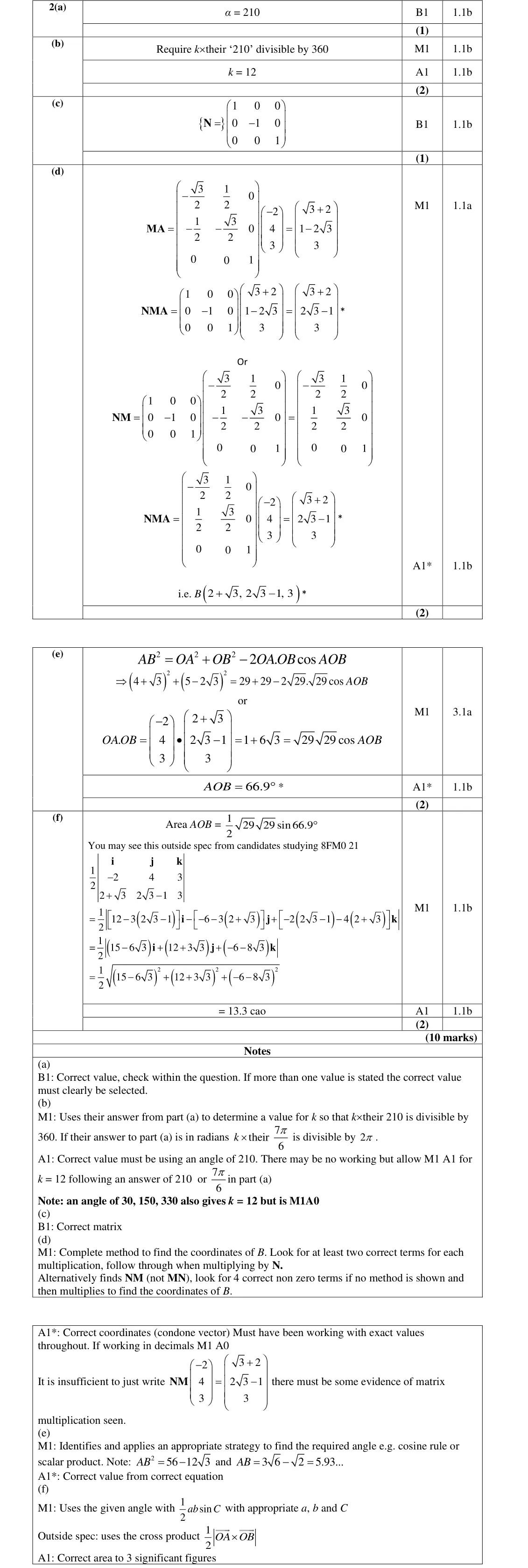
June 2024 · AS Paper 1 (Core Pure) · Q2(e)2 marks
Mark scheme (whole question; this part is marked with the orange bar)
Examiner's comment
Part a) was often answered incorrectly and candidates failed to check their value worked consistently, common incorrect answers included 30 and 150 . ± Part b) was attempted by most students who recognised the need for alpha to be divisible exactly k by 360, it was common to see attempts involving trial and error or calculator use. The odd value of k however not the lowest. Many students who got 300 and 1500 in part a) were able to attempt at finding the LCM of alpha and 360 was seen which were generally successful in finding a calculate k, scoring M1A0. Part c) was very well answered with the large majority achieving this mark. It was pleasing to see candidates that although maybe couldn’t access a) and b) continued to read through the question and pick up marks here. Part d) was a show that question and whilst many candidates appreciated the need for matrix multiplication and furthermore understood the necessary order many failed to show evidence of matrix multiplication which was not sufficient. Those who did show their working generally did so correctly and were able to proceed to the correct answer. Some students left their answer as a vector which was condoned in this question. Candidates who drew a sketch were more successful in part e and f than those who didn’t. It was common to see both the cosine rule and scalar product used in part e), most candidates who selected a correct method were able to proceed to the final answer. Numerical and sign errors were more common when using the cosine rule and calculating AB . Part f) was generally well done although some candidates selected the wrong side and used AB in place of OA or OB, again a sketch helped with this. A small number of candidates failed to round to the required level of accuracy in e) and f) losing the final mark.
Key points from the mark scheme and examiner's report
OA.OB = 6√3 + 1 with both lengths √29 (rotation and reflection preserve length)
cos AOB = (6√3 + 1)/29
66.9°
June 2024 · AS Paper 1 (Core Pure) · Q2(f)2 marks
Mark scheme (whole question; this part is marked with the orange bar)
Examiner's comment
Part a) was often answered incorrectly and candidates failed to check their value worked consistently, common incorrect answers included 30 and 150 . ± Part b) was attempted by most students who recognised the need for alpha to be divisible exactly k by 360, it was common to see attempts involving trial and error or calculator use. The odd value of k however not the lowest. Many students who got 300 and 1500 in part a) were able to attempt at finding the LCM of alpha and 360 was seen which were generally successful in finding a calculate k, scoring M1A0. Part c) was very well answered with the large majority achieving this mark. It was pleasing to see candidates that although maybe couldn’t access a) and b) continued to read through the question and pick up marks here. Part d) was a show that question and whilst many candidates appreciated the need for matrix multiplication and furthermore understood the necessary order many failed to show evidence of matrix multiplication which was not sufficient. Those who did show their working generally did so correctly and were able to proceed to the correct answer. Some students left their answer as a vector which was condoned in this question. Candidates who drew a sketch were more successful in part e and f than those who didn’t. It was common to see both the cosine rule and scalar product used in part e), most candidates who selected a correct method were able to proceed to the final answer. Numerical and sign errors were more common when using the cosine rule and calculating AB . Part f) was generally well done although some candidates selected the wrong side and used AB in place of OA or OB, again a sketch helped with this. A small number of candidates failed to round to the required level of accuracy in e) and f) losing the final mark.
Key points from the mark scheme and examiner's report
area = ½ × √29 × √29 × sin 66.9° = 13.3
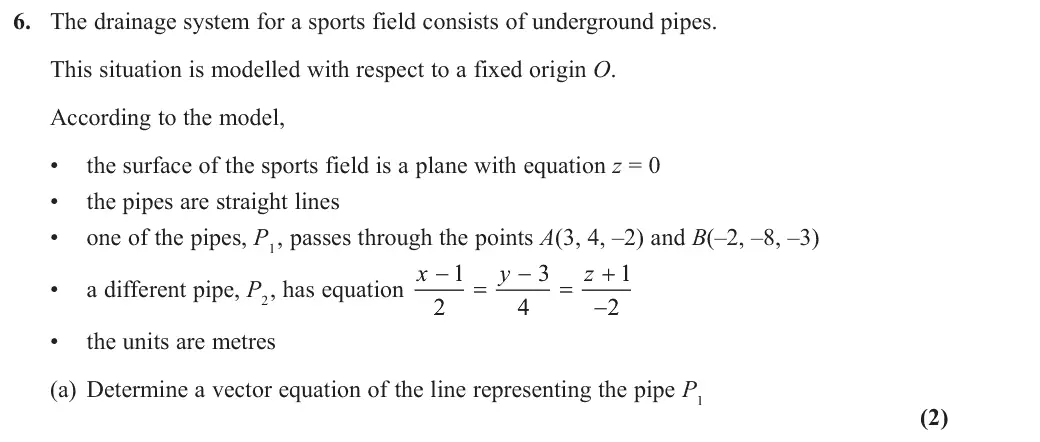
June 2024 · AS Paper 1 (Core Pure) · Q6(a)2 marks
Mark scheme (whole question; this part is marked with the orange bar)
Examiner's comment
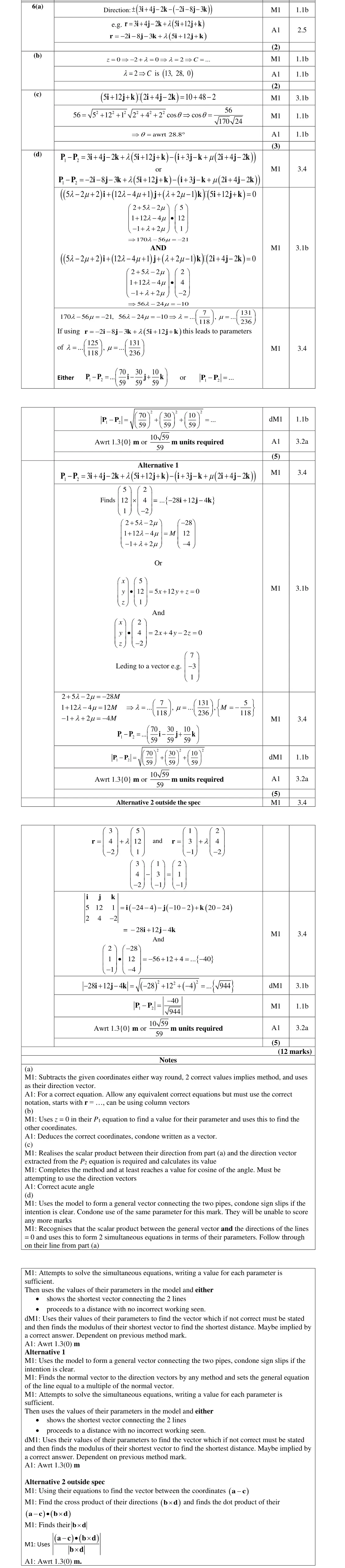
In part (a), the vast majority of the candidates correctly formed the vector equation of the line representing the pipe P1 with any loss of marks being mainly due to the equation not having r as the subject.
Key points from the mark scheme and examiner's report
direction AB = (5, 12, 1)
r = (3, 4, −2) + λ(5, 12, 1)
must begin r =
June 2024 · AS Paper 1 (Core Pure) · Q6(b)2 marks
Mark scheme (whole question; this part is marked with the orange bar)
Examiner's comment
In part (b), nearly all of the cohort recognised the need to equate the k component of r to zero and hence find the i and j components.
Key points from the mark scheme and examiner's report
z = 0 gives λ = 2: (13, 28, 0)
June 2024 · AS Paper 1 (Core Pure) · Q6(c)3 marks
Mark scheme (whole question; this part is marked with the orange bar)
Examiner's comment
In part (c), there was much success in finding the acute angle between the pipes with the use of the scalar product being the most common method in this procedure.
Key points from the mark scheme and examiner's report
directions (5, 12, 1) and (2, 4, −2): cos θ = 56/(√170√24)
28.8°
June 2023 · Paper 1 (Core Pure 1) · Q5(b)5 marks
Mark scheme (whole question; this part is marked with the orange bar)
Examiner's comment
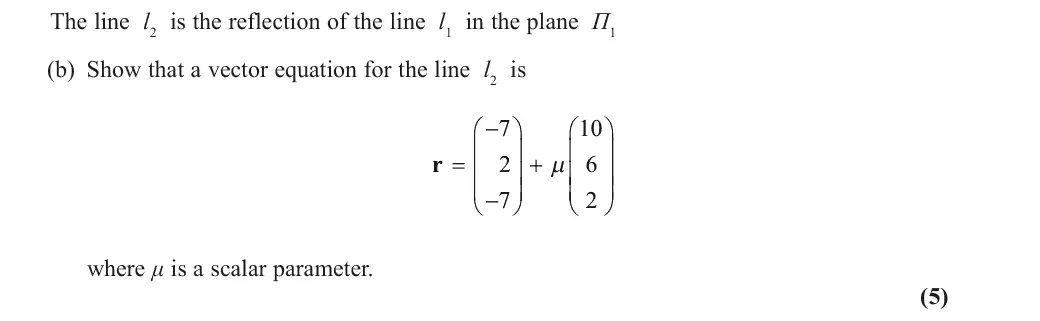
This question yielded a varied range of mark profiles and also saw a wide variety of methods employed in the different parts of the question. In part (b), the majority of candidates executed their solutions competently to achieve the given result. Most set up the equation of a new line using the normal to the plane and a point on the given line (usually (–5, -4, 3)) and attempted to find the value of their parameter where this line met the plane. They then proceeded to find the image point and the equation of the line as required. Those who had used an initial point other than (-5, -4, 3) generally realised that their resulting direction vector was a multiple of the required direction vector. When writing the equation of the reflected line, a significant number did not write “r =” (despite it being a given result), either omitting it entirely or writing e.g. l2 = . This omission lost them the final accuracy mark. A relatively small number of candidates identified a point on l1 and found the perpendicular distance from this point to the plane. Many did not progress any further, but some went on to gain full marks by considering the modulus of the normal to the plane which in turn enabled them to identify the image point and ultimately the equation of the line as required. A few candidates found the angle between the line and the plane, but this very rarely resulted in any creditworthy work.
Key points from the mark scheme and examiner's report
line through (−5, −4, 3) along the normal meets the plane at t = 2, so the mirror image point is (3, 8, −5)
direction from (−7, 2, −7)
must write r = for the given answer
June 2023 · Paper 1 (Core Pure 1) · Q5(c)2 marks
Mark scheme (whole question; this part is marked with the orange bar)
Examiner's comment
This question yielded a varied range of mark profiles and also saw a wide variety of methods employed in the different parts of the question. In part (c), relatively few students used their working from part (b) to establish a second point on the line of intersection of the two planes, which enabled the equation of the line of intersection to be found very efficiently. Instead, there was a wide variety of (quite time consuming) attempts, many using a vector cross product to find the vector equation of the second plane and solve this simultaneously with the first. Many such attempts, however, stopped short of providing a vector equation of a line and so did not score any marks. Often seen amongst the successful attempts was the relatively efficient method of using the vector product twice; first using the direction vectors of the two reflected lines to find the normal to plane 2, then once again using this normal vector with the normal to plane 1 to find the direction vector of the line of intersection. The vector product is not on the specification, but its use was entirely acceptable.
Key points from the mark scheme and examiner's report
best: the point found in (b) on the line through (−5, −4, 3) gives a second common point
r = (−7, 2, −7) + λ(1, 0, 1) o.e.
many lengthy vector-product attempts never reached a line equation
June 2023 · Paper 1 (Core Pure 1) · Q5(d)3 marks
Mark scheme (whole question; this part is marked with the orange bar)
Examiner's comment
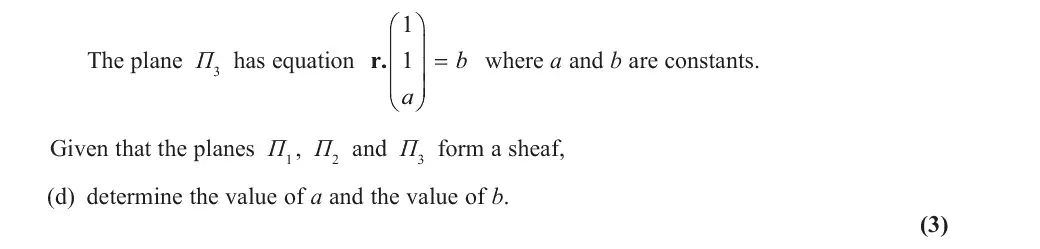
This question yielded a varied range of mark profiles and also saw a wide variety of methods employed in the different parts of the question. Many candidates were unsure of what to do in part (d) and did not attempt a solution. A common method was finding (often using earlier work) the vector equation of the second plane, then using consistency arguments by considering a linear combination of the equations of the three planes. Others candidates who had also established the three equations of the planes used a determinant method to find the value of a. However, these candidates were often unsure how to proceed to find the value of b. Again, the easier methods were seen quite rarely. Those with two points on the line of intersection were able to find the values of a and b very efficiently by substituting these position vectors into the equation of the third plane. A few candidates recognised that the normal to the third plane was perpendicular to the direction vector of their line of intersection found in part (c) and they used the scalar product to find the value of a. These candidates usually went on to use a point on the line of intersection to find b.
Key points from the mark scheme and examiner's report
a sheaf means the line from (c) lies in Π₃: direction perpendicular to (1, 1, a) gives a = −1, a point on it gives b = 2
often not attempted
determinant routes found a but stalled on b
June 2023 · AS Paper 1 (Core Pure) · Q6(a)2 marks
Mark scheme (whole question; this part is marked with the orange bar)
Examiner's comment
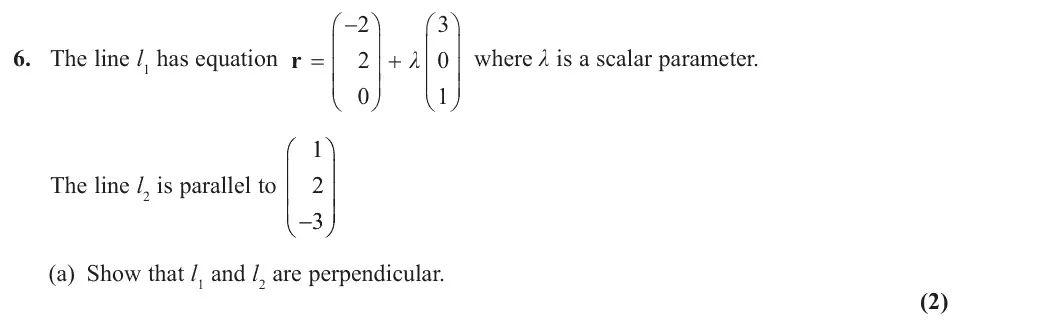
This was another good question with the first three parts being accessed by the majority with part (d) providing a good level of challenge. In part (a), this was generally well answered with most candidates using the dot product. They were able to show the answer was equal to zero, although a minority of candidates failed to conclude that the lines were perpendicular or in fact incorrectly concluded parallel. Some failed to show full use of dot product, instead just stating = 0 and therefore gained no marks despite correct conclusion.
Key points from the mark scheme and examiner's report
Mark scheme (whole question; this part is marked with the orange bar)
Examiner's comment
This was another good question with the first three parts being accessed by the majority with part (d) providing a good level of challenge. In part (b), this part was also well answered although some candidates left their answer as a scalar equation, other errors were to attempt the Cartesian equation of a line. Those who proceeded to a cartesian equation most likely did so correctly with either achieving 2 3 2 x y z + - = or 2 3 2 0 x y z + - - = In part (c), those who obtained both marks in (b) typically also obtained the mark here, it was pleasing to see that most gave a minimal conclusion, though that was not necessary for this mark.
Key points from the mark scheme and examiner's report
leaving it in vector form or giving a line equation lost marks
June 2023 · AS Paper 1 (Core Pure) · Q6(c)1 mark
Mark scheme (whole question; this part is marked with the orange bar)
Examiner's comment
This was another good question with the first three parts being accessed by the majority with part (d) providing a good level of challenge. In part (c), those who obtained both marks in (b) typically also obtained the mark here, it was pleasing to see that most gave a minimal conclusion, though that was not necessary for this mark.
Key points from the mark scheme and examiner's report
3 + 2 − 3 = 2
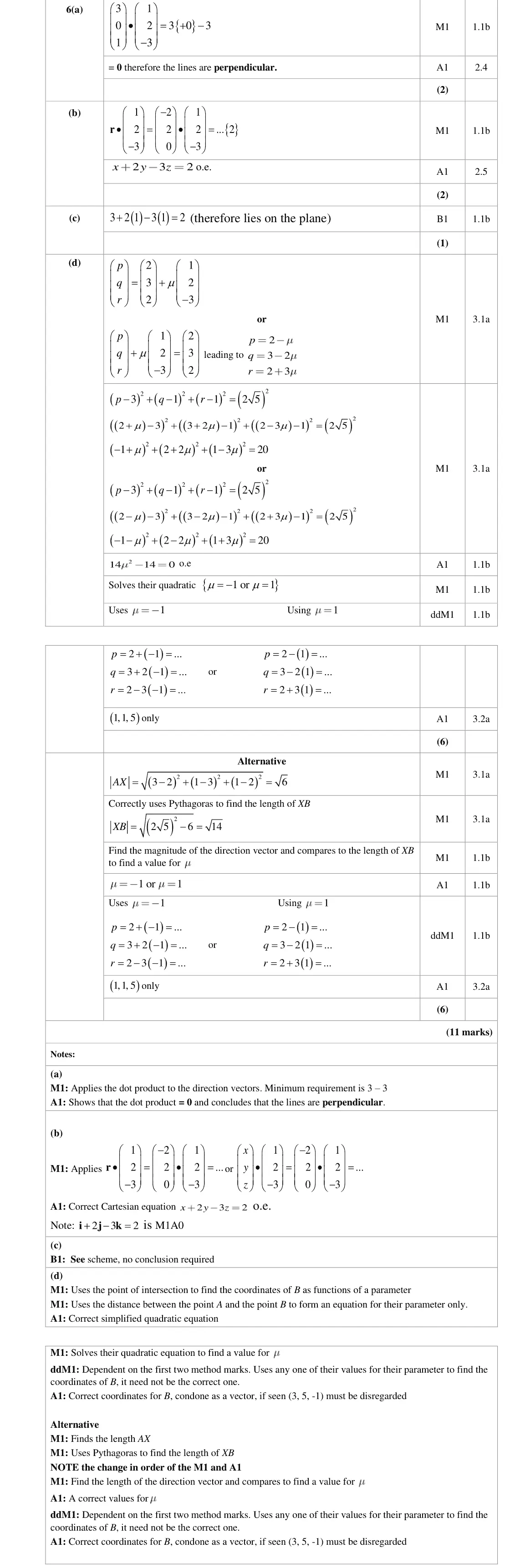
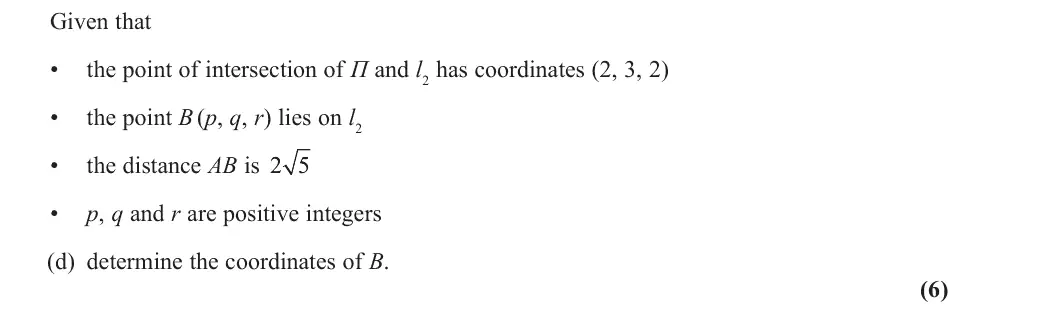
June 2023 · AS Paper 1 (Core Pure) · Q6(d)6 marks
Mark scheme (whole question; this part is marked with the orange bar)
Examiner's comment
This was another good question with the first three parts being accessed by the majority with part (d) providing a good level of challenge. In part (d), this part was less well answered. Several candidates obtained the first mark for finding the coordinates of B but were unable to then use the distance between points in terms of their parameter. There were several numerical errors which led to an incorrect quadratic equation. It was very common for candidates to only find the positive root of their quadratic equation and therefore find the wrong coordinate. Some candidates used the Alternative approach finding the length of AX then XB. They were not always certain how to then proceed and compare to find . For those successful candidates the main scheme proved most popular, occasionally candidates rewrote their three expressions in terms of p in place of which proved to be equally as effective.
Key points from the mark scheme and examiner's report
B = (2 + μ, 3 + 2μ, 2 − 3μ)
AB² = 20 gives 14μ² = 14, μ = ±1
positive integers needed so B = (1, 1, 5)
taking only μ = 1 gave (3, 5, −1)
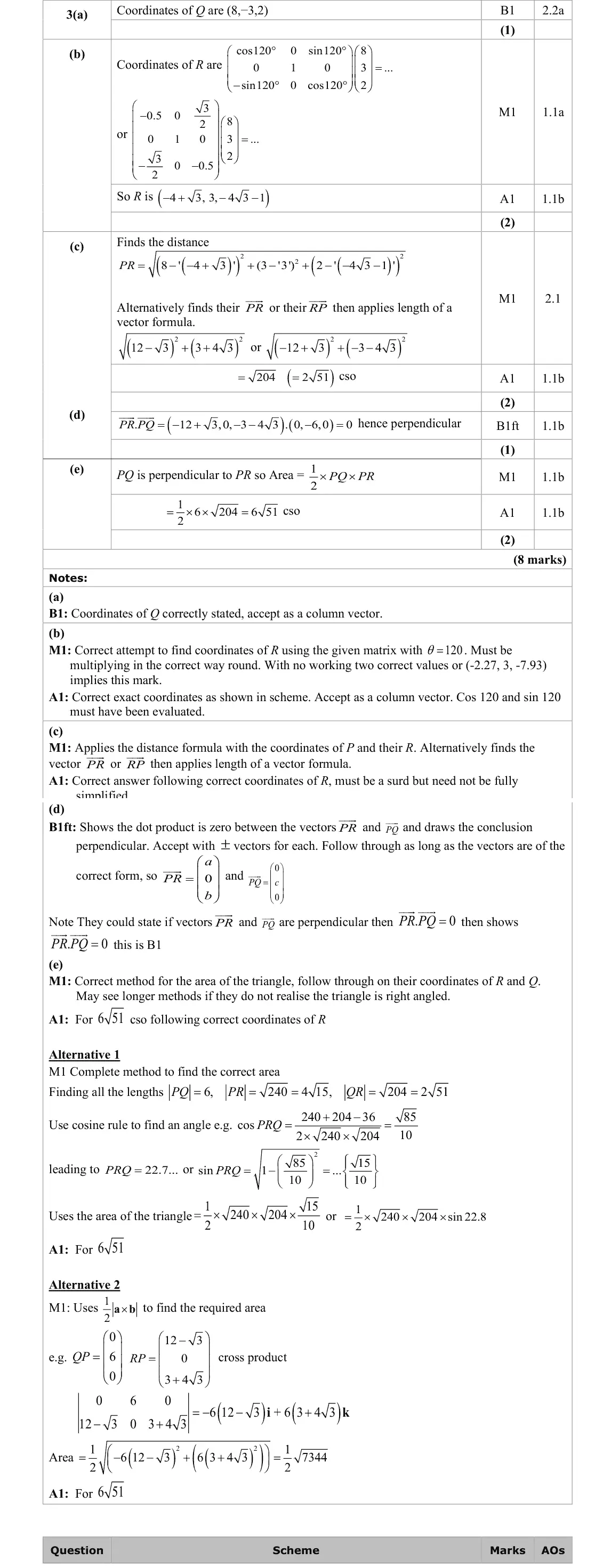
June 2022 · AS Paper 1 (Core Pure) · Q3(d)1 mark
Mark scheme (whole question; this part is marked with the orange bar)
Examiner's comment
inexact coordinates for R were able to recover and give an exact answer for the distance. was not of the correct form to be able to reach a dot product of 0. For Part (d) was inaccessible to some candidates as they had incorrectly used Q in place of P and as a result their vector PQ those who had proceeded correctly to this point, this part was fairly straightforward, and they candidates reaching 0 and stopping there, presumably thinking that they had done enough. made light work of it. The most common issue was an omission of a conclusion, with some Part (e) was more mixed for those that got this far. There was a significant proportion of candidates that made no attempt, having failed to make progress earlier in the question. Again, many candidates produced concise solutions, having recognised the important of the previous step in identifying a right-angle. Others made the connection but did not identify the correct angle to be right-angled and as a result included the wrong side lengths in their calculation for the area.
Key points from the mark scheme and examiner's report
PR.PQ = 0 with PQ = (0, −6, 0)
conclusion "perpendicular" needed
June 2022 · AS Paper 1 (Core Pure) · Q3(e)2 marks
Mark scheme (whole question; this part is marked with the orange bar)
Examiner's comment
inexact coordinates for R were able to recover and give an exact answer for the distance. was not of the correct form to be able to reach a dot product of 0. For Part (d) was inaccessible to some candidates as they had incorrectly used Q in place of P and as a result their vector PQ those who had proceeded correctly to this point, this part was fairly straightforward, and they candidates reaching 0 and stopping there, presumably thinking that they had done enough. made light work of it. The most common issue was an omission of a conclusion, with some Part (e) was more mixed for those that got this far. There was a significant proportion of candidates that made no attempt, having failed to make progress earlier in the question. Again, many candidates produced concise solutions, having recognised the important of the previous step in identifying a right-angle. Others made the connection but did not identify the correct angle to be right-angled and as a result included the wrong side lengths in their calculation for the area.
Key points from the mark scheme and examiner's report
right angle at P: area = ½ × 6 × √204 = 6√51
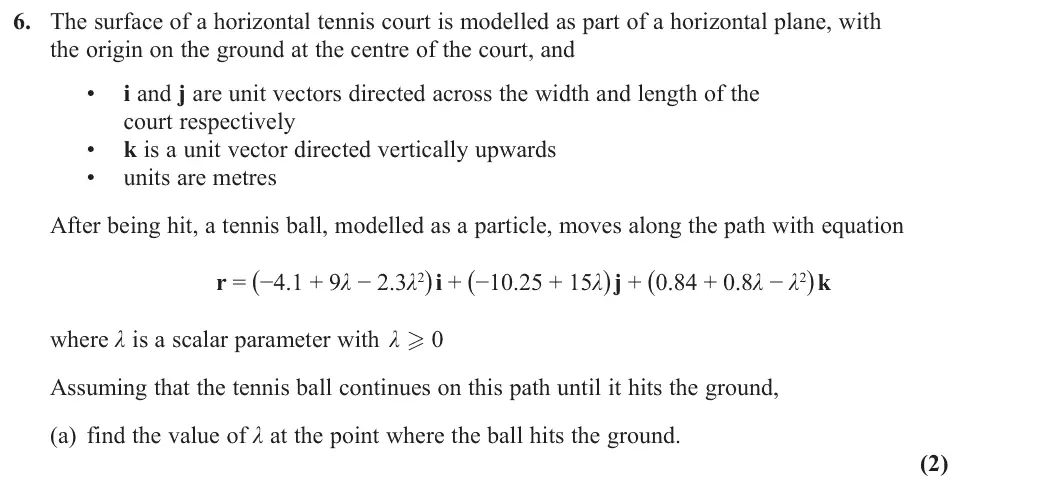
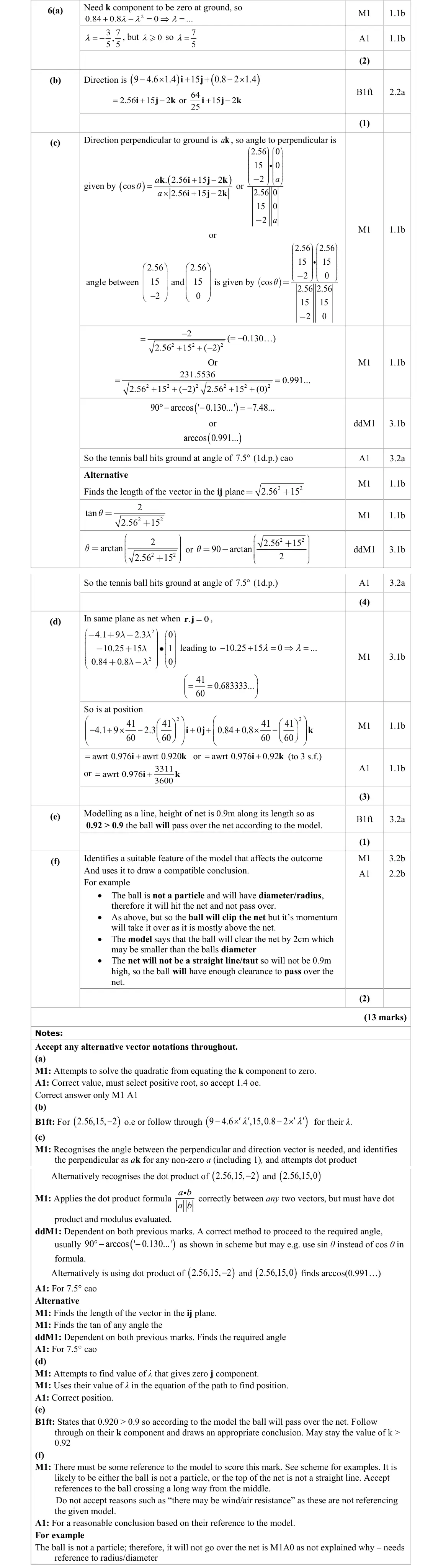
June 2022 · AS Paper 1 (Core Pure) · Q6(a)2 marks
Mark scheme (whole question; this part is marked with the orange bar)
Examiner's comment
This question, which required candidates to work with a model of a tennis ball, proved quite challenging for candidates and tested their ability to apply vector methods to a real-life scenario. There was a great deal of confusion between the position vector of the tennis ball and the direction vector for which it was moving, and less confident students mixed these up frequently. In part (a), the vast majority of candidates correctly identified the coefficient of k in the position vector and solved the quadratic having set it equal to 0. Of these, all of the candidates correctly selected the positive value for λ . There was some inaccurate solving of the quadratic, and, as mentioned above, some candidates used the direction vector instead. Surprisingly, many candidates solved the i or j component of the position vector set equal to 0, which generally meant they continued to make dimensional errors and scored quite poorly in this question.
Key points from the mark scheme and examiner's report
Mark scheme (whole question; this part is marked with the orange bar)
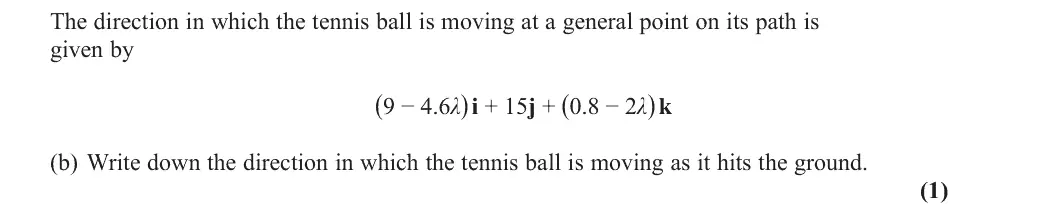
Examiner's comment
This question, which required candidates to work with a model of a tennis ball, proved quite challenging for candidates and tested their ability to apply vector methods to a real-life scenario. There was a great deal of confusion between the position vector of the tennis ball and the direction vector for which it was moving, and less confident students mixed these up frequently. Part (b) was generally well answered, with candidates providing a mixture of decimal and fractional forms for 64 25 . For those that found an incorrect value for λ , for whichever reason mentioned above, this mark was still accessible, but many substituted into the position vector, instead of the direction vector.
Key points from the mark scheme and examiner's report
substitute λ = 1.4 into the DIRECTION vector (not the position): 2.56i + 15j − 2k
June 2022 · AS Paper 1 (Core Pure) · Q6(c)4 marks
Mark scheme (whole question; this part is marked with the orange bar)
Examiner's comment
This question, which required candidates to work with a model of a tennis ball, proved quite challenging for candidates and tested their ability to apply vector methods to a real-life scenario. There was a great deal of confusion between the position vector of the tennis ball and the direction vector for which it was moving, and less confident students mixed these up frequently. Marks in part (c) varied between no marks, full marks, and just the second method mark, but of these, full marks was the least common. The vast majority of candidates were able to identify that they needed to use . cos theta = a b a b but the choice of vectors used varied quite dramatically. It was clear that as the equation of the plane was not given explicitly a number of candidates found it impossible to access this question as they had no directional vector for the normal. For those candidates that did attempt to use the scalar product most used their answer to (b), but the second vector was frequently one of ( ) 1,1,0 or ( ) 0,1,0 or the position vector particle at their λ from (a). These candidates typically evaluated the dot product and distances correctly for their vectors and scored the second method mark only. Of those that used a correct combination of vectors, the most common approach was using ( ) 0,0,1 , with other methods seen rarely. These candidates typically went on to score full marks, although occasionally incomplete methods were seen: stopping before the acute angle with the plane had been found or 7.49 was given as an answer, without the requested level of accuracy in the question.
Key points from the mark scheme and examiner's report
angle with the ground: between (2.56, 15, −2) and k then 90° minus, or with (2.56, 15, 0)
7.5°
wrong choice of vectors common
June 2022 · AS Paper 1 (Core Pure) · Q6(e)1 mark
Mark scheme (whole question; this part is marked with the orange bar)
Examiner's comment
This question, which required candidates to work with a model of a tennis ball, proved quite challenging for candidates and tested their ability to apply vector methods to a real-life scenario. There was a great deal of confusion between the position vector of the tennis ball and the direction vector for which it was moving, and less confident students mixed these up frequently. Clearly, by parts (e) and (f), many candidates had moved on to another question, as responses at this stage became less common. The candidates that had made progress to this stage had a good understanding of the model by this point and generally gave concise and clear responses to both parts. In (e), candidates made the correct decision based on their k component, but they should be encouraged to use both values in their comparison and to be explicit with their wording.
Key points from the mark scheme and examiner's report
height 0.92 m > 0.9 m so the ball passes over the net according to the model
June 2022 · AS Paper 1 (Core Pure) · Q6(f)2 marks
Mark scheme (whole question; this part is marked with the orange bar)
Examiner's comment
This question, which required candidates to work with a model of a tennis ball, proved quite challenging for candidates and tested their ability to apply vector methods to a real-life scenario. There was a great deal of confusion between the position vector of the tennis ball and the direction vector for which it was moving, and less confident students mixed these up frequently. Clearly, by parts (e) and (f), many candidates had moved on to another question, as responses at this stage became less common. The candidates that had made progress to this stage had a good understanding of the model by this point and generally gave concise and clear responses to both parts. In (e), candidates made the correct decision based on their k component, but they should be encouraged to use both values in their comparison and to be explicit with their wording. In (f), some very good answers were seen, but unfortunately there were the common comments about air resistance and gravity, both of which did not relate to the model and as a result scored no marks. Candidates are remined to look back at the question and identify where the modelling accords – tennis ball is modelled as a particle, modelling the top of the net as a straight line.
Key points from the mark scheme and examiner's report
the ball is not a particle: radius larger than the 2 cm clearance so it hits the net
or net sags so it passes
feature of the model plus a compatible conclusion
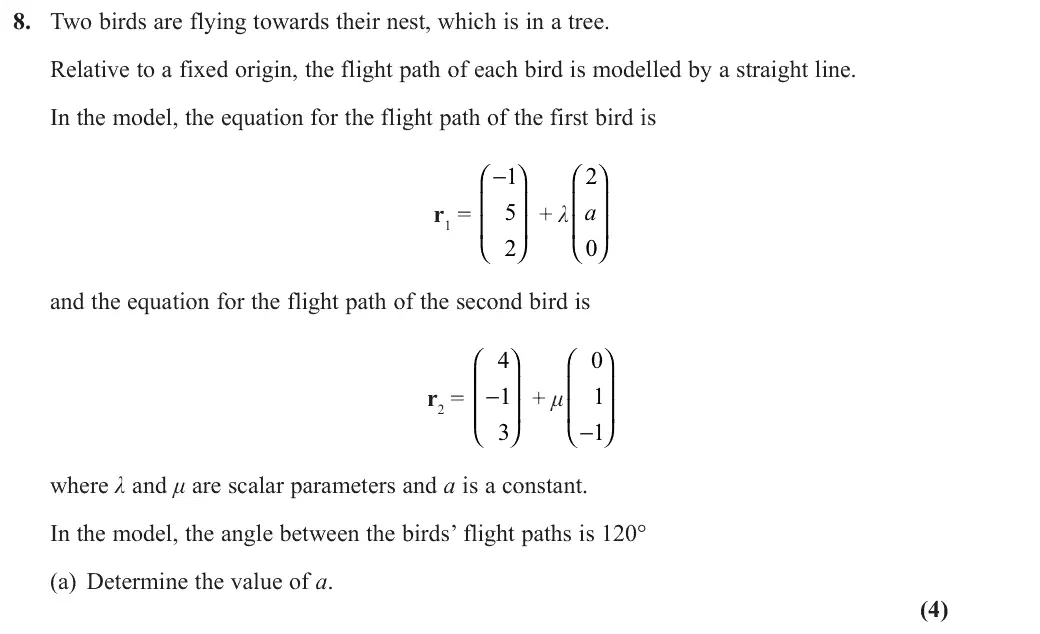
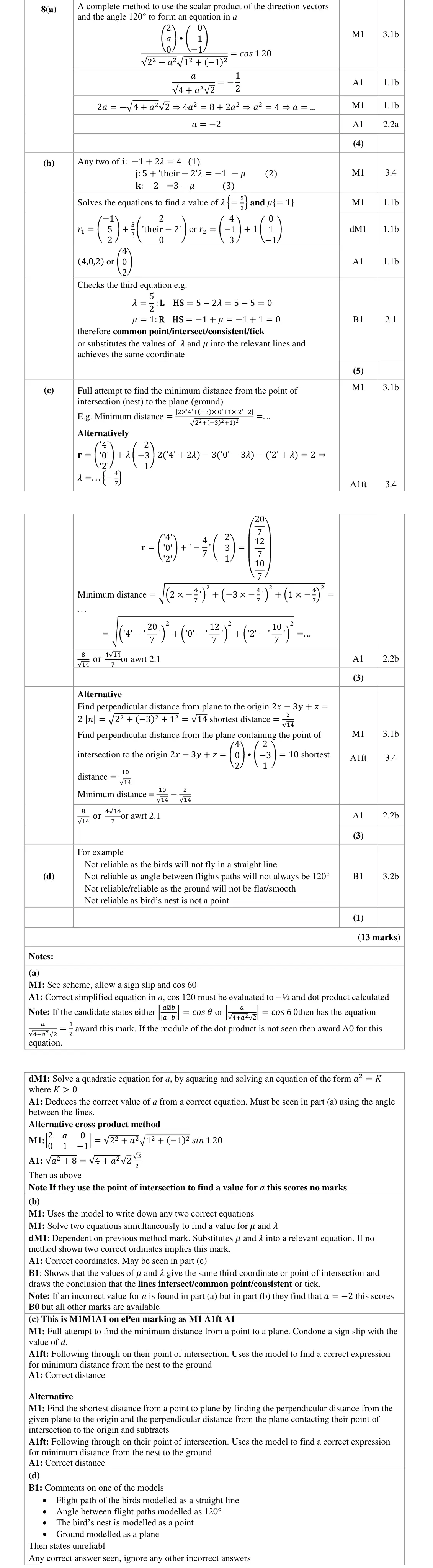
June 2022 · Paper 2 (Core Pure 2) · Q8(a)4 marks
Mark scheme (whole question; this part is marked with the orange bar)
Examiner's comment
This question on a vector model was well-answered although completely correct solutions across all question parts were not that common. Most knew how to use the scalar product to set up an equation in part (a) although the acute angle between the flight paths was used on occasion. Most solved their equation correctly but many responses did not identify that it was the negative value of a that was required.
Key points from the mark scheme and examiner's report
scalar product of the direction vectors with cos 120° = −½
squaring gives a² = 4 and a = −2 must be chosen (many did not reject +2)
using the acute angle 60° was an error
June 2022 · Paper 2 (Core Pure 2) · Q8(b)5 marks
Mark scheme (whole question; this part is marked with the orange bar)
Examiner's comment
This question on a vector model was well-answered although completely correct solutions across all question parts were not that common. Part (b) was very well done on the whole. Most knew to equate the components of the two lines and the correct coordinates of the nest were widely seen. However, a significant number did not perform an appropriate check on the consistency of their equations.
Key points from the mark scheme and examiner's report
solve two component equations: λ = 5/2, μ = 1, then check the third equation for consistency and conclude (check often missing)
common point (4, 0, 2)
June 2022 · Paper 2 (Core Pure 2) · Q8(d)1 mark
Mark scheme (whole question; this part is marked with the orange bar)
Examiner's comment
This question on a vector model was well-answered although completely correct solutions across all question parts were not that common. The mark in part (d) was not widely scored. Many said “reliable” or “unreliable” based on their assessment of the reasonableness of the actual distance found in part (c). However, the best students did identify an appropriate reason, usually that the model was unreliable due to its assumptions that birds fly in a straight line or that the ground was being modelled as a plane or the nest will not be a particle. Candidates are reminded to reread the question and look where the modelling takes place.
Key points from the mark scheme and examiner's report
not reliable because e.g. birds do not fly in straight lines, the ground is not a flat plane, the nest is not a point
judging reliability by the size of the distance scored 0
Nov 2021 · Paper 1 (Core Pure 1) · Q7(a)2 marksMedium
Mark scheme (whole question; this part is marked with the orange bar)
Examiner's comment
There was a step up in difficulty from this question in the paper, perhaps a tail off towards the end of the exam, but the performance was not as high on the next (a) Only a third of candidates scored both marks in this part, with just over 40% accessing the method mark. Fortunately, a minimal conclusion was adequate for the A mark which limited the tail off. Some just found the scalar product with one of the direction vectors, others showed no calculations. A small number used the vector product, though marks were not available if no calculation was shown.
Key points from the mark scheme and examiner's report
scalar product with BOTH direction vectors = 0 with working shown, plus a conclusion
Nov 2021 · Paper 1 (Core Pure 1) · Q7(b)2 marksMedium
Mark scheme (whole question; this part is marked with the orange bar)
Examiner's comment
There was a step up in difficulty from this question in the paper, perhaps a tail off towards the end of the exam, but the performance was not as high on the next questions. For this question 51% for the M mark in (b) was the best performing trait, and the only one over 50% scored. (b) This was very better attempted, though surprisingly not as well done as might have been expected. A little over half scored the M for knowing the correct procedure, with just over 40% scoring both marks.
Key points from the mark scheme and examiner's report
r.n = a.n: 2x + 3y − 4z = 7
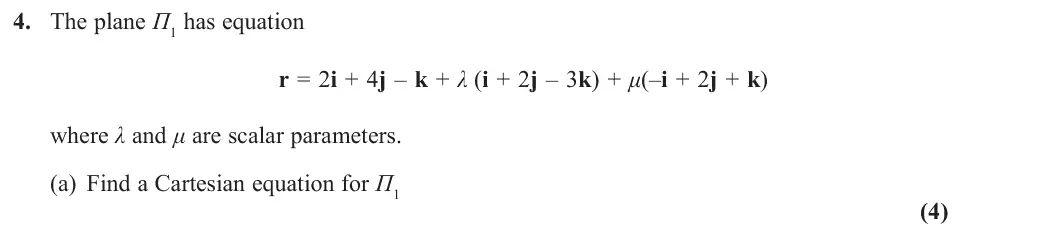
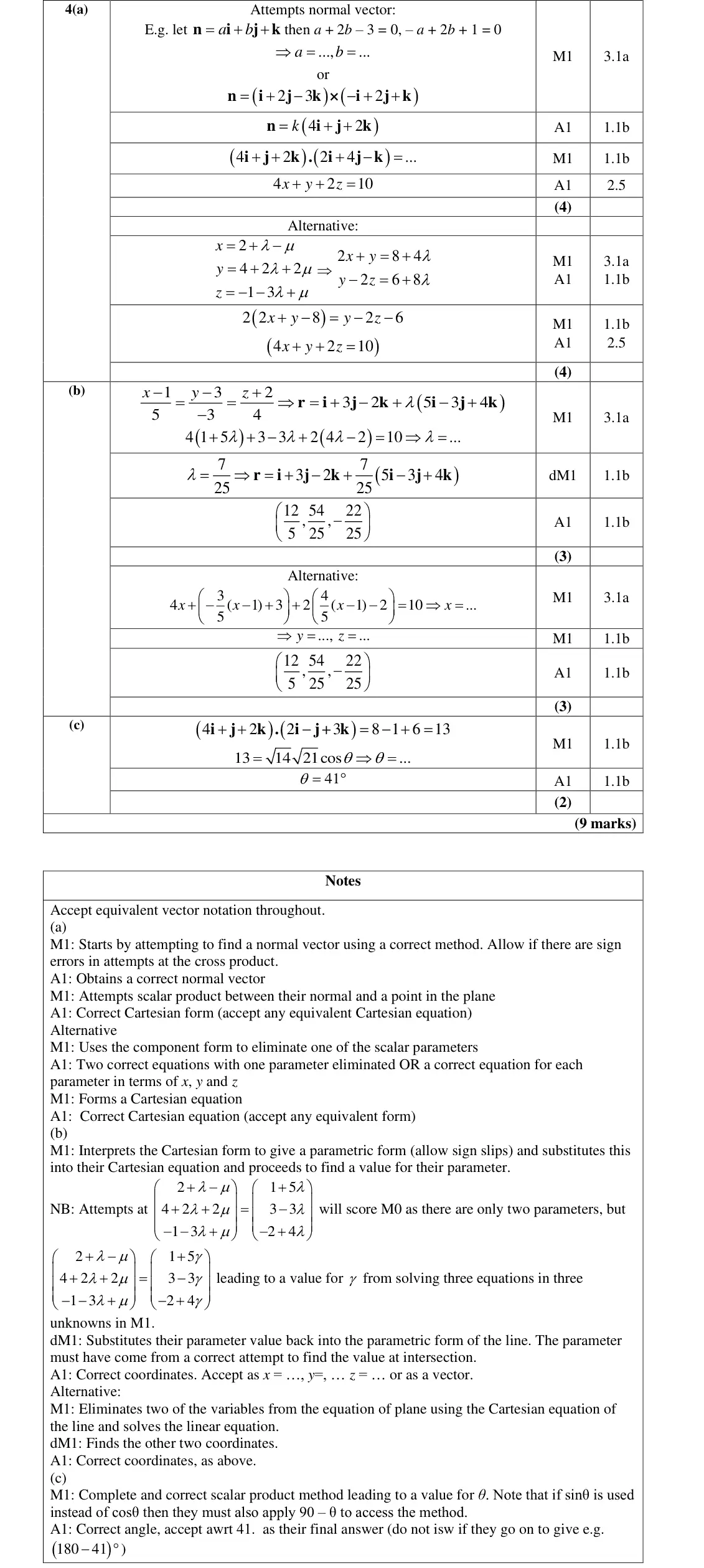
Oct 2020 · Paper 1 (Core Pure 1) · Q4(a)4 marks
Mark scheme (whole question; this part is marked with the orange bar)
Examiner's comment
(a) There were some pleasing responses to this vector question, with many gaining full marks. A popular approach to finding the normal vector to the plane was to use the vector product, although there were a few sign errors. The rest used a scalar product method to find the normal. A few used the Cartesian forms to eliminate one of the scalar parameters, although these often got bogged down with the algebra. Some gave the final answer in scalar product form, losing the last A mark. There were many who were very confused and gained no marks in (a) use this method. Those who had not managed to do part (a) were still able to gain full marks (c) Provided they had found a normal to their plane in part (a), they were then able to apply a correct scalar product method to find the angle between the two planes. However, a few went on to find the wrong angle after a correct application of the dot product, by subtracting from90º. Some were very confused here and methods which were not considering the normal vectors to each plane gained no marks.
Key points from the mark scheme and examiner's report
normal by cross product or scalar products: n = 4i + j + 2k
r.n = a.n gives 4x + y + 2z = 10 (Cartesian, not r.n form)
sign errors in the cross product
Oct 2020 · Paper 1 (Core Pure 1) · Q4(c)2 marks
Mark scheme (whole question; this part is marked with the orange bar)
Examiner's comment
(c) Provided they had found a normal to their plane in part (a), they were then able to apply a correct scalar product method to find the angle between the two planes. However, a few went on to find the wrong angle after a correct application of the dot product, by subtracting from90º. Some were very confused here and methods which were not considering the normal vectors to each plane gained no marks.
Key points from the mark scheme and examiner's report
angle between the normals: cos θ = 13/(√21 √14), θ = 41°
do not subtract from 90°
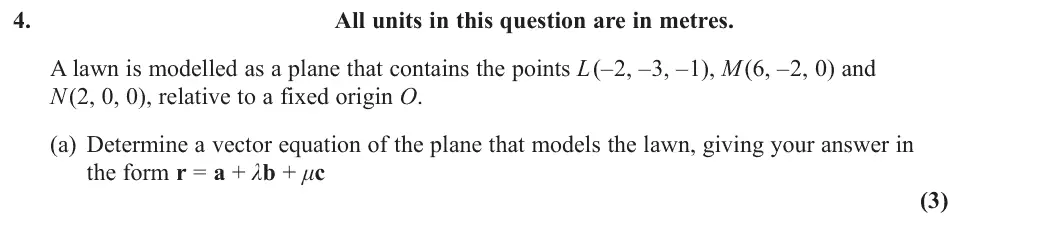
Oct 2020 · AS Paper 1 (Core Pure) · Q4(a)3 marks
Mark scheme (whole question; this part is marked with the orange bar)
Examiner's comment
It was pleasing to see that the large majority of candidates attempted at least parts of this question. r Part (a) was answered correctly by most candidates. Only a very small handful omitted a couple didn't find direction vectors at all and others made an arithmetic error in one of the direction vectors.
Key points from the mark scheme and examiner's report
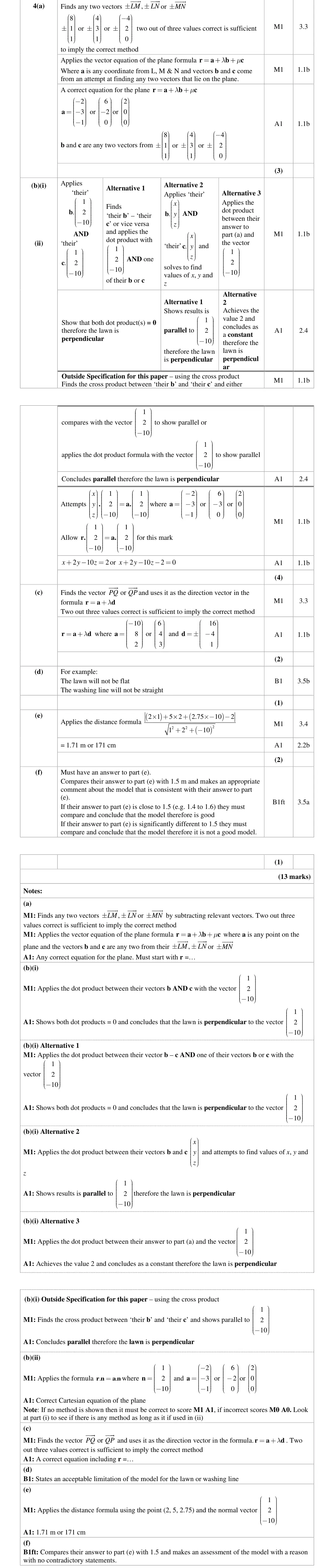
two direction vectors from LM, LN, MN, e.g. (8, 1, 1), (4, 3, 1)
r = a + λb + μc with a point of the plane
must begin r =
Oct 2020 · AS Paper 1 (Core Pure) · Q4(b)4 marks
Mark scheme (whole question; this part is marked with the orange bar)
Examiner's comment
It was pleasing to see that the large majority of candidates attempted at least parts of this question. Part (b) (i) and (ii) were not so successful. The large majority attempted the main scheme though just under half failed to show the vector was perpendicular to both direction vectors. A small number of candidates attempted alternate 1 or 2 method, all being successful in gaining the method mark but not having a conclusion lost them the accuracy mark.
Key points from the mark scheme and examiner's report
(i) scalar product with BOTH direction vectors = 0, then conclude perpendicular (about half showed only one)
(ii) r.(1, 2, −10) = a.(1, 2, −10): x + 2y − 10z = 2
Oct 2020 · AS Paper 1 (Core Pure) · Q4(c)2 marks
Mark scheme (whole question; this part is marked with the orange bar)
Examiner's comment
It was pleasing to see that the large majority of candidates attempted at least parts of this question. r Part (c) was answered very well though some failed to gain the A mark through loss of
Key points from the mark scheme and examiner's report
direction PQ = (16, −4, 1)
r = (−10, 8, 2) + λ(16, −4, 1)
Oct 2020 · AS Paper 1 (Core Pure) · Q4(d)1 mark
Mark scheme (whole question; this part is marked with the orange bar)
Examiner's comment
It was pleasing to see that the large majority of candidates attempted at least parts of this question. Part (d) was answered very well with the majority of candidates commenting on how washing would make the line not straight or that the lawn would not be flat.
Key points from the mark scheme and examiner's report
lawn not flat
washing line not straight (sags)
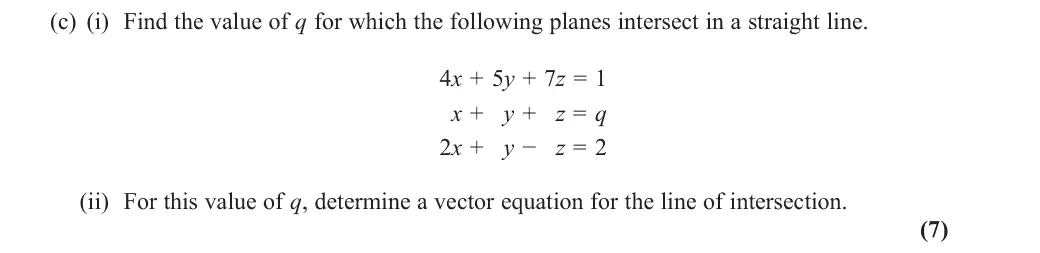
Oct 2020 · Paper 2 (Core Pure 2) · Q6(c)7 marks
Mark scheme (whole question; this part is marked with the orange bar)
Examiner's comment
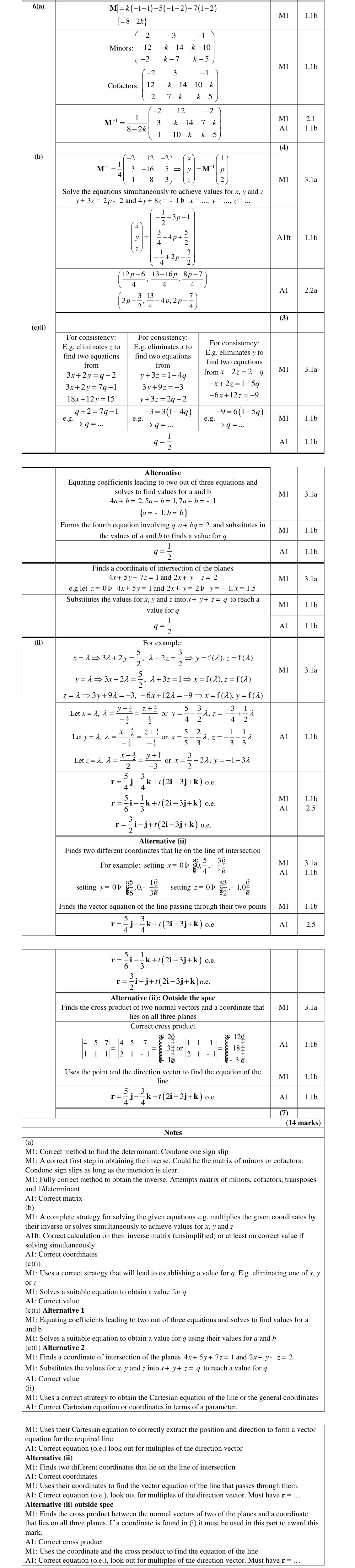
Part (c) The part was only done successfully by a handful of candidates. Many candidates did not attempt this part. (i) a few eliminated a variable to fid two equations and formed an equation for q. An alternative method was to find a point of intersection by letting for example x = 1 and then using this to find a value for q (ii) Very few attempted this part. Correct answers were rarely seen using let x l = and finding y an z in terms of l and went on to find a correct vector equation of the line.
Key points from the mark scheme and examiner's report
M is singular for k = 4, so eliminate a variable to get two equations and a consistency condition: q = ½
(ii) set x = λ (or y or z) to get a parametric line, e.g. r = (3/2)i − j + t(2i − 3j + k)
rarely completed
June 2019 · Paper 1 (Core Pure 1) · Q7(a)3 marks
Mark scheme (whole question; this part is marked with the orange bar)
Examiner's comment
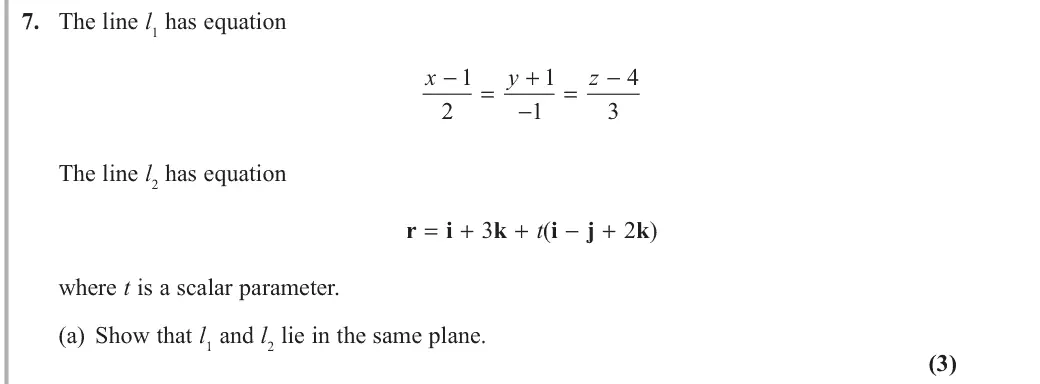
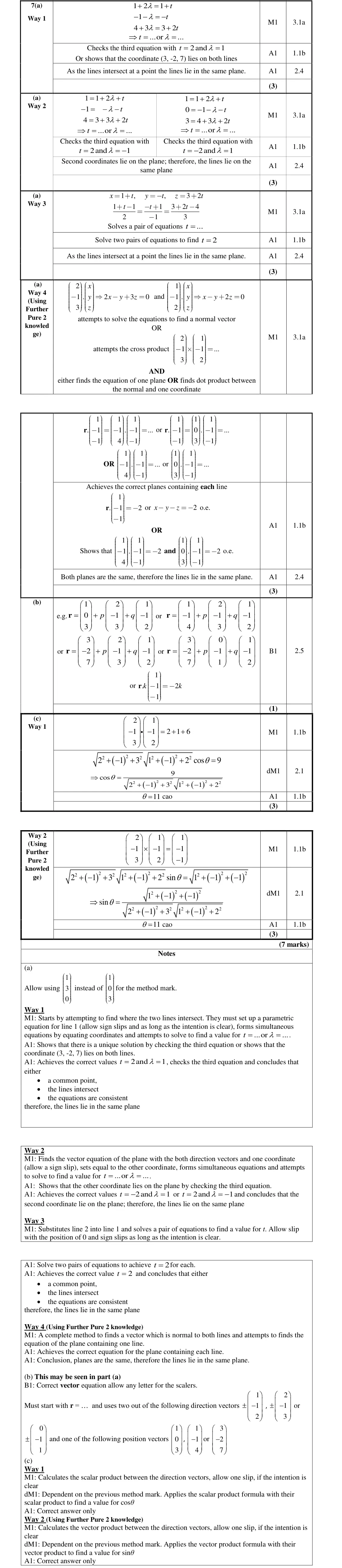
Part (a) Candidates generally either chose to try to show that the lines intersected at a point or tried to find a vector which was perpendicular to both lines. Those candidates who tried to show that the lines intersected generally set up three equations and tried to solve one pair of them. Some candidates then failed to use their solution in the third equation and a significant number then failed to make a full conclusion. Those candidates who tried to find a perpendicular vector generally managed to do so, typically using the cross product, but then failed to use this with the coordinate points to find the equation of the plane show that both lines lay on the plane. Many candidates failed to achieve the final mark as they did not give a reason why the lines lie in the same plane i.e. point of intersection
Key points from the mark scheme and examiner's report
equate the lines, solve two equations (t = 2, λ = 1) and check the third
intersect at (3, −2, 7) so coplanar
final conclusion often missing
June 2019 · Paper 1 (Core Pure 1) · Q7(b)1 mark
Mark scheme (whole question; this part is marked with the orange bar)
Examiner's comment
(b) Most candidates gave a correct form for the equation of the plane, but a significant number lost this mark because they failed to write as an equation r = ... (many incorrectly wrote pi =…)
Key points from the mark scheme and examiner's report
r = position vector of a point + p(2i − j + 3k) + q(i − j + 2k)
must be written as r = …, not π = …
June 2019 · Paper 1 (Core Pure 1) · Q7(c)3 marks
Mark scheme (whole question; this part is marked with the orange bar)
Examiner's comment
(c) Most candidates successfully used the dot product to obtain the correct value for cos theta but some failed to give their answer to the nearest degree or used arcsin instead of arccos.
Key points from the mark scheme and examiner's report
scalar product of the direction vectors: cos θ = 9/√(14 × 6), θ = 11°
using arcsin or not rounding to the nearest degree
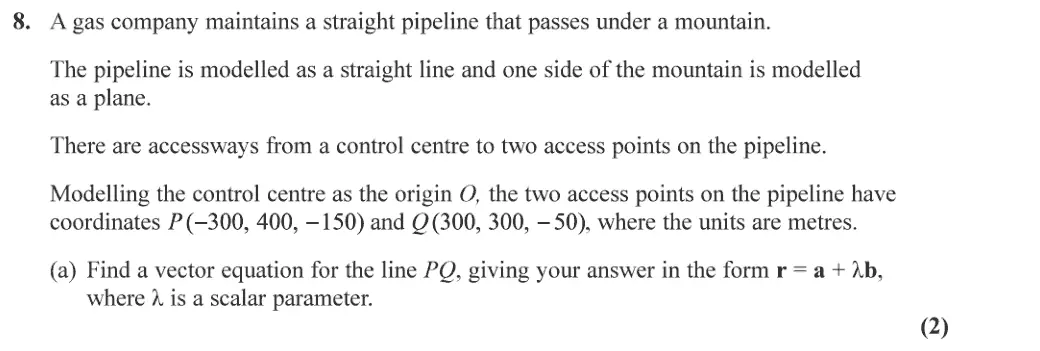
June 2019 · AS Paper 1 (Core Pure) · Q8(a)2 marks
Mark scheme (whole question; this part is marked with the orange bar)
Key points from the mark scheme and examiner's report
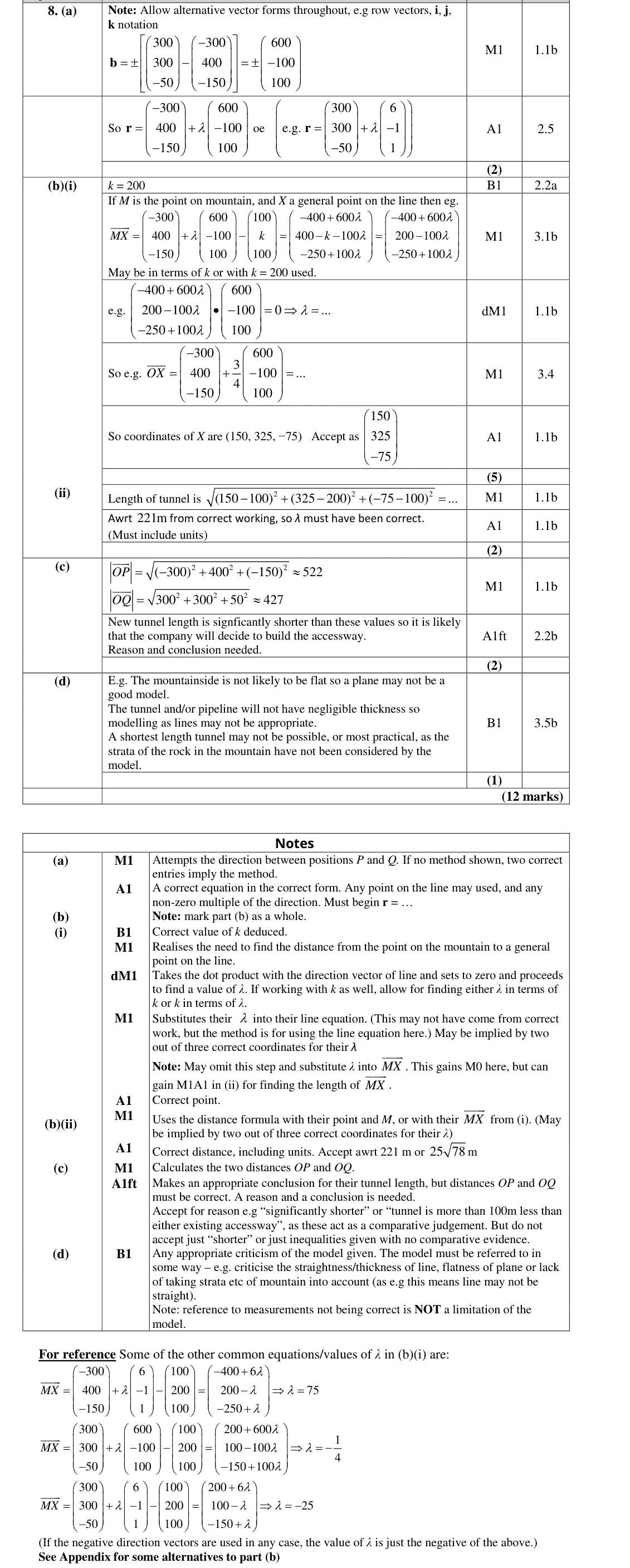
direction PQ = (600, −100, 100)
r = (−300, 400, −150) + λ(6, −1, 1)
must start r =
June 2019 · AS Paper 1 (Core Pure) · Q8(c)2 marks
Mark scheme (whole question; this part is marked with the orange bar)
Key points from the mark scheme and examiner's report
OP ≈ 522 m, OQ ≈ 427 m
new tunnel 221 m is significantly shorter so build it
reason and conclusion needed
June 2019 · AS Paper 1 (Core Pure) · Q8(d)1 mark
Mark scheme (whole question; this part is marked with the orange bar)
Key points from the mark scheme and examiner's report
mountainside not flat so a plane is a poor model
pipe/tunnel have thickness
rock strata ignored
inaccurate measurements is not a limitation of the model
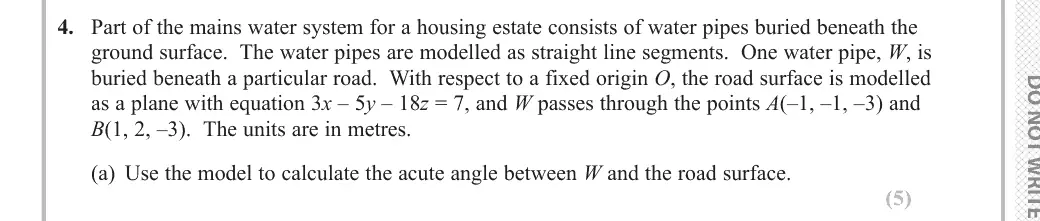
June 2018 · AS Paper 1 (Core Pure) · Q4(a)5 marks
Mark scheme (whole question; this part is marked with the orange bar)
Examiner's comment
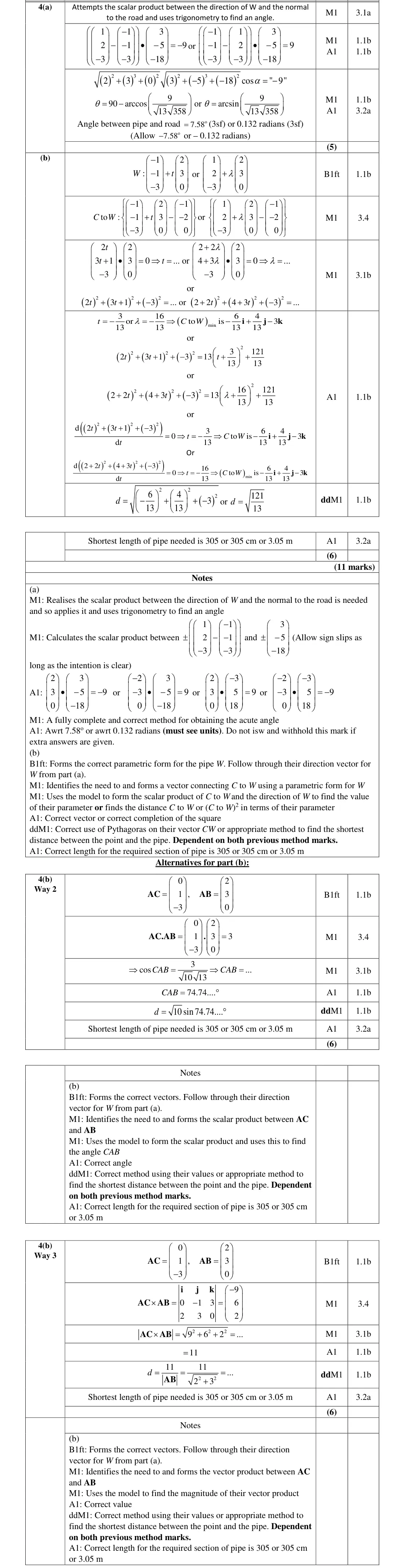
(a) Most students appreciated the strategy needed to solve the problem and use the scalar product to find an angle between the normal vector and the direction of W. Unfortunately, many could not then find the required acute angle – a clear diagram would have helped them to visualise which angle was required. A common error was to subtract the result of their inverse cosine from 180°. Those using sine were usually more successful here. A few found the correct angle but failed to give it to the correct accuracy or to indicate degrees or radians and hence lost the final mark.
Key points from the mark scheme and examiner's report
angle between line and plane: scalar product of direction (2, 3, 0) with normal then 90° − arccos or use arcsin
7.58° (0.132 rad), units needed
subtracting from 180° was common
Find an Edexcel Further Maths tutor
Stuck on this? Book a trial lesson with our Further Maths tutor.