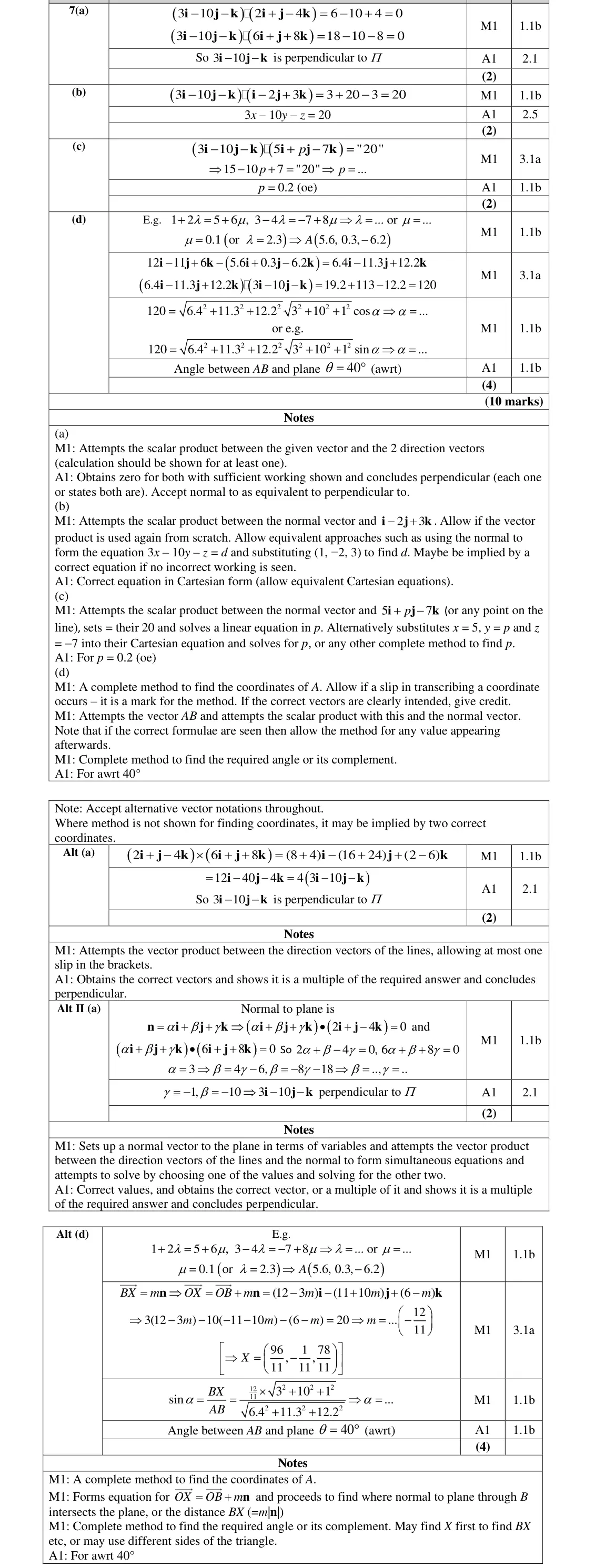
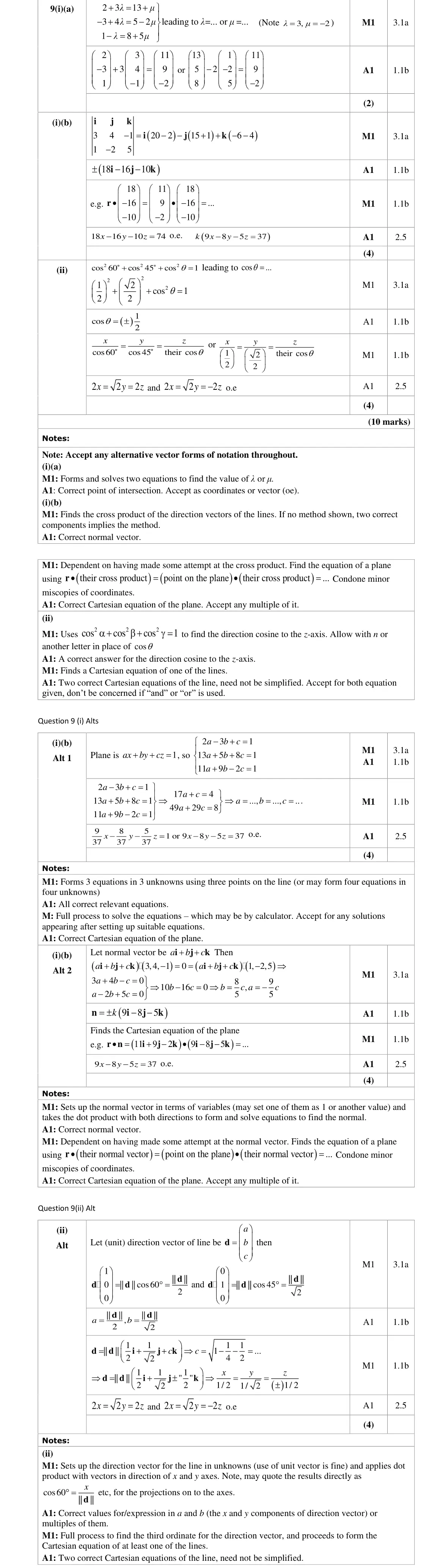
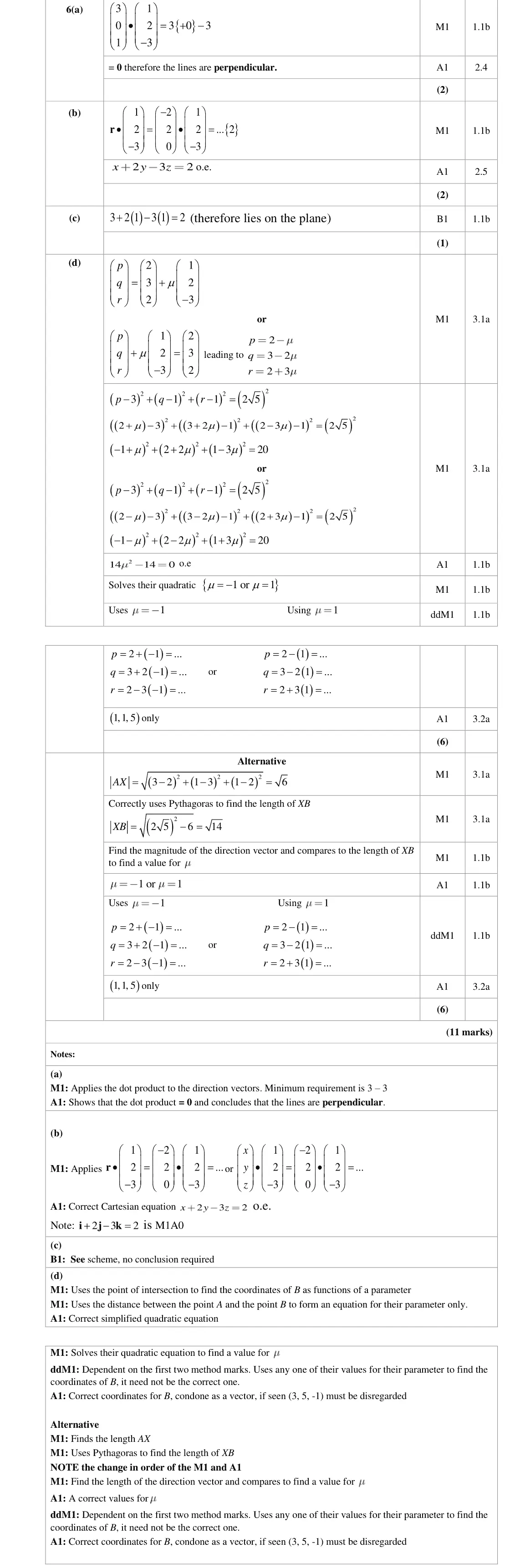
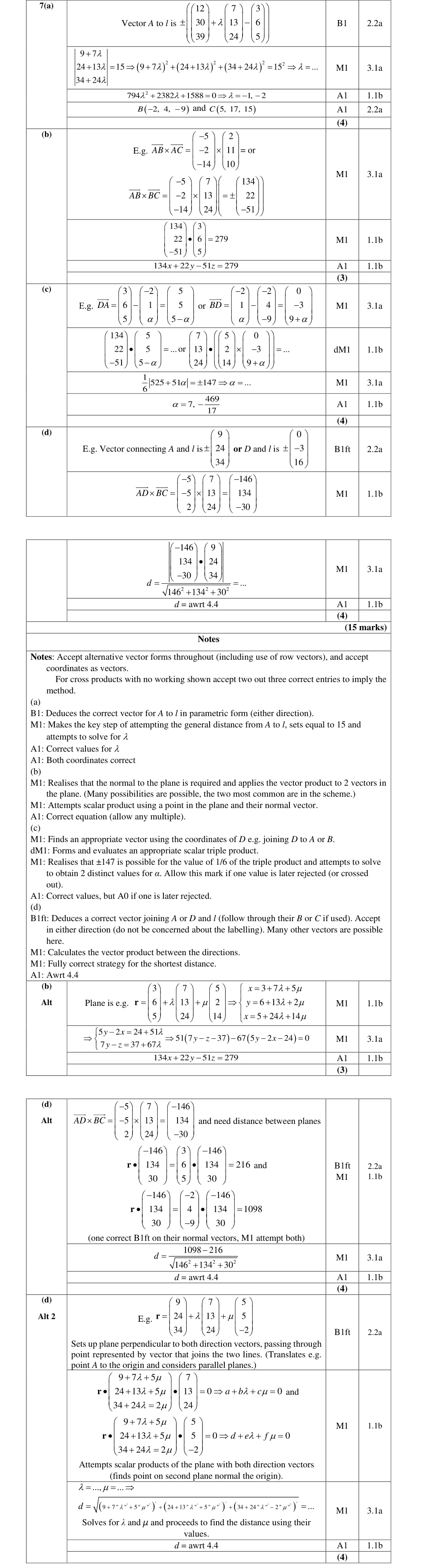
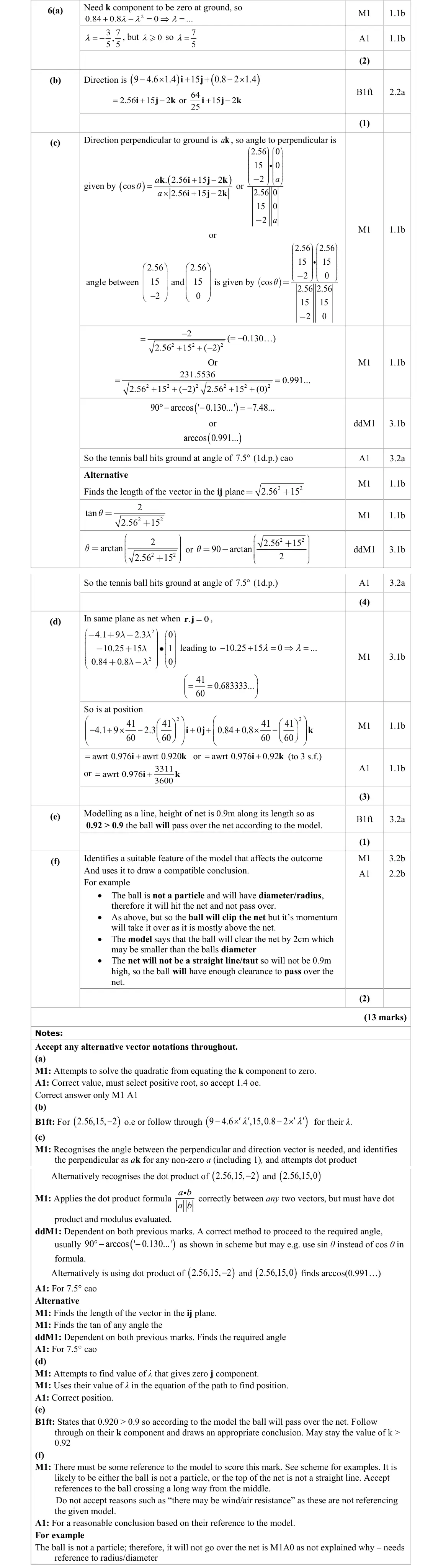
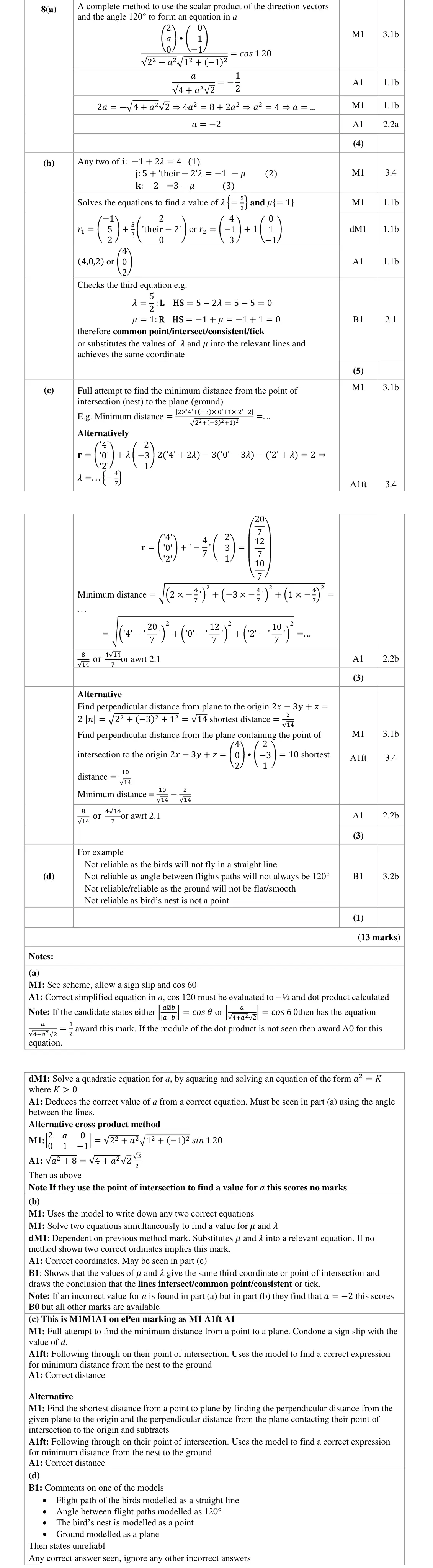
Mark scheme (whole question; this part is marked with the orange bar)
Examiner's comment
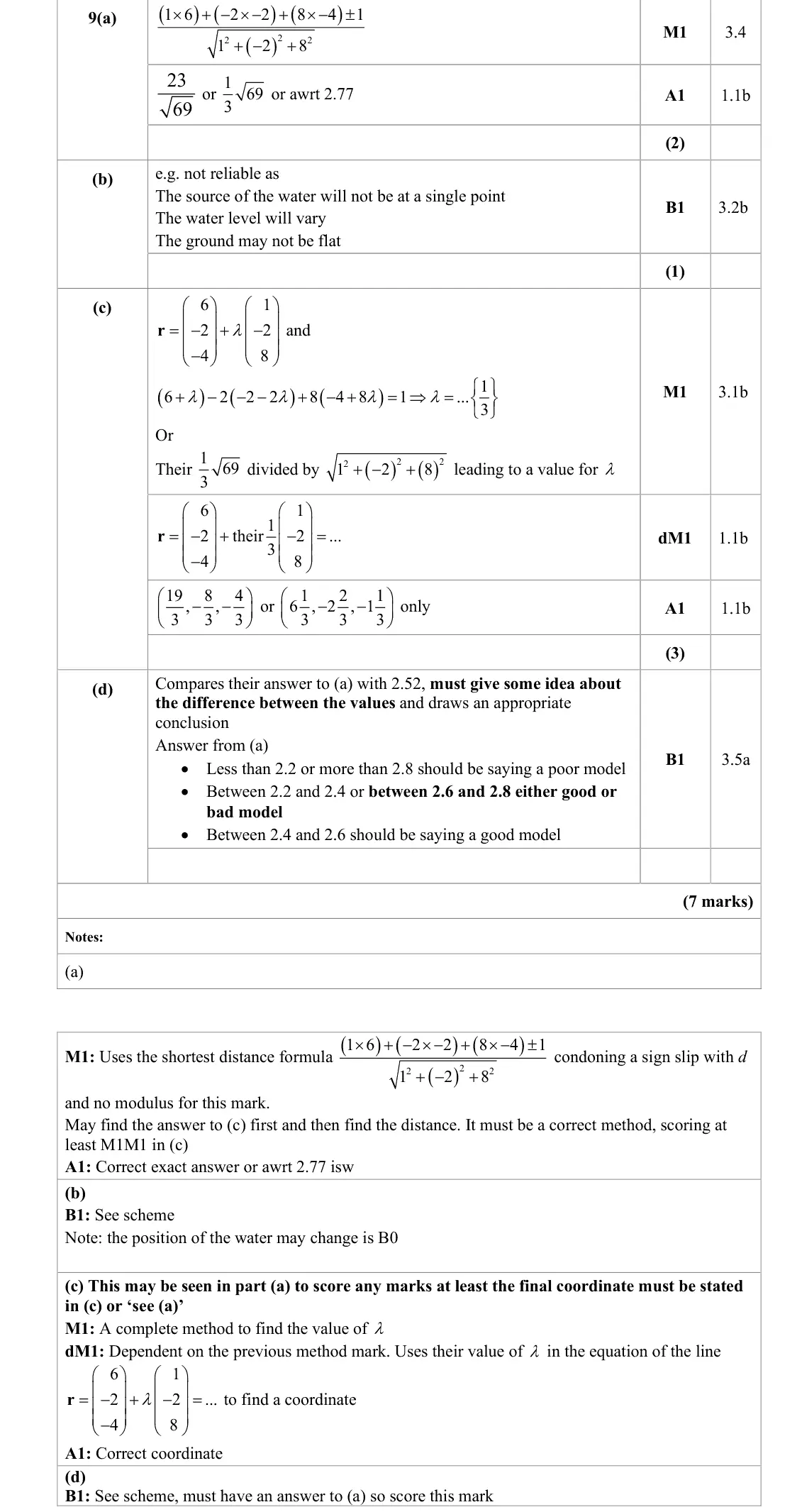
This question was well answered with many completely correct solutions. Part (c) was usually well answered. Only rarely did learners resort to decimals in their final answers. An error when substituting the parametric form of the point into the plane was to equate the scalar product to 1 rather than 0 so losing all marks in this part.
Key points from the mark scheme and examiner's report
line through W along the normal (1, −2, 8) meets the plane at λ = 1/3: P = (19/3, −8/3, −4/3)
June 2025 · AS Paper 1 (Core Pure) · Q10(a)2 marks
Mark scheme (whole question; this part is marked with the orange bar)
Examiner's comment
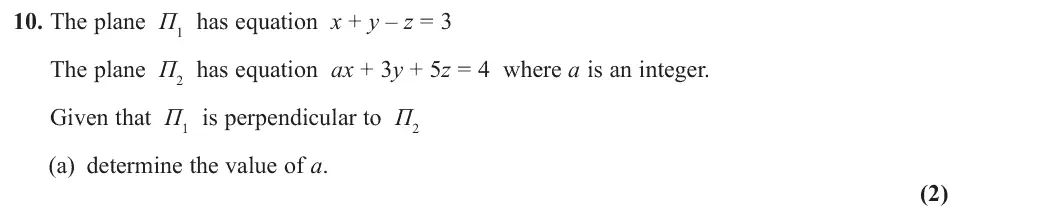
In part (a), the vast majority of the learners recognised the need to equate the scalar product of the two normal vectors to zero and thus correctly found the value of a.
Key points from the mark scheme and examiner's report
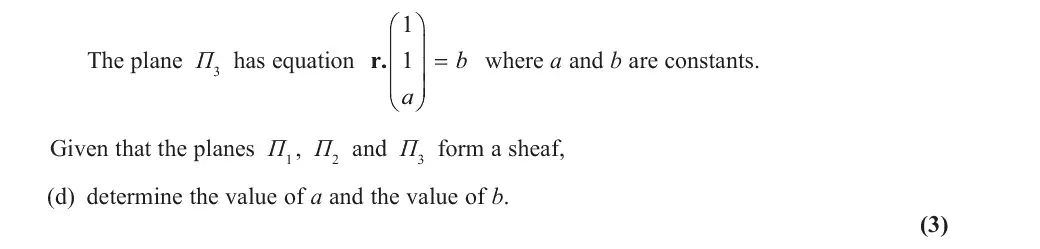
normals perpendicular: (1, 1, −1).(a, 3, 5) = a − 2 = 0, a = 2
June 2025 · AS Paper 1 (Core Pure) · Q10(b)6 marks
Mark scheme (whole question; this part is marked with the orange bar)
Examiner's comment
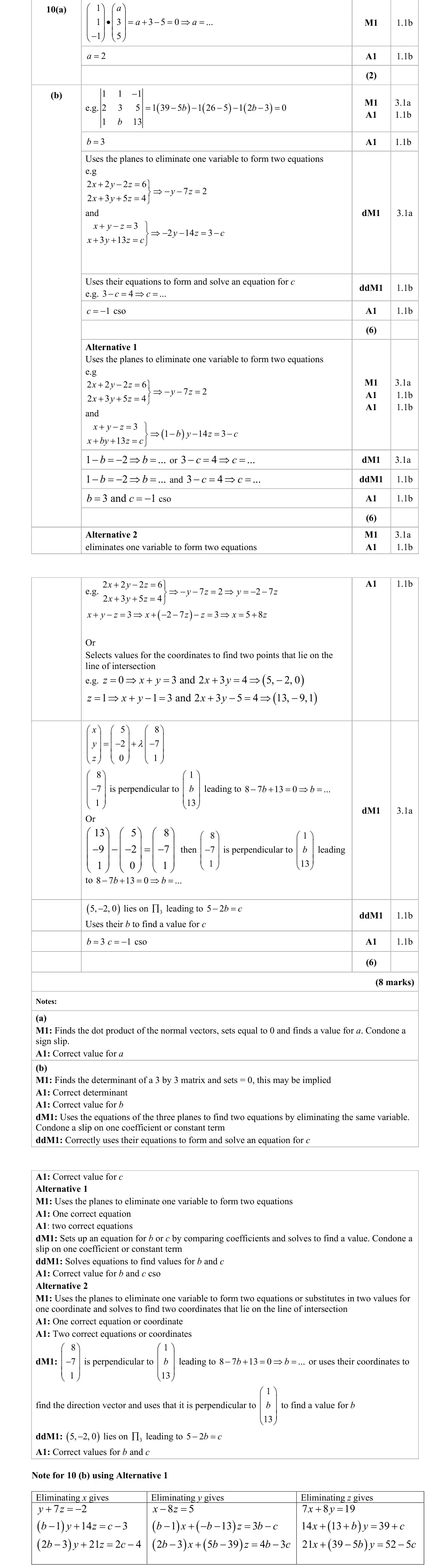
In part (b), the method used to find b was equally split between those who used the determinant of the 3x3 matrix formed from the normal vectors of the three planes and those who used the three plane equations to form two equations by eliminating one of the variables x, y or z. Either way, much success was achieved in finding both b and c but there was clear evidence that some of the learners were unclear of the definition of a sheaf and thus made little progress in their solution.
Key points from the mark scheme and examiner's report
sheaf: det of normals = 0 gives b = 3
eliminate a variable to get matching equations (−y − 7z = 2 and −2y − 14z = 3 − c): c = −1
confusion over what a sheaf means
June 2024 · AS Paper 1 (Core Pure) · Q6(b)2 marks
Mark scheme (whole question; this part is marked with the orange bar)
Examiner's comment
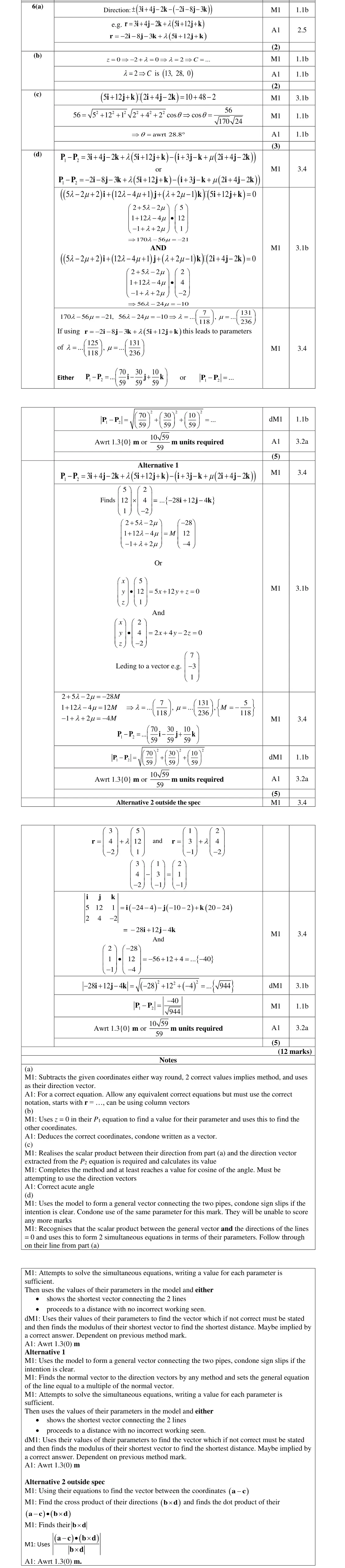
In part (b), nearly all of the cohort recognised the need to equate the k component of r to zero and hence find the i and j components.
Key points from the mark scheme and examiner's report
z = 0 gives λ = 2: (13, 28, 0)
June 2024 · Paper 1 (Core Pure 1) · Q7(b)2 marks
Mark scheme (whole question; this part is marked with the orange bar)
Examiner's comment
Although vectors is not a favoured topic with candidates the first three parts of this question proved accessible to most, with the final part discriminating between the better candidates. Notation throughout was generally very good, with either column vectors or the i, j and k forms used, or coordinates where appropriate. For part (b) the method mark was almost always scored by those who made some attempt at the part, though a few did use one of the direction vectors instead of a point on the line. There was the occasional arithmetic error, for example reaching 26 rather than 20, but usually the calculation was correct. The accuracy was also often lost by a candidate leaving their answer in vector rather than Cartesian form, not adhering to the instruction in the question.
Key points from the mark scheme and examiner's report
r.n = a.n using a point on l₁ (not a direction vector): 3x − 10y − z = 20
June 2024 · Paper 1 (Core Pure 1) · Q7(c)2 marks
Mark scheme (whole question; this part is marked with the orange bar)
Examiner's comment
Although vectors is not a favoured topic with candidates the first three parts of this question proved accessible to most, with the final part discriminating between the better candidates. Notation throughout was generally very good, with either column vectors or the i, j and k forms used, or coordinates where appropriate. It was rare to see errors in part (c), with most able to get the correct value of p, even in some instances where an incorrect equation had been found because they went back to use a correct vector. Occasionally a candidate would fail to solve a correct linear equation in p, but this was rare. There were also some who managed to correctly find p from work in part (d), without having attempted the plane equation at all.
Key points from the mark scheme and examiner's report
the point (5, p, −7) on l₂ satisfies the plane equation: p = 0.2
June 2024 · Paper 3A (Further Pure 1) · Q9(i)(b)4 marks
Mark scheme (whole question; this part is marked with the orange bar)
Examiner's comment
The first two part of this question was well answered while the second part proved far more challenging and discriminating. This is no doubt to do with the fact that part (i) is very familiar vectors work from long standing, while part (ii) contains mathematics novel to the newer specification, which has not been tested in great depth thus far. In part (i)(a), the strategy for finding the intersection point of the two lines was well know. Candidates equated the two parametrised forms of the two lines and solved to find one, or both, of the parameters. Most clearly used a calculator to solve their simultaneous equations and this was an acceptable method for solution. It was pleasing to see candidates checking their work by verifying that the values of their parameters satisfied the third equation that was unused in their solution. There were occasional slips in substitution to achieve the position of the point of intersection, but the majority of solutions to this part were correct and completed with little fuss. Likewise for part (i)(b) most were able to speedily find the normal vector and proceed t the equation of the plane. The usual method of solution to find the equation of the plane was to find the vector product of the direction vectors of the two lines and then to use the r.n=a.n form of the equation of the plane before writing the equation in a Cartesian form, although sometimes the last mark in this part was lost because a Cartesian form was not given. The cross product was completed very well, with only very few making errors, and so the correct equation usually resulted. Occasionally candidates would use an incorrect vector for a, using a direction vector instead of point on the plane, but again these were a minority. It was rare to see an alternative approach using the Cartesian form of the plane from the outset, and when it was used it was far more prone to error in the solution of the equations. Part (ii) of the question proved more demanding for candidates with many not having a clear strategy for proceeding and was the part that was more often simply omitted by candidates than any other part of any question on the paper. It was rare to see the approach using direction cosines from the outset. This unfamiliar topic has yet to be taken on board and those who were aware of it were in the minority. Those who did use the direction cosines generally managed to get as far as cos theta = 1 2 but were not always able to make the step from here to a Cartesian equation for the line. Indeed, many seemed unsure of what the Cartesian equation for a line is, attempting plane equations instead. Most candidates opted for using the projection on to the coordinate axes approach, using the dot product, but working was often not clearly presented and after setting up correct equations there was again often no progression to a Cartesian equation. Solutions often got the first two marks and then proceeded no further. There were, nevertheless, some fully correct solutions via both methods, where the candidates showed a good understanding of the equations of lines in 3 dimensions and how to find them. But overall, even among the A* candidates, the latter two marks in this question were ones that were highly likely to prevent full marks on the paper.
Key points from the mark scheme and examiner's report
normal = (3, 4, −1) × (1, −2, 5) = (18, −16, −10)
r.n = a.n with a point on the plane: 9x − 8y − 5z = 37
Cartesian form required
using a direction vector as the point
June 2023 · AS Paper 1 (Core Pure) · Q6(b)2 marks
Mark scheme (whole question; this part is marked with the orange bar)
Examiner's comment
This was another good question with the first three parts being accessed by the majority with part (d) providing a good level of challenge. In part (b), this part was also well answered although some candidates left their answer as a scalar equation, other errors were to attempt the Cartesian equation of a line. Those who proceeded to a cartesian equation most likely did so correctly with either achieving 2 3 2 x y z + - = or 2 3 2 0 x y z + - - = In part (c), those who obtained both marks in (b) typically also obtained the mark here, it was pleasing to see that most gave a minimal conclusion, though that was not necessary for this mark.
Key points from the mark scheme and examiner's report
leaving it in vector form or giving a line equation lost marks
June 2023 · AS Paper 1 (Core Pure) · Q6(c)1 mark
Mark scheme (whole question; this part is marked with the orange bar)
Examiner's comment
This was another good question with the first three parts being accessed by the majority with part (d) providing a good level of challenge. In part (c), those who obtained both marks in (b) typically also obtained the mark here, it was pleasing to see that most gave a minimal conclusion, though that was not necessary for this mark.
Key points from the mark scheme and examiner's report
3 + 2 − 3 = 2
June 2023 · Paper 1 (Core Pure 1) · Q5(c)2 marks
Mark scheme (whole question; this part is marked with the orange bar)
Examiner's comment
This question yielded a varied range of mark profiles and also saw a wide variety of methods employed in the different parts of the question. In part (c), relatively few students used their working from part (b) to establish a second point on the line of intersection of the two planes, which enabled the equation of the line of intersection to be found very efficiently. Instead, there was a wide variety of (quite time consuming) attempts, many using a vector cross product to find the vector equation of the second plane and solve this simultaneously with the first. Many such attempts, however, stopped short of providing a vector equation of a line and so did not score any marks. Often seen amongst the successful attempts was the relatively efficient method of using the vector product twice; first using the direction vectors of the two reflected lines to find the normal to plane 2, then once again using this normal vector with the normal to plane 1 to find the direction vector of the line of intersection. The vector product is not on the specification, but its use was entirely acceptable.
Key points from the mark scheme and examiner's report
best: the point found in (b) on the line through (−5, −4, 3) gives a second common point
r = (−7, 2, −7) + λ(1, 0, 1) o.e.
many lengthy vector-product attempts never reached a line equation
June 2023 · Paper 1 (Core Pure 1) · Q5(d)3 marks
Mark scheme (whole question; this part is marked with the orange bar)
Examiner's comment
This question yielded a varied range of mark profiles and also saw a wide variety of methods employed in the different parts of the question. Many candidates were unsure of what to do in part (d) and did not attempt a solution. A common method was finding (often using earlier work) the vector equation of the second plane, then using consistency arguments by considering a linear combination of the equations of the three planes. Others candidates who had also established the three equations of the planes used a determinant method to find the value of a. However, these candidates were often unsure how to proceed to find the value of b. Again, the easier methods were seen quite rarely. Those with two points on the line of intersection were able to find the values of a and b very efficiently by substituting these position vectors into the equation of the third plane. A few candidates recognised that the normal to the third plane was perpendicular to the direction vector of their line of intersection found in part (c) and they used the scalar product to find the value of a. These candidates usually went on to use a point on the line of intersection to find b.
Key points from the mark scheme and examiner's report
a sheaf means the line from (c) lies in Π₃: direction perpendicular to (1, 1, a) gives a = −1, a point on it gives b = 2
often not attempted
determinant routes found a but stalled on b
June 2023 · Paper 3A (Further Pure 1) · Q7(b)3 marks
Mark scheme (whole question; this part is marked with the orange bar)
Examiner's comment
Easily the most challenging question of the paper, with many students unable to make progress, especially in the latter parts. However, there were still many who were able to successfully complete the whole question, so there was little evidence time was an issue, but mainly the low scores were due to very poor attempts with students unable to determine what was required. Vectors is, and will continue to be, one of the most demanding subjects for students. However, the majority were able to make some progress in places, though only the higher-grade students could access part (d). The techniques involved throughout seemed to be well known to many, with formulae quoted for various parts. However, in many cases these were not always employed to good effect, but sometimes just stated without the students working out the relevant vectors needed to use in them. It would help the understanding of a solution if students clearly stated which vectors they were using in their attempted solution. The method of evaluating cross products was well demonstrated by the majority, but there were a lot of arithmetic errors, sign errors and poor notation during the workings and simplifications, even for students who knew the required steps. As the question progressed, workings became scrappier as students struggled to find their way through, and possibly hurried to finish the paper, with many attempting dot and cross products of any vector they could find just in case it helped. Part (b) was done reasonably well with many fully correct solutions seen, and many scoring both methods where errors had led to incorrect coordinates for B and C. Common errors were to use vectors OA and OB rather than AB and AC, while some gave the answer in a vector form rather than in the required Cartesian form. There were also a few students who gave the plane in the alternative vector form shown in the alternative method, but did not attempt to convert into Cartesian form, so scored no marks.
Key points from the mark scheme and examiner's report
normal AB × AC (or AB × BC) = multiple of (134, 22, −51)
134x + 22y − 51z = 279
June 2022 · AS Paper 1 (Core Pure) · Q6(d)3 marks
Mark scheme (whole question; this part is marked with the orange bar)
Examiner's comment
This question, which required candidates to work with a model of a tennis ball, proved quite challenging for candidates and tested their ability to apply vector methods to a real-life scenario. There was a great deal of confusion between the position vector of the tennis ball and the direction vector for which it was moving, and less confident students mixed these up frequently. Part (d) was similarly mixed for the same reasons as the errors in (b), although some candidates picked up the second method mark for using their new value of λ in the correct vector expression. Some candidates lost the final accuracy mark due to calculation errors or a lack of accuracy in the i component.
Key points from the mark scheme and examiner's report
r.j = 0 gives −10.25 + 15λ = 0, λ = 41/60
position awrt 0.976i + 0.920k
June 2022 · Paper 2 (Core Pure 2) · Q8(d)1 mark
Mark scheme (whole question; this part is marked with the orange bar)
Examiner's comment
This question on a vector model was well-answered although completely correct solutions across all question parts were not that common. The mark in part (d) was not widely scored. Many said “reliable” or “unreliable” based on their assessment of the reasonableness of the actual distance found in part (c). However, the best students did identify an appropriate reason, usually that the model was unreliable due to its assumptions that birds fly in a straight line or that the ground was being modelled as a plane or the nest will not be a particle. Candidates are reminded to reread the question and look where the modelling takes place.
Key points from the mark scheme and examiner's report
not reliable because e.g. birds do not fly in straight lines, the ground is not a flat plane, the nest is not a point
judging reliability by the size of the distance scored 0
June 2022 · Paper 3A (Further Pure 1) · Q6(a)2 marksEasy
Mark scheme (whole question; this part is marked with the orange bar)
Examiner's comment
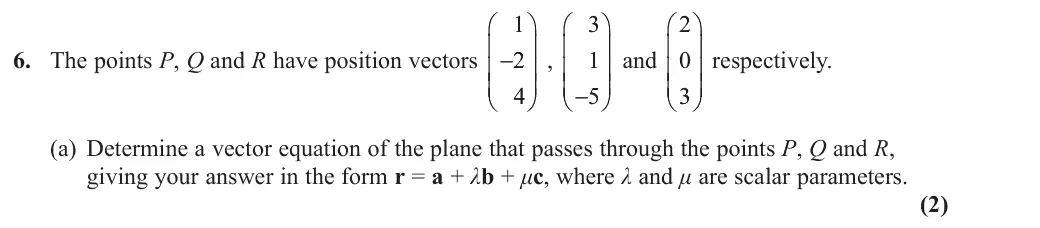
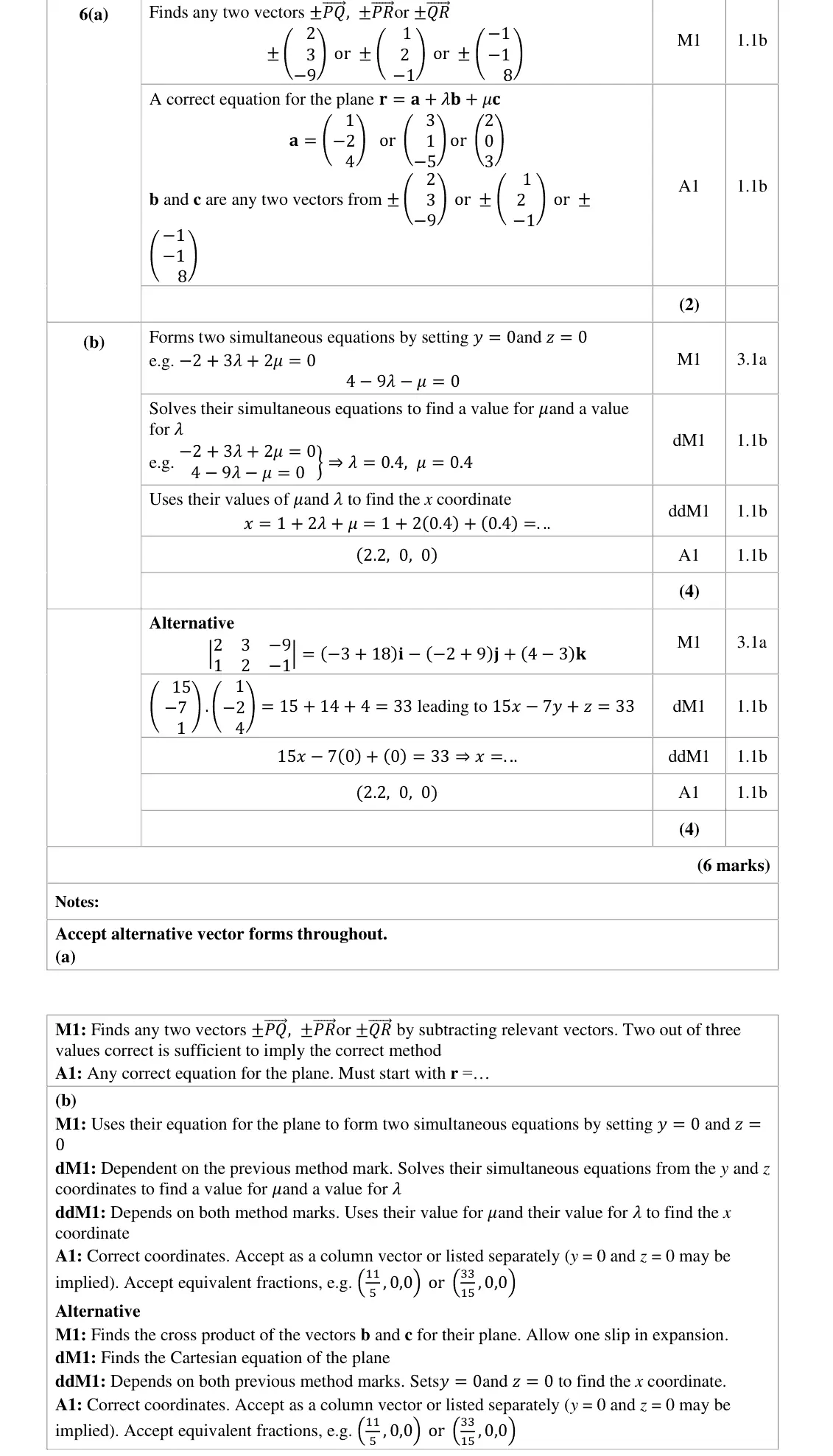
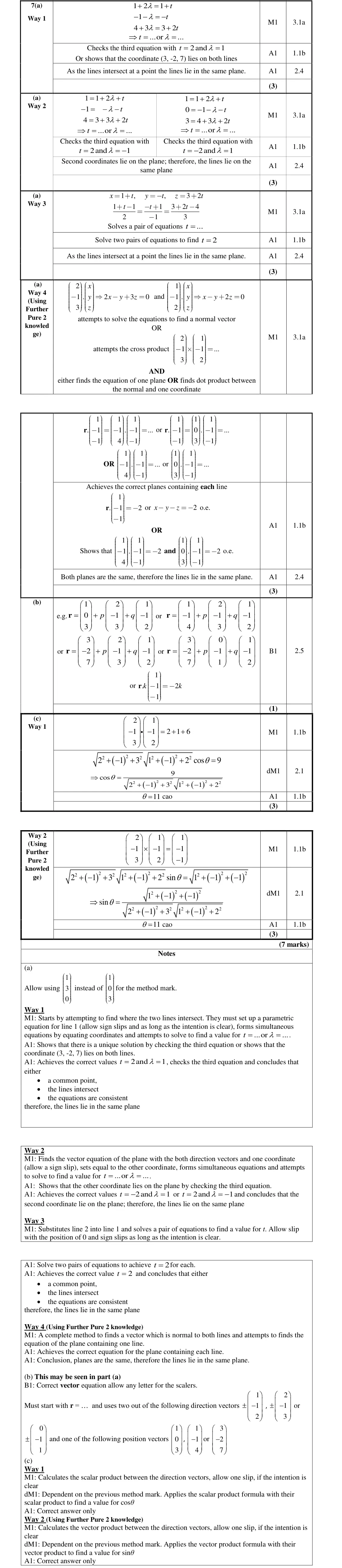
Despite vectors being a topic many find difficult, this proved to be a very accessible question on the topic. Over 60% were able to attain full marks, 95% scored at least two marks, and the mean mark was 5/6, overall being the third most accessible question of the paper. The position of the two vector questions on the paper would have been better interchanged. It was rare to see an incorrect answer to part (a) with incorrect responses usually due to numerical errors when calculating the directions (a sign error/miscopy was relatively common), or mixing up the point vector and the direction vectors of the two vectors on the plane.
Key points from the mark scheme and examiner's report
two direction vectors e.g. PQ = (2, 3, −9), PR = (1, 2, −1)
r = (1, −2, 4) + λ(2, 3, −9) + μ(1, 2, −1)
sign slips or mixing position and direction vectors
June 2022 · Paper 3A (Further Pure 1) · Q6(b)4 marksEasy
Mark scheme (whole question; this part is marked with the orange bar)
Examiner's comment
Despite vectors being a topic many find difficult, this proved to be a very accessible question on the topic. Over 60% were able to attain full marks, 95% scored at least two marks, and the mean mark was 5/6, overall being the third most accessible question of the paper. The position of the two vector questions on the paper would have been better interchanged. In part (b) both approaches shown in the scheme were commonly seen, though the main version was the more popular. The most common error in this approach was to set the x coordinate equal to 1 and attempt to solve this with one of the other equations, losing the last three marks. Slips in solving the correct equations were uncommon, but did occur. Another error made by some candidates who used the main method on the scheme there was to assume that x = 0 at the intersection point with the x – axis and obtain awkward equations to solve. Of the candidates who used the alternative method, most were able to find the normal vector and transform the plane into either Cartesian or dot product form, with a successful substitution of y = z =0 to follow. Of the candidates who used this method, calculation errors or using x = 0 were the most common reasons for failing to get to the correct point of intersection. It is worth noting many answers to part (b) were expressed as a column vector as opposed to the requested coordinates though this was condoned. An appreciation of the difference between vectors and coordinates is not well understood.
Key points from the mark scheme and examiner's report
set y = 0 and z = 0: λ = 0.4, μ = 0.4
x = 2.2: (2.2, 0, 0)
alternatively Cartesian 15x − 7y + z = 33
errors: setting x = 0 or x = 1
Nov 2021 · Paper 1 (Core Pure 1) · Q7(b)2 marksMedium
Mark scheme (whole question; this part is marked with the orange bar)
Examiner's comment
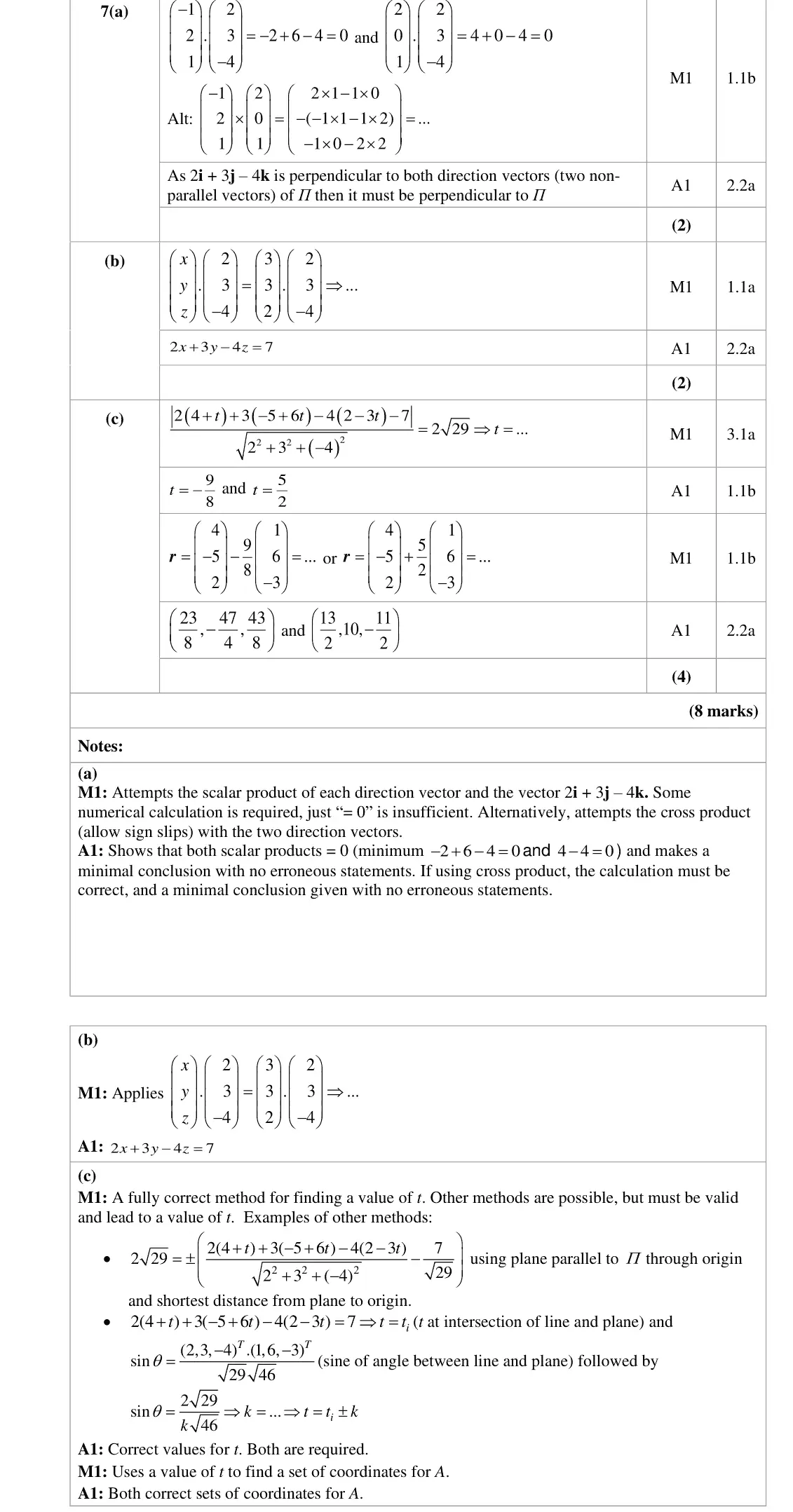
There was a step up in difficulty from this question in the paper, perhaps a tail off towards the end of the exam, but the performance was not as high on the next questions. For this question 51% for the M mark in (b) was the best performing trait, and the only one over 50% scored. (b) This was very better attempted, though surprisingly not as well done as might have been expected. A little over half scored the M for knowing the correct procedure, with just over 40% scoring both marks.
Key points from the mark scheme and examiner's report
r.n = a.n: 2x + 3y − 4z = 7
Nov 2021 · Paper 3A (Further Pure 1) · Q4(a)1 mark
Mark scheme (whole question; this part is marked with the orange bar)
Examiner's comment
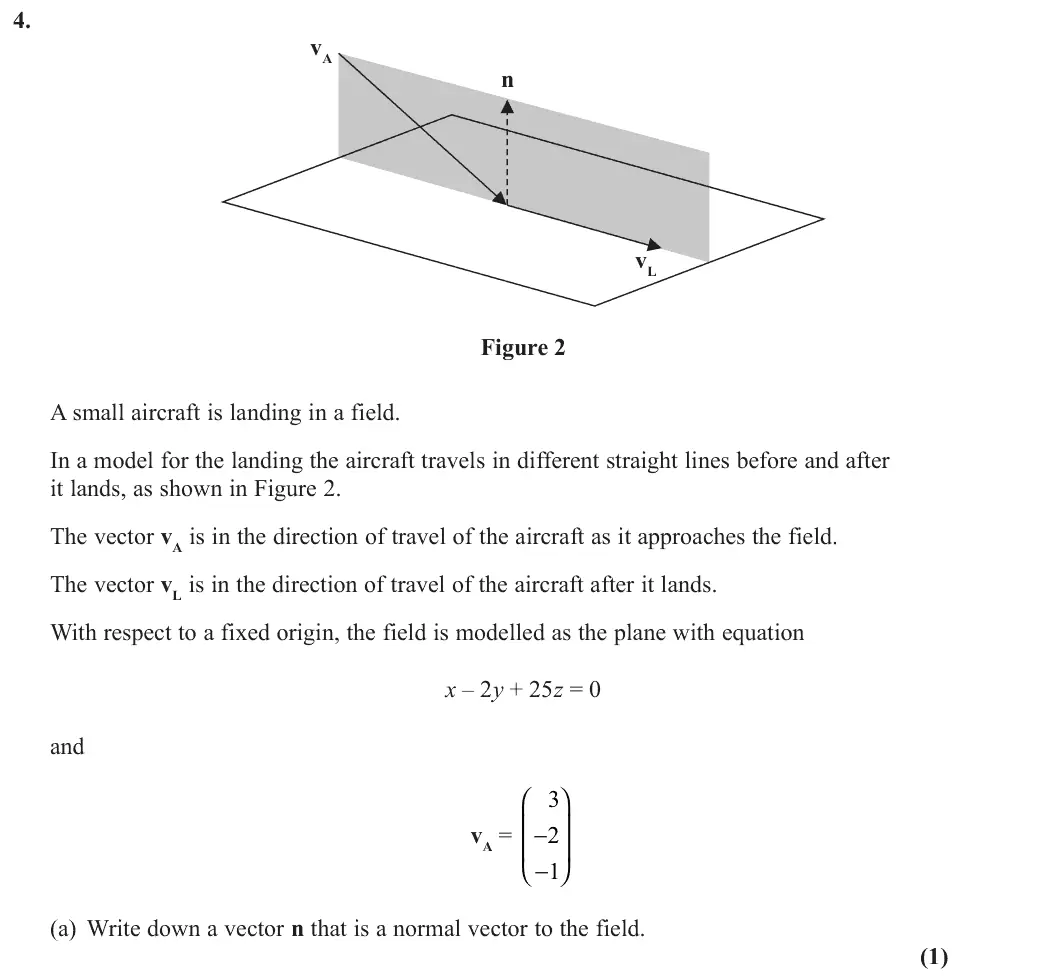
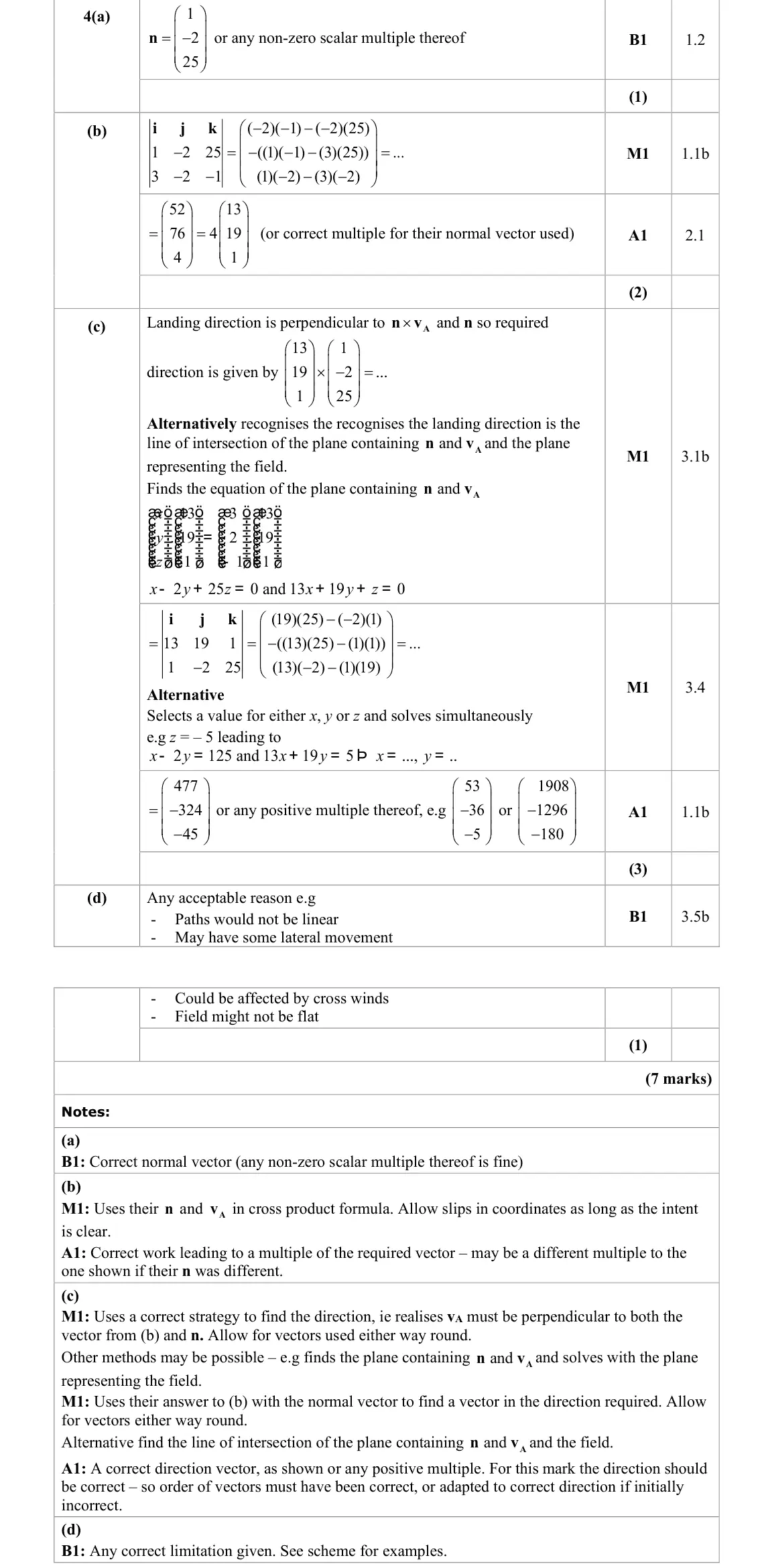
Part (a) The majority of candidates were able to identify the normal vector of the plane. their answer to part (a) so . Candidates needed to make sure that 19 2 x - 5 2 1 they found the cross product in the correct order to give the correct direction of travel of the plane after landing.
Key points from the mark scheme and examiner's report
n = i − 2j + 25k or any non-zero multiple
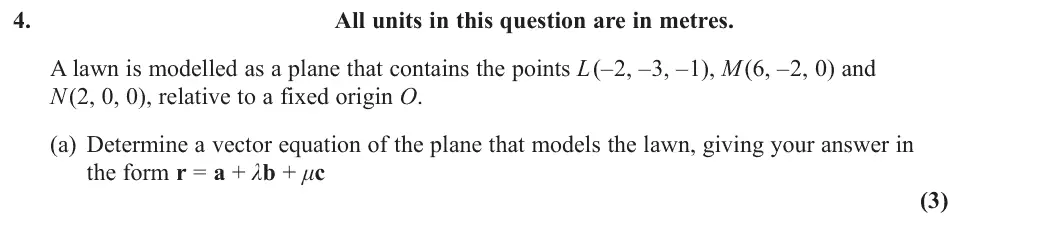
Oct 2020 · AS Paper 1 (Core Pure) · Q4(a)3 marks
Mark scheme (whole question; this part is marked with the orange bar)
Examiner's comment
It was pleasing to see that the large majority of candidates attempted at least parts of this question. r Part (a) was answered correctly by most candidates. Only a very small handful omitted a couple didn't find direction vectors at all and others made an arithmetic error in one of the direction vectors.
Key points from the mark scheme and examiner's report
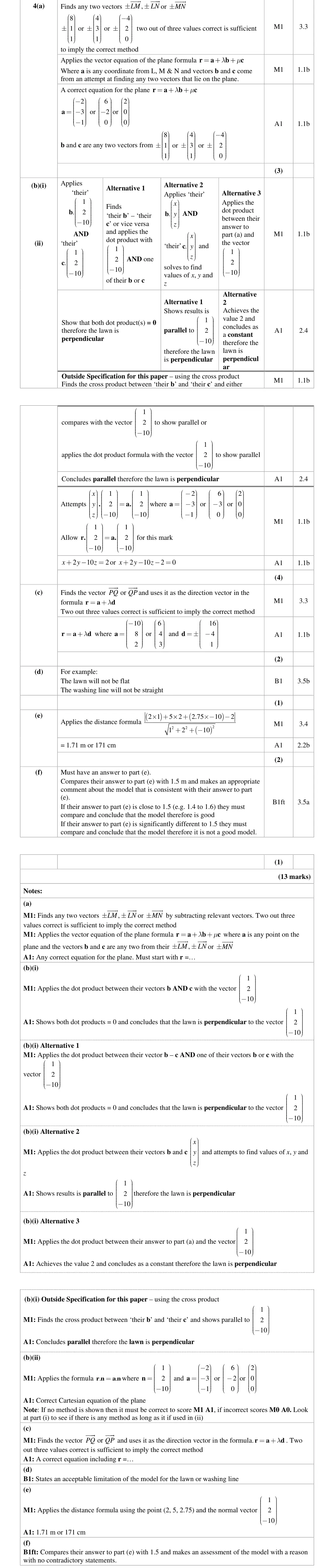
two direction vectors from LM, LN, MN, e.g. (8, 1, 1), (4, 3, 1)
r = a + λb + μc with a point of the plane
must begin r =
Oct 2020 · AS Paper 1 (Core Pure) · Q4(b)4 marks
Mark scheme (whole question; this part is marked with the orange bar)
Examiner's comment
It was pleasing to see that the large majority of candidates attempted at least parts of this question. Part (b) (i) and (ii) were not so successful. The large majority attempted the main scheme though just under half failed to show the vector was perpendicular to both direction vectors. A small number of candidates attempted alternate 1 or 2 method, all being successful in gaining the method mark but not having a conclusion lost them the accuracy mark.
Key points from the mark scheme and examiner's report
(i) scalar product with BOTH direction vectors = 0, then conclude perpendicular (about half showed only one)
(ii) r.(1, 2, −10) = a.(1, 2, −10): x + 2y − 10z = 2
Oct 2020 · AS Paper 1 (Core Pure) · Q4(d)1 mark
Mark scheme (whole question; this part is marked with the orange bar)
Examiner's comment
It was pleasing to see that the large majority of candidates attempted at least parts of this question. Part (d) was answered very well with the majority of candidates commenting on how washing would make the line not straight or that the lawn would not be flat.
Key points from the mark scheme and examiner's report
lawn not flat
washing line not straight (sags)
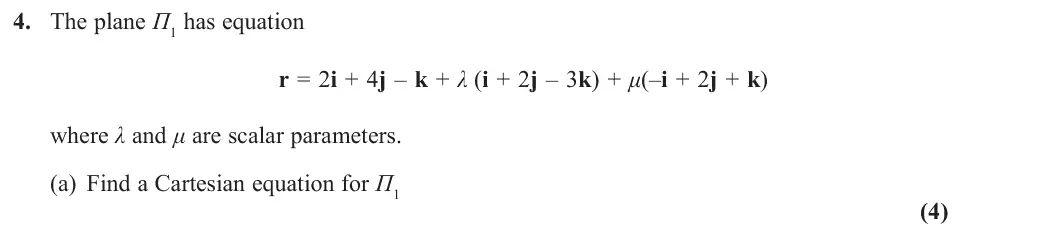
Oct 2020 · Paper 1 (Core Pure 1) · Q4(a)4 marks
Mark scheme (whole question; this part is marked with the orange bar)
Examiner's comment
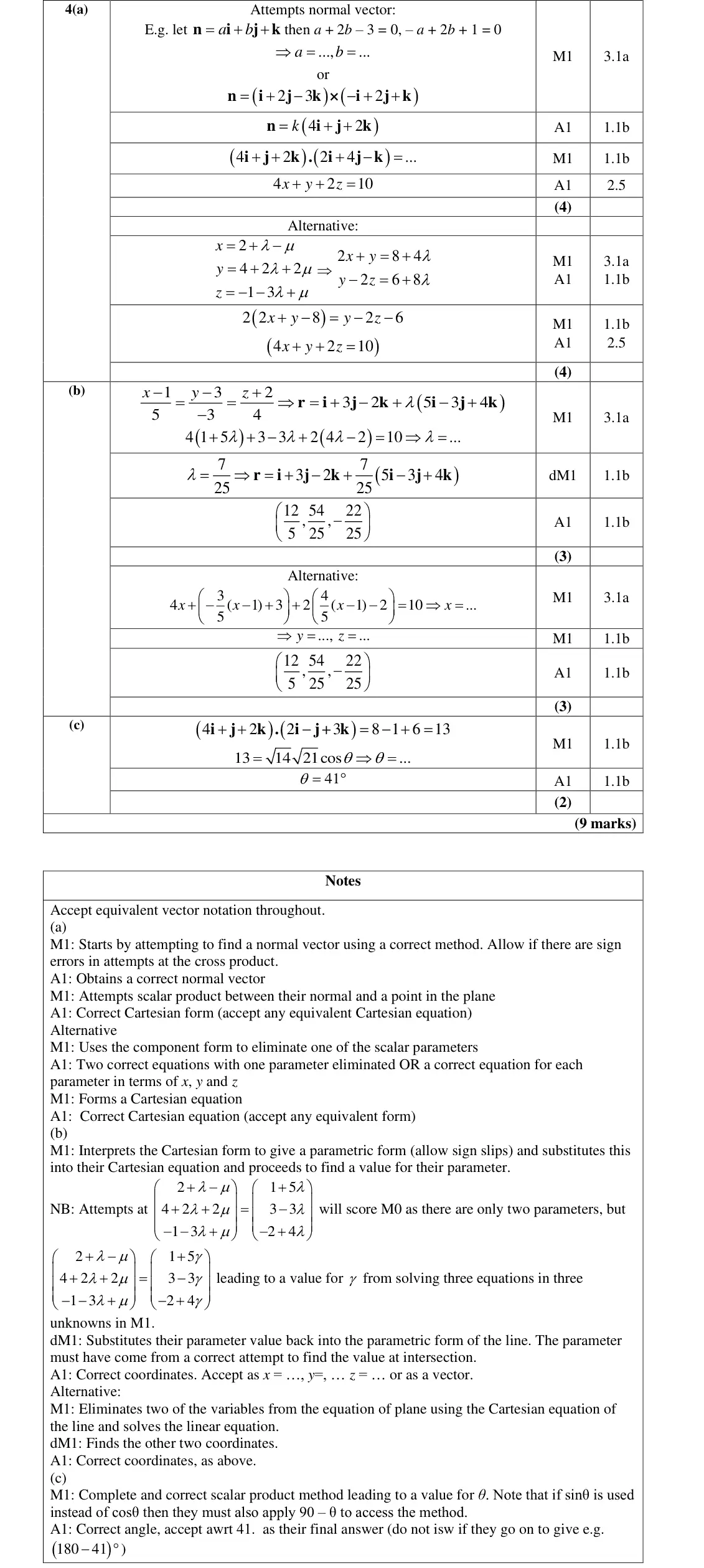
(a) There were some pleasing responses to this vector question, with many gaining full marks. A popular approach to finding the normal vector to the plane was to use the vector product, although there were a few sign errors. The rest used a scalar product method to find the normal. A few used the Cartesian forms to eliminate one of the scalar parameters, although these often got bogged down with the algebra. Some gave the final answer in scalar product form, losing the last A mark. There were many who were very confused and gained no marks in (a) use this method. Those who had not managed to do part (a) were still able to gain full marks (c) Provided they had found a normal to their plane in part (a), they were then able to apply a correct scalar product method to find the angle between the two planes. However, a few went on to find the wrong angle after a correct application of the dot product, by subtracting from90º. Some were very confused here and methods which were not considering the normal vectors to each plane gained no marks.
Key points from the mark scheme and examiner's report
normal by cross product or scalar products: n = 4i + j + 2k
r.n = a.n gives 4x + y + 2z = 10 (Cartesian, not r.n form)
sign errors in the cross product
Oct 2020 · Paper 3A (Further Pure 1) · Q3(b)2 marks
Mark scheme (whole question; this part is marked with the orange bar)
Examiner's comment
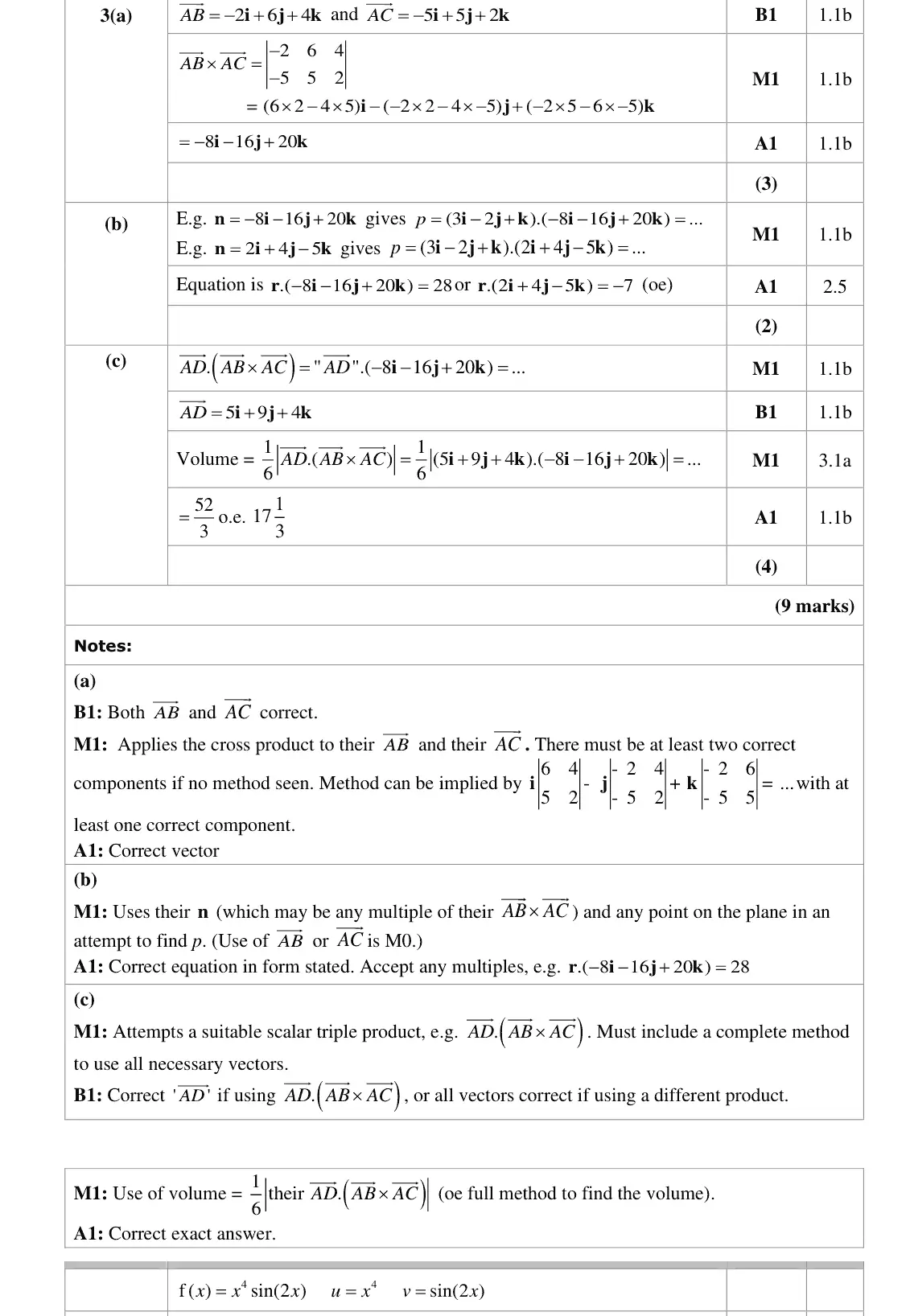
This question was a routine application of the vector product and scalar triple product and there were few candidates who were unable to achieve a good proportion of the marks available. Errors were mainly sign errors and arithmetic errors with an occasional Cartesian equation given in part b rather than the required vector equation, and vector OD being used as the third vector or a missing factor of 1/6 in part c.
Key points from the mark scheme and examiner's report
n from (a) with a point on the plane: r.(2i + 4j − 5k) = −7 (or r.(−8i − 16j + 20k) = 28)
Cartesian equation given instead of the vector form
June 2019 · AS Paper 1 (Core Pure) · Q45 marks
Mark scheme (whole question; this part is marked with the orange bar)
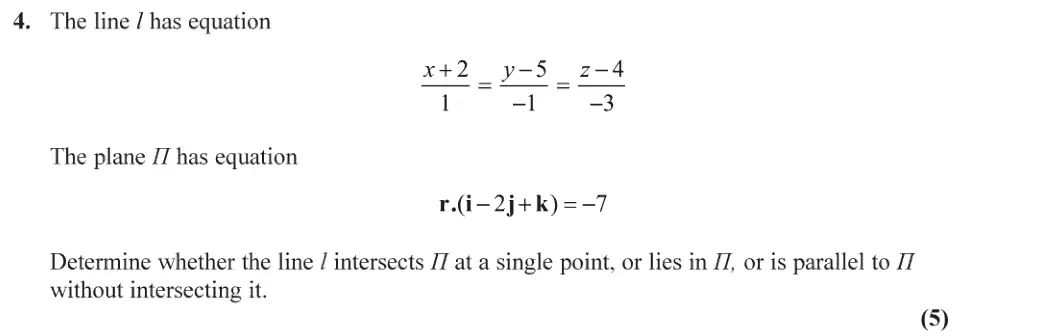
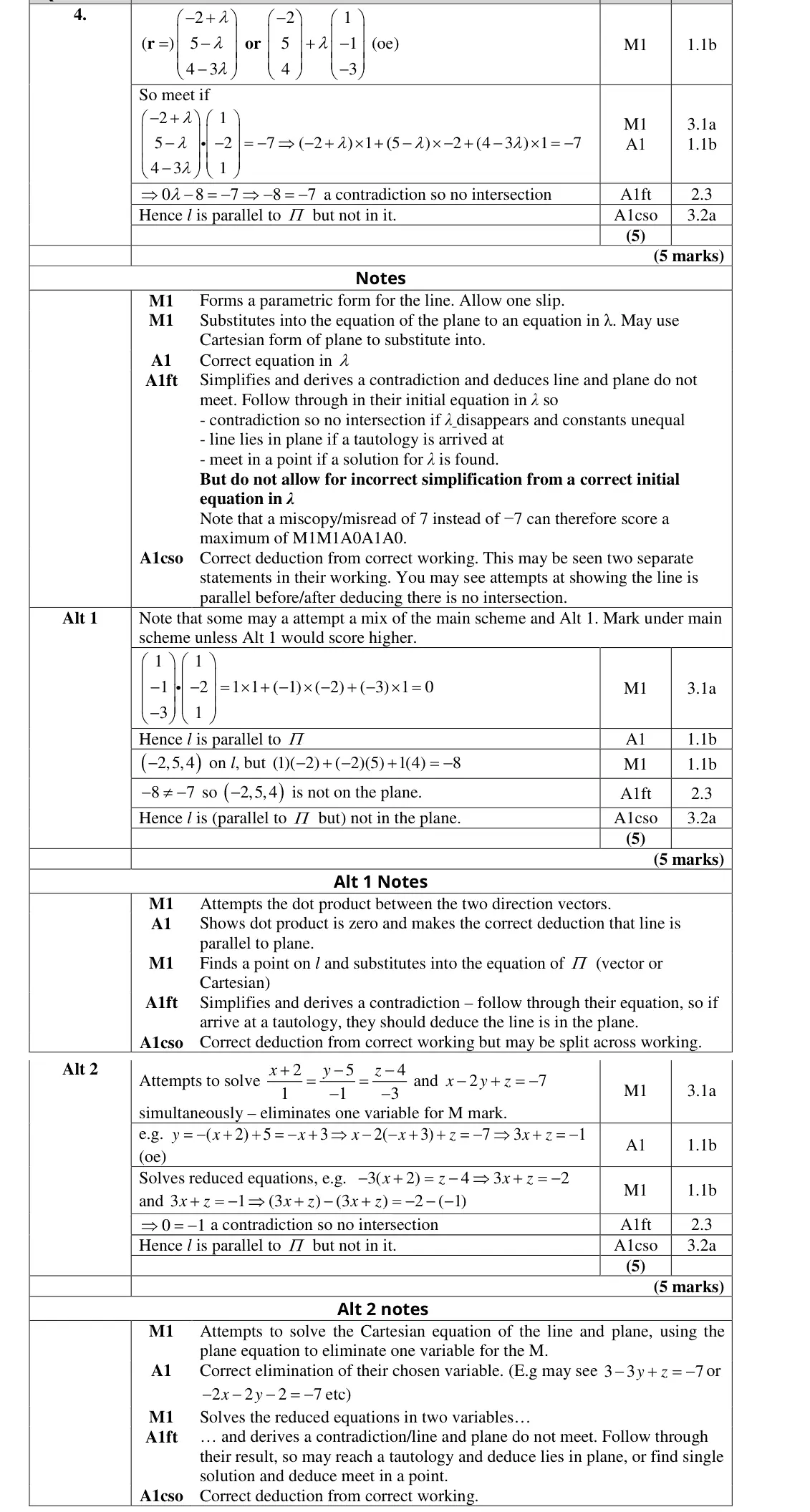
Key points from the mark scheme and examiner's report
substitute the parametric line into r.(1, −2, 1) = −7: 0λ − 8 = −7, a contradiction so no intersection
l is parallel to Π but not in it
or direction.normal = 0 then test a point
June 2019 · AS Paper 1 (Core Pure) · Q8(b)7 marks
Mark scheme (whole question; this part is marked with the orange bar)
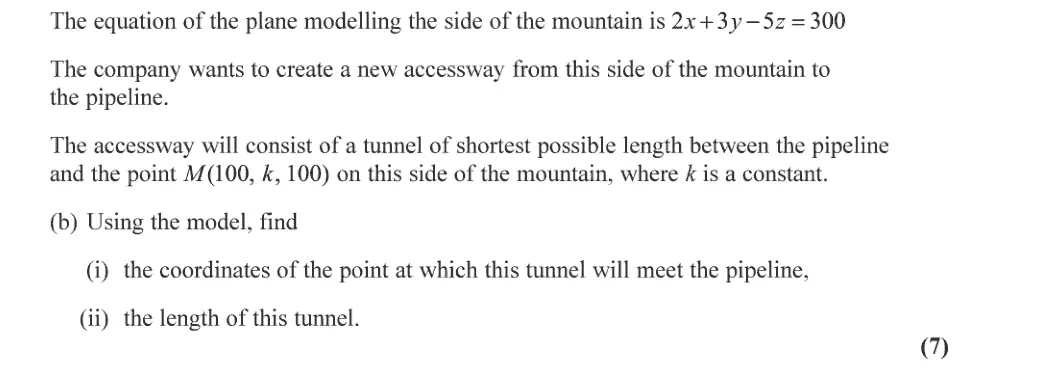
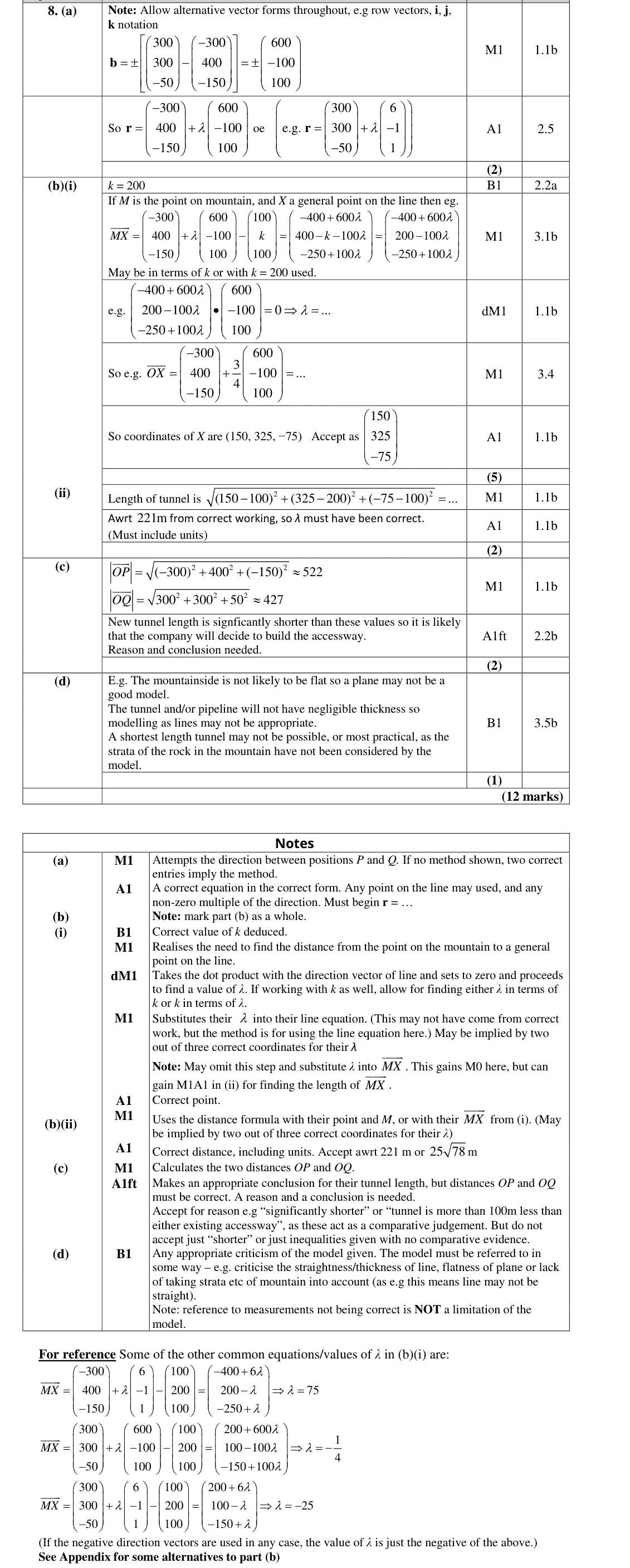
Key points from the mark scheme and examiner's report
k = 200 from M on the plane
MX perpendicular to the line direction gives λ = 3/4 (for direction (600, −100, 100))
X = (150, 325, −75)
length awrt 221 m (25√78), units needed
June 2019 · AS Paper 1 (Core Pure) · Q8(d)1 mark
Mark scheme (whole question; this part is marked with the orange bar)
Key points from the mark scheme and examiner's report
mountainside not flat so a plane is a poor model
pipe/tunnel have thickness
rock strata ignored
inaccurate measurements is not a limitation of the model
June 2019 · Paper 1 (Core Pure 1) · Q7(b)1 mark
Mark scheme (whole question; this part is marked with the orange bar)
Examiner's comment
(b) Most candidates gave a correct form for the equation of the plane, but a significant number lost this mark because they failed to write as an equation r = ... (many incorrectly wrote pi =…)
Key points from the mark scheme and examiner's report
r = position vector of a point + p(2i − j + 3k) + q(i − j + 2k)
must be written as r = …, not π = …
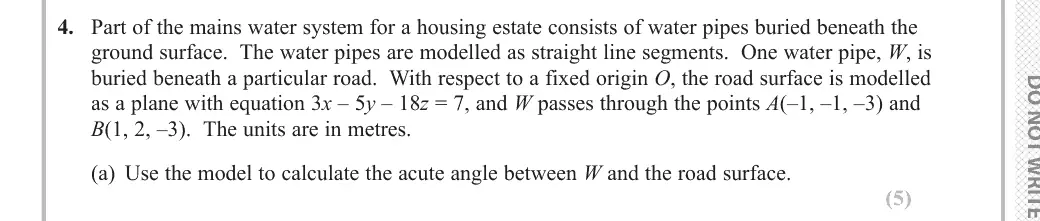
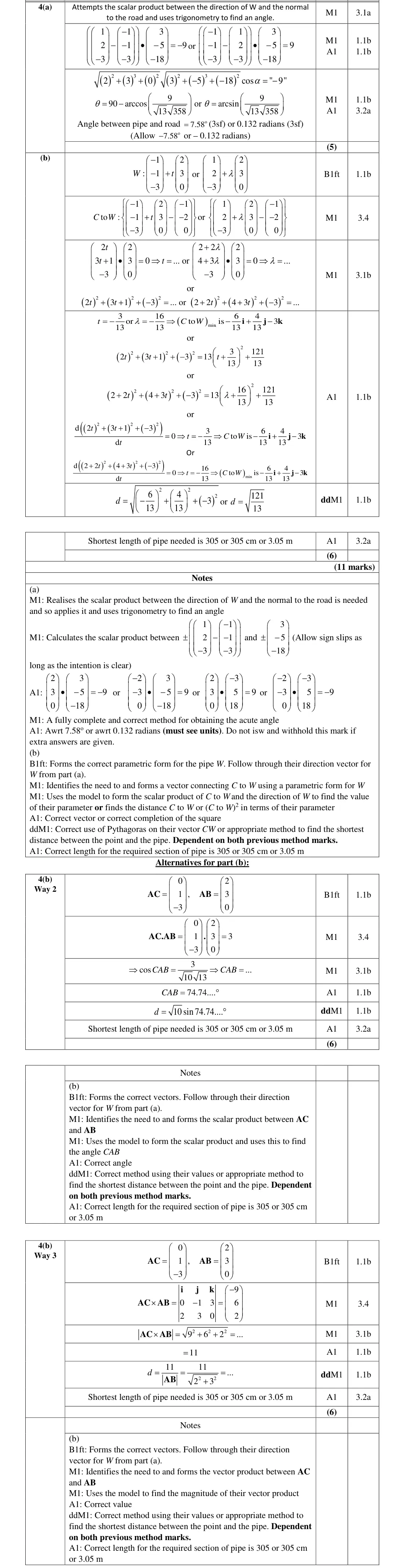
June 2018 · AS Paper 1 (Core Pure) · Q4(a)5 marks
Mark scheme (whole question; this part is marked with the orange bar)
Examiner's comment
(a) Most students appreciated the strategy needed to solve the problem and use the scalar product to find an angle between the normal vector and the direction of W. Unfortunately, many could not then find the required acute angle – a clear diagram would have helped them to visualise which angle was required. A common error was to subtract the result of their inverse cosine from 180°. Those using sine were usually more successful here. A few found the correct angle but failed to give it to the correct accuracy or to indicate degrees or radians and hence lost the final mark.
Key points from the mark scheme and examiner's report
angle between line and plane: scalar product of direction (2, 3, 0) with normal then 90° − arccos or use arcsin
7.58° (0.132 rad), units needed
subtracting from 180° was common
Find an Edexcel Further Maths tutor
Stuck on this? Book a trial lesson with our Further Maths tutor.