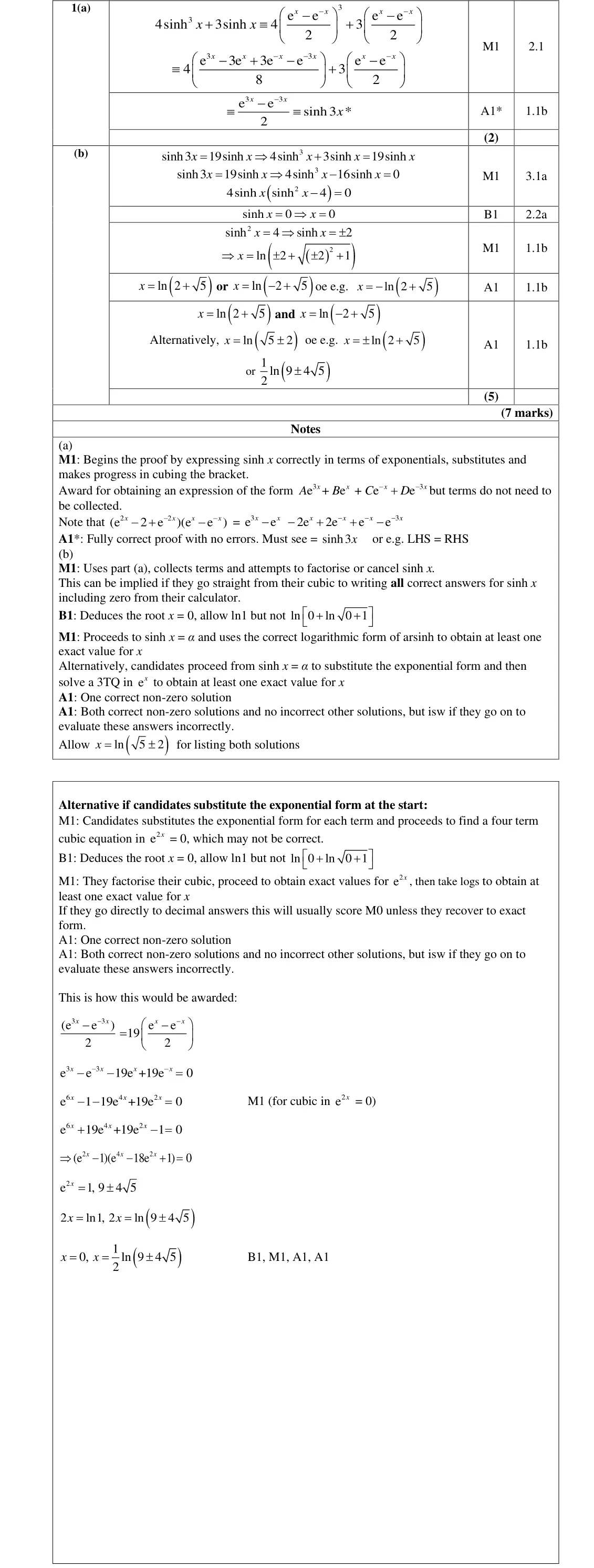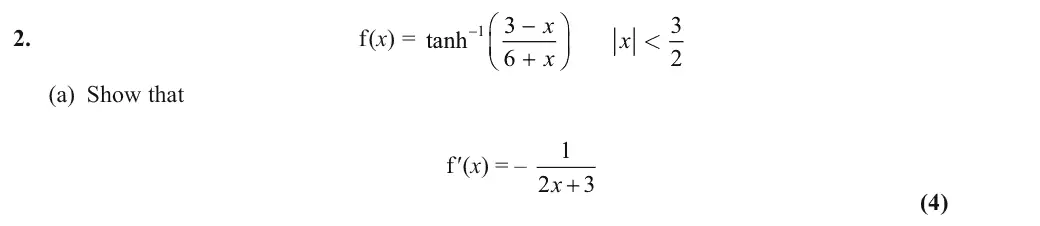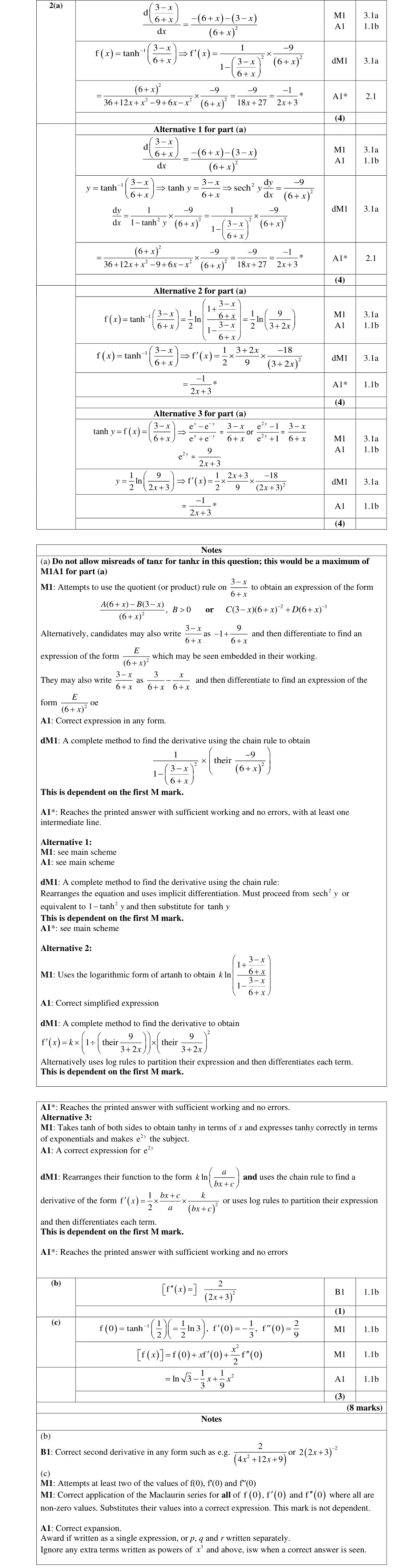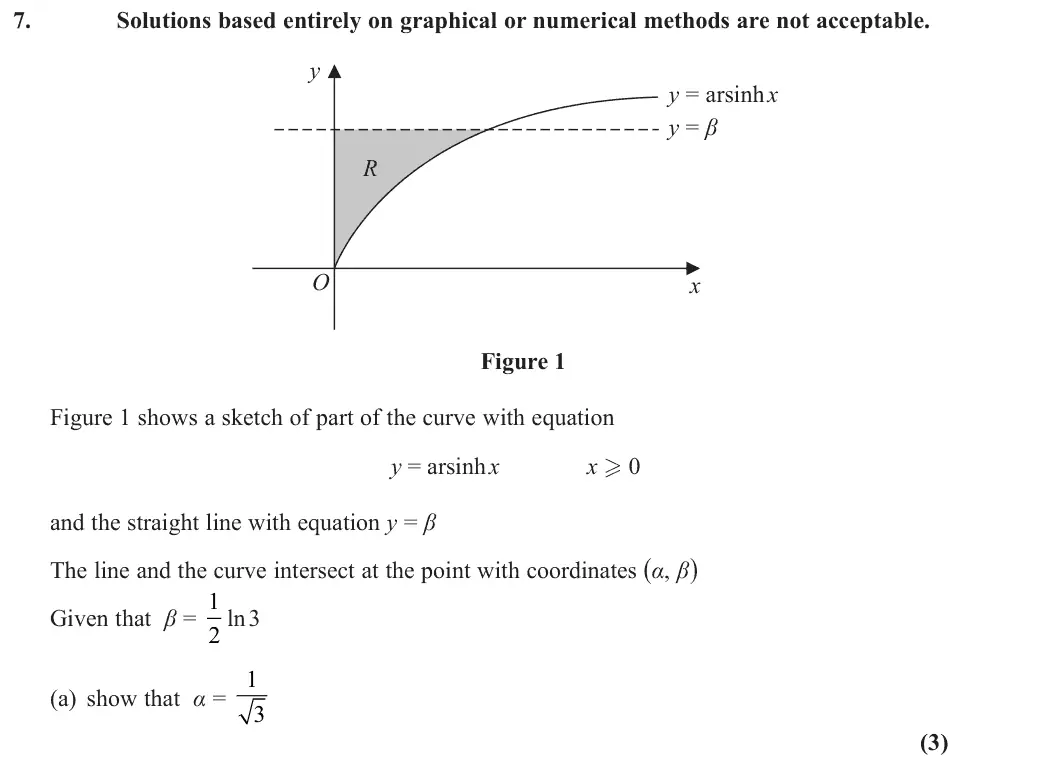
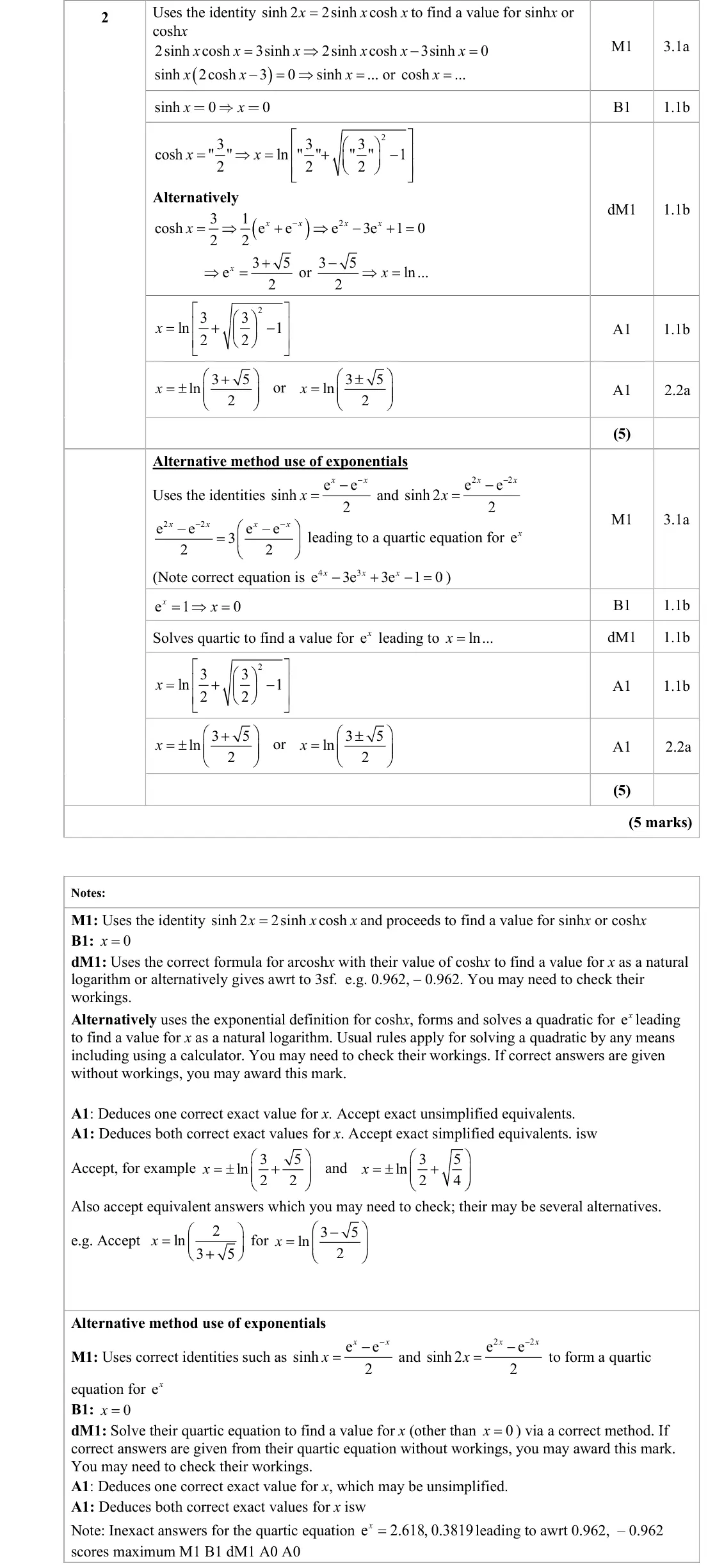
Mark scheme (whole question; this part is marked with the orange bar)
Examiner's comment
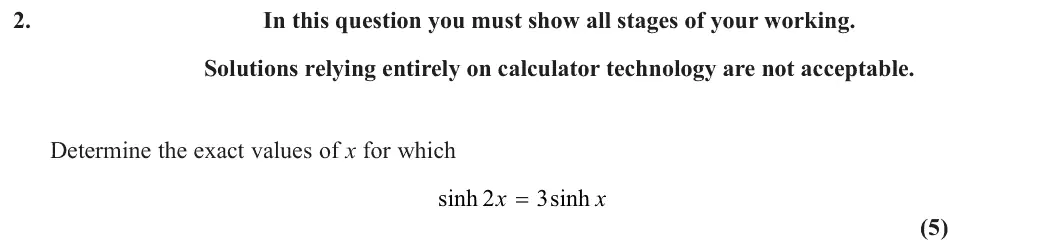
Candidates were well prepared for this question. A clear majority chose to use a hyperbolic identity to unpick the equation, rather than the exponential definitions, and overall, the former approach was more reliable and successful. Following the use of the hyperbolic identity, many candidates cancelled outsinh x , not considering thatsinh x could equal zero, and lost the B mark. There were a variety of ways to find exact solutions to 3 cosh 2 x = and the formula for inverse cosh was marginally more popular than solving a quadratic in ex . Those that did reach 2e 3e 1 x x - + often then did not take logs and gave their answers as 3 5 e 2 x ± = scoring only the first two marks since they had to reach x = ln… There were very few errors in using the logarithmic form for arcosh 3 2 occasionally a sign error. The most common mistake at this stage was to forget that cosh x is symmetrical and therefore miss the negative solution. Those that went fully into exponentials and tried to solve a quartic equation in ex struggled to give exact answers as it was tempting to use a calculator and get decimal answers, which received no credit. A few students missed out the x = 0 solution by this approach. This approach did however have the benefit of generating two solutions to the quadratic.
Key points from the mark scheme and examiner's report
- sinh 2x = 2sinh x cosh x, so sinh x(2cosh x − 3) = 0
- do not cancel sinh x (x = 0 is a root)
- cosh x = 3/2 gives x = ±ln((3 + √5)/2)
- leaving eˣ = (3 ± √5)/2 without logs loses marks