cosh² − sinh² = 1, sinh 2x, cosh 2x, the log forms of arsinh, arcosh and artanh, and the hyperbolic derivatives and integrals are given.
Since 2018
26 question parts, 93 marks, 4 with a difficulty rating from the examiner's report
Notes, worked examples and practice for this topic are being written by our tutors. The past-paper questions below are ready now: work each one on paper, then open the mark scheme and the examiner's comment.
Tap a question to zoom it. Mark scheme and examiner's comment open under each question.
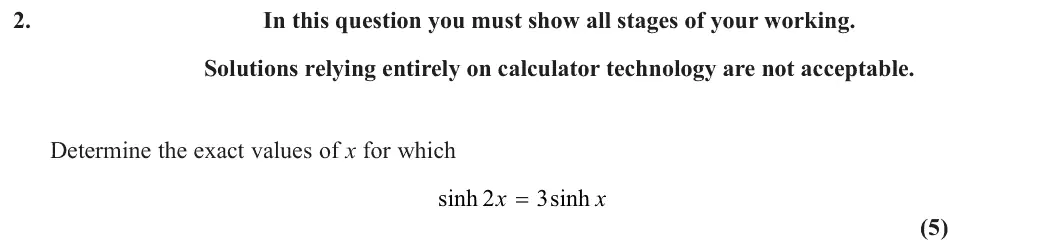
June 2025 · Paper 1 (Core Pure 1) · Q25 marks
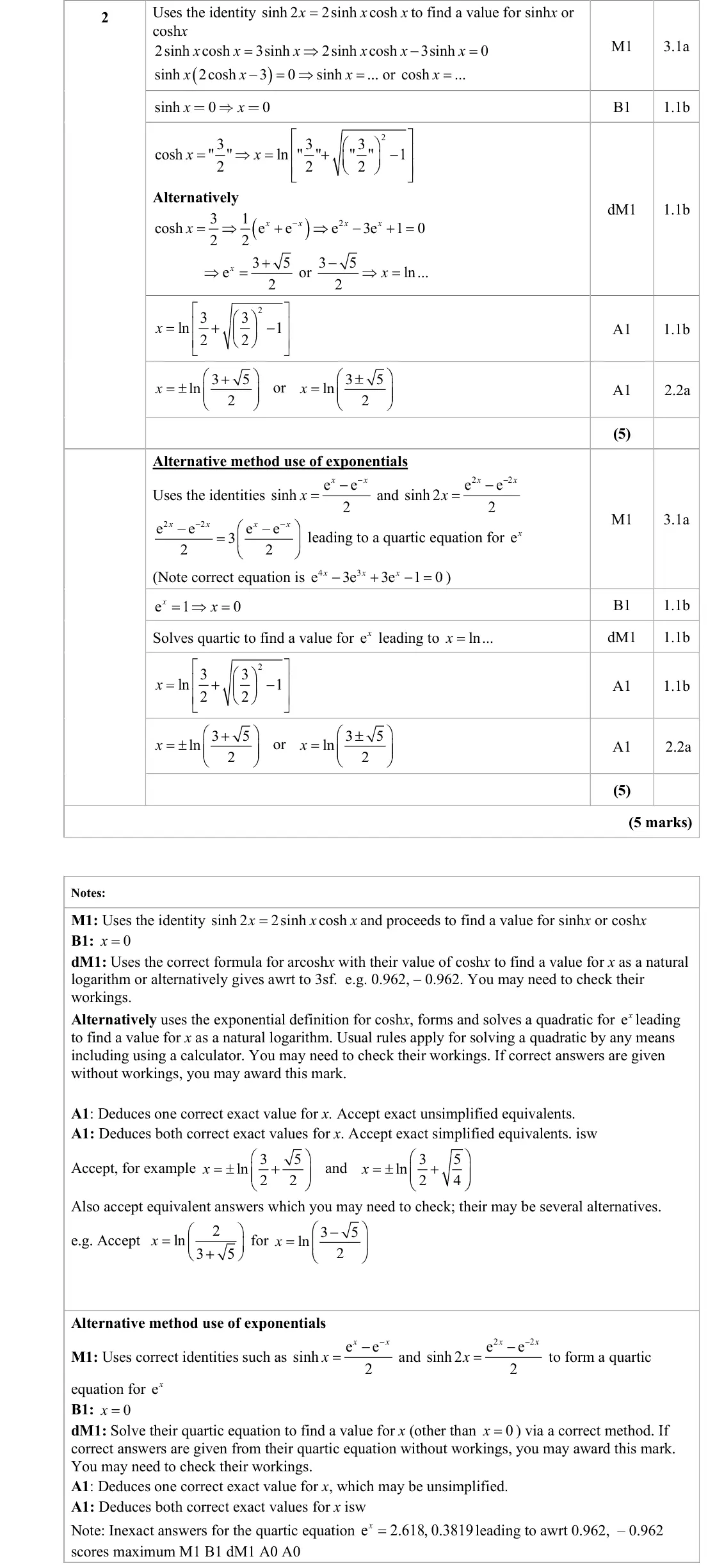
Mark scheme (whole question; this part is marked with the orange bar)
Examiner's comment
Candidates were well prepared for this question. A clear majority chose to use a hyperbolic identity to unpick the equation, rather than the exponential definitions, and overall, the former approach was more reliable and successful. Following the use of the hyperbolic identity, many candidates cancelled outsinh x , not considering thatsinh x could equal zero, and lost the B mark. There were a variety of ways to find exact solutions to 3 cosh 2 x = and the formula for inverse cosh was marginally more popular than solving a quadratic in ex . Those that did reach 2e 3e 1 x x - + often then did not take logs and gave their answers as 3 5 e 2 x ± = scoring only the first two marks since they had to reach x = ln… There were very few errors in using the logarithmic form for arcosh 3 2 occasionally a sign error. The most common mistake at this stage was to forget that cosh x is symmetrical and therefore miss the negative solution. Those that went fully into exponentials and tried to solve a quartic equation in ex struggled to give exact answers as it was tempting to use a calculator and get decimal answers, which received no credit. A few students missed out the x = 0 solution by this approach. This approach did however have the benefit of generating two solutions to the quadratic.
Key points from the mark scheme and examiner's report
sinh 2x = 2sinh x cosh x, so sinh x(2cosh x − 3) = 0
do not cancel sinh x (x = 0 is a root)
cosh x = 3/2 gives x = ±ln((3 + √5)/2)
leaving eˣ = (3 ± √5)/2 without logs loses marks
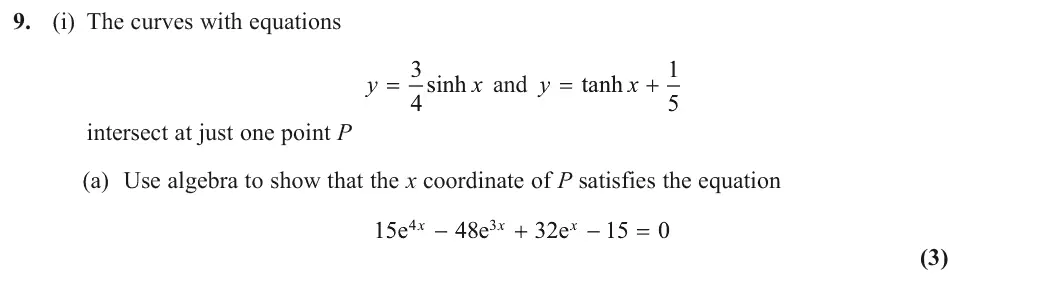
June 2025 · Paper 1 (Core Pure 1) · Q9(i)(a)3 marks
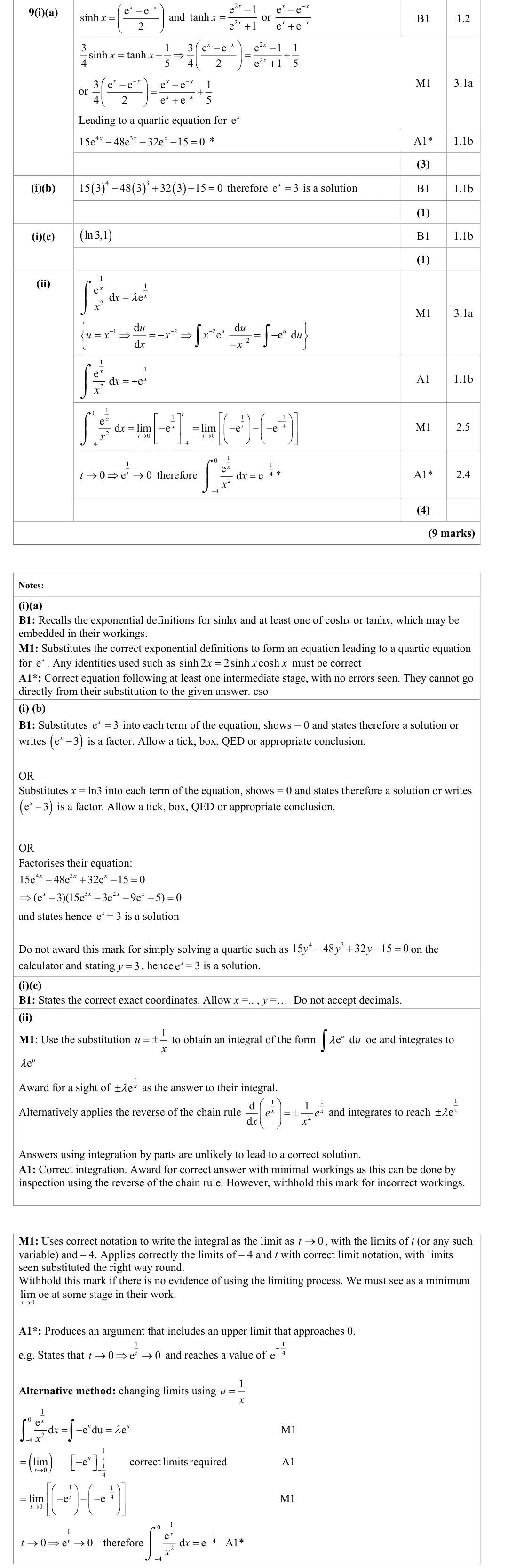
Mark scheme (whole question; this part is marked with the orange bar)
Examiner's comment
(i)(a) Many candidates successfully approached this part by correctly substituting the exponential definitions for sinh x and tanh x to form an equation. An equally successful alternative involved multiplying the equation by sinh x before applying the exponential definitions for sinh x and cosh x Most candidates then successfully progressed to derive the correct quartic equation for ex . Common errors observed included: ● Missing brackets during multiplication, leading to unmultiplied terms. ● Careless copying from previous lines. ● Incorrect treatment of signs. A significant number of unsuccessful attempts stemmed from candidates trying to use hyperbolic identities instead of converting to exponential form. There was no discernible difference in outcome based on whether candidates removed fractions early or gradually. x = or (i)(b) Most candidates confidently substituted e 3 into each term of the ln3 x = equation. However, a significant majority failed to provide an appropriate concluding statement, which was a prerequisite for earning this mark. A few candidates resorted to using a calculator to solve the quartic, which would also have resulted in the loss of this mark as they never showed evidence of their work. (i)(c) Most candidates were successful in achieving this mark. The primary reasons for not attaining it included: ● Obtaining an incorrect y-coordinate. and stopping without calculating the y-coordinate. ● Stating ln3 x = (ii) This part of the question was significantly more challenging for candidates, with very few scoring any marks. Many candidates unsuccessfully attempted integration by parts, often using several pages without making progress and consequently scoring zero marks. Candidates who employed substitution in their integration were generally more successful in achieving the correct integral. However, those who changed the limits frequently made errors, such as using an upper limit of “t” and expressing the integral as the limit as “t” approaches infinity, which often led to the loss of subsequent marks. Of those who integrated correctly, candidates who did not use a substitution were more successful in handling the limits and often secured the second method mark. Nevertheless, several candidates simply substituted 0 1 into their integral. Only a minority of candidates appreciated that 0 e 0 t → ⇒ → to reach a t 1 -. Very few candidates achieved full marks on this question. e value of 4
Key points from the mark scheme and examiner's report
exponential definitions of sinh x and tanh x, clear fractions to reach 15e⁴ˣ − 48e³ˣ + 32eˣ − 15 = 0
missing brackets and sign slips
using hyperbolic identities did not work
June 2025 · Paper 1 (Core Pure 1) · Q9(i)(b)1 mark
Mark scheme (whole question; this part is marked with the orange bar)
Examiner's comment
(i)(a) Many candidates successfully approached this part by correctly substituting the exponential definitions for sinh x and tanh x to form an equation. An equally successful alternative involved multiplying the equation by sinh x before applying the exponential definitions for sinh x and cosh x Most candidates then successfully progressed to derive the correct quartic equation for ex . Common errors observed included: ● Missing brackets during multiplication, leading to unmultiplied terms. ● Careless copying from previous lines. ● Incorrect treatment of signs. A significant number of unsuccessful attempts stemmed from candidates trying to use hyperbolic identities instead of converting to exponential form. There was no discernible difference in outcome based on whether candidates removed fractions early or gradually. x = or (i)(b) Most candidates confidently substituted e 3 into each term of the ln3 x = equation. However, a significant majority failed to provide an appropriate concluding statement, which was a prerequisite for earning this mark. A few candidates resorted to using a calculator to solve the quartic, which would also have resulted in the loss of this mark as they never showed evidence of their work. (i)(c) Most candidates were successful in achieving this mark. The primary reasons for not attaining it included: ● Obtaining an incorrect y-coordinate. and stopping without calculating the y-coordinate. ● Stating ln3 x = (ii) This part of the question was significantly more challenging for candidates, with very few scoring any marks. Many candidates unsuccessfully attempted integration by parts, often using several pages without making progress and consequently scoring zero marks. Candidates who employed substitution in their integration were generally more successful in achieving the correct integral. However, those who changed the limits frequently made errors, such as using an upper limit of “t” and expressing the integral as the limit as “t” approaches infinity, which often led to the loss of subsequent marks. Of those who integrated correctly, candidates who did not use a substitution were more successful in handling the limits and often secured the second method mark. Nevertheless, several candidates simply substituted 0 1 into their integral. Only a minority of candidates appreciated that 0 e 0 t → ⇒ → to reach a t 1 -. Very few candidates achieved full marks on this question. e value of 4
Key points from the mark scheme and examiner's report
substitute eˣ = 3 into each term, show it equals 0 and conclude (conclusion often missing)
solving on a calculator scores 0
June 2025 · Paper 1 (Core Pure 1) · Q9(i)(c)1 mark
Mark scheme (whole question; this part is marked with the orange bar)
Examiner's comment
(i)(a) Many candidates successfully approached this part by correctly substituting the exponential definitions for sinh x and tanh x to form an equation. An equally successful alternative involved multiplying the equation by sinh x before applying the exponential definitions for sinh x and cosh x Most candidates then successfully progressed to derive the correct quartic equation for ex . Common errors observed included: ● Missing brackets during multiplication, leading to unmultiplied terms. ● Careless copying from previous lines. ● Incorrect treatment of signs. A significant number of unsuccessful attempts stemmed from candidates trying to use hyperbolic identities instead of converting to exponential form. There was no discernible difference in outcome based on whether candidates removed fractions early or gradually. x = or (i)(b) Most candidates confidently substituted e 3 into each term of the ln3 x = equation. However, a significant majority failed to provide an appropriate concluding statement, which was a prerequisite for earning this mark. A few candidates resorted to using a calculator to solve the quartic, which would also have resulted in the loss of this mark as they never showed evidence of their work. (i)(c) Most candidates were successful in achieving this mark. The primary reasons for not attaining it included: ● Obtaining an incorrect y-coordinate. and stopping without calculating the y-coordinate. ● Stating ln3 x = (ii) This part of the question was significantly more challenging for candidates, with very few scoring any marks. Many candidates unsuccessfully attempted integration by parts, often using several pages without making progress and consequently scoring zero marks. Candidates who employed substitution in their integration were generally more successful in achieving the correct integral. However, those who changed the limits frequently made errors, such as using an upper limit of “t” and expressing the integral as the limit as “t” approaches infinity, which often led to the loss of subsequent marks. Of those who integrated correctly, candidates who did not use a substitution were more successful in handling the limits and often secured the second method mark. Nevertheless, several candidates simply substituted 0 1 into their integral. Only a minority of candidates appreciated that 0 e 0 t → ⇒ → to reach a t 1 -. Very few candidates achieved full marks on this question. e value of 4
Key points from the mark scheme and examiner's report
P = (ln 3, 1)
missing or wrong y-coordinate
June 2025 · Paper 2 (Core Pure 2) · Q8(a)5 marks
Mark scheme (whole question; this part is marked with the orange bar)
Examiner's comment
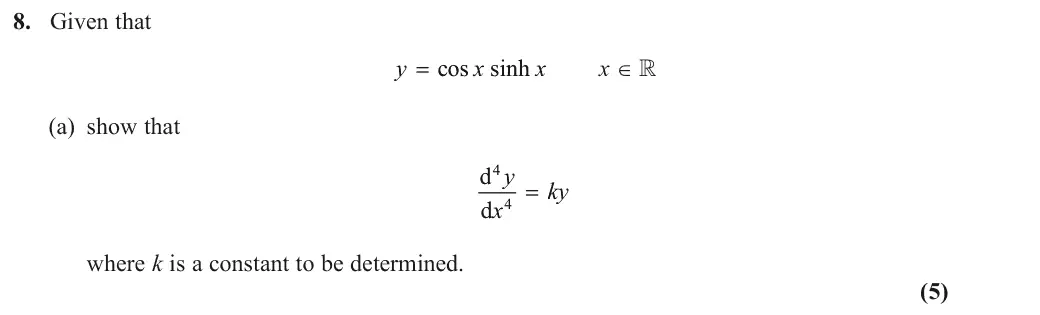
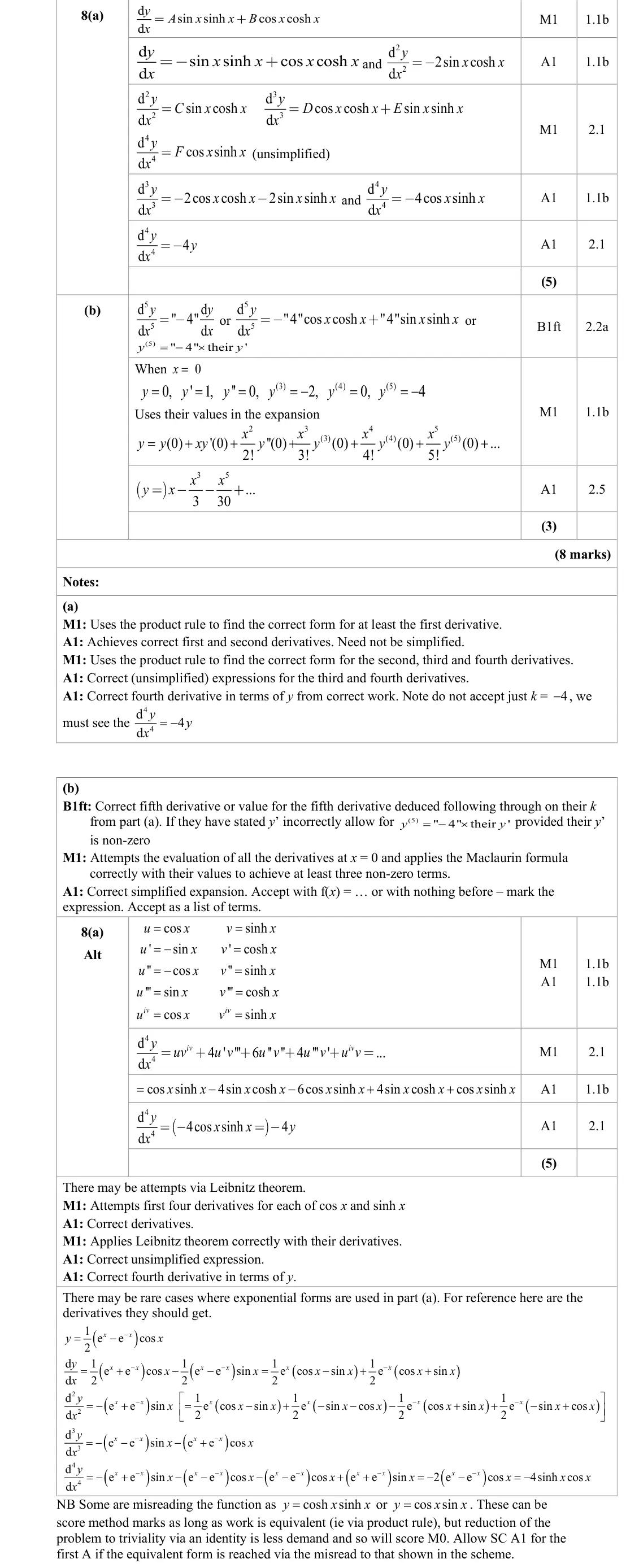
This question was answered extremely well by the vast majority of candidates, providing a good source of marks late in the paper. Even at the lower grade boundary it would not be uncommon to see good attempts at this question. Part (a) saw most candidates pick up the first four marks with relative ease, applying the product rule successively to reach the third derivative. Most went on to find the correct value for k by continuing to the fourth derivative, though a few did not simplify the second derivative correctly, making subsequent differentiations unnecessarily complicated, a lack of simplification and carelessness leading to making mistakes. There were numerous cases of fully correct differentiation up to the fourth derivative; however, some failed to conclude with the required result 4 4 d 4 d y y x = - , even though they correctly reached expressions such as 4 4 d 4cos sinh d y x x x = - . The conclusion needed to be explicitly stated to earn full credit. Errors with signs caused problems for some and a significant minority made errors using the product rule. A small number of candidates attempted to use Leibniz's theorem, but this often proved counterproductive especially when it came to complete part (b). Unfortunately a notable minority of learners misread the question, either as cos sin x x or as cosh sinh x x , both of which reduced the complexity of the problem if an appropriate identity was apply. However, some credit was permitted for equivalent work for provided the product rule was used to find the derivatives, but reducing to a triviality e.g. by writing 1 sinh 2 2 x y = , resulted in no marks. Learners should be advised to read carefully each question to avoid such errors.
Key points from the mark scheme and examiner's report
repeated product rule: y″ = −2sin x cosh x, y⁗ = −4cos x sinh x = −4y, so k = −4
failure to simplify y″ made later derivatives messy
June 2024 · Paper 2 (Core Pure 2) · Q1(a)2 marks
Mark scheme (whole question; this part is marked with the orange bar)
Examiner's comment
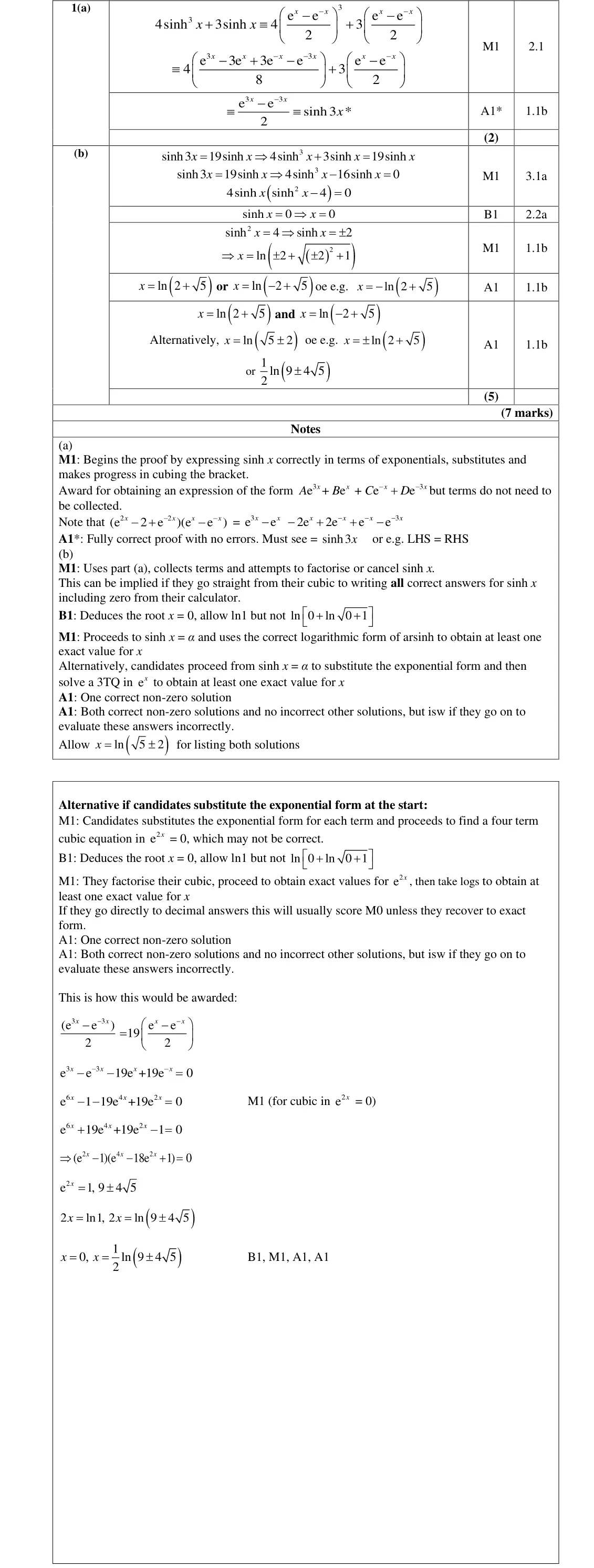
(a) The majority of candidates answered this part well. Typically, candidates substituted for sinh x and attempted to cube brackets. Some candidates used the binomial expansion for the cubing of their bracket. The most common errors were expressing sinh x as e + e 2 x x - or mistakes in cubing the bracket with sign errors occurring in their expansion. Other common errors included forgetting to cube the denominator leading to a coefficient of 2 instead of . Some candidates failed to complete their proof and add a conclusion such as LHS = RHS Also, some candidates concluded by incorrectly stating sinh or sin3 x x = = at the end. Other candidates failed to convert sinh x to exponentials and used the double angle formulae or other identities resulting in no marks being scored.
Key points from the mark scheme and examiner's report
sinh x = (eˣ − e⁻ˣ)/2 (not +), cube the bracket including the 2³ in the denominator, reach (e³ˣ − e⁻³ˣ)/2 = sinh 3x and conclude
using identities instead of exponentials scored 0
June 2024 · Paper 2 (Core Pure 2) · Q1(b)5 marks
Mark scheme (whole question; this part is marked with the orange bar)
Examiner's comment
(b) This was reasonably well answered. A minority of candidates cancelled the sinh x term from both sides, disregarding the possibility that sinh 0 x = Other candidates proceeded from 2 4sinh 16 x = to sinh 4 x = Candidates that used the given logarithmic form formula usually obtained the correct answers, whereas those who used the exponential form to solve sinh 2 x = were less successful, some giving all four solutions from their two quadratics without discarding the incorrect extra values. There were a significant minority that when taking the square root only wrote sinh 2 x = Most went on to use the correct form of arsinh x in terms of ln. Some opted to solve using the exponential form and this sometimes resulted in sign errors or exact solutions not being found. A not insignificant number of candidates did not put brackets around their answer leaving it as e.g. ln 2 5 + Those who substituted the exponential form for each term and proceeded to find a four-term cubic equation in 2e x = 0, were much less likely to achieve correct solutions.
Key points from the mark scheme and examiner's report
4sinh³x − 16sinh x = 0: do not cancel sinh x, so x = 0 is a solution
sinh x = ±2 (not just 2) gives x = ±ln(2 + √5) (or ln(√5 ± 2))
exponential routes produced extra invalid roots
June 2024 · Paper 2 (Core Pure 2) · Q2(a)4 marks
Mark scheme (whole question; this part is marked with the orange bar)
Examiner's comment
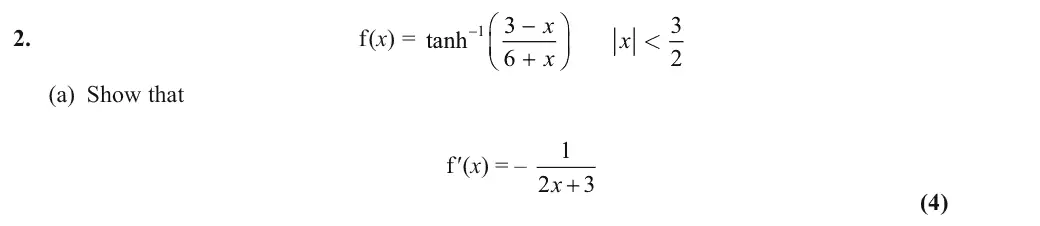
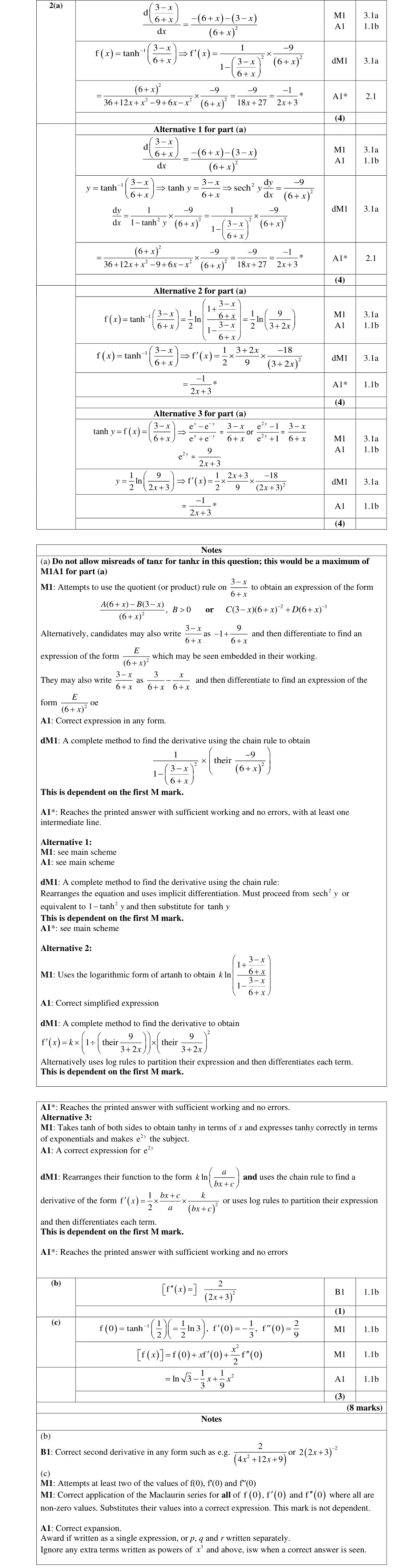
This question saw the entire range of marks awarded. (a) Numerous approaches were taken with varying degrees of success. Candidates were asked to prove a given result. Some candidates failed to realise the requirement for application of the quotient/product and chain rules and scored no marks in this part. Those who used the quotient rule were usually able to score the first two marks, and some would proceed to use the chain rule correctly to score at least the third mark. 2 2 A few students used the incorrect identity for sech x possibly getting confused with sec x Many candidates accurately simplified their expression to reach the given answer, though some candidates did get lost within their algebraic manipulation. Alternative methods were seen, the most frequent being removal of the inverse hyperbolic into the form tanh y = …followed by implicit differentiation. This made the requirement for the quotient rule clearer, but several candidates used incorrect identities or struggled with the manipulation stemming from rearranging into d y x = and thus were less likely to score. ... d Reframing as a logarithm was also seen occasionally, with many candidates again achieving the first two marks for correct rearrangement and simplification of the argument of the logarithm, but once again many failed to appreciate the need for the chain rule and scored no further marks.
Key points from the mark scheme and examiner's report
quotient rule on (3 − x)/(6 + x) gives −9/(6 + x)², times 1/(1 − u²) for artanh
simplify to −1/(2x + 3)
log form ½ln(9/(3 + 2x)) also neat
confusing sech with sec
June 2024 · Paper 2 (Core Pure 2) · Q2(b)1 mark
Mark scheme (whole question; this part is marked with the orange bar)
Examiner's comment
This question saw the entire range of marks awarded. (b) This was very straight forward for candidates, even if (a) was not attempted. However, the most common error was failing to multiply by the "2" when applying the chain rule. There were a few candidates who integrated rather than differentiated.
Key points from the mark scheme and examiner's report
f″(x) = 2/(2x + 3)²
missing the 2 from the chain rule
June 2023 · Paper 1 (Core Pure 1) · Q2(a)1 mark
Mark scheme (whole question; this part is marked with the orange bar)
Examiner's comment
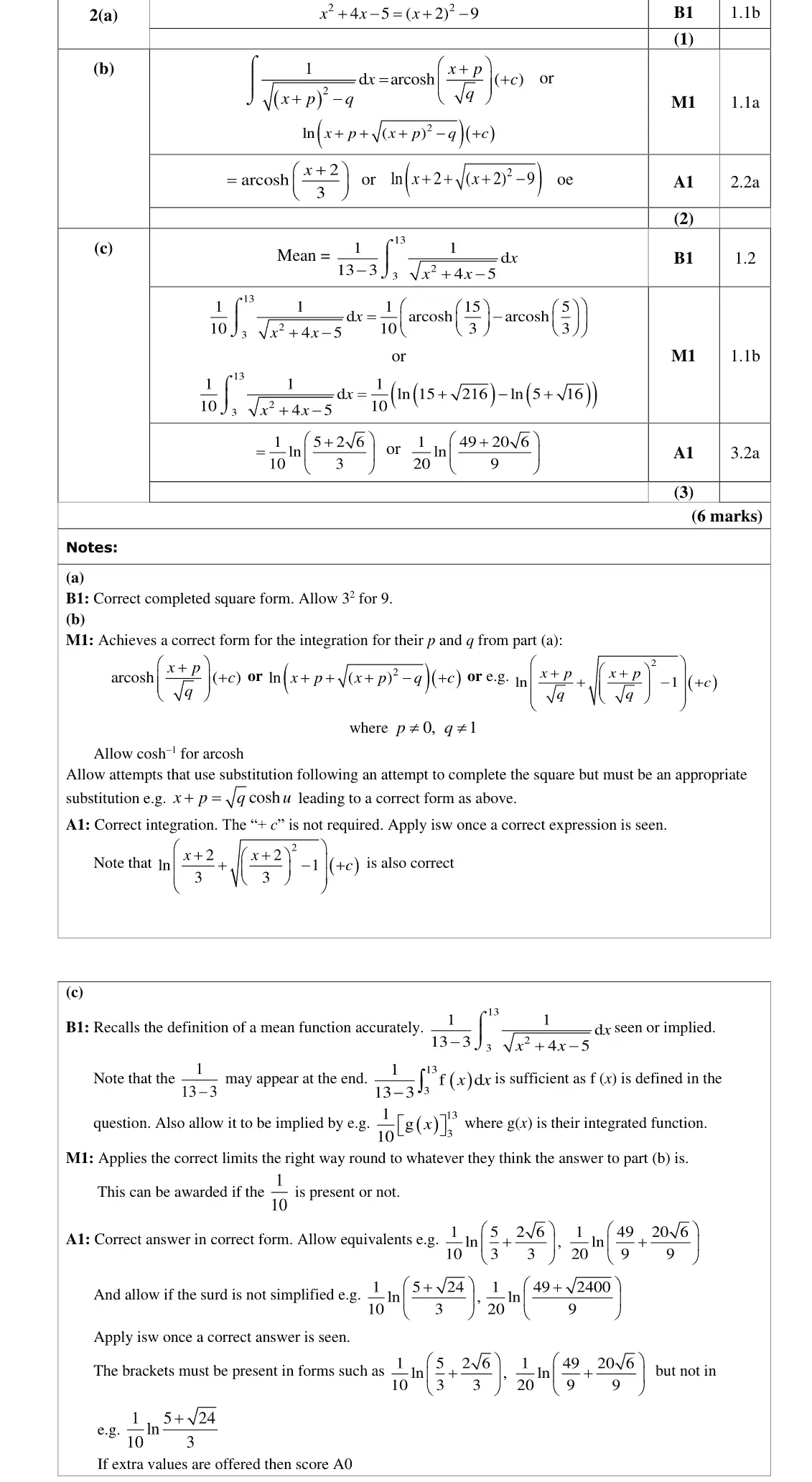
This question proved accessible to most candidates, with many scoring full marks. In part (a), almost all candidates completed the square successfully with candidates in general being able to write the answer with no working. Any errors were very rare.
Key points from the mark scheme and examiner's report
(x + 2)² − 9
June 2023 · Paper 1 (Core Pure 1) · Q2(b)2 marks
Mark scheme (whole question; this part is marked with the orange bar)
Examiner's comment
This question proved accessible to most candidates, with many scoring full marks. In part (b), most candidates left their answer in terms of arcosh, usually working directly from the integral having used part (a) to rearrange the denominator. Many wrote the answer down using a standard result with no working but some could not obtain the required form and wrote down e.g. arcosh 2 3 x + or 2 arcosh 9 x + instead of the correct 2 arcosh . 3 x + Relatively few candidates gave their solution just as a logarithm, though a few gave both forms. Those who used the logarithmic form made more slips. Rather than use a standard result, some candidates chose to use a substitution e.g. u = x + 2 or x + 2 = sec theta . A few responses were seen where arcsin or arsinh was mistakenly given.
Key points from the mark scheme and examiner's report
standard result: arcosh((x + 2)/3) + c, or ln(x + 2 + √((x + 2)² − 9))
arcosh(x + 2)/3 or arcosh((x + 2)/9) and arsinh/arcsin were common errors
June 2023 · Paper 1 (Core Pure 1) · Q2(c)3 marks
Mark scheme (whole question; this part is marked with the orange bar)
Examiner's comment
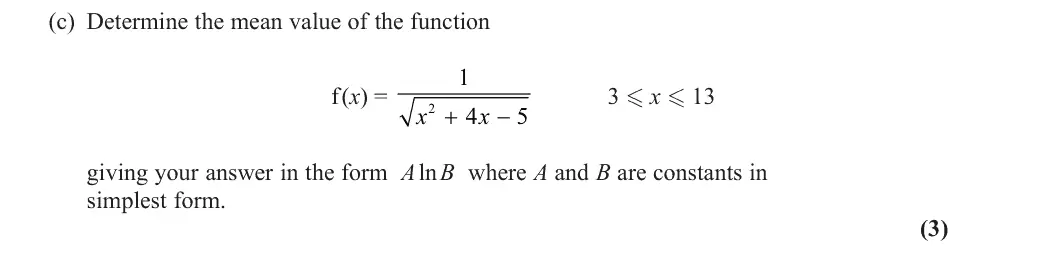
This question proved accessible to most candidates, with many scoring full marks. In part (c), most candidates knew how to find the mean value of a function. Those who failed to do that could often obtain B0M1A0 with the correct use of limits with their integral. There were some incorrect substitutions and collection and/or simplification of answers with some failing to divide both parts of their final fraction by 3 where appropriate.
Key points from the mark scheme and examiner's report
some failed to divide by 13 − 3 or simplify the log
June 2023 · Paper 2 (Core Pure 2) · Q14 marks
Mark scheme (whole question; this part is marked with the orange bar)
Examiner's comment
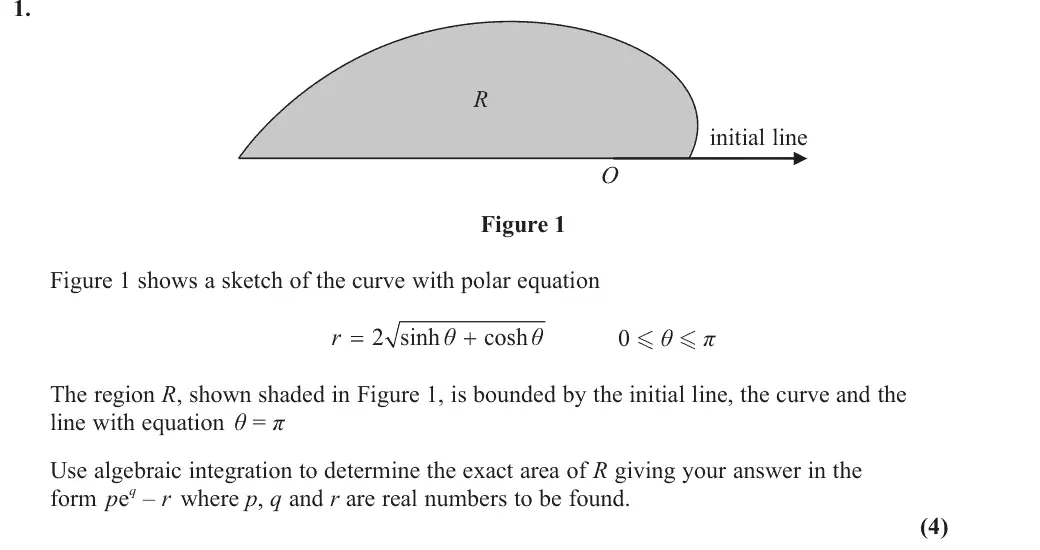
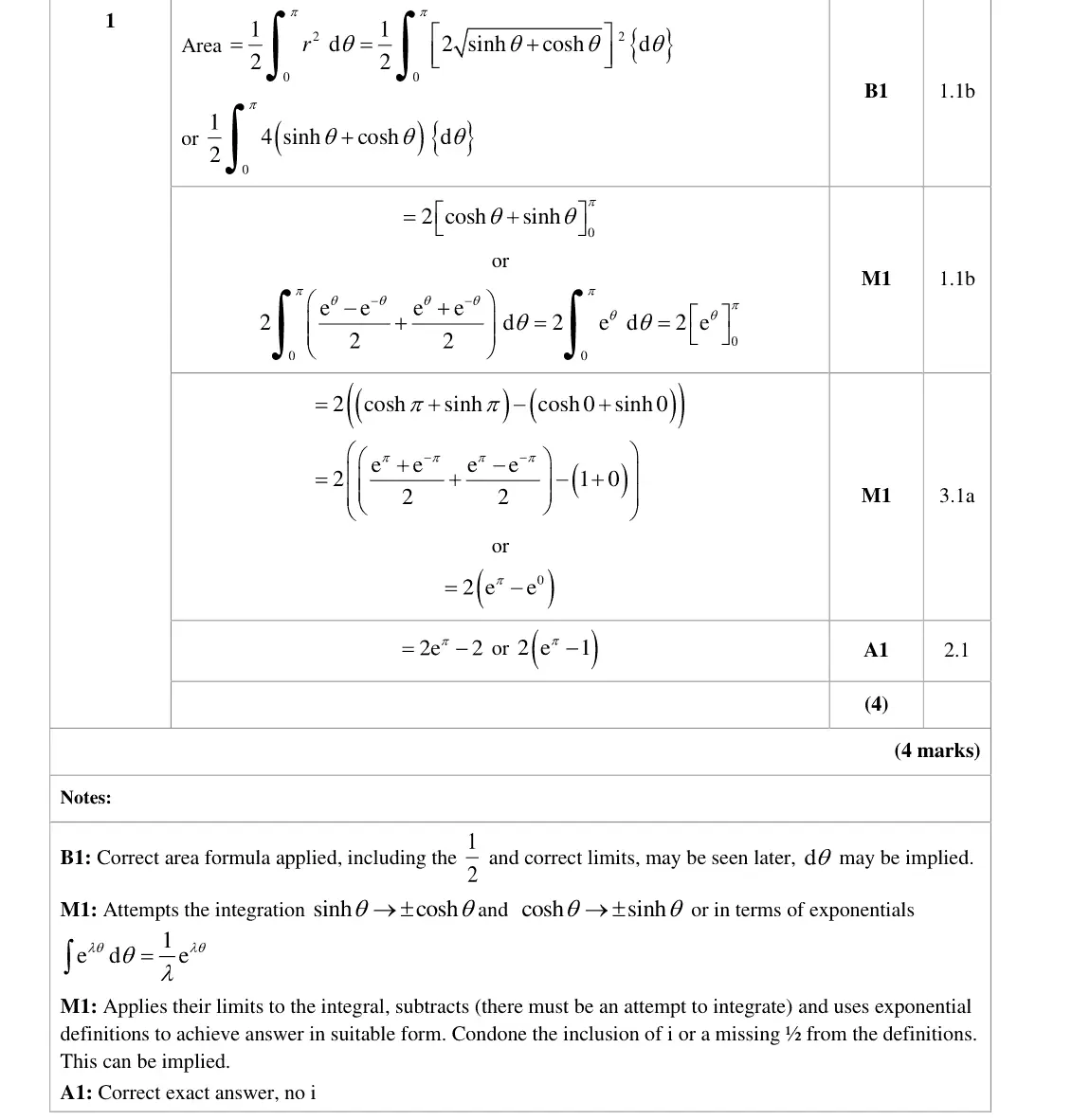
On the whole this question was really well done with only a few candidates with an insecure knowledge of the relevant formula. Most candidates scored full marks. Errors were with the arithmetic, usually in adding exponentials incorrectly, multiplying through by 2 and missing doing this to the constant or by being unable to square the expression. Errors in the latter involved squaring twice (usually each term the second time) or by square rooting each term. The vast majority of candidates did the integration in sinhx and coshx and converted to exponentials after integrating. Some candidates lost the final mark. A common error seen was e e e e 2 1 2e 1 2 2 - - + - + - = - Some candidates that did not gain full marks, incorrectly quoted the definitions of sinhx and coshx with the inclusion of i leading to an answer not of the correct form. Whereas some candidates made a slight error in distributing the factor of 2 to both limits. The majority of candidates were gaining full marks. Of those that didn't, some failed to start with the correct formula (missing the half in front, or the squaring of r), but the vast majority of lost marks were through poor accuracy in substituting the limits. The multiples of 1 2 and 4 caused some confusion with candidates not being sure whether to cancel them or multiply them out.
Key points from the mark scheme and examiner's report
area = ½∫ from 0 to π of 4(sinh θ + cosh θ) dθ = 2[cosh θ + sinh θ]
errors squaring r, slips with exponentials, definitions quoted with i
June 2022 · Paper 1 (Core Pure 1) · Q24 marksEasy
Mark scheme (whole question; this part is marked with the orange bar)
Examiner's comment
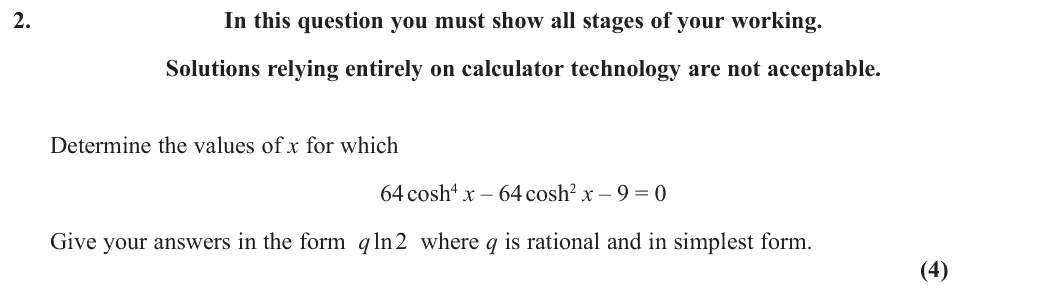
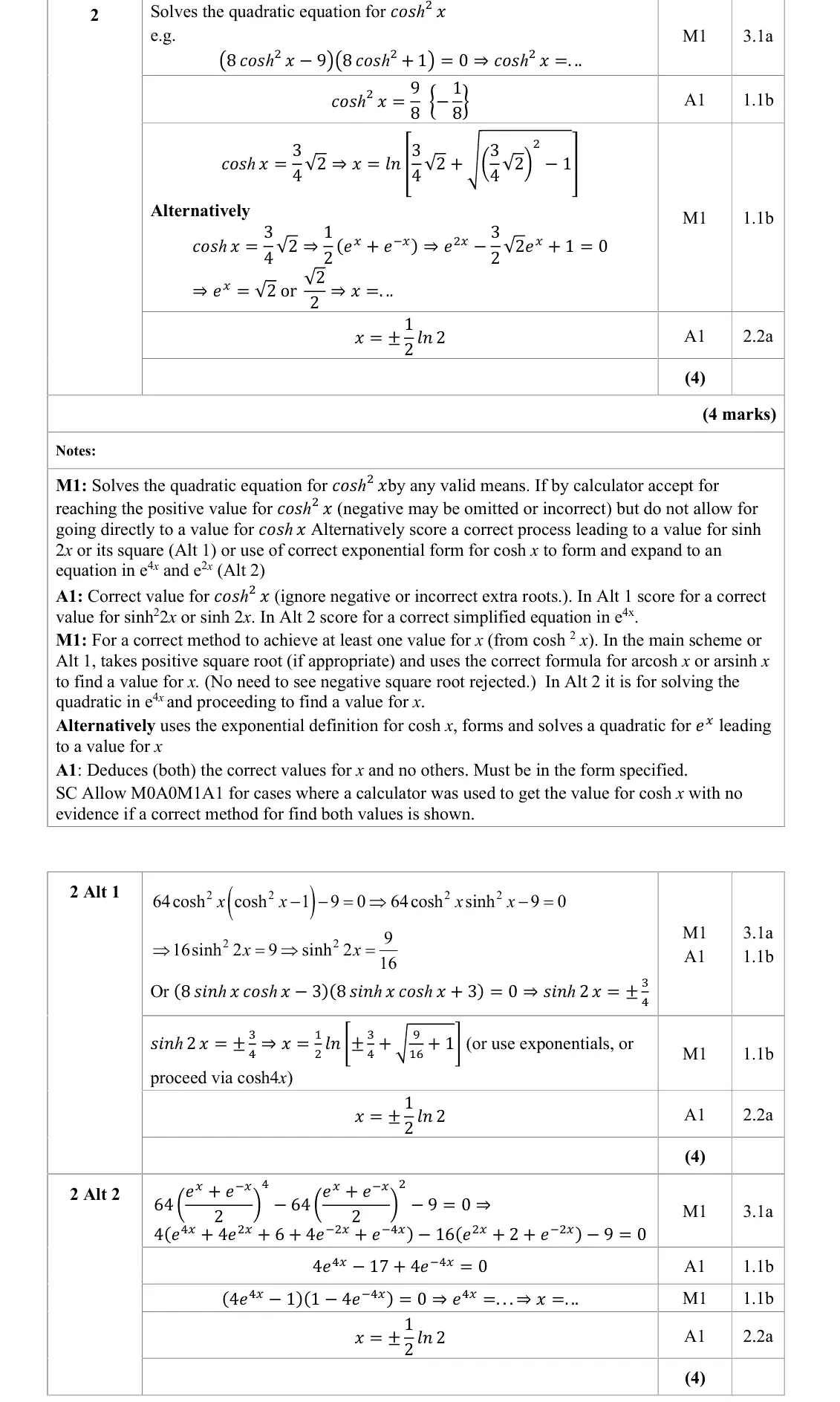
The majority (over 75%) of candidates were able to access this question with full marks or 3 out of 4 marks (losing the final accuracy mark) being the most common mark profiles seen in a bimodal distribution. Most candidates were able to successfully find values for cosh^2x.This was done usually by factorising their quartic equation, although there was use of the quadratic formula demonstrated frequently. There were also several instances where candidates used their calculator to find both values for cosh^2x with no evidence of workings which immediately lost the first two marks since the question specified reliance on a calculator was not allowed. In such cases candidates need to be aware that full methods without resorting to a calculator need to be shown. Those who found both values for cosh^2 x usually dismissed or omitted the value of 1 8 - correctly and proceeded with their 9 8 (usually the correct value), though some did attempt to find values of cosh x from their 1 8 - (which did not affect their overall solution). The candidates who obtained the second method mark were more often those who took the positive square root approach and using the correct formula for arccosh x. There was then mixed success in using logs to find answers in the correct form, with many candidates giving only the positive solution of 1 ln 2 2 , or giving spurious extra solutions from the negative square root. Those using the exponential form for cosh x and solving a quadratic in ex were fewer in number, but the proportion achieving 2 correct solutions was higher via this method. There was small number of candidates who attempted to use the exponential definition for cosh x in the original equation to reach a quadratic in 4e x . Some did not use a valid method to expand their brackets, while those who did so successfully would have found this a time- consuming approach and not many successfully achieve answers via this route.
Key points from the mark scheme and examiner's report
calculator values for cosh²x without working lose the first two marks
both values needed
June 2022 · Paper 1 (Core Pure 1) · Q9(i)(b)3 marksEasy
Mark scheme (whole question; this part is marked with the orange bar)
Examiner's comment
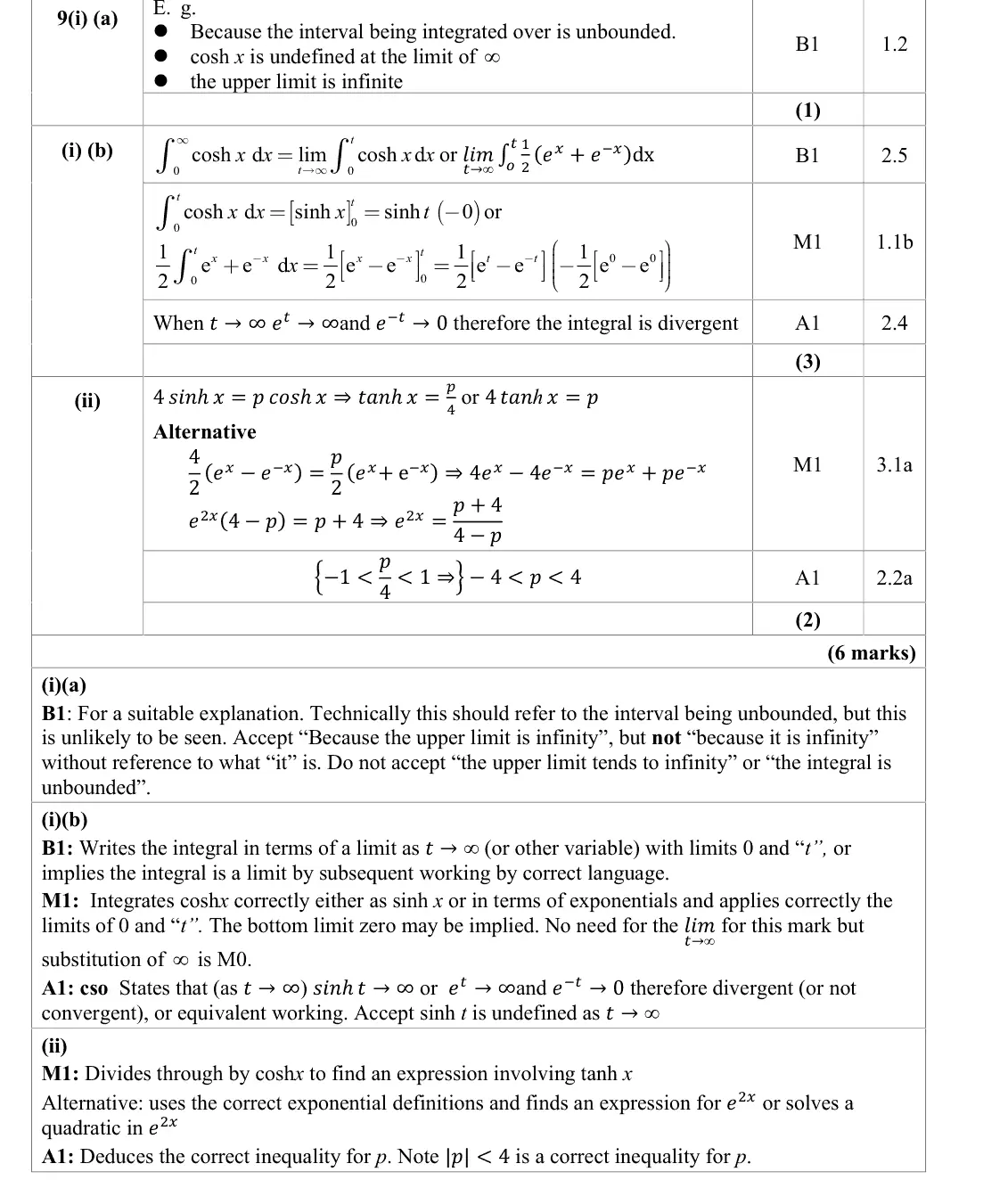
The first question for which the modal mark was not full marks, but was in this case 5 out of 6, with 6 and 4 marks being the next most common scores (about equally likely). Over 80% scored at least 3 marks, but there were many who made little progress in either part. Part (i) (a) proved difficult for candidates to explain, despite being a deceptively simple question expecting the answer that one of the limits is infinite. The intention was often clear but incorrect phrasing or vocabulary made it difficult for marks to be awarded. While most candidates had some idea the interval being integrated over is unbounded they found it difficult to express this clearly, with the most common comment being that one of the limits is infinity. It was not always clear whether they were referring to one of the limits or the integral as a whole. A huge variety of wording used by candidates demonstrated a lack of depth in their understanding of the definition of an improper integral. Part (i)(b) was much more successful but again, students did not always appreciate the importance of the correct language. Most candidates attempted to write down the integral, but a significant number did not replace ∞ with a parameter. They then went on to integrate, but some substituted ∞ instead of using a parameter. Candidates either integrated cosh x directly to give sinh x, or expressed cosh x in terms of exponentials and then integrated, with incorrect processing of limits being the most common reason for dropped marks. Those who did use a parameter and correctly applied the limits 0 and t (or a) usually attempted to find the limit as their t tended to infinity. If they got this far they often made the correct statement and drew the conclusion that it is divergent, but some omitted this. Incomplete statements were more common in those who used exponentials, so the last A mark was often not awarded. Those who opted to integrate to ( ) 1 - - x x 2 e e sometimes did not consider what happens as t tends to infinity for both et and e-t. Part (ii) was mostly answered well with both approached shown in the scheme being seen p = frequently. Those who went straight to tanh x were able to achieve and answer swiftly, 4 however some made lots of work for themselves by working in exponentials and this increased the chances of making an error somewhere along the way. The most efficient x responses used the range of tanh x to state the range for tanh 4 . A few of those who used the exponential form struggled to reach an expression in 𝑒2𝑥. There were some algebraic errors in their working but the most common error was to use the inclusive inequality, the inequality the wrong way round, or a single inequality, usually p < 4. Among those that took the exponential approach some tried to form an equation in terms of ex and use the discriminant to form an inequality in p – it rarely led to the correct final answer, being often abandoned. For those who continued to reach an inequality for p from an exponential definition, most managed to identify 4 as a boundary value but then left this as a single inequality, often p > 4.
Key points from the mark scheme and examiner's report
write as lim t → ∞ of ∫ from 0 to t
= sinh t, which tends to infinity, so divergent
substituting ∞ directly scores M0
June 2022 · Paper 1 (Core Pure 1) · Q9(ii)2 marksEasy
Mark scheme (whole question; this part is marked with the orange bar)
Examiner's comment
The first question for which the modal mark was not full marks, but was in this case 5 out of 6, with 6 and 4 marks being the next most common scores (about equally likely). Over 80% scored at least 3 marks, but there were many who made little progress in either part. Part (i) (a) proved difficult for candidates to explain, despite being a deceptively simple question expecting the answer that one of the limits is infinite. The intention was often clear but incorrect phrasing or vocabulary made it difficult for marks to be awarded. While most candidates had some idea the interval being integrated over is unbounded they found it difficult to express this clearly, with the most common comment being that one of the limits is infinity. It was not always clear whether they were referring to one of the limits or the integral as a whole. A huge variety of wording used by candidates demonstrated a lack of depth in their understanding of the definition of an improper integral. Part (i)(b) was much more successful but again, students did not always appreciate the importance of the correct language. Most candidates attempted to write down the integral, but a significant number did not replace ∞ with a parameter. They then went on to integrate, but some substituted ∞ instead of using a parameter. Candidates either integrated cosh x directly to give sinh x, or expressed cosh x in terms of exponentials and then integrated, with incorrect processing of limits being the most common reason for dropped marks. Those who did use a parameter and correctly applied the limits 0 and t (or a) usually attempted to find the limit as their t tended to infinity. If they got this far they often made the correct statement and drew the conclusion that it is divergent, but some omitted this. Incomplete statements were more common in those who used exponentials, so the last A mark was often not awarded. Those who opted to integrate to ( ) 1 - - x x 2 e e sometimes did not consider what happens as t tends to infinity for both et and e-t. Part (ii) was mostly answered well with both approached shown in the scheme being seen p = frequently. Those who went straight to tanh x were able to achieve and answer swiftly, 4 however some made lots of work for themselves by working in exponentials and this increased the chances of making an error somewhere along the way. The most efficient x responses used the range of tanh x to state the range for tanh 4 . A few of those who used the exponential form struggled to reach an expression in 𝑒2𝑥. There were some algebraic errors in their working but the most common error was to use the inclusive inequality, the inequality the wrong way round, or a single inequality, usually p < 4. Among those that took the exponential approach some tried to form an equation in terms of ex and use the discriminant to form an inequality in p – it rarely led to the correct final answer, being often abandoned. For those who continued to reach an inequality for p from an exponential definition, most managed to identify 4 as a boundary value but then left this as a single inequality, often p > 4.
Key points from the mark scheme and examiner's report
divide by cosh x: tanh x = p/4 and the range of tanh is (−1, 1), so −4 < p < 4
June 2022 · Paper 2 (Core Pure 2) · Q9(a)(i)4 marks
Mark scheme (whole question; this part is marked with the orange bar)
Examiner's comment
This proved a demanding question for many candidates In part (a)(i), a good attempt was made by many, using the chain rule and product rules but there were a few slips (even though they sometimes recovered from them). Some gained no credit because the square on the sinhx term for the second derivative was missing. Missing x’s were also quite common as a cause of dropped marks. The identity 2 2 cosh sinh 1 x x - = was well remembered well by most with a few sign slips.
Key points from the mark scheme and examiner's report
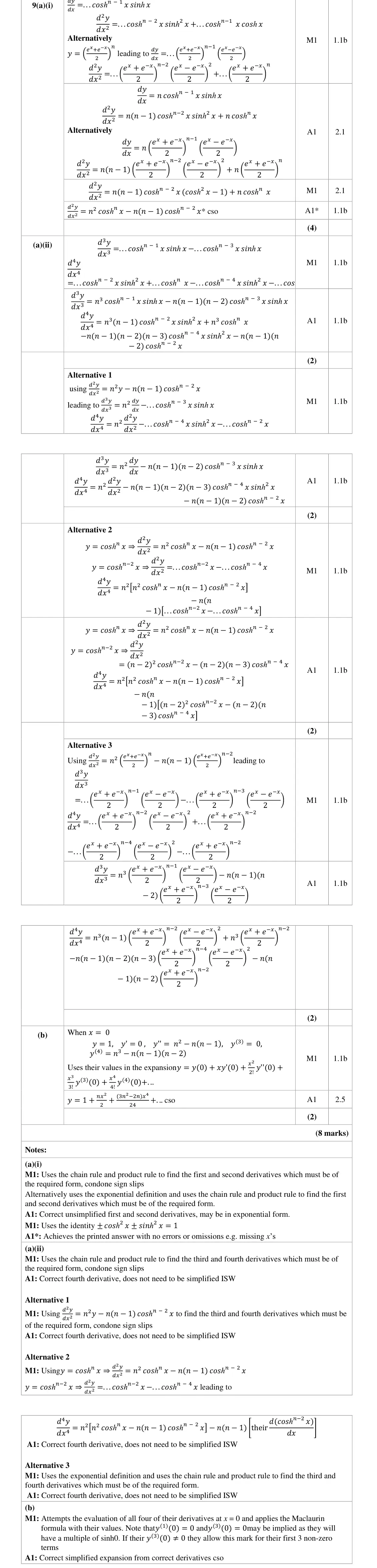
dy/dx = n coshⁿ⁻¹x sinh x, then product and chain rules
replace sinh²x by cosh²x − 1
missing square on sinh x or missing x lost marks
June 2022 · Paper 2 (Core Pure 2) · Q9(a)(ii)2 marks
Mark scheme (whole question; this part is marked with the orange bar)
Examiner's comment
This proved a demanding question for many candidates Part (a)(ii) proved a challenge, there were many alternatives approaches possible and students didn’t need to simplify to get the marks. Some replaced ncosh2x with ny2 which made it easier to differentiate. A few changed hyperbolic functions into exponential functions and used this to differentiate. The complexity of the 3rd and 4th differentials put many off and those who attempted it often made slips with a term or got themselves very confused with multiple attempts. It was very common for candidates to make a slip, meaning that only a minority of candidates were able to produce a completely correct expression for the 4th differential.
Key points from the mark scheme and examiner's report
differentiate the given second derivative twice (or use d²y/dx² = n²y − n(n − 1)coshⁿ⁻²x)
no need to simplify
slips in the many terms were very common
Nov 2021 · Paper 1 (Core Pure 1) · Q9(a)6 marksHard
Mark scheme (whole question; this part is marked with the orange bar)
Examiner's comment
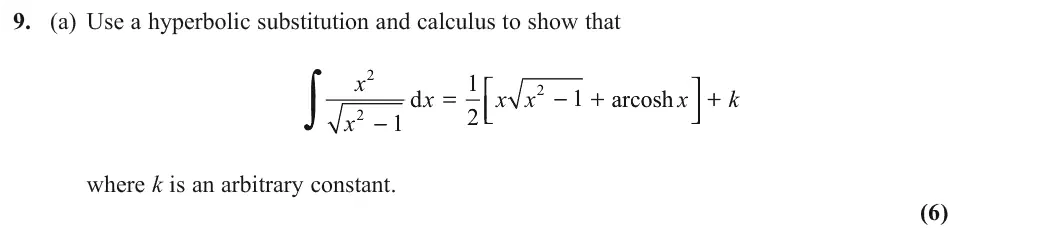
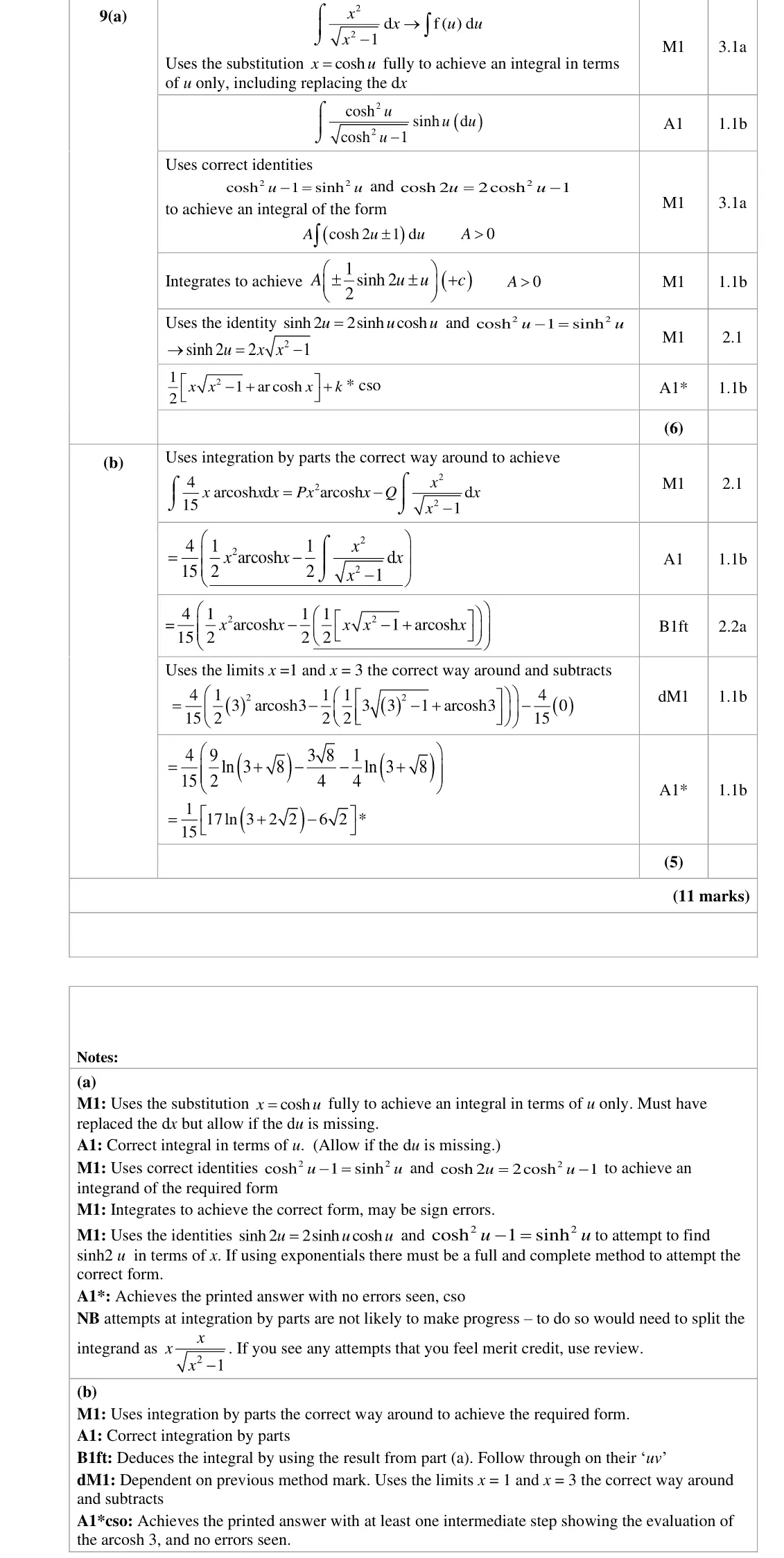
A challenging closing question, but the first part did give a bit more access than question 8. (a) About 40% of candidates used the correct hyperbolic substitution and these usually went on to use correct identities to gain the first two marks, though only 28% gained the first 4 marks. The next M mark required them to use identities and show clearly how to obtain the given form, and few managed to do this, with only 15% successfully completing the part. was a link to part (a) even though they had been told this in the question. Those who did make some progress usually realised that the lower limit was 1 but many didn’t show their evaluation clearly, so lost at least the last A mark.
Key points from the mark scheme and examiner's report
substitute x = cosh u including dx = sinh u du
cosh²u = ½(cosh 2u + 1)
sinh 2u = 2sinh u cosh u = 2x√(x² − 1)
printed answer needs every step
Nov 2021 · Paper 1 (Core Pure 1) · Q9(b)5 marks
Mark scheme (whole question; this part is marked with the orange bar)
Examiner's comment
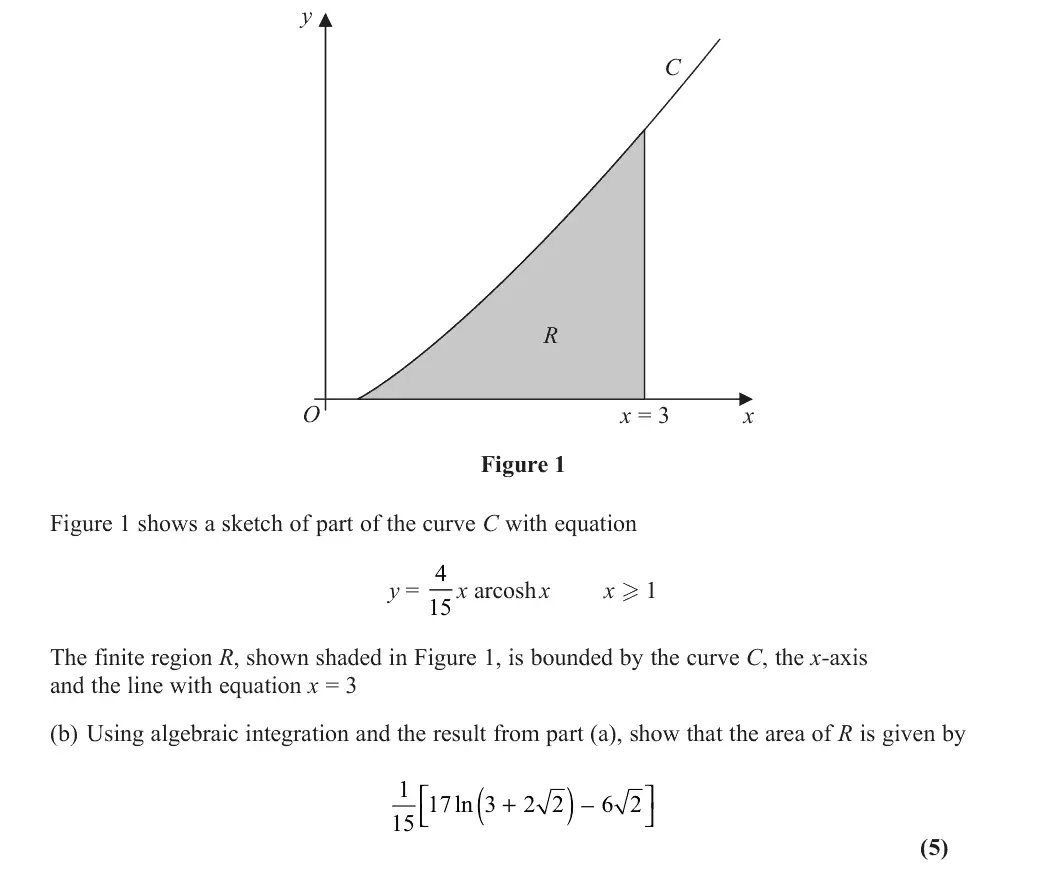
(b) This part was not well done, perhaps as it was at the very end of the paper and time was running out. Only about 10% made any significant progress at all in this part, with very few fully correct responses, though about half who did make such progress reached at least the final M mark. Very few used integration by parts to achieve the required form, but many instead tried another substitution which went nowhere. A few attempt parts in the wrong direction and again soon gave up. Many didn’t realise that there was a link to part (a) even though they had been told this in the question.
Key points from the mark scheme and examiner's report
integration by parts with u = arcosh x, then use (a)
limits 1 and 3
arcosh 3 = ln(3 + √8) shown
area (1/15)[17ln(3 + 2√2) − 6√2]
few linked to (a)
Nov 2021 · Paper 2 (Core Pure 2) · Q7(a)3 marks
Mark scheme (whole question; this part is marked with the orange bar)
Examiner's comment
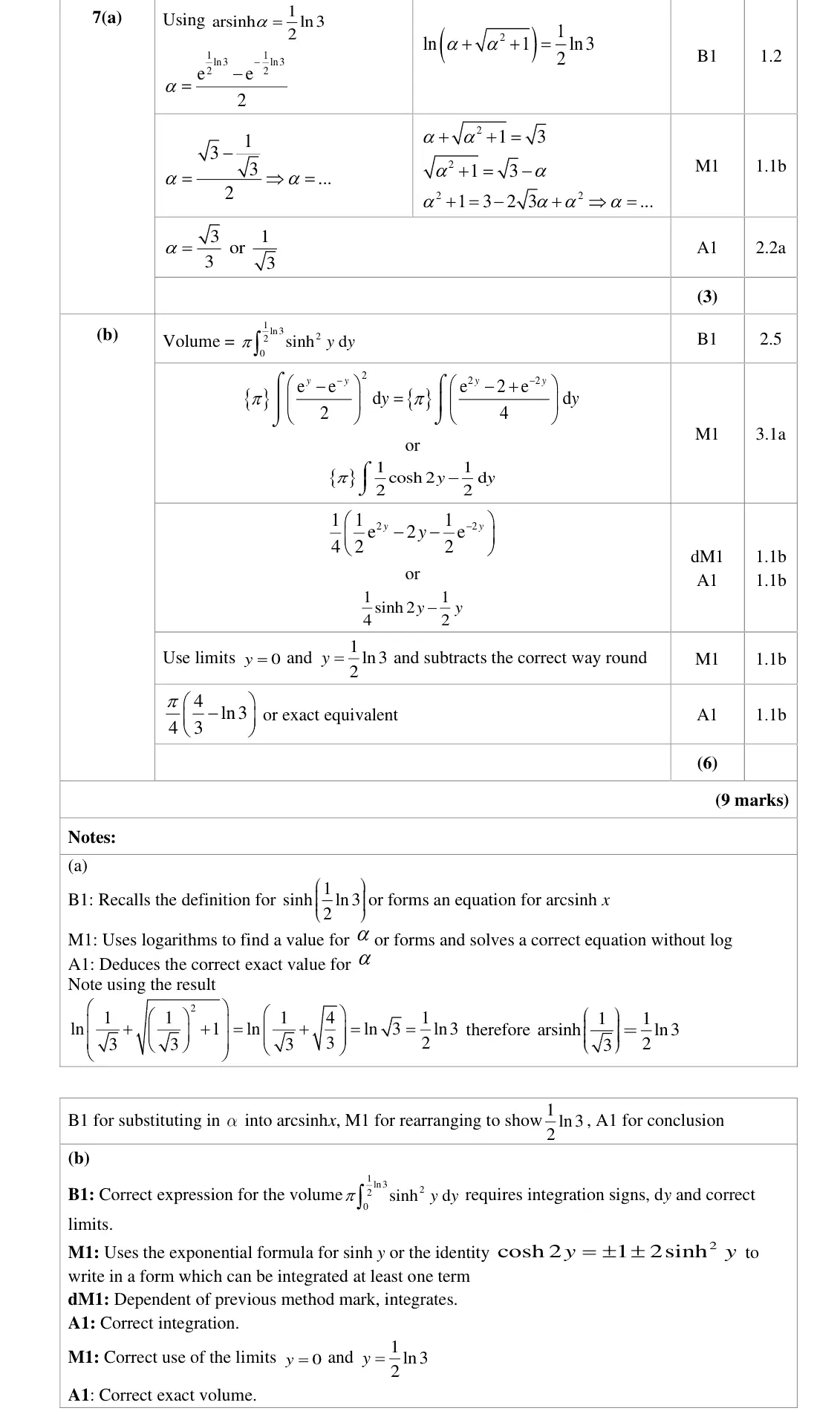
Part (a) Was very well done by the majority. Using the exponential definition of sinh x or the natural log representation of arsinh x. A few who took the latter root went wrong by squaring instead of 2 1 3 alpha alpha + + = then squaring. rearranging to 2 1 3 alpha alpha + = -
Key points from the mark scheme and examiner's report
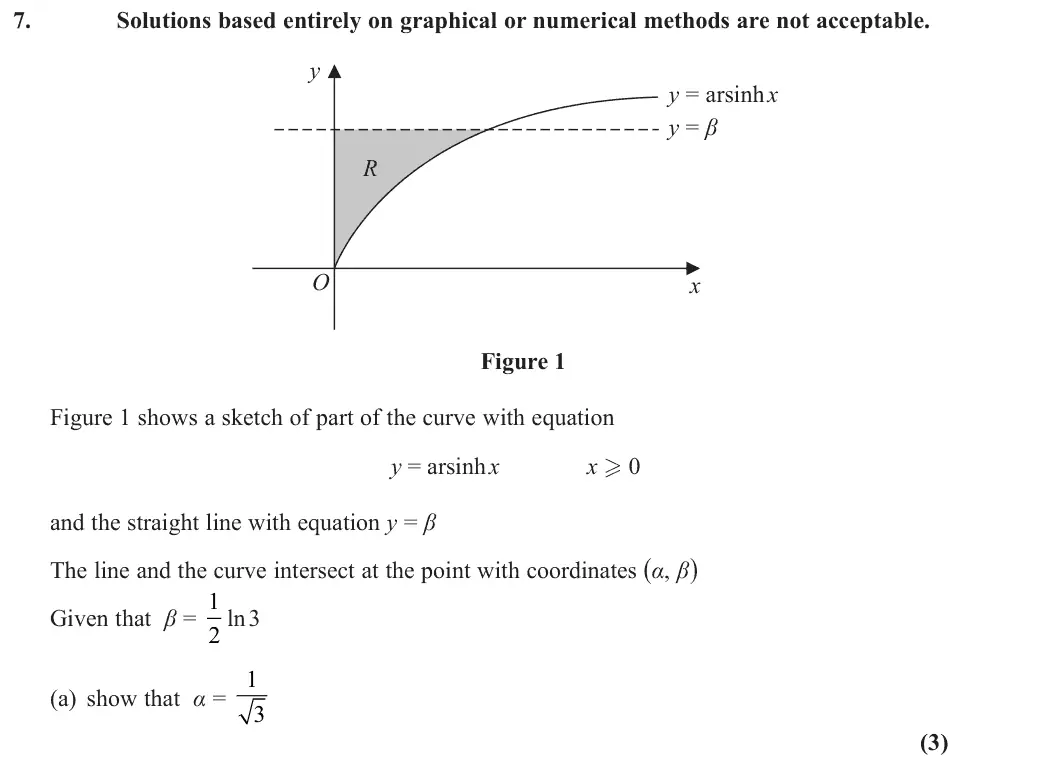
α = sinh(½ ln 3) = (√3 − 1/√3)/2 = 1/√3, or ln(α + √(α² + 1)) = ½ ln 3 and isolate the root before squaring
Nov 2021 · Paper 2 (Core Pure 2) · Q7(b)6 marks
Mark scheme (whole question; this part is marked with the orange bar)
Examiner's comment
Part (b) This was generally well done, with candidates correctly using the sinh y in terms of exponential or volume of revolution formula. Expressing 2 using the double angle formula for cosh 2y were equally popular, to arrange it an integrable form. There were many fully correct attempts but some with careless slips along the way followed through to an incorrect conclusion. There were also some candidates who used 3 as the upper 3 limit instead of ln
Key points from the mark scheme and examiner's report
V = π∫ sinh²y dy from 0 to ½ ln 3
sinh²y = ½(cosh 2y − 1) or exponentials
(π/4)(4/3 − ln 3)
using 1/√3 or √3 as the upper limit instead of ½ ln 3
Oct 2020 · Paper 2 (Core Pure 2) · Q17 marks
Mark scheme (whole question; this part is marked with the orange bar)
Examiner's comment
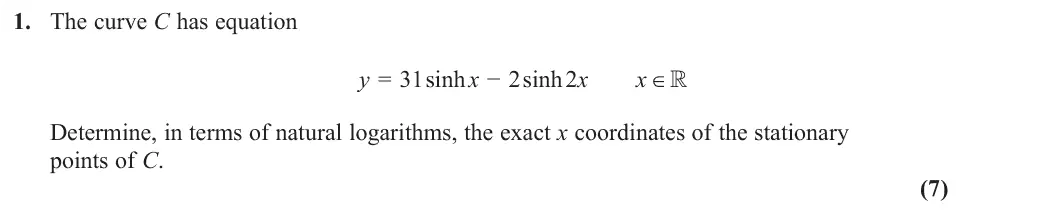
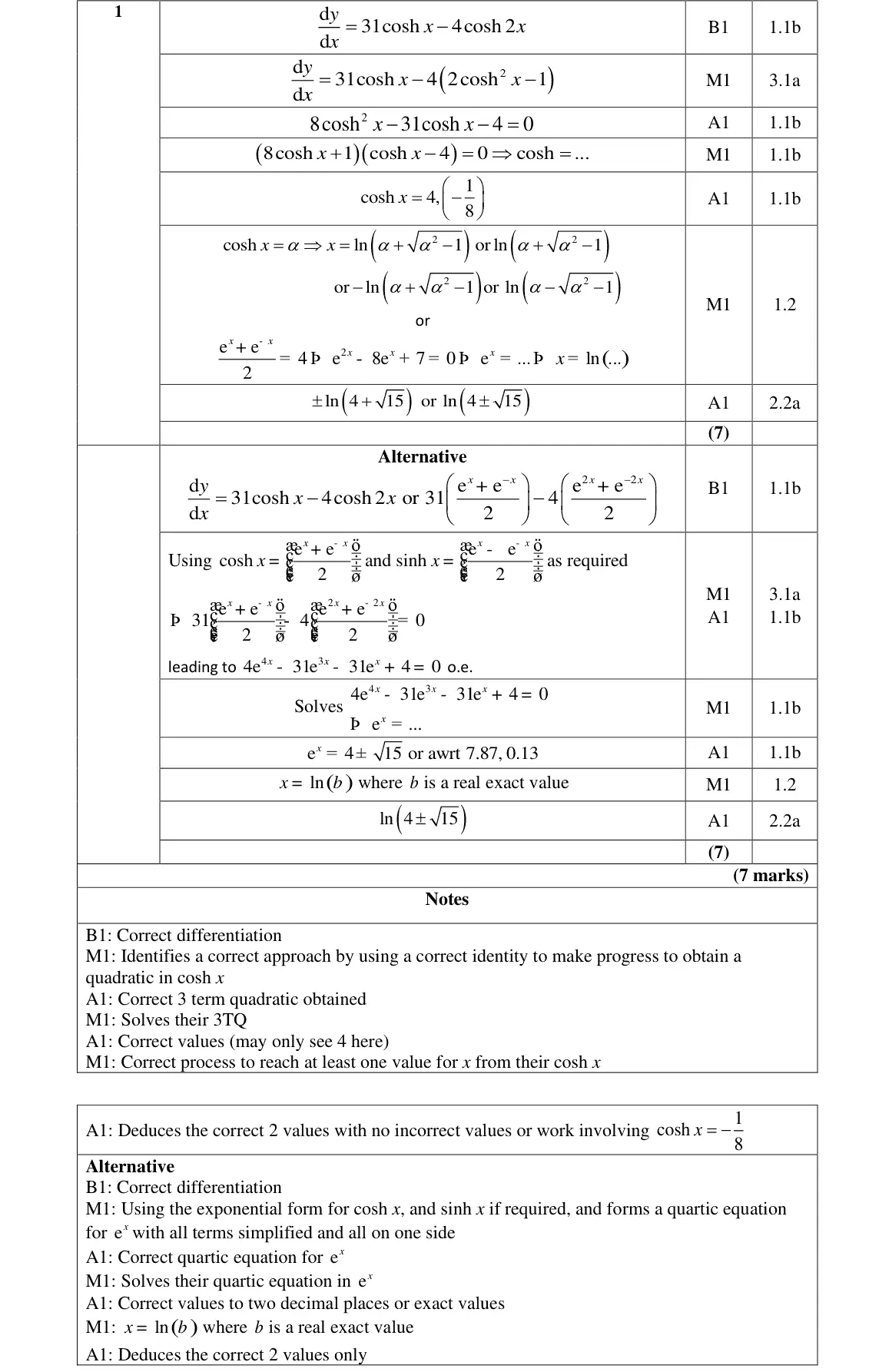
Two different routes were chosen by candidates in solving this problem. The more successful of these was to work with hyperbolic functions. Differentiation was usually correct and most spotted the necessary substitution in order to obtain a quadratic equation in cosh x. This was straightforward to solve but many candidates, probably after looking at the formula book, only found one solution for x – that being ( ) ln 4 15 + The alternative approach involving converting to exponential form was less successful. Quite a few candidates had hoped for an easier passage than to encounter a quartic equation and so became lost on the way. A large number did however arrive at the correct equation and were able to use their calculators to obtain the solutions. The main advantage of this approach was that if they completed it they would arrive at both of the possible values.
Key points from the mark scheme and examiner's report
many gave only the positive value from the formula book
exponential route leads to a quartic in eˣ
June 2019 · Paper 2 (Core Pure 2) · Q1(a)5 marks
Mark scheme (whole question; this part is marked with the orange bar)
Examiner's comment
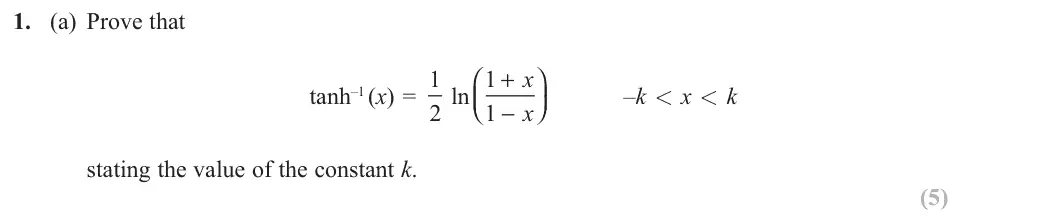
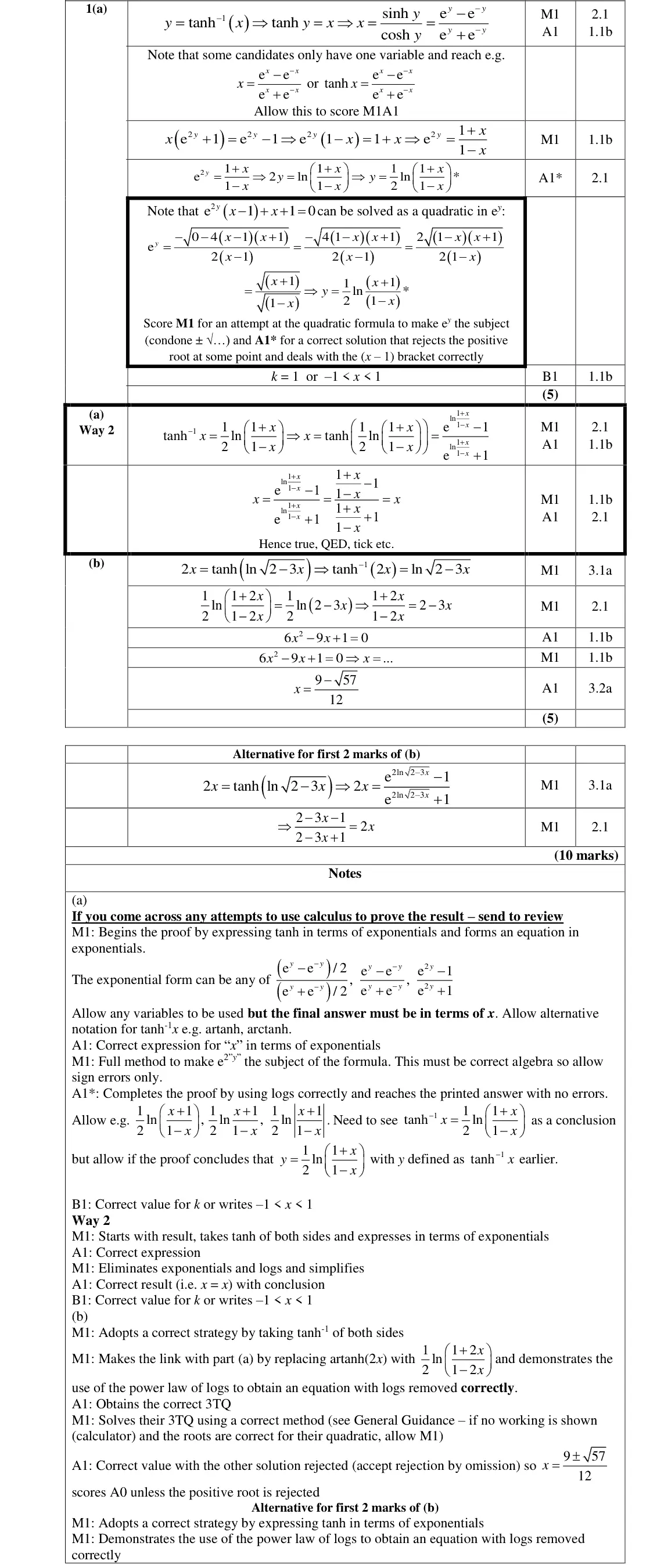
Part (a) required proving the logarithmic form of tanh-1(x) and it produced a mixed response. Most candidates were able to obtain an appropriate equation in exponentials but some did not appreciate the need to rearrange it, particularly those who did not introduce another variable. Those who did make e2”y” the subject usually did so correctly, although a few did not convert the resulting –1– x x – 1 into the required 1 + x 1 – x. Some solved a quadratic in ey but often got bogged down in the algebra. A small number of candidates started with the given result and verified it appropriately. A few attempted to use sinh-1x cosh-1x for tanh-1(x). A significant number neglected to state the value of k. Approaches using differentiation followed by integration could not get full credit.
Key points from the mark scheme and examiner's report
write x = tanh y in exponentials, make e^(2y) the subject, then take logs
k = 1 (state −1 < x < 1, often omitted)
calculus (differentiate then integrate) routes not accepted
June 2019 · Paper 2 (Core Pure 2) · Q1(b)5 marks
Mark scheme (whole question; this part is marked with the orange bar)
Examiner's comment
Part (b) was more successful for most although slips occasionally led to candidates not achieving a quadratic when the logarithms were removed. There were a surprising number of errors seen producing the correct 3TQ from 1 + 2x 1 – 2x = 2 – 3x. The quadratic was almost always solved correctly, but many failed to reject the ineligible solution, despite being asked about the range of validity of tanh-1(x) in part (a). Presentation of work was an issue for many. For example, many scripts were seen where “tan” was written when “tanh” was intended.
Key points from the mark scheme and examiner's report
take tanh⁻¹ of both sides and use (a): (1 + 2x)/(1 − 2x) = 2 − 3x, 6x² − 9x + 1 = 0
x = (9 − √57)/12 only
must reject the other root (outside the domain of tanh⁻¹ 2x)
June 2019 · Paper 2 (Core Pure 2) · Q3(a)4 marks
Mark scheme (whole question; this part is marked with the orange bar)
Examiner's comment
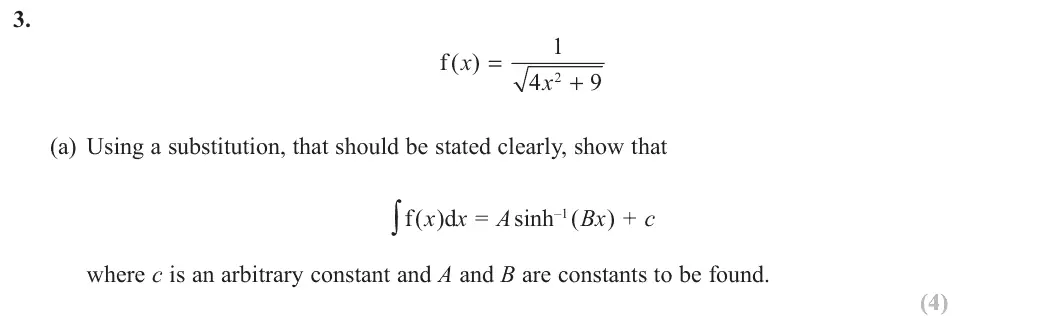
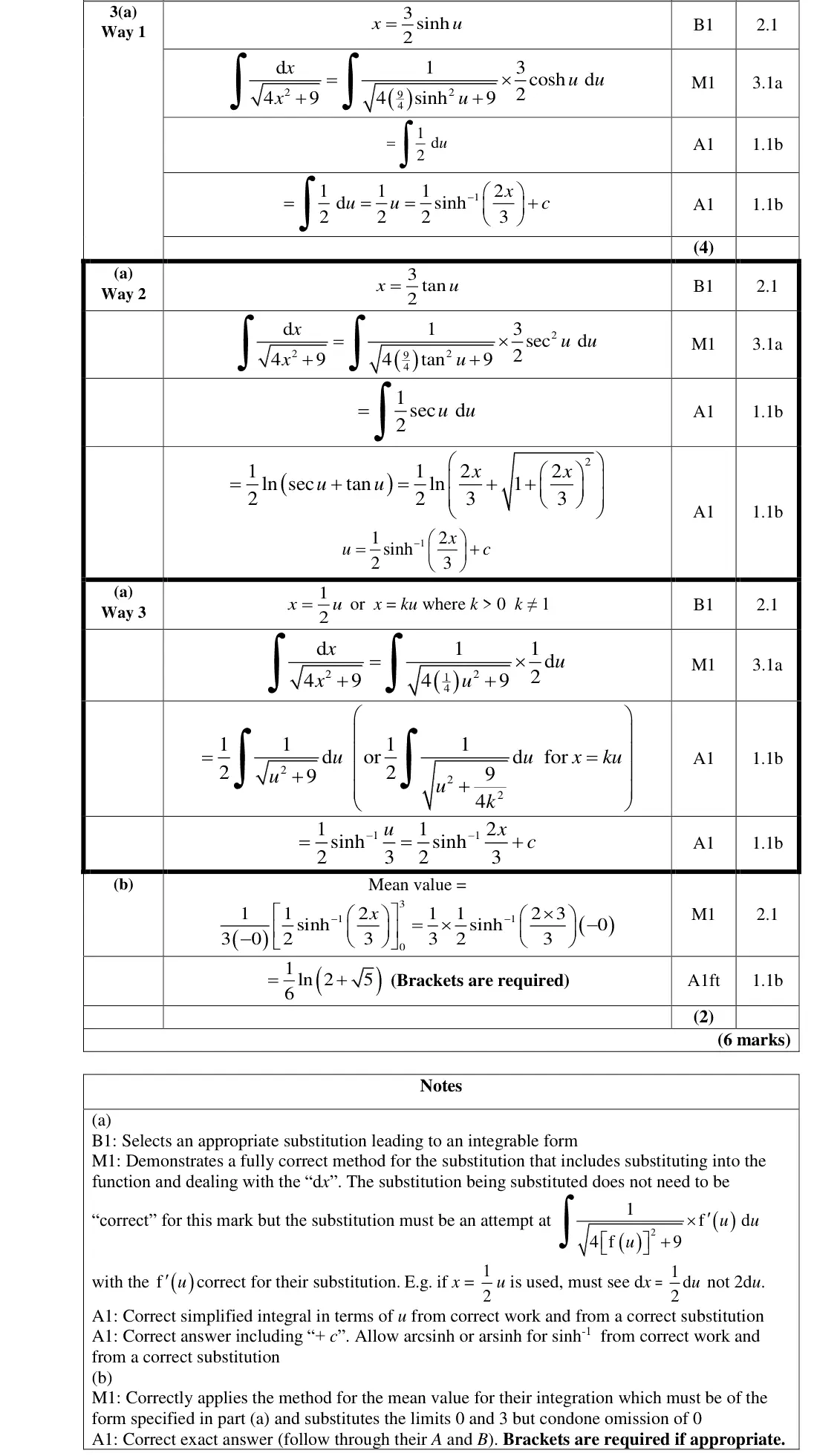
Part (a) required an integration by substitution. Unfortunately, some candidates merely used 1 3 the formula book. Those who chose an appropriate substitution, usually x = 2 u or x = 2 sinh u, tended to proceed correctly. The method mark was still available to those who chose a substitution that did not lead to an easily integratable form. There were very few cases where du dx dx was replaced with dx du rather than du du. In part (ii) the concept of mean value was widely known. A few errors were seen in the use of the logarithmic form of sinh-1(x) but generally the two marks here were widely scored.
Key points from the mark scheme and examiner's report
substitution x = (3/2)sinh u, dx = (3/2)cosh u du
½ sinh⁻¹(2x/3) + c, so A = ½, B = 2/3
quoting the formula book without a substitution loses marks
Find an Edexcel Further Maths tutor
Stuck on this? Book a trial lesson with our Further Maths tutor.