June 2018: AS Paper 22: Further Pure Mathematics 2

40 marks · 13 question parts · Question paper, mark scheme and examiner's report on Pearson's site

Question by question

QTopicMarksDifficulty
1(i) Number theory: Euclid, Bezout, modular arithmetic and Fermat 2 —
1(ii) Number theory: Euclid, Bezout, modular arithmetic and Fermat 3 —
2(a) Groups: axioms, Cayley tables, subgroups, Lagrange and isomorphism 6 —
2(b) Groups: axioms, Cayley tables, subgroups, Lagrange and isomorphism 2 —
2(c) Groups: axioms, Cayley tables, subgroups, Lagrange and isomorphism 1 —
2(d) Groups: axioms, Cayley tables, subgroups, Lagrange and isomorphism 1 —
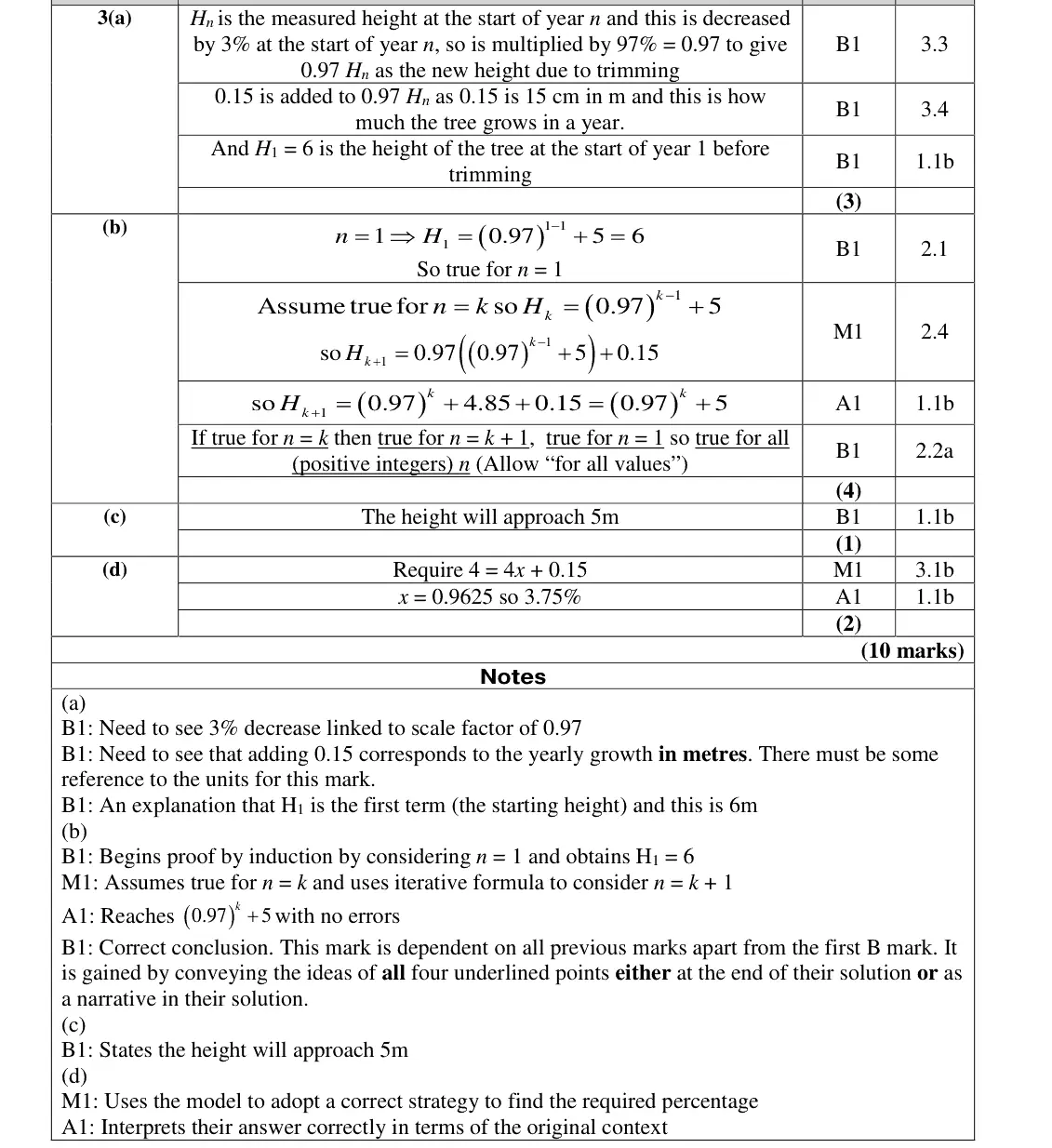
3(a) Recurrence relations and proof of closed forms 3 —
3(b) Recurrence relations and proof of closed forms 4 —
3(c) Recurrence relations and proof of closed forms 1 —
3(d) Recurrence relations and proof of closed forms 2 —
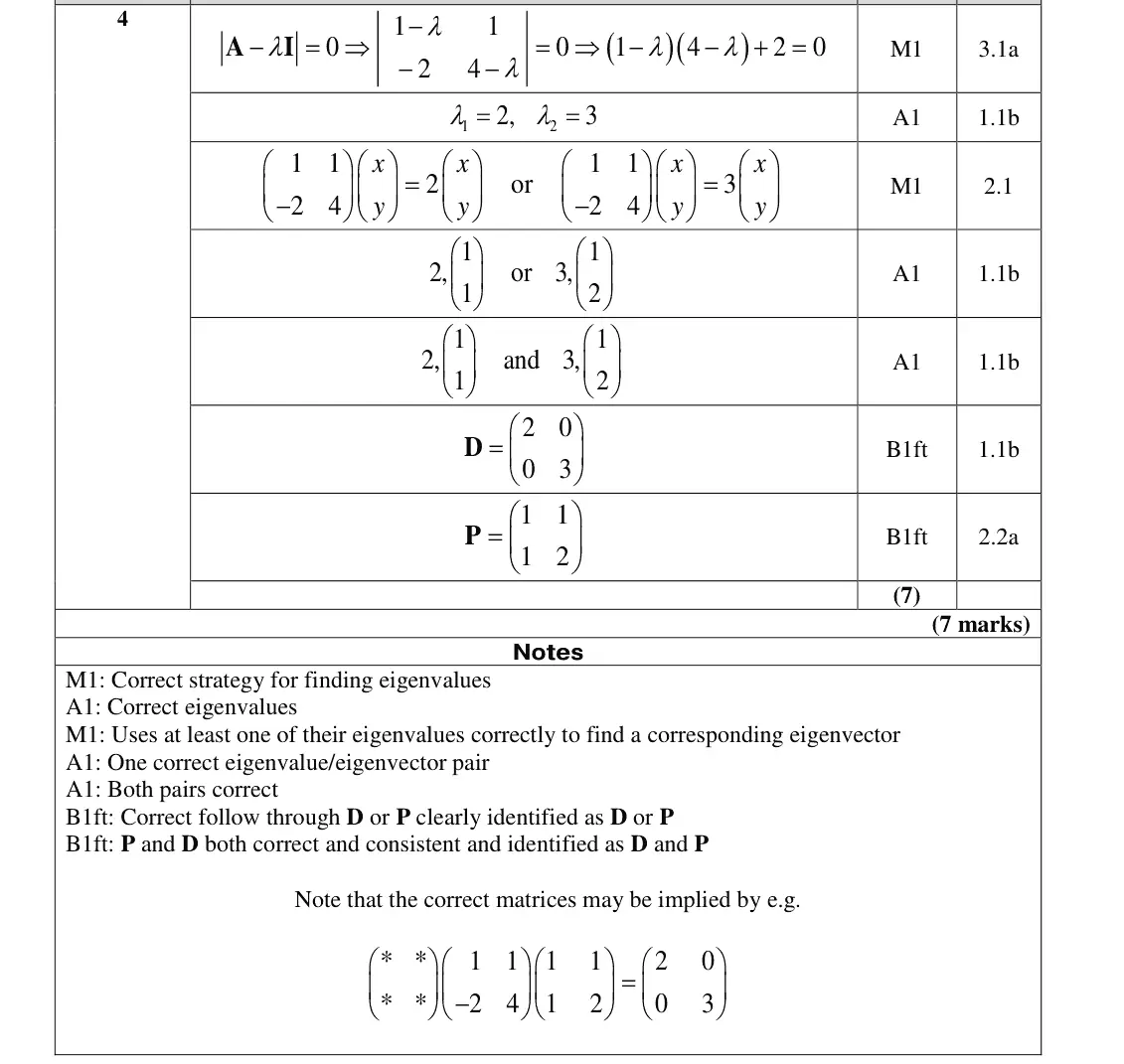
4 Eigenvalues, eigenvectors, diagonalisation and Cayley-Hamilton 7 —
5(a) Further complex numbers: regions and transformations of the plane 3 —
5(b) Further complex numbers: regions and transformations of the plane 5 —

The questions

1(i)1(ii)2(a)2(b)2(c)2(d)3(a)3(b)3(c)3(d)45(a)5(b)
June 2018 · AS Paper 2 (Further Pure 2) · Q1(i) 2 marks number theory
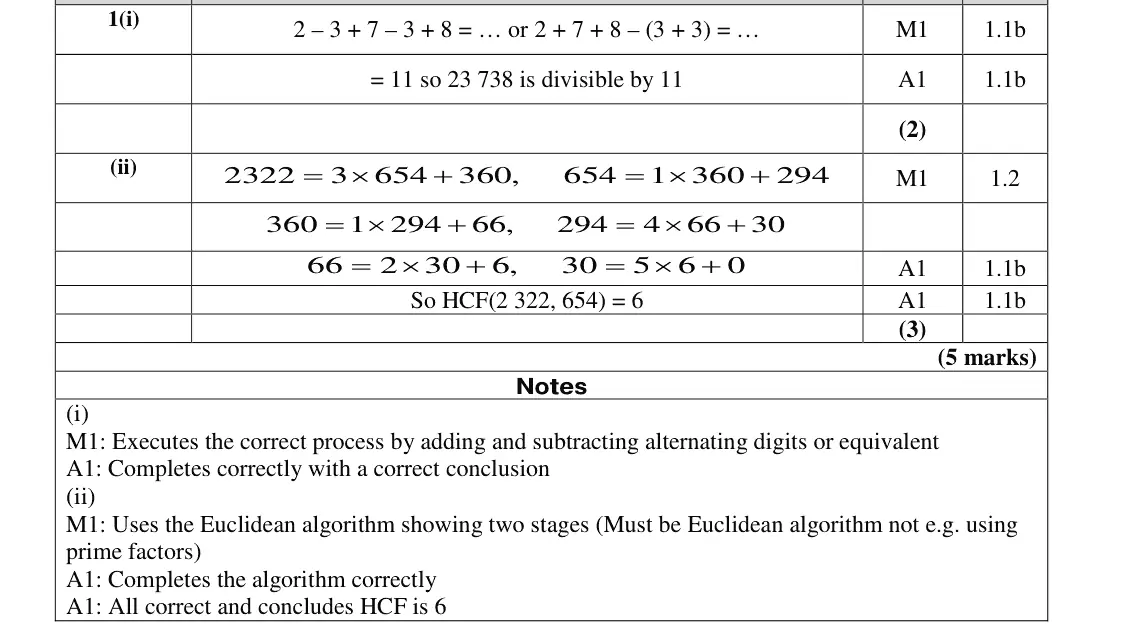
1. (i) Using a suitable algorithm and without performing any division, determine whether 23 738 is divisible by 11 (2)
June 2018 · AS Paper 2 (Further Pure 2) · Q1(ii) 3 marks number theory
(ii) Use the Euclidean algorithm to find the highest common factor of 2322 and 654 (3)
June 2018 · AS Paper 2 (Further Pure 2) · Q2(a) 6 marks groups
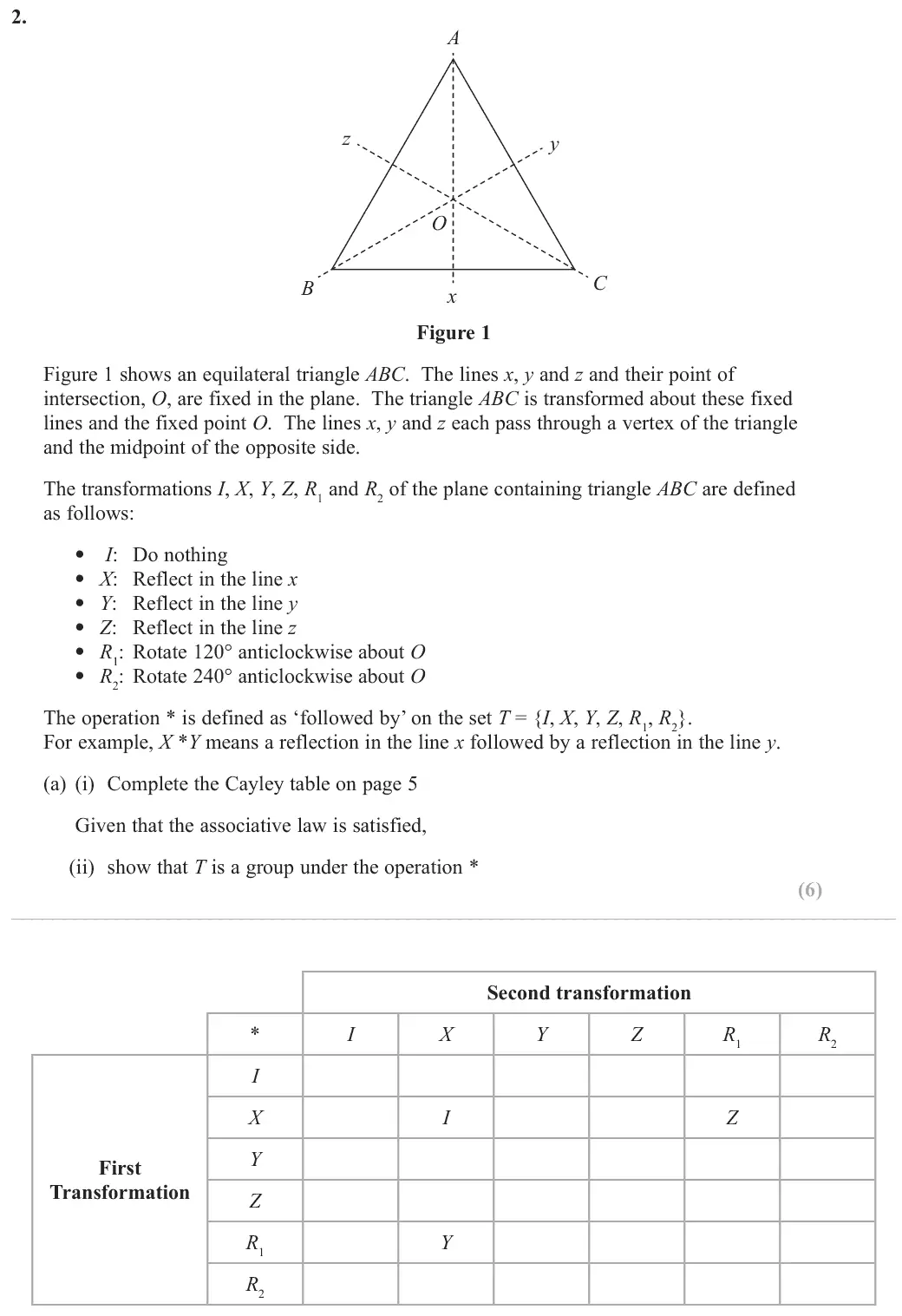
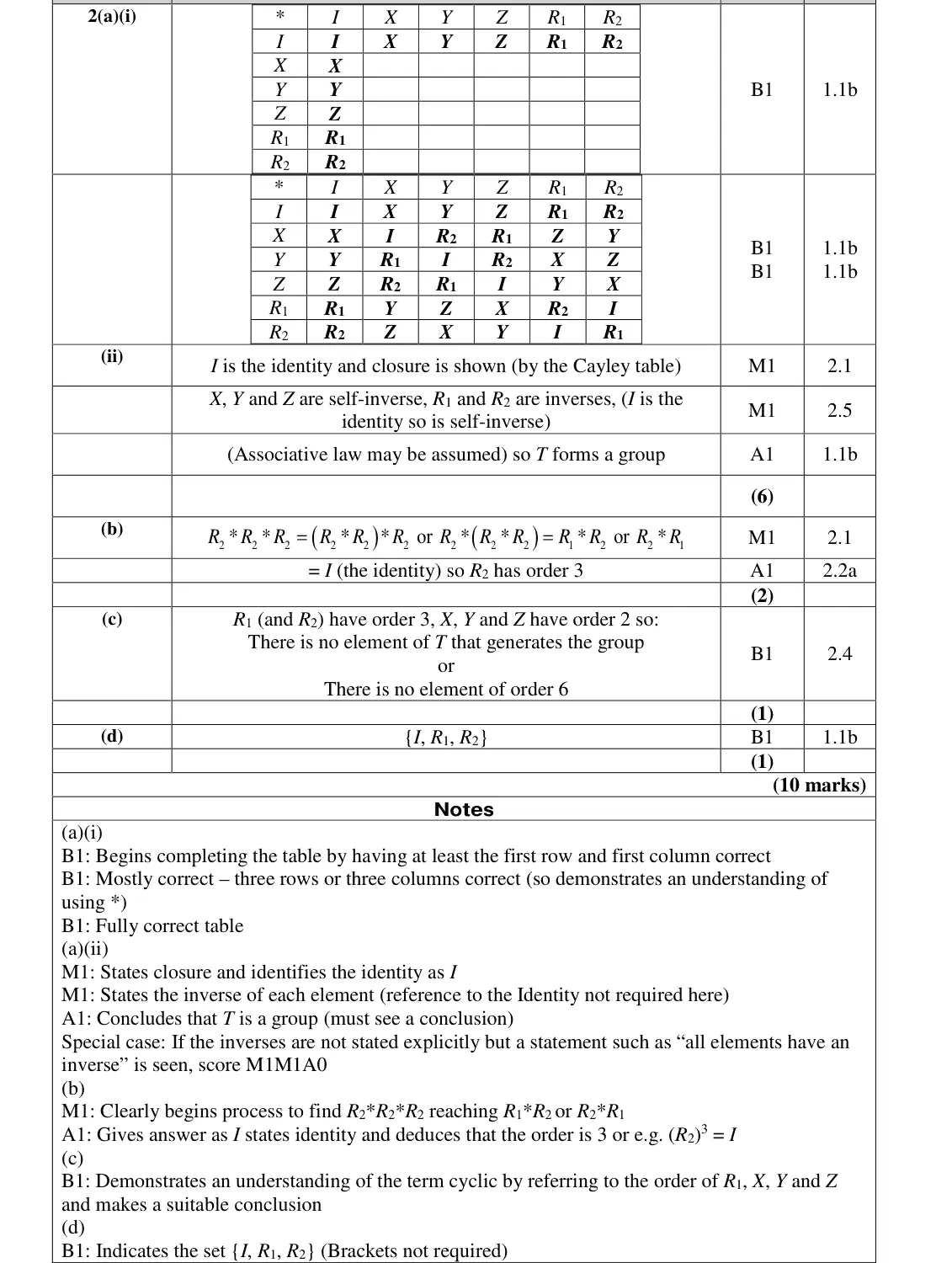
2. A z y C B x Figure 1 Figure 1 shows an equilateral triangle ABC. The lines x, y and z and their point of intersection, O, are fixed in the plane. The triangle ABC is transformed about these fixed lines and the fixed point O. The lines x, y and z each pass through a vertex of the triangle and the midpoint of the opposite side. The transformations I, X, Y, Z, R1 and R2 of the plane containing triangle ABC are defined as follows: • I: Do nothing • X: Reflect in the line x • Y: Reflect in the line y • Z: Reflect in the line z • R1: Rotate 120° anticlockwise about O • R2: Rotate 240° anticlockwise about O The operation * is defined as ‘followed by’ on the set T = {I, X, Y, Z, R1, R2}. For example, X *Y means a reflection in the line x followed by a reflection in the line y. (a) (i) Complete the Cayley table on page 5 Given that the associative law is satisfied, (ii) show that T is a group under the operation * (6)
June 2018 · AS Paper 2 (Further Pure 2) · Q2(b) 2 marks groups
(b) Show that the element R2 has order 3 (2)
June 2018 · AS Paper 2 (Further Pure 2) · Q2(c) 1 mark groups
(c) Explain why T is not a cyclic group. (1)
June 2018 · AS Paper 2 (Further Pure 2) · Q2(d) 1 mark groups
(d) Write down the elements of a subgroup of T that has order 3 (1)
June 2018 · AS Paper 2 (Further Pure 2) · Q3(a) 3 marks recurrence relations fp2
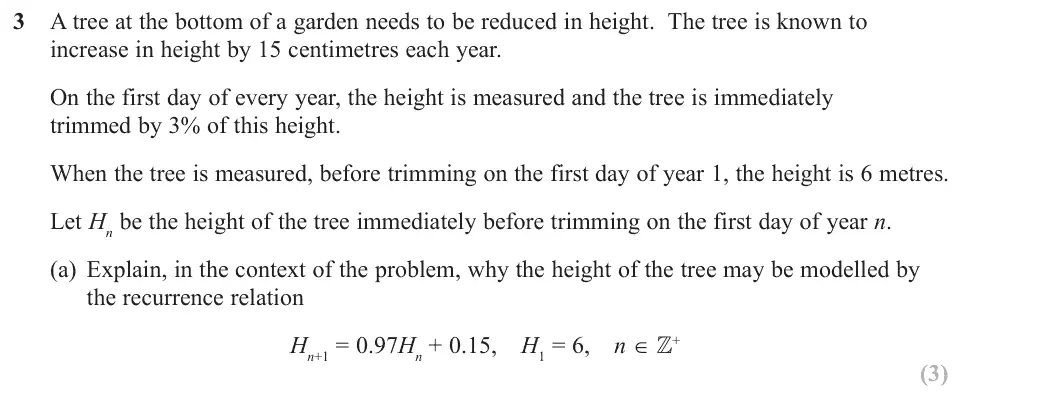
3 A tree at the bottom of a garden needs to be reduced in height. The tree is known to increase in height by 15 centimetres each year. On the first day of every year, the height is measured and the tree is immediately trimmed by 3% of this height. When the tree is measured, before trimming on the first day of year 1, the height is 6 metres. Let Hn be the height of the tree immediately before trimming on the first day of year n. (a) Explain, in the context of the problem, why the height of the tree may be modelled by the recurrence relation Hn+1 = 0.97Hn + 0.15, H1 = 6, n ∈ + (3)
June 2018 · AS Paper 2 (Further Pure 2) · Q3(b) 4 marks recurrence relations fp2
(b) Prove by induction that Hn = 0.97n–1 + 5, n 1 (4)
June 2018 · AS Paper 2 (Further Pure 2) · Q3(c) 1 mark recurrence relations fp2
(c) Explain what will happen to the height of the tree immediately before trimming in the long term. (1)
June 2018 · AS Paper 2 (Further Pure 2) · Q3(d) 2 marks recurrence relations fp2
(d) By what fixed percentage should the tree be trimmed each year if the height of the tree immediately before trimming is to be 4 metres in the long term? (2)
June 2018 · AS Paper 2 (Further Pure 2) · Q4 7 marks eigenvalues and eigenvectors
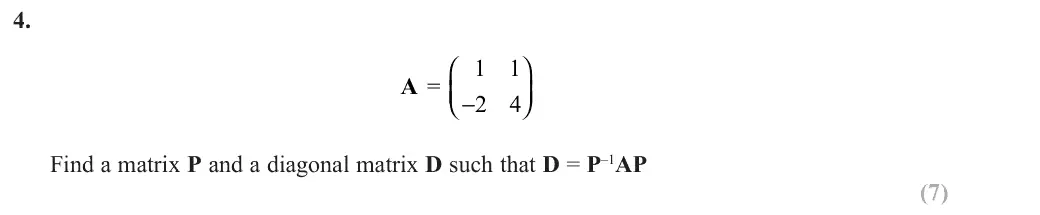
4. A = - Find a matrix P and a diagonal matrix D such that D = P–1AP (7)
June 2018 · AS Paper 2 (Further Pure 2) · Q5(a) 3 marks complex transformations
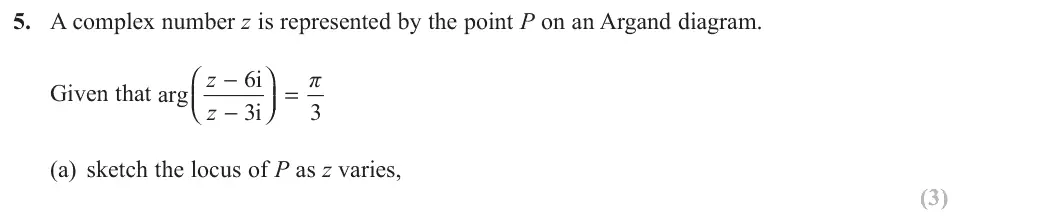
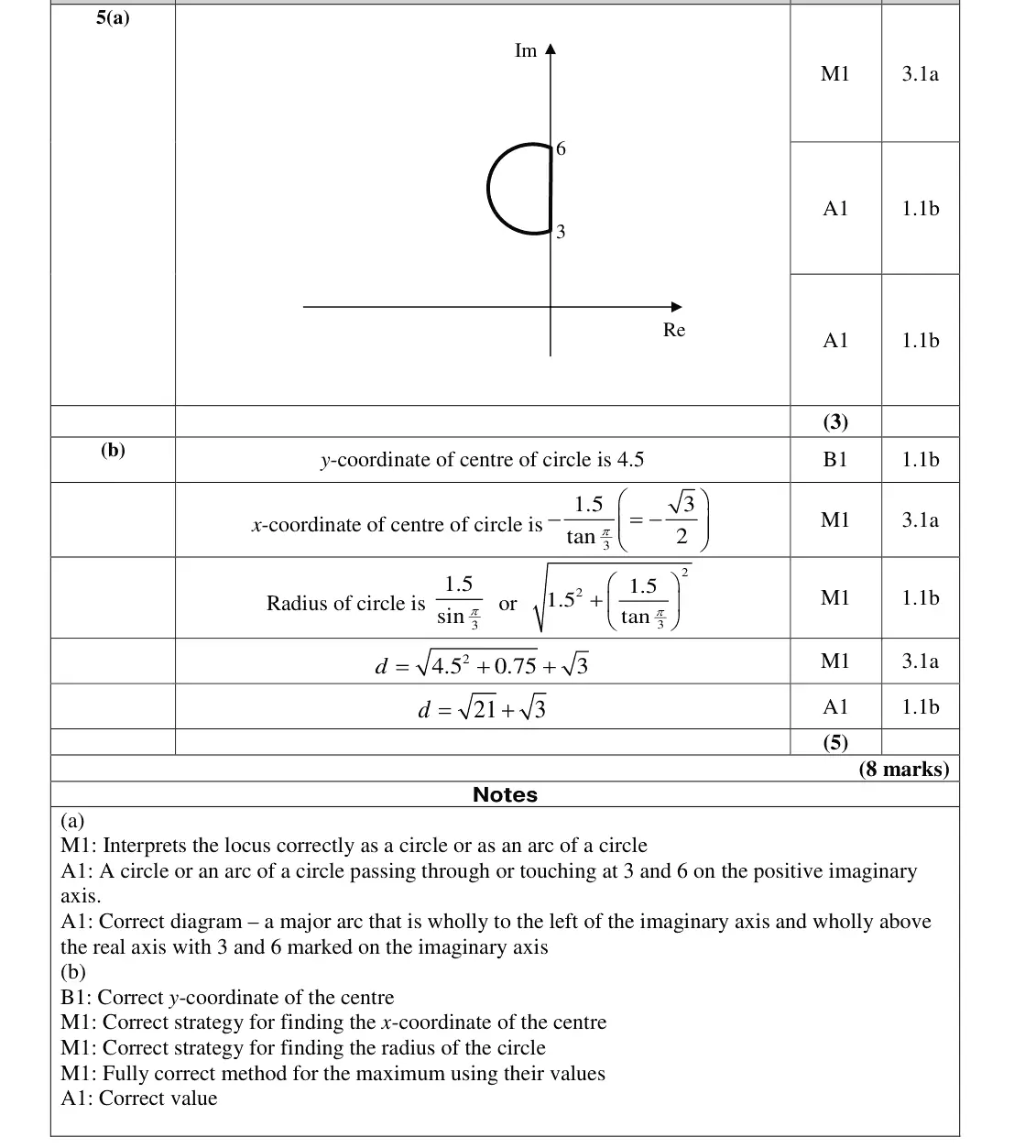
5. A complex number z is represented by the point P on an Argand diagram. z - pi = 6i Given that arg z - 3i (a) sketch the locus of P as z varies, (3)
June 2018 · AS Paper 2 (Further Pure 2) · Q5(b) 5 marks complex transformations
(b) find the exact maximum possible value of |z| (5)

Find an Edexcel Further Maths tutor

Want this paper marked and gone through with a Further Maths tutor? Message us.

Prefer email? Send an enquiry

If you are under 18, please include a parent's contact details. Enquiries go to enquiries@alevelfurthermathstutor.com and are deleted once handled.