June 2019: AS Paper 22: Further Pure Mathematics 2

40 marks · 16 question parts · Question paper, mark scheme and examiner's report on Pearson's site

Question by question

QTopicMarksDifficulty
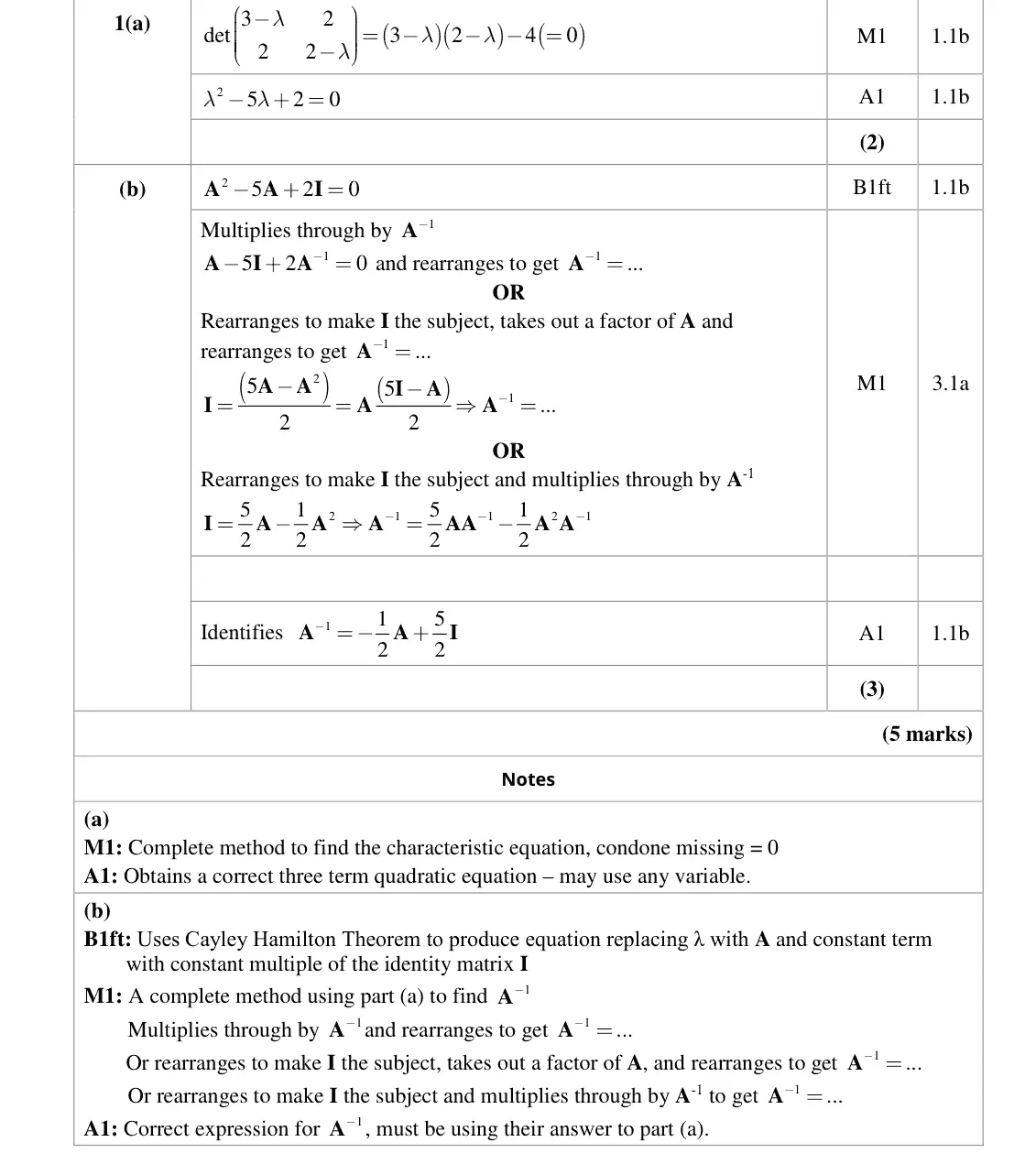
1(a) Eigenvalues, eigenvectors, diagonalisation and Cayley-Hamilton 2 —
1(b) Eigenvalues, eigenvectors, diagonalisation and Cayley-Hamilton 3 —
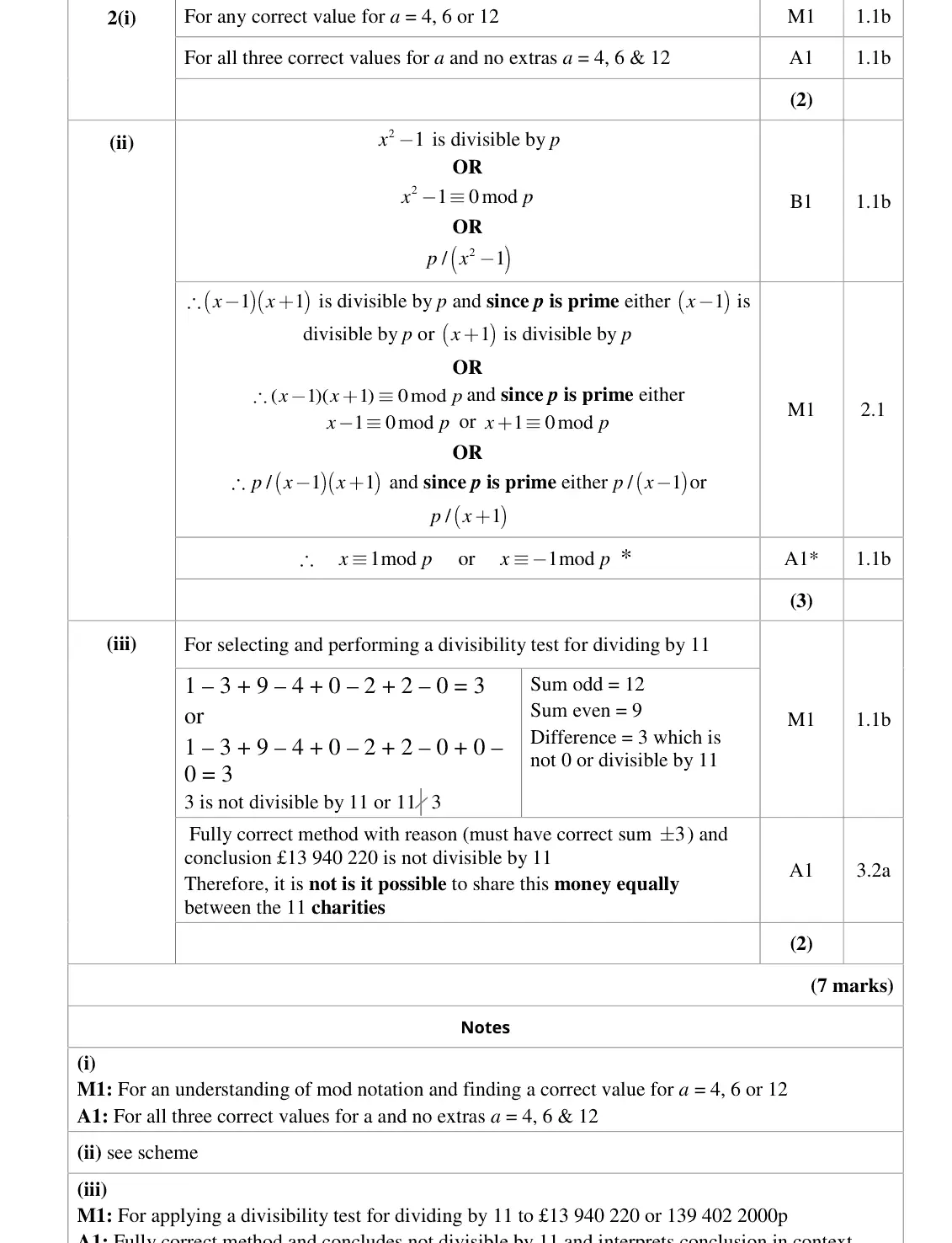
2(i) Number theory: Euclid, Bezout, modular arithmetic and Fermat 2 —
2(ii) Number theory: Euclid, Bezout, modular arithmetic and Fermat 3 —
2(iii) Number theory: Euclid, Bezout, modular arithmetic and Fermat 2 —
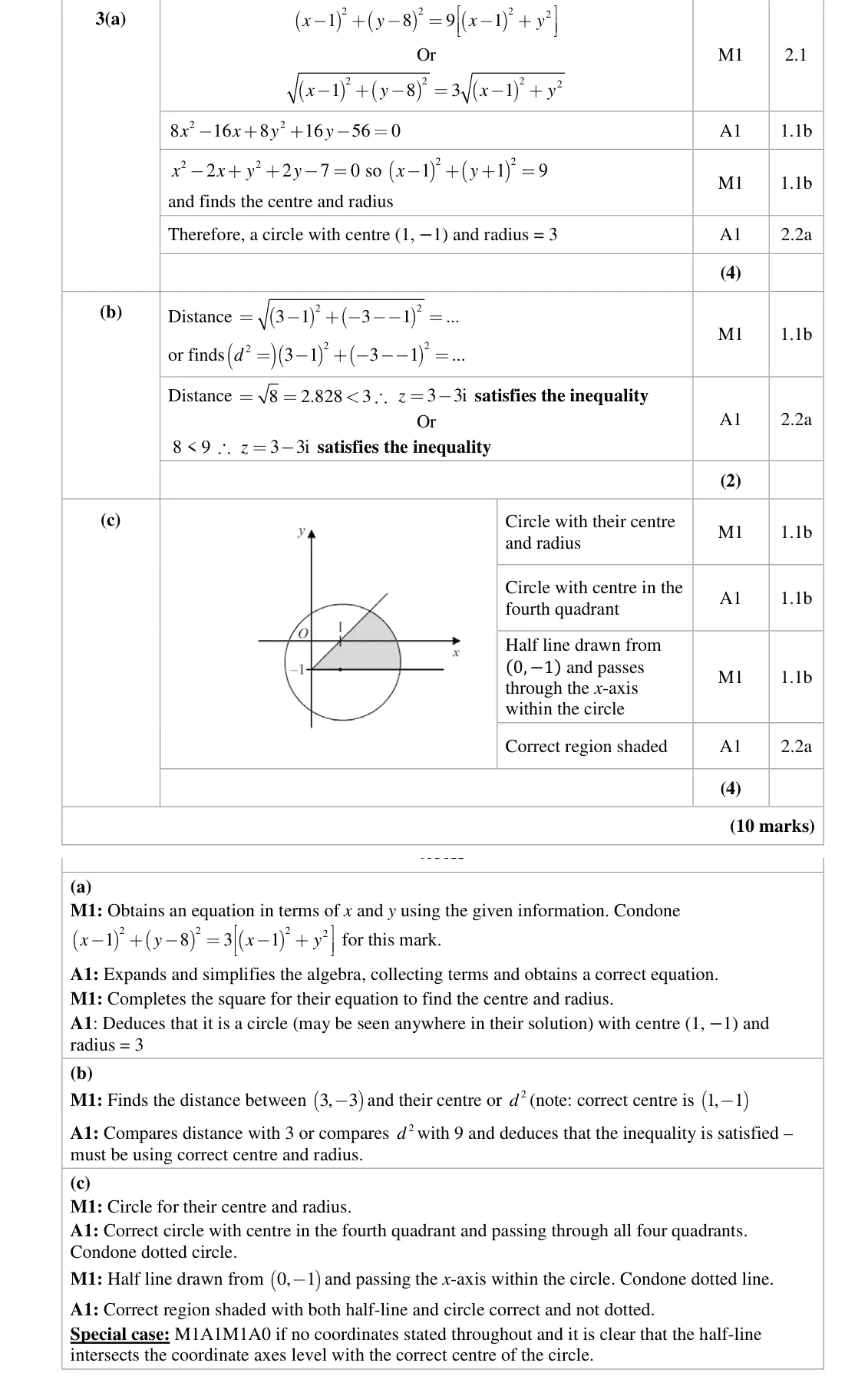
3(a) Further complex numbers: regions and transformations of the plane 4 —
3(b) Further complex numbers: regions and transformations of the plane 2 —
3(c) Further complex numbers: regions and transformations of the plane 4 —
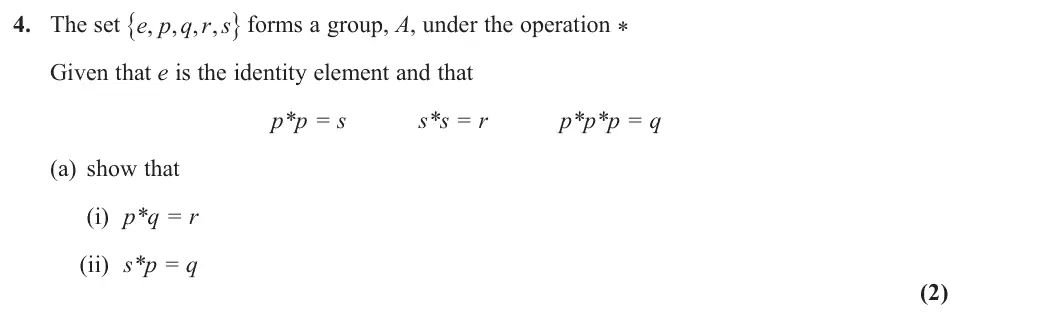
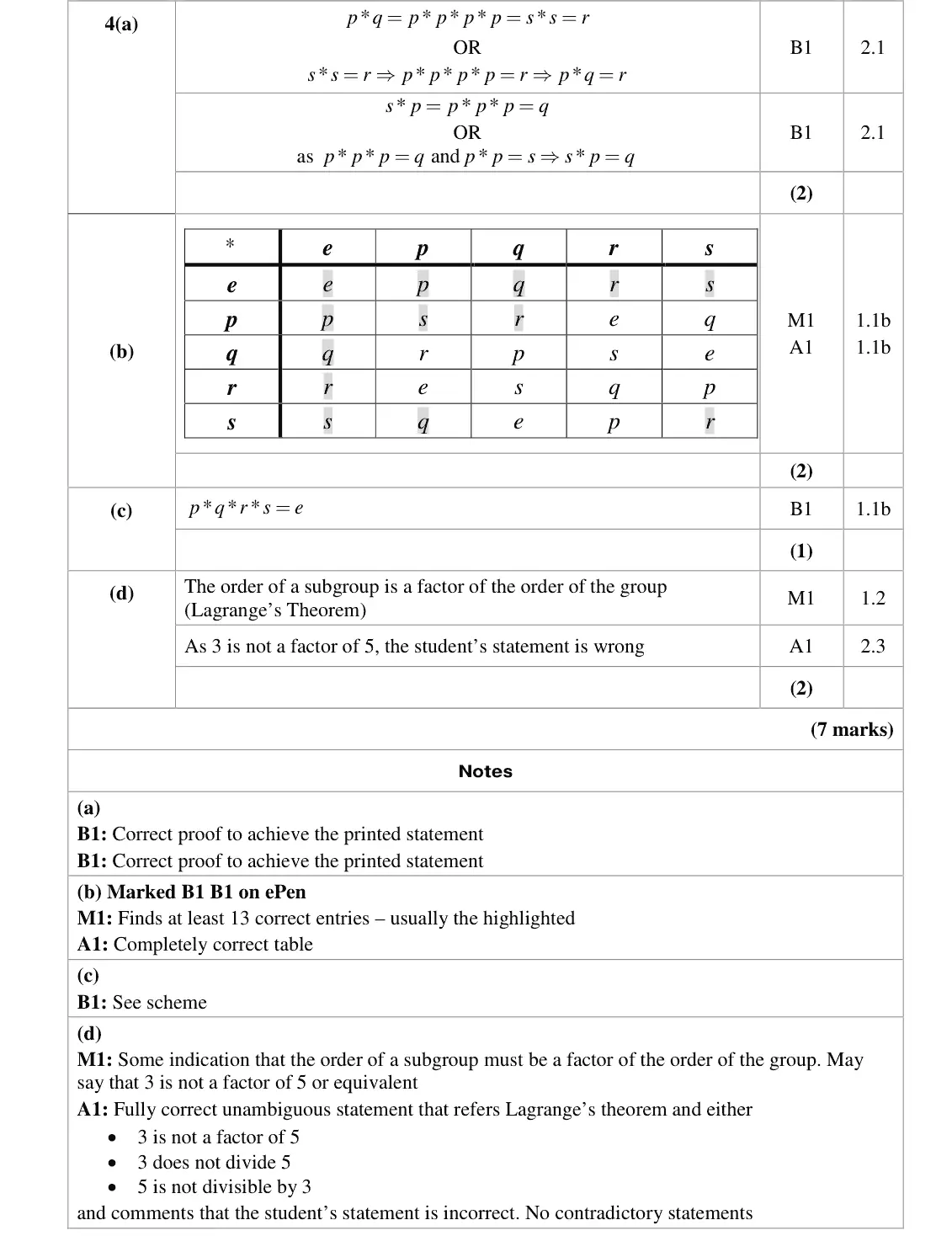
4(a) Groups: axioms, Cayley tables, subgroups, Lagrange and isomorphism 2 —
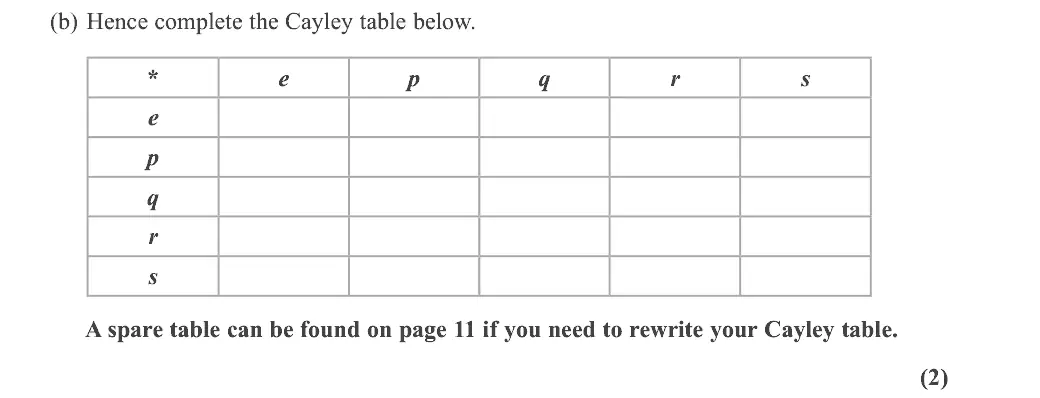
4(b) Groups: axioms, Cayley tables, subgroups, Lagrange and isomorphism 2 —
4(c) Groups: axioms, Cayley tables, subgroups, Lagrange and isomorphism 1 —
4(d) Groups: axioms, Cayley tables, subgroups, Lagrange and isomorphism 2 —
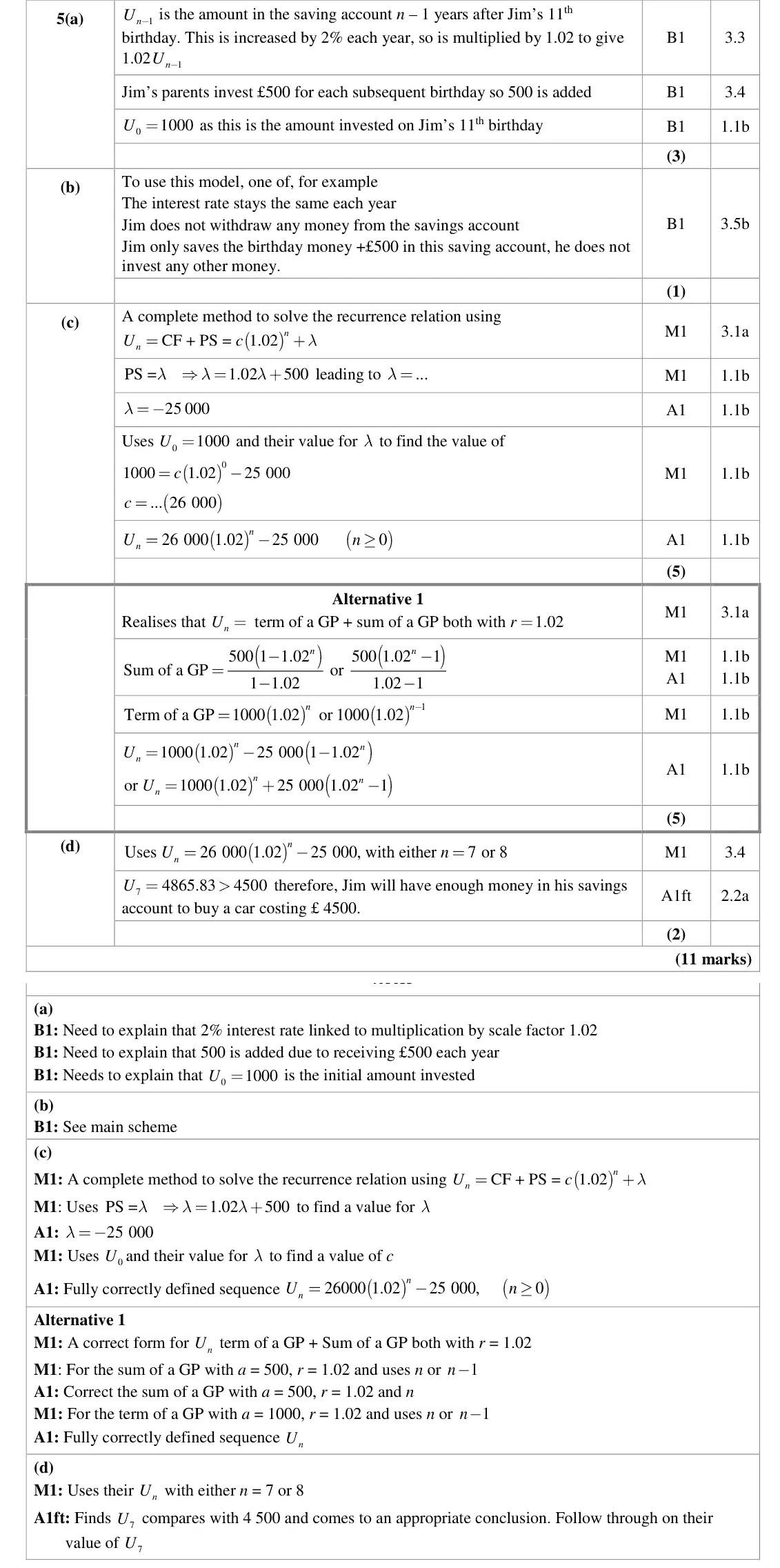
5(a) Recurrence relations and proof of closed forms 3 —
5(b) Recurrence relations and proof of closed forms 1 —
5(c) Recurrence relations and proof of closed forms 5 —
5(d) Recurrence relations and proof of closed forms 2 —

The questions

1(a)1(b)2(i)2(ii)2(iii)3(a)3(b)3(c)4(a)4(b)4(c)4(d)5(a)5(b)5(c)5(d)
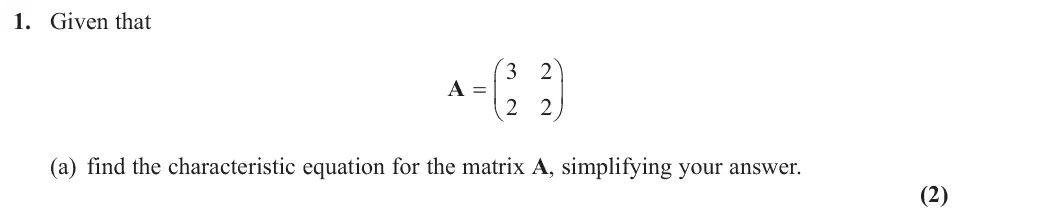
June 2019 · AS Paper 2 (Further Pure 2) · Q1(a) 2 marks eigenvalues and eigenvectors
1. Given that A = ⎛ ⎞ ⎝⎜ ⎠⎟ (a) find the characteristic equation for the matrix A, simplifying your answer. (2)
June 2019 · AS Paper 2 (Further Pure 2) · Q1(b) 3 marks eigenvalues and eigenvectors
(b) Hence find an expression for the matrix A-1 in the form λ + , where Ȝ and μ are A μ I constants to be found. (3)
June 2019 · AS Paper 2 (Further Pure 2) · Q2(i) 2 marks number theory
2. (i) Determine all the possible integers a, where a ! 3, such that { mod a (2)
June 2019 · AS Paper 2 (Further Pure 2) · Q2(ii) 3 marks number theory
{ mod then either (ii) Show that if p is prime, x is an integer and x p { 1mod or x x p ≡-1mod p (3)
June 2019 · AS Paper 2 (Further Pure 2) · Q2(iii) 2 marks number theory
(iii) A company has £13 940 220 to share between 11 charities. Without performing any division and showing all your working, decide if it is possible to share this money equally between the 11 charities. (2)
June 2019 · AS Paper 2 (Further Pure 2) · Q3(a) 4 marks complex transformations
3. A curve C in the complex plane is described by the equation z z -- 1 8 i = - (a) Show that C is a circle, and find its centre and radius. (4)
June 2019 · AS Paper 2 (Further Pure 2) · Q3(b) 2 marks complex transformations
(b) Using the answer to part (a), determine whether z = 3i satisfies the inequality - - - i . - z z (2)
June 2019 · AS Paper 2 (Further Pure 2) · Q3(c) 4 marks complex transformations
(c) Shade, on an Argand diagram, the set of points that satisfies both pi - - i . - - ( )i - z z and 0 arg z + (4)
June 2019 · AS Paper 2 (Further Pure 2) · Q4(a) 2 marks groups
{ } forms a group, A, under the operation * 4. The set e p q r s , , , , Given that e is the identity element and that p*p = s s*s = r p*p*p = q (a) show that (i) p*q = r (ii) s*p = q (2)
June 2019 · AS Paper 2 (Further Pure 2) · Q4(b) 2 marks groups
(b) Hence complete the Cayley table below. * e p q r s e p q r s A spare table can be found on page 11 if you need to rewrite your Cayley table. (2)
June 2019 · AS Paper 2 (Further Pure 2) · Q4(c) 1 mark groups
(c) Use your table to find p*q*r*s (1)
June 2019 · AS Paper 2 (Further Pure 2) · Q4(d) 2 marks groups
A student states that there is a subgroup of A of order 3 (d) Comment on the validity of this statement, giving a reason for your answer. (2)
June 2019 · AS Paper 2 (Further Pure 2) · Q5(a) 3 marks recurrence relations fp2
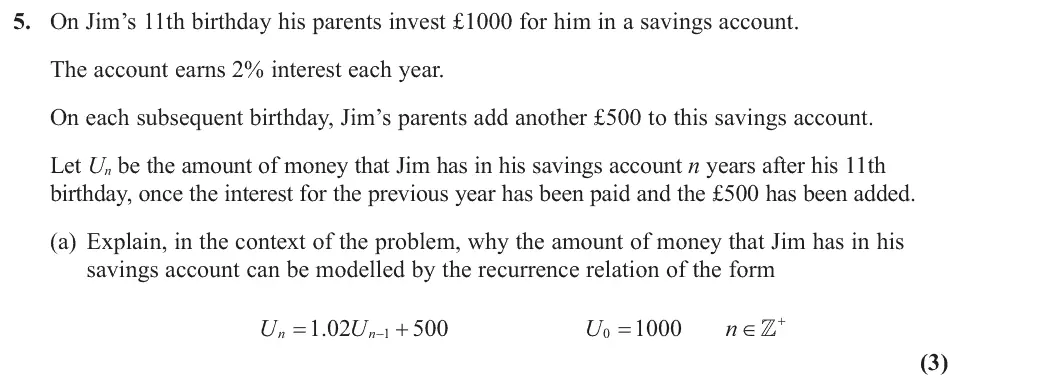
5. On Jim’s 11th birthday his parents invest £1000 for him in a savings account. The account earns 2% interest each year. On each subsequent birthday, Jim’s parents add another £500 to this savings account. Let Un be the amount of money that Jim has in his savings account n years after his 11th birthday, once the interest for the previous year has been paid and the £500 has been added. (a) Explain, in the context of the problem, why the amount of money that Jim has in his savings account can be modelled by the recurrence relation of the form ' + U = U + U = n ∈ 1 02 1000 n n - (3)
June 2019 · AS Paper 2 (Further Pure 2) · Q5(b) 1 mark recurrence relations fp2
(b) State an assumption that must be made for this model to be valid. (1)
June 2019 · AS Paper 2 (Further Pure 2) · Q5(c) 5 marks recurrence relations fp2
(c) Solve the recurrence relation ' + U = 1 02 U + U = 1000 n ∈ n n - (5)
June 2019 · AS Paper 2 (Further Pure 2) · Q5(d) 2 marks recurrence relations fp2
Jim hopes to be able to buy a car on his 18th birthday. (d) Use the answer to part (c) to find out whether Jim will have enough money in his savings account to buy a car that costs £4 500 (2)

Find an Edexcel Further Maths tutor

Want this paper marked and gone through with a Further Maths tutor? Message us.

Prefer email? Send an enquiry

If you are under 18, please include a parent's contact details. Enquiries go to enquiries@alevelfurthermathstutor.com and are deleted once handled.