June 2019: AS Paper 23: Further Statistics 1

40 marks · 13 question parts · Question paper, mark scheme and examiner's report on Pearson's site

Question by question

QTopicMarksDifficulty
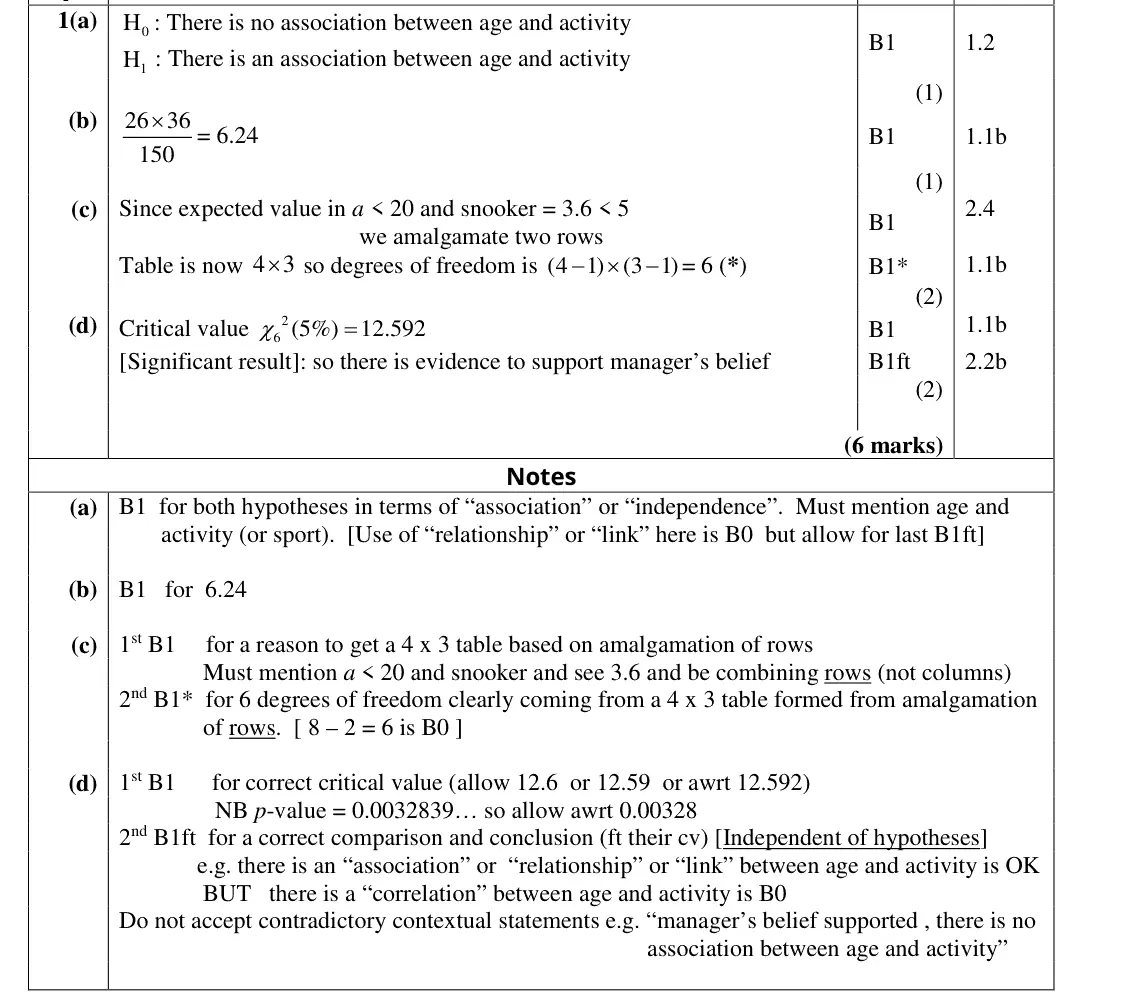
1(a) Chi-squared tests: goodness of fit and contingency tables 1 —
1(b) Chi-squared tests: goodness of fit and contingency tables 1 —
1(c) Chi-squared tests: goodness of fit and contingency tables 2 —
1(d) Chi-squared tests: goodness of fit and contingency tables 2 —
2 Chi-squared tests: goodness of fit and contingency tables 7 —
3(a) Poisson and binomial distributions 2 —
3(b) Poisson and binomial distributions 2 —
3(c) Poisson and binomial distributions 5 —
3(d) Hypothesis tests: Poisson, binomial and geometric 4 —
4(a) Discrete random variables: mean and variance 1 —
4(b) Discrete random variables: mean and variance 2 —
4(c) Discrete random variables: mean and variance 7 —
4(d) Discrete random variables: mean and variance 4 —

The questions

1(a)1(b)1(c)1(d)23(a)3(b)3(c)3(d)4(a)4(b)4(c)4(d)
June 2019 · AS Paper 2 (Further Statistics 1) · Q1(a) 1 mark chi squared tests
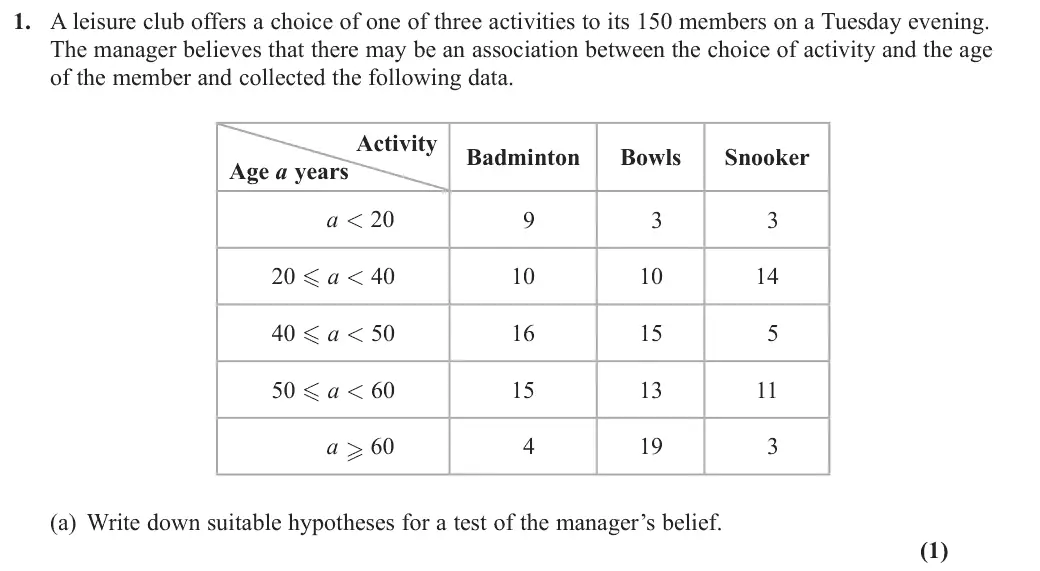
1. A leisure club offers a choice of one of three activities to its 150 members on a Tuesday evening. The manager believes that there may be an association between the choice of activity and the age of the member and collected the following data. Activity Badminton Bowls Snooker Age a years a : 20 20 - a : 40 40 - a : 50 50 - a : 60 a . 60 (a) Write down suitable hypotheses for a test of the manager’s belief. (1)
June 2019 · AS Paper 2 (Further Statistics 1) · Q1(b) 1 mark chi squared tests
The manager calculated expected frequencies to use in the test. (b) Calculate the expected frequency of members aged 60 or over who choose snooker, used by the manager. (1)
June 2019 · AS Paper 2 (Further Statistics 1) · Q1(c) 2 marks chi squared tests
(c) Explain why there are 6 degrees of freedom used in this test. (2)
June 2019 · AS Paper 2 (Further Statistics 1) · Q1(d) 2 marks chi squared tests
The test statistic used to test the manager’s belief is 19.583 (d) Using a 5% level of significance, complete the test of the manager’s belief. (2)
June 2019 · AS Paper 2 (Further Statistics 1) · Q2 7 marks chi squared tests
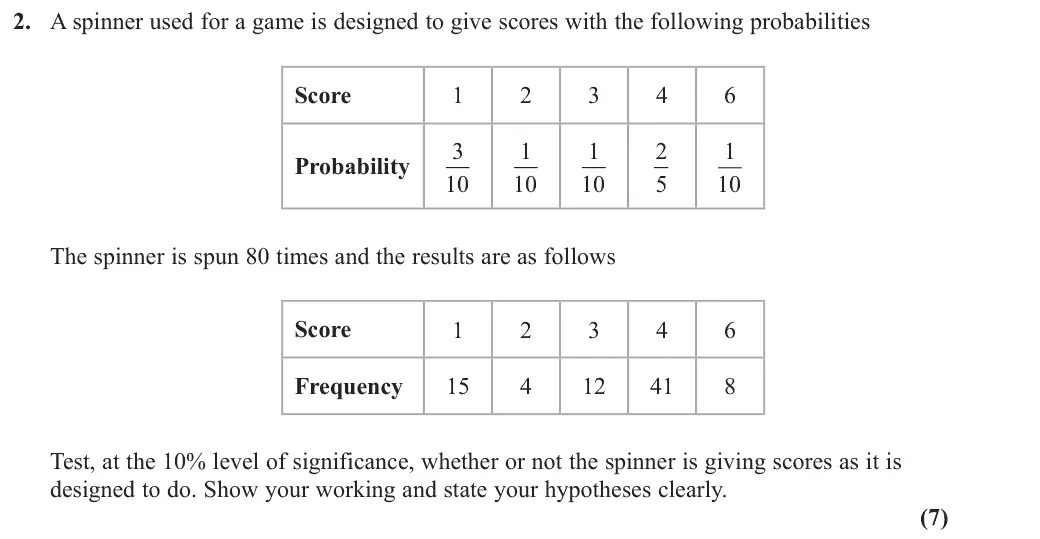
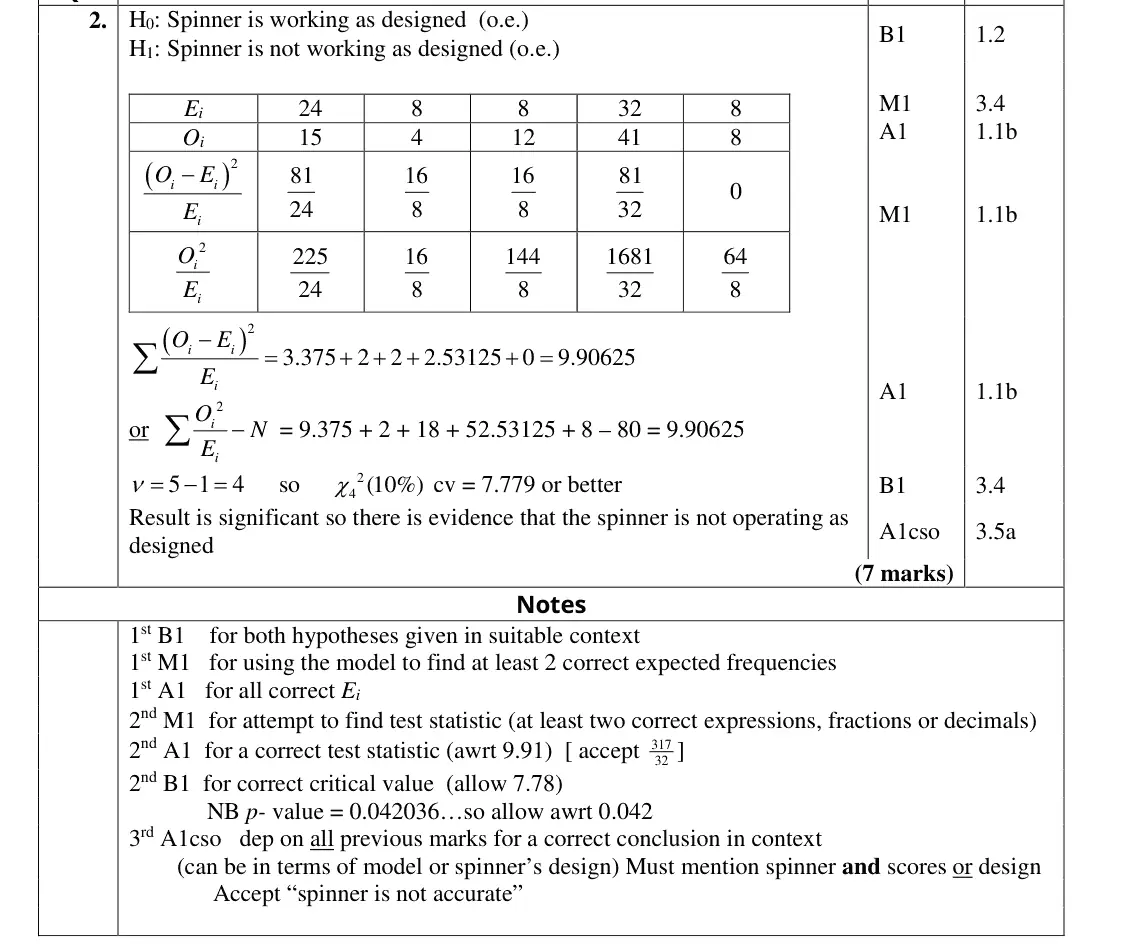
2. A spinner used for a game is designed to give scores with the following probabilities Score Probability The spinner is spun 80 times and the results are as follows Score Frequency Test, at the 10% level of significance, whether or not the spinner is giving scores as it is designed to do. Show your working and state your hypotheses clearly. (7)
June 2019 · AS Paper 2 (Further Statistics 1) · Q3(a) 2 marks poisson distribution
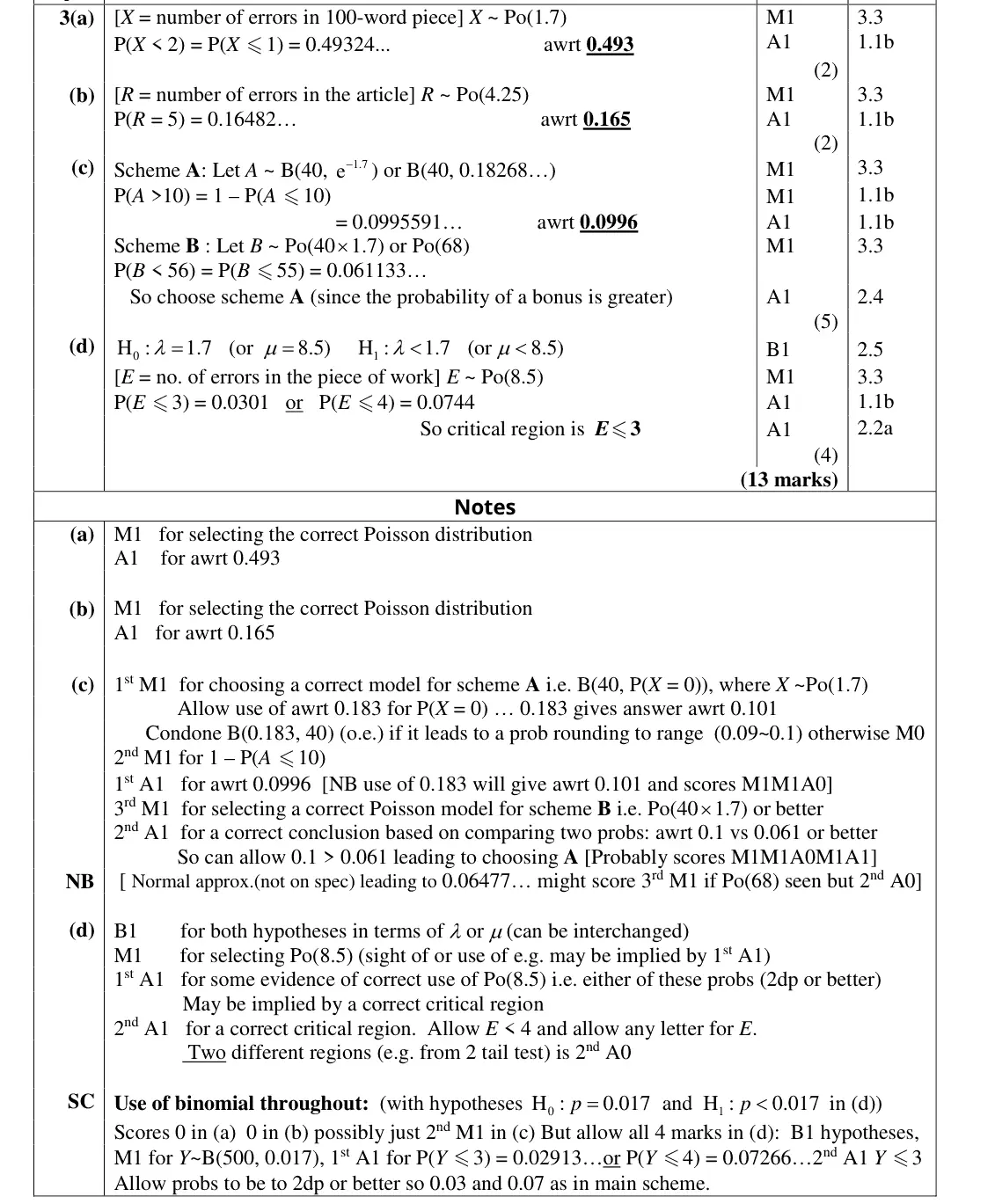
3. Andreia’s secretary makes random errors in his work at an average rate of 1.7 errors every 100 words. (a) Find the probability that the secretary makes fewer than 2 errors in the next 100-word piece of work. (2)
June 2019 · AS Paper 2 (Further Statistics 1) · Q3(b) 2 marks poisson distribution
Andreia asks the secretary to produce a 250-word article for a magazine. (b) Find the probability that there are exactly 5 errors in this article. (2)
June 2019 · AS Paper 2 (Further Statistics 1) · Q3(c) 5 marks poisson distribution
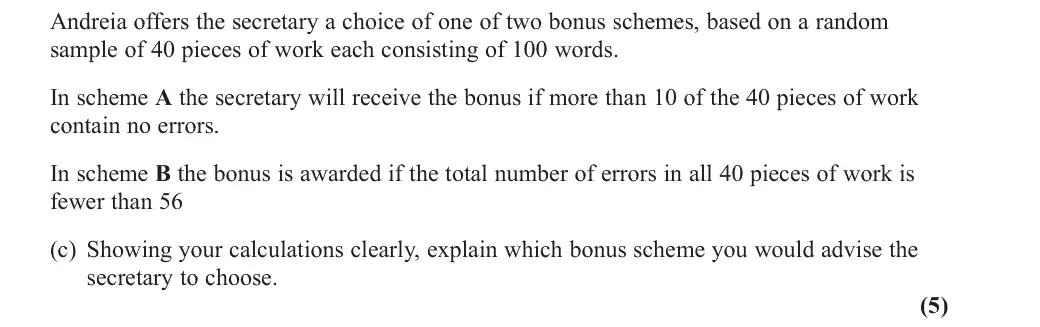
Andreia offers the secretary a choice of one of two bonus schemes, based on a random sample of 40 pieces of work each consisting of 100 words. In scheme A the secretary will receive the bonus if more than 10 of the 40 pieces of work contain no errors. In scheme B the bonus is awarded if the total number of errors in all 40 pieces of work is fewer than 56 (c) Showing your calculations clearly, explain which bonus scheme you would advise the secretary to choose. (5)
June 2019 · AS Paper 2 (Further Statistics 1) · Q3(d) 4 marks hypothesis tests fs1
Following the bonus scheme, Andreia randomly selects a single 500-word piece of work from the secretary to test if there is any evidence that the secretary’s rate of errors has decreased. (d) Stating your hypotheses clearly and using a 5% level of significance, find the critical region for this test. (4)
June 2019 · AS Paper 2 (Further Statistics 1) · Q4(a) 1 mark discrete random variables
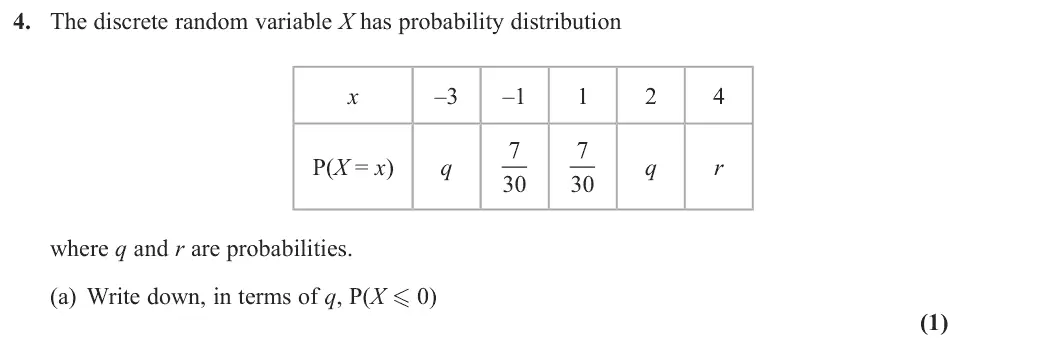
4. The discrete random variable X has probability distribution x –3 –1 P(X = x) q q r where q and r are probabilities. (a) Write down, in terms of q, P(X - 0) (1)
June 2019 · AS Paper 2 (Further Statistics 1) · Q4(b) 2 marks discrete random variables
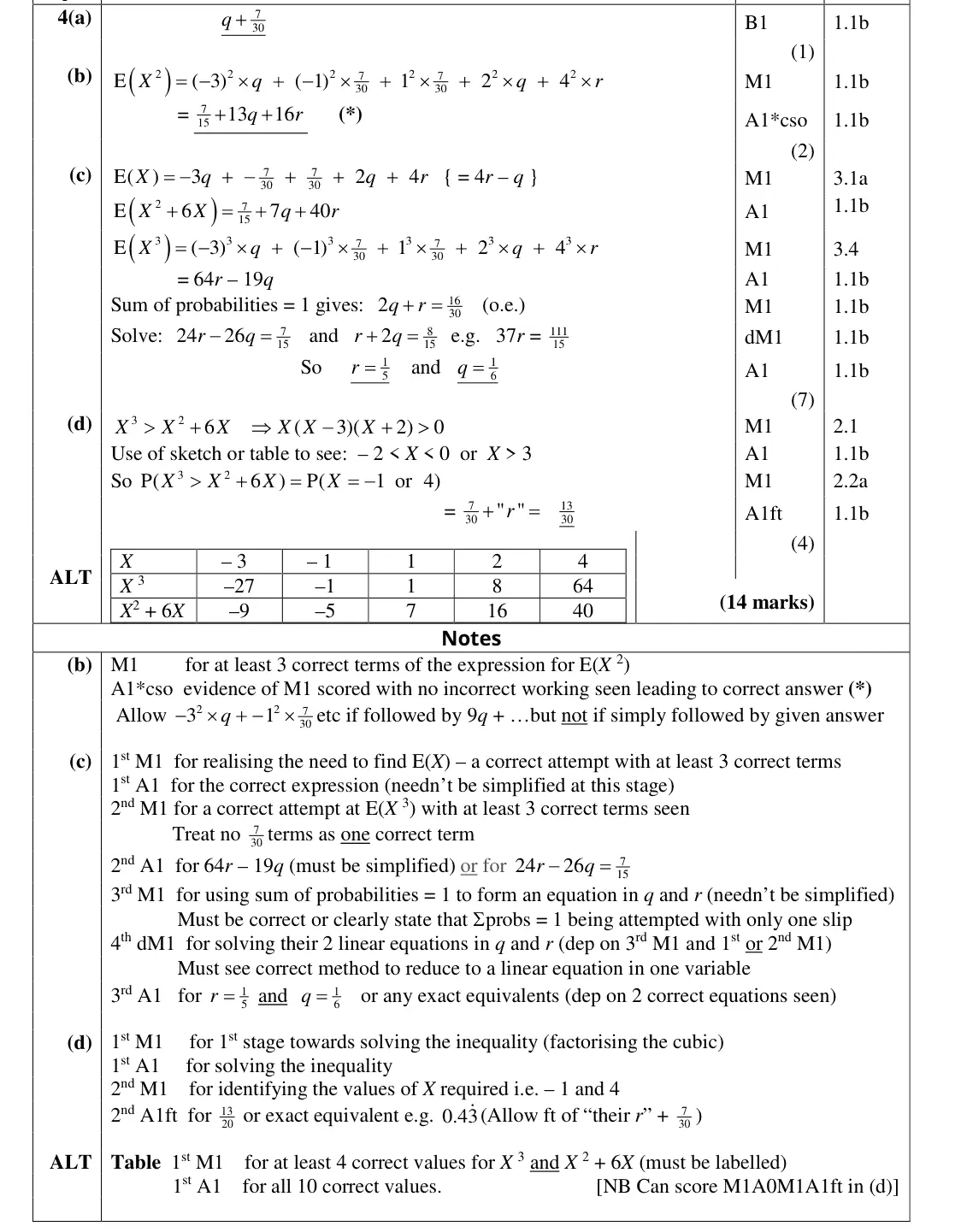
(b) Show that E(X 2) = 15 + 13q + 16r (2)
June 2019 · AS Paper 2 (Further Statistics 1) · Q4(c) 7 marks discrete random variables
Given that E(X 3) = E(X 2) + E(6X) (c) find the value of q and the value of r (7)
June 2019 · AS Paper 2 (Further Statistics 1) · Q4(d) 4 marks discrete random variables
(d) Hence find P(X 3 < X 2 + 6X ) (4)

Find an Edexcel Further Maths tutor

Want this paper marked and gone through with a Further Maths tutor? Message us.

Prefer email? Send an enquiry

If you are under 18, please include a parent's contact details. Enquiries go to enquiries@alevelfurthermathstutor.com and are deleted once handled.