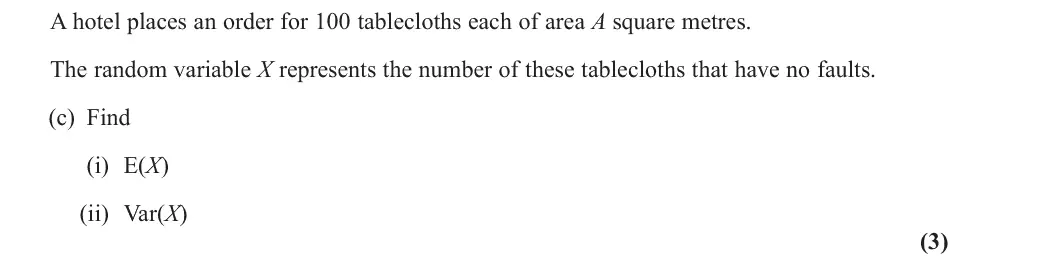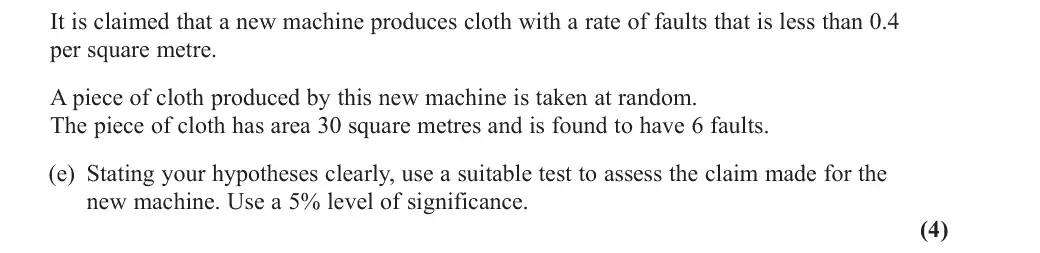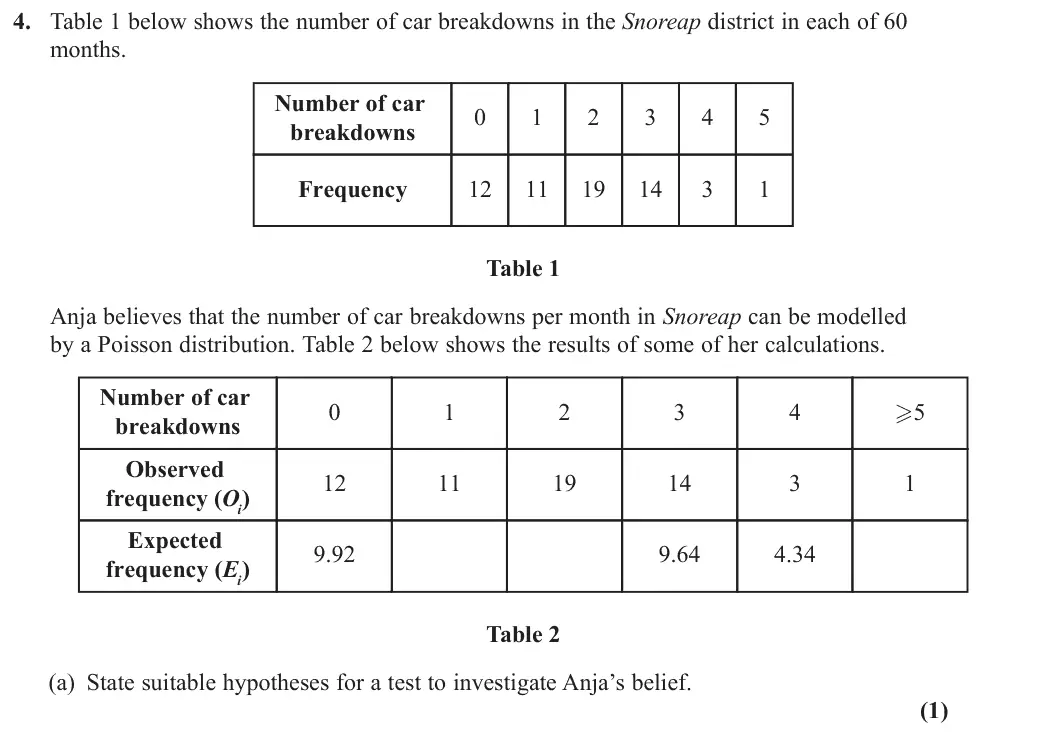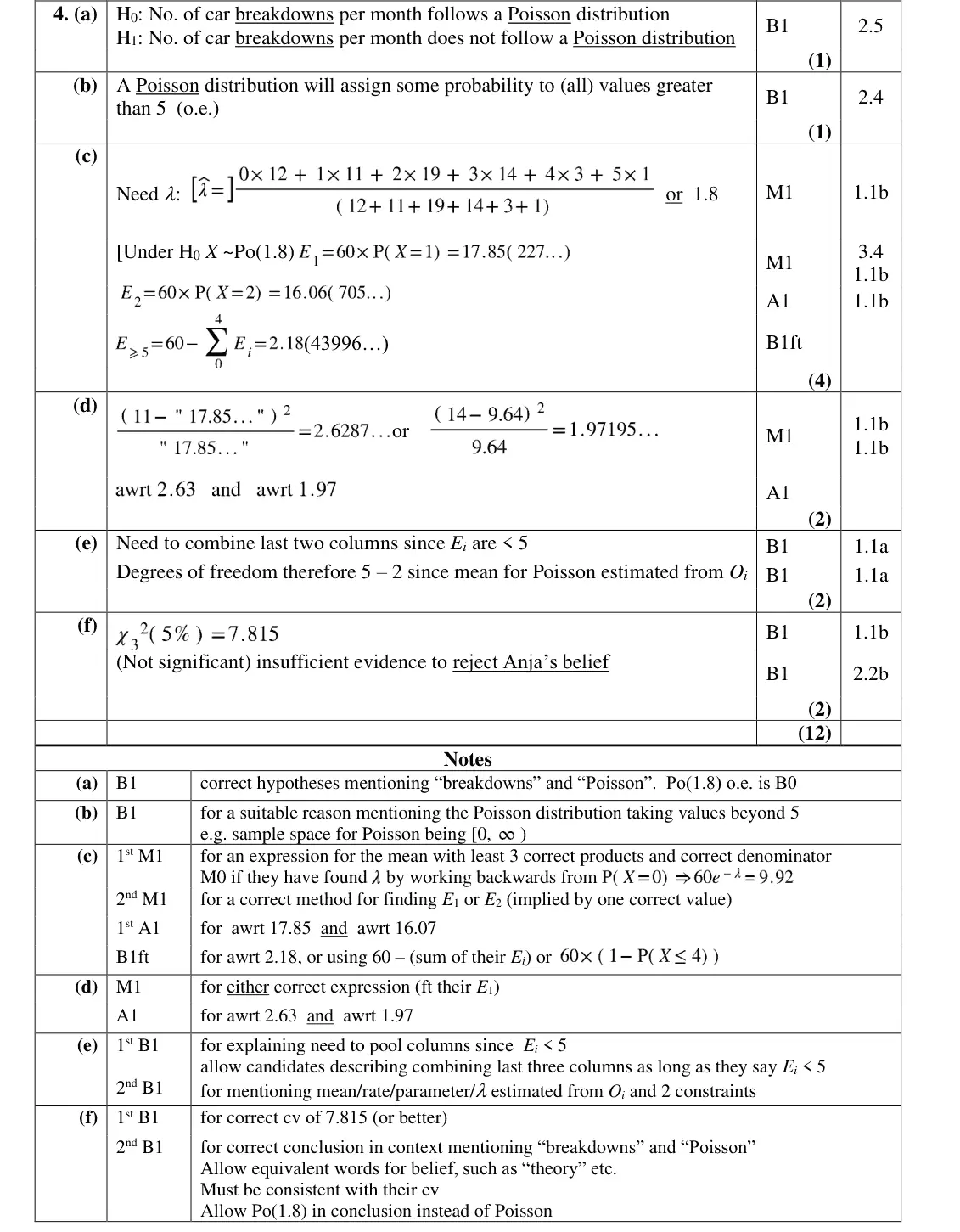
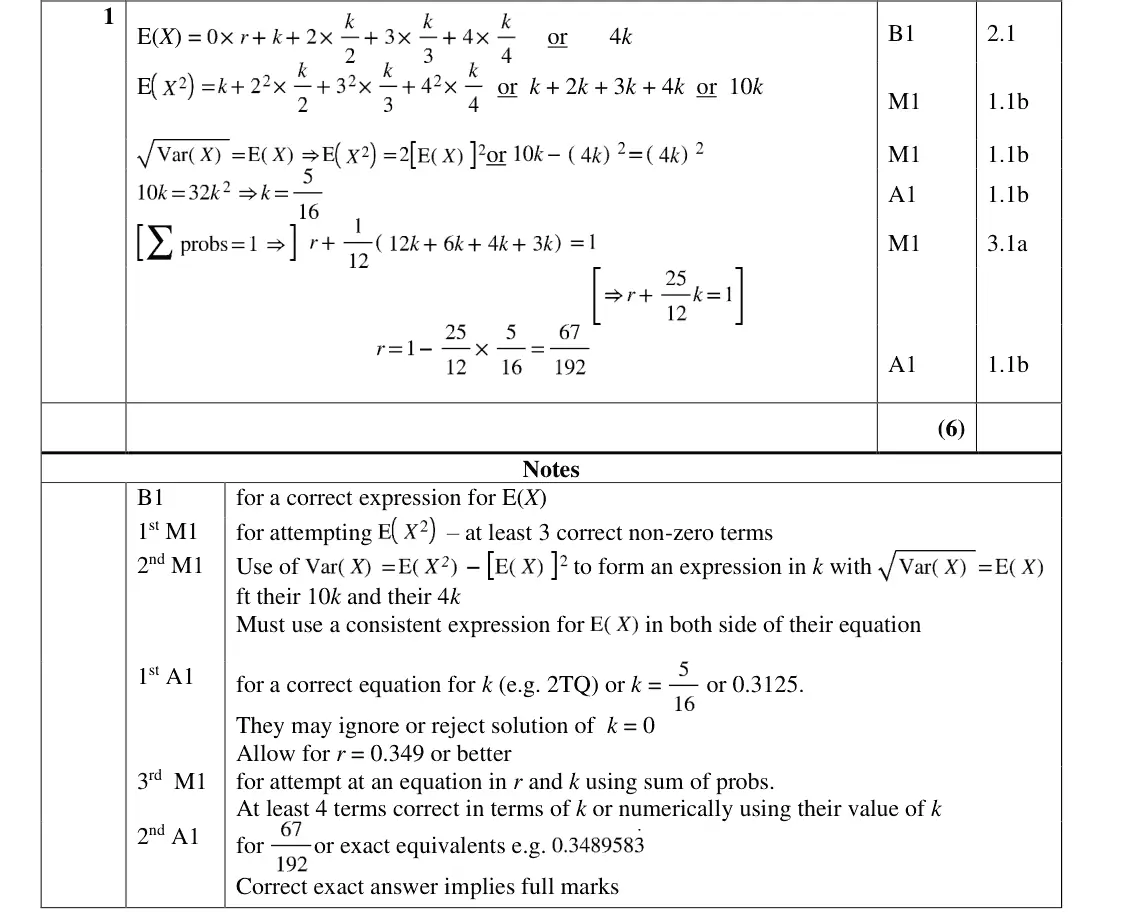
Mark scheme (whole question; this part is marked with the orange bar)
Examiner's comment
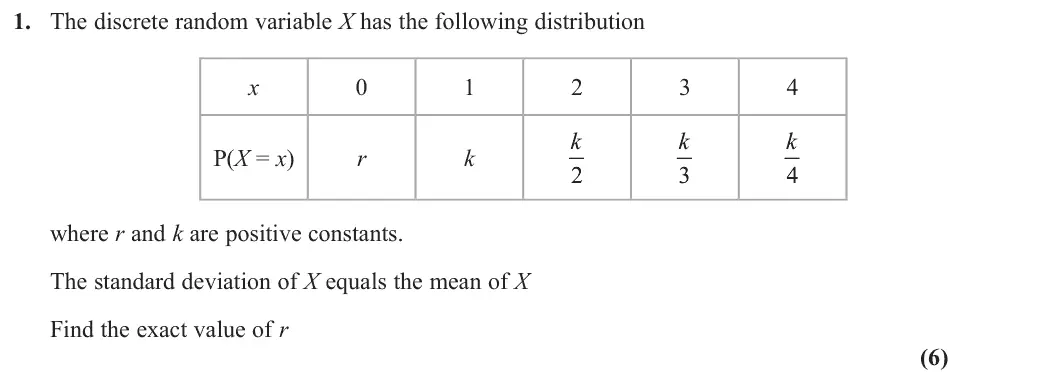
This was a generally welcoming first question as it had little wording and required skills that all candidates should immediately recognise. A large proportion of candidates were able to score full marks. Candidates not scoring full marks usually gained the B1 for ( ) E X and the first M1 for ( ) 2 E X , with many also gaining the final M1 for summing the probabilities. The issue that proved most challenging for the candidates was forming an equation with their standard deviation and mean. There were a lot of algebraic errors, such as taking the square of terms individually. Candidates should be reminded of the importance of clearly labelling the expressions they find. Some candidates did not use the mean as ( ) E X or did not label their variance as such. Therefore, they were unable to gain method marks for using their expressions correctly as it was not clear they were equating their standard deviation to their ( ) E X . This question would have likely provided a helpful confidence boost early in the paper. Many candidates answered correctly, and most of those who made an error would have been unaware as most errors still gave plausible values of k and r.
Key points from the mark scheme and examiner's report
- E(X) = 4k, E(X²) = 10k
- √Var(X) = E(X) gives 10k − 16k² = 16k², k = 5/16
- Σp = 1 gives r + 25k/12 = 1, r = 67/192
- main difficulty forming the sd = mean equation (squaring terms individually)
- label E(X) and Var(X) clearly