June 2024: AS Paper 22: Further Pure Mathematics 2

40 marks · 15 question parts · Question paper, mark scheme and examiner's report on Pearson's site

Question by question

QTopicMarksDifficulty
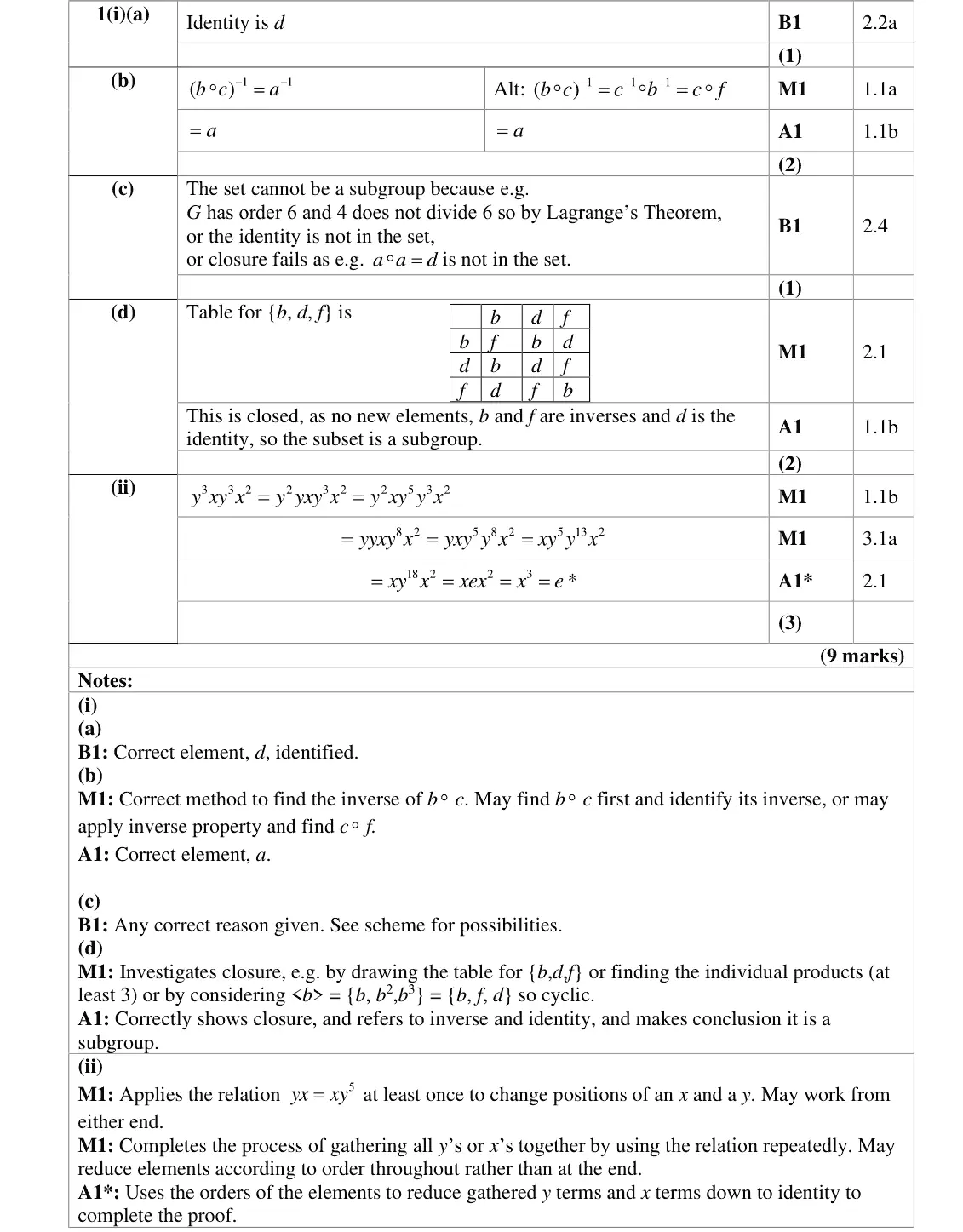
1(i)(a) Groups: axioms, Cayley tables, subgroups, Lagrange and isomorphism 1 —
1(i)(b) Groups: axioms, Cayley tables, subgroups, Lagrange and isomorphism 2 —
1(i)(c) Groups: axioms, Cayley tables, subgroups, Lagrange and isomorphism 1 —
1(i)(d) Groups: axioms, Cayley tables, subgroups, Lagrange and isomorphism 2 —
1(ii) Groups: axioms, Cayley tables, subgroups, Lagrange and isomorphism 3 —
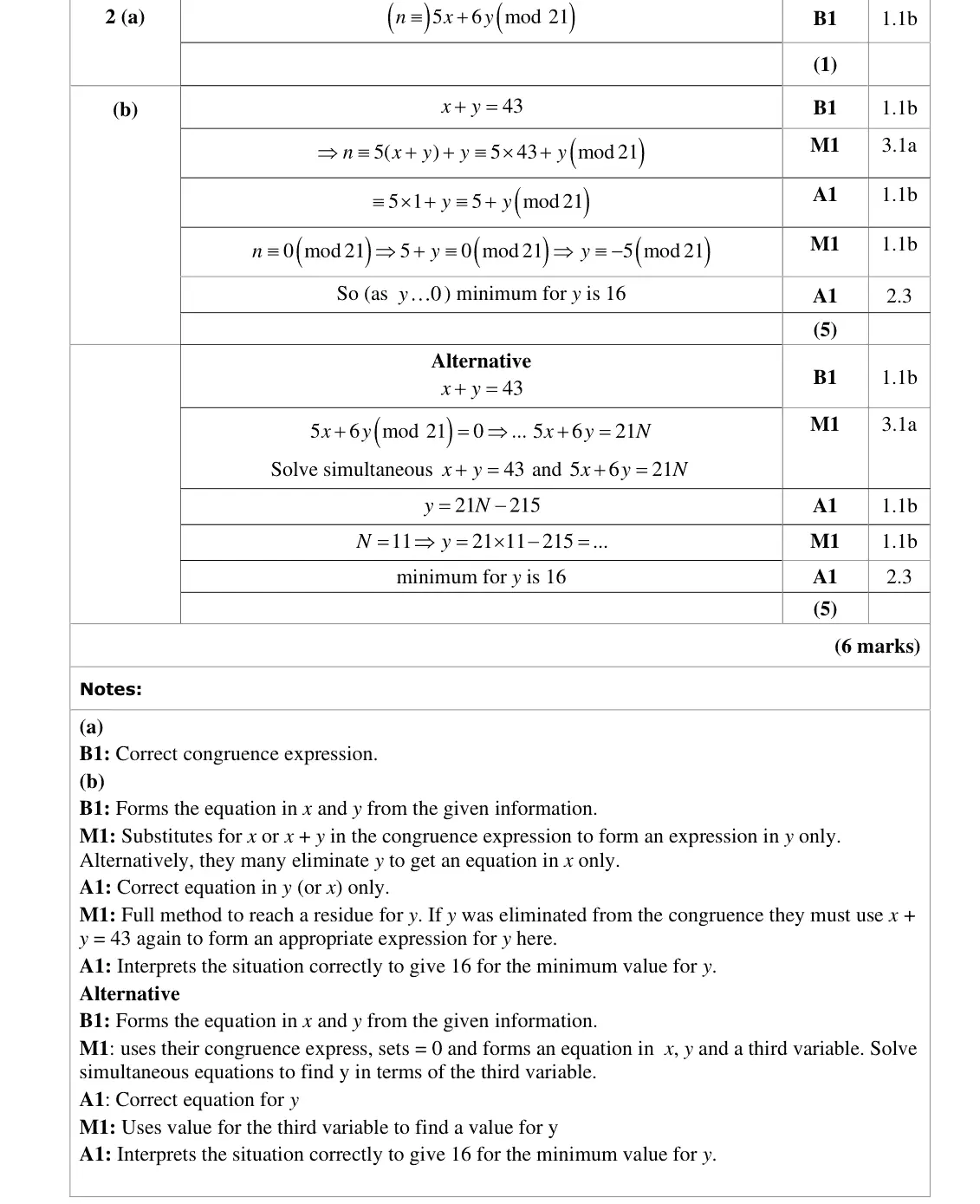
2(a) Number theory: Euclid, Bezout, modular arithmetic and Fermat 1 —
2(b) Number theory: Euclid, Bezout, modular arithmetic and Fermat 5 —
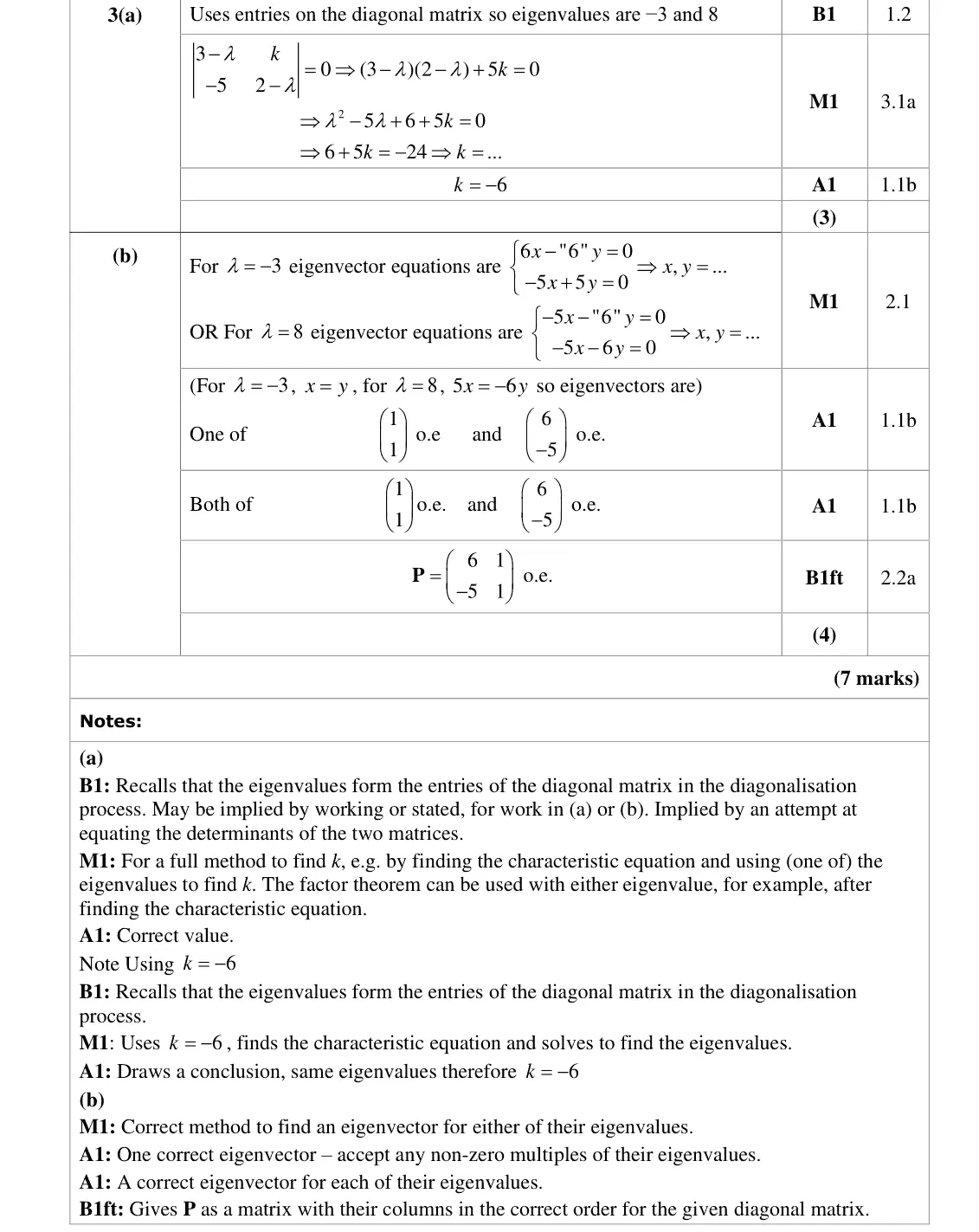
3(a) Eigenvalues, eigenvectors, diagonalisation and Cayley-Hamilton 3 —
3(b) Eigenvalues, eigenvectors, diagonalisation and Cayley-Hamilton 4 —
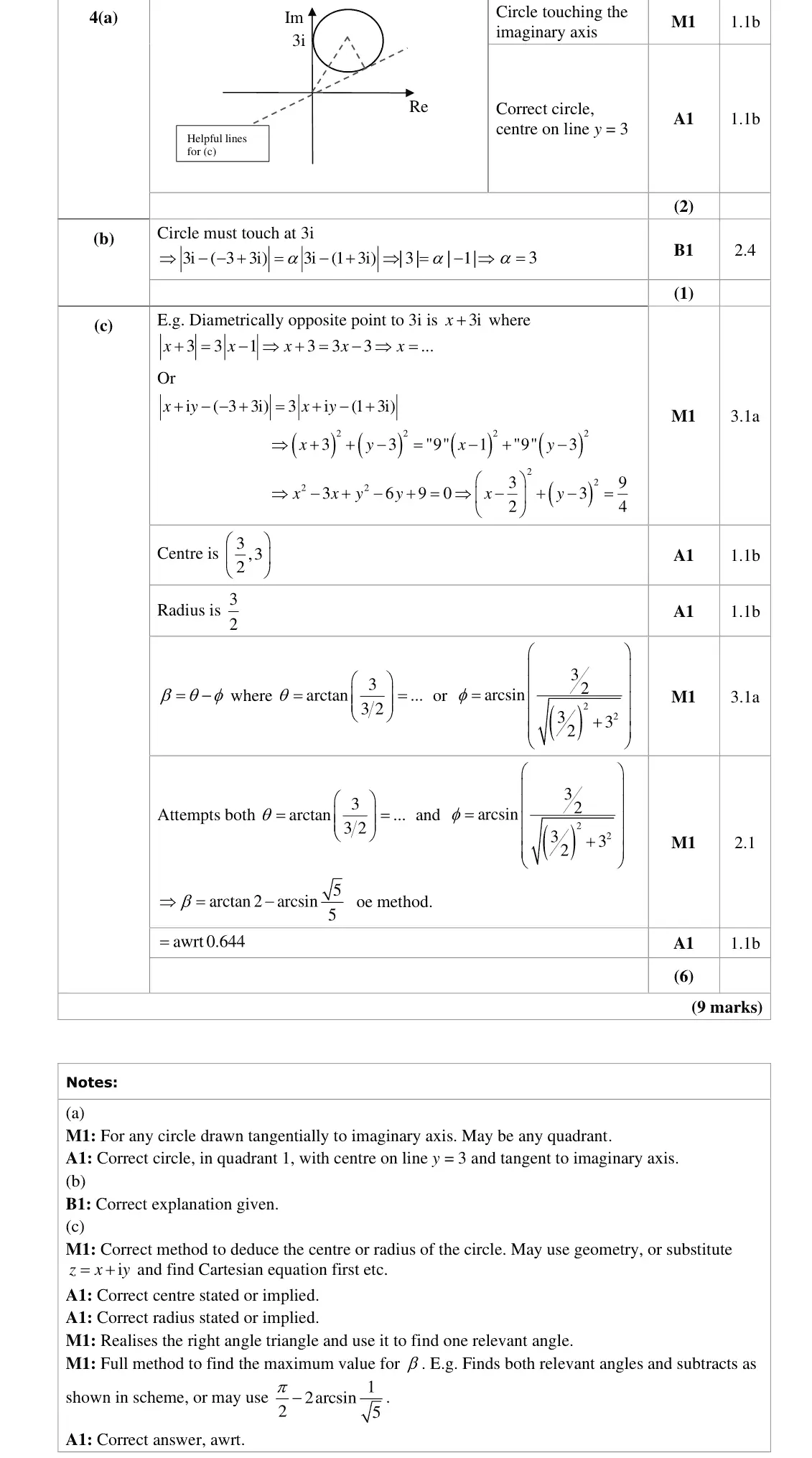
4(a) Further complex numbers: regions and transformations of the plane 2 —
4(b) Further complex numbers: regions and transformations of the plane 1 —
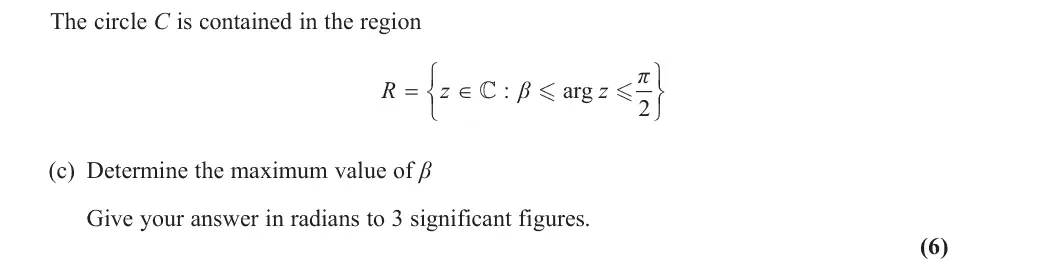
4(c) Further complex numbers: regions and transformations of the plane 6 —
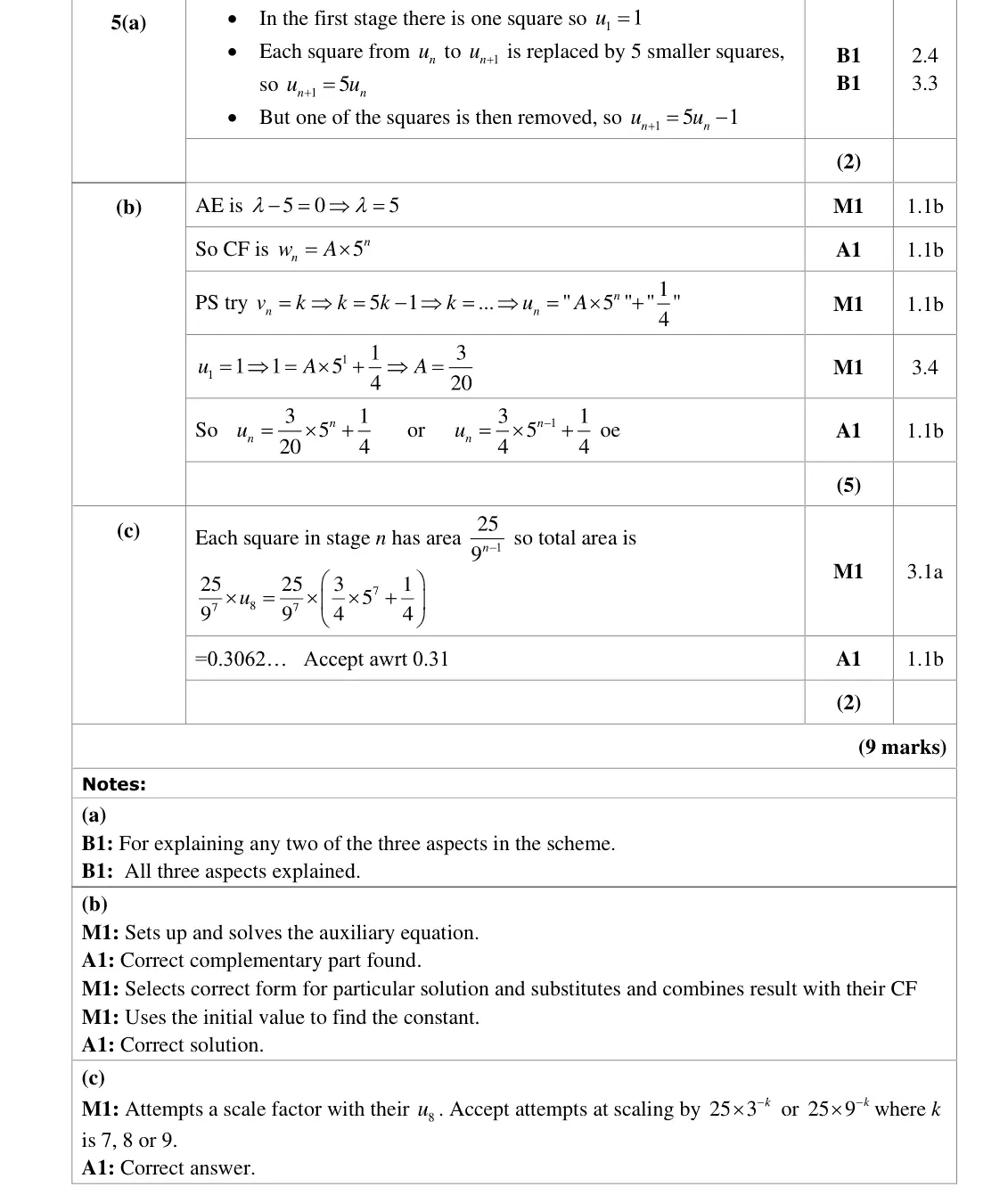
5(a) Recurrence relations and proof of closed forms 2 —
5(b) Recurrence relations and proof of closed forms 5 —
5(c) Recurrence relations and proof of closed forms 2 —

The questions

1(i)(a)1(i)(b)1(i)(c)1(i)(d)1(ii)2(a)2(b)3(a)3(b)4(a)4(b)4(c)5(a)5(b)5(c)
June 2024 · AS Paper 2 (Further Pure 2) · Q1(i)(a) 1 mark groups
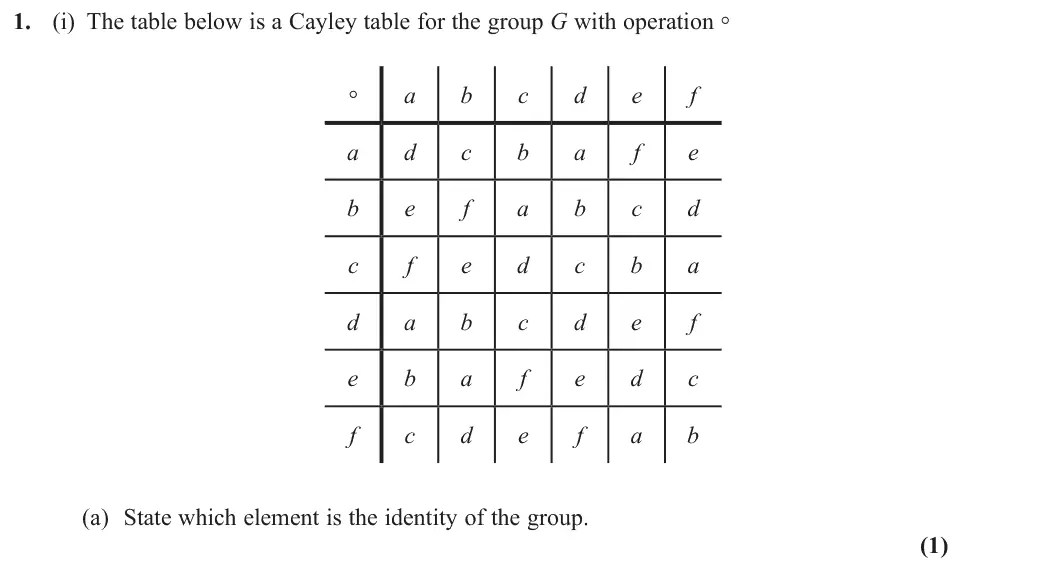
1. (i) The table below is a Cayley table for the group G with operation ° a b c d e f ° a d c b a f e b e f a b c d c f e d c b a d a b c d e f e b a f e d c f c d e f a b (a) State which element is the identity of the group. (1)
June 2024 · AS Paper 2 (Further Pure 2) · Q1(i)(b) 2 marks groups
(b) Determine the inverse of the element (b°c) (2)
June 2024 · AS Paper 2 (Further Pure 2) · Q1(i)(c) 1 mark groups
(c) Give a reason why the set {a, b, e, f} cannot be a subgroup of G. You must justify your answer. (1)
June 2024 · AS Paper 2 (Further Pure 2) · Q1(i)(d) 2 marks groups
(d) Show that the set {b, d, f} is a subgroup of G. (2)
June 2024 · AS Paper 2 (Further Pure 2) · Q1(ii) 3 marks groups
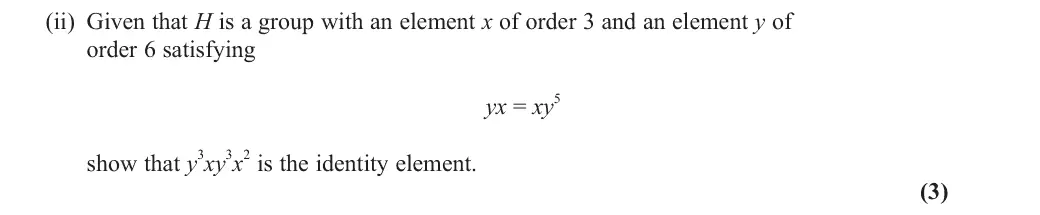
(ii) Given that H is a group with an element x of order 3 and an element y of order 6 satisfying yx = xy 3xy 3x 2 is the identity element. show that y (3)
June 2024 · AS Paper 2 (Further Pure 2) · Q2(a) 1 mark number theory
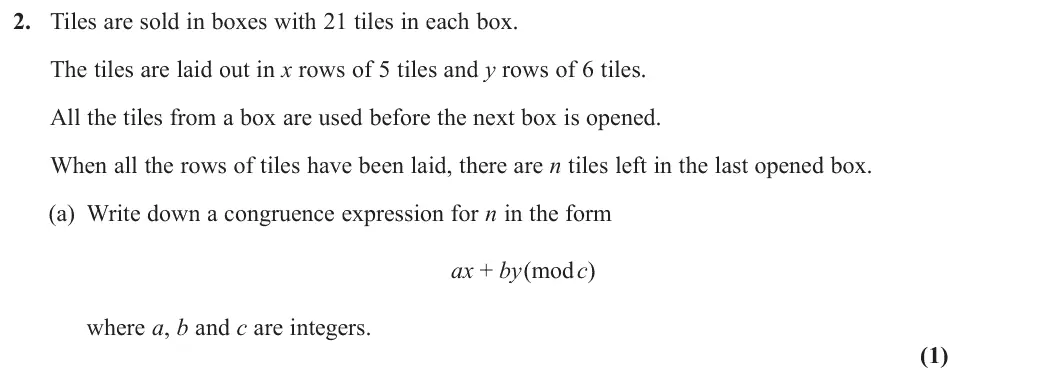
2. Tiles are sold in boxes with 21 tiles in each box. The tiles are laid out in x rows of 5 tiles and y rows of 6 tiles. All the tiles from a box are used before the next box is opened. When all the rows of tiles have been laid, there are n tiles left in the last opened box. (a) Write down a congruence expression for n in the form ax + by(mod c) where a, b and c are integers. (1)
June 2024 · AS Paper 2 (Further Pure 2) · Q2(b) 5 marks number theory
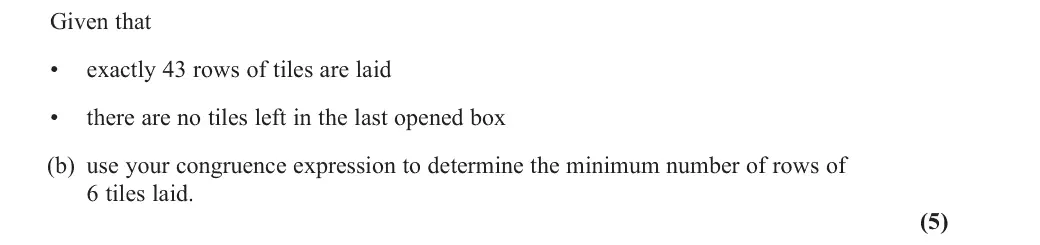
Given that • exactly 43 rows of tiles are laid • there are no tiles left in the last opened box (b) use your congruence expression to determine the minimum number of rows of 6 tiles laid. (5)
June 2024 · AS Paper 2 (Further Pure 2) · Q3(a) 3 marks eigenvalues and eigenvectors
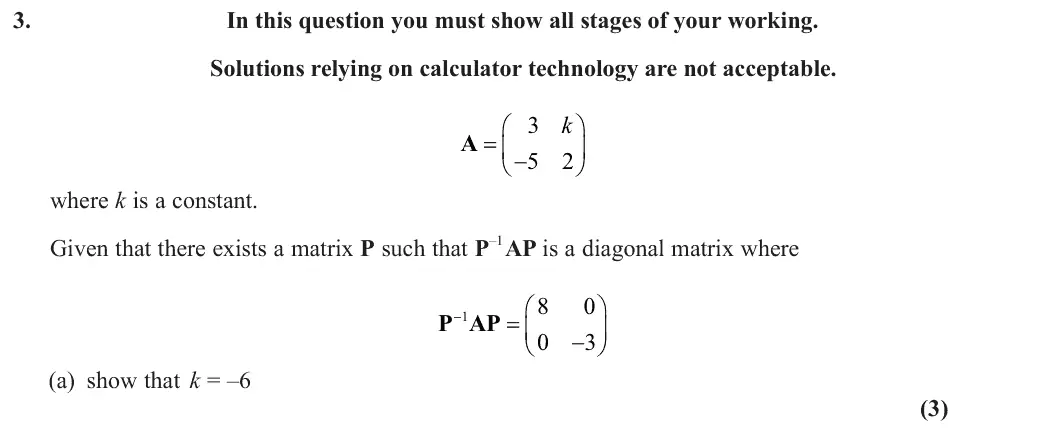
3. In this question you must show all stages of your working. Solutions relying on calculator technology are not acceptable. k : A O 3 where k is a constant. Given that there exists a matrix P such that P –1 AP is a diagonal matrix where : P AP (a) show that k = –6 (3)
June 2024 · AS Paper 2 (Further Pure 2) · Q3(b) 4 marks eigenvalues and eigenvectors
(b) determine a suitable matrix P (4)
June 2024 · AS Paper 2 (Further Pure 2) · Q4(a) 2 marks complex transformations
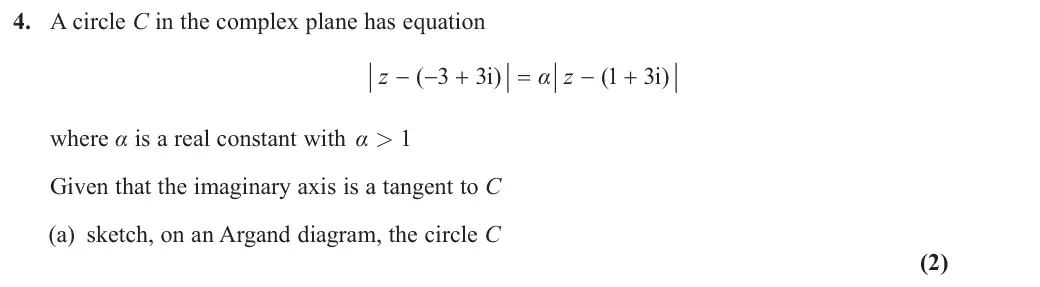
4. A circle C in the complex plane has equation z 3 3 ( i) alpha z 3 (1 i) where alpha is a real constant with alpha > 1 Given that the imaginary axis is a tangent to C (a) sketch, on an Argand diagram, the circle C (2)
June 2024 · AS Paper 2 (Further Pure 2) · Q4(b) 1 mark complex transformations
(b) explain why the value of alpha is 3 (1)
June 2024 · AS Paper 2 (Further Pure 2) · Q4(c) 6 marks complex transformations
The circle C is contained in the region pi < ; R O 9 z 5=< : beta < arg z < (c) Determine the maximum value of beta Give your answer in radians to 3 significant figures. (6)
June 2024 · AS Paper 2 (Further Pure 2) · Q5(a) 2 marks recurrence relations fp2
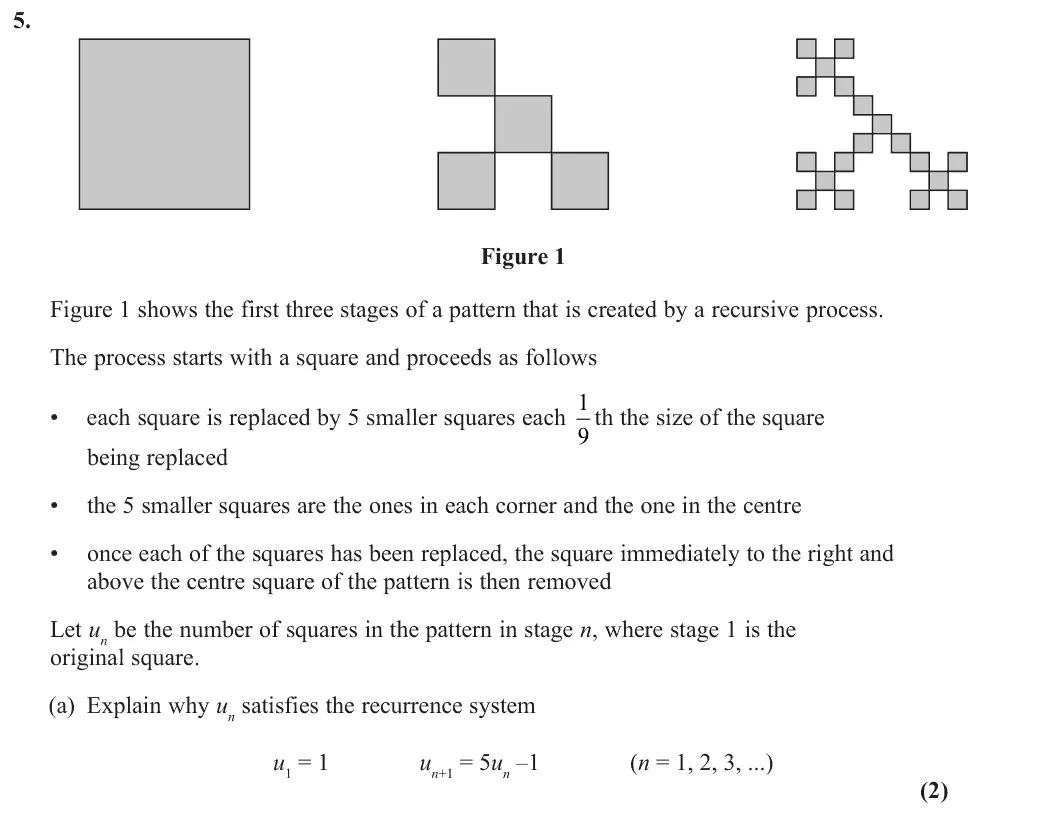
5. Figure 1 Figure 1 shows the first three stages of a pattern that is created by a recursive process. The process starts with a square and proceeds as follows each square is replaced by 5 smaller squares each 1 • 9 th the size of the square being replaced • the 5 smaller squares are the ones in each corner and the one in the centre • once each of the squares has been replaced, the square immediately to the right and above the centre square of the pattern is then removed Let un be the number of squares in the pattern in stage n, where stage 1 is the original square. (a) Explain why un satisfies the recurrence system u1 = 1 un+1 = 5un –1 (n = 1, 2, 3, ...) (2)
June 2024 · AS Paper 2 (Further Pure 2) · Q5(b) 5 marks recurrence relations fp2
(b) Solve this recurrence system. (5)
June 2024 · AS Paper 2 (Further Pure 2) · Q5(c) 2 marks recurrence relations fp2
Given that the initial square has area 25 (c) determine the total area of all the squares in stage 8 of the pattern, giving your answer to 2 significant figures. (2)

Find an Edexcel Further Maths tutor

Want this paper marked and gone through with a Further Maths tutor? Message us.

Prefer email? Send an enquiry

If you are under 18, please include a parent's contact details. Enquiries go to enquiries@alevelfurthermathstutor.com and are deleted once handled.