June 2024: A level Paper 4C: Further Mechanics 2

75 marks · 20 question parts · Question paper, mark scheme and examiner's report on Pearson's site

Question by question

QTopicMarksDifficulty
1(a) Further kinematics: acceleration as a function of time, displacement or velocity 4 —
1(b) Further kinematics: acceleration as a function of time, displacement or velocity 1 —
1(c) Further kinematics: acceleration as a function of time, displacement or velocity 4 —
2(a) Centres of mass of plane figures 4 —
2(b) Centres of mass of plane figures 3 —
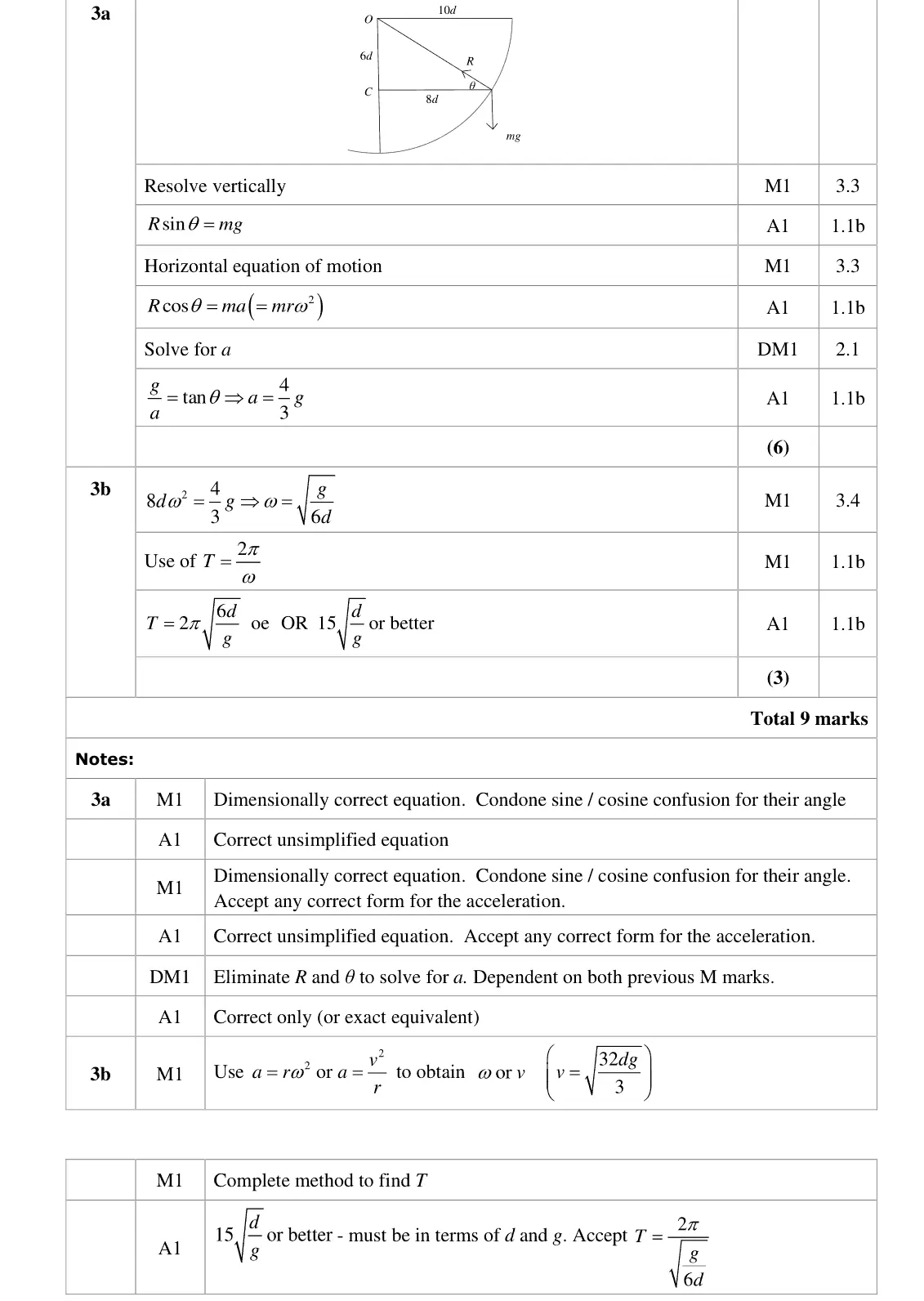
3(a) Motion in a circle: horizontal and vertical 6 —
3(b) Motion in a circle: horizontal and vertical 3 —
4(a) Centres of mass of rigid bodies, equilibrium, toppling and sliding 5 —
4(b) Centres of mass of rigid bodies, equilibrium, toppling and sliding 4 —
4(c) Centres of mass of plane figures 3 —
5(a) Further dynamics: variable forces and simple harmonic motion 5 —
5(b) Further dynamics: variable forces and simple harmonic motion 2 —
5(c) Further dynamics: variable forces and simple harmonic motion 4 —
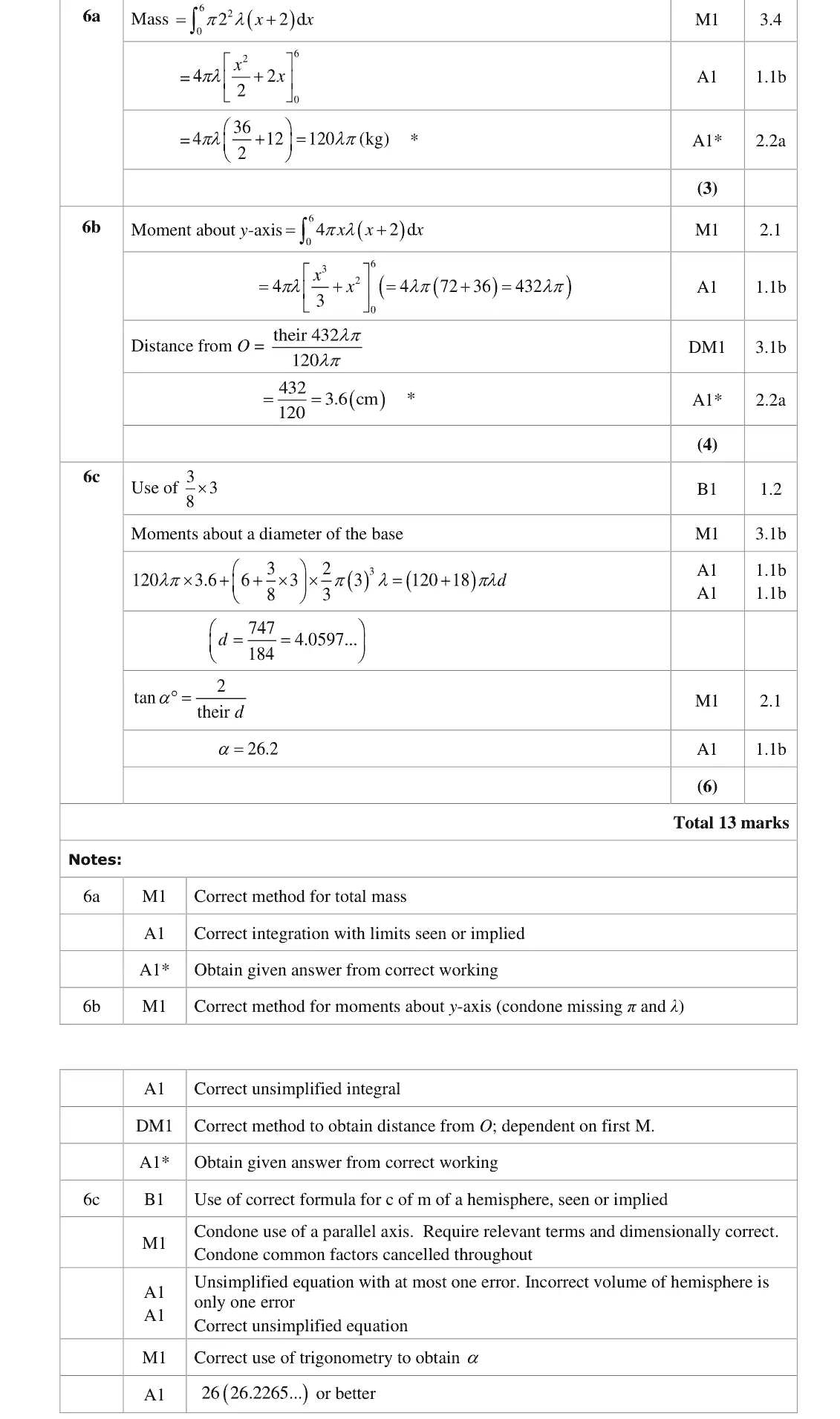
6(a) Centres of mass of rigid bodies, equilibrium, toppling and sliding 3 —
6(b) Centres of mass of rigid bodies, equilibrium, toppling and sliding 4 —
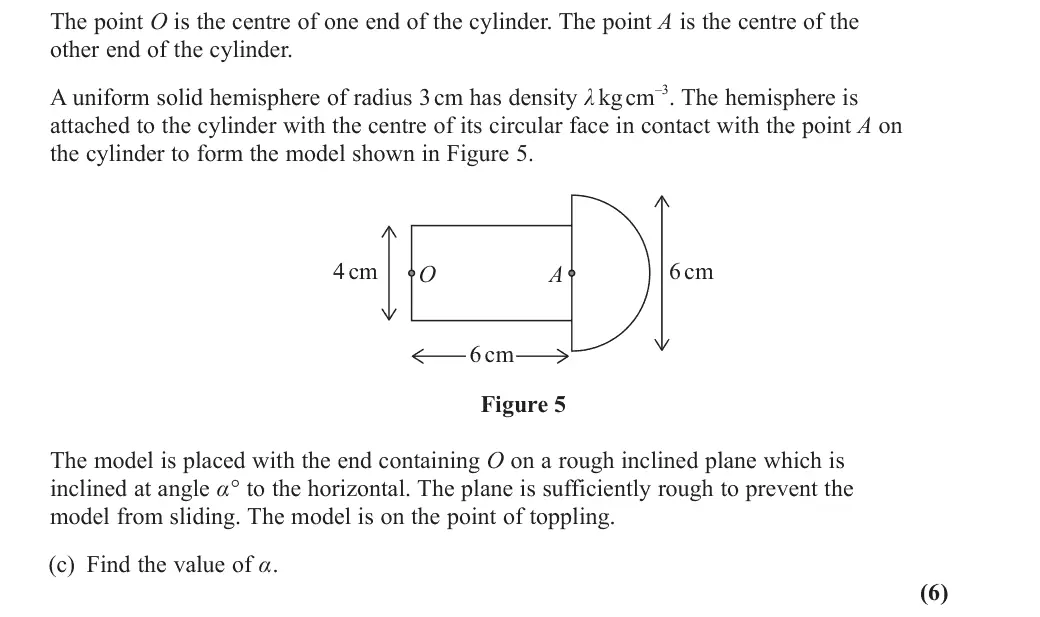
6(c) Centres of mass of rigid bodies, equilibrium, toppling and sliding 6 —
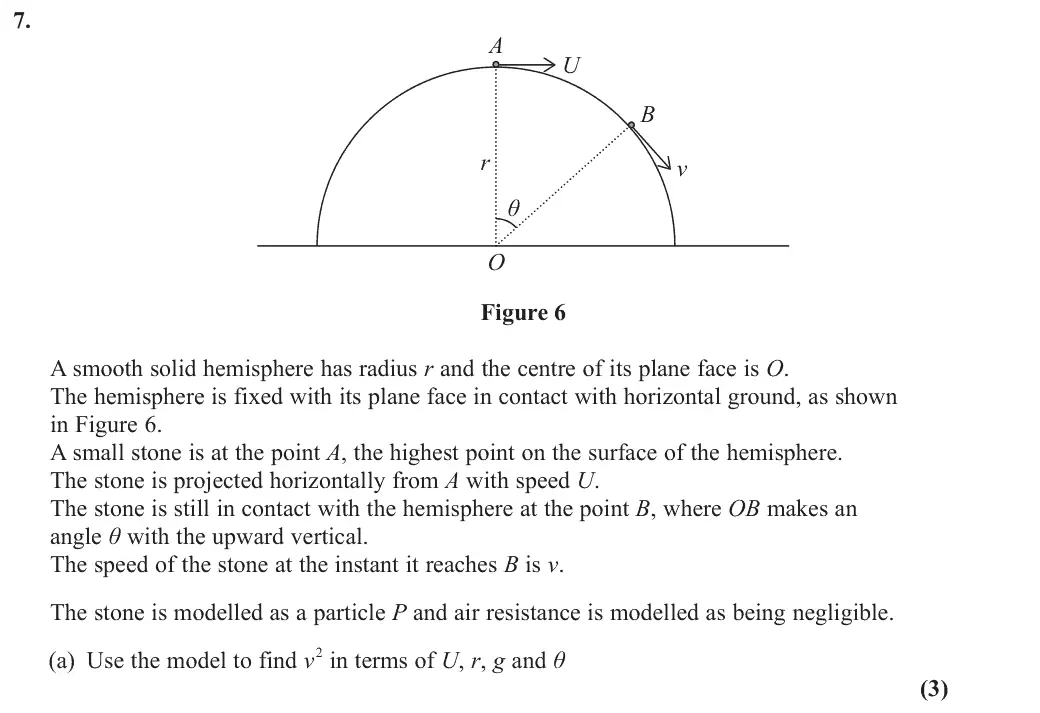
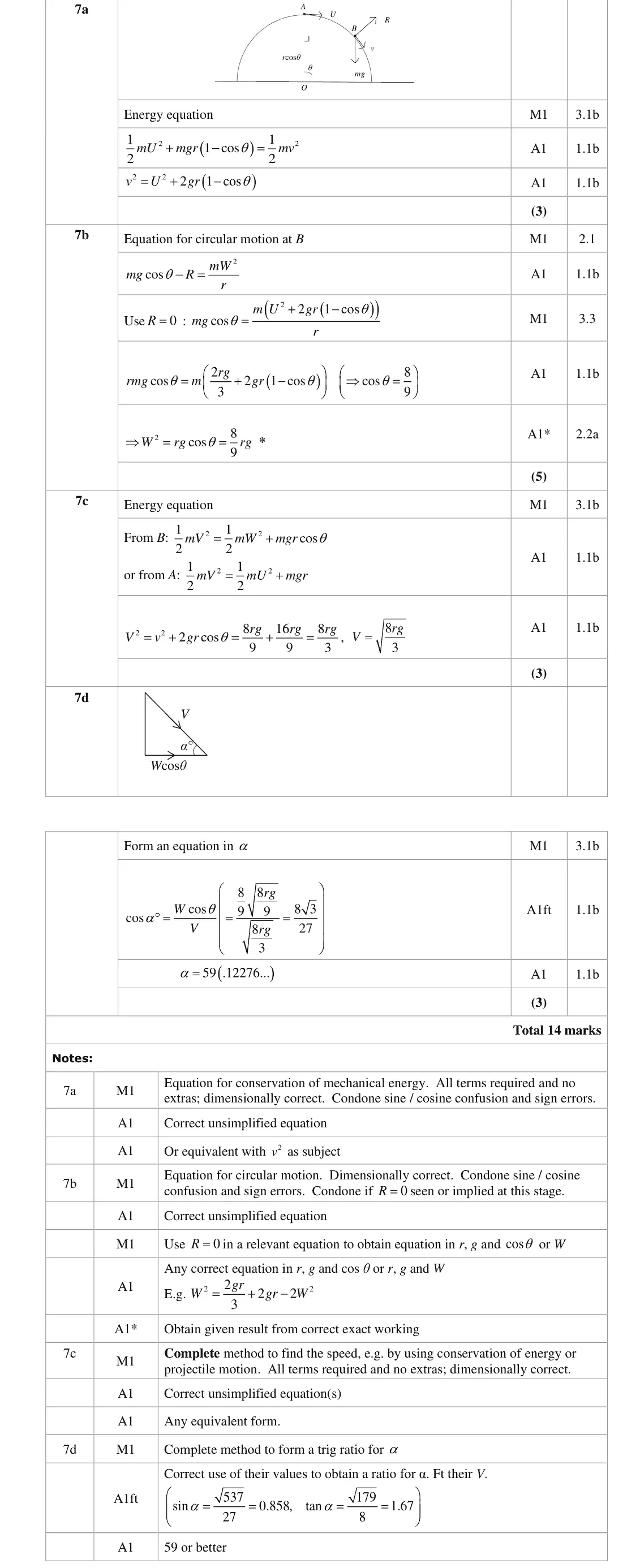
7(a) Motion in a circle: horizontal and vertical 3 —
7(b) Motion in a circle: horizontal and vertical 5 —
7(c) Motion in a circle: horizontal and vertical 3 —
7(d) Motion in a circle: horizontal and vertical 3 —

The questions

1(a)1(b)1(c)2(a)2(b)3(a)3(b)4(a)4(b)4(c)5(a)5(b)5(c)6(a)6(b)6(c)7(a)7(b)7(c)7(d)
June 2024 · Paper 4C (Further Mechanics 2) · Q1(a) 4 marks further kinematics
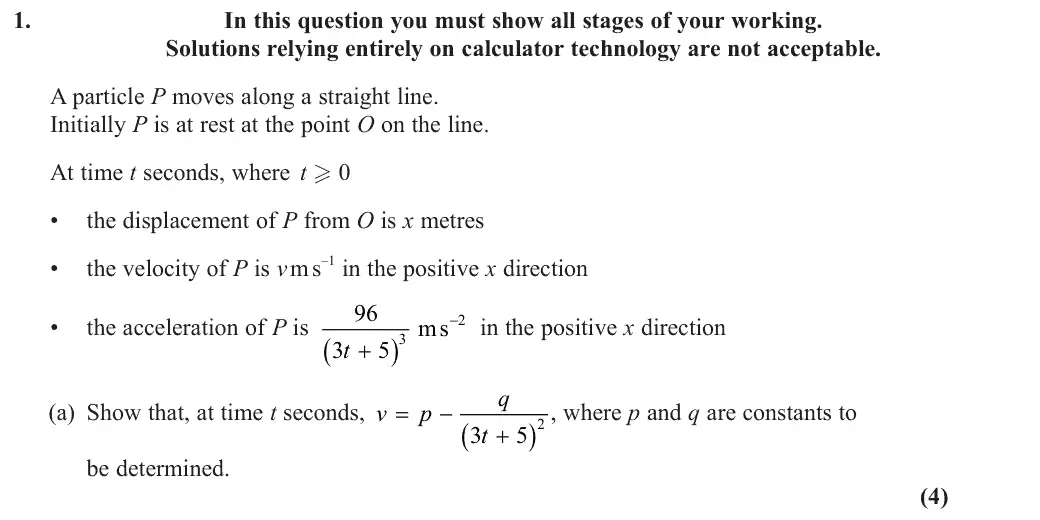
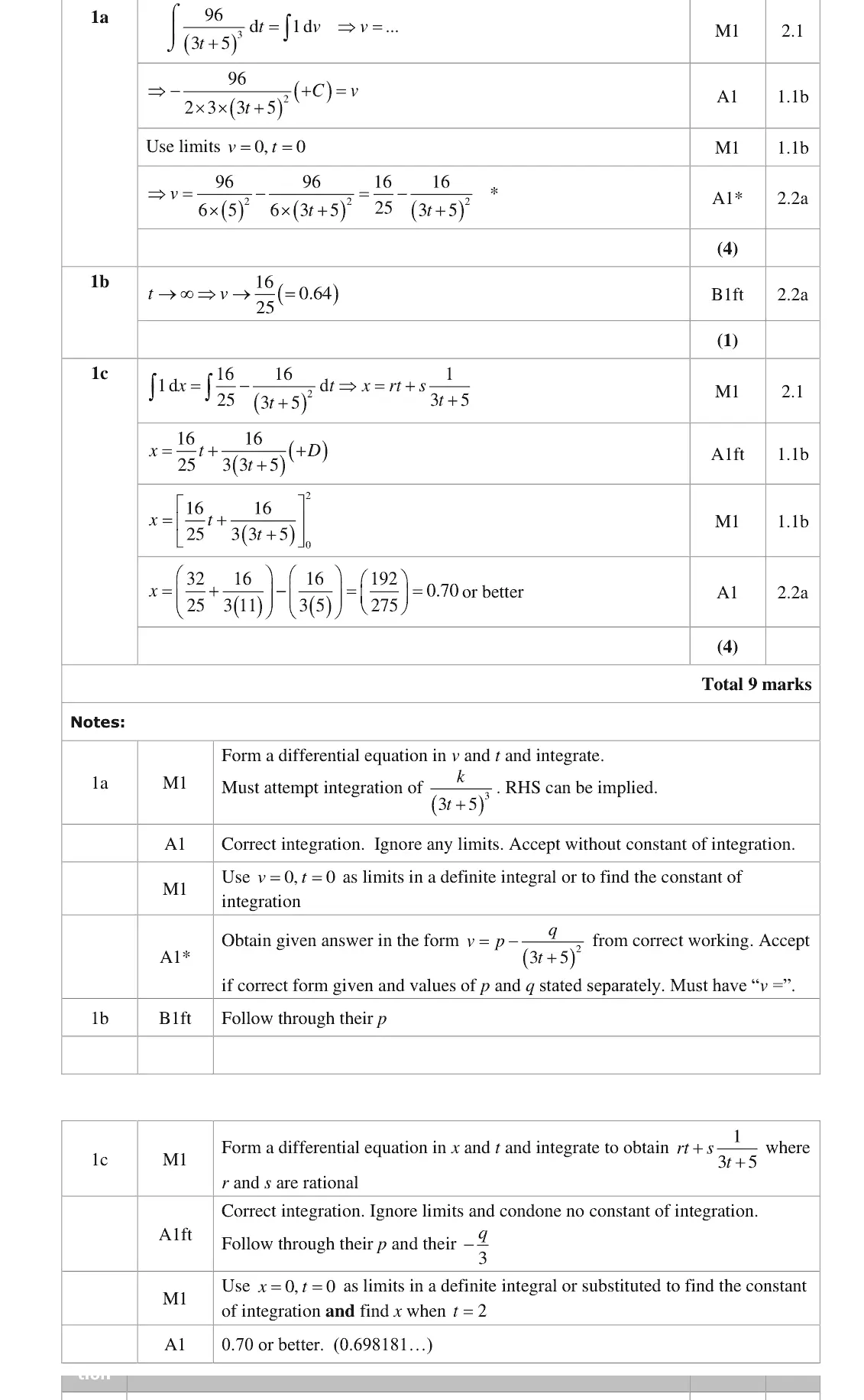
1. In this question you must show all stages of your working. Solutions relying entirely on calculator technology are not acceptable. A particle P moves along a straight line. Initially P is at rest at the point O on the line. At time t seconds, where t 0 • the displacement of P from O is x metres • the velocity of P is v m s –1 in the positive x direction • the acceleration of P is in the positive x direction ms / t 1 q (a) Show that, at time t seconds, v 2 , where p and q are constants to p / t be determined. (4)
June 2024 · Paper 4C (Further Mechanics 2) · Q1(b) 1 mark further kinematics
(b) Find the limiting value of v as t increases. (1)
June 2024 · Paper 4C (Further Mechanics 2) · Q1(c) 4 marks further kinematics
(c) Find the value of x when t = 2 (4)
June 2024 · Paper 4C (Further Mechanics 2) · Q2(a) 4 marks centres of mass plane figures
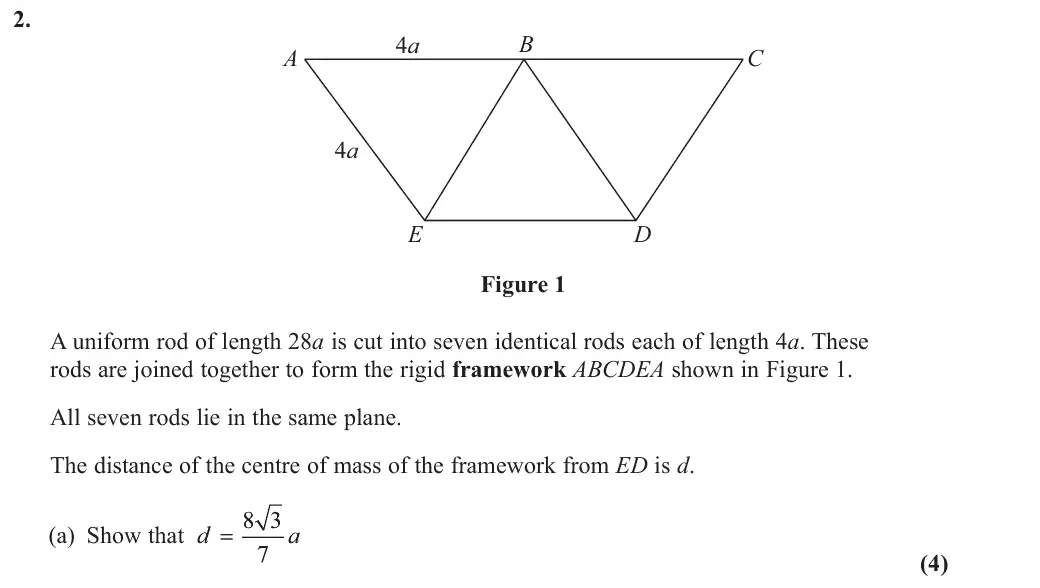
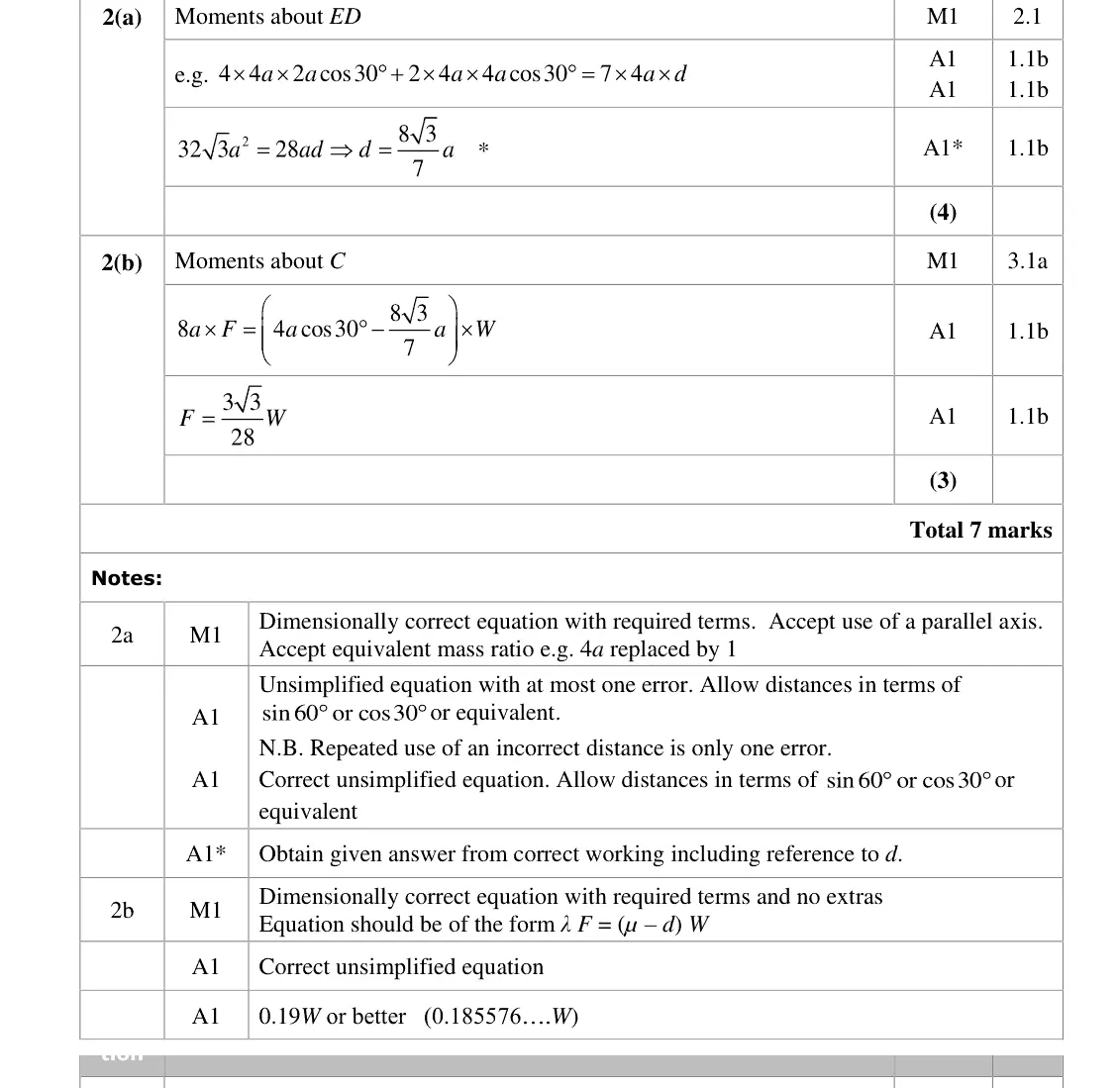
2. 4a B A C 4a E Figure 1 A uniform rod of length 28a is cut into seven identical rods each of length 4a. These rods are joined together to form the rigid framework ABCDEA shown in Figure 1. All seven rods lie in the same plane. The distance of the centre of mass of the framework from ED is d. = 8 3 (a) Show that d a (4)
June 2024 · Paper 4C (Further Mechanics 2) · Q2(b) 3 marks centres of mass plane figures
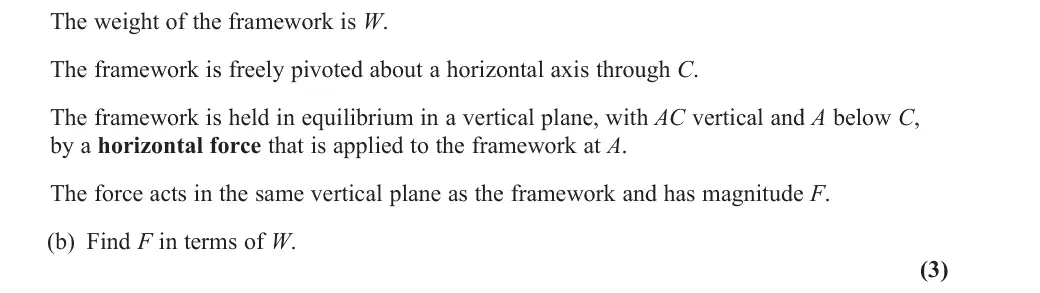
The weight of the framework is W. The framework is freely pivoted about a horizontal axis through C. The framework is held in equilibrium in a vertical plane, with AC vertical and A below C, by a horizontal force that is applied to the framework at A. The force acts in the same vertical plane as the framework and has magnitude F. (b) Find F in terms of W. (3)
June 2024 · Paper 4C (Further Mechanics 2) · Q3(a) 6 marks circular motion
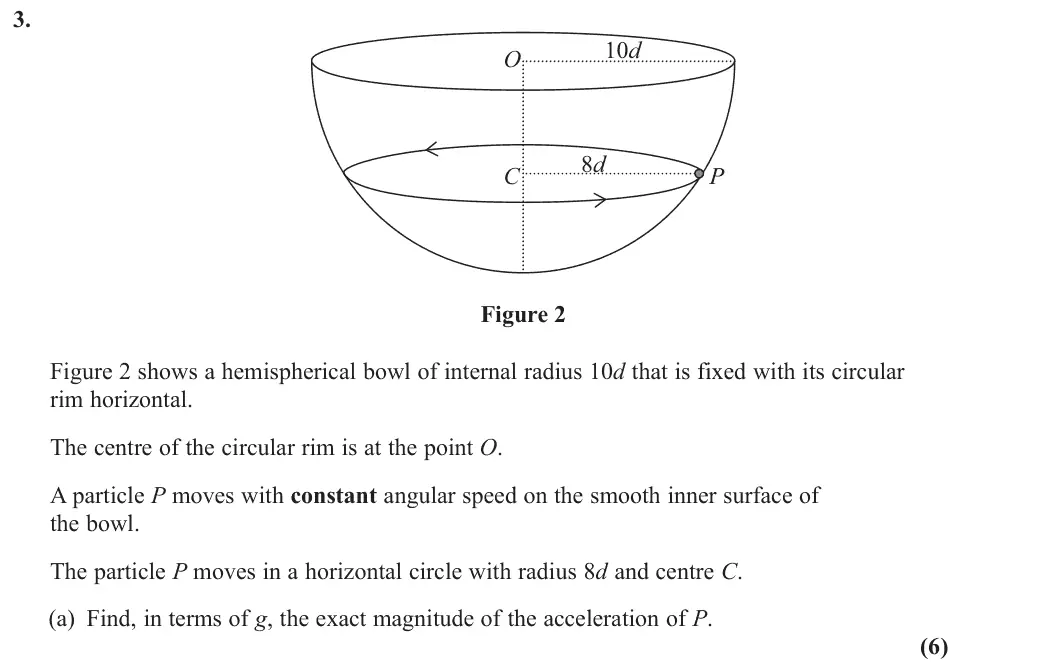
3. 10d 8d C P Figure 2 Figure 2 shows a hemispherical bowl of internal radius 10d that is fixed with its circular rim horizontal. The centre of the circular rim is at the point O. A particle P moves with constant angular speed on the smooth inner surface of the bowl. The particle P moves in a horizontal circle with radius 8d and centre C. (a) Find, in terms of g, the exact magnitude of the acceleration of P. (6)
June 2024 · Paper 4C (Further Mechanics 2) · Q3(b) 3 marks circular motion
The time for P to complete one revolution is T. (b) Find T in terms of d and g. (3)
June 2024 · Paper 4C (Further Mechanics 2) · Q4(a) 5 marks further centres of mass
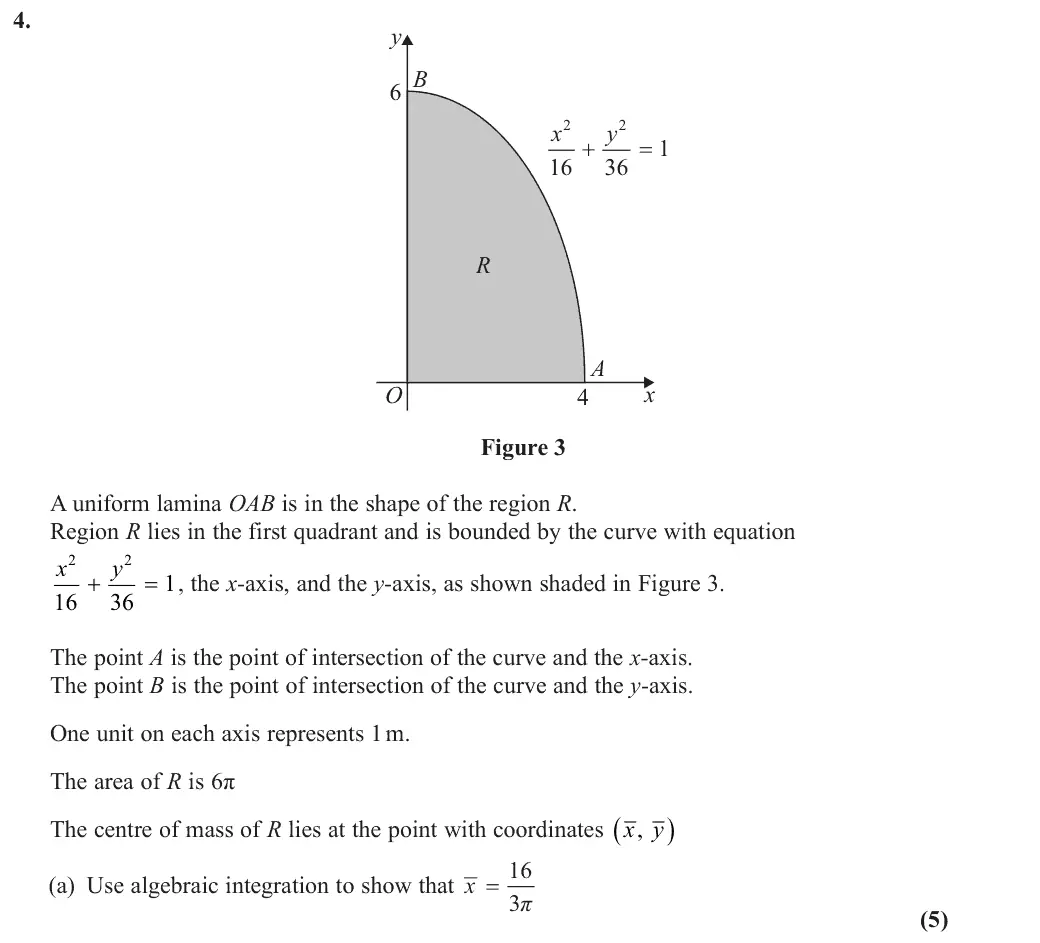
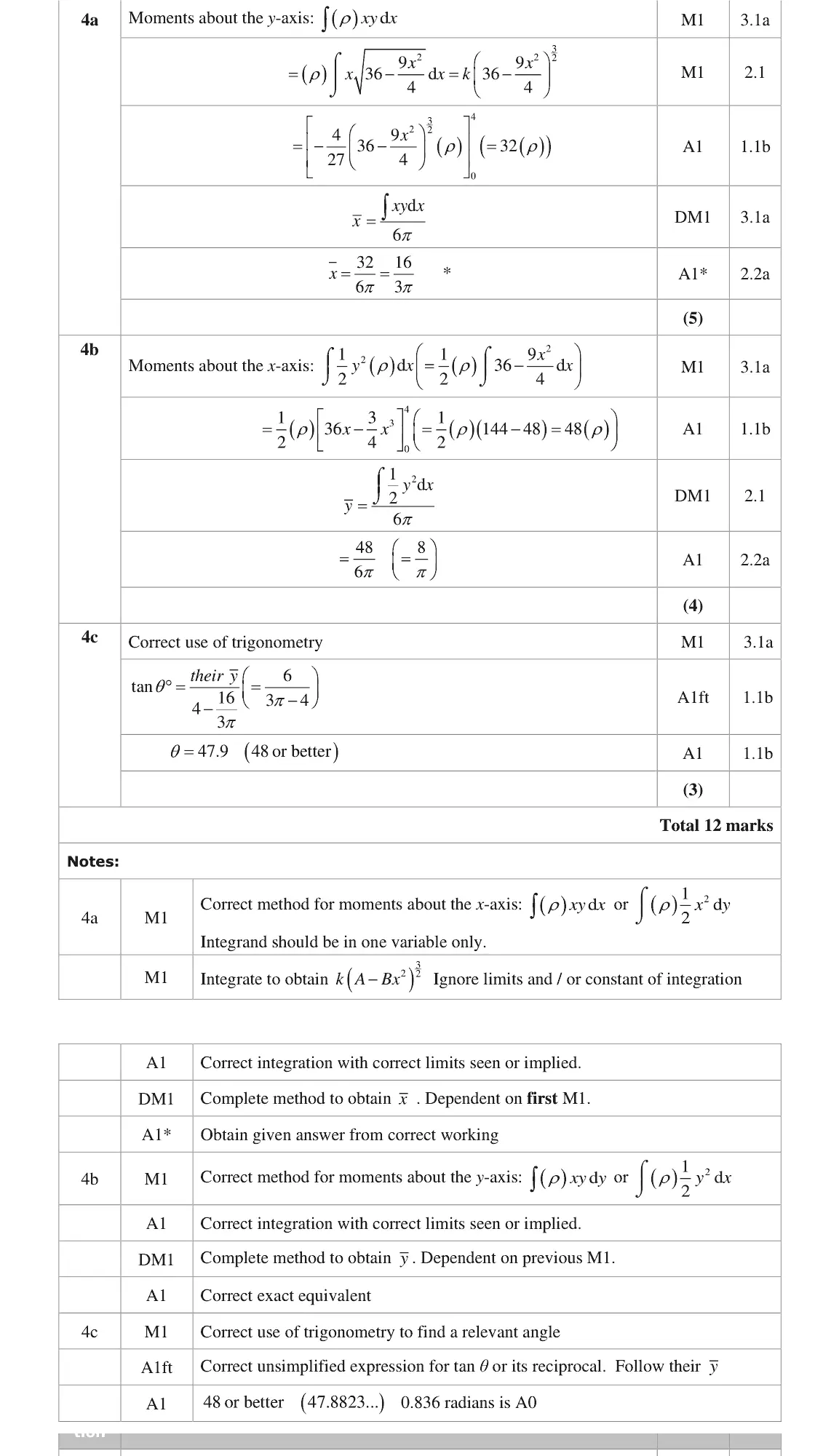
4. y B x y R A x Figure 3 A uniform lamina OAB is in the shape of the region R. Region R lies in the first quadrant and is bounded by the curve with equation x y , the x‑axis, and the y‑axis, as shown shaded in Figure 3. The point A is the point of intersection of the curve and the x‑axis. The point B is the point of intersection of the curve and the y‑axis. One unit on each axis represents 1 m. The area of R is 6 pi / The centre of mass of R lies at the point with coordinates x y , (a) Use algebraic integration to show that x pi (5)
June 2024 · Paper 4C (Further Mechanics 2) · Q4(b) 4 marks further centres of mass
(b) Use algebraic integration to find the exact value of y (4)
June 2024 · Paper 4C (Further Mechanics 2) · Q4(c) 3 marks centres of mass plane figures
The lamina is freely suspended from A and hangs in equilibrium with OA at angle theta ° to the downward vertical. (c) Find the value of theta (3)
June 2024 · Paper 4C (Further Mechanics 2) · Q5(a) 5 marks further dynamics and shm
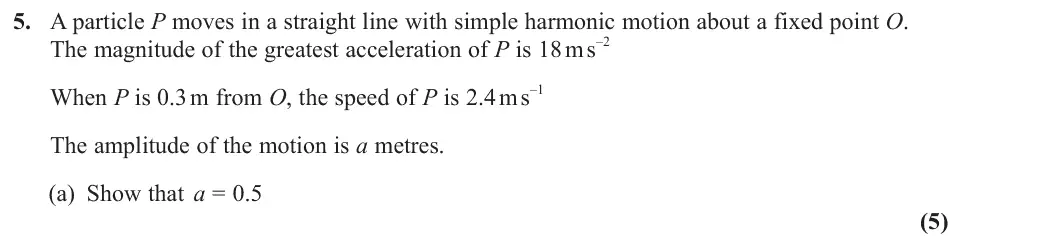
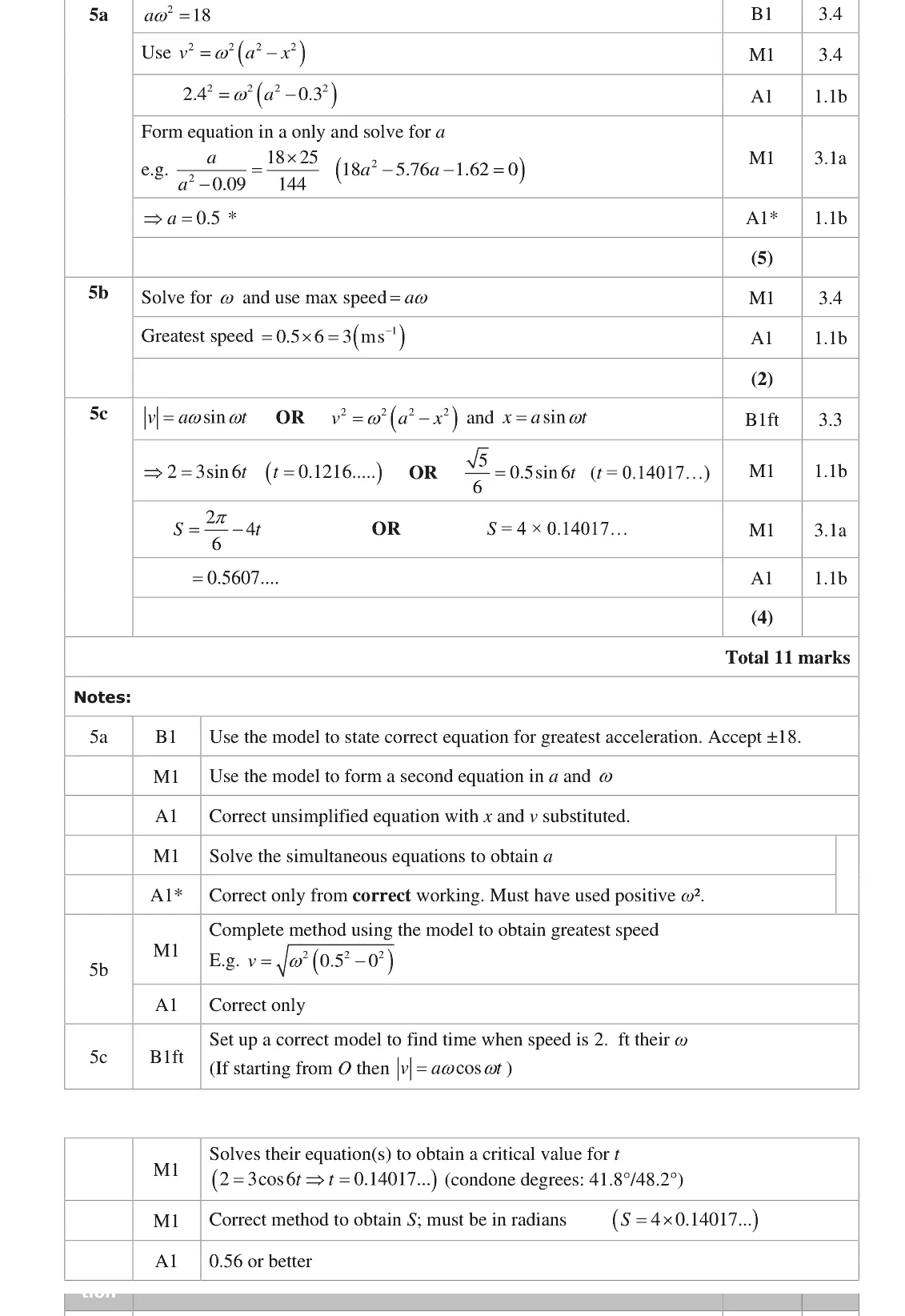
5. A particle P moves in a straight line with simple harmonic motion about a fixed point O. The magnitude of the greatest acceleration of P is 18 m s –2 When P is 0.3 m from O, the speed of P is 2.4 m s –1 The amplitude of the motion is a metres. (a) Show that a = 0.5 (5)
June 2024 · Paper 4C (Further Mechanics 2) · Q5(b) 2 marks further dynamics and shm
(b) Find the greatest speed of P. (2)
June 2024 · Paper 4C (Further Mechanics 2) · Q5(c) 4 marks further dynamics and shm
During one oscillation, the speed of P is at least 2 m s –1 for S seconds. (c) Find the value of S. (4)
June 2024 · Paper 4C (Further Mechanics 2) · Q6(a) 3 marks further centres of mass
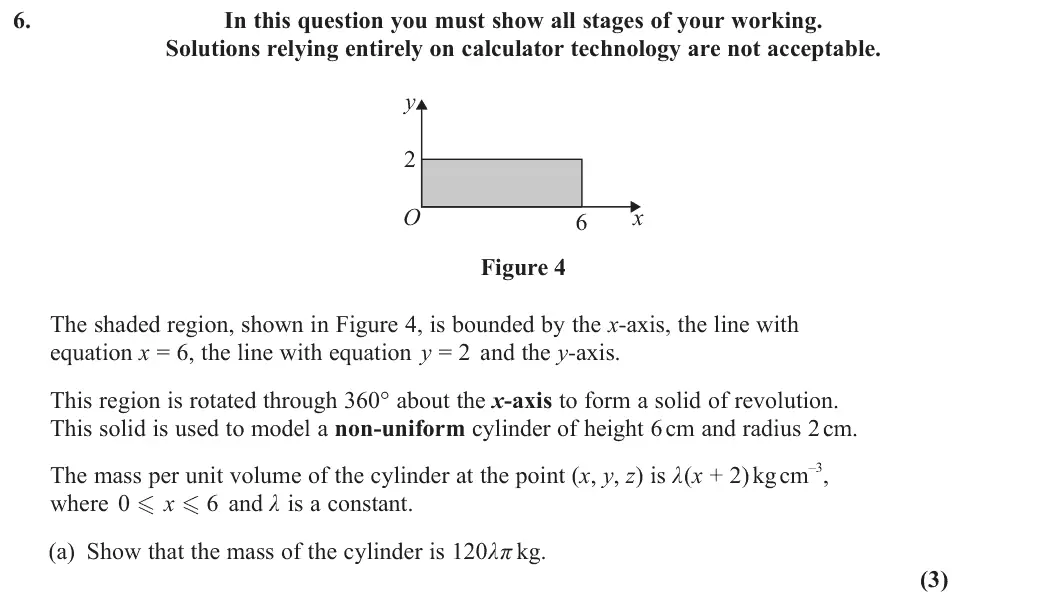
6. In this question you must show all stages of your working. Solutions relying entirely on calculator technology are not acceptable. y x Figure 4 The shaded region, shown in Figure 4, is bounded by the x‑axis, the line with equation x = 6, the line with equation y = 2 and the y‑axis. This region is rotated through 360° about the x‑axis to form a solid of revolution. This solid is used to model a non‑uniform cylinder of height 6 cm and radius 2 cm. –3, The mass per unit volume of the cylinder at the point (x, y, z) is λ(x + 2) kg cm where 0 x 6 and λ is a constant. (a) Show that the mass of the cylinder is 120λ pi kg. (3)
June 2024 · Paper 4C (Further Mechanics 2) · Q6(b) 4 marks further centres of mass
(b) Show that the centre of mass of the cylinder is 3.6 cm from O. (4)
June 2024 · Paper 4C (Further Mechanics 2) · Q6(c) 6 marks further centres of mass
The point O is the centre of one end of the cylinder. The point A is the centre of the other end of the cylinder. –3. The hemisphere is A uniform solid hemisphere of radius 3 cm has density λ kg cm attached to the cylinder with the centre of its circular face in contact with the point A on the cylinder to form the model shown in Figure 5. 4 cm 6 cm A 6 cm Figure 5 The model is placed with the end containing O on a rough inclined plane which is inclined at angle alpha ° to the horizontal. The plane is sufficiently rough to prevent the model from sliding. The model is on the point of toppling. (c) Find the value of alpha . (6)
June 2024 · Paper 4C (Further Mechanics 2) · Q7(a) 3 marks circular motion
7. A U B r v theta Figure 6 A smooth solid hemisphere has radius r and the centre of its plane face is O. The hemisphere is fixed with its plane face in contact with horizontal ground, as shown in Figure 6. A small stone is at the point A, the highest point on the surface of the hemisphere. The stone is projected horizontally from A with speed U. The stone is still in contact with the hemisphere at the point B, where OB makes an angle theta with the upward vertical. The speed of the stone at the instant it reaches B is v. The stone is modelled as a particle P and air resistance is modelled as being negligible. (a) Use the model to find v 2 in terms of U, r, g and theta (3)
June 2024 · Paper 4C (Further Mechanics 2) · Q7(b) 5 marks circular motion
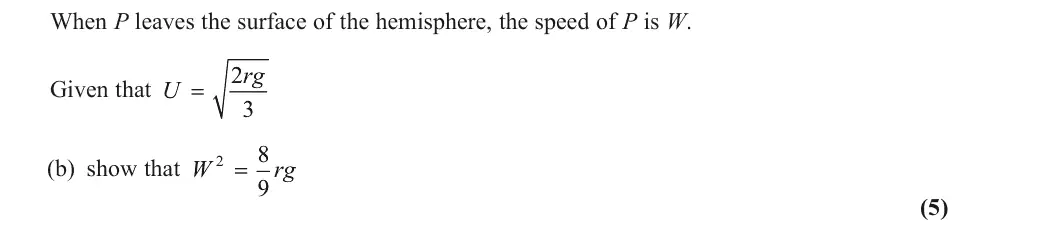
When P leaves the surface of the hemisphere, the speed of P is W. rg Given that U = (b) show that W rg = (5)
June 2024 · Paper 4C (Further Mechanics 2) · Q7(c) 3 marks circular motion
After leaving the surface of the hemisphere, P moves freely under gravity until it hits the ground. (c) Find the speed of P as it hits the ground, giving your answer in terms of r and g. (3)
June 2024 · Paper 4C (Further Mechanics 2) · Q7(d) 3 marks circular motion
At the instant when P hits the ground it is travelling at alpha ° to the horizontal. (d) Find the value of alpha . (3)

Find an Edexcel Further Maths tutor

Want this paper marked and gone through with a Further Maths tutor? Message us.

Prefer email? Send an enquiry

If you are under 18, please include a parent's contact details. Enquiries go to enquiries@alevelfurthermathstutor.com and are deleted once handled.