Oct 2020: AS Paper 23: Further Statistics 1

40 marks · 12 question parts · Question paper, mark scheme and examiner's report on Pearson's site

Question by question

QTopicMarksDifficulty
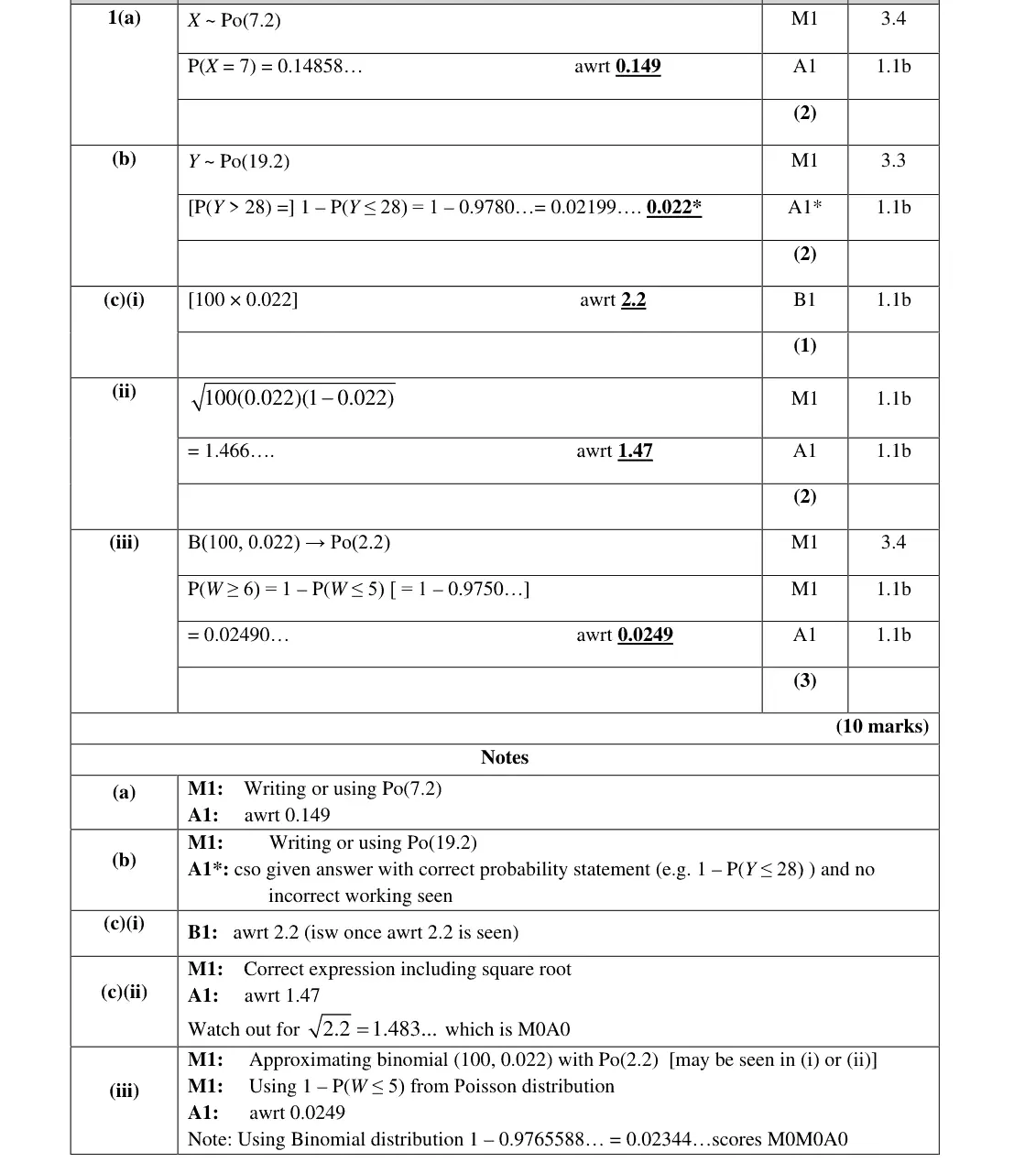
1(a) Poisson and binomial distributions 2 —
1(b) Poisson and binomial distributions 2 —
1(c)(i) Poisson and binomial distributions 1 —
1(c)(ii) Poisson and binomial distributions 2 —
1(c)(iii) Poisson and binomial distributions 3 —
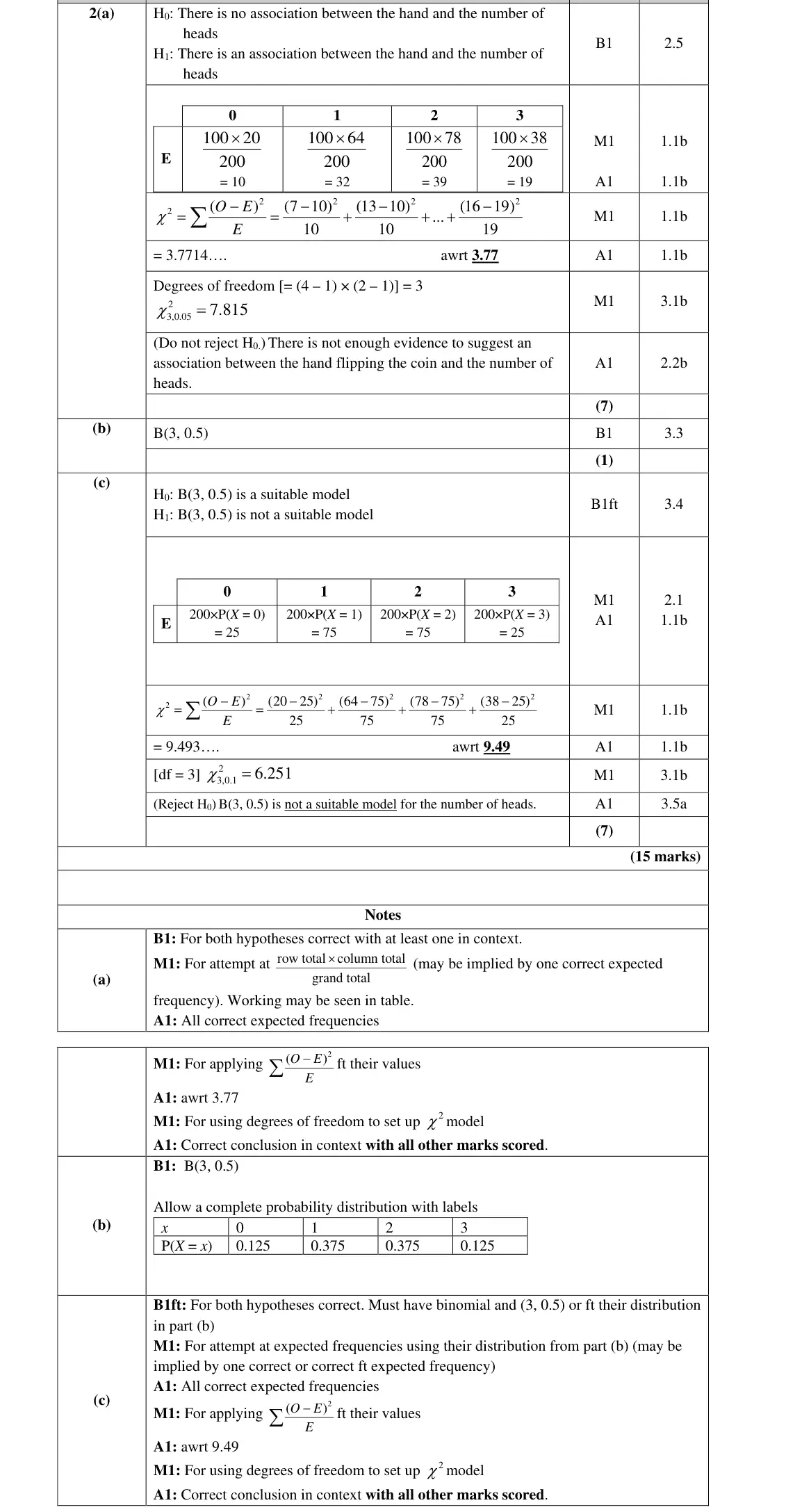
2(a) Chi-squared tests: goodness of fit and contingency tables 7 —
2(b) Chi-squared tests: goodness of fit and contingency tables 1 —
2(c) Chi-squared tests: goodness of fit and contingency tables 7 —
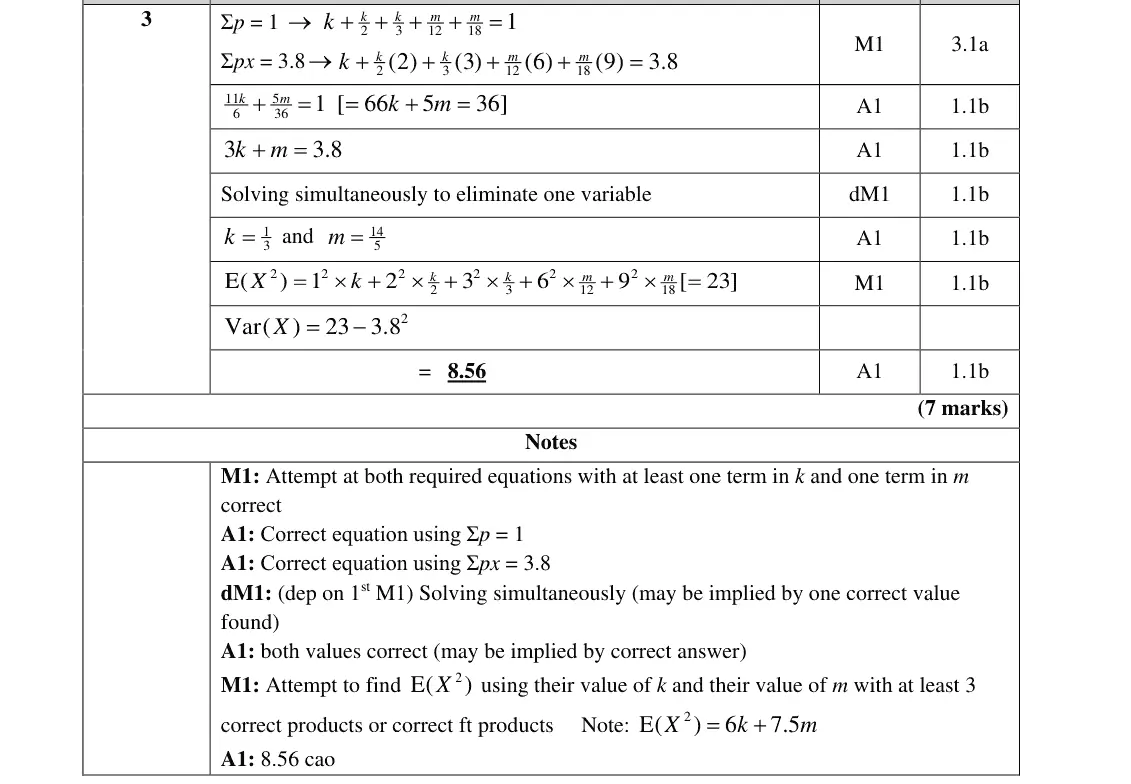
3 Discrete random variables: mean and variance 7 —
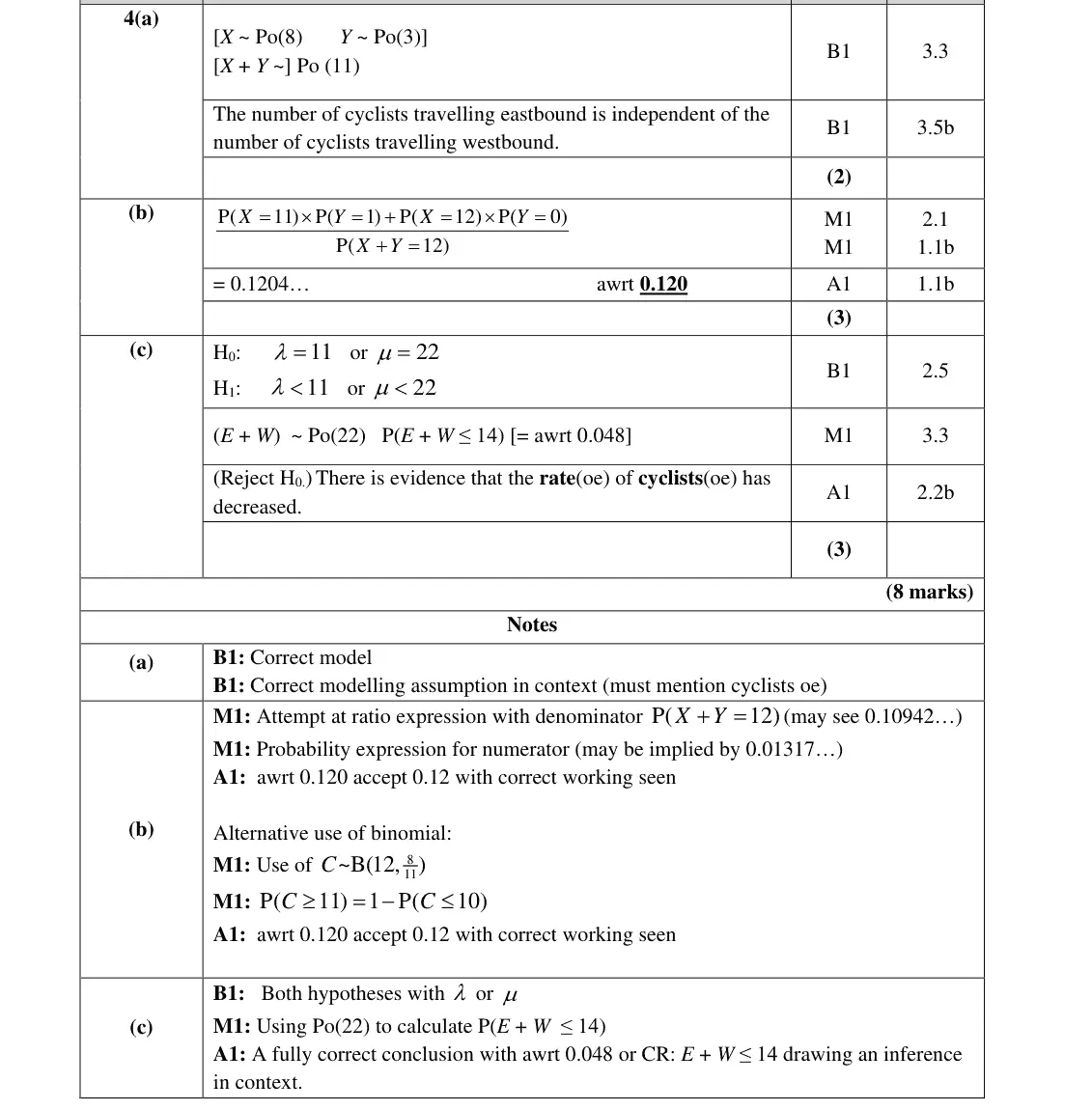
4(a) Poisson and binomial distributions 2 —
4(b) Poisson and binomial distributions 3 —
4(c) Hypothesis tests: Poisson, binomial and geometric 3 —

The questions

1(a)1(b)1(c)(i)1(c)(ii)1(c)(iii)2(a)2(b)2(c)34(a)4(b)4(c)
Oct 2020 · AS Paper 2 (Further Statistics 1) · Q1(a) 2 marks poisson distribution
1. A plumbing company receives call-outs during the working day at an average rate of 2.4 per hour. (a) Find the probability that the company receives exactly 7 call-outs in a randomly selected 3-hour period of a working day. (2)
Oct 2020 · AS Paper 2 (Further Statistics 1) · Q1(b) 2 marks poisson distribution
The company has enough staff to respond to 28 call-outs in an 8-hour working day. (b) Show that the probability that the company receives more than 28 call-outs in a randomly selected 8-hour working day is 0.022 to 3 decimal places. (2)
Oct 2020 · AS Paper 2 (Further Statistics 1) · Q1(c)(i) 1 mark poisson distribution
In a random sample of 100 working days each of 8 hours, (c) (i) find the expected number of days that the company receives more than 28 call-outs, (1)
Oct 2020 · AS Paper 2 (Further Statistics 1) · Q1(c)(ii) 2 marks poisson distribution
(ii) find the standard deviation of the number of days that the company receives more than 28 call-outs, (2)
Oct 2020 · AS Paper 2 (Further Statistics 1) · Q1(c)(iii) 3 marks poisson distribution
(iii) use a Poisson approximation to estimate the probability that the company receives more than 28 call-outs on at least 6 of these days. (3)
Oct 2020 · AS Paper 2 (Further Statistics 1) · Q2(a) 7 marks chi squared tests
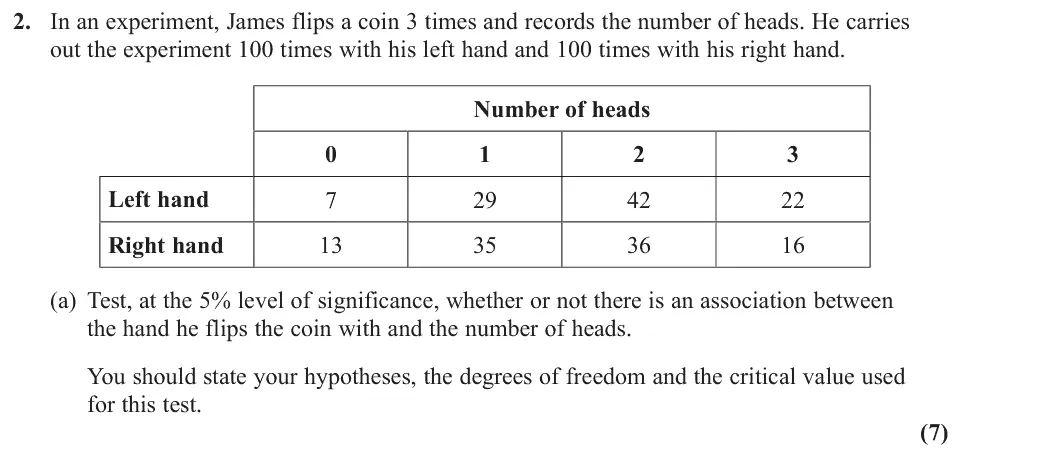
2. In an experiment, James flips a coin 3 times and records the number of heads. He carries out the experiment 100 times with his left hand and 100 times with his right hand. Number of heads Left hand Right hand (a) Test, at the 5% level of significance, whether or not there is an association between the hand he flips the coin with and the number of heads. You should state your hypotheses, the degrees of freedom and the critical value used for this test. (7)
Oct 2020 · AS Paper 2 (Further Statistics 1) · Q2(b) 1 mark chi squared tests
(b) Assuming the coin is unbiased, write down the distribution of the number of heads in 3 flips. (1)
Oct 2020 · AS Paper 2 (Further Statistics 1) · Q2(c) 7 marks chi squared tests
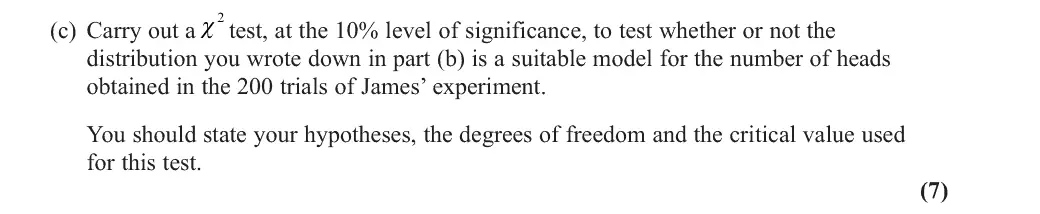
(c) Carry out a χ 2 test, at the 10% level of significance, to test whether or not the distribution you wrote down in part (b) is a suitable model for the number of heads obtained in the 200 trials of James’ experiment. You should state your hypotheses, the degrees of freedom and the critical value used for this test. (7)
Oct 2020 · AS Paper 2 (Further Statistics 1) · Q3 7 marks discrete random variables
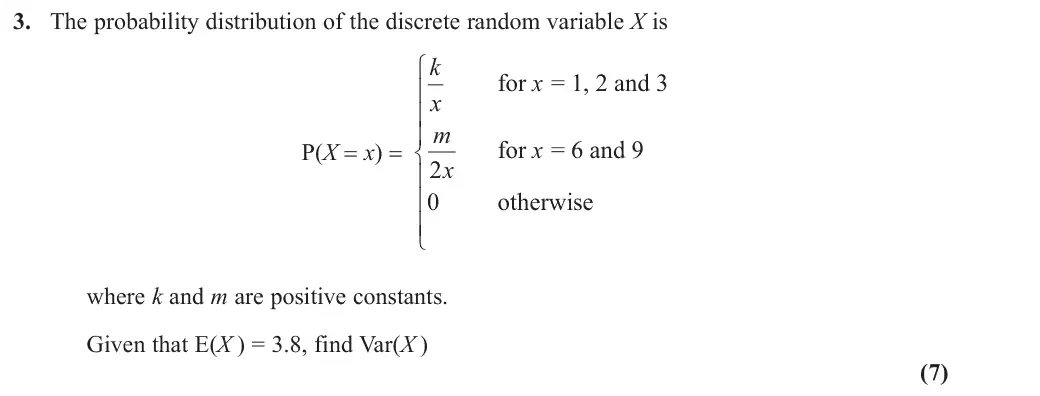
3. The probability distribution of the discrete random variable X is k for = 1, 2 and 3 x x m P(X = x) = for = 6 and 9 x x otherwise where k and m are positive constants. Given that E(X ) = 3.8, find Var(X ) (7)
Oct 2020 · AS Paper 2 (Further Statistics 1) · Q4(a) 2 marks poisson distribution
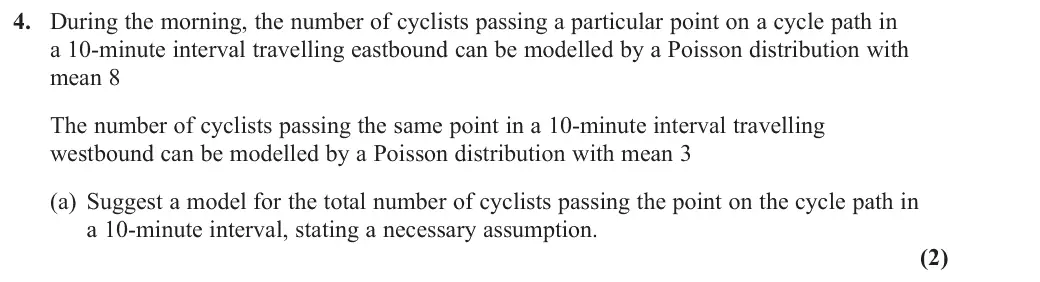
4. During the morning, the number of cyclists passing a particular point on a cycle path in a 10-minute interval travelling eastbound can be modelled by a Poisson distribution with mean 8 The number of cyclists passing the same point in a 10-minute interval travelling westbound can be modelled by a Poisson distribution with mean 3 (a) Suggest a model for the total number of cyclists passing the point on the cycle path in a 10-minute interval, stating a necessary assumption. (2)
Oct 2020 · AS Paper 2 (Further Statistics 1) · Q4(b) 3 marks poisson distribution
Given that exactly 12 cyclists pass the point in a 10-minute interval, (b) find the probability that at least 11 are travelling eastbound. (3)
Oct 2020 · AS Paper 2 (Further Statistics 1) · Q4(c) 3 marks hypothesis tests fs1
After some roadworks were completed, the total number of cyclists passing the point in a randomly selected 20-minute interval one morning is found to be 14 (c) Test, at the 5% level of significance, whether there is evidence of a decrease in the rate of cyclists passing the point. State your hypotheses clearly. (3)

Find an Edexcel Further Maths tutor

Want this paper marked and gone through with a Further Maths tutor? Message us.

Prefer email? Send an enquiry

If you are under 18, please include a parent's contact details. Enquiries go to enquiries@alevelfurthermathstutor.com and are deleted once handled.