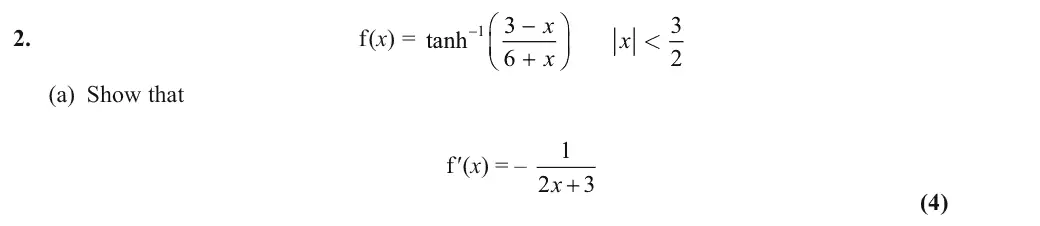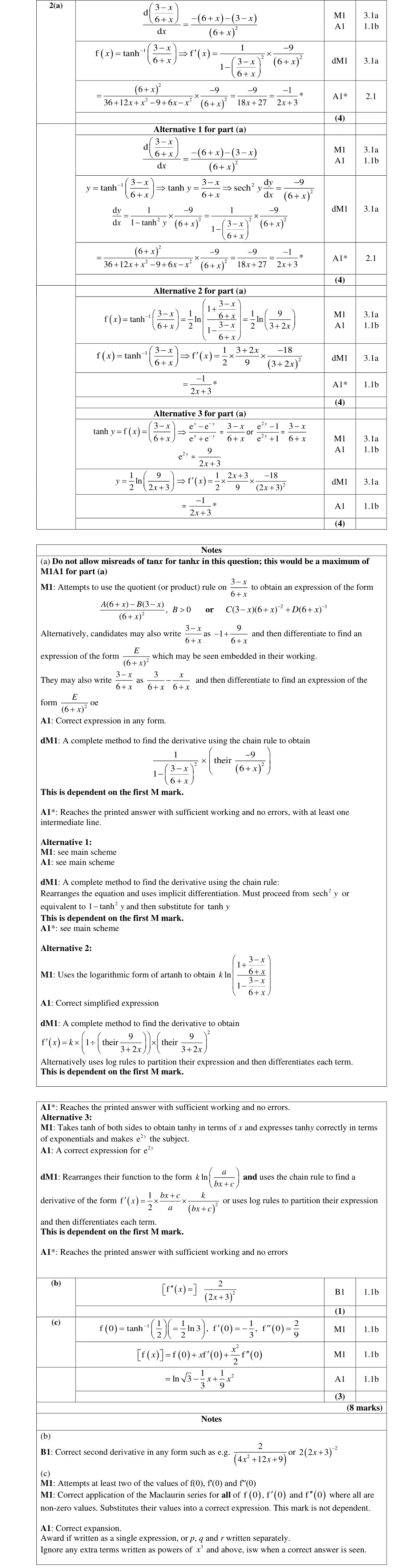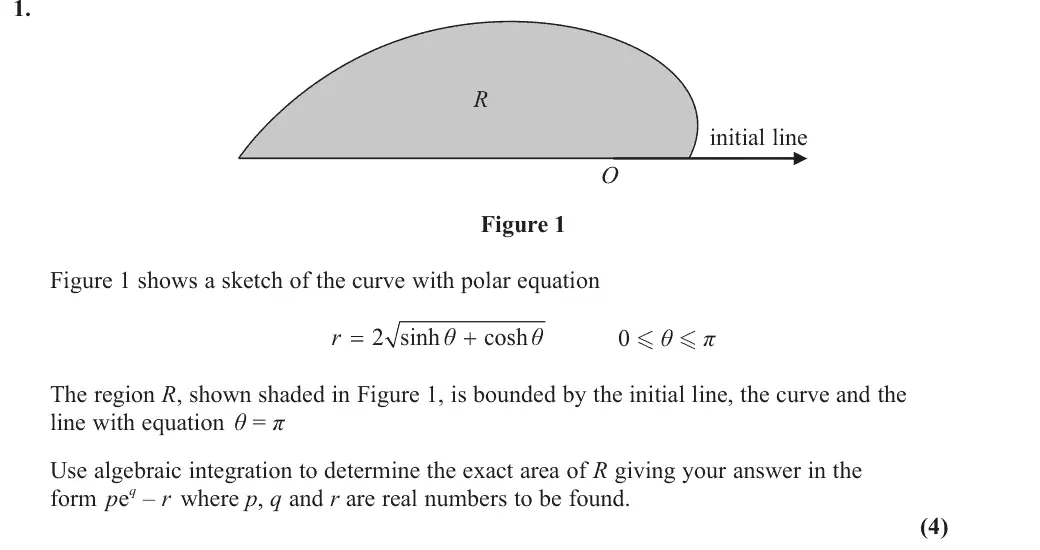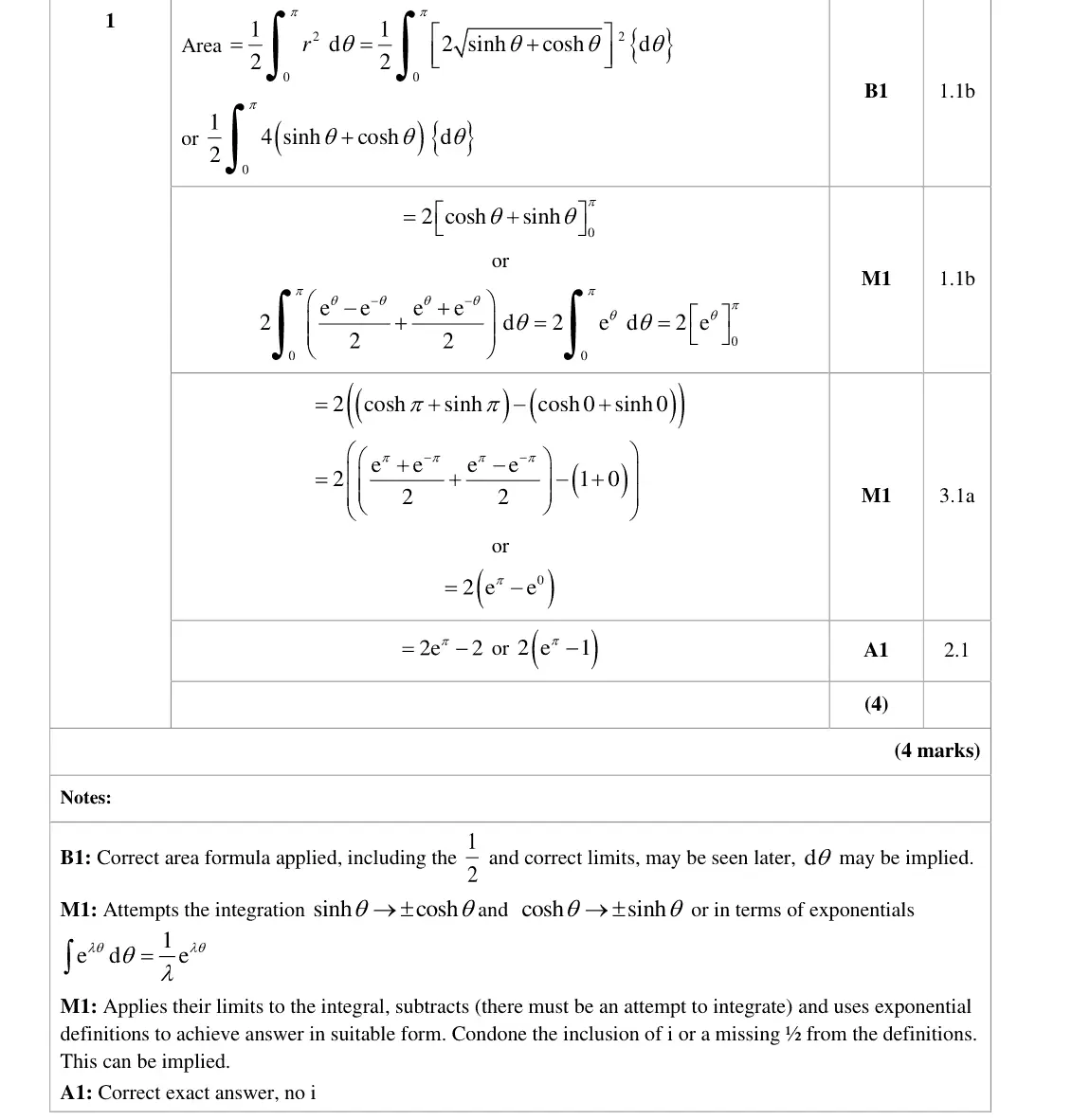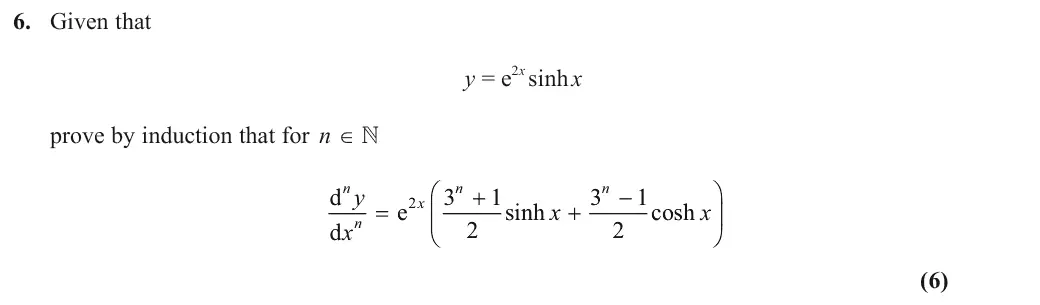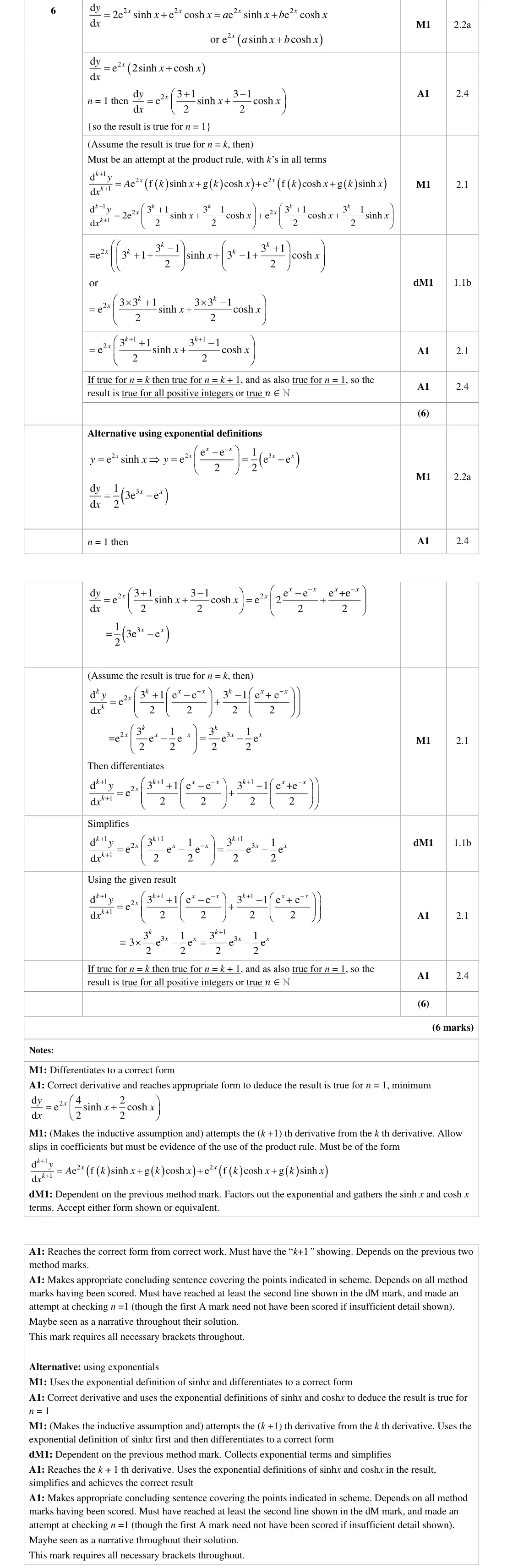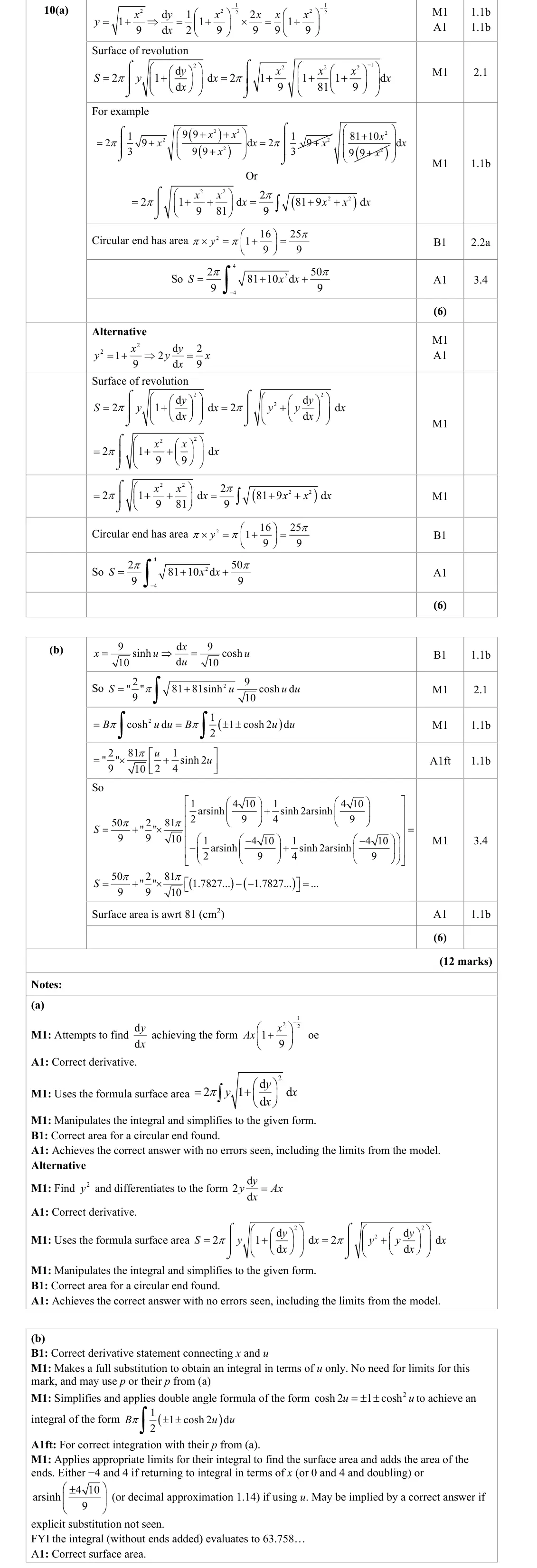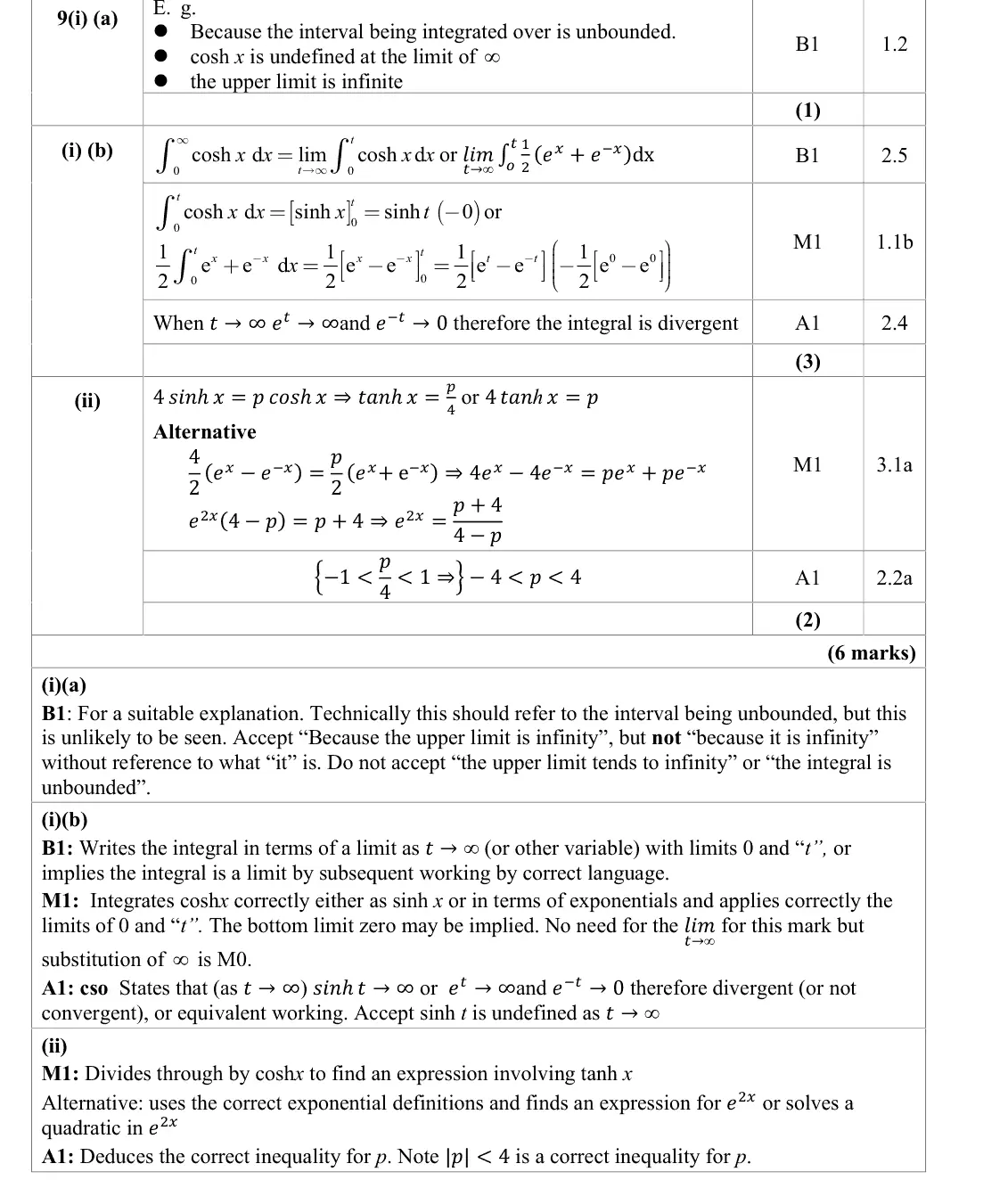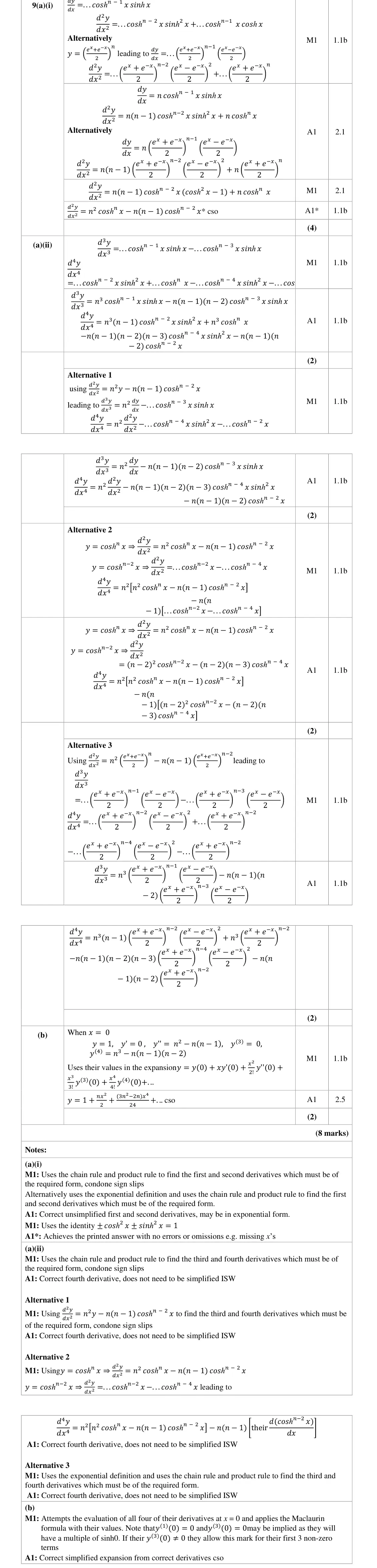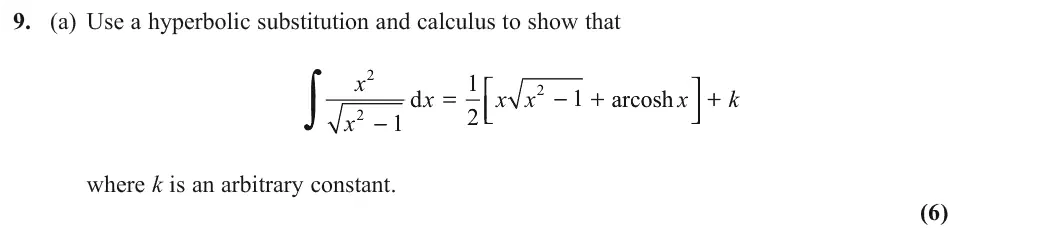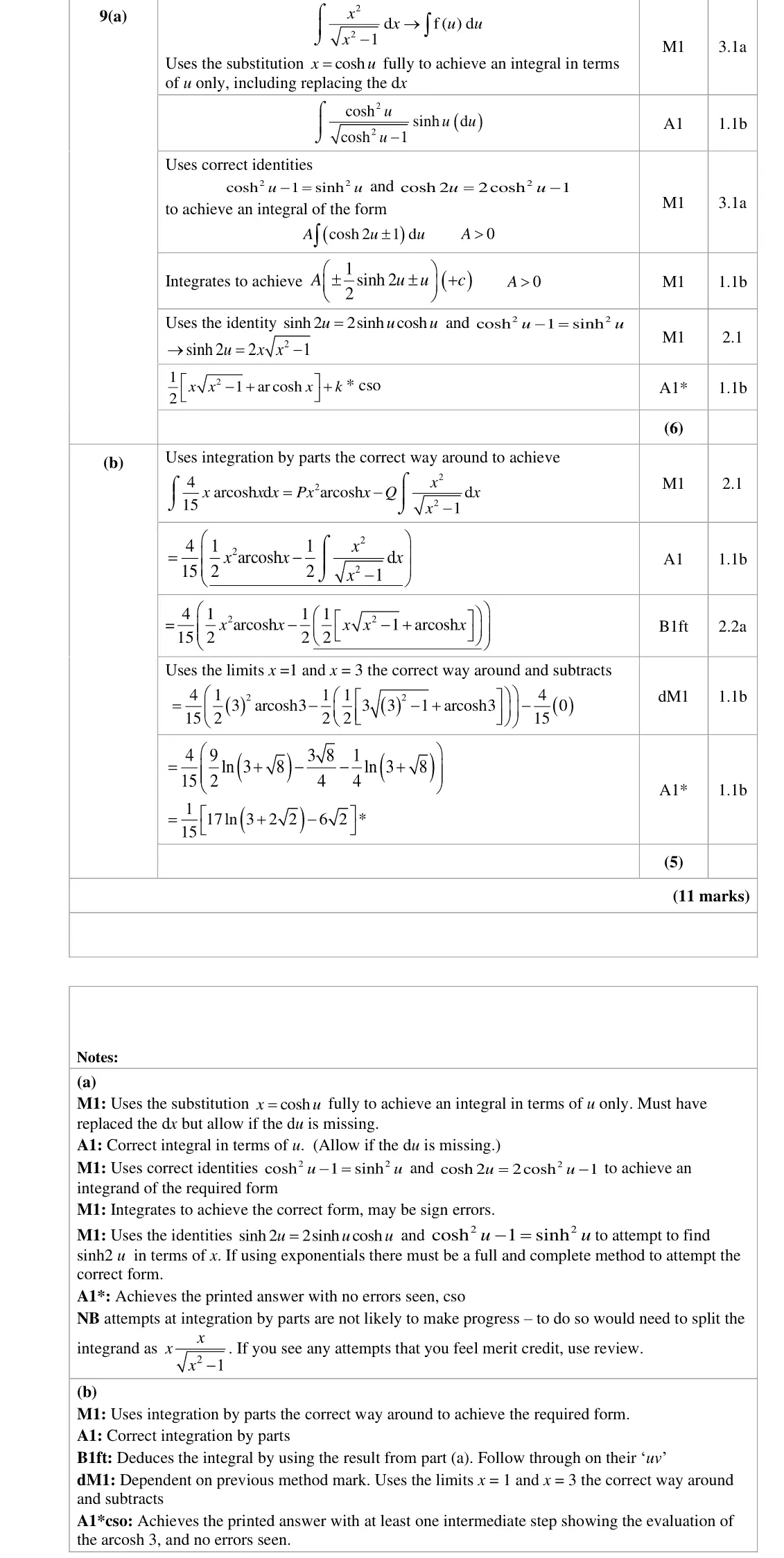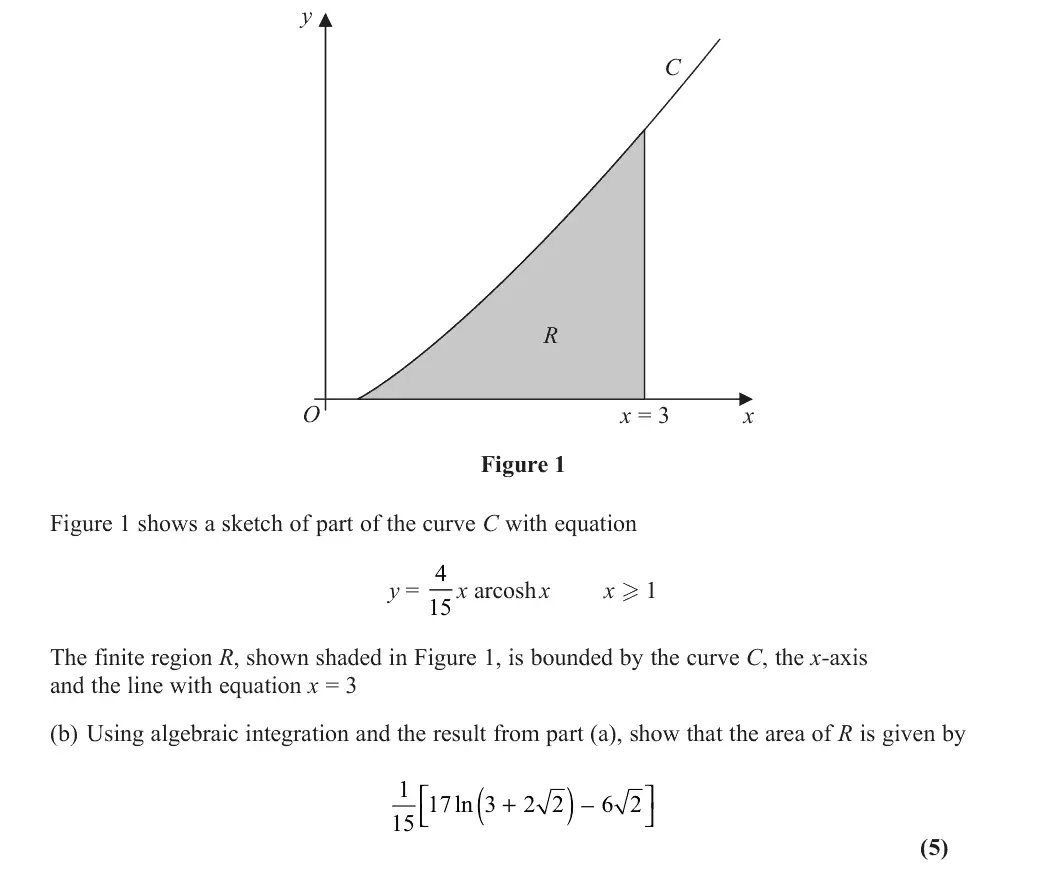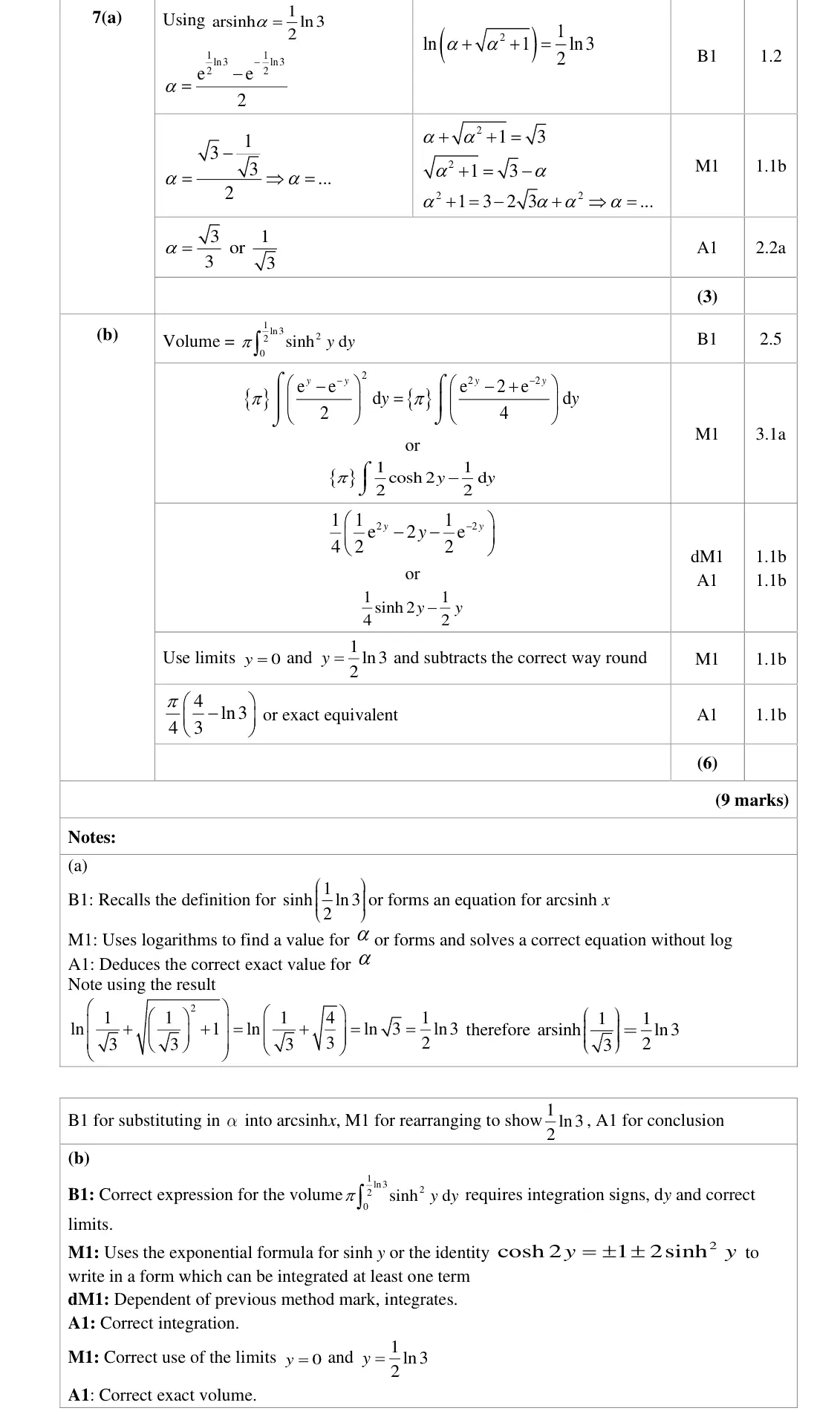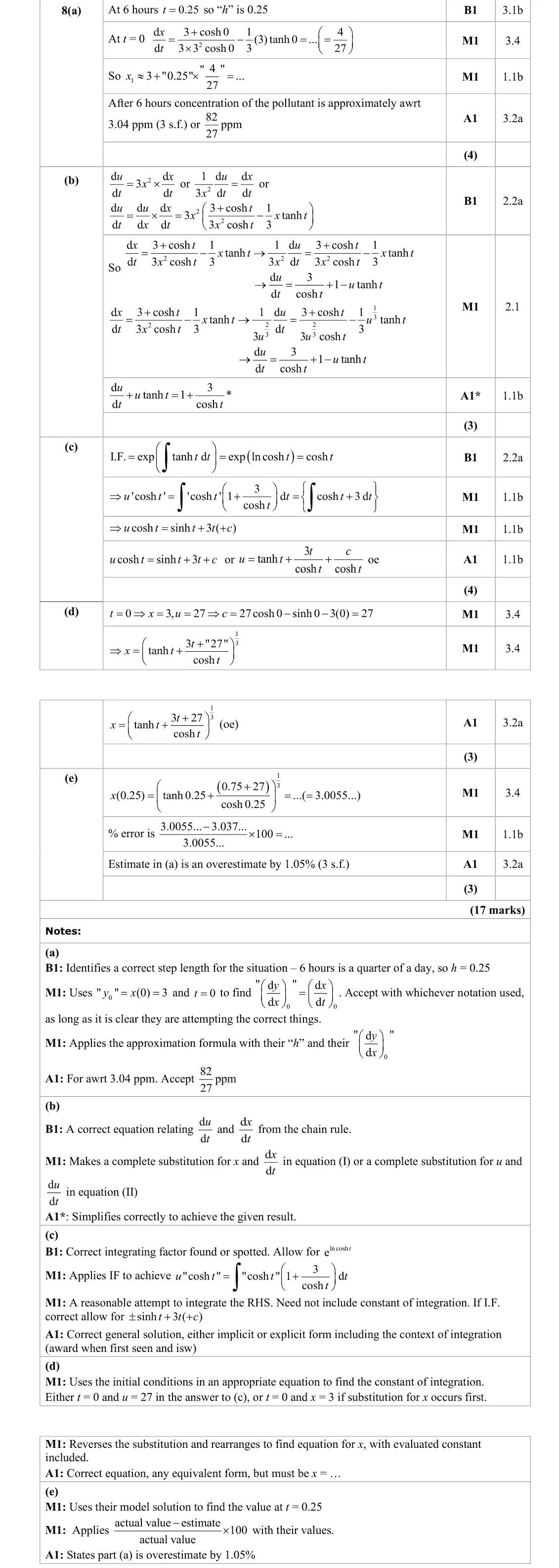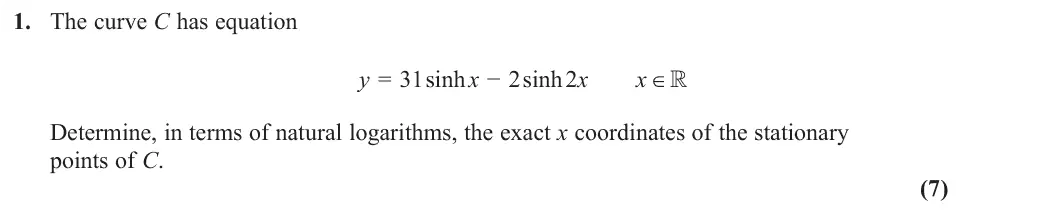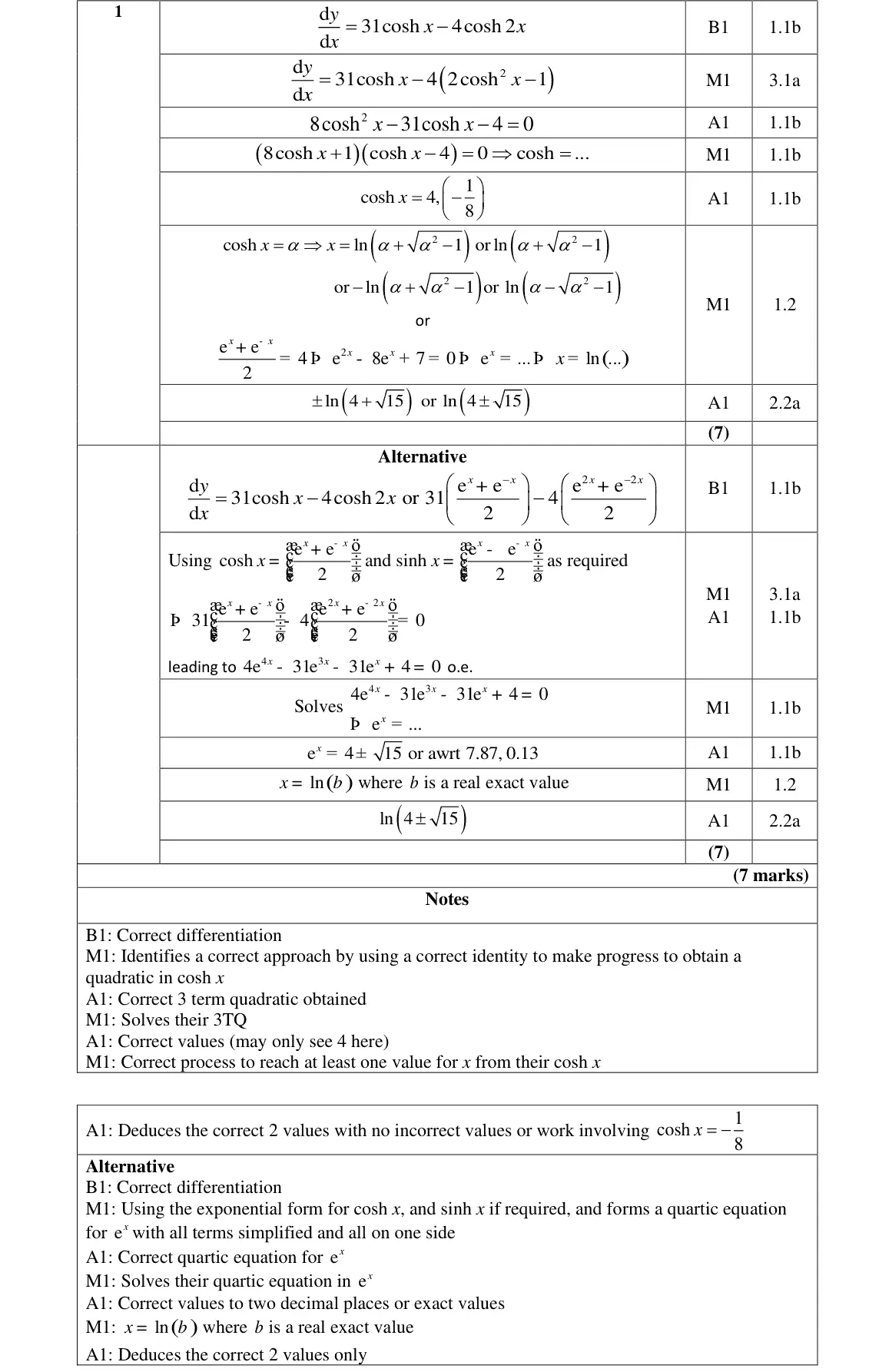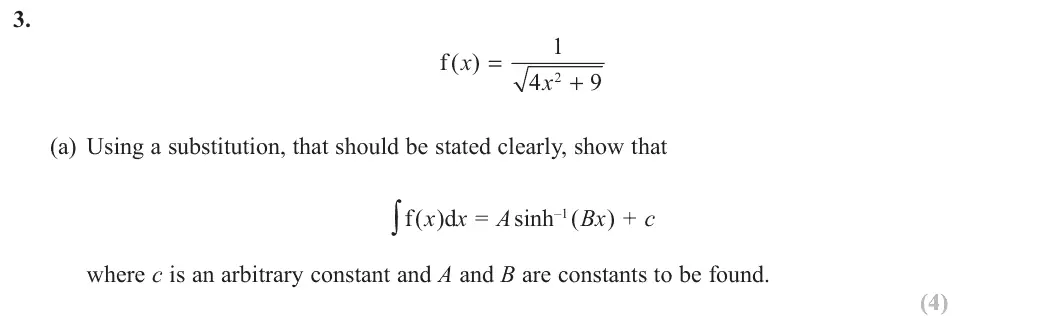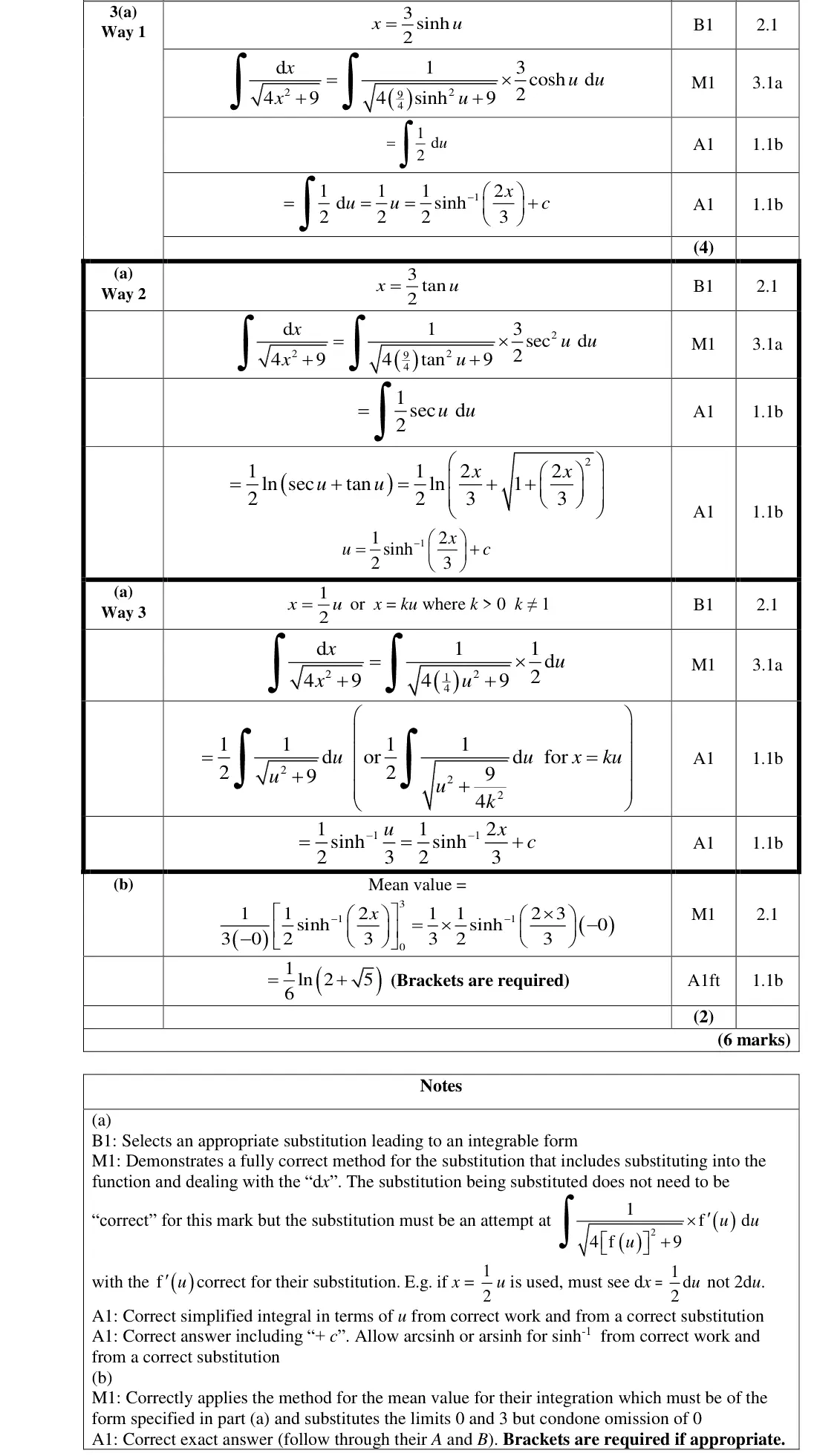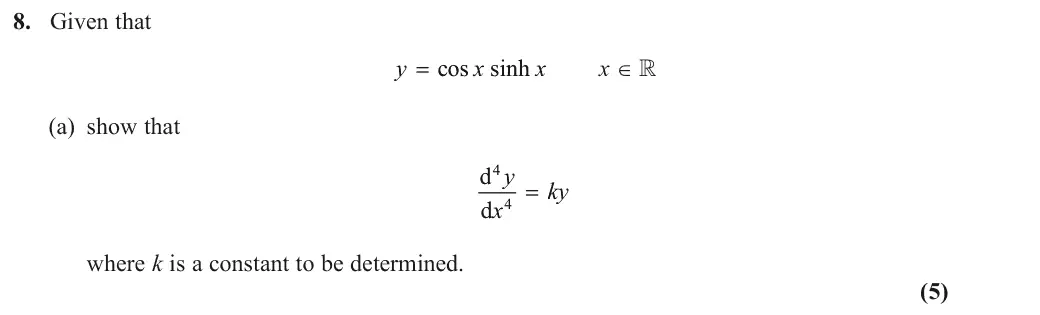
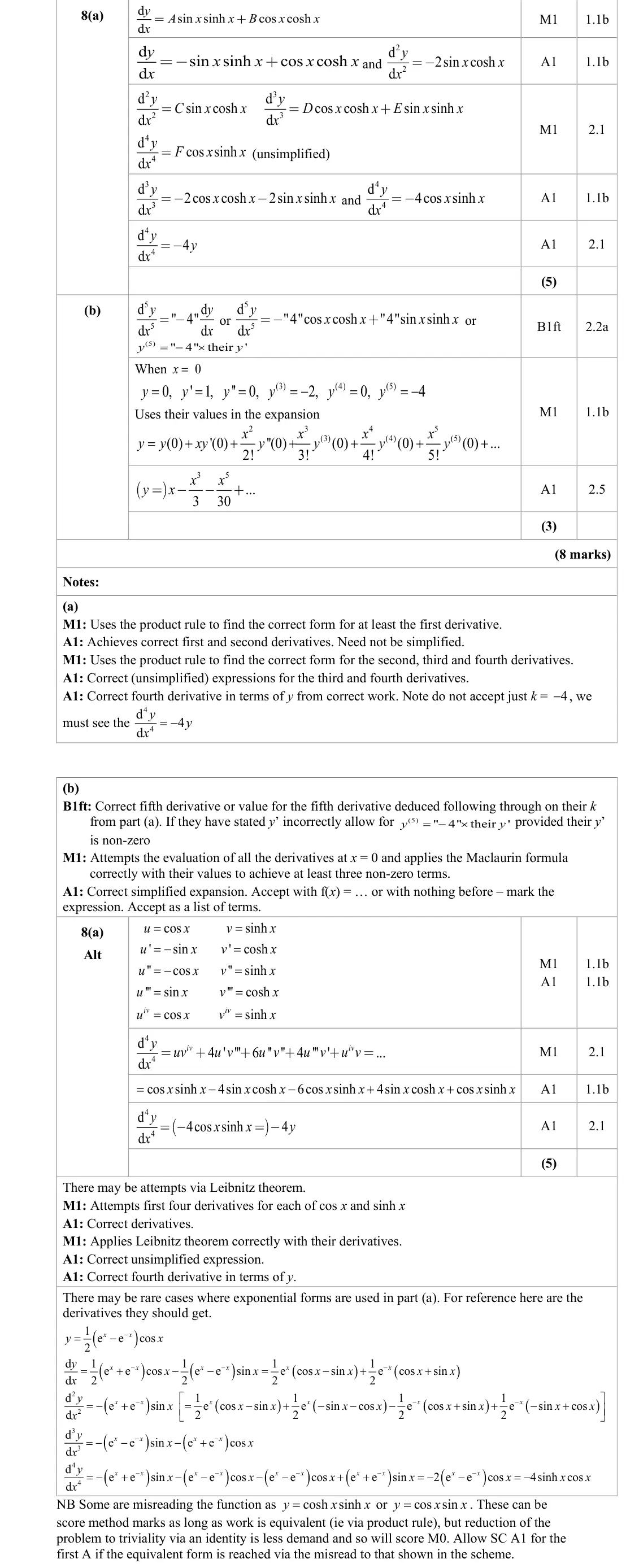
Mark scheme (whole question; this part is marked with the orange bar)
Examiner's comment
This question was answered extremely well by the vast majority of candidates, providing a good source of marks late in the paper. Even at the lower grade boundary it would not be uncommon to see good attempts at this question. Part (a) saw most candidates pick up the first four marks with relative ease, applying the product rule successively to reach the third derivative. Most went on to find the correct value for k by continuing to the fourth derivative, though a few did not simplify the second derivative correctly, making subsequent differentiations unnecessarily complicated, a lack of simplification and carelessness leading to making mistakes. There were numerous cases of fully correct differentiation up to the fourth derivative; however, some failed to conclude with the required result 4 4 d 4 d y y x = - , even though they correctly reached expressions such as 4 4 d 4cos sinh d y x x x = - . The conclusion needed to be explicitly stated to earn full credit. Errors with signs caused problems for some and a significant minority made errors using the product rule. A small number of candidates attempted to use Leibniz's theorem, but this often proved counterproductive especially when it came to complete part (b). Unfortunately a notable minority of learners misread the question, either as cos sin x x or as cosh sinh x x , both of which reduced the complexity of the problem if an appropriate identity was apply. However, some credit was permitted for equivalent work for provided the product rule was used to find the derivatives, but reducing to a triviality e.g. by writing 1 sinh 2 2 x y = , resulted in no marks. Learners should be advised to read carefully each question to avoid such errors.
Key points from the mark scheme and examiner's report
- repeated product rule: y″ = −2sin x cosh x, y⁗ = −4cos x sinh x = −4y, so k = −4
- failure to simplify y″ made later derivatives messy