CP8.5 Integrate functions of the form (x² + a²)^(−1/2) and (x² −…

Section
CP8 Hyperbolic functions
Level
A level only
Statement
Integrate functions of the form (x² + a²)^(−1/2) and (x² − a²)^(−1/2) and be able to choose substitutions to integrate associated functions.
Since 2018
8 parts, 32 marks · topic pages: Reduction formulae, arc length and surface area, Hyperbolic functions, Improper integrals and the mean value of a function

Back to the checklist

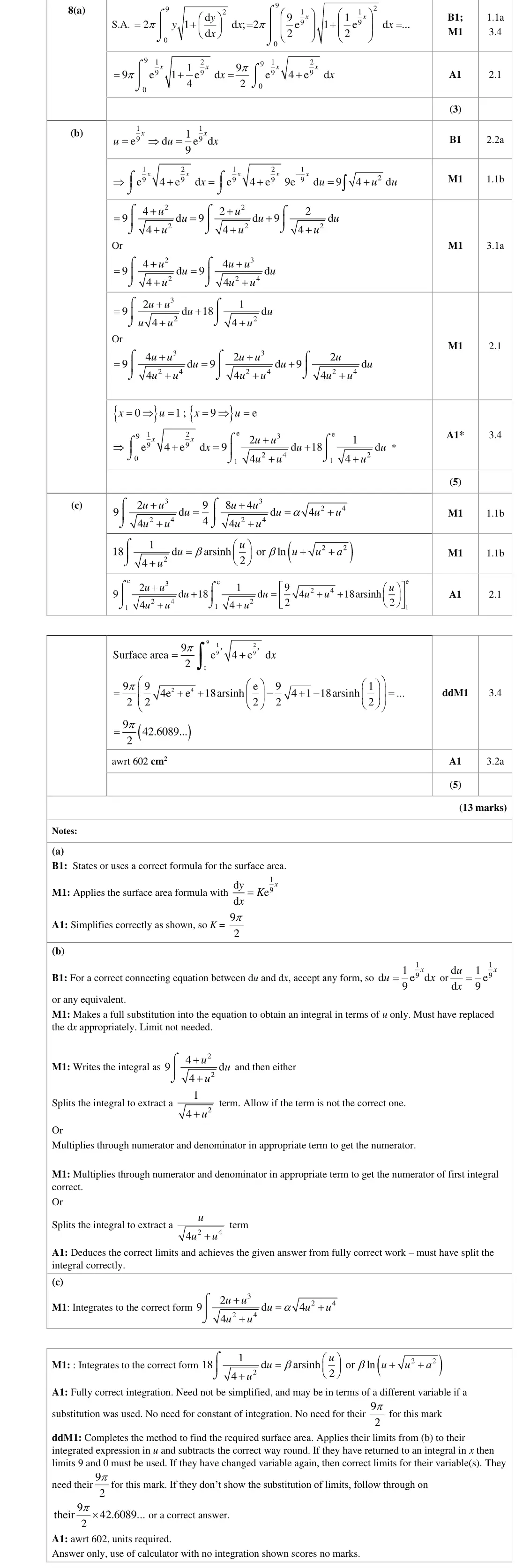
June 2024 · Paper 4A (Further Pure 2) · Q8(c) 5 marks
Hence, using algebraic integration, (c) determine, according to the model, the external surface area of the bell section of the horn, giving your answer to 3 significant figures. (5)
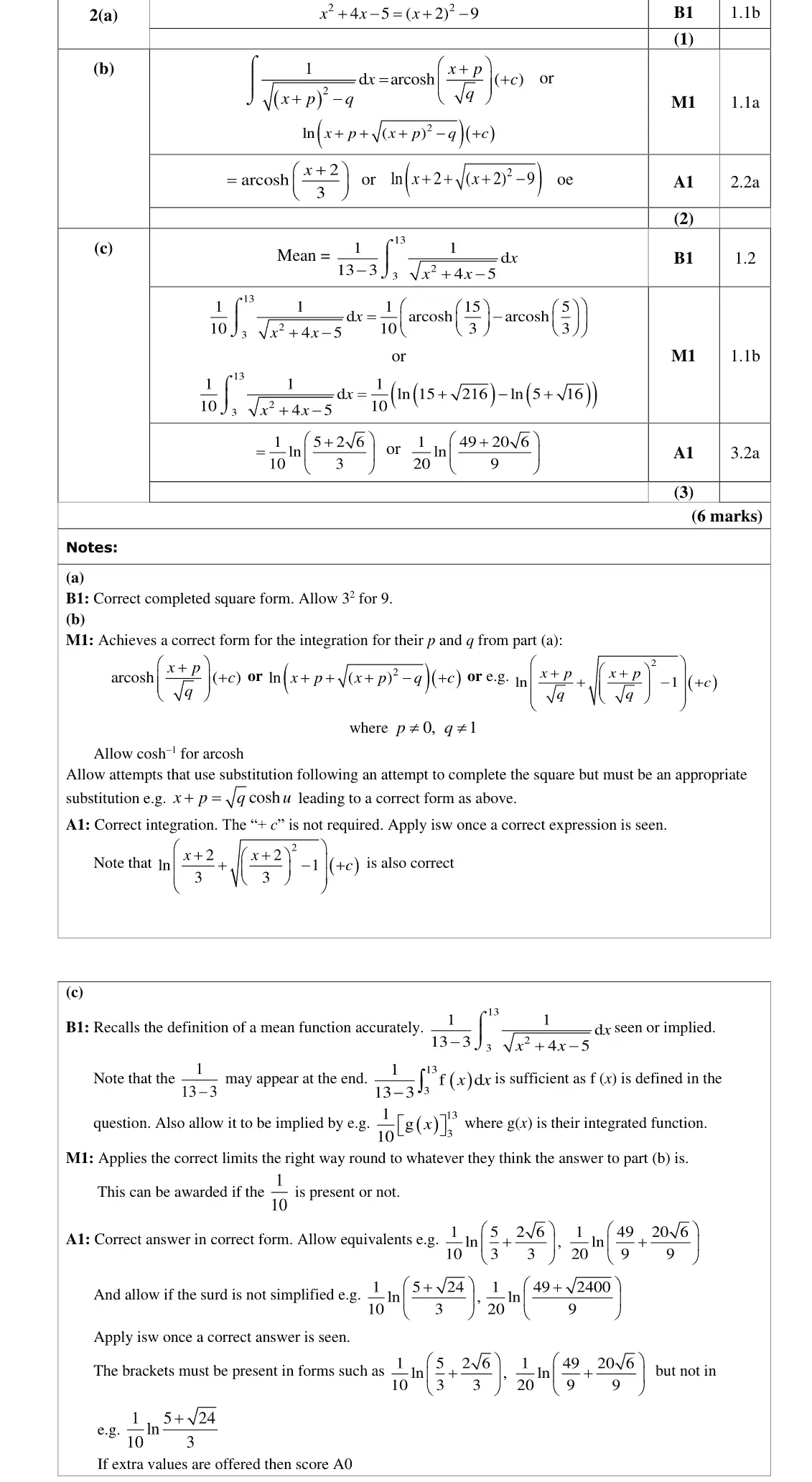
June 2023 · Paper 1 (Core Pure 1) · Q2(a) 1 mark
2. (a) Write x 2 + 4x – 5 in the form (x + p) 2 + q where p and q are integers. (1)
June 2023 · Paper 1 (Core Pure 1) · Q2(b) 2 marks
(b) Hence use a standard integral from the formula book to find : d x 2x x (2)
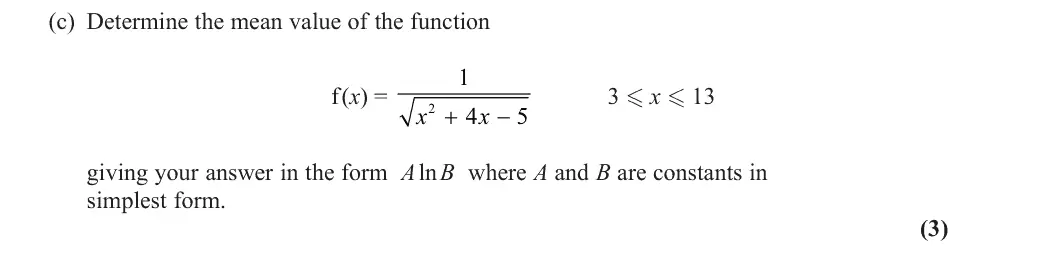
June 2023 · Paper 1 (Core Pure 1) · Q2(c) 3 marks
(c) Determine the mean value of the function f(x) = 3 x 13 2x x giving your answer in the form A ln B where A and B are constants in simplest form. (3)
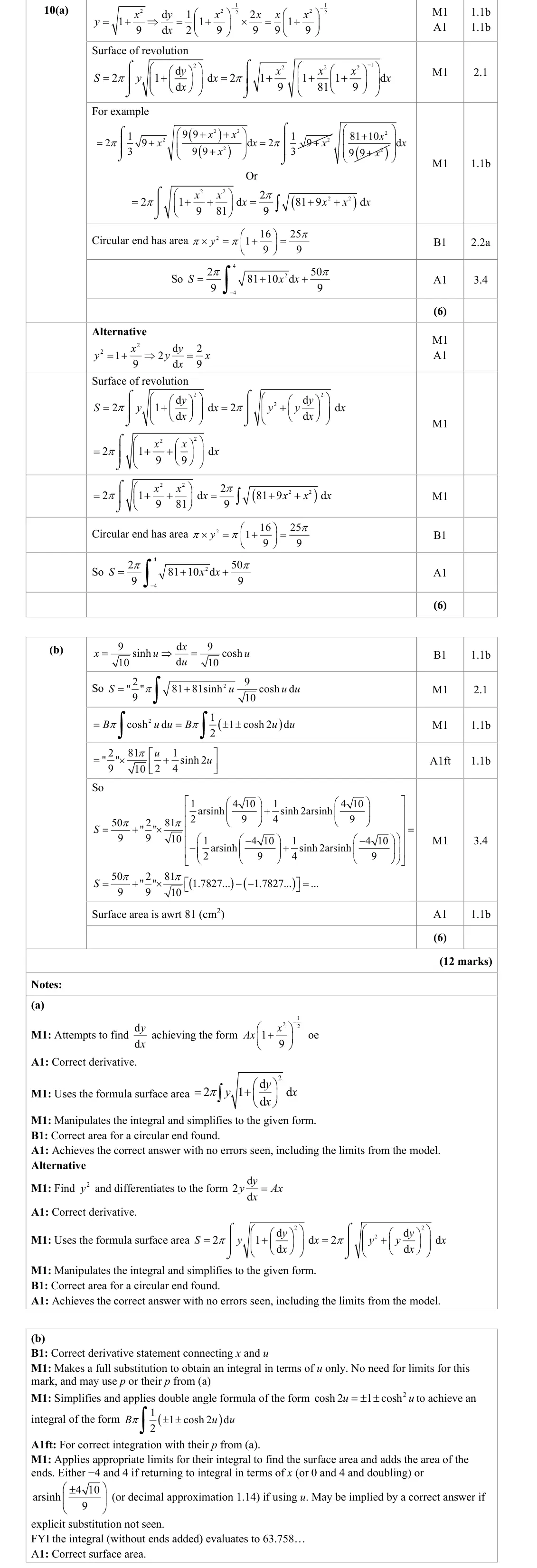
June 2023 · Paper 4A (Further Pure 2) · Q10(b) 6 marks
Using the substitution x u = sinh , or another algebraic integration method, and showing all your working, (b) determine the total surface area of the playing piece, giving your answer to the nearest cm2 (6)
Nov 2021 · Paper 1 (Core Pure 1) · Q9(a) 6 marks Hard
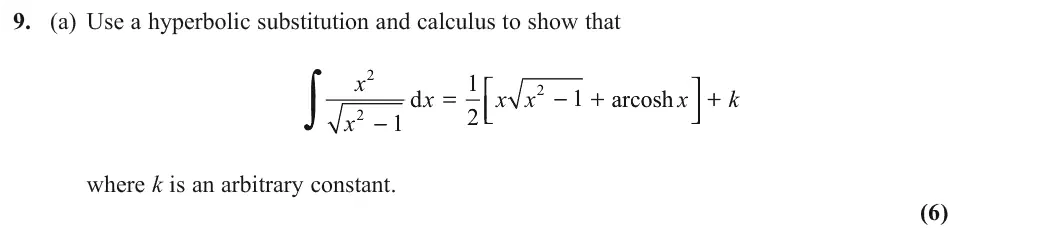
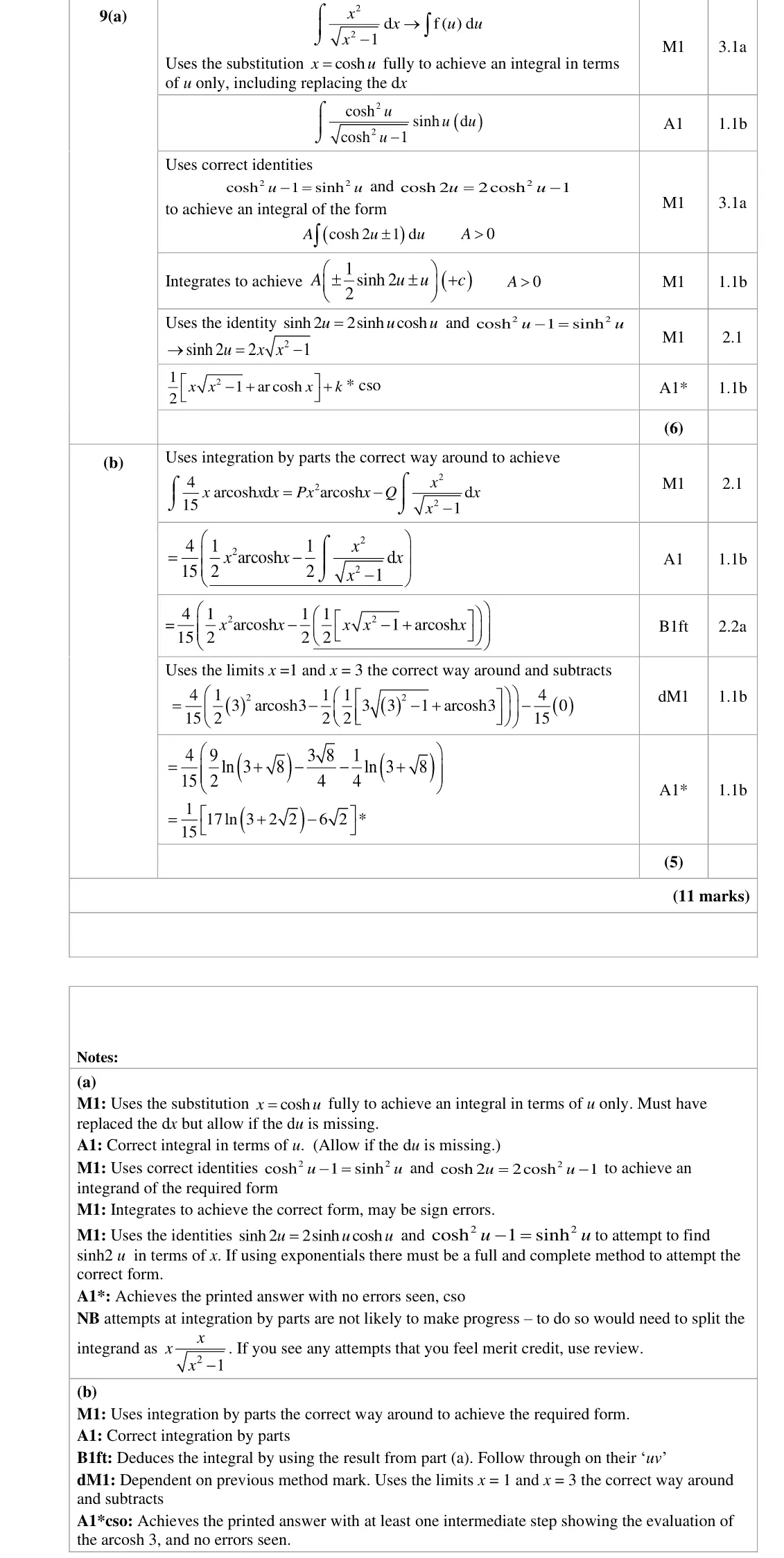
9. (a) Use a hyperbolic substitution and calculus to show that ∫ x d x = x x - + arcosh x + k x - where k is an arbitrary constant. (6)
Nov 2021 · Paper 1 (Core Pure 1) · Q9(b) 5 marks
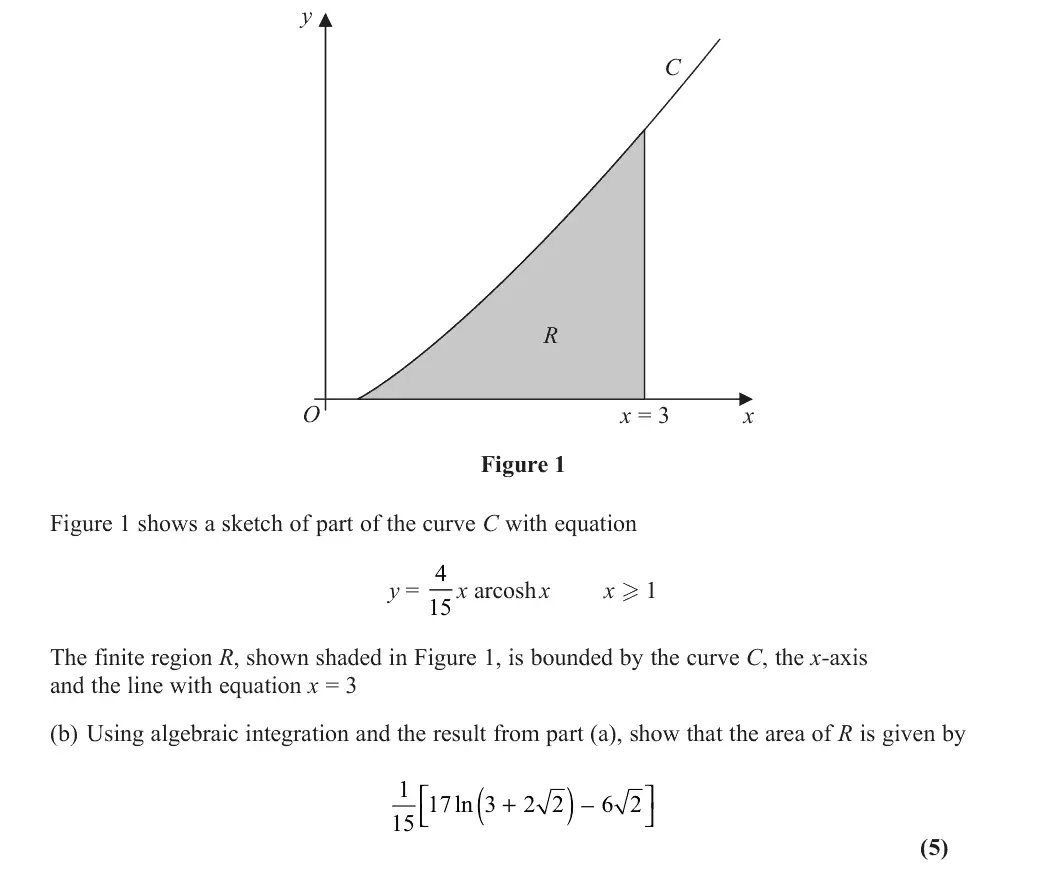
y C R x = 3 x Figure 1 Figure 1 shows a sketch of part of the curve C with equation y = 4 15 x arcosh x x 1 The finite region R, shown shaded in Figure 1, is bounded by the curve C, the x‑axis and the line with equation x = 3 (b) Using algebraic integration and the result from part (a), show that the area of R is given by ( ) - 15 17 ln + 2 2 6 2 (5)
June 2019 · Paper 2 (Core Pure 2) · Q3(a) 4 marks
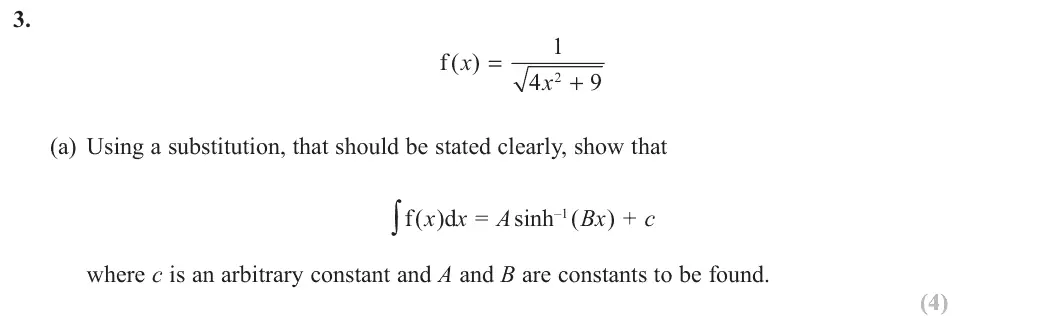
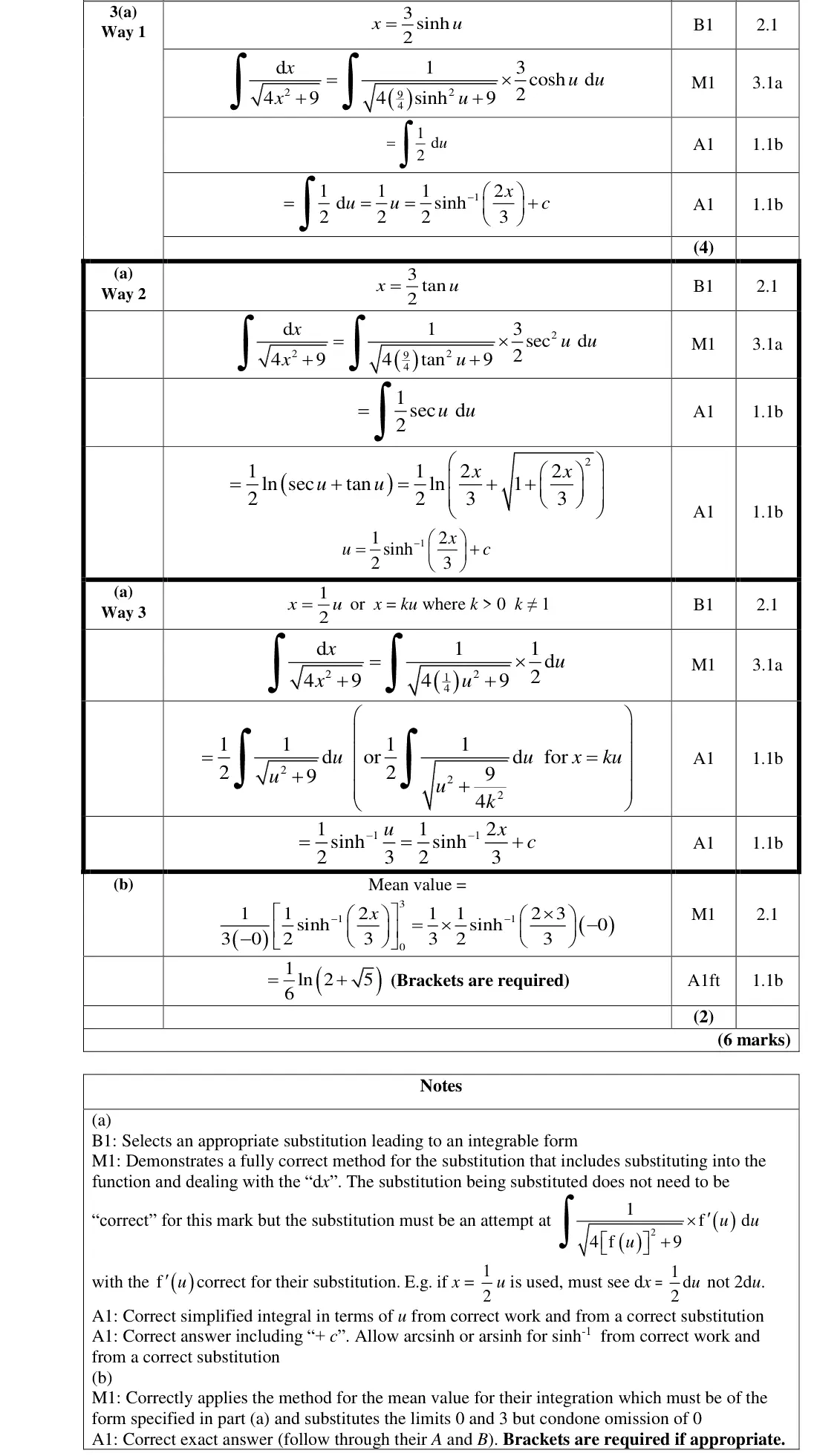
3. f ( ) x = x + (a) Using a substitution, that should be stated clearly, show that œ f (x)dx = A sinh–1 (Bx) + c where c is an arbitrary constant and A and B are constants to be found. (4)

Find an Edexcel Further Maths tutor

Stuck on this? Book a trial lesson with our Further Maths tutor.

Prefer email? Send an enquiry

If you are under 18, please include a parent's contact details. Enquiries go to enquiries@alevelfurthermathstutor.com and are deleted once handled.