Notes, worked examples and practice for this topic are being written by our tutors. The past-paper questions below are ready now: work each one on paper, then open the mark scheme and the examiner's comment.
Tap a question to zoom it. Mark scheme and examiner's comment open under each question.
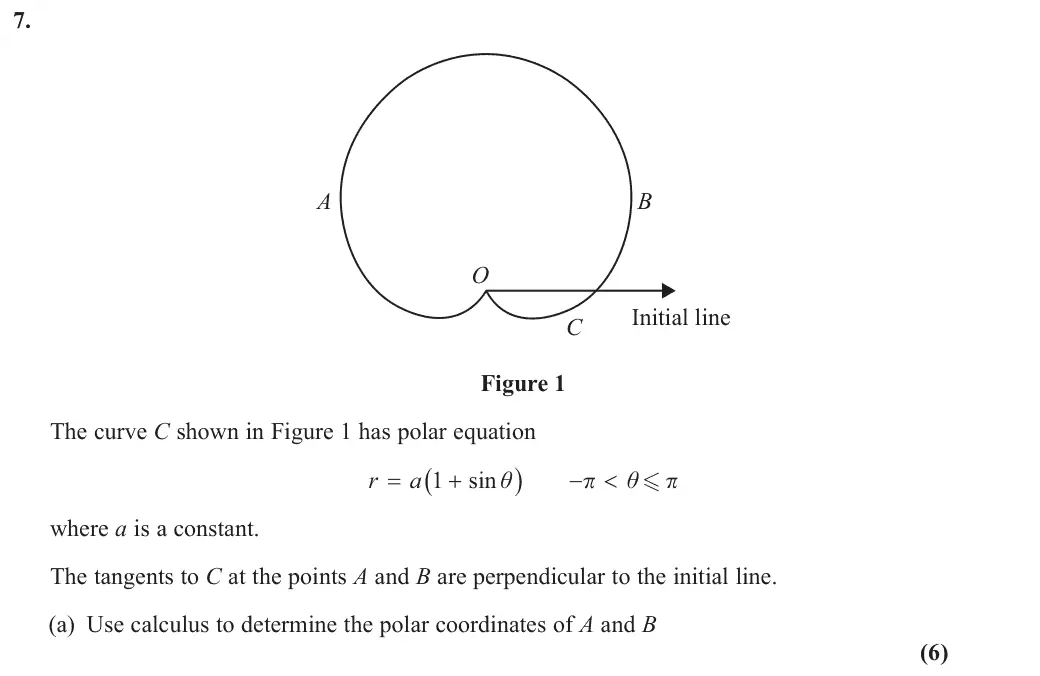
June 2025 · Paper 2 (Core Pure 2) · Q7(a)6 marks
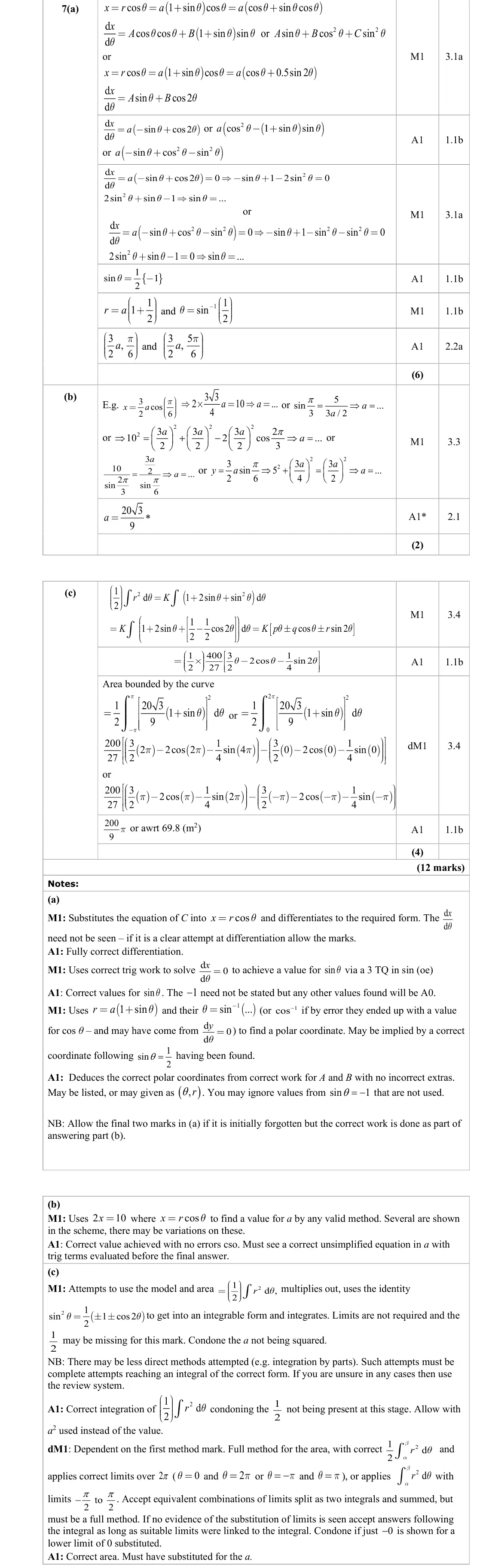
Mark scheme (whole question; this part is marked with the orange bar)
Examiner's comment
Although being overall one of the more challenging questions on the paper, this question did give some access to most candidates, but only the better learners were able to produce fully correct solutions. The structure given meant many were able to access all the last part of the question even if falling down on some of the earlier parts. Part (a) was well answered, with most learners showing sufficient evidence of their working. Most learners realised that they needed to work out d d x theta and set it equal to zero, although a small minority mistakenly used d d y theta and were unable to make much progress in this part. Learners who simplified cos (1 sin )cos x r a theta theta theta = = + to (cos 0.5sin 2 ) x a theta theta = + before differentiating tended to perform better overall, as this allowed for a more straightforward differentiation process without having to apply the product rule. Those who did not simplify beforehand gave themselves a more difficult differentiation task, followed by a more complex trigonometric equation to solve, but nevertheless were mostly able to do so correctly. Some candidates struggled to use trigonometric identities to simplify expressions or to solve d 0 d x theta = accurately, with occasional sign or algebraic slips when rearranging. Most candidates went on to find 1 sin 2 theta = or -1, but some failed to consider the geometrical interpretation and reject the sin 1 theta = - equation, giving a point with 3 2 pi theta = . Most candidates were able to proceed to correctly find the value of r for their theta values and so identify the coordinates of A and B, although some did not specify which was which, and some had clearly incompatible coordinates which they did not seem to realise.
Key points from the mark scheme and examiner's report
x = r cos θ = a(cos θ + ½ sin 2θ)
dx/dθ = 0 gives 2sin²θ + sin θ − 1 = 0, sin θ = ½ (reject −1)
A (3a/2, 5π/6), B (3a/2, π/6)
using dy/dθ made no progress
June 2025 · Paper 2 (Core Pure 2) · Q7(b)2 marks
Mark scheme (whole question; this part is marked with the orange bar)
Examiner's comment
Although being overall one of the more challenging questions on the paper, this question did give some access to most candidates, but only the better learners were able to produce fully correct solutions. The structure given meant many were able to access all the last part of the question even if falling down on some of the earlier parts. Part (b) saw a much wider variety in the quality and form of responses from candidates and was probably the least well answered part of this question. There was no single dominant method, and a range of approaches were adopted – some more coherent than others. A notable shortcoming was the limited use of diagrams: many candidates launched into algebraic or trigonometric manipulation without visualising the problem, which often led to confusion or misinterpretation. A clear diagram would have helped the learners better understand the geometry involved and helped guide them toward a more structured solution. There were some excellent solutions, particularly where diagrams were utilised to help explain their reasoning. A significant number of candidates gave minimal explanations making it more difficult to understand their reasoning. A small minority of candidates failed to attempt this part of the question, often because of an incorrect answer to (a) which was incompatible with the geometry of the diagram and therefore not knowing where to start.
Key points from the mark scheme and examiner's report
AB = 2 × (3a/2)cos(π/6) = 10 gives a = 20√3/9
poorly answered, few drew a diagram
June 2025 · Paper 2 (Core Pure 2) · Q7(c)4 marks
Mark scheme (whole question; this part is marked with the orange bar)
Examiner's comment
Although being overall one of the more challenging questions on the paper, this question did give some access to most candidates, but only the better learners were able to produce fully correct solutions. The structure given meant many were able to access all the last part of the question even if falling down on some of the earlier parts. Part (c) was a very familiar question, which was done well overall, and with the value of a given many were able to make good progress as this part was not dependent on earlier work (one reason why it was more successfully answered then part (b)). The most efficient solutions were by candidates who took the 2 a term outside of the bracket. The majority used the identity 1 1 sin ^2 cos2 2 2 theta theta = - to achieve an integral of the correct form, though errors with the numerical/algebraic processing caused problems for some learners. A common error, for example, was made in squaring r to expand the brackets, but neglecting to square a, while forgetting to double the sin term was also relatively common. The 1 2 in the formula was seldom omitted, though sometimes applied, while very few neglected to square r at all. The main difficulty with this part was in choosing which limits to use to apply to the integral, as none were stated in the question since the integration happens around the whole circle, so any range spanning 2 pi was suitable. But many attempted to use symmetry, leading to some errors where doubling of an integral with wrong limits was used. The most common correct approaches were equally split between • 2 2 2 1 2 d 2 r pi pi theta - x ∫ • 2 2 0 1 d 2 r pi theta ∫ • 2 1 d 2 r pi pi theta -∫ But as common as these was 2 0 1 2 d 2 r pi theta x ∫ , an incorrect doubling as the 0 to pi region was not half of the overall shape. Other limits were also seen, though less common, such as 3 to 2 2 pi pi - (correct) or e.g. doubling the integral over 5 to 6 6 pi pi (incorrect). In some cases, the learners split into two integrals, often repeating the same work twice over before combing to a final answer, but usually these methods did amount to a correct combination of limits used. For those who selected a correct combination of limits/doubling, applying the limits proved little problem, though evidence was not always shown and had to be taken on trust, particularly where a lower limit leading to 0 was involved, and many correct answers were seen to this part.
Key points from the mark scheme and examiner's report
½∫a²(1 + sin θ)² dθ over a full turn (−π to π) using sin²θ = ½(1 − cos 2θ): area = (3/2)πa² = 200π/9 ≈ 69.8 m²
taking a² outside the bracket helps
June 2024 · Paper 1 (Core Pure 1) · Q3(a)2 marks
Mark scheme (whole question; this part is marked with the orange bar)
Examiner's comment
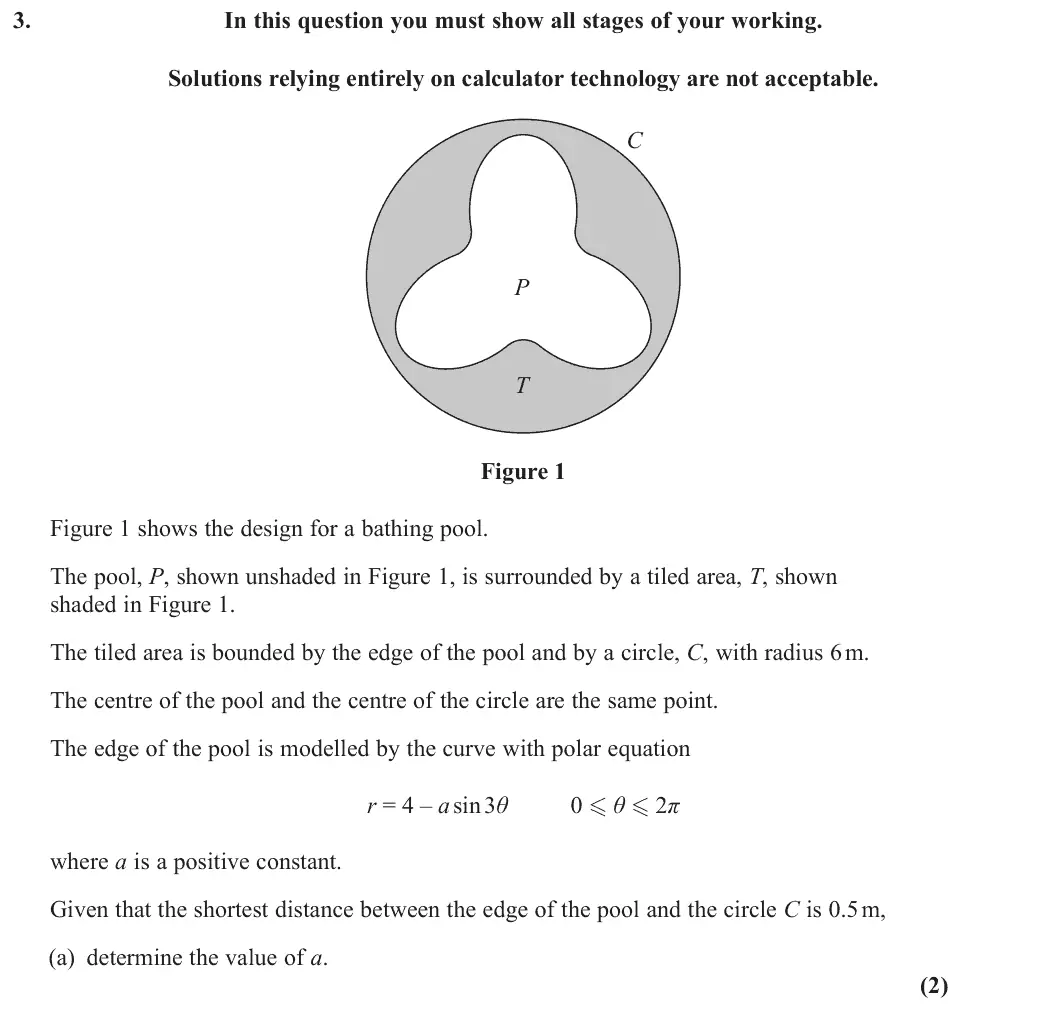
While generally the polar work was very well done in this question, understanding the context at the start caused a few difficulties with many unable to write down the correct value for a. Part (a) proved surprisingly challenging for candidates, in what was not anticipated to be a difficult part. Solutions often did not consider the extreme values of sin 3 theta or tried using incorrect values of theta to proceed. Common incorrect values for a were 1.5 - (which could gain the method mark) and 3.5 ( ) 4 0.5 = - , but various other incorrect values also were seen, for instance some candidates did not take account of the either the 0.5m gap, yielding 6 4 a = so 2 a = The strategy involved in part (b) subtracting the area enclosed of the polar curve obtained by integration from the area of the circle was well understood, and the approach to the integral was carried out correctly by most. Slips in working or inappropriate limits accounted for most errors made. There were only a small number of solutions where squaring was not seen, did not produce three terms, or where the double angle formula was not used to get to a function of 6 theta . Early coefficient slips in expanding meant the A1ft was forfeit but most showed a correct method integration for integration via use of the double angle identity. The most successful solutions then chose the limits as 0 to 2 pi for the whole area but other pairs of limits using symmetry were attempted, with varying levels of success – there were pairs that were not appropriate, such as 0 to pi followed by doubling. Some combinations such as 2 - to 2 and doubling, or 0 to 2 3 and tripling, were possible but often only served to increase the amount of work and propensity for error. Candidates should consider whether the use of symmetry approaches make the work involved any simpler. Most candidates went to find the area of the circle and subtract the area of the curve from it, though a few did omit this final step. With the vast majority having gained the first method, there were relatively few cases where the final M was lost despite remembering this step. It was pleasing to see candidates giving exact answers, with only very few resorting to decimal work, but careful checking was needed when correct answers were found since errors in the trigonometric terms cancelled over the full circle meaning inaccuracies in these terms would still lead to the correct answer but in fact lost both A marks.
Key points from the mark scheme and examiner's report
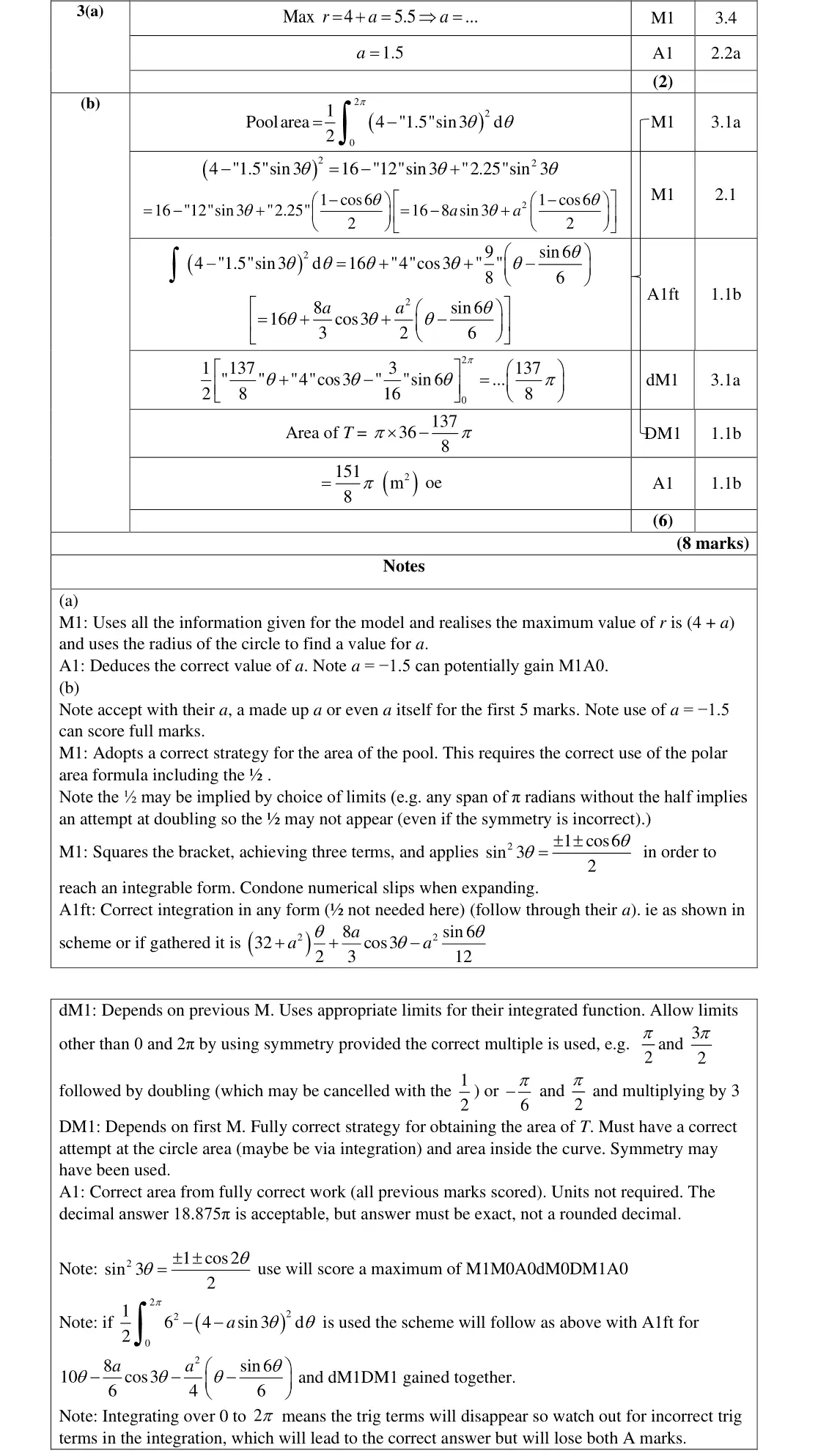
greatest r is 4 + a = 6 − 0.5, so a = 1.5
a = −1.5 scores M1 only
common wrong answers 3.5 or forgetting the 0.5 m gap
June 2024 · Paper 1 (Core Pure 1) · Q3(b)6 marks
Mark scheme (whole question; this part is marked with the orange bar)
Examiner's comment
While generally the polar work was very well done in this question, understanding the context at the start caused a few difficulties with many unable to write down the correct value for a. Overall many candidates scored full marks on part (b) with some elegant and efficient mathematics, while others lost only the final A due to an incorrect answer in part (a), as follow through on intermediate marks meant the rest of the marks could be scored.
Key points from the mark scheme and examiner's report
T = 36π − pool area = 151π/8
the ½ in ½∫r²dθ
sin²3θ = (1 − cos 6θ)/2 (using cos 2θ loses most marks)
exact answer, not a decimal
June 2023 · Paper 2 (Core Pure 2) · Q14 marks
Mark scheme (whole question; this part is marked with the orange bar)
Examiner's comment
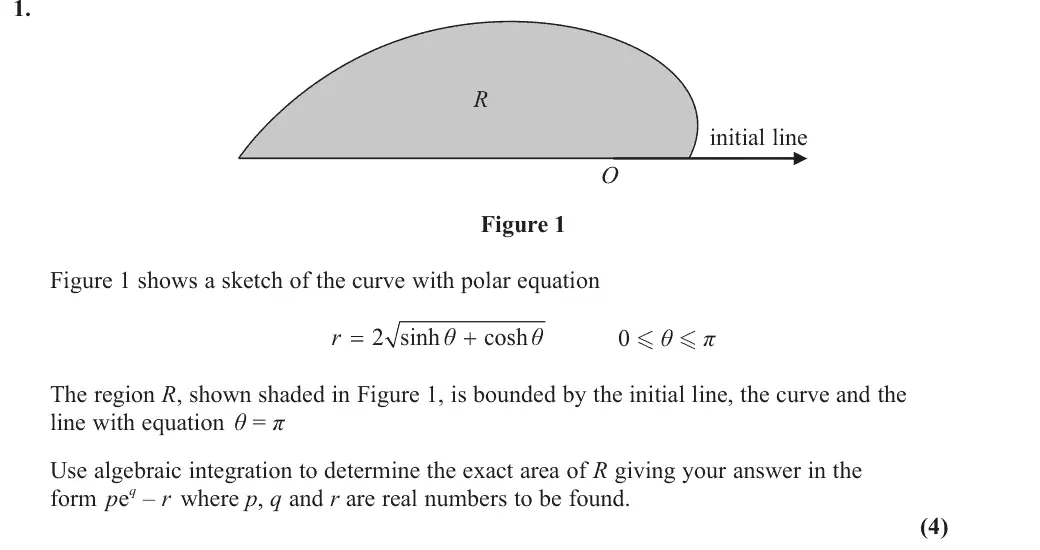
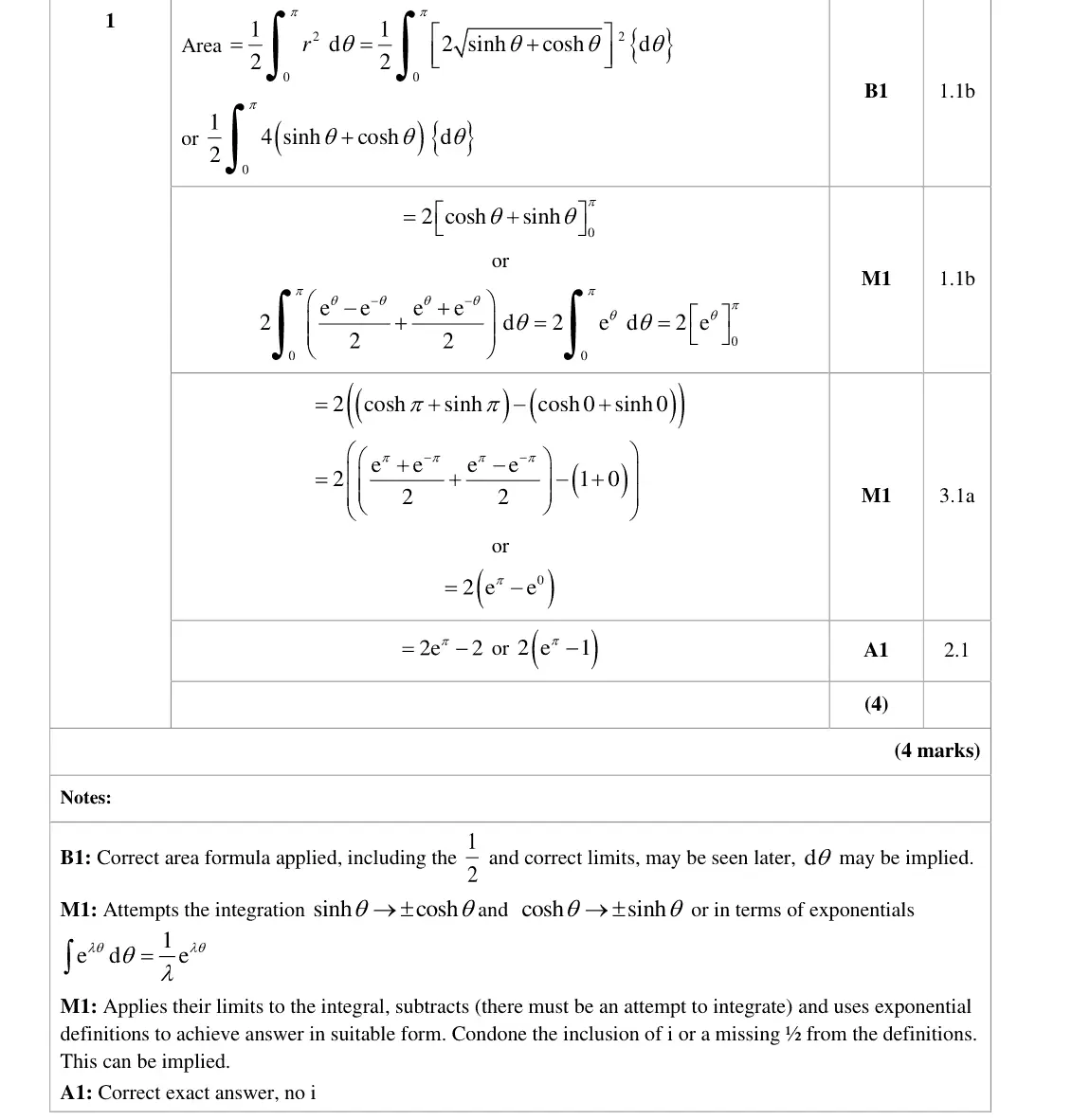
On the whole this question was really well done with only a few candidates with an insecure knowledge of the relevant formula. Most candidates scored full marks. Errors were with the arithmetic, usually in adding exponentials incorrectly, multiplying through by 2 and missing doing this to the constant or by being unable to square the expression. Errors in the latter involved squaring twice (usually each term the second time) or by square rooting each term. The vast majority of candidates did the integration in sinhx and coshx and converted to exponentials after integrating. Some candidates lost the final mark. A common error seen was e e e e 2 1 2e 1 2 2 - - + - + - = - Some candidates that did not gain full marks, incorrectly quoted the definitions of sinhx and coshx with the inclusion of i leading to an answer not of the correct form. Whereas some candidates made a slight error in distributing the factor of 2 to both limits. The majority of candidates were gaining full marks. Of those that didn't, some failed to start with the correct formula (missing the half in front, or the squaring of r), but the vast majority of lost marks were through poor accuracy in substituting the limits. The multiples of 1 2 and 4 caused some confusion with candidates not being sure whether to cancel them or multiply them out.
Key points from the mark scheme and examiner's report
area = ½∫ from 0 to π of 4(sinh θ + cosh θ) dθ = 2[cosh θ + sinh θ]
errors squaring r, slips with exponentials, definitions quoted with i
June 2023 · Paper 2 (Core Pure 2) · Q4(a)2 marks
Mark scheme (whole question; this part is marked with the orange bar)
Examiner's comment
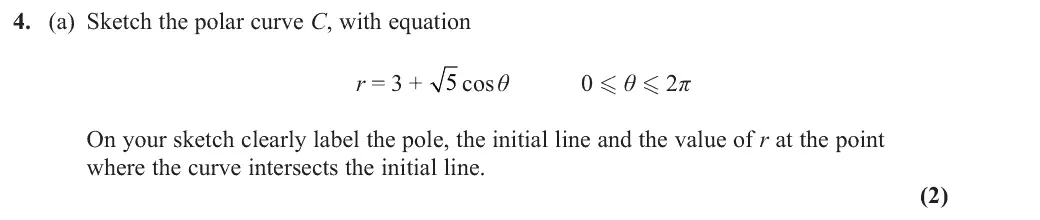
(a) Candidates were successful in recalling the correct shape for the curve. The overall dimple shape of the cardioid and its orientation was almost universally known. A common error was omitting all requested labels, often misidentifying the pole by drawing a line at 2 = and labelling as pole. Very few candidates scored full marks because they failed to label the diagram as requested with the pole, the initial line and the intercept point.
Key points from the mark scheme and examiner's report
cardioid-type 'dimpled' curve, not through the pole
label the pole, the initial line and r = 3 + √5 on the initial line
most lost the second mark by omitting labels
June 2023 · Paper 2 (Core Pure 2) · Q4(b)4 marks
Mark scheme (whole question; this part is marked with the orange bar)
Examiner's comment
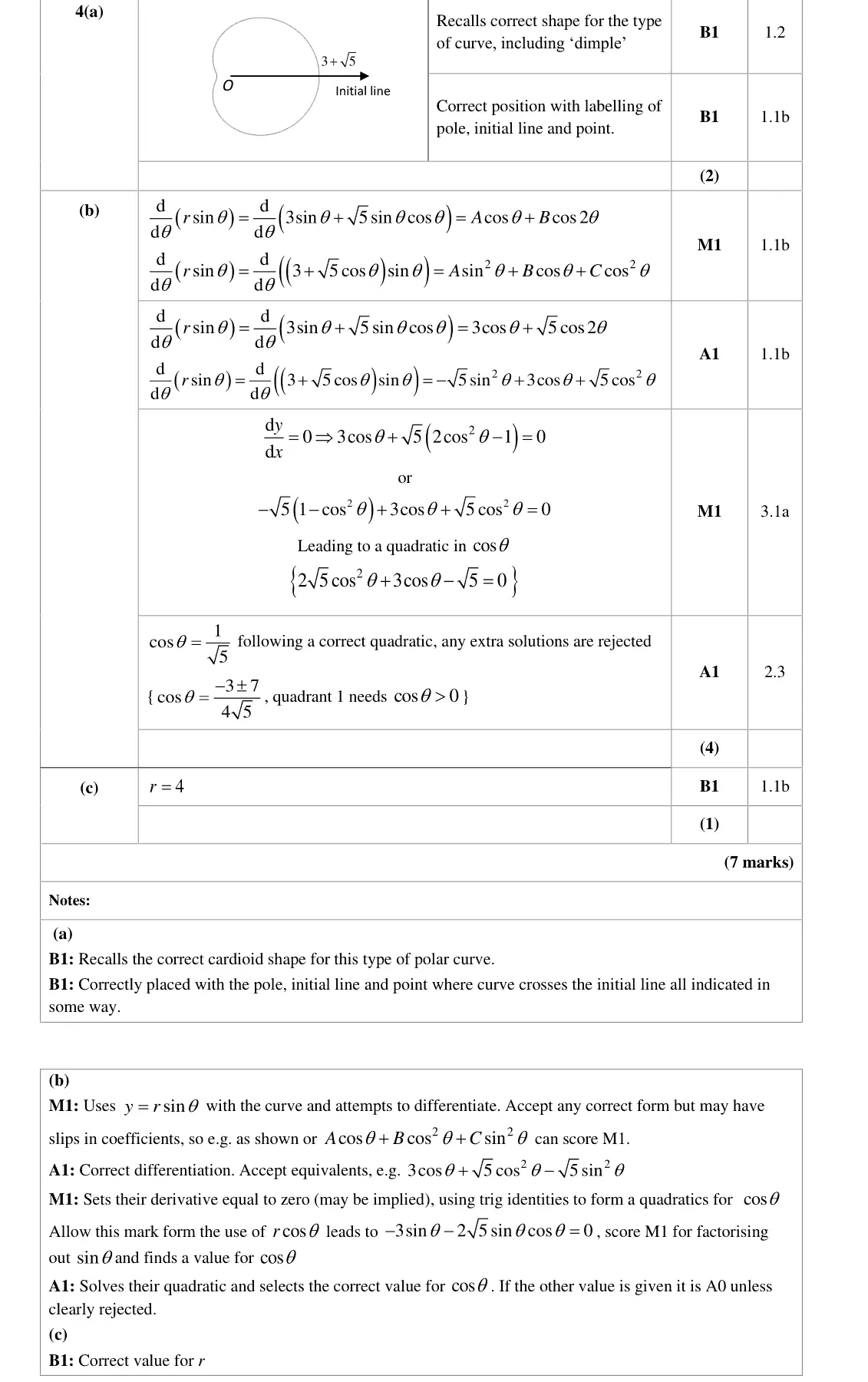
Parts (b) and (c) were completed to a high standard with only a few candidates using cos r instead of sin r . (b) The majority of candidates were able to differentiate sin r correctly and then used correct trigonometric identities to form a quadratic for cos . Most candidates reasoned that as 𝜃 was acute, the result for cos𝜃 would be positive and that the second solution was not valid, leading to successful rejection of the second solution. Some candidates did fail to reject the other solution of their quadratic.
Key points from the mark scheme and examiner's report
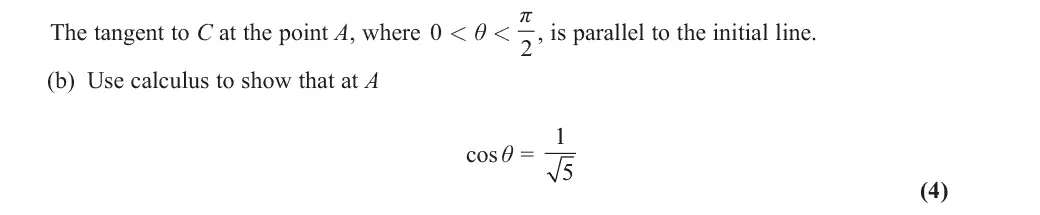
parallel to the initial line: d(r sin θ)/dθ = 0
quadratic 2√5cos²θ + 3cos θ − √5 = 0
reject the negative root (θ acute) to get cos θ = 1/√5
a few used r cos θ
failure to reject the other root
June 2023 · Paper 2 (Core Pure 2) · Q4(c)1 mark
Mark scheme (whole question; this part is marked with the orange bar)
Examiner's comment
Parts (b) and (c) were completed to a high standard with only a few candidates using cos r instead of sin r . (c) Virtually all candidates correctly scored this mark, even those who did not attempt (b), with only a small handful of candidates attempting 1 cos 5 leading to an incorrect answer. A few candidates arrived at a solution of 3 due to a simple calculation error.
Key points from the mark scheme and examiner's report
r = 3 + √5 × 1/√5 = 4
June 2022 · Paper 2 (Core Pure 2) · Q7(a)4 marks
Mark scheme (whole question; this part is marked with the orange bar)
Examiner's comment
Part (a) was well answered, with the majority of students showing sufficient evidence of their working Students who did best on this question, tended to simplify ( ) cos 1 tan x r = = + to cos sin x = + before differentiating as it enabled quite simple differentiation without having to use reciprocal functions. Those who did not, gave themselves a harder differentiation to perform followed by a harder trig equation to solve. A noticeable number of candidates incorrectly attempted to find d d y and so attained no marks for part a. On rare occasions some candidates tried to over complicate the trig identities and used double angle formulae but were unable to progress due to the complicated process they had begun.
Key points from the mark scheme and examiner's report
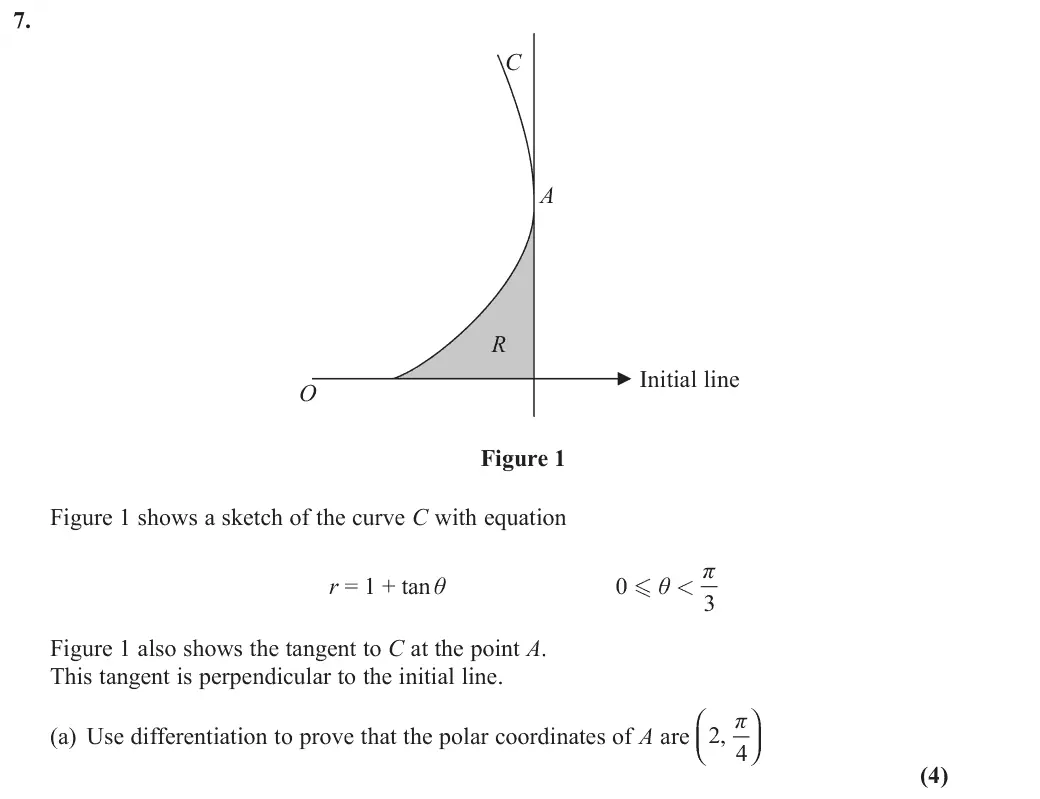
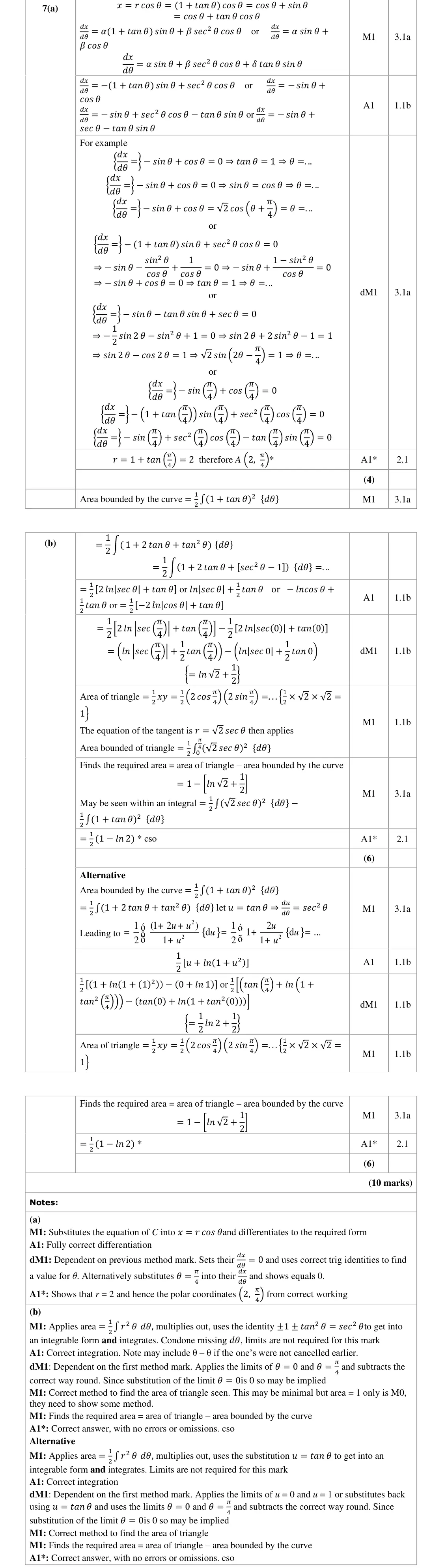
x = r cos θ = cos θ + sin θ, set dx/dθ = 0 giving tan θ = 1, θ = π/4, r = 2
differentiating y = r sin θ instead scored 0
simplifying x first made it easier
June 2022 · Paper 2 (Core Pure 2) · Q7(b)6 marks
Mark scheme (whole question; this part is marked with the orange bar)
Examiner's comment
Part (b) was not well answered in its entirety. Candidates correctly applied the formula to find the area bounded by a polar curve with the majority using the identity 2 2 tan 1 sec = - to integrate 2 tan . A few used the substitution u = tan theta , mostly with success. Aside from careless errors most were able to integrate correctly and having done so, substituted the limits, which in the main were the correct values of pi /4 and 0. There was much confusion about which area bounded by the polar equation actually gave. Candidates who drew on the diagram generally realised that they need to subtract area bounded by the curve from the area of the triangle. There was much bluffing to try and get the answer as ln2 appeared in the integral, changing signs in their working to match the given answer and so changing a correct integral to incorrect, resulting in loss of marks.
Key points from the mark scheme and examiner's report
½∫(1 + tan θ)² dθ using tan²θ = sec²θ − 1 from 0 to π/4 = ln√2 + ½
R = triangle area 1 minus this = ½(1 − ln 2)
many did not see that the area must be subtracted from the triangle, and fudged signs to reach the given answer
Nov 2021 · Paper 2 (Core Pure 2) · Q6(a)5 marks
Mark scheme (whole question; this part is marked with the orange bar)
Examiner's comment
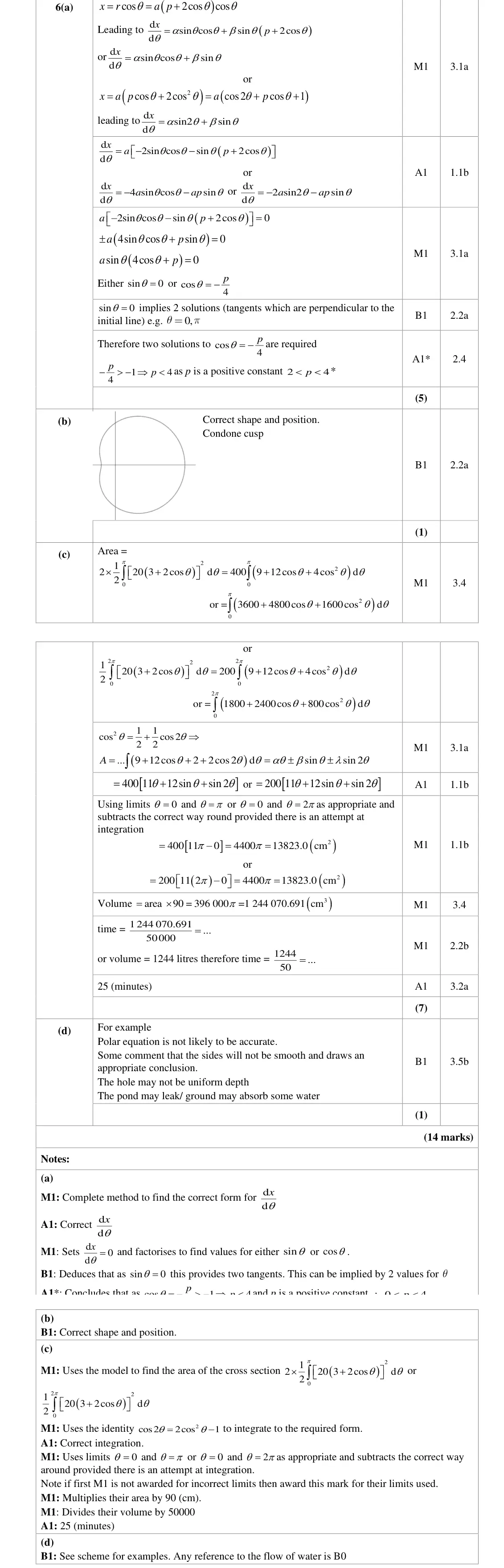
Part (a) The majority started well using cos x r theta = to find d d x theta correctly. Setting d 0 d x theta = and factorising, but many missed the significance that sin 0 is a solution which leads to two solutions. The other factor leads to cos 4 p theta = - and candidates need to use the fact that as cos 1 leading to 1 4 4 p p - > -⇒ < . Only a very small number of candidates were able to complete the proof successfully.
Key points from the mark scheme and examiner's report
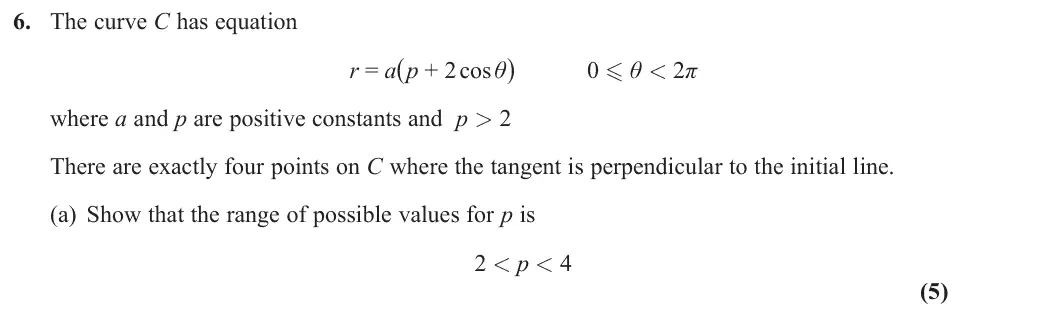
x = r cos θ, dx/dθ = −a sin θ(4cos θ + p) = 0
sin θ = 0 gives two tangents, so cos θ = −p/4 must give two more: −p/4 > −1, p < 4
the sin θ = 0 solutions often overlooked
Nov 2021 · Paper 2 (Core Pure 2) · Q6(b)1 mark
Mark scheme (whole question; this part is marked with the orange bar)
Examiner's comment
Part (b) The vast majority, using the information that there are four points on C were the tangent is perpendicular to the initial line, knew what this curve looked like, although a small minority either drew a circle or made the curve pass through the origin.
Key points from the mark scheme and examiner's report
convex limaçon (dimple-free, not through the pole) symmetric about the initial line
a circle or a curve through the origin scores 0
Nov 2021 · Paper 2 (Core Pure 2) · Q6(c)7 marks
Mark scheme (whole question; this part is marked with the orange bar)
Examiner's comment
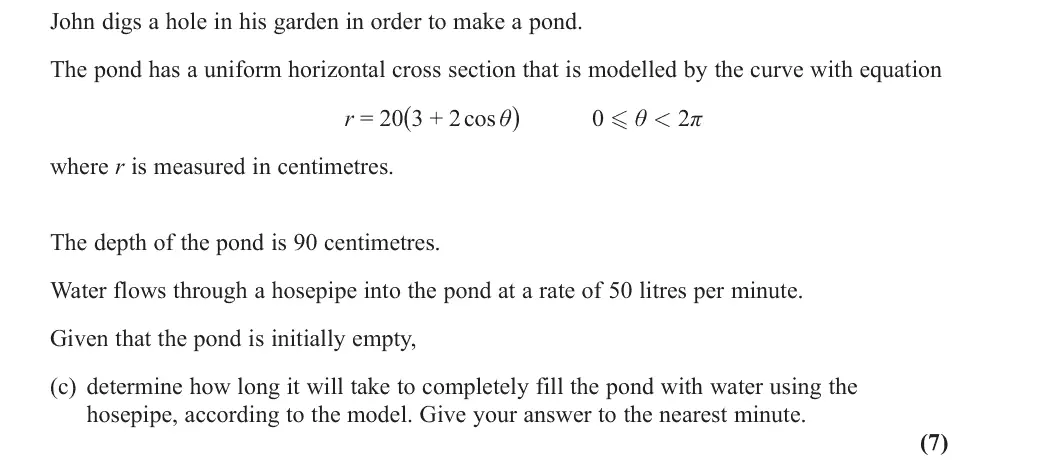
Part (c) Most candidates knew what was expected here using either 2 0 1 2 d 2 r or 2 2 0 1 d 2 r . Most candidates knew that they needed to use 2 cos2 2cos 1 to be able to integrate. There were occasional careless slip, but candidates were able to use limits correctly to proceeded to find the area of cross section. Candidates then needed to multiply this by 90 and divide by 50 litres which is equivalent to 50000 cm3, to obtain the final answer. The correct solution of 25 mins was not that common due mainly to errors during these final arithmetic steps, often the pi became lost along the way.
Key points from the mark scheme and examiner's report
area = ½∫ from 0 to 2π of 400(3 + 2cos θ)²dθ with cos²θ = ½(1 + cos 2θ): 4400π cm²
volume × 90 cm = 396 000π cm³
50 litres = 50 000 cm³
25 minutes
π lost or unit slips at the end
Nov 2021 · Paper 2 (Core Pure 2) · Q6(d)1 mark
Mark scheme (whole question; this part is marked with the orange bar)
Examiner's comment
(d) Too many candidates thought that a possible limitation related to the flow of water, which is not part of the model. Candidates are reminded to look back at the question and identify were the model set up. So in this question ‘The pond has a uniform horizontal cross section that is modelled by the curve with equation ( ) 20 3 2cos r theta = + ’
Key points from the mark scheme and examiner's report
e.g. the polar curve is unlikely to be exact, sides not smooth, depth not uniform, ground may absorb water
comments on the water flow score 0 (not part of the model)
Nov 2021 · Paper 2 (Core Pure 2) · Q8(ii)(b)4 marks
Mark scheme (whole question; this part is marked with the orange bar)
Examiner's comment
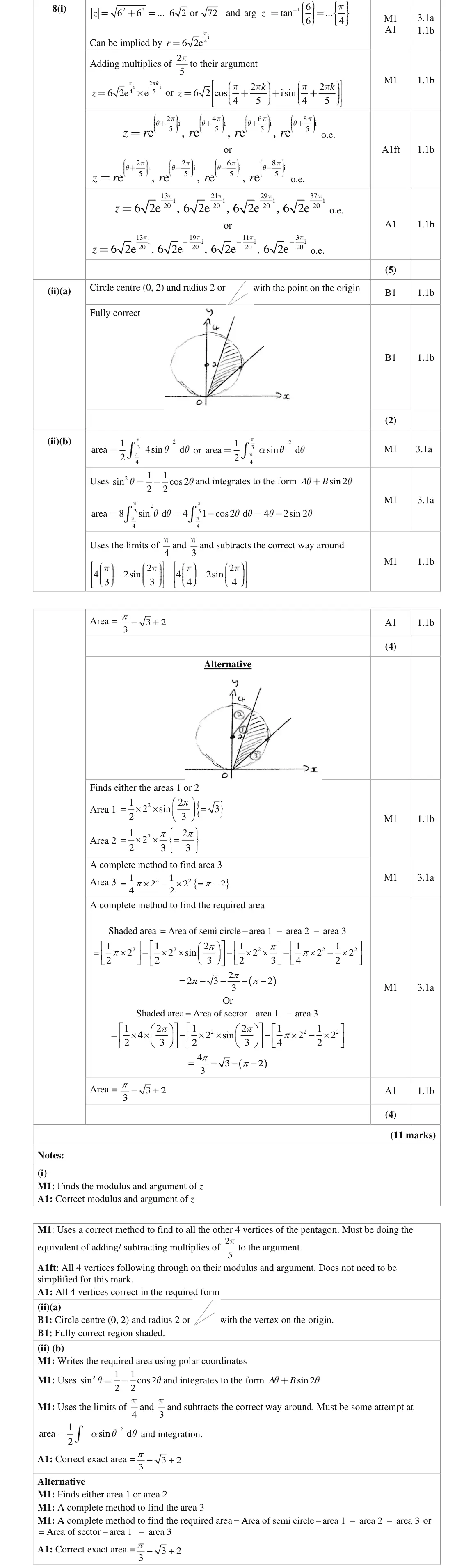
Part (i) Most candidates were able to correctly find the modulus and argument of 6 + 6i and a majority also realised that the angle at the center of a regular pentagon is 2 . They then either added or subtracted multiples 5 of 2 to their original argument to obtain the required arguments. Having 5 done this successfully a few candidates failed to give their final answer in the correct format. (ii) Part (a) Quite well done on the whole. Candidates recognised that a circle with centre on the y axis and passes through the origin but some candidates failed to indicate that the radius of the circle was 2. Candidates are reminded to indicate key coordinates on graphs. (ii) Part (b) This was well done by the majority of candidates by expressing the circle as a polar equation and finding the required area 4sin r between and . 4 3
Key points from the mark scheme and examiner's report
circle in polar form r = 4sin θ
area = ½∫ 16sin²θ dθ from π/4 to π/3 = π/3 − √3 + 2
geometric route with segments and triangles also accepted
Oct 2020 · Paper 1 (Core Pure 1) · Q39 marks
Mark scheme (whole question; this part is marked with the orange bar)
Examiner's comment
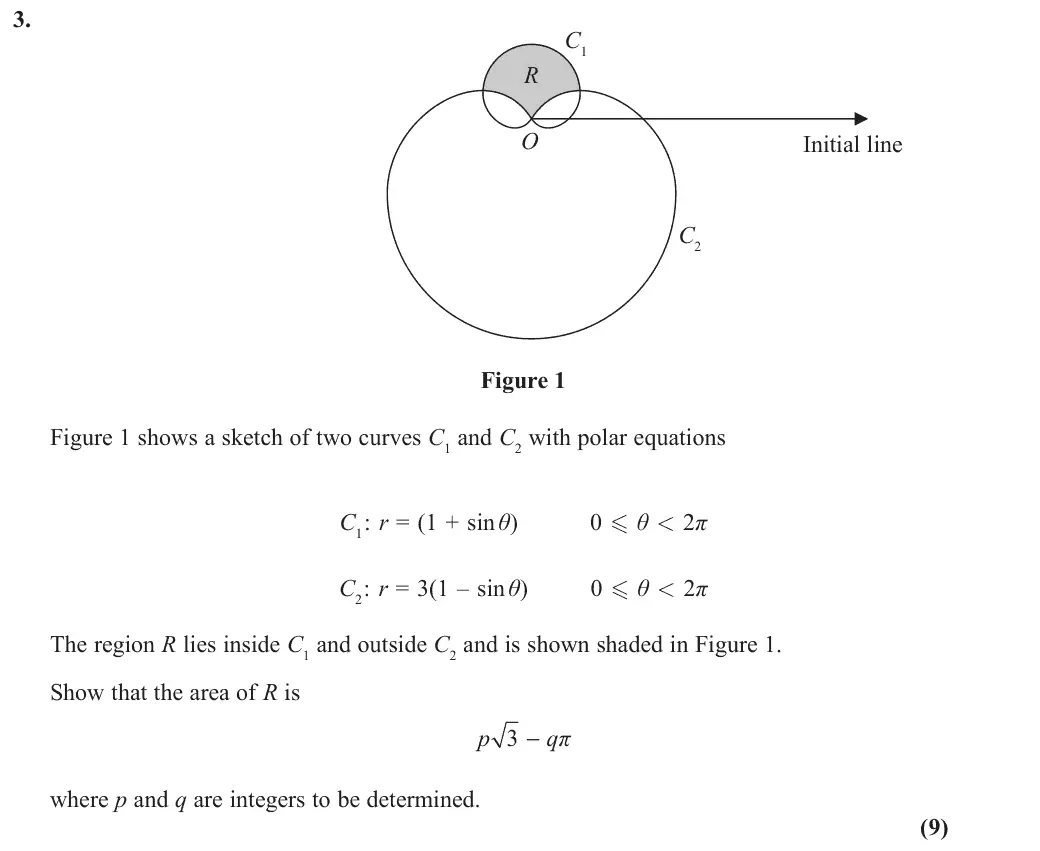
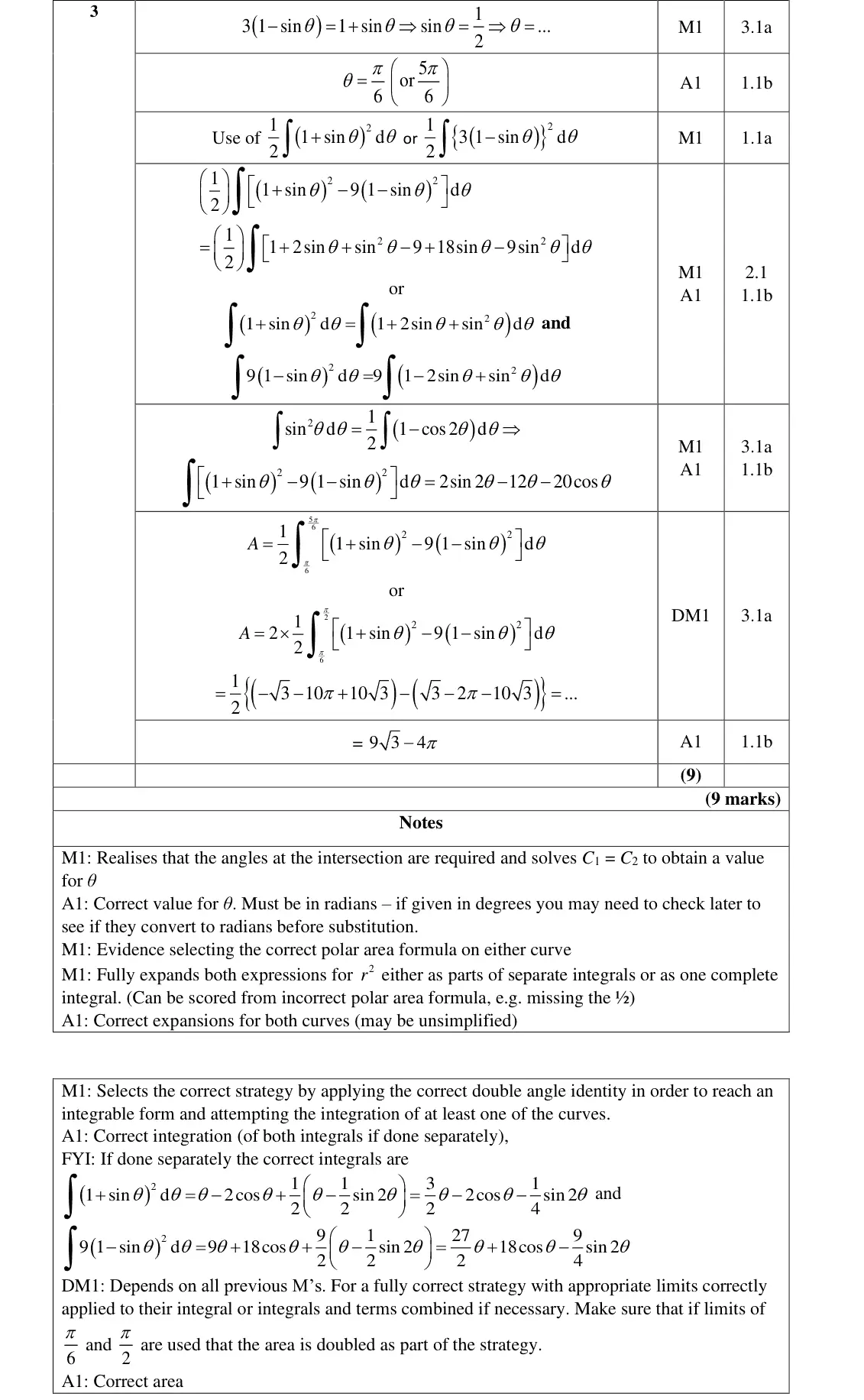
This was a standard Polar Coordinate question which was well attempted by the majority of candidates with bimodal peaks of 7 or 9 marks as the most common scores. Most started by finding the intersections of the two curves and gained the first 2 marks. Nearly all used a correct polar area formula and expanded at least one expression for r2. A few only considered one curve and these lost 4 of the subsequent marks. A generous mark scheme awarded marks for correct expansions of both expressions for r2, and most gained these marks. Some however forgot to square the 3 in curve C2. Again, most realised they needed to use a double angle formula in order to reach an integrable form and this was done very well, with the integration of both expressions usually correct. Candidates who gained full marks up to this point often lost the last two marks by applying an incorrect overall strategy. This usually meant they used the wrong limits of integration. Some integrated from pi /6 to pi /2 which was fine as long as they remembered to double their answer. There were a few very pleasing concise and completely correct solutions.
Key points from the mark scheme and examiner's report
intersections sin θ = ½, θ = π/6, 5π/6
area = ½∫(r₁² − r₂²)dθ over π/6 to 5π/6 (or double from π/6 to π/2)
sin²θ = (1 − cos 2θ)/2
9√3 − 4π
forgetting to square the 3
wrong overall strategy for the region lost the last marks
June 2019 · Paper 1 (Core Pure 1) · Q3(a)2 marks
Mark scheme (whole question; this part is marked with the orange bar)
Examiner's comment
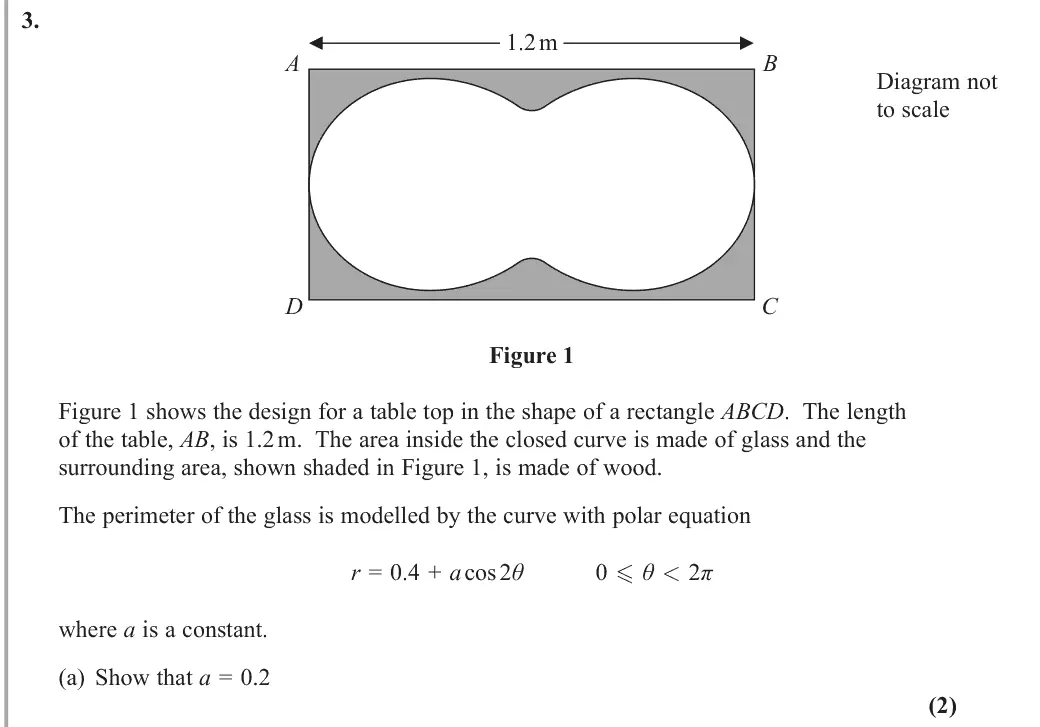
This question proved to be accessible to most candidates. The majority of candidates gained full marks in part (a). One or two lost both marks for using 𝜃= 2𝜋 which is not a valid angle for the model.
Key points from the mark scheme and examiner's report
greatest r is half the table length: 0.4 + a = 0.6 at θ = 0, so a = 0.2
using θ = 2π scores 0 (not in the domain)
June 2019 · Paper 1 (Core Pure 1) · Q3(b)8 marks
Mark scheme (whole question; this part is marked with the orange bar)
Examiner's comment
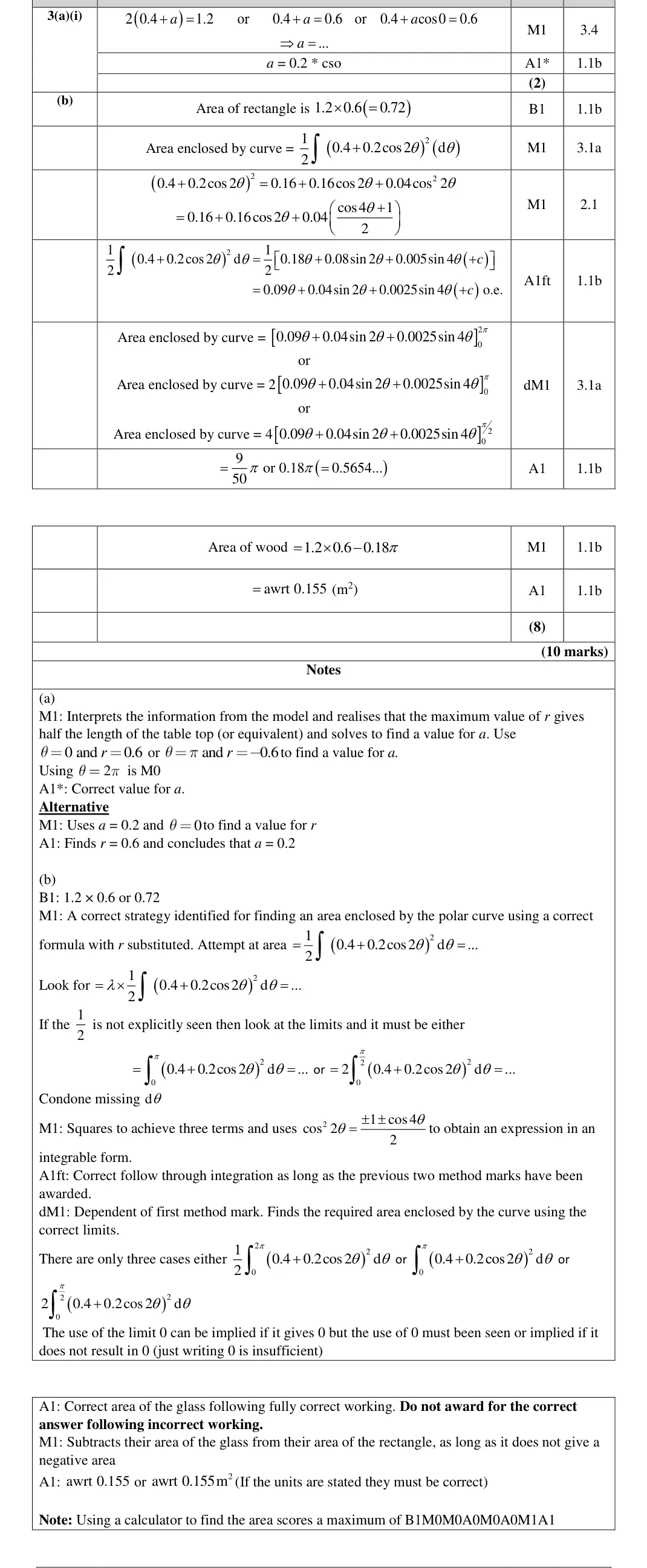
This question proved to be accessible to most candidates. The majority of candidates gained full marks Part (b) Almost all candidates realised they needed to use the correct area formula and then went on to expand the expression for r. Candidates appeared to be familiar with the method needed for integrating 2 cos x and most used a fully correct double angle formula in their integral. One or two attempted the double angle formula but then substituted an expression in terms of 2𝜃 rather than 4𝜃 and so lost the second M mark. The majority integrated their expression correctly, although one or two made sign errors or slips when finding the coefficients. Most candidates then went on to substitute the correct limits for their integral. Almost all candidates gained the B1 mark for correctly finding the area of the table top (the mixed of units was dealt with), and most realised they needed to subtract their area enclosed by the curve from the area of the rectangle. Although most candidates were able to make good progress on this question, sign or arithmetic errors were often made along the way resulting in the A marks being lost.
Key points from the mark scheme and examiner's report
½∫(0.4 + 0.2cos 2θ)²dθ over 0 to 2π = 0.18π
cos²2θ = (1 + cos 4θ)/2 (using 2θ instead of 4θ is a common slip)
wood = 0.72 − 0.18π = 0.155 m²
calculator-only scores 2 of 8
Find an Edexcel Further Maths tutor
Stuck on this? Book a trial lesson with our Further Maths tutor.