CP7.3 Find the area enclosed by a polar curve.

Section
CP7 Polar coordinates
Level
A level only
Statement
Find the area enclosed by a polar curve.
Guidance
Use of the formula ½∫(α to β) r² dθ for area. The ability to find tangents parallel to, or at right angles to, the initial line is expected.
Since 2018
14 parts, 78 marks · topic pages: Polar coordinates: curves and areas, Hyperbolic functions, Loci in the Argand diagram, Reduction formulae, arc length and surface area

Back to the checklist

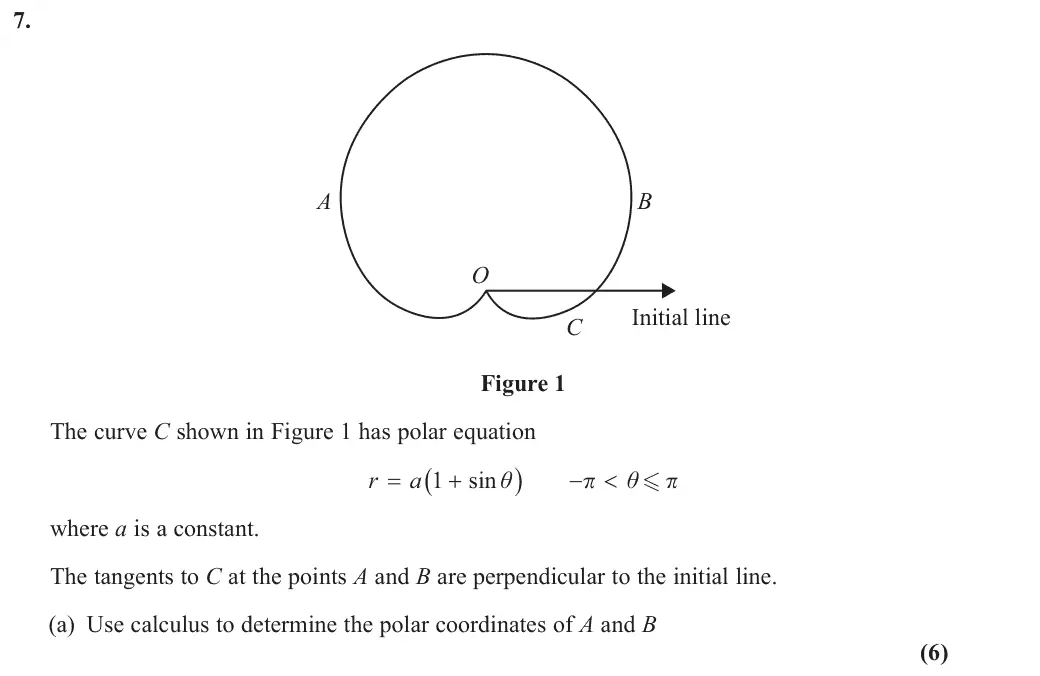
June 2025 · Paper 2 (Core Pure 2) · Q7(a) 6 marks
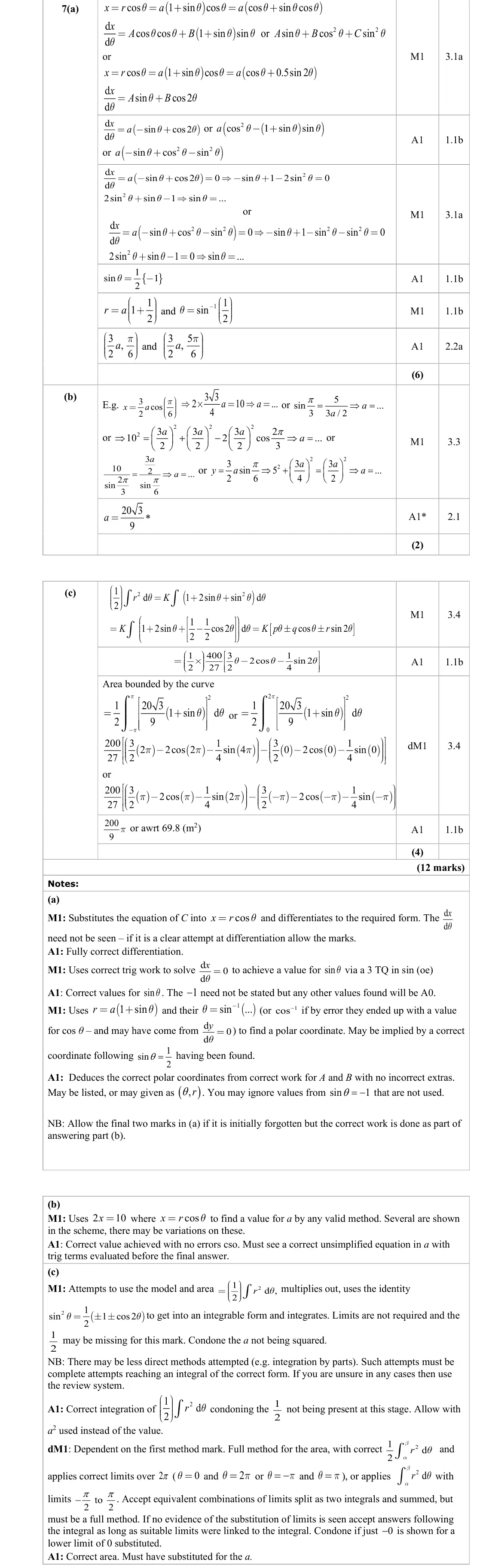
7. A B Initial line C Figure 1 The curve C shown in Figure 1 has polar equation r a 1 sin theta ϖ theta < ϖ where a is a constant. The tangents to C at the points A and B are perpendicular to the initial line. (a) Use calculus to determine the polar coordinates of A and B (6)
June 2025 · Paper 2 (Core Pure 2) · Q7(c) 4 marks
(c) Use algebraic integration to determine the surface area of the swimming pool, according to the model. (4)
June 2024 · Paper 1 (Core Pure 1) · Q3(b) 6 marks
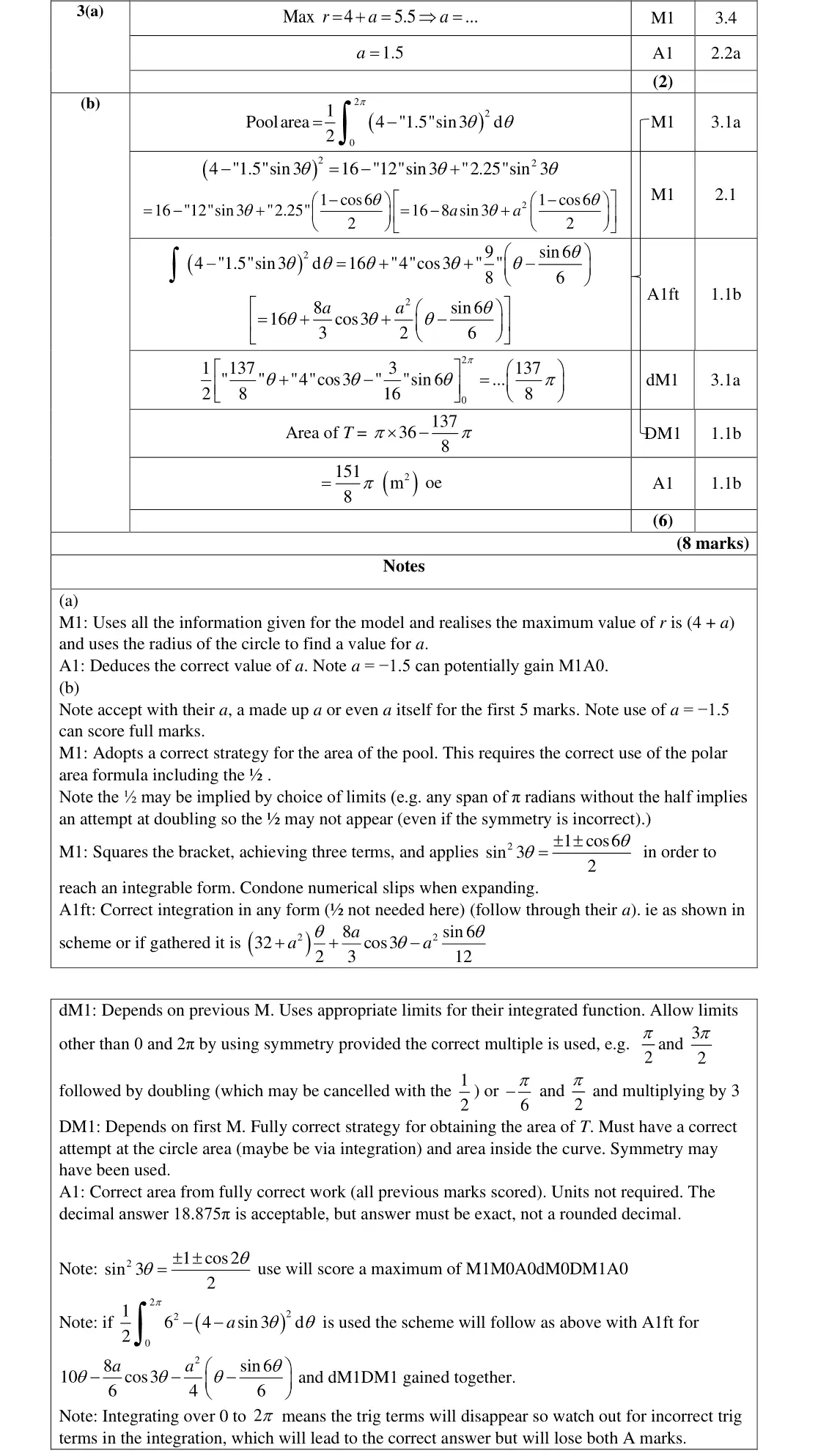
(b) Hence, using algebraic integration, determine, according to the model, the exact area of T. (6)
June 2023 · Paper 2 (Core Pure 2) · Q1 4 marks
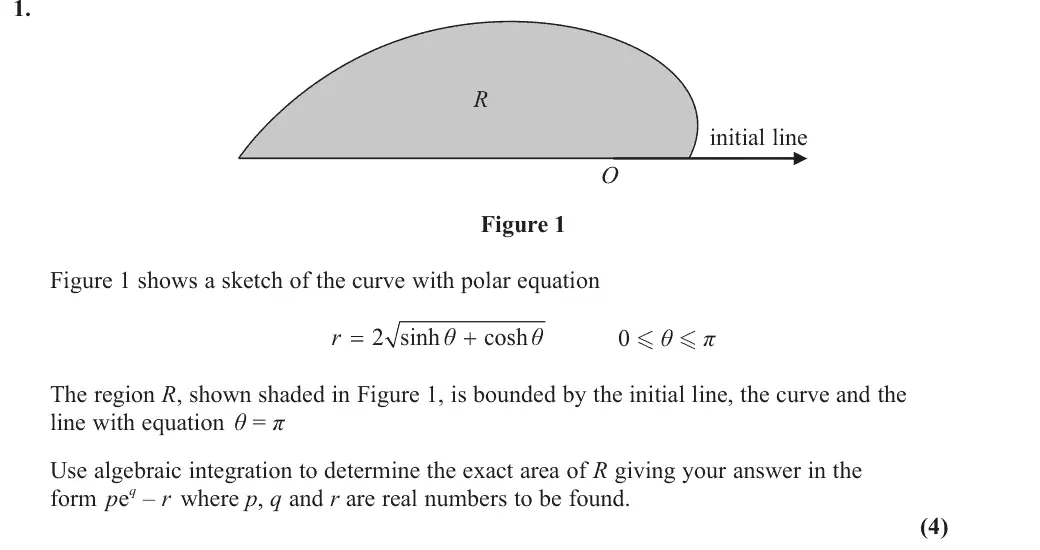
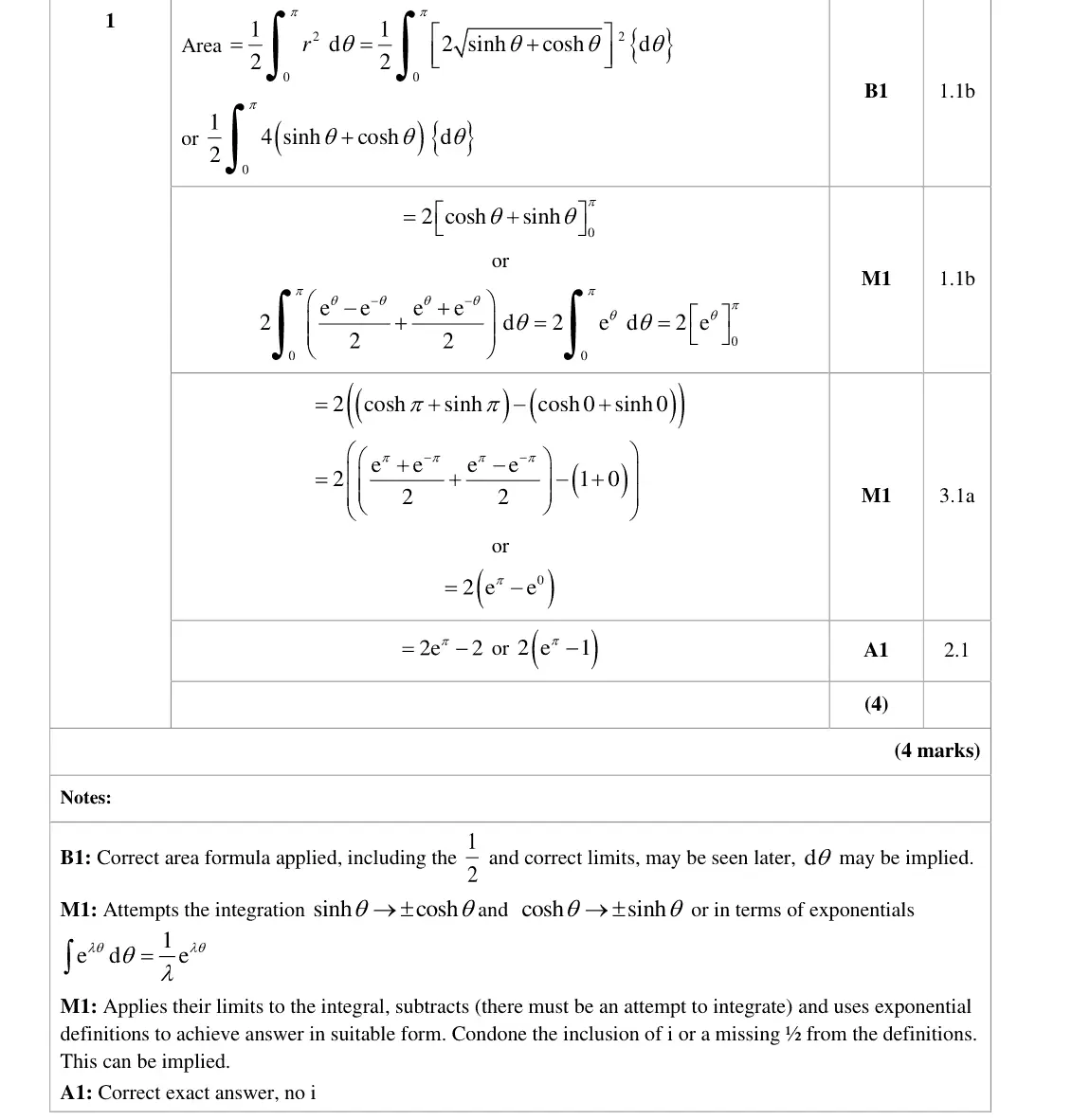
1. R initial line Figure 1 Figure 1 shows a sketch of the curve with polar equation 0 theta pi r 2 sinh theta cosh theta The region R, shown shaded in Figure 1, is bounded by the initial line, the curve and the line with equation theta = pi Use algebraic integration to determine the exact area of R giving your answer in the form pe q – r where p, q and r are real numbers to be found. (4)
June 2023 · Paper 2 (Core Pure 2) · Q4(b) 4 marks
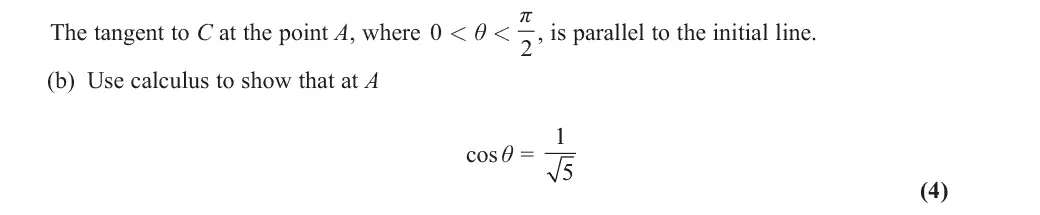
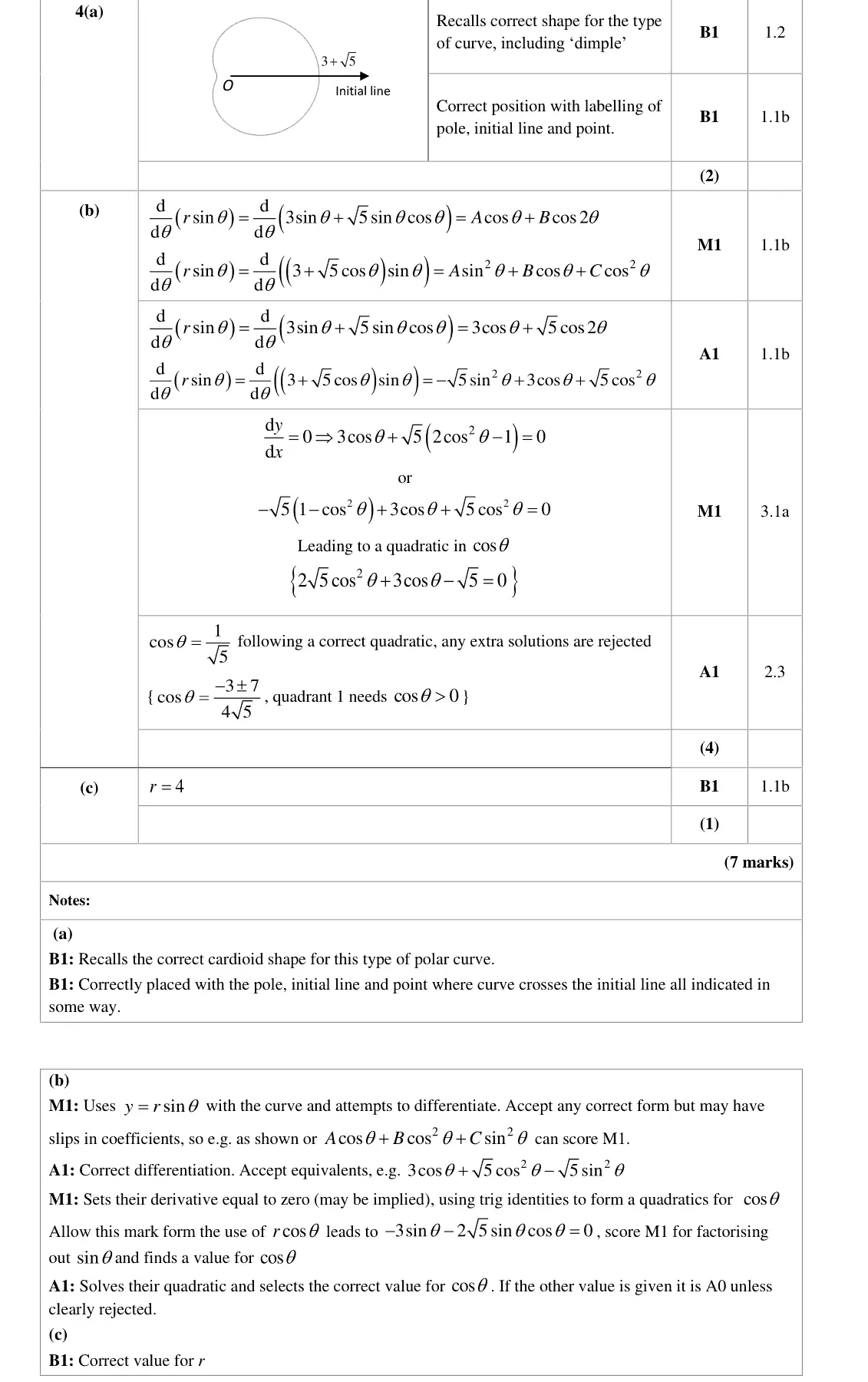
pi , is parallel to the initial line. The tangent to C at the point A, where 0 < theta < 2 (b) Use calculus to show that at A cos theta = 1 (4)
June 2022 · Paper 2 (Core Pure 2) · Q7(a) 4 marks
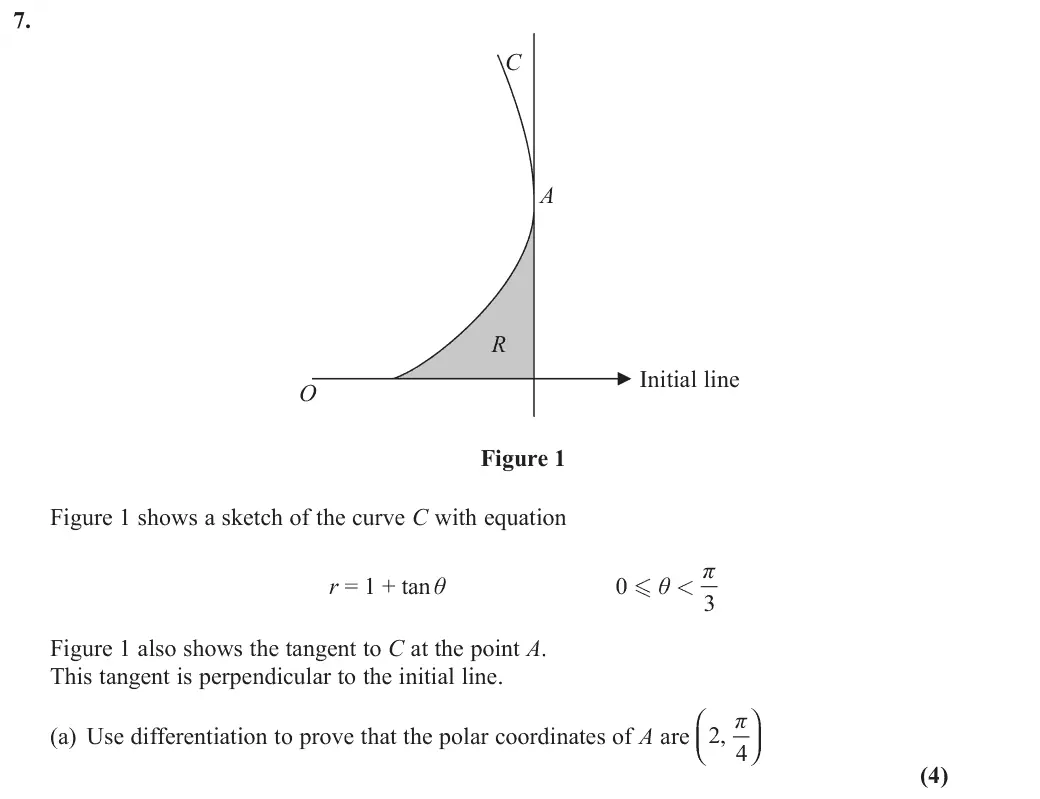
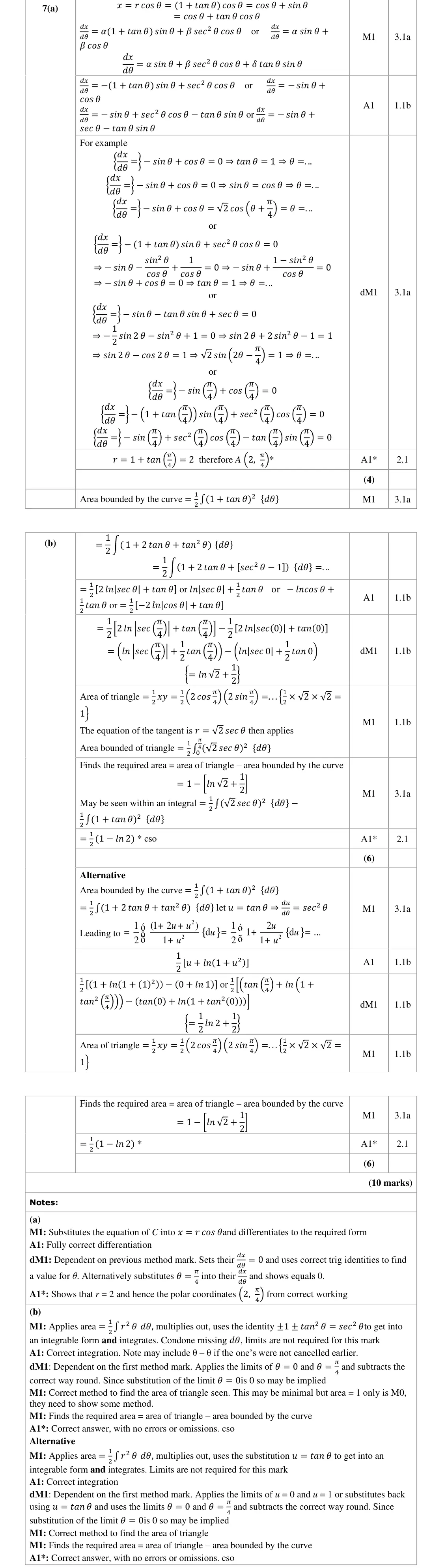
7. C A R Initial line Figure 1 Figure 1 shows a sketch of the curve C with equation pi r = 1 + tan theta 0 theta < 3 Figure 1 also shows the tangent to C at the point A. This tangent is perpendicular to the initial line. pi (a) Use differentiation to prove that the polar coordinates of A are 2, 4 (4)
June 2022 · Paper 2 (Core Pure 2) · Q7(b) 6 marks
The finite region R, shown shaded in Figure 1, is bounded by C, the tangent at A and the initial line. (b) Use calculus to show that the exact area of R is 1 2 (1 – ln 2) (6)
Nov 2021 · Paper 2 (Core Pure 2) · Q6(a) 5 marks
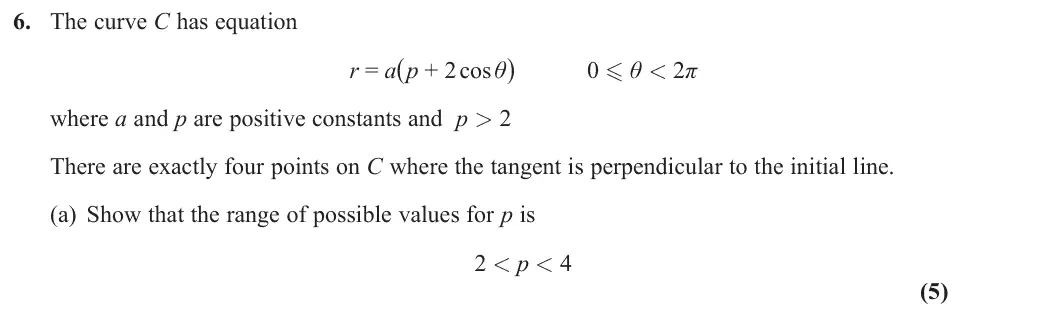
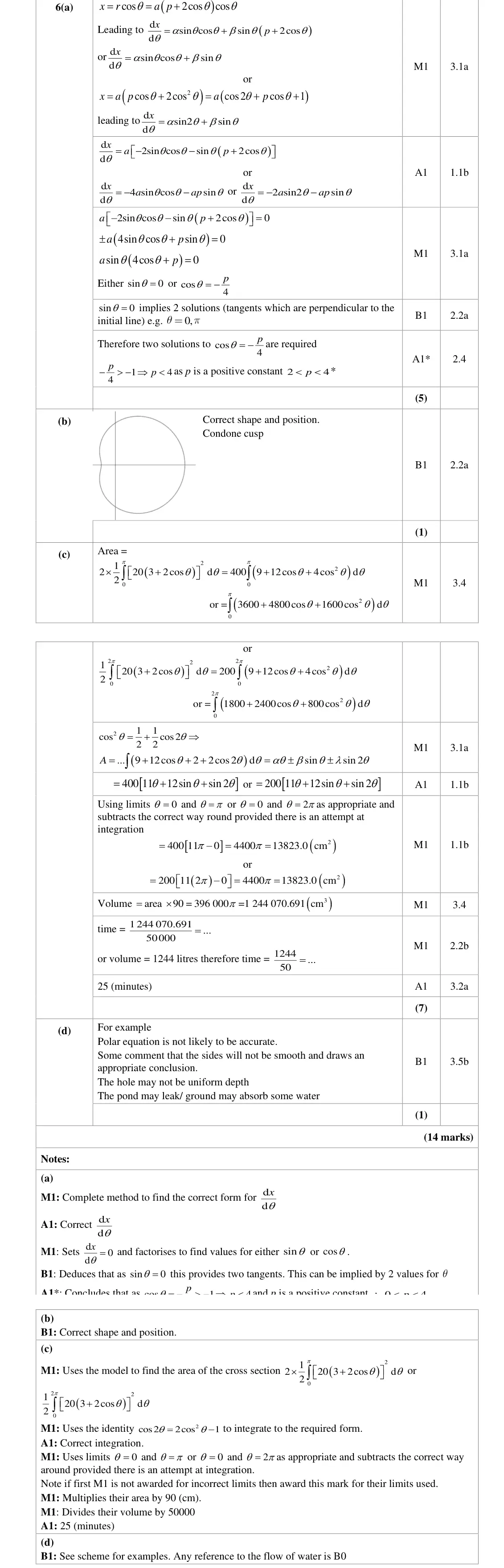
6. The curve C has equation r = a(p + 2 cos theta ) 0 theta < 2 pi where a and p are positive constants and p > 2 There are exactly four points on C where the tangent is perpendicular to the initial line. (a) Show that the range of possible values for p is 2 < p < 4 (5)
Nov 2021 · Paper 2 (Core Pure 2) · Q6(c) 7 marks
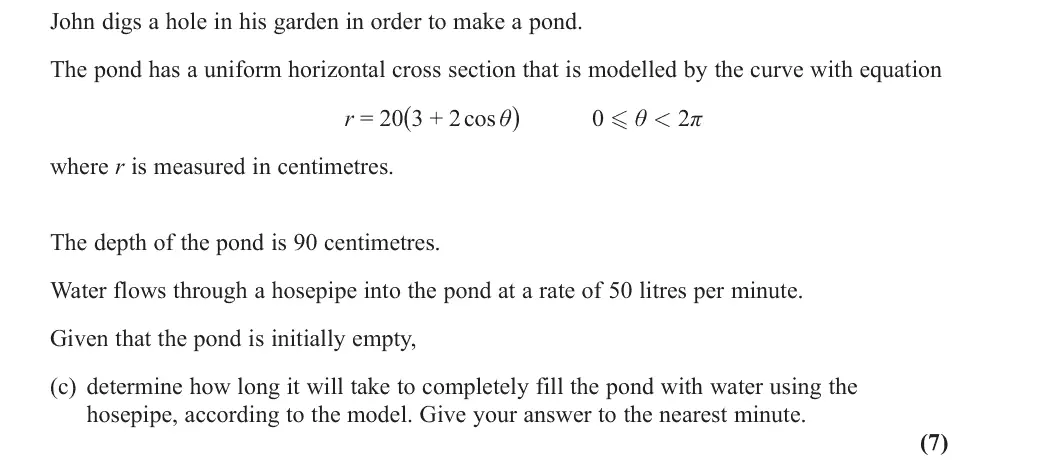
John digs a hole in his garden in order to make a pond. The pond has a uniform horizontal cross section that is modelled by the curve with equation r = 20(3 + 2 cos theta ) 0 theta < 2 pi where r is measured in centimetres. The depth of the pond is 90 centimetres. Water flows through a hosepipe into the pond at a rate of 50 litres per minute. Given that the pond is initially empty, (c) determine how long it will take to completely fill the pond with water using the hosepipe, according to the model. Give your answer to the nearest minute. (7)
Nov 2021 · Paper 2 (Core Pure 2) · Q6(d) 1 mark
(d) State a limitation of the model. (1)
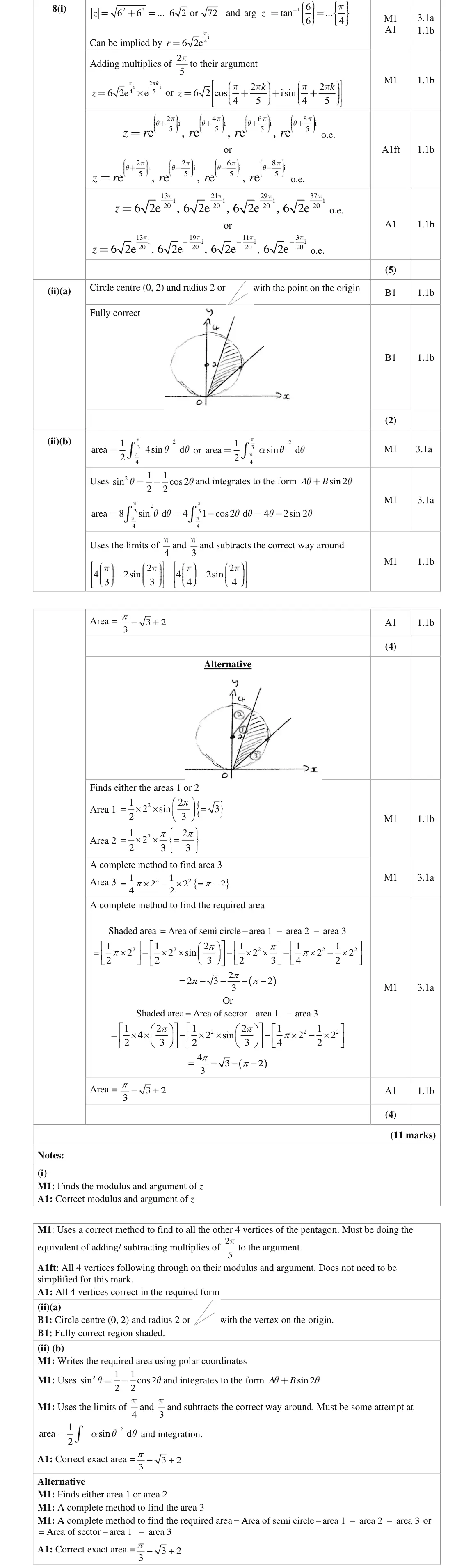
Nov 2021 · Paper 2 (Core Pure 2) · Q8(ii)(b) 4 marks
(b) Determine the exact area of R, giving your answer in simplest form. (4)
Oct 2020 · Paper 1 (Core Pure 1) · Q3 9 marks
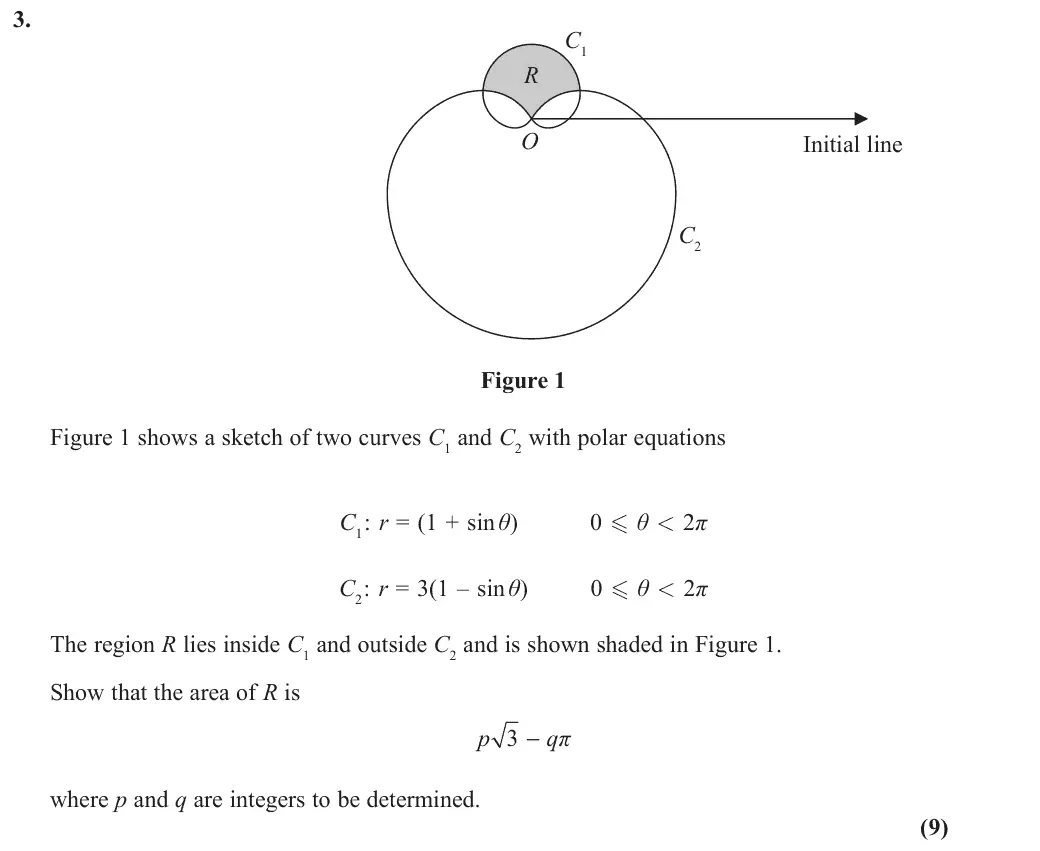
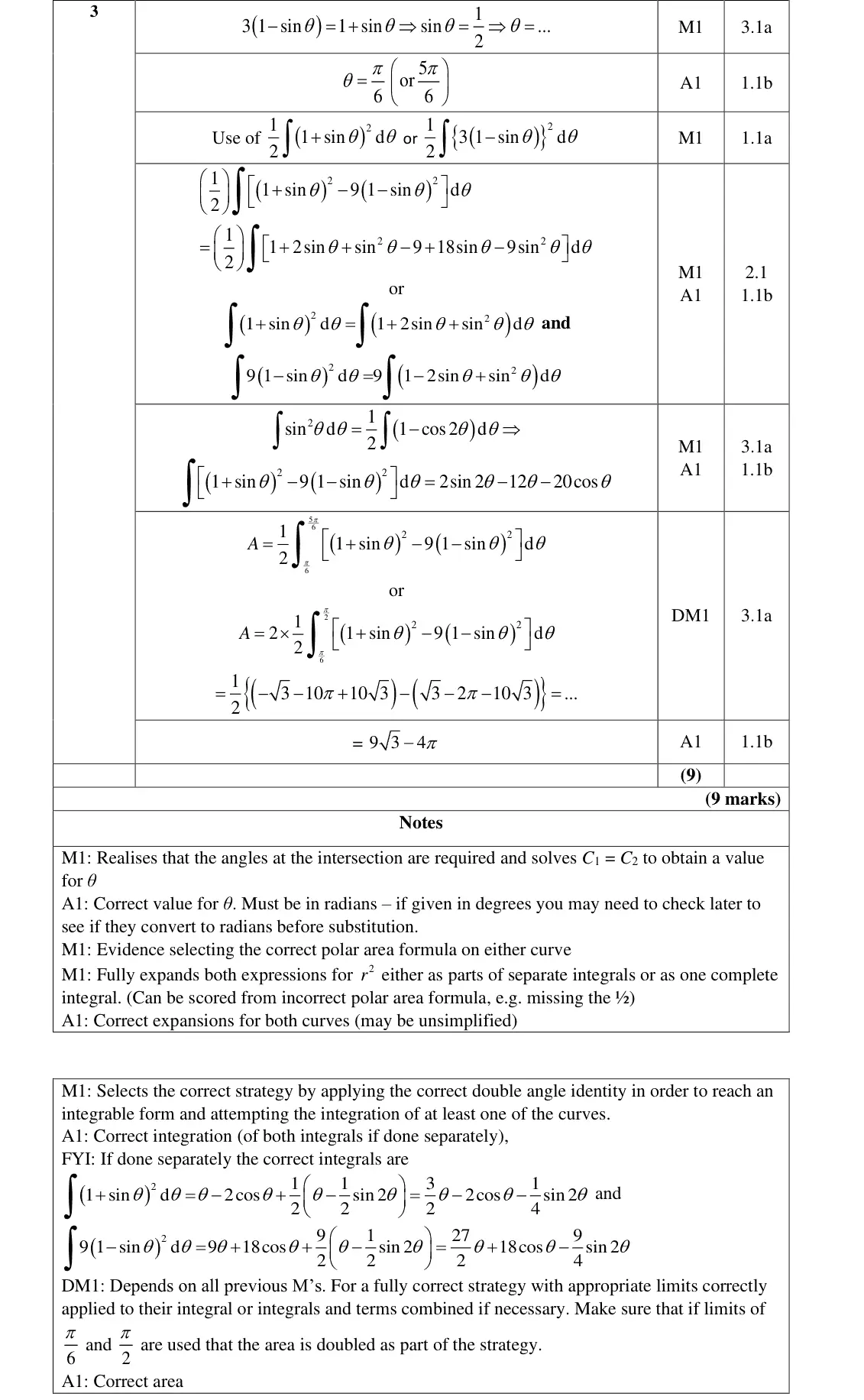
3. C1 R Initial line C2 Figure 1 Figure 1 shows a sketch of two curves C1 and C2 with polar equations C1 : r = (1 + sin theta ) 0 theta < 2 pi C2 : r = 3(1 – sin theta ) 0 theta < 2 pi The region R lies inside C1 and outside C2 and is shown shaded in Figure 1. Show that the area of R is p q pi - where p and q are integers to be determined. (9)
Oct 2020 · Paper 4A (Further Pure 2) · Q4 10 marks
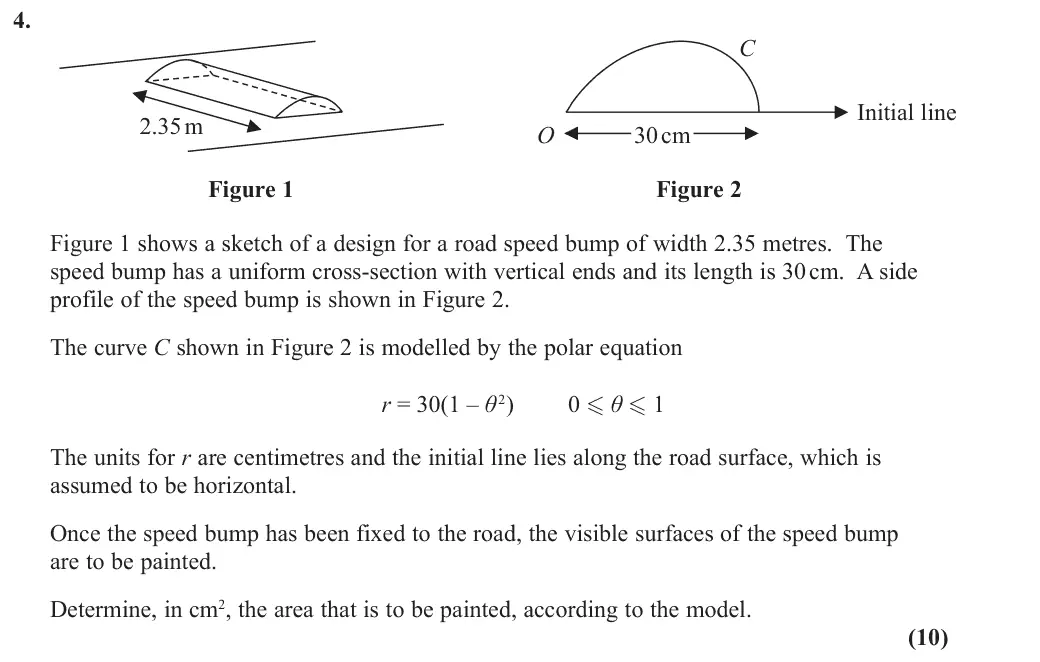
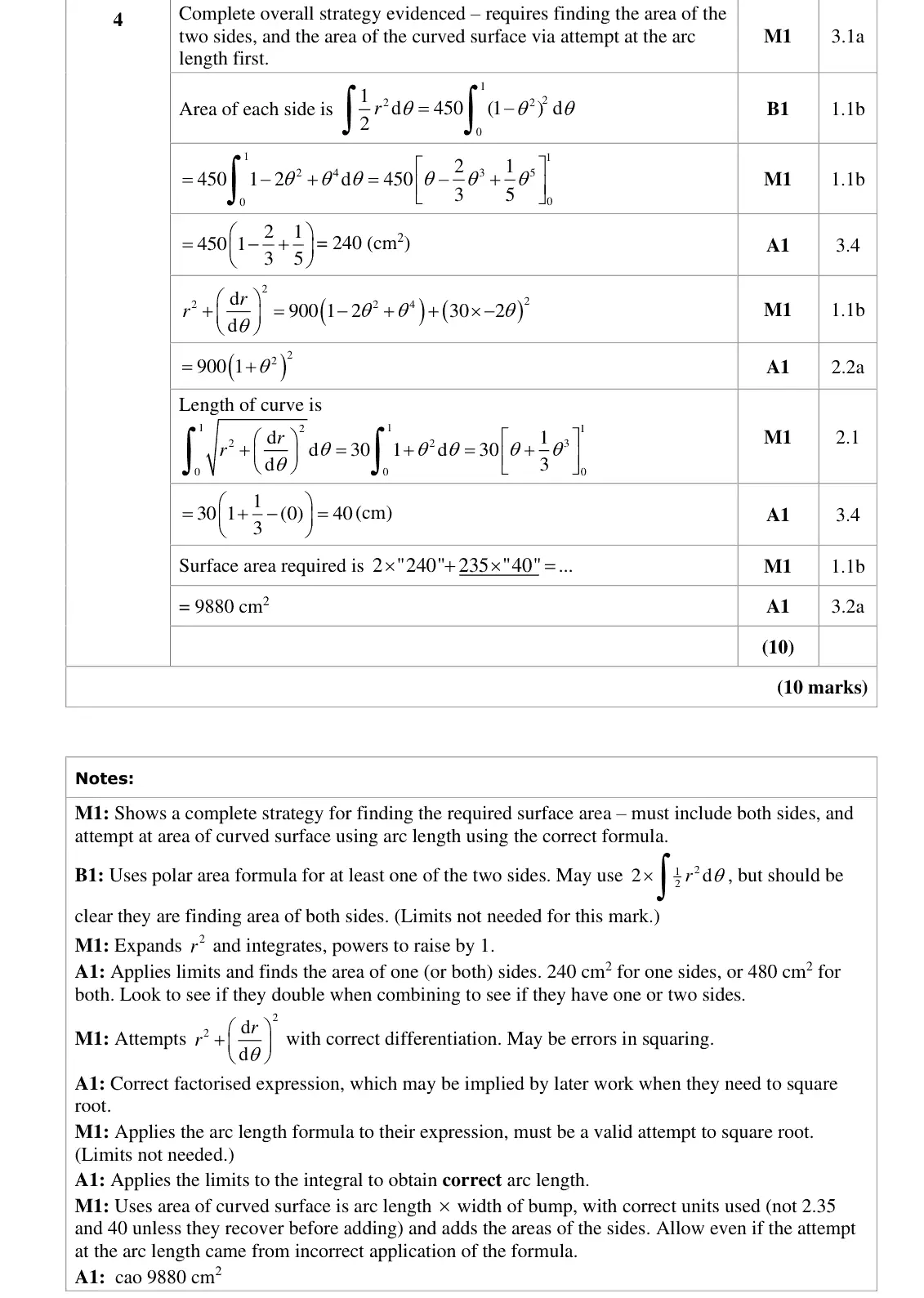
4. C Initial line 2.35 m 30 cm Figure 1 Figure 2 Figure 1 shows a sketch of a design for a road speed bump of width 2.35 metres. The speed bump has a uniform cross‑section with vertical ends and its length is 30 cm. A side profile of the speed bump is shown in Figure 2. The curve C shown in Figure 2 is modelled by the polar equation r = 30(1 – theta 2) 0 theta 1 The units for r are centimetres and the initial line lies along the road surface, which is assumed to be horizontal. Once the speed bump has been fixed to the road, the visible surfaces of the speed bump are to be painted. Determine, in cm2, the area that is to be painted, according to the model. (10)
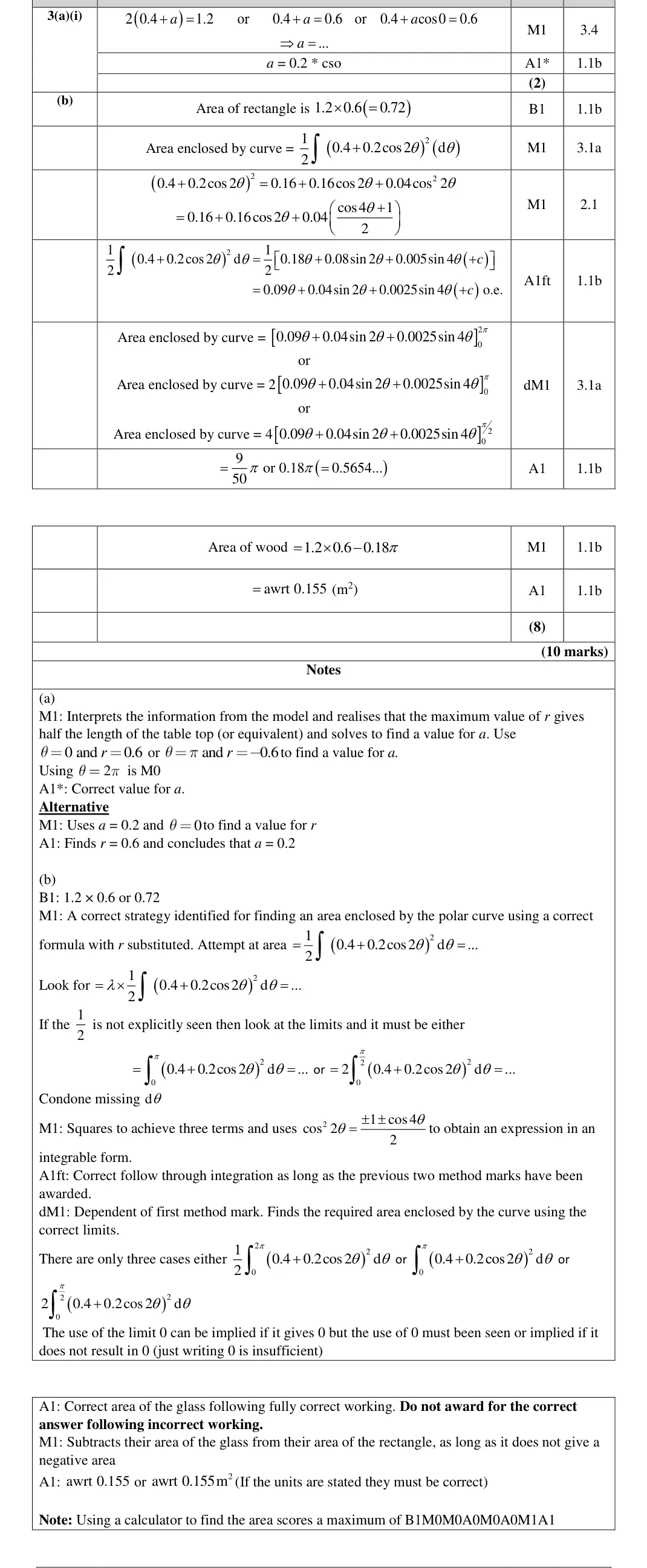
June 2019 · Paper 1 (Core Pure 1) · Q3(b) 8 marks
Hence, given that AD = 60 cm, (b) find the area of the wooden part of the table top, giving your answer in m2 to 3 significant figures. (8)

Find an Edexcel Further Maths tutor

Stuck on this? Book a trial lesson with our Further Maths tutor.

Prefer email? Send an enquiry

If you are under 18, please include a parent's contact details. Enquiries go to enquiries@alevelfurthermathstutor.com and are deleted once handled.