Examiner's comment
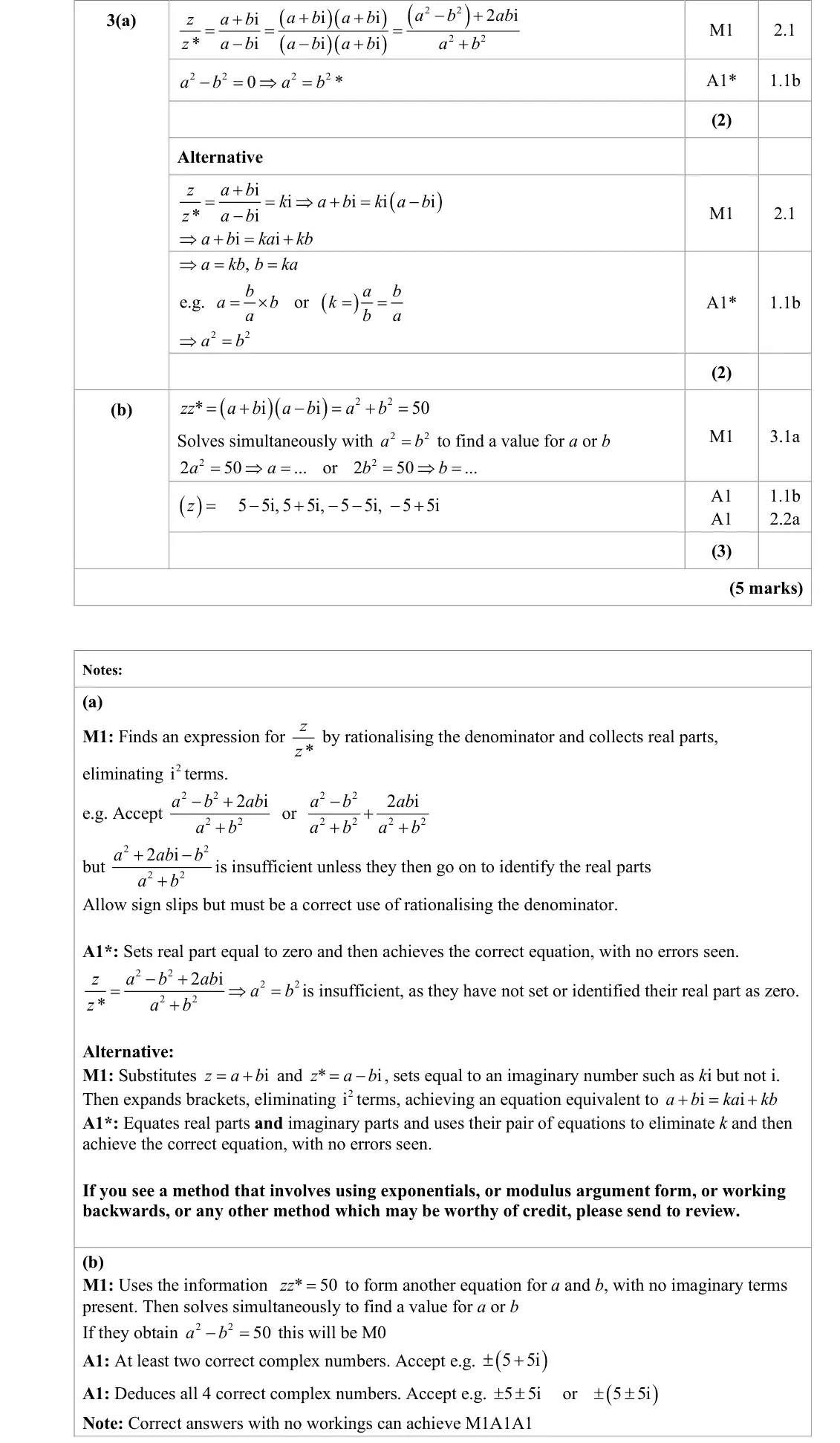
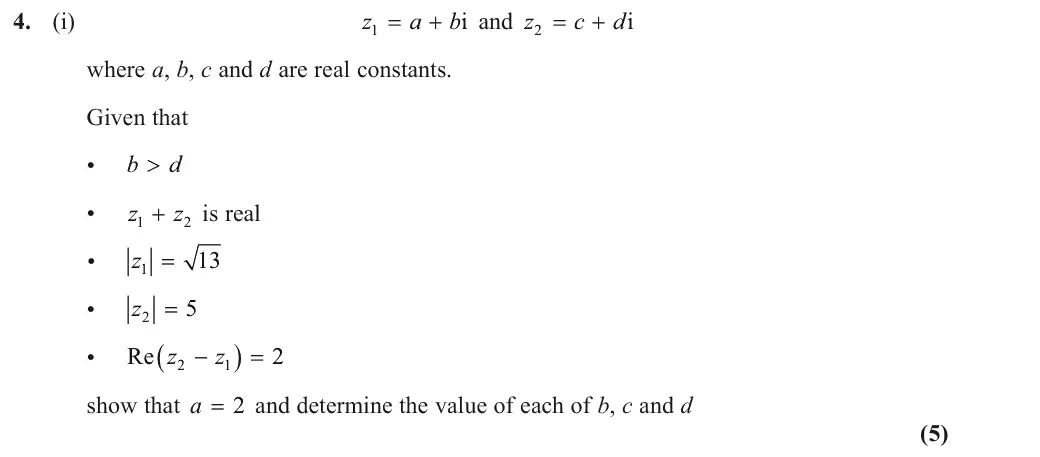
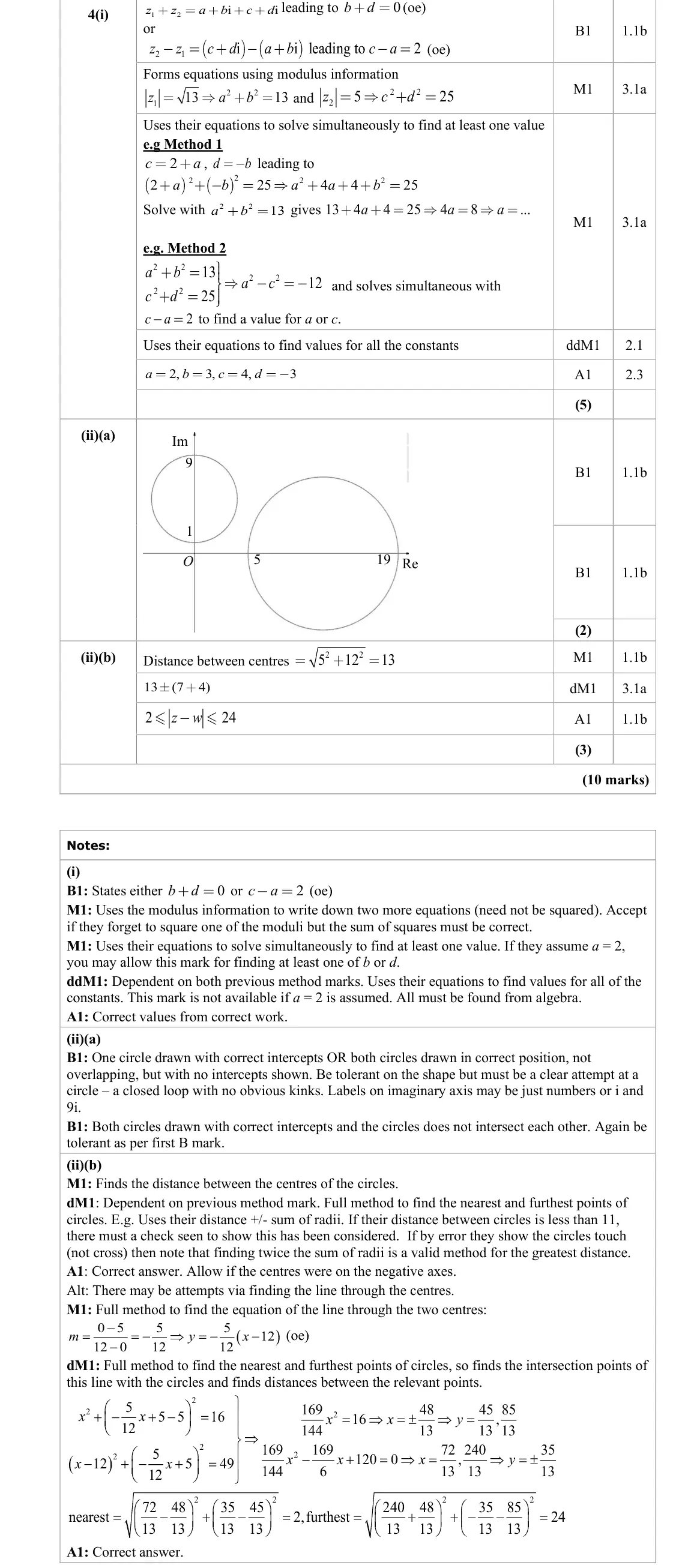
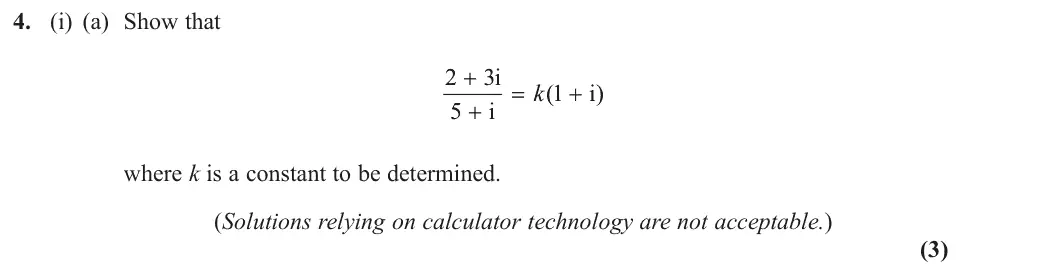
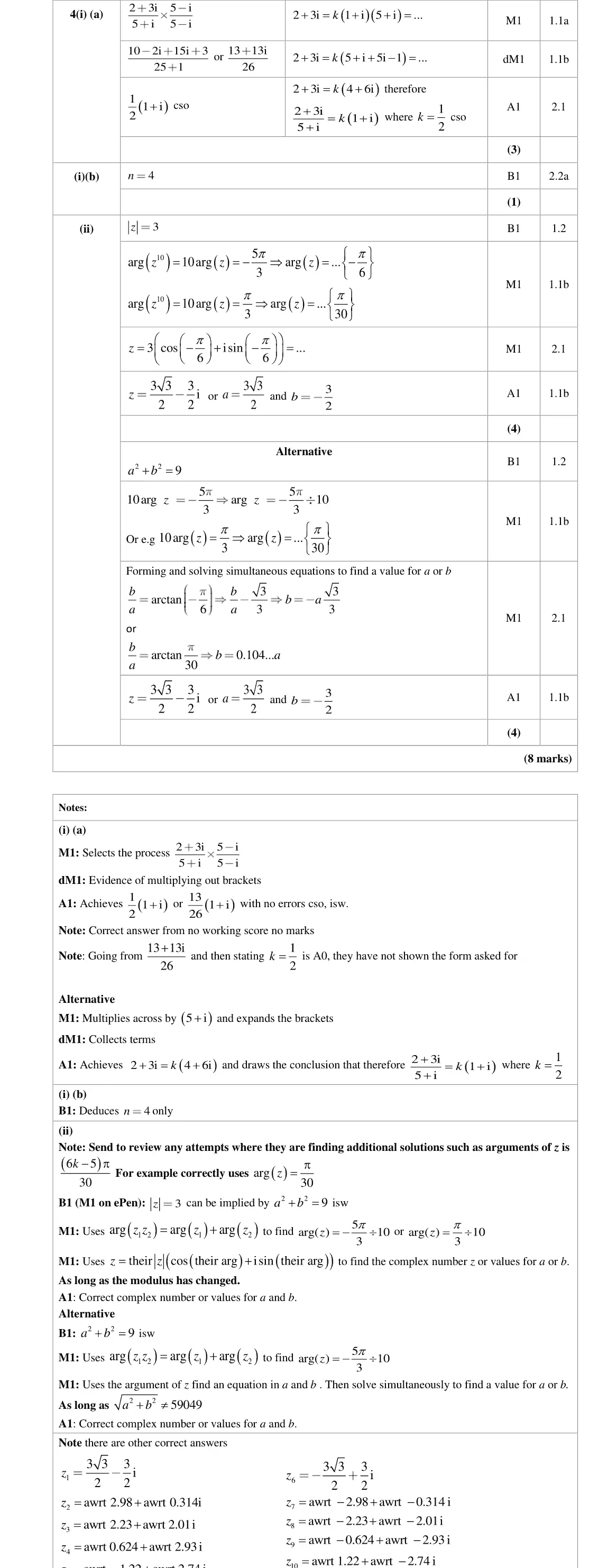
This proved a useful question for discriminating across grades with good access in part (i) for all grades but a demanding part (ii) that gave the better learners opportunity to show case their ability. Part (i) was well done overall. The majority gained the first two marks for the links between a and c and/or b and d, though there were occasional slips particularly with the used of the modulus. Some forgot to square the 5 to give , for example, while others squared 2 2 5 a b + = the 13, giving but most usually had one correct to gain the method mark. Only 2 2 169 a b + = a minority had subtraction between the terms or left an i in the equation. Proceeding from this point there were several different approaches to the problem, but most were able to manipulate their equations to find the required values by some means (the mark scheme shows the most common approaches). The non-standard nature of the simultaneous equations occasionally caused confusion with some unable to correctly solve, either giving incorrect answer or assuming a =2 in order to find the remaining values and so lost the final two marks. A few did not read the question properly and stopped when they found a. Perhaps some took a as given by a misread of the question. Those who managed to successfully find one correct value legitimately almost always gained full marks, though occasionally errors square rooting 9 occurred. Putting the b and d values in order was done well. Part (ii) was more troublesome for learners, especially (b). Most were able to sketch the loci to give two circles for (a) with the majority recognising that there was one on each axis. Relatively few had them on the negative parts of the axes. Drawing them to scale was less well done, though, and hence many failed to realise that the circles did not touch or overlap. Also, many marked the centres and radii rather than marking the x and y intercepts, so not heeding the directive of the question regarding labelling. An relatively common error was to have 17, rather than 19, for the second intercept on the larger circle. Overlapping circles were quite common, though as long as sufficient labelling was given these could still gain at least one mark, but it did mean the second mark was quite often lost. So, knowing the loci were circles was shown by the majority but scales and positions were not considered by all. For (ii)(b) learners were much less secure on how to proceed to find the answer, and as such proved to be a good discriminator. Many candidates either did not attempt the question at all or did a lot of unnecessary algebra with the 2 cartesian equations, attempting to find the intersections of the circles (rarely leading to successful solutions). Not many used the diagram they had drawn to realis that | z - w | was the distance between points on the circles, so that they were looking for closest points. Those who did were able to spot what to do, so those who had incorrect diagrams disadvantaged themselves, particularly those with crossing circles. Many were able to gain the first mark for finding the distance between the centres, albeit that they did not always proceed to show how it related to the problem in subsequent work. Those who assumed the circles touch or cross usually did no work to show it, so could not gain the next marks, though a few did at least find the maximum distance. There were a small number of cases of correct extreme values, but incorrect inequalities used, so most who were able to identify the correct method were able to score full marks. The alternative method of the line through the centres was far less common to see, but occasionally did lead to successful solution. However, this method was laborious and rarely led to full marks.