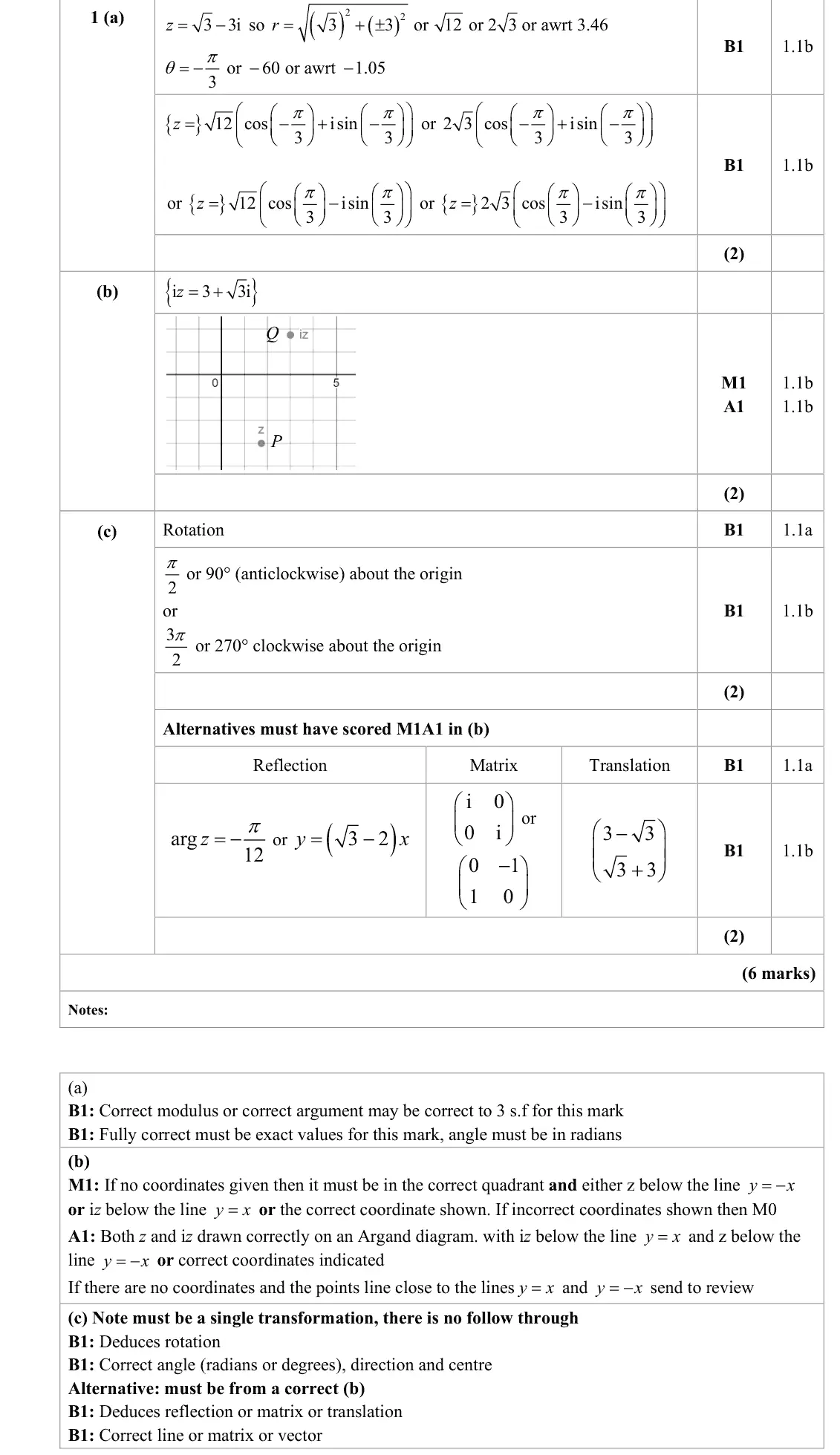
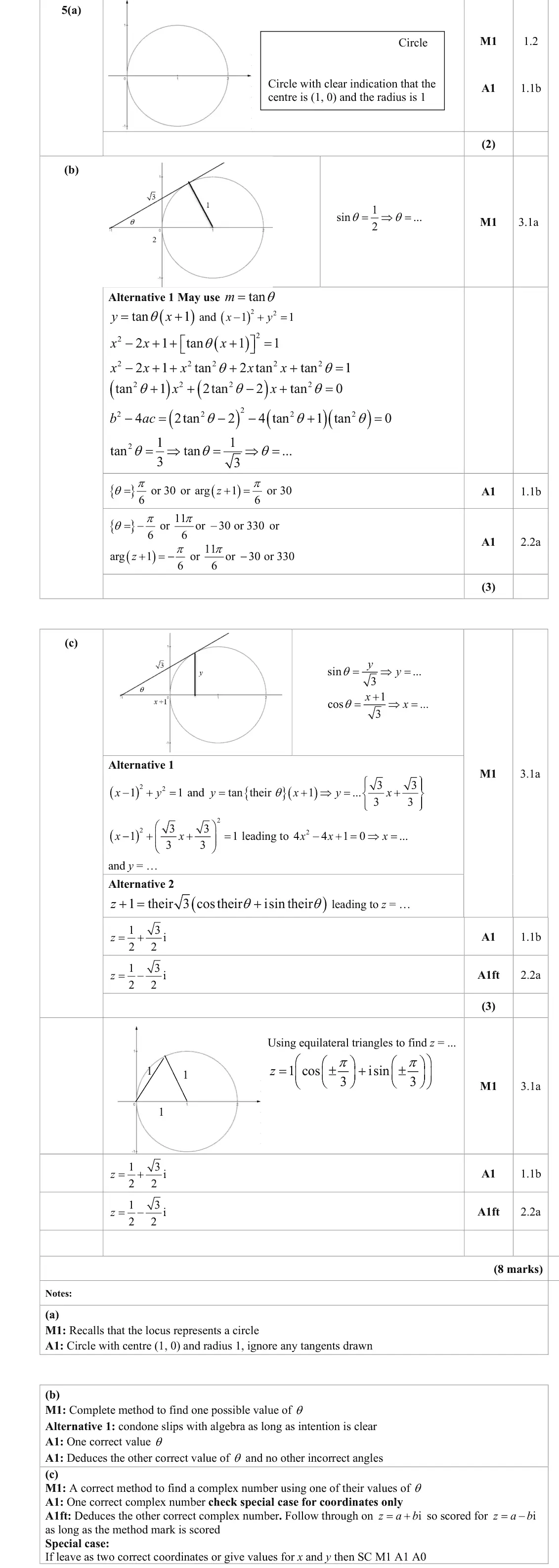
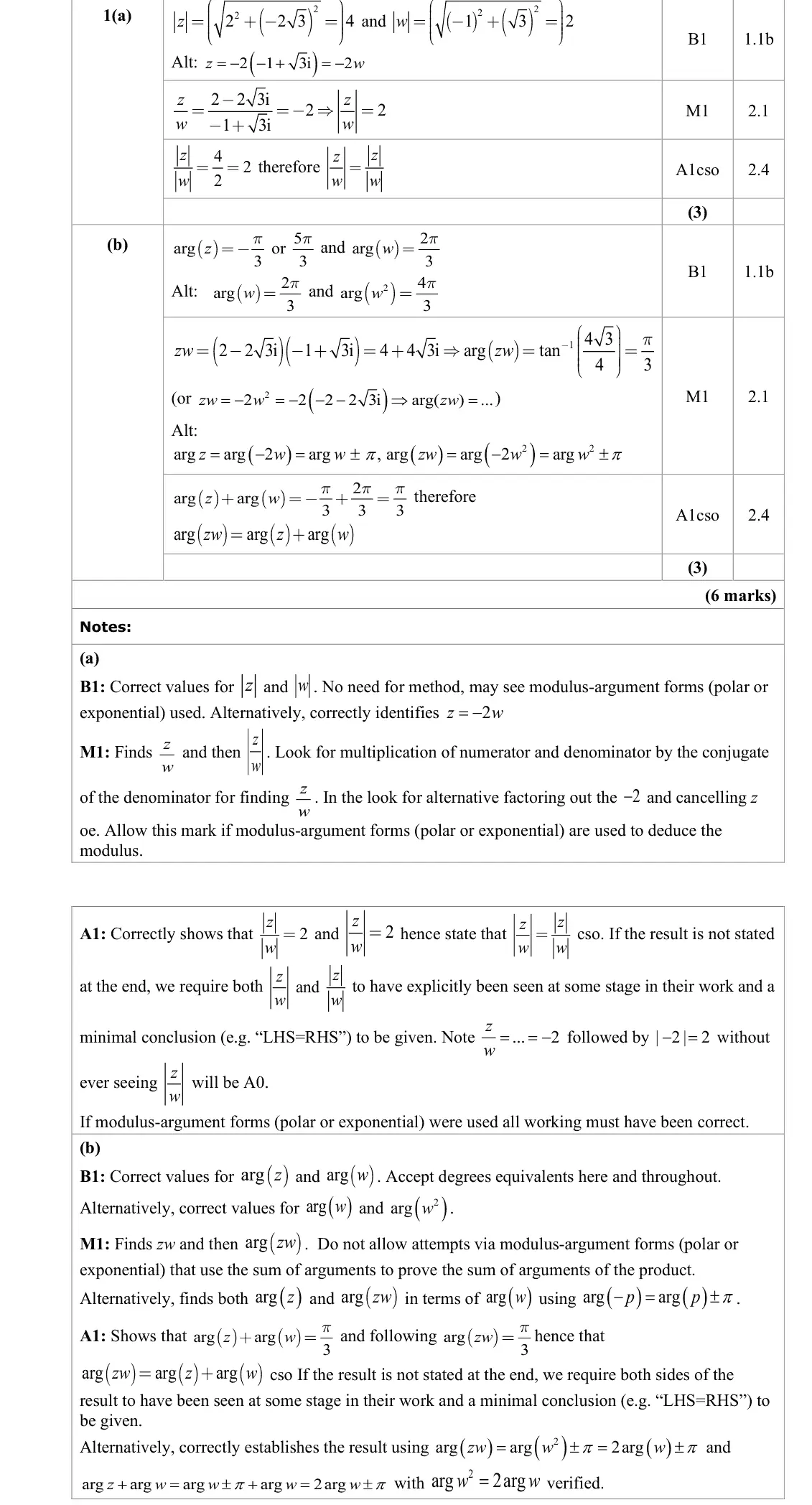
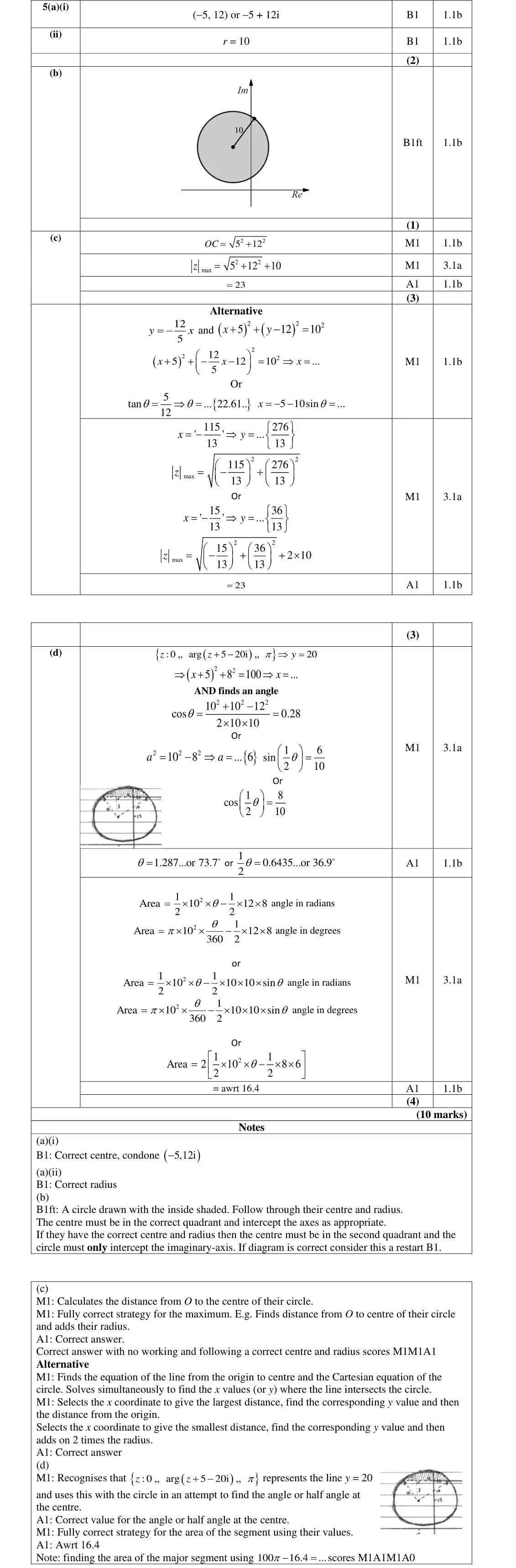
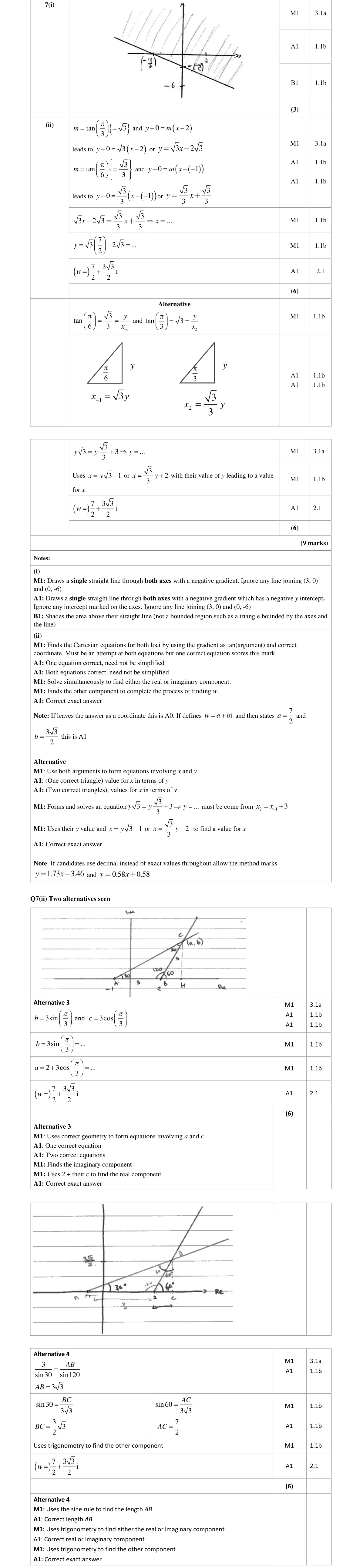
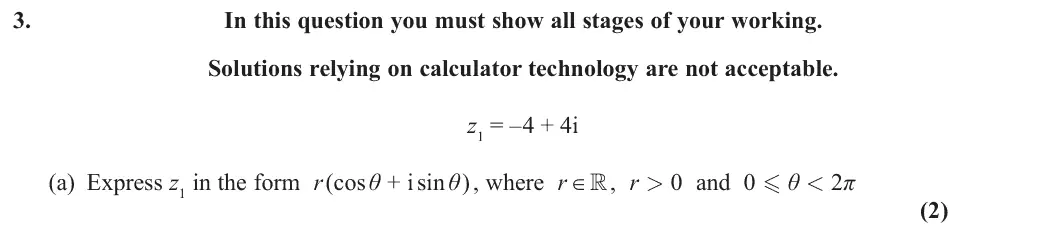
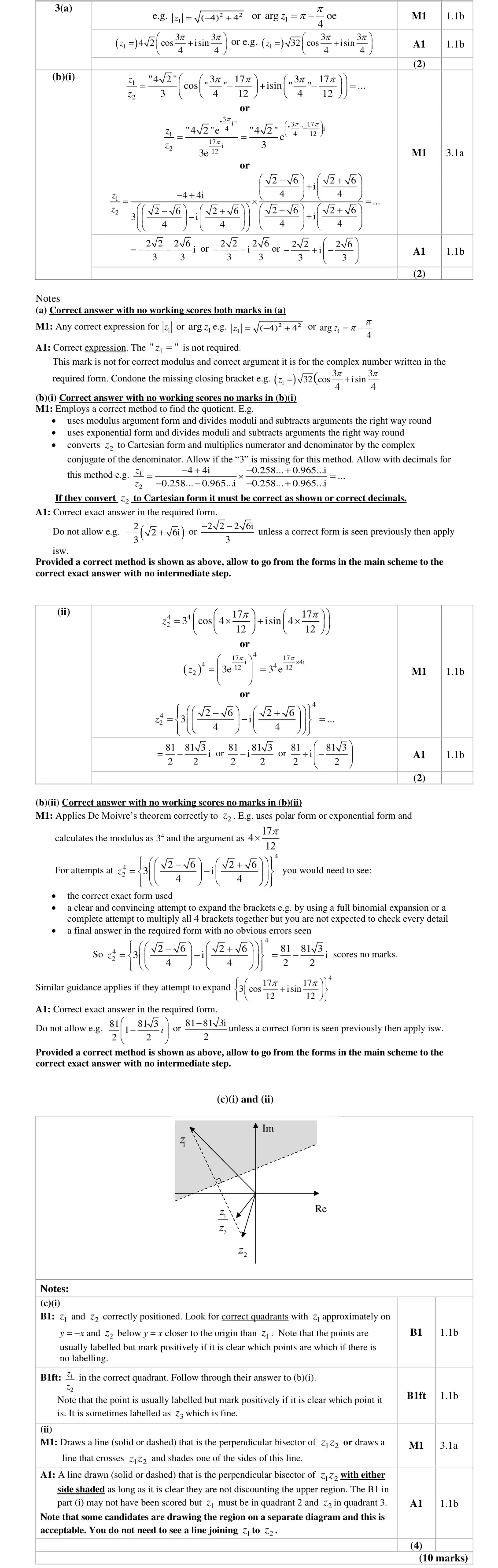
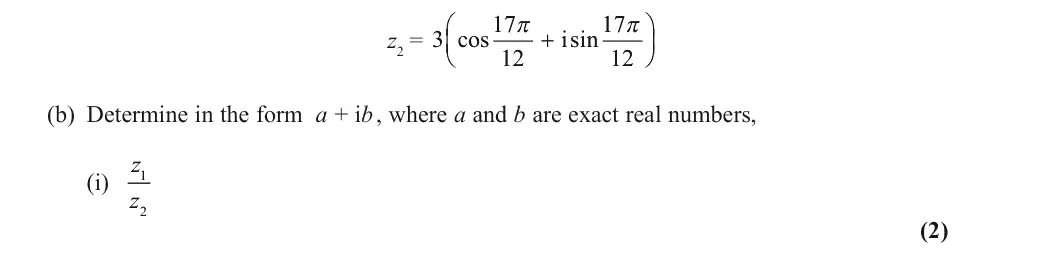
Mark scheme (whole question; this part is marked with the orange bar)
Examiner's comment
This question proved to be an accessible start to this paper with many fully correct solutions seen. In part (a), the methods for finding the modulus and the argument were well known. A common error seen was to incorrectly identify the correct angle to use for the argument. A diagram is always useful in this identification.
Key points from the mark scheme and examiner's report
Mark scheme (whole question; this part is marked with the orange bar)
Examiner's comment
Learners found this to be a challenging question with only a minority achieving full marks. Part (c) proved to be the most challenging. The use of geometry resulting from a clear diagram would have made solution more straightforward but many used the equation of a tangent, often incorrectly and so failed to make progress. Very few recognised that the second solution must be the complex conjugate (again, use of a clear diagram would have helped) and solved for two values of x. A common error was to find x + 1 and think this was the real part of the complex number required.
Key points from the mark scheme and examiner's report
tangent length √3: z = −1 + √3(cos π/6 ± i sin π/6) = 1/2 ± (√3/2)i
very few spotted the conjugate second solution
June 2025 · Paper 2 (Core Pure 2) · Q1(b)3 marks
Mark scheme (whole question; this part is marked with the orange bar)
Examiner's comment
It was similar in part (b) except in that the scheme was less forgiving for the circular reasoning via modulus-argument forms in this part, which even more clearly were simply adding the arguments to find the new argument before concluding it was the sum. Such attempts could score at best just the initial mark for identifying the correct arguments of z and w. The first B mark was less secure in this part than in part (a) as well, as some candidates had
Key points from the mark scheme and examiner's report
arg z = −π/3, arg w = 2π/3
expand zw = 4 + 4√3i so arg(zw) = π/3 = sum
using mod-arg forms that add arguments is circular and scored at most B1
June 2024 · AS Paper 1 (Core Pure) · Q5(c)3 marks
Mark scheme (whole question; this part is marked with the orange bar)
Examiner's comment
In part (c), the majority of the cohort recognised the point on the circle at which the maximum value of z occurs and thus found the correct distance of 23. Although the vast majority of candidates added the radius to the distance from the origin to the centre of the circle, some candidates found the coordinates of the required point on the circle which, although involving more work, is a perfectly acceptable method.
Key points from the mark scheme and examiner's report
max modulus = distance to centre + radius = 13 + 10 = 23
June 2024 · Paper 2 (Core Pure 2) · Q7(c)2 marks
Mark scheme (whole question; this part is marked with the orange bar)
Examiner's comment
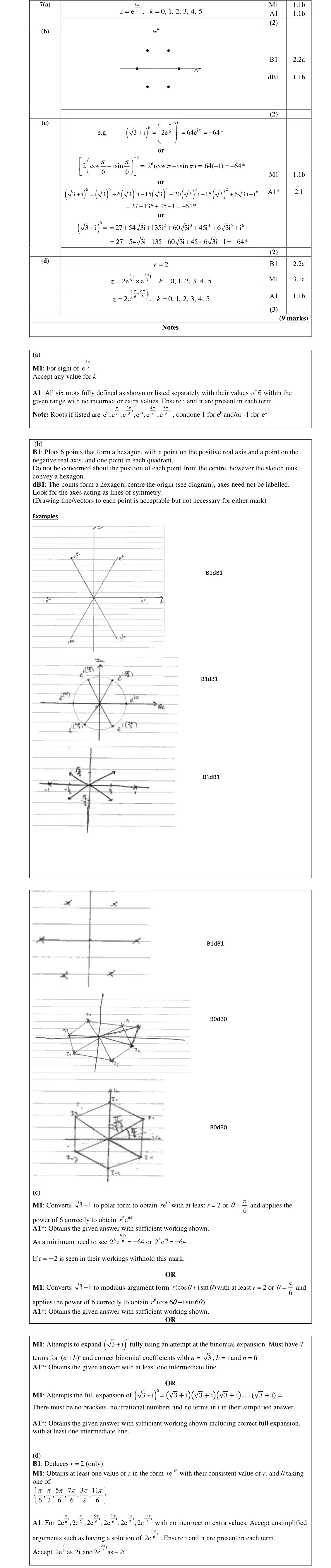
(c) There were various allowable approaches. Writing the complex number in polar and/or exponential form was the most straight forward and most successful, and many candidates gave clear concise solutions. Another approach was to expand the brackets which was time consuming and sometimes resulted in algebraic errors. Those who used a binomial expansion were slightly quicker and made less errors. However, many fully correct solutions were provided using both of these methods.
Key points from the mark scheme and examiner's report
√3 + i = 2e^(iπ/6), so 2⁶e^(iπ) = −64 (de Moivre)
binomial expansion also accepted
June 2023 · AS Paper 1 (Core Pure) · Q4(i)(b)1 mark
Mark scheme (whole question; this part is marked with the orange bar)
Examiner's comment
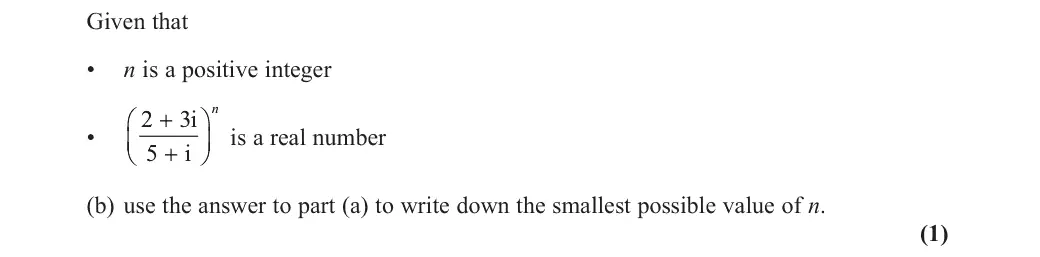
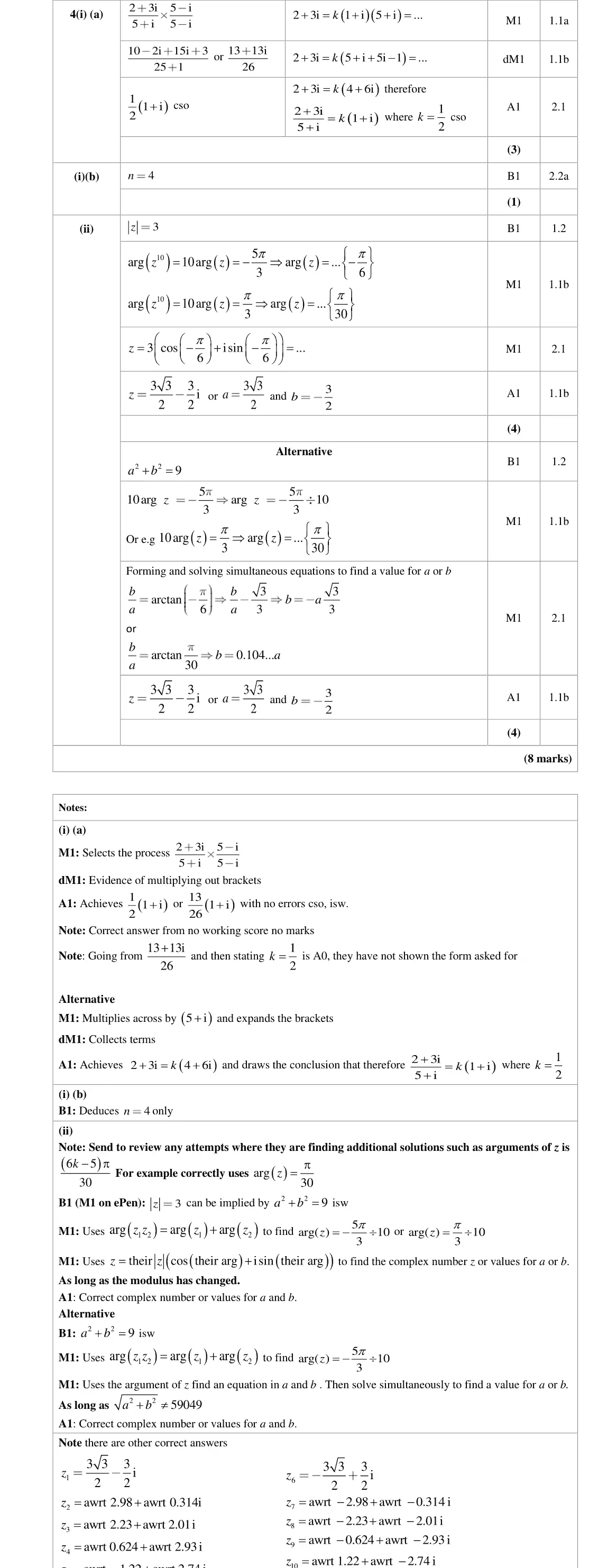
This question enabled all students to access some part of the question whilst also providing challenge to the more able. In (i) part (a), this was generally answered very well with the majority of candidates achieving full marks. The common errors that did occur were usually either the incorrect denominator - = 2 25 i 24 or students not giving the answer in the correct form. Occasionally we saw some state the correct answer but without the working to demonstrate their understanding and thus, lost marks. In (i) part (b), most candidates realised that they could use trial and error, there were lots of students who calculated this by hand instead of using the calculator. Frequent incorrect answers n = 0 were which almost satisfies the demand of the question except it is not a positive integer, n = 2 or . (ii) This proved a very challenging question for most students. Many blank or no scoring attempts were seen however a good number of students were able to gain the first mark from z = + = 3 2 2 a b 9 either or and whilst it was certainly less common for them to able to deal with the argument correctly some did go on to achieve the second M for a valid attempt to find 3 3 3 b = a = the complex number, with an incorrect argument generally leading to and . For 2 2 those who did manage to correctly identify the modulus and argument they nearly always went on to achieve a correct answer, with the occasional loss of sign on the real part. ( ) 10 = + 10 z a i b Other incorrect attempts involved attempts at expanding
Key points from the mark scheme and examiner's report
arg(1 + i) = π/4 so nπ/4 must be a multiple of π: n = 4
June 2023 · AS Paper 1 (Core Pure) · Q4(ii)4 marks
Mark scheme (whole question; this part is marked with the orange bar)
Examiner's comment
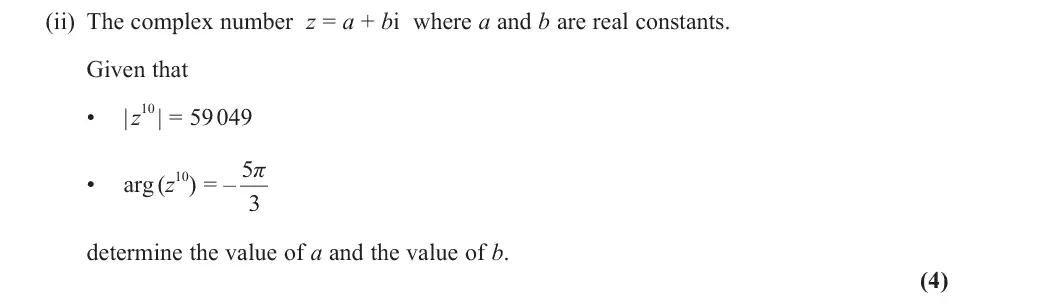
This question enabled all students to access some part of the question whilst also providing challenge to the more able. In (i) part (a), this was generally answered very well with the majority of candidates achieving full marks. The common errors that did occur were usually either the incorrect denominator - = 2 25 i 24 or students not giving the answer in the correct form. Occasionally we saw some state the correct answer but without the working to demonstrate their understanding and thus, lost marks. In (i) part (b), most candidates realised that they could use trial and error, there were lots of students who calculated this by hand instead of using the calculator. Frequent incorrect answers n = 0 were which almost satisfies the demand of the question except it is not a positive integer, n = 2 or . (ii) This proved a very challenging question for most students. Many blank or no scoring attempts were seen however a good number of students were able to gain the first mark from z = + = 3 2 2 a b 9 either or and whilst it was certainly less common for them to able to deal with the argument correctly some did go on to achieve the second M for a valid attempt to find 3 3 3 b = a = the complex number, with an incorrect argument generally leading to and . For 2 2 those who did manage to correctly identify the modulus and argument they nearly always went on to achieve a correct answer, with the occasional loss of sign on the real part. ( ) 10 = + 10 z a i b Other incorrect attempts involved attempts at expanding
Key points from the mark scheme and examiner's report
modulus of z = 59049^(1/10) = 3
arg z = −π/6 (from −5π/3 ÷ 10)
z = 3√3/2 − (3/2)i (other arguments differing by 2π/10 also valid)
June 2023 · AS Paper 1 (Core Pure) · Q7(ii)6 marks
Mark scheme (whole question; this part is marked with the orange bar)
Examiner's comment
In part (a), the first part of this question was well done overall, with the best solutions coming from candidates who drew a scale drawing of the perpendicular bisector required. It was necessary for equal scales on both axes to ensure that the y-intercept was negative. Quite a few went to the trouble of calculating the exact equation of the line and then drew it correctly, not required for the marks in this case. Shading the correct side of the line caused a few more difficulties with some not knowing how to decide which side to shade. Occasionally the shading was bounded which cost them the final mark. In part (b), using the argument to find the gradient of each line proved quite challenging for some in this part of the question. If the correct Cartesian equations of both lines were found, then a correct solution for w usually followed. M0A0A0M1M1A0 was a fairly common mark trait as the demand of the final Ms was simply simultaneously equating their two lines and solving to reach w. Some very good diagrams allowed some candidates to use basic trigonometry to reach the correct complex number from a very neat geometric approach, although this was not seen often it was usually correct providing the real length had been dealt with correctly. It is clear that not all students have a sound enough understanding of what the argument of a complex number actually represents.
Key points from the mark scheme and examiner's report
half-lines y = √3(x − 2) and y = (√3/3)(x + 1)
solve: w = 7/2 + (3√3/2)i
answer as a coordinate scores A0
June 2023 · Paper 1 (Core Pure 1) · Q3(a)2 marks
Mark scheme (whole question; this part is marked with the orange bar)
Examiner's comment
Part (a) was mainly answered correctly with most candidates writing the modulus as 4 sqrt 2 and the However, some gave an argument in an incorrect quadrant such as argument as 3 . or 7 - . 4 4 4
Key points from the mark scheme and examiner's report
modulus 4√2, argument 3π/4
arguments in the wrong quadrant (π/4, −3π/4) were the common error
June 2023 · Paper 1 (Core Pure 1) · Q3(b)(i)2 marks
Mark scheme (whole question; this part is marked with the orange bar)
Examiner's comment
In part (b), correct answers only with no working scored no marks because the candidates were required to show all stages of their working and not rely on calculator technology. A few candidates did not heed these warnings but generally sufficient working was shown. In part (i), most candidates 𝑧1 found 𝑧2 by dividing the modulii and subtracting the arguments. Those that tried to divide the two complex numbers in Cartesian form, often failed to show sufficient working and resorted to using a calculator or could not negotiate the processing required to achieve an answer in the required exact form. In part (ii) most candidates attempted to apply de Moivre’s Theorem correctly. Candidates knew to raise the power of the modulus and multiply the argument by 4. There were some failed attempts to write their answer in the required form. Candidates who were most successful in part (b) often resorted to writing the complex numbers in exponential form. 𝑧1 quadrant. Of those who did not give the required forms in part (b), some also positioned 𝑧2 in an incorrect quadrant. In part (ii) quite a number of candidates did not draw a line or have any shading to indicate the region required. A few realised that a perpendicular bisector was required but failed to do any shading. Others drew a line across z1z2 but it was not a perpendicular bisector. For those who did identify the perpendicular bisector, very few specified which side they believed to be the required area. Only a small number of responses were seen where the wrong side was clearly stated. Incorrect areas included areas between arcs from z1 and z2 and wedge-shaped areas between the lines from the origin to the points in their diagram.
Key points from the mark scheme and examiner's report
divide moduli and subtract arguments: (4√2/3)(cos(−2π/3) + i sin(−2π/3)) = −2√2/3 − (2√6/3)i
answer with no working scores 0
Cartesian division often fell back on a calculator
June 2023 · Paper 1 (Core Pure 1) · Q3(b)(ii)2 marks
Mark scheme (whole question; this part is marked with the orange bar)
Examiner's comment
Part (a) was mainly answered correctly with most candidates writing the modulus as 4 sqrt 2 and the However, some gave an argument in an incorrect quadrant such as argument as 3 . or 7 - . 4 4 4 In part (b), correct answers only with no working scored no marks because the candidates were required to show all stages of their working and not rely on calculator technology. A few candidates did not heed these warnings but generally sufficient working was shown. In part (i), most candidates 𝑧1 found 𝑧2 by dividing the modulii and subtracting the arguments. Those that tried to divide the two complex numbers in Cartesian form, often failed to show sufficient working and resorted to using a calculator or could not negotiate the processing required to achieve an answer in the required exact form. In part (ii) most candidates attempted to apply de Moivre’s Theorem correctly. Candidates knew to raise the power of the modulus and multiply the argument by 4. There were some failed attempts to write their answer in the required form. Candidates who were most successful in part (b) often resorted to writing the complex numbers in exponential form. In part (c), around one third of candidates scored full marks. Axes were sometimes poorly drawn and in some cases z1 and z2 appeared to be equidistant from O or z2 was wrongly positioned within the 𝑧1 quadrant. Of those who did not give the required forms in part (b), some also positioned 𝑧2 in an incorrect quadrant. In part (ii) quite a number of candidates did not draw a line or have any shading to indicate the region required. A few realised that a perpendicular bisector was required but failed to do any shading. Others drew a line across z1z2 but it was not a perpendicular bisector. For those who did identify the perpendicular bisector, very few specified which side they believed to be the required area. Only a small number of responses were seen where the wrong side was clearly stated. Incorrect areas included areas between arcs from z1 and z2 and wedge-shaped areas between the lines from the origin to the points in their diagram.
Key points from the mark scheme and examiner's report
de Moivre: 3⁴ and 4 × 17π/12: 81/2 − (81√3/2)i
answer with no working scores 0
June 2023 · Paper 4A (Further Pure 2) · Q67 marks
Mark scheme (whole question; this part is marked with the orange bar)
Examiner's comment
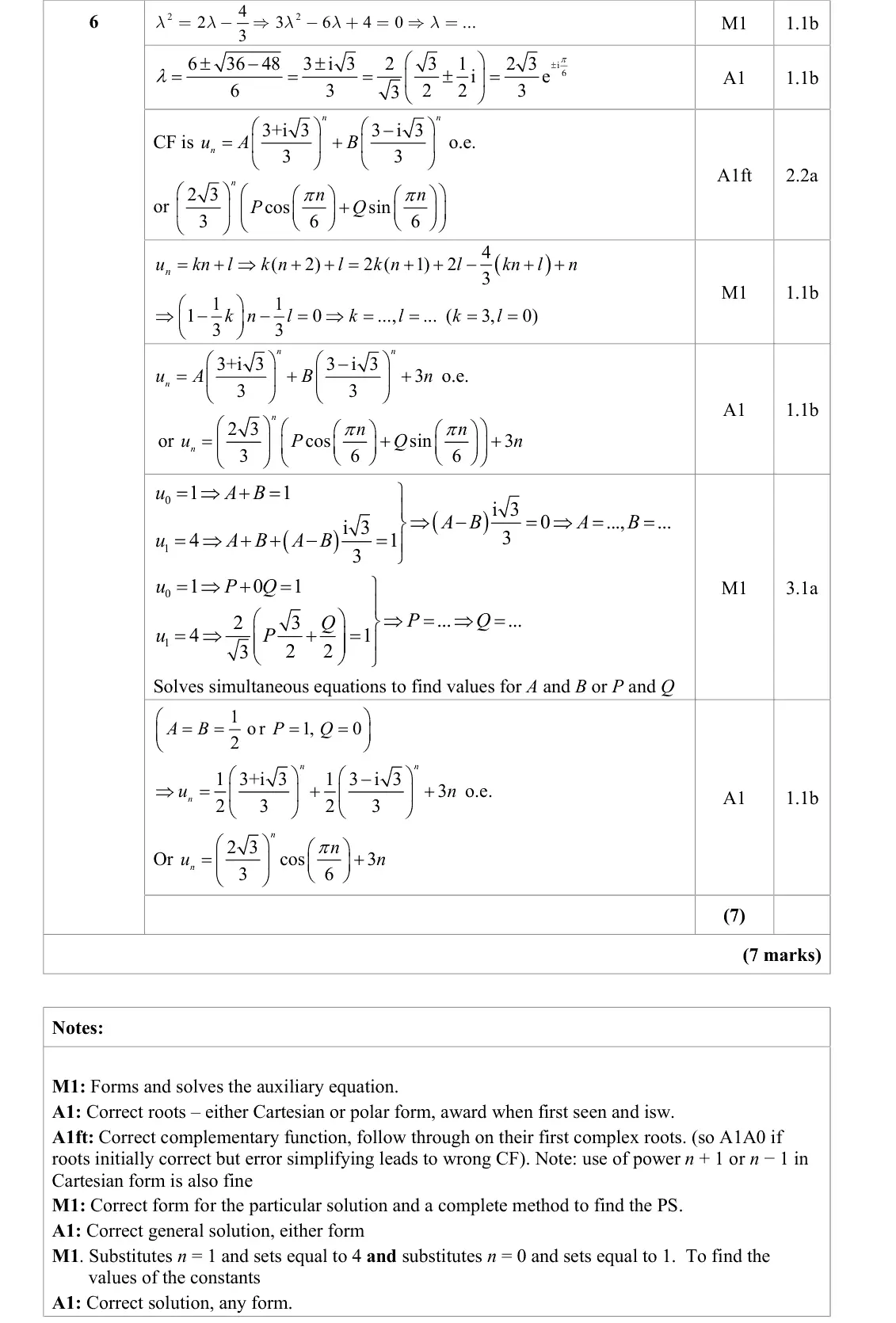
The majority of candidates knew how to find the closed form for a recurrence relation. They were able to form and solve the auxiliary equation. Then wrote down the correct general solution either the Cartesian or polar form. There were some errors with the particular solution, candidates need to use the form nu n = + , some incorrectly used nu n = . Candidates then used 0 1 u = and 1 4 u = to find the values of the constants. There were some numerical slips but the correct method was used.
Key points from the mark scheme and examiner's report
Mark scheme (whole question; this part is marked with the orange bar)
Examiner's comment
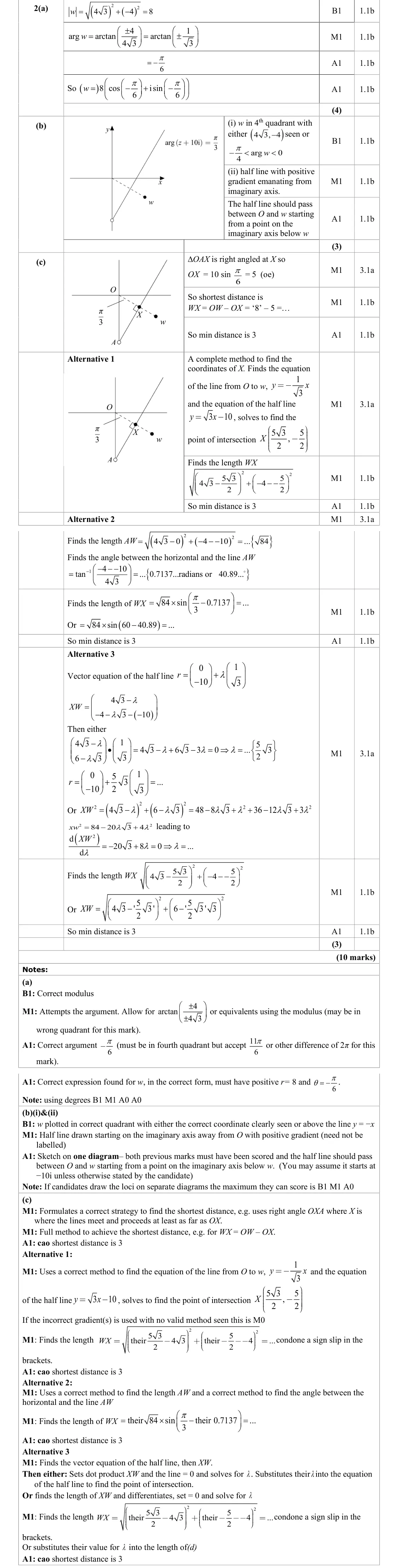
Both parts (a) and (b) of this question proved to be very accessible to the vast majority of candidates, but the geometrical aspects of (c) caused significant problems for a similar majority who were unable to go on and score any marks at the end of this early question in the paper. In (a), the majority of candidates were able to correctly find both w and arg w , with occasional errors creeping in both. For w it was most common to see 2 7 found from incorrectly squaring 4 3 . Forarg w degrees were relatively rare, with the most common error to not recognise that the w lies in the fourth quadrant. The success rate for those that drew an Argand diagram first was significantly higher, and it had the added benefit that they would score the first mark in (b) immediately as well. Occasionally 11 arg 6 w pi = was seen, note the question stated - pi < theta < pi , and generally only lost the final mark because 6 pi - had already been seen. Unfortunately, a number of candidates lost the final mark because they did not give their answer in the required form, ( ) cos isin r theta + theta ,instead dealing with the negative in the argument and just writing down 8 cos isin 6 6 pi pi - . We were able to ignore subsequence work for those who had already written down the correct answer.
Key points from the mark scheme and examiner's report
modulus 8 (√(48 + 16))
w is in the fourth quadrant so arg = −π/6
w = 8(cos(−π/6) + i sin(−π/6))
an Argand sketch helps
June 2022 · AS Paper 1 (Core Pure) · Q2(c)3 marks
Mark scheme (whole question; this part is marked with the orange bar)
Examiner's comment
In (c), the majority of candidates that were successful identified that the line Ow met the half- line at a right angled and proceeded to attempt to use coordinate geometry techniques to solve simultaneous equations and then find the distance between w and this intersection point. The most significant problem encountered with this strategy was inaccurate use of gradients, which arose due to the use of trigonometry to find them. Candidates who had problems here generally scored M0M1A0, but some did have multiple attempts and eventually found the correct gradients and produced a correct solution. It was far less common to see more direct attempts using the main scheme, with many who tried this failing to identify the correct triangle to use or drawing multiple diagrams to no avail. That said, there were some excellent and concise solutions.
Key points from the mark scheme and examiner's report
OW is perpendicular to the half-line: OX = 10 sin(π/6) = 5, WX = 8 − 5 = 3
coordinate-geometry route prone to wrong gradients
June 2022 · Paper 2 (Core Pure 2) · Q1(a)2 marks
Mark scheme (whole question; this part is marked with the orange bar)
Examiner's comment
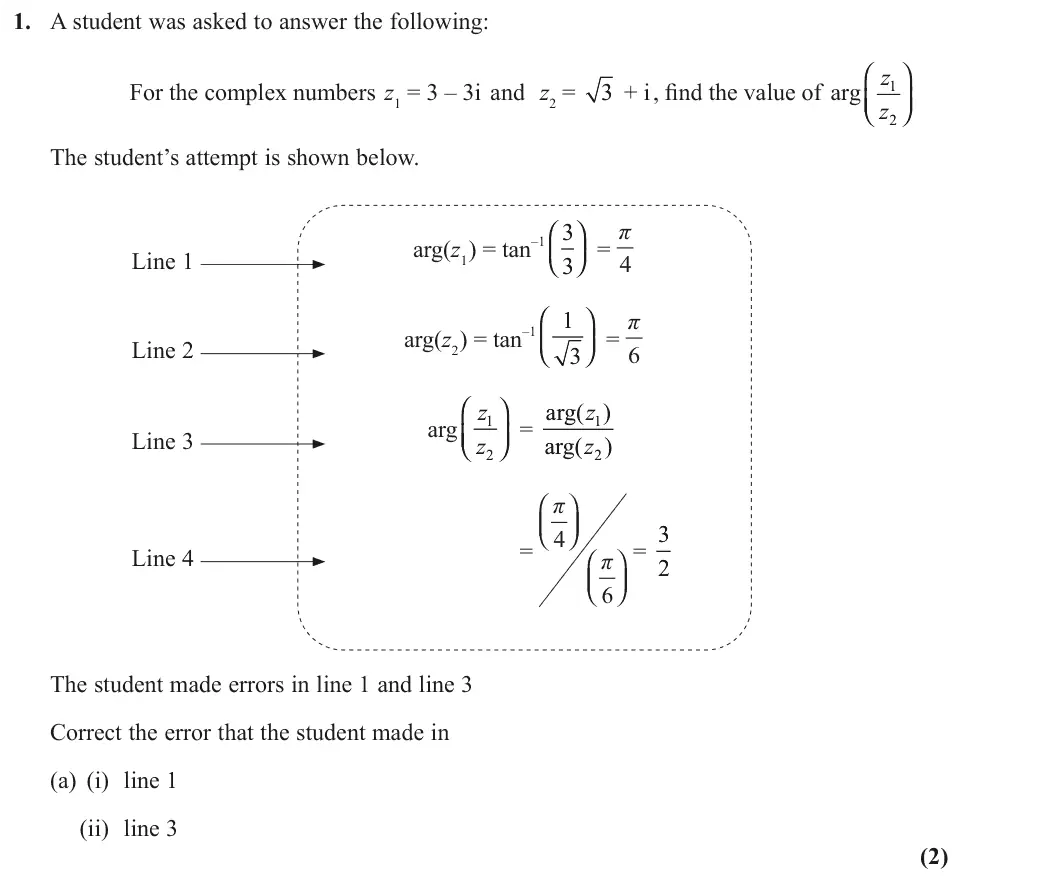
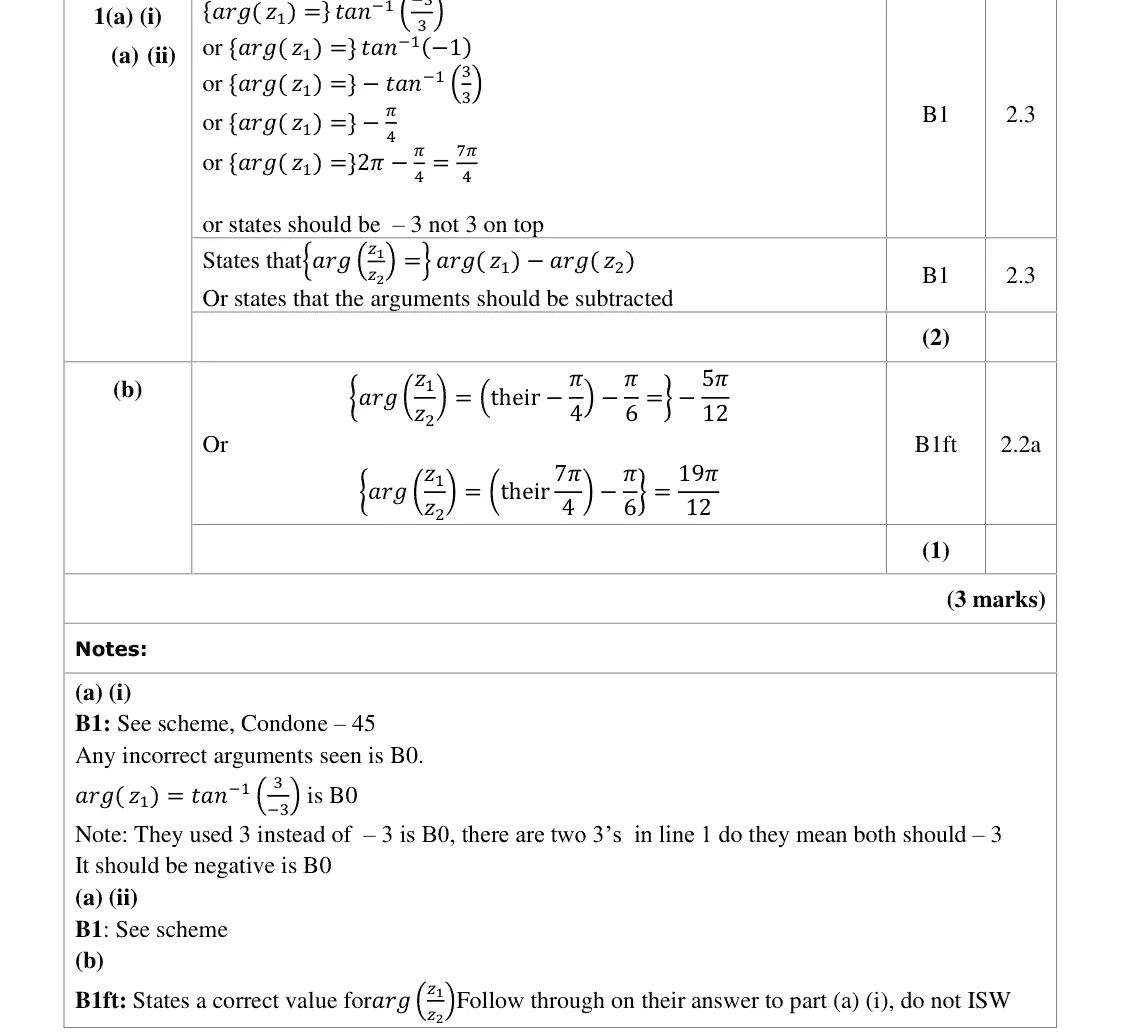
This question was generally well answered by most candidates and was a gentle lead into the entire paper. Part (a) (i) Those who drew diagrams to support understanding and working out were often rewarded with full marks. Some struggled to convey their thoughts mathematically, resorting to words rather than using notation (or just writing out the correct answer). While - 3 1 a few were incorrect in having or says that the 3 should be – 3 not specify which tan - 3 3, the vast majority got the mark eventually. Part (a) (ii) This was the poorest of the 3 parts. Many got the answer but there was a ( ) - arg z z significant minority who incorrectly wrote , but then recovered to get the 1 2 correct answer in part (b) showing they understood the idea, if not how to write it actually using the answer they got in part (a) to answer the question.
Key points from the mark scheme and examiner's report
(i) z₁ is in the 4th quadrant so arg z₁ = −π/4 (tan⁻¹(−3/3)), not π/4
(ii) arg(z₁/z₂) = arg z₁ − arg z₂, not a quotient of arguments
vague words without notation lost marks
June 2022 · Paper 2 (Core Pure 2) · Q1(b)1 mark
Mark scheme (whole question; this part is marked with the orange bar)
Examiner's comment
This question was generally well answered by most candidates and was a gentle lead into the entire paper. correct answer in part (b) showing they understood the idea, if not how to write it mathematically. The most common error for part (b) was missing negative signs, or not actually using the answer they got in part (a) to answer the question.
Key points from the mark scheme and examiner's report
−5π/12 (or 19π/12), follow through from (a)(i)
missing negative signs and not using their (a) were the common errors
June 2022 · Paper 2 (Core Pure 2) · Q4(i)3 marks
Mark scheme (whole question; this part is marked with the orange bar)
Examiner's comment
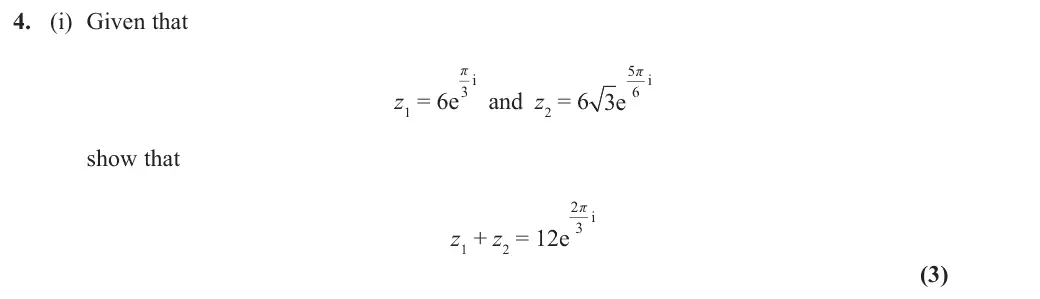
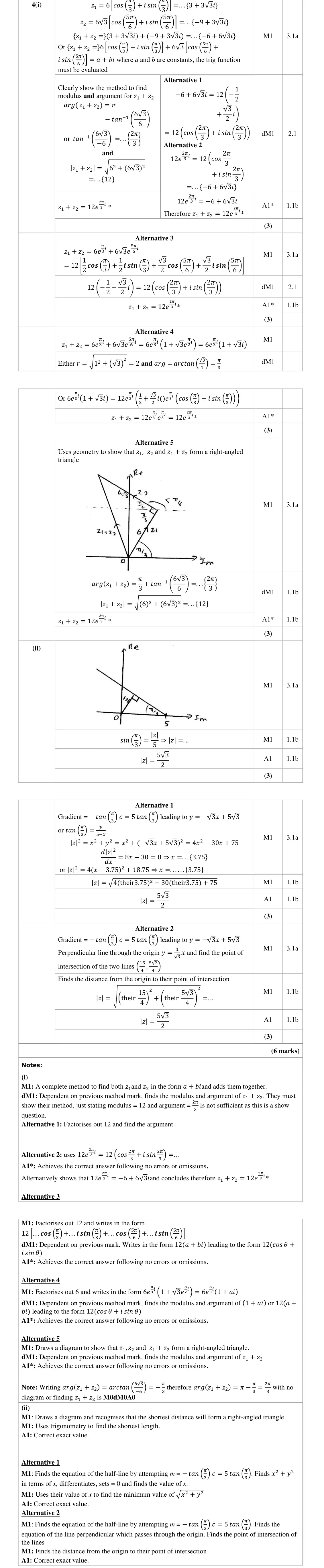
This complex number question saw a mixed response with part (b) proving fairly discriminating in particular. Most knew the sensible way forward in part (a) with the wide variety of viable alternatives rarely seen. However, having converted to a + ib form and adding, many students did not show their method to obtain the modulus and/or the argument, this is a show question. In part (b), students who produced a reasonable sketch usually went on to score all the marks. Most sketches seen were realistic with the half-line in the correct place. It was anticipated that simple right-angled trigonometry or Pythagoras would be the most likely ways forward from here. Most who opted for this were successful. Algebraic approaches were more mixed in quality. Those who chose to find the distance of the point of intersection of the two relevant lines to the origin were often correct but those embarking on a circuitous route requiring minimisation tended to fall short.
Key points from the mark scheme and examiner's report
convert both to a + bi and add: −6 + 6√3i
must show the modulus 12 and the argument 2π/3 (π − tan⁻¹ etc.), not just state them, as this is a show that
Nov 2021 · Paper 2 (Core Pure 2) · Q1(a)2 marks
Mark scheme (whole question; this part is marked with the orange bar)
Examiner's comment
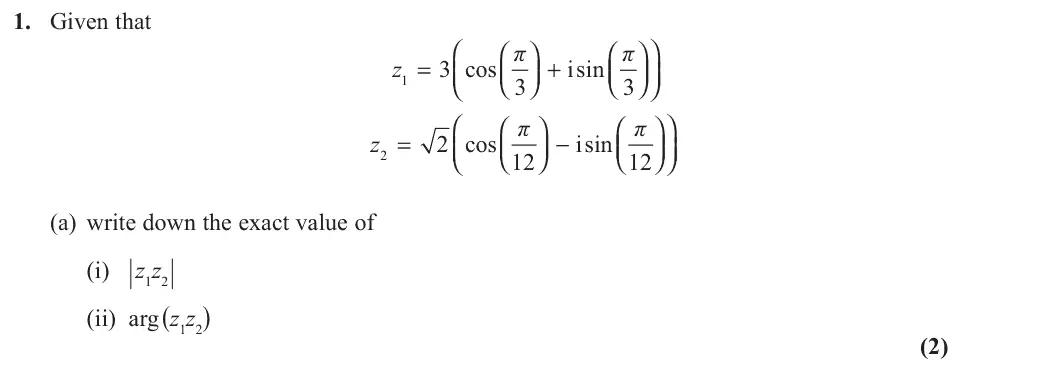
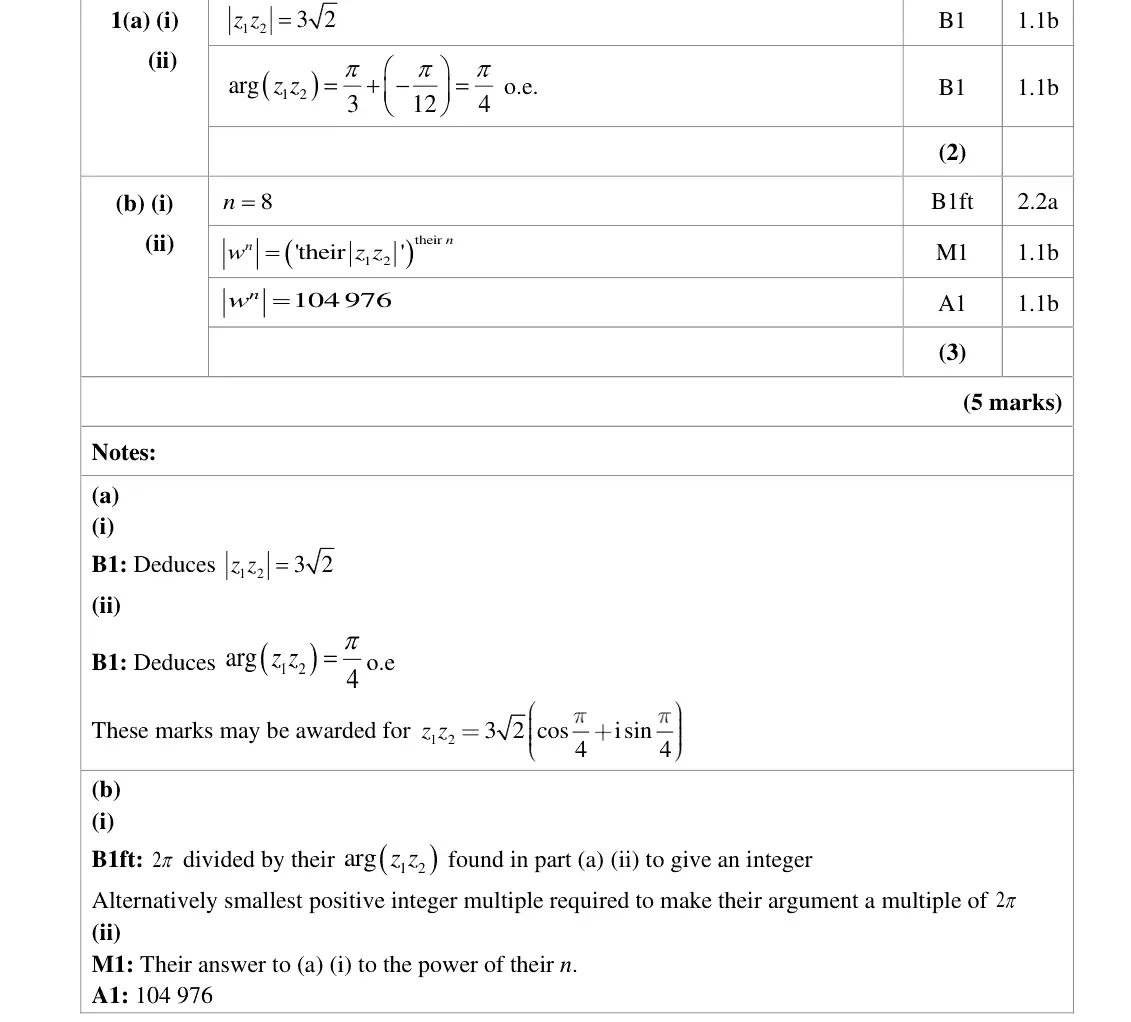
A gentle start to the paper, but it still had its pitfalls. Part (a) Candidates generally had no problem finding the modulus, most able to just write it down. However, the argument did produce errors, a large number thought that the argument of 2z 12 when it was 12 leading to an incorrect answer of 5 12 . Candidates are reminded to look out for the minus sign in 2 2 cos isin 12 12 z
Key points from the mark scheme and examiner's report
modulus of z₁z₂ = 3√2
arg = π/3 + (−π/12) = π/4
missing the minus sign in z₂ (argument −π/12) gives 5π/12
Nov 2021 · Paper 2 (Core Pure 2) · Q8(i)5 marks
Mark scheme (whole question; this part is marked with the orange bar)
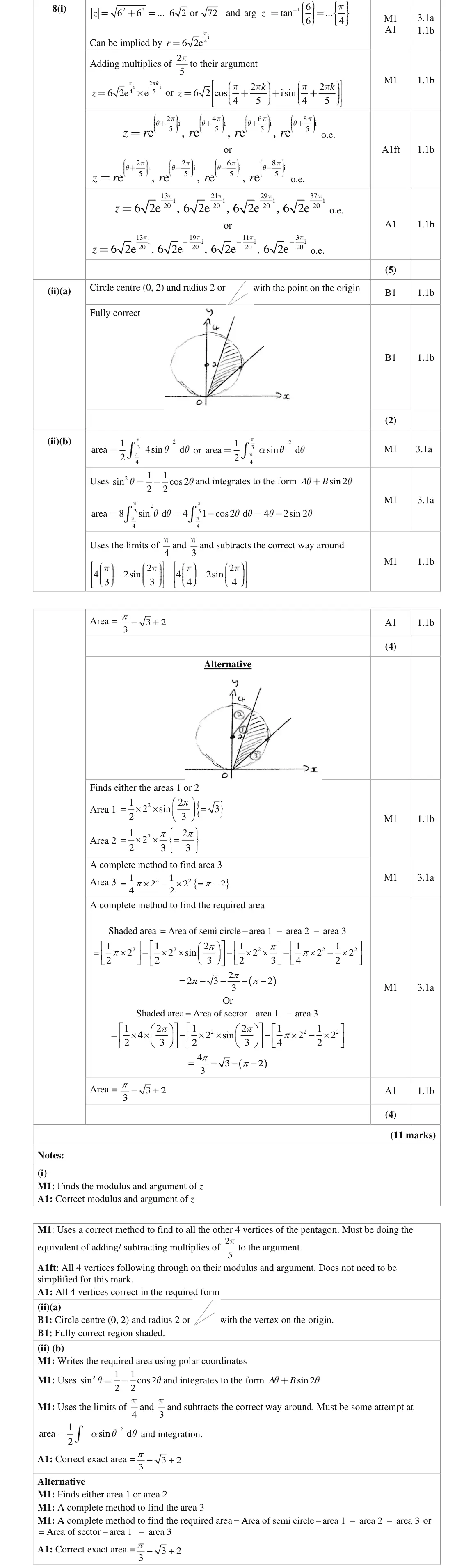
Examiner's comment
Part (i) Most candidates were able to correctly find the modulus and argument of 6 + 6i and a majority also realised that the angle at the center of a regular pentagon is 2 . They then either added or subtracted multiples 5 of 2 to their original argument to obtain the required arguments. Having 5 done this successfully a few candidates failed to give their final answer in the correct format. (ii) Part (a) Quite well done on the whole. Candidates recognised that a circle with centre on the y axis and passes through the origin but some candidates failed to indicate that the radius of the circle was 2. Candidates are reminded to indicate key coordinates on graphs. (ii) Part (b) This was well done by the majority of candidates by expressing the circle as a polar equation and finding the required area 4sin r between and . 4 3
Key points from the mark scheme and examiner's report
Mark scheme (whole question; this part is marked with the orange bar)
Examiner's comment
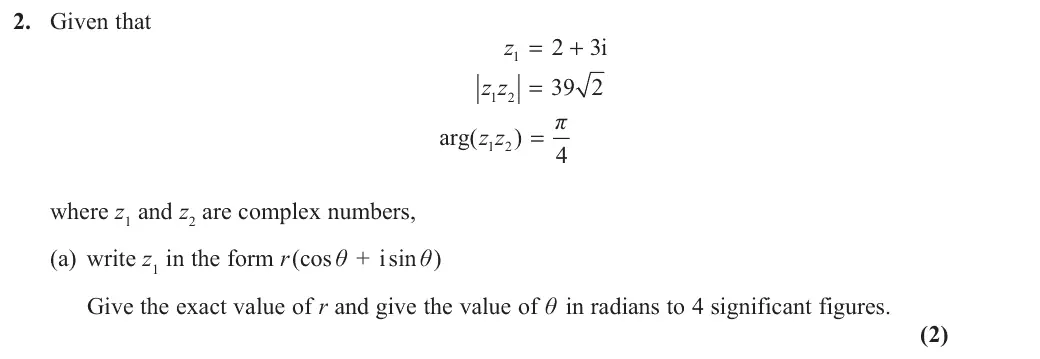
Part (a) on the whole was answered very well. Occasionally some students did not leave to 4sf as requested and a few surprising blank responses.
Key points from the mark scheme and examiner's report
modulus √13, argument arctan(3/2) = 0.9828
z₁ = √13(cos 0.9828 + i sin 0.9828)
4 s.f. required
Oct 2020 · AS Paper 1 (Core Pure) · Q2(b)6 marks
Mark scheme (whole question; this part is marked with the orange bar)
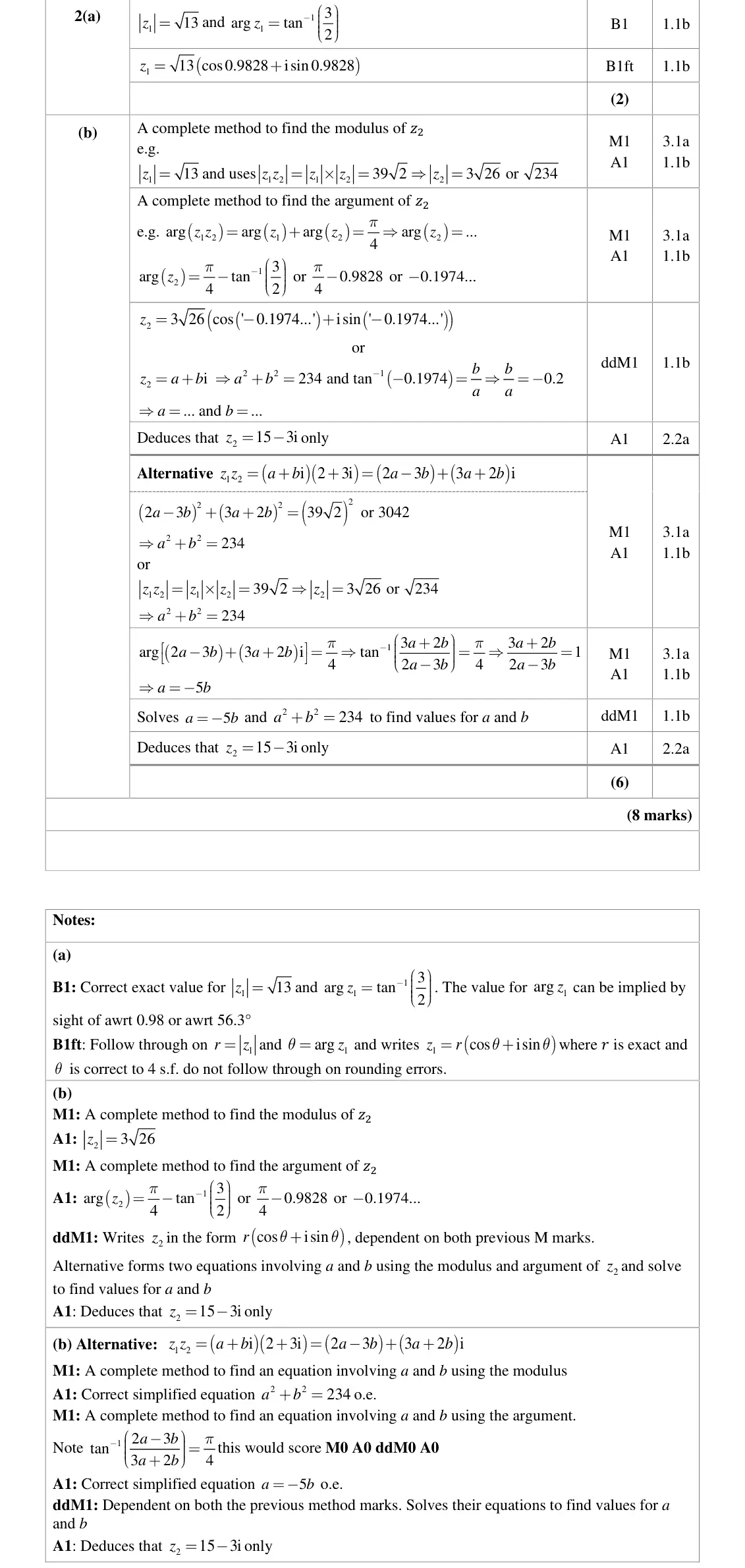
Examiner's comment
Part (b) was not as successful but still had good success overall. It often saw students using a mixture of the main scheme and the alternative. Few went for the most efficient direct root to the answer. Those that did were nearly always successful whilst those that used the alternative method often ended up with sign errors. Of those students who didn't come up with a full method in (b) they nearly always managed to find the correct modulus. z1 + z2 = 1 was an error that appeared a few times.
Key points from the mark scheme and examiner's report
modulus of z₂ = 39√2/√13 = 3√26
arg z₂ = π/4 − 0.9828 = −0.1974
z₂ = 15 − 3i
direct mod-arg route most efficient
a + bi route prone to sign errors
June 2019 · AS Paper 1 (Core Pure) · Q5(b)3 marks
Mark scheme (whole question; this part is marked with the orange bar)
Key points from the mark scheme and examiner's report
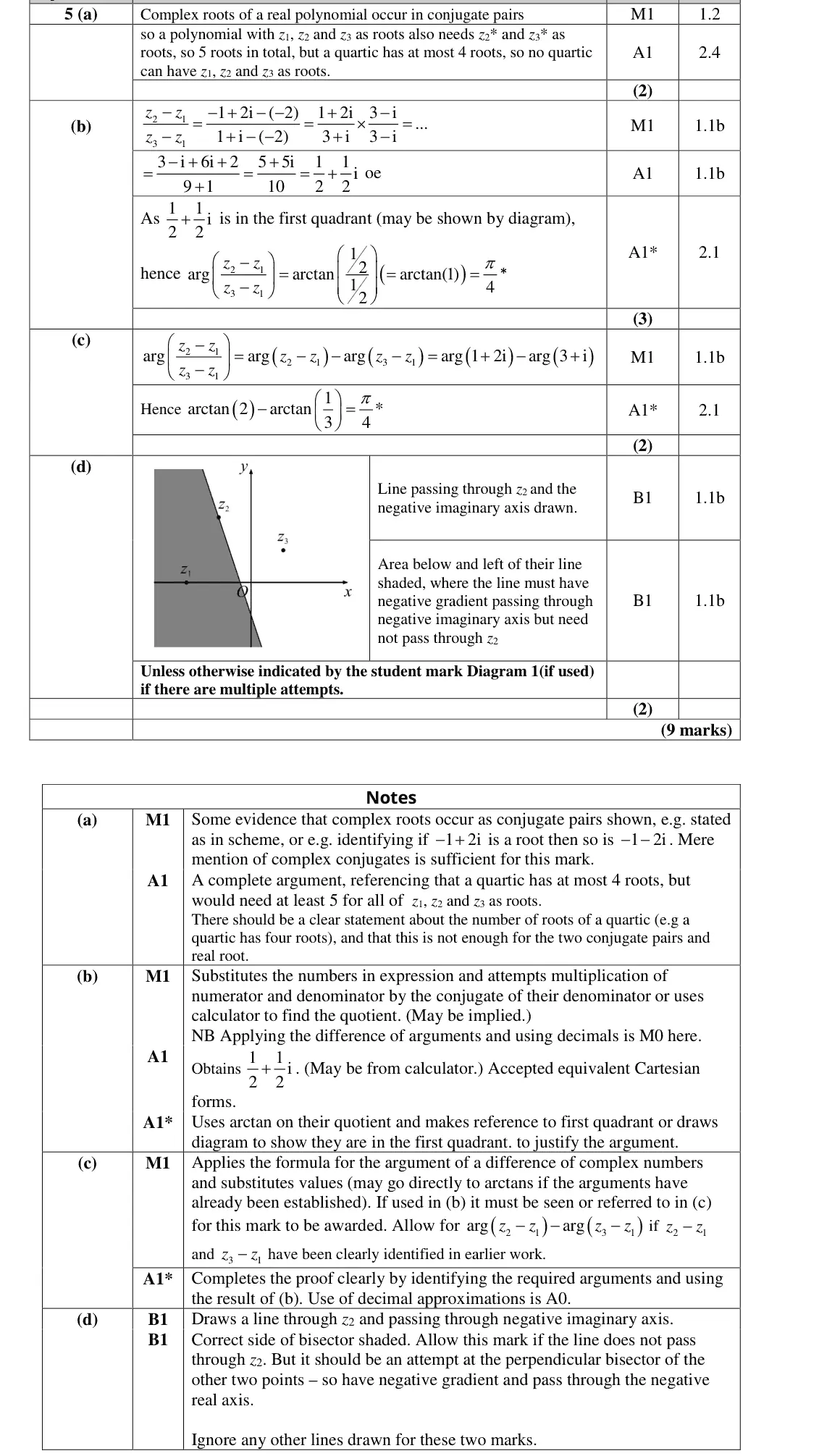
(1 + 2i)/(3 + i) = ½ + ½i, in the first quadrant so arg = arctan 1 = π/4
must justify the quadrant
decimal arguments score M0
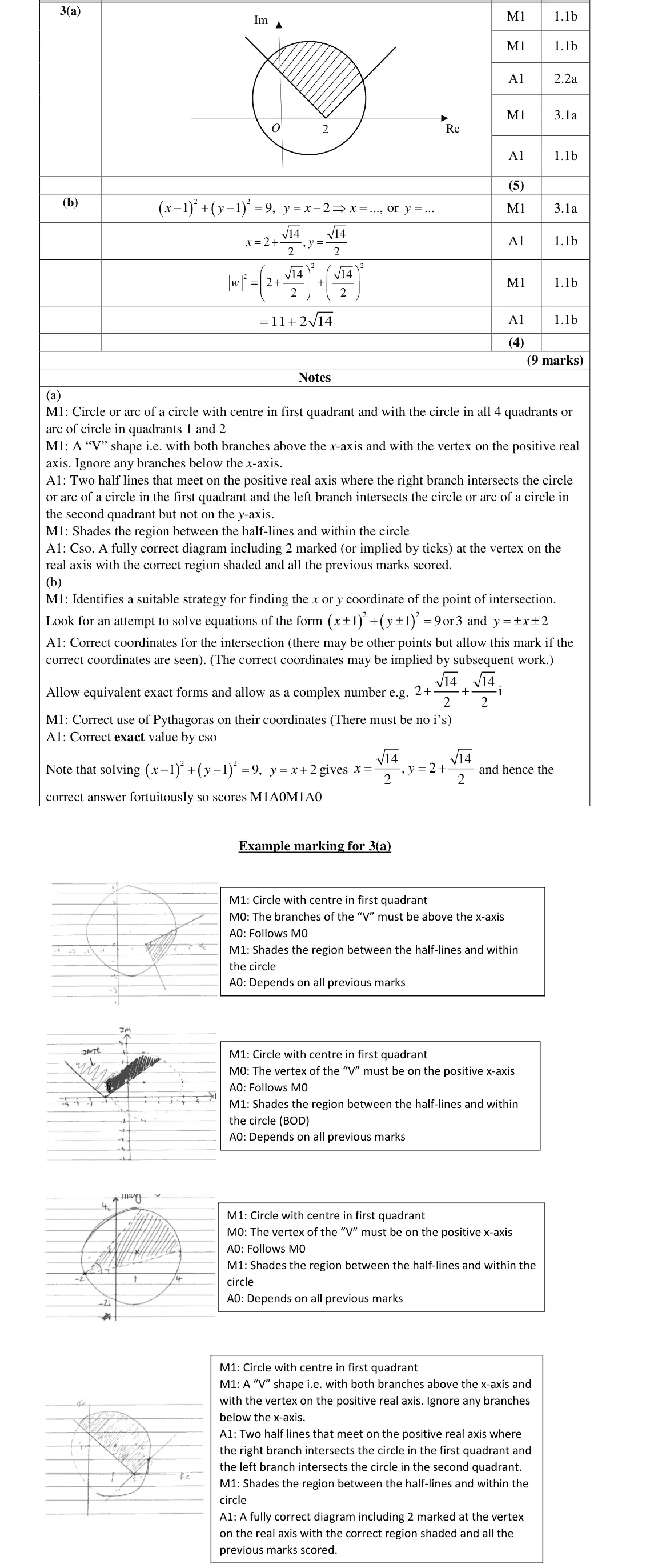
June 2018 · AS Paper 1 (Core Pure) · Q3(b)4 marks
Mark scheme (whole question; this part is marked with the orange bar)
Examiner's comment
(b) Proved much more challenging and many students did not know where to start. Those that were able to give the equation of the circle and equation of a half line gained the method marks by attempting to solve simultaneous equations and using the solutions correctly. Some students tried to work with the diagram and find the point of intersection by simple trigonometry but often made false assumptions when doing so. A few considered the triangle with vertices at (2, 0), the centre of the circle and the point of intersection, correctly calculating the sides as sqrt 2 , 3 and sqrt 7. They were then able to get the point of intersection from trigonometry. A few students left their answer as a decimal rather than a surd.
Key points from the mark scheme and examiner's report
solve (x − 1)² + (y − 1)² = 9 with y = x − 2
x = 2 + √14/2, y = √14/2
modulus squared = 11 + 2√14
many did not know where to start
Find an Edexcel Further Maths tutor
Stuck on this? Book a trial lesson with our Further Maths tutor.