June 2019: AS Paper 27: Decision Mathematics 1

40 marks · 14 question parts · Question paper, mark scheme and examiner's report on Pearson's site

Question by question

QTopicMarksDifficulty
1(a) Algorithms, sorting, bin packing and graph theory 1 —
1(b) Algorithms, sorting, bin packing and graph theory 3 —
1(c) Algorithms, sorting, bin packing and graph theory 2 —
2(a) Algorithms, sorting, bin packing and graph theory 4 —
2(b) Algorithms, sorting, bin packing and graph theory 3 —
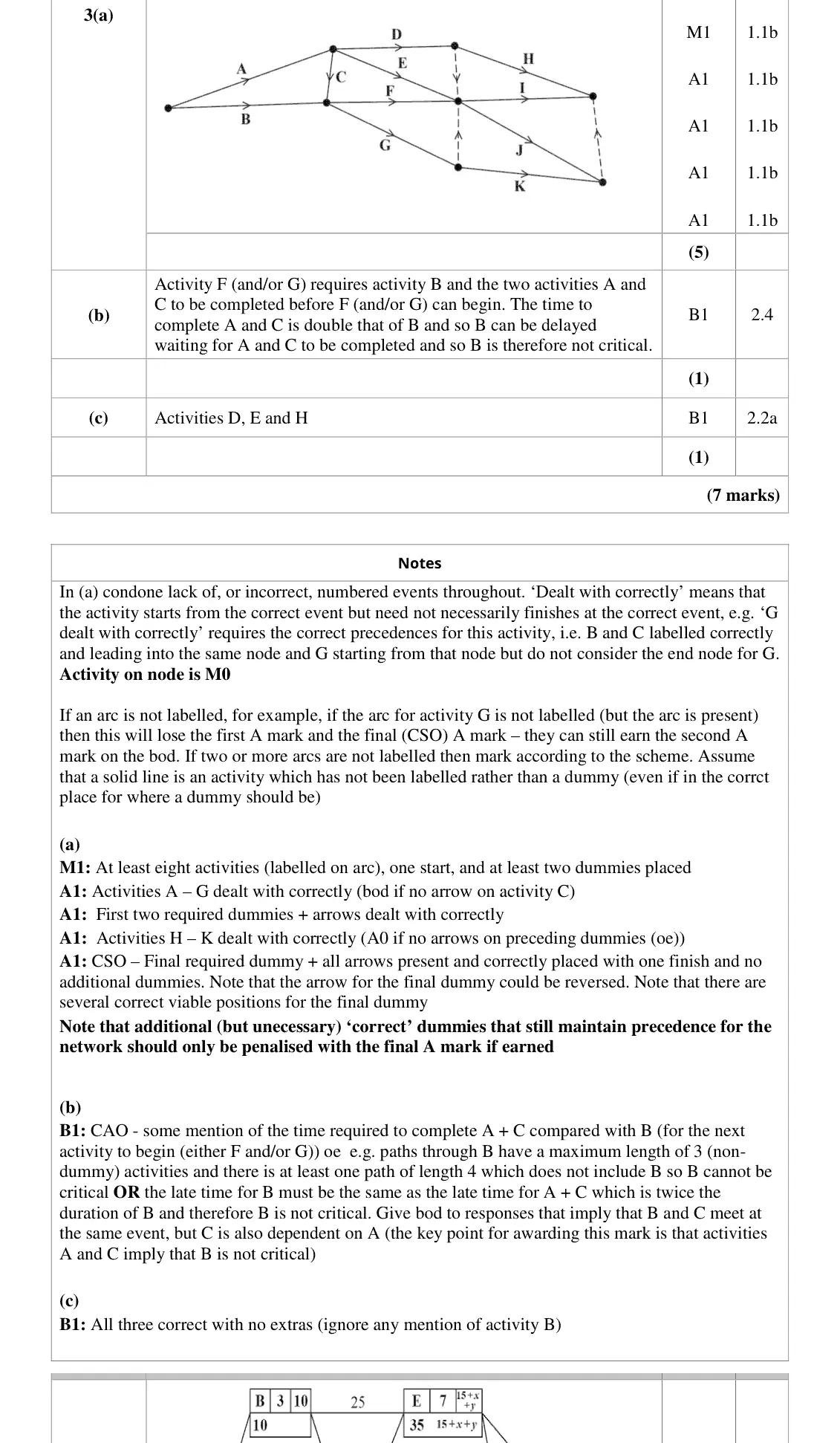
3(a) Critical path analysis 5 —
3(b) Critical path analysis 1 —
3(c) Critical path analysis 1 —
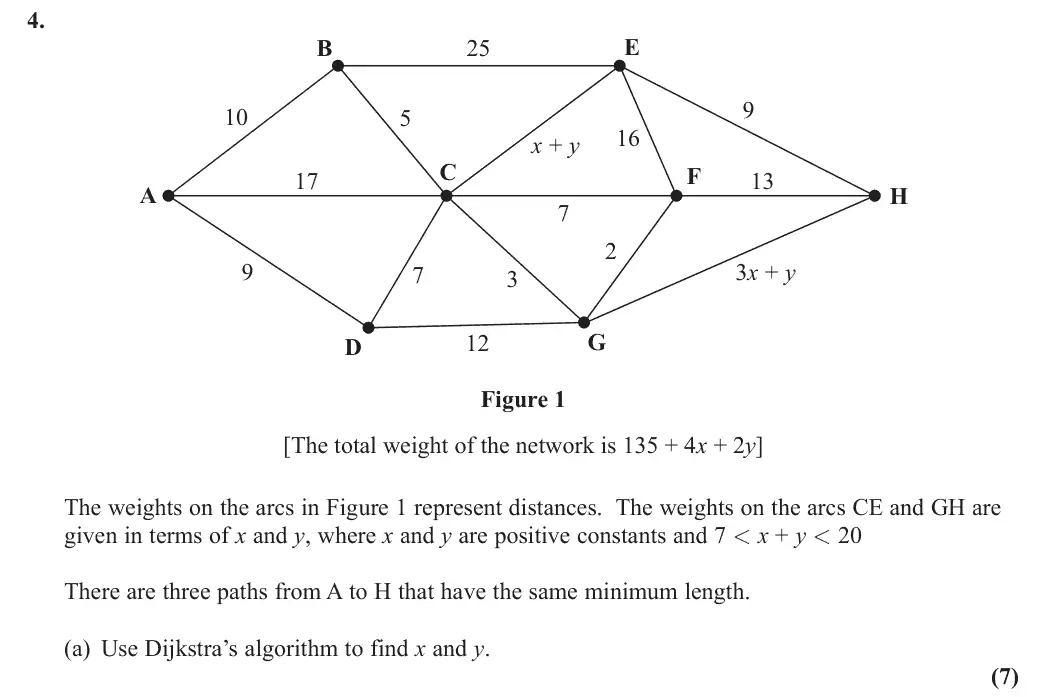
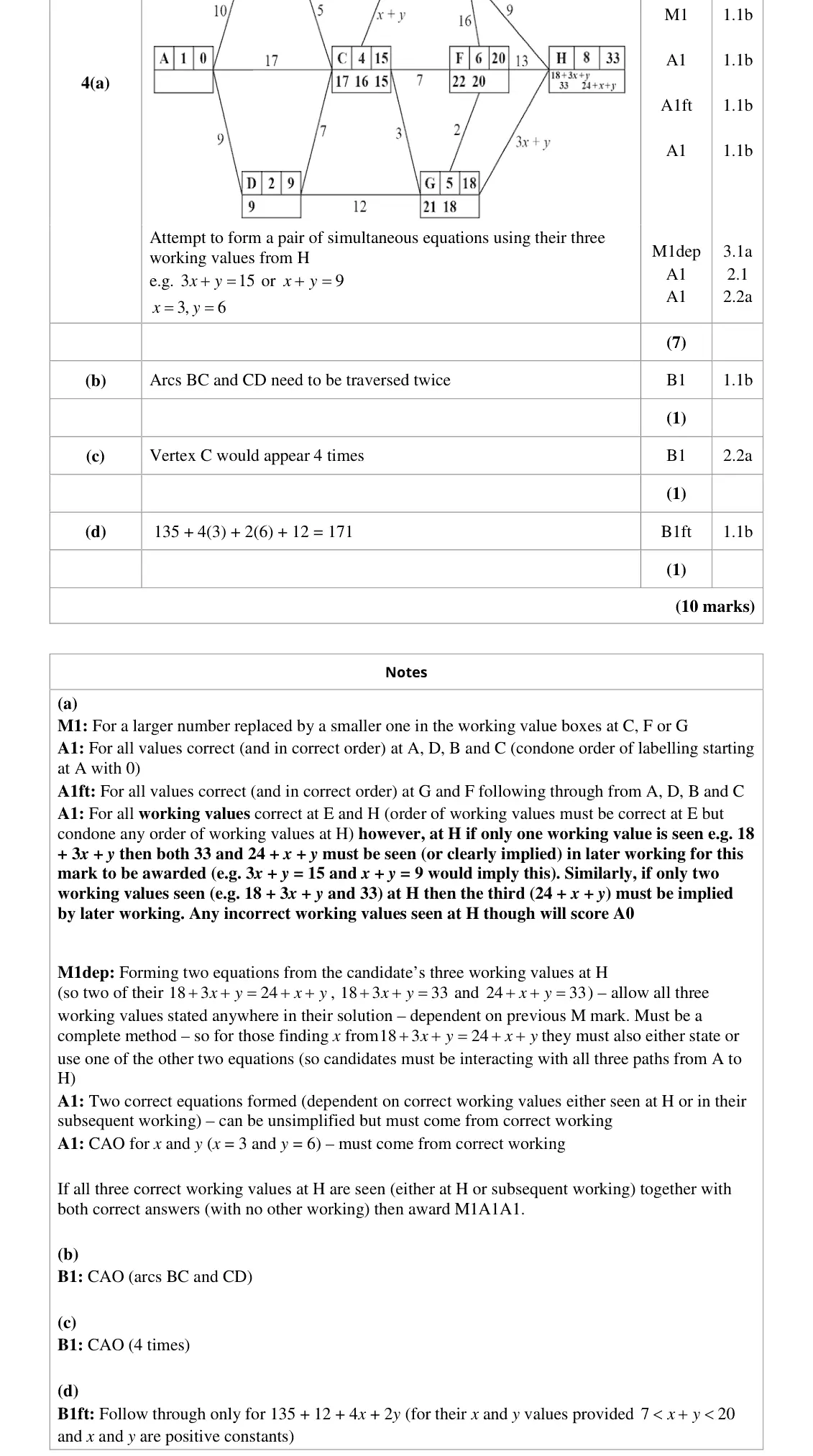
4(a) Minimum spanning trees (Prim, Kruskal) and shortest paths (Dijkstra, Floyd) 7 —
4(b) Route inspection and the travelling salesman problem 1 —
4(c) Route inspection and the travelling salesman problem 1 —
4(d) Route inspection and the travelling salesman problem 1 —
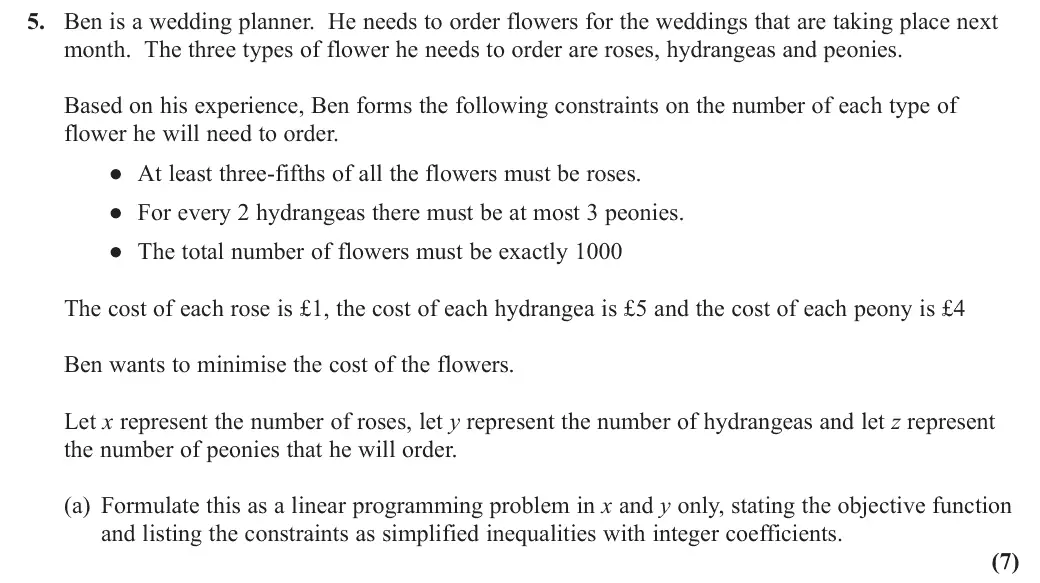
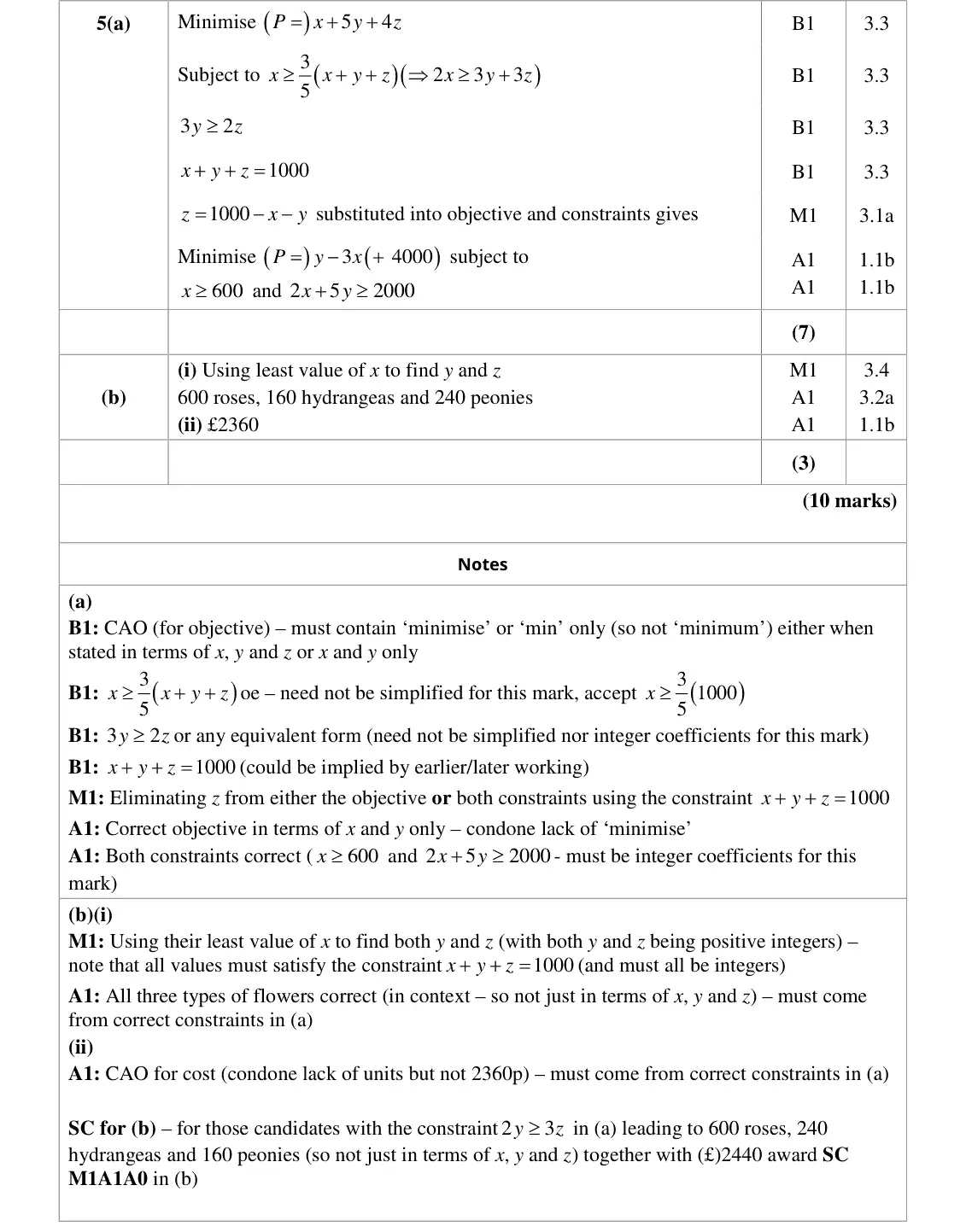
5(a) Linear programming: formulation, graphs and the Simplex algorithm 7 —
5(b) Linear programming: formulation, graphs and the Simplex algorithm 3 —

The questions

1(a)1(b)1(c)2(a)2(b)3(a)3(b)3(c)4(a)4(b)4(c)4(d)5(a)5(b)
June 2019 · AS Paper 2 (Decision 1) · Q1(a) 1 mark algorithms and graph theory
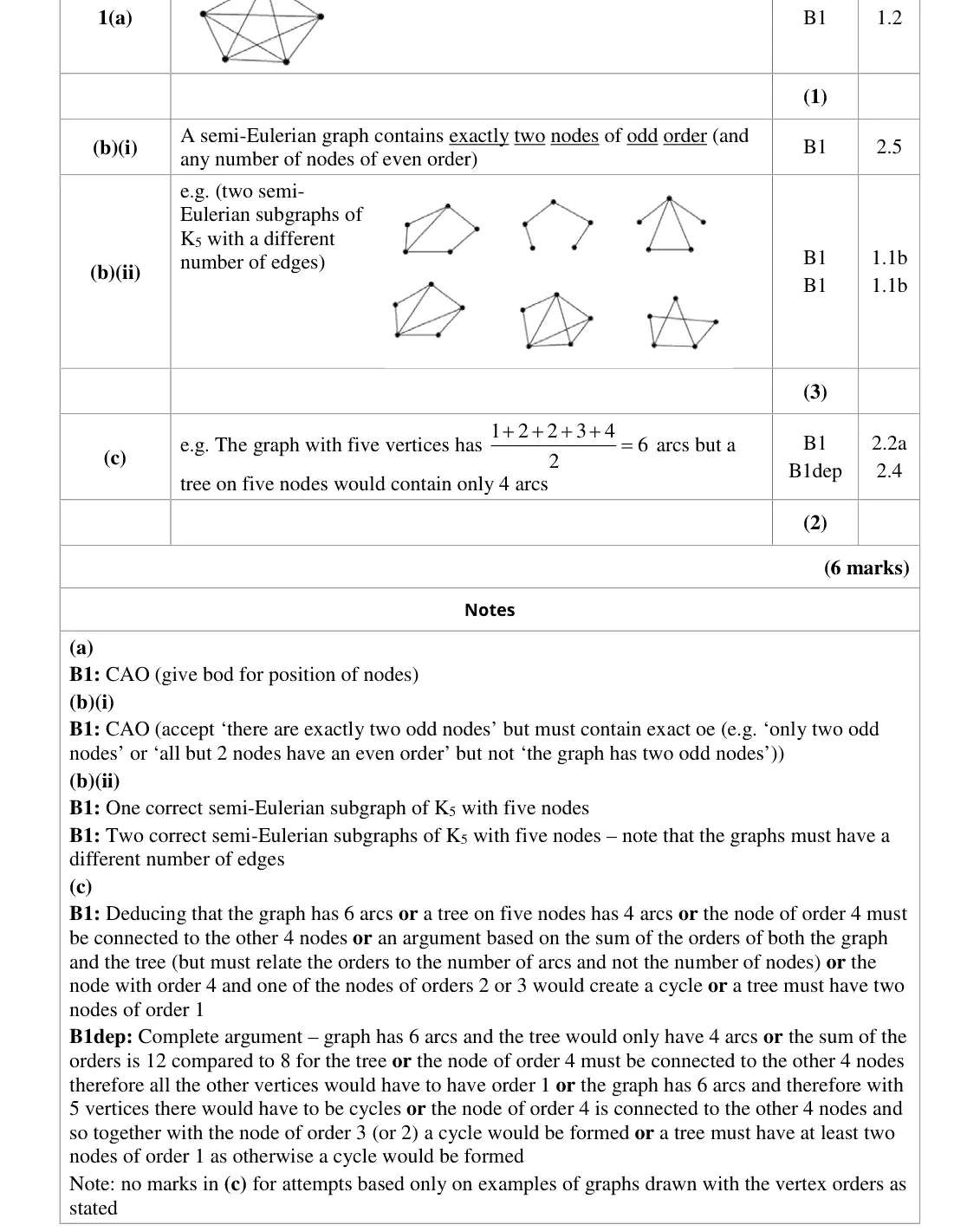
1. (a) Draw the graph K5 (1)
June 2019 · AS Paper 2 (Decision 1) · Q1(b) 3 marks algorithms and graph theory
(b) (i) In the context of graph theory explain what is meant by ‘semi-Eulerian’. (ii) Draw two semi-Eulerian subgraphs of K5, each having five vertices but with a different number of edges. (3)
June 2019 · AS Paper 2 (Decision 1) · Q1(c) 2 marks algorithms and graph theory
(c) Explain why a graph with exactly five vertices with vertex orders 1, 2, 2, 3 and 4 cannot be a tree. (2)
June 2019 · AS Paper 2 (Decision 1) · Q2(a) 4 marks algorithms and graph theory
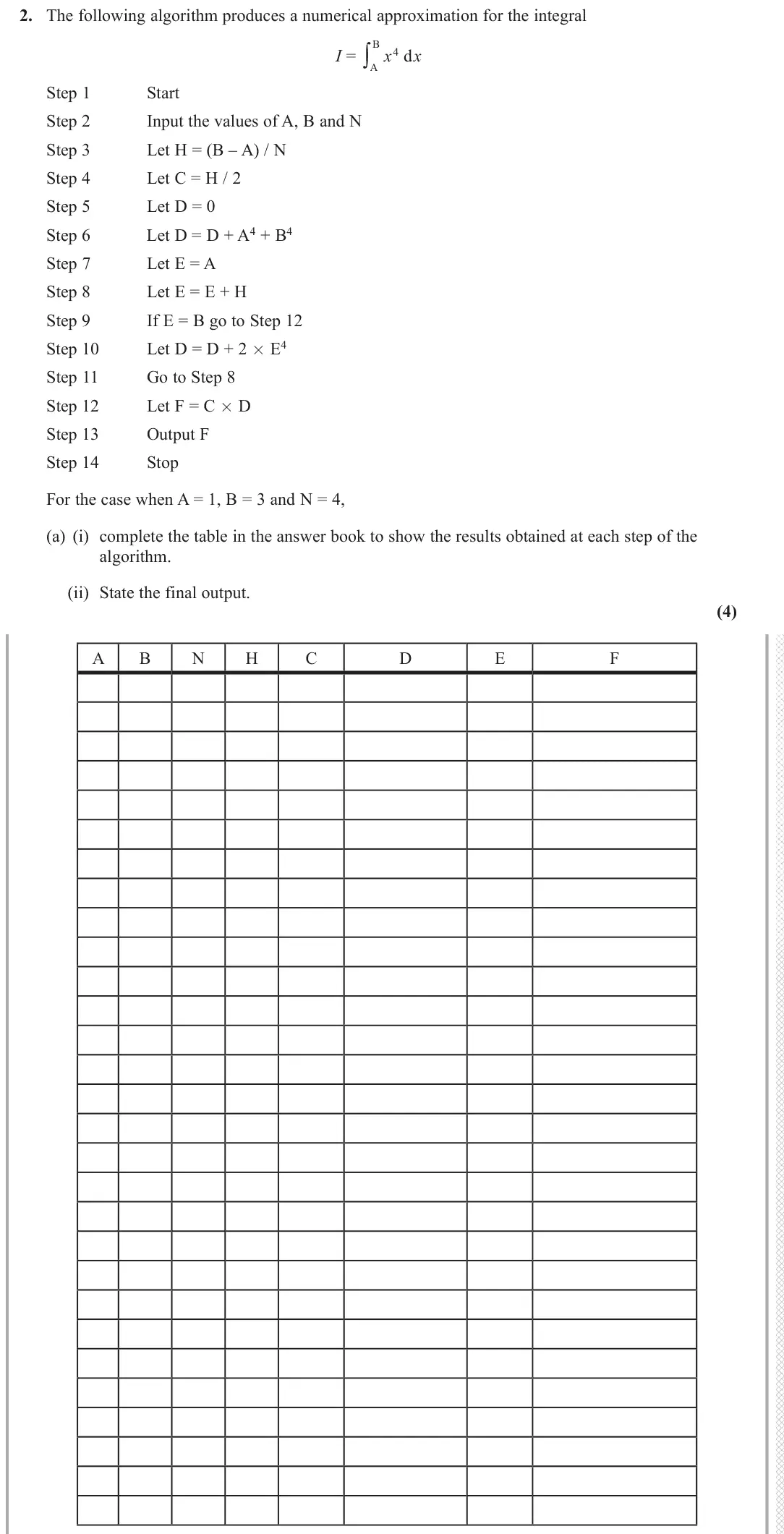
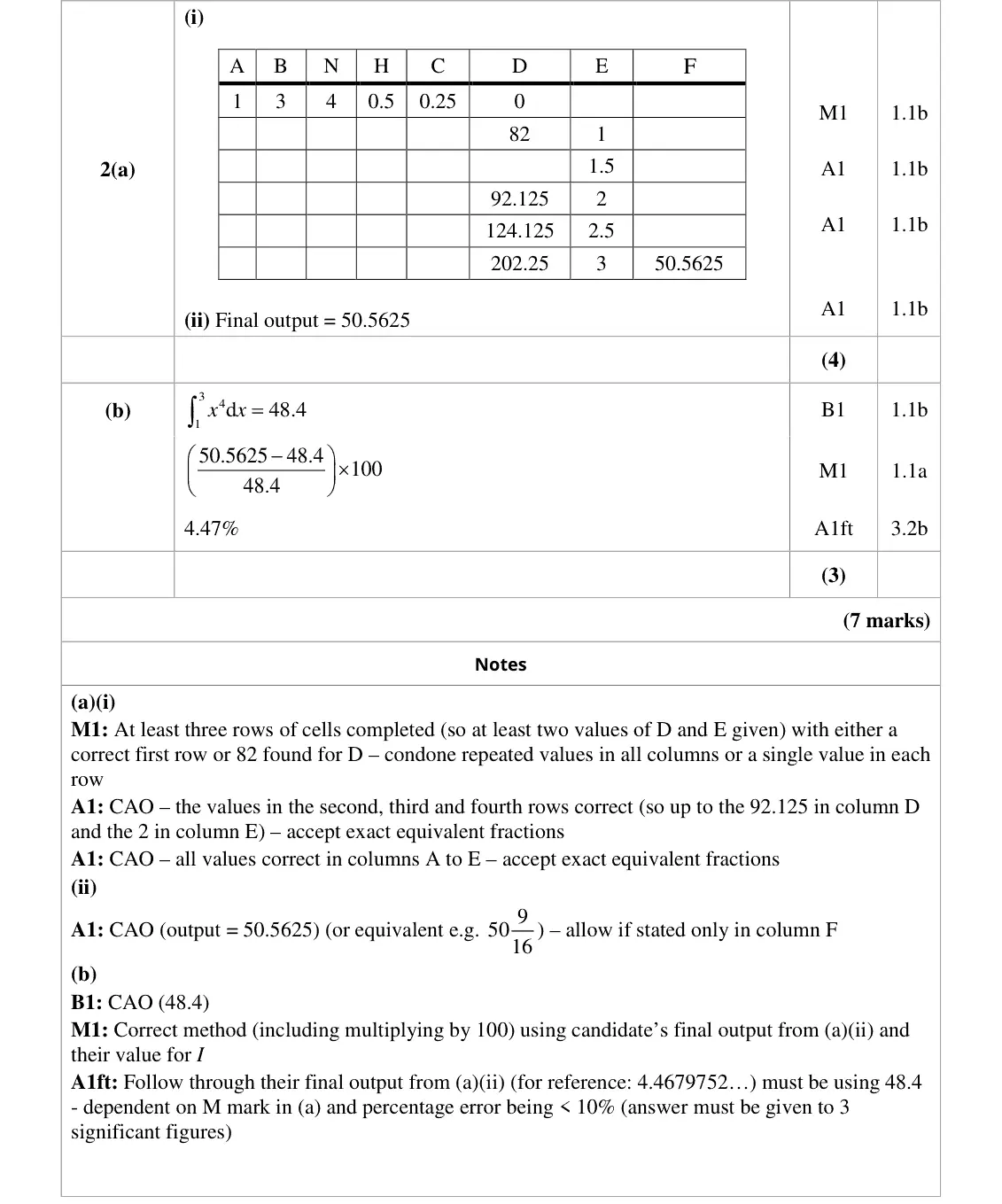
2. The following algorithm produces a numerical approximation for the integral B∫ x4 dx I = A Step 1 Start Step 2 Input the values of A, B and N Step 3 Let H = (B – A) / N Step 4 Let C = H / 2 Step 5 Let D = 0 Let D = D + A4 + B4 Step 6 Step 7 Let E = A Step 8 Let E = E + H Step 9 If E = B go to Step 12 Step 10 Let D = D + 2 x E4 Step 11 Go to Step 8 Step 12 Let F = C x D Step 13 Output F Step 14 Stop For the case when A = 1, B = 3 and N = 4, (a) (i) complete the table in the answer book to show the results obtained at each step of the algorithm. (ii) State the final output. (4)
June 2019 · AS Paper 2 (Decision 1) · Q2(b) 3 marks algorithms and graph theory
(b) Calculate, to 3 significant figures, the percentage error between the exact value of I and the value obtained from using the approximation to I in this case. (3)
June 2019 · AS Paper 2 (Decision 1) · Q3(a) 5 marks critical path analysis
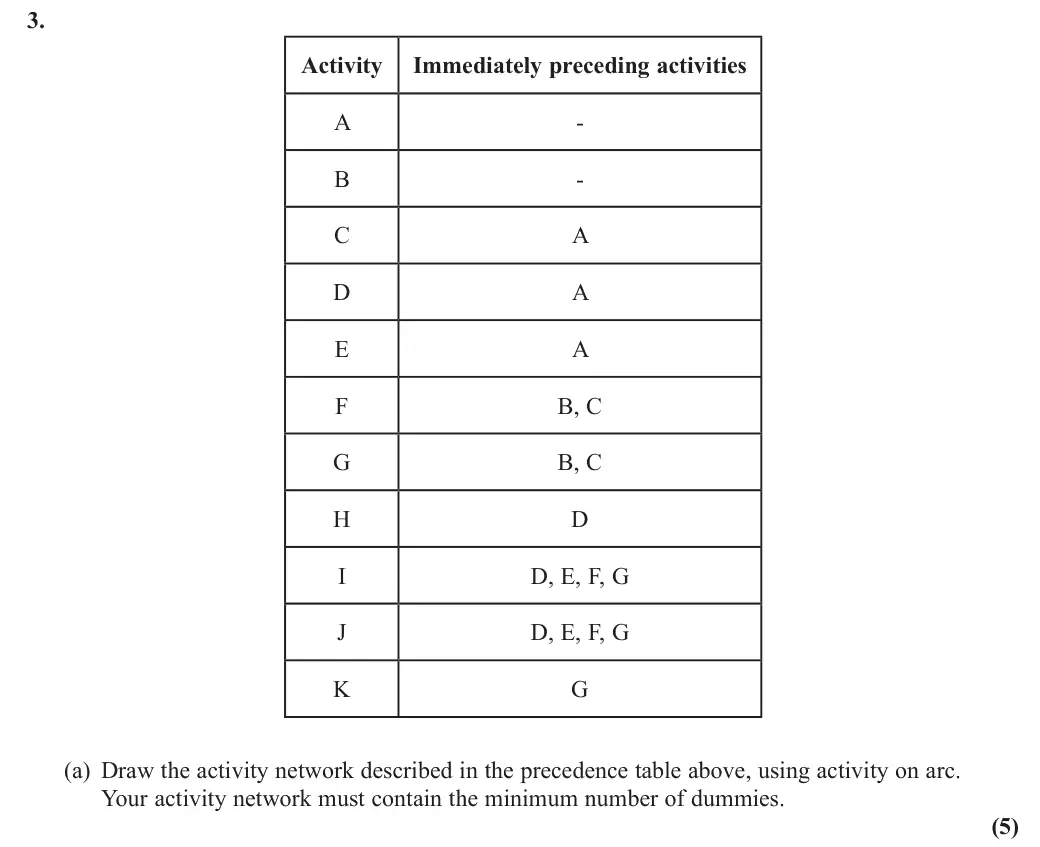
3. Activity Immediately preceding activities A - B - C A A E A F B, C G B, C H I D, E, F, G J D, E, F, G K G (a) Draw the activity network described in the precedence table above, using activity on arc. Your activity network must contain the minimum number of dummies. (5)
June 2019 · AS Paper 2 (Decision 1) · Q3(b) 1 mark critical path analysis
Every activity shown in the precedence table has the same duration. (b) Explain why activity B cannot be critical. (1)
June 2019 · AS Paper 2 (Decision 1) · Q3(c) 1 mark critical path analysis
(c) State which other activities are not critical. (1)
June 2019 · AS Paper 2 (Decision 1) · Q4(a) 7 marks minimum spanning trees and shortest paths
4. B E x + y C F A H 3x + y G Figure 1 [The total weight of the network is 135 + 4x + 2y] The weights on the arcs in Figure 1 represent distances. The weights on the arcs CE and GH are given in terms of x and y, where x and y are positive constants and 7 : x + y : 20 There are three paths from A to H that have the same minimum length. (a) Use Dijkstra’s algorithm to find x and y. (7)
June 2019 · AS Paper 2 (Decision 1) · Q4(b) 1 mark route inspection and travelling salesman
An inspection route starting at A and finishing at H is found. The route traverses each arc at least once and is of minimum length. (b) State the arcs that are traversed twice. (1)
June 2019 · AS Paper 2 (Decision 1) · Q4(c) 1 mark route inspection and travelling salesman
(c) State the number of times that vertex C appears in the inspection route. (1)
June 2019 · AS Paper 2 (Decision 1) · Q4(d) 1 mark route inspection and travelling salesman
(d) Determine the length of the inspection route. (1)
June 2019 · AS Paper 2 (Decision 1) · Q5(a) 7 marks linear programming
5. Ben is a wedding planner. He needs to order flowers for the weddings that are taking place next month. The three types of flower he needs to order are roses, hydrangeas and peonies. Based on his experience, Ben forms the following constraints on the number of each type of flower he will need to order. Ɣ At least three-fifths of all the flowers must be roses. Ɣ For every 2 hydrangeas there must be at most 3 peonies. Ɣ The total number of flowers must be exactly 1000 The cost of each rose is £1, the cost of each hydrangea is £5 and the cost of each peony is £4 Ben wants to minimise the cost of the flowers. Let x represent the number of roses, let y represent the number of hydrangeas and let z represent the number of peonies that he will order. (a) Formulate this as a linear programming problem in x and y only, stating the objective function and listing the constraints as simplified inequalities with integer coefficients. (7)
June 2019 · AS Paper 2 (Decision 1) · Q5(b) 3 marks linear programming
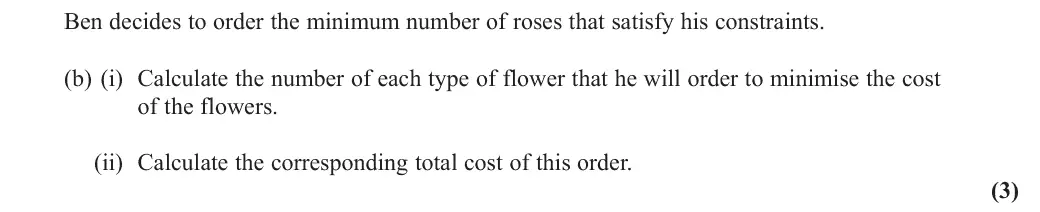
Ben decides to order the minimum number of roses that satisfy his constraints. (b) (i) Calculate the number of each type of flower that he will order to minimise the cost of the flowers. (ii) Calculate the corresponding total cost of this order. (3)

Find an Edexcel Further Maths tutor

Want this paper marked and gone through with a Further Maths tutor? Message us.

Prefer email? Send an enquiry

If you are under 18, please include a parent's contact details. Enquiries go to enquiries@alevelfurthermathstutor.com and are deleted once handled.